Jerico is the manager of a weekend market in which there are 220 stalls for rent. From past experience, Jerico knows that if he charges \(d\) dollars to rent a stall. then the number of stalls, \(s\), that will be rented is given by:
\(s=220-4d\)
- How many stalls will be rented if Jerico charges $7.50 per stall . (1 mark)
--- 2 WORK AREA LINES (style=lined) ---
- Complete the following table for the function \(s=220-4d\). (1 mark)
--- 0 WORK AREA LINES (style=lined) ---
\begin{array} {|c|c|c|}
\hline
\rule{0pt}{2.5ex} \quad d\quad \rule[-1ex]{0pt}{0pt} & \rule{0pt}{2.5ex} \quad 10\quad\rule[-1ex]{0pt}{0pt} & \rule{0pt}{2.5ex} \quad 30\quad & \rule{0pt}{2.5ex} \quad 50\quad \\
\hline
\rule{0pt}{2.5ex} \quad s\quad \rule[-1ex]{0pt}{0pt} & \ & \ & \\
\hline
\end{array}
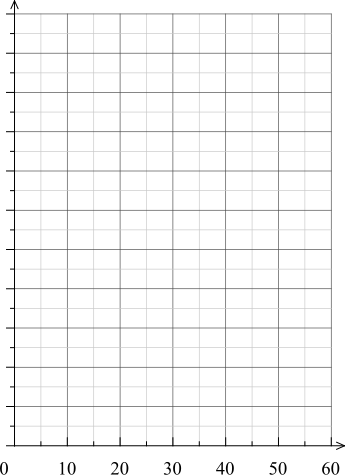
- Using an appropriate vertical scale and labelled axes, graph the function \(s=220-4d\) on the grid below. (2 marks)
--- 0 WORK AREA LINES (style=lined) ---
- Does it make sense to use the formula \(s=220-4d\) to calculate the number of stalls rented if Jerico charges $60 per stall? Explain your answer. (2 marks)
--- 4 WORK AREA LINES (style=lined) ---
a. \(190\ \text{stalls will be rented}\)
b.
\begin{array} {|c|c|c|}
\hline
\rule{0pt}{2.5ex} \quad d\quad \rule[-1ex]{0pt}{0pt} & \rule{0pt}{2.5ex} \quad 10\quad\rule[-1ex]{0pt}{0pt} & \rule{0pt}{2.5ex} \quad 30\quad & \rule{0pt}{2.5ex} \quad 50\quad \\
\hline
\rule{0pt}{2.5ex} \quad s\quad \rule[-1ex]{0pt}{0pt} & 180 \ & 100 \ & 20 \\
\hline
\end{array}
c.
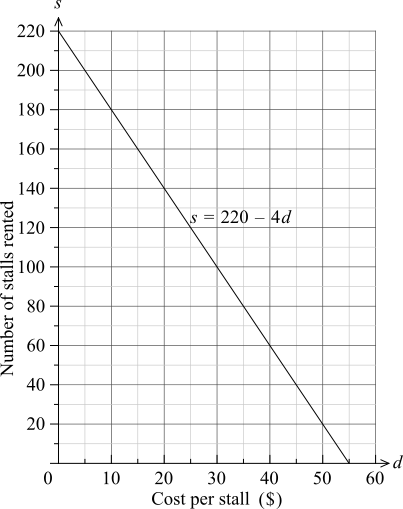
d. \(\text{When}\ d=60, s=220-4\times 60=-20\)
\(\therefore\ \text{It does not make sense to charge }$60\ \text{ per stall}\)
\(\text{as you cannot have a negative number of stalls.}\)
| a. | \(s\) | \(=220-4d\) |
| \(=220-4\times 7.50\) | ||
| \(=190\) |
\(190\ \text{stalls will be rented}\)
b.
\begin{array} {|c|c|c|}
\hline
\rule{0pt}{2.5ex} \quad d\quad \rule[-1ex]{0pt}{0pt} & \rule{0pt}{2.5ex} \quad 10\quad\rule[-1ex]{0pt}{0pt} & \rule{0pt}{2.5ex} \quad 30\quad & \rule{0pt}{2.5ex} \quad 50\quad \\
\hline
\rule{0pt}{2.5ex} \quad s\quad \rule[-1ex]{0pt}{0pt} & 180 \ & 100 \ & 20 \\
\hline
\end{array}
c.
d. \(\text{When}\ d=60, s=220-4\times 60=-20\)
\(\therefore\ \text{It does not make sense to charge }$60\ \text{ per stall}\)
\(\text{as you cannot have a negative number of stalls.}\)