People are placed into groups to complete a puzzle. There are 9 different groups.
The table shows the number of people in each group and the amount of time, in minutes, for each group to complete the puzzle.
\begin{array} {|l|c|c|c|c|c|c|c|c|c|}
\hline
\rule{0pt}{2.5ex} \text{Number of people} \rule[-1ex]{0pt}{0pt} & 2 & 2 & 3 & 5 & 5 & 7 & 7 & 7 & 8 \\
\hline
\rule{0pt}{2.5ex} \text{Time taken (min)} \rule[-1ex]{0pt}{0pt} & 28 & 30 & 26 & 19 & 21 & 12 & 13 & 11 & 8 \\
\hline
\end{array}
- Complete the scatterplot by adding the last four points from the table. (1 mark)
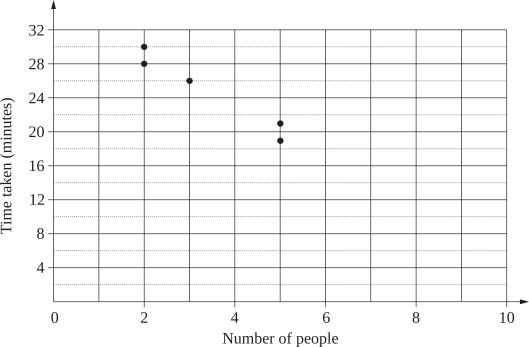
- Add a line of best fit by eye to the graph in part (a). (1 mark)
--- 0 WORK AREA LINES (style=lined) ---
- The graph in part (a) shows the association between the time to complete the puzzle and the number of people in the group.
- Identify the form (linear or non-linear), the direction and the strength of the association. (2 marks)
--- 3 WORK AREA LINES (style=lined) ---
a.
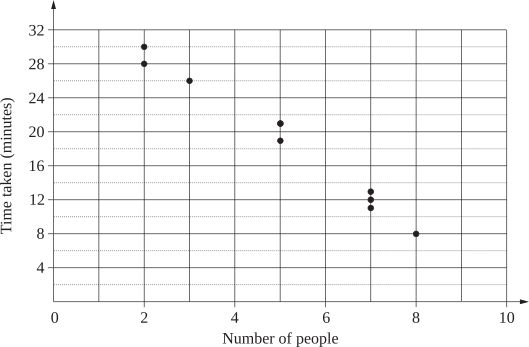
b.
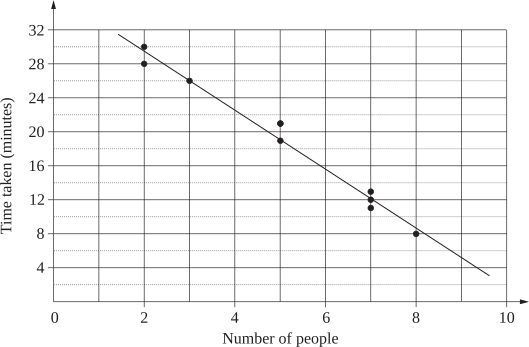
c. `text(Form: linear)
`text{Direction: negative}`
`text{Strength: strong}`
a.
b.
c. `text{Form: linear (i.e. straight line)}`
`text{Direction: negative}`
`text{Strength: strong}`