SmarterEd

Aussie Maths & Science Teachers: Save your time with SmarterEd

  • Login
  • Get Help
  • About

Area, SM-Bank 135

A shape consisting of a quadrant and a right-angled triangle is shown.
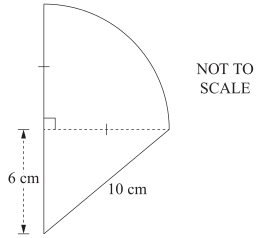
 

  1. Use Pythagoras' Theorem to calculate the radius of the quadrant.  (2 marks)

    --- 4 WORK AREA LINES (style=lined) ---

  2. What is the area of this shape, correct to one decimal place?  (2 marks)

    --- 4 WORK AREA LINES (style=lined) ---

Show Answers Only

a.    \(8\ \text{cm}\)

b.    \(74.3\ \text{cm}^2\ (1\text{d.p.})\)

Show Worked Solution

a.    \(\text{Using Pythagoras to find radius}\ (r):\)

\(a^2+b^2\) \(=c^2\)
\(r^2+6^2\) \(=10^2\)
\(r^2\) \(=10^2-6^2\)
\(r\) \(=\sqrt{64}\)
  \(=8\ \text{cm}\)


b.    \(\text{Total area}\) \(=\text{Area of triangle}+\text{Area of quadrant}\)
    \(=\dfrac{1}{2}\times 8\times 6+\dfrac{1}{4}\times \pi\times 8^2\)
    \(=24+50.265\dots\)
    \(=74.265\dots\)
    \(\approx 74.3\ \text{cm}^2\ (1\text{d.p.})\)

Filed Under: Circular measure Tagged With: num-title-ct-core, smc-4944-50-Composite shapes

Copyright © 2014–2025 SmarterEd.com.au · Log in