Prove that
\(\dfrac{\sin ^4 \theta+\cos ^4 \theta}{\sin ^2 \theta\, \cos ^2 \theta}+2=\sec ^2 \theta\, \operatorname{cosec}^2 \theta\). (2 marks)
--- 10 WORK AREA LINES (style=lined) ---
Aussie Maths & Science Teachers: Save your time with SmarterEd
Prove that
\(\dfrac{\sin ^4 \theta+\cos ^4 \theta}{\sin ^2 \theta\, \cos ^2 \theta}+2=\sec ^2 \theta\, \operatorname{cosec}^2 \theta\). (2 marks)
--- 10 WORK AREA LINES (style=lined) ---
\(\text{See Worked Solutions}\)
\(\text{Note: RHS } =\sec ^2 \theta\, \operatorname{cosec}^2 \theta=\dfrac{1}{\sin ^2 \theta\, \cos ^2 \theta}\)
| \(\text{RHS}\) | \(=\dfrac{\sin ^4 \theta+\cos ^4 \theta}{\sin ^2 \theta \cos ^2 \theta}+2\) |
| \(=\dfrac{\sin ^4 \theta+\cos ^4 \theta+2 \sin ^2 \theta \cos ^2 \theta}{\sin ^2 \theta\, \cos ^2 \theta}\) | |
| \(=\dfrac{\left(\sin ^2 \theta+\cos ^2 \theta\right)^2}{\sin ^2 \theta\, \cos ^2 \theta}\) | |
| \(=\dfrac{1}{\sin ^2 \theta\, \cos ^2 \theta}\) | |
| \(=\sec ^2 \theta\, \operatorname{cosec} ^2 \theta\) |
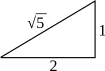
Given \(\tan \theta=\dfrac{3}{2}\) and \(0°<\theta<90°\),
find the value of \(\dfrac{1-\sin (180-\theta)}{\cos (180+\theta)}\). (3 marks)
--- 7 WORK AREA LINES (style=lined) ---
\(\dfrac{1-\sqrt{5}}{2}\)
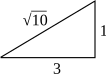
Given \(\tan \theta=\cfrac{1}{3}\) and \(0°<\theta<90°\),
find the value of \(\dfrac{1-\sin (180+\theta)}{\cos (90-\theta)}\).
\(\Rightarrow A\)
Solve the equation \(2 \cos 2 \theta=2 \sin 2 \theta\) for \(0 \leqslant \theta \leqslant 2 \pi\) (2 marks)
--- 5 WORK AREA LINES (style=lined) ---
\(\theta=\displaystyle\frac{\pi}{8}, \frac{5 \pi}{8}, \frac{9 \pi}{8}, \frac{13 \pi}{8} \)
| \(2 \cos 2 \theta\) | \(=2 \sin 2 \theta\) |
| \(\dfrac{2 \sin 2 \theta}{2 \cos 2 \theta}\) | \(=1\) |
| \(\tan 2 \theta\) | \(=1\) |
| \(2 \theta\) | \(=\displaystyle \frac{\pi}{4}, \frac{5 \pi}{4}, \frac{9 \pi}{4}, \frac{13 \pi}{4}, \cdots\) |
| \(\theta\) | \(=\displaystyle\frac{\pi}{8}, \frac{5 \pi}{8}, \frac{9 \pi}{8}, \frac{13 \pi}{8} \quad(0 \leqslant \theta \leqslant 2 \pi)\) |
Prove \(\dfrac{1+\cot \theta}{1+\tan \theta}=\cot \theta\). (3 marks) --- 8 WORK AREA LINES (style=lined) ---
| \(\text{LHS}\) | \(=\dfrac{1+\dfrac{\cos \theta}{\sin \theta}}{1+\dfrac{\sin \theta}{\cos \theta}}\) | |
| \(=\dfrac{\dfrac{\sin \theta+\cos \theta}{\sin \theta}}{\dfrac{\cos \theta+\sin \theta}{\cos \theta}}\) | ||
| \(=\dfrac{\sin \theta+\cos \theta}{\sin \theta} \times \dfrac{\cos \theta}{\cos \theta+\sin \theta}\) | ||
| \(=\dfrac{\cos \theta}{\sin \theta}\) | ||
| \(=\cot \theta\) | ||
| \(\ =\text{ RHS}\) |
| \(\text{LHS}\) | \(=\dfrac{1+\dfrac{\cos \theta}{\sin \theta}}{1+\dfrac{\sin \theta}{\cos \theta}}\) | |
| \(=\dfrac{\dfrac{\sin \theta+\cos \theta}{\sin \theta}}{\dfrac{\cos \theta+\sin \theta}{\cos \theta}}\) | ||
| \(=\dfrac{\sin \theta+\cos \theta}{\sin \theta} \times \dfrac{\cos \theta}{\cos \theta+\sin \theta}\) | ||
| \(=\dfrac{\cos \theta}{\sin \theta}\) | ||
| \(=\cot \theta\) | ||
| \(\ =\text{ RHS}\) |
Simplify \(\sin \, \theta \, \cos \theta \,\operatorname{cosec}^2 \, \theta\). (2 marks) --- 4 WORK AREA LINES (style=lined) ---
\(\cot \theta\)
\(\sin \theta \cos \theta \times \dfrac{1}{\sin ^2 \theta}\)
\(=\dfrac{\cos \, \theta}{\sin \, \theta}\)
\(=\cot \, \theta\)
Solve \(\sin x-\cos x=0 \quad-\pi \leqslant x \leqslant \pi\) (2 marks)
--- 5 WORK AREA LINES (style=lined) ---
\(x=\dfrac{\pi}{4}, -\dfrac{3\pi}{4}\)
| \(\sin x-\cos x\) | \(=0\) | |
| \(\dfrac{\sin x}{\cos x}-\dfrac{\cos x}{\cos x}\) | \(=0\) | |
| \(\tan x-1\) | \(=0\) | |
| \(\tan x\) | \(=1\) | |
| \(x\) | \(=\tan ^{-1}(1)\) |
\(\therefore x=\dfrac{\pi}{4}, -\dfrac{3\pi}{4}\)
Prove \(\dfrac{\operatorname{cosec} \theta+\sec \theta}{1+\tan \theta}=\operatorname{cosec} \theta\). (3 marks)
--- 8 WORK AREA LINES (style=lined) ---
\(\text{Prove:}\ \ \dfrac{\operatorname{cosec} \theta+\sec \theta}{1+\tan \theta}=\operatorname{cosec} \theta\)
| \(\text{LHS}\) | \(= \dfrac{\operatorname{cosec} \theta + \sec \theta}{1 + \tan \theta}\) | |
| \(=\dfrac{\dfrac{1}{\sin \theta} + \dfrac{1}{\cos \theta}}{1 + \dfrac{\sin \theta}{\cos \theta}} \times \dfrac{\cos \theta}{\cos \theta} \) | ||
| \(=\dfrac{\dfrac{\cos \theta}{\sin \theta}+1}{\cos \theta+\sin \theta}\) | ||
| \(=\dfrac{\dfrac{\cos \theta+\sin \theta}{\sin \theta}}{\cos \theta+\sin \theta}\) | ||
| \(=\dfrac{1}{\sin \theta}\) | ||
| \(=\operatorname{cosec} \theta \quad \text{… as required.}\) |
\(\text{Prove:}\ \ \dfrac{\operatorname{cosec} \theta+\sec \theta}{1+\tan \theta}=\operatorname{cosec} \theta\)
| \(\text{LHS}\) | \(= \dfrac{\operatorname{cosec} \theta + \sec \theta}{1 + \tan \theta}\) | |
| \(=\dfrac{\dfrac{1}{\sin \theta} + \dfrac{1}{\cos \theta}}{1 + \dfrac{\sin \theta}{\cos \theta}} \times \dfrac{\cos \theta}{\cos \theta} \) | ||
| \(=\dfrac{\dfrac{\cos \theta}{\sin \theta}+1}{\cos \theta+\sin \theta}\) | ||
| \(=\dfrac{\dfrac{\cos \theta+\sin \theta}{\sin \theta}}{\cos \theta+\sin \theta}\) | ||
| \(=\dfrac{1}{\sin \theta}\) | ||
| \(=\operatorname{cosec} \theta \quad \text{… as required.}\) |
Express \(3 \operatorname{cosec}(180+x)+5 \cos (90-x)\) as a single fraction in terms of \(\sin x\), given all angles are measured in degrees. (3 marks) --- 8 WORK AREA LINES (style=lined) --- \(\dfrac{-3+5 \sin ^2 x}{\sin x}\) \(3 \operatorname{cosec}(180+x)+5 \cos (90-x)\) \(=\dfrac{3}{\sin \left(180^{\circ}+x\right)}+5 \sin x\) \(=\dfrac{3}{-\sin x}+5 \sin x\) \(=\dfrac{-3}{\sin x}+\dfrac{5 \sin ^2 x}{\sin x}\) \(=\dfrac{-3+5 \sin ^2 x}{\sin x}\)
Which of the following is equivalent to `sin^2 5x` ?
`B`
`text(Using the identity:)`
| `sin^2 5x + cos^2 5x` | `= 1` |
| `sin^2 5x` | `= 1 – cos^2 5x` |
`=> B`
Prove that `sec theta-cos theta = sin theta\ tan theta.` (2 marks)
| `text(LHS)` | `=1/cos theta-cos theta` | |
| `=(1-cos^2 theta)/cos theta` | ||
| `=sin^2 theta/cos theta` | ||
| `=sin theta * sin theta/cos theta` | ||
| `=sin theta\ tan theta\ …\ text(as required)` |
| `text(LHS)` | `=1/cos theta-cos theta` | |
| `=(1-cos^2 theta)/cos theta` | ||
| `=sin^2 theta/cos theta` | ||
| `=sin theta * sin theta/cos theta` | ||
| `=sin theta\ tan theta\ …\ text(as required)` |
Find all solutions of the equation `2 cos theta = sqrt 3 cot theta`, for `0<=theta<=2pi` (3 marks)
--- 6 WORK AREA LINES (style=lined) ---
`theta=pi/3, pi/2, (2pi)/3, (3pi)/2`
`2 cos theta = sqrt 3 cot theta`
| `2 cos theta-sqrt 3 cot theta` | `= 0` | |
| `2 cos theta-sqrt 3 (cos theta)/(sin theta)` | `=0` | |
| `(2-sqrt 3/sin theta) cos theta` | `=0` |
`text(If)\ \ cos theta=0,`
`theta=pi/2, (3pi)/2`
`text(If)\ \ 2-sqrt 3/sin theta = 0\ \ =>\ \ sin theta = sqrt 3/2`
`theta = pi/3, (2pi)/3`
The domain of the function with rule `f(x) = 1 - sec(x + pi/4)` is
`C`
`y = sec (x)=1/cos(x)\ \ text(has asymptotes when)`
`x = −pi/2, pi/2, (3pi)/2, …`
`=> y = sec (x + pi/4)\ \ text(has asymptotes at when)`
`x = (−3pi)/4, pi/4, (5pi)/4, …`
`:.\ text(Domain:)\ {((4k + 1)pi)/4}, (text{for}\ k\ text{integer}) `
`=>C`
Solve `2 sin x cos x = sin x` for `0 <= x <= 2pi`. (3 marks)
`x = 0, quad pi/3, quad pi, quad (5 pi)/3`
| `2 sin x cos x-sin x` | `= 0` |
| `sin x (2 cos x-1)` | `= 0` |
| `sin x` | `= 0` |
| `=> x` | `= 0,\ pi,\ 2pi` |
| `cos x` | `= 1/2` |
| `=> x` | `= pi/3, (5 pi)/3` |
`:. x = 0, quad pi/3, quad pi, quad (5 pi)/3,quad 2pi`
Prove that
`(1 - sin^2 x cos^2 x)/(sin^2 x) = cot^2 x + sin^2 x`. (2 marks)
--- 4 WORK AREA LINES (style=lined) ---
`text(See Worked Solutions)`
| `text(RHS)` | `= (cos^2 x)/(sin^2 x) + sin^2 x` |
| `= (cos^2 x + sin^4 x)/(sin^2 x)` | |
| `= (cos^2 x + sin^2 x(1 – cos^2 x))/(sin^2 x)` | |
| `= (cos^2 x + sin^2 x – sin^2 x cos^2 x)/(sin^2 x)` | |
| `= (1 – sin^2 x cos^2 x)/(sin^2 x)` | |
| `= \ text(LHS)` |
Prove that
`(secx + tanx)(secx - tanx) = 1`. (2 marks)
--- 4 WORK AREA LINES (style=lined) ---
`text(See Worked Solutions)`
| `text(LHS)` | `= (secx + tanx)(secx – tanx)` |
| `= sec^2x – tan^2x` | |
| `= 1/(cos^2x) – (sin^2 x)/(cos^2 x)` | |
| `= (1 – sin^2 x)/(cos^2 x)` | |
| `= (cos^2 x)/(cos^2 x)` | |
| `= 1` | |
| `=\ text(RHS)` |
Let `(tantheta-1) (sin theta-sqrt 3 cos theta) (sin theta + sqrt 3 costheta) = 0`.
--- 2 WORK AREA LINES (style=lined) ---
--- 4 WORK AREA LINES (style=lined) ---
i. `(tantheta-1) (sin theta-sqrt 3 cos theta) (sin theta + sqrt 3 costheta) = 0`
`=> tan theta = 1`
| `=>sin theta-sqrt 3 cos theta` | `=0` |
| `sin theta` | `=sqrt3 cos theta` |
| `tan theta` | `=sqrt3` |
| `=>sin theta + sqrt 3 cos theta` | `=0` |
| `sin theta` | `=-sqrt3 cos theta` |
| `tan theta` | `=-sqrt3` |
`:. tan theta = 1 or tan theta = +- sqrt 3`
ii. `(tan theta-1) (sin^2 theta-3 cos^2 theta) = 0`
`text(Using part a:)`
`(tan theta-1) (sin theta-sqrt 3 cos theta) (sin theta + sqrt 3 cos theta) = 0`
| `=> tan theta` | `= 1` | `qquad or qquad` | `tan theta` | `= +- sqrt 3` |
| `theta` | `= pi/4` | `theta` | `= pi/3, (2 pi)/3` |
`:. theta = pi/4, pi/3 or (2 pi)/3\ \ \ \ (0<=theta<=pi)`
Solve the equation `sqrt 3 sin x = cos x` for `– pi<=x<= pi`. (2 marks)
--- 4 WORK AREA LINES (style=lined) ---
`x = pi/6,\ \ \ – (5 pi)/6`
`text(Divide both sides by)\ cos x :`
| `sqrt 3 sin x` | `=cos x` |
| `sqrt 3 tan x` | `= 1` |
| `tan x` | `= 1/sqrt 3` |
| `=>\ text(Base angle)\ = pi/6` | |
`:. x = pi/6\ \ text(or)\ -(5 pi)/6,\ \ \ (-pi <=x<= pi)`
Express `5cot^2 x - 2text(cosec)\ x + 2` in terms of `text(cosec)\ x` and hence solve
`5cot^2 x - 2text(cosec)\ x + 2 = 0` for `0 < x < 2pi`. (3 marks)
--- 6 WORK AREA LINES (style=lined) ---
`x = pi/2`
| `cot^2 x` | `= (cos^2 x)/(sin^2 x)` |
| `= (1 – sin^2 x)/(sin^2 x)` | |
| `= text(cosec)^2 x – 1` |
| `5cot^2 x – 2text(cosec)\ x + 2` | `= 0` |
| `5(text(cosec)^2 x – 1) – 2text(cosec)\ x + 2` | `= 0` |
| `5text(cosec)^2 x – 2text(cosec)\ x – 3` | `= 0` |
| `(5text(cosec)\ x + 3)(text(cosec)\ x – 1)` | `= 0` |
| `text(cosec)\ x` | `= −3/5` | `text(cosec)\ x` | `= 1` |
| `sinx` | `= −5/3` | `sinx` | `= 1` |
| `(text(no solution))` | `x` | `= pi/2` | |
`:. x = pi/2`
Which expression is equivalent to `tan theta + cot theta`?
`B`
| `tan theta + cot theta` | `= (sin theta)/(cos theta) + (cos theta)/(sin theta)` |
| `= (sin^2 theta + cos^2 theta)/(cos theta sin theta)` | |
| `= 1/(cos theta sin theta)` | |
| `= sec theta\ text(cosec)\ theta` |
`=> B`
How many solutions does the equation `|\ cos (2x)\ | = 1` have for `0 <= x <= 2 pi?`
`D`
`|\ cos (2x)\ | = 1`
`cos (2x) = +- 1`
| `text(When)\ \ cos (2x)` | `= 1` |
| `2x` | `= 0, 2pi, 4 pi, …` |
| `:. x` | `= 0, pi, 2 pi, …` |
| `text(When)\ \ cos (2x)` | `= – 1` |
| `2x` | `= pi, 3 pi, 5 pi, …` |
| `:. x` | `= pi/2, (3 pi)/2, (5 pi)/2, …` |
`:. x = 0, pi/2, pi, (3 pi)/2, 2 pi\ \ \ text(for)\ \ \ 0 <= x <= 2pi`
`=> D`
Consider the geometric series `1 − tan^2 theta + tan^4 theta − …`
--- 4 WORK AREA LINES (style=lined) ---
--- 5 WORK AREA LINES (style=lined) ---
i. `1 − tan^2 theta + tan^4 theta − …`
`=>\ text(GP where)\ \ a=1,\ \ r=T_2/T_1= − tan^2 theta`
| `:. S_∞` | `= 1/(1 − (−tan^2 theta))` |
| `= 1/(1 + tan^2 theta)` | |
| `= 1/(sec^2 theta)` | |
| `= cos^2 theta` |
| ii. | `text(Find)\ \ theta\ \ text(such that)\ \ \ |\ r\ |` | `< 1` |
| `|−tan^2 theta\ |` | `< 1` | |
| ` tan^2 theta` | `< 1` | |
| `−1 < tan theta` | `< 1` | |
| `:. − pi/4 < theta` | `< pi/4` |
--- 2 WORK AREA LINES (style=lined) ---
--- 5 WORK AREA LINES (style=lined) ---
i. `text(Prove)\ \ cos theta tan theta = sin theta`
| `text(LHS)` | `= cos theta tan theta` |
| `= cos theta ((sin theta)/(cos theta))` | |
| `= sin theta` | |
| `=\ text{RHS}` |
| ii. | `8 sin theta cos theta tan theta` | `= text(cosec)\ theta` |
| `:. 8 sin theta(sin theta)` | `= text(cosec)\ theta,\ \ \ \ text{(part (i))}` | |
| `8 sin^2 theta` | `= 1/(sin theta)` | |
| `8 sin^3 theta` | `= 1` | |
| `sin^3 theta` | `= 1/8` | |
| `sin theta` | `= 1/2` | |
| `:. theta` | `= pi/6, (5pi)/6\ \ \ \ text{(for}\ \ 0 ≤ theta ≤ 2pi text{)}` |
Find all solutions of `2 sin^2 x + cos x − 2 = 0`, where `0 <= x <= 2pi`. (3 marks)
--- 6 WORK AREA LINES (style=lined) ---
`x = pi/3,\ pi/2,\ (3pi)/2,\ (5pi)/3`
| `2 sin^2 x + cos x\ – 2` | `= 0` |
| `2(1\ – cos^2x) + cos x\ – 2` | `= 0` |
| `2\ – 2cos^2x + cosx\ – 2` | `= 0` |
| `-2cos^2x + cosx` | `= 0` |
| `cosx (-2 cosx + 1)` | `= 0` |
| `:. -2 cosx + 1` | `= 0` | `\ text(or)\ \ \ \ \ \ \ ` | `cos x` | `= 0` |
| `2 cos x` | `= 1` | `x` | `= pi/2,\ (3pi)/2` | |
| `cos x` | `= 1/2` | |||
| `cos(pi/3)` | `=1/2` |
`text(S)text(ince cos is positive in)\ 1^text(st) // 4^text(th)\ text(quadrants,)`
| `x` | `= pi/3,\ 2 pi \ – pi/3` |
| `= pi/3,\ (5pi)/3` |
`:. x = pi/3,\ pi/2,\ (3pi)/2,\ (5pi)/3\ \ text(for)\ \ 0 <= x <= 2pi`
How many solutions of the equation `(sin x-1)(tan x + 2) = 0` lie between `0` and `2 pi`?
`B`
`text(When)\ (sin x-1)(tan x + 2) = 0`
`(sinx-1) = 0\ \ text(or)\ \ tan x + 2 = 0`
`text(If)\ \ sin x-1= 0:`
`sin x= 1\ \ =>\ \ x= pi/2,\ \ \ 0 < x < 2 pi`
`text(If)\ \ tan x + 2= 0:`
`tan x= -2`
`text{Since}\ tan\ pi/2\ text{is undefined, there are only 2 solutions when}`
`tan x = -2\ \text{(which occurs in the 1st and 4th quadrants).}`
`:.\ 2\ text(solutions)`
`=> B`
--- 4 WORK AREA LINES (style=lined) ---
`int_0^(pi/4) 1/(1 - sinx)\ dx`. (2 marks)
--- 4 WORK AREA LINES (style=lined) ---
i. `text(Need to prove)`
`sec^2x + secxtanx = (1 + sinx)/(cos^2x)`
| `text(LHS)` | `=sec^2x + secx tanx` |
| `=1/(cos^2x) + 1/(cosx) xx (sinx)/cosx` | |
| `=1/(cos^2x) + (sinx)/(cos^2x)` | |
| `=(1 + sinx)/(cos^2x)` | |
| `= text(RHS)\ \ \ \ text(… as required)` |
ii. `text(Need to prove)`
| `sec^2x + secx tanx` | `= 1/(1\ – sinx)` |
| `text(i.e.)\ \ (1 + sinx)/(cos^2x)` | `= 1/(1\ – sin x)\ \ \ \ \ text{(part (i))}` |
| `text(LHS)` | `= (1 + sinx)/(cos^2x)` |
| `=(1 + sin x)/(1\ – sin^2x)` | |
| `=(1 + sinx)/((1\ – sinx)(1 + sinx)` | |
| `=1/(1\ – sinx)\ \ \ \ text(… as required)` |
iii. `int_0^(pi/4) 1/(1\ – sinx)\ dx`
`= int_0^(pi/4) (sec^2x + secx tanx)\ dx`
`= [tanx + secx]_0^(pi/4)`
`= [(tan(pi/4) + sec(pi/4)) – (tan0 + sec0)]`
`= [(1 + 1/(cos(pi/4)))\ – (0 + 1/(cos0))]`
`= 1 + sqrt2\ – 1`
`= sqrt2`