SmarterEd

Aussie Maths & Science Teachers: Save your time with SmarterEd

  • Login
  • Get Help
  • About

L&E, 2ADV EQ-Bank 5

The mass `M` kg of a baby pig at age `x` days is given by  `M = A(1.1)^x`  where `A` is a constant. The graph of this equation is shown.
 

2ug-2016-hsc-q29_1

  1. What is the value of `A`?   (1 mark)

    --- 1 WORK AREA LINES (style=lined) ---

  2. What is the daily growth rate of the pig’s mass? Write your answer as a percentage.   (1 mark)

    --- 2 WORK AREA LINES (style=lined) ---

Show Answers Only

i.    `1.5\ text(kg)`

ii.   `10text(%)`

Show Worked Solution

i.   `text(When)\ x = 0:`

♦ Mean mark (i) 48%.
♦♦♦ Mean mark part (ii) 6%!

`1.5` `= A(1.1)^0`
`:. A` `= 1.5\ text(kg)`

 
ii.
   `text(Daily growth rate)\ = 0.1 = 10text(%)`

Filed Under: Graphs and Applications (Adv-2027) Tagged With: Band 3, Band 4, smc-6456-20-Exponential Graphs

L&E, 2ADV EQ-Bank 4

  1. The number of bacteria in a culture grows from 100 to 114 in one hour.


    What is the percentage increase in the number of bacteria?   (1 mark)

    --- 3 WORK AREA LINES (style=lined) ---

  2. The bacteria continue to grow according to the formula  `n = 100(1.14)^t`, where `n` is the number of bacteria after `t` hours.


    What is the number of bacteria after 15 hours?   (1 mark)

\begin{array} {|l|c|}
\hline
\rule{0pt}{2.5ex} \text{Time in hours $(t)$} \rule[-1ex]{0pt}{0pt} & \;\; 0 \;\;  &  \;\; 5 \;\;  & \;\; 10 \;\;  & \;\; 15 \;\; \\
\hline
\rule{0pt}{2.5ex} \text{Number of bacteria ( $n$ )} \rule[-1ex]{0pt}{0pt} & \;\; 100 \;\;  &  \;\; 193 \;\;  & \;\; 371 \;\;  & \;\; ? \;\; \\
\hline
\end{array}

--- 1 WORK AREA LINES (style=lined) ---

  1. Use the values of `n` from  `t = 0`  to  `t = 15`  to draw a graph of  `n = 100(1.14)^t`.


    Use about half a page for your graph and mark a scale on each axis.   (2 marks)

    --- 10 WORK AREA LINES (style=lined) ---

  2. Using your graph or otherwise, estimate the time in hours for the number of bacteria to reach 300.   (1 mark)

    --- 2 WORK AREA LINES (style=lined) ---
Show Answers Only

i.    `text(14%)`

ii.   `714`

iii.  `text(Proof)\ \ text{(See Worked Solutions)}`

iv.   `text(8.4 hours)`

Show Worked Solution

i.   `text(Percentage increase)`

COMMENT: Common ADV/STD2 content in new syllabus.

`= (114 -100)/100 xx 100`

`= 14text(%)`
 

ii.  `n = 100(1.14)^t`

`text(When)\ \ t = 15,`

`n= 100(1.14)^15= 713.793\ …\ = 714\ \ \ text{(nearest whole)}`
 

iii. 


iv.  `text(Using the graph)`

`text(The number of bacteria reaches 300 after ~ 8.4 hours.)`

Filed Under: Graphs and Applications (Adv-2027) Tagged With: Band 3, Band 4, smc-6456-20-Exponential Graphs

L&E, 2ADV E1 2024 HSC 13

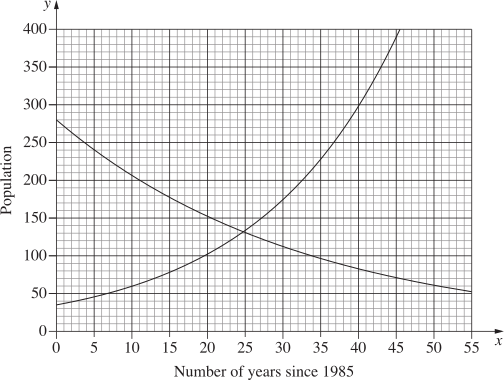
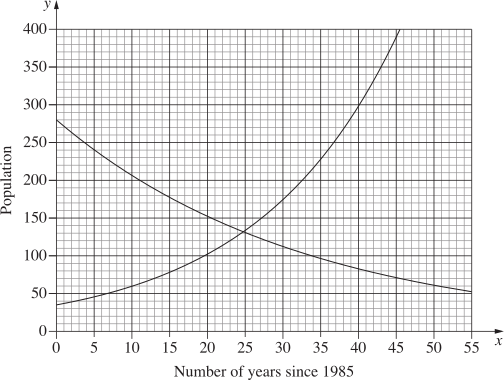
The graph shows the populations of two different animals, \(W\) and \(K\), in a conservation park over time. The \(y\)-axis is the size of the population and the \(x\)-axis is the number of years since 1985 .

Population \(W\) is modelled by the equation  \(y=A \times(1.055)^x\).

Population \(K\) is modelled by the equation  \(y=B \times(0.97)^x\).
 

Complete the table using the information provided.   (3 marks)

\begin{array}{|l|c|c|}
\hline
\rule{0pt}{2.5ex}\rule[-1ex]{0pt}{0pt}&\text {Population } W & \text {Population } K \\
\hline
\rule{0pt}{2.5ex}\text { Population in 1985 }\rule[-1ex]{0pt}{0pt} & A=34 & B=\ \ \ \ \  \\
\hline
\rule{0pt}{2.5ex}\text { Percentage yearly change in the population }\rule[-1ex]{0pt}{0pt} & & \\
\hline
\rule{0pt}{2.5ex}\text { Predicted population when } x=50 \rule[-1ex]{0pt}{0pt}& & 61 \\
\hline
\end{array}

--- 5 WORK AREA LINES (style=lined) ---

Show Answers Only

\begin{array}{|l|c|c|}
\hline
\rule{0pt}{2.5ex}\rule[-1ex]{0pt}{0pt}&\text {Population } W & \text {Population } K \\
\hline
\rule{0pt}{2.5ex}\text { Population in 1985 }\rule[-1ex]{0pt}{0pt} & A=34 & B=280 \\
\hline
\rule{0pt}{2.5ex}\text { Percentage yearly change in the population }\rule[-1ex]{0pt}{0pt} &+5.5\% & -3.0\%\\
\hline
\rule{0pt}{2.5ex}\text { Predicted population when } x=50 \rule[-1ex]{0pt}{0pt}&494 & 61 \\
\hline
\end{array}

Show Worked Solution

\begin{array}{|l|c|c|}
\hline
\rule{0pt}{2.5ex}\rule[-1ex]{0pt}{0pt}&\text {Population } W & \text {Population } K \\
\hline
\rule{0pt}{2.5ex}\text { Population in 1985 }\rule[-1ex]{0pt}{0pt} & A=34 & B=280 \\
\hline
\rule{0pt}{2.5ex}\text { Percentage yearly change in the population }\rule[-1ex]{0pt}{0pt} &+5.5\% & -3.0\%\\
\hline
\rule{0pt}{2.5ex}\text { Predicted population when } x=50 \rule[-1ex]{0pt}{0pt}&494 & 61 \\
\hline
\end{array}

\(\text{Calculations:}\)

\(\text{Population } W: \ (1.055)^x \Rightarrow \text { increase of 5.5% each year}\)

\(\text {Population } K: \ (0.97)^x \Rightarrow 1-0.97=0.03 \Rightarrow \text { decrease of 3.0% each year}\)

\(\text {Predicted population }(W)=34 \times(1.055)^{50}=494\)

Filed Under: Graphs and Applications (Adv-2027), Graphs and Applications (Y11) Tagged With: 2adv-std2-common, Band 4, smc-6456-20-Exponential Graphs, smc-966-10-Exponential graphs, smc-966-20-Population

L&E, 2ADV E1 2021 HSC 5 MC

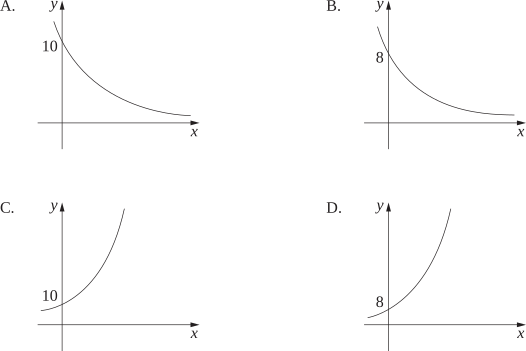
Which of the following best represents the graph of  `y = 10 (0.8)^x`?
 

Show Answers Only

`A`

Show Worked Solution

`\text{By elimination:}`

`\text{When} \ x = 0 \ , \ y = 10(0.8) ^0 = 10`

`-> \ text{Eliminate B and D}`

`text(As)\ \ x→oo, \ y→0`

`-> \ text{Eliminate C}`

`=> A`

Filed Under: Graphs and Applications (Adv-2027), Graphs and Applications (Y11), Non-Calculus Graphing (Y12) Tagged With: 2adv-std2-common, Band 4, common-content, smc-1009-20-Exponential, smc-1009-30-Identify Graphs, smc-6456-10-Identify Graphs, smc-966-10-Exponential graphs

L&E, 2ADV E1 SM-Bank 14

The spread of a highly contagious virus can be modelled by the function

`f(x) = 8000/(1 + 1000e^(−0.12x))`

Where `x` is the number of days after the first case of sickness due to the virus is diagnosed and `f(x)` is the total number of people who are infected by the virus in the first `x` days.

  1. Calculate `f(0)`.   (1 mark)

    --- 1 WORK AREA LINES (style=lined) ---

  2. Find the value of `f(365)` and interpret it result.   (2 marks)

    --- 4 WORK AREA LINES (style=lined) ---
Show Answers Only
  1. `7.99…`
  2. `text(After 1 year, the model predicts the total number)`
    `text(of people infected by the virus is 8000.)`
Show Worked Solution
i.   `f(0)` `= 8000/(1 + 1000e^0)`
    `= 8000/1001`
    `= 7.99…`


ii.    `f(365)` `= 8000/(1 + 1000e^(−0.12 xx 365))`
    `= 8000/(1 + 1000e^(−43.8))`
    `~~ 8000`

 
`text(After 1 year, the model predicts the total number)`

`text(of people infected by the virus is 8000.)`

Filed Under: Graphs and Applications (Adv-2027), Graphs and Applications (Y11) Tagged With: Band 3, Band 4, smc-6456-20-Exponential Graphs, smc-966-30-Other exponential modelling

Functions, 2ADV F2 SM-Bank 13


  1. Show that the function  `y = (1-e^x)/(1 + e^x)`  is an odd function?   (1 mark) 

    --- 5 WORK AREA LINES (style=lined) ---

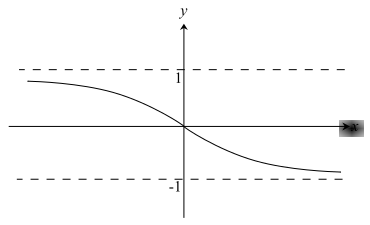
  2. Sketch  `y = (1-e^x)/(1 + e^x)`, labelling all intercepts and asymptotes.   (2 marks)

    --- 8 WORK AREA LINES (style=lined) ---

Show Answers Only
  1. `{text(all real)\ x,  x!=1/4}`


Show Worked Solution

i.   `f(x) = (1-e^x)/(1 + e^x)`

`f(−x)` `= (1-e^(−x))/(1 + e^(−x)) xx (e^x)/(e^x)`
  `= (e^x-1)/(e^x + 1)`
  `= −(1-e^x)/(1 + e^x)`
  `= −f(x)`

 
`:. f(x)\ text(is ODD.)`


ii.   `y = (1-e^x)/(1 + e^x) xx (e^(−x))/(e^(−x)) = (e^(−x)-1)/(e^(−x) + 1) = 1-2/(e^(−x) + 1)`

`text(As)\ x -> ∞, \ 2/(e^(−x) + 1) -> 2, \ y -> −1`

`text(As)\ x ->-∞, \ 2/(e^(−x) + 1) -> 0, \ y -> 1`

`text(When)\ x = 0, \ y = 0`
 

Filed Under: Graphs and Applications (Adv-2027), Graphs and Applications (Y11), Non-Calculus Graphing (Y12) Tagged With: Band 4, smc-1009-20-Exponential, smc-1009-50-Odd Functions, smc-6456-20-Exponential Graphs, smc-6456-50-Odd/Even Functions, smc-966-10-Exponential graphs

L&E, 2ADV E1 SM-Bank 2

The population of Indian Myna birds in a suburb can be described by the exponential function

`N = 35e^(0.07t)`

where `t` is the time in months.

  1.  What will be the population after 2 years?  (1 mark)

    --- 1 WORK AREA LINES (style=lined) ---

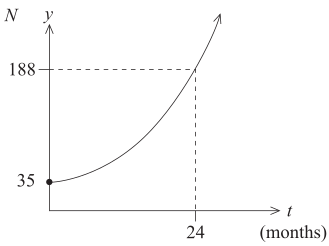
  2.  Draw a graph of the population.  (2 marks)

    --- 8 WORK AREA LINES (style=lined) ---

Show Answers Only
  1. `188\ text(birds)`
  2.  

Show Worked Solution

i.   `N = 35e^(0.07t)`

`text(Find)\ N\ text(when)\ \ t = 24:`

`N` `= 35e^(0.07 xx 24)`
  `= 35e^(1.68)`
  `= 187.79…`
  `= 188\ text(birds)`


ii.

Filed Under: Graphs and Applications (Adv-2027), Graphs and Applications (Y11) Tagged With: Band 3, smc-6456-20-Exponential Graphs, smc-966-10-Exponential graphs, smc-966-20-Population

L&E, 2ADV E1 2015 HSC 8 MC

The diagram shows the graph of  `y = e^x (1 + x).`
 

How many solutions are there to the equation  `e^x (1 + x) = 1-x^2`?

  1. `0`
  2. `1`
  3. `2`
  4. `3`
Show Answers Only

`C`

Show Worked Solution

`text(The graphs intersect at 2 points)`

`:. e^x(1 + x) = 1-x^2\ text(has 2 solutions)`

`=> C`

Filed Under: Graphs and Applications (Adv-2027), Graphs and Applications (Y11), Log/Index Laws and Equations (Adv-2027), Log/Index Laws and Equations (Y11), Log/Index laws and Other Equations Tagged With: Band 4, smc-6455-50-Exponential Equations, smc-6456-20-Exponential Graphs, smc-963-50-Exponential Equation, smc-966-10-Exponential graphs

Copyright © 2014–2025 SmarterEd.com.au · Log in