SmarterEd

Aussie Maths & Science Teachers: Save your time with SmarterEd

  • Login
  • Get Help
  • About

HMS, TIP EQ-Bank 239

A hockey player is preparing for the upcoming season using a comprehensive training program. During pre-season, they focus on aerobic training and strength development. As the season approaches, they shift to sport-specific skills and tactical training. Throughout the competitive season, they maintain fitness while prioritising recovery.

Explain how the different types of training methods work together across these three phases to optimise the hockey player's performance throughout the entire season.   (5 marks)

--- 15 WORK AREA LINES (style=lined) ---
Show Answers Only
  • Pre-season aerobic training builds the cardiovascular base essential for sustained performance during matches.
  • This foundation enables the player to maintain intensity throughout 70-minute hockey games without excessive fatigue.
  • Strength development creates muscular power required for explosive movements like shooting and tackling.
  • These adaptations result in improved force production and injury prevention during competitive play.
  • Sport-specific skills training develops technical abilities under game-like conditions as competition approaches.
  • This preparation causes enhanced decision-making speed and movement efficiency during actual matches.
  • Tactical training integrates individual skills into team strategies and positional play requirements.
  • The combination leads to coordinated team performance and strategic execution during games.
  • In-season maintenance preserves fitness gains while preventing overtraining and burnout.
  • Recovery focus allows physiological adaptation and muscle repair between competitive matches.
  • Therefore the progressive training phases optimise peak performance timing while maintaining long-term player health.
Show Worked Solution
  • Pre-season aerobic training builds the cardiovascular base essential for sustained performance during matches.
  • This foundation enables the player to maintain intensity throughout 70-minute hockey games without excessive fatigue.
  • Strength development creates muscular power required for explosive movements like shooting and tackling.
  • These adaptations result in improved force production and injury prevention during competitive play.
  • Sport-specific skills training develops technical abilities under game-like conditions as competition approaches.
  • This preparation causes enhanced decision-making speed and movement efficiency during actual matches.
  • Tactical training integrates individual skills into team strategies and positional play requirements.
  • The combination leads to coordinated team performance and strategic execution during games.
  • In-season maintenance preserves fitness gains while preventing overtraining and burnout.
  • Recovery focus allows physiological adaptation and muscle repair between competitive matches.
  • Therefore the progressive training phases optimise peak performance timing while maintaining long-term player health.

Filed Under: Types of training and training methods Tagged With: Band 3, smc-5459-30-All phases

HMS, TIP EQ-Bank 238

A tennis coach uses drills and modified games to help players improve their backhand technique. The coach notices that players perform well during drills but struggle to use the backhand effectively during actual match play.

Explain why modified games might be more effective than drills for developing the backhand skill in competitive situations.   (3 marks)

--- 9 WORK AREA LINES (style=lined) ---

Show Answers Only
  • Drills involve repetitive practice under controlled conditions without decision-making pressure or opposition.
  • This creates limited transfer to match situations where players face unpredictable ball placement and timing.
  • Modified games provide realistic match conditions with decision-making requirements and variable ball trajectories.
  • These conditions enable players to practice backhand technique while responding to changing game situations.
  • Therefore modified games better prepare players for competitive backhand execution under match pressure.
Show Worked Solution
  • Drills involve repetitive practice under controlled conditions without decision-making pressure or opposition.
  • This creates limited transfer to match situations where players face unpredictable ball placement and timing.
  • Modified games provide realistic match conditions with decision-making requirements and variable ball trajectories.
  • These conditions enable players to practice backhand technique while responding to changing game situations.
  • Therefore modified games better prepare players for competitive backhand execution under match pressure.

Filed Under: Types of training and training methods Tagged With: Band 2, smc-5459-25-Skill/tactical dev

HMS, TIP EQ-Bank 237

Two athletes are following different strength training approaches: Athlete A uses isotonic training with free weights focusing on 3-8 repetitions at high resistance, while Athlete B uses isometric training with body weight exercises holding positions for 30-60 seconds. Both athletes compete in sports requiring explosive power and muscular endurance.

Evaluate the effectiveness of these two strength training approaches for developing both explosive power and muscular endurance in competitive athletes.   (8 marks)

--- 24 WORK AREA LINES (style=lined) ---

Show Answers Only

Evaluation Statement

  • Isotonic training proves highly effective for explosive power but moderately effective for muscular endurance.
  • Isometric training shows limited explosive power effectiveness yet demonstrates high muscular endurance effectiveness.

Isotonic Training Effectiveness

  • Isotonic training strongly meets explosive power requirements through progressive overload and dynamic contractions across full range of motion.
  • Evidence supporting this includes research demonstrating 3-8 repetition protocols maximise strength gains and fast-twitch fibre recruitment essential for power sports.
  • However, isotonic training partially fulfils muscular endurance needs as low repetition protocols inadequately stress aerobic muscle metabolism pathways.
  • Studies indicate limited Type I fibre adaptation when using high-resistance, low-repetition protocols exclusively.

Isometric Training Effectiveness

  • Isometric training fails to achieve optimal explosive power development due to static contractions lacking velocity-specific adaptations.
  • Research reveals isometric exercises produce strength gains primarily at held joint angles, limiting transfer to dynamic movements.
  • Conversely, isometric training strongly meets muscular endurance criteria through sustained contractions requiring aerobic energy system development.
  • Evidence demonstrates 30-60 second holds enhance Type I fibre recruitment and improve fatigue resistance effectively.

Final Evaluation

  • Weighing effectiveness across both criteria reveals isotonic training provides superior overall benefits for competitive athletes requiring explosive power.
  • While isometric training excels in endurance development, explosive power’s critical importance makes isotonic approaches more suitable for most competitive sports.
Show Worked Solution

Evaluation Statement

  • Isotonic training proves highly effective for explosive power but moderately effective for muscular endurance.
  • Isometric training shows limited explosive power effectiveness yet demonstrates high muscular endurance effectiveness.

Isotonic Training Effectiveness

  • Isotonic training strongly meets explosive power requirements through progressive overload and dynamic contractions across full range of motion.
  • Evidence supporting this includes research demonstrating 3-8 repetition protocols maximise strength gains and fast-twitch fibre recruitment essential for power sports.
  • However, isotonic training partially fulfils muscular endurance needs as low repetition protocols inadequately stress aerobic muscle metabolism pathways.
  • Studies indicate limited Type I fibre adaptation when using high-resistance, low-repetition protocols exclusively.

Isometric Training Effectiveness

  • Isometric training fails to achieve optimal explosive power development due to static contractions lacking velocity-specific adaptations.
  • Research reveals isometric exercises produce strength gains primarily at held joint angles, limiting transfer to dynamic movements.
  • Conversely, isometric training strongly meets muscular endurance criteria through sustained contractions requiring aerobic energy system development.
  • Evidence demonstrates 30-60 second holds enhance Type I fibre recruitment and improve fatigue resistance effectively.

Final Evaluation

  • Weighing effectiveness across both criteria reveals isotonic training provides superior overall benefits for competitive athletes requiring explosive power.
  • While isometric training excels in endurance development, explosive power’s critical importance makes isotonic approaches more suitable for most competitive sports.

Filed Under: Types of training and training methods Tagged With: Band 6, smc-5459-20-Strength

HMS, TIP EQ-Bank 236

A rugby forward needs to develop strength for scrummaging and tackling situations. The coach is considering whether to use free weights, body weight exercises, or elastic resistance training methods.

Analyse the relationship between these three strength training methods and their specific applications for rugby forward performance requirements.   (5 marks)

--- 15 WORK AREA LINES (style=lined) ---
Show Answers Only

Overview Statement

  • Free weights, body weight exercises and elastic resistance each connect to rugby forward requirements through different strength development mechanisms.

Component Relationship 1

  • Free weights interact with scrummaging demands by providing progressive overload through controllable resistance levels.
  • This relationship enables targeted development of major muscle groups essential for sustained pushing forces in scrum situations.
  • Research demonstrates free weights develop maximal strength capacity required for scrum engagement and driving phases.
  • The adaptations mean forwards generate greater force production during set-piece situations.

Component Relationship 2

  • Body weight and elastic resistance connect to rugby’s functional movement patterns through sport-specific training angles.
  • Body weight exercises affect multiple muscle groups simultaneously, replicating integrated strength required for tackling techniques.
  • Elastic resistance influences strength across variable resistance curves, matching natural force production patterns.
  • These methods enhance proprioceptive awareness and stabilising muscle strength for contact situations.

Implications and Synthesis

  • The relationships demonstrate that combining all three methods addresses rugby’s diverse strength requirements effectively.
  • Overall significance shows integrated approaches optimise forward performance across different game scenarios.
Show Worked Solution

Overview Statement

  • Free weights, body weight exercises and elastic resistance each connect to rugby forward requirements through different strength development mechanisms.

Component Relationship 1

  • Free weights interact with scrummaging demands by providing progressive overload through controllable resistance levels.
  • This relationship enables targeted development of major muscle groups essential for sustained pushing forces in scrum situations.
  • Research demonstrates free weights develop maximal strength capacity required for scrum engagement and driving phases.
  • The adaptations mean forwards generate greater force production during set-piece situations.

Component Relationship 2

  • Body weight and elastic resistance connect to rugby’s functional movement patterns through sport-specific training angles.
  • Body weight exercises affect multiple muscle groups simultaneously, replicating integrated strength required for tackling techniques.
  • Elastic resistance influences strength across variable resistance curves, matching natural force production patterns.
  • These methods enhance proprioceptive awareness and stabilising muscle strength for contact situations.

Implications and Synthesis

  • The relationships demonstrate that combining all three methods addresses rugby’s diverse strength requirements effectively.
  • Overall significance shows integrated approaches optimise forward performance across different game scenarios.

Filed Under: Types of training and training methods Tagged With: Band 4, smc-5459-20-Strength

HMS, TIP EQ-Bank 235

A basketball player wants to improve their vertical jump and overall court performance. Their trainer suggests incorporating both free weights and plyometric exercises into their strength training program.

Explain how these two strength training methods would enhance the basketball player's power development and jumping ability.   (4 marks)

--- 12 WORK AREA LINES (style=lined) ---

Show Answers Only
  • Free weights create resistance that stimulates muscle hypertrophy and strength development in major muscle groups.
  • Progressive overload occurs because muscles must adapt by recruiting additional fast-twitch fibres for increased movement demands.
  • Increased strength leads to greater force production capacity essential for explosive jumping movements on court.
  • Plyometric exercises involve rapid stretch-shortening cycles that develop reactive power through eccentric-concentric muscle contractions.
  • This mechanism enhances the muscle’s elastic recoil properties and faster force generation during basketball takeoff phases.
  • Therefore combining both methods optimises strength and reactive power for significantly improved vertical jump performance.
Show Worked Solution
  • Free weights create resistance that stimulates muscle hypertrophy and strength development in major muscle groups.
  • Progressive overload occurs because muscles must adapt by recruiting additional fast-twitch fibres for increased movement demands.
  • Increased strength leads to greater force production capacity essential for explosive jumping movements on court.
  • Plyometric exercises involve rapid stretch-shortening cycles that develop reactive power through eccentric-concentric muscle contractions.
  • This mechanism enhances the muscle’s elastic recoil properties and faster force generation during basketball takeoff phases.
  • Therefore combining both methods optimises strength and reactive power for significantly improved vertical jump performance.

Filed Under: Types of training and training methods Tagged With: Band 3, smc-5459-20-Strength

HMS, TIP EQ-Bank 234

A gymnastics coach is developing flexibility training programs for their athletes. The coach is considering using static stretching, dynamic stretching and PNF stretching methods but is unsure which combination would be most effective for different phases of training.

Justify the use of these three flexibility training methods for gymnasts during warm-up, skill development and cool-down phases.   (6 marks)

--- 20 WORK AREA LINES (style=lined) ---

Show Answers Only

Position Statement

  • Static, dynamic and PNF stretching methods each provide specific benefits that justify their strategic use across different training phases for gymnasts.

Warm-up Phase Benefits

  • Dynamic stretching proves most effective during warm-up as it gradually increases muscle temperature and range of motion.
  • Evidence demonstrates dynamic movements prepare muscles for explosive gymnastics skills while reducing injury risk through progressive muscle activation.
  • This method mimics competitive movement patterns, enhancing proprioceptive awareness essential for complex gymnastic routines.
  • Research confirms dynamic stretching maintains muscle power output better than static alternatives during warm-up phases.

Skill Development and Cool-down Applications

  • PNF stretching maximises flexibility gains during skill development through its contract-relax mechanism targeting specific muscle groups.
  • Static stretching becomes essential during cool-down phases as it promotes muscle relaxation and reduces post-exercise tension.
  • Studies show PNF methods achieve greater range of motion improvements than other techniques when used strategically.
  • The combination prevents muscle shortening while enhancing recovery between training sessions.

Reinforcement

  • While each method has limitations, their strategic combination addresses gymnastics’ diverse flexibility requirements more effectively than single approaches.
  • Therefore the integrated use of all three methods optimises gymnastic performance while minimising injury risk across training phases.
Show Worked Solution

Position Statement

  • Static, dynamic and PNF stretching methods each provide specific benefits that justify their strategic use across different training phases for gymnasts.

Warm-up Phase Benefits

  • Dynamic stretching proves most effective during warm-up as it gradually increases muscle temperature and range of motion.
  • Evidence demonstrates dynamic movements prepare muscles for explosive gymnastics skills while reducing injury risk through progressive muscle activation.
  • This method mimics competitive movement patterns, enhancing proprioceptive awareness essential for complex gymnastic routines.
  • Research confirms dynamic stretching maintains muscle power output better than static alternatives during warm-up phases.

Skill Development and Cool-down Applications

  • PNF stretching maximises flexibility gains during skill development through its contract-relax mechanism targeting specific muscle groups.
  • Static stretching becomes essential during cool-down phases as it promotes muscle relaxation and reduces post-exercise tension.
  • Studies show PNF methods achieve greater range of motion improvements than other techniques when used strategically.
  • The combination prevents muscle shortening while enhancing recovery between training sessions.

Reinforcement

  • While each method has limitations, their strategic combination addresses gymnastics’ diverse flexibility requirements more effectively than single approaches.
  • Therefore the integrated use of all three methods optimises gymnastic performance while minimising injury risk across training phases.

Filed Under: Types of training and training methods Tagged With: Band 4, smc-5459-15-Flexibility

HMS, TIP EQ-Bank 233

A swimming coach is designing training programs for two different athletes: a 1500-metre freestyle swimmer and a water polo player. Both athletes need improved aerobic capacity but have different performance requirements.

Discuss the use of continuous training versus aerobic interval training for these two athletes, considering their specific sport demands.   (6 marks)

--- 20 WORK AREA LINES (style=lined) ---

Show Answers Only

For Continuous Training

  • [P] Continuous training provides sustained aerobic development through uninterrupted effort lasting 20-30 minutes minimum.
  • [E] This approach directly supports the 1500-metre swimmer’s race demands requiring steady-state aerobic capacity throughout the event.
  • [Ev] Research demonstrates continuous training improves oxygen delivery efficiency and enhances cardiovascular endurance for prolonged swimming efforts.
  • [L] Therefore continuous training effectively develops the aerobic base essential for distance swimming performance.

Against Continuous Training for Water Polo

  • [P] Continuous training limitations become apparent when considering water polo’s intermittent high-intensity demands.
  • [E] Water polo requires rapid acceleration, explosive movements and frequent direction changes rather than sustained steady effort.
  • [Ev] Studies show continuous training alone fails to develop the anaerobic power and recovery capacity needed for repeated sprints.
  • [L] Consequently continuous training provides insufficient preparation for water polo’s varied intensity requirements.

For Aerobic Interval Training

  • [P] Aerobic interval training offers superior specificity for both athletes through work-rest manipulation.
  • [E] The method allows coaches to target specific energy system development while maintaining aerobic stress through incomplete recovery.
  • [Ev] Evidence indicates interval training improves both VO2 max and lactate threshold more effectively than continuous methods alone.
  • [L] This versatility makes aerobic interval training suitable for both swimming disciplines despite different performance demands.
Show Worked Solution

For Continuous Training

  • [P] Continuous training provides sustained aerobic development through uninterrupted effort lasting 20-30 minutes minimum.
  • [E] This approach directly supports the 1500-metre swimmer’s race demands requiring steady-state aerobic capacity throughout the event.
  • [Ev] Research demonstrates continuous training improves oxygen delivery efficiency and enhances cardiovascular endurance for prolonged swimming efforts.
  • [L] Therefore continuous training effectively develops the aerobic base essential for distance swimming performance.

Against Continuous Training for Water Polo

  • [P] Continuous training limitations become apparent when considering water polo’s intermittent high-intensity demands.
  • [E] Water polo requires rapid acceleration, explosive movements and frequent direction changes rather than sustained steady effort.
  • [Ev] Studies show continuous training alone fails to develop the anaerobic power and recovery capacity needed for repeated sprints.
  • [L] Consequently continuous training provides insufficient preparation for water polo’s varied intensity requirements.

For Aerobic Interval Training

  • [P] Aerobic interval training offers superior specificity for both athletes through work-rest manipulation.
  • [E] The method allows coaches to target specific energy system development while maintaining aerobic stress through incomplete recovery.
  • [Ev] Evidence indicates interval training improves both VO2 max and lactate threshold more effectively than continuous methods alone.
  • [L] This versatility makes aerobic interval training suitable for both swimming disciplines despite different performance demands.

Filed Under: Types of training and training methods Tagged With: Band 5, smc-5459-10-Aerobic

HMS, TIP EQ-Bank 232

A soccer midfielder needs to maintain performance throughout a 90-minute match that requires frequent changes in intensity. Their fitness coach recommends using fartlek training and circuit training to improve their aerobic capacity.

Analyse the relationship between these training methods and the specific demands of soccer performance.   (5 marks)

--- 18 WORK AREA LINES (style=lined) ---

Show Answers Only

Overview Statement

  • Fartlek and circuit training both connect to soccer’s varied intensity demands through complementary physiological adaptations for sustained match performance.

Component Relationship 1

  • Fartlek training interacts with soccer’s unpredictable pace changes by developing simultaneous aerobic and anaerobic energy system capacity.
  • This relationship enables rapid transitions between moderate jogging phases and explosive sprinting bursts throughout competitive matches.
  • Evidence shows fartlek’s random intensity variations mimic game-specific demands which results in improved lactate clearance during play.
  • The training specificity means midfielders maintain optimal speed and endurance over 90 minutes without significant performance decline.
  • Additionally, the varied terrain component enhances proprioceptive awareness required for changing field conditions.

Component Relationship 2

  • Circuit training connects to soccer’s multi-directional movement patterns through sequential station-based sport-specific exercises targeting different muscle groups.
  • This method influences cardiovascular endurance development while simultaneously building functional strength, agility and coordination capacities.
  • Research demonstrates circuit training formats affect metabolic recovery rates between repeated high-intensity efforts during competitive matches.
  • Therefore players sustain optimal decision-making abilities and consistent physical output throughout the entire game duration.

Implications and Synthesis

  • These training relationships work synergistically to optimise comprehensive aerobic capacity for soccer’s complex and demanding physical requirements.
  • The broader implication demonstrates that combined training approaches enhance overall match performance more effectively than isolated training methods.
Show Worked Solution

Overview Statement

  • Fartlek and circuit training both connect to soccer’s varied intensity demands through complementary physiological adaptations for sustained match performance.

Component Relationship 1

  • Fartlek training interacts with soccer’s unpredictable pace changes by developing simultaneous aerobic and anaerobic energy system capacity.
  • This relationship enables rapid transitions between moderate jogging phases and explosive sprinting bursts throughout competitive matches.
  • Evidence shows fartlek’s random intensity variations mimic game-specific demands which results in improved lactate clearance during play.
  • The training specificity means midfielders maintain optimal speed and endurance over 90 minutes without significant performance decline.
  • Additionally, the varied terrain component enhances proprioceptive awareness required for changing field conditions.

Component Relationship 2

  • Circuit training connects to soccer’s multi-directional movement patterns through sequential station-based sport-specific exercises targeting different muscle groups.
  • This method influences cardiovascular endurance development while simultaneously building functional strength, agility and coordination capacities.
  • Research demonstrates circuit training formats affect metabolic recovery rates between repeated high-intensity efforts during competitive matches.
  • Therefore players sustain optimal decision-making abilities and consistent physical output throughout the entire game duration.

Implications and Synthesis

  • These training relationships work synergistically to optimise comprehensive aerobic capacity for soccer’s complex and demanding physical requirements.
  • The broader implication demonstrates that combined training approaches enhance overall match performance more effectively than isolated training methods.

Filed Under: Types of training and training methods Tagged With: Band 4, smc-5459-10-Aerobic

HMS, TIP EQ-Bank 231

A cross-country runner is preparing for a 10-kilometre race and wants to improve their aerobic endurance. Their coach suggests incorporating both continuous training and aerobic interval training into their program.

Explain how these two aerobic training methods would improve the runner's performance in long-distance running.   (4 marks)

--- 12 WORK AREA LINES (style=lined) ---

Show Answers Only
  • Continuous training involves sustained effort for at least 20-30 minutes without rest intervals.
  • This causes the heart rate to rise above aerobic threshold and remain in target zone.
  • Reaching the threshold leads to improved oxygen delivery to muscles and enhanced cardiovascular efficiency for distance running.
  • Aerobic interval training alternates work periods with short recovery phases.
  • The short recovery periods enable the maintenance of stress on the aerobic system through incomplete recovery between intervals.
  • Therefore the runner develops greater aerobic capacity and improved lactate clearance for race performance.
Show Worked Solution
  • Continuous training involves sustained effort for at least 20-30 minutes without rest intervals.
  • This causes the heart rate to rise above aerobic threshold and remain in target zone.
  • Reaching the threshold leads to improved oxygen delivery to muscles and enhanced cardiovascular efficiency for distance running.
  • Aerobic interval training alternates work periods with short recovery phases.
  • The short recovery periods enable the maintenance of stress on the aerobic system through incomplete recovery between intervals.
  • Therefore the runner develops greater aerobic capacity and improved lactate clearance for race performance.

Filed Under: Types of training and training methods Tagged With: Band 3, smc-5459-10-Aerobic

HMS, TIP 2012 HSC 15 MC

Which types of training methods would be most suitable for an elite basketball player?

  1. Anaerobic interval, ballistic flexibility, elastic resistance
  2. Anaerobic interval, continuous, hydraulic resistance
  3. Aerobic interval, static flexibility, free weights
  4. Circuit, dynamic flexibility, free weights
Show Answers Only

\(A\)

Show Worked Solution
  • A is correct: Basketball requires anaerobic power, ballistic flexibility and functional resistance training.

Other Options:

  • B is incorrect: Continuous training less relevant for intermittent basketball demands.
  • C is incorrect: Static flexibility less functional than ballistic for basketball movements.
  • D is incorrect: Circuit training less specific than anaerobic interval for basketball.

♦♦♦♦ Mean mark 29%.

Filed Under: Types of training and training methods Tagged With: Band 6, smc-5459-05-Anaerobic, smc-5459-15-Flexibility

HMS, TIP 2013 HSC 15 MC

Features of a resistance training program are listed.

\begin{array}{|l|l|}
\hline \textit{Sets}\quad & 3-6 \\
\hline \textit{Reps} & 5-6 \\
\hline \textit{Load} & 35\%-50\% \ \text{of 1 Repetition Maximum (RM) } \\
\hline \textit{Rest} & 3-4 \text{ minutes (between sets) } \\
\hline \textit{Speed} & \text {Fast} \\
\hline
\end{array}

What is this training program specifically designed to improve?

  1. Endurance
  2. Hypertrophy
  3. Power
  4. Strength
Show Answers Only

\(C\)

Show Worked Solution
  • C is correct: Moderate load with fast speed develops explosive power output.

Other Options:

  • A is incorrect: Endurance requires higher reps, lower load, shorter rest.
  • B is incorrect: Hypertrophy needs moderate reps, higher load, shorter rest.
  • D is incorrect: Strength requires higher load percentage, slower controlled movements.

♦♦ Mean mark 50%.

Filed Under: Types of training and training methods Tagged With: Band 5, smc-5459-05-Anaerobic

HMS, TIP 2014 HSC 32a

How do different types of training improve performance in various sports?   (8 marks)

--- 22 WORK AREA LINES (style=lined) ---

Show Answers Only
  • Different training types create specific physiological adaptations that enhance performance by targeting the precise energy systems and movement patterns required for each sport.
      
  • Aerobic training methods improve endurance performance by enhancing the cardiovascular system’s oxygen delivery capacity and muscular efficiency.
  • Continuous training develops aerobic capacity through sustained moderate-intensity exercise, enabling marathon runners to maintain pace over 42 kilometres.
  • This occurs because continuous training increases cardiac output, stroke volume and capillarisation.
  • Fartlek training combines speed variations with aerobic conditioning, allowing middle-distance athletes to handle race pace changes.
  • As a result, sports requiring sustained effort like cycling and swimming benefit from enhanced oxygen utilisation and delayed fatigue onset.
      
  • Anaerobic training methods target power and speed development by stressing the ATP-PCr and glycolytic energy systems.
  • Plyometric training produces explosive power through stretch-shortening cycles, enabling basketball players to jump higher and sprint faster.
  • This works by improving neuromuscular coordination and fast-twitch muscle fibre recruitment.
  • High Intensity Interval Training develops anaerobic capacity whilst maintaining aerobic benefits, making it ideal for sports like hockey requiring repeated high-intensity efforts.
  • Consequently, athletes develop greater power output and faster recovery between intense bursts.
      
  • Resistance training builds muscular strength and hypertrophy, creating force production improvements essential for contact sports.
  • This leads to enhanced tackle effectiveness in rugby and throwing distance in field events.
  • Therefore, matching training types to sport-specific energy demands and movement patterns optimises performance adaptations.
Show Worked Solution
  • Different training types create specific physiological adaptations that enhance performance by targeting the precise energy systems and movement patterns required for each sport.
      
  • Aerobic training methods improve endurance performance by enhancing the cardiovascular system’s oxygen delivery capacity and muscular efficiency.
  • Continuous training develops aerobic capacity through sustained moderate-intensity exercise, enabling marathon runners to maintain pace over 42 kilometres.
  • This occurs because continuous training increases cardiac output, stroke volume and capillarisation.
  • Fartlek training combines speed variations with aerobic conditioning, allowing middle-distance athletes to handle race pace changes.
  • As a result, sports requiring sustained effort like cycling and swimming benefit from enhanced oxygen utilisation and delayed fatigue onset.
      
  • Anaerobic training methods target power and speed development by stressing the ATP-PCr and glycolytic energy systems.
  • Plyometric training produces explosive power through stretch-shortening cycles, enabling basketball players to jump higher and sprint faster.
  • This works by improving neuromuscular coordination and fast-twitch muscle fibre recruitment.
  • High Intensity Interval Training develops anaerobic capacity whilst maintaining aerobic benefits, making it ideal for sports like hockey requiring repeated high-intensity efforts.
  • Consequently, athletes develop greater power output and faster recovery between intense bursts.
      
  • Resistance training builds muscular strength and hypertrophy, creating force production improvements essential for contact sports.
  • This leads to enhanced tackle effectiveness in rugby and throwing distance in field events.
  • Therefore, matching training types to sport-specific energy demands and movement patterns optimises performance adaptations.

Filed Under: Types of training and training methods Tagged With: Band 4, smc-5459-30-All phases

HMS, TIP 2014 HSC 19 MC

The table below shows an athlete’s adaptations from training that occurred over 14 weeks.

\begin{array}{|l|l|}
\hline \text{Adaptation} & \text{Result} \\
\hline \text{% slow-twitch muscle fibre} \quad & \text{Increase} \\
\hline \text{Aerobic capacity} & \text{Increase} \\
\hline \text{Number of capillaries} & \text{Increase} \\
\hline \text{Anaerobic capacity} & \text{No change} \\
\hline
\end{array}

Which is the most likely method of training to have been undertaken?

  1. Circuit training
  2. Fartlek training
  3. Resistance training
  4. Continuous training
Show Answers Only

\(D\)

Show Worked Solution
  • D is correct: Continuous training produces purely aerobic adaptations without anaerobic improvements.

Other Options:

  • A is incorrect: Circuit training would improve both aerobic and anaerobic capacity.
  • B is incorrect: Fartlek training would improve some anaerobic capacity due to intervals.
  • C is incorrect: Resistance training would primarily improve anaerobic not aerobic capacity.

Filed Under: Types of training and training methods Tagged With: Band 4, smc-5459-10-Aerobic

HMS, TIP 2015 HSC 14 MC

Which of the following would be a suitable weight training plan for enhancing the performance of an endurance athlete?

  1. Low repetition numbers with long recovery periods between sets
  2. Low repetition numbers with short recovery periods between sets
  3. High repetition numbers with slow speed and long recovery periods between sets
  4. High repetition numbers with fast speed and short recovery periods between sets
Show Answers Only

\(D\)

Show Worked Solution
  • D is correct: High reps with fast speed and short recovery mimics endurance demands.

Other Options:

  • A is incorrect: Low reps and long recovery develops power not endurance.
  • B is incorrect: Low reps develops strength not muscular endurance.
  • C is incorrect: Slow speed and long recovery doesn’t match endurance specificity.

♦♦ Mean mark 47%.

Filed Under: Principles of training, Types of training and training methods Tagged With: Band 5, smc-5459-20-Strength, smc-5460-05-Adaptations

HMS, TIP 2015 HSC 12 MC

How could a coach use a circuit training program to develop the aerobic capacity and strength of her athletes?

  1. By increasing the time allowed for the circuit to be completed
  2. By increasing the resistance and the time at each of the stations
  3. By decreasing the time allowed for the circuit to be completed
  4. By decreasing the resistance and the time at each of the stations
Show Answers Only

\(B\)

Show Worked Solution
  • B is correct: Higher resistance builds strength while longer time develops aerobic capacity.

Other Options:

  • A is incorrect: More time doesn’t increase training intensity effectively.
  • C is incorrect: Less time reduces aerobic development opportunities.
  • D is incorrect: Lower resistance and time reduces both strength and aerobic benefits.

Filed Under: Principles of training, Types of training and training methods Tagged With: Band 4, smc-5459-10-Aerobic, smc-5459-20-Strength, smc-5460-05-Adaptations

HMS, TIP 2015 HSC 25

How can flexibility improve athletic performance?   (3 marks)

--- 9 WORK AREA LINES (style=lined) ---

Show Answers Only
  • Flexibility training enables athletes to achieve greater range of motion around joints during movement execution. This leads to more efficient technique patterns, such as swimmers achieving longer stroke distances through improved shoulder flexibility.
  • As a result, athletes experience reduced injury risk because flexible muscles and joints can accommodate sudden movements without exceeding normal range limits. Consequently, improved flexibility allows faster recovery between training sessions and competitions through reduced muscle tension and stiffness.
  • Therefore, enhanced flexibility contributes to optimal performance by combining technical efficiency with injury prevention, enabling consistent training participation.
Show Worked Solution
  • Flexibility training enables athletes to achieve greater range of motion around joints during movement execution. This leads to more efficient technique patterns, such as swimmers achieving longer stroke distances through improved shoulder flexibility.
  • As a result, athletes experience reduced injury risk because flexible muscles and joints can accommodate sudden movements without exceeding normal range limits. Consequently, improved flexibility allows faster recovery between training sessions and competitions through reduced muscle tension and stiffness.
  • Therefore, enhanced flexibility contributes to optimal performance by combining technical efficiency with injury prevention, enabling consistent training participation.

Filed Under: Types of training and training methods Tagged With: Band 3, smc-5459-15-Flexibility

HMS, TIP 2016 HSC 12 MC

An athlete trains by running 4 km in 20 minutes without stopping. For 30 seconds in each minute the athlete increases the intensity significantly before returning to the normal intensity.

Which row in the table indicates the type of training and the method that is being used?

  Type of training Training method
A.   Aerobic Fartlek
B. Anaerobic Fartlek
C. Aerobic Interval
D.  Anaerobic Interval
Show Answers Only

\(A\)

Show Worked Solution
  • A is correct: 20-minute continuous run with varied intensity describes aerobic fartlek training.

Other Options:

  • B is incorrect: Extended duration indicates aerobic system, not anaerobic.
  • C is incorrect: Fartlek varies intensity randomly, interval training uses set periods.
  • D is incorrect: Both training type and method are incorrectly identified.

Filed Under: Types of training and training methods Tagged With: Band 4, smc-5459-10-Aerobic

HMS, TIP 2017 HSC 1 MC

What type of training involves an activity with intermittent bursts of speed?

  1. Circuit
  2. Fartlek
  3. Flexibility
  4. Continuous
Show Answers Only

\(B\)

Show Worked Solution
  • B is correct: Fartlek training involves varied speed bursts during continuous activity.

Other Options:

  • A is incorrect: Circuit training uses different exercise stations, not speed variations.
  • C is incorrect: Flexibility training focuses on range of motion, not speed.
  • D is incorrect: Continuous training maintains steady pace without speed bursts.

Filed Under: Types of training and training methods Tagged With: Band 3, smc-5459-10-Aerobic

HMS, TIP 2018 HSC 5 MC

In training, an athlete completes TWO laps of the following activity.
 

What type of training does this activity represent?

  1. Aerobic fartlek
  2. Aerobic interval
  3. Anaerobic fartlek
  4. Anaerobic interval
Show Answers Only

\(D\)

Show Worked Solution

  • D is correct: Structured sprint-recovery pattern represents anaerobic interval training with defined work-rest periods.

Other Options:

  • A is incorrect: Fartlek involves varied intensity without structured recovery periods.
  • B is incorrect: Sprints are anaerobic intensity, not aerobic training zones.
  • C is incorrect: Fartlek training lacks the structured work-rest pattern shown here.

♦♦♦♦ Mean mark 33%.

Filed Under: Types of training and training methods Tagged With: Band 5, smc-5459-05-Anaerobic

HMS, TIP 2019 HSC 16 MC

The diagram shows the exercise intensity for an athlete during different stages of a 20-minute continuous running activity.

Which type of training method does this activity represent?

  1. Circuit training
  2. Fartlek training
  3. Continuous training
  4. Aerobic interval training
Show Only

\(B\)

Show Worked S11olution

  • B is correct: Fartlek involves varied intensity periods during continuous running activity.

Other Options:

  • A is incorrect: Circuit training uses different exercise stations, not continuous running.
  • C is incorrect: Continuous training maintains steady intensity throughout the session.
  • D is incorrect: Aerobic interval training has structured work-rest periods with recovery.

♦♦ Mean mark 54%.

Filed Under: Types of training and training methods Tagged With: Band 5, smc-5459-10-Aerobic

HMS, TIP 2019 HSC 31a

  1. Describe TWO different types of training methods that are best suited to the performance requirements of an athlete in a particular sport.   (4 marks)

    --- 12 WORK AREA LINES (style=lined) ---

  2. How can the training adaptations for the athlete identified in part (i) be measured and monitored?   (4 marks)

    --- 12 WORK AREA LINES (style=lined) ---

Show Answers Only

i.    Athlete – 400 metre runner

  • A 400-metre runner requires anaerobic interval training and plyometric training to meet performance demands.
  • Anaerobic interval training involves high-intensity efforts with incomplete recovery periods, developing lactate tolerance essential for 400-metre racing. This method trains the glycolytic energy system predominantly used during the race duration and intensity.
  • Plyometric training develops explosive power through rapid muscle contractions involving stretch-shortening cycles. This training method enhances sprint acceleration and stride power crucial for 400-metre performance. Exercises include depth jumps, bounding and reactive movements. These exercises improve neuromuscular coordination and force production rates necessary for competitive sprinting speeds.

ii.   Measuring and monitoring

  • Anaerobic capacity can be measured through repeated sprint tests and lactate threshold protocols. This determines the athlete’s ability to maintain high-intensity efforts over race distance. Time trials provide specific performance indicators, showing training adaptation effectiveness.
  • Power development is monitored using vertical jump tests and sprint acceleration measurements. These assessments reveal improvements in explosive strength from plyometric training. Standing broad jump distance measures horizontal power development, indicating neuromuscular adaptation improvements.
  • Heart rate recovery patterns demonstrate cardiovascular adaptation efficiency and can be analysed using heart rate monitors or smart watches. These devices track resting heart rate changes and recovery rates after training sessions. Faster recovery rates indicate improved anaerobic fitness and training adaptation success for 400-metre performance requirements.

Show Worked Solution

i.    Athlete – 400 metre runner

  • A 400-metre runner requires anaerobic interval training and plyometric training to meet performance demands.
  • Anaerobic interval training involves high-intensity efforts with incomplete recovery periods, developing lactate tolerance essential for 400-metre racing. This method trains the glycolytic energy system predominantly used during the race duration and intensity.
  • Plyometric training develops explosive power through rapid muscle contractions involving stretch-shortening cycles. This training method enhances sprint acceleration and stride power crucial for 400-metre performance. Exercises include depth jumps, bounding and reactive movements. These exercises improve neuromuscular coordination and force production rates necessary for competitive sprinting speeds.

♦♦ Mean mark (i) 52%.

ii.   Measuring and monitoring

  • Anaerobic capacity can be measured through repeated sprint tests and lactate threshold protocols. This determines the athlete’s ability to maintain high-intensity efforts over race distance. Time trials provide specific performance indicators, showing training adaptation effectiveness.
  • Power development is monitored using vertical jump tests and sprint acceleration measurements. These assessments reveal improvements in explosive strength from plyometric training. Standing broad jump distance measures horizontal power development, indicating neuromuscular adaptation improvements.
  • Heart rate recovery patterns demonstrate cardiovascular adaptation efficiency and can be analysed using heart rate monitors or smart watches. These devices track resting heart rate changes and recovery rates after training sessions. Faster recovery rates indicate improved anaerobic fitness and training adaptation success for 400-metre performance requirements.

♦♦ Mean mark (ii) 42%.

Filed Under: Performance/fitness testing, Types of training and training methods Tagged With: Band 5, smc-5459-05-Anaerobic

HMS, TIP 2020 HSC 18 MC

The following table shows features of the strength training programs that Athlete \(A\) and Athlete \(B\) completed over an 8 -week period.

\begin{array} {|c|c|c|}
\hline Athlete & Weight & Sets &Repetitions & Exercise Speed \\
\hline A & \text{Very heavy}\ & 5-6 & 2-5 & \text{Slow}\ \\
\hline B & \text{Light/medium}\ & 3-6 & 15-20 & \text{Moderate}\ \\
\hline
\end{array}

Which row in the table identifies what has most likely increased as a result of the training program for each athlete?

\begin{align*}
\begin{array}{c|c}
\text{ } \\
\text{ A.   } \\
\text{ B.   } \\
\text{ C.   } \\
\text{ D.   } \\
\end{array}
\begin{array}{|l|l|}
\hline
\ \ \ \ \ \ Athlete A   & \ \ \ \ \ \ \ Athlete B \\
\hline
\text{Absolute strength}\ & \text{Muscular endurance} \\
\hline
\text{Power}\ & \text{Lean body mass}\\
\hline
\text{Muscular endurance}\ & \text{Power} \\
\hline
\text{Lean body mass}\ & \text{Absolute strength} \\
\hline
\end{array}
\end{align*}

Show Answers Only

\(A\)

Show Worked Solution
  • A is correct: Heavy weight/low reps develops absolute strength, light weight/high reps develops endurance.

Other Options:

  • B is incorrect: Slow speed doesn’t develop power, light weight doesn’t optimise mass.
  • C is incorrect: Heavy weight/low reps develops strength not endurance.
  • D is incorrect: Light weight/high reps develops endurance not absolute strength.

Filed Under: Types of training and training methods Tagged With: Band 4, smc-5459-20-Strength

HMS, TIP 2020 HSC 10 MC

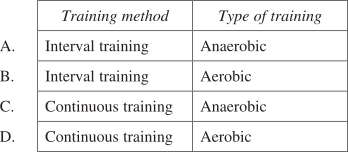
Which row in the table identifies the training method and type of training that is most appropriate for improving the performance of an elite 50-metre swimmer?

Show Answers Only

\(A\)

Show Worked Solution
  • A is correct: 50m swimming requires high-intensity anaerobic power with interval training.

Other Options:

  • B is incorrect: 50m swimming is anaerobic not aerobic event.
  • C is incorrect: Cannot do continuous training at anaerobic intensity.
  • D is incorrect: 50m swimming requires anaerobic not aerobic training.

Filed Under: Types of training and training methods Tagged With: Band 4, smc-5459-05-Anaerobic

HMS, TIP 2020 HSC 24

Explain how TWO flexibility training methods can improve the performance of an athlete in ONE sport. Provide examples to support your answer.  (5 marks)

--- 15 WORK AREA LINES (style=lined) ---
Show Answers Only

Any TWO of the following – Sport choice – Tennis

Dynamic stretching

  • Involves continuous movement through range of motion to prepare muscles for activity. This occurs because the controlled movements gradually increase muscle temperature and blood flow. A tennis player performing leg swings leads to improved hip flexibility and hamstring length. The result is enhanced stride length during court coverage and the production of more powerful serves through increased shoulder rotation. As a result, the athlete can cover the court more efficiently and hit winners from wider positions.

PNF stretching

  • Combines passive stretching with isometric muscle contractions against resistance. This works by overriding the stretch reflex, allowing muscles to relax and lengthen further. A tennis player using PNF for shoulder flexibility creates greater racquet head speed during groundstrokes. The reason for this is increased range of motion at the shoulder joint enables fuller backswing and follow-through movements. Consequently, the athlete generates more power and accuracy in shot placement whilst reducing injury risk.

Static stretching

  • Involves holding muscles in lengthened positions for extended periods. This happens when muscle fibres gradually relax under sustained tension. A tennis player performing static calf stretches results in improved ankle flexibility for better court movement. This mechanism allows enhanced push-off power during explosive directional changes. Therefore, the athlete achieves faster acceleration and deceleration, improving reaction time to opponent shots and reducing lower limb injury risk.

Ballistic stretching

  • Uses bouncing movements to force muscles beyond normal range of motion. This works through momentum forcing muscle lengthening beyond typical limits. A tennis player using controlled arm circles causes increased shoulder mobility for overhead shots. This process enables greater racquet extension during serves and smashes. As a consequence, the athlete generates higher ball velocity and improved court angles whilst maintaining technique consistency.
Show Worked Solution

Any TWO of the following – Sport choice – Tennis

Dynamic stretching

  • Involves continuous movement through range of motion to prepare muscles for activity. This occurs because the controlled movements gradually increase muscle temperature and blood flow. A tennis player performing leg swings leads to improved hip flexibility and hamstring length. The result is enhanced stride length during court coverage and the production of more powerful serves through increased shoulder rotation. As a result, the athlete can cover the court more efficiently and hit winners from wider positions.

PNF stretching

  • Combines passive stretching with isometric muscle contractions against resistance. This works by overriding the stretch reflex, allowing muscles to relax and lengthen further. A tennis player using PNF for shoulder flexibility creates greater racquet head speed during groundstrokes. The reason for this is increased range of motion at the shoulder joint enables fuller backswing and follow-through movements. Consequently, the athlete generates more power and accuracy in shot placement whilst reducing injury risk.

Static stretching

  • Involves holding muscles in lengthened positions for extended periods. This happens when muscle fibres gradually relax under sustained tension. A tennis player performing static calf stretches results in improved ankle flexibility for better court movement. This mechanism allows enhanced push-off power during explosive directional changes. Therefore, the athlete achieves faster acceleration and deceleration, improving reaction time to opponent shots and reducing lower limb injury risk.

Ballistic stretching

  • Uses bouncing movements to force muscles beyond normal range of motion. This works through momentum forcing muscle lengthening beyond typical limits. A tennis player using controlled arm circles causes increased shoulder mobility for overhead shots. This process enables greater racquet extension during serves and smashes. As a consequence, the athlete generates higher ball velocity and improved court angles whilst maintaining technique consistency.

♦♦ Mean mark 47%.

Filed Under: Types of training and training methods Tagged With: Band 5, smc-5459-15-Flexibility

HMS, TIP 2021 HSC 3 MC

Which of the following is used when performing a proprioceptive neuromuscular facilitation (PNF) stretch?

  1. Isometric contraction and static stretches
  2. Isometric contraction and dynamic stretches
  3. Isotonic contraction and static stretches
  4. Isotonic contraction and dynamic stretches
Show Answers Only

\(A\)

Show Worked Solution
  • A is correct: PNF uses isometric contractions followed by static stretches.

Other Options:

  • B is incorrect: Uses static not dynamic stretching phases.
  • C is incorrect: Uses isometric not isotonic contractions.
  • D is incorrect: Wrong contraction type and stretch method.

♦ Mean mark 49%.

Filed Under: Types of training and training methods Tagged With: Band 5, smc-5459-15-Flexibility

HMS, TIP 2022 HSC 30b

To what extent should the types of training and training methods vary when planning a training year? Answer this question in relation to ONE sport.   (12 marks)

--- 28 WORK AREA LINES (style=lined) ---

Show Answers Only

Chosen Sport – Competitive swimming

Judgment Statement

  • Training types and methods should vary significantly throughout a training year for swimming. Key factors supporting this include seasonal periodisation demands and performance optimisation requirements.

Seasonal Periodisation Requirements

  • Pre-season phase demands extensive aerobic base building through continuous training and high-volume sessions. Swimmers require 6-8 weeks of aerobic foundation work to develop cardiovascular capacity for competition demands.
  • Volume decreases as season approaches while intensity increases through anaerobic interval training. This progression ensures swimmers peak physically when major competitions occur.
  • Training shifts from general fitness development to race-specific preparation and skill refinement. Strength training emphasis changes from hypertrophy focus to power development closer to competition.
  • Off-season training incorporates cross-training activities like cycling to maintain fitness while allowing psychological recovery.

Performance Optimisation Through Variation

  • Tapering strategies require dramatic training load reductions 2-3 weeks before major competitions. This variation allows physiological adaptations to consolidate while maintaining race sharpness through quality sets.
  • Different stroke techniques demand varied training methods – distance events need aerobic capacity while sprints require explosive power. Flexibility training becomes crucial during taper to maintain stroke efficiency and prevent injury. Psychological preparation intensifies during competition phases through visualisation and race simulation. Recovery strategies increase during high-intensity periods to prevent overtraining and maintain performance gains.
  • In-season training balances maintenance of fitness with competition readiness through reduced volume but maintained intensity. Skill development varies seasonally from technique refinement in pre-season to race-specific tactical work during competition.

Reaffirmation

  • Evidence demonstrates training variation is essential for optimal swimming performance throughout yearly cycles. Periodisation principles prove that systematic variation prevents plateaus and enables peak performance timing.
  • Without significant variation, swimmers risk overtraining, injury, and suboptimal competition results.
Show Worked Solution

Chosen Sport – Competitive swimming

Judgment Statement

  • Training types and methods should vary significantly throughout a training year for swimming. Key factors supporting this include seasonal periodisation demands and performance optimisation requirements.

Seasonal Periodisation Requirements

  • Pre-season phase demands extensive aerobic base building through continuous training and high-volume sessions. Swimmers require 6-8 weeks of aerobic foundation work to develop cardiovascular capacity for competition demands.
  • Volume decreases as season approaches while intensity increases through anaerobic interval training. This progression ensures swimmers peak physically when major competitions occur.
  • Training shifts from general fitness development to race-specific preparation and skill refinement. Strength training emphasis changes from hypertrophy focus to power development closer to competition.
  • Off-season training incorporates cross-training activities like cycling to maintain fitness while allowing psychological recovery.

Performance Optimisation Through Variation

  • Tapering strategies require dramatic training load reductions 2-3 weeks before major competitions. This variation allows physiological adaptations to consolidate while maintaining race sharpness through quality sets.
  • Different stroke techniques demand varied training methods – distance events need aerobic capacity while sprints require explosive power. Flexibility training becomes crucial during taper to maintain stroke efficiency and prevent injury. Psychological preparation intensifies during competition phases through visualisation and race simulation. Recovery strategies increase during high-intensity periods to prevent overtraining and maintain performance gains.
  • In-season training balances maintenance of fitness with competition readiness through reduced volume but maintained intensity. Skill development varies seasonally from technique refinement in pre-season to race-specific tactical work during competition.

Reaffirmation

  • Evidence demonstrates training variation is essential for optimal swimming performance throughout yearly cycles. Periodisation principles prove that systematic variation prevents plateaus and enables peak performance timing.
  • Without significant variation, swimmers risk overtraining, injury, and suboptimal competition results.

♦♦ Mean mark 39%.

Filed Under: Individual vs group programs, Types of training and training methods Tagged With: Band 5, smc-5459-30-All phases, smc-5463-05-Competition phases, smc-5463-10-Peaking/tapering, smc-5463-15-Sub-phases, smc-5463-20-Sports specific

HMS, TIP 2022 HSC 21b

Describe the effects of regular anaerobic training on an athlete's performance.
Provide an example to support your answer.   (4 marks)

--- 12 WORK AREA LINES (style=lined) ---

Show Answers Only

  • Regular anaerobic training produces physiological adaptations that enhance high-intensity performance. A basketball player completing regular anaerobic training experiences muscle hypertrophy as fast-twitch muscle fibres increase in size. This results in greater power output for explosive jumping and sprinting.
  • The basketball player’s lactate tolerance improves through enhanced buffering capacity. They develop the ability to maintain higher intensities during fast breaks despite lactate accumulation. Their neuromuscular coordination becomes more efficient, allowing faster muscle recruitment for quick direction changes.
  • These adaptations enable more explosive movements during games, whilst improved lactate tolerance allows sustained high-intensity play throughout quarters without performance decline.
Show Worked Solution
  • Regular anaerobic training produces physiological adaptations that enhance high-intensity performance. A basketball player completing regular anaerobic training experiences muscle hypertrophy as fast-twitch muscle fibres increase in size. This results in greater power output for explosive jumping and sprinting.
  • The basketball player’s lactate tolerance improves through enhanced buffering capacity. They develop the ability to maintain higher intensities during fast breaks despite lactate accumulation. Their neuromuscular coordination becomes more efficient, allowing faster muscle recruitment for quick direction changes.
  • These adaptations enable more explosive movements during games, whilst improved lactate tolerance allows sustained high-intensity play throughout quarters without performance decline.

♦♦ Mean mark 45%.

Filed Under: Types of training and training methods Tagged With: Band 5, smc-5460-05-Adaptations

HMS, TIP 2022 HSC 21a

Outline ONE anaerobic training method that is appropriate for an athlete who is competing in a high intensity, short duration event. Provide an example to support your answer.   (3 marks)

--- 7 WORK AREA LINES (style=lined) ---

Show Answers Only
  • Anaerobic interval training uses repeated high-intensity efforts with incomplete recovery periods. Athletes perform multiple sets at maximum effort with short rest intervals between each repetition.
  • For example, a 100-metre sprinter could perform 8 × 50-metre sprints at maximum effort, leaving every 90 seconds. The athlete runs as fast as possible for each repetition. The incomplete recovery forces the body to work under fatigue conditions, improving power maintenance during competition.
Show Worked Solution
  • Anaerobic interval training uses repeated high-intensity efforts with incomplete recovery periods. Athletes perform multiple sets at maximum effort with short rest intervals between each repetition.
  • For example, a 100-metre sprinter could perform 8 × 50-metre sprints at maximum effort, leaving every 90 seconds. The athlete runs as fast as possible for each repetition. The incomplete recovery forces the body to work under fatigue conditions, improving power maintenance during competition.

Filed Under: Types of training and training methods Tagged With: Band 4, smc-5459-05-Anaerobic

HMS, TIP 2023 HSC 31a

Choose ONE type of training to answer BOTH Question 31 (a) (i) and (ii).

  1. For the type of training chosen, outline TWO methods an athlete can use to improve performance.  (3 marks)

    --- 7 WORK AREA LINES (style=lined) ---

  2. For the type of training chosen, explain TWO measurements that can be used by an athlete to monitor improved performance.  (5 marks)

    --- 15 WORK AREA LINES (style=lined) ---

Show Answers Only

Sample answer

i.   Anaerobic Training

  • Sprint Interval Training (SIT)
    • In this method an athlete performs repeated bouts of all-out sprints (e.g., 30-second maximal effort) followed by longer rest periods (e.g., 2-4 minutes).
    • Anaerobic capacity is improved by stressing the lactic acid system, enhancing the ability to perform high-intensity efforts.
  • Plyometrics
    • This method involves explosive movements such as box jumps, depth jumps, or medicine ball throws.
    • These exercises utilise the stretch-shortening cycle to develop power, improving performance in sports requiring explosive movements like basketball or volleyball.

ii.  Performance Measurements – Anaerobic Training

  • The Wingate test measures anaerobic power through a 30-second all-out cycling assessment. This test works by recording peak power output and power decline over the duration. Athletes can monitor improvement because pre and post-training comparisons reveal increased anaerobic capacity. For example, a soccer player showing increased peak power demonstrates improved ability to perform repeated sprints during matches. This measurement is effective because it directly reflects the energy system adaptations resulting from anaerobic training programs.
  • Vertical jump testing assesses lower body power development from explosive training methods. The measurement functions through precise height recording using contact mats or jump platforms. Athletes track progress because increased jump height indicates enhanced muscular power and coordination. A basketball player who improves their vertical jump after plyometric training demonstrates better explosive capacity. This measurement proves valuable because it directly translates to improved in-game performance when jumping for rebounds or blocking shots, showing clear functional application of training adaptations.

Show Worked Solution

Sample answer

i.   Anaerobic Training

  • Sprint Interval Training (SIT)
    • In this method an athlete performs repeated bouts of all-out sprints (e.g., 30-second maximal effort) followed by longer rest periods (e.g., 2-4 minutes).
    • Anaerobic capacity is improved by stressing the lactic acid system, enhancing the ability to perform high-intensity efforts.
  • Plyometrics
    • This method involves explosive movements such as box jumps, depth jumps, or medicine ball throws.
    • These exercises utilise the stretch-shortening cycle to develop power, improving performance in sports requiring explosive movements like basketball or volleyball.

ii.  Performance Measurements – Anaerobic Training

  • The Wingate test measures anaerobic power through a 30-second all-out cycling assessment. This test works by recording peak power output and power decline over the duration. Athletes can monitor improvement because pre and post-training comparisons reveal increased anaerobic capacity. For example, a soccer player showing increased peak power demonstrates improved ability to perform repeated sprints during matches. This measurement is effective because it directly reflects the energy system adaptations resulting from anaerobic training programs.
  • Vertical jump testing assesses lower body power development from explosive training methods. The measurement functions through precise height recording using contact mats or jump platforms. Athletes track progress because increased jump height indicates enhanced muscular power and coordination. A basketball player who improves their vertical jump after plyometric training demonstrates better explosive capacity. This measurement proves valuable because it directly translates to improved in-game performance when jumping for rebounds or blocking shots, showing clear functional application of training adaptations.

♦ (ii) Mean mark 55%.

Filed Under: Types of training and training methods Tagged With: Band 4, Band 5, smc-5457-30-Specific tests, smc-5459-05-Anaerobic

HMS, TIP 2023 HSC 23b

Why is it important for athletes to develop decision-making skills in a training program?   (4 marks)

--- 12 WORK AREA LINES (style=lined) ---

Show Answers Only

Sample answer

  • Decision-making training improves athlete ability to select appropriate skills under pressure, leading to better competition performance. Training scenarios simulating game situations help athletes transfer decision-making skills to unpredictable competitive environments.
  • Decision-making practice teaches athletes to recognise environmental cues and respond with effective tactical choices in limited timeframes. Sport-specific decision training enables athletes to execute strategic plans more effectively during competition.
  • Athletes with developed decision-making skills better adapt to unexpected situations and opponent strategies, maintaining performance quality when conditions change. Including decision-making in training develops cognitive abilities alongside physical skills, creating complete performers.
Show Worked Solution

Sample answer

  • Decision-making training improves athlete ability to select appropriate skills under pressure, leading to better competition performance. Training scenarios simulating game situations help athletes transfer decision-making skills to unpredictable competitive environments.
  • Decision-making practice teaches athletes to recognise environmental cues and respond with effective tactical choices in limited timeframes. Sport-specific decision training enables athletes to execute strategic plans more effectively during competition.
  • Athletes with developed decision-making skills better adapt to unexpected situations and opponent strategies, maintaining performance quality when conditions change. Including decision-making in training develops cognitive abilities alongside physical skills, creating complete performers.

Filed Under: Types of training and training methods Tagged With: Band 4, smc-5459-25-Skill/tactical dev

HMS, TIP 2023 HSC 23a

Outline TWO benefits of developing tactics for use in team sports.   (3 marks)

--- 8 WORK AREA LINES (style=lined) ---

Show Answers Only

Sample Answer

  • Developing tactics enhances decision-making efficiency during competitive situations. Players understand predetermined movement patterns and positional responsibilities. This reduces cognitive load under pressure, allowing faster responses to opponent strategies.
  • Tactical preparation improves team coordination through established communication systems. Players anticipate teammates’ movements and execute synchronised plays. This maximises collective performance by utilising individual strengths within organised team structures.
Show Worked Solution

Sample Answer

  • Developing tactics enhances decision-making efficiency during competitive situations. Players understand predetermined movement patterns and positional responsibilities. This reduces cognitive load under pressure, allowing faster responses to opponent strategies.
  • Tactical preparation improves team coordination through established communication systems. Players anticipate teammates’ movements and execute synchronised plays. This maximises collective performance by utilising individual strengths within organised team structures.

Filed Under: Types of training and training methods Tagged With: Band 3, smc-5459-25-Skill/tactical dev

HMS, TIP 2023 HSC 9 MC

A discus athlete has recently mastered the foundational movements and now wants to improve their throwing performance. Their coach decides to change the athlete's pre-throw stance from stationary to spinning to help generate greater momentum for the throw.

Which sequence of practice methods is most likely to allow the athlete to effectively transition to the spinning stance?

  1. Massed part then whole practice
  2. Massed whole then part practice
  3. Distributed part then whole practice
  4. Distributed whole then part practice
Show Answers Only

\(C\)

Show Worked Solution
  • C is correct: Distributed practice (spaced practice with rest) combined with progressing from part to whole practice is ideal for complex skill development.

Other Options:

  • A is incorrect: Massed practice (without rest intervals) is less effective for skill retention.
  • B is incorrect: Starting with whole practice for a complex skill would be overwhelming.
  • D is incorrect: Distributed practice is correct, but starting with whole practice is inappropriate for complex skill learning.

Filed Under: Designing training sessions, Types of training and training methods Tagged With: Band 4, smc-5459-25-Skill/tactical dev, smc-5462-10-Skill and conditioning

HMS, TIP 2023 HSC 5 MC

Which of the following best describes ballistic stretching?

  1. Slow purposeful actions to move a joint beyond its normal range of motion
  2. Incorporation of momentum to move a joint beyond its normal range of motion
  3. Use of bouncing movements to ensure a joint moves through its normal range of motion
  4. Incorporation of an isometric contraction to ensure a joint moves through its normal range of motion
Show Answers Only

\(B\)

Show Worked Solution
  • B is correct: Ballistic stretching utilises momentum to force a joint beyond its normal range of motion.

Other Options:

  • A is incorrect: Describes static stretching, not ballistic.
  • C is incorrect: Incorrectly suggests bouncing is only to normal range, not beyond.
  • D is incorrect: Describes PNF stretching, not ballistic stretching.

♦♦♦♦ Mean mark 28%.

Filed Under: Types of training and training methods Tagged With: Band 6, smc-5459-15-Flexibility

Copyright © 2014–2025 SmarterEd.com.au · Log in