SmarterEd

Aussie Maths & Science Teachers: Save your time with SmarterEd

  • Login
  • Get Help
  • About

Probability, SM-Bank 091

In an experiment, a 6-sided die is thrown a number of times and the results are listed below.
 

\(4, 1, 3, 2, 6, 5, 2, 2, 1, 4\)

\(3, 2, 1, 1, 2, 4, 2, 6, 1, 2\)
 

  1. What is the relative frequency of getting a 2? Give your answer as a decimal.  (1 mark)

    --- 2 WORK AREA LINES (style=lined) ---

  2. If this experiment was repeated 160 times, how many times would you expect to throw a 2?  (1 mark)

    --- 3 WORK AREA LINES (style=lined) ---

Show Answers Only

a.    \(0.35\)

b.    \(56\)

Show Worked Solution

a.    \(\text{Relative frequency}=\dfrac{\text{number of times event occurs}}{\text{total number of trials}}\)

\(P(2)\) \(=\dfrac{7}{20}\)
  \(=0.35\)


b.     \(\text{Number of 2’s}\) \(=160\times\dfrac{7}{20}\)
    \(=56\)

\(\therefore\ \text{You would expect to throw 56 2’s in 160 trials}\)

Filed Under: Probability Tagged With: num-title-ct-core, smc-4225-35-Relative frequency

Probability, SM-Bank 090

A coin is tossed and the results are as follows, where \(H=\)heads and \(T=\)Tails.

\(H, T, H, T, H, T, H, T, T, T, H, T, T, T\)

  1. What is the relative frequency of getting a Head?  (1 mark)

    --- 2 WORK AREA LINES (style=lined) ---

  2. If the trial was repeated 42 times, how many times would you expect to toss a head?  (1 mark)

    --- 3 WORK AREA LINES (style=lined) ---
Show Answers Only

a.    \(\dfrac{5}{14}\)

b.    \(15\)

Show Worked Solution

a.    \(\text{Relative frequency}=\dfrac{\text{number of times event occurs}}{\text{total number of trials}}\)

\(P(H)=\dfrac{5}{14}\)

b.     \(\text{Number of heads}\) \(=42\times\dfrac{5}{14}\)
    \(=15\)

\(\therefore\ \text{You would expect to toss 15 heads in 42 trials}\)

Filed Under: Probability Tagged With: num-title-ct-core, smc-4225-35-Relative frequency

Probability, SM-Bank 089

The fish in a pond are to be removed for the pond to be cleaned. There are 4 different types of coloured carp in the pond.

Calculate the probability that the first carp captured is orange, given the probability of capturing:

  • a red carp is \(\dfrac{2}{9}\)
  • a white carp is \(\dfrac{1}{6}\) and
  • a mulit-coloured carp is \(\dfrac{5}{12}\).  (2 marks)

--- 3 WORK AREA LINES (style=lined) ---

Show Answers Only

\(\dfrac{7}{36}\)

Show Worked Solution

\(\text{The sum of all probabilities in an event = 1}\)

\(P\text{(Orange)}\) \(=1-\Bigg(\dfrac{2}{9}+\dfrac{1}{6}+\dfrac{5}{12}\Bigg)\)
  \(=1-\Bigg(\dfrac{8}{36}+\dfrac{6}{36}+\dfrac{15}{36}\Bigg)\)
  \(=1-\dfrac{29}{36}=\dfrac{7}{36}\)


Filed Under: Probability Tagged With: num-title-ct-core, smc-4225-05-Core concepts

Probability, SM-Bank 088

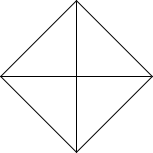
A spinner with equal divisions has the numbers 1, 2 and 3 printed on it.

The probability of spinning the number 2 is \(\dfrac{1}{5}\) and the probability of spinning the number 3 is \(\dfrac{2}{3}\).

What is the probability of spinning the number 1?  (2 marks)

--- 3 WORK AREA LINES (style=lined) ---
Show Answers Only

\(\dfrac{2}{15}\)

Show Worked Solution

\(\text{The sum of all probabilities in an event = 1}\)

\(P\text{(1)}\) \(=1-\Bigg(\dfrac{1}{5}+\dfrac{2}{3}\Bigg)\)
  \(=1-\Bigg(\dfrac{3}{15}+\dfrac{10}{15}\Bigg)\)
  \(=1-\dfrac{13}{15}=\dfrac{2}{15}\)


Filed Under: Probability Tagged With: num-title-ct-core, smc-4225-05-Core concepts

Probability, SM-Bank 087

A bag contains a number of identical red, blue and green discs.

The probability of drawing a red disc is \(\dfrac{2}{3}\) and the probability of drawing a blue disc is \(\dfrac{1}{4}\).

What is the probability of drawing a green disc?  (2 marks)

--- 3 WORK AREA LINES (style=lined) ---

Show Answers Only

\(\dfrac{1}{12}\)

Show Worked Solution

\(\text{The sum of all probabilities in an event = 1}\)

\(P\text{(Green)}\) \(=1-\Bigg(\dfrac{2}{3}+\dfrac{1}{4}\Bigg)\)
  \(=1-\Bigg(\dfrac{8}{12}+\dfrac{3}{12}\Bigg)\)
  \(=1-\dfrac{11}{12}=\dfrac{1}{12}\)


Filed Under: Probability Tagged With: num-title-ct-core, smc-4225-05-Core concepts

Probability, SM-Bank 086

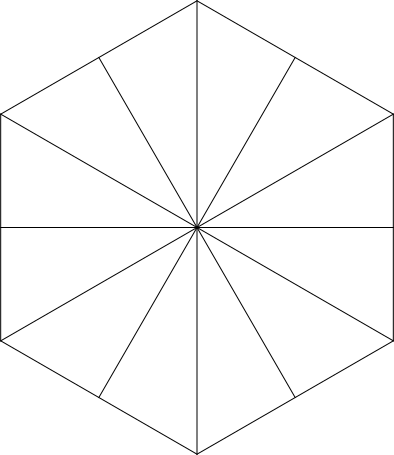
A 12 sided die is rolled. List the favourable outcomes for this event where the number rolled is less than 6.  (1 mark)

--- 1 WORK AREA LINES (style=lined) ---
Show Answers Only

\(\text{{1, 2, 3, 4, 5}}\)

Show Worked Solution

\(\text{Possible outcomes = {1, 2, 3, 4, 5, 6, 7, 8, 9, 10, 11, 12}}\)

\(\text{Favourable outcomes = {1, 2, 3, 4, 5}  (Note: 6 not included)}\)

Filed Under: Probability Tagged With: num-title-ct-core, smc-4225-05-Core concepts

Probability, SM-Bank 085

Jordan and Degas play a board game with the spinner shown.


Jordan spins the arrow.

  1. What is the probability that Jordan spins an even number?  (1 mark)

    --- 3 WORK AREA LINES (style=lined) ---

  2. To win the game you must spin an odd number.
    What is the probability that Jordan will win the game on the next spin?  (1 mark)

    --- 3 WORK AREA LINES (style=lined) ---

Show Answers Only

a.    \(\dfrac{1}{3}\)

b.    \(\dfrac{2}{3}\)

Show Worked Solution
a.    \(P\text{(Even)}\) \(=\dfrac{\text{# even numbers}}{\text{Total numbers}}\)
    \(=\dfrac{3}{9}\)
    \(=\dfrac{1}{3}\)


b.    \(P\text{(Odd)}\) \(=1-P\text{(Even)}\)
    \(=1-\dfrac{1}{3}\)
    \(=\dfrac{2}{3}\)

Filed Under: Probability Tagged With: num-title-ct-core, smc-4225-15-Single-stage events, smc-4225-20-Complementary events

Probability, SM-Bank 084 MC

Which percentage description best describes an event that is likely to occur?

  1. \(\text{Equal to }50\%\)
  2. \(\text{Equal to }0\%\)
  3. \(\text{Greater than }0\%\ \text{but less than }50\%\)
  4. \(\text{Greater than }50\%\ \text{but less than }100\%\)
Show Answers Only

\(D\)

Show Worked Solution

\(\text{An event that is likely to occur has a greater than }50\%\)

\(\text{but less than }100\%\ \text{chance of occurring.}\)

\(\Rightarrow D\)

Filed Under: Probability Tagged With: num-title-ct-core, smc-4225-05-Core concepts

Probability, SM-Bank 083

The letters from the word KITCHEN are written on cards and one is drawn at random.

  1. List the elements of the sample space.  (1 mark)

    --- 1 WORK AREA LINES (style=lined) ---
  2. List the favourable outcomes if the letter chosen is NOT a vowel (a,e, i, o, u).  (1 mark)

    --- 1 WORK AREA LINES (style=lined) ---
  3. For the letter chosen, find \(P\)(letter is a vowel).  (1 mark)

    --- 2 WORK AREA LINES (style=lined) ---
Show Answers Only

a.    \(\text{{K, I, T, C, H, E, N}}\)

b.    \(\text{{K, T, C, H, N}}\)

c.    \(\dfrac{2}{7}\)

Show Worked Solution

a.    \(\text{{K, I, T, C, H, E, N}}\)

b.    \(\text{{K, T, C, H, N}}\)

c.    \(P\text{(is a vowel)}\)

\(=\dfrac{2}{7}\)

Filed Under: Probability Tagged With: num-title-ct-core, smc-4225-05-Core concepts

Probability, SM-Bank 082

A spinner has 8 equal divisions numbered using the even numbers from 2 to 16.

List the sample space for this spinner.  (1 mark)

--- 1 WORK AREA LINES (style=lined) ---

Show Answers Only

\(\text{{2, 4, 6, 8, 10, 12, 14, 16}}\)

Show Worked Solution

\(\text{Sample space = {2, 4, 6, 8, 10, 12, 14, 16}}\)

Filed Under: Probability Tagged With: num-title-ct-core, smc-4225-05-Core concepts

Probability, SM-Bank 081

Guy is going to throw a ten sided dice labelled with the numbers 1 to 10.

He is interested in the likelihood of various events.

  1. List the sample space for throwing this dice.  (1 mark)

    --- 1 WORK AREA LINES (style=lined) ---

  2. List the favourable outcomes if Guy wants a number greater than 7.  (1 mark)

    --- 1 WORK AREA LINES (style=lined) ---

  3. List the favourable outcomes if Guy wants an odd number less than 5.  (1 mark)

    --- 1 WORK AREA LINES (style=lined) ---
  4. Which of the events from (b) and (c) above is more likely?  (1 mark)

    --- 1 WORK AREA LINES (style=lined) ---
Show Answers Only

a.    \(\text{{1, 2, 3, 4, 5, 6, 7, 8, 9, 10}}\)

b.    \(\text{{8, 9, 10}}\)

c.    \(\text{{1, 3}}\)

d.    \(\text{(b) a number > 8}\)

Show Worked Solution

a.    \(\text{Sample space = {1, 2, 3, 4, 5, 6, 7, 8, 9, 10}}\)

b.    \(\text{Numbers}>7= \text{{8, 9, 10}}\)

c.    \(\text{Odd numbers}<5= \text{{1, 3}}\)

d.    \(\text{(b) a number} > 8\ \text{is more likely as it }\)

\(\text{has 1 more favourable outcome than (c).}\)

Filed Under: Probability Tagged With: num-title-ct-core, smc-4225-05-Core concepts

Probability, SM-Bank 080

Ahmed rolled a standard 6-sided dice a number of times. He noticed after numerous rolls that the 5 and 6 were twice as likely to occur than any of the other numbers.

Use the numbers 1, 2, 3, 4, 5 and 6 on the spinner below to create a spinner that would give the same results.  (1 mark)
 

--- 0 WORK AREA LINES (style=lined) ---
Show Answers Only

Show Worked Solution

\(\text{5 and 6 twice as likely}\)

\(\longrightarrow\ \text{Spinner has 6 + 2 sections}\)

\(\therefore\ \text{5 and 6 take up 2 sections each and 1, 2, 3 and 4 one section each.}\)

Filed Under: Probability Tagged With: num-title-ct-core, smc-4225-05-Core concepts

Probability, SM-Bank 079

Using the numbers 1, 2 and 3 label, the spinner below so that 3 is twice as likely to occur as either of the other numbers.  (1 mark)
 

--- 0 WORK AREA LINES (style=lined) ---
Show Answers Only

Show Worked Solution

\(\text{3 twice as likely}\)

\(\therefore\ \text{3 takes up 2 sections and 1 and 2 each take up 1 section.}\)

Filed Under: Probability Tagged With: num-title-ct-core, smc-4225-05-Core concepts

Probability, SM-Bank 078

Shade the spinner below so that white is 2 times more likely to occur than grey.  (1 mark)
 

--- 0 WORK AREA LINES (style=lined) ---

Show Answers Only

Show Worked Solution

\(\text{White 2 times more likely}\)

\(\therefore\ \text{White takes up }\dfrac{8}{12}=\dfrac{2}{3}\text{ and grey}\dfrac{4}{12}=\dfrac{1}{3}.\)

Filed Under: Probability Tagged With: num-title-ct-core, smc-4225-05-Core concepts

Probability, SM-Bank 077

Shade the spinner below so that white is 2 times more likely to occur than grey.  (1 mark)
 

--- 0 WORK AREA LINES (style=lined) ---
Show Answers Only

Show Worked Solution

\(\text{White 2 times more likely}\)

\(\therefore\ \text{White takes up }\dfrac{4}{6}=\dfrac{2}{3}\text{ and grey}\dfrac{2}{6}=\dfrac{1}{3}.\)

Filed Under: Probability Tagged With: num-title-ct-core, smc-4225-05-Core concepts

Probability, SM-Bank 076

Shade the spinner below so that white is 3 times more likely to occur than grey.  (1 mark)
 

--- 0 WORK AREA LINES (style=lined) ---

Show Answers Only

Show Worked Solution

\(\text{White 3 times more likely}\)

\(\therefore\ \text{White each take up }\dfrac{3}{4}\text{ and grey}\dfrac{1}{4}.\)

Filed Under: Probability Tagged With: num-title-ct-core, smc-4225-05-Core concepts

Probability, SM-Bank 075

Shade the spinner below so that grey and white have an even chance of occurring.  (1 mark)
 

--- 0 WORK AREA LINES (style=lined) ---

Show Answers Only

Show Worked Solution

\(\text{Even chance}\)

\(\therefore\ \text{Grey and white each take up half the spinner.}\)

Filed Under: Probability Tagged With: num-title-ct-core, smc-4225-05-Core concepts

Probability, SM-Bank 074

Given that white and yellow are equally likely, shade the spinner below so that blue is twice as likely to occur as either white or yellow.  (1 mark)
 

--- 0 WORK AREA LINES (style=lined) ---

Show Answers Only

Show Worked Solution

\(\text{Blue is is twice as likely as white or yellow}\)

\(\therefore\ \text{Blue takes up half the circle and white }\)

\(\ \ \ \ \text{and yellow each take up one quarter.}\)

Filed Under: Probability Tagged With: num-title-ct-core, smc-4225-05-Core concepts

Probability, SM-Bank 073

Shade the spinner below so that blue is certain to occur.  (1 mark)
 

--- 0 WORK AREA LINES (style=lined) ---

Show Answers Only

Show Worked Solution

\(\text{Blue is certain}\)

\(\therefore\ \text{blue takes up whole circle}\)

Filed Under: Probability Tagged With: num-title-ct-core, smc-4225-05-Core concepts

Probability, SM-Bank 072

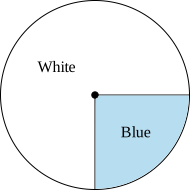
Shade the spinner below so that white is 3 times more likely to occur than blue.  (1 mark)
 

--- 0 WORK AREA LINES (style=lined) ---
Show Answers Only

Show Worked Solution

\(\text{White 3 times more likely }\)

\(\therefore\ \text{white takes up }\dfrac{3}{4}\text{ of circle and blue }\dfrac{1}{4}\)

Filed Under: Probability Tagged With: num-title-ct-core, smc-4225-05-Core concepts

Probability, SM-Bank 071

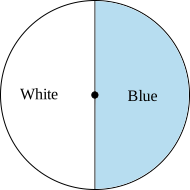
Shade the spinner below so that blue and white have an even chance of occurring.  (1 mark)
 

--- 0 WORK AREA LINES (style=lined) ---

Show Answers Only

Show Worked Solution

\(\text{Even chance }=\dfrac{1}{2}\text{ white and }\dfrac{1}{2}\text{ blue}\)

Filed Under: Probability Tagged With: num-title-ct-core, smc-4225-05-Core concepts

Probability, SM-Bank 070

Tom has a dice and rolls it repeatedly 54 times, each time recording which side faces up.

How many times should he expect to see the side four coming up?  (2 marks)

--- 3 WORK AREA LINES (style=lined) ---

Show Answers Only

\(9\text{ times}\)

Show Worked Solution
\(\text{Number of times a 4}\) \(=P\text{(4 on die)}\times 54\)
  \(=\dfrac{1}{6}\times 54\)
  \(=9\)

 
\(\therefore\ \text{A 4 would be expected 9 times.}\)

Filed Under: Probability Tagged With: num-title-ct-core, smc-4225-35-Relative frequency

Probability, SM-Bank 069

Wendy has a number of different types of flowers as shown in the table below. 
 

\begin{array} {|c|c|}
\hline
\rule{0pt}{2.5ex} \textbf{Type of Flower} \rule[-1ex]{0pt}{0pt} & \textbf{Number of Flowers} \\
\hline
\rule{0pt}{2.5ex} \text{Carnation} \rule[-1ex]{0pt}{0pt} & 8 \\
\hline
\rule{0pt}{2.5ex} \text{Tulip} \rule[-1ex]{0pt}{0pt} & 6 \\
\hline
\rule{0pt}{2.5ex} \text{Dandelion} \rule[-1ex]{0pt}{0pt} & 10 \\
\hline
\rule{0pt}{2.5ex} \text{Rose} \rule[-1ex]{0pt}{0pt} & 8 \\
\hline
\end{array}

  1. What is the probability that a randomly selected flower will be either a carnation or a tulip?  (2 marks)

    --- 3 WORK AREA LINES (style=lined) ---
  2. What is the probability that a randomly selected flower will not be a rose?  (2 marks)

    --- 5 WORK AREA LINES (style=lined) ---

Show Answers Only

a.    \(\dfrac{7}{16}\)

b.    \(\dfrac{3}{4}\)

Show Worked Solution
a.    \(P\text{(carnation or tulip)}\) \(=\dfrac{\text{number carnations + number tulips}}{\text{total number of flowers}}\)
    \(=\dfrac{8+6}{32}\)
    \(=\dfrac{14}{32}=\dfrac{7}{16}\)


b.    \(P\text{(not a rose)}\) \(=1-P\text{(is a rose)}\)
    \(=1-\dfrac{\text{number roses}}{\text{total number of flowers}}\)
    \(=1-\dfrac{8}{32}\)
    \(=1-\dfrac{1}{4}\)
    \(=\dfrac{3}{4}\)

Filed Under: Probability Tagged With: num-title-ct-core, smc-4225-15-Single-stage events, smc-4225-20-Complementary events

Probability, SM-Bank 068 MC

A biased die has 6 faces numbered from 1 to 6.

Jackson throws the die 60 times and records the results in the table below.
 

\begin{array} {|c|c|}
\hline
\rule{0pt}{2.5ex} \textbf{Number} \rule[-1ex]{0pt}{0pt} & \ \ 1\ \ & \ \ 2 \ \ & \ \ 3 \ \ & \ \ 4 \ \ & \ \ 5 \ \ & \ \ 6 \ \ \\
\hline
\rule{0pt}{2.5ex} \textbf{Times} \rule[-1ex]{0pt}{0pt} & \ \ 8\ \ & \ \ 14 \ \ & \ \ 9 \ \ & \ \ 13 \ \ & \ \ 7 \ \ & \ \ 9 \\
\hline
\end{array} 

Using the table, what is the probability that Jackson throws a 2 on his next throw?

  1. \(\dfrac{7}{30}\)
  2. \(\dfrac{14}{46}\)
  3. \(\dfrac{1}{5}\)
  4. \(\dfrac{1}{6}\)

Show Answers Only

\(A\)

Show Worked Solution
\(P(2)\) \(=\dfrac{\text{Number of 2’s}}{\text{Total number of throws}}\)
  \(=\dfrac{14}{60}\)
  \(=\dfrac{7}{30}\)

 
\(\Rightarrow A\)

Filed Under: Probability Tagged With: num-title-ct-core, smc-4225-35-Relative frequency

Probability, SM-Bank 067

A bag of coloured balls contains 10 blue balls, 12 white balls, 5 black balls, 2 red balls, and 9 orange balls.

Joyce grabs a ball from the bag without looking what is inside.

What is the probability that she grabs an white ball?  (1 mark)

--- 3 WORK AREA LINES (style=lined) ---
Show Answers Only

\(\dfrac{6}{19}\)

Show Worked Solution
\(P\text{(White ball)}\) \(=\dfrac{\text{Total white balls}}{\text{Total balls}}\)
  \(=\dfrac{12}{10+12+5+2+9}\)
  \(=\dfrac{12}{38}\)
  \(=\dfrac{6}{19}\)

Filed Under: Probability Tagged With: num-title-ct-core, smc-4225-15-Single-stage events

Probability, SM-Bank 066

A bag contains different coloured balls.

It contains 4 red balls, 8 green balls, 3 pink balls, 6 grey balls and 11 yellow balls.

Nathalie picks a ball from the bag without looking.

  1. What is the chance that she draws a grey ball?  (1 mark)

    --- 3 WORK AREA LINES (style=lined) ---

  2. What is the chance that the ball she draws in not pink?  (2 marks)

    --- 4 WORK AREA LINES (style=lined) ---

Show Answers Only

a.    \(\dfrac{3}{16}\)

b.    \(\dfrac{29}{32}\)

Show Worked Solution
a.    \(P\text{(Grey ball)}\) \(=\dfrac{\text{Number of grey balls}}{\text{Total number of balls}}\)
    \(=\dfrac{6}{4+8+3+6+11}\)
    \(=\dfrac{6}{32}\)
    \(=\dfrac{3}{16}\)


b.    \(P\text{(not pink ball)}\) \(=1-P\text{(pink ball)}\)
    \(=1-\dfrac{\text{Number of pink balls}}{\text{Total number of balls}}\)
    \(=1-\dfrac{3}{32}\)
    \(=\dfrac{29}{32}\)

Filed Under: Probability Tagged With: num-title-ct-core, smc-4225-15-Single-stage events, smc-4225-20-Complementary events

Probability, SM-Bank 065 MC

Newton holds an apple in his outstretched hand and releases it.

Which number below represents the probability that it will travel towards the ground?

  1. 0.0
  2. 0.5
  3. 1.0
  4. 1.99
Show Answers Only

\(1.0\)

Show Worked Solution

\(\text{A certain event has a probability of 1.0.}\)

\(\Rightarrow C\)

Filed Under: Probability Tagged With: num-title-ct-core, smc-4225-05-Core concepts

Probability, SM-Bank 064

A biased die is rolled.

The probability of rolling an even number is 56%.

What is the probability of rolling an odd number?  (1 mark)

--- 3 WORK AREA LINES (style=lined) ---

Show Answers Only

\(44\%\)

Show Worked Solution

\(P\text{(odd number)}\)

  \(=1-P\text{(even number)}\)
  \(=1-0.56\)
  \(=0.44\)
  \(=44\%\)

Filed Under: Probability Tagged With: num-title-ct-core, smc-4225-20-Complementary events

Probability, SM-Bank 063

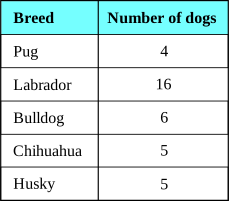
Victoria runs a pet store that sells pure breed dogs.

She has several dogs in the shop from different breeds.


  1. If one of Victoria's dogs is chosen at random, what is the probability it will be either a labrador or a pug?  (1 mark)

    --- 3 WORK AREA LINES (style=lined) ---

  2. If one of the dogs is chosen at random, what is the probability that the dog is not a bulldog?  (2 marks)

    --- 3 WORK AREA LINES (style=lined) ---
Show Answers Only

a.    \(\dfrac{5}{9}\)

b.    \(\dfrac{5}{6}\)

Show Worked Solution
a.    \(P\text{(Labrador or Pug)}\) \(=\dfrac{\text{Number of Labrador and Pug}}{\text{Total dogs}}\)
    \(=\dfrac{16 + 4}{4+16+6+5+5}\)
    \(=\dfrac{20}{36}=\dfrac{5}{9}\)


b.    \(P\text{(Dog not a bulldog)}\) \(=1-P\text{(Dog is a bulldog)}\)
    \(=1-\dfrac{6}{36}\)
    \(=\dfrac{30}{36}=\dfrac{5}{6}\)

Filed Under: Probability Tagged With: num-title-ct-core, smc-4225-15-Single-stage events, smc-4225-20-Complementary events

Probability, SM-Bank 062

Tristan's laundromat has a lost clothing basket that contains only black and white socks.

The probability of randomly picking a black sock from the basket is 35%.

What is the probability of randomly picking a white sock?  (1 mark)

--- 3 WORK AREA LINES (style=lined) ---
Show Answers Only

\(65\%\)

Show Worked Solution

\(P\text{(white)}+P\text{(Black)}=100\%\)

\(\therefore\ P\text{(white)}\) \(=100-P\text{(black)}\)
  \(=100-35\)
  \(=65\%\)

Filed Under: Probability Tagged With: num-title-ct-core, smc-4225-20-Complementary events

Probability, SM-Bank 061

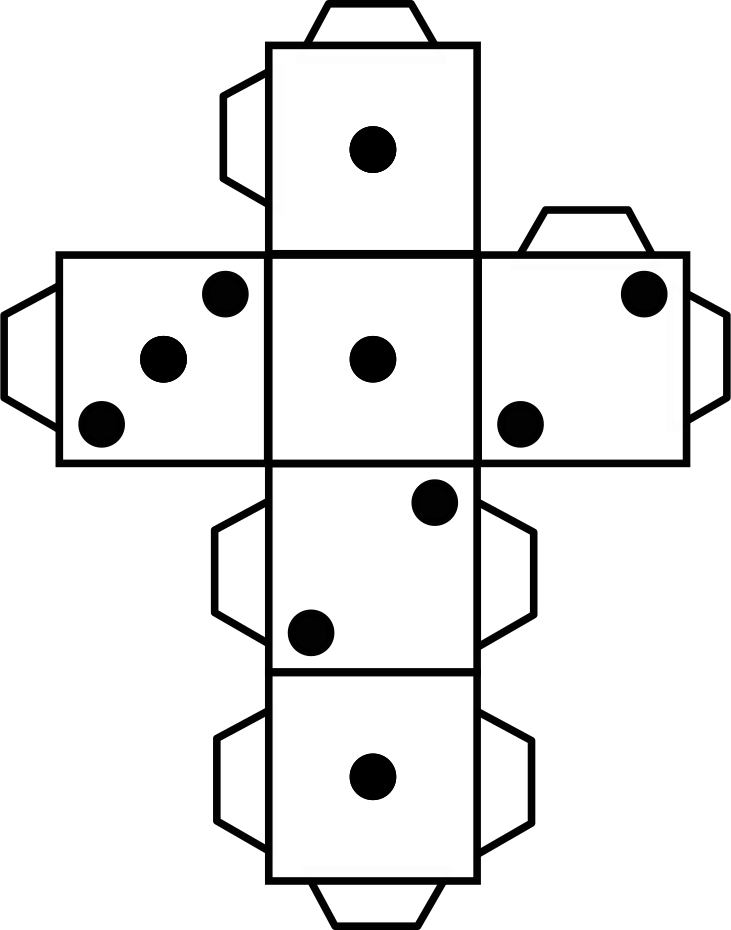
Chusi uses this net to make a dice.


  1. Chusi rolls the dice once. What is the chance that Chusi will roll a 2? (1 mark)

    --- 2 WORK AREA LINES (style=lined) ---

  2. Chusi makes up a game and to win the game you must roll a number larger than 2.
    What is the chance that Chusi will win the game on her next roll?  (1 mark)

    --- 2 WORK AREA LINES (style=lined) ---

  3. If Chusi rolls the dice 108 times, how many times could she expect to win the game?  (1 mark)

    --- 3 WORK AREA LINES (style=lined) ---

Show Answers Only

a.    \(\dfrac{1}{3}\)

b.    \(\dfrac{1}{6}\)

c.    \(18\ \text{times}\)

Show Worked Solution
a.    \(P(2)\) \(=\dfrac{\text{number of 2’s}}{\text{total possibilities}}\)
    \(=\dfrac{2}{6}\)
    \(=\dfrac{1}{3}\)


b.    \(P\text{(number>2)}\) \(=\dfrac{\text{number of 3’s}}{\text{total possibilities}}\)
    \(=\dfrac{1}{6}\)

\(\therefore\ \text{Chusi’s chance of winning on the next roll is }\dfrac{1}{6}.\)
 

c.    \(\text{Expected wins}\) \(=\text{number of rolls}\times \text{probability of winning}\)
    \(=108\times \dfrac{1}{6}\)
    \(=18\)

\(\therefore\ \text{Chusi could expect to win 18 times with 108 rolls.}\)

Filed Under: Probability Tagged With: num-title-ct-core, smc-4225-15-Single-stage events, smc-4225-35-Relative frequency

Probability, SM-Bank 060 MC

Benji randomly picks one disc from the group of white and coloured discs, pictured below.


What is the probability Benji chooses a white disc?

  1. \(\dfrac{2}{3}\)
  2. \(\dfrac{8}{13}\)
  3. \(\dfrac{8}{21}\)
  4. \(\dfrac{13}{21}\)
Show Answers Only

\(D\)

Show Worked Solution
\(P\text{(White disc)}\) \(=\dfrac{\text{Number of white discs}}{\text{Total discs}}\)
  \(=\dfrac{13}{21}\)

\(\Rightarrow D\)

Filed Under: Probability Tagged With: num-title-ct-core, smc-4225-15-Single-stage events

Probability, SM-Bank 059 MC

Ashanti works in the city on weekdays and has weekends off.

She catches a bus to work 3 days each week and drives two days.

If today is a weekday, what is the probability that Ashanti catches a bus to work?

  1. \(3\%\)
  2. \(0.30\)
  3. \(\dfrac{3}{7}\)
  4. \(\dfrac{3}{5}\)
Show Answers Only

\(D\)

Show Worked Solution
\(P\text{(Bus)}\) \(=\dfrac{\text{favourable events}}{\text{total possible events}}\)
  \(=\dfrac{3}{5}\)

\(\Rightarrow D\)

Filed Under: Probability Tagged With: num-title-ct-core, smc-4225-15-Single-stage events

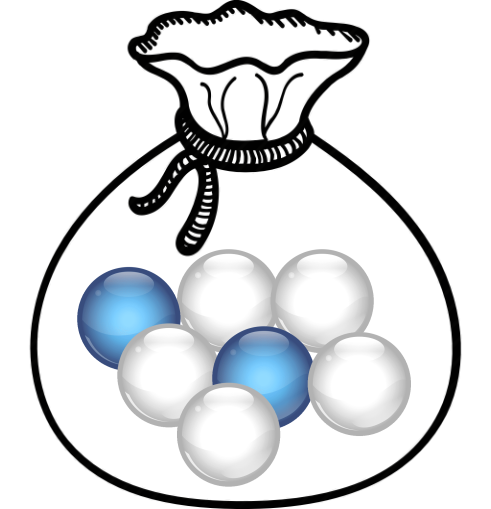
Probability, SM-Bank 058 MC

A bag of balls contains only blue and white balls.

Jimoen picks one ball from the bag.

What is the chance the ball is white?

  1. \(\dfrac{2}{7}\)
  2. \(\dfrac{1}{3}\)
  3. \(\dfrac{2}{5}\)
  4. \(\dfrac{5}{7}\)
Show Answers Only

\(D\)

Show Worked Solution
\(P\text{(white)}\) \(=\dfrac{\text{Number of white balls}}{\text{Total number of balls}}\)
  \(=\dfrac{5}{7}\)

\(\Rightarrow D\)

Filed Under: Probability Tagged With: num-title-ct-core, smc-4225-15-Single-stage events

Probability, SM-Bank 057 MC

Blinky is blowing up balloons for a birthday party.

The number of blown up balloons of each colour is recorded in the table below.

\begin{array} {|l|c|}
\hline
\rule{0pt}{2.5ex} \textbf{Colour} \rule[-1ex]{0pt}{0pt} & \textbf{Number of Balloons} \\
\hline
\rule{0pt}{2.5ex} \text{white} \rule[-1ex]{0pt}{0pt} & 11 \\
\hline
\rule{0pt}{2.5ex} \text{purple} \rule[-1ex]{0pt}{0pt} & 7 \\
\hline
\rule{0pt}{2.5ex} \text{orange} \rule[-1ex]{0pt}{0pt} & 6 \\
\hline
\rule{0pt}{2.5ex} \text{yellow} \rule[-1ex]{0pt}{0pt} & 9 \\
\hline
\end{array}

Blinky picks one balloon without looking and gives it to the first person who arrives at the party.

What is the chance it is white?

  1. \(\dfrac{1}{11}\)
  2. \(\dfrac{1}{27}\)
  3. \(\dfrac{1}{2}\)
  4. \(\dfrac{1}{3}\)
Show Answers Only

\(D\)

Show Worked Solution
\(P\text{(white)}\) \(=\dfrac{\text{Number of white balloons}}{\text{Total number of balloons}}\)
  \(=\dfrac{11}{11+7+6+9}\)
  \(=\dfrac{11}{33}\)
  \(=\dfrac{1}{3}\)

\(\Rightarrow D\)

Filed Under: Probability Tagged With: num-title-ct-core, smc-4225-35-Relative frequency

Probability, SM-Bank 056

Marie has a bag containing various coloured balls.

Marie grabs a coloured ball from the bag and records the colour.

She then puts the ball back into the bag and repeats this process a number of times.

 
\begin{array} {|c|c|}
\hline
\rule{0pt}{2.5ex} \text{Orange} \rule[-1ex]{0pt}{0pt} & \ \ \text{Blue}\ \ \rule[-1ex]{0pt}{0pt} & \ \ \text{Red}\ \ \rule[-1ex]{0pt}{0pt} & \text{Green} \rule[-1ex]{0pt}{0pt} \ & \text{White} \rule[-1ex]{0pt}{0pt} & \text{Black} \rule[-1ex]{0pt}{0pt} & \text{Yellow} \rule[-1ex]{0pt}{0pt} \\
\hline
13 & 20 & 18 & 9 & 12 & 14 & 10\\
\hline
\end{array} 

Using the table, what is the probability that the next ball picked out by Marie will be yellow? (2 marks)

--- 3 WORK AREA LINES (style=lined) ---

Show Answers Only

\(\dfrac{1}{6}\)

Show Worked Solution
\(P \text{(white)}\) \(=\dfrac{\text{Number of white}}{\text{Total number of selections}}\)
  \(=\dfrac{12}{13 + 20 + 18 + 9 + 12 + 14 + 10}\)
  \(=\dfrac{12}{96}\)
  \(=\dfrac{1}{8}\)

Filed Under: Probability Tagged With: num-title-ct-core, smc-4225-35-Relative frequency

Probability, SM-Bank 055

Jackson spins a wheel with 5 different coloured sections and records which colour it lands on each time.

He repeats the process multiple times.

The table below shows the results.
 

\begin{array} {|c|c|}
\hline
\rule{0pt}{2.5ex} \text{White} \rule[-1ex]{0pt}{0pt} & \text{Yellow} \rule[-1ex]{0pt}{0pt} & \ \ \text{Red}\ \ \rule[-1ex]{0pt}{0pt} & \ \text{Blue} \rule[-1ex]{0pt}{0pt}\ \ & \text{Green} \rule[-1ex]{0pt}{0pt} \\
\hline
40 & 26 & 36 & 28 & 38\\
\hline
\end{array} 

Using the table, what is the probability that the next spin will be Blue?  (2 marks)

--- 3 WORK AREA LINES (style=lined) ---

Show Answers Only

\(\dfrac{1}{6}\)

Show Worked Solution
\(P \text{(Blue)}\) \(=\dfrac{\text{Number of blue}}{\text{Total number of throws}}\)
  \(=\dfrac{28}{40 + 26 + 36 + 28 + 38}\)
  \(=\dfrac{28}{168}\)
  \(=\dfrac{1}{6}\)

Filed Under: Probability Tagged With: num-title-ct-core, smc-4225-35-Relative frequency

Probability, SM-Bank 054

The two spinners shown are used in a game.

2UG 2011 26a1

Each arrow is spun once. The score is the total of the two numbers shown by the arrows.
A table is drawn up to show all scores that can be obtained in this game.

2UG 2011 26a2

  1. What is the value of \(X\) in the table?  (1 mark)

    --- 0 WORK AREA LINES (style=lined) ---

  2. What is the probability of obtaining a score less than 4?  (1 mark)

    --- 1 WORK AREA LINES (style=lined) ---

  3. On Spinner \(B\), a 2 is obtained. What is the probability of obtaining a score of 3?  (1 mark)

    --- 2 WORK AREA LINES (style=lined) ---

Show Answers Only

a.    \(5\)

b.    \(\dfrac{1}{2}\)

c.    \(\dfrac{2}{3}\)

Show Worked Solution

a.    \(X=2+3=5\)

b.    \(P\text{(score < 4)}=\dfrac{6}{12}=\dfrac{1}{2}\)

c.   \(\text{Given Spinner } B =2\)

\(\text{Possible spins }\rightarrow\ (2 , 1), (2 , 1), (2 , 3)\)

\(P\text{(score = 3)}=\dfrac{2}{3}\)

Filed Under: Probability Tagged With: num-title-ct-core, smc-4225-45-Multi-stage events

Probability, SM-Bank 053

Two unbiased dice,  \(A\)  and  \(B\), with faces numbered  \(1\),  \(2\),  \(3\),  \(4\),  \(5\) and  \(6\) are rolled.

The numbers on the uppermost faces are noted. This table shows all the possible outcomes.

 
\begin{align}
\textbf{Die B } \
\begin{array}{c }
\textbf{Die A } \\
\begin{array}{c|c|c|c|c|c|c}
\ & 1 & 2 & 3 & 4 & 5 & 6  \\
\hline
\ 1 & 1,1 & 1,2 & 1,3 & 1,4 & 1,5 & 1,6  \\
\hline
\ 2 & 2,1 & 2,2 & 2,3 & 2,4 & 2,5 & 2,6  \\
\hline
\ 3 & 3,1 & 3,2 & 3,3 & 3,4 & 3,5 & 3,6  \\
\hline
\ 4 & 4,1 & 4,2 & 4,3 & 4,4 & 4,5 & 4,6  \\
\hline
\ 5 & 5,1 & 5,2 & 5,3 & 5,4 & 5,5 & 5,6  \\
\hline
\ 6 & 6,1 & 6,2 & 6,3 & 6,4 & 6,5 & 6,6  \\
\end{array}
\end{array}
\end{align}


A game is played where the difference between the highest number showing and the lowest number showing on the uppermost faces is calculated.

What is the probability that the difference between the numbers showing on the uppermost faces of the two dice is one?   (2 marks)

--- 3 WORK AREA LINES (style=lined) ---

Show Answers Only

\(\dfrac{5}{18}\)

Show Worked Solution

\begin{align}
\textbf{Die B } \
\begin{array}{c }
\textbf{Die A } \\
\begin{array}{c|c|c|c|c|c|c}
\ & 1 & 2 & 3 & 4 & 5 & 6  \\
\hline
\ 1 & 1,1 & \colorbox{lightblue}{1,2} & 1,3 & 1,4 & 1,5 & 1,6  \\
\hline
\ 2 & \colorbox{lightblue}{2,1} & 2,2 & \colorbox{lightblue}{2,3} & 2,4 & 2,5 & 2,6  \\
\hline
\ 3 & 3,1 & \colorbox{lightblue}{3,2} & 3,3 & \colorbox{lightblue}{3,4} & 3,5 & 3,6  \\
\hline
\ 4 & 4,1 & 4,2 & \colorbox{lightblue}{4,3} & 4,4 & \colorbox{lightblue}{4,5} & 4,6  \\
\hline
\ 5 & 5,1 & 5,2 & 5,3 & \colorbox{lightblue}{5,4} & 5,5 & \colorbox{lightblue}{5,6}  \\
\hline
\ 6 & 6,1 & 6,2 & 6,3 & 6,4 & \colorbox{lightblue}{6,5} & 6,6  \\
\end{array}
\end{array}
\end{align}


\(\text{# Outcomes with a difference of 1}\)

\(=10\)

\(\therefore\ P \text{(diff of 1)}=\dfrac{10}{36}=\dfrac{5}{18}\)

Filed Under: Probability Tagged With: num-title-ct-core, smc-4225-45-Multi-stage events

Probability, SM-Bank 052

A random sample of people were asked what is their favourite winter sport.

The table below recorded the results.
 

\begin{array} {|l|c|}
\hline
\rule{0pt}{2.5ex} \textbf{Sport} \rule[-1ex]{0pt}{0pt} & \textbf{Number of People} \\
\hline
\rule{0pt}{2.5ex} \text{Netball} \rule[-1ex]{0pt}{0pt} & \text{49} \\
\hline
\rule{0pt}{2.5ex} \text{Aussie Rules} \rule[-1ex]{0pt}{0pt} & \text{19} \\
\hline
\rule{0pt}{2.5ex} \text{Rugby League} \rule[-1ex]{0pt}{0pt} & \text{135} \\
\hline
\rule{0pt}{2.5ex} \text{Ice Hockey} \rule[-1ex]{0pt}{0pt} & \text{13} \\
\hline
\end{array}

Using the data from the survey, predict how many people would choose rugby league if 2000 people were surveyed.  (2 marks)

--- 5 WORK AREA LINES (style=lined) ---

Show Answers Only

\(1250\)

Show Worked Solution

\(\text{Total people surveyed}\)

\(=49+19+135+13\)

\(=216\)

\(\therefore\ \text{Predicted number to choose rugby league}\)

\(=P\text{(Rugby League)}\times 2000\)

\(=\dfrac{135}{216}\times 2000\)

\(=1250\)

Filed Under: Probability Tagged With: num-title-ct-core, smc-4225-35-Relative frequency

Probability, SM-Bank 051

In any standard six-sided dice, the sum of the opposite faces is 7.

Milo rolls 3 dice and the total of the top faces is 5.

What is the sum of the three opposite faces?  (2 marks)

--- 5 WORK AREA LINES (style=lined) ---

Show Answers Only

\(16\)

Show Worked Solution

\(\text{Sum of 3 top faces + 3 opposite}\)

\(=3\times 7\)

\(=21\)

\(\therefore\ \text{Sum of 3 opposite faces}\)

\(=21-5\)

\(=16\)

Filed Under: Probability Tagged With: num-title-ct-core, smc-4225-45-Multi-stage events

Probability, SM-Bank 050

Mandy surveyed all year 7 students about their favourite flavour of milkshake.


Which flavour did 4 out of 10 year 7 students choose as their favourite?  (2 marks)

--- 5 WORK AREA LINES (style=lined) ---

Show Answers Only

\(\text{Vanilla}\)

Show Worked Solution
\(\text{Total students}\) \(=75+100+35+40\)
  \(=250\)

 
\(\text{If 4 out of 10 students chose a certain flavour,}\)

\(\text{Number of students}\)

\(=\dfrac{4}{10}\times 250\)

\(=100\)
 

\(\therefore\ \text{4 out of 10 students choose Vanilla.}\)

Filed Under: Probability Tagged With: num-title-ct-core, smc-4225-35-Relative frequency

Probability, SM-Bank 049

Maxi and Jim are playing a dice game.

They have two standard 6-sided dice.

One of the die is white and the other is grey.

Maxi needs to roll a total of 11 to win.

There are two different ways she can roll a total of 11 as shown.


Jim has to roll a 6 to win.

How many different ways can Jim roll a total of 6?  (1 mark)

--- 3 WORK AREA LINES (style=lined) ---

Show Answers Only

\(\text{5 different ways.}\)

Show Worked Solution

\(\text{The table below shows the ways a sum of 6 can be rolled.}\)

\(\therefore\ \text{5 different ways.}\)

Filed Under: Probability Tagged With: num-title-ct-core, smc-4225-45-Multi-stage events

Probability, SM-Bank 048

Rachel has a bag that contains 6 blue and 4 green balls.

She selects one ball at random and records its colour. The ball is then put back into the bag.

Rachel does this 50 times.

How many times should Rachel expect to select a green ball from the bag?  (2 marks)

Show Answers Only

\(20\)

Show Worked Solution

\(P\text{(picking green)}=\dfrac{4}{10}=\dfrac{2}{5}\)

\(\therefore\ \text{Expected green balls}\) \(=\dfrac{2}{5}\times 50\)
  \(=20\)

Filed Under: Probability Tagged With: num-title-ct-core, smc-4225-35-Relative frequency

Probability, SM-Bank 047

Sharon made 24 milkshakes at her nephew's birthday party. The milkshakes were either vanilla or chocolate.

All the milkshakes were served in an aluminium cup and looked the same.

Murray took one milkshake and had a 1 in 8 chance of taking a vanilla milkshake.

How many chocolate milkshakes did Sharon make?  (2 marks)

--- 5 WORK AREA LINES (style=lined) ---

Show Answers Only

\(21\)

Show Worked Solution

\(\text{Number of vanilla milkshakes}\)

\(=\dfrac{1}{8}\times 24\)

\(=3\)
 

\(\therefore\ \text{Number of chocolate}\)

\(=24-3\)

\(=21\)

Filed Under: Probability Tagged With: num-title-ct-core, smc-4225-15-Single-stage events

Probability, SM-Bank 046 MC

A standard six-sided dice is rolled once.

What is the probability that the number on the top face is a factor of 4?

  1. \(\dfrac{5}{6}\)
  2. \(\dfrac{1}{2}\)
  3. \(\dfrac{1}{3}\)
  4. \(\dfrac{1}{6}\)
Show Answers Only

\(B\)

Show Worked Solution

\(\text{Factors of 4 are: 1, 4, 2}\)

\(\therefore\ P\text{(factor of 4)}\) \(=\dfrac{3}{6}\)
  \(=\dfrac{1}{2}\)

 
\(\Rightarrow B\)

Filed Under: Probability Tagged With: num-title-ct-core, smc-4225-15-Single-stage events

Probability, SM-Bank 045

Albert has 50 marbles in a bag.

He records the colour of each marble in the table below.

\begin{array} {|c|c|}
\hline
\rule{0pt}{2.5ex} \textbf{Marble} \rule[-1ex]{0pt}{0pt} & \textbf{Number of Marbles} \\
\hline
\rule{0pt}{2.5ex} \text{Blue} \rule[-1ex]{0pt}{0pt} & \text{20} \\
\hline
\rule{0pt}{2.5ex} \text{Red} \rule[-1ex]{0pt}{0pt} & \text{12} \\
\hline
\rule{0pt}{2.5ex} \text{Orange} \rule[-1ex]{0pt}{0pt} & \text{4} \\
\hline
\rule{0pt}{2.5ex} \text{White} \rule[-1ex]{0pt}{0pt} & \text{?} \\
\hline
\rule{0pt}{2.5ex} \textbf{TOTAL} \rule[-1ex]{0pt}{0pt} & \textbf{50} \\
\hline
\end{array}

  1. What percentage of the marbles are white?  (1 mark)

    --- 2 WORK AREA LINES (style=lined) ---

  2. If Albert draws a marble from the bag at random, what is the probability that the marble will be orange or white? Give your answer as a fraction in simplest form.  (2 marks)

    --- 3 WORK AREA LINES (style=lined) ---

Show Answers Only

a.    \(28\%\)

b.    \(\dfrac{9}{25}\)

Show Worked Solution

a.    \(\text{Number of white marbles}\)

 \(=50-(20+12+4)\)

\(=14\)

\(\therefore\ \%\text{ white}\) \(=\dfrac{14}{50}\times 100\)
  \(=28\%\)
b.    \(P\text{(Orange or white)}\) \(=\dfrac{\text{number orange and white}}{\text{total number of marbles}}\)
    \(=\dfrac{4+14}{50}=\dfrac{18}{50}\)
    \(=\dfrac{9}{25}\)

Filed Under: Probability Tagged With: num-title-ct-core, smc-4225-15-Single-stage events

Probability, SM-Bank 044

Ronald rolled a standard dice 80 times.

He recorded if an odd or even number was rolled, each time, and wrote the results in the table below.
 

\begin{array} {|l|c|}
\hline
\rule{0pt}{2.5ex} \text{} \rule[-1ex]{0pt}{0pt} & \textbf{Number of times} \\
\hline
\rule{0pt}{2.5ex} \textbf{Odd} \rule[-1ex]{0pt}{0pt} & \text{33} \\
\hline
\rule{0pt}{2.5ex} \textbf{Even} \rule[-1ex]{0pt}{0pt} & \text{47} \\
\hline
\end{array}

What is the difference between the expected number of odd rolls and the actual number recorded?  (2 marks)

--- 5 WORK AREA LINES (style=lined) ---

Show Answers Only

\(7\)

Show Worked Solution

\(\text{50% = the probability of an odd roll.}\)

\(\text{Expected odd rolls}\)

\(=50\%\times 80\)

\(=40\)
 

\(\therefore\ \text{Difference}\) \(=40-33\)
  \(=7\)

Filed Under: Probability Tagged With: num-title-ct-core, smc-4225-35-Relative frequency

Probability, SM-Bank 043 MC

Aurora rolls a standard six-sided die.

Which of the following events has a probability of less than 0.5?

  1. rolling a number greater than 1
  2. rolling an odd number
  3. rolling a number less than 5
  4. rolling a number greater than or equal to 6
Show Answers Only

\(D\)

Show Worked Solution

\(\text{Considering each option}\)

\(\text{Option A: }\ P\text{(number > 1)}=\dfrac{5}{6}=0.83\)

\(\text{Option B: }\ P\text{(odd number)}=\dfrac{3}{6}=0.5\)

\(\text{Option C: }\ P\text{(number < 5)}=\dfrac{4}{6}=0.67\)

\(\text{Option D: }\ P\text{(number}\geq 6)=\dfrac{1}{6}=0.17\ \checkmark\)

 
\(\Rightarrow D\)

Filed Under: Probability Tagged With: num-title-ct-core, smc-4225-15-Single-stage events

Probability, SM-Bank 042

Archer did a survey of his class, asking everyone what their favourite ice cream flavour is.

This table below shows the results.
 

\begin{array} {|l|c|}
\hline
\rule{0pt}{2.5ex} \textbf{Flavour} \rule[-1ex]{0pt}{0pt} & \textbf{Number of Classmates} \\
\hline
\rule{0pt}{2.5ex} \text{Chocolate} \rule[-1ex]{0pt}{0pt} & 14\\
\hline
\rule{0pt}{2.5ex} \text{Vanilla} \rule[-1ex]{0pt}{0pt} & 17 \\
\hline
\rule{0pt}{2.5ex} \text{Strawberry} \rule[-1ex]{0pt}{0pt} & 8 \\
\hline
\end{array}

What is the probability that a randomly selected classmate's favourite flavour is chocolate?

Round your answer to the nearest hundredth.  (2 marks)

--- 3 WORK AREA LINES (style=lined) ---

Show Answers Only

\(0.39\)

Show Worked Solution
\(P\text{(likes chocolate)}\) \(=\dfrac{\text{number who chose chocolate}}{\text{total number of classmates}}\)
  \(=\dfrac{14}{14+17+8}\)
  \(=\dfrac{14}{39}\)
  \(=0.358\dots\)
  \(\approx 0.36\ \text{(nearest hundredth)}\)

Filed Under: Probability Tagged With: num-title-ct-core, smc-4225-15-Single-stage events

Probability, SM-Bank 041

Claire baked 18 cookies.

She baked equal numbers of chocolate chip, macadamia nut and plain cookies.

Claire randomly picked one of the cookies.

  1. What are the chances it was chocolate chip or plain?  (1 mark)

    --- 3 WORK AREA LINES (style=lined) ---

  2. Claire's brother ate a macadamia nut cookie. What are the chances that the next cookie Claire randomly selects is macadamia nut or plain?  (2 marks)

    --- 5 WORK AREA LINES (style=lined) ---

Show Answers Only

a.    \(\dfrac{2}{3}\)

b.    \(\dfrac{11}{17}\)

Show Worked Solution
a.    \(P\text{(choosing chocolate chip or plain)}\) \(=\dfrac{\text{number of chocolate chip and plain}}{\text{total number of cookies}}\)
    \(=\dfrac{12}{18}\)
    \(=\dfrac{2}{3}\)


b.    \(P\text{(choosing macadamia or plain)}\) \(=\dfrac{\text{number of macadamia and plain}}{\text{total number of cookies}}\)
    \(=\dfrac{5+6}{17}\)
    \(=\dfrac{11}{17}\)

Filed Under: Probability Tagged With: num-title-ct-core, smc-4225-15-Single-stage events

Probability, SM-Bank 040

Elodie turns over the cards below and mixes them up.


She selects one at random.

  1. What is the chance of Elodie selecting a 2 of spades?  (1 mark)

    --- 3 WORK AREA LINES (style=lined) ---

  2. What is the chance of Elodie selecting a card that does not have an even number of it?  (1 mark)

    --- 3 WORK AREA LINES (style=lined) ---

Show Answers Only

a.    \(\dfrac{2}{5}\)

b.    \(\dfrac{3}{10}\)

Show Worked Solution

a.    \(P\text{(selecting a 2 of spades)}\)

\(=\dfrac{4}{10}\)

\(=\dfrac{2}{5}\)

b.    \(P\text{(selecting not even)}\) \(=P\text{(selecting odd)}\)
    \(=\dfrac{3}{10}\)


Filed Under: Probability Tagged With: num-title-ct-core, smc-4225-15-Single-stage events

Probability, SM-Bank 039 MC

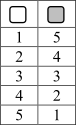
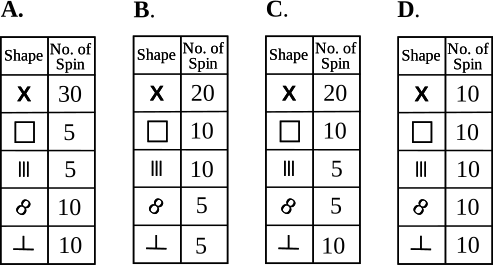
Nev spins the arrow 50 times.


Which table is most likely to show his result?

Show Answers Only

\(B\)

Show Worked Solution

\(\text{One strategy:}\)

\(\text{X should be worth }\dfrac{2}{5}\ \text{(20 spins),}\)

\(\rightarrow\ \text{Eliminate the first and last options.}\)

\(\text{The other relative sizes require the answer to be:}\)

\(\Rightarrow B\)

Filed Under: Probability Tagged With: num-title-ct-core, smc-4225-35-Relative frequency

Probability, SM-Bank 038 MC

Bryce has a bag of marbles. 80% of his marbles are red.

Bryce takes a yellow marble from his bag and loses it in a game.

If he takes another marble from the bag without looking, what are the chances it is red?

  1. greater than 80%
  2. equal to 80%
  3. less than 80%
  4. there is not enough information to predict the chance
Show Answers Only

\(A\)

Show Worked Solution

\(\text{There will be greater than 80% chance}\)

\(\text{because there are the same amount of }\)

\(\text{red marbles to be chosen but 1 less}\)

\(\text{marble in the bag.}\)

 
\(\Rightarrow A\)

Filed Under: Probability Tagged With: num-title-ct-core, smc-4225-45-Multi-stage events

Probability, SM-Bank 037

A school canteen has two different types of sandwiches.

There are 14 chicken sandwiches and 11 vegemite sandwiches.

The canteen sells one sandwich to each of the first five students in line at lunch time.

The table shows the type of sandwich the first five students buy.
 

\begin{array} {|l|c|}
\hline
\rule{0pt}{2.5ex} \textbf{Student} \rule[-1ex]{0pt}{0pt} & \textbf{Sandwich Type} \\
\hline
\rule{0pt}{2.5ex} \text{Tim} \rule[-1ex]{0pt}{0pt} & \text{chicken} \\
\hline
\rule{0pt}{2.5ex} \text{Kate} \rule[-1ex]{0pt}{0pt} & \text{vegemite} \\
\hline
\rule{0pt}{2.5ex} \text{Choon} \rule[-1ex]{0pt}{0pt} & \text{vegemite} \\
\hline
\rule{0pt}{2.5ex} \text{Raj} \rule[-1ex]{0pt}{0pt} & \text{chicken} \\
\hline
\rule{0pt}{2.5ex} \text{Kelly} \rule[-1ex]{0pt}{0pt} & \text{vegemite} \\
\hline
\end{array}

 
Dom is next in line and asks for a sandwich but doesn't care which type.

What is the chance that Dom is given chicken sandwich? Give your answer as a percentage.  (2 marks)

--- 5 WORK AREA LINES (style=lined) ---

Show Answers Only

\(60\%\)

Show Worked Solution

\(P\text{(chicken sandwich for Dom)}\)

\(=\dfrac{\text{chicken sandwiches left}}{\text{total sandwiches left}}\)

\(=\dfrac{14-2}{20}\)

\(= 0.60\)

\(= 60\%\)

Filed Under: Probability Tagged With: num-title-ct-core, smc-4225-15-Single-stage events

Probability, SM-Bank 036 MC

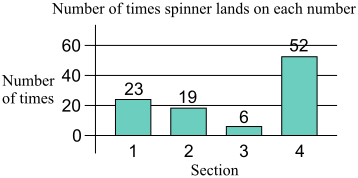
A spinner can land in any of 4 sections, labelled 1 to 4.

The spinner is spun 100 times and the results are recorded in the bar chart below.


Which of these spinners is most likely to give results shown in the graph?

A. B. C. D.
Show Answers Only

\(D\)

Show Worked Solution

\(\text{Landing on 1 should be about 23% (slightly less than one quarter).}\)

\(\text{Landing on 4 should be about 52% (just over half).}\)

\(\text{Landing on 2 and 3 (combined) should be 25%.}\)
 

\(\Rightarrow D\)

Filed Under: Probability Tagged With: num-title-ct-core, smc-4225-35-Relative frequency

Probability, SM-Bank 035

There are 50 coloured jelly beans in a bag. Twenty four jelly beans are green, the others are yellow.

Wayne picks a jelly bean from the bag without looking.

What is the chance of Wayne picking a green jelly bean?  (1 mark)

--- 2 WORK AREA LINES (style=lined) ---

Show Answers Only

\(\dfrac{12}{25}\)

Show Worked Solution
\(P\text{(Green)}\) \(=\dfrac{24}{50}\)
  \(=\dfrac{12}{25}\)

Filed Under: Probability Tagged With: num-title-ct-core, smc-4225-15-Single-stage events

Probability, SM-Bank 034

Francine has a bag of marbles.

The number of marbles of each colour is recorded in the table below.
 

\begin{array} {|l|c|}
\hline
\rule{0pt}{2.5ex} \textbf{Colour} \rule[-1ex]{0pt}{0pt} & \textbf{Number of marbles} \\
\hline
\rule{0pt}{2.5ex} \textbf{green} \rule[-1ex]{0pt}{0pt} & 14 \\
\hline
\rule{0pt}{2.5ex} \textbf{blue} \rule[-1ex]{0pt}{0pt} & 7 \\
\hline
\rule{0pt}{2.5ex} \textbf{white} \rule[-1ex]{0pt}{0pt} & 3 \\
\hline
\rule{0pt}{2.5ex} \textbf{red} \rule[-1ex]{0pt}{0pt} & 4 \\
\hline
\end{array}  

Francine randomly takes 1 marble out of her bag without looking.

  1. What is the chance it is green?  (1 mark)

    --- 3 WORK AREA LINES (style=lined) ---

  2. What is the chance it is red or white?  (1 mark)

    --- 3 WORK AREA LINES (style=lined) ---

  3. What is the chance it is yellow?  (1 mark)

    --- 1 WORK AREA LINES (style=lined) ---

Show Answers Only

a.    \(\dfrac{1}{2}\)

b.    \(\dfrac{1}{4}\)

c.    \(0\)

Show Worked Solution
a.    \(P\text{(green)}\) \(=\dfrac{\text{Number of green}}{\text{Total number}}\)
  \(=\dfrac{14}{28}\)
  \(=\dfrac{1}{2}\)


b.    \(P\text{(red or white)}\) \(=\dfrac{\text{Number of red and white}}{\text{Total number}}\)
  \(=\dfrac{4+3}{28}\)
  \(=\dfrac{1}{4}\)

 
c.    \(\text{There are no yellow marbles}\)

\(\therefore\ P\text{(yellow)}=0\)

Filed Under: Probability Tagged With: num-title-ct-core, smc-4225-15-Single-stage events

Probability, SM-Bank 033 MC

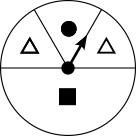
Which spinner does not show a 50-50 chance of landing on the `Delta` symbol?
 

Show Answers Only

\(A\)

Show Worked Solution

\(\text{Each of the triangle sections in the above image}\)

\(\text{only account for}\ \dfrac{1}{6}\ \text{of the pie.}\)

\(\therefore\ \text{The spinner only has}\ \dfrac{1}{3}\ \text{chance of landing}\)

\(\text{on a triangle.}\)

\(\Rightarrow A\)

Filed Under: Probability Tagged With: num-title-ct-core, smc-4225-05-Core concepts

Probability, SM-Bank 032

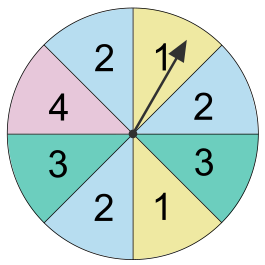
Bellamy creates a game with the spinner shown below.


If the spinner lands on a 3, he wins a prize.

What is the probability that Bellamy will win a prize on his next spin?  (1 mark)

--- 2 WORK AREA LINES (style=lined) ---

Show Answers Only

\(\dfrac{1}{4}\)

Show Worked Solution
\(P\text{(landing on a 3)}\) \(=\dfrac{\text{Number of 3’s}}{\text{Total possibilities}}\)
  \(=\dfrac{2}{8}\)
  \(=\dfrac{1}{4}\)

Filed Under: Probability Tagged With: num-title-ct-core, smc-4225-15-Single-stage events

  • 1
  • 2
  • 3
  • Next Page »

Copyright © 2014–2025 SmarterEd.com.au · Log in