Jordan visits Italy on his holidays. He pays €180 (180 euros) for a pair of Italian leather boots.
How much is €180 in Australian dollars if AUD1 is worth €0.58? (2 marks)
--- 3 WORK AREA LINES (style=lined) ---
Aussie Maths & Science Teachers: Save your time with SmarterEd
Jordan visits Italy on his holidays. He pays €180 (180 euros) for a pair of Italian leather boots.
How much is €180 in Australian dollars if AUD1 is worth €0.58? (2 marks)
--- 3 WORK AREA LINES (style=lined) ---
The graph shows the tax payable against taxable incomes up to $60 000 in a proposed tax system.
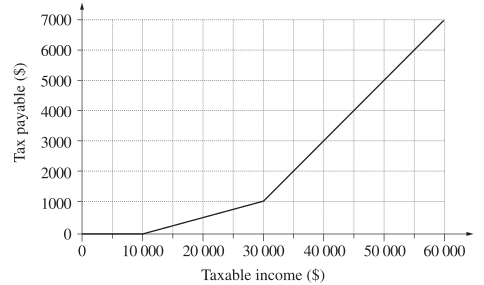
How much of each dollar earned over \($30\,000\) is payable in tax?
Jerico is the manager of a weekend market in which there are 220 stalls for rent. From past experience, Jerico knows that if he charges \(d\) dollars to rent a stall. then the number of stalls, \(s\), that will be rented is given by:
\(s=220-4d\)
--- 2 WORK AREA LINES (style=lined) ---
--- 0 WORK AREA LINES (style=lined) ---
\begin{array} {|c|c|c|}
\hline
\rule{0pt}{2.5ex} \quad d\quad \rule[-1ex]{0pt}{0pt} & \rule{0pt}{2.5ex} \quad 10\quad\rule[-1ex]{0pt}{0pt} & \rule{0pt}{2.5ex} \quad 30\quad & \rule{0pt}{2.5ex} \quad 50\quad \\
\hline
\rule{0pt}{2.5ex} \quad s\quad \rule[-1ex]{0pt}{0pt} & \ & \ & \\
\hline
\end{array}
--- 0 WORK AREA LINES (style=lined) ---
--- 4 WORK AREA LINES (style=lined) ---
a. \(190\ \text{stalls will be rented}\)
b.
\begin{array} {|c|c|c|}
\hline
\rule{0pt}{2.5ex} \quad d\quad \rule[-1ex]{0pt}{0pt} & \rule{0pt}{2.5ex} \quad 10\quad\rule[-1ex]{0pt}{0pt} & \rule{0pt}{2.5ex} \quad 30\quad & \rule{0pt}{2.5ex} \quad 50\quad \\
\hline
\rule{0pt}{2.5ex} \quad s\quad \rule[-1ex]{0pt}{0pt} & 180 \ & 100 \ & 20 \\
\hline
\end{array}
c.
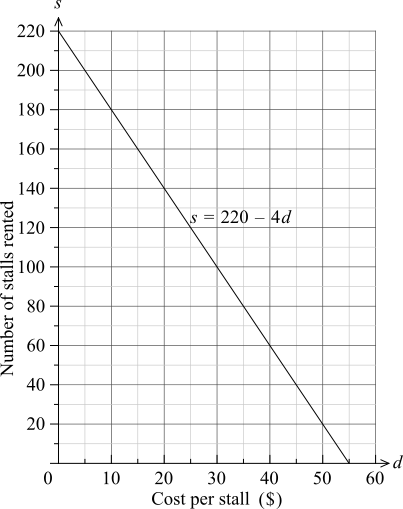
d. \(\text{When}\ d=60, s=220-4\times 60=-20\)
\(\therefore\ \text{It does not make sense to charge }$60\ \text{ per stall}\)
\(\text{as you cannot have a negative number of stalls.}\)
| a. | \(s\) | \(=220-4d\) |
| \(=220-4\times 7.50\) | ||
| \(=190\) |
\(190\ \text{stalls will be rented}\)
b.
\begin{array} {|c|c|c|}
\hline
\rule{0pt}{2.5ex} \quad d\quad \rule[-1ex]{0pt}{0pt} & \rule{0pt}{2.5ex} \quad 10\quad\rule[-1ex]{0pt}{0pt} & \rule{0pt}{2.5ex} \quad 30\quad & \rule{0pt}{2.5ex} \quad 50\quad \\
\hline
\rule{0pt}{2.5ex} \quad s\quad \rule[-1ex]{0pt}{0pt} & 180 \ & 100 \ & 20 \\
\hline
\end{array}
c.
d. \(\text{When}\ d=60, s=220-4\times 60=-20\)
\(\therefore\ \text{It does not make sense to charge }$60\ \text{ per stall}\)
\(\text{as you cannot have a negative number of stalls.}\)
The formula `C=100 n+b` is used to calculate the cost of producing laptops, where `C` is the cost in dollars, `n` is the number of laptops produced and `b` is the fixed cost in dollars.
--- 2 WORK AREA LINES (style=lined) ---
--- 4 WORK AREA LINES (style=lined) ---
Tom is 25 years old, and likes to keep fit by exercising.
--- 2 WORK AREA LINES (style=lined) ---
--- 4 WORK AREA LINES (style=lined) ---
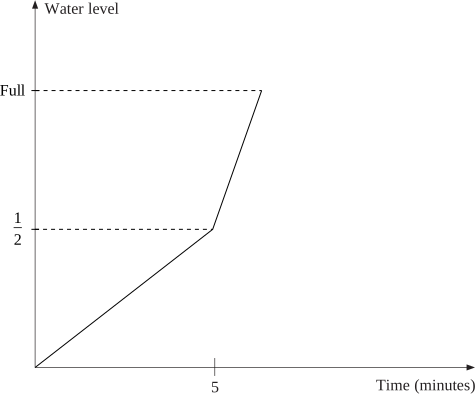
The diagram shows a container which consists of a small cylinder on top of a larger
cylinder.

The container is filled with water at a constant rate to the top of the smaller cylinder. It takes 5 minutes to fill the larger cylinder.
Draw a possible graph of the water level in the container against time. (2 marks)
--- 0 WORK AREA LINES (style=lined) ---
The fuel consumption for a car is 6.7 litres/100 km. On a road trip, the car travels a distance of 1560 km and the fuel cost is $1.45 per litre.
What is the total fuel cost for the trip? (2 marks)
A plumber charges a call-out fee of $90 as well as $2 per minute while working.
Suppose the plumber works for `t` hours.
Which equation expresses the amount the plumber charges ($`C`) as a function of time (`t` hours)?
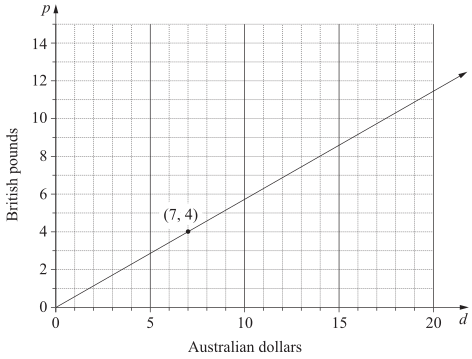
The relationship between British pounds `(p)` and Australian dollars `(d)` on a particular day is shown in the graph.
--- 2 WORK AREA LINES (style=lined) ---
Convert 93 100 Japanese yen to British pounds. (2 marks)
--- 4 WORK AREA LINES (style=lined) ---
A car travels 350 km on 40 L of petrol.
What is its fuel consumption?
Water was poured into a container at a constant rate. The graph shows the depth of water in the container as it was being filled.
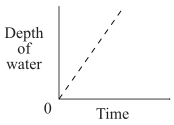
Which of the following containers could have been used to produce this result?
| A. | 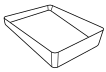 |
B. |  |
| C. | 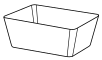 |
D. |  |
`text(S)text(ince the graph is a straight line, the cup fills up at)`
`text(a constant rate.)`
`=> B`
The average height, `C`, in centimetres, of a girl between the ages of 6 years and 11 years can be represented by a line with equation
`C = 6A + 79`
where `A` is the age in years. For this line, the gradient is 6.
--- 2 WORK AREA LINES (style=lined) ---
--- 2 WORK AREA LINES (style=lined) ---
The driving distance from Alex's home to his work is 20 km. He drives to and from work five times each week. His car uses fuel at the rate of 8 L/100 km.
How much fuel does he use driving to and from work each week?
Kate is comparing two different models of car. Car A uses fuel at the rate of 9 L/100 km. Car B uses 3.5 L/100 km.
Suppose Kate plans on driving 8000 km in the next year.
How much less fuel will she use driving car B instead of car A?
A. `text(280 L)`
B. `text(440 L)`
C. `text(720 L)`
D. `text(1000 L)`
The graph shows the relationship between infant mortality rate (deaths per 1000 live births) and life expectancy at birth (in years) for different countries.
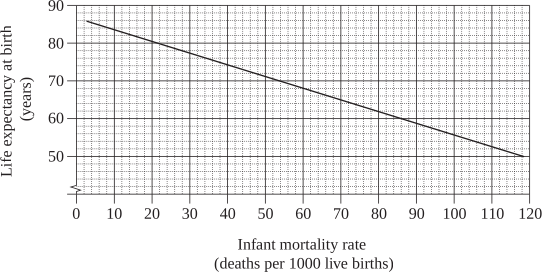
What is the life expectancy at birth in a country which has an infant mortality rate of 60?
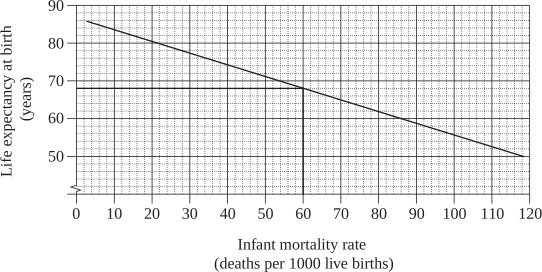
\(\text{When infant mortality rate is 60, life expectancy}\)
\(\text{at birth is 68 years (see below).}\)
\(\Rightarrow A\)
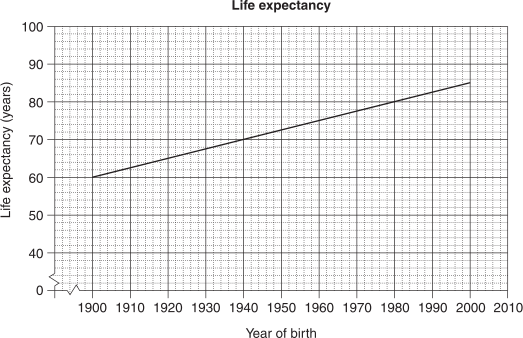
The graph shows the life expectancy of people born between 1900 and 2000.
--- 1 WORK AREA LINES (style=lined) ---
--- 4 WORK AREA LINES (style=lined) ---
Peta’s car uses fuel at the rate of 5.9 L /100 km for country driving and 7.3 L /100 km for city driving. On a trip, she drives 170 km in the country and 25 km in the city.
Calculate the amount of fuel she used on this trip. (2 marks)
--- 4 WORK AREA LINES (style=lined) ---
John knows that
• one Australian dollar is worth 0.62 euros
• one Vistabella dollar `text{($V)}` is worth 1.44 euros.
John changes 25 Australian dollars to Vistabella dollars.
How many Vistabella dollars will he get?
A clubhouse uses four long-life light globes for five hours every night of the year. The purchase price of each light globe is $6.00 and they each cost `$d` per hour to run.
--- 4 WORK AREA LINES (style=lined) ---
--- 2 WORK AREA LINES (style=lined) ---
--- 2 WORK AREA LINES (style=lined) ---
What is the mean life, in hours, of these light globes if 97.5% will last up to 5000 hours? (1 mark)
--- 2 WORK AREA LINES (style=lined) ---
i. `text(Purchase price) = 4 xx 6 = $24`
| `text(Running cost)` | `= text(# Hours) xx text(Cost per hour)` |
| `= 4 xx 5 xx 365 xx d` | |
| `= 7300d` | |
| `:.\ $c = 24 + 7300d` | |
ii. `text(Given)\ \ $c = $250`
| `250` | `= 24 + 7300d` |
| `7300d` | `= 226` |
| `d` | `= 226/7300` |
| `= 0.03095…` | |
| `= 0.031\ $ text(/hr)\ text{(3 d.p.)}` |
iii. `text(If)\ d\ text(doubles to 0.062)\ \ $text(/hr)`
| `$c` | `= 24 + 7300 xx 0.062` |
| `= $476.60` | |
| `text(S) text(ince $476.60 is less than)\ 2 xx $250\ ($500),` | |
| `text(the total cost increases to less than double)` | |
| `text(the original cost.)` | |
iv. `sigma = 170`

`z\ text(-score of 5000 hours) = 2`
| `z` | `= (x – mu)/sigma` |
| `2` | `= (5000 – mu)/170` |
| `340` | `= 5000 – mu` |
| `mu` | `= 4660` |
`:.\ text(The mean life of these globes is 4660 hours.)`
Sandy travels to Europe via the USA. She uses this graph to calculate her currency conversions.
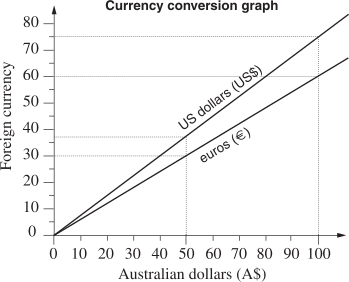
She converts all of her money to euros. How many euros does she have to spend in Europe? (3 marks)
--- 6 WORK AREA LINES (style=lined) ---
--- 2 WORK AREA LINES (style=lined) ---
Xuso is comparing the costs of two different ways of travelling to university.
Xuso’s motorcycle uses one litre of fuel for every 17 km travelled. The cost of fuel is $1.67/L and the distance from her home to the university car park is 34 km. The cost of travelling by bus is $36.40 for 10 single trips.
Which way of travelling is cheaper and by how much? Support your answer with calculations. (2 marks)
--- 4 WORK AREA LINES (style=lined) ---
Heather’s car uses fuel at the rate of 6.6 L per 100 km for long-distance driving and 8.9 L per 100 km for short-distance driving.
She used the car to make a journey of 560 km, which included 65 km of short-distance driving.
Approximately how much fuel did Heather’s car use on the journey?
The graph shows tax payable against taxable income, in thousands of dollars.

--- 1 WORK AREA LINES (style=lined) ---
--- 3 WORK AREA LINES (style=lined) ---
--- 2 WORK AREA LINES (style=lined) ---
--- 4 WORK AREA LINES (style=lined) ---
| i. |  |
`text(Income on)\ $21\ 000=$3000\ \ \ text{(from graph)}`
ii. `text(Using the points)\ (21,3)\ text(and)\ (39,9)`
| `text(Gradient at)\ A` | `= (y_2\-y_1)/(x_2\ -x_1)` |
| `= (9000-3000)/(39\ 000 -21\ 000)` | |
| `= 6000/(18\ 000)` | |
| `= 1/3\ \ \ \ \ text(… as required)` |
iii. `text(The gradient represents the tax applicable to each dollar)`
| `text(Tax)` | ` = 1/3\ text(of each dollar earned)` |
| ` = 33 1/3\ text(cents per dollar earned)` |
iv. `text( Tax payable up to $21 000 = $3000)`
`text(Tax payable on income between $21 000 and $39 000)`
` = 1/3 (I\-21\ 000)`
| `:.\ text(Tax payable on)\ \ I` | `= 3000 + 1/3 (I\-21\ 000)` |
| `= 3000 + 1/3 I\-7000` | |
| `= 1/3 I\-4000` |
A factory makes boots and sandals. In any week
• the total number of pairs of boots and sandals that are made is 200
• the maximum number of pairs of boots made is 120
• the maximum number of pairs of sandals made is 150.
The factory manager has drawn a graph to show the numbers of pairs of boots (`x`) and sandals (`y`) that can be made.
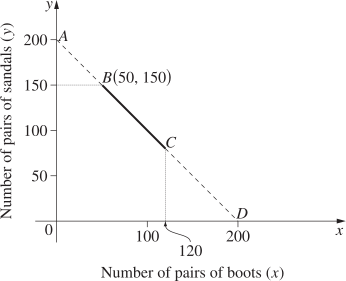
--- 2 WORK AREA LINES (style=lined) ---
--- 3 WORK AREA LINES (style=lined) ---
Compare the profits at `B` and `C`. (2 marks)
--- 5 WORK AREA LINES (style=lined) ---
The volume of water in a tank changes over six months, as shown in the graph.

Consider the overall decrease in the volume of water.
What is the average percentage decrease in the volume of water per month over this time, to the nearest percent?
Conversion graphs can be used to convert from one currency to another.
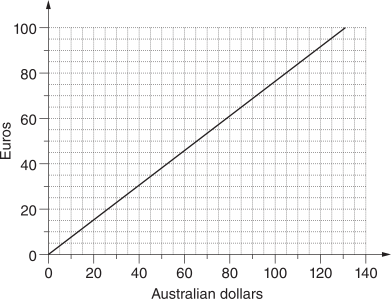
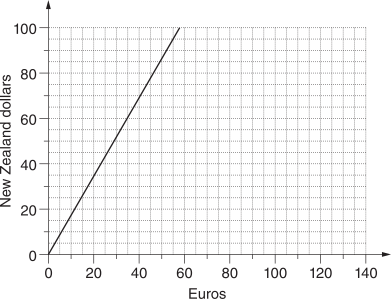
Sarah converted 60 Australian dollars into Euros. She then converted all of these Euros
into New Zealand dollars.
How much money, in New Zealand dollars, should Sarah have?