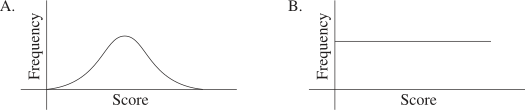
Which graph represents a negatively skewed distribution?

Aussie Maths & Science Teachers: Save your time with SmarterEd
Which graph represents a negatively skewed distribution?
The stem plot below shows the height, in centimetres, of 20 players in a junior football team.
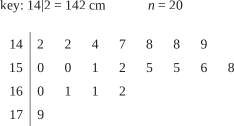
A player with a height of 179 cm is considered an outlier because 179 cm is greater than
The stem-and-leaf plot shows the number of goals scored by a team in each of ten netball games.
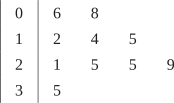
What is the mode of this dataset?
The dot plots show the height of students in Year 9 and Year 12 in a school. They are drawn on the same scale.

Which statement about the change in heights when comparing Y9 to Y12 is correct?
A set of data is displayed in this dot plot.
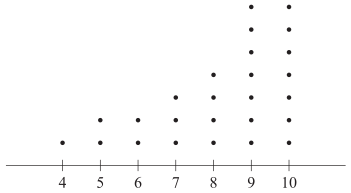
Which of the following best describes this set of data?
The ages of members of a dance class are shown in the back-to-back stem-and-leaf plot.

Pat claims that the women who attend the dance class are generally older than the men.
Is Pat correct? Justify your answer by referring to the median and skewness of the two sets of data. (3 marks)
--- 6 WORK AREA LINES (style=lined) ---
The table shows the life expectancy (expected remaining years of life) for females at selected ages in the given periods of time.

In 1975, a 45‑year‑old female used the information in the table to calculate the age to which she was expected to live. Twenty years later she recalculated the age to which she was expected to live.
What is the difference between the two ages she calculated?
The sector graph shows the proportion of people, as a percentage, living in each region of Sumcity. There are 24 000 people living in the Eastern Suburbs.

--- 1 WORK AREA LINES (style=lined) ---
Jake used the information above to draw a column graph.

Identify this region and justify your answer. (2 marks)
--- 4 WORK AREA LINES (style=lined) ---
`21\ \ \ 45\ \ \ 29\ \ \ 27\ \ \ 19\ \ \ 35\ \ \ 23\ \ \ 58\ \ \ 34\ \ \ 27` (2 marks)
--- 6 WORK AREA LINES (style=blank) ---
--- 2 WORK AREA LINES (style=lined) ---
--- 2 WORK AREA LINES (style=lined) ---
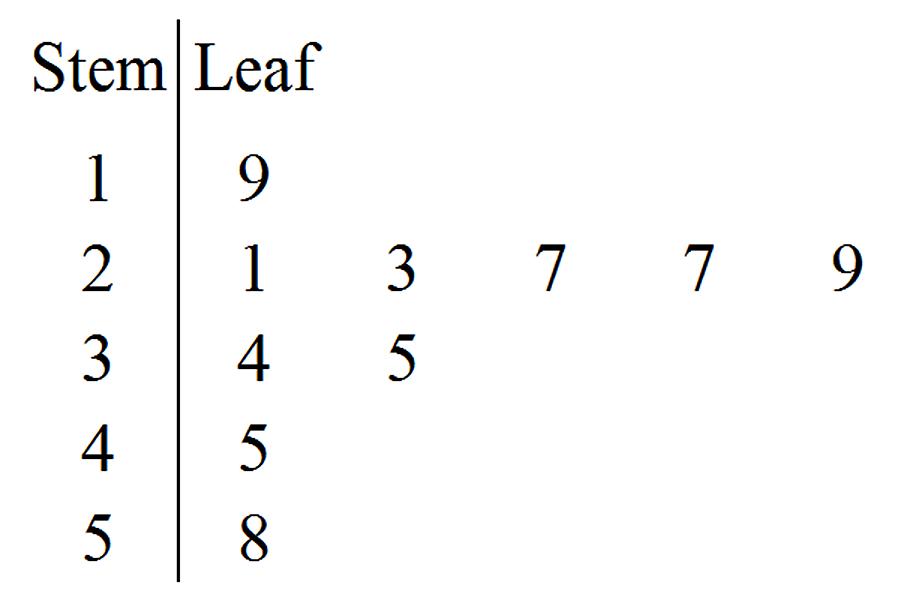
`:.\ text(Data is positively Skewed.)`
| i. | |
ii. `text(10 scores)`
| `:.\ text(Median)` | `= text{(5th + 6th)}/2` |
| `= (27 + 29)/2` | |
| `= 28` |
iii. `text(The data has a tail that stretches to the right)`
`:.\ text(Data is positively skewed.)`
Which of these graphs best represents positively skewed data with the smaller standard deviation?


A set of scores is displayed in a stem-and-leaf plot.

What is the median of this set of scores?
This sector graph shows the distribution of 116 prizes won by three schools: X, Y and Z.

How many prizes were won by School X?
Barry constructed a back-to-back stem-and-leaf plot to compare the ages of his students.

--- 2 WORK AREA LINES (style=lined) ---
--- 1 WORK AREA LINES (style=lined) ---
For the age group 30 - 39 years, what is the value of the product of the class centre and the frequency? (2 marks)
--- 3 WORK AREA LINES (style=lined) ---
Caitlyn correctly used the original data in the back-to-back stem-and-leaf plot and calculated the mean to be 38.2.
What is the reason for the difference in the two answers? (1 mark)
--- 2 WORK AREA LINES (style=lined) ---
You are organising an outside sporting event at Mathsville and have to decide which month has the best weather for your event. The average temperature must be between 20°C and 30°C, and average rainfall must be less than 80 mm.
The radar chart for Mathsville shows the average temperature for each month, and the table gives the average rainfall for each month.

--- 1 WORK AREA LINES (style=lined) ---
--- 1 WORK AREA LINES (style=lined) ---
The stem-and-leaf plot represents the daily sales of soft drink from a vending machine.
| If the range of sales is 43, what is the value of |  |
? |

Data was collected from 30 students on the number of text messages they had sent in the previous 24 hours. The set of data collected is displayed.

--- 1 WORK AREA LINES (style=lined) ---
--- 1 WORK AREA LINES (style=lined) ---
Jason travels to work by car on all five days of his working week, leaving home at 7 am each day. He compares his travel times using roads without tolls and roads with tolls over a period of 12 working weeks.
He records his travel times (in minutes) in a back-to-back stem-and-leaf plot.

--- 1 WORK AREA LINES (style=lined) ---
--- 1 WORK AREA LINES (style=lined) ---
--- 5 WORK AREA LINES (style=lined) ---
This back-to-back stem-and-leaf plot displays the test results for a class of 26 students.

What is the median test result for the class?
The diagram below shows a stem-and-leaf plot for 22 scores.

--- 1 WORK AREA LINES (style=lined) ---
--- 1 WORK AREA LINES (style=lined) ---
The results of a survey are displayed in the dot plot.
What is the range of this data?

A set of 15 scores is displayed in a stem-and-leaf plot.

What is the median of these scores?