Differentiate `cos^(–1) (3x)` with respect to `x`. (2 marks)
Functions, EXT1 F2 2008 HSC 1a
The polynomial `x^3` is divided by `x + 3`. Calculate the remainder. (2 marks)
Statistics, STD2 S1 2008 HSC 26d
The graph shows the predicted population age distribution in Australia in 2008.

- How many females are in the 0–4 age group? (1 mark)
--- 1 WORK AREA LINES (style=lined) ---
- What is the modal age group? (1 mark)
--- 1 WORK AREA LINES (style=lined) ---
- How many people are in the 15–19 age group? (2 marks)
--- 4 WORK AREA LINES (style=lined) ---
- Give ONE reason why there are more people in the 80+ age group than in the 75–79 age group. (1 mark)
--- 2 WORK AREA LINES (style=lined) ---
Probability, STD2 S2 2008 HSC 26a
Cecil invited 175 movie critics to preview his new movie. After seeing the movie, he conducted a survey. Cecil has almost completed the two-way table.

- Determine the value of `A`. (1 mark)
--- 1 WORK AREA LINES (style=lined) ---
- A movie critic is selected at random.
What is the probability that the critic was less than 40 years old and did not like the movie? (2 marks)
--- 4 WORK AREA LINES (style=lined) ---
- Cecil believes that his movie will be a box office success if 65% of the critics who were surveyed liked the movie.
Will this movie be considered a box office success? Justify your answer. (1 mark)
--- 2 WORK AREA LINES (style=lined) ---
Financial Maths, STD2 F1 2008 HSC 24a
Bob is employed as a salesman. He is offered two methods of calculating his income.
\begin{array} {|l|}
\hline
\rule{0pt}{2.5ex}\text{Method 1: Commission only of 13% on all sales}\rule[-1ex]{0pt}{0pt} \\
\hline
\rule{0pt}{2.5ex}\text{Method 2: \$350 per week plus a commission of 4.5% on all sales}\rule[-1ex]{0pt}{0pt} \\
\hline
\end{array}
Bob’s research determines that the average sales total per employee per month is $15 670.
- Based on his research, how much could Bob expect to earn in a year if he were to choose Method 1? (2 marks)
--- 4 WORK AREA LINES (style=lined) ---
- If Bob were to choose a method of payment based on the average sales figures, state which method he should choose in order to earn the greater income. Justify your answer with appropriate calculations. (3 marks)
--- 6 WORK AREA LINES (style=lined) ---
Statistics, STD2 S1 2008 HSC 23a
You are organising an outside sporting event at Mathsville and have to decide which month has the best weather for your event. The average temperature must be between 20°C and 30°C, and average rainfall must be less than 80 mm.
The radar chart for Mathsville shows the average temperature for each month, and the table gives the average rainfall for each month.

- If you consider only the temperature data, there are a number of possible months for holding the event. Name ONE of these months. (1 mark)
--- 1 WORK AREA LINES (style=lined) ---
- If both rainfall and temperature data are considered, which month is the best month for the sporting event? (1 mark)
--- 1 WORK AREA LINES (style=lined) ---
Measurement, STD2 M6 2008 HSC 14 MC
Danni is flying a kite that is attached to a string of length 80 metres. The string makes an angle of 55° with the horizontal.
How high, to the nearest metre, is the kite above Danni’s hand?

- 46 m
- 66 m
- 98 m
- 114 m
Show Worked Solution

| `sin 55^@` | `= h/80` |
| `h` | `= 80 xx sin 55^@` |
| `= 65.532…\ text(m)` |
`=> B`
Financial Maths, STD2 F1 2008 HSC 7 MC
Luke’s normal rate of pay is $15 per hour. Last week he was paid for 12 hours, at time-and-a-half.
How many hours would Luke need to work this week, at double time, to earn the same amount?
- 4
- 6
- 8
- 9
Financial Maths, STD2 F1 2008 HSC 6 MC

Using the tax table, what is the tax payable on $43 561?
- $5424.40
- $10 824.40
- $16 224.40
- $17 424.40
Algebra, 2UG 2008 HSC 1 MC
Which expression is equivalent to `12k^3 ÷ 4k`?
- `3k^2 `
- `3k^3`
- `8k^2`
- `8k^3`
Quadratic, 2UA 2008 HSC 4c
Consider the parabola `x^2 = 8(y\ – 3)`.
- Write down the coordinates of the vertex. (1 mark)
- Find the coordinates of the focus. (1 mark)
- Sketch the parabola. (1 mark)
- Calculate the area bounded by the parabola and the line `y = 5`. (3 marks)
Show Answers Only
(i) `(0,3)`
(ii) `(0,5)`
| (iii) |  |
(iv) `10 2/3\ text(u²)`
Show Worked Solution
| (i) | `text(Vertex)\ = (0,3)` |
| (ii) | `text(Using)\ \ \ x^2` | `= 4ay` |
| `4a` | `= 8` | |
| `a` | `= 2` |
`:.\ text(Focus) = (0,5)`
| (iii) | |
| (iv) | `text(Intersection when)\ y = 5` |
| `=> x^2` | `= 8 (5-3)` |
| `x^2` | `= 16` |
| `x` | `= +- 4` |
`text(Find shaded area)`
| `x^2` | `= 8 (y-3)` |
| `y – 3` | `= x^2/8` |
| `y` | `= x^2/8 +3` |
| `text(Area)` | `= int_-4^4 5\ dx – int_-4^4 x^2/8 + 3\ dx` |
| `= int_-4^4 5 – (x^2/8 + 3)\ dx` | |
| `= int_-4^4 2 – x^2/8\ dx` | |
| `= [2x – x^3/24]_-4^4` | |
| `= [(8 – 64/24) – (-8 + 64/24)]` | |
| `= 5 1/3 – (- 5 1/3)` | |
| `= 10 2/3\ text(u²)` |
Calculus, 2ADV C2 2008 HSC 2aiii
Differentiate with respect to `x`:
`sinx/(x+4)`. (2 marks)
Calculus, 2ADV C2 2008 HSC 2aii
Differentiate with respect to `x`:
`x^2 log_e x` (2 marks)
Differentiation, 2UA 2008 HSC 2ai
Differentiate with respect to `x`:
`(x^2 + 3)^9` (2 marks)
Calculus, 2ADV C4 2008 HSC 3b
- Differentiate `log_e (cos x)` with respect to `x`. (2 marks)
--- 4 WORK AREA LINES (style=lined) ---
- Hence, or otherwise, evaluate `int_0^(pi/4) tan x\ dx`. (2 marks)
--- 4 WORK AREA LINES (style=lined) ---
Linear Functions, 2UA 2008 HSC 3a

In the diagram, `ABCD` is a quadrilateral. The equation of the line `AD` is `2x- y- 1 = 0`.
- Show that `ABCD` is a trapezium by showing that `BC` is parallel to `AD`. (2 marks)
- The line `CD` is parallel to the `x`-axis. Find the coordinates of `D`. (1 mark)
- Find the length of `BC`. (1 mark)
- Show that the perpendicular distance from `B` to `AD` is `4/sqrt5`. (2 marks)
- Hence, or otherwise, find the area of the trapezium `ABCD`. (2 marks)
Linear Functions, 2UA 2008 HSC 2b
Let `M` be the midpoint of `(-1, 4)` and `(5, 8)`.
Find the equation of the line through `M` with gradient `-1/2`. (2 marks)
--- 5 WORK AREA LINES (style=lined) ---
Financial Maths, 2ADV M1 2008 HSC 1f
Find the sum of the first 21 terms of the arithmetic series 3 + 7 + 11 + ... (2 marks)
--- 5 WORK AREA LINES (style=lined) ---
Functions, 2ADV F1 2008 HSC 1e
Expand and simplify `(sqrt3-1)(2 sqrt3 + 5)`. (2 marks)
Functions, 2ADV F1 2008 HSC 1d
Solve `|\ 4x - 3\ | = 7`. (2 marks)
--- 5 WORK AREA LINES (style=lined) ---
Functions, 2ADV F1 2008 HSC 1a
Evaluate `2 cos (pi/5)` correct to three significant figures. (2 marks)
Financial Maths, STD2 F5 SM-Bank 2
The table below shows the present value of an annuity with a contribution of $1.

- Fiona pays $3000 into an annuity at the end of each year for 4 years at 2% p.a., compounded annually. What is the present value of her annuity? (1 mark)
--- 2 WORK AREA LINES (style=lined) ---
- If John pays $6000 into an annuity at the end of each year for 2 years at 4% p.a., compounded annually, is he better off than Fiona? Use calculations to justify your answer. (2 marks)
--- 4 WORK AREA LINES (style=lined) ---
Mechanics, EXT2* M1 2014 HSC 14a
The take-off point `O` on a ski jump is located at the top of a downslope. The angle between the downslope and the horizontal is `pi/4`. A skier takes off from `O` with velocity `V` m s−1 at an angle `theta` to the horizontal, where `0 <= theta < pi/2`. The skier lands on the downslope at some point `P`, a distance `D` metres from `O`.

The flight path of the skier is given by
`x = Vtcos theta,\ y = -1/2 g t^2 + Vt sin theta`, (Do NOT prove this.)
where `t` is the time in seconds after take-off.
- Show that the cartesian equation of the flight path of the skier is given by
`y = x tan theta - (gx^2)/(2V^2) sec^2 theta`. (2 marks)
--- 5 WORK AREA LINES (style=lined) ---
- Show that
`D = 2 sqrt 2 (V^2)/(g) cos theta (cos theta + sin theta)`. (3 marks)
--- 8 WORK AREA LINES (style=lined) ---
- Show that
`(dD)/(d theta) = 2 sqrt 2 (V^2)/(g) (cos 2 theta - sin 2 theta)`. (2 marks)
--- 4 WORK AREA LINES (style=lined) ---
- Show that `D` has a maximum value and find the value of `theta` for which this occurs. (3 marks)
--- 9 WORK AREA LINES (style=lined) ---
Calculus, EXT1 C1 2014 HSC 13b
One end of a rope is attached to a truck and the other end to a weight. The rope passes over a small wheel located at a vertical distance of 40 m above the point where the rope is attached to the truck.
The distance from the truck to the small wheel is `L\ text(m)`, and the horizontal distance between them is `x\ text(m)`. The rope makes an angle `theta` with the horizontal at the point where it is attached to the truck.
The truck moves to the right at a constant speed of `text(3 m s)^(-1)`, as shown in the diagram.

- Using Pythagoras’ Theorem, or otherwise, show that `(dL)/(dx) = cos theta`. (2 marks)
--- 10 WORK AREA LINES (style=lined) ---
- Show that `(dL)/(dt) = 3 cos theta`. (1 mark)
--- 2 WORK AREA LINES (style=lined) ---
Show Worked Solution
| i. |  |
`text(Show)\ \ (dL)/(dx) = cos theta`
`text(Using Pythagoras,)`
| `L^2` | `=40^2 + x^2` |
| `L` | `=(40^2 + x^2)^(1/2)` |
| `(dL)/(dx)` | `=1/2 * 2x * (40^2 + x^2)^(-1/2)` |
| `=x/ sqrt((40^2 + x^2))` | |
| `=x/L` | |
| `=cos theta\ \ \ text(… as required.)` |
ii. `text(Show)\ \ (dL)/(dt) = 3 cos theta`
| `(dL)/(dt)` | `= (dL)/(dx) * (dx)/(dt)` |
| `= cos theta * 3` | |
| `= 3 cos theta\ \ \ text(… as required)` |
Calculus, EXT1 C1 2014 HSC 12f
Milk taken out of a refrigerator has a temperature of 2° C. It is placed in a room of constant temperature 23°C. After `t` minutes the temperature, `T`°C, of the milk is given by
`T = A-Be ^(-0.03t)`,
where `A` and `B` are positive constants.
How long does it take for the milk to reach a temperature of 10°C? (3 marks)
--- 8 WORK AREA LINES (style=lined) ---
Functions, EXT1 F1 2014 HSC 11e
Solve `(x^2 + 5)/x > 6`. (3 marks)
--- 8 WORK AREA LINES (style=lined) ---
Show Worked Solution
| `(x^2 + 5)/x` | `> 6` |
| `x^2 ((x^2 + 5)/x)` | `> 6x^2` |
| `x^3 + 5x` | `> 6x^2` |
| `x^3 – 6x^2 + 5x` | `> 0` |
| `x (x^2 – 6x + 5)` | `> 0` |
| `x (x – 5)(x – 1)` | `> 0` |

`:.\ 0 < x < 1\ \ text(or)\ \ x > 5`
Trigonometry, EXT1 T1 2014 HSC 11c
Sketch the graph `y = 6 tan^(-1)x`, clearly indicating the range. (2 marks)
Show Answers Only

Show Worked Solution
`y = 6 tan^(-1)x`
Quadratics, EXT1 2014 HSC 11a
Solve `(x + 2/x)^2 - 6 (x + 2/x) + 9 = 0`. (3 marks)
Calculus, EXT1 C2 2014 HSC 6 MC
What is the derivative of `3 sin^(-1)\ x/2`?
- `6/sqrt(4 - x^2)`
- `3/sqrt(4 - x^2)`
- `3/(2sqrt(4 - x^2))`
- `3/(4sqrt(4 - x^2))`
Combinatorics, EXT1 A1 2014 HSC 3 MC
What is the constant term in the binomial expansion of `(2x - 5/(x^3))^12`?
- `((12),(3)) 2^9 5^3`
- `((12),(9)) 2^3 5^9`
- `-((12),(3)) 2^9 5^3`
- `-((12),(9)) 2^3 5^9`
Trigonometry, EXT1 T3 2014 HSC 2 MC
Which expression is equal to `cos x - sin x`?
- `sqrt 2 cos (x + pi/4)`
- `sqrt 2 cos (x - pi/4)`
- `2 cos (x + pi/4)`
- `2 cos (x - pi/4)`
Geometry and Calculus, EXT1 2009 HSC 4b
Consider the function `f(x) = (x^4 + 3x^2)/(x^4 + 3)`.
- Show that `f(x)` is an even function. (1 mark)
- What is the equation of the horizontal asymptote to the graph `y = f(x)`? (1 mark)
- Find the `x`-coordinates of all stationary points for the graph `y = f(x)`. (3 marks)
- Sketch the graph `y = f(x)`. You are not required to find any points of inflection. (2 marks)
Show Answers Only
- `text(Proof)\ \ text{(See Worked Solutions)}`
- `y = 1`
- `x = 0, – sqrt 3, sqrt 3`
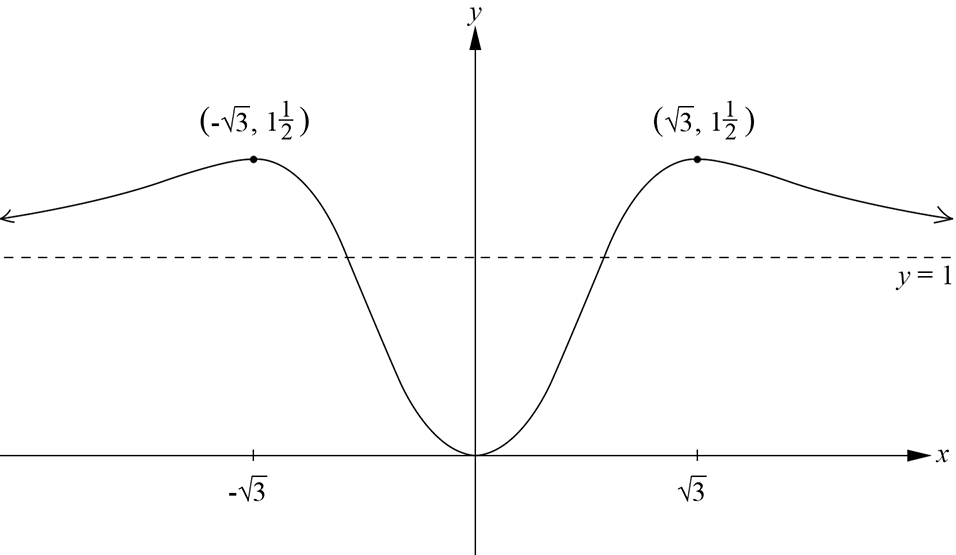
Show Worked Solution
| (i) | `f(x)` | `= (x^4 + 3x^2)/(x^4 + 3)` |
| `f(–x)` | `= ((–x)^4 + 3(-x)^2)/((–x)^4 + 3)` | |
| `= (x^4 + 3x^2)/(x^4 + 3)` | ||
| `= f(x)` |
`:.\ text(Even function.)`
| (ii) | `y` | `= (x^4 + 3x^2)/(x^4 + 3)` |
| `= (1 + 3/(x^2))/(1 + 3/(x^4))` |
| `text(As)\ \ ` | `x` | `-> oo` |
| `y` | `-> 1` |
`:.\ text(Horizontal asymptote at)\ \ y = 1`
| (iii) | `f(x) = (x^4 + 3x^2)/(x^4 + 3)` |
| `u` | `= x^4 + 3x^2\ \ \ \ \ ` | `v` | `= x^4 + 3` |
| `u prime` | `= 4x^3 + 6x\ \ \ \ \ ` | `v prime` | `= 4x^3` |
| `f prime (x)` | `= (u prime v\ – u v prime)/(v^2)` |
| `= ((4x^3 + 6x)(x^4 + 3)\ – (x^4 + 3x^2)4x^3)/((x^4 + 3)^2)` | |
| `= (4x^7 + 12x^3 + 6x^5 + 18x\ – 4x^7\ – 12x^5)/((x^4 + 3)^2)` | |
| `= (-6x^5 + 12x^3 + 18x)/((x^4 + 3)^2)` | |
| `= (-6x(x^4\ – 2x^2\ – 3))/((x^4 + 3)^2)` |
`text(S.P. when)\ x = 0\ \ \ text(or) \ \ x^4\ – 2x^2\ – 3 = 0`
`text(Let)\ X = x^2`
MARKER’S COMMENT: Many students did not realise the denominator of `f′(x)` could be ignored when equating `f′(x)=0`.
| `X^2\ – 2X\ – 3` | `= 0` |
| `(X\ – 3)(X + 1)` | `= 0` |
`X = 3\ \ text(or)\ \ -1`
| `:. x^2` | `= 3` | `text(or)\ \ \ \ \ ` | `x^2 = -1` |
| `x` | `= +- sqrt3\ \ \ \ ` | `text{(no solution)}` |
`:.\ text(SPs occur when)\ \ x = 0, – sqrt3, sqrt3`
| (iv) | `text(When)\ x = 0,\ ` | `y = 0` |
| `text(When)\ x = sqrt3,\ \ \ ` | `y = ((sqrt3)^4 + 3(sqrt3)^2)/((sqrt3)^4 + 3) = 3/2` |
Trig Calculus, EXT1 2009 HSC 3b
- On the same set of axes, sketch the graphs of
- `y = cos 2x` and `y = (x + 1)/2`, for `–pi <= x <= pi`. (2 marks)
- Use your graph to determine how many solutions there are to the equation `2 cos 2x = x + 1` for `–pi <= x <= pi`. (1 mark)
- One solution of the equation `2 cos 2x = x + 1` is close to `x = 0.4`. Use one application of Newton’s method to find another approximation to this solution. Give your answer correct to three decimal places. (3 marks)
Show Worked Solution
| (i) |  |
(ii) `text(3 solutions)`
(iii) `2 cos 2x = x + 1`
MARKER’S COMMENT: Better responses defined `f(x)` and `f′(x)` and evaluated each for `x=0.4` before calculating Newton’s formula, as done in the Worked Solution.
| `f(x)` | `= 2 cos 2x\ – x\ – 1` |
| `f prime (x)` | `= -4 sin 2x\ – 1` |
| `=>f(0.4)` | `= 2 cos 0.8\ – 0.4\ – 1` |
| `=-0.0065865 …` | |
| `=> f prime(0.4)` | `= -4 sin 0.8\ – 1` |
| `=-3.869424 …` |
`text(Find)\ x_1\ text(where)`
| `x_1` | `= 0.4\ – (f(0.4))/(f prime(0.4))` |
| `= 0.4\ – ((-0.0065865 …)/(-3.869424 …))` | |
| `= 0.39829…` | |
| `= 0.398\ \ text{(3 d.p.)}` |
Functions, EXT1 F2 2009 HSC 2a
The polynomial `p(x) = x^3-ax + b` has a remainder of `2` when divided by `(x-1)` and a remainder of `5` when divided by `(x + 2)`.
Find the values of `a` and `b`. (3 marks)
--- 8 WORK AREA LINES (style=lined) ---
Trig Calculus, EXT1 2009 HSC 1e
Differentiate `x cos^2 x`. (2 marks)
L&E, EXT1 2009 HSC 1b
Let `f(x) = ln (x - 3)`. What is the domain of `f(x)`? (1 mark)
Plane Geometry, 2UA 2014 HSC 15b
In `Delta DEF`, a point `S` is chosen on the side `DE`. The length of `DS` is `x`, and the length of `ES` is `y`. The line through `S` parallel to `DF` meets `EF` at `Q`. The line through `S` parallel to `EF` meets `DF` at `R`.

The area of `Delta DEF` is `A`. The areas of `Delta DSR` and `Delta SEQ` are `A_1` and `A_2` respectively.
- Show that `Delta DEF` is similar to `Delta DSR`. (2 marks)
- Explain why `(DR)/(DF) = x/(x + y)`. (1 mark)
- Show that
- `sqrt ((A_1)/A) = x/(x + y)`. (2 marks)
- Using the result from part (iii) and a similar expression for
- `sqrt ((A_2)/A)`, deduce that `sqrt A = sqrt (A_1) + sqrt (A_2)`. (2 marks)
Calculus, 2ADV C4 2014 HSC 12d
The parabola `y = −2x^2 + 8x` and the line `y = 2x` intersect at the origin and at the point `A`.

- Find the `x`-coordinate of the point `A`. (1 mark)
--- 2 WORK AREA LINES (style=lined) ---
- Calculate the area enclosed by the parabola and the line. (3 marks)
--- 6 WORK AREA LINES (style=lined) ---
Show Worked Solution
| i. |
|
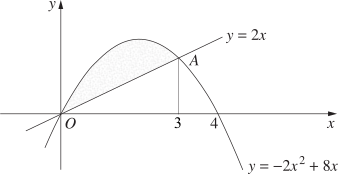
`text(Need to find)\ x\ text(-co-ord of)\ A`
| `y` | `= 2x\ \ \ \ \ …\ text{(i)}` |
| `y` | `= -2x^2 + 8x\ \ \ \ \ …\ text{(ii)}` |
`text(Subst)\ y = 2x\ text(from)\ text{(i)}\ text(into)\ text{(ii)}`
| `-2x^2 + 8x` | `= 2x` |
| `-2x^2 + 6x` | `= 0` |
| `-2x (x\ – 3)` | `= 0` |
`:.\ x = 0\ text(or)\ 3`
`:.\ x\ text(-coordinate of)\ A\ text(is 3)`
| ii. | `text(Area)` | `= int_0^3 (-2x^2 + 8x)\ dx\ – int_0^3 2x\ dx` |
| `= int_0^3 (-2x^2 + 6x)\ dx` | ||
| `= [-2/3x^3 + 3x^2]_0^3` | ||
| `= [(-2/3(3^3) + 3(3^2))\ – (0 + 0)]` | ||
| `= -18 + 27` | ||
| `= 9\ text(u²)` |
Probability, 2ADV S1 2014 HSC 12c
A packet of lollies contains 5 red lollies and 14 green lollies. Two lollies are selected at random without replacement.
- Draw a tree diagram to show the possible outcomes. Include the probability on each branch. (2 marks)
--- 6 WORK AREA LINES (style=lined) ---
- What is the probability that the two lollies are of different colours? (1 mark)
--- 2 WORK AREA LINES (style=lined) ---
Show Answers Only
-

- `70/171`
Show Worked Solution
| i. |  |
ii. `P text{(different colours)}`
`= P(RG) + P(GR)`
`= 5/19 xx 14/18 + 14/19 xx 5/18`
`= 70/342 + 70/342`
`= 140/342`
`= 70/171`
Financial Maths, 2ADV M1 2014 HSC 14d
At the beginning of every 8-hour period, a patient is given 10 mL of a particular drug.
During each of these 8-hour periods, the patient’s body partially breaks down the drug. Only `1/3` of the total amount of the drug present in the patient’s body at the beginning of each 8-hour period remains at the end of that period.
- How much of the drug is in the patient’s body immediately after the second dose is given? (1 mark)
--- 2 WORK AREA LINES (style=lined) ---
- Show that the total amount of the drug in the patient’s body never exceeds 15 mL. (2 marks)
--- 4 WORK AREA LINES (style=lined) ---
Quadratic, 2UA 2014 HSC 14b
The roots of the quadratic equation `2x^2 + 8x + k = 0` are `alpha` and `beta`.
- Find the value of `alpha + beta`. (1 mark)
- Given that `alpha^2 beta + alpha beta^2 = 6`, find the value of `k`. (2 marks)
Calculus, EXT1* C1 2014 HSC 13b
A quantity of radioactive material decays according to the equation
`(dM)/(dt) = -kM`,
where `M` is the mass of the material in kg, `t` is the time in years and `k` is a constant.
- Show that `M = Ae^(–kt)` is a solution to the equation, where `A` is a constant. (1 mark)
--- 2 WORK AREA LINES (style=lined) ---
- The time for half of the material to decay is 300 years. If the initial amount of material is 20 kg, find the amount remaining after 1000 years. (3 marks)
--- 10 WORK AREA LINES (style=lined) ---
Linear Functions, 2UA 2014 HSC 12b
The points `A(0, 4)`, `B(3, 0)` and `C(6, 1)` form a triangle, as shown in the diagram.

- Show that the equation of `AC` is `x + 2y − 8 = 0`. (2 marks)
- Find the perpendicular distance from `B` to `AC`. (2 marks)
- Hence, or otherwise, find the area of `Delta ABC`. (2 marks)
Functions, 2ADV F1 2014 HSC 6 MC
Which expression is a factorisation of `8x^3 + 27`?
- `(2x - 3)(4x^2 + 12x - 9)`
- `(2x + 3)(4x^2 - 12x + 9)`
- `(2x - 3)(4x^2 + 6x - 9)`
- `(2x + 3)(4x^2 - 6x + 9)`
Calculus, 2ADV C4 2014 HSC 4 MC
Which expression is equal to `int e^(2x)\ dx`?
- `e^(2x) + C`
- `2e^(2x) + C`
- `(e^(2x))/2 +C`
- `(e^(2x + 1))/(2x + 1) + C`
Functions, 2ADV F2 2014 HSC 2 MC
Which graph best represents `y = (x - 1)^2`?

Functions, 2ADV F1 2014 HSC 1 MC
What is the value of `(pi^2)/6`, correct to 3 significant figures?
- `1.64`
- `1.65`
- `1.644`
- `1.645`
Trigonometry, 2ADV T1 2014 HSC 11g
The angle of a sector in a circle of radius 8 cm is `pi/7` radians, as shown in the diagram.

Find the exact value of the perimeter of the sector. (2 marks)
Calculus, 2ADV C1 2014 HSC 11c
Differentiate `x^3/(x + 1)`. (2 marks)
--- 5 WORK AREA LINES (style=lined) ---
Functions, 2ADV F1 2014 HSC 11b
Factorise `3x^2 + x − 2`. (2 marks)
Functions, 2ADV F1 2014 HSC 11a
Rationalise the denominator of `1/(sqrt5-2)`. (2 marks)
Statistics, STD2 S1 2014 HSC 29c
Terry and Kim each sat twenty class tests. Terry’s results on the tests are displayed in the box-and-whisker plot shown in part (i).
- Kim’s 5-number summary for the tests is 67, 69, 71, 73, 75.
Draw a box-and-whisker plot to display Kim’s results below that of Terry’s results. (1 mark)

- What percentage of Terry’s results were below 69? (1 mark)
--- 1 WORK AREA LINES (style=lined) ---
- Terry claims that his results were better than Kim’s. Is he correct?
Justify your answer by referring to the summary statistics and the skewness of the distributions. (4 marks)
--- 8 WORK AREA LINES (style=lined) ---
Show Worked Solution
| i. | 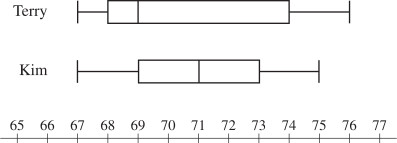 |
♦ Mean mark 39%
ii. `text(50%)`
iii. `text(Terry’s results are more positively skewed than)`
♦♦ Mean mark 29%
COMMENT: Examiners look favourably on using language of location in answers, particularly the areas they have specifically pointed students towards (skewness in this example).
COMMENT: Examiners look favourably on using language of location in answers, particularly the areas they have specifically pointed students towards (skewness in this example).
`text(Kim’s and also have a higher limit high.)`
`text(However, Kim’s results are more consistent,)`
`text(showing a tighter IQR. They also have a)`
`text(significantly higher median than Terry’s and)`
`text(are evenly skewed.)`
`:.\ text(Kim’s results were better.)`
Algebra, STD2 A2 2014 HSC 27b
Xuso is comparing the costs of two different ways of travelling to university.
Xuso’s motorcycle uses one litre of fuel for every 17 km travelled. The cost of fuel is $1.67/L and the distance from her home to the university car park is 34 km. The cost of travelling by bus is $36.40 for 10 single trips.
Which way of travelling is cheaper and by how much? Support your answer with calculations. (2 marks)
--- 4 WORK AREA LINES (style=lined) ---
Financial Maths, STD2 F1 2014 HSC 13 MC
Jane sells jewellery. Her commission is based on a sliding scale of 6% on the first $2000 of her sales, 3.5% on the next $1000, and 2% thereafter.
What is Jane’s commission when her total sales are $5670?
- $188.40
- $208.40
- $321.85
- $652.05
Financial Maths, STD2 F4 2014 HSC 9 MC
A car is bought for $19 990. It will depreciate at 18% per annum.
Using the declining balance method, what will be the salvage value of the car after 3 years, to the nearest dollar?
- $8968
- $9195
- $11 022
- $16 392
Probability, STD2 S2 2014 HSC 8 MC
A group of 150 people was surveyed and the results recorded.

A person is selected at random from the surveyed group.
What is the probability that the person selected is a male who does not own a mobile?
- `28/150`
- `45/150`
- `28/70`
- `45/70`
Probability, STD2 S2 2014 HSC 6 MC
A cafe menu has 3 entrees, 5 main courses and 2 desserts. Ariana is choosing a three-course meal consisting of an entree, a main course and a dessert.
How many different three-course meals can Ariana choose?
- 3
- 10
- 15
- 30
Measurement, STD2 M1 2014 HSC 2 MC
A measurement of 72 cm is increased by 20% and then the result is decreased by 20%.
What is the new measurement, correct to the nearest centimetre?
- 46 cm
- 69 cm
- 72 cm
- 104 cm
Quadratic, EXT1 2014 HSC 13c
The point `P(2at, at^2)` lies on the parabola `x^2 = 4ay` with focus `S`.
The point `Q` divides the interval `PS` internally in the ratio `t^2 :1`.

- Show that the coordinates of `Q` are
- `x = (2at)/(1 + t^2)` and `y = (2at^2)/(1 + t^2)`. (2 marks)
- Express the slope of `OQ` in terms of `t`. (1 mark)
- Using the result from part (ii), or otherwise, show that `Q` lies on a fixed circle of radius `a`. (3 marks)
Quadratic, EXT1 2009 HSC 2c
The diagram shows points `P(2t, t^2)` and `Q(4t, 4t^2)` which move along the parabola `x^2 = 4y`. The tangents to the parabola at `P` and `Q` meet at `R`.

- Show that the equation of the tangent at `P` is `y = tx\ - t^2.` (2 marks)
- Write down the equation of the tangent at `Q`, and find the coordinates of the point `R` in terms of `t`. (2 marks)
- Find the Cartesian equation of the locus of `R`. (1 mark)
- « Previous Page
- 1
- …
- 52
- 53
- 54
- 55
- 56
- 57
- Next Page »