SmarterEd

Aussie Maths & Science Teachers: Save your time with SmarterEd

  • Login
  • Get Help
  • About

Statistics, STD2 S1 2011 HSC 11 MC

The sets of data, `X` and `Y`, are displayed in the histograms.

2UG 2011 11

Which of these statements is true?

  1.   `X` has a larger mode and `Y ` has a larger range.
  2.   `X` has a larger mode and the ranges are the same.
  3.   The modes are the same and `Y` has a larger range.
  4.   The modes are the same and the ranges are the same.
Show Answers Only

`B`

Show Worked Solution
♦ Mean mark 47%

`text(Mode of)\ X=9`

`text(Range of)\ X=9-3=6`

`text(Mode of)\ Y=8`

`text(Range of)\ Y=11-5=6`

`:. X\ text(has a larger mode and ranges are the same)`

`=>B`

Filed Under: Bar Charts and Histograms, Bar Charts and Histograms (Std 2), Bar Charts and Histograms (Std2-2027), Bar Charts and Histograms (Y12), Bar Charts, Histograms and Other Graphs (Std 1), Data Analysis Tagged With: Band 4, common-content, num-title-ct-core, num-title-qs-hsc, smc-1128-15-Histograms, smc-4224-45-Mean/median/mode/range, smc-6310-20-Histograms, smc-821-15-Histograms, smc-997-15-Histograms

Statistics, STD2 S4 2011 HSC 8 MC

In which graph would the data have a correlation coefficient closest to  – 0.9?

2UG 2011 8

Show Answers Only

`D`

Show Worked Solution

`text{Data needs to show a strong negative correlation}`

`text{(i.e. top left to lower right.)}`

`=>D`

Filed Under: Bivariate Data Analysis (Y12), Correlation / Body Measurements, S4 Bivariate Data Analysis (Y12) Tagged With: Band 4, common-content, smc-1001-30-Correlation, smc-785-30-Correlation

Measurement, STD2 M2 2011 HSC 3 MC

Perth in Western Australia is 8 hours ahead of Coordinated Universal Time (UTC). Cape Town in South Africa is 2 hours ahead of UTC.

What is the time in Cape Town when it is 1 pm in Perth?

  1.  3 am
  2. 7 am
  3. 7 pm
  4. 11 pm
Show Answers Only

`B`

Show Worked Solution

`text(Perth is 6 hrs ahead of Cape Town)`

`:.\ 1 text(pm in Perth = 7 am in Cape Town)`

`=> B`

Filed Under: M2 Working with Time (Y11), M2 Working with Time (Y11), Time and Time Difference (Std2-2027) Tagged With: Band 4, smc-1102-10-Time Differences, smc-6306-10-Time Differences, smc-776-10-Time Differences

Probability, STD2 S2 2011 HSC 2 MC

Which of the following could be the probability of an event occurring?

  1.    `1` 
  2.    `6/5` 
  3.    `1.27` 
  4.    `text(145%)` 
Show Answers Only

`A`

Show Worked Solution

`text(Probabilities must lie between 0 and 1 inclusive.)`

`=>A`

Filed Under: Fundamental understanding, Fundamental Understanding (Std 1), Fundamental Understanding (Std 2), Probability Tagged With: Band 4, num-title-ct-core, num-title-qs-hsc, smc-4225-05-Core concepts

Probability, STD2 S2 2010 HSC 8 MC

A bag contains red, green, yellow and blue balls.

\begin{array} {|c|c|}
\hline
\rule{0pt}{2.5ex} \textit{Colour} \rule[-1ex]{0pt}{0pt} & \textit{Probability} \\
\hline
\rule{0pt}{2.5ex} \text{Red} & \dfrac{1}{3} \\
\hline
\rule{0pt}{2.5ex} \text{Green}  & \dfrac{1}{4} \\
\hline
\rule{0pt}{2.5ex} \text{Yellow}  & \text{?} \\
\hline
\rule{0pt}{2.5ex} \text{Blue}  & \dfrac{1}{6} \\
\hline
\end{array}

The table shows the probability of choosing a red, green, or blue ball from the bag.

If there are 12 yellow balls in the bag, how many balls are in the bag altogether

  1.    16
  2.    36
  3.    48
  4.    60
Show Answers Only

\(C\)

Show Worked Solution
\(P(R)+P(G)+P(Y)+P(B)\) \(=1\)
\(\dfrac{1}{3}+\dfrac{1}{4}+P(Y)+\dfrac{1}{6}\) \(=1\)
\(P(Y)\) \(= 1-(\dfrac{1}{3}+\dfrac{1}{4}+\dfrac{1}{6})\)
  \(=1-\dfrac{9}{12}\)
  \(=\dfrac{1}{4}\)
\(P(Y)\) \(=\dfrac{\text{Yellow balls}}{\text{Total balls}}\)
\(\dfrac{1}{4}\) \(=\dfrac{12}{\text{Total balls}}\)


\(\therefore\ \text{ Total balls}=48\)

\(\Rightarrow C\)

Filed Under: Combinations and Single Stage Events (Std 2), Probability, Single and Multi-Stage Events (Std 1), Single stage events Tagged With: Band 4, num-title-ct-core, num-title-qs-hsc, smc-1135-05-Simple Probability, smc-4225-15-Single-stage events, smc-828-10-Simple Probability

Financial Maths, STD2 F1 2010 HSC 5 MC

Minjy invests $2000 for 1 year and 5 months. The simple interest is calculated at a rate of 6% per annum.

What is the total value of the investment at the end of this period?

  1. $2170
  2. $2180
  3. $3003
  4. $3700
Show Answers Only

`A`

Show Worked Solution
`text(Interest)` `=Prn`
  `=2000 xx\ text(6%)\ xx 17/12`
  `=$170`


`:.\ text(Value of Investment)` `=2000+170`
  `=$2170`

`=>  A`

Filed Under: FM2 - Investing, Simple Interest, Simple Interest and S/L Depreciation (Std 1), Simple Interest and S/L Depreciation (Std 2) Tagged With: Band 4, num-title-ct-corea, num-title-qs-hsc, smc-1124-10-Simple Interest, smc-4332-10-Find interest, smc-808-10-Simple Interest

Statistics, STD2 S5 2010 HSC 4 MC

Which of the following frequency histograms shows data that could be normally distributed?
 

Capture1

Capture2 

Show Answers Only

`A`

Show Worked Solution

`text(Normally distributed data have a frequency)`

`text(histogram graph that is shaped like a bell.)`

`=>  A`

Filed Under: Bar Charts and Histograms, Bar Charts and Histograms (Std 2), Bar Charts and Histograms (Std2-2027), Bar Charts and Histograms (Y12), DS5/6 - Normal Distribution and Sampling, Normal Distribution (Y12), S5 The Normal Distribution (Y12) Tagged With: Band 4, common-content, smc-6310-20-Histograms, smc-819-40-Graphs, smc-821-15-Histograms, smc-995-40-Graphs, smc-997-15-Histograms

Measurement, STD2 M6 2010 HSC 3 MC

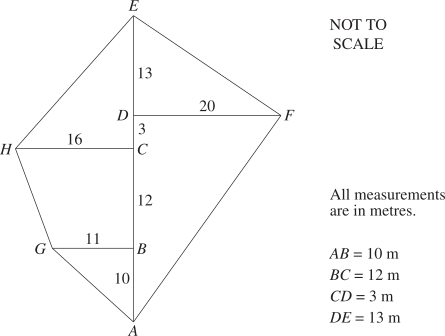
A field diagram has been drawn from an offset survey.

What is the distance from `G` to `H` correct to the nearest metre?

  1. 11
  2. 13
  3. 16
  4. 20
Show Answers Only

`B`

Show Worked Solution

`text(Using Pythagoras:)`

`GH^2` `=12^2+(16-11)^2`
  `=144+25`
  `=169`
   
`:.\ GH` `=sqrt169 `
  `=13\ text(m)`

 
` =>  B`

Filed Under: M3 Right-Angled Triangles (Y12), MM2 - Perimeter, Area and Volume (Prelim), Pythagoras and Right-Angled Trig (Std2) Tagged With: Band 4, smc-1103-10-Pythagoras, smc-802-10-Pythagoras

Measurement, STD2 M1 2012 HSC 26g

Bhawana purchases pool chlorine in a new container which holds 35 kg.
 

2012 26g

 
She begins using this new container on the first day of a week.

How many full weeks should this container last?     (2 marks)

--- 4 WORK AREA LINES (style=lined) ---

Show Answers Only

 `text(15 full weeks.)`

Show Worked Solution
`text(Cups used per week)` `= 3 + 6 = 9`
`text(Chlorine usage per week)` `= 9 xx 250text(g)`
  `= 2250 text(g)`

 
`text(Total chlorine available)\ = 35text(kg) = 35\ 000\  text(grams)`

MARKER’S COMMENT: Better answers converted all measurements to grams (rather than use decimals and kgs) and realised the answer should be in full weeks.
`text(Time it will last)` `= (35\ 000)/2250`
  `= 15.555…`


`:.\ text(The container will last 15 full weeks.)`

Filed Under: Identify and Convert Between Units (Std2-2027), MM1 - Units of Measurement, Units and Measurement Error (Std 1), Units and Measurement Error (Std 2) Tagged With: Band 4, smc-1120-40-Other unit conversion, smc-6303-30-Capacity/Volume/Mass, smc-797-40-Other unit conversion

Probability, STD2 S2 2012 HSC 26e

The dot plot shows the number of push-ups that 13 members of a fitness class can do in one minute.

2012 26e

  1.  What is the probability that a member selected at random from the class can do more than 38 push-ups in one minute?   (1 mark)

    --- 1 WORK AREA LINES (style=lined) ---

  2.  A new member who can do 32 push-ups in one minute joins the class.


    Does the addition of this new member to the class change the probability calculated in part (i)? Justify your answer.    (1 mark)

    --- 2 WORK AREA LINES (style=lined) ---

Show Answers Only
  1. `7/13`
  2. `text{Yes (See Worked Solutions)}`
Show Worked Solution
i.  `P` `= text(# Members > 38 push-ups)/text(Total members)`
  `= 7/13`

 
ii.
   `text(Yes.)`

`Ptext{(+ New member)}` `= text(Members > 38 push-ups)/text(Total members)`
  `= 7/14≠ 7/13`
MARKER’S COMMENT: The most successful candidates used the fraction `7/14` in their part (ii) answer rather than relying solely on words.

Filed Under: Probability, Relative Frequency, Relative Frequency (Std 1), Relative Frequency (Std 2), Relative Frequency (Y11) Tagged With: Band 3, Band 4, common-content, num-title-ct-core, num-title-qs-hsc, smc-1133-10-Surveys/Two-Way Tables, smc-4225-35-Relative frequency, smc-827-10-Surveys/Two-Way Tables, smc-990-10-Surveys/Two-Way Tables

Statistics, STD2 S1 2012 HSC 26d

Greg needs to conduct a statistical inquiry into how much time people aged 18–25 years have spent accessing social media websites in the last two weeks. He has decided to survey a sample of students from his university.

The process of statistical inquiry includes the following steps, which are NOT in order.
 

2012 26d 

  1. Using the letters A, B, C, D, E and F, list the steps in the most appropriate order for Greg to conduct his statistical inquiry.   (2 marks)

    --- 4 WORK AREA LINES (style=lined) ---

  2. Greg conducts his statistical inquiry.


    At which step in the process would he have drawn this graph?    (1 mark) 

2012 26d2

--- 2 WORK AREA LINES (style=lined) ---

Show Answers Only
  1. `text(B, E, C, F, D, A)`
  2. `text(F)`
Show Worked Solution

i.   `text(B, E, C, F, D, A)`

ii.   `text(F)`

Filed Under: Classifying Data (Std 1), Classifying Data (Std 2), Data Classification, Investigation and Sampling Methods (Std2-2027), DS1 - Stats and society Tagged With: Band 4, common-content, smc-1127-30-Other, smc-6309-30-Other, smc-820-30-Other

Algebra, STD2 A1 2012 HSC 21 MC

Which of the following correctly expresses  `c`  as the subject of  `E = mc^2 + p` ? 

  1. `c = +-sqrt(\ \ (E-p)/m)` 
  2. `c = +-sqrt(E-p)/m` 
  3. `c = +- sqrt(\ \ E/m) -p` 
  4. `c = +- sqrt(\ \ E/m-p)`
Show Answers Only

`A`

Show Worked Solution
`E` `=\ mc^2 + p`
`mc^2` `=\ E-p`
`c^2` `=(E-p)/m`
`:.c` `= +-sqrt((E-p)/m)`

 
`=>  A`

Filed Under: Formula Rearrange, Formula Rearrange (Std 1), Formula Rearrange (Std 2), Formula Rearrange (Std2-2027) Tagged With: Band 4, smc-1200-20-Non-Linear, smc-1201-20-Non-Linear, smc-6236-20-Non-Linear

Measurement, STD2 M6 2012 HSC 20 MC

Town `B` is 80 km due north of Town `A` and 59 km from Town `C`.

Town `A` is 31 km from Town `C`.
 

2012 20 mc
 

 What is the bearing of Town `C` from Town `B`?  

  1.   `019^@`
  2.   `122^@` 
  3.   `161^@` 
  4.   `341^@` 
Show Answers Only

`C`

Show Worked Solution
♦ Mean mark 49%

`text(Using the cosine rule:)`

`cos\ /_B` `= (a^2 + c^2 -b^2)/(2ac)`
  `= (59^2 + 80^2 -31^2)/(2 xx 59 xx 80)`
  `= 0.9449…`
`/_B` `= 19^@\  text((nearest degree))`


`:.\ text(Bearing of Town C from B) = 180-19= 161^@`

`=>  C`

Filed Under: Bearings & Field Surveys, Bearings and Radial Surveys (Std2) Tagged With: Band 4, common-content, smc-803-10-Bearings

Financial Maths, STD2 F1 2012 HSC 18 MC

Jo qualifies for both Rent Assistance and Youth Allowance and receives a fortnightly payment from the government. 

Rent Assistance is  $119.40  per fortnight. 

The maximum Youth Allowance is $402.70 per fortnight. It is reduced by 50 cents in the dollar for any income earned over $236 per fortnight.

Jo earns $300 per fortnight from a part-time job.

What is the total payment Jo receives each fortnight from the government?

  1. $370.70
  2. $372.10
  3. $458.60
  4. $490.10
Show Answers Only

`D`

Show Worked Solution

`text(Rent assistance)\ = $119.40`

`text(Youth allowance)` `= 402.70\ text(less 50c per dollar)\ \ (text(income) > $236)`
  `= 402.70-0.5(300-236)`
  `= 402.70-32`
  `= $370.70`


`:.\ text{Total Payment}` `=119.40 + 370.70`  
  `=$490.10`  

 
`=>  D`

Filed Under: Earning and Spending Money, Earning Money and Budgeting (Std 1), Earning Money and Budgeting (Std 2), FM1 - Earning money, Ways of Earning (Std2-2027) Tagged With: Band 4, num-title-ct-corea, num-title-qs-hsc, smc-1126-10-Wages, smc-4331-10-Wages, smc-6276-40-Govt Payments, smc-810-10-Wages

Financial Maths, STD2 F4 2012 HSC 16 MC

A machine was bought for $25 000.

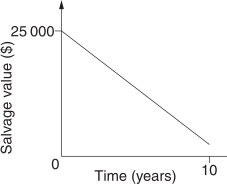
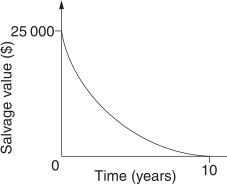
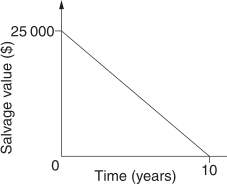
Which graph best represents the salvage value of the machine over 10 years using the declining balance method of depreciation?

(A)     (B)  
         
(C)        (D)
Show Answers Only

`A`

Show Worked Solution

`text(By Elimination)`

`B\ \ text(and)\ \ D\ \ text(represent straight line depreciation.)`

`C\ \ text(incorrectly has no salvage value after 10 years)`

`=>A`

Filed Under: Depreciation, Depreciation - Declining Balance (Std 1), Depreciation - Declining Balance (Std 2), Depreciation / Running costs Tagged With: Band 4, num-title-ct-coreb, num-title-qs-hsc, smc-1139-60-Depreciation Graphs, smc-4335-50-Graphs, smc-813-60-Depreciation Graphs

Algebra, STD2 A1 2012 HSC 15 MC

A car takes 6 hours to complete a journey when travelling at 60 km/h.

How long would the same journey take if the car were travelling at 100 km/h?

  1.    36 minutes
  2.      1 hour and 40 minutes
  3.      3 hours and 6 minutes
  4.      3 hours and 36 minutes
Show Answers Only

`D`

Show Worked Solution

`T = D/S`

`text(S)text(ince)\ \ \ T = 6\ \ \ text(when)\ \ \ S = 60`

`6` `= D/60`
`D` `= 360\ text(km)`


`text(Find)\ \ T\ \ text (when)\ \ \ S = 100\ \ text(and)\ \ \ D = 360`

`T` `= 360/100`
  `= 3.6\ text(hours)`
  `= 3\ text(hrs)\ \ 36\ text(minutes)`

`=>  D`

Filed Under: Applications: BAC, Medication and D=SxT (Std 2), Applications: BAC, Medicine and D=SxT (Std2-2027), Applications: D=SxT and Other (Std 1), Safety: D=ST & BAC Tagged With: Band 4, smc-1117-20-Distance Speed Time, smc-6235-20-Speed Distance Time, smc-791-20-Speed Distance Time

Algebra, 2UG 2012 HSC 14 MC

Which of the following expresses  `2x^2 (5- x)-x(x-2)`  in its simplest form?

(A)   `–2x^3 + 9x^2 + 2x`

(B)  `–2x^3-  9x^2-  2x `

(C)  `9x^2- x + 2`

(D)   `9x^2- x- 2`

Show Answers Only

`A`

Show Worked Solution
`2x^2 (5-x)\-x(x-2)` `= 10x^2-2 x ^3-x^2+ 2x`
  `=-2x^3+9 x^2+2x`

`=>  A`

Filed Under: Linear and Other Equations Tagged With: Band 4

Financial Maths, STD2 F4 2012 HSC 24 MC

A  $400 000 loan can be repaid by making either monthly or fortnightly repayments.

The graph shows the loan balances over time using these two different methods of repayment.
 

2012 24 mc

The monthly repayment is $2796.86 and the fortnightly repayment is $1404.76.

What is the difference in the total interest paid using the two different methods of
repayment, to the nearest dollar?

  1.    $51 596
  2.    $166 823
  3.    $210 000
  4.    $234 936
Show Answers Only

`B`

Show Worked Solution
`text(Monthly repayment)` `= $2796.86`
`text(# Repayments)` `= 30 xx 12 = 360`
`text(Total repaid)` `= 360 xx 2796.86`
  `= $1\ 006\ 869.60`
`text(Total interest)` `= 1\ 006\ 869.60\ -400\ 000`
  `=$606\ 869.60`


`text(Fortnightly payment)` `= $1404.76`
`text(# Repayments)` `= 23 xx 26 = 598`
`text(Total repaid)` `= 598 xx 1404.76`
  `=$840\ 046.48`
`text(Total interest)` `= 840\ 046.48-400\ 000`
  `= $440\ 046.48`


`:.\ text(Difference in interest)` `= 606\ 869.60-440\ 046.48`
  `= $166\ 823\ \ \  text((nearest dollar))`

`=>  B`

Filed Under: FM5 - Annuities and Loan repayments, Loans (Std 1), Loans and Credit Cards (Std 2) Tagged With: Band 4, smc-1140-40-Total Loan/Interest Payments, smc-1140-50-Loan Graphs, smc-814-40-Total Loan/Interest Payments, smc-814-50-Loan Graphs

Measurement, STD2 M6 2012 HSC 10 MC

 What is the area of this triangle, to the nearest square metre? 

  1. `33\ text(m²)`
  2. `37\ text(m²)`
  3. `42\ text(m²)`
  4. `44\ text(m²)`
Show Answers Only

`C`

Show Worked Solution

`text(Let unknown angle)=/_C`

`/_C` `= 180-(50 + 57)\ \ \ \ \ (180^@ \ text(in)\ Delta)`
  `=73^@`


`:. A` `= 1/2 ab\ sinC`
  `= 1/2 xx 9.9 xx 8.8 xx sin73^@`
  `= 41.656 \ text(m²)`

 
`=>  C`

Filed Under: Non Right-Angled Trig, Non-Right Angled Trig, Non-Right Angled Trig (Std2) Tagged With: Band 4, num-title-ct-pathc, num-title-qs-hsc, smc-4553-30-Sine Rule (Area), smc-804-30-Sine Rule (Area)

Algebra, STD2 A2 2012 HSC 8 MC

Dots were used to create a pattern. The first three shapes in the pattern are shown. 
 

 The number of dots used in each shape is recorded in the table. 

\begin{array} {|l|c|}
\hline
\rule{0pt}{2.5ex} \text{Shape $(S)$} \rule[-1ex]{0pt}{0pt} &\;\;\;  1 \;\;\; & \;\; \;2  \;\;\; &   \;\;\; 3 \;\;\; \\
\hline
\rule{0pt}{2.5ex} \text{Number of dots $(N)$} \rule[-1ex]{0pt}{0pt} &\;\;\;  6 \;\;\; & \;\; \;8  \;\;\; &   \;\; \;10\; \;\; \\
\hline
\end{array}

How many dots would be required for Shape 156?

  1. `316` 
  2. `520`   
  3. `624` 
  4. `936`  
Show Answers Only

`A`

Show Worked Solution

`text(Linear relationship where)`

`N=4+(2 xx S)`

`text(When)\ \ S = 156`

`N` `= 4 + (2 xx 156)`
  `=316`

`=>  A`

Filed Under: Linear Equations and Basic Graphs (Std 1), Linear Equations and Basic Graphs (Std 2) Tagged With: Band 4, smc-1118-30-Patterns, smc-792-30-Patterns

Statistics, STD2 S1 2012 HSC 7 MC

The Pi Company has two bakeries. The radar chart displays the monthly sales for the bakeries.
 

2012 7 mc 

  
What was the difference in sales in June between the two bakeries?

  1.   $7.50
  2.   $17.50
  3.   $7500
  4.   $17 500
Show Answers Only

`D`

Show Worked Solution
`text(Bakery 1 Sales in June)` `= $17\ 500`
`text(Bakery 2 Sales in June)` `=$35\ 000`
`:.\ text(Difference in Sales)` `= 35\ 000 \-17\ 500`
  `= 17\ 500`

`=>  D`

Filed Under: Bar Charts, Histograms and Other Graphs (Std 1), Other Chart Types (Y12), Other Charts (Std 2), Other Graphs Tagged With: Band 4, common-content, smc-1128-28-Other Charts, smc-822-40-Other Charts, smc-998-40-Other Charts

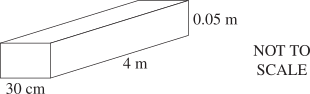
Measurement, STD2 M1 2012 HSC 6 MC

What is the volume of this rectangular prism in cubic centimetres? 
  

  1. 6 cm³
  2. 600 cm³
  3. 60 000 cm³
  4. 6 000 000 cm³
Show Answers Only

`C`

Show Worked Solution

`text{Convert all measurements to centimetres:}`

`V` `= l xx b xx h`
  `=30 xx 5 xx 400`
  `=60\ 000\ \ text(cm)^3`

 
`=>  C`

Filed Under: MM2 - Perimeter, Area and Volume (Prelim), Perimeter, Area and Volume (Std 2), Perimeter, Area and Volume (Std2-2027), Volume Tagged With: Band 4, num-title-ct-corea, num-title-qs-hsc, smc-4235-10-Prisms, smc-6304-40-Volume, smc-798-40-Volume

Measurement, STD2 M6 2011 HSC 4 MC

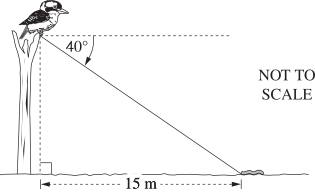
The angle of depression from a kookaburra’s feet to a worm on the ground is 40°. The worm is 15 metres from a point on the ground directly below the kookaburra’s feet. 
 

 How high above the ground are the kookaburra's feet, correct to the nearest metre?

  1. 10 m
  2. 11 m
  3. 13 m
  4. 18 m
Show Answers Only

`C`

Show Worked Solution
`  /_ \ text{Elevation (worm)}` `= 40^@`    `text{(alternate angles)}`
`tan 40^@` `=h/15`
`:. h` `=15xxtan 40^@`
  `=12.58…\ text(m)`

`=>C`

Filed Under: M3 Right-Angled Triangles (Y12), Pythagoras and basic trigonometry, Pythagoras and Right-Angled Trig (Std2), Right-Angled Trig Tagged With: Band 4, num-title-ct-coreb, num-title-qs-hsc, smc-1103-20-Right-angled Trig, smc-1103-30-Angle of Depression, smc-4552-40-Real world applications, smc-4552-50-Angle of depression, smc-802-20-Right-Angled Trig, smc-802-30-Angle of Depression

Measurement, STD2 M6 2012 HSC 4 MC

 Which expression could be used to calculate the value of `x` in this triangle? 


  1. `29 xx cos40^@`  
  2. `29 xx cos 50^@`  
  3. `cos40^@/29`  
  4. `cos50^@/29`  
Show Answers Only

`A`

Show Worked Solution
♦ Mean mark 42%
`cos40^@` `= x/29`
`x` `= 29xxcos40^@`

 
`=>  A`

Filed Under: M3 Right-Angled Triangles (Y12), Pythagoras and basic trigonometry, Pythagoras and Right-Angled Trig (Std2), Right-Angled Trig Tagged With: Band 4, num-title-ct-corea, num-title-qs-hsc, smc-1103-20-Right-angled Trig, smc-4552-20-cos, smc-802-20-Right-Angled Trig

Statistics, STD2 S1 2012 HSC 1 MC

A set of 15 scores is displayed in a stem-and-leaf plot.
 

2012 1 mc 
 

 What is the median of these scores?

  1.    7 
  2.    8
  3.   77
  4.   78
Show Answers Only

`D`

Show Worked Solution

`text(15 scores)\ \ =>\ \ text(Median is 8th)`

`:.\ \ text(Median is)\ \ 78`

`=>  D`

Filed Under: Bar Charts, Histograms and Other Graphs (Std 1), Data Analysis, Other Chart Types (Y12), Other Charts (Std 2), Other Charts (Std2-2027), Stem & Leaf, Box & Whisker Tagged With: Band 4, common-content, num-title-ct-core, num-title-qs-hsc, smc-1128-24-Stem and Leaf, smc-4224-20-Median, smc-4224-40-Stem and Leaf, smc-6311-10-Stem-and-Leaf, smc-822-20-Stem and Leaf, smc-998-20-Stem and Leaf

Measurement, STD2 M1 2013 HSC 19 MC

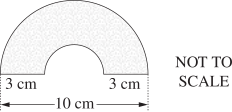
A logo is designed using half of an annulus.
  

What is the area of the logo, to the nearest cm²?

  1. `25\ text(cm²)`
  2. `33\ text(cm²)`
  3. `132\ text(cm²)`
  4. `143\ text(cm²)`
Show Answers Only

`B`

Show Worked Solution
`text(Area)` `=1/2xxpi(R^2-r^2)`
  `=1/2xxpi(5^2-2^2)`
  `=21/2pi`
  `=33\ text(cm²)\ \ \ text{(nearest cm²)}` 

 
`=>\ B`

Filed Under: Area and Surface Area, Areas and Volumes (Harder), Perimeter and Area (Std 1), Perimeter, Area and Volume (Std 2), Perimeter, Area and Volume (Std2-2027) Tagged With: Band 4, num-title-ct-corea, num-title-qs-hsc, smc-4234-20-Area (circular), smc-6304-20-Perimeter and Area (Circular Measure), smc-798-20-Perimeter and Area (Circular Measure)

Measurement, STD2 M1 2013 HSC 16 MC

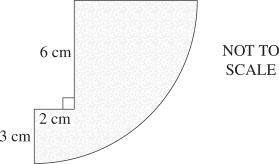
The shaded region shows a quadrant with a rectangle removed.
  

What is the area of the shaded region, to the nearest cm2?

  1. 38 cm²
  2. 52 cm²
  3. 61 cm²
  4. 70 cm²
Show Answers Only

`B`

Show Worked Solution
`text(Shaded area)` `=\ text(Area of segment – Area of rectangle)`
  `=1/4 pi r^2-(6xx2)`
  `=1/4 pi xx9^2-12`
  `=51.617…\ text(cm²)`

`=>\ B`

Filed Under: Areas and Volumes (Harder), Circular measure, Perimeter and Area (Std 1), Perimeter, Area and Volume (Std 2), Perimeter, Area and Volume (Std2-2027) Tagged With: Band 4, num-title-ct-core, num-title-qs-hsc, smc-4944-30-Sectors, smc-6304-20-Perimeter and Area (Circular Measure), smc-798-20-Perimeter and Area (Circular Measure)

Statistics, STD2 S1 2013 HSC 15 MC

The frequency histogram shows the number of goals scored by a football team in each game in a season.
 

2013 15 mc

 
What is the mean number of goals scored per game by this team?

  1.    4
  2.    4.5
  3.    5
  4.    5.5
Show Answers Only

`C`

Show Worked Solution

`text(Total number of goals scored)`

`=(3xx3)+(4xx7)+(5xx5)+(6xx1)+(7xx0)+(8xx4)`

`=9+28+25+6+0+32`

`=100`

`text(Number of games)=3+7+5+1+4=20`

`:.\ text(Mean goals per game)=100/20=5`

`=>\ C`

Filed Under: Bar Charts and Histograms, Bar Charts and Histograms (Std 2), Bar Charts and Histograms (Std2-2027), Bar Charts and Histograms (Y12), Bar Charts, Histograms and Other Graphs (Std 1), Data Analysis Tagged With: Band 4, common-content, num-title-ct-core, num-title-qs-hsc, smc-1128-15-Histograms, smc-4224-25-Mean, smc-6310-20-Histograms, smc-821-15-Histograms, smc-997-15-Histograms

Statistics, STD2 S1 2013 HSC 14 MC

The July sales prices for properties in a suburb were:

$552 000,  $595 000,  $607 000,  $607 000,  $682 000, and  $685 000.

On 1 August, another property in the same suburb was sold for over one million dollars.

If the property had been sold in July, what effect would it have had on the mean and median sale prices for July?

  1.    Both the mean and median would have changed.
  2.    Neither the mean nor the median would have changed.
  3.    The mean would have changed and the median would have stayed the same.
  4.    The mean would have stayed the same and the median would have changed.
Show Answers Only

`C`

Show Worked Solution

`text(Mean increases because new house is sold above)`

`text(the existing average.)`

`text(Initial median)= (607\ 000+607\ 000)/2=607\ 000` 

`text(New median)=607\ 000\ \ \  text{(4th value in a list of 7)}`

`=>\ C`

Filed Under: Data Analysis, Measures of Centre and Spread (Std2-2027), Summary Statistics - No Graph (Std 2), Summary Statistics - No graph (Y12), Summary Statistics (no graph), Summary Statistics (Std 1) Tagged With: Band 4, common-content, num-title-ct-core, num-title-qs-hsc, smc-1131-10-Mean, smc-1131-20-Median and Mode, smc-4224-50-Add/remove data, smc-6312-10-Mean, smc-6312-20-Median and Mode, smc-824-10-Mean, smc-824-20-Median and Mode, smc-999-10-Mean, smc-999-20-Median and Mode

Financial Maths, STD2 F1 2013 HSC 13 MC

Polly borrowed $11 000.  She repaid the loan in full at the end of two years with a lump sum of  $12 000.

What annual simple interest rate was she charged?

  1. 4.17%
  2. 4.55%
  3. 8.33%
  4. 9.09%
Show Answers Only

`B`

Show Worked Solution

`text(Total interest paid)=12\ 000-11\ 000=$1000`

`I` `=Prn`
`1000` `=11\ 000 xx r xx2`
`r` `=1000/(22\ 000)`
  `=4.55 text(%)`

 
`=>\ B`

Filed Under: FM4 - Credit and Borrowing, Simple Interest, Simple Interest and S/L Depreciation (Std 1), Simple Interest and S/L Depreciation (Std 2) Tagged With: Band 4, num-title-ct-corea, num-title-qs-hsc, smc-1124-10-Simple Interest, smc-4332-20-Find interest rate, smc-808-10-Simple Interest

Measurement, STD2 M1 2013 HSC 12 MC

A square pyramid fits exactly on top of a cube to form a solid.

2013 12 mc

What is the volume of the solid?

  1. 513 cm³
  2. 999 cm³
  3. 1242 cm³
  4. 1539 cm³
Show Answers Only

`B`

Show Worked Solution
`text(Volume )` `=text{Vol (cube)} +text{Vol (pyramid)}`
  `=l^3+1/3Ah`
  `=(9xx9xx9)+(1/3xx9xx9xx10)`
  `=999\ text(cm)^3`

 
`=>\ B`

Filed Under: Areas and Volumes (Harder), Perimeter, Area and Volume (Std 2), Perimeter, Area and Volume (Std2-2027) Tagged With: Band 4, num-title-ct-pathb, num-title-qs-hsc, smc-4235-50-Pyramids/Cones, smc-6304-40-Volume, smc-798-40-Volume

Probability, STD2 S2 2013 HSC 10 MC

Students studying vocational education courses were surveyed about their living arrangements.

One of these students is selected at random.

 What is the probability that this student is male and living with his parent(s)?

  1. 31%
  2. 40%
  3. 56%
  4. 77%
Show Answers Only

`A`

Show Worked Solution

`text(Number of males living with their parents is = 155)`.

`:.\ P=155/505=0.30693…%`

`=>\ A`

Filed Under: Relative Frequency, Relative Frequency (Std 1), Relative Frequency (Std 2), Relative Frequency (Y11) Tagged With: Band 4, common-content, smc-1133-10-Surveys/Two-Way Tables, smc-827-10-Surveys/Two-Way Tables, smc-990-10-Surveys/Two-Way Tables

Financial Maths, STD2 F1 2013 HSC 9 MC

Lynne invests $1000 for a term of 15 months. Simple interest is paid on the investment at a rate of 3.75% per annum.

How much will Lynne's investment be worth at the end of the term?

  1. $1046.88
  2. $1047.09
  3. $1296.88
  4. $1468.75
Show Answers Only

`A`

Show Worked Solution

`I=Prn=1000xx3.75/100xx15/12=$46.88`

`:.\ text(Investment worth)\ = 1000+46.88=$1046.88`

`=>\ A`

Filed Under: FM2 - Investing, Simple Interest, Simple Interest and S/L Depreciation (Std 1), Simple Interest and S/L Depreciation (Std 2) Tagged With: Band 4, num-title-ct-corea, num-title-qs-hsc, smc-1124-10-Simple Interest, smc-4332-10-Find interest, smc-808-10-Simple Interest

Statistics, STD2 S1 2013 HSC 6 MC

A survey was conducted where people were asked which of two brands of smartphones they preferred. The results were:

  • 48% preferred Brand X
  • 52% preferred Brand Y

A graph displaying the data is to be included in a magazine article. The editor of the magazine wishes to ensure that the graph is not misleading in any way.

Which graph should the editor choose to include in the article?
 

2013 6 mc1

2013 6 mc2

Show Answers Only

`D`

Show Worked Solution

`D\ text(is the best as it starts at zero on the)\ y text(-axis)`

`text(and has the same column widths.)`

Filed Under: Bar Charts and Histograms, Bar Charts and Histograms (Std 2), Bar Charts and Histograms (Std2-2027), Bar Charts and Histograms (Y12), Bar Charts, Histograms and Other Graphs (Std 1), Interpreting Data Tagged With: Band 4, common-content, num-title-ct-core, num-title-qs-hsc, smc-1128-10-Bar Charts, smc-6310-10-Bar Charts, smc-821-10-Bar Charts, smc-997-10-Bar Charts

Algebra, 2UG 2013 HSC 5 MC

Which of the following is  `(12T^2)/(3Txx2W)`  in its simplest form?

  1. `(2T)/W`
  2. `2TW`
  3. `(8T)/W`
  4. `8TW`
Show Answers Only

`A`

Show Worked Solution

`(12T^2)/(3Txx2W)=(12T^2)/(6TW)=(2T)/W`

  
`=>\ A`

Filed Under: Index and Log Laws, Indices Tagged With: Band 4, num-title-ct-pathb, num-title-qs-hsc, smc-4228-10-Positive integers

Financial Maths, STD2 F1 2013 HSC 3 MC

Luke's normal rate of pay is  $24.80  per hour. In one week he worked 14 hours at the normal rate, 4 hours at time-and-a-half, and 3 .5 hours at double time. He was also paid a wet weather allowance of  $50  for the week.

What was his pay for the week?

  1. $583.20
  2. $620.40
  3. $669.60
  4. $719.60
Show Answers Only

`D`

Show Worked Solution
 `text(Pay)` `=(14xx24.80)+(4xx1.5xx24.80)+(3.5xx2xx24.80)+50` 
   `=347.20+148.80+173.60+50`
   `=$719.60`

 
`=>D`

Filed Under: Earning and Spending Money, Earning Money and Budgeting (Std 1), Earning Money and Budgeting (Std 2), FM1 - Earning money, Ways of Earning (Std2-2027) Tagged With: Band 4, num-title-ct-corea, num-title-qs-hsc, smc-1126-10-Wages, smc-4331-10-Wages, smc-6276-10-Wages/Salaries, smc-810-10-Wages

Statistics, STD2 S4 2013 HSC 2 MC

Which graph best shows data with a correlation closest to 0.3?
 

2013 2 mc1

2013 2 mc2


Show Answers Only

`A`

Show Worked Solution

`A\ text(is correct since the data slopes bottom)`

`text{left to top right (i.e. it’s positive).}`

`D\ text(also slopes correctly but exhibits a higher)`

`text(correlation co-efficient.)`

`=>A`

Filed Under: Bivariate Data Analysis (Y12), Correlation / Body Measurements, S4 Bivariate Data Analysis (Y12) Tagged With: Band 4, common-content, smc-1001-30-Correlation, smc-785-30-Correlation

Probability, STD2 S2 2013 HSC 1 MC

Which of the following events would be LEAST likely to occur?

  1.    Tossing a fair coin and obtaining a head
  2.    Rolling a standard six-sided die and obtaining a 3
  3.    Randomly selecting the letter 'G' from the 26 letters of the alphabet
  4.    Winning first prize in a raffle of 100 tickets in which you have 4 tickets
Show Answers Only

`C`

Show Worked Solution

`P(A)=1/2,\ \ P(B)=1/6`

`P(C)=1/26,\ \ P(D)=4/100=1/25`


`=>C\ text(is the least likely.)`

Filed Under: Combinations and Single Stage Events (Std 2), Probability, Single and Multi-Stage Events (Std 1), Single stage events Tagged With: Band 4, num-title-ct-core, num-title-qs-hsc, smc-1135-05-Simple Probability, smc-4225-15-Single-stage events, smc-828-10-Simple Probability

Quadratic, 2UA 2011 HSC 2a

The quadratic equation  `x^2-6x+2=0`  has roots  `alpha`  and  `beta`.

  1. Find  `alpha+beta`.       (1 mark)
  2. Find  `alpha beta`.        (1 mark)
  3. Find  `1/alpha+1/beta`.      (1 mark)
Show Answers Only
  1. `6`
  2. `2`
  3. `3`
Show Worked Solution

(i)  `alpha+beta=-b/a=6`

(ii)  `alpha beta=c/a=2`

(iii)  `1/alpha+1/beta=(alpha+beta)/(alpha beta)=3`

Filed Under: Roots and the discriminant Tagged With: Band 3, Band 4

Quadratic, 2UA 2012 HSC 11e

Find the coordinates of the focus of the parabola  `x^2=16(y-2)`.  (2 marks)

Show Answers Only

`(0,6)`

Show Worked Solution
MARKER’S COMMENT: Better responses had students calculating the vertex and focal length before finding the focus, as shown in the Worked Solution. Students should also include a diagram if this helps.

`text(Vertex is at)\ (0,2)`

`text(Focal length)\ =a`

`text(S)text(ince)\ 4a=16\ \ \ =>\ a=4`

`:.\ text(Focus is)\ (0,6)`

Filed Under: The Parabola Tagged With: Band 4

Quadratric, 2UA 2013 HSC 7 MC

A parabola has focus  `(5,0)`  and directrix  `x=1`.

What is the equation of the parabola?

(A)    `y^2=16(x-5)`

(B)    `y^2=8(x-3)`

(C)    `y^2=-16(x-5)`

(D)    `y^2=-8(x-3)`

Show Answers Only

`B`

Show Worked Solution

2UA 2013 HSC 7 MC Answer

`y^2=4ax`

`text{Focal length}=a=(5-1)/2=2`

`text(Vertex)=(3,0)`

`:.\  y^2` `=4xx2(x-3)`
  `=8(x-3)`

`=>B`

Filed Under: The Parabola Tagged With: Band 4

Calculus, 2ADV C3 2008 HSC 10b


The diagram shows two parallel brick walls  `KJ`  and  `MN`  joined by a fence from  `J`  to  `M`.  The wall  `KJ`  is  `s`  metres long and  `/_KJM=alpha`.  The fence  `JM`  is  `l`  metres long.

A new fence is to be built from  `K`  to a point  `P`  somewhere on  `MN`.  The new fence  `KP`  will cross the original fence  `JM`  at  `O`.

Let  `OJ=x`  metres, where  `0<x<l`.

  1. Show that the total area,  `A`  square metres, enclosed by  `DeltaOKJ`  and  `DeltaOMP`  is given by
     
         `A=s(x-l+l^2/(2x))sin alpha`.   (3 marks)

    --- 6 WORK AREA LINES (style=lined) ---

  2. Find the value of  `x`  that makes  `A`  as small as possible. Justify the fact that this value of  `x`  gives the minimum value for  `A`.  (3 marks)

    --- 6 WORK AREA LINES (style=lined) ---

  3. Hence, find the length of  `MP`  when  `A`  is as small as possible.    (1 mark)

    --- 2 WORK AREA LINES (style=lined) ---

Show Answers Only
  1. `text{Proof  (See Worked Solutions)}`
  2. `l/sqrt2`
  3. `(sqrt2-1)s\ \ text(metres)`
Show Worked Solution
i.

`A=text(Area)\  Delta OJK+text(Area)\ Delta OMP`

♦♦♦ Low mean marks highlighted (although exact data not available before 2009).

`text(Using sine rule)`

`text(Area)\ Delta OJK=1/2\ x s sin alpha` 

`text(Area)\ DeltaOMP =>text(Need to find)\ \ MP`

`/_OKJ` `=/_MPO\ \ text{(alternate angles,}\ MP\ text(||)\ KJtext{)}`
`/_PMO` `=/_OJK=alpha\ \ text{(alternate angles,}\ MP\ text(||)\ KJtext{)}`

 
`:.\ DeltaOJK\ text(|||)\ Delta OMP\ \ text{(equiangular)}`

`=>x/s` `=(l-x)/(MP)\ ` ` text{(corresponding sides of similar triangles)}`
`MP` `=(l-x)/x *s`  
`text(Area)\ Delta\ OMP` `=1/2 (l-x)* MP * sin alpha`
  `=1/2 (l-x)*((l-x))/x* s  sin alpha`
`:. A`  `=1/2 x*s sin alpha+1/2 (l-x)*((l-x))/x* s sin alpha`
  `=s sin alpha(1/2 x+1/2 (l-x)*((l-x))/x)`
  `=s sin alpha(1/2 x+(l-x)^2/(2x))`
  `=s sin alpha(1/2 x+l^2/(2x)-l+1/2 x)`
  `=s(x-l+l^2/(2x))sin alpha\ \ \ \ text(… as required)`


ii.   `text(Find)\ x\ text(such that)\ A\ text(is a minimum)`

MARKER’S COMMENT: Students who could not complete part (i) are reminded that they can still proceed to part (ii) and attempt to differentiate the result given.
Note that `l` and `alpha` are constants when differentiating. 
`A` `=s(x-l+l^2/(2x))sin alpha`
`(dA)/(dx)` `=s(1-l^2/(2x^2))sin alpha`

`text(MAX/MIN when)\ (dA)/(dx)=0`

`s(1-l^2/(2x^2))sin alpha` `=0`
`l^2/(2x^2)` `=1`
`2x^2` `=l^2`
`x^2` `=l^2/2`
`x` `=l/sqrt2,\ \ \ x>0`


`(d^2A)/(dx^2)=s((l^2)/(2x^3))sin alpha`

`text(S)text(ince)\ \ 0<alpha<90°\ \ =>\ sin alpha>0,\ \ l>0\ \ text(and)\ \  x>0`

`(d^2A)/(dx^2)>0\ \ \ =>text(MIN at)\ \ x=l/sqrt2`


iii.   `text(S)text(ince)\ \ MP=((l-x))/x s\ \ text(and MIN when)\ \ x=l/sqrt2`

`MP` `=((l-l/sqrt2)/(l/sqrt2))s xx sqrt2/sqrt2`
  `=((sqrt2 l-l))/l s`
  `=(sqrt2-1)s\ \ text(metres)`


`:.\ MP=(sqrt2-1)s\ \ text(metres when)\ A\ text(is a MIN.)`

Filed Under: Maxima and Minima, Maxima and Minima (Y12) Tagged With: Band 4, Band 5, Band 6, smc-970-10-Area

Calculus, 2ADV C3 2009 HSC 9b

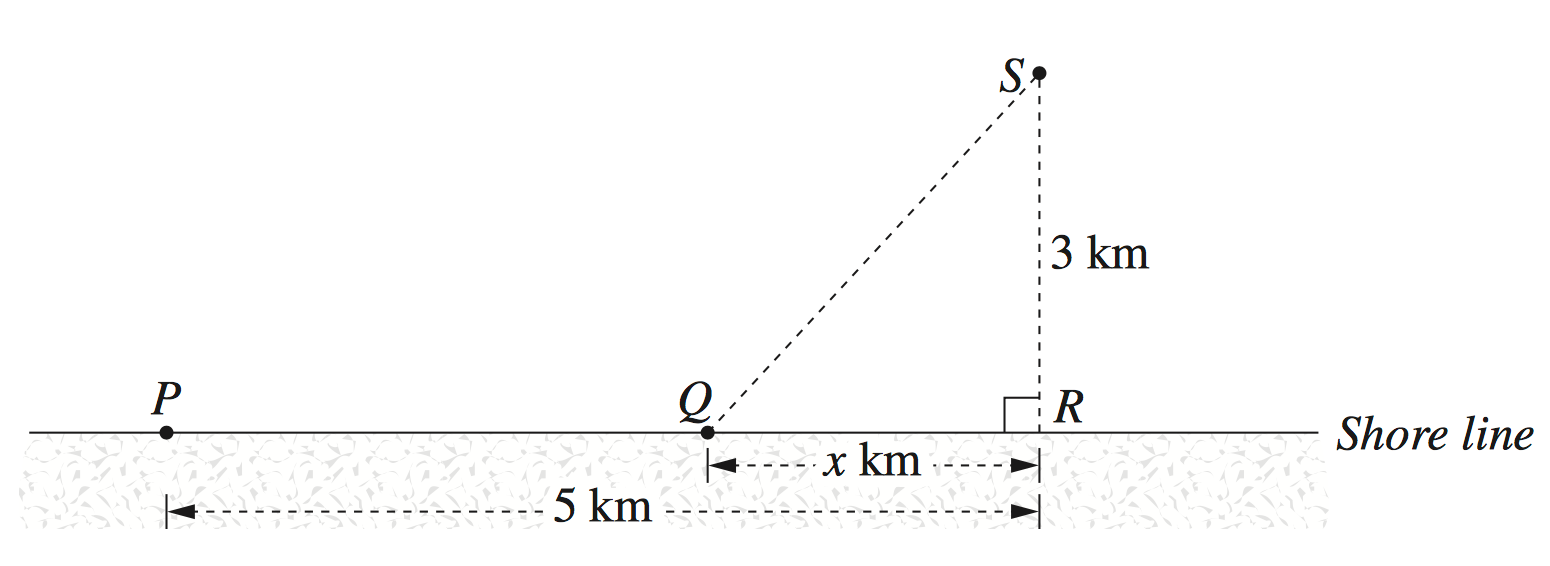
An oil rig,  `S`,  is 3 km offshore. A power station,  `P`,  is on the shore. A cable is to be laid from `P`  to  `S`.  It costs $1000 per kilometre to lay the cable along the shore and $2600 per kilometre to lay the cable underwater from the shore to  `S`.

The point  `R`  is the point on the shore closest to  `S`,  and the distance  `PR`  is 5 km.

The point  `Q`  is on the shore, at a distance of  `x`  km from  `R`,  as shown in the diagram.


  1. Find the total cost of laying the cable in a straight line from  `P`  to  `R`  and then in a straight line from  `R`  to  `S`.   (1 mark)

    --- 2 WORK AREA LINES (style=lined) ---

  2. Find the cost of laying the cable in a straight line from  `P`  to  `S`.  (1 mark)

    --- 2 WORK AREA LINES (style=lined) ---

  3. Let  `$C`  be the total cost of laying the cable in a straight line from  `P`  to  `Q`,  and then in a straight line from `Q`  to  `S`.
     
    Show that  `C=1000(5-x+2.6sqrt(x^2+9))`.    (2 marks)

    --- 5 WORK AREA LINES (style=lined) ---

  4. Find the minimum cost of laying the cable.    (4 marks)

    --- 8 WORK AREA LINES (style=lined) ---

  5. New technology means that the cost of laying the cable underwater can be reduced to $1100 per kilometre.


    Determine the path for laying the cable in order to minimise the cost in this case.    (2 marks)

    --- 5 WORK AREA LINES (style=lined) ---

Show Answers Only
  1. `$12\ 800`
  2. `$15\ 160`
  3. `text{Proof (See Worked Solutions)}`
  4. `$12\ 200`
  5. `P\ text(to)\  S\ text(in a straight line.)`
Show Worked Solution
♦♦ Although specific data is unavailable for question parts, mean marks were 35% for Q9 in total.
i.   `text(C)text(ost)` `=(PRxx1000)+(SRxx2600)`
  `=(5xx1000)+(3xx2600)`
  `=12\ 800`

 
`:. text(C)text(ost is)\   $12\ 800`


ii.   `text(C)text(ost)=PSxx2600`

`text(Using Pythagoras:)`

`PS^2` `=PR^2+SR^2`
  `=5^2+3^2`
  `=34`
`PS` `=sqrt34`


`:.\ text(C)text(ost)` `=sqrt34xx2600`
  `=15\ 160.474…`
  `=$15\ 160\ \ text{(nearest dollar)}`


iii.  `text(Show)\ \ C=1000(5-x+2.6sqrt(x^2+9))`

`text(C)text(ost)=(PQxx1000)+(QSxx2600)`

`PQ` `=5-x`
`QS^2` `=QR^2+SR^2`
  `=x^2+3^2`
`QS` `=sqrt(x^2+9)`
`:.C` `=(5-x)1000+sqrt(x^2+9)\ (2600)`
  `=1000(5-x+2.6sqrt(x^2+9))\ \ text(…  as required)`


iv.   `text(Find the MIN cost of laying the cable)`

`C` `=1000(5-x+2.6sqrt(x^2+9))`
`(dC)/(dx)` `=1000(–1+2.6xx1/2xx2x(x^2+9)^(–1/2))`
  `=1000(–1+(2.6x)/(sqrt(x^2+9)))`

`text(MAX/MIN when)\ (dC)/(dx)=0`

IMPORTANT: Tougher derivative questions often require students to deal with multiple algebraic constants. See Worked Solutions in part (iv).

`1000(–1+(2.6x)/(sqrt(x^2+9)))=0`

`(2.6x)/sqrt(x^2+9)` `=1`
`2.6x` `=sqrt(x^2+9)`
`(2.6)^2x^2` `=x^2+9`
`x^2(2.6^2-1)` `=9`
`x^2` `=9/5.76`
  `=1.5625`
`x` `=1.25\ \ \ \ (x>0)`
MARKER’S COMMENT: Check the nature of the critical points in these type of questions. If using the first derivative test, make sure some actual values are substituted in.

`text(If)\ \ x=1,\ \ (dC)/(dx)<0`

`text(If)\ \ x=2,\ \ (dC)/(dx)>0`

`:.\ text(MIN when)\ \ x=1.25`

`C` `=1000(5-1.25+2.6sqrt(1.25^2+9))`
  `=1000(122)`
  `=12\ 200` 


`:.\ text(MIN cost is)\  $12\ 200\ text(when)\   x=1.25`


v.   `text(Underwater cable now costs $1100 per km)`

`=>\ C` `=1000(5-x)+1100sqrt(x^2+9)`
  `=1000(5-x+1.1sqrt(x^2+9))`
`(dC)/(dx)` `=1000(–1+1.1xx1/2xx2x(x^2+9)^(-1/2))`
  `=1000(–1+(1.1x)/sqrt(x^2+9))`

 
`text(MAX/MIN when)\ (dC)/(dx)=0`

`1000(–1+(1.1x)/sqrt(x^2+9))` `=0`
`(1.1x)/sqrt(x^2+9)` `=1`
`1.1x` `=sqrt(x^2+9)`
`1.1^2x^2` `=x^2+9`
`x^2(1.1^2-1)` `=9`
`x^2` `=9/0.21`
`x` `~~6.5\ text{km (to 1 d.p.)}`
  `=>\ text(no solution since)\ x<=5`

 
`text(If we lay cable)\ PR\ text(then)\ RS`

MARKER’S COMMENT: Many students failed to interpret a correct calculation of  `x>5`  as providing no solution.

`=>\ text(C)text(ost)=5xx1100+3xx1000=8500`

`text(If we lay cable directly underwater via)\ PS`

`=>\ text(C)text(ost)=sqrt34xx1100=6414.047…`

`:.\ text{MIN cost is  $6414 by cabling directly from}\ P\ text(to)\ S`.

Filed Under: Maxima and Minima, Maxima and Minima (Y12) Tagged With: Band 3, Band 4, Band 5, Band 6, smc-970-50-Distance, smc-970-60-Other Themes

Calculus, 2ADV C3 2010 HSC 5a

A rainwater tank is to be designed in the shape of a cylinder with radius  `r`  metres and height  `h`  metres.

2010 5a

The volume of the tank is to be 10 cubic metres. Let  `A`  be the surface area of the tank, including its top and base, in square metres.

  1. Given that  `A=2pir^2+2pi r h`,   show that  `A=2 pi r^2+20/r`.   (2 marks)

    --- 4 WORK AREA LINES (style=lined) ---

  2. Show that  `A`  has a minimum value and find the value of  `r`  for which the minimum occurs.  (3 marks)

    --- 6 WORK AREA LINES (style=lined) ---

Show Answers Only
  1. `text{Proof  (See Worked Solutions)}`
  2. `r~~1.17\ text(metres)`
Show Worked Solution

i.    `text(Show)\ A=2 pi r^2+20/r`

MARKER’S COMMENT: Students MUST know the volume formula for a cylinder. Those that did and stated `10=pi r^2 h` most often completed this question efficiently.

`text(S)text(ince)\ V=pi r^2h=10\ \ \ \ =>\ h=10/(pi r^2)`

`text(Substituting into)\ A`

`A` `= pi r^2+2 pi r (10/(pi r^2))`
  `=2 pi r^2+20/r\ \ \ text(…  as required)`


♦ Mean mark 44%
MARKER’S COMMENT: The “table method” or 1st derivative test for proving a minimum (i.e. showing how `(dA)/(dr)` changes sign) was also quite successful.
ii. `A`  `=2 pi r^2+20/r`
  `(dA)/(dr)` `=4 pi r-20/r^2`
  `(d^2A)/(dr^2)` `=4 pi+40/r^3>0\ \ \ \ \ (r>0)`

 
`=>\ text(MIN occurs when)\ \ (dA)/(dr)=0`

`4 pi r-20/r^2` `=0`
`4 pi r^3-20` `=0`
`4 pi r^3` `=20`
`r` `=root3 (5/pi)`
  `=1.16754…`
  `=1.17\ text{metres  (2 d.p.)}`

Filed Under: Maxima and Minima, Maxima and Minima (Y12) Tagged With: Band 4, Band 5, smc-970-30-Volume - Cylinder

Calculus, 2ADV C3 2011 HSC 10b

A farmer is fencing a paddock using  `P`  metres of fencing. The paddock is to be in the shape of a sector of a circle with radius  `r`  and sector angle `theta`  in radians, as shown in the diagram.

2011 10b

  1. Show that the length of fencing required to fence the perimeter of the paddock is
      
       `P=r(theta+2)`.    (1 mark)

    --- 2 WORK AREA LINES (style=lined) ---

  2. Show that the area of the sector is  `A=1/2 Pr-r^2`.    (1 mark) 

    --- 2 WORK AREA LINES (style=lined) ---

  3. Find the radius of the sector, in terms of  `P`, that will maximise the area of the paddock.    (2 marks)

    --- 4 WORK AREA LINES (style=lined) ---

  4. Find the angle  `theta`  that gives the maximum area of the paddock.    (1 mark)

    --- 2 WORK AREA LINES (style=lined) ---

  5. Explain why it is only possible to construct a paddock in the shape of a sector if
     
         `P/(2(pi+1)) <\ r\ <P/2`   (2 marks)

    --- 5 WORK AREA LINES (style=lined) ---

Show Answers Only
  1. `text{Proof  (See Worked Solutions)}`
  2. `text{Proof  (See Worked Solutions)}`
  3. `r=P/4`
  4. `2\ text(radians)`
  5. `text{Proof  (See Worked Solutions)}`
Show Worked Solution

i.   `text(Need to show)\ \ P=r(theta+2)`

`P` `=(2xxr)+theta/(2pi)xx2pir`
  `=2r+ r theta`
  `=r(theta+2)\ \ text(…  as required)`


ii.   `text(Need to show)\ \ A=1/2 Pr-r^2`.

`text(S)text(ince)\ \ P=r(theta+2)\ \ \ =>\ theta=(P-2r)/r`

♦ Mean mark 41%.
TIP: Area of a sector `=pi r^2 xx` the percentage of the circle that the sector angle accounts for, i.e. `theta/(2 pi)` radians. `:. A=pi r^2“ xx theta/(2 pi)=1/2 r^2 theta`.
`:. A` `=1/2 r^2 theta`
  `=1/2 r^2*(P-2r)/r`
  `=1/2(Pr-2r^2)`
  `=1/2 Pr-r^2\ \ text(…  as required)`


iii.  `A=1/2 Pr-r^2`

♦♦ Mean mark 29%
MARKER’S COMMENT: The second derivative test proved much more successful and easily proven in this part. Make sure you are comfortable choosing between it and the 1st derivative test depending on the required calcs.

`(dA)/(dr)=1/2 P-2r`

`text(MAX or MIN when)\ \ (dA)/(dr)=0`

`1/2 P-2r` `=0`
`2r` `=1/2 P`
`r` `=P/4`

 
`(d^2A)/(dr^2)=-2\ \ \ \ =>text(MAX)`

`:.\ text(Area is a MAX when)\ r=P/4\ text(units)`


iv.   `text(Need to find)\ theta\ text(when area is a MAX)\ =>\ r=P/4`

♦♦♦ Mean mark 20%
`P` `=r(theta+2)`
  `=P/4(theta+2)`
`4P` `=P(theta+2)`
`theta+2` `=4`
`theta` `=2\ text(radians)`


v.  `text(For a sector to exist)\ \ 0<\ theta\ <2pi, \ \ text(and)\ \ theta=(P-2r)/r`

♦♦♦ Mean mark 4%. A BEAST!
MARKER’S COMMENT: When asked to ‘explain’, students should support their answer with a mathematical argument.
`=>(P-2r)/r` `>0`
`P-2r` `>0`
`r` `<P/2`
`=>(P-2r)/r` `<2pi`
`P-2r` `<2r pi`
`2r pi+2r` `>P`
`2r(pi+1)` `>P`
`r` `>P/(2(pi+1))`


`:.P/(2(pi+1)) <\ r\ <P/2\ \ text(…  as required)`

Filed Under: Maxima and Minima, Maxima and Minima (Y12) Tagged With: Band 4, Band 5, Band 6, page-break-before-solution, smc-970-10-Area

Mechanics, EXT2* M1 2009 HSC 6a

Two points, `A` and `B`,  are on cliff tops on either side of a deep valley. Let `h` and `R` be the vertical and horizontal distances between `A` and `B` as shown in the diagram. The angle of elevation of `B` from `A` is  `theta`,  so that  `theta=tan^-1(h/R)`.
 

2009 6a
 

At time `t=0`,  projectiles are fired simultaneously from `A` and `B`.  The projectile from `A` is aimed at `B`, and has initial speed `U` at an angle of  `theta`  above the horizontal. The projectile from `B` is aimed at `A` and has initial speed `V` at an angle  `theta`  below the horizontal.

The equations of motion for the projectile from `A` are

`x_1=Utcos theta`   and   `y_1=Utsin theta-1/2 g t^2`,

and the equations for the motion of the projectile from `B` are

`x_2=R-Vtcos theta`   and   `y_2=h-Vtsin theta-1/2 g t^2`,     (DO NOT prove these equations.)

  1. Let `T` be the time at which  `x_1=x_2`.
     
    Show that  `T=R/((U+V)\ cos theta)`.   (1 mark)

    --- 3 WORK AREA LINES (style=lined) ---

  2. Show that the projectiles collide.    (2 marks)

    --- 6 WORK AREA LINES (style=lined) ---

  3. If the projectiles collide on the line  `x=lambdaR`,  where  `0<lambda<1`,  show that
     
         `V=(1/lambda-1)U`.    (1 mark)

    --- 6 WORK AREA LINES (style=lined) ---

Show Answers Only
  1. `text{Proof  (See Worked Solutions)}` 
  2. `text{Proof  (See Worked Solutions)}`
  3. `text{Proof  (See Worked Solutions)}`
Show Worked Solution

i.   `text(Let)\ \ x_1=x_2\ \ text(at)\ \ t=T`

`UTcos theta` `=R-VTcos theta`
`UTcos theta+VTcos theta` `=R`
`Tcos theta\ (U+V)` `=R`

 
 `:. T=R/((U+V)\ cos theta)\ \ text(… as required)`


ii.   `text(If particles collide,)\ \  y_1=y_2\ \ text(at)\ \ t=T`

♦♦♦ Mean mark data not available although “few” students were able to complete this part.
MARKER’S COMMENT: Better responses showed  `y_1=y_2`,  or  `y_1-y_2=0`  which eliminated  `–½ g t^2`  from the algebra. Substituting `tan theta=h//R` was a key element in completing this proof.
`y_1` `=UTsin theta-1/2 g T^2`
  `=(UR sin theta)/((U+V)\ cos theta)-1/2 g T^2`
`y_2` `=h-VTsin theta-1/2 g T^2`
  `=Rtan theta-(VR sin theta)/((U+V)\ cos theta)-1/2 g T^2`
  `=R(((sin theta/cos theta)(U+V) cos theta-V sin theta)/((U+V)\ cos theta))-1/2 g T^2`
  `=R/((U+V)\ cos theta)(Usin theta+Vsin theta-Vsin theta)-1/2 g T^2`
  `=(UR sin theta)/((U+V)\ cos theta)-1/2 g T^2`
  `=y_1`


`:.\ text(Particles collide since)\  y_1=y_2\ text(at)\ t=T`.


iii.  `text(Particles collide on line)\ \ x=lambdaR,\ text(i.e.  where)\ \ t=T`

MARKER’S COMMENT: Students must show sufficient working in proofs to convince markers they have derived the answer themselves.
`lambdaR` `=UTcos theta`
  `=U R/((U+V)\ cos theta)cos theta`
  `=(UR)/((U+V))`
`(U+V)(lambdaR)` `=UR`
`U+V` `=(UR)/(lambdaR)`
`V` `=U/lambda-U`
  `=(1/lambda-1)U\ \ text(… as required)`

Filed Under: Projectile Motion, Projectile Motion EXT1 Tagged With: Band 4, Band 5, Band 6, smc-1062-10-Range/Time of Flight, smc-1062-40-Initial Angle/Speed, smc-1062-90-Projectiles Collide

Mechanics, EXT2* M1 2013 HSC 13c

Points `A` and `B` are located `d` metres apart on a horizontal plane. A projectile is fired from `A` towards `B` with initial velocity `u` m/s at angle `alpha` to the horizontal.

At the same time, another projectile is fired from `B` towards `A` with initial velocity `w` m/s at angle `beta` to the horizontal, as shown on the diagram.

The projectiles collide when they both reach their maximum height.
 

2013 13c
 

The equations of motion of a projectile fired from the origin with initial velocity  `V` m/s at angle  `theta`  to the horizontal are

`x=Vtcostheta`   and   `y=Vtsintheta-g/2 t^2`.        (DO NOT prove this.)

  1. How long does the projectile fired from  `A`  take to reach its maximum height?  (2 marks)

    --- 5 WORK AREA LINES (style=lined) ---

  2. Show that  `usinalpha=w sin beta`.    (1 mark)

    --- 3 WORK AREA LINES (style=lined) ---

  3. Show that  `d=(uw)/(g)sin(alpha+beta)`.    (2 marks)

    --- 8 WORK AREA LINES (style=lined) ---

Show Answers Only
  1. `(u)/(g) sin alpha\ \ text(seconds)`
  2. `text{Proof  (See Worked Solutions)}`
  3. `text{Proof  (See Worked Solutions)}`
Show Worked Solution

i.   `y=Vtsintheta-g/2 t^2`

`text(Projectile)\ A\   => V=u,\ \ theta=alpha`

`y` `=ut sinalpha- (g)/2 t^2`
`doty` `=u sinalpha- g t`


`text(Max height when)\  doty=0`

`0` `=usinalpha-g t`
`g t` `=usinalpha`
`t` `=(u)/(g)sinalpha`

 
`:.\ text(Projectile from)\ A\ text(reaches max height at)`

 `t=(u)/(g)sin alpha\ \ text(seconds)`


ii.  `text(Show that)\ \ usin alpha=wsin beta`

IMPORTANT: Part (i) in this example leads students to a very quick solution. Always look to previous parts for clues to direct your strategy.

`text(Projectile)\ B\ =>V=w,\ \ theta=beta`

`y` `=wt sin beta- (g)/2 t^2`
`doty` `=wsin beta-g t`


`text(Max height when)\ \ doty=0`

`t=(w)/(g) sin beta`

`text{Projectiles collide at max heights}`

`text(S)text(ince they were fired at the same time)`

`(u)/(g) sin alpha` `=(w)/(g) sin beta`
`:.\ usin alpha` `=wsin beta\ \ text(… as required)`


iii  `text(Show)\ \ d=(uw)/(g) sin (alpha+beta) :`

`text(Find)\ x text(-values for each projectile at max height)`

`text(Projectile)\ A`

`x_1` `=utcos alpha`
  `=u((u)/(g) sin alpha)cos alpha`
  `=(u^2)/(g) sin alpha cos alpha`


`text(Projectile)\ B`

♦ Mean mark 39%
IMPORTANT: Students should direct their calculations by reverse engineering the required result. `sin(alpha+beta)` in the proof means that  `sin alpha cos beta+“ cos alpha sin beta`  will appear in the working calculations.
`x_2` `=wt cos beta`
  `=w((w)/(g) sin beta)cos beta`
  `=(w^2)/(g) sin beta cos beta`
`d` `=x_1+x_2`
  `=(u^2)/(g) sin alpha cos alpha+(w^2)/(g) sin beta cos beta`
  `=(u)/(g)(u sin alpha)cos alpha+(w)/(g) (w sin beta) cos beta`
  `=(u)/(g)(w sin beta) cos alpha+(w)/(g) (usin alpha)cos beta\ \ text{(part (ii))}`
  `=(uw)/(g) (sin alpha cos beta+cos alpha sin beta)`
  `=(uw)/(g) sin (alpha+beta)\ \ text(… as required)`


Filed Under: Projectile Motion, Projectile Motion EXT1 Tagged With: Band 4, Band 5, Band 6, smc-1062-20-Max Height, smc-1062-90-Projectiles Collide

Calculus in the Physical World, 2UA 2008 HSC 6b

The graph shows the velocity of a particle,  `v`  metres per second, as a function of time,  `t`  seconds.


  1. What is the initial velocity of the particle?   (1 mark)
  2. When is the velocity of the particle equal to zero?    (1 mark)
  3. When is the acceleration of the particle equal to zero?    (1 mark)
  4. By using Simpson's Rule with five function values, estimate the distance travelled by the particle between  `t=0`  and  `t=8`.   (3 marks)
  5.  
Show Answers Only
  1. `20\ text(m/s)`
  2. `t=10\ text(seconds)`
  3. `t=6\ text(seconds)`
  4. `493 1/3\ text(metres)`
Show Worked Solution

(i)    `text(Find)\   v  \ text(when)  t=0`

`v=20\ \ text(m/s)`


(ii)    `text(Particle comes to rest at)\  t=10\ text{seconds  (from graph)}`


(iii)  `text(Acceleration is zero when)\ t=6\ text{seconds  (from graph)}`


(iv)   

MARKER’S COMMENT: Less errors were made by students using a table and the given formula. Note however, that the formula `A~~(b-a)/6xx` `[f(a)+4f((a+b)/2)+f(b)]` produced the most errors.
`text(Area)` `~~h/3[y_0+y_n+4text{(odds)}+2text{(evens)}]`
  `~~h/3[y_0+y_4+4(y_1+y_3)+2(y_2)]`
  `~~2/3[20+60+4(50+80)+2(70)]`
  `~~2/3[740]`
  `~~493 1/3`


`:.\ text{Distance travelled is 493 1/3 m (approx.)}` 

Filed Under: Motion, Trapezoidal and Simpson's Rule Tagged With: Band 2, Band 3, Band 4, HSC

Calculus, 2ADV C4 2009 HSC 7a

The acceleration of a particle is given by

`a=8e^(-2t)+3e^(-t)`,

where  `x`  is the displacement in metres and  `t`  is the time in seconds.

Initially its velocity is  `text(– 6 ms)^(–1)` and its displacement is 5 m.

  1. Show that the displacement of the particle is given by
  2. `qquad  x=2e^(-2t)+3e^-t+t`.   (2 marks) 

    --- 5 WORK AREA LINES (style=lined) ---

  3. Find the time when the particle comes to rest.    (3 marks)

    --- 7 WORK AREA LINES (style=lined) ---

  4. Find the displacement  when the particle comes to rest.    (1 mark)

    --- 3 WORK AREA LINES (style=lined) ---

Show Answers Only
  1. `text{Proof  (See Worked Solutions)}`
  2. `ln4\ text(seconds)`
  3. `7/8+ln4\ \ text(units)`
Show Worked Solution

i.    `text(Show)\ \ x=2e^(-2t)+3e^-t+t`

`a=8e^(-2t)+3e^-t\ \ text{(given)}`

`v=int a\ dt=-4e^(-2t)-3e^-t+c_1`

`text(When)\ t=0,  v=-6\ \ text{(given)}`

`-6` `=-4e^0-3e^0+c_1`
`-6` `=-7+c_1`
`c_1` `=1`

 
`:. v=-4e^(-2t)-3e^-t+1`
 

`x` `=int v\ dt`
  `=int(-4e^(-2t)-3e^-t+1)\ dt`
  `=2e^(-2t)+3e^-t+t+c_2`

 
`text(When)\ \ t=0,\ x=5\ \ text{(given)}`

`5` `=2e^0+3e^0+c_2`
`c_2` `=0`

 
`:.\ x=2e^(-2t)+3e^-t+t\ \ text(… as required)`


ii.   `text(Particle comes to rest when)\ \ v=0`

`text(i.e.)\ \ -4e^(-2t)-3e^-t+1=0`

`text(Let)\ X=e^-t\ \ \ \ =>X^2=e^(-2t)`

`-4X^2-3X+1` `=0`
`4X^2+3X-1` `=0`
`(4X-1)(X+1)` `=0`

 
 `:.\ \ X=1/4\ \ text(or)\ \ X=-1`

`text(When)\ \ X=1/4:`

`e^-t` `=1/4`
`lne^-t` `=ln(1/4)`
`-t` `=ln(1/4)`
`t` `=-ln(1/4)=ln(1/4)^-1=ln4`

 
`text(When)\ \ X=-1:`

`e^-t=-1\ \ text{(no solution)}`
 

`:.\ text(The particle comes to rest when)\ t=ln4\ text(seconds)`
  

iii.  `text(Find)\ \ x\ \ text(when)\ \ t=ln4 :`

`x=2e^(-2t)+3e^-t+t`

`\ \ =2e^(-2ln4)+3e^-ln4+ln4`

`\ \ =2(e^ln4)^-2+3(e^ln4)^-1+ln4`

`\ \ =2xx4^-2+3xx4^-1+ln4`

`\ \ =2/16+3/4+ln4`

`\ \ =7/8+ln4`

ALGEBRA TIP: Helpful identity  `e^lnx=x`. Easily provable as follows:
`e^ln2=x`
`\ =>lne^ln2=lnx\ `
`\ => ln2=lnx\ `
`\ =>x=2`.

Filed Under: Motion, Other Integration Applications (Y12) Tagged With: Band 3, Band 4, Band 5, smc-1091-10-Motion, smc-1091-30-Log/Exp Function, smc-1213-10-Motion

Calculus, EXT1* C1 2010 HSC 7a

The acceleration of a particle is given by

`ddotx=4cos2t`,

where  `x`  is the displacement in metres and  `t`  is the time in seconds. 

Initially the particle is at the origin with a velocity of  `text(1 ms)^(–1)`.

  1. Show that the velocity of the particle is given by


      `dotx=2sin2t+1`.    (2 marks)

    --- 5 WORK AREA LINES (style=lined) ---

  2. Find the time when the particle first comes to rest.    (2 marks)

    --- 4 WORK AREA LINES (style=lined) ---

  3. Find the displacement,  `x`,  of the particle in terms of  `t`.    (2 marks)

    --- 4 WORK AREA LINES (style=lined) ---

Show Answers Only
  1. `text{Proof  (See Worked Solutions)}`
  2. `(7pi)/12\ text(seconds)`
  3. `x=1-cos2t+t`
Show Worked Solution
i.   `text(Show)\ dotx` `=2sin2t+1`
`dotx` `=intddotx\ dt`
  `=int4cos2t\ dt`
  `=2sin2t+c`

 
`text(When)\ t=0, \ \ dotx=1\ \ text{(given)}`

`1=2sin0+c`

`c=1`

 
`:. dotx=2sin2t+1 \ \ \ text(… as required)`
 

ii.   `text(Find)\ t\ text(when)\ dotx=0 :`

`2sin2t+1` `=0`
`sin2t` `=-1/2`

 
`=>sin theta=1/2\ text(when)\ theta=pi/6`

`text(S)text(ince)\ \ sin theta\ \ text(is negative in 3rd and 4th quadrants)`

`2t` `=pi + pi/6`
`2t` `=(7pi)/6`
`t` `=(7pi)/12`

 
`:.\ text(Particle first comes to rest at)\ t=(7pi)/12\ text(seconds)`
 

iii.    `x` `=intdotx\ dt`
  `=int(2sin2t+1)\ dt`
  `=t-cos2t+c`

 
`text(When)\ t=0,\ x=0\ \ text{(given)}`

`0=0-cos0+c`

`c=1`

 
`:. x=t-cos2t+1`

Filed Under: Motion, Rates of Change with respect to time (Ext1) Tagged With: Band 3, Band 4, Band 5, smc-1077-10-Motion, smc-1077-30-Trig Equation

Calculus, 2ADV C4 2012 HSC 15b

The velocity of a particle is given by

`v=1-2cost`,

where  `x`  is the displacement in metres and  `t`  is the time in seconds. Initially the particle is 3 m to the right of the origin.

  1. Find the initial velocity of the particle.    (1 mark)

    --- 1 WORK AREA LINES (style=lined) ---

  2. Find the maximum velocity of the particle.    (1 mark)

    --- 1 WORK AREA LINES (style=lined) ---

  3. Find the displacement, `x`,  of the particle in terms of  `t`.    (2 marks)

    --- 4 WORK AREA LINES (style=lined) ---

  4. Find the position of the particle when it is at rest for the first time.    (2 marks)

    --- 4 WORK AREA LINES (style=lined) ---

Show Answers Only
  1. `-1\ text(m/s)`
  2. `3\ text(m/s)`
  3. `x=t-2sint+3`
  4. `pi/3-sqrt3+3`
Show Worked Solution

i.    `text(Find)\ \ v\ \ text(when)\ \ t=0`:

`v` `=1-2cos0`
  `=1-2`
  `=-1`

 
`:.\ text(Initial velocity is)\ -1\ text(m/s.)`


ii.  `text(Solution 1)`

`text(Max velocity occurs when)\ \ a=(d v)/(dt)=0`

♦♦ Mean mark 29%
MARKER’S COMMENT: Solution 2 is more efficient here. Using the -1 and +1 limits of trig functions can be very a effective way to calculate max/min values.

`a=2sint`
 

`text(Find)\ \ t\ \ text(when)\ \ a=0 :`

`2sint=0`

`t=0`,  `pi`,  `2pi`, …

`text(At)\ \ t=0,\ \   v=-1\ text(m/s)`

`text(At)\ \ t=pi,\ \ v=1-2(-1)=3\ text(m/s)`

 
`:.\ text(Maximum velocity is 3 m/s)`


`text(Solution 2)`

`v=1-2cost`

`text(S)text(ince)\ \ -1` `<cost<1`
`-2` `<2cost<2`
`-1` `<1-2cost<3`

 
`:.\ text(Maximum velocity is 3 m/s)`


iii.   `x` `=int v\ dt`
  `=int(1-2cost)\ dt`
  `=t-2sint+c`

 
`text(When)\ \ t=0,\ \ x=3\ \ text{(given)}`

`3=0-2sin0+3`

`c=3`

 
`:. x=t-2sint+3`


iv.  `text(Find)\ \ x\ \ text(when)\ \ v=0\ \ text{(first time):}`

♦ Mean mark 50%
MARKER’S COMMENT: Many students found  `t=pi/3`  but failed to gain full marks by omitting to find  `x`. Remember that for calculus, angles are measured in radians, NOT degrees!

`text(When)\ \ v=0 ,`

`0` `=1-2cost`
`cost` `=1/2`
`t` `=cos^-1(1/2)`
  `=pi/3\ \ \ text{(first time)}`

 
`text(Find)\ \ x\ \ text(when)\ \ t=pi/3 :`

`x` `=pi/3-2sin(pi/3)+3`
  `=pi/3-2xxsqrt3/2+3`
  `=pi/3-sqrt3+3\ \ text(units)`

Filed Under: Motion, Other Integration Applications (Y12) Tagged With: Band 3, Band 4, Band 5, smc-1213-10-Motion

Calculus, EXT1 C1 2010 HSC 2b

The mass `M` of a whale is modelled by

`M=36-35.5e^(-kt)` 

where  `M`  is measured in tonnes,  `t`  is the age of the whale in years and  `k`  is a positive constant.

  1. Show that the rate of growth of the mass of the whale is given by the differential equation
     
    `qquad qquad (dM)/(dt)=k(36-M)`    (1 mark)

    --- 2 WORK AREA LINES (style=lined) ---

  2. When the whale is 10 years old its mass is 20 tonnes.


    Find the value of  `k`,  correct to three decimal places.    (2 marks)

    --- 8 WORK AREA LINES (style=lined) ---

  3. According to this model, what is the limiting mass of the whale?    (1 mark)

    --- 3 WORK AREA LINES (style=lined) ---

Show Answers Only
  1. `text{Proof (See Worked Solutions)}`
  2. `0.080`
  3. `36\ text(tonnes)`
Show Worked Solution

i.  `M=36-35.5e^(-kt)`

IMPORTANT: Know this standard proof well and be able to produce it quickly.

`35.5e^(-kt)=36-M`

`:. (dM)/(dt)` `=-kxx-35.5e^(-kt)`
  `=kxx35.5e^(-kt)`
  `=k(36-M)\ \ \ text(… as required)`


ii.  `text(Find)\ \ k`

`text(When)\ \ t=10,\ \ M=20`

`M` `=36-35.5e^(-kt)`
`20` `=36-35.5e^(-10k)`
`35.5e^(-10k)` `=16`
`lne^(-10k)` `=ln(16/35.5)`
`-10k` `=ln(16/35.5)`
`:. k` `=-ln(16/35.5)/10`
  `=0.07969…`
  `=0.080\ \ text{(to 3 d.p.)}`


iii.  `text(As)\ t->oo,  e^(-kt)=1/e^(kt)\ ->0,\ \ k>0`

`M->36`

`:.\ text(The whale’s limiting mass is 36 tonnes.)`

Filed Under: Exponential Growth and Decay EXT1, Modified Growth and Decay Tagged With: Band 2, Band 3, Band 4, smc-1080-20-Other

Calculus, EXT1 C1 2011 HSC 5b

To test some forensic science students, an object has been left in the park. At 10am the temperature of the object is measured to be 30°C. The temperature in the park is a constant 22°C. The object is moved immediately to a room where the temperature is a constant 5°C.

The temperature of the object in the room can be modelled by the equation

`T=5+25e^(-kt)`,

where  `T`  is the temperature of the object in degrees Celcius, `t` is the time in hours since the object was placed in the room and `k` is a constant.

After one hour in the room the temperature of the object is 20°C.

  1. Show that  `k=ln(5/3)`    (2 marks)

    --- 6 WORK AREA LINES (style=lined) ---

  2. In a similar manner, the temperature of the object in the park before it was discovered can be modelled by an equation in the form  `T=A+Be^(-kt)`,  with the same constant  `k=ln(5/3)`.


    Find the time of day when the object had a temperature of 37°C.    (3 marks)

    --- 8 WORK AREA LINES (style=lined) ---

Show Answers Only
  1. `text{Proof  (See Worked Solutions)}`
  2. `8:46\ text(am)`
Show Worked Solution

i.   `T=5+25e^(-kt)`

`text(At)\ t=1,  T=20`

`20` `=5+25e^(-k)`
`25e^(-k)` `=15`
`e^(-k)` `=15/25=3/5`
`lne^(-k)` `=ln(3/5)`
`-k` `=ln(3/5)`
`k` `=-ln(3/5)`
  `=ln(3/5)^-1`
  `=ln(5/3)\ \ \ text(… as required)`


ii.   `T=A+Be^(-kt)\ \ text(where)\ \ k=ln(5/3)`

`text(S)text(ince park temp is a constant 22°`

`=>A=22`

`:.\ T=22+Be^(-kt)`
 

`text(At)\ t=0\ \ text{(10 am),}\  \ T=30`

`text(i.e.)\ \ 30=22+Be^0`

`=>B=8`

`:.\ T=22+8e^(-kt)`
 

`text(Find)\ \ t\ \ text(when)\ \ T=37`

MARKER’S COMMENT: Many students failed to recognise that a negative value for `t` was not invalid but represented the time before 10am.
`37` `=22+8e^(-kt)`
`8e^(-kt)` `=15`
`lne^(-kt)` `=ln(15/8)`
`-kt` `=ln(15/8)`
`:. t` `=-1/k ln(15/8),\  text(where)\ k=ln(5/3)`
  `=ln(15/8)/ln(5/3)`
  `=-1.23057` ….
  `=- text{1h 14m  (nearest minute)}`

 
`:.\ text{The object had a temp of  37°C  at  8:46 am}`

`text{(1h 14m  before 10am).}`

Filed Under: Exponential Growth and Decay EXT1, Modified Growth and Decay Tagged With: Band 2, Band 4, smc-1080-10-Cooling

Calculus, EXT1* C1 2008 HSC 5c

Light intensity is measured in lux. The light intensity at the surface of a lake is 6000 lux. The light intensity,  `I`  lux, a distance  `s`  metres below the surface of the lake is given by

`I=Ae^(-ks)`

where  `A`,  and  `k`  are constants.

  1. Write down the value of  `A`.   (2 marks)

    --- 2 WORK AREA LINES (style=lined) ---

  2. The light intensity 6 metres below the surface of the lake is 1000 lux. Find the value of  `k`.    (2 marks)

    --- 6 WORK AREA LINES (style=lined) ---

  3. At what rate, in lux per metre, is the light intensity decreasing 6 metres below the surface of the lake?    (2 marks)

    --- 6 WORK AREA LINES (style=lined) ---

Show Answers Only
  1. `6000`
  2. `- 1/6 ln(1/6)\ text(or)\ 0.29863`
  3. `299`
Show Worked Solution

i.   `I=Ae^(-ks)`

`text(Find)\ A,\ text(given)\   I=6000\ text(at)\  s=0`

`6000` `=Ae^0`
`:.\ A` `=6000`


ii.   `text(Find)\ k\ text(given)\  I=1000\ text(at)  s=6`

MARKER’S COMMENT: Many students used the “log” function on their calculator rather than the `log_e` function. BE CAREFUL!
`1000` `=6000e^(-6xxk)`
`e^(-6k)` `=1/6`
`lne^(-6k)` `=ln(1/6)`
`-6k` `=ln(1/6)`
`k` `=- 1/6 ln(1/6)`
  `=0.2986…`
  `=0.30\ \ \ text{(2 d.p.)}`


iii.  `text(Find)\ \ (dI)/(ds)\ \ text(at)\ \ s=6`

ALGEBRA TIP: Tidy your working by calculating `(dI)/(ds)` using `k` and then only substituting for `k` in part (ii) at the final stage.
`I` `=6000e^(-ks)`
`:.(dI)/(ds)` `=-6000ke^(-ks)`

 
`text(At)\ s=6,`

`(dI)/(ds)` `=-6000ke^(-6k),\ \ \ text(where)\ k=- 1/6 ln(1/6)`
  `=-298.623…`
  `=-299\ \ text{(nearest whole number)}`

 
`:. text(At)\ s=6,\ text(the light intensity is decreasing)`

`text(at 299 lux per metre.)`

Filed Under: Exponential growth and decay, Standard Growth and Decay Tagged With: Band 3, Band 4, Band 5, smc-1081-20-Decay, smc-1081-50-Other Themes

Calculus, EXT1* C1 2009 HSC 6b

Radium decays at a rate proportional to the amount of radium present. That is, if  `Q(t)`  is the amount of radium present at time  `t`,  then  `Q=Ae^(-kt)`,  where  `k`  is a positive constant and  `A`  is the amount present at  `t=0`. It takes 1600 years for an amount of radium to reduce by half.

  1. Find the value of  `k`.   (2 marks)

    --- 6 WORK AREA LINES (style=lined) ---

  2. A factory site is contaminated with radium. The amount of radium on site is currently three times the safe level.


    How many years will it be before the amount of radium reaches the safe level.    (2 marks)

    --- 6 WORK AREA LINES (style=lined) ---

Show Answers Only
  1. `(-ln(1/2))/1600\ \ text(or 0.000433)`
  2. `2536\ text(years)`
Show Worked Solution

i.   `Q=Ae^(-kt)`

MARKER’S COMMENT: Students must be familiar with “half-life” and the algebra required. i.e. using `Q=1/2 A` within their calculations.

`text(When)\ \ t=0,\ \ Q=A`

`text(When)\ \ t=1600,\ \ Q=1/2 A`

`:.1/2 A` `=A e^(-1600xxk)`
`e^(-1600xxk)` `=1/2`
`lne^(-1600xxk)` `=ln(1/2)`
`-1600k` `=ln(1/2)`
`k` `=(-ln(1/2))/1600`
  `=0.0004332\ \ text{(to 4 sig. figures)}`


ii.   `text(Find)\ \ t\ \ text(when)\ \ Q=1/3 A :`

IMPORTANT: Know how to use the memory function on your calculator to store the exact value of `k` found in part (i) to save time.
`1/3 A` `=A e^(-kt)`
`e^(-kt)` `=1/3`
`lne^(-kt)` `=ln(1/3)`
`-kt` `=ln(1/3)`
`:.t` `=(-ln(1/3))/k,\ \ \ text(where)\ \ \ k=(-ln(1/2))/1600`
  `=(ln(1/3) xx1600)/ln(1/2)`
  `=2535.940…`

 
`:.\ text(It will take  2536  years.)`

Filed Under: Exponential growth and decay, Standard Growth and Decay Tagged With: Band 3, Band 4, Band 5, page-break-before-solution, smc-1081-20-Decay, smc-1081-30-Radioactivity

Calculus, EXT1* C1 2010 HSC 8a

Assume that the population,  `P`,  of cane toads in Australia has been growing at a rate proportional to  `P`.  That is,  `(dP)/(dt)=kP`  where `k`  is a positive constant.

There were 102 cane toads brought to Australia from Hawaii in 1935.

Seventy-five years later, in 2010, it is estimated that there are 200 million cane toads in Australia.

If the population continues to grow at this rate, how many cane toads will there be in Australia in 2035?   (4 marks)

--- 8 WORK AREA LINES (style=lined) ---

Show Answers Only

`2.5xx10^10`

Show Worked Solution

`text(S)text(ince)\ (dP)/(dt)=kP\ \ \ =>\ P=P_0e^(kt)`

NOTE: Students should be comfortable converting 200 million into scientific notation. It can help noting that 200 million `=200xx10^6“=2 xx 10^8`

`text(At)\ \ t=0,\ \ P=102`

`102` `=P_0xxe^0`
`:.P_0` `=102`

 
`text(When)\ \ t=75,\ P=200\ text(million)=2xx10^8`

MARKER’S COMMENT: This question differed from previous years in that it did not ask students to verify that that  `P=P_0e^(kt)`  is a solution to  `(dP)/(dt)=kP`.
`:.2xx10^8` `=102e^(75xxk)`
`e^(75xxk)` `=(2xx10^8)/102`
`75k` `=ln((2xx10^8)/102)`
`k` `=1/75ln((2xx10^8)/102)`
  `=0.1931847…`

 
`text(Find)\ P\ text{when t = 100  (in 2035)`

`P` `=102xxe^(100k),\ \ \ \ \ k=ln((2xx10^8)/102)`
  `=2.503… xx10^10`
  `=2.5xx10^10\ \ text{(to 2 sig. figures)}`

 
`:.\ text(There will be)\ 2.5xx10^10\ text(cane toads.)`

Filed Under: Exponential growth and decay, Standard Growth and Decay Tagged With: Band 4, smc-1081-10-Growth, smc-1081-40-Population

Calculus, EXT1* C1 2011 HSC 10a

The intensity, `I`,  measured in  watt/m2,  of a sound is given by

`I=10^-12xxe^(0.1L)`,

where  `L`  is the loudness of the sound in decibels.

  1. If the loudness of a sound at a concert is 110 decibels, find the intensity of the sound. Give your answer in scientific notation.   (1 mark)

    --- 2 WORK AREA LINES (style=lined) ---

  2. Ear damage occurs if the intensity of a sound is greater than `8.1xx10^-9`  watt/m2.


    What is the maximum loudness of a sound so that no ear damage occurs?    (2 marks)

    --- 6 WORK AREA LINES (style=lined) ---

  3. By how much will the loudness of a sound have increased if its intensity has doubled?     (2 marks)

    --- 5 WORK AREA LINES (style=lined) ---

Show Answers Only
  1. `6xx10^-8\ \ text{(1 sig. figure)}`
  2. `90\ text(decibels)`
  3. `7\ text(decibels)`
Show Worked Solution

i.    `text(Find)\ I\ text(when)\ \ L=110`

MARKER’S COMMENT: Note that `e^11 xx 10^-12` is not correct scientific notation.
`I` `=10^-12xxe^(0.1xx110)`
  `=10^-12xxe^11`
  `=5.9874…\ \ xx10^-8`
  `=6xx10^-8\ \ \ text{(to 1 sig. fig.)}`


ii.   `text(Find)\ \ L\ \ text(such that)\ \ \ I=8.1xx10^-9`

`text(i.e.)\ \ \  8.1xx10^-9` `=10^-12xxe^(0.1L)`
`e^(0.1L)` `=8.1xx10^3`
`lne^(0.1L)` `=ln8100`
`0.1L xx ln e` `=ln8100`
`L` `=ln8100/0.1`
  `=89.996…`
  `=90\ \ text{(nearest whole)}`

 
`:.\ 90\ text(decibels is the maximum loudness.)`


iii.  `text(Let)\ \ I=I_0 e^(0.1L)`

♦♦ Mean mark 32%
MARKER’S COMMENT: Actual values can help here. Calculate the intensity at `L=0` (which equals `1xx10^-12`) and then find `L` when this intensity level is doubled (to `2xx10^-12`).

`text(Find)\ \ L\ \ text(when)\ \ I=2I_0`

`2I_0` `=I_0e^(0.1L)`
`e^(0.1L)` `=2`
`lne^(0.1L)` `=ln2`
`0.1L` `=ln2`
`L` `=ln2/0.1`
  `=6.93147…`
  `=7\ \ text{(nearest whole)}`

 
`:.\ text(The loudness of a sound must increase 7)`

`text(decibels for the intensity to double.)`

Filed Under: Exponential growth and decay, Standard Growth and Decay Tagged With: Band 4, Band 5, smc-1081-10-Growth, smc-1081-50-Other Themes

Calculus, EXT1* C1 2012 HSC 14c

Professor Smith has a colony of bacteria. Initially there are 1000 bacteria. The number of bacteria,  `N(t)`,  after  `t`  minutes is given by

`N(t)=1000e^(kt)`. 

  1. After 20 minutes there are 2000 bacteria.


    Show that `k=0.0347`  correct to four decimal places.   (1 mark)

    --- 4 WORK AREA LINES (style=lined) ---

  2. How many bacteria are there when  `t=120`?    (1 mark)

    --- 2 WORK AREA LINES (style=lined) ---

  3. What is the rate of change of the number of bacteria per minute, when  `t=120`?     (1 mark)

    --- 5 WORK AREA LINES (style=lined) ---

  4. How long does it take for the number of bacteria to increase from 1000 to 100 000?    (2 marks)

    --- 7 WORK AREA LINES (style=lined) ---

Show Answers Only
  1. `text{Proof (See Worked Solutions).}`
  2. `64\ 328`
  3. `2232`
  4. `133\ text(minutes)` 
Show Worked Solution

i.   `N=1000e^(kt)\ text(and given)\ N=2000\ text(when)\  t=20`

`2000` `=1000e^(20xxk)`
`e^(20k)` `=2`
`lne^(20k)` `=ln2`
`20k` `=ln2`
`:.k` `=ln2/20`
  `=0.0347\ \ text{(to 4 d.p.)  … as required}`


 ii.  `text(Find)\ \ N\ \ text(when)\  t=120`

NOTE: Students could have used the exact value of  `k=ln2/20`  in parts (ii), (iii) and (iv), which would yield the answers (ii) 64,000, (iii) 2,218, and (iv) 133 minutes.
`N` `=1000e^(120xx0.0347)`
  `=64\ 328.321..`
  `=64\ 328\ \ text{(nearest whole number)}`

 
`:.\ text(There are)\  64\ 328\ text(bacteria when t = 120.)`
 

iii.  `text(Find)\ (dN)/(dt)\ text(when)\  t=120`

MARKER’S COMMENT: This part proved challenging for many students. Differentiation is required to find the rate of change in these type of questions.
`(dN)/(dt)` `=0.0347xx1000e^(0.0347t)`
  `=34.7e^(0.0347t)`

 
`text(When)\ \ t=120`

`(dN)/(dt)` `=34.7e^(0.0347xx120)`
  `=2232.1927…`
  `=2232\ \ text{(nearest whole)}`

 
`:.\ (dN)/(dt)=2232\ text(bacteria per minute at)\  t=120`


iv.  `text(Find)\ \ t\ \ text(such that)\  N=100,000`

`=>100\ 000` `=1000e^(0.0347t)`
`e^(0.0347t)` `=100`
`lne^(0.0347t)` `=ln100`
`0.0347t` `=ln100`
`t` `=ln100/0.0347`
  `=132.7138…`
  `=133\ \ text{(nearest minute)}`

 
`:.\ N=100\ 000\ text(when)\  t=133\ text(minutes.)`

Filed Under: Exponential growth and decay, Standard Growth and Decay Tagged With: Band 2, Band 3, Band 4, page-break-before-solution, smc-1081-10-Growth, smc-1081-40-Population

Calculus, EXT1* C1 2013 HSC 16b

Trout and carp are types of fish. A lake contains a number of trout. At a certain time, 10 carp are introduced into the lake and start eating the trout. As a consequence, the number of trout,  `N`,  decreases according to

`N=375-e^(0.04t)`,

where `t` is the time in months after the carp are introduced.

The population of carp,  `P`,  increases according to  `(dP)/(dt)=0.02P`.

  1. How many trout were in the lake when the carp were introduced?    (1 mark)

    --- 2 WORK AREA LINES (style=lined) ---

  2. When will the population of trout be zero?    (1 mark)

    --- 6 WORK AREA LINES (style=lined) ---

  3. Sketch the number of trout as a function of time.     (1 marks)

    --- 6 WORK AREA LINES (style=lined) ---

  4. When is the rate of increase of carp equal to the rate of decrease of trout?    (3 marks)

    --- 10 WORK AREA LINES (style=lined) ---

  5. When is the number of carp equal to the number of trout?    (2 marks)

    --- 8 WORK AREA LINES (style=lined) ---

Show Answers Only
  1. `text(374 trout)`
  2. `text{148 months (nearest month)}`
  3.  
     
    2UA 2013 HSC 16b Answer
  4. `text{After 80 months (nearest month)}`
  5. `text{After 135 months (nearest month)}`
Show Worked Solution

i.    `text(Carp introduced at)\ \ t=0`

MARKER’S COMMENT: A number of students did not equate `e^0=1` in this part.

`N=375-e^0=374`

`:.\ text(There was 374 trout when carp were introduced.)`


ii.    `text(Trout population will be zero when)`

NOTE: The last line of the solution isn’t necessary but is included as good practice as a check that the answer matches the exact question asked.
`N` `=375-e^(0.04t)=0`
`e^(0.04t)` `=375`
`0.04t` `=ln375`
`t` `=ln375/0.04`
  `=148.173 …`
  `=148\ text{months (nearest month)}`

 
`:.\ text(After 148 months, the trout population will be zero.)`
 

iii.   2UA 2013 HSC 16b Answer

♦♦ Mean mark 33% for part (iii)


iv.   `text(We need) \ |(dN)/(dt)|=(dP)/(dt)`

`text(Given)\ N=375-e^(0.04t)`

`(dN)/(dt)=-0.04e^(0.04t)`
  

`text(Find)\ P\ text(in terms of)\  t`

`text(Given)\ (dP)/(dt)=0.02P`

`=> P=Ae^(0.02t)`

♦♦♦ Mean mark 20%
COMMENT: Students who progressed to `0.2e^(0.02t)“=0.04e^(0.04t)` received 2 full marks in this part. Show your working!

 `text(Find)\ A\ \ =>text(when)\  t=0,\ P=10`

`10` `=Ae^0`
`:.A` `=10`
`=>(dP)(dt)` `=10xx0.02e^(0.02t)`
  `=0.2e^(0.02t)`

 
`text(Given that)\ \ (dP)/(dt)=|(dN)/(dt)|`

`0.2e^(0.02t)` `=0.04e^(0.04t)`
`5e^(0.02t)` `=e^(0.04t)`
`e^(0.04t)/e^(0.02t)` `=5`
`e^(0.04t-0.02t)` `=5`
`lne^(0.02t)` `=ln5`
`0.02t` `=ln5`
`t` `=ln5/0.02`
  `=80.4719…`
  `=80\ text{months (nearest month)}`


v.   `text(Find)\ t\ text(when)\ N=P`

`text(i.e.)\ \ 375-e^(0.04t)` `=10e^(0.02t)`
`e^(0.04t)+10e^(0.02t)-375` `=0`

`text(Let)\ X=e^(0.02t),\ text(noting)\ \ X^2=(e^(0.02t))^2=e^(0.04t)`

♦♦♦ Mean mark 4%!
MARKER’S COMMENT: Correctly applying substitution to exponentials to form a solvable quadratic proved very difficult for almost all students.
`:.\ X^2+10X-375` `=0`
`(X-15)(X+25)` `=0`

`X=15\ \ text(or)\ \ –25`

 
`text(S)text(ince)\  X=e^(0.02t)`

`e^(0.02t)` `=15\ \ \ \ (e^(0.02t)>0)`
`lne^(0.02t)` `=ln15`
`0.02t` `=ln15`
`t` `=ln15/0.02`
  `=135.4025…`
  `=135\ text(months)`

Filed Under: Exponential growth and decay, Standard Growth and Decay Tagged With: Band 3, Band 4, Band 5, Band 6, smc-1081-10-Growth, smc-1081-20-Decay, smc-1081-40-Population

Calculus, 2ADV C3 2011 HSC 7b

The velocity of a particle moving along the `x`-axis is given by

`v=8-8e^(-2t)`,

where `t` is the time in seconds and `x` is the displacement in metres.

  1. Show that the particle is initially at rest.     (1 mark)

    --- 1 WORK AREA LINES (style=lined) ---

  2. Show that the acceleration of the particle is always positive.     (1 mark)

    --- 2 WORK AREA LINES (style=lined) ---

  3. Explain why the particle is moving in the positive direction for all  `t>0`.     (2 marks)

    --- 5 WORK AREA LINES (style=lined) ---

  4. As  `t->oo`, the velocity of the particle approaches a constant.


    Find the value of this constant.     (1 mark) 

    --- 2 WORK AREA LINES (style=lined) ---

  5. Sketch the graph of the particle's velocity as a function of time.     (2 marks)

    --- 8 WORK AREA LINES (style=lined) ---

Show Answers Only
  1. `text{Proof (See Worked Solutions)}`
  2. `text{Proof (See Worked Solutions)}`
  3. `text(See Worked Solutions.)`
  4. `8\ text(m/s)`
  5. `text(See sketch in Worked Solutions)`
Show Worked Solution

i.   `text(Initial velocity when)\ \ t=0`

`v` `=8-8e^0`
  `=0\ text(m/s)`
 
`:.\ text(Particle is initially at rest.)`


MARKER’S COMMENT: Students whose working showed `e^(-2t)` as `1/e^(2t)`, tended to score highly in this question.

ii.   `a=d/(dt) (v)=-2xx-8e^(-2t)=16e^(-2t)`

`text(S)text(ince)\  e^(-2t)=1/e^(2t)>0\ text(for all)\  t`.

`=>\ a=16e^(-2t)=16/e^(2t)>0\ text(for all)\  t`.
 

`:.\ text(Acceleration is positive for all)\ \ t>0`.
 

iii.  `text{S}text{ince the particle is initially at rest, and ALWAYS}`

♦♦♦ Mean mark 22%
COMMENT: Students found part (iii) the most challenging part of this question by far.

`text{has a positive acceleration.`
 

`:.\ text(It moves in a positive direction for all)\ t`.
 

iv.   `text(As)\ t->oo`,  `e^(-2t)=1/e^(2t)->0`

`=>8/e^(2t)->0\  text(and)`

`=>v=8-8/e^(2t)->8\ text(m/s)`
 

`:.\ text(As)\ \ t->oo,\ text(velocity approaches 8 m/s.)`


IMPORTANT: Use previous parts to inform this diagram. i.e. clearly show velocity was zero at  `t=0`  and the asymptote at  `v=8`. 
v.   

Calculus in the Physical World, 2UA 2011 HSC 7b Answer

Filed Under: Motion, Rates of Change (Y12) Tagged With: Band 3, Band 4, Band 5, Band 6, smc-1091-10-Motion, smc-1091-30-Log/Exp Function

  • « Previous Page
  • 1
  • …
  • 111
  • 112
  • 113
  • 114
  • Next Page »

Copyright © 2014–2025 SmarterEd.com.au · Log in