The line `l` has intercepts `p` and `q`, where `p` and `q` are positive integers.
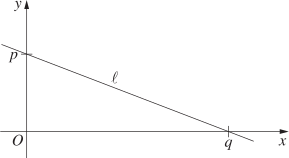
What is the gradient of line `l ` ?
- `-p/q`
- `-q/p`
- `\ \ \ p/q`
- `\ \ \ q/p`
Aussie Maths & Science Teachers: Save your time with SmarterEd
The line `l` has intercepts `p` and `q`, where `p` and `q` are positive integers.
What is the gradient of line `l ` ?
A pair of players is to be selected from 6 people.
How many different pairs of players can be selected?
(A) `6`
(B) `12`
(C) `15`
(D) `30`
A net is made using four rectangles and two trapeziums. It is folded to form a solid.
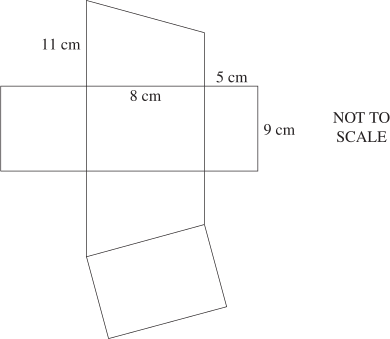
What is the volume of the solid, in cm3 ?
What is the value of `theta`, to the nearest degree?

Which equation correctly shows `r` as the subject of `S=800(1-r)`?
Two unbiased dice, each with faces numbered 1, 2, 3, 4, 5, 6, are rolled.
What is the probability of obtaining a sum of 6?
Triangles `ABC` and `DEF` are similar.
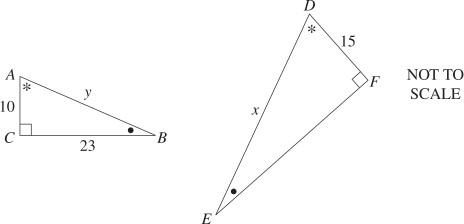
Which expression could be used to find the value of `x`?
An enterprise agreement has the following annual salary arrangements:
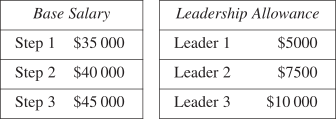
George's employer pays 6% more than the enterprise agreement. He is on Step 3 and receives an allowance for Leader 2.
What is George's gross monthly pay?

The diagram shows two parallel brick walls `KJ` and `MN` joined by a fence from `J` to `M`. The wall `KJ` is `s` metres long and `/_KJM=alpha`. The fence `JM` is `l` metres long.
A new fence is to be built from `K` to a point `P` somewhere on `MN`. The new fence `KP` will cross the original fence `JM` at `O`.
Let `OJ=x` metres, where `0<x<l`.
--- 6 WORK AREA LINES (style=lined) ---
--- 6 WORK AREA LINES (style=lined) ---
--- 2 WORK AREA LINES (style=lined) ---
| i. |  |
`A=text(Area)\ Delta OJK+text(Area)\ Delta OMP`
`text(Using sine rule)`
`text(Area)\ Delta OJK=1/2\ x s sin alpha`
`text(Area)\ DeltaOMP =>text(Need to find)\ \ MP`
| `/_OKJ` | `=/_MPO\ \ text{(alternate angles,}\ MP\ text(||)\ KJtext{)}` |
| `/_PMO` | `=/_OJK=alpha\ \ text{(alternate angles,}\ MP\ text(||)\ KJtext{)}` |
`:.\ DeltaOJK\ text(|||)\ Delta OMP\ \ text{(equiangular)}`
| `=>x/s` | `=(l-x)/(MP)\ ` | ` text{(corresponding sides of similar triangles)}` |
| `MP` | `=(l-x)/x *s` |
| `text(Area)\ Delta\ OMP` | `=1/2 (l-x)* MP * sin alpha` |
| `=1/2 (l-x)*((l-x))/x* s sin alpha` |
| `:. A` | `=1/2 x*s sin alpha+1/2 (l-x)*((l-x))/x* s sin alpha` |
| `=s sin alpha(1/2 x+1/2 (l-x)*((l-x))/x)` | |
| `=s sin alpha(1/2 x+(l-x)^2/(2x))` | |
| `=s sin alpha(1/2 x+l^2/(2x)-l+1/2 x)` | |
| `=s(x-l+l^2/(2x))sin alpha\ \ \ \ text(… as required)` |
ii. `text(Find)\ x\ text(such that)\ A\ text(is a minimum)`
| `A` | `=s(x-l+l^2/(2x))sin alpha` |
| `(dA)/(dx)` | `=s(1-l^2/(2x^2))sin alpha` |
`text(MAX/MIN when)\ (dA)/(dx)=0`
| `s(1-l^2/(2x^2))sin alpha` | `=0` |
| `l^2/(2x^2)` | `=1` |
| `2x^2` | `=l^2` |
| `x^2` | `=l^2/2` |
| `x` | `=l/sqrt2,\ \ \ x>0` |
`(d^2A)/(dx^2)=s((l^2)/(2x^3))sin alpha`
`text(S)text(ince)\ \ 0<alpha<90°\ \ =>\ sin alpha>0,\ \ l>0\ \ text(and)\ \ x>0`
`(d^2A)/(dx^2)>0\ \ \ =>text(MIN at)\ \ x=l/sqrt2`
iii. `text(S)text(ince)\ \ MP=((l-x))/x s\ \ text(and MIN when)\ \ x=l/sqrt2`
| `MP` | `=((l-l/sqrt2)/(l/sqrt2))s xx sqrt2/sqrt2` |
| `=((sqrt2 l-l))/l s` | |
| `=(sqrt2-1)s\ \ text(metres)` |
`:.\ MP=(sqrt2-1)s\ \ text(metres when)\ A\ text(is a MIN.)`
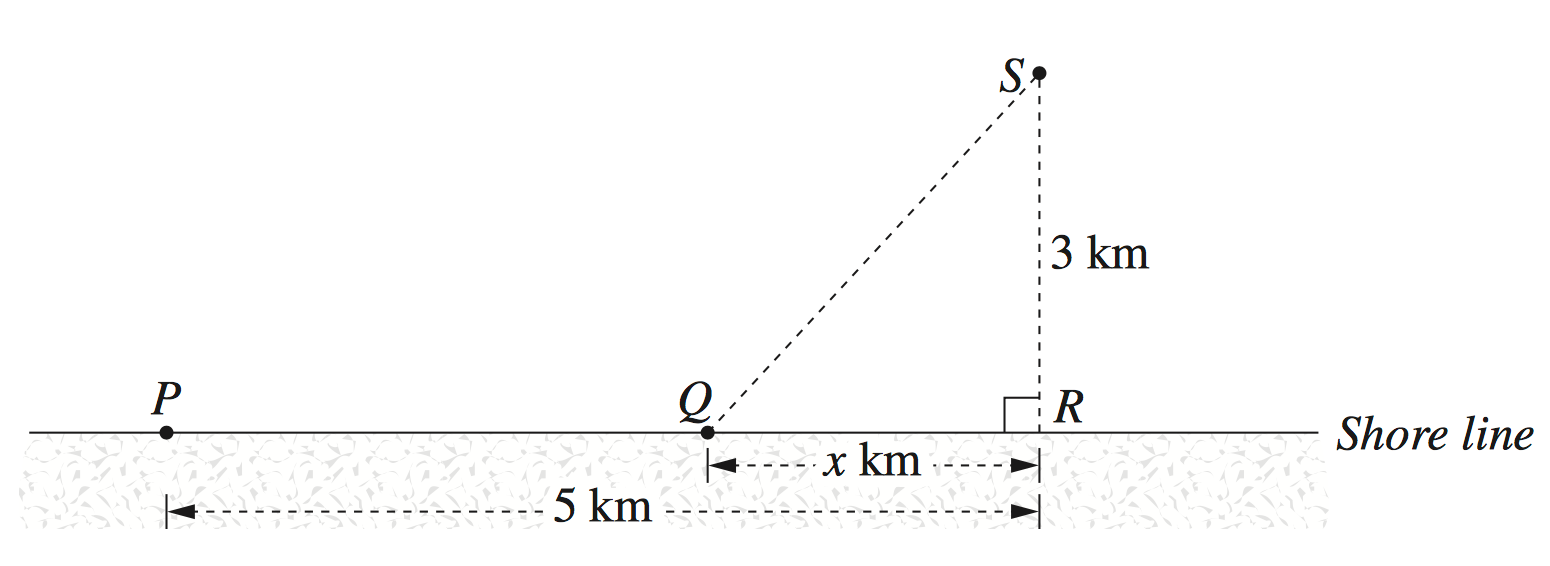
An oil rig, `S`, is 3 km offshore. A power station, `P`, is on the shore. A cable is to be laid from `P` to `S`. It costs $1000 per kilometre to lay the cable along the shore and $2600 per kilometre to lay the cable underwater from the shore to `S`.
The point `R` is the point on the shore closest to `S`, and the distance `PR` is 5 km.
The point `Q` is on the shore, at a distance of `x` km from `R`, as shown in the diagram.
--- 2 WORK AREA LINES (style=lined) ---
--- 2 WORK AREA LINES (style=lined) ---
--- 5 WORK AREA LINES (style=lined) ---
--- 8 WORK AREA LINES (style=lined) ---
Determine the path for laying the cable in order to minimise the cost in this case. (2 marks)
--- 5 WORK AREA LINES (style=lined) ---
A rainwater tank is to be designed in the shape of a cylinder with radius `r` metres and height `h` metres.

The volume of the tank is to be 10 cubic metres. Let `A` be the surface area of the tank, including its top and base, in square metres.
--- 4 WORK AREA LINES (style=lined) ---
--- 6 WORK AREA LINES (style=lined) ---
A farmer is fencing a paddock using `P` metres of fencing. The paddock is to be in the shape of a sector of a circle with radius `r` and sector angle `theta` in radians, as shown in the diagram.

--- 2 WORK AREA LINES (style=lined) ---
--- 2 WORK AREA LINES (style=lined) ---
--- 4 WORK AREA LINES (style=lined) ---
--- 2 WORK AREA LINES (style=lined) ---
--- 5 WORK AREA LINES (style=lined) ---
Two points, `A` and `B`, are on cliff tops on either side of a deep valley. Let `h` and `R` be the vertical and horizontal distances between `A` and `B` as shown in the diagram. The angle of elevation of `B` from `A` is `theta`, so that `theta=tan^-1(h/R)`.

At time `t=0`, projectiles are fired simultaneously from `A` and `B`. The projectile from `A` is aimed at `B`, and has initial speed `U` at an angle of `theta` above the horizontal. The projectile from `B` is aimed at `A` and has initial speed `V` at an angle `theta` below the horizontal.
The equations of motion for the projectile from `A` are
`x_1=Utcos theta` and `y_1=Utsin theta-1/2 g t^2`,
and the equations for the motion of the projectile from `B` are
`x_2=R-Vtcos theta` and `y_2=h-Vtsin theta-1/2 g t^2`, (DO NOT prove these equations.)
--- 3 WORK AREA LINES (style=lined) ---
--- 6 WORK AREA LINES (style=lined) ---
--- 6 WORK AREA LINES (style=lined) ---
A basketball player throws a ball with an initial velocity `v` m/s at an angle of `theta` to the horizontal. At the time the ball is released its centre is at `(0,0)`, and the player is aiming for the point `(d,h)` as shown on the diagram. The line joining `(0,0) ` and `(d,h)` makes an angle `alpha` with the horizontal, where `0<alpha<pi/2`.

Assume that at time `t` seconds after the ball is thrown its centre is at the point `(x,y)`, where
`x=vtcos theta`
`y=vt sin theta-5 t^2`. (DO NOT prove this.)
--- 1 WORK AREA LINES (style=lined) ---
(2) What happens to `v` as `theta\ ->pi/2` ? (1 mark)
--- 1 WORK AREA LINES (style=lined) ---
--- 6 WORK AREA LINES (style=lined) ---
--- 3 WORK AREA LINES (style=lined) ---
*Please note for the purposes of this question, part (a)(ii) showed that when `tanA tanB=-1`, then `A-B=pi/2`
--- 6 WORK AREA LINES (style=lined) ---
The diagram shows the trajectory of a ball thrown horizontally, at speed `v` m/s, from the top of a tower `h` metres above the ground level.

The ball strikes the ground at an angle of 45°, `d` metres from the base of the tower, as shown in the diagram. The equations describing the trajectory of the ball are
`x=vt` and `y=h-1/2 g t^2`, (DO NOT prove this)
where `g` is the acceleration due to gravity, and `t` is time in seconds.
--- 3 WORK AREA LINES (style=lined) ---
--- 7 WORK AREA LINES (style=lined) ---
Points `A` and `B` are located `d` metres apart on a horizontal plane. A projectile is fired from `A` towards `B` with initial velocity `u` m/s at angle `alpha` to the horizontal.
At the same time, another projectile is fired from `B` towards `A` with initial velocity `w` m/s at angle `beta` to the horizontal, as shown on the diagram.
The projectiles collide when they both reach their maximum height.

The equations of motion of a projectile fired from the origin with initial velocity `V` m/s at angle `theta` to the horizontal are
`x=Vtcostheta` and `y=Vtsintheta-g/2 t^2`. (DO NOT prove this.)
--- 5 WORK AREA LINES (style=lined) ---
--- 3 WORK AREA LINES (style=lined) ---
--- 8 WORK AREA LINES (style=lined) ---
The acceleration of a particle is given by
`a=8e^(-2t)+3e^(-t)`,
where `x` is the displacement in metres and `t` is the time in seconds.
Initially its velocity is `text(– 6 ms)^(–1)` and its displacement is 5 m.
--- 5 WORK AREA LINES (style=lined) ---
--- 7 WORK AREA LINES (style=lined) ---
--- 3 WORK AREA LINES (style=lined) ---
The acceleration of a particle is given by
`ddotx=4cos2t`,
where `x` is the displacement in metres and `t` is the time in seconds.
Initially the particle is at the origin with a velocity of `text(1 ms)^(–1)`.
`dotx=2sin2t+1`. (2 marks)
--- 5 WORK AREA LINES (style=lined) ---
--- 4 WORK AREA LINES (style=lined) ---
--- 4 WORK AREA LINES (style=lined) ---
The velocity of a particle is given by
`v=1-2cost`,
where `x` is the displacement in metres and `t` is the time in seconds. Initially the particle is 3 m to the right of the origin.
--- 1 WORK AREA LINES (style=lined) ---
--- 1 WORK AREA LINES (style=lined) ---
--- 4 WORK AREA LINES (style=lined) ---
--- 4 WORK AREA LINES (style=lined) ---
The diagram shows a point `T` on the unit circle `x^2+y^2=1` at an angle `theta` from the positive `x`-axis, where `0<theta<pi/2`.
The tangent to the circle at `T` is perpendicular to `OT`, and intersects the `x`-axis at `P`, and the line `y=1` intersects the `y`-axis at `B`.

--- 5 WORK AREA LINES (style=lined) ---
--- 2 WORK AREA LINES (style=lined) ---
--- 5 WORK AREA LINES (style=lined) ---
--- 6 WORK AREA LINES (style=lined) ---
| i. |  |
`text(Find)\ T:`
`text(S)text(ince)\ \ cos theta=x/1\ \ \ text(and)\ \ \ sin theta=y/1`
`:. T\ (cos theta, sin theta)`
`text(Gradient of)\ OT=sin theta/cos theta`
`:.\ text(Gradient)\ PT=-cos theta/sin theta\ \ text{(} _|_ text{lines)}`
`text(Equation of)\ PT\ text(where)`
`m=-cos theta/sin theta,\ \ text(and through)\ \ (cos theta, sin theta)`
| `text(Using)\ \ y-y_1` | `=m(x-x_1)` |
| `y-sin theta` | `=-cos theta/sin theta(x-cos theta)` |
| `y sin theta-sin^2 theta` | `=-x cos theta+cos^2 theta` |
| `x cos theta+y sin theta` | `=sin^2 theta+cos^2 theta` |
| `x cos theta+y sin theta` | `=1\ \ \ \ \ text(… as required)` |
ii. `text(Find)\ Q:`
`Q\ => text(intersection of)\ xcos theta+y sin theta=1\ \ text(and)\ \ y=1`
| `x cos theta+sin theta` | `=1` |
| `x cos theta` | `=1-sin theta` |
| `x` | `=(1-sin theta)/cos theta` |
`:.\ text(Length of)\ BQ\ text(is)\ \ (1-sin theta)/cos theta\ text(units)`
iii. `text(Show Area)\ OPQB=(2-sin theta)/(2cos theta)`
`A=1/2h(a+b)\ \ text(where)\ \ h=OB=1\ \ a=OP\ \ text(and)`
`b=BQ=(1-sin theta)/cos theta`
`text(Find length)\ OP:`
`P => xcos theta+ysin theta=1 \ text(cuts)\ \ x text(-axis)`
| `xcos theta` | `=1` |
| `x` | `=1/cos theta` |
| `=>text(Length)\ OP` | `=1/cos theta` |
| `text(Area)\ OPQB` | `=1/2xx1(1/cos theta+(1-sin theta)/cos theta)` |
| `=1/2((2-sin theta)/cos theta)` | |
| `=(2-sin theta)/(2cos theta)\ \ text(u²)\ \ \ text(… as required)` |
iv. `text(Find)\ theta\ text(such that Area)\ OPQB\ text(is a MIN)`
| `A` | `=(2-sin theta)/(2cos theta)` |
| `(dA)/(d theta)` | `=(2cos theta(-cos theta)-(2- sin theta)(-2 sin theta))/(4cos^2 theta)` |
| `=(4 sin theta-2sin^2 theta-2 cos^2 theta)/(4 cos^2 theta)` | |
| `=(4sin theta-2(sin^2 theta+cos^2 theta))/(4 cos^2 theta)` | |
| `=(4sin theta-2)/(4cos^2 theta)` | |
| `=(2sin theta-1)/(2 cos^2 theta)` |
`text(MAX or MIN when)\ (dA)/(d theta)=0`
| `=>2sin theta-1` | `=0` |
| `sin theta` | `=1/2` |
| `theta` | `=pi/6\ \ \ \ \0<theta<pi/2` |
`text(Test for MAX/MIN)`
`text(If)\ theta=pi/12\ \ (dA)/(d theta)<0`
`text(If)\ theta=pi/3\ \ (dA)/(d theta)>0\ \ =>text(MIN)`
`:.\text(Area)\ OPQB\ text(is a MIN when)\ theta=pi/6`.
Two straight roads meet at `R` at an angle of 60°. At time `t=0` car `A` leaves `R` on one road, and car `B` is 100km from `R` on the other road. Car `A` travels away from `R` at a speed of 80 km/h, and car `B` travels towards `R` at a speed of 50 km/h.

The distance between the cars at time `t` hours is `r` km.
--- 5 WORK AREA LINES (style=lined) ---
--- 7 WORK AREA LINES (style=lined) ---
Light intensity is measured in lux. The light intensity at the surface of a lake is 6000 lux. The light intensity, `I` lux, a distance `s` metres below the surface of the lake is given by
`I=Ae^(-ks)`
where `A`, and `k` are constants.
--- 2 WORK AREA LINES (style=lined) ---
--- 6 WORK AREA LINES (style=lined) ---
--- 6 WORK AREA LINES (style=lined) ---
Radium decays at a rate proportional to the amount of radium present. That is, if `Q(t)` is the amount of radium present at time `t`, then `Q=Ae^(-kt)`, where `k` is a positive constant and `A` is the amount present at `t=0`. It takes 1600 years for an amount of radium to reduce by half.
--- 6 WORK AREA LINES (style=lined) ---
How many years will it be before the amount of radium reaches the safe level. (2 marks)
--- 6 WORK AREA LINES (style=lined) ---
The intensity, `I`, measured in watt/m2, of a sound is given by
`I=10^-12xxe^(0.1L)`,
where `L` is the loudness of the sound in decibels.
--- 2 WORK AREA LINES (style=lined) ---
What is the maximum loudness of a sound so that no ear damage occurs? (2 marks)
--- 6 WORK AREA LINES (style=lined) ---
--- 5 WORK AREA LINES (style=lined) ---
Trout and carp are types of fish. A lake contains a number of trout. At a certain time, 10 carp are introduced into the lake and start eating the trout. As a consequence, the number of trout, `N`, decreases according to
`N=375-e^(0.04t)`,
where `t` is the time in months after the carp are introduced.
The population of carp, `P`, increases according to `(dP)/(dt)=0.02P`.
--- 2 WORK AREA LINES (style=lined) ---
--- 6 WORK AREA LINES (style=lined) ---
--- 6 WORK AREA LINES (style=lined) ---
--- 10 WORK AREA LINES (style=lined) ---
--- 8 WORK AREA LINES (style=lined) ---

i. `text(Carp introduced at)\ \ t=0`
`N=375-e^0=374`
`:.\ text(There was 374 trout when carp were introduced.)`
ii. `text(Trout population will be zero when)`
| `N` | `=375-e^(0.04t)=0` |
| `e^(0.04t)` | `=375` |
| `0.04t` | `=ln375` |
| `t` | `=ln375/0.04` |
| `=148.173 …` | |
| `=148\ text{months (nearest month)}` |
`:.\ text(After 148 months, the trout population will be zero.)`
| iii. | |
iv. `text(We need) \ |(dN)/(dt)|=(dP)/(dt)`
`text(Given)\ N=375-e^(0.04t)`
`(dN)/(dt)=-0.04e^(0.04t)`
`text(Find)\ P\ text(in terms of)\ t`
`text(Given)\ (dP)/(dt)=0.02P`
`=> P=Ae^(0.02t)`
`text(Find)\ A\ \ =>text(when)\ t=0,\ P=10`
| `10` | `=Ae^0` |
| `:.A` | `=10` |
| `=>(dP)(dt)` | `=10xx0.02e^(0.02t)` |
| `=0.2e^(0.02t)` |
`text(Given that)\ \ (dP)/(dt)=|(dN)/(dt)|`
| `0.2e^(0.02t)` | `=0.04e^(0.04t)` |
| `5e^(0.02t)` | `=e^(0.04t)` |
| `e^(0.04t)/e^(0.02t)` | `=5` |
| `e^(0.04t-0.02t)` | `=5` |
| `lne^(0.02t)` | `=ln5` |
| `0.02t` | `=ln5` |
| `t` | `=ln5/0.02` |
| `=80.4719…` | |
| `=80\ text{months (nearest month)}` |
v. `text(Find)\ t\ text(when)\ N=P`
| `text(i.e.)\ \ 375-e^(0.04t)` | `=10e^(0.02t)` |
| `e^(0.04t)+10e^(0.02t)-375` | `=0` |
`text(Let)\ X=e^(0.02t),\ text(noting)\ \ X^2=(e^(0.02t))^2=e^(0.04t)`
| `:.\ X^2+10X-375` | `=0` |
| `(X-15)(X+25)` | `=0` |
`X=15\ \ text(or)\ \ –25`
`text(S)text(ince)\ X=e^(0.02t)`
| `e^(0.02t)` | `=15\ \ \ \ (e^(0.02t)>0)` |
| `lne^(0.02t)` | `=ln15` |
| `0.02t` | `=ln15` |
| `t` | `=ln15/0.02` |
| `=135.4025…` | |
| `=135\ text(months)` |
The velocity of a particle moving along the `x`-axis is given by
`v=8-8e^(-2t)`,
where `t` is the time in seconds and `x` is the displacement in metres.
--- 1 WORK AREA LINES (style=lined) ---
--- 2 WORK AREA LINES (style=lined) ---
--- 5 WORK AREA LINES (style=lined) ---
Find the value of this constant. (1 mark)
--- 2 WORK AREA LINES (style=lined) ---
--- 8 WORK AREA LINES (style=lined) ---
i. `text(Initial velocity when)\ \ t=0`
| `v` | `=8-8e^0` |
| `=0\ text(m/s)` | |
| `:.\ text(Particle is initially at rest.)` | |
ii. `a=d/(dt) (v)=-2xx-8e^(-2t)=16e^(-2t)`
`text(S)text(ince)\ e^(-2t)=1/e^(2t)>0\ text(for all)\ t`.
`=>\ a=16e^(-2t)=16/e^(2t)>0\ text(for all)\ t`.
`:.\ text(Acceleration is positive for all)\ \ t>0`.
iii. `text{S}text{ince the particle is initially at rest, and ALWAYS}`
`text{has a positive acceleration.`
`:.\ text(It moves in a positive direction for all)\ t`.
iv. `text(As)\ t->oo`, `e^(-2t)=1/e^(2t)->0`
`=>8/e^(2t)->0\ text(and)`
`=>v=8-8/e^(2t)->8\ text(m/s)`
`:.\ text(As)\ \ t->oo,\ text(velocity approaches 8 m/s.)`
| v. |
|
The diagram shows the curve `y=1/x`, for `x>0`.
The area under the curve between `x=a` and `x=1` is `A_1`. The area under the curve between `x=1` and `x=b` is `A_2`.

The areas `A_1` and `A_2` are each equal to `1` square unit.
Find the values of `a` and `b`. (3 marks)
--- 6 WORK AREA LINES (style=lined) ---
Peter retires with a lump sum of $100 000. The money is invested in a fund which pays interest each month at a rate of 6% per annum, and Peter receives a fixed monthly payment `$M` from the fund. Thus the amount left in the fund after the first monthly payment is `$(100\ 500-M)`.
--- 4 WORK AREA LINES (style=lined) ---
--- 6 WORK AREA LINES (style=lined) ---
Consider the geometric series
`5+10x+20x^2+40x^3+\ ...`
--- 4 WORK AREA LINES (style=lined) ---
Find the value of `x`. (2 marks)
--- 4 WORK AREA LINES (style=lined) ---
The velocity of a particle moving along the `x`-axis is given by `dotx=10-2t`, where `x` is the displacement from the origin in metres and `t` is the time in seconds. Initially the particle is 5 metres to the right of the origin.
--- 2 WORK AREA LINES (style=lined) ---
--- 2 WORK AREA LINES (style=lined) ---
--- 5 WORK AREA LINES (style=lined) ---
--- 6 WORK AREA LINES (style=lined) ---
--- 2 WORK AREA LINES (style=lined) ---
--- 8 WORK AREA LINES (style=lined) ---
--- 4 WORK AREA LINES (style=lined) ---
--- 8 WORK AREA LINES (style=lined) ---
Solve `log_e x-3/log_ex=2` (3 marks)
--- 6 WORK AREA LINES (style=lined) ---
One year ago Daniel borrowed $350 000 to buy a house. The interest rate was 9% per annum, compounded monthly. He agreed to repay the loan in 25 years with equal monthly repayments of $2937.
--- 2 WORK AREA LINES (style=lined) ---
Daniel has just made his 12th monthly repayment. He now owes $346 095. The interest rate now decreases to 6% per annum, compounded monthly.
The amount `$A_n`, owing on the loan after the `n`th monthly repayment is now calculated using the formula
`qquad qquad A_n=346,095xx1.005^n-1.005^(n-1)M-\ ... -1.005M-M`
where `$M` is the monthly repayment, and `n=1,2,\ ...,288`. (DO NOT prove this formula.)
--- 6 WORK AREA LINES (style=lined) ---
--- 6 WORK AREA LINES (style=lined) ---
--- 3 WORK AREA LINES (style=lined) ---
Let `$P` be the value of the investment after 240 months, when Chris retires.
Show that `P=232\ 175.55` (2 marks)
--- 5 WORK AREA LINES (style=lined) ---
Let `$A_n` be the amount left in the account `n` months after Chris's retirement.
(1) Show that `A_n=(P-400\ 000)xx1.005^n+400\ 000`. (3 marks)
--- 7 WORK AREA LINES (style=lined) ---
(2) For how many months after retirement will there be money left in the account? (2 marks)
--- 4 WORK AREA LINES (style=lined) ---
When Jules started working she began paying $100 at the beginning of each month into a superannuation fund.
The contributions are compounded monthly at an interest rate of 6% per annum.
She intends to retire after having worked for 35 years.
--- 4 WORK AREA LINES (style=lined) ---
At the end of `n` months after starting the new contributions, the amount in the fund is `$A_n`.
(1) Show that `A_2=29\ 227xx1.005^2+M(1.005+1.005^2)`. (1 mark)
--- 2 WORK AREA LINES (style=lined) ---
(2) Find the value of `M` so that Jules will have $800 000 in her fund after the remaining 20 years (240 months). (3 marks)
--- 8 WORK AREA LINES (style=lined) ---
The number of members of a new social networking site doubles every day. On Day 1 there were 27 members and on Day 2 there were 54 members.
--- 1 WORK AREA LINES (style=lined) ---
--- 6 WORK AREA LINES (style=lined) ---
--- 5 WORK AREA LINES (style=lined) ---
Ari takes out a loan of $360 000. The loan is to be repaid in equal monthly repayments, `$M`, at the end of each month, over 25 years (300 months). Reducible interest is charged at 6% per annum, calculated monthly.
Let `$A_n` be the amount owing after the `n`th repayment.
--- 2 WORK AREA LINES (style=lined) ---
--- 4 WORK AREA LINES (style=lined) ---
--- 6 WORK AREA LINES (style=lined) ---
Pat and Chandra are playing a game. They take turns throwing two dice. The game is won by the first player to throw a double six. Pat starts the game.
--- 2 WORK AREA LINES (style=lined) ---
--- 5 WORK AREA LINES (style=lined) ---
--- 5 WORK AREA LINES (style=lined) ---
A family borrows $500 000 to buy a house. The loan is to be repaid in equal monthly instalments. The interest, which is charged at 6% per annum, is reducible and calculated monthly. The amount owing after `n` months, `$A_n`, is given by
`qquad qquadA_n=Pr^n-M(1+r+r^2+ \ .... +r^(n-1))\ \ \ \ \ \ \ \ \ ` (DO NOT prove this)
where `$P` is the amount borrowed, `r=1.005` and `$M` is the monthly repayment.
--- 4 WORK AREA LINES (style=lined) ---
--- 3 WORK AREA LINES (style=lined) ---
After 20 years the family borrows an extra amount, so that the family then owes a total of $370 000. The monthly repayment remains $2998, and the interest rate remains the same.
--- 5 WORK AREA LINES (style=lined) ---
Kim and Alex start jobs at the beginning of the same year. Kim's annual salary in the first year is $30,000 and increases by 5% at the beginning of each subsequent year. Alex's annual salary in the first year is $33,000, and increases by $1,500 at the beginning of each subsequent year.
--- 4 WORK AREA LINES (style=lined) ---
--- 4 WORK AREA LINES (style=lined) ---
--- 6 WORK AREA LINES (style=lined) ---
