SmarterEd

Aussie Maths & Science Teachers: Save your time with SmarterEd

  • Login
  • Get Help
  • About

Interpreting Data, SM-Bank 029 MC

Students at a high school were surveyed to find whether they did exercise before school.

The graph below shows the results.
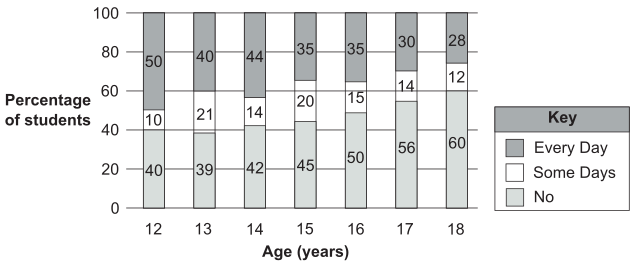


There were 150 17-year-old students at the high school.

How many 17-year-old students responded 'Every Day'?

  1. 14
  2. 30
  3. 38
  4. 45
Show Answers Only

\(D\)

Show Worked Solution

\(\text{30% of 17-year-old responded ‘Every Day’.}\)

\(\therefore\ \text{Number}\) \(=0.3\times 150\)
  \(=45\)

 
\(\Rightarrow D\)

Filed Under: Interpreting Data Tagged With: num-title-ct-core, smc-5077-15-Reading graphs

Interpreting Data, SM-Bank 028 MC

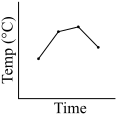
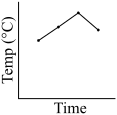
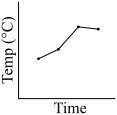
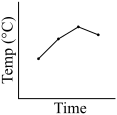
Gavin measured the temperature every 3 hours from 6:00 am to 3:00 pm.
 

\begin{array} {|l|c|c|c|c|}
\hline
\rule{0pt}{2.5ex} \text{Time of the day} \rule[-1ex]{0pt}{0pt} & \text{6:00 am}& \text{9:00 am} & \text{12:00 pm} & \text{3:00 pm} \\
\hline
\rule{0pt}{2.5ex} \text{Temperature (°C)} \rule[-1ex]{0pt}{0pt} & 22&28&32&29 \\
\hline
\end{array}


Which graph shows Gavin's results?

A. B. C. D.
Show Answers Only

\(D\)

Show Worked Solution

\(\Rightarrow D\)

Filed Under: Interpreting Data Tagged With: num-title-ct-core, smc-5077-15-Reading graphs

Interpreting Data, SM-Bank 027

The goals scored by 4 players in a season of water polo were recorded in the graph below.

Will scored 8 goals in the season.

Sam scored 5 goals.

How many more goals did Bilbo score than Ginili?  (2 marks)

--- 4 WORK AREA LINES (style=lined) ---

Show Answers Only

\(7\ \text{more goals}\)

Show Worked Solution

\(\text{Since Will scored 8 goals,}\)

\(= 2\ \text{goals}\)

\(\longrightarrow\ \text{Bilbo scored 10 goals}\)

\(\longrightarrow\ \text{Ginili scored 3 goals}\)

\(\therefore\ \text{Bilbo scored 7 more goals than Ginili.}\)

Filed Under: Interpreting Data Tagged With: num-title-ct-core, smc-5077-15-Reading graphs

Interpreting Data, SM-Bank 026

Matt and Libby planted 50 trees each over 3 weeks.

The bar chart below shows the amount of trees each planted in each week.
 

How many more trees did Libby plant than Matt in Week 2.  (2 marks)

--- 4 WORK AREA LINES (style=lined) ---

Show Answers Only

\(5\)

Show Worked Solution

\(\text{Trees planted by Matt in Week 2}\)

\(= 35-15\)

\(= 20\)
 

\(\text{Trees planted by Libby in Week 2}\)

\(= 45-20\)

\(= 25\)
 

\(\therefore\ \text{Libby planted 5 more trees than Matt in Week 2.}\)

Filed Under: Interpreting Data Tagged With: num-title-ct-core, smc-5077-15-Reading graphs

Interpreting Data, SM-Bank 025 MC

Camilla asked each student in four year 7 classes if they played soccer.

She recorded the results in the graph below. 


Which class had the highest number of students that played soccer?

  1. Class A
  2. Class B
  3. Class C
  4. Class D
Show Answers Only

\(A\)

Show Worked Solution

\(\text{Consider each option:}\)

\(\text{Class A}: 8+6=14\)

\(\text{Class B}: 10+3=13\)

\(\text{Class C}: 4+9=13\)

\(\text{Class D}: 11+2=13\)

\(\therefore\ \text{Class A has the most soccer players.}\)

\(\Rightarrow A\)

Filed Under: Interpreting Data Tagged With: num-title-ct-core, smc-5077-15-Reading graphs

Interpreting Data, SM-Bank 024 MC

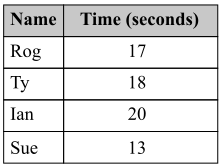
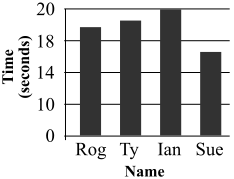
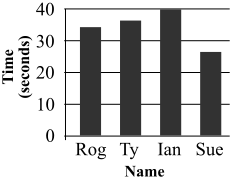
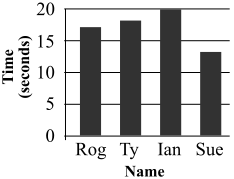
The table shows the time (in seconds) some children can run 100 metres.

Which column graph correctly shows the data in the table?

A. B.
C. D.
   
Show Answers Only

\(C\)

Show Worked Solution

\(\text{Considering the vertical scale of each option:}\)
 

\(\Rightarrow C\)

Filed Under: Interpreting Data Tagged With: num-title-ct-core, smc-5077-15-Reading graphs

Interpreting Data, SM-Bank 023

32 students are shown 5 colours and they choose their favourite.

The fractions in the graph below show how the students voted.

How many more students voted for green than blue?  (2 marks)

--- 3 WORK AREA LINES (style=lined) ---

Show Answers Only

\(4\)

Show Worked Solution
\(\text{Votes for green}\) \(=\dfrac{1}{4}\times 32\)
  \(=8\)
   
\(\text{Votes for blue}\) \(=\dfrac{1}{8}\times 32\)
  \(=4\)


\(\therefore\ \text{4 more students voted for green than blue.}\)

Filed Under: Interpreting Data Tagged With: num-title-ct-core, smc-5077-15-Reading graphs

Interpreting Data, SM-Bank 022 MC

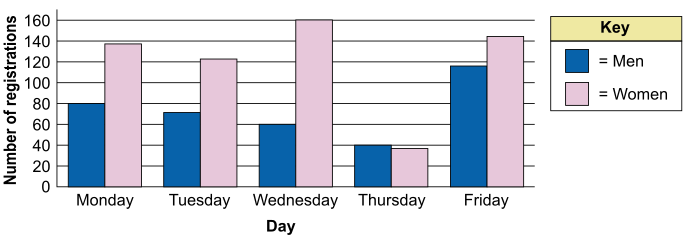
This graph shows the number of men and women that registered to vote before a council election on different days of the week.
  

On which day is the difference between the number of men and women registering closest to 50?

  1. Monday
  2. Tuesday
  3. Wednesday
  4. Friday
Show Answers Only

\(B\)

Show Worked Solution

\(\text{Each interval = 20 people}\)

\(\text{Difference needs to be 2.5 intervals}\)

\(\therefore\ \text{Tuesday is closest}\)

 
\(\Rightarrow B\)

Filed Under: Interpreting Data Tagged With: num-title-ct-core, smc-5077-15-Reading graphs

Interpreting Data, SM-Bank 021 MC

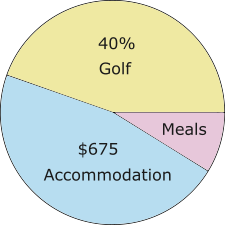
Aaron went on holiday and spent his money on accommodation, golf and meals.

He spent $1500 in total and the pie chart below shows how he spent it.


How much money did Aaron spend on meals on his holiday?

  1. $225
  2. $375
  3. $425
  4. $600
Show Answers Only

\(A\)

Show Worked Solution

\(\text{Percentage spent on accommodation}\)

\(=\dfrac{675}{1500}\times 100\)

\(=45\%\)
 

\(\rightarrow\ \text{Percentage on meals}=100-(40+45)=15\%\)

\(\therefore\ \text{Amount spent on meals}\)

\(=15\%\times 1500\)

\(=$225\)

\(\Rightarrow A\)

Filed Under: Interpreting Data Tagged With: num-title-ct-core, smc-5077-15-Reading graphs

Interpreting Data, SM-Bank 020 MC

This graph shows the number of cockatoos in a gum tree at 15 minute intervals over 4 hours.


At which time were the lowest number of cockatoos in the gum tree?

  1. 3:00
  2. 3:15
  3. 3:45
  4. 4:00
Show Answers Only

\(C\)

Show Worked Solution

\(\text{The lowest data point is one interval before 4:00 pm.}\)

\(\therefore\ \text{The lowest number were in the tree at 3:45 pm.}\)

\(\Rightarrow C\)

Filed Under: Interpreting Data Tagged With: num-title-ct-core, smc-5077-15-Reading graphs

Interpreting Data, SM-Bank 019 MC

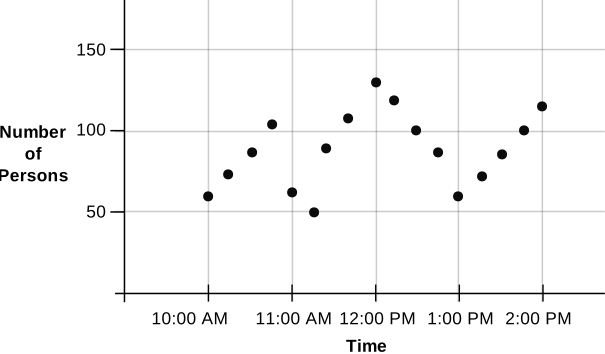
The graph below shows the number of people in a supermarket at 15-minute intervals during a 4 hour period.


What time were the greatest amount of people in the supermarket?

  1. 11:15 AM
  2. 12:00 PM
  3. 12:30 PM
  4. 1:45 PM

Show Answers Only

\(B\)

Show Worked Solution

\(\therefore\ \text{The highest data point in the graph is at 12:00 PM}\)
 

\(\Rightarrow B\)

Filed Under: Interpreting Data Tagged With: num-title-ct-core, smc-5077-15-Reading graphs

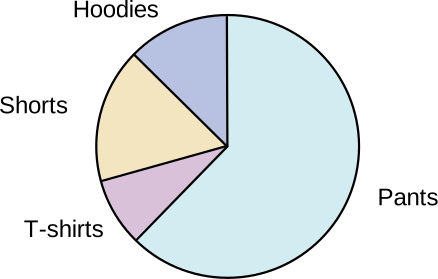
Interpreting Data, SM-Bank 018 MC

A menswear store recorded the number of items it sold in four different categories.

What category makes up 60% of the total number of items sold?


  1. Hoodies
  2. Shorts
  3. T-shirts
  4. Pants
Show Answers Only

\(D\)

Show Worked Solution

\(\text{Pants represent more than half of the graph.}\)

\(\Rightarrow D\)

Filed Under: Interpreting Data Tagged With: num-title-ct-core, smc-5077-15-Reading graphs

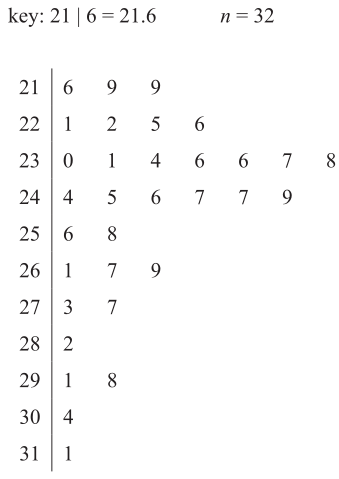
Interpreting Data, SM-Bank 017

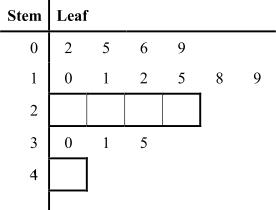
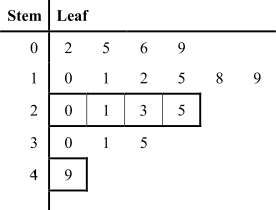
Body mass index (BMI), in kilograms per square metre, was recorded for a sample of 32 men and displayed in the ordered stem plot below.
  

  1. Describe the shape of the distribution.  (1 mark)

    --- 1 WORK AREA LINES (style=lined) ---

  2. Determine the median BMI for this group of men.  (1 mark)

    --- 2 WORK AREA LINES (style=lined) ---

  3. People with a BMI of 25 or over are considered to be overweight.
  4. What percentage of these men would be considered to be overweight?  (1 mark)

    --- 3 WORK AREA LINES (style=lined) ---

Show Answers Only

a.    \(\text{Positively skewed}\)

b.    \(24.55\)

c.    \(37.5\%\)

Show Worked Solution

a.   \(\text{The tail is to the right, therefore positively skewed}\)
 

b.   \(32\ \text{data points}\)

\(\text{Median}\) \(=\dfrac{\text{(16th + 17th)}}{2}\)
  \(=\dfrac{ (24.5 + 24.6)}{2}\)
  \(= 24.55\)


c.    \(\text{Percentage}\) \(=\dfrac{12}{32}\times 100\)
    \(=37.5\%\)

Filed Under: Interpreting Data Tagged With: num-title-ct-core, smc-5077-15-Reading graphs, smc-5077-25-Mean Median Mode Range

Interpreting Data, SM-Bank 016 MC

A single back-to-back stem-and-leaf plot would be an appropriate graphical tool to investigate the association between a car’s speed, in kilometres per hour, and the

  1. driver’s age, in years. 
  2. car’s colour (white, red, grey, other). 
  3. average distance travelled, in kilometres.
  4. driver’s sex (female, male).
Show Answers Only

\(D\)

Show Worked Solution

\(\text{In a back-to-back stem-and-leaf plot, the numerical }\)

\(\text{speed data has to be plotted against categorical data}\)

\(\text{with two options.}\)

\(\therefore\ \text{Driver’s sex (M or F)}\)

\(\Rightarrow D\)

Filed Under: Interpreting Data Tagged With: num-title-ct-core, smc-5077-15-Reading graphs

Interpreting Data, SM-Bank 015 MC

The back-to-back ordered stem-and-leaf plot below shows the distribution of maximum temperatures (in °Celsius) of two towns, Beachside and Flattown, over 21 days in January.


For this distribution, which of the following is not true?

  1. The range of temperatures for Flattown is greater than the range of temperatures for Beachside.
  2. The median temperature for Beachside is lower than the median temperature for Flatttown.
  3. The distribution of temperatures for Beachside is positively skewed.
  4. The maximum temperatures for Flattown are generally lower than those of Beachside.
Show Answers Only

\(D\)

Show Worked Solution

\(\text{Options A}\ \rightarrow\ \text{Flattown Range}=28,\ \ \text{Beachside Range}=23\ \checkmark\)

\(\text{Options B}\ \rightarrow\ \text{Flattown Median}=37,\ \ \text{Beachside Median}=23\ \checkmark\)

\(\text{Options C}\ \rightarrow \ \text{Beachside distribution has a tail to the right, so positively skewed}\ \checkmark\)

\(\text{Options D}\ \rightarrow \ \text{Flattown has 8 max temps that are}\geq\ \text{to those of Beachside.  ×}\)
 

\(\Rightarrow D\)

Filed Under: Interpreting Data Tagged With: num-title-ct-core, smc-5077-15-Reading graphs, smc-5077-25-Mean Median Mode Range

Interpreting Data, SM-Bank 014 MC

The stem-and-leaf plot below displays 30 temperatures recorded at a cold climate weather station.
 

The modal temperature is

  1.  2.8°C
  2.  2.9°C
  3.  3.7°C
  4.  8.0°C
Show Answers Only

\(A\)

Show Worked Solution

\(\text{2.8° appears the most in this data set.}\)

\(\Rightarrow A\)

Filed Under: Interpreting Data Tagged With: num-title-ct-core, smc-5077-15-Reading graphs

Interpreting Data, SM-Bank 013 MC

The back-to-back ordered stem plot below shows the female and male smoking rates, expressed as a percentage, in 18 countries.


For these 18 countries, the smoking rates for females are generally

  1. lower and less variable than the smoking rates for males.
  2. lower and more variable than the smoking rates for males.
  3. higher and less variable than the smoking rates for males.
  4. higher and more variable than the smoking rates for males.
Show Answers Only

\(A\)

Show Worked Solution

\(\text{Smoking rates are lower and less variable (range of}\)

\(\text{females rates vs male rates is 13% vs 30%).}\)

\(\Rightarrow A\)

Filed Under: Interpreting Data Tagged With: num-title-ct-core, smc-5077-15-Reading graphs

Interpreting Data, SM-Bank 012 MC

The back-to-back ordered stem plot below shows the female and male smoking rates, expressed as a percentage, in 18 countries.


For these 18 countries, the lowest female smoking rate is

  1. \(5\%\)
  2. \(9\%\)
  3. \(15\%\)
  4. \(19\%\)
Show Answers Only

\(C\)

Show Worked Solution

\(\text{Lowest female smoking rate is 15%.}\)

\(\Rightarrow C\)

Filed Under: Interpreting Data Tagged With: num-title-ct-core, smc-5077-15-Reading graphs

Interpreting Data, SM-Bank 011

Table 1 shows the number of rainy days recorded in a high rainfall area for each month during 2022.
 

CORE, FUR2 2009 VCAA 11


The dot plot below displays the distribution of the number of rainy days for the 12 months of 2008.
 

CORE, FUR2 2009 VCAA 12
 

  1. Circle the dot on the dot plot that represents the number of rainy days in April 2008.  (1 mark)

    --- 0 WORK AREA LINES (style=lined) ---

  2. For the year 2022, determine


i.  the median number of rainy days per month  (1 mark)

--- 2 WORK AREA LINES (style=lined) ---

    1. the percentage of months that have more than 10 rainy days. Write your answer correct to the nearest percent.  (2 marks) 

      --- 3 WORK AREA LINES (style=lined) ---

Show Answers Only

 a.

CORE, FUR2 2009 VCAA 12 Answer

b.    i.    \(15.5\)

ii.    \(92\%\)

Show Worked Solution
a.    CORE, FUR2 2009 VCAA 12 Answer


b.i.    \(\text{Median}\) \(=\text{(6th + 7th)}/2\)
    \(=\dfrac{(15+16)}{2}\)
    \(=15.5\)


b.ii.   \(\text{Months with more than 10 rainy days}\)

\(=\dfrac{11}{12}\times 100\%\)

\(=91.66\dots\)

\(\approx 92\%\ \text{(nearest %)}\)

Filed Under: Interpreting Data Tagged With: num-title-ct-core, smc-5077-15-Reading graphs

Data Analysis, SM-Bank 056 MC

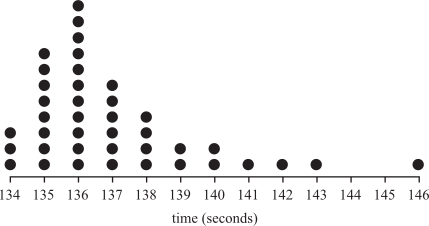
The dot plot below shows the times, in seconds, of 40 runners in the qualifying heats of their 800 m club championship.
 

The shape of this distribution is best described as

  1. positively skewed with one outlier.
  2. approximately symmetric with one outlier.
  3. approximately symmetric with no outliers.
  4. negatively skewed with one outlier.
Show Answers Only

\(A\)

Show Worked Solution

\(\text{Distribution is positively skewed (tail stretches to the right)} \)

\(\text{and 146 is a possible outlier}\)

\(\Rightarrow A\)

Filed Under: Data Analysis Tagged With: num-title-ct-core, smc-4224-35-Describing datasets

Interpreting Data, SM-Bank 010 MC

Kerri-anne records the temperature on her verandah at hourly intervals for a 24 hour period.

Which type of graph would best display this data so Kerri-anne could easily see the temperature fluctuations throughout the day?

  1. A sector graph
  2. A stem-and-leaf plot
  3. A column graph
  4. A line graph
Show Answers Only

\(D\)

Show Worked Solution

\(\text{A line graph shows variations over time.}\)

\(\Rightarrow D\)

Filed Under: Interpreting Data Tagged With: num-title-ct-core, smc-5077-15-Reading graphs

Interpreting Data, SM-Bank 009 MC

Michael wants to record how he used the data on his phone last week. He spent time on social media, playing games and listening to music.

Which type of graph would best display this data so Michael could easily see the proportion of time spent on each activity?

  1. A sector graph
  2. A stem-and-leaf plot
  3. A column graph
  4. A dot plot
Show Answers Only

\(A\)

Show Worked Solution

\(\text{Sector graph}\)

\(\Rightarrow A\)

Filed Under: Interpreting Data Tagged With: num-title-ct-core, smc-5077-15-Reading graphs

Interpreting Data, SM-Bank 008 MC

At the school cross country carnival, the times of the 15 year of girls and boys were recorded.

Which type of graph would best display this data to enable a comparison of the performance of both groups?

  1. A sector graph
  2. Back-to-back stem-and-leaf plot
  3. A column graph
  4. A dot plot
Show Answers Only

\(B\)

Show Worked Solution

\(\text{Back-to-back stem-and-leaf plot}\)

\(\Rightarrow B\)

Filed Under: Interpreting Data Tagged With: num-title-ct-core, smc-5077-15-Reading graphs

Interpreting Data, SM-Bank 007 MC

Which type of graph would be best used to show the favourite colours of a group of year 7 students?

  1. A sector graph
  2. Stem-and-Leaf plot
  3. A column graph
  4. A dot plot
Show Answers Only

\(C\)

Show Worked Solution

\(\text{Column graph}\)

\(\Rightarrow C\)

Filed Under: Interpreting Data Tagged With: num-title-ct-core, smc-5077-15-Reading graphs

Interpreting Data, SM-Bank 006

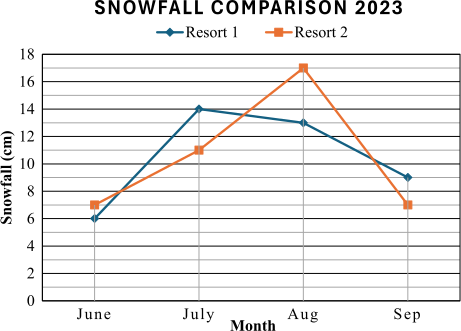
Hannah is planning an Australian snowboarding trip this winter and is using the chart below to help decide when she should take her holidays and where she should go.
 

Hannah wishes to compare the 2 resorts using statistical information.

  1. Complete the statistical information in the table below.  (2 marks)
     
    \begin{array} {|l|c|c|}
    \hline
    \rule{0pt}{2.5ex} \ \rule[-1ex]{0pt}{0pt} &\ \ \ \ \ \ \  \textbf{Resort 1}\ \ \ \ \ \ \  \rule[-1ex]{0pt}{0pt} &\ \ \ \ \ \ \  \textbf{Resort 2}\ \ \ \ \ \ \  \\
    \hline
    \rule{0pt}{2.5ex} \textbf{Range of snowfall (cm)} \rule[-1ex]{0pt}{0pt}&  & \\
    \hline
    \rule{0pt}{2.5ex} \textbf{Mean of snowfall (cm)} \rule[-1ex]{0pt}{0pt} &   &  \\
    \hline
    \rule{0pt}{2.5ex} \textbf{Median of snowfall (cm)} \rule[-1ex]{0pt}{0pt} & &  \\
    \hline
    \end{array}

    --- 0 WORK AREA LINES (style=lined) ---

  2. Using your results in the table above (a), which resort should Hannah choose to visit for her snowboarding holiday?
    Justify your answer with at least 1 reference to the table.  (1 mark)

    --- 5 WORK AREA LINES (style=lined) ---

  3. Complete the table below, and use it to decide in which month Hannah should book her snowboarding holiday?
    Justify your answer with at least 1 reference to the table and 1 to the graph.  (3 marks)

    \begin{array} {|l|c|c|}
    \hline
    \rule{0pt}{2.5ex} \ \rule[-1ex]{0pt}{0pt} &\ \ \ \ \ \ \  \textbf{Mean Snowfall}\ \ \ \ \ \ \    \\
    \hline
    \rule{0pt}{2.5ex} \textbf{June} \rule[-1ex]{0pt}{0pt}& \\
    \hline
    \rule{0pt}{2.5ex} \textbf{July} \rule[-1ex]{0pt}{0pt} &  \\
    \hline
    \rule{0pt}{2.5ex} \textbf{August} \rule[-1ex]{0pt}{0pt} & \\
    \hline
    \rule{0pt}{2.5ex} \textbf{September} \rule[-1ex]{0pt}{0pt} & \\
    \hline
    \end{array}

    --- 5 WORK AREA LINES (style=lined) ---

Show Answers Only

a.

\begin{array} {|l|c|c|}
\hline
\rule{0pt}{2.5ex} \ \rule[-1ex]{0pt}{0pt} &\ \ \ \ \ \ \  \textbf{Resort 1}\ \ \ \ \ \ \  \rule[-1ex]{0pt}{0pt} &\ \ \ \ \ \ \  \textbf{Resort 2}\ \ \ \ \ \ \  \\
\hline
\rule{0pt}{2.5ex} \textbf{Range of snowfall (cm)} \rule[-1ex]{0pt}{0pt} &7 &10\\
\hline
\rule{0pt}{2.5ex} \textbf{Mean of snowfall (cm)} \rule[-1ex]{0pt}{0pt} & 10.5  & 10.5 \\
\hline
\rule{0pt}{2.5ex} \textbf{Median of snowfall (cm)} \rule[-1ex]{0pt}{0pt} & 14 & 13.5 \\
\hline
\end{array}

b.    \(\text{See worked solution}\)

c.  

\begin{array} {|l|c|c|}
\hline
\rule{0pt}{2.5ex} \ \rule[-1ex]{0pt}{0pt} &\ \ \ \ \ \ \  \textbf{Mean Snowfall}\ \ \ \ \ \ \    \\
\hline
\rule{0pt}{2.5ex} \textbf{June} \rule[-1ex]{0pt}{0pt}& 6.5 \\
\hline
\rule{0pt}{2.5ex} \textbf{July} \rule[-1ex]{0pt}{0pt} & 13.5 \\
\hline
\rule{0pt}{2.5ex} \textbf{August} \rule[-1ex]{0pt}{0pt} & 16\\
\hline
\rule{0pt}{2.5ex} \textbf{September} \rule[-1ex]{0pt}{0pt} & 8\\
\hline
\end{array}

\(\text{See worked solution}\)

Show Worked Solution

a.

\begin{array} {|l|c|c|}
\hline
\rule{0pt}{2.5ex} \ \rule[-1ex]{0pt}{0pt} &\ \ \ \ \ \ \  \textbf{Resort 1}\ \ \ \ \ \ \  \rule[-1ex]{0pt}{0pt} &\ \ \ \ \ \ \  \textbf{Resort 2}\ \ \ \ \ \ \  \\
\hline
\rule{0pt}{2.5ex} \textbf{Range of snowfall (cm)} \rule[-1ex]{0pt}{0pt} & 14-7=7 & 17-7=10\\
\hline
\rule{0pt}{2.5ex} \textbf{Mean of snowfall (cm)} \rule[-1ex]{0pt}{0pt} & \dfrac{6+14+13+9}{4}=10.5  & \dfrac{7+11+17+7}{4}=10.5 \\
\hline
\rule{0pt}{2.5ex} \textbf{Median of snowfall (cm)} \rule[-1ex]{0pt}{0pt} & \dfrac{11+17}{2}=14 & \dfrac{14+13}{2}=13.5 \\
\hline
\end{array}


b.    \(\text{The mean snowfall for both resorts is the same.}\)

\(\text{The median snowfall for Resort 2 is higher than Resort 1.}\)

\(\text{The range of snowfall for Resort 2 is higher than Resort 1.}\)

\(\text{Based on these findings Hannah should choose Resort 2.}\)

c.   

\begin{array} {|l|c|c|}
\hline
\rule{0pt}{2.5ex} \ \rule[-1ex]{0pt}{0pt} &\ \ \ \ \ \ \  \textbf{Mean Snowfall}\ \ \ \ \ \ \    \\
\hline
\rule{0pt}{2.5ex} \textbf{June} \rule[-1ex]{0pt}{0pt}& \dfrac{6+7}{2}=6.5 \\
\hline
\rule{0pt}{2.5ex} \textbf{July} \rule[-1ex]{0pt}{0pt} & \dfrac{14+13}{2}=13.5 \\
\hline
\rule{0pt}{2.5ex} \textbf{August} \rule[-1ex]{0pt}{0pt} & \dfrac{15+17}{2}=16\\
\hline
\rule{0pt}{2.5ex} \textbf{September} \rule[-1ex]{0pt}{0pt} & \dfrac{9+7}{2}=8\\
\hline
\end{array}

 
\(\text{Based on both the information in the graph and the table above,}\)

\(\text{Hannah should holiday in August.}\)

\(\text{The mean snowfall is highest in this month from the table}\)

\(\text{and, from the graph, Resort 2 has its highest snowfall in August which is 3 cm}\)

\(\text{than Resort 1’s highest in July.}\)

Filed Under: Interpreting Data Tagged With: num-title-ct-core, smc-5077-15-Reading graphs, smc-5077-25-Mean Median Mode Range

Interpreting Data, SM-Bank 005

While packaging cookies for the Easter show, Johnny recorded the number of broken cookies in each batch.

Broken cookies per batch

\(05\ ,\ 12\ ,\ 09\ ,\ 02\ ,\ 31\ ,\ 11\ ,\ 10\ ,\ 18\ ,\ 20\)

\(25\ ,\ 23\ ,\ 06\ ,\ 15\ ,\ 21\ ,\ 30\ ,\ 35\ ,\ 19\ ,\ 49\)


  1. Use the data to complete the stem-and-leaf plot below.  (1 mark)
     

    --- 0 WORK AREA LINES (style=lined) ---

  2. What is the range of broken cookies?  (1 mark)

    --- 1 WORK AREA LINES (style=lined) ---

  3. What is the median number of broken cookies?  (1 mark)

    --- 1 WORK AREA LINES (style=lined) ---

  4. Is the distribution symmetrical, positively skewed or negatively skewed?  (1 mark)

    --- 1 WORK AREA LINES (style=lined) ---

Show Answers Only

a.

b.    \(47\)

c.    \(18.5\)

d.    \(\text{Positively skewed}\)

Show Worked Solution

a.

b.    \(\text{Range} = 49-2=47\)

c.    \(\text{18 scores → Median}\)

\(=\dfrac{\text{9th + 10th}}{2}\)

\(=\dfrac{18+19}{2}=18.5\)

d.    \(\text{Positively skewed}\)

Filed Under: Interpreting Data Tagged With: num-title-ct-core, smc-5077-25-Mean Median Mode Range

Interpreting Data, SM-Bank 004

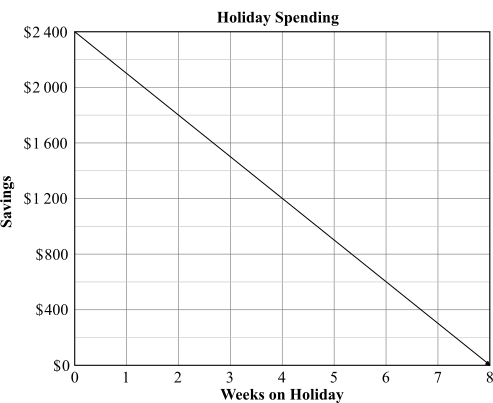
Bonn saved $2400 for his annual holiday.

He has drawn the graph below to represent his weekly holiday spending.

  1. What type of graph has been used to display the information?  (1 mark)

    --- 1 WORK AREA LINES (style=lined) ---

  2. Identify the two variables Bonn has used in this graph?  (1 mark)

    --- 1 WORK AREA LINES (style=lined) ---

  3. What is the amount per week that Bonn is expecting to spend on his holiday?  (1 mark)

    --- 2 WORK AREA LINES (style=lined) ---

  4. Bonn needs keep $600 for airfares to return home. With this in mind, what is the maximum number of weeks that Bonn can be on holidays?  (1 mark)

    --- 2 WORK AREA LINES (style=lined) ---

  5. Briefly describe what happens to the amount of savings as the number of weeks on holiday increases?  (1 mark)

    --- 2 WORK AREA LINES (style=lined) ---

Show Answers Only

a.    \(\text{Line graph}\)

b.    \(\text{Weeks on Holidays and Savings}\)

c.    \($300\)

d.    \(6\ \text{weeks}\)

e.    \(\text{As the number of weeks on holiday increases the amount of savings decreases.}\)

Show Worked Solution

a.    \(\text{Line graph}\)

b.    \(\text{Weeks on Holidays and Savings}\)

c.    \(\text{From the graph, the Savings spent per week}= $300\)

d.    \(\text{Maximum weeks on holidays}\)

\(=(2400-600)\ ÷\ 300\)

\(=6\ \text{weeks}\)

e.    \(\text{As the number of weeks on holiday increases the amount of savings decreases.}\)

Filed Under: Interpreting Data Tagged With: num-title-ct-core, smc-5076-12-Line Graphs, smc-5077-15-Reading graphs

Interpreting Data, SM-Bank 003

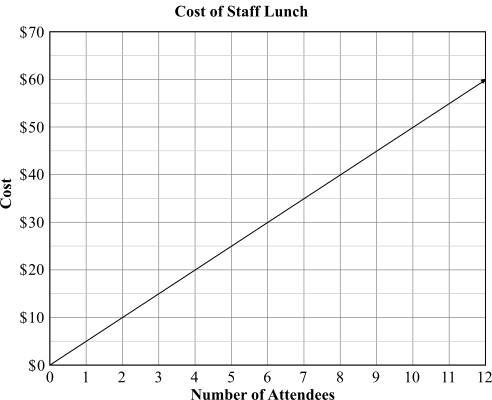
Margaret is preparing a report for her supervisor regarding costs for the recent staff development day.

Below is the graph Margaret prepared summarising the cost of the staff lunch for the day.

  1. What type of graph has been used to display the information?  (1 mark)

    --- 1 WORK AREA LINES (style=lined) ---

  2. Identify the two variables Margaret has used in this graph?  (1 mark)

    --- 1 WORK AREA LINES (style=lined) ---

  3. What is the cost of lunch per attendee?  (1 mark)

    --- 2 WORK AREA LINES (style=lined) ---

  4. If the total cost for the staff lunch was $85, how many attendees were there?  (1 mark)

    --- 2 WORK AREA LINES (style=lined) ---

  5. Briefly describe what happens to the total cost of the staff lunch as the number of attendees increases?  (1 mark)

    --- 2 WORK AREA LINES (style=lined) ---

Show Answers Only

a.    \(\text{Line graph}\)

b.    \(\text{Number of Attendees and Cost}\)

c.    \($5\)

d.    \(17\)

e.    \(\text{As the number of attendees increases the cost increases.}\)

Show Worked Solution

a.    \(\text{Line graph}\)

b.    \(\text{Number of Attendees and Cost}\)

c.    \(\text{From the graph, the cost per attendee}= $5\)

d.    \(\text{Number of Attendees}\)

\(=$85\ ÷\ 5\)

\(=17\)

e.    \(\text{As the number of attendees increases the cost increases.}\)

Filed Under: Interpreting Data Tagged With: num-title-ct-core, smc-5076-12-Line Graphs, smc-5077-15-Reading graphs

Displaying Data, SM-Bank 043

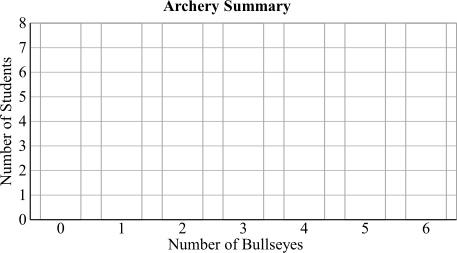
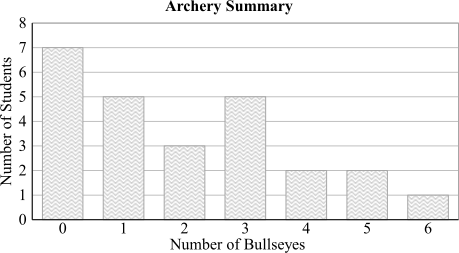
While working at the Year 7 camp, Gene counted how many bullseyes the archery group achieved during the afternoon activity.

He summarised the data in the table below.
  

\begin{array} {|l|c|c|c|c||}
\hline
\rule{0pt}{2.5ex} \textbf{Number of Bullseyes} \rule[-1ex]{0pt}{0pt} & \  0\   &  \  1\   & \  2\   & \  3\   & \  4\   & \  5\   & \  6  \\
\hline
\rule{0pt}{2.5ex} \textbf{Number of Students} \rule[-1ex]{0pt}{0pt} &7 &5&3&5&2&2&1 \\
\hline
\end{array}

  1. How many students were in the afternoon session of archery?  (1 mark)

    --- 3 WORK AREA LINES (style=lined) ---

  2. How many students scored zero bullseyes?  (1 mark)

    --- 1 WORK AREA LINES (style=lined) ---

  3. Assuming all shots were bullseye attempts, how many shots at the bullseye were made?  (1 mark)

    --- 2 WORK AREA LINES (style=lined) ---

  4. Display this data in a vertical column graph using the grid below.  (2 marks)
     

    --- 0 WORK AREA LINES (style=lined) ---

Show Answers Only

a.    \(25\)

b.    \(7\)

c.    \(57\)

d.   

Show Worked Solution

a.    \(\text{Number of students} = 25\)

b.    \(\text{Zero bullseyes} = 7\)

c.   
\(\text{Total shots at bullseye}\) \(=7+5\times 1+3\times 2+5\times 3+2\times 4+2\times 5+1\times 6\)
    \(=57\)

\(\text{NOTE:  The question asks for total shots NOT total value of shots,}\)

\(\text{therefore, the 7 who score 0 bullseyes must be added in.}\)

d.

Filed Under: Displaying Data Tagged With: num-title-ct-core, smc-5076-10-Column graphs and histograms

Displaying Data, SM-Bank 042

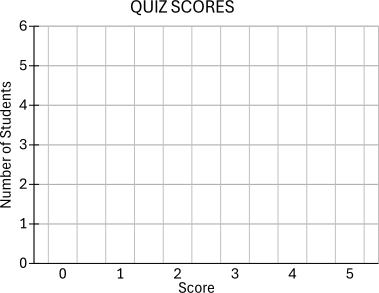
The marks below were recorded by Ms Smith for her students in a recent statistics quiz. The highest possible score was 5.
 

\(3,\ 1,\ 5,\ 2,\ 1,\ 3,\ 4,\ 1,\ 4,\ 2,\ 4,\ 5,\ 3,\ 4,\ 2,\ 4,\ 3,\ 0,\ 5,\ 1,\ 4\)
 

  1. Summarise the data using the table below.  (1 mark)
    \begin{array} {|l|c|c|c|c||}
    \hline
    \rule{0pt}{2.5ex} \textbf{Score} \rule[-1ex]{0pt}{0pt} & \  0\   &  \  1\   & \  2\   & \  3\   & \  4\   & \  5\   \\
    \hline
    \rule{0pt}{2.5ex} \textbf{Number of Students} \rule[-1ex]{0pt}{0pt} & &&&&& \\
    \hline
    \end{array}

    --- 0 WORK AREA LINES (style=lined) ---

  2. Represent this data as a column graph using the grid below.  (2 marks)


    --- 0 WORK AREA LINES (style=lined) ---

  3. How many students sat for the quiz?  (1 mark)

    --- 1 WORK AREA LINES (style=lined) ---

  4. If the pass mark was 60%, how many students passed the quiz?  ( 1 mark)

    --- 1 WORK AREA LINES (style=lined) ---

  5. What was the average score achieved in the quiz? Give your answer correct to one decimal place.  (1 mark)

    --- 3 WORK AREA LINES (style=lined) ---

Show Answers Only

a.

\begin{array} {|l|c|c|c|c||}
\hline
\rule{0pt}{2.5ex} \textbf{Score} \rule[-1ex]{0pt}{0pt} & 0&1&2&3&4&5 \\
\hline
\rule{0pt}{2.5ex} \textbf{Number of Students} \rule[-1ex]{0pt}{0pt} & 1&4&3&4&6&3 \\
\hline
\end{array}

b.   

c.    \(21\)

d.    \(13\)

e.    \(2.9\)

Show Worked Solution

a.

\begin{array} {|l|c|c|c|c||}
\hline
\rule{0pt}{2.5ex} \textbf{Score} \rule[-1ex]{0pt}{0pt} & 0&1&2&3&4&5 \\
\hline
\rule{0pt}{2.5ex} \textbf{Number of Students} \rule[-1ex]{0pt}{0pt} & 1&4&3&4&6&3 \\
\hline
\end{array}

b.   


c.    \(21\)


d.    \(60\%\ \text{pass mark}\) \(=5\times \dfrac{60}{100}\)
    \(=3\)

 
\(\therefore\ 4+6+3 = 13\ \text{students passed the quiz}\)


e.    \(\text{Average score}\) \(=\dfrac{1\times 0+4\times 1+3\times 2+4\times 3+6\times 4+3\times 5}{21}\)
    \(=\dfrac{61}{21}\)
    \(=2.904\dots\approx 2.9\ \text{(1 d.p.)}\)

Filed Under: Displaying Data Tagged With: num-title-ct-core, smc-5076-10-Column graphs and histograms

Displaying Data, SM-Bank 041

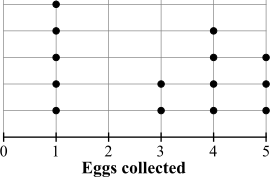
Stuart collected the eggs from his free range chickens and recorded the number of eggs he collected each day for two weeks.
 

\(3,\ 1,\ 5,\ 5,\ 1,\ 3,\ 4,\ 1,\ 4,\ 1,\ 4,\ 5,\ 1,\ 4\)
 

  1. Represent this data as a dot plot using the grid below.  (2 marks)
     

    --- 0 WORK AREA LINES (style=lined) ---

  2. How many eggs were collected altogether?  ( 1 mark)

    --- 1 WORK AREA LINES (style=lined) ---

  3. What is the average number of eggs Stuart collected?  (1 mark)

    --- 3 WORK AREA LINES (style=lined) ---

Show Answers Only

a.

b.    \(42\)  

c.    \(3\)

Show Worked Solution

a.


b.    \(\text{Total eggs}\) \(=5\times 1+2\times 3+4\times 4+3\times 5\)
    \(=42\)


c.    \(\text{Average number of eggs}\) \(=\dfrac{42}{14}\)
    \(=3\)

Filed Under: Displaying Data Tagged With: num-title-ct-core, smc-5076-18-Dot plots

Displaying Data, SM-Bank 040

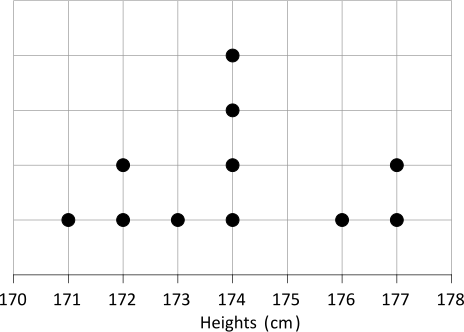
The heights, in centimetres, of David's hockey side are as follows:
 

\(172,\ 177,\ 171,\ 174,\ 174,\ 176,\ 173,\ 177,\ 174,\ 172,\ 174\)
 

  1. Represent this data as a dot plot using the grid below.  (2 marks)
     

    --- 0 WORK AREA LINES (style=lined) ---

  2. What is the average height of the players in David's hockey team?  (2 marks)

    --- 3 WORK AREA LINES (style=lined) ---

Show Answers Only

a.

b.    \(174\ \text{cm}\)

Show Worked Solution

a.


b.    \(\text{Average height}\) \(=\dfrac{171+2\times 172+173+4\times 174+176+2\times 177}{11}\)
    \(=\dfrac{1914}{11}\)
    \(=174\ \text{cm}\)

Filed Under: Displaying Data Tagged With: num-title-ct-core, smc-5076-18-Dot plots

Displaying Data, SM-Bank 039 MC

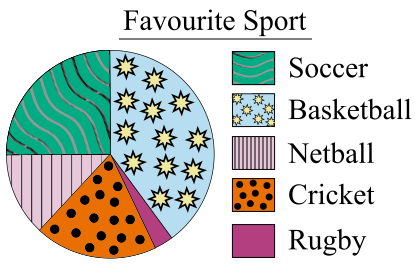
Joseph asked children in his class what their favourite sport was.

Their answers were used to draw the sector graph below.


Around a quarter of the students preferred which sport?

  1. Netball
  2. Soccer
  3. Cricket
  4. Basketball
Show Answers Only

\(B\)

Show Worked Solution

\(\text{Soccer represents one quarter of the graph.}\)

\(\Rightarrow B\)

Filed Under: Displaying Data Tagged With: num-title-ct-core, smc-5076-15-Sector graphs and Divided Bar graphs

Displaying Data, SM-Bank 038 MC

The results of a reading test are shown in the graph below.

If the test was out of 10, how many students scored 70% or more?

  1. 22
  2. 17
  3. 10
  4. 5
Show Answers Only

\(A\)

Show Worked Solution
\(70\%\ \text{of total}\) \(=70\%\times 10\)
  \(=7\)


\(\text{Number who scored 7, 8, 9 or 10}\) \(=5+7+6+4\)
  \(=22\)

\(\Rightarrow A\)

Filed Under: Displaying Data Tagged With: num-title-ct-core, smc-5076-10-Column graphs and histograms

Displaying Data, SM-Bank 037 MC

The results of a mathematics test are shown in the graph below.

If the test was out of 30, how many students scored less than 50%?

  1. 3
  2. 20
  3. 23
  4. 29
Show Answers Only

\(C\)

Show Worked Solution
\(50\%\ \text{of total}\) \(=50\%\times 30\)
  \(=15\)


\(\text{Number who scored less than 15}\) \(=6+8+9\)
  \(=23\)

\(\Rightarrow C\)

Filed Under: Displaying Data Tagged With: num-title-ct-core, smc-5076-10-Column graphs and histograms

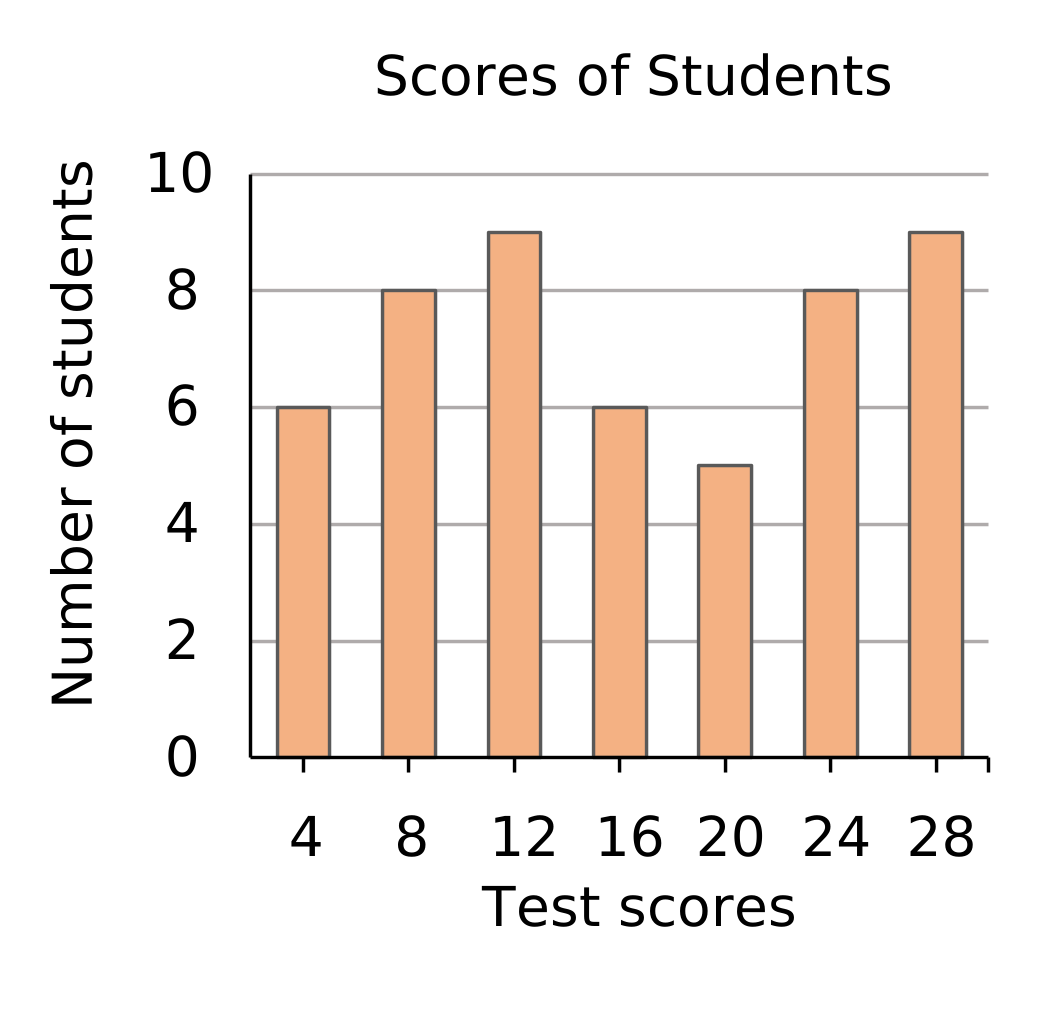
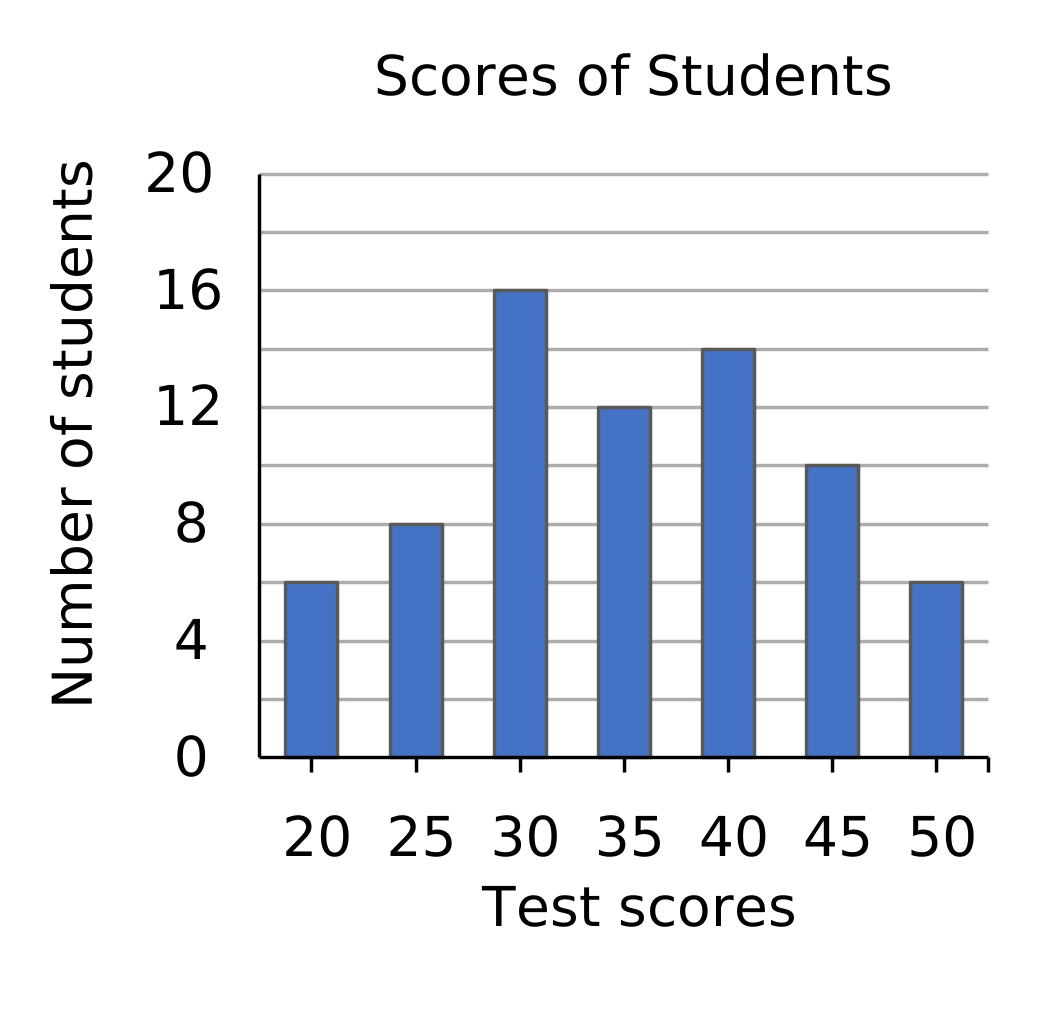
Displaying Data, SM-Bank 036 MC

The results of a spelling quiz are shown in the graph below.

How many students scored 35 or more?

  1. 4
  2. 14
  3. 30
  4. 42
Show Answers Only

\(D\)

Show Worked Solution
\(\text{Number of students who scored 35 or more}\) \(=12+14+10+6\)
  \(=42\)

 
\(\Rightarrow D\)

Filed Under: Displaying Data Tagged With: num-title-ct-core, smc-5076-10-Column graphs and histograms

Displaying Data, SM-Bank 035

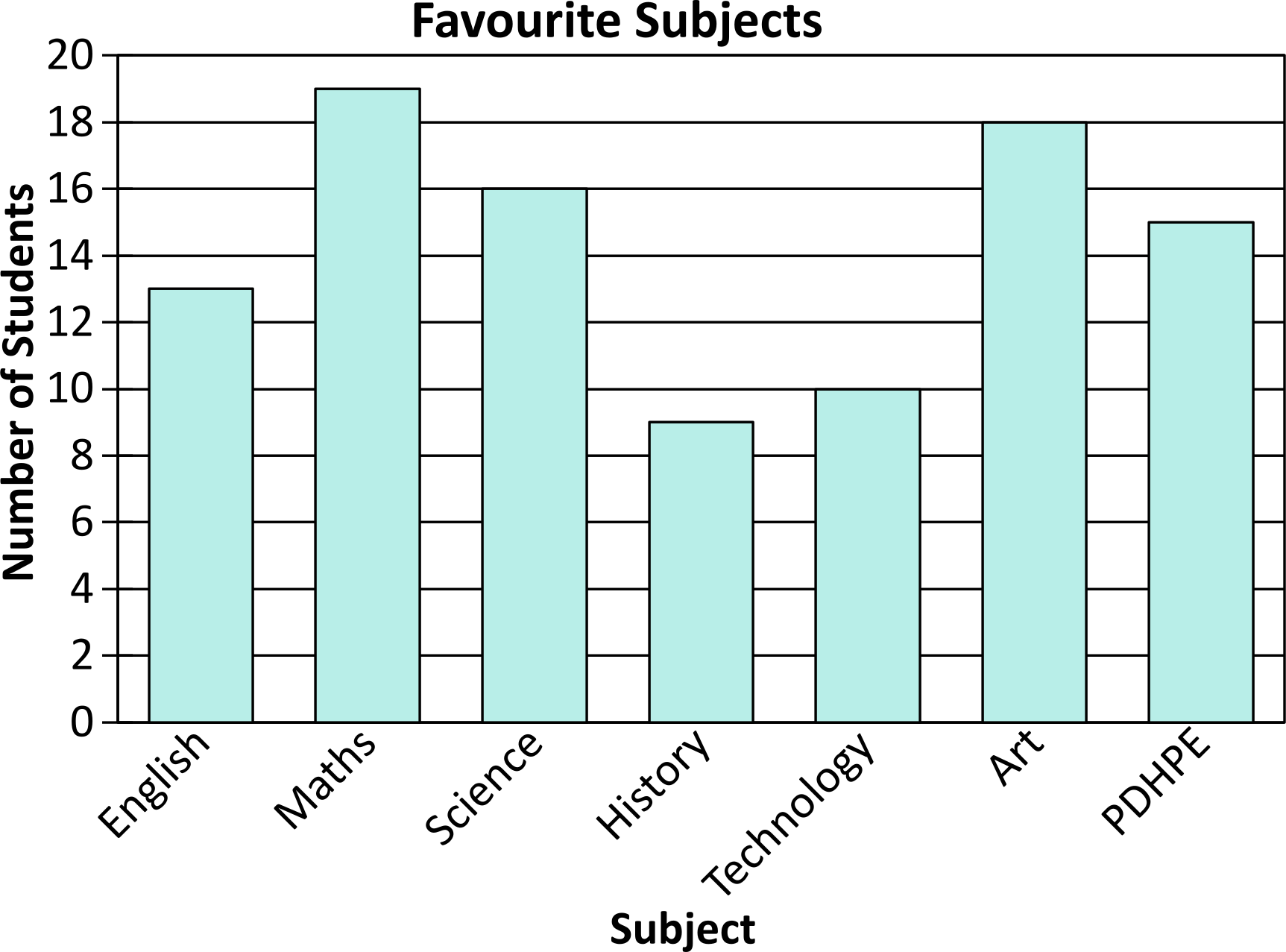
The graph below shows the favourite subjects of a group of 100 students.


  1. How many students in total chose either Technology or English as their favourite subject?  (1 mark)

    --- 2 WORK AREA LINES (style=lined) ---

  2. What percentage of students preferred either Science or PDHPE?  (2 marks)

    --- 3 WORK AREA LINES (style=lined) ---

  3. How many more students chose Maths as their favourite subject than History?  (1 mark)

    --- 2 WORK AREA LINES (style=lined) ---

Show Answers Only

a.    \(23\ \text{students}\)

b.    \(31\%\)

c.    \(10\ \text{students}\)

Show Worked Solution
a.     \(\text{Technology or English}\) \(=10+13\)
    \(=23\ \text{students}\)


b.     \(\text{Percentage Science or PDHPE}\) \(=\dfrac{16+15}{100}\times 100%\)
    \(=31\%\)


c.     \(\text{Difference}\) \(=19-9\)
    \(=10\ \text{students}\)

Filed Under: Displaying Data Tagged With: num-title-ct-core, smc-5076-10-Column graphs and histograms

Displaying Data, SM-Bank 034

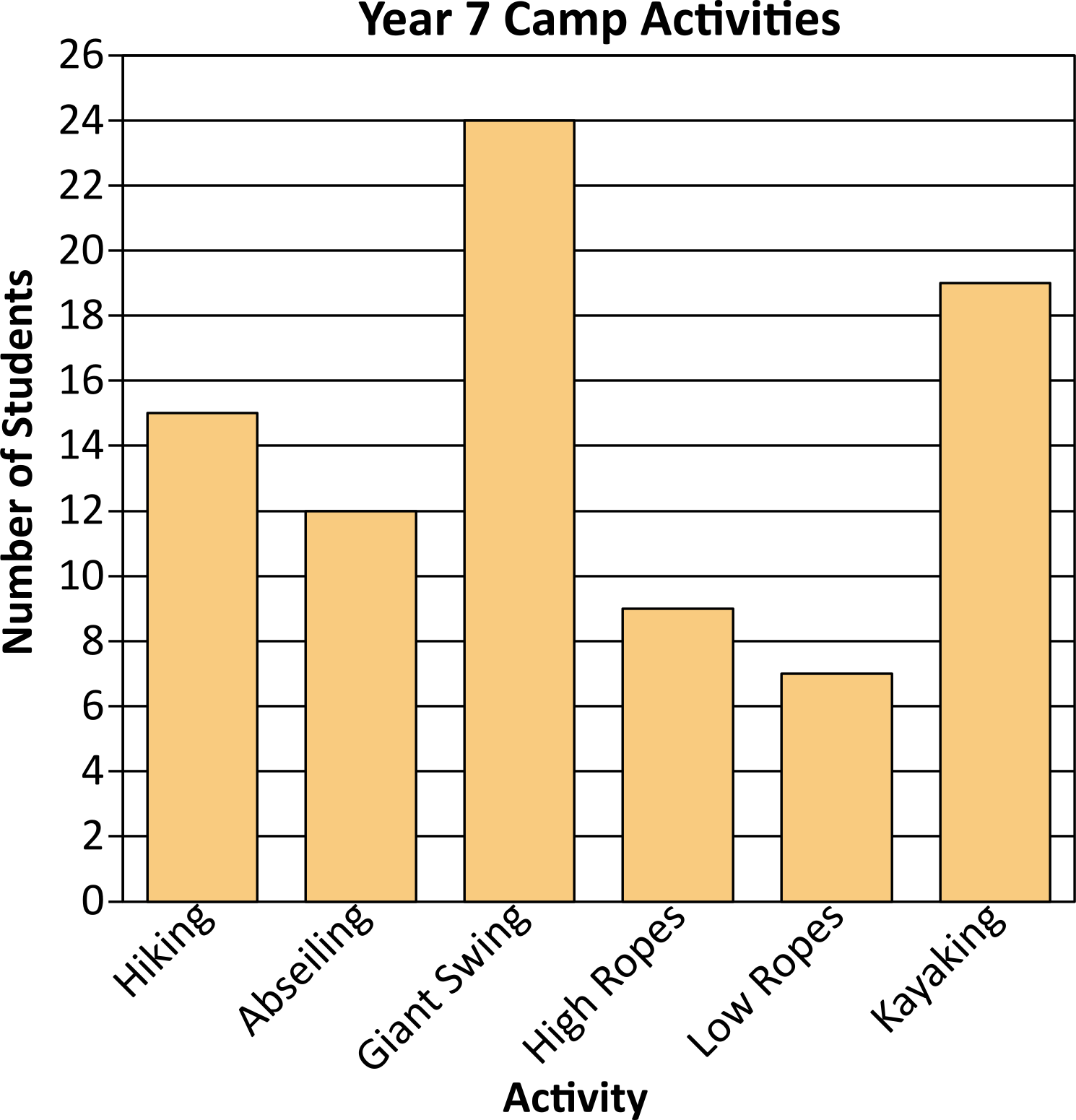
The graph below shows the outdoor activities chosen by students at the Year 7 camp.


  1. How many students in total chose either high ropes or abseiling?  (1 mark)

    --- 2 WORK AREA LINES (style=lined) ---

  2. What was the average number of students participating in each of the activities? Give your answer correct to the nearest whole number.  (2 marks)

    --- 3 WORK AREA LINES (style=lined) ---

  3. How many more students chose the Giant Swing than Hiking? (1 mark)

    --- 2 WORK AREA LINES (style=lined) ---

Show Answers Only

a.   \(21\ \text{students}\)

b.   \(14\ \text{students (nearest whole number)}\)

c.    \(9\ \text{students}\)

Show Worked Solution
a.     \(\text{High ropes and abseiling}\) \(=9+12\)
    \(=21\ \text{students}\)


b.     \(\text{Average students/activity}\) \(=\dfrac{15+12+24+9+7+19}{6}\)
    \(=\dfrac{86}{6}\)
    \(=14.333\dots\)
    \(=14\ \text{students (nearest whole number)}\)


c.     \(\text{Difference}\) \(=24-15\)
    \(=9\ \text{students}\)

Filed Under: Displaying Data Tagged With: num-title-ct-core, smc-5076-10-Column graphs and histograms

Displaying Data, SM-Bank 033

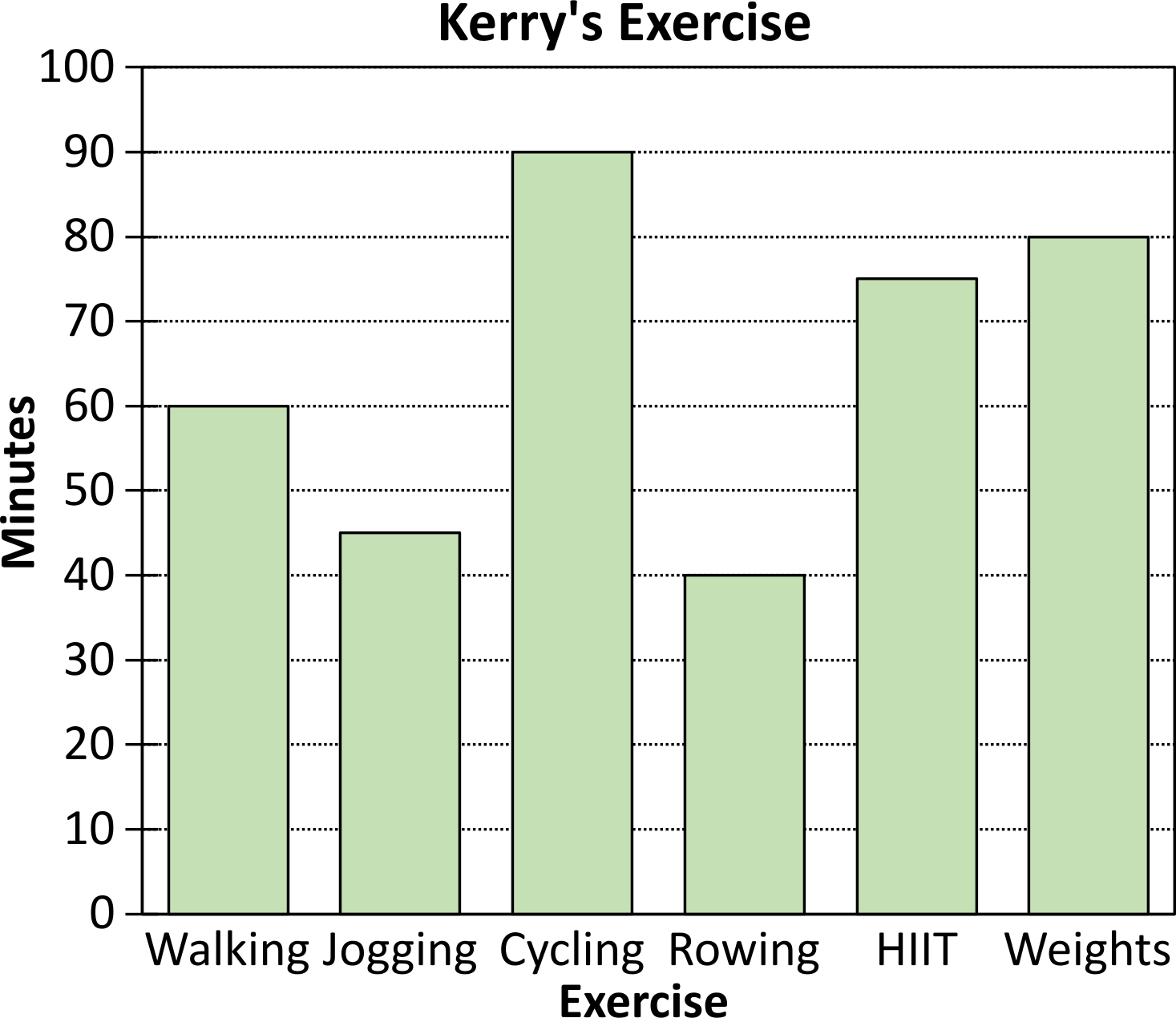
The graph below shows the times Kerry spent, in minutes, performing different exercises at the gym over the last fortnight.


  1. How many minutes in total did Kerry spend cycling and walking? (1 mark)

    --- 2 WORK AREA LINES (style=lined) ---

  2. What was the average time per day that Kerry spent exercising over the last fortnight? Give your answer correct to the nearest minute.  (2 marks)

    --- 3 WORK AREA LINES (style=lined) ---

  3. How many more minutes did Kerry spend doing HIIT than rowing?  (1 mark)

    --- 2 WORK AREA LINES (style=lined) ---

Show Answers Only

a.   \(\text{150 minutes}\)

b.   \(28\text{ minutes (nearest minute)}\)

c.    \(35\text{ minutes}\)

Show Worked Solution
a.     \(\text{Cycling and walking}\) \(=90+60\)
    \(=150\ \text{minutes}\)


b.     \(\text{Average exercise minutes/day}\) \(=\dfrac{60+45+90+40+75+80}{14}\)
    \(=\dfrac{390}{14}\)
    \(=27.857\dots\)
    \(=28\text{ minutes (nearest minute)}\)


c.     \(\text{Difference}\) \(=75-40\)
    \(=35\ \text{minutes}\)

Filed Under: Displaying Data Tagged With: num-title-ct-core, smc-5076-10-Column graphs and histograms

Displaying Data, SM-Bank 032

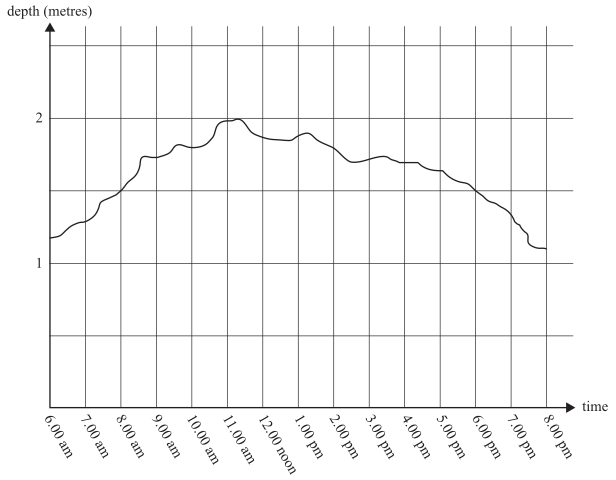
The graph below shows the depth of water in a sea bath from 6.00 am to 8.00 pm.


  1. What was the maximum depth, in metres, of water in the sea bath?  (1 mark)

    --- 1 WORK AREA LINES (style=lined) ---

  2. The sea bath was open to the public when the depth of water was above 1.5 m.


    Between which times was the sea bath open?  (1 mark)

    --- 1 WORK AREA LINES (style=lined) ---


Show Answers Only

a.   \(\text{2 metres}\)

b.   \(\text{8 am – 6 pm}\)

Show Worked Solution

a.   \(\text{2 metres}\)

b.   \(\text{8 am – 6 pm}\)

Filed Under: Displaying Data Tagged With: num-title-ct-core, smc-5076-12-Line Graphs

Displaying Data, SM-Bank 031

  1. Draw an ordered stem-and-leaf plot for the following set of scores.
     
    \(51\ \ \ \ \ 56\ \ \ \ \ 58\ \ \ \ \ 36\ \ \ \ \ 28\ \ \ \ \ 45\ \ \ \ \ 53\ \ \ \ \ 69\ \ \ \ \ 47\ \ \ \ \ 52\)     (2 marks)

    --- 6 WORK AREA LINES (style=blank) ---

  2. What is the median of the set of scores?   (1 mark)

    --- 2 WORK AREA LINES (style=lined) ---

  3. Comment on the skewness of the set of scores.   (1 mark)

    --- 2 WORK AREA LINES (style=lined) ---

Show Answers Only
a.    \begin{array} {r|lll} \textbf{Stem} & \textbf{Leaf} \\ \hline 2 & 8 \\ 3 & 6 \ \\ 4 & 5\ 7\\ 5 & 1\ 2\ 3\ 6 \ 8 \\ 6 & 9 \\ \end{array}

b.    \(51.5\)

c.    \(\text{The data has a tail that stretches to the left}\)

\(\therefore\ \text{Data is negatively skewed.}\)

Show Worked Solution
a.    \begin{array} {r|lll} \textbf{Stem} & \textbf{Leaf} \\ \hline 2 & 8 \\ 3 & 6 \ \\ 4 & 5\ 7\\ 5 & 1\ 2\ 3\ 6 \ 8 \\ 6 & 9 \\ \end{array}


b.    \(\text{10 scores}\)

\(\therefore\ \text{Median}\) \(=\dfrac{\text{(5th + 6th)}}{2}\)
  \(=\dfrac{51 + 52}{2}\)
  \(=51.5\)


c.    \(\text{The data has a tail that stretches to the left}\)

\(\therefore\ \text{Data is negatively skewed.}\)

Filed Under: Displaying Data Tagged With: num-title-ct-core, smc-5076-20-Stem and Leaf

Data Analysis, SM-Bank 055

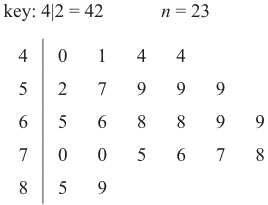
The stem plot below shows the distribution of mathematics test scores for a class of 23 students.


For this class:

  1. What was the range of test scores?  (1 mark)

    --- 1 WORK AREA LINES (style=lined) ---

  2. What was the mean test score, correct to 1 decimal place?  (2 marks)

    --- 3 WORK AREA LINES (style=lined) ---

  3. What was the median test mark?  (1 mark)

    --- 2 WORK AREA LINES (style=lined) ---

  4. What was the mode of the test scores?  (1 mark)

    --- 1 WORK AREA LINES (style=lined) ---

  5. A student sits the test late and scores a mark of 58. Describe the change, if any, in the range, the mean, the median and the mode.  (2 marks)

    --- 3 WORK AREA LINES (style=lined) ---

Show Answers Only

a.    \(49\)

b.    \(64.3\ \text{(1 d.p.)}\)

c.    \(68\)

d.    \(\text{Range → unchanged}\)

\(\text{Mean → reduced}\)

\(\text{Median → reduced}\)

\(\text{Mode → unchanged}\)

Show Worked Solution
a.    \(\text{Range}\) \(=89-40\)
    \(=49\)


b.   \(\text{Mean}\) \(=\dfrac{40+41+2\times 44+52+57+3\times 59+65+66+2\times 68+2\times 69+2\times 70+75+76+77+78+85+89}{23}\)
    \(=\dfrac{1480}{23}\)
    \(=64.347\dots\)
    \(\approx 64.3\ \text{(1 d.p.)}\)


c.    \(\text{Median}\) \(=\dfrac{23+1}{2}\ \text{score}\)
    \(=\text{12th score}\)
    \(=68\)

 
d.    \(\text{Range}\ \longrightarrow\ \text{stays the same}\)
 

\(\text{Mean}\) \(=\dfrac{1480+58}{24}\)
  \(=64.1\ \text{(1 d.p.)}\)
  \(\therefore\ \text{Mean is reduced}\)


\(\text{Median}\) \(=\dfrac{\text{12th score+13th score}}{2}\)
  \(=\dfrac{66+68}{2}\)
  \(=67\)
  \(\therefore\ \text{Median is reduced}\)


\(\text{Mode}\ \longrightarrow\ \text{stays the same}\)


Filed Under: Data Analysis Tagged With: num-title-ct-core, smc-4224-40-Stem and Leaf, smc-4224-45-Mean/median/mode/range, smc-4224-50-Add/remove data

Data Analysis, SM-Bank 054

The following ordered stem plot shows the areas, in square kilometres, of 27 suburbs of a large city.

\begin{array} {r|lll}
\textbf{Stem} & \textbf{Leaf} \\
\hline 1 & 5\ 6\ 7\ 8  \\
2 & 1\ 2\ 4\ 5 \ 6\ 8\ 9\ 9 \\
3 & 0\ 1\ 1\ 2\ 2\ 8\ 9 \\
4 & 0\ 4\ 7 \\
5 & 0\ 1 \\
6 & 1\ 9 \\
7 &  \\
8 & 4 \\
\end{array}
\(\text{key:  }1|6=1.6\ \text{km}^2\)
  1. For these suburbs
    i.     What is the median, in square kilometres?  (1 mark)

    --- 1 WORK AREA LINES (style=lined) ---

    ii.    What is the range, in square kilometres?  (1 mark)

    --- 1 WORK AREA LINES (style=lined) ---

  2. What is the possible outlier?  (1 mark)

    --- 1 WORK AREA LINES (style=lined) ---

  3. Briefly describe the skewness of the data.  (1 mark)

    --- 1 WORK AREA LINES (style=lined) ---

Show Answers Only

a.    i.    \(3.1\ \text{km}^2\)

ii.   \(6.9\)

b.    \(8.4\ \text{km}^2\)

c.    \(\text{Positively skewed.}\)

Show Worked Solution
a.    i.     \(\text{Median}\) \(=\dfrac{27+1}{2}\)
      \(=\ \text{14 th score}\)
    \(\therefore\ \text{Median}\) \(=3.1\ \text{km}^2\)
       
  ii. \(\text{Range}\) \(=8.4-1.5\)
      \(=6.9\)

 
b.    \(8.4\ \text{km}^2\ \text{is a possible outlier}\)

c.    \(\text{The data is positively skewed as the tail is to the right.}\)

Filed Under: Data Analysis Tagged With: num-title-ct-core, smc-4224-35-Describing datasets, smc-4224-40-Stem and Leaf, smc-4224-45-Mean/median/mode/range

Data Analysis, SM-Bank 053

The following ordered stem plot shows the percentage of homes connected to broadband internet for 24 countries in 2007.
 

   CORE, FUR1 2013 VCAA 1-2 MC 
 

  1. How many of these countries had more than 22% of homes connected to broadband internet in 2007?  (1 mark)

    --- 1 WORK AREA LINES (style=lined) ---

  2. What was the median percentage of homes connected to broadband?  (1 mark)

    --- 1 WORK AREA LINES (style=lined) ---

  3. For these countries, what is the modal percentage of homes connected to broadband?  (1 mark)

    --- 5 WORK AREA LINES (style=lined) ---

Show Answers Only

a.    \(19\)

b.    \(29.5\)

c.    \(31\)

Show Worked Solution

a.    \(\text{There are 19 values greater than 22%}\)


b.     \(\text{Median}\) \(=\dfrac{\text{12th + 13th}}{2}\)
    \(=\dfrac{29+30}{2}\)
    \(=29.5\)

 
c.    \(\text{Mode} = 31\)

Filed Under: Data Analysis Tagged With: num-title-ct-core, smc-4224-15-Mode, smc-4224-20-Median, smc-4224-40-Stem and Leaf

Data Analysis, SM-Bank 052 MC

The stem plot below displays the average number of decayed teeth in 12-year-old children from `31` countries.

\begin{array} {r|lll}
\textbf{Stem} & \textbf{Leaf} \\
\hline 0 & 2 \\
0 & 5\ 6\ 7\ 7 \ 8\ 9\  \\
1 & 0\ 0\ 0\ 0\ 1\ 4\ 4\ 4\\
1 & 5\ 6\ 7 \\
2 & 3\ 3\ 4 \\
2 & 7\ 7\ 8\ 8 \\
3 & 0\ 4 \\
3 & 5\ 6 \\
4 & 1 \\
4 & 7 \\
\end{array}
\(\text{key:  }0|2=0.2\)

Based on this stem plot, the distribution of the average number of decayed teeth for these countries is best described as

  1. positively skewed with a median of 15 decayed teeth and a range of 45
  2. approximately symmetric with a median of 1.5 decayed teeth and a range of 4.5
  3. negatively skewed with a median of 1.5 decayed teeth and a range of 4.5
  4. positively skewed with a median of 1.5 decayed teeth and a range of 4.5
Show Answers Only

\(D\)

Show Worked Solution

\(\text{Median = 16th value} = 1.5\)

\(\text{Range} = 4.7-0.2=4.5\)

\(\text{The clear tail to the upper end of values shows that the}\)

\(\text{data is positively skewed.}\)

\(\Rightarrow D\)

Filed Under: Data Analysis Tagged With: num-title-ct-core, smc-4224-35-Describing datasets, smc-4224-40-Stem and Leaf

Displaying Data, SM-Bank 030

A random sample of people were asked what is their favourite winter sport.

The table below recorded the results.

\begin{array} {|l|c|}
\hline
\rule{0pt}{2.5ex} \textbf{Sport} \rule[-1ex]{0pt}{0pt} & \textbf{Number of People} \\
\hline
\rule{0pt}{2.5ex} \text{Netball} \rule[-1ex]{0pt}{0pt} & \text{25} \\
\hline
\rule{0pt}{2.5ex} \text{Aussie Rules} \rule[-1ex]{0pt}{0pt} & \text{35} \\
\hline
\rule{0pt}{2.5ex} \text{Rugby League} \rule[-1ex]{0pt}{0pt} & \text{30} \\
\hline
\rule{0pt}{2.5ex} \text{Ice Hockey} \rule[-1ex]{0pt}{0pt} & \text{10} \\
\hline
\end{array}

  1. Use the information in the table to construct a divided bar graph on the template below. Remember to include a title and labels.  (2 marks)


  2. Using the data from the survey, predict how many people would choose Aussie Rules if 2000 people were surveyed. (2 marks)

    --- 2 WORK AREA LINES (style=lined) ---

Show Answers Only

a. 

b.    \(700\)

Show Worked Solution
 

a.    \(\text{Total Number Sampled}\) \(=25+35+30+10\)
    \(=100\)

 
\(\text{Division on the template}=\dfrac{100}{20}=5\ \text{people}\)

b.    \(\text{Aussie rules}\) \(=\dfrac{35}{100}\times 2000\)
    \(=700\)

 
\(\therefore\ \text{700 people would be predicted to choose Aussie Rules}\)

Filed Under: Displaying Data Tagged With: num-title-ct-core, smc-5076-15-Sector graphs and Divided Bar graphs

Interpreting Data, SM-Bank 002

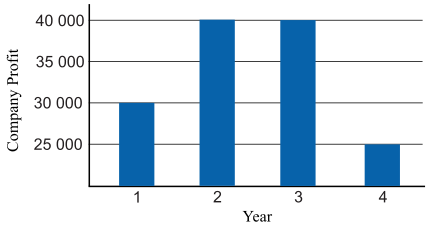
This graph shows a company's profits over a 4 year period.
 

  1. What were the company's total profits during this period?  (1 mark)

    --- 2 WORK AREA LINES (style=lined) ---

  2. What was the average yearly profit?  (1 mark)

    --- 2 WORK AREA LINES (style=lined) ---

  3. What percentage of total profit was made in the first year? Give your answer to 1 decimal place.  (2 mark)

    --- 3 WORK AREA LINES (style=lined) ---

  4. Explain how this graph could be misleading.  (2 marks)

    --- 4 WORK AREA LINES (style=lined) ---

Show Answers Only

a.    \($135\ 000\)

b.    \($33\ 750\)

c.    \(22.2\%\)

d.    \(\text{See worked solution}\)

Show Worked Solution
a.    \(\text{Total Profit}\) \(=30\ 000+2\times 40\ 000+25\ 000\)
    \(=$135\ 000\)


b.    \(\text{Average Profit}\) \(=\dfrac{$135\ 000}{4}\)
    \(=$33\ 750\)


c.    \(\text{Percentage Profit}\) \(=\dfrac{30\ 000}{135\ 000}\times 100\%\)
    \(=22.222\dots\%\)
    \(\approx 22.2\%\ \text{(1 d.p.)}\)

 
d.   
\(\text{The vertical axis does not start at zero and could}\)

\(\text{give the impression that the years 2 and 3 profits are}\)

\(\text{twice as large as year 1, and 4 times as large as year 4.}\)

Filed Under: Interpreting Data Tagged With: num-title-ct-core, smc-5077-10-Misleading graphs

Interpreting Data, SM-Bank 001

Luke picked bananas during his university holidays last summer. He counted the total number of bananas he picked everyday and created the graph shown below.


  1. For how many days in total did Luke pick bananas?  (1 mark)

    --- 2 WORK AREA LINES (style=lined) ---

  2. On how many days did he pick less than 145 bananas?  (1 mark)

    --- 2 WORK AREA LINES (style=lined) ---

  3. Explain how this graph could be misleading.  (2 marks)

    --- 3 WORK AREA LINES (style=lined) ---

Show Answers Only

a.    \(30\ \text{days}\)

b.    \(17\ \text{days}\)

c.    \(\text{See worked solution}\)

Show Worked Solution
a.    \(\text{Days}\) \(=4+5+6+7+8\)
    \(=30\ \text{days}\)


b.    \(\text{Less than 145 bananas}\) \(=4+5+8\)
    \(=17\ \text{days}\)


c.    \(\text{The vertical axis starts at 135 and could give}\)

\(\text{the impress that the number of bananas picked}\)

\(\text{on 6 of the days was more than twice the number}\)

\(\text{picked on 4.}\)

\(\text{The actual difference being only}\)

\(= 152-139=15\ \text{bananas}\)

Filed Under: Interpreting Data Tagged With: num-title-ct-core, smc-5077-10-Misleading graphs

Displaying Data, SM-Bank 029

The graph shows the origin and type of all vehicles in a city.
 

  1.  Complete the table below using the graph.  (2 marks)
    \begin{array} {|l|c|c|c|}
    \hline
    \rule{0pt}{2.5ex} \ \rule[-1ex]{0pt}{0pt} &\ \ \ \ \ \ \  \textbf{Sedans}\ \ \ \ \ \ \  \rule[-1ex]{0pt}{0pt} & \textbf{Utility vehicles}\rule[-1ex]{0pt}{0pt} & \textbf{Trucks and vans}\\
    \hline
    \rule{0pt}{2.5ex} \textbf{Australian vehicles} \rule[-1ex]{0pt}{0pt} & \\
    \hline
    \rule{0pt}{2.5ex} \textbf{European vehicles} \rule[-1ex]{0pt}{0pt} &  \\
    \hline
    \rule{0pt}{2.5ex} \textbf{Asian vehicles} \rule[-1ex]{0pt}{0pt} &\\
    \hline
    \end{array}
  2. What was the total number of Asian vehicles in the city?  (1 mark)

    --- 2 WORK AREA LINES (style=lined) ---

  3. What was the total number of Trucks and vans in the city?  (1 mark)

    --- 2 WORK AREA LINES (style=lined) ---

  4. What percentage of all vehicles in the city were Australian vehicles? Give your answer correct to 1 decimal place.  (2 marks)

    --- 3 WORK AREA LINES (style=lined) ---

Show Answers Only

a.

\begin{array} {|l|c|c|c|}
\hline
\rule{0pt}{2.5ex} \ \rule[-1ex]{0pt}{0pt} &\ \ \ \ \ \ \  \textbf{Sedans}\ \ \ \ \ \ \  \rule[-1ex]{0pt}{0pt} & \textbf{Utility vehicles}\rule[-1ex]{0pt}{0pt} & \textbf{Trucks and vans}\\
\hline
\rule{0pt}{2.5ex} \textbf{Australian vehicles} \rule[-1ex]{0pt}{0pt} & 2000 & 1000 & 5000\\
\hline
\rule{0pt}{2.5ex} \textbf{European vehicles} \rule[-1ex]{0pt}{0pt} & 4000 & 3000 & 3000 \\
\hline
\rule{0pt}{2.5ex} \textbf{Asian vehicles} \rule[-1ex]{0pt}{0pt} & 5000 & 7000 & 7000\\
\hline
\end{array}

b.    \(19\ 000\)

c.    \(15\ 000\)

d.    \(21.6\%\)

Show Worked Solution

a.

\begin{array} {|l|c|c|c|}
\hline
\rule{0pt}{2.5ex} \ \rule[-1ex]{0pt}{0pt} &\ \ \ \ \ \ \  \textbf{Sedans}\ \ \ \ \ \ \  \rule[-1ex]{0pt}{0pt} & \textbf{Utility vehicles}\rule[-1ex]{0pt}{0pt} & \textbf{Trucks and vans}\\
\hline
\rule{0pt}{2.5ex} \textbf{Australian vehicles} \rule[-1ex]{0pt}{0pt} & 2000 & 1000 & 5000\\
\hline
\rule{0pt}{2.5ex} \textbf{European vehicles} \rule[-1ex]{0pt}{0pt} & 4000 & 3000 & 3000 \\
\hline
\rule{0pt}{2.5ex} \textbf{Asian vehicles} \rule[-1ex]{0pt}{0pt} & 5000 & 7000 & 7000\\
\hline
\end{array}

b.    \(\text{Total Asian vehicles}\)

\(=5000+7000+7000=19\ 000\)

c.    \(\text{Total Trucks and vans}\)

\(=5000+3000+7000=15\ 000\)

d.    \(\text{% Australian vehicles}\) \(=\Bigg(\dfrac{\text{Total Australian vehicles}}{\text{Total Sedans + Utilities + Trucks and vans}}\Bigg)\times 100\%\)
    \(=\Bigg(\dfrac{2000+1000+5000}{11\ 000+11\ 000+15\ 000}\Bigg)\times 100\%\)
    \(=\dfrac{8000}{37\ 000}\times 100\%\)
    \(=21.621\dots\%\)
    \(\approx 21.6\%\ \text{(1 d.p.)}\)

Filed Under: Displaying Data Tagged With: num-title-ct-core, smc-5076-10-Column graphs and histograms

Data Analysis, SM-Bank 051

Ms Granger measured and recorded the heights of all the students in her class, to the nearest centimetre.

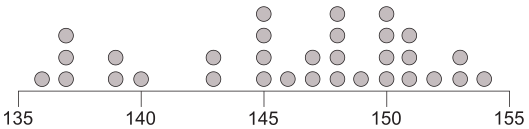
She made a dot plot to show the heights of these 32 children.


Student Heights (nearest cm)


  1. What fraction of the students' heights are greater than 145 centimetres and less than 150?  (2 marks)

    --- 2 WORK AREA LINES (style=lined) ---

  2. What is the range of the heights?  (1 mark)

    --- 1 WORK AREA LINES (style=lined) ---

  3. What is the median of the heights?  (1 mark)

    --- 2 WORK AREA LINES (style=lined) ---

  4. What would the median be if a new student arrived with a height of 135 cm?  (1 mark)

    --- 1 WORK AREA LINES (style=lined) ---

Show Answers Only

a.    \(\dfrac{1}{4}\)

b.    \(18\)

c.    \(147.5\ \text{cm}\)

d.    \(147\ \text{cm}\)

Show Worked Solution
a.    \(\text{Fraction}\) \(=\dfrac{\text{Students with height 145 – 150}}{\text{Total students}}\)
    \(=\dfrac{8}{32}\)
    \(=\dfrac{1}{4}\)

 
\(\text{(Note students with heights of 145 or 150 are not included)}\)
 

b.    \(\text{Range}=154-136=18\)
 

c.    \(\text{Median}\) \(=\dfrac{\text{16th score + 17th score}}{\text{2}}\)
    \(=\dfrac{147+148}{2}\)
    \(=147.5\ \text{cm}\)


d.    \(\text{Median }\) \(=\text{ 17th score}\)
    \(=147\ \text{cm}\)

Filed Under: Data Analysis Tagged With: num-title-ct-core, smc-4224-45-Mean/median/mode/range

Displaying Data, SM-Bank 028

Melinda and Cathy run the 100 metre sprint in their school athletics carnival.

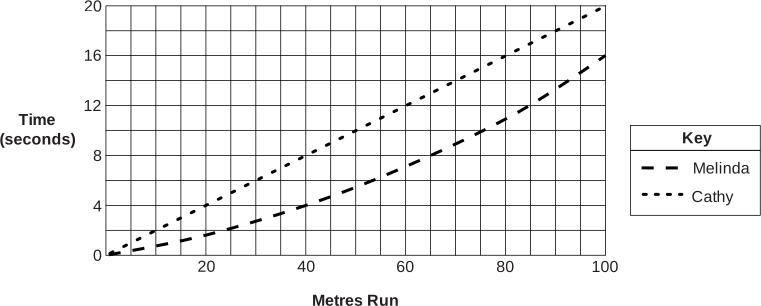
A device tracks their progress and the results are shown in separate line graphs below.


Melinda starts quickly and passes the 75 metre mark after 10 seconds, slowing down as the race progresses.

Cathy is slower but runs the whole race at the same speed.

Approximately how long after Melinda did Cathy pass the 75 metre mark in the race?  (2 marks)

--- 2 WORK AREA LINES (style=lined) ---

Show Answers Only

\(5\ \text{seconds}\)

Show Worked Solution

\(\text{Melinda passes 75 metre mark at 10 seconds.}\)

\(\text{Cathy passes at approximately 15 seconds.}\)

\(\therefore\ \text{Cathy passes approximately 5 seconds after Melinda.}\)

Filed Under: Displaying Data Tagged With: num-title-ct-core, smc-5076-12-Line Graphs

Displaying Data, SM-Bank 027

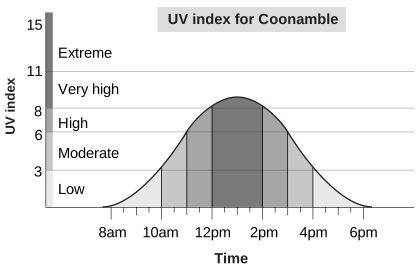
This graph shows the UV index for the town of Coonamble during one day.


Between which hours was the UV index always in the high range?  (1 mark)

--- 1 WORK AREA LINES (style=lined) ---

​

Show Answers Only

\(\text{11 am – 12 pm, 2 pm – 3 pm}\)

Show Worked Solution

\(\text{UV index is on high:}\)

\(\text{between 11 am – 12 pm and between 2 pm – 3 pm}\)

Filed Under: Displaying Data Tagged With: num-title-ct-core, smc-5076-12-Line Graphs

Displaying Data, SM-Bank 026

Tom collected data on the number of big game animals in an African wildlife park.

This graph shows how many big game animals lived in the park.


There were 16 more elephants than rhinos in the wildlife park.

  1. What fraction of the animals were elephants?  (1 mark)

    --- 1 WORK AREA LINES (style=lined) ---

  2. What fraction of the animals were rhinos?  (1 mark)

    --- 1 WORK AREA LINES (style=lined) ---

  3. How many big game animals were in the park in total?  (2 marks)

    --- 3 WORK AREA LINES (style=lined) ---

Show Answers Only

a.    \(\dfrac{7}{20}\)

b.    \(\dfrac{3}{20}\)

c.    \(80\)

Show Worked Solution

a.    \(\text{There are 20 divisions on the sector graph}\)

\(\text{Elephants}=\dfrac{7}{20}\)

b.    \(\text{Rhinos}=\dfrac{3}{20}\)

c.    \(\text{Let}\ \ n =\ \text{total big games animals in the park}\)

\(\text{Elephants – Rhinos}\) \(=16\)
\(\dfrac{7}{20} n-\dfrac{3}{20}n\) \(=16\)
\(\dfrac{4}{20}n\) \(=16\)
\(n\) \(=\dfrac{16\times 20}{4}\)
  \(= 80\)

 
\(\therefore\ \text{There are 80 big game animals in the park}\)

Filed Under: Displaying Data Tagged With: num-title-ct-core, smc-5076-15-Sector graphs and Divided Bar graphs

Displaying Data, SM-Bank 025

Bradley's class were asked to choose their favourite colour among four choices.

  • 5 voted for red which represented 90° on the sector graph
  • 2 voted for orange
  • 6 voted for blue
  • The rest voted for green


How many students in Bradley's class chose green?  (2 marks)

--- 3 WORK AREA LINES (style=lined) ---

Show Answers Only

`7`

Show Worked Solution

\(\text{Since red is 90° it is one-quarter of the sector graph}\)

\(\rightarrow\ \text{There are 20 students in Bradley’s class.}\)

\(\therefore\ \text{Votes for green}\)

\(=20-(5+2+6)\)

\(=7\)

Filed Under: Displaying Data Tagged With: num-title-ct-core, smc-5076-15-Sector graphs and Divided Bar graphs

Displaying Data, SM-Bank 024

Kat went on her annual holiday and spent her money on accommodation, meals and shopping.

She spent $1200 in total and the pie chart below shows how she spent it.


  1. How much money did Kat spend on shopping?  (2 marks)

    --- 3 WORK AREA LINES (style=lined) ---

  2. How much money did Kat spend on meals?  (2 marks)

    --- 4 WORK AREA LINES (style=lined) ---

Show Answers Only

a.    \($396\)

b.    \($264\)

Show Worked Solution

a.    \(\text{Money spent on shopping}\)

\(=33\%\times 1200\)

\(=$396\)

 
b.    \(\text{Money spent on meals}\)

\(=1200-(540+396)\)

\(=$264\)

Filed Under: Displaying Data Tagged With: num-title-ct-core, smc-5076-15-Sector graphs and Divided Bar graphs

Displaying Data, SM-Bank 023 MC

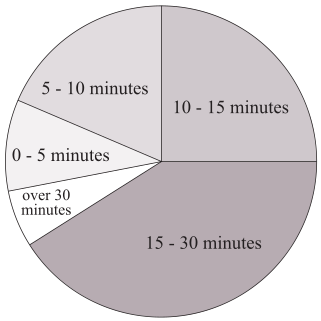
A survey was conducted that asked students how long it took them to travel to school. This graph show the results.


What percentage of students had a commute between \(15-30\) minutes?

  1. less that 25%
  2. between 25% and 50%
  3. between 50% and 75%
  4. more than 75%
Show Answers Only

\(B\)

Show Worked Solution

\(\text{Section (15 – 30 minutes) is more than one quarter}\)

\(\text{of the chart and less than half.}\)

\(\therefore\ \text{between 25% and 50%}\)
 

\(\Rightarrow B\)

Filed Under: Displaying Data Tagged With: num-title-ct-core, smc-5076-15-Sector graphs and Divided Bar graphs

Displaying Data, SM-Bank 022 MC

This diagram shows the proportion of milkshake flavours sold by a corner store over a 1 month period.


Which flavour makes up 55% of the milkshakes sold?

  1. vanilla
  2. strawberry
  3. caramel
  4. chocolate
Show Answers Only

\(D\)

Show Worked Solution

\(\text{Chocolate takes up slightly more than half the sector graph.}\)

\(\Rightarrow D\)

Filed Under: Displaying Data Tagged With: num-title-ct-core, smc-5076-15-Sector graphs and Divided Bar graphs

Displaying Data, SM-Bank 021 MC

Anne taught a kindergarten class and asked her students what their favorite fruit is.

Their answers were used to draw the pie chart below.


Around a quarter of her students preferred which fruit?

  1. Banana
  2. Apple
  3. Mango
  4. Grapes
Show Answers Only

\(B\)

Show Worked Solution

\(\text{A quarter of students will represent a sector that}\)

\(\text{is the size of a quarter of the circle }\rightarrow\ \text{Apple}\) 
 

\(\Rightarrow B\)

Filed Under: Displaying Data Tagged With: num-title-ct-core, smc-5076-15-Sector graphs and Divided Bar graphs

Displaying Data, SM-Bank 020 MC

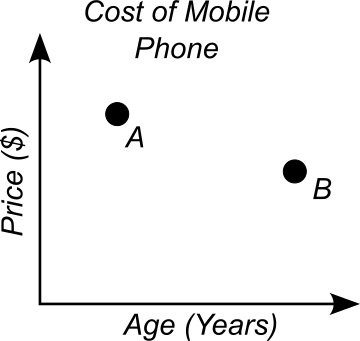
A store sells second hand mobile phones.

The graph below shows the price of 2 similar second-hand phones.


Which of the following is true based on the graph shown?

  1. Phone A is older and less expensive than Phone B
  2. Phone B is older and more expensive than phone A
  3. Phone A is newer and more expensive than Phone B
  4. Phone A is older and more expensive than Phone B

Show Answers Only

\(C\)

Show Worked Solution

\(\text{Phone A is left of Phone B }\rightarrow\ \text{ it is newer.}\)

\(\text{Phone A is higher than Phone B }\rightarrow\ \text{it is more expensive.}\)
 

\(\therefore\ \text{Phone A is newer and more expensive than Phone B.}\)
 

\(\Rightarrow C\)

Filed Under: Displaying Data Tagged With: num-title-ct-core, smc-5076-7-Other Graphs

Displaying Data, SM-Bank 019 MC

Christie measured the temperature every 3 hours from 6:00 am to 3:00 pm.
 

\begin{array} {|l|c|c|c|c|}
\hline
\rule{0pt}{2.5ex} \text{Time of the day} \rule[-1ex]{0pt}{0pt} & \text{6 a.m.} \rule[-1ex]{0pt}{0pt} & \text{9 a.m.} \rule[-1ex]{0pt}{0pt} & \text{12 p.m.} \rule[-1ex]{0pt}{0pt} & \text{3 p.m.} \\
\hline
\rule{0pt}{2.5ex} \text{Temperature (°C)} \rule[-1ex]{0pt}{0pt} & \text{22} \rule[-1ex]{0pt}{0pt} & \text{27} \rule[-1ex]{0pt}{0pt} & \text{32} \rule[-1ex]{0pt}{0pt} & \text{26} \\
\hline
\end{array}

 
Which graph shows Christie's results?
 

A.   B.
 
C.   D.
 
Show Answers Only

\(B\)

Show Worked Solution

\(\text{1st increase } = 27-22 = 5^{\circ}\)

\(\text{2nd increase } = 32-27 = 5^{\circ}\)
 

\(\longrightarrow\ \text{Temperature then drops 6° to 26°}\)
 

\(\Rightarrow B\)

Filed Under: Displaying Data Tagged With: num-title-ct-core, smc-5076-12-Line Graphs

  • « Previous Page
  • 1
  • 2
  • 3
  • 4
  • 5
  • …
  • 31
  • Next Page »

Copyright © 2014–2025 SmarterEd.com.au · Log in