SmarterEd

Aussie Maths & Science Teachers: Save your time with SmarterEd

  • Login
  • Get Help
  • About

Displaying Data, SM-Bank 018 MC

Natalie is the supervisor of the Maths club and keeps a record of the number of students in the club at the end of each week.


If no students have left the club, how many joined in Week 3?

  1. 5
  2. 7
  3. 9
  4. 21
Show Answers Only

\(A\)

Show Worked Solution

\(\text{Students in club:}\)

\(\text{At the end of week 2 = 16}\)

\(\text{At the end of week 3 = 21}\)

\(\therefore\ \text{Students who joined in week 3}\)

\(=21-16\)

\(=5\)

\(\Rightarrow A\)

Filed Under: Displaying Data Tagged With: num-title-ct-core, smc-5076-10-Column graphs and histograms

Displaying Data, SM-Bank 017 MC

Mathew is captain of the drama club and keeps a record of the number of students in the club at the end of each week.
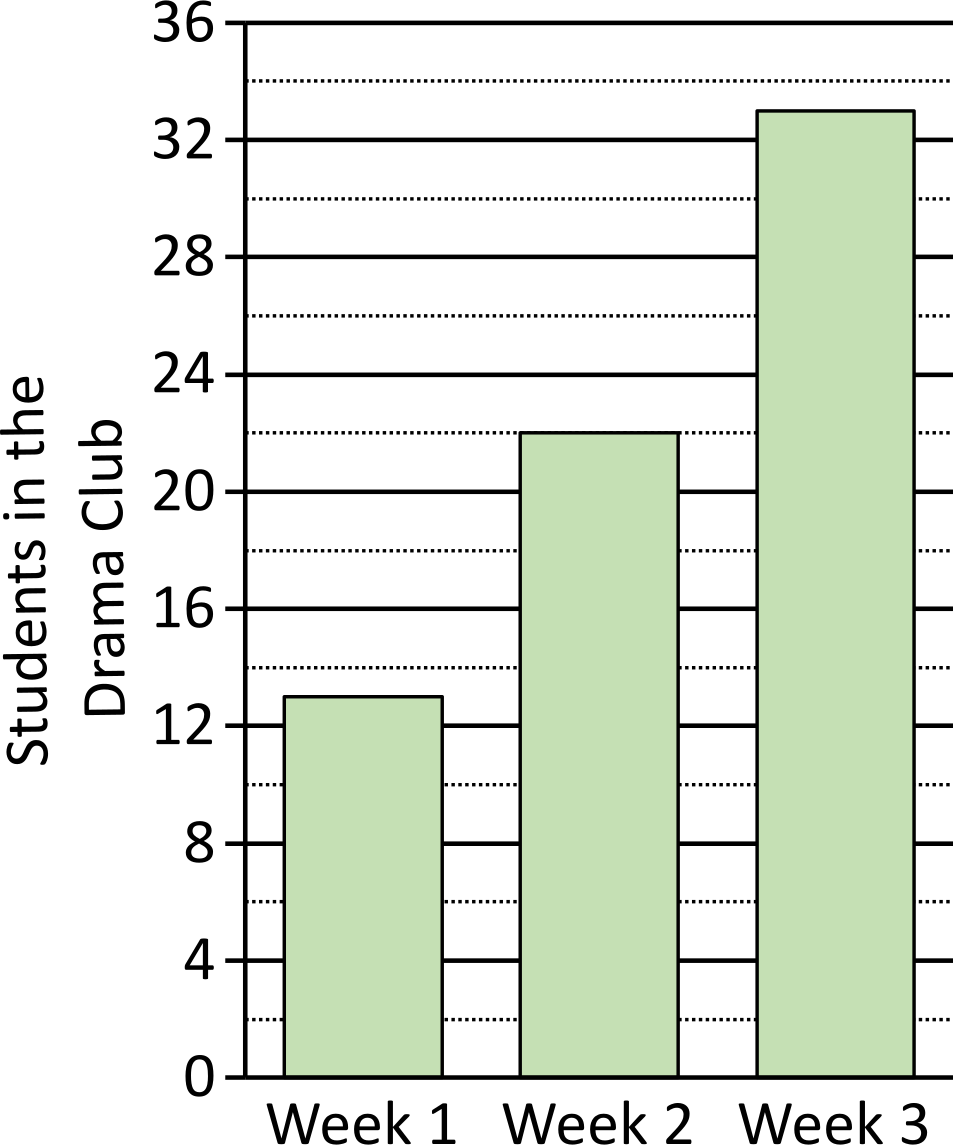


If no students have left the club, how many joined in Week 3?

  1. 3
  2. 8
  3. 11
  4. 33
Show Answers Only

\(C\)

Show Worked Solution

\(\text{Students in club:}\)

\(\text{At the end of week 2 = 22}\)

\(\text{At the end of week 3 = 33}\)

\(\therefore\ \text{Students who joined in week 3}\)

\(=33-22\)

\(=11\)

\(\Rightarrow C\)

Filed Under: Displaying Data Tagged With: num-title-ct-core, smc-5076-10-Column graphs and histograms

Displaying Data, SM-Bank 016

The goals scored by 4 players in a season of soccer were recorded in the graph below.
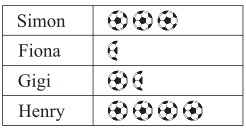
 

Simon scored 6 goals in the season.

Gigi scored 3 goals.

How many more goals did Henry score than Fiona?  (2 marks)

--- 2 WORK AREA LINES (style=lined) ---

Show Answers Only

\(7\ \text{goals}\)

Show Worked Solution

\(\text{Since Simon scored 6 goals}\)

\(\longrightarrow\ \text{1 soccer ball = 2 goals}\)

\(\longrightarrow\ \text{Henry scored 8 goals.}\)

\(\longrightarrow\ \text{Fiona scored 1 goals.}\)
 

\(\therefore\ \text{Extra goals}\) \(=8-1\)
  \(=7\ \text{goals}\)

Filed Under: Displaying Data Tagged With: num-title-ct-core, smc-5076-5-Picture Graphs

Displaying Data, SM-Bank 015

The picture graph shows how many tonnes of concrete are needed for 4 jobs.
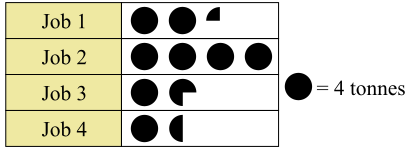


How many more tonnes of concrete does Job 1 need than Job 3?  (2 marks)

--- 2 WORK AREA LINES (style=lined) ---

Show Answers Only

\(2\ \text{tonnes}\)

Show Worked Solution

\(\text{Job 1 needs 9 tonnes}\)

\(\text{Job 2 needs 7 tonnes}\)
 

\(\therefore\ \text{Extra tonnes}\) \(=9-7\)
  \(=2\ \text{tonnes}\)

Filed Under: Displaying Data Tagged With: num-title-ct-core, smc-5076-5-Picture Graphs

Displaying Data, SM-Bank 014 MC

The bottles in Leisa's fridge are pictured below.
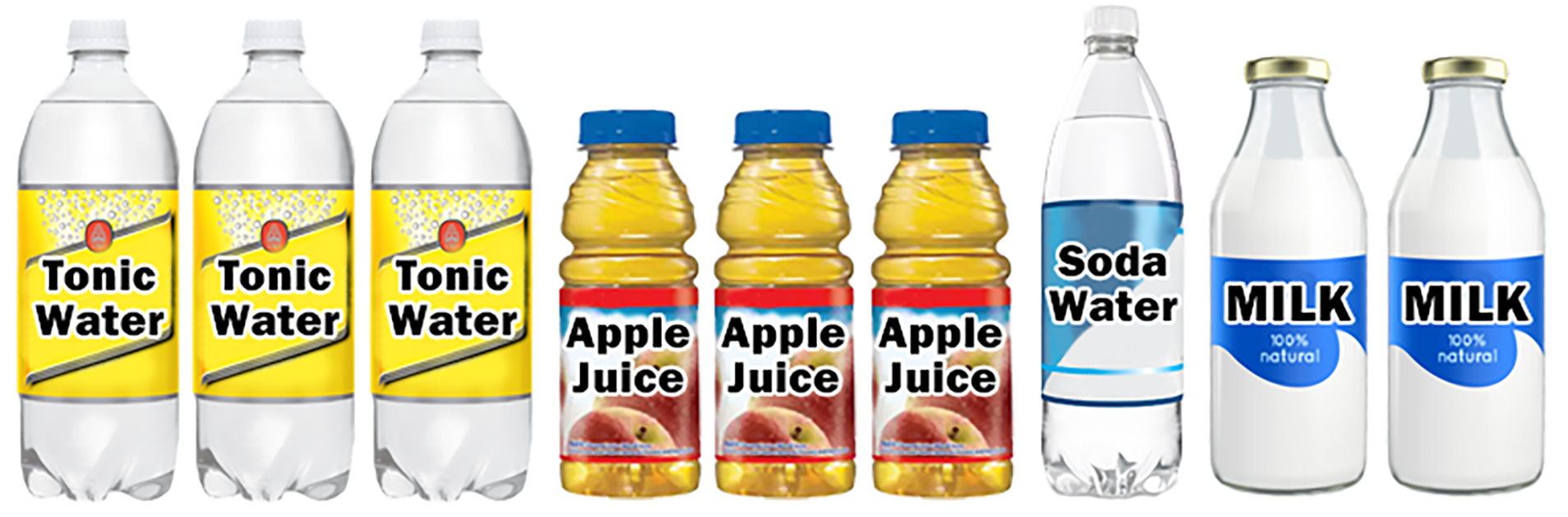


Leisa decides to make a graph where each bar represents one type of bottle in her fridge.
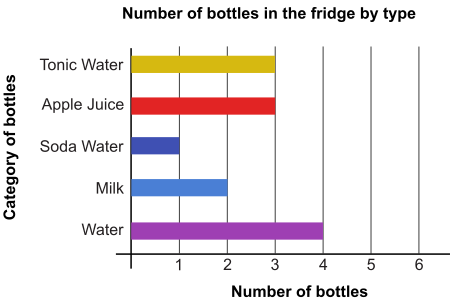


Leisa makes an error when creating the graph.

What should Leisa do to correct the error?

  1. Change the 'Number of bottles' label to 'Volume of bottles'.
  2. Change the title to 'Number of bottles in the fridge by volume'.
  3. The thickness of each bar should vary, depending on the number of bottles.
  4. Remove the 'Water' category since tonic water and soda water are already shown.
Show Answers Only

\(D\)

Show Worked Solution

\(\text{Remove the ‘Water’ category since tonic water and}\)

\(\text{soda water are already shown.}\)

\(\Rightarrow D\)

Filed Under: Displaying Data Tagged With: num-title-ct-core, smc-5076-5-Picture Graphs

Displaying Data, SM-Bank 013 MC

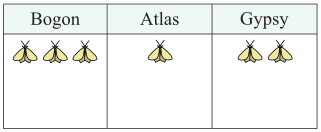
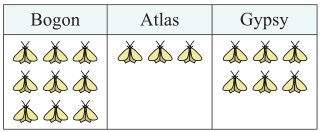
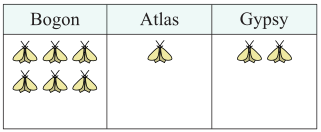
Patrick counts the number of moths he has collected.

  • 9 Bogon moths
  • 3 Atlas moths
  • 6 Gypsy moths

In each picture graph below,  = 3 moths

Select the picture graph that shows the number of moths Patrick counts.

A.   B.
 
C.   D.
 
Show Answers Only

\(A\)

Show Worked Solution
  \(\text{= 3 moths}\)
    \(\text{= 6 moths}\)
     \(\text{= 9 moths}\)


\(\Rightarrow A\)

Filed Under: Displaying Data Tagged With: num-title-ct-core, smc-5076-5-Picture Graphs

Displaying Data, SM-Bank 012 MC

During picking season, four groups of people were hired to pick apples.

A group will receive a bonus if they pick more than 24 apples per person in a 10-minute period.

The table below shows the total amount of apples picked by each group in the first 10 minutes.


Which group would have received a bonus in the first 10-minute period?

  1. Group A
  2. Group B
  3. Group C
  4. Group D
Show Answers Only

\(C\)

Show Worked Solution

\(\text{Calculate apples picked per person (in 10 mins) for each group:}\)

\(\text{A} = 68\ ÷\ 3=22.67\dots\)

\(\text{B} = 95\ ÷\ 4 = 23.75\)

\(\text{C} = 122\ ÷\ 5 = 24.4\)

\(\text{D} = 143\ ÷\ 6 = 23.83\dots\)
 

\(\Rightarrow C\)

Filed Under: Displaying Data Tagged With: num-title-ct-core, smc-5076-5-Picture Graphs

Displaying Data, SM-Bank 011 MC

Chris did a survey of the number of female toilets in four shopping centres.

The results were recorded in the table below but the key has been left off the graph?

The total number of female toilets was 44.

How many toilets does represent in the graph?
  1. 1
  2. 2
  3. 4
  4. 5
Show Answers Only

\(B\)

Show Worked Solution

\(\text{Total number of female symbols}\)

\(=5+4.5+5.5+7\)

\(=22\)
 

\(\therefore\ \text{The number of toilets one symbol represents}\)

\(=\dfrac{44}{22}\)

\(=2\)

 
\(\Rightarrow B\)

Filed Under: Displaying Data Tagged With: num-title-ct-core, smc-5076-5-Picture Graphs

Displaying Data, SM-Bank 010 MC

Each bar on this graph shows the population of a country and the population of its capital city.

The white section is the population that lives in the capital city.

The black section is the population that lives outside the capital city.


Which of the following countries has the highest percentage of its population living in its capital city?

  1. Australia
  2. Belgium
  3. France
  4. England
Show Answers Only

\(B\)

Show Worked Solution

\(\text{Considering the length of the white section of each}\)

\(\text{bar and comparing it to the length of the total bar,}\)

\(\text{Belgium easily has the highest percentage living in}\)

\(\text{its capital city.}\)

\(\Rightarrow B\)

Filed Under: Displaying Data Tagged With: num-title-ct-core, smc-5076-15-Sector graphs and Divided Bar graphs

Displaying Data, SM-Bank 009

Angus asked all the students in his primary school how far away they lived from school.

He used the results to create the column graph below but left off some labels.


Angus' primary school has 100 students.

How many students lived over 8 km from school?  (2 marks)

--- 4 WORK AREA LINES (style=lined) ---

Show Answers Only

\(18\ \text{students}\)

Show Worked Solution

\(\text{Since there are 5 columns and 100 students, the }\)

\(\text{average number of students per column is 20.}\)
 

\(\longrightarrow\ \text{Each interval = 4 students}\)
 

\(\therefore\ \text{Number of students living over 8 km away}\)

\(=4.5\times 4\)

\(=18\ \text{students}\)

Filed Under: Displaying Data Tagged With: num-title-ct-core, smc-5076-10-Column graphs and histograms

Displaying Data, SM-Bank 008

Two fishing boats record the number of tuna they catch on four fishing trips.
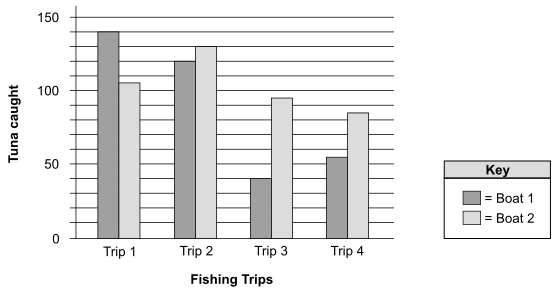


How many more tuna did Boat 2 catch than Boat 1 in total over the four trips.  (2 marks)

--- 5 WORK AREA LINES (style=lined) ---

Show Answers Only

\(60\)

Show Worked Solution
\(\text{Boat 1 tuna}\) \(=140+120+40+55\)
  \(=355\)


\(\text{Boat 2 tuna}\) \(=105+130+95+85\)
  \(=415\)

 
\(\therefore\ \text{Extra tuna caught by Boat 2}\)

\(=415-355\)

\(=60\)

Filed Under: Displaying Data Tagged With: num-title-ct-core, smc-5076-10-Column graphs and histograms

Displaying Data, SM-Bank 007 MC

Students at a high school were surveyed to find whether they did exercise before school.

The graph below shows the results.
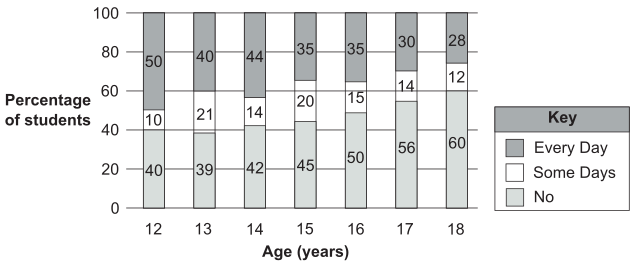


There were 150 17-year-old students at the high school.

How many 17-year-old students responded 'Every Day'?

  1. 14
  2. 30
  3. 45
  4. 60
Show Answers Only

\(C\)

Show Worked Solution

\(\text{30% of 17-year-old students responded ‘Every Day’.}\)

\(\therefore\ \text{Number}\) \(=0.3\times 150\)
  \(=45\)

\(\Rightarrow C\)

Filed Under: Displaying Data Tagged With: num-title-ct-core, smc-5076-15-Sector graphs and Divided Bar graphs

Displaying Data, SM-Bank 006 MC

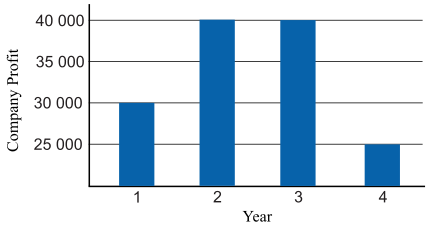
This graph shows a company's profit over a four year period.


Which conclusion can be reached from the graph?

  1. The profit in Year 2 was double of the profit in Year 1.
  2. The profits were greater than $20 000 in the period between Year 1 and Year 4.
  3. The profit in Year 4 was one quarter the profit in Year 3.
  4. The profits were positive in Years 2 and 3, and negative in Years 1 and 4.
Show Answers Only

\(B\)

Show Worked Solution

\(\text{Important to note that profits in this table begin at }$25\ 000, \text{not zero.}\)

\(\therefore\ \text{Profits were greater than }$20\ 000 \text{ in the period}\)

\(\text{between Year 1 and Year 4.}\)

\(\Rightarrow B\)

Filed Under: Displaying Data Tagged With: num-title-ct-core, smc-5076-10-Column graphs and histograms

Displaying Data, SM-Bank 005

Matt and Libby love nature and planted 50 trees each over 3 weeks.

The bar chart below shows the number of trees each of them planted in each week.
 

How many more trees did Libby plant than Matt in Week 2.  (2 marks)

--- 5 WORK AREA LINES (style=lined) ---

Show Answers Only

\(5\)

Show Worked Solution

\(\text{Trees planted by Matt in Week 2}\)

\(= 35-15\)

\(= 20\)

\(\text{Trees planted by Libby in Week 2}\)

\(= 45-20\)

\(= 25\)
 

\(\therefore\ \text{Libby planted 5 more trees than Matt in Week 2.}\)

Filed Under: Displaying Data Tagged With: num-title-ct-core, smc-5076-15-Sector graphs and Divided Bar graphs

Displaying Data, SM-Bank 004 MC

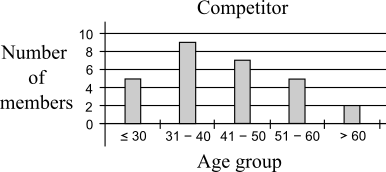
A local triathlon club gathers data on its members and displays it in a graph below.


How many members in the triathlon club are 50 or younger?

  1. 7
  2. 9
  3. 14
  4. 21
Show Answers Only

\(D\)

Show Worked Solution

\(\text{Number of members 50 or younger}\)

\(=5+9+7\)

\(=21\)

\(\Rightarrow D\)

Filed Under: Displaying Data Tagged With: num-title-ct-core, smc-5076-10-Column graphs and histograms

Displaying Data, SM-Bank 003 MC

The graph shows the origin and type of all vehicles in a city.


Which statement is most accurate based on the graph?

  1. There are more utility vehicles than trucks and vans.
  2. Utility vehicles are the most common type of vehicles
  3. There are more Australian vehicles than European vehicles.
  4. There are more Asian vehicles than European vehicles.
Show Answers Only

\(D\)

Show Worked Solution

\(\text{Consider the 4th option:}\)

\(\text{Total Asian vehicles}\)

\(=5+7+7=19\)

\(\text{Total European vehicles}\)

\(=4+3+3=10\)

\(\therefore\ \text{There are more Asian vehicles than European vehicles.}\)

\(\Rightarrow D\)

Filed Under: Displaying Data Tagged With: num-title-ct-core, smc-5076-10-Column graphs and histograms

Displaying Data, SM-Bank 002 MC

Clive and Alvin asked their friends how many books they had read in the past month.

Clive draws a picture graph to show the results for his friends.

Alvin draws a column graph to show the results for his friends.
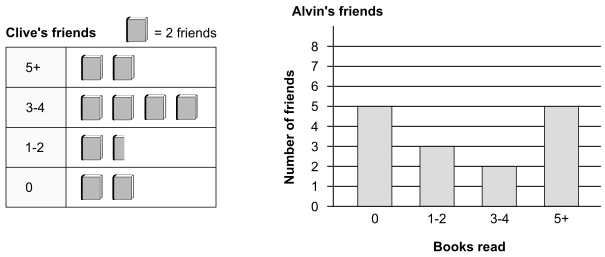


How many more of Clive's friends read 3-4 books in the last month than Alvin's friends?

  1. 0
  2. 4
  3. 6
  4. 8
Show Answers Only

\(C\)

Show Worked Solution

\(\text{Number of Clive’s friends}\)

\(=4\times 2\)

\(=8\)

\(\text{Number of Alvin’s friends}\)

\(=2\)

\(\therefore\ \text{6 more of Clive’s friends.}\)

\(\Rightarrow C\)

Filed Under: Displaying Data Tagged With: num-title-ct-core, smc-5076-10-Column graphs and histograms, smc-5076-5-Picture Graphs

Displaying Data, SM-Bank 001 MC

This graph shows the number of lottery tickets sold by a newsagent on each day of a given week.
 

On which days did the newsagent sell 23 lottery tickets?

  1. Tuesday
  2. Wednesday
  3. Thursday
  4. Friday
Show Answers Only

\(C\)

Show Worked Solution

\(\text{Thursday}\)

\(\Rightarrow C\)

Filed Under: Displaying Data Tagged With: num-title-ct-core, smc-5076-10-Column graphs and histograms

Classifying Data, SM-Bank 024 MC

The school canteen wishes to conduct a survey to find out the preferred sandwich fillings of students so they can ensure they are catering to the likes of the students.

Which of the following survey options would provide the most useful information.

  1. A survey of all students in year 8.
  2. A survey of the total school population.
  3. A survey of 20 boys from each year group.
  4. A survey of 25 students from each year group who regularly buy their lunch at the canteen.
Show Answers Only

\(D\)

Show Worked Solution

\(\text{Considering each option:}\)

A.   \(\text{Not representative of the whole school population.}\)
B. \(\text{Not necessary to survey students who do not use the canteen.}\)
C. \(\text{Not representative of the whole school population.}\)
D. \(\text{Students from each year who use the canteen are surveyed,}\)
  \(\text{so representative of the whole population of canteen users. }\checkmark \)


\(\Rightarrow D\)

Filed Under: Classifying Data Tagged With: num-title-ct-core, smc-5075-5-Sampling Methods

Classifying Data, SM-Bank 023 MC

Which of the following would be best conducted as a sample?

  1. The heights of players in the school basketball team.
  2. The number of people attending the 3 pm session of the latest Marvel movie in Gold Class at the local cinema on Friday.
  3. The number of bottles of water were sold at the school athletics carnival.
  4. The most popular streaming platform in Australia.
Show Answers Only

\(D\)

Show Worked Solution

\(\text{Considering each option:}\)

\(\text{A.  You could measure the all players }\longrightarrow\ \text{Census}\)

\(\text{B.  This information would be available from ticket sales }\longrightarrow\ \text{Census}\)

\(\text{C.  Could be determined exactly with a stocktake of remaining bottles }\longrightarrow\ \text{Census}\)

\(\text{D.  It would not be possible to interview every household to determine popularity }\longrightarrow\ \text{Sample}\)
 

\(\Rightarrow D\)

Filed Under: Classifying Data Tagged With: num-title-ct-core, smc-5075-5-Sampling Methods

Classifying Data, SM-Bank 022

Explain the difference between a census and a sample.  (2 marks)

--- 2 WORK AREA LINES (style=lined) ---

Show Answers Only

\(\text{A census surveys the whole population.}\)

\(\text{A sample surveys a section of the population.}\)

Show Worked Solution

\(\text{A census surveys the whole population.}\)

\(\text{A sample surveys a section of the population.}\)

Filed Under: Classifying Data Tagged With: num-title-ct-core, smc-5075-5-Sampling Methods

Classifying Data, SM-Bank 021

Explain why a door-to-door survey conducted between the hours of 9 am and 3 pm on a Tuesday may not give results representative of the population.  (2 marks)

--- 2 WORK AREA LINES (style=lined) ---

Show Answers Only

\(\text{It would not be representative of the whole community.}\)

\(\text{For example day workers and school children would not be included.}\)

Show Worked Solution

\(\text{It would not be representative of the whole community.}\)

\(\text{For example day workers and school children would not be included.}\)

Filed Under: Classifying Data Tagged With: num-title-ct-core, smc-5075-5-Sampling Methods

Classifying Data, SM-Bank 120

The local council is researching possible uses for a large area of land close to an established housing development.

One of the options for the land is a football stadium with a crowd capacity of \(30\ 000\) people.

The council is considering surveying people as they exit an existing football stadium in a neighbouring town.

Give a reason why this survey may not provide reliable data.  (2 marks)

--- 2 WORK AREA LINES (style=lined) ---

Show Answers Only
  • \(\text{Could be biassed towards people who like football}\)
  • \(\text{Should be conducted within the town where the impact will be felt}\)
Show Worked Solution
  • \(\text{Could be biassed towards people who like football}\)
  • \(\text{Should be conducted within the town where the impact will be felt}\)

Filed Under: Classifying Data Tagged With: num-title-ct-core, smc-5075-5-Sampling Methods

Classifying Data, SM-Bank 019

Min is writing a report regarding the capacity of dams in NSW during 2023 projecting in to 2024. He wishes to include rainfall data for the previous 12 months in each of the catchment areas.

Should Min use primary or secondary sources to obtain this informaiton? Give a reason for your answer.  (2 marks)

--- 2 WORK AREA LINES (style=lined) ---

Show Answers Only

\(\text{Secondary Source data}\)

\(\text{Reason: See worked example}\)

Show Worked Solution

\(\text{Secondary source data.}\)

\(\text{It would not be possible for Min to collect this information}\)

\(\text{himself so he would therefore need to rely on already existing}\)

\(\text{secondary source data.}\)

Filed Under: Classifying Data Tagged With: num-title-ct-core, smc-5075-5-Sampling Methods

Classifying Data, SM-Bank 018

Michael is conducting a survey to determine whether his clients are happy with the customer service they receive at his restaurant.

Should Michael use primary or secondary source data for his survey? Give a reason for your answer.  (2 marks)

--- 2 WORK AREA LINES (style=lined) ---

Show Answers Only

\(\text{Primary Source data}\)

\(\text{Reason: See worked example}\)

Show Worked Solution

\(\text{Primary source data.}\)

\(\text{Michael would survey his actual customers}\)

\(\text{to obtain their opinions and is therefore using}\)

\(\text{primary source data.}\)

Filed Under: Classifying Data Tagged With: num-title-ct-core, smc-5075-5-Sampling Methods

Classifying Data, SM-Bank 017

Explain the difference between continuous and discrete data, giving an example of each.  (3 marks)

--- 4 WORK AREA LINES (style=lined) ---

Show Answers Only

\(\text{See worked example}\)

Show Worked Solution

\(\text{Discrete can be assigned a numerical value and can}\)

\(\text{usually be counted.}\)

\(\text{Examples could include:} \)

  • \(\text{The number of people living in a household}\)
  • \(\text{The number of people catching the 4:10 pm train}\)
  • \(\text{The number of cars park at Westfield on Monday}\)

\(\text{Continuous data can be assigned any value in a range}\)

\(\text{and usually involves a measurements.}\)

\(\text{Examples could include:} \)

  • \(\text{The weights of parcels at the post office}\)
  • \(\text{The heights of students in Year 7}\)
  • \(\text{The temperatures recorded at Sydney during March}\)

Filed Under: Classifying Data Tagged With: num-title-ct-core, smc-5075-15-Numerical

Classifying Data, SM-Bank 016 MC

The following question was asked in a survey.

'What month were you born?'

How would the responses be classified?

  1. Categorical, ordinal
  2. Categorical, nominal
  3. Numerical, discrete
  4. Numerical, continuous
Show Answers Only

\(A\)

Show Worked Solution

\(\text{Months are names and so categorical data and}\)

\(\text{they are ordered}\)

\(\longrightarrow\ \text{Categorical, ordinal.}\) 

\(\Rightarrow A\)

Filed Under: Classifying Data Tagged With: num-title-ct-core, smc-5075-10-Categorical

Classifying Data, SM-Bank 015 MC

Organisers were choosing relay teams for the regional athletics carnival.

They asked the following question.

'What were the times for the 15 Years boys relay teams at zone athletics carnivals?'

How would the responses be classified?

  1. Categorical, ordinal
  2. Categorical, nominal
  3. Numerical, discrete
  4. Numerical, continuous
Show Answers Only

\(D\)

Show Worked Solution

\(\text{The times recorded are measurements}\)

\(\text{so all numbers on the scale are possible}\)

\(\longrightarrow\ \text{Numerical, continuous.}\) 

\(\Rightarrow D\)

Filed Under: Classifying Data Tagged With: num-title-ct-core, smc-5075-15-Numerical

Classifying Data, SM-Bank 014 MC

Which of the following is an example of categorical nominal data?

  1. Gold, Silver, Bronze medals
  2. Small, Medium, Large
  3. French Bulldog, Poodle, Cavoodle
  4. First place, Second place
Show Answers Only

\(C\)

Show Worked Solution

\(\text{French Bulldog, Poodle and Cavoodle are types of dogs (order not important) }\)

\(\longrightarrow\ \text{categorical nominal}\)

\(\Rightarrow C\)

Filed Under: Classifying Data Tagged With: num-title-ct-core, smc-5075-10-Categorical

Classifying Data, SM-Bank 013

Which of the following is an example of categorical ordinal data?

  1. Pink, Blue, Mauve
  2. Small, Medium, Large
  3. Apple, Pear, Orange
  4. Labrador, Beagle, Poodle
Show Answers Only

\(B\)

Show Worked Solution

\(\text{Small, Medium, Large are categories with an order }\longrightarrow\ \text{categorical ordinal}\)

\(\Rightarrow B\)

Filed Under: Classifying Data Tagged With: num-title-ct-core, smc-5075-10-Categorical

Classifying Data, SM-Bank 012

Which of the following is an example of numerical continuous data?

  1. The weights of babies born in a hospital during the month of May
  2. The types of cars sold at a car yard
  3. The number of funnel-web spiders collected by the Australian Reptile Park in 2023
  4. The colours used in the American flag
Show Answers Only

\(A\)

Show Worked Solution

\(\text{Weights are measurements (quantitative) }\longrightarrow\ \text{numerical continuous}\)

\(\Rightarrow A\)

Filed Under: Classifying Data Tagged With: num-title-ct-core, smc-5075-15-Numerical

Classifying Data, SM-Bank 011 MC

Which of the following is an example of numerical discrete data?

  1. The minimum temperature in each capital city on Monday morning
  2. The number of competitors in a triathlon
  3. The different types of snakes in a reptile display
  4. The lengths of earth worms in a garden
Show Answers Only

\(B\)

Show Worked Solution

\(\text{The number of competitors in a triathlon can be counted }\longrightarrow\ \text{numerical discrete}\)

\(\Rightarrow B\)

Filed Under: Classifying Data Tagged With: num-title-ct-core, smc-5075-15-Numerical

Classifying Data, SM-Bank 010

State whether the following categorical data is nominal or ordinal.

  1. Rating exam questions as easy or hard.  (1 mark)

    --- 1 WORK AREA LINES (style=lined) ---

  2. Listing the colours of cars passing the bus stop during period 3.  (1 mark)

    --- 1 WORK AREA LINES (style=lined) ---

  3. Recording dietary preferences such as vegan, gluten-free, vegetarian.  (1 mark)

    --- 1 WORK AREA LINES (style=lined) ---

  4. Receiving an A, B, C, D or E on a report card.  (1 mark)

    --- 1 WORK AREA LINES (style=lined) ---

Show Answers Only

a.    \(\text{Ordinal}\)

b.    \(\text{Nominal}\)

c.    \(\text{Nominal}\)

d.    \(\text{Ordinal}\)

Show Worked Solution

a.    \(\text{The data is ranked}\ \longrightarrow\ \text{Ordinal}\)

b.    \(\text{Colours are the names assigned}\ \longrightarrow\ \text{Nominal}\)

c.    \(\text{Preferences are the names assigned}\ \longrightarrow\ \text{Nominal}\)

d.    \(\text{Grades rank the data}\ \longrightarrow\ \text{Ordinal}\)

Filed Under: Classifying Data Tagged With: num-title-ct-core, smc-5075-10-Categorical

Classifying Data, SM-Bank 009

State whether the following data is categorical or numerical.  If numerical, state whether discrete or continuous.

  1. The distance thrown by the 15 years javelin champion.  (1 mark)

    --- 1 WORK AREA LINES (style=lined) ---

  2. The types of fruit used in a fruit salad.  (1 mark)

    --- 1 WORK AREA LINES (style=lined) ---

  3. The number of students travelling to the Year 7 camp by bus.  (1 mark)

    --- 1 WORK AREA LINES (style=lined) ---

Show Answers Only

a.    \(\text{Numerical continuous}\)

b.    \(\text{Categorical}\)

c.    \(\text{Numerical discrete}\)

Show Worked Solution

a.    \(\text{Data is a measurement}\ \longrightarrow\ \text{Numerical continuous}\)

b.    \(\text{Fruit is grouped into categories or types}\ \longrightarrow\ \text{Categorical}\)

c.    \(\text{Students can be counted}\ \longrightarrow\ \text{Numerical discrete}\)

Filed Under: Classifying Data Tagged With: num-title-ct-core, smc-5075-10-Categorical, smc-5075-15-Numerical

Classifying Data, SM-Bank 008

Match each variable with its classification on the right.  (2 marks)

\begin{array} {ll} \text{A.  Hair colour of students in Year 7} &\text{1.  Numerical discrete} \\\text{B.  Heights of players in the Boomers basketball team} & \text{2.  Categorical ordinal} \\\text{C.  The number of people living in each household in NSW}\  & \text{3.  Numerical continous}\\\text{D.  A, B, C, D, E grades on a report card}  & \text{4.  Categorical nominal}\end{array}

Show Answers Only

\(\text{A}\longrightarrow 4,\ \text{B}\longrightarrow 3,\ \text{C}\longrightarrow 1,\ \text{D}\longrightarrow 2\)

Show Worked Solution

\(\text{A. Hair colour is data grouped in categories with no order}\)

\(\therefore\ \text{4. Categorical nominal}\)

\(\text{B. Heights are measurements which are numerical and continuous}\)

\(\therefore\ \text{3. Numerical continous}\)

\(\text{C. The people living in each household are counted}\)

\(\therefore\ \text{1. Numerical discrete}\)

\(\text{D. Grades on a report card are categorical but the order is important}\)

\(\therefore\ \text{2. Categorical ordinal}\)

Filed Under: Classifying Data Tagged With: num-title-ct-core, smc-5075-10-Categorical, smc-5075-15-Numerical

Classifying Data, SM-Bank 007

Classify the following as either categorical or numerical data. 

  1. The colours of the cars entering a shopping centre.  (1 mark)

    --- 1 WORK AREA LINES (style=lined) ---

  2. The temperatures recorded in Brisbane over a 2 week period.  (1 mark)

    --- 1 WORK AREA LINES (style=lined) ---

Show Answers Only

a.    \(\text{categorical}\)

b.    \(\text{numerical}\)

Show Worked Solution

a.    \(\text{Colours of cars are words therefore categorical.}\)

b.    \(\text{Temperatures are measurements therefore numerical.}\)

Filed Under: Classifying Data Tagged With: num-title-ct-core, smc-5075-10-Categorical, smc-5075-15-Numerical

Classifying Data, SM-Bank 006 MC

Which of the following is not an example of categorical data?

  1. A list of religions
  2. Colours of the rainbow
  3. Fruits in a smoothie
  4. Heights of children in Year 8
Show Answers Only

\(D\)

Show Worked Solution

\(\text{Heights are quantitative (measurements) and therefore not categorical.}\)

\(\Rightarrow D\)

Filed Under: Classifying Data Tagged With: num-title-ct-core, smc-5075-10-Categorical

Classifying Data, SM-Bank 005

What is the term used to describe data that is grouped in categories such as gold, silver and copper?  (1 mark)

--- 1 WORK AREA LINES (style=lined) ---

Show Answers Only

\(\text{Categorical}\)

Show Worked Solution

\(\text{The term for data that is not numerical is categorical.}\)

Filed Under: Classifying Data Tagged With: num-title-ct-core, smc-5075-10-Categorical

Data Analysis, SM-Bank 050

Brandon made a dot plot to show the hours he worked over the last 16 weeks.


What is the mean number of hours that Brandon worked over that last 16 weeks?  (2 marks)

--- 4 WORK AREA LINES (style=lined) ---

Show Answers Only

\(15.75\ \text{hours}\)

Show Worked Solution
\(\text{Mean}\ \) \(=\dfrac{\text{Sum of the scores}}{\text{Number of scores}}\)
  \(=\dfrac{2\times 13+3\times 14+3\times 15+3\times 16+2\times 17+3\times 19}{16}\)
  \(=\dfrac{252}{16}\)
  \(=15.75\ \text{hours}\)

Filed Under: Data Analysis Tagged With: num-title-ct-core, smc-4224-25-Mean

Data Analysis, SM-Bank 049

Evie made a dot plot to show the distances she has swum in her training for a long distance ocean swim.
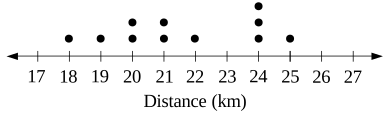


What is the mean distance that Evie has swum? Give your answer correct to 1 decimal place.  (2 marks)

--- 4 WORK AREA LINES (style=lined) ---

Show Answers Only

\(21.6\ \text{km}\)

Show Worked Solution
\(\text{Mean}\ \) \(=\dfrac{\text{Sum of the scores}}{\text{Number of scores}}\)
  \(=\dfrac{18+19+2\times 20+2\times 21+22+3\times 24+25}{11}\)
  \(=\dfrac{238}{11}=21.636\dots\)
  \(\approx 21.6\ \text{km (1 d.p.)}\)

Filed Under: Data Analysis Tagged With: num-title-ct-core, smc-4224-25-Mean

Data Analysis, SM-Bank 048 MC

Dante made a dot plot to show the distances he has run in his training for a half-marathon.


What is the median of the distances Dante has run?

  1. \(2\)
  2. \(7\)
  3. \(21\)
  4. \(24\)
Show Answers Only

\(C\)

Show Worked Solution
\(\text{Median}\ \) \(=\ \text{6th score}\)
  \(=21\)

\(\Rightarrow C\)

Filed Under: Data Analysis Tagged With: num-title-ct-core, smc-4224-20-Median

Data Analysis, SM-Bank 047 MC

Angelica made a dot plot to show the distances she has run in her training for a marathon.


What is the range of the distances Angelica has run?

  1. \(3\)
  2. \(7\)
  3. \(21\)
  4. \(24\)
Show Answers Only

\(B\)

Show Worked Solution
\(\text{Range}\ \) \(=\ \text{high – low}\)
  \(=25-1\)
  \(=7\)

\(\Rightarrow B\)

Filed Under: Data Analysis Tagged With: num-title-ct-core, smc-4224-10-Range

Data Analysis, SM-Bank 046

The back-to-back ordered stem-and-leaf plot below shows the female and male smoking rates, expressed as a percentage, in 18 countries.
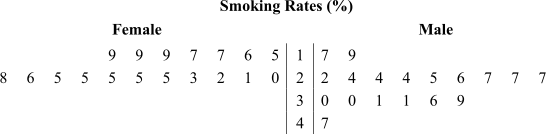
 

  1. For the 18 countries listed, what is the range of the male smoking rates?  (1 mark)

    --- 1 WORK AREA LINES (style=lined) ---

  2. For the 18 countries listed, what is the mode of the female smoking rates?  (1 mark)

    --- 1 WORK AREA LINES (style=lined) ---

  3. For the 18 countries listed, what is the difference between the medians of the female and male smoking rates?  (2 marks)

    --- 4 WORK AREA LINES (style=lined) ---

Show Answers Only

a.     \(30\%\)

b.     \(25\%\)

c.     \(5.5\%\)

Show Worked Solution

a.    \(\text{Range}=47-17=30\%\)

b.    \(\text{Female mode}=25\%\)

c.     \(\text{Female Median }\) \(=\ \text{average of 9th and 10th scores}\)
    \(=\dfrac{21+22}{2}=21.5\%\)


\(\text{Male Median }\) \(=\ \text{average of 9th and 10th scores}\)
  \(=27\%\)

  
\(\therefore\ \text{The difference in medians}\)

\(=27-21.5=5.5\%\)

Filed Under: Data Analysis Tagged With: num-title-ct-core, smc-4224-40-Stem and Leaf, smc-4224-45-Mean/median/mode/range

Classifying Data, SM-Bank 004 MC

The variables age (under 55 years, 55 years and over) and preferred travel destination (domestic, international) are

  1. both categorical variables.
  2. both numerical variables.
  3. a numerical variable and a categorical variable respectively.
  4. a categorical variable and a numerical variable respectively.
Show Answers Only

\(A\)

Show Worked Solution

\(\text{Age is a categorical ordinal variable}\)

\(\text{because it is categorical data that can}\)

\(\text{have an order.}\)

\(\text{Preferred travel destination is a categorical}\)

\(\text{nominal value because the data has a name.}\)
 

\(\Rightarrow A\)

Filed Under: Classifying Data Tagged With: num-title-ct-core, smc-5075-10-Categorical, smc-5075-15-Numerical

Classifying Data, SM-Bank 003

The variables blood pressure (low, normal, high) and age (under 50 years, 50 years or over) are

  1. both nominal variables.
  2. both ordinal variables.
  3. a nominal variable and an ordinal variable respectively.
  4. an ordinal variable and a nominal variable respectively.
Show Answers Only

\(B\)

Show Worked Solution

\(\text{Blood pressure is an ordinal variable}\)

\(\text{because it is categorical data that can}\)

\(\text{have an order.}\)

\(\text{Under 50 and over 50, likewise, is an}\)

\(\text{ordinal variable.}\)
 

\(\Rightarrow B\)

Filed Under: Classifying Data Tagged With: num-title-ct-core, smc-5075-10-Categorical, smc-5075-15-Numerical

Classifying Data, SM-Bank 002 MC

The variables recovery time after exercise (in minutes) and fitness level (below average, average, above average) are

  1. both numerical.
  2. an ordinal variable and a nominal variable respectively.
  3. a numerical variable and a nominal variable respectively.
  4. a numerical variable and an ordinal variable respectively.
Show Answers Only

\(D\)

Show Worked Solution

\(\text{Recovery time in minutes → numerical variable}\)

\(\text{Fitness level → ordinal (categories that can be ordered)}\)

\(\Rightarrow D\)

Filed Under: Classifying Data Tagged With: num-title-ct-core, smc-5075-10-Categorical, smc-5075-15-Numerical

Data Analysis, SM-Bank 045 MC

For an ordered set of data containing an odd number of values, the middle value is always

  1. the mean.
  2. the median.
  3. the mode.
  4. the mean, the median and the mode.
Show Answers Only

\(B\)

Show Worked Solution

\(\text{For an odd number of values the median is always the middle score.}\)

\(\Rightarrow B\)

Filed Under: Data Analysis Tagged With: num-title-ct-core, smc-4224-45-Mean/median/mode/range

Data Analysis, SM-Bank 044 MC

The total birth weight of a sample of 12 babies is 39.0 kg.

The mean birth weight of these babies, in kilograms, is

  1.  2.50
  2.  2.75
  3.  3.00
  4.  3.25
Show Answers Only

\(D\)

Show Worked Solution
\(\text{Mean}\) \(=\dfrac{\text{Total birth weight}}{\text{# babies}}\)
  \(=\dfrac{39.0}{12}\)
  \(=3.25\ \text{kg}\)

 
\(\Rightarrow D\)

Filed Under: Data Analysis Tagged With: num-title-ct-core, smc-4224-25-Mean

Data Analysis, SM-Bank 043 MC

The total weight of nine oranges is 1.53 kg.

Using this information, the mean weight of an orange would be calculated to be closest to

  1. 115 g
  2. 153 g
  3. 162 g
  4. 170 g
Show Answers Only

\(D\)

Show Worked Solution
\(\text{Mean Weight}\) \(=\dfrac{\text{Total weight}}{\text{# Oranges}}\)
  \(=\dfrac{1.53}{9}\)
  \(= 0.17\ \text{kg}\)
  \(= 170\ \text{g}\)

 
\(\Rightarrow D\)

Filed Under: Data Analysis Tagged With: num-title-ct-core, smc-4224-25-Mean

Classifying Data, SM-Bank 001 MC

The variables

region (city, urban, rural)

population density (number of people per square kilometre)

  1. are both categorical.
  2. are both numerical. 
  3. are categorical and numerical respectively.
  4. are numerical and categorical respectively.
Show Answers Only

\(C\)

Show Worked Solution

\(\text{Region is a categorical variable and population}\)

\(\text{density is a numerical variable (i.e. it can be}\)

\(\text{represented by countable numbers).}\)

\(\Rightarrow C\)

Filed Under: Classifying Data Tagged With: num-title-ct-core, smc-5075-10-Categorical, smc-5075-15-Numerical

Volume, SM-Bank 166

The cube and cylinder below both have the same volume.
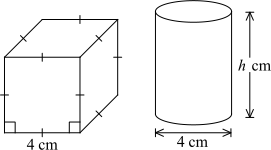
  

  1. Calculate the volume of the cube in cubic centimetres.  (2 marks)

    --- 3 WORK AREA LINES (style=lined) ---

  2. Calculate the height of the cylinder, \(\large h\), in centimetres. Give your answer correct to 1 decimal place.  (2 marks)

    --- 5 WORK AREA LINES (style=lined) ---

Show Answers Only

a.    \(64\ \text{cm}^3\)

b.    \(5.1\ \text{cm (1 d.p.)}\)

Show Worked Solution
 

a.    \(V\) \(=l\times b\times h\)
    \(=4^3\)
    \(=64\)

 
\(\therefore\ \text{The volume of the cube is 64 cm}^3\)
 

b.    \(\text{Diameter = 4 cm}\ \longrightarrow\ \text{Radius = 2 cm}\)

\(V\) \(=\pi r^2h\)
\(64\) \(=\pi\times 2^2\times h\)
\(64\) \(=4\pi h\)
\(\therefore\ h\) \(=\dfrac{64}{4\pi}\)
  \(=5.092\dots\approx 5.1\ \text{(1 d.p.)}\)

 
\(\therefore\ \text{The height of the cylinder is approximately 5.1 cm}\)

Filed Under: Cylinders Tagged With: num-title-ct-core, smc-4981-15-cylinders

Volume, SM-Bank 165

The cylinder and rectangular prism below both have the same volume.
 

  1. Calculate the volume of the cylinder in cubic centimetres, correct to 2 decimal places.  (2 marks)

    --- 3 WORK AREA LINES (style=lined) ---

  2. Calculate the length of the side labelled \(\large x\), in the rectangular prism. Give your answer correct to 1 decimal place.  (2 marks)

    --- 5 WORK AREA LINES (style=lined) ---

Show Answers Only

a.    \(314.16\ \text{cm}^3\ \text{(2 d.p.)}\)

b.    \(9.8\ \text{cm (1 d.p.)}\)

Show Worked Solution
 

a.    \(\text{Diameter = 10 cm }\longrightarrow\ \text{Radius = 5 cm}\)

\(V\) \(=\pi r^2h\)
  \(=\pi\times 5^2\times 4\)
  \(=314.159\dots\)
  \(\approx 314.16\ \text{(2 d.p.)}\)

 
\(\therefore\ \text{The volume of the cylinder is approximately 314.16 cm}^3\)
 

b.    \(V\) \(=l\times b\times h\)
  \(314.16\) \(=8\times x\times 4\)
  \(314.16\) \(=32x\)
  \(\therefore\ x\) \(=\dfrac{314.16}{32}\)
    \(=9.8175\)
    \(\approx 9.8\ \text{(1 d.p.)}\)

 
\(\therefore\ \text{The side labelled }x\ \text{is approximately 9.8 cm in length}\)

Filed Under: Cylinders Tagged With: num-title-ct-core, smc-4981-15-cylinders

Volume, SM-Bank 164

A half-cylinder has a height of 44 millimetres and a diameter of 20 millimetres. Calculate the volume of the half-cylinder in cubic centimetres, giving your answer as an exact value in terms of \(\pi\).  (2 marks)

--- 3 WORK AREA LINES (style=lined) ---

Show Answers Only

\(2200\pi\ \text{cm}^3\)

Show Worked Solution

\(\text{NOTE: change measurements to centimetres before calculations}\)

\(V\) \(=\dfrac{1}{2}\pi r^2h\)
  \(=\dfrac{1}{2}\times\pi\times 10^2\times 44\)
  \(=2200\pi\)

 
\(\therefore\ \text{The exact volume of the half-cylinder is }2200\pi\ \text{cm}^3\)

Filed Under: Cylinders Tagged With: num-title-ct-core, smc-4981-25-cylinder parts

Volume, SM-Bank 163

A quarter-cylinder has a height of 160 centimetres and a radius of 800 centimetres . Calculate the volume of the quarter-cylinder in cubic metres, giving your answer as an exact value in terms of \(\pi\).  (2 marks)

--- 3 WORK AREA LINES (style=lined) ---

Show Answers Only

\(25.6\pi\ \text{m}^3\)

Show Worked Solution

\(\text{NOTE: change measurements to metres before calculations}\)

\(V\) \(=\dfrac{1}{4}\pi r^2h\)
  \(=\dfrac{1}{4}\times\pi\times 8^2\times 1.6\)
  \(=25.6\pi\)

 
\(\therefore\ \text{The exact volume of the quarter-cylinder is }25.6\pi\ \text{m}^3\)

Filed Under: Cylinders Tagged With: num-title-ct-core, smc-4981-25-cylinder parts

Volume, SM-Bank 162

A half-cylinder has a height of 12 centimetres and a radius of 9 centimetres. Calculate the volume of the half-cylinder, giving your answer as an exact value in terms of \(\pi\).  (2 marks)

--- 3 WORK AREA LINES (style=lined) ---

Show Answers Only

\(486\pi\ \text{cm}^3\)

Show Worked Solution
\(V\) \(=\dfrac{1}{2}\pi r^2h\)
  \(=\dfrac{1}{2}\times\pi\times 9^2\times 12\)
  \(=486\pi\)

 
\(\therefore\ \text{The exact volume of the half-cylinder is }486\pi\ \text{cm}^3\)

Filed Under: Cylinders Tagged With: num-title-ct-core, smc-4981-25-cylinder parts

Volume, SM-Bank 161

A right cylinder has a height of 100 millimetres and a radius of 1.1 millimetres. Calculate the volume of the cylinder, giving your answer as an exact value in terms of \(\pi\).  (2 marks)

--- 3 WORK AREA LINES (style=lined) ---

Show Answers Only

\(121\large\pi\ \)\(\text{mm}^3\)

Show Worked Solution
\(V\) \(=\pi r^2h\)
  \(=\pi\times 1.1^2\times 100\)
  \(=121\large\pi\)

 
\(\therefore\ \text{The exact volume of the cylinder is }121\large\pi\ \)\(\text{mm}^3\)

Filed Under: Cylinders Tagged With: num-title-ct-core, smc-4981-15-cylinders

Volume, SM-Bank 160

A right cylinder has a height of 7 metres and a radius of 4 metres. Calculate the volume of the cylinder, giving your answer as an exact value in terms of \(\pi\).  (2 marks)

--- 3 WORK AREA LINES (style=lined) ---

Show Answers Only

\(112\large\pi\ \)\(\text{m}^3\)

Show Worked Solution
\(V\) \(=\pi r^2h\)
  \(=\pi\times 4^2\times 7\)
  \(=112\large\pi\)

 
\(\therefore\ \text{The exact volume of the cylinder is }112\large\pi\ \)\(\text{m}^3\)

Filed Under: Cylinders Tagged With: num-title-ct-core, smc-4981-15-cylinders

Volume, SM-Bank 159

A right cylinder has a volume of \(11\ 451\) cubic metres. Calculate the radius of the cylinder if the height is 45 metres.

Give your answer to the nearest whole centimetre.  (2 marks)

--- 5 WORK AREA LINES (style=lined) ---

Show Answers Only

\(9\ \text{m}\)

Show Worked Solution
\(V\) \(=\pi r^2h\)
\(11\ 451\) \(=\pi\times r^2\times 45\)
\(11\ 451\) \(=10\pi\times r^2\)
\(r^2\) \(=\dfrac{11\ 451}{45\pi}\)
\(r^2\) \(=80.999\dots\)
\(r\) \(=\sqrt{80.999}=8.999\dots\)
\(r\) \(\approx 9\ \text{m (nearest whole m)}\)

 
\(\therefore\ \text{The radius of the cylinder is approximately 9 m}\)

Filed Under: Cylinders Tagged With: num-title-ct-core, smc-4981-15-cylinders

Volume, SM-Bank 158

A right cylinder has a volume of 22 cubic metres. Calculate the diameter of the cylinder if the height is 7 metres.

Give your answer to the nearest whole metre.  (3 marks)

--- 6 WORK AREA LINES (style=lined) ---

Show Answers Only

\(2\ \text{m}\)

Show Worked Solution
\(V\) \(=\pi r^2h\)
\(22\) \(=\pi\times r^2\times 7\)
\(22\) \(=7\pi\times r^2\)
\(r^2\) \(=\dfrac{22}{7\pi}\)
\(r^2\) \(=1.000\dots\)
\(r\) \(=\sqrt{1.000}=1.000\dots\)
\(r\) \(\approx 1\ \text{m (nearest whole m)}\)

 
\(\therefore\ \text{The diameter of the cylinder is approximately 2 m}\)

Filed Under: Cylinders Tagged With: num-title-ct-core, smc-4981-15-cylinders

Volume, SM-Bank 157

A right cylinder has a volume of 8482.3 cubic millimetres. Calculate the diameter of the cylinder if the height is 12 millimetres.

Give your answer to the nearest whole millimetre.  (3 marks)

--- 6 WORK AREA LINES (style=lined) ---

Show Answers Only

\(30\ \text{mm}\)

Show Worked Solution
\(V\) \(=\pi r^2h\)
\(8482.3\) \(=\pi\times r^2\times 12\)
\(8482.3\) \(=12\pi\times r^2\)
\(r^2\) \(=\dfrac{8482.3}{12\pi}\)
\(r^2\) \(=224.999\dots\)
\(r\) \(=\sqrt{224.999}=14.999\dots\)
\(r\) \(\approx 15\ \text{mm (nearest whole mm)}\)

 
\(\therefore\ \text{The diameter of the cylinder is approximately 30 mm}\)

Filed Under: Cylinders Tagged With: num-title-ct-core, smc-4981-15-cylinders

  • « Previous Page
  • 1
  • 2
  • 3
  • 4
  • 5
  • 6
  • …
  • 31
  • Next Page »

Copyright © 2014–2025 SmarterEd.com.au · Log in