SmarterEd

Aussie Maths & Science Teachers: Save your time with SmarterEd

  • Login
  • Get Help
  • About

BIOLOGY, M5 2019 HSC 9 MC

Which of the following is an advantage for animals using internal fertilisation rather than external fertilisation?

  1. It prevents dehydration of gametes.
  2. It involves large numbers of gametes.
  3. It relies on adaptations such as mating rituals.
  4. It allows gametes to combine to form unique offspring.
Show Answers Only

`A`

Show Worked Solution
  • The damp environment utilised in internal fertilisation prevents dehydration of the gametes, which would lead to the death of the cells.

`=>A`


Mean mark 57%.

Filed Under: Reproduction Tagged With: Band 4, smc-3647-10-Other animal, smc-3647-15-Internal vs. External

BIOLOGY, M5 2020 HSC 25

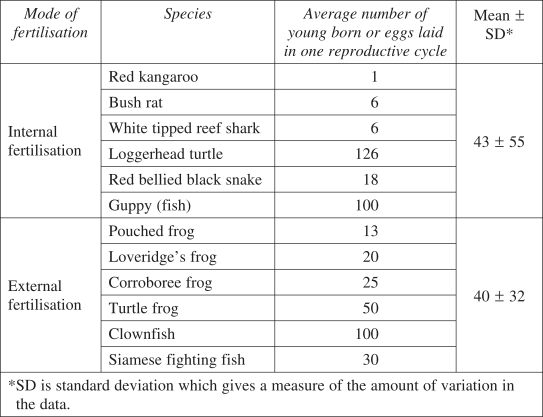
Students tested the hypothesis that the number of eggs/young produced was greater in animals using external fertilisation than those using internal fertilisation. They obtained the following data from secondary sources.
 

  1. What conclusion can be drawn from the data? Justify your answer.   (3 marks)

    --- 6 WORK AREA LINES (style=lined) ---

  2. Justify an improvement to the students' experimental design to test the same hypothesis.   (2 marks)

    --- 5 WORK AREA LINES (style=lined) ---

  3. Explain ONE advantage for animals of using external fertilisation.   (2 marks)

    --- 5 WORK AREA LINES (style=lined) ---

Show Answers Only

a.   Conclusion: There is little difference

  • The numbers of eggs laid/young born between different species was similar in both external and internal animals (43, 40).
  • The standard deviation (variability of the data) was significantly high (55, 32).
  • These two factors mean that students may conclude there is little to no difference between the number of young produced and the mode of fertilisation.

b.   Potential adjustments to improve design

  • Students have selected only twelve species to use in their investigation, which has led to similar results in both internal and external fertilisation.
  • A much larger number of species should be included in a follow up investigation to increase the likelihood of yielding more accurate results.

c.   Successful answers should include one of the following:

  • External fertilisation will expend less energy on gestation, as it occurs outside the body.
  • The large number of young produced in external fertilisation will ensure continuity of the species with minimal parental guidance.
Show Worked Solution

a.   Conclusion: There is little difference

  • The numbers of eggs laid/young born between different species was similar in both external and internal animals (43, 40).
  • The standard deviation (variability of the data) was significantly high (55, 32).
  • These two factors mean that students may conclude there is little to no difference between the number of young produced and the mode of fertilisation.

Mean mark (a) 51%.

b.   Potential adjustments to improve design

  • Students have selected only twelve species to use in their investigation, which has led to similar results in both internal and external fertilisation.
  • A much larger number of species should be included in a follow up investigation to increase the likelihood of yielding more accurate results.

♦♦ Mean mark (b) 38%.

c.   Successful answers should include one of the following:

  • External fertilisation will expend less energy on gestation, as it occurs outside the body.
  • The large number of young produced in external fertilisation will ensure continuity of the species with minimal parental guidance.

Filed Under: Reproduction Tagged With: Band 4, Band 5, smc-3647-05-Human/Mammal, smc-3647-10-Other animal, smc-3647-15-Internal vs. External

BIOLOGY, M5 2021 HSC 2 MC

Which of the following photographs shows an example of sexual reproduction?


Show Answers Only

`D`

Show Worked Solution

By Elimination

  • Budding in fungi, binary fission in bacteria and runners in plants are all examples of asexual reproduction (Eliminate A, B and C).
  • Frog spawning requires a female to lay eggs and a male frog to fertilise them with sperm.

`=>D`

Filed Under: Reproduction Tagged With: Band 3, smc-3647-05-Human/Mammal, smc-3647-10-Other animal, smc-3647-25-Plant, smc-3647-40-Sexual vs Asexual

Copyright © 2014–2025 SmarterEd.com.au · Log in