SmarterEd

Aussie Maths & Science Teachers: Save your time with SmarterEd

  • Login
  • Get Help
  • About

Linear Relationships, SM-Bank 039 MC

Pepper uses matchsticks to make a pattern of shapes, as shown in the table below.
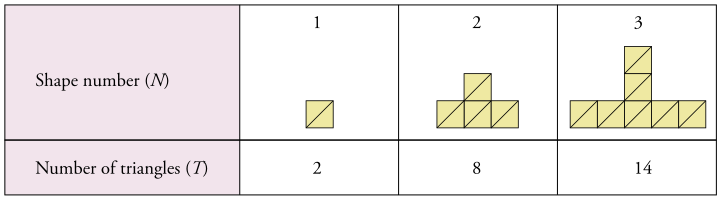


The equation used to show the relationship between  \(T\)  and  \(N\)  is

  1. \(T = N + 1\)
  2. \(T = 6N\)
  3. \(T = 6N+2\)
  4. \(T = 6N-4\)
Show Answers Only

\(D\)

Show Worked Solution

\(T\ \text{increases by 6 each shape.}\)

\(\text{Consider}\ T = 6N – 4:\)

\(\text{When}\ \ N = 1,\ T = 6\times 1 − 4 = 2\)

\(\text{When}\ \ N = 2, \ T = 6\times − 4 = 8\)

\(\text{When}\ \ N = 3,\ T = 6\times − 4 = 14\)

\(\therefore T = 6N − 4\ \text{is correct}\)

\(\Rightarrow D\)


Filed Under: Linear Relationships Tagged With: num-title-ct-core, smc-4216-15-Patterns, smc-4216-20-Rules

Linear Relationships, SM-Bank 032 MC

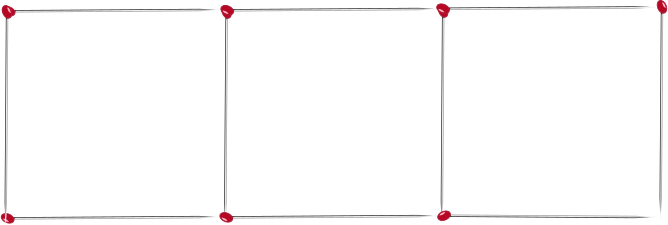
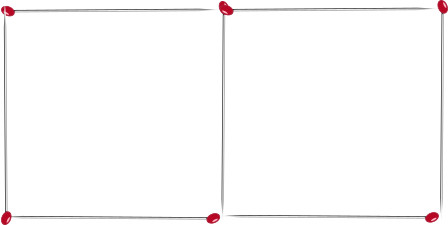
Which rule correctly describes the pattern below?

             

  1. \(\text{The number of pins}=2\times \text{The number of squares}+3\)
  2. \(\text{The number of pins}=3\times \text{The number of squares}+1\)
  3. \(\text{The number of pins}=1\times \text{The number of squares}+3\)
  4. \(\text{The number of pins}=4\times \text{The number of squares}\)
Show Answers Only

\(B\)

Show Worked Solution

\begin{array} {|l|c|c|c|c|c|c|}
\hline
\rule{0pt}{2.5ex} \text{Number of squares} \rule[-1ex]{0pt}{0pt} & 1 & 2 & 3 \\
\hline
\rule{0pt}{2.5ex} \text{Number of pins} \rule[-1ex]{0pt}{0pt} & 4 & 7 & 10 \\
\hline
\end{array}

\(\therefore\ \text{The number of pins}=3\times \text{Number of squares}+1\)

\(\Rightarrow B\)

Filed Under: Linear Relationships Tagged With: num-title-ct-core, smc-4216-15-Patterns, smc-4216-20-Rules

Linear Relationships, SM-Bank 031 MC

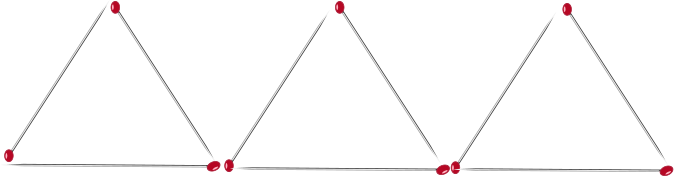
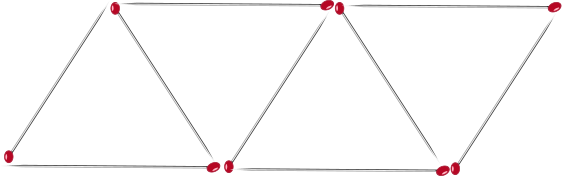
Which rule correctly describes the pattern below?
           

  1. \(\text{The number of pins}=\text{The number of triangles}+3\)
  2. \(\text{The number of pins}=\text{The number of triangles}+5\)
  3. \(\text{The number of pins}=\text{The number of triangles}\times 2\)
  4. \(\text{The number of pins}=\text{The number of triangles}\times 3\)
Show Answers Only

\(D\)

Show Worked Solution
\(\text{Number of triangles }(t)\) \(\ \ 1\ \ \) \(\ \ 2\ \ \) \(\ \ 3\ \ \) \(\ \ ….\ \ \)
\(\text{Number of pins }(p)\) \(\ \ 3\ \ \) \(\ \ 6\ \ \) \(\ \ 9\ \ \) \(\ \ ….\ \ \)

  
\(\therefore\ \text{The number of pins}=\text{Number of triangles}\times 3\)

\(\Rightarrow D\)

Filed Under: Linear Relationships Tagged With: num-title-ct-core, smc-4216-15-Patterns, smc-4216-20-Rules

Linear Relationships, SM-Bank 030

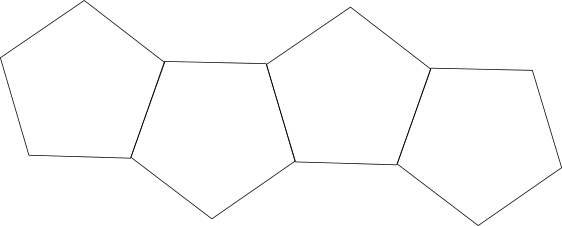
Michael is making a geometric pattern using sticks to make pentagons.

The first 3 shapes in the pattern are shown below.


  1. Draw the next shape in the pattern.  (1 mark)

    --- 6 WORK AREA LINES (style=lined) ---

  2. Complete the table of values using the pattern.  (2 marks)

    Number of pentagons \((\large p)\) \(\ \ 1\ \ \) \(\ \ 2\ \ \) \(\ \ 3\ \ \) \(\ \ 4\ \ \)
    Number of sticks \((\large s)\) \(\ \ 5\ \ \)      
  3. Write the rule connecting the number of sticks \((s)\) to the number of pentagons \((p)\).  (2 marks)

    --- 3 WORK AREA LINES (style=lined) ---

  4. How many sticks will be needed to make \(12\) pentagons?  (2 marks)

    --- 3 WORK AREA LINES (style=lined) ---

Show Answers Only

a.    \(\text{Shape number }4\)

b.    \(\text{Table of values}\)

\(\text{Number of pentagons }(\large p)\) \(\ \ 1\ \ \) \(\ \ 2\ \ \) \(\ \ 3\ \ \) \(\ \ 4\ \ \)
\(\text{Number of sticks }(\large s)\) \(\ \ 5\ \ \) \(\ \ 9\ \ \) \(\ \ 13\ \ \) \(\ \ 17\ \ \)

c.    \(s=4\times p+1\)

d.    \(49\)

Show Worked Solution

a.    \(\text{Shape number }4\)

b.    \(\text{Table of values}\)

\(\text{Number of pentagons }(\large p)\) \(\ \ 1\ \ \) \(\ \ 2\ \ \) \(\ \ 3\ \ \) \(\ \ 4\ \ \)
\(\text{Number of sticks }(\large s)\) \(\ \ 5\ \ \) \(\ \ 9\ \ \) \(\ \ 13\ \ \) \(\ \ 17\ \ \)

c.    \(\text{Rule:  The number of sticks}=4\times \text{(the number of pentagons)}+1\)

\(\therefore\ \text{Rule:  }\ s=4\times p+1\)

d.    \(\text{Find the value of }s\ \text{when }p=12\)

\(s=4\times p+1=4\times 12+1=49\)

Filed Under: Linear Relationships Tagged With: num-title-ct-core, smc-4216-15-Patterns, smc-4216-20-Rules

Linear Relationships, SM-Bank 029

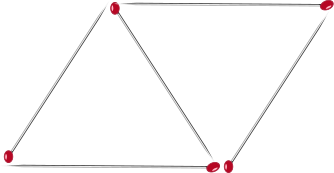
Michael is making a geometric pattern using pins to form triangles.

The first 3 shapes in the pattern are shown below.


  1. Draw the next shape in the pattern.  (1 mark)

    --- 6 WORK AREA LINES (style=lined) ---

  2. Complete the table of values using the pattern.  (2 marks)

    Number of triangles \((t)\) \(\ \ 1\ \ \) \(\ \ 2\ \ \) \(\ \ 3\ \ \) \(\ \ 4\ \ \)
    Number of pins \((p)\) \(\ \ 3\ \ \)      
  3. Write the rule connecting the number of pins \((p)\) to the number of triangles \((t)\).  (2 marks)

    --- 2 WORK AREA LINES (style=lined) ---

  4. How many pins will be needed to make \(25\) triangles?  (2 marks)

    --- 2 WORK AREA LINES (style=lined) ---

Show Answers Only

a.    \(\text{Shape number }4\)

b.    \(\text{Table of values}\)

\(\text{Number of triangles }(t)\) \(\ \ 1\ \ \) \(\ \ 2\ \ \) \(\ \ 3\ \ \) \(\ \ 4\ \ \)
\(\text{Number of pins }(p)\) \(\ \ 3\ \ \) \(\ \ 5\ \ \) \(\ \ 7\ \ \) \(\ \ 9\ \ \)

c.    \(p=2\times t+1\)

d.    \(51\)

Show Worked Solution

a.    \(\text{Shape number }4\)

b.    \(\text{Table of values}\)

\(\text{Number of triangles }(t)\) \(\ \ 1\ \ \) \(\ \ 2\ \ \) \(\ \ 3\ \ \) \(\ \ 4\ \ \)
\(\text{Number of pins }(p)\) \(\ \ 3\ \ \) \(\ \ 5\ \ \) \(\ \ 7\ \ \) \(\ \ 9\ \ \)

c.    \(\text{Rule:  The number of pins}=2\times \text{(the number of triangles)}+1\)

\(\therefore\ \text{Rule:  }\ p=2\times t+1\)

d.    \(\text{Find the value of }p\ \text{when }t=25\)

\(p=2\times t+1=2\times 25+1=51\)

Filed Under: Linear Relationships Tagged With: num-title-ct-core, smc-4216-15-Patterns, smc-4216-20-Rules

Linear Relationships, SM-Bank 028

A weekly gym membership can be purchased for different numbers of classes, as shown in the table below. 

Number of classes 1 2 3 4
Cost in dollars  42  72  102  132

What is the rule connecting the number of classes purchased and the cost in dollars?  (2 marks)

Show Answers Only

\(\text{Cost in dollars}=30\times \text{Number of classes}+12\)

Show Worked Solution

\(\text{Firstly, look at the increase in the cost with each additional class }\)

\(\longrightarrow\ 42 , 72 , 102 , 132\ \ \longrightarrow\text{The cost increases by }$30\text{ every class}\)

\(\text{Secondly, if we look at the difference between }42\ \text{and }30\ \text{in the first class}\)

\(\text{we get }12\text{ which needs to be added to each membership}\)

\(\therefore\ \text{Rule:  Cost in dollars}=30\times \text{Number of classes}+12\)

Filed Under: Linear Relationships Tagged With: num-title-ct-core, smc-4216-20-Rules

Linear Relationships, SM-Bank 027

A surfboard can be hired for different numbers of hours, as shown in the table below. 

Number of hours 1 2 3 4
Cost in dollars  35  50  65  80

What is the rule connecting the number of hours of surfboard hire and the cost in dollars?  (2 marks)

Show Answers Only

\( Cost in dollars}=15\times \text{Number of hours}+20\)

Show Worked Solution

\(\text{Firstly, look at the increase in the cost with each hour of hire }\)

\(\longrightarrow\ 35 , 50 , 65 , 80\ \ \longrightarrow\text{The price increases by }$15\text{ every hour}\)

\(\text{Secondly, if we look at the difference between }35\ \text{and }15\ \text{in the first hour}\)

\(\text{we get }20\text{ which needs to be added to each hiring fee}\)

\(\therefore\ \text{Rule:  Cost in dollars}=15\times \text{Number of hours}+20\)

Filed Under: Linear Relationships Tagged With: num-title-ct-core, smc-4216-20-Rules

Linear Relationships, SM-Bank 026 MC

Dress sizes
Country A 6 8 10 12 14
Country B 36 38 40 42 44

What is the rule connecting dress sizes in Country A and Country B?

  1. \(\text{Country B}=\text{Country A}-30\)
  2. \(\text{Country B}=\text{Country A}+30\)
  3. \(\text{Country B}=(4\times\text{Country A})+12\)
  4. \(\text{Country B}=6\times\text{Country A}\)
Show Answers Only

\(B\)

Show Worked Solution

\(\text{Rule:  Country B = Country A + 30}\)

\(\Rightarrow B\)

Filed Under: Linear Relationships Tagged With: num-title-ct-core, smc-4216-20-Rules

Linear Relationships, SM-Bank 025 MC

Billy is setting up tables for a comedy night at his club.

An  X  is placed for every available seat at a table, as shown below.


Which of these rules can be used to work out how many people can sit on any row of tables?

  1. \(\text{number of tables}\times 6\)
  2. \(\text{number of tables}\ ÷\ 2-2\)
  3. \(\text{number of tables}\times 4+2\)
  4. \(\text{number of tables}\times 4-2\)
Show Answers Only

\(C\)

Show Worked Solution

\(\text{Consider Option C:}\)

\(\text{1st table:}\ \ 1\times 4 +2 = 6\ \text{people}\)

\(\text{2nd table:}\ \ 2\times 4 +2 = 10\ \text{people}\)

\(\text{3rd table:}\ \ 3\times 4 +2 = 14\ \text{people}\)

\(\therefore\ \text{number of tables}\times 4 + 2\ \text{is the correct rule.}\)

\(\Rightarrow C\)

Filed Under: Linear Relationships Tagged With: num-title-ct-core, smc-4216-20-Rules

Copyright © 2014–2025 SmarterEd.com.au · Log in