SmarterEd

Aussie Maths & Science Teachers: Save your time with SmarterEd

  • Login
  • Get Help
  • About

PHYSICS, M3 EQ-Bank 7

A group of students conducted an investigation of waves using a slinky. They generated a transverse wave pulse with an amplitude of 10 cm in a slinky under tension \(T_1\). They measured the time taken for the pulse to travel the 3.0 m length of the slinky as 0.75 seconds.

They then increased the tension to \(T_2\) where  \(T_2 = 2.25T_1\) and found that the same amplitude pulse took 0.5 seconds to travel the same distance.

  1. Calculate the wave speed for both tension values \(T_1\) and \(T_2\).   (2 marks)

--- 4 WORK AREA LINES (style=lined) ---

  1. Determine the proportionality between wave speed and tension in the slinky. Use your calculations to support your answer.   (2 marks)

--- 4 WORK AREA LINES (style=lined) ---
Show Answers Only

a.    The speed of \(T_1 = \dfrac{3}{0.75} = 4\ \text{ms}^{-1}\).

The speed of \(T_2 = \dfrac{3}{0.5} = 6\ \text{ms}^{-1}\).

b.     \(v \propto \sqrt{T}\).

Show Worked Solution

a.    The speed of the wave can be calculated using \(v=\dfrac{d}{t}\).

  • The speed of \(T_1 = \dfrac{3}{0.75} = 4\ \text{ms}^{-1}\).
  • The speed of \(T_2 = \dfrac{3}{0.5} = 6\ \text{ms}^{-1}\).

b.    \(\dfrac{v_2}{v_1}= \dfrac{6}{4} = 1.5\).

\(\dfrac{T_2}{T_1} = \dfrac{2.25T_1}{T_1} = 2.25\).

  • Noting, \(\sqrt{\dfrac{T_2}{T_1}} = \sqrt{2.25} = 1.5 \ \Rightarrow \ \dfrac{v_2}{v_1} = \sqrt{\dfrac{T_2}{T_1}}\).
  • Hence  \(v \propto \sqrt{T}\).

Filed Under: Wave Properties and Behaviour Tagged With: Band 3, Band 6, smc-4278-20-Wave calculations, smc-4278-35-Mechanical Waves

PHYSICS, M3 EQ-Bank 6

A student team conducted an experiment using a horizontal spring to study wave properties. They measured the wave speed, frequency, and wavelength under normal conditions.

The students then repeated the experiment after making a modification to the spring system.

For each of the following changes, explain whether the wave speed, frequency, and wavelength would increase, decrease, or remain unchanged using the equation \(v=\sqrt{\dfrac{T}{\mu}}\) where \(T\) is the tension in the string and \(\mu\) is the mass of the string per unit of length. Support each answer with brief reasoning.

  1. The students decrease the tension in the spring while maintaining the same oscillation pattern at the source.   (3 marks)

--- 6 WORK AREA LINES (style=lined) ---

  1. The students increase the mass per unit length of the spring by attaching small weights along its length, while keeping the tension and oscillation pattern constant.   (3 marks)

--- 6 WORK AREA LINES (style=lined) ---

Show Answers Only

a.    Velocity: decrease.

  • \(v\) is proportional to \(\sqrt{T}\), hence if the tension in the spring decreases, the wave velocity will also decrease.

Frequency: no change.

  • The frequency is determined by the oscillation pattern at the source. This is constant and therefore the frequency will not change.

Wavelength: decrease.

  • The wavelength is proportional to the velocity of the wave \((v=f\lambda)\). Since the frequency remains constant and the velocity decreases, the wavelength must also decrease.

b.    Velocity: decrease.

  • \(v\) is proportional to \(\sqrt{\dfrac{1}{\mu}}\). Given the mass per unit of length of the spring increases, the velocity of the wave will decrease.

Frequency: no change.

  • The frequency is determined by the oscillation pattern at the source. This is constant and therefore the frequency will not change.

Wavelength: decrease.

  • The wavelength is proportional to the velocity of the wave as \(v=f\lambda\). Since the frequency remains constant and the velocity decreases, the wavelength must also decrease.
Show Worked Solution

a.    Velocity: decrease.

  • \(v\) is proportional to \(\sqrt{T}\), hence if the tension in the spring decreases, the wave velocity will also decrease.

Frequency: no change.

  • The frequency is determined by the oscillation pattern at the source. This is constant and therefore the frequency will not change.

Wavelength: decrease.

  • The wavelength is proportional to the velocity of the wave \((v=f\lambda)\). Since the frequency remains constant and the velocity decreases, the wavelength must also decrease.

b.    Velocity: decrease.

  • \(v\) is proportional to \(\sqrt{\dfrac{1}{\mu}}\). Given the mass per unit of length of the spring increases, the velocity of the wave will decrease.

Frequency: no change.

  • The frequency is determined by the oscillation pattern at the source. This is constant and therefore the frequency will not change.

Wavelength: decrease.

  • The wavelength is proportional to the velocity of the wave as \(v=f\lambda\). Since the frequency remains constant and the velocity decreases, the wavelength must also decrease.

Filed Under: Wave Properties and Behaviour Tagged With: Band 5, smc-4278-35-Mechanical Waves

PHYSICS, M3 EQ-Bank 10 MC

Which of the following waves has the shortest wavelength?

  1. A microwave with a frequency of \(3.0 \times 10^{11}\ \text{Hz}\).
  2. A sound wave with a frequency of \(15\ \text{kHz}\).
  3. A water wave travelling at \(4.0\ \text{ms}^{-1}\) with a frequency of \(0.25\ \text{Hz}\).
  4. A radio wave with a frequency of \(90\ \text{MHz}\).
Show Answers Only

\(A\)

Show Worked Solution

\(v=f\lambda\) \(\Rightarrow\) \(\lambda = \dfrac{v}{f}\).

  Microwave: \(\lambda = \dfrac{3.0 \times 10^8}{3.0 \times 10^{11}} = 1 \times 10^{-3}\ \text{m}\).

  Sound wave: \(\lambda = \dfrac{340}{15 \times 10^3} = 0.023\ \text{m}\).

  Water wave: \(\lambda = \dfrac{4.0}{0.25} = 1\ \text{m}\).

  Radio wave: \(\lambda = \dfrac{3.0 \times 10^8}{90 \times 10^6} = 3.33\ \text{m}\).
 

  • The microwave has the smallest wavelength.

\(\Rightarrow A\)

Filed Under: Wave Properties and Behaviour Tagged With: Band 4, smc-4278-20-Wave calculations, smc-4278-35-Mechanical Waves, smc-4278-45-EMR

PHYSICS, M3 EQ-Bank 9 MC

Which of the following best describes the role of a medium in the transmission of a mechanical wave?

  1. Mechanical waves involve only longitudinal particle motion within the medium.
  2. Mechanical waves involve only transverse particle motion within the medium.
  3. Energy is transferred through the medium by the motion of its particles.
  4. The particles in the medium move at a lower frequency than the wave’s frequency.
Show Answers Only

\(C\)

Show Worked Solution
  • In mechanical waves, the medium plays a crucial role by allowing energy to be transferred through the vibration of its particles.
  • As the wave moves, particles in the medium oscillate and pass energy to adjacent particles. This process allows the wave to travel through the medium without transporting matter along with it.
  • The oscillations can be either longitudinal or transverse, depending on the type of wave, but in both cases, it is the particle motion that enables energy propagation.

\(\Rightarrow C\)

Filed Under: Wave Properties and Behaviour Tagged With: Band 3, smc-4278-35-Mechanical Waves

PHYSICS, M3 EQ-Bank 3

How do mechanical waves differ from electromagnetic waves? Include examples to illustrate your response.   (4 marks)

--- 12 WORK AREA LINES (style=lined) ---

Show Answers Only
  • Mechanical waves (e.g. sound, water waves, vibrations on a string) need a medium to travel through.
  • They transfer energy by making particles in the medium vibrate. This vibration can be either perpendicular (transverse waves – eg. ripples in water) or parallel (longitudinal waves – eg. sound waves in air) to the direction of motion.
  • The speed of a mechanical wave depends on the medium’s physical properties.
  • Electromagnetic waves (e.g. light, radio waves, X-rays) do not need a medium and can move through a vacuum.
  • These waves are transverse, made of electric and magnetic fields oscillating at right angles.
  • They travel fastest in a vacuum \((3 \times 10^8\ \text{ms}^{-1})\) and slow down in materials like air or glass—how much depends on the material’s refractive index.
  • The electromagnetic spectrum includes a wide range, from low-frequency radio waves to high-frequency gamma rays.
Show Worked Solution
  • Mechanical waves (e.g. sound, water waves, vibrations on a string) need a medium to travel through.
  • They transfer energy by making particles in the medium vibrate. This vibration can be either perpendicular (transverse waves – eg. ripples in water) or parallel (longitudinal waves – eg. sound waves in air) to the direction of motion.
  • The speed of a mechanical wave depends on the medium’s physical properties.
  • Electromagnetic waves (e.g. light, radio waves, X-rays) do not need a medium and can move through a vacuum.
  • These waves are transverse, made of electric and magnetic fields oscillating at right angles.
  • They travel fastest in a vacuum \((3 \times 10^8\ \text{ms}^{-1})\) and slow down in materials like air or glass—how much depends on the material’s refractive index.
  • The electromagnetic spectrum includes a wide range, from low-frequency radio waves to high-frequency gamma rays.

Filed Under: Wave Properties and Behaviour Tagged With: Band 4, Band 5, smc-4278-35-Mechanical Waves, smc-4278-45-EMR

PHYSICS, M3 EQ-Bank 1

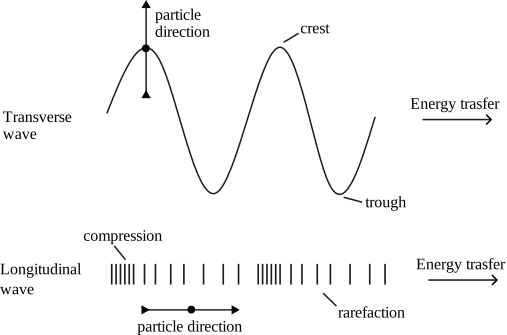
  1. Create a labelled diagram to illustrate the distinction between transverse and longitudinal wave types. Briefly describe how the particle motion differs in each case.   (3 marks)

--- 10 WORK AREA LINES (style=lined) ---

  1. Describe a difference between electromagnetic waves and mechanical waves, giving an example of each.   (2 marks)

--- 4 WORK AREA LINES (style=lined) ---

  1. A beam of light has a frequency of \(5.0 \times 10^{14}\ \text{Hz}\). Calculate the wavelength of this light in metres.   (1 mark)

--- 2 WORK AREA LINES (style=lined) ---

Show Answers Only

a.    


  • For transverse waves, particles move at 90 degrees to the direction of energy transfer.
  • For longitudinal waves, particles move back and forward in the same direction as the energy transfer.

b.   Electromagnetic wave example: radio wave.

  • EMR does not require a medium to travel through. i.e. they can travel through a vacuum.

Mechanical wave example: sound wave.

  • Mechanical waves require a medium to travel through.

c.    \(6 \times 10^{-7}\ \text{m}\).

Show Worked Solution

a.    


  • For transverse waves, particles move at 90 degrees to the direction of energy transfer.
  • For longitudinal waves, particles move back and forward in the same direction as the energy transfer.

b.   Electromagnetic wave example: radio wave.

  • EMR does not require a medium to travel through. i.e. they can travel through a vacuum.

Mechanical wave example: sound wave.

  • Mechanical waves require a medium to travel through.

c.   Using  \(v = f \lambda\):

\(\lambda = \dfrac{v}{f} = \dfrac{3 \times 10^8}{5.0 \times 10^{14}} = 6 \times 10^{-7}\ \text{m}\).

Filed Under: Wave Properties and Behaviour Tagged With: Band 4, smc-4278-20-Wave calculations, smc-4278-30-Transverse vs longitudinal, smc-4278-35-Mechanical Waves

PHYSICS, M3 EQ-Bank 4 MC

When a water wave moves from deep water into shallow water, its speed decreases.

What effect does this have on the wave?

  1. The frequency decreases while the wavelength stays the same.
  2. The wavelength decreases while the frequency stays the same.
  3. Both the wavelength and frequency decrease.
  4. The wavelength and frequency both remain unchanged.
Show Answers Only

\(B\)

Show Worked Solution
  • The frequency of a wave is determined by the source and remains constant when moving from deeper to shallower water.
  • Since \(v=f \lambda\), if the speed decreases and the frequency remains the same, the wavelength must also decrease.

\(\Rightarrow B\)

Filed Under: Wave Properties and Behaviour Tagged With: Band 5, smc-4278-35-Mechanical Waves

Copyright © 2014–2025 SmarterEd.com.au · Log in