SmarterEd

Aussie Maths & Science Teachers: Save your time with SmarterEd

  • Login
  • Get Help
  • About

Rates, SM-Bank 103

 Each stage of Moira's 30 km charity fitness challenge is outlined below.

  • Moira started the challenge with a running leg and ran 10 kilometres in 1.5 hours.
  • She then stopped for 30 minutes.
  • Her next leg involved cycling and she averaged 40 km/h for the next half an hour.
  • Moira then stopped and had lunch for 1.5 hours.
  • She walked with her friends for the next hour averaging 5 km/h.
  • Moira stopped for half an hour for afternoon tea and completed the challenge in a total of 7 hours.

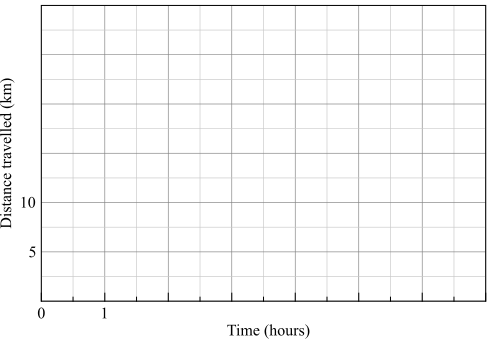
Draw a distance-time graph to represent Moira's challenge on the following grid. Include the scale on both axes.  (3 marks)
 

--- 0 WORK AREA LINES (style=lined) ---

Show Answers Only

Show Worked Solution

Filed Under: Rates Tagged With: num-title-ct-core, smc-4609-10-Distance/Time graphs, smc-4609-50-Word problems rates

Rates, SM-Bank 102

Jefferson left home at 9 a.m. and travelled at an average speed of 80 km/h for 4 hours.

Draw a distance-time graph to represent Jefferson's journey on the following grid, completing times and distances on the axes.  (2 marks)
 

--- 0 WORK AREA LINES (style=lined) ---

Show Answers Only

Show Worked Solution

Filed Under: Rates Tagged With: num-title-ct-core, smc-4609-10-Distance/Time graphs, smc-4609-50-Word problems rates

Rates, SM-Bank 101

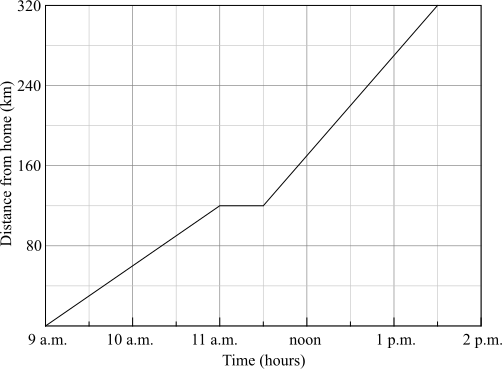
Roland left home at 9 a.m. and travelled through the city averaging 60 km/h for 2 hours.

He then stopped for half an hour at a roadhouse.

Roland continued his journey on the motorway and averaged 100 km/h arriving at his destination after 2 hours.
 

Draw a distance-time graph to represent Roland's journey on the following grid, completing times and distances on the axes.  (3 marks)
 

--- 0 WORK AREA LINES (style=lined) ---

Show Answers Only

Show Worked Solution
Filed Under: Rates Tagged With: num-title-ct-core, smc-4609-10-Distance/Time graphs, smc-4609-50-Word problems rates

Rates, SM-Bank 100

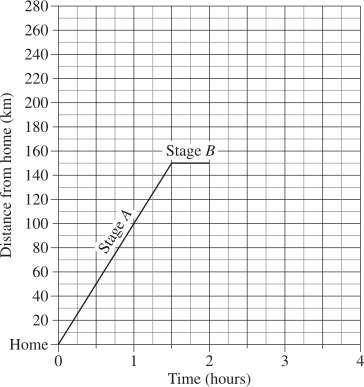
The distance-time graph shows the first two stages of a car journey from home to a holiday house.
  

  1. At what speed, in kilometres per hour, did the car travel during stage A of the journey?  (1 mark)

    --- 1 WORK AREA LINES (style=lined) ---

  2. For how long did the car stop during stage B of the journey?  (1 mark)

    --- 1 WORK AREA LINES (style=lined) ---

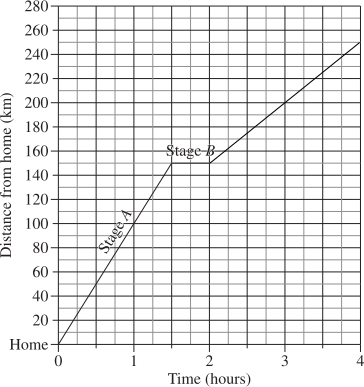
  3. After stage B, the car continues to travel towards the holiday house at a constant speed of 50 km/h for 2 hours. Graph this part of the journey on the grid above. (2 marks)

    --- 0 WORK AREA LINES (style=lined) ---

Show Answers Only

a.    \(100\text{ km/h}\)

b.    \(30\text{ minutes}\)

c.   

Show Worked Solution

a.    \(S=\dfrac{D}{T}\)

\(S=\dfrac{150}{1.5}=100\text{ km/h}\)

b.    \(\text{Stage}\ B=1.5\rightarrow 2\text{ hours}=30\text{ minutes}\)

c.    \(\text{Position at time 4 hours at 50km/h}=150+2\times 50 = 250\ \text{km} \)

Filed Under: Rates Tagged With: num-title-ct-core, smc-4609-10-Distance/Time graphs, smc-4609-50-Word problems rates

Rates, SM-Bank 099

The distance-time graph below shows Clive's walk home from school.

  1. How far did Clive walk in the first minute?  (1 mark)

    --- 1 WORK AREA LINES (style=lined) ---

  2. How far had Clive walked before he stopped to wait for the traffic lights to change to green?  (1 mark)

    --- 1 WORK AREA LINES (style=lined) ---

  3. How far is Clive's home from the school?  (1 mark)

    --- 1 WORK AREA LINES (style=lined) ---

  4. What was Clive's average speed during the first 2 minutes?  (2 marks)

    --- 2 WORK AREA LINES (style=lined) ---

  5. What was Clive's average speed for the entire trip?  (2 marks)

    --- 2 WORK AREA LINES (style=lined) ---

  6. During which times is the graph the steepest? What can you say about Clive's speed in this section? (2 marks)

    --- 2 WORK AREA LINES (style=lined) ---

Show Answers Only

a.    \(40\ \text{m}\)

b.    \(240\ \text{m}\)

c.    \(320\ \text{m}\)

d.    \(40\ \text{m/minute}\)

e.    \(64\ \text{m/minute}\)

f.    \(\text{The graph was steepest between the 2nd and 3rd minutes.}\)

\(\text{This is where Clive was walking the fastest.}\)

Show Worked Solution

a.    \(40\ \text{m}\)

b.    \(240\ \text{m}\)

c.    \(320\ \text{m}\)

d.    
\(\text{Speed}\) \(=\dfrac{\text{Distance}}{\text{Time}}\)
    \(=\dfrac{80}{2}\)
    \(=40\ \text{m/minute}\)


e.    
\(\text{Speed}\) \(=\dfrac{\text{Distance}}{\text{Time}}\)
    \(=\dfrac{320}{5}\)
    \(=64\ \text{m/minute}\)

 
f.   
\(\text{The graph was steepest between the 2nd and 3rd minutes.}\)

\(\text{This is where Clive was walking the fastest.}\)

Filed Under: Rates Tagged With: num-title-ct-core, smc-4609-10-Distance/Time graphs, smc-4609-50-Word problems rates

Rates, SM-Bank 098

The distance-time graph below shows Betty's train trip to her Grandmother's house in the Blue Mountains and the return journey in her Grandmother's car.

  1. Which section of the the graph shows where Betty had to change trains and wait to catch the next train?  (1 mark)

    --- 1 WORK AREA LINES (style=lined) ---

  2. How long did Betty take to complete section C?  (1 mark)

    --- 1 WORK AREA LINES (style=lined) ---

  3. After how many hours did Betty reach her Grandmother's house?  (1 mark)

    --- 1 WORK AREA LINES (style=lined) ---

  4. What was Betty's average speed for section D?  (2 marks)

    --- 2 WORK AREA LINES (style=lined) ---

  5. How many kilometres did Betty travel in total?  ( 2 marks)

    --- 1 WORK AREA LINES (style=lined) ---

  6. What was Betty's average speed for the entire trip?  (2 marks)

    --- 2 WORK AREA LINES (style=lined) ---

  7. Which section of the graph is the steepest? What can you say about Betty's speed in this section? (2 marks)

    --- 2 WORK AREA LINES (style=lined) ---

Show Answers Only

a.    \(\textit{B}\)

b.    \(1 \text{ hour}\)

c.    \(2.5 \text{ hours}\)

d.    \(80\ \text{km/h}\)

e.    \(240\ \text{km}\)

f.     \(60\ \text{km/h}\)

g.    \(\text{The graph was steepest in Section }\textit{A}.\)

\(\text{This is where Betty was travelling the fastest.}\)

Show Worked Solution

a.    \(\text{Horizontal sections of the graph indicate the person}\)

\(\text{is not moving.}\)

\(\therefore\ \text{Betty waited for the next train in section}\ \textit{B}.\)

b.    \(1 \text{ hour}\)

c.    \(2.5 \text{ hours}\)

d.    
\(\text{Speed}\) \(=\dfrac{\text{Distance}}{\text{Time}}\)
    \(=\dfrac{120}{1.5}\)
    \(=80\ \text{km/h}\)

 
e.
   \(\text{Total distance}=2\times 120=240\ \text{km}\)

f.    
\(\text{Speed}\) \(=\dfrac{\text{Distance}}{\text{Time}}\)
    \(=\dfrac{240}{4}\)
    \(=60\ \text{km/h}\)

 
g.
    \(\text{The graph was steepest in Section }\textit{A}.\)

\(\text{This is where Betty was travelling the fastest.}\)

Filed Under: Rates Tagged With: num-title-ct-core, smc-4609-10-Distance/Time graphs, smc-4609-50-Word problems rates

Rates, SM-Bank 043 MC

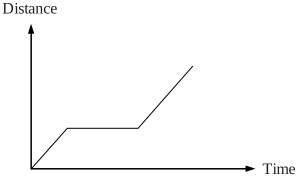
Elvis walks from his home to the beach through a park.


Which of the following situations best fits the distance/time graph above, where distance is Elvis' distance from home?

  1. Elvis ran to the park, sat down on a bench, and then ran home.
  2. Elvis walked to the park, sat down on a bench, then ran to the beach.
  3. Elvis ran to the beach, sat down, then ran home.
  4. Elvis walked to the park, sat down on a bench, then walked to the beach.
Show Answers Only

\(D\)

Show Worked Solution

\(\text{The horizontal section of the graph indicates Elvis’ distance}\)

\(\text{from home is not changing and he is resting.}\)

\(\text{The slope before and after the rest break is the same, so Elvis’}\)

\(\text{speed of travel was the same before and after the rest.}\)


\(\therefore\ \text{Elvis walked, rested then walked.}\)

 
\(\Rightarrow D\)

Filed Under: Rates Tagged With: num-title-ct-core, smc-4609-10-Distance/Time graphs, smc-4609-50-Word problems rates

Copyright © 2014–2025 SmarterEd.com.au · Log in