Find the range of \(g(f(x))\), given \(f(x)=\dfrac{3}{x-1}\) and \(g(x)=x+5\). (2 marks)
--- 8 WORK AREA LINES (style=lined) ---
Aussie Maths & Science Teachers: Save your time with SmarterEd
Find the range of \(g(f(x))\), given \(f(x)=\dfrac{3}{x-1}\) and \(g(x)=x+5\). (2 marks)
--- 8 WORK AREA LINES (style=lined) ---
Given that \(f(x)=x^2+1\) and \(g(x)=x+2\), determine \(f(g(x))\) and its range. (2 marks)
--- 5 WORK AREA LINES (style=lined) ---
If \(f(x)=x^2-3\) and \(g(x)=\sqrt{x-2}\), --- 3 WORK AREA LINES (style=lined) --- --- 2 WORK AREA LINES (style=lined) ---
Given `f(x) = sqrtx` and `g(x) = 25 - x^2`
--- 2 WORK AREA LINES (style=lined) ---
--- 3 WORK AREA LINES (style=lined) ---
Given `f(x) = sqrt (x^2 - 9)` and `g(x) = x + 5`
--- 4 WORK AREA LINES (style=lined) ---
--- 6 WORK AREA LINES (style=lined) ---
| a. | `f(g(x))` | `= sqrt {(x + 5)^2 – 9}` |
| `= sqrt (x^2 + 10x + 16)` | ||
| `= sqrt {(x + 2) (x + 8)}` |
`:. c = 2, d = 8 or c = 8, d = 2`
b. `text(Find)\ x\ text(such that:)`
`(x+2)(x+8) >= 0`

`(x + 2) (x + 8) >= 0\ \ text(when)`
`x <= -8 or x >= -2`
`:.\ text(Domain:)\ \ x<=-8\ \ and\ \ x>=-2`
Let `f(x) = log_e(x)` for `x>0,` and `g (x) = x^2 + 1` for all `x`.
--- 2 WORK AREA LINES (style=lined) ---
--- 4 WORK AREA LINES (style=lined) ---
--- 4 WORK AREA LINES (style=lined) ---
Let `f(x) = sqrt(x + 1)` for `x>=0`
--- 4 WORK AREA LINES (style=lined) ---
--- 6 WORK AREA LINES (style=lined) ---
i. `text(Sketch of)\ \ f(x):`
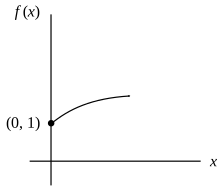
`:.\ text(Range:)\ \ y>= 1`
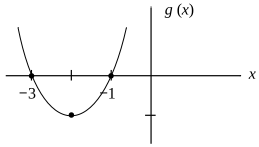
ii. `text(Sketch)\ \ g(x) = (x + 1) (x + 3)`
`text(Domain of)\ \ f(x):\ \ x>=0`
`text(Find domain of)\ g(x)\ text(such that range)\ g(x):\ y>=0`
`text(Graphically, this occurs when)\ \ g(x)\ \ text(has domain:)`
`x <= –3\ \ text(and)\ \ x>=-1`
`:. c = -3`