SmarterEd

Aussie Maths & Science Teachers: Save your time with SmarterEd

  • Login
  • Get Help
  • About

STD1 Snapshot: S2 Fundamental Understanding

IMPORTANT FEATURES AND TIPS FROM EXAM HISTORY

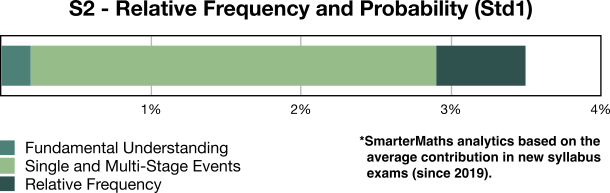
  • S2 Relative Frequency and Probability has accounted for an average of 3.5% per Std1 exam since the new course was introduced in 2019. 
  • S2 Relative Frequency and Probability is split into the following two sub-topics for the purposes of this analysis: 1-Fundamental Understanding (0.2%), 2-Relative Frequency (0.6%) and 3-Single and Multi-stage Events (2.7%).
  • This analysis looks at the minor topic area of Fundamental Understanding.

ANALYSIS - What to Expect and Common pitfalls

  • Fundamental Understanding was examined for first time in the 2024 Std1 exam.
  • Students need to have a solid conceptual understanding of what ranges are possible for probability (in particular, they cannot > 1) and what probabilities represent likely or unlikely events.
  • A minor contributor where most of the database is taken from past Std2 HSC exams. 
Filed Under: Fundamental Understanding (Std 1) Tagged With: worksheet-preamble

ENGINEERING, TE Communication Snapshot

HISTORICAL CONTRIBUTION

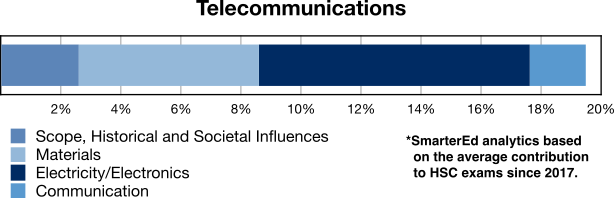
  • Telecommunications has contributed an average of 19.0% per HSC Engineering exam since 2017.
  • This topic has been split into four subtopics for analysis purposes which are: 1-Scope, Historical and Societal Influences (2.6%), 2-Materials (6.0%), 3-Electricity/Electronics (9.0%) and 4-Communication (1.9%).
  • This analysis looks at the subtopic, Communication.

HSC ANALYSIS - What to expect and common pitfalls

  • Communication is a minor contributing topic within Telecommunications that has nonetheless appeared in longer response questions three times in the last 5 years (most recently in 2024).
  • Pictoral sketching given orthoganol drawings/views is the key skill of this topic area (review 2024 HSC 23c, 2022 HSC 22d and 2020 HSC 27b).

Filed Under: Communication Tagged With: worksheet-preamble

ENGINEERING, TE Electricity/Electronics Snapshot

HISTORICAL CONTRIBUTION

  • Telecommunications has contributed an average of 19.0% per HSC Engineering exam since 2017.
  • This topic has been split into four subtopics for analysis purposes which are: 1-Scope, Historical and Societal Influences (2.6%), 2-Materials (6.0%), 3-Electricity/Electronics (9.0%) and 4-Communication (1.9%).
  • This analysis looks at the subtopic Electricity/Electronics.

HSC ANALYSIS - What to expect and common pitfalls

  • Electricity/Electronics is the largest contributing topic within the Telecommunications module, averaging over two longer response and two multiple-choice questions per year in the period 2020-24.
  • Radio transmission was examined via multiple-choice in 2024 but more importantly, attracted significant mark allocations in the 2019-2020 period (review the 9-mark 2019 HSC 26b).
  • Television/Telephony has been examined broadly (most recently in 2023). Students have been tested on their knowledge of increasing antennae strength, 5G vs 4G networks, benefits of digital transmission and placement of repeater transmitters on a mobile phone tower.
  • Logic Gates/Circuits have been examined every year since 2017 in questions worth anywhere from 1-5 marks that typically test in the band 4-5 difficulty range. 
  • Satellites have appeared in the last 5 HSC exams, including 2023 HSC 25c and 2021 HSC 24c that tested the basic principles of GPS positioning and low orbit telecommunication systems, producing sub-50% mean marks.
  • Circuits were tested in the 2022-23 exams but absent in 2024. An important theme looks at the identification and function of various diodes.

Filed Under: Electricity/Electronics Tagged With: worksheet-preamble

ENGINEERING, TE Materials Snapshot

HISTORICAL CONTRIBUTION

  • Telecommunications has contributed an average of 19.0% per HSC Engineering exam since 2017.
  • This topic has been split into four subtopics for analysis purposes which are: 1-Scope, Historical and Societal Influences (2.6%), 2-Materials (6.0%), 3-Electricity/Electronics (9.0%) and 4-Communication (1.9%).
  • This analysis looks at the subtopic, Materials.

HSC ANALYSIS - What to expect and common pitfalls

  • Materials have been examined in at least one longer response question per exam in the period 2020-24 (absent only in 2019) as well as multiple-choice question(s) every year over the same period.
  • Specialised testing questions have looked at voltage (2021 HSC 24b) and insulation testing (review the challenging 2022 HSC 25a) .
  • Insulation and Polymers have been examined in 5 of the last 6 exams in a mixture of mid-difficulty longer answer and multiple-choice. Justifying the use of a material by specifying its properties is a consistent theme.
  • Fibre optics have been examined 5 times in the last 6 years, causing problems on a majority of occasions (review 2021 HSC 26d, 2024 HSC 17 MC and 2022 HSC 14 MC).
  • Copper and its alloys are a semi-regular contributor with some important revision questions that caused problems (see 2021 HSC 15 MC, 2018 HSC 19 MC and 2020 HSC 21d).
  • Semi-conductors were examined in the 2024 HSC after a long absence ("must review" question, see 2017 HSC 23b).
  • Device casings are a sneaky contributor to past HSC exams and deserve attention (see 2024 HSC 23d and 2022 HSC 22c).

Filed Under: Materials Tagged With: worksheet-preamble

ENGINEERING, TE Scope, Historical and Societal Snapshot

HISTORICAL CONTRIBUTION

  • Telecommunications has contributed an average of 19.0% per HSC Engineering exam since 2017.
  • This topic has been split into four subtopics for analysis purposes which are: 1-Scope, Historical and Societal Influences (2.6%), 2-Materials (6.0%), 3-Electricity/Electronics (9.0%) and 4-Communication (1.9%).
  • This analysis looks at the subtopic Scope, Historical and Societal Influences.

HSC ANALYSIS - What to expect and common pitfalls

  • Scope, Historical and Societal Influences has been tested via longer answer questions in 4 of the last 5 years (including twice in 2024 and 2020) as well as occasional multiple-choice.
  • Professional Scope was last examined in 2023 and prior to that, twice in the 2020 exam. 2020 HSC 5 MC produced a mean mark of just 40% and deserves attention.
  • Innovation within the Telecommunications sector has been tested three times since 2020. Themes include satellite coverage of rural areas (2024 HSC 24), ethical considerations around smart watch development (2022 HSC 22a) and choose and explain any innovation in voice communications (2020 HSC 21a).
  • Historical Developments from morse code to bakelite phones to smart phones formed the basis of 2016 HSC 22a and should be reviewed.

Filed Under: Scope, Historical and Societal Influences Tagged With: worksheet-preamble

ENGINEERING, PPT Communication Snapshot

HISTORICAL CONTRIBUTION

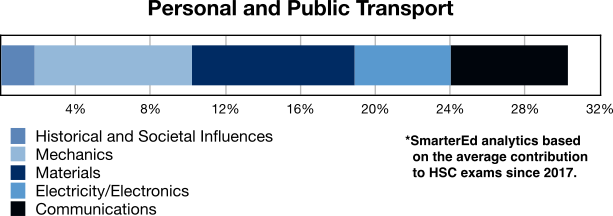
  • Personal and Public Transport has contributed an average of 30.3% per HSC Engineering exam since 2017.
  • This topic has been split into five sub-categories for analysis purposes which are: 1-Historical and Societal Influences (1.8%), 2-Mechanics (8.4%), 3-Materials (8.7%), 4-Electricity/Electronics (5.1%) and 5-Communication (6.3%).
  • This analysis looks at the subtopic, Communication.

HSC ANALYSIS - What to expect and common pitfalls

  • Sectional views is easily the most examined content area within Communications, attracting a long response question in 8 of the last 9 exams (absent only in 2020).
  • High mark allocations and low mean marks make this a key revision area (review 2024 HSC 27c, 2023 HSC 27b and 2021 HSC 24d). 
  • Orthogonal drawings are another commonly tested subtopic last examined in 2021-22, causing problems on both occasions. 
  • AS 1100 standards, as well as being critical in both Sectional View sketching and Orthogonal Drawings, are also regularly tested in challenging multiple-choice questions (review the difficult 2018 HSC 4 MC).
  • As previously noted, questions in this subtopic have a significant overlap with the Communication subtopic within other Engineering modules due to the extremely broad nature of many of the questions.

Filed Under: Communication Tagged With: worksheet-preamble

ENGINEERING, PPT Electricity/Electronics Snapshot

HISTORICAL CONTRIBUTION

  • Personal and Public Transport has contributed an average of 30.3% per HSC Engineering exam since 2017.
  • This topic has been split into five sub-categories for analysis purposes which are: 1-Historical and Societal Influences (1.8%), 2-Mechanics (8.4%), 3-Materials (8.7%), 4-Electricity/Electronics (5.1%) and 5-Communication (6.3%).
  • This analysis looks at the subtopic, Electricity/Electronics.

HSC ANALYSIS - What to expect and common pitfalls

  • Electrical Systems/Power generation was examined each year in the period 2019-21 but notably not since. Questions may require a "prepared" answer (2016 HSC 22b) or present an applied context (2020 HSC 23c, 2019 HSC 26a).
  • Circuit diagrams have been examined every year since 2018, evenly split between longer answer and multiple-choice.  2023 HSC 23a tested students' knowledge of circuit diagram symbols in a novel way and is important revision.
  • Electrical motors is a regularly examined content area that has significant overlap with multiple other categories in Electricity/Electronics. Generic questions can simply look at the benefits of electric motors (2018 HSC 21b) to more challenging ones that look at how the speed of the motor can be controlled (2020 HSC 26d, 2020 HSC 6 MC)
  • Control technology/Safety within self-driving cars was last examined in 2021 HSC 25a after attracting significant mark allocations in the 2018 exam. An important and topical area for revision attention.

Filed Under: Electricity/Electronics Tagged With: worksheet-preamble

ENGINEERING, PPT Materials Snapshot

HISTORICAL CONTRIBUTION

  • Personal and Public Transport (PPT) has contributed an average of 30.3% per HSC Engineering exam since 2017.
  • This topic has been split into five sub-categories for analysis purposes which are: 1-Historical and Societal Influences (1.8%), 2-Mechanics (8.4%), 3-Materials (8.7%), 4-Electricity/Electronics (5.1%) and 5-Communication (6.3%).
  • This analysis looks at the subtopic, Materials.

HSC ANALYSIS - What to expect and common pitfalls

  • Materials is a major contributor to the PPT module which has averaged two longer answer questions (or part thereof) per exam since 2020, as well as multiple-choice in 7 of the past 8 years.
  • Manufacturing processes for ferrous materials is commonly examined content appearing in every exam between 2020-24, predominantly via longer answer questions.
  • Students should not only be familiar with different manufacturing processes by name (2018 HSC 23a), but also be able to compare processes (2021 HSC 22b) and describe them in step-by-step detail (2020 HSC 24b).
  • Heat treatment of ferrous materials has been examined four times in longer response since 2019 (most recently in 2024).
  • Drawing diagrams to illustrate changes in micro/macrostructure during manufacturing processes is regularly tested and key revision (see 2023 HSC 24b, 2019 HSC 24b and 2022 HSC 23c).
  • Ceramics, laminated glass and polymers have been examined within the context of PPT 5 times in the last 8 years (most recently in 2023).

Filed Under: Materials Tagged With: worksheet-preamble

ENGINEERING, PPT Mechanics Snapshot

HISTORICAL CONTRIBUTION

  • Personal and Public Transport has contributed an average of 30.3% per HSC Engineering exam since 2017.
  • This topic has been split into five sub-categories for analysis purposes which are: 1-Historical and Societal Influences (1.8%), 2-Mechanics (8.4%), 3-Materials (8.7%), 4-Electricity/Electronics (5.1%) and 5-Communication (6.3%).
  • This analysis looks at the subtopic, Mechanics.

HSC ANALYSIS - What to expect and common pitfalls

  • Mechanics has attracted at least one longer answer question every year since 2020 (including 2 in 2023), as well as two multiple-choice questions most years.
  • Simple Machines look at mechanical advantage, velocity ratio and efficiency and have been examined in 7 of the last 8 years, primarily via multiple-choice. Note that longer answer questions appeared in 2022 and 2017 (review the challenging 2017 HSC 21c).
  • Friction is a consistently tested concept, appearing in 4 of the last 5 HSC exams (most recently in 2024). Within this area, students must be competent in dealing with normal forces, inclined planes and labelling diagrams with forces (2023 HSC 25d a high band test of this area).
  • Work, Energy and Power calculations were tested 4 times in the last 6 years (most recently in 2024). Sub-50% mean marks on a majority of these occasions make this subtopic an important revision focus area.
  • Conservation of Energy is an important concept that was tested within Mechanics in 2023 (mean mark 48%) and each year between 2017-2019.

Filed Under: Mechanics Tagged With: worksheet-preamble

ENGINEERING, PPT Historical and Societal Snapshot

HISTORICAL CONTRIBUTION

  • Personal and Public Transport has contributed an average of 30.3% per HSC Engineering exam since 2017.
  • This topic has been split into five sub-categories for analysis purposes which are: 1-Historical and Societal Influences (1.8%), 2-Mechanics (8.4%), 3-Materials (8.7%), 4-Electricity/Electronics (5.1%) and 5-Communication (6.3%).
  • This analysis looks at the smallest subtopic, Historical and Societal Influences.

HSC ANALYSIS - What to expect and common pitfalls

  • Historical and Societal Influences is easily the smallest contributor to this topic area, accounting for an average of 1.8% per exam.
  • Transport system development and innovation are very closely related and have been tested through the development of the bicycle (2020 and 2017) and roller-coaster (2023) . 
  • The environment and in particular, the CO2 emissions of various modes of transport is important revision which has been tested in four questions since 2016.
  • 2016 HSC 27b is a must review 7-mark question in this area that covers both emissions in multiple transport modes and the engineering innovation response.

Filed Under: Historical and Societal Influences Tagged With: worksheet-preamble

ENGINEERING, AE Communication Snapshot

HISTORICAL CONTRIBUTION

  • Aeronautical Engineering has contributed an average of 23.5% per HSC Engineering exam since 2017.
  • This topic has been split into four sub-topics for analysis purposes which are: 1-Scope, Historical and Societal Influences (3.9%), 2-Mechanics and Hydraulics (8.0%), 3-Materials (6.5%) and 4-Communication (5.1%).
  • This analysis looks at the subtopic, Communication.

HSC ANALYSIS - What to expect and common pitfalls

  • Communication within the Aeronautical Engineering module has appeared in the longer answer section each year in the period 2019-24 (notably three times in 2023) as well as via multiple-choice in a majority of exams.
  • Transition pieces is regularly tested, appearing every year between 2022-24 (the challenging 2022 HSC 27b is a "must review" question).
  • Orthogonal Drawings were tested in 2020 and caused problems (review 2020 HSC 21c).
  • CAD is a sneaky contributor, examined in the longer section in the 2022-24 papers in 2-3 mark low-band questions. 
  • It must be noted that questions in this subtopic have a significant overlap with Scope, Historical and Societal Influences within the Aeronautical module, as well as the Communication subtopic within other Engineering modules due the broad nature of questions in this area.

Filed Under: Communication Tagged With: worksheet-preamble

ENGINEERING, AE Materials Snapshot

HISTORICAL CONTRIBUTION

  • Aeronautical Engineering has contributed an average of 23.5% per HSC Engineering exam since 2017.
  • This topic has been split into four sub-categories for analysis purposes which are: 1-Scope, Historical and Societal Influences (3.9%), 2-Mechanics and Hydraulics (8.0%), 3-Materials (6.5%) and 4-Communication (5.1%).
  • This analysis looks at the subtopic, Materials.

HSC ANALYSIS - What to expect and common pitfalls

  • Specialist testing of aircraft materials was last examined in a 2022 multiple-choice question and before that in a more substantial 4-mark question looking at landing gear testing (2020 HSC 22c).
  • Metal Alloys and the change in their properties under different treatments attracted significant mark allocations in the period 2017-2019 which should be the basis of any revision of this content area.
  • 2019 HSC 25b and 2019 HSC 24a both required comparisons between metal alloys and other composites such as carbon fibre and deserve revision attention.
  • Thermosetting polymers have been tested in 2023 and 2021, with 2023 HSC 21d a "must review" question that produced a state mean mark of just 36%.
  • Students must be able to efficiently summarise the manufacturing and in-service benefits of composites such as Kevlar, carbon fibre (2021 HSC 23d) and FML (2024 HSC 22d). Manufacturing descriptions have caused particular issues and 2017 HSC 22b and 2016 HSC 25aii are important revision examples.
  • Corrosion has been examined 3 times in the last 5 years (most recently 2022). Questions range from high difficulty multiple-choice (2017 HSC 17 MC) to 2-3 mark longer response (2022 HSC 24b, 2021 HSC 23a).

Filed Under: Materials Tagged With: worksheet-preamble

ENGINEERING, AE Mechanics and Hydraulics Snapshot

HISTORICAL CONTRIBUTION

  • Aeronautical Engineering has contributed an average of 23.5% per HSC Engineering exam since 2017.
  • This topic has been split into four sub-topics for analysis purposes which are: 1-Scope, Historical and Societal Influences (3.9%), 2-Mechanics and Hydraulics (8.0%), 3-Materials (6.5%) and 4-Communication (5.1%).
  • This analysis looks at the largest sub-topic, Mechanics and Hydraulics.

HSC ANALYSIS - What to expect and common pitfalls

  • Fundamental flight mechanics of lift, thrust and drag represent the most commonly tested content within Mechanics and Hydraulics. A heavily examined content area appearing in both the longer answer and multiple-choice sections in 5 of the last 6 years (absent only in 2020).
  • While a majority of this subject is examined within an aeroplane context, we note that drones (2016), hydrofoils (2019) and yachts (2019) have also featured and should be revised.
  • Bending Stress returned in 2024 in a challenging 6-mark question after an absence of 4 years (review the challenging 2024 HSC 26c and 2019 HSC 24c).
  • Propulsion Systems were examined via multiple-choice in 2024 and each year in the period 2018-20, as well as a broad descriptive 3-mark question in 2018 HSC 25a. 
  • Fluid Mechanics has been examined in 5 out of the last 6 years, including longer answer questions in the 2020 and 2017 exams. 2024 HSC 8 MC, 2023 HSC 6 MC and 2020 HSC 22d each caused problems and are "must review" questions in this area.

Filed Under: Mechanics and Hydraulics Tagged With: worksheet-preamble

ENGINEERING, AE Scope, Historical and Societal Snapshot

HISTORICAL CONTRIBUTION

  • Aeronautical Engineering has contributed an average of 23.5% per HSC Engineering exam since 2017.
  • This topic has been split into four sub-categories for analysis purposes which are: 1-Scope, Historical and Societal Influences (3.9%), 2-Mechanics and Hydraulics (8.0%), 3-Materials (6.5%) and 4-Communication (5.1%).
  • This analysis looks at the subtopic Scope, Historical and Societal Influences.

HSC ANALYSIS - What to expect and common pitfalls

  • Innovation is easily the most examined content area, appearing in the longer response section in 4 exams since 2019 (most recently in 2023).
  • Questions can be extremely broad and allow students to select their own pre-prepared examples of innovation (2020 HSC 22a) or refer to specific component design such as propellers (2022 HSC 24a).
  • Innovation within the context of yacht design was the subject of two 3-mark questions in 2019 that deserve revision attention.
  • Professional Scope has attracted a multiple-choice question in 3 of the last 5 years (most recently in 2021).
  • Historical Development has looked at the materials that are used to make aeroplane wings (2020) and a comparison of flight control systems (2016). The latter required a contrast of two given systems and we recommend students review the table format as an efficient and effective answer strategy.
  • Aircraft Safety was examined in 2024 and 2021, looking at black box data recorders (on two separate occasions) and a broad question requiring examples of the ways engineers have improved safety (see 2021 HSC 23b).

Filed Under: Scope, Historical and Societal Influences Tagged With: worksheet-preamble

ENGINEERING, CS Communication Snapshot

HISTORICAL CONTRIBUTION

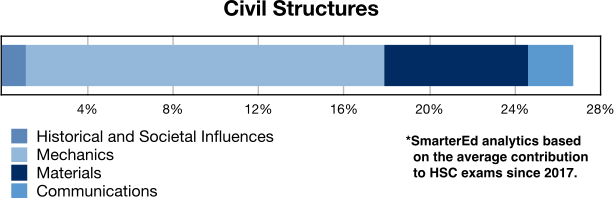
  • Civil Structures has contributed an average of 26.7% per HSC Engineering exam since 2017.
  • This topic has been split into four sub-categories for analysis purposes which are: 1-Historical and Societal Influences (1.1%), 2-Mechanics (16.8%), 3-Materials (6.7%) and 4-Communication (2.1%).
  • This analysis looks at the subtopic, Communication.

HSC ANALYSIS - What to expect and common pitfalls

  • AS 1100 standards are the most examined content area within Communication, appearing 5 times in the last 8 years (most recently in 2024), predominantly in multiple-choice.
  • Students should have an efficient summary of the general benefits of AS 1100 standards prepared (2016 HSC 23a) as well as an in-depth knowledge of specific drawing representations.
  • Orthogonal Drawings have been examined in both longer answer (most recently 2024) and multiple-choice questions (see 2024 HSC 21d, 2020 HSC 24d and the challenging 2020 HSC 17 MC).
  • Questions looking at Freehand Drawing and CAD can be broad enough to apply to the Communication subtopic of all Engineering Modules. 2021 HSC 27 is a classic example, attracting a huge 8-mark allocation. We recommend students prepare efficient summaries of this topic area that they can quickly synthesise into specific questions.

Filed Under: Communication Tagged With: worksheet-preamble

ENGINEERING, CS Materials Snapshot

HISTORICAL CONTRIBUTION

  • Civil Structures has contributed an average of 26.7% per HSC Engineering exam since 2017.
  • This topic has been split into four sub-categories for analysis purposes which are: 1-Historical and Societal Influences (1.1%), 2-Mechanics (16.8%), 3-Materials (6.7%) and 4-Communication (2.1%).
  • This analysis looks at the subtopic, Materials.

HSC ANALYSIS - What to expect and common pitfalls

  • Materials has contributed an average of two longer answer questions per exam since 2016 as well as an average of 1.5 multiple-choice questions.
  • Concrete is the most commonly tested content area, appearing in the multiple-choice section in 2023-24 and 3-mark longer answer questions in 2020-2021 (review the difficult 2021 HSC 21c).
  • Specialised Testing has been examined in challenging multiple-choice questions each year between 2018-2021, together with a 4-mark longer response question in 2019 HSC 21c that caused problems and deserves attention.
  • Laminates (including laminated timber) are a commonly tested composite, examined in longer response questions 4 times in the last 6 years, most recently in 2023 in a broad "provide suitable building materials" style question. 
  • Geotextiles were examined in the longer answer section of the 2024 exam and via multiple-choice in 2022. An important area that can attract high mark allocations on occasion (review 2016 HSC 23b).
  • Corrosion was examined in 2024 and 2020-21. 2020 HSC 26a is a "must review" question that required examples (plural) of corrosion prevention.
  • Other Materials/Composites have looked at treated pine and asphalt in the last decade, with meaningful mark allocations on both occasions. 

Filed Under: Engineering Materials Tagged With: worksheet-preamble

ENGINEERING, CS Mechanics Snapshot

HISTORICAL CONTRIBUTION

  • Civil Structures has contributed an average of 26.7% per HSC Engineering exam since 2017.
  • This topic has been split into four sub-categories for analysis purposes which are: 1-Historical and Societal Influences (1.1%), 2-Mechanics (16.8%), 3-Materials (6.7%) and 4-Communication (2.1%).
  • This analysis looks at the largest subtopic, Mechanics.

HSC ANALYSIS - What to expect and common pitfalls

  • Mechanics within the Civil Structures Module is the 550-pound Silverback of the Engineering rainforest that beats its chest every year! It is comfortably the largest contributing subtopic within any module, accounting for a huge 16.8% of the exam since 2017.
  • Truss Analysis has been examined with significant mark allocations every year between 2019-2024. Question difficulty is typically at the band 5-6 level making this a critical revision area.
  • Bending Stress induced by point loads is another commonly tested content area (last examined in 2024). Students must be confident in drawing both shear force and bending moment diagrams which have both been required in the same question in 4 of the last 7 exams (most recently in 2023).
  • Shear and Compressive Stress has been examined in longer answer questions worth 2-3 marks in 5 of the last 7 exams (most recently in 2024). Historically, this content has proven challenging and deserves revision attention.
  • Stress-strain analysis, calculations and diagrams represent another important subtopic which has also consistently produced low mean marks and should be a revision focus.

Filed Under: Engineering Mechanics Tagged With: worksheet-preamble

ENGINEERING, CS History and Society Snapshot

HISTORICAL CONTRIBUTION

  • Civil Structures has contributed an average of 26.7% per HSC Engineering exam since 2017.
  • This topic has been split into four sub-categories for analysis purposes which are: 1-Historical and Societal Influences (1.1%), 2-Mechanics (16.8%), 3-Materials (6.7%) and 4-Communication (2.1%).
  • This analysis looks at the smallest subtopic, Historical and Societal Influences.

HSC ANALYSIS - What to expect and common pitfalls

  • Historical and Societal Influences is a minor contributor to Civil Structures that has been examined almost exclusively via multiple-choice with the exception of 2024 and 2021 where it was tested in a 2-mark low difficulty questions.
  • The most common content area examined looks at different types of bridges, their characteristics and associated structural advantages (most recently examined in 2023).
  • The chronology of the use of building materials such as stone, timber, iron, cast steel and stainless steel was tested twice in 2019 multiple-choice and deserves revision attention.

Filed Under: Historical and Societal Influences Tagged With: worksheet-preamble

STD1 Snapshot: F3 Credit Cards

IMPORTANT FEATURES AND TIPS FROM EXAM HISTORY

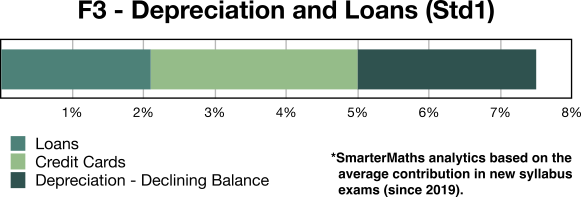
  • F3 Depreciation and Loans has accounted for a substantial average of 7.7% per Std1 exam since it was introduced in 2019.
  • We have split this area into its three subtopics for analysis purposes: 1-Loans (2.1%), 2-Credit Cards (2.9%) and 3-Declining Balance Depreciation (2.7%).
  • This analysis looks at the topic Credit Cards.

ANALYSIS - What to Expect and Common pitfalls

  • Credit cards have been examined in the longer answer section of 4 of the 6 new syllabus Std1 exams to date (most recently 2024), as well as via multiple-choice in 2023 Std1 5 MC.
  • Each longer answer question involved a combination of high mark allocations and (very) low mean marks, making it an important topic area for revision.
  • Calculating daily interest rates is a core competency that is required in every credit card question.
  • Applying the correct number of days for compounding formula has proven very challenging for a majority of students and represents another key revision area.
  • 2021 Std1 30 and 2019 Std1 32 required students to calculate a credit card's minimum payment. Revision attention required here.

Filed Under: Credit Cards (Std 1) Tagged With: worksheet-preamble

EXT2 N2 Snapshot: Geometrical Implications

HISTORICAL CONTRIBUTION

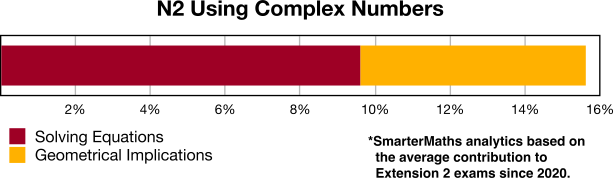
  • N2 Using Complex Numbers has contributed a substantial 15.6% per new syllabus Ext2 exam since it was introduced in 2020.
  • We have split this topic into two categories for analysis purposes which are: 1-Solving Equations With Complex Numbers (9.6%) and 2-Geometrical Implications of Complex Numbers (6.0%).
  • This analysis looks at Geometrical Implications of Complex Numbers.

HSC ANALYSIS - What to expect and common pitfalls

  • Geometrical Implications of Complex Numbers (6.0%) surprised to the upside in the 2023-24 period with a total of 5 longer answer questions and 2 multiple choice questions appearing over this time.
  • An important take home in looking at this topic area is the high level of difficulty of the questions, with sub-25% mean marks not uncommon (see 2023 Ext2 16a, 2022 Ext2 16a and 2021 Ext2 16c).
  • Sketching regions has been examined four times, most recently in 2024. Revision should include questions in a broad spectrum from band 3 to band 6 difficulty. 
  • Exponential form and the geometrical rotation of associated complex numbers featured in 2023 Ext2 16a and 2020 Ext2 14a. These questions proved very challenging to most students and should appear in any revision set.
  • 2021 Ext2 10 MC combined both vectors and complex numbers in a high difficulty question deserving attention.

Filed Under: Geometrical Implications of Complex Numbers Tagged With: worksheet-preamble

EXT2 N2 Snapshot: Solving Equations With Complex Numbers

HISTORICAL CONTRIBUTION

  • N2 Using Complex Numbers has contributed a substantial 15.6% per new syllabus Ext2 exam since it was introduced in 2020.
  • We have split this topic into two categories for analysis purposes which are: 1-Solving Equations With Complex Numbers (9.6%) and 2-Geometrical Implications of Complex Numbers (6.0%).
  • This analysis looks at the largest subtopic, Solving Equations With Complex Numbers.

HSC ANALYSIS - What to expect and common pitfalls

  • Solving Equations With Complex Numbers (9.6%) is the Huon pine of N2 Using Complex Numbers, contributing an average of two longer answer questions each new syllabus exam, as well as multiple choice questions in 4 out of 5 years.
  • Finding quadratic roots is the most common question type, tested every new syllabus exam except 2024 (review the difficult 2022 Ext2 13c(ii)).
  • Cubic roots and greater have also been prominent, appearing every year since 2021. 2024 Ext2 16b and 2022 Ext2 16d represent two extremely challenging questions in this area.
  • Exponential form has been explicitly required within questions in this topic area every year (see 2023 Ext2 12d, 2022 Ext2 12e and 2021 Ext2 14c) as well as being a strategy choice that simplifies calculations in many instances (see 2022 Ext2 16d).
  • A deep understanding of conjugate roots is critical to success in this topic, and has been a feature of solving questions in 4 of the last 5 years.
  • This is a topic area where examiners can throw the kitchen sink at students! 2024 Ext2 16d and 2022 Ext2 16d are two great examples of the higher levels of difficulty possible.

Filed Under: Solving Equations with Complex Numbers Tagged With: worksheet-preamble

EXT2 Snapshot: N1 Arithmetic of Complex Numbers

HISTORICAL CONTRIBUTION

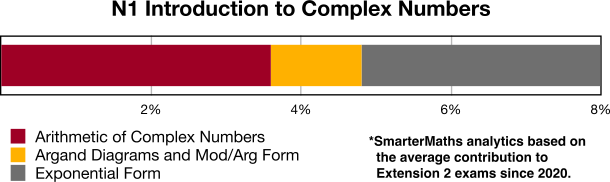
  • N1 Introduction to Complex Numbers has contributed 8.0% per new syllabus Ext2 exam since it was introduced in 2020.
  • We have split this topic into three categories for analysis purposes which are: 1-Arithmetic of Complex Numbers (3.6%), 2-Argand Diagrams and Mod/Arg Form (1.2%) and 3-Exponential Form (3.2%).
  • This analysis looks at Arithmetic of Complex Numbers.

HSC ANALYSIS - What to expect and common pitfalls

  • Arithmetic of Complex Numbers (3.6%) is the closest thing that can be described as low hanging fruit in the Extension 2 course. It has been examined in the longer answer section of each new syllabus exam (including twice in 2024 and 2021).
  • This topic requires core competency in calculations involving complex numbers and basic operators, as well as factorisation and dealing with conjugates.
  • 2023 Ext2 14a(i) required the conversion from exponential form to cartesian form and proof of an identity (as part of a larger cross topic question) and deserves revision attention.
  • Calculations involving the modulus of a complex number is a core skill. 2024 Ext2 12c tested this content to a higher degree of difficulty and is important revision.
  • A relatively challenging area in this topic is calculating the square root of a complex number in form  `z=a+ib` (see 2021 Ext2 11d).

Filed Under: Arithmetic of Complex Numbers Tagged With: worksheet-preamble

EXT2 Snapshot: V1 Vectors and Vector Equations of Lines

HISTORICAL CONTRIBUTION

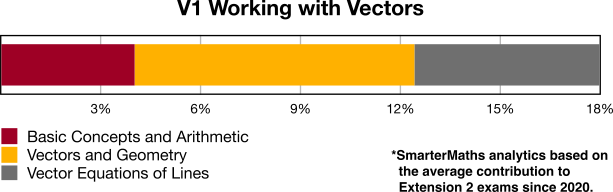
  • V1 Working With Vectors has contributed an impressive 18.0% per new syllabus Ext2 exam since it was introduced in 2020.
  • We have split this topic into three categories for analysis purposes which are: 1-Basic Concepts and Arithmetic (4.0%), 2-Vectors and Geometry (8.4%) and 3-Vectors and Vector Equations of Lines (5.6%).
  • This analysis looks at Vectors and Vector Equations of Lines.

HSC ANALYSIS - What to expect and common pitfalls

  • Vectors and Vector Equations of Lines (5.6%) has appeared in the longer answer section of every new syllabus exam so far (including 3 questions in 2024) as well as further multiple choice questions in three of those years.
  • Competency in calculations relating to parallel vectors (2023, 2022), perpendicular vectors (2024, 2021) and vector intersection (2024, 2020) is required. Most are low difficulty examiner gifts worth 2–3 marks, although 2024 Ext2 12e and 2023 Ext2 5 MC are more challenging and warrant specific attention.
  • Finding the equation of a line between 2 points has been examined three times, most recently in 2024, and is key revision.
  • Converting from vector to Cartesian form (and less often vice versa) is an important skill that has already been required in 2 separate questions (2020 Ext2 3 MC and 2022 Ext2 11e).
  • Identifying the position vector of a curve was a challenging multiple choice in 2021 Ext2 7 MC and deserves revision attention.

Filed Under: Vectors and Vector Equations of Lines Tagged With: worksheet-preamble

EXT2 Snapshot: V1 Vectors and Geometry

HISTORICAL CONTRIBUTION

  • V1 Working With Vectors has contributed an impressive 18.0% per new syllabus Ext2 exam since it was introduced in 2020.
  • We have split this topic into three categories for analysis purposes which are: 1-Basic Concepts and Arithmetic (4.0%), 2-Vectors and Geometry (8.4%) and 3-Vectors and Vector Equations of Lines (5.6%).
  • This analysis looks at Vectors and Geometry.

HSC ANALYSIS - What to expect and common pitfalls

  • Vectors and Geometry (8.4%) is the new 600-pound Silverback in the Ext2 rainforest that beat its chest big time in 2023-24 with multiple high mark, high difficulty questions in each exam!
  • This topic area has seen consistently low mean marks produced in new syllabus exams. Its importance in differentiating the best exam papers cannot be overstated.
  • While the scope of questions examiners can ask is extremely broad, we have categorised them into 2D and 3D shapes which is a good starting point for structured revision in our view.
  • The most common question type has looked at pyramids, both square (2021) and triangular (2023, 2022).
  • 2D quadrilaterals and triangles were the subject of 2024 Ext2 14e, 2023 Ext2 11d and 2020 Ext2 15b. A deep understanding in working with ratios is a key skill for success here.
  • 2023 Ext2 15c and 2021 Ext2 16a looked at spheres and both caused major issues.

Filed Under: Vectors and Geometry Tagged With: worksheet-preamble

EXT2 Snapshot: V1 Basic Concepts and Arithmetic

HISTORICAL CONTRIBUTION

  • V1 Working With Vectors has contributed an impressive 18.0% per new syllabus Ext2 exam since it was introduced in 2020.
  • We have split this topic into three categories for analysis purposes which are: 1-Basic Concepts and Arithmetic (4.0%), 2-Vectors and Geometry (8.4%) and 3-Vectors and Vector Equations of Lines (5.6%).
  • This analysis looks at Basic Concepts and Arithmetic.

HSC ANALYSIS - What to expect and common pitfalls

  • Basic Concepts and Arithmetic (4.0%) has been examined in longer answer questions in every new syllabus Ext2 exam to date, as well as multiple choice in 3 of the last 5 years.
  • While a majority of questions have been examiner softballs in the band 2–3 difficulty range, difficulty has sporadically been dialled up (see 2024 Ext2 12a and 2023 Ext2 10 MC). 
  • Angles between vectors has been the most commonly tested topic, examined and well answered each year in the period 2020-2023 (we note the 2024 question was an outlier of high difficulty).
  • Vector projection appeared in the longer answer section for the first time in 2024 Ext2 12a. Prior to that, 2021 Ext2 10 MC combined complex numbers with this concept in a very challenging question (mean mark 30%).

Filed Under: Basic Concepts and Arithmetic Tagged With: worksheet-preamble

EXT2 Snapshot: C1 Recurrence Relations

HISTORICAL CONTRIBUTION

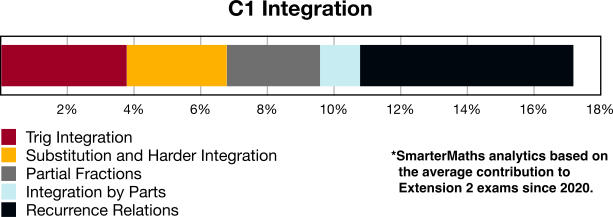
  • C1 Integration has contributed a highly significant 17.2% per new syllabus Ext2 exam since it was introduced in 2020.
  • We have split this topic into five categories for analysis purposes which are: 1-Trig Integration (3.8%), 2-Substitution and Harder Integration (3.0%), 3-Partial Fractions (2.8%), 4-Integration by Parts (1.2%) and 5-Recurrence Relations (6.4%).
  • This analysis looks at the largest sub-topic Recurrence Relations.

HSC ANALYSIS - What to expect and common pitfalls

  • Recurrence Relations (6.4%) has received significant mark allocations in all new syllabus exams to date, a trend we fully expect to continue.
  • Recurrence Relations regularly appear in large cross topic questions that have incorporated Induction (2022), Solids of Revolution (2021) and multiple other challenging proofs (2020).
  • The most common underlying equations have been log and exponentials (2023, 2022 and 2021). Although generally well answered, 2023 Ext2 15a is the exception and deserves specific revision attention.
  • Trig underlying equations are much less common but deserve attention as they have proved very challenging when asked (see 2020 Ext2 16b).
  • Due to the high mark allocations and relative difficulty of this topic, it is a key revision focus area where students can outperform.

Filed Under: Recurrence Relations Tagged With: worksheet-preamble

EXT2 Snapshot: C1 Integration By Parts


HISTORICAL CONTRIBUTION

  • C1 Integration has contributed a highly significant 17.2% per new syllabus Ext2 exam since it was introduced in 2020.
  • We have split this topic into five categories for analysis purposes which are: 1-Trig Integration (3.8%), 2-Substitution and Harder Integration (3.0%), 3-Partial Fractions (2.8%), 4-Integration by Parts (1.2%) and 5-Recurrence Relations (6.4%).
  • This analysis looks at Integration by Parts.

HSC ANALYSIS - What to expect and common pitfalls

  • Integration by Parts (1.2%) has been examined in new syllabus exams via multiple choice twice (most recently in 2024) and a 3-mark longer answer question in 2020.
  • This modest contribution belies its importance as it is tested virtually every year within the much larger Recurrence Relation topic which is covered in a separate analysis.
  • This topic area is typically examined at the band 3-4 difficulty level. One exception is 2014 Ext2 16c which combines substitution with integration by parts and represents the upper most level of difficulty students will encounter.

Filed Under: Integration By Parts Tagged With: worksheet-preamble

EXT2 Snapshot: C1 Partial Fractions

HISTORICAL CONTRIBUTION

  • C1 Integration has contributed a highly significant 17.2% per new syllabus Ext2 exam since it was introduced in 2020.
  • We have split this topic into five categories for analysis purposes which are: 1-Trig Integration (3.8%), 2-Substitution and Harder Integration (3.0%), 3-Partial Fractions (2.8%), 4-Integration by Parts (1.2%) and 5-Recurrence Relations (6.4%).
  • This analysis looks at Partial Fractions.

HSC ANALYSIS - What to expect and common pitfalls

  • Partial Fractions (2.8%) has been examined in each exam between 2024-2021 in band 3 difficulty questions worth 3–4 marks each (absent in 2020).
  • In each new syllabus exams to date, no indication of the structure of the partial fraction was provided although historically this guidance is given half the time.
  • This question type is typically examined around the band 3–4 level of difficulty and represents Extension 2's version of low lying fruit. We note that the difficulty level is sometimes ratcheted up. 2011 Ext2 7b is case in point which produced a 36% mean mark and deserves attention.
  • The database provides questions where the denominator is a quadratic as well as the slightly more difficult cubic/degree 4 denominators. Any revision should cover multiple examples of both types.

Filed Under: Partial Fractions Tagged With: worksheet-preamble

EXT2 Snapshot: C1 Substitution and Harder Integration

HISTORICAL CONTRIBUTION

  • C1 Integration has contributed a highly significant 17.2% per new syllabus Ext2 exam since it was introduced in 2020.
  • We have split this topic into five categories for analysis purposes which are: 1-Trig Integration (3.8%), 2-Substitution and Harder Integration (3.0%), 3-Partial Fractions (2.8%), 4-Integration by Parts (1.2%) and 5-Recurrence Relations (6.4%).
  • This analysis looks at Substitution and Harder Integration.

HSC ANALYSIS - What to expect and common pitfalls

  • Substitution and Harder Integration (3.0%) has been tested via longer answer questions in 4 out of 5 new syllabus exams as well as multiple choice questions in two of those years.
  • Substitutions may be explicit (2022 Ext2 15c) or students will need to identify an appropriate substitution themselves (2024 Ext2 15d, 2023 Ext2 13a and 2021 Ext2 13b). The database includes numerous examples of both.
  • Exposure to a wide array of underlying functions and the strategies required to manipulate them into identifiable integrals is key to success in this area. This process will test student knowledge of trig identities as well as manipulation of challenging logs and exponential expressions.
  • 2022 Ext2 5 MC and 2020 Ext2 10 MC provide novel challenges for students in this topic area and deserve particular attention.

Filed Under: Substitution and Harder Integration Tagged With: worksheet-preamble

EXT2 Snapshot: C1 Trig Integration


HISTORICAL CONTRIBUTION

  • C1 Integration has contributed a highly significant 17.2% per new syllabus Ext2 exam since it was introduced in 2020.
  • We have split this topic into five categories for analysis purposes which are: 1-Trig Integration (3.8%), 2-Substitution and Harder Integration (3.0%), 3-Partial Fractions (2.8%), 4-Integration by Parts (1.2%) and 5-Recurrence Relations (6.4%).
  • This analysis looks at Trig Integration.

HSC ANALYSIS - What to expect and common pitfalls

  • Trig Integration (3.8%) has been examined with dedicated questions every new syllabus exam, including twice in 2022 and 2021.
  • A common question type looks at integrations involving arctan which have appeared via multiple choice (2022 and 2020) and a 2-mark low difficulty question in 2020.
  • The use of  `t = tan\ theta/2` has been required to solve difficult trig integral in 3 out of 5 new syllabus exams. Note that the use of this identity was not specified in any of these questions. Key revision (see 2024 Ext2 11d, 2022 Ext2 11f and 2021 Ext2 14a).
  • Identifying opportunities to complete the square within equations is a critical skill in this topic area. The database includes numerous questions looking at arctan and arcsin/arccos in this key area (see 2020 Ext2 6 MC and 2004 Ext2 1c).

Filed Under: Trig Integration Tagged With: worksheet-preamble

EXT2 Snapshot: M1 Projectile Motion

HISTORICAL CONTRIBUTION

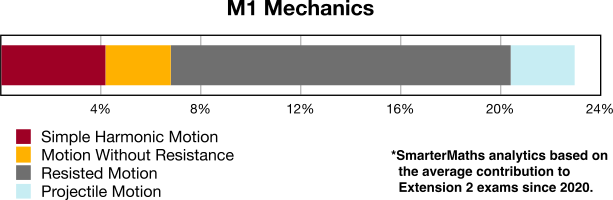
  • M1 Mechanics is the Everest of the Ext2 mountain range, contributing a massive 23.0% per new syllabus Ext2 exam since it was introduced in 2020.
  • We have split this topic into four categories for analysis purposes which are: 1-Simple Harmonic Motion (4.2%), 2-Motion Without Resistance (2.6%), 3-Resisted Motion (13.6%) and 4-Projectile Motion (2.6%).
  • This analysis looks at Projectile Motion.

HSC ANALYSIS - What to expect and common pitfalls

  • Projectile Motion (2.6%) was examined in longer answer questions in 2020 and 2021 (notably absent in 2022-24) with significant allocations of 8 and 5 marks respectively.
  • Projectile motion questions in this section do not include any resistance factors which are covered within the earlier topic of Resisted Motion.
  • The examination of this topic within the new Ext2 syllabus has the following important features: 1-students must be comfortable with the vector expressions of the motion, and 2-challenging proofs have required a deep understanding of discriminants which have been a feature of the solutions.
  • 2021 Ext2 16b deserves particular attention as it provided little scaffolding (i.e. it had no question parts) and caused major problems. Attention to this unscaffolded question style is important revision.
  • The database consists of a majority of questions from the old Ext1 course which remain relevant in our view. These examples can be identified by EXT2* in their title and note all band levels are with reference to Ext1 results data.

Filed Under: Projectile Motion Tagged With: worksheet-preamble

EXT2 Snapshot: M1 Resisted Motion

HISTORICAL CONTRIBUTION

  • M1 Mechanics is the Everest of the Ext2 mountain range, contributing a massive 23.0% per new syllabus Ext2 exam since it was introduced in 2020.
  • We have split this topic into four categories for analysis purposes which are: 1-Simple Harmonic Motion (4.2%), 2-Motion Without Resistance (2.6%), 3-Resisted Motion (13.6%) and 4-Projectile Motion (2.6%).
  • This analysis looks at Resisted Motion.

HSC ANALYSIS - What to expect and common pitfalls

  • Resisted Motion (13.6%) is the Emperor penguin amongst the M1 Mechanics topics (to mix metaphors). It is easily the most examined topic area within M1 Mechanics, averaging over 2.5 longer answer questions per exam.
  • Projectile Motion is the most common question type within Resisted Motion and looks at objects moving with vertical motion against gravity and other factors such as air resistance. The topic represents critical revision and contributed two separate questions in 2024 and 2023.
  • Horizontal motion along a flat or inclined plane (or axis) has been tested in 4 of the last 5 years and is another key focus area for any revision.
  • Important concepts for revision include "terminal velocity" (see 2022 Ext2 10 MC and 2021 Ext2 14b) and "pulleys" (see 2020 Ext2 16a → 37% mean mark).
  • The application of Newton's laws of motion is common. Students were required to apply this knowledge in both the 2022 (twice) and 2020 exams. 
  • The database includes numerous examples where resistance is proportional to velocity (~v), ~ v², and ~constant. Effective revision should include examples of each type.

Filed Under: Resisted Motion Tagged With: worksheet-preamble

EXT2 Snapshot: M1 Motion Without Resistance

HISTORICAL CONTRIBUTION

  • M1 Mechanics is the Everest of the Ext2 mountain range, contributing a massive 23.0% per new syllabus Ext2 exam since it was introduced in 2020.
  • We have split this topic into four categories for analysis purposes which are: 1-Simple Harmonic Motion (4.2%), 2-Motion Without Resistance (2.6%), 3-Resisted Motion (13.6%) and 4-Projectile Motion (2.6%).
  • This analysis looks at Motion Without Resistance.

HSC ANALYSIS - What to expect and common pitfalls

  • Motion Without Resistance (2.6%) has appeared in the longer answer section of 3 of the last 5 new syllabus Ext2 exams, in addition to a multiple choice question in all but one of those years.
  • 2023 Ext2 12c involved an inclined plane in this topic for the first time and proved challenging. An important revision question.
  • Otherwise, this topic is as easy as Mechanics will get and presents a great opportunity for students to score high marks.
  • Examiners have tested students in 3-mark longer answer questions in 2022 and 2020 at the band 3 difficulty level, with a slightly higher band 4 difficulty for the multiple choice questions.
  • 2020 Ext2 8 MC involved motion along a curve described with velocity and acceleration vectors. Revision attention recommended.

Filed Under: Motion Without Resistance Tagged With: worksheet-preamble

EXT2 Snapshot: M1 Simple Harmonic Motion

HISTORICAL CONTRIBUTION

  • M1 Mechanics is the Everest of the Ext2 mountain range, contributing a massive 23.0% per new syllabus Ext2 exam since it was introduced in 2020.
  • We have split this topic into four categories for analysis purposes which are: 1-Simple Harmonic Motion (4.2%), 2-Motion Without Resistance (2.6%), 3-Resisted Motion (13.6%) and 4-Projectile Motion (2.6%).
  • This analysis looks at Simple Harmonic Motion.

HSC ANALYSIS - What to expect and common pitfalls

  • Simple Harmonic Motion (4.2%) has appeared in the longer answer section of each new syllabus exam (twice in 2023), as well as additional multiple choice question in 3 of those years.
  • New syllabus questions have ranged between band 3 difficulty (see 2024 Ext2 5 MC and 2023 Ext2 11e) and band 5–6 (see 2023 Ext2 14b and 2021 Ext2 13d).
  • 2022 Ext2 15b involved a novel real world example of pistons, looking at resultant force. With a mean mark of 50% it deserves revision attention.
  • The database contains many relevant questions from old syllabus Ext1 exams which can be identified by having EXT2* in their title (note that the band levels and mean marks are taken from Ext1 results).

Filed Under: Simple Harmonic Motion Tagged With: worksheet-preamble

P2 Induction, EXT2 Snapshot

HISTORICAL CONTRIBUTION

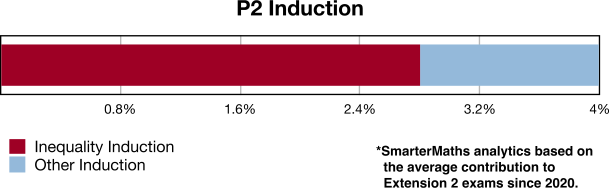
  • P2 Induction has contributed an average of 4.0% per new syllabus Ext2 exam since it was introduced in 2020.

HSC ANALYSIS - What to expect and common pitfalls

  • Induction (4.0%) is a super consistent topic area that has been tested in a longer answer question in each of the last 8 Ext2 exams .
  • Inequality induction proofs are most common question type, appearing in 4 out of 5 new syllabus exams (absent only in 2022). 
  • Recurrence relations featured in both 2022 questions in this topic area and proved challenging. 2022 Ext2 14b(iv) (cross topic calculus question) and 2022 Ext1 13b had mean marks of 50% and 58% respectively and deserve attention.
  • Other induction proofs that NESA guidance recommends involve geometry and calculus (see EQ-Bank questions) as well as traditional themes of divisibility and trigonometry.
  • Proficiency at handling sigma notation is a key competence in this area and a sub-category has been created in the database to interrogate this specific skill.
  • Historically, Ext2 induction questions have ranged from band 4 level difficulty to extremely challenging. With an expectation of this topic continues to appear consistently, a revision focus will be rewarded.

Filed Under: P2 Induction (Ext2) Tagged With: worksheet-preamble

P1 Converse, Contradiction, EXT2 Snapshot

HISTORICAL CONTRIBUTION

  • P1 Nature of Proof has contributed a surprising average of 14.2% per new syllabus Ext2 exam since it was introduced in 2020.
  • This topic has been split into two categories for analysis purposes: 1-Proof and Inequalities (8.6%) and 2-Converse, Contradiction and Contrapositive Proof (5.6%).
  • This analysis looks at Converse, Contradiction and Contrapositive Proof.

HSC ANALYSIS - What to expect and common pitfalls

  • Converse, Contradiction and Contrapositive Proof (5.6%) has averaged just over one longer answer question in addition to two multiple choice per new syllabus Ext2 exam.
  • Contrapositive Proof has easily been the most common question type appearing in two questions of each exam between 2020–22 (absent 2023–24). While most were low-mid band and well handled, 2020 Ext2 15a and 2021 Ext2 9 MC both produced sub-50% mean marks and deserve revision attention.
  • Converse Proofs have appeared in each new syllabus exam and been generally well answered although 2022 Ext2 7 MC and 2020 Ext2 15a were challenging outliers (note the latter combined converse and contrapositive proofs).
  • Contradiction can have broad applications for proof (see 2020 Ext2 7 MC and 2021 Ext2 5 MC), with its most important being for proof of irrationality, examined in 2023 Ext2 12a and 2020 Ext2 14d. 

Filed Under: Converse, Contradiction and Contrapositive Proof Tagged With: worksheet-preamble

P1 Inequalities, EXT2 Snapshot

HISTORICAL CONTRIBUTION

  • P1 Nature of Proof has contributed a surprising average of 14.2% per new syllabus Ext2 exam since it was introduced in 2020.
  • This topic has been split into two categories for analysis purposes: 1-Proof and Inequalities (8.6%) and 2-Converse, Contradiction and Contrapositive Proof (5.6%).
  • This analysis looks at Proof and Inequalities.

HSC ANALYSIS - What to expect and common pitfalls

  • Proof and Inequalities (8.6%) is the 18 foot saltwater croc in the Extension 2 estuary that has come out to feed big time in new syllabus exams.
  • In the last 4 years, this topic area has averaged over two longer answer questions and an additional multiple choice per exam. The mark allocations to this topic area have surprised to the upside and look set to continue, in our view.
  • Question difficulty has been across the whole spectrum, ranging from band 2 to band 6.
  • A common question type requires students to use the non-negativity property of squares, asked in moderate (2023 Ext2 12b) to low difficulty examples (2022 Ext2 12a and 2020 Ext2 13c) in new syllabus exams to date.
  • Proofs using a given equation have regularly appeared in high difficulty 3-5 mark questions (see 2023 Ext2 16b, 2022 Ext2 16c and 2021 Ext2 15a). 
  • Triangle inequality proofs were required in 2022 Ext2 15d and 2021 within a cross-topic vector themed example.
  • The database contains a rich history of past Ext2 inequality proof questions that cover many proofs utilising  `a > b`  and  arithmetic/geometric mean properties on top of the above examples highlighted. 

Filed Under: Proof and Inequalities Tagged With: worksheet-preamble

EXT1 C3 Snapshot: Applications of Differential Equations

HISTORICAL CONTRIBUTION

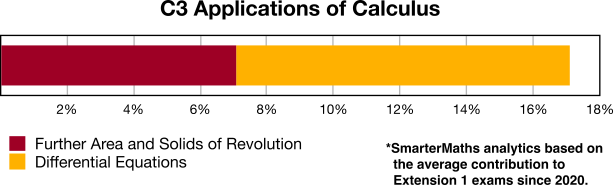
  • C3 Application of Calculus is the 880-pound Silverback of the Extension 1 course, contributing a huge 17.1% per new syllabus Ext1 exam since the new course began in 2020.
  • This topic has been split into two sub-categories for analysis purposes which are: 1-Further Areas and Solids of Revolution (7.1%) and 2-Differential Equations (10.0%).
  • This analysis looks at a sub-topic of Differential Equations → Applications (4.3%).

HSC ANALYSIS - What to expect and common pitfalls

  • Applications of Differential Equations (4.3%) have appeared in the longer answer section of a majority new syllabus exams, most recently in 2024.
  • 2023 Ext1 13a tested students in a flow in/flow out scenario that caused serious problems. Revision attention is a must here!
  • 2021 Ext1 14b looked at population growth in a 4-mark question that proved challenging (45% mean mark).
  • The NESA Ext1 C3 Topic Guidance includes "mixing problems" within its exemplar questions section (p.10) and numerous database examples cover this question type.
  • This is a key revision focus area which has the potential to combine significant mark allocations with high difficulty. 

Filed Under: Applications of Differential Equations Tagged With: worksheet-preamble

CHEMISTRY M8 Snapshot: Chemical Synthesis and Design

HISTORICAL CONTRIBUTION

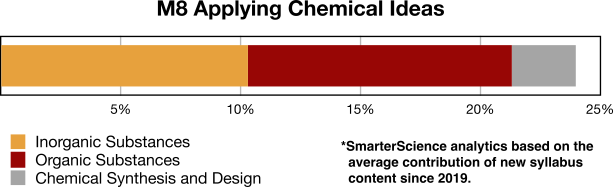
  • M8 Applying Chemical Ideas has contributed an average of 24.0% per HSC Chemistry exam since the new syllabus was introduced in 2019.
  • This topic has been split into three sub-categories for analysis purposes which are: 1-Inorganic Substances (10.3%), 2-Organic Substances (11.0%) and 3-Chemical Synthesis and Design (2.7%).
  • This analysis looks at the sub-topic, Chemical Synthesis and Design.

HSC ANALYSIS - What to expect and common pitfalls

  • Chemical Synthesis and Design is not a large contributor to new syllabus HSC exams, but nonetheless has appeared in four exams since 2019 (most recently in 2024).
  • Designing a Chemical Synthesis Process is the main concept examined, appearing four times in the longer response section of the paper and attracting meaningful mark allocations on each occasion.
  • Particular attention should be given to 2022 HSC 33, an extended response question that specifically requires student to address factors that cover most syllabus dot points in this area. A mean mark of 52% and huge allocation of 8 marks make this a particularly important revision example.

Filed Under: Chemical Synthesis and Design Tagged With: worksheet-preamble

CHEMISTRY M8 Snapshot: Organic Substances

HISTORICAL CONTRIBUTION

  • M8 Applying Chemical Ideas has contributed an average of 24.0% per HSC Chemistry exam since the new syllabus was introduced in 2019.
  • This topic has been split into three sub-categories for analysis purposes which are: 1-Inorganic Substances (10.3%), 2-Organic Substances (11.0%) and 3-Chemical Synthesis and Design (2.7%).
  • This analysis looks at the sub-topic, Organic Substances.

HSC ANALYSIS - What to expect and common pitfalls

  • Organic Substances has been thoroughly tested via two longer answer questions in each new syllabus exam since 2019, as well as averaging 2.5 multiple-choice questions per paper over the same period.
  • Combining (Spectroscopic) Techniques is easily the most important question type, given significant 5–9 mark allocations every year of the new syllabus. The technique combinations are varied and the importance of this key revision area cannot be overstated.
  • Students are required to deduce the identity of an organic compound(s) given multiple techniques looking at the relevant spectra. This area has proven very challenging to a majority of students and represents critical revision (see 2024 HSC 38, 2023 HSC 36, 2022 HSC 30, 2021 HSC 29 and 2020 HSC 30).
  • Individual (vs combined) spectroscopic techniques have only been examined in longer answer questions on two occasions (see 2024 HSC 33b and 2023 HSC 28b).
  • Individual spectroscopic techniques have, however, been regularly examined via multiple choice questions with \(^{13}\text{C NMR, }^{1}\text{H NMR}\) and Mass Spectrometry the most common. 
  • A minor part of this topic involves chemical testing for the Carbon-Carbon Double Bond, Hydroxyl Group and Carboxylic Acid Group (review 2021 HSC 21 and 2019 HSC 19).

Filed Under: Organic Substances Tagged With: worksheet-preamble

CHEMISTRY M8 Snapshot: Inorganic Substances

HISTORICAL CONTRIBUTION

  • M8 Applying Chemical Ideas has contributed an average of 24.0% per HSC Chemistry exam since the new syllabus was introduced in 2019.
  • This topic has been split into three sub-categories for analysis purposes which are: 1-Inorganic Substances (10.3%), 2-Organic Substances (11.0%) and 3-Chemical Synthesis and Design (2.7%).
  • This analysis looks at the sub-topic, Inorganic Substances.

HSC ANALYSIS - What to expect and common pitfalls

  • Inorganic Substances has been tested in at least one longer answer question every year and an average of two multiple choice questions per paper (we note a high of 4 MC questions appeared in the 2022 exam!).
  • Tests for Ions in Solution is a commonly assessed concept which requires students to deduce the identity of a specific ion, or analyse a method used to identity a specific ion using their knowledge of solubility rules and flame tests. 
  • Tests for Ions in Solution attracted a significant 4-mark allocation in 2024 HSC 27 (also review the challenging 2020 HSC 22 and 2021 HSC 30).
  • Gravimetric Analysis is another common question-type where students are required to mathematically analyse a solution given the mass of a final dried, weighed sample (see 2022 HSC 28 and 2021 HSC 28).
  • Colourimetry, UV-Vis and AAS are regularly examined through multiple choice questions with the exception of 2024 HSC 25 and 2019 HSC 29 longer answer questions (consistent sub-50% mean marks flag this important revision area).
  • Precipitation Titrations were last examined in the longer answer section in 2023 and 2020, producing low mean marks on both occasions. 

Filed Under: Inorganic Substances Tagged With: worksheet-preamble

CHEMISTRY M7 Snapshot: Polymers

HISTORICAL CONTRIBUTION

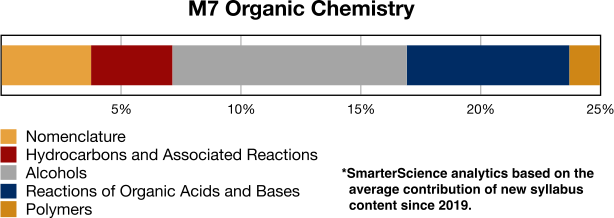
  • M7 Organic Chemistry has contributed an average of 25.0% per HSC Chemistry exam since the new syllabus was introduced in 2019.
  • This topic has been split into five sub-categories for analysis purposes which are: 1-Nomenclature (3.7%), 2-Hydrocarbons and Associated Reactions (3.4%), 3-Alcohols (9.8%), 4-Reactions of Organic Acids and Bases (6.8%) and 5-Polymers (1.3%).
  • This analysis looks at the smallest sub-topic, Polymers.

HSC ANALYSIS - What to expect and common pitfalls

  • Polymers has only contributed 1.3% to new syllabus exams to date which is below its old-syllabus historical average and belies its importance, in our view.
  • Revision attention is warranted due to the topic's potential for long response questions, examples of which are included in the database.
  • Addition Polymers and Condensation Polymers have been examined via multiple choice in 5 of 6 new syllabus exams. We also note that Addition Polymers were examined for the first time in the longer answer section of new syllabus exams in 2024.
  • A common question style involves requiring students to deduce the monomer(s) that a given polymer is made up from.
  • We recommend careful attention be paid to 2022 HSC 18 MC which assessed Condensation Polymers and exposed a knowledge gap (state mean mark 23%).

Filed Under: Polymers Tagged With: worksheet-preamble

CHEMISTRY M7 Snapshot: Reactions of Organic Acids and Bases

HISTORICAL CONTRIBUTION

  • M7 Organic Chemistry has contributed an average of 25.0% per HSC Chemistry exam since the new syllabus was introduced in 2019.
  • This topic has been split into five sub-categories for analysis purposes which are: 1-Nomenclature (3.7%), 2-Hydrocarbons and Associated Reactions (3.4%), 3-Alcohols (9.8%), 4-Reactions of Organic Acids and Bases (6.8%) and 5-Polymers (1.3%).
  • This analysis looks at the sub-topic, Reactions of Organic Acids and Bases.

HSC ANALYSIS - What to expect and common pitfalls

  • Esters is easily the most commonly assessed concept within this sub-topic (notably absent 2023-24). Questions deal mainly with the chemical reaction used to form an ester as well as the reflux process for esterification.
  • Reaction Pathways which lead up to an ester synthesis were tested in 2021 and 2019. This area deserves revision attention due to high mark allocations and low mean marks (see 2021 HSC 26 and 2019 HSC 34). An understanding of the reflux technique is important (see 2016 HSC 22c).
  • Boiling Point has been examined in 4 of the 6 new syllabus exams, including twice in longer answer questions (see 2024 HSC 24 and 2020 HSC 32). Students must have a clear and concise explanation of intermolecular forces within this context.
  • Soaps and Detergents has only appeared via multiple choice on one occasion since 2019. We see scope for a longer answer examination of this topic area and believe it warrants attention (review M7 Q-Bank 21).
  • A review of 2019 HSC 21 is recommended as it proved challenging for a majority of students and is a reminder that reactions of ketones and aldehydes are explored in this sub-topic. 

Filed Under: Reactions of Organic Acids and Bases Tagged With: worksheet-preamble

CHEMISTRY M7 Snapshot: Alcohols

HISTORICAL CONTRIBUTION

  • M7 Organic Chemistry has contributed an average of 25.0% per HSC Chemistry exam since the new syllabus was introduced in 2019.
  • This topic has been split into five sub-categories for analysis purposes which are: 1-Nomenclature (3.7%), 2-Hydrocarbons and Associated Reactions (3.4%), 3-Alcohols (9.8%), 4-Reactions of Organic Acids and Bases (6.8%) and 5-Polymers (1.3%).
  • This analysis looks at the sub-topic, Alcohols.

HSC ANALYSIS - What to expect and common pitfalls

  • Alcohols is the blue whale in the M7 Organic Chemistry ocean, responsible for approximately 10% of the exam just on its own. A key revision focus area!
  • Reactions of Alcohols is the largest sub-category, examined each year in the period 2019-22 predominantly via high-mark cross-topic questions (see 2019 HSC 34).
  • Students are regularly required to draw the structural formulae of a given reactions (review the challenging 2020 HSC 29 and 2021 HSC 26).
  • Combustion has been tested in 5 of 6 new syllabus exams. Mark allocations have been significant on most occasions with difficulty typically at the band 4-5 level.
  • Oxidation of Alcohols was last examined in 2024 via multiple-choice. Any revision should focus on the numerous questions that appeared in the 2021-22 exams. 
  • Production of Alcohol was last examined in 2023 and 2021 with 4-mark allocations on each occasion (review the challenging 2023 HSC 27 and 2021 HSC 25).

Filed Under: Alcohols Tagged With: worksheet-preamble

CHEMISTRY M7 Snapshot: Hydrocarbons and Associated Reactions

HISTORICAL CONTRIBUTION

  • M7 Organic Chemistry has contributed an average of 25.0% per HSC Chemistry exam since the new syllabus was introduced in 2019.
  • This topic has been split into five sub-categories for analysis purposes which are: 1-Nomenclature (3.7%), 2-Hydrocarbons and Associated Reactions (3.4%), 3-Alcohols (9.8%), 4-Reactions of Organic Acids and Bases (6.8%) and 5-Polymers (1.3%).
  • This analysis looks at the sub-topic, Hydrocarbons and Associated Reactions.

HSC ANALYSIS - What to expect and common pitfalls

  • Hydrocarbons and Associated Reactions has been examined predominantly within the multiple choice section of new syllabus exams, including twice each year between 2021-2023.
  • Longer answer questions looking at this topic area are often within cross-topic contexts rather than dedicated examples, a number of which are included in the database. 
  • Questions looking at Saturated and Unsaturated Hydrocarbons represent the largest contributing sub-topic in this area, with longer answer questions appearing in both the 2021 and 2022 exams.
  • Solubility and Boiling Points have been examined in 4 of the last 6 exams and deserve revision attention.
  • Formulae and molecular shape are often presented in a multiple-choice format. Last examined in 2022, they represent fundamental concepts which have been poorly answered in the past.

Filed Under: Hydrocarbons and Associated Reactions Tagged With: worksheet-preamble

CHEMISTRY M7 Snapshot: Nomenclature

HISTORICAL CONTRIBUTION

  • M7 Organic Chemistry has contributed an average of 25.0% per HSC Chemistry exam since the new syllabus was introduced in 2019.
  • This topic has been split into five sub-categories for analysis purposes which are: 1-Nomenclature (3.7%), 2-Hydrocarbons and Associated Reactions (3.4%), 3-Alcohols (9.8%), 4-Reactions of Organic Acids and Bases (6.8%) and 5-Polymers (1.3%).
  • This analysis looks at the sub-topic, Nomenclature.

HSC ANALYSIS - What to expect and common pitfalls

  • Nomenclature is a modest contributor to the Chemistry exam at 3.7% but importantly provides gateway knowledge to other topics within M7 Organic Chemistry.
  • Isomers is the most common concept assessed within this sub-topic, appearing in nearly every new syllabus exam (notably absent in 2024) and producing low mean marks on most occasions.
  • Isomers have been regularly assessed in the long response section, where students were required to draw all isomers of a given chemical compound or formula (review 2022 HSC 27 and 2019 HSC 21).
  • Naming Halogenated Organic Compounds is another commonly assessed concept, typically appearing in the multiple choice section (review the challenging 2022 HSC 7 MC, 2020 HSC 6 MC and 2016 HSC 11 MC). 
  • Naming other organic chemicals such as alkanes, alkenes, alcohols, ketones and aldehydes etc... should all be covered. Note that each group can be filtered into its own sub-category within the database.

Filed Under: Nomenclature Tagged With: worksheet-preamble

CHEMISTRY M6 Snapshot: Quantitative Analysis

HISTORICAL CONTRIBUTION

  • M6 Properties of Acids and Bases has contributed an average of 26.9% per HSC Chemistry exam since the new syllabus was introduced in 2019.
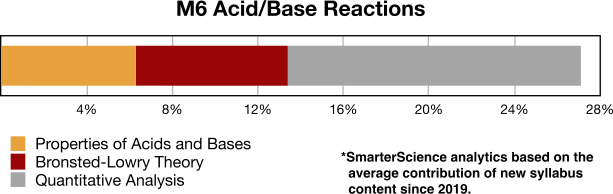
  • This topic has been split into three sub-categories for analysis purposes which are: 1-Properties of Acids and Bases (6.3%), 2-Bronsted-Lowry Theory (7.1%) and 3-Quantitative Analysis (13.7%).
  • This analysis looks at the largest sub-topic, Quantitative Analysis.

HSC ANALYSIS - What to expect and common pitfalls

  • Quantitative Analysis is the 500-pound Silverback in the Chemistry rainforest, attracting the largest average mark allocation per exam of any sub-topic in any module. Its revision importance cannot be overstated.
  • Titration is an important question type, being assessed in difficult 3–8 mark longer answer questions every year of the new syllabus. Mean marks below 50% are common (some well below) and specific revision attention is required here (see 2022 HSC 32 and 2021 HSC 35).
  • Titration Curves and Conductivity Graphs have featured in the multiple choice section every year of the new syllabus as well as the longer answer section in 2024 and 2019. Low state mean marks flag that this area should be well covered in any revision.
  • Difficult calculation and analysis questions involving `K_a` and `K_b` occur frequently, appearing in the long response section in 4 of the last 6 years as well as multiple choice each year between 2021-22. A critical revision area.
  • Buffers is a sneaky contributor to the new syllabus Chemistry exams, appearing twice in longer answer questions and twice in MC (review the challenging 2021 HSC 34 and 2021 HSC 8 MC).

Filed Under: Quantitative Analysis Tagged With: worksheet-preamble

CHEMISTRY M6 Snapshot: Bronsted-Lowry Theory

HISTORICAL CONTRIBUTION

  • M6 Properties of Acids and Bases has contributed an average of 26.9% per HSC Chemistry exam since the new syllabus was introduced in 2019.
  • This topic has been split into three sub-categories for analysis purposes which are: 1-Properties of Acids and Bases (6.3%), 2-Bronsted-Lowry Theory (7.1%) and 3-Quantitative Analysis (13.7%).
  • This analysis looks at the sub-topic, Bronsted-Lowry Theory.

HSC ANALYSIS - What to expect and common pitfalls

  • Bronsted-Lowry Theory is consistently examined, contributing, on average, to 3 longer answer questions (we note that multiple were broad cross-topic examples) and 2 multiple choice questions per year.
  • Calculations Involving pH is a frequently assessed concept within Bronsted-Lowry Theory. It has appeared in three exams in the long response section (most recently in 2024), as well as in the multiple choice section every year.
  • Questions commonly require calculation using `K_a` to determine hydrogen or hydroxide ion concentration, from which pH or pOH can be calculated.
  • Dissociation of Acids and Bases in Water is an important topic area, examined in longer answer questions in 3 of the last 4 HSC exams (most recently in 2024).
  • Questions often assess the reaction between a strong or weak acid with water and the properties of ions formed (review 2024 HSC 28 and 2020 HSC 18 MC).
  • pH of Mixed Solutions has been examined back-to-back in the period 2023-24. Within this topic area, questions that require actual pH calculations have proven challenging in the past and should be emphasised (see 2024 HSC 29 and 2021 HSC 15 MC).

Filed Under: Bronsted-Lowry Theory Tagged With: worksheet-preamble

CHEMISTRY M6 Snapshot: Properties of Acids and Bases

HISTORICAL CONTRIBUTION

  • M6 Properties of Acids and Bases has contributed an average of 26.9% per HSC Chemistry exam since the new syllabus was introduced in 2019.
  • This topic has been split into three sub-categories for analysis purposes which are: 1-Properties of Acids and Bases (6.3%), 2-Bronsted-Lowry Theory (7.1%) and 3-Quantitative Analysis (13.7%).
  • This analysis looks at the sub-topic, Properties of Acids and Bases.

HSC ANALYSIS - What to expect and common pitfalls

  • Properties of Acids and Bases has attracted an average of two longer answer questions and one multiple choice each year since the new syllabus was introduced in 2019.
  • Arrhenius and Bronsted-Lowry is an important concept within this topic area which has been tested in the longer answer section in 4 out of 6 new syllabus exams (most recently in 2023).
  • Typically, questions involve evaluating the usefulness and/or limitations of both models, or writing a chemical equation with reference to the Bronsted-Lowry model (review 2019 HSC 28 - a simple model explanation that was poorly answered).
  • Enthalpy of Neutralisation has attracted significant mark allocations in 2024 and each year in the period between 2020-22. Students should be well versed in this calculation heavy question style which regularly produces sub-50% mean marks (see 2024 HSC 36, 2020 HSC 36 and 2021 HSC 32).
  • Other concepts in Properties of Acids and Bases have not been regularly examined with dedicated questions in new syllabus exams to date, although this area is important gateway knowledge needed in later topics such as Quantitative Analysis.

Filed Under: Properties of Acids and Bases Tagged With: worksheet-preamble

CHEMISTRY M5 Snapshot: Solution Equilibria

HISTORICAL CONTRIBUTION

  • M5 Equilibrium and Acid Reactions has contributed an average of 24.0% per HSC Chemistry exam since the new syllabus was introduced in 2019.
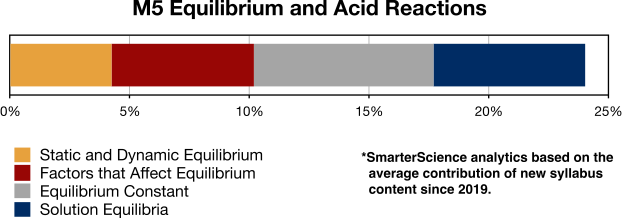
  • This topic has been split into four sub-categories for analysis purposes which are: 1-Static and Dynamic Equilibrium (4.2%), 2-Factors that Affect Equilibrium (6.0%), 3-Equilibrium Constant (7.5%) and 4-Solution Equilibria (6.3%).
  • This analysis looks at the sub-topic, Solution Equilibria.

HSC ANALYSIS - What to expect and common pitfalls

  • Solution Equilibria has been examined in the longer response section of every new syllabus exam to date, as well as two multiple choice questions in 5 of the 6 years.
  • Mixed ionic solutions has been the most commonly tested question type, primarily in the longer answer section of the paper (most recently in 2023). This topic area produces sub-50% mean marks more often than not and must be a revision focus.
  • Questions involving `K_(sp)` calculations are another examiner favourite. This area has received significant mark allocations each year in the period 2021-24 and students must be ready for these calculation-heavy and challenging questions. A critical revision area regularly producing sub-50% mean marks.
  • Concentration graphs is a less commonly examined area that should be covered (see 2020 HSC 20 MC).

Filed Under: Solution Equilibria Tagged With: worksheet-preamble

CHEMISTRY M5 Snapshot: Equilibrium Constant

HISTORICAL CONTRIBUTION

  • M5 Equilibrium and Acid Reactions has contributed an average of 24.0% per HSC Chemistry exam since the new syllabus was introduced in 2019.
  • This topic has been split into four sub-categories for analysis purposes which are: 1-Static and Dynamic Equilibrium (4.2%), 2-Factors that Affect Equilibrium (6.0%), 3-Equilibrium Constant (7.5%) and 4-Solution Equilibria (6.3%).
  • This analysis looks at the sub-topic, Equilibrium Constant.

HSC ANALYSIS - What to expect and common pitfalls

  • Equilibrium Constant has been examined in longer response questions in 5 out 6 new syllabus exams (including 2+ in 2023-24), as well as at least one multiple choice question each year (including two in each year 2022-24).
  • Calculation heavy questions dominate, with students required to either find `K_(eq)` or perform related calculations given `K_(eq)`. High mark allocations and low mean marks make this a key revision focus area.
  • Determining the formation of a precipitate is another key application of `K_(eq)` (review 2019 HSC 17 MC and 2021 HSC 19 MC).
  • Although examiners usually provide the chemical equation when applicable, students should also be prepared to deduce the chemical equation and use in all further calculations. This was required each year from 2019-2021 and produced sub-50% mean marks on each occasion. Attention warranted here.
  • Equilibrium expressions of acid/base reactions and related pH calculations are regularly examined (see 2020 HSC 27 and 2019 HSC 27).

Filed Under: Equilibrium Constant Tagged With: worksheet-preamble

CHEMISTRY M5 Snapshot: Factors that Affect Equilibrium

HISTORICAL CONTRIBUTION

  • M5 Equilibrium and Acid Reactions has contributed an average of 24.0% per HSC Chemistry exam since the new syllabus was introduced in 2019.
  • This topic has been split into four sub-categories for analysis purposes which are: 1-Static and Dynamic Equilibrium (4.2%), 2-Factors that Affect Equilibrium (6.0%), 3-Equilibrium Constant (7.5%) and 4-Solution Equilibria (6.3%).
  • This analysis looks at the sub-topic, Factors that Affect Equilibrium.

HSC ANALYSIS - What to expect and common pitfalls

  • Factors that Affect Equilibrium has been allocated a longer answer question every year in the new syllabus, as well as two multiple choice questions in 5 of the 6 years.
  • Collision theory has been tested in longer answer questions in three new syllabus exams to date (most recently in 2024). Questions require students to be able to concisely explain this theory in multiple contexts.
  • A deep understanding of equilibrium shifts due to changes in temperature, pressure, volume and concentrations is required. An interplay of these changes is common and the dataset provides many examples for revision.
  • Concentration diagrams through equilibrium have proven challenging in the past. Last examined in 2023, a revision focus is warranted here (review 2020 HSC 11 MC, 2019 HSC 25).

Filed Under: Factors that Affect Equilibrium Tagged With: worksheet-preamble

CHEMISTRY M5 Snapshot: Static and Dynamic Equilibrium

HISTORICAL CONTRIBUTION

  • M5 Equilibrium and Acid Reactions has contributed an average of 24.0% per HSC Chemistry exam since the new syllabus was introduced in 2019.
  • This topic has been split into four sub-categories for analysis purposes which are: 1-Static and Dynamic Equilibrium (4.2%), 2-Factors that Affect Equilibrium (6.0%), 3-Equilibrium Constant (7.5%) and 4-Solution Equilibria (6.3%).
  • This analysis looks at the sub-topic, Static and Dynamic Equilibrium.

HSC ANALYSIS - What to expect and common pitfalls

  • Static and Dynamic Equilibrium has been examined in the long response section of every new syllabus exam, as well as the multiple-choice section in 3 of the 6 years.
  • Enthalpy and entropy are easily the most tested concepts, appearing in the longer answer section in 2024 and every year between 2019-2022.
  • We note that within this topic area, combustion reactions, with its own syllabus dot point, deserves specific attention (see 2018 HSC 30).
  • Although less examined, students should have a clear understanding of the differences between open and closed systems (last examined in 2022 HSC 36 with a 49% mean mark).
  • Special attention should be paid to 2019 HSC 30, which required students to compare and contrast the effects of enthalpy and entropy on the solubility of salts (mean mark 34%).

Filed Under: Static and Dynamic Equilibrium Tagged With: worksheet-preamble

BIOLOGY M8 Snapshot: Technologies and Disorders

HISTORICAL CONTRIBUTION

  • M8 Non-Infectious Disease/Disorders has contributed an average of 26.5% per HSC Biology exam since the new syllabus was introduced in 2019.
  • This topic has been split into five sub-categories for analysis purposes which are: 1-Homeostasis (7.4%), 2-Causes and Effects (4.1%), 3-Epidemiology (7.0%), Prevention (2.7%) and 5-Technologies and Disorders (5.3%).
  • This analysis looks at the sub-topic, Technologies and Disorders.

HSC ANALYSIS - What to expect and common pitfalls

  • Technologies and Disorders has been tested in the longer answer section of four new syllabus exams to date, as well as multiple choice every year except 2021.
  • Eyes have been tested predominantly via multiple-choice although we note 2023 HSC 24 presented a 6-mark longer answer question (also review 2018 HSC 31a).
  • Kidneys - the working of this organ and the process of dialysis is important content to cover (see 2022 HSC 20 MC and 2020 HSC 24).
  • Ears have been tested twice in the longer answer section (most recently in 2024) and twice in the MC section.
  • Bone conduction implants (2021 HSC 25) and Cochlear implant technology (2024 HSC 35 and 2019 HSC 6 MC) have both caused problems and deserve attention.

Filed Under: Technologies and Disorders Tagged With: worksheet-preamble

BIOLOGY M8 Snapshot: Prevention

HISTORICAL CONTRIBUTION

  • M8 Non-Infectious Disease/Disorders has contributed an average of 26.5% per HSC Biology exam since the new syllabus was introduced in 2019.
  • This topic has been split into five sub-categories for analysis purposes which are: 1-Homeostasis (7.4%), 2-Causes and Effects (4.1%), 3-Epidemiology (7.0%), Prevention (2.7%) and 5-Technologies and Disorders (5.3%).
  • This analysis looks at the sub-topic, Prevention.

HSC ANALYSIS - What to expect and common pitfalls

  • This is a small topic which has been tested in 4 of the last 6 years in the extended response section (most recently in 2024), albeit as a contributing topic within a broader question on three of these occasions.
  • Educational Programs were the aspect of prevention examined in 2024, 2022 and 2019 and deserve revision attention.
  • Genetic Engineering featured in 2020 HSC 30 which had a significant allocation of 7 marks and was poorly answered (mean mark 44%). This is a "must review" question for any revision of this topic.

Filed Under: Prevention Tagged With: worksheet-preamble

BIOLOGY M8 Snapshot: Epidemiology

HISTORICAL CONTRIBUTION

  • M8 Non-Infectious Disease/Disorders has contributed an average of 26.5% per HSC Biology exam since the new syllabus was introduced in 2019.
  • This topic has been split into five sub-categories for analysis purposes which are: 1-Homeostasis (7.4%), 2-Causes and Effects (4.1%), 3-Epidemiology (7.0%), Prevention (2.7%) and 5-Technologies and Disorders (5.3%).
  • This analysis looks at the sub-topic, Epidemiology.

HSC ANALYSIS - What to expect and common pitfalls

  • Epidemiology has attracted longer answer questions with significant mark allocations in every new syllabus exam to date, as well as multiple choice questions in 4 of those exams.
  • Analysing Results requires students to analyse and interpret both graphical and tabulated results taken from epidemiological studies. Questions regularly require cross topic knowledge and the extrapolation and interpolation of results.
  • 2024 HSC 29, which required students to plot data on a grid and draw a line of best fit, surprisingly caused problems and deserves attention. Other challenging questions in this area with sub-50% mean marks include 2019 HSC 33b and 2023 HSC 16 MC.
  • Evaluating the Method of epidemiological studies has been examined in longer answer questions in each exam between 2021-23. High mark allocations and low mean marks make 2023 HSC 27, 2022 HSC 31a and 2021 HSC 31 critical revision.
  • Treatment/Management of non-infectious diseases has been examined via multiple choice in 2020 and 2021.

Filed Under: Epidemiology Tagged With: worksheet-preamble

BIOLOGY M8 Snapshot: Causes and Effects

HISTORICAL CONTRIBUTION

  • M8 Non-Infectious Disease/Disorders has contributed an average of 26.5% per HSC Biology exam since the new syllabus was introduced in 2019.
  • This topic has been split into five sub-categories for analysis purposes which are: 1-Homeostasis (7.4%), 2-Causes and Effects (4.1%), 3-Epidemiology (7.0%), Prevention (2.7%) and 5-Technologies and Disorders (5.3%).
  • This analysis looks at the sub-topic, Causes and Effects.

HSC ANALYSIS - What to expect and common pitfalls

  • Causes and Effects has been examined in the longer answer section of four new syllabus exams (most recently in 2024) as well as multiple choice questions in 2023 and 2021.
  • Environmental & Nutritional diseases have been tested by asking students to provide a general example (2024 HSC 24), or through a stimulus style question (2020 HSC 27).
  • Genetic Disease/Cancer is a question category that has significant content overlap with modules 5 and 6.
  • 2023 HSC 25c looked at the genetic causes associated with the onset of Huntington's Disease while 2019 HSC 33d looked at factors contributing to Alzheimer's disease. Both represent important revision for this topic area.
  • "Collecting and representing data" (syllabus dot point) has required students to create graphs on a given grid from data tables in both 2024 HSC 29 and 2022 HSC 24. 
  • The unusual "double" multiple choice questions in 2019 HSC 19-20 MC both produced sub-50% mean marks and deserve attention.

Filed Under: Causes and Effects Tagged With: worksheet-preamble

BIOLOGY M8 Snapshot: Homeostasis

HISTORICAL CONTRIBUTION

  • M8 Non-Infectious Disease/Disorders has contributed an average of 26.5% per HSC Biology exam since the new syllabus was introduced in 2019.
  • This topic has been split into five sub-categories for analysis purposes which are: 1-Homeostasis (7.4%), 2-Causes and Effects (4.1%), 3-Epidemiology (7.0%), Prevention (2.7%) and 5-Technologies and Disorders (5.3%).
  • This analysis looks at the sub-topic, Homeostasis.

HSC ANALYSIS - What to expect and common pitfalls

  • Homeostasis has attracted longer answer questions every year of the new syllabus except 2022, and averaged just below two multiple-choice questions per exam.
  • Negative Feedback Loops is regularly examined with meaningful mark allocations. Themes include temperature, blood glucose responses and water balance in plants (review 2021 HSC 32).
  • Temperature & BGL/Diabetes have been tested 4 times since 2019, in both longer answer and multiple choice sections. 2020 HSC 31 is a challenging high-mark example that represents important revision.
  • Water Balance in Plants has been examined four times in new syllabus exams, most recently in 2024 (2019 HSC 29 - key revision).
  • The Nervous System was last examined in 2018 although it appeared in 3 HSC papers between 2014-2018 and revision is recommended.

Filed Under: Homeostasis Tagged With: worksheet-preamble

BIOLOGY M7 Snapshot: Prevention, Control and Treatment

HISTORICAL CONTRIBUTION

  • M7 Infectious Diseases has contributed an average of 24.4% per HSC Biology exam since the new syllabus was introduced in 2019.
  • This topic has been split into three sub-categories for analysis purposes which are: 1-Causes of Infectious Diseases (8.5%), 2-Immunity and Responses to Pathogens (4.9%) and 3-Prevention, Treatment and Control (11.0%).
  • This analysis looks at the largest sub-topic, Prevention, Treatment and Control.

HSC ANALYSIS - What to expect and common pitfalls

  • Prevention, Treatment and Control is the blue whale of the Module 7 ocean, averaging two longer answer (or part thereof) questions and two multiple choice each year.
  • Passive and Active Vaccines consistently attracts high-mark allocations. Efficiency is required in describing antibody mediated responses in this context (see 2021 HSC 28b and 2020 HSC 32c). 
  • Pharmaceuticals requires students to justify, analyse and evaluate the use/overuse of antibiotics and how this can cause antibiotic resistant bacteria (see 2014 HSC 11 and 2020 HSC 22).
  • Procedures to Prevent Spread such as hygiene, quarantine and public health initiatives have been examined in longer answer questions four times (most recently in 2024) as well as via multiple choice in a majority of new syllabus exams.
  • Interpreting Data related to the incidence of infectious disease has been a feature of multiple high-mark questions (see 2024 HSC 27, 2021 HSC 30 and 2019 HSC 32). 
  • An indigenous context within this topic was tested in 2022 HSC 26. 

Filed Under: Prevention, Treatment and Control Tagged With: worksheet-preamble

BIOLOGY M7 Snapshot: Immunity

HISTORICAL CONTRIBUTION

  • M7 Infectious Diseases has contributed an average of 24.4% per HSC Biology exam since the new syllabus was introduced in 2019.
  • This topic has been split into three sub-categories for analysis purposes which are: 1-Causes of Infectious Diseases (8.5%), 2-Immunity and Responses to Pathogens (4.9%) and 3-Prevention, Treatment and Control (11.0%).
  • This analysis looks at the smallest sub-topic, Immunity.

HSC ANALYSIS - What to expect and common pitfalls

  • Immunity is the smallest subtopic within M7 Infectious Diseases which has been tested in longer answer questions (or part thereof) four times in new syllabus exams (most recently in 2024) as well as multiple choice each year between 2022-24.
  • Antibodies/Antibodies mediated represent the most commonly tested content in this topic area, appearing in both longer answer (2024 HSC 32) and multiple-choice format.
  • The Cell Mediated response was examined in a vaccine cross-topic question in 2023 after not being tested in previous years. 2017 HSC 11 MC and 2018 HSC 16 MC both caused problems in this area and deserve revision attention.
  • The Innate Response (2nd line of defence) was a feature of 2024 HSC 32 as well as being regularly tested by multiple choice questions (review 2018 HSC 3 MC and 2019 HSC 5 MC - both were poorly answered).
  • This topic's importance goes beyond its individual contribution as it provides the framework to understand Vaccines (covered in the later topic M7 Prevention, Treatment and Control).

Filed Under: Immunity and Responses to Pathogens Tagged With: worksheet-preamble

  • 1
  • 2
  • 3
  • …
  • 10
  • Next Page »

Copyright © 2014–2025 SmarterEd.com.au · Log in