SmarterEd

Aussie Maths & Science Teachers: Save your time with SmarterEd

  • Login
  • Get Help
  • About

2ADV F2 Snapshot: Transformations

HISTORICAL CONTRIBUTION

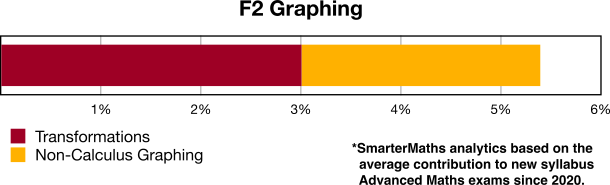
  • F2 Graphing Techniques has contributed an average of 5.4% per Advanced exam since the new syllabus was introduced in 2020.
  • We have split the topic into 2 categories for analysis purposes: 1-Transformations (3.0%) and 2-Non-Calculus Graphing (2.4%).
  • This analysis looks at Transformations.

HSC ANALYSIS - What to expect and common pitfalls

  • Transformations (3.0%) represents new syllabus content that explicitly looks at translations and dilations of several function types.
  • Absolute value graph transformations were last examined in 2023 Adv 27 with a 5-mark allocation. A "must revise" question where part (b) produced a 23% mean mark.
  • Questions typically involve combinations of translations, dilations and/or reflections. Mean marks have hovered around 50% and revision attention is required (see 2022 Adv 19 and 2021 Adv 21).
  • The NESA sample HSC exam has informed F2 EQ-Bank questions which are important revision.
  • We note that Trig transformations, which we regard as an extremely important  transformation sub-topic, are covered separately under T3 Trig Graphs.
Filed Under: Transformations (Y12) Tagged With: worksheet-preamble

2ADV F1 Snapshot: Composite Functions

HISTORICAL CONTRIBUTION

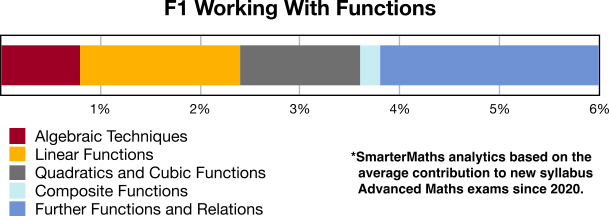
  • F1 Working with Functions is classic low hanging fruit, contributing a healthy 6.0% per exam since the new Advanced syllabus was introduced in 2020.
  • We have split the topic into 5 categories for analysis purposes: 1-Algebraic Techniques (0.8%), 2-Linear Functions (1.6%), 3-Quadratics and Cubic Functions (1.2%), 4-Composite Functions (0.2%) and 5-Further Functions and Relations (2.2%).
  • This analysis looks at Composite Functions.

HSC ANALYSIS - What to expect and common pitfalls

  • Composite Functions was examined for the first (and only) time within F1 Working With Functions in 2022 (important to note here that it has been examined within Calculus in 2023, 2021 and 2020).
  • 2022 Adv 10 MC posed a high difficulty multiple choice question that produced a sub-50% mean mark and deserves close revision attention.
  • Despite a modest contribution to date, we are wary that this area is highly examinable and will be tested more regularly going forward.
  • Revision questions where students need to state the domain and range of composite functions are important. Many examples in the database test this competence.

Filed Under: Composite Functions (Y11) Tagged With: worksheet-preamble

2ADV F1 Snapshot: Further Functions and Relations

HISTORICAL CONTRIBUTION

  • F1 Working with Functions is classic low hanging fruit, contributing a healthy 6.0% per exam since the new Advanced syllabus was introduced in 2020.
  • We have split the topic into 5 categories for analysis purposes: 1-Algebraic Techniques (0.8%), 2-Linear Functions (1.6%), 3-Quadratics and Cubic Functions (1.2%), 4-Composite Functions (0.2%) and 5-Further Functions and Relations (2.2%).
  • This analysis looks at the largest sub-topic, Further Functions and Relations.

HSC ANALYSIS - What to expect and common pitfalls

  • Further Functions and Relations (2.2%) was most recently tested in multiple-choice questions in 2023-24, and in a chunky 4-mark question in 2022.
  • Proportional relationships was examined as an Adv/Std2 common question in 2022 Adv 12 and surprisingly produced a sub-50% mean mark in part (a) which should be reviewed.
  • Absolute value equations can be examined in the new course, although it must be emphasised that absolute value inequality equations have moved to the Ext1 course. 
  • Graphing absolute value equations should be a revision focus in our view, as we expect this skill to be examined more frequently going forward.
  • Reflections require students to graph  `y=–f(x)`  and  `y=f(–x)`  of given equations. Examined in the first new syllabus paper (2020 Adv 24) within the context of a circle function, this question and other reflection examples in the database warrant attention.

Filed Under: Further Functions and Relations (Y11) Tagged With: worksheet-preamble

2ADV F1 Snapshot: Quadratics and Cubics

HISTORICAL CONTRIBUTION

  • F1 Working with Functions is classic low hanging fruit, contributing a healthy 6.0% per exam since the new Advanced syllabus was introduced in 2020.
  • We have split the topic into 5 categories for analysis purposes: 1-Algebraic Techniques (0.8%), 2-Linear Functions (1.6%), 3-Quadratics and Cubic Functions (1.2%), 4-Composite Functions (0.2%) and 5-Further Functions and Relations (2.2%).
  • This analysis looks at Quadratics and Cubic Functions.

HSC ANALYSIS - What to expect and common pitfalls

  • Quadratics and Cubic Functions (1.2%) were last examined via two challenging multiple-choice questions in the 2023 exam.
  • Quadratic factorisation has easily been the most common question style in this sub-topic, appearing in four exams in the last decade.
  • 2023 Adv 10 MC presented the hardest question in this topic for years (mean mark 24%). Review!
  • Students have been tested on the general formula, finding intersections between quadratics and linear graphs and expressing a quadratic's range in set notation (see 2022 Adv 4 MC).
  • Understanding the role of the discriminant (syllabus verbatim) is well covered in the database and under-examined in our view.
  • Identifying the equation of a cubic/quadratic from their graphs was examined in challenging questions in both 2023 and 2021. Important revision examples.

Filed Under: Quadratics and Cubic Functions (Y11) Tagged With: worksheet-preamble

2ADV F1 Snapshot: Linear Functions


HISTORICAL CONTRIBUTION

  • F1 Working with Functions is classic low hanging fruit, contributing a healthy 6.0% per exam since the new Advanced syllabus was introduced in 2020.
  • We have split the topic into 5 categories for analysis purposes: 1-Algebraic Techniques (0.8%), 2-Linear Functions (1.6%), 3-Quadratics and Cubic Functions (1.2%), 4-Composite Functions (0.2%) and 5-Further Functions and Relations (2.2%).
  • This analysis looks at Linear Functions.

HSC ANALYSIS - What to expect and common pitfalls

  • Linear Functions (1.6%) primarily looks at analysing and modelling linear relationships and was last examined in 2024.
  • This area represents common Adv/Std2 content with common questions appearing in 3 of the last 4 years, including a 4-mark allocation in 2020 Adv 11.
  • Modelling and analysis of linear equations looks at numerous Std2 past HSC questions which proved challenging, including breakeven analysis.
  • Although co-ordinate geometry content is diminished, some important areas remain examinable in this area and are covered in the database.
  • NESA's HSC sample exam included a challenging simultaneous equation question. Review F1 EQ-Bank 12 to cover this area.

Filed Under: Linear Functions (Y11) Tagged With: worksheet-preamble

2ADV F1 Snapshot: Algebraic Techniques

HISTORICAL CONTRIBUTION

  • F1 Working with Functions is classic low hanging fruit, contributing a healthy 6.0% per exam since the new Advanced syllabus was introduced in 2020.
  • We have split the topic into 5 categories for analysis purposes: 1-Algebraic Techniques (0.8%), 2-Linear Functions (1.6%), 3-Quadratics and Cubic Functions (1.2%), 4-Composite Functions (0.2%) and 5-Further Functions and Relations (2.2%).
  • This analysis looks at Algebraic Techniques.

HSC ANALYSIS - What to expect and common pitfalls

  • Algebraic Techniques (0.8%) has been a minor contributor to new syllabus exams although it is covers crucial skills required throughout later topics.
  • Surds have traditionally been most common question type but as yet, have not attracted a dedicated in new syllabus exams. We note that prior to 2020, most past questions involved compound surds in the denominator which are no longer examinable.
  • Algebraic Fractions were last examined in the 2021 Advanced paper and deserve attention, particularly as they represent an overlap between the new Advanced and Standard 2 content.
  • Rounding questions can require students to know standard decimal place rounding, significant figures (2019) and scientific notation (2015).

Filed Under: Algebraic Techniques (Y11) Tagged With: worksheet-preamble

2ADV M1 Snapshot: Modelling Investments and Loans

HISTORICAL CONTRIBUTION

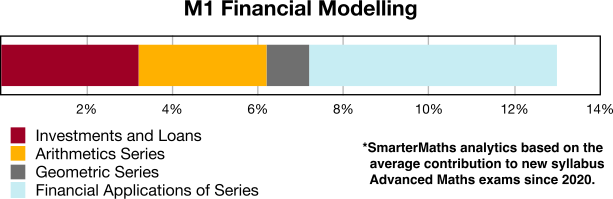
  • M1 Financial Modelling has contributed a substantial 13.0% to new syllabus Advanced exams since it was introduced in 2020.
  • The topic is split into four sub-topics for the purposes of analysis: 1-Investments and Loans (3.2%), 2-Arithmetic Series (3.0%), 3-Geometric Series (1.0%) and 4-Financial Applications of Series (5.8%).
  • This analysis looks at Investments and Loans.

HSC ANALYSIS - What to expect and common pitfalls

  • Investments and Loans (3.2%) has attracted a substantial 4-5 mark longer answer question (note all were common to both Std2/Adv exams) each year in the period 2022-24.
  • The Future Value of an Annuity Table is the most common question type, examined each year between 2021-23. Important revision examples include 2022 Adv 21, 2019 Std2 42 and M1 EQ-Bank 1.
  • Present value interest factors is another important question type, contributing a high difficulty challenge in 2024 Adv 26 (see also 2015 Std2 30c).
  • Applying the compound interest formula  `A=P(1+r)^n`  is a core skill and important revision.
  • Compounded Value of $1 tables has proven challenging in past Std2 exams. Needs to be specifically revised although we note it is yet to appear in an Advanced exam.

Filed Under: Modelling Investments and Loans (Y12) Tagged With: worksheet-preamble

2ADV M1 Snapshot: Arithmetic Series

HISTORICAL CONTRIBUTION

  • M1 Financial Modelling has contributed a substantial 13.0% to new syllabus Advanced exams since it was introduced in 2020.
  • The topic is split into four sub-topics for the purposes of analysis: 1-Investments and Loans (3.2%), 2-Arithmetic Series (3.0%), 3-Geometric Series (1.0%) and 4-Financial Applications of Series (5.8%).
  • This analysis looks at Arithmetic Series.

HSC ANALYSIS - What to expect and common pitfalls

  • Arithmetic Series (3.0%) has been a surprise packet in new syllabus exams, contributing a longer answer question to every new syllabus exam to date.
  • Our original expectation that new syllabus questions would involve arithmetic series applications within a financial context have proven incorrect. As a result, all past HSC questions on this sub-topic represent high quality and relevant revision examples.
  • The recursive definition of an arithmetic sequence is covered in response to syllabus changes. We recommend giving attention to M1 SM-Bank 7 where the straight line depreciation is modelled in this way.
  • A great area to pick up high marks with the typical difficulty around the band 3 level. However, please note the exceptions of 2018 Adv 14d and 2013 Adv 12c where a combination of arithmetic and geometric series caused significant problems and deserve attention.

Filed Under: Arithmetic Series (Y12) Tagged With: worksheet-preamble

2ADV M1 Snapshot: Geometric Series

HISTORICAL CONTRIBUTION

  • M1 Financial Modelling has contributed a substantial 13.0% to new syllabus Advanced exams since it was introduced in 2020.
  • The topic is split into four sub-topics for the purposes of analysis: 1-Investments and Loans (3.2%), 2-Arithmetic Series (3.0%), 3-Geometric Series (1.0%) and 4-Financial Applications of Series (5.8%).
  • This analysis looks at Geometric Series.

HSC ANALYSIS - What to expect and common pitfalls

  • Geometric Series (1.0%) has been examined in the last two Advanced exams after being omitted in the 2020-22 period (note that its significant presence in "Financial Applications of Series" is not considered here but included in later topic analysis).
  • Numerous examples using the recursive definition of a geometric sequence are included to cover syllabus changes and deserve revision attention.
  • Geometric Series has historically been tested in high difficulty cross-topic questions (see our new "X-topic" subcategory). 2024 Adv 30 is a cracking illustration of this that deserves attention.
  • Pitfalls: The summing of a series that incorporated both arithmetic and geometric elements in 2018 Adv 14d caused major problems.
  • Testing "sum to infinity" within the Geometric Series has been an examiner favourite in old syllabus exams (see 2017 Adv 16b).

Filed Under: Geometric Series (Y12) Tagged With: worksheet-preamble

2ADV M1 Snapshot: Financial Applications of Series

HISTORICAL CONTRIBUTION

  • M1 Financial Modelling has contributed a substantial 13.0% to new syllabus Advanced exams since it was introduced in 2020.
  • The topic is split into four sub-topics for the purposes of analysis: 1-Investments and Loans (3.2%), 2-Arithmetic Series (3.0%), 3-Geometric Series (1.0%) and 4-Financial Applications of Series (5.8%).
  • This analysis looks at Financial Applications of Series.

HSC ANALYSIS - What to expect and common pitfalls

  • Financial Applications of Series is examined like clockwork in the new syllabus Advanced exam, accounting for a significant 5.8% of the exam.
  • Students need to be confident in dealing with 3 main question types: 1-Loans, 2-Annuity (growth phase), and 3-Annuity (withdrawal phase).
  • 1-Loans were last examined in 2022 after a six year absence.
  • 2-Annuity (growth phase) was last examined in 2024. Examiners have included a difficult twist involving increasing annuity payments that is important revision (review 2014 Adv 16b).
  • 3-Annuity (withdrawal phase) represents the upper difficulty of this topic area, examined 5 times in 6 years between 2018-23. 2020 Q26 involved an annuity balance expressed as a "recurrence equation" for the 1st time, and is important revision.
  • Pitfalls: Marker's Comments - good setting out and clear handwriting is at a premium with messy working a major contributor to errors. Best practice is illustrated in worked solutions - take note!

Filed Under: Financial Applications of Series (Y12) Tagged With: worksheet-preamble

2ADV S3 Snapshot: Probability Density Functions

HISTORICAL CONTRIBUTION

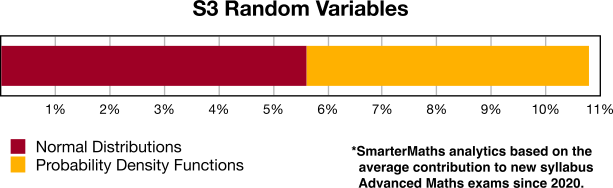
  • S3 Random Variables has contributed a significant 10.8% per new syllabus Advanced exam since it was introduced in 2020.
  • The topic is split into two sub-topics for the purposes of analysis: 1-Normal Distribution (5.6%) and 2-Probability Density Functions (5.2%).
  • This analysis looks at Probability Density Functions.

HSC ANALYSIS - What to expect and common pitfalls

  • Probability Density Functions (5.2%) has been examined in at least one question in each new syllabus exam to date (two in 2022 and 2021).
  • The 2020-24 Advanced exams allocated 4-6 marks to this topic in each exam, producing sub-50% mean marks on every longer answer question.
  • Students must be able to find the median and mode given a probability density function. Mode has been examined each year between 2021-23 and has caused major problems (see 2021 Adv 33 and 2023 Adv 29).
  • Finding mode and other probability percentiles using cumulative distributive functions is a core skill well covered in the database.
  • Students must have a deep understanding of the link between a cumulative distributive functions and their probability density functions, tested three times in the last 4 years and causing major problems. 

Filed Under: Probability Density Functions (Y12) Tagged With: worksheet-preamble

2ADV S3 Snapshot: Normal Distribution

HISTORICAL CONTRIBUTION

  • S3 Random Variables has contributed a significant 10.8% per new syllabus Advanced exam since it was introduced in 2020.
  • The topic is split into two sub-topics for the purposes of analysis: 1-Normal Distribution (5.6%) and 2-Probability Density Functions (5.2%).
  • This analysis looks at Normal Distribution.

HSC ANALYSIS - What to expect and common pitfalls

  • Normal Distribution (5.6%) has been examined in longer answer section of every new syllabus exam to date, as well as multiple choice questions in 2024 and 2020. It has the important characteristics of high mark allocations and low mean marks.
  • The most common question type deals with `z`-score intervals that have featured in longer answer questions in every new syllabus exam to date.
  • A deep understanding of the challenging `z`-score tables has been required in 3 of the last 4 exams and represents critical revision.
  • The Advanced syllabus extends the Std2 syllabus to calculations involving the normal distribution probability density function. The syllabus explicitly mentions this in conjunction with the Trapezoidal Rule (review S3 EQ-Bank 2 and 17).
  • Marker's Comments of note: Graphically representing z-scores on a curve to calculate percentages has been specifically mentioned as a feature of the "more successful" responses in past HSC exams. Heed this advice by including a quick default sketch whenever possible and minimise errors!

Filed Under: Normal Distribution (Y12) Tagged With: worksheet-preamble

2ADV S2 Snapshot: Bivariate Data

HISTORICAL CONTRIBUTION

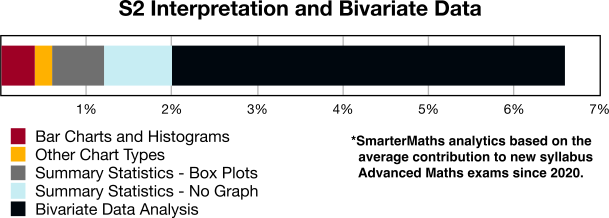
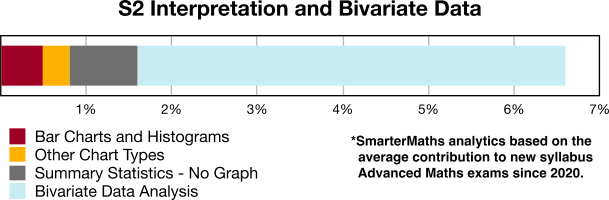
  • S2 Interpretation and Bivariate Data has contributed an average of 6.6% per new syllabus Advanced exam since 2020.
  • We have split the area into six sub-topics for analysis purposes which are: 1-Classifying Data (0%), 2-Bar Charts and Histograms (0.4%), 3-Other Chart Types (0.2%), 4-Summary Statistics - Box Plots (0.6%), 5-Summary Statistics - No Graph (0.8%) and 6-Bivariate Data Analysis (4.6%).
  • This analysis looks at the dominant subtopic in this area, Bivariate Data Analysis.

HSC ANALYSIS - What to expect and common pitfalls

  • Bivariate Data Analysis (4.6%) investigates scatterplots, correlation, lines of best fit, least squares regression analysis etc ... Common Adv-Std2 questions have appeared in every new syllabus exam to date, with significant allocations of between 3-6 marks on each occasion. 
  • The word-heavy narrative style of the 2021 Adv Q17 and 2020 Adv Q27 are both must review questions.
  • 2022 Adv Q24 asked students to "describe and interpret the data and other information provided, with reference to the context given". Answering broad questions like this efficiently is important.
  • Calculating a least squares regression line from raw data is a key skill that students must be able to execute efficiently (see EQ-Bank Q1-3).
  • Pitfalls: Interpreting gradients and identifying limitations of an equation are poorly answered in general and deserve attention.

Filed Under: Bivariate Data Analysis (Y12) Tagged With: worksheet-preamble

2ADV S2 Snapshot: Summary Statistics – Box Plots

HISTORICAL CONTRIBUTION

  • S2 Interpretation and Bivariate Data has contributed an average of 6.6% per new syllabus Advanced exam since 2020.
  • We have split the area into six sub-topics for analysis purposes which are: 1-Classifying Data (0%), 2-Bar Charts and Histograms (0.4%), 3-Other Chart Types (0.2%), 4-Summary Statistics - Box Plots (0.6%), 5-Summary Statistics - No Graph (0.8%) and 6-Bivariate Data Analysis (4.6%).
  • This analysis looks at Summary Statistics - Box Plots.

HSC ANALYSIS - What to expect and common pitfalls

  • Box-plots was meaningfully examined in 2024 for the first time in new syllabus exams.
  • Prior to that, it contributed a small part of a Bivariate Data question in the 2020 paper which is included in a later topic area.
  • Box-plots are a common content area with Std2 that accounted for two common questions in 2024. Worth noting that this sub-topic has also attracted significant 4-6 mark allocations in past Std2 exams.
  • Comparing parallel box plots is easily the most important question type. 2024 Adv 16 required a comparison of box plots in general terms and efficiently structuring an answer to such a question is key revision.

Filed Under: Summary Statistics - Box Plots (Y12) Tagged With: worksheet-preamble

2ADV S2 Snapshot: Summary Statistics – No Graph

HISTORICAL CONTRIBUTION

  • S2 Interpretation and Bivariate Data has contributed an average of 6.6% per new syllabus Advanced exam since 2020.
  • We have split the area into six sub-topics for analysis purposes which are: 1-Classifying Data (0%), 2-Bar Charts and Histograms (0.4%), 3-Other Chart Types (0.2%), 4-Summary Statistics - Box Plots (0.6%), 5-Summary Statistics - No Graph (0.8%) and 6-Bivariate Data Analysis (4.6%).
  • This analysis looks at Summary Statistics - No Graph (0.8%).

HSC ANALYSIS - What to expect and common pitfalls

  • Summary Statistics - No Graph (0.8%) has only been examined in one new syllabus Advanced exam to date, in 2022, where it contributed to two separate questions.
  • We note past Std2 questions have required students to calculate a simple dataset's five-number summary, median, IQR, mean and standard deviation. 
  • An important skill is calculating mean and median changes when a dataset is adjusted.
  • Pitfalls: The 2019 Std2 exam tested students on "outlier" calculations after the 2017 Std2 30a and 2015 Std2 27d exams exposed a lack of understanding in this area.
  • Major issues have been encountered in identifying the IQR of a cumulative frequency table, and finding the mean of grouped data, where students must use the "class centres".  

Filed Under: Summary Statistics - No graph (Y12) Tagged With: worksheet-preamble

2ADV S2 Snapshot: Other Chart Types

HISTORICAL CONTRIBUTION

  • S2 Interpretation and Bivariate Data has contributed an average of 6.6% per new syllabus Advanced exam since 2020.
  • We have split the area into six sub-topics for analysis purposes which are: 1-Classifying Data (0%), 2-Bar Charts and Histograms (0.4%), 3-Other Chart Types (0.2%), 4-Summary Statistics - Box Plots (0.6%), 5-Summary Statistics - No Graph (0.8%) and 6-Bivariate Data Analysis (4.6%).
  • This analysis looks at Other Chart Types.

HSC ANALYSIS - What to expect and common pitfalls

  • Pareto Charts were examined most recently in new syllabus Advanced exams in 2022 with a 3-mark question that involved frequency tables.
  • Pareto Charts represents important common content between the Advanced and Std2 courses and possible regular testing in both exams.
  • Stem & Leaf plots require revision attention and more particularly, Double Stem and Leaf plots, which have caused problems in past Std2 exams.
  • We believe it is unlikely that examiners will test Area charts within the new syllabus, but the generality of the syllabus wording means best practice is briefly covering this graph type.
  • Other charts tested that students have answered well include pie charts, segregated bar charts, step graphs and dot plots.

Filed Under: Other Chart Types (Y12) Tagged With: worksheet-preamble

2ADV S2 Snapshot: Bar Charts and Histograms

HISTORICAL CONTRIBUTION

  • S2 Interpretation and Bivariate Data has contributed an average of 6.6% per new syllabus Advanced exam since 2020.
  • We have split the area into six sub-topics for analysis purposes which are: 1-Classifying Data (0%), 2-Bar Charts and Histograms (0.4%), 3-Other Chart Types (0.2%), 4-Summary Statistics - Box Plots (0.6%), 5-Summary Statistics - No Graph (0.8%) and 6-Bivariate Data Analysis (4.6%).
  • This analysis looks at Bar Charts and Histograms.

HSC ANALYSIS - What to expect and common pitfalls

  • Bar Charts & Histograms was last examined via a multiple choice question in the 2021 Advanced paper.
  • The more difficult cumulative frequency histogram questions are examined the most often. Questions from past Std2 exams have shown this topic to be quite challenging.
  • Note that the related Pareto Charts are likely to cannibalise some marks previously allocated to this sub-topic. These are covered under a separate sub-topic Other Charts.
  • Pitfalls: Markers have consistently highlighted student difficulties in working with class centres and a very poor understanding of finding the median and quartile values of cumulative frequency histograms. With consistently low mean marks when these concepts have been examined in past Std2 papers, a review is recommended.

Filed Under: Bar Charts and Histograms (Y12) Tagged With: worksheet-preamble

2ADV S2 Snapshot: Classifying Data

HISTORICAL CONTRIBUTION

  • S2 Interpretation and Bivariate Data has contributed an average of 6.5% per new syllabus Advanced exam since it began in 2020.
  • We have split the area into six sub-topics for analysis purposes which are: 1-Classifying Data (0%), 2-Bar Charts and Histograms (0.5%), 3-Other Chart Types (0.3%), 4-Summary Statistics - Box Plots (0%), 5-Summary Statistics - No Graph (0.8%) and 6-Bivariate Data Analysis (5.0%).
  • This analysis looks at Classifying Data.

HSC ANALYSIS - What to expect and common pitfalls

  • Classifying Data looks at categorical data (nominal vs ordinal) and numerical data (discrete vs continuous).
  • This topic area has not been examined in new syllabus Advanced exams to date although it retains its separate dot point in the syllabus document. It is small area that nonetheless students should cover in case it appears in a multiple choice question (as it has in pre-2020 exams).
  • Classifying Data looks at categorical data (nominal vs ordinal) and numerical data (discrete vs continuous).
  • It has been asked in multiple choice questions 3 times since 2016 (in Std2 exams). We note that questions on stratified sampling are beyond the new Advanced syllabus and are not included in the database.

Filed Under: Classifying Data (Y12) Tagged With: worksheet-preamble

2ADV S1 Snapshot: Discrete Probability Distributions

HISTORICAL CONTRIBUTION

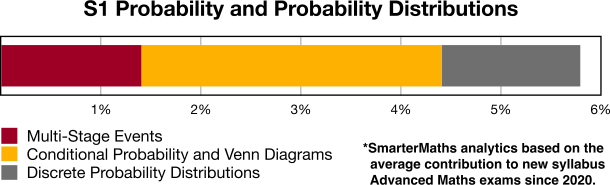
  • S1 Probability has contributed an average of 5.8% per new syllabus Advanced exam since it was introduced in 2020.
  • S1 Probability has been split into four sub-categories for the purposes of this analysis: 1-Multi-Stage Events (1.4%), 2-Relative Frequency (0.0%), 3-Conditional Probability and Venn Diagrams (3.0%) and 4-Discrete Probability Distributions (1.4%).
  • This analysis looks at Discrete Probability Distributions.

HSC ANALYSIS - What to expect and common pitfalls

  • Discrete Probability Distributions (1.4%) was last examined in the 2023 and 2021 Advanced exams, the latter in which it received a 2 question allocation.
  • 2021 Adv 34 was an extremely challenging question requiring students to calculate \(\ce{$E(X)$}\) using algebraic probabilities that produced an 18% mean mark. Review closely.
  • 2023 Adv 12 required students to calculate \(\sigma(X)\)  by first using the formula to find \(\text{Var}(X)\). An important core skill in this topic area to revise.
  • NESA's HSC sample exam and Topic Guidance also provides an indication of concepts that will likely be examined and the database's exemplar questions are informed by these examples.
  • Our research has also looked at the examination of this topic area by other States. This history has been analysed and high quality revision examples that test numerous important concepts are included in the database.

Filed Under: Discrete Probability Distributions (Y11) Tagged With: worksheet-preamble

2ADV S1 Snapshot: Conditional Probability

HISTORICAL CONTRIBUTION

  • S1 Probability has contributed an average of 5.8% per new syllabus Advanced exam since it was introduced in 2020.
  • S1 Probability has been split into four sub-categories for the purposes of this analysis: 1-Multi-Stage Events (1.4%), 2-Relative Frequency (0.0%), 3-Conditional Probability and Venn Diagrams (3.0%) and 4-Discrete Probability Distributions (1.4%).
  • This analysis looks at Conditional Probability and Venn Diagrams.

HSC ANALYSIS - What to expect and common pitfalls

  • Conditional Probability and Venn Diagrams (3.0%) has been examined in 4 of the 5 new syllabus exams to date, including significant 5-mark allocations in 2023 and 2020.
  • Conditional Probability as a "concept" has been examined in past Advanced exams through probability trees and selection without replacement. Note that these question types are both covered under the separate topic Multi-stage Events.
  • However, the new syllabus states explicitly that understanding Venn diagrams and the use of specific notation is now also required. A concerning knowledge gap was flagged by 2023 Adv Q31 which used specific notation and was terribly answered. A "must review" question in all parts. Please pay specific attention to the concept of independent events in this context!
  • Venn Diagrams can be extremely effective in solving conditional probability questions (review 2020 Adv 14). This important solution strategy appears in many of the worked solutions.

Filed Under: Conditional Probability and Venn Diagrams (Y11) Tagged With: worksheet-preamble

2ADV S1 Snapshot: Relative Frequency

HISTORICAL CONTRIBUTION

  • S1 Probability has contributed an average of 5.8% per new syllabus Advanced exam since it was introduced in 2020.
  • S1 Probability has been split into four sub-categories for the purposes of this analysis: 1-Multi-Stage Events (1.4%), 2-Relative Frequency (0.0%), 3-Conditional Probability and Venn Diagrams (3.0%) and 4-Discrete Probability Distributions (1.4%).
  • This analysis looks at Relative Frequency.

HSC ANALYSIS - What to expect and common pitfalls

  • Relative Frequency is a sub-topic that has previously only been examined in the Standard course but now represents common content with the new Advanced syllabus.
  • Relative Frequency was not examined in the first four Advanced exams in 2020-24. 
  • It has however been a contributor to new syllabus Std2 HSC exams and should be covered. The database includes numerous past Std2 HSC questions, which can be identified by the "STD2 S2" in their title.
  • Although generally well answered, note the sub-50% mean marks in 2018 Std2 26a, 2017 Std2 29c and in 2016 Std2 23 MC that deserve attention (note that all mean marks and comments are taken from Std2 results).

Filed Under: Relative Frequency (Y11) Tagged With: worksheet-preamble

2ADV S1 Snapshot: MSE

HISTORICAL CONTRIBUTION

  • S1 Probability has contributed an average of 5.8% per new syllabus Advanced exam since it was introduced in 2020.
  • S1 Probability has been split into four sub-categories for the purposes of this analysis: 1-Multi-Stage Events (1.4%), 2-Relative Frequency (0.0%), 3-Conditional Probability and Venn Diagrams (3.0%) and 4-Discrete Probability Distributions (1.4%).
  • This analysis looks at Multi-Stage Events.

HSC ANALYSIS - What to expect and common pitfalls

  • Multi-Stage Events (1.4%) has been a modest contributor to new syllabus exams as it now has to compete with Conditional Probability/Venn Diagrams and Discrete Probability Distributions.
  • When examined, past HSC cohorts have found Multi-Stage Events very challenging with around half the questions producing sub-50% mean marks (2018 was a particularly tough year).
  • Tree diagrams can be specifically examined or very useful in answering questions. Note the slightly different tree diagram required in 2008 Adv 7c and the Marker's Comment.
  • Critical to recognise opportunities to apply complementary probability where  P(E) = 1 - P(complement). A regularly tested concept last examined in 2024.
  • Revision should include examples when the use of an array (table) is efficient (see 2018 Adv 16b).
  • Probability was combined with the Series and Sequence topic in 2013 and 2016, and terribly answered on both occasions! 

Filed Under: Multi-Stage Events (Y11) Tagged With: worksheet-preamble

2ADV E1 Snapshot: L&E Graphs and Applications

HISTORICAL CONTRIBUTION

  • E1 Logs and Exponentials is a Year 11 topic covering significant amounts of gateway content that is applicable to multiple other Year 12 topic areas.
  • It's contribution to other sub-topics is highly significant, including Tangents, Areas Under Curves, Probability Density Functions, Rates of Change and L&E Calculus just to name a few. Importantly, these are not covered in this analysis as they are included in other topic areas.
  • E1 Logs and Exponentials has been split into two sub-categories for the purposes of analysis which are: 1-Index Laws and Equations and 2-L&E Graphs and Applications.
  • This analysis look at L&E Graphs and Applications.

HSC ANALYSIS - What to expect and common pitfalls

  • L&E Graphs and Applications attracted a low difficulty Adv/Std2 common question in the 2024 exam worth a healthy 3 marks.
  • In the new syllabus period between 2020-23, it was the subject of just a single multiple-choice question (see 2021 Adv 3 MC the produced mean mark 52%).
  • It is important to note that the contributions above do not include exponential graphs that have been new syllabus contributors to Rates of Change, Curve Sketching (involving calculus) and other topic areas mentioned in the Historical Contribution section.
  • NESA Topic Guidance makes it clear that past HSC questions in the Std2 course are relevant to the new Advanced course in this topic area. We have included a number of these questions in the database, which can be identified with "STD2 A4" in their title (all bands and mean marks are relevant to Std2).

Filed Under: Graphs and Applications (Y11) Tagged With: worksheet-preamble

2ADV E1 Snapshot: Index and log laws

HISTORICAL CONTRIBUTION

  • E1 Logs and Exponentials is a Year 11 topic covering significant amounts of gateway content that is applicable to multiple other Year 12 topic areas.
  • It's contribution to other sub-topics is highly significant, including Tangents, Areas Under Curves, Probability Density Functions, Rates of Change and L&E Calculus just to name a few. Importantly, these are not covered in this analysis as they are included in other topic areas.
  • E1 Logs and Exponentials has been split into two sub-categories for the purposes of analysis which are: 1-Index Laws and Equations and 2-L&E Graphs and Applications.
  • This analysis looks at Index Laws and Equations.

HSC ANALYSIS - What to expect and common pitfalls

  • Index Laws and Other Equations was examined with a dedicated question in new syllabus exams for the first time in 2023, although we note it was the theme of regular multiple choice questions pre-2020.
  • The database, despite limited new syllabus HSC exam questions, provides important practice for algebraic manipulation of logs and exponential equations, which is a critical skill for later Calculus topics.
  • While generally well answered, important revision includes the questions 2019 Adv 15a, 2016 Adv 14e, and 2008 Adv 7a, which students had difficulty with.

Filed Under: Log/Index Laws and Equations (Y11) Tagged With: worksheet-preamble

2ADV C4 Snapshot: Integrals Parent

HISTORICAL CONTRIBUTION

  • C4 Integration has contributed a substantial 14.0% to new syllabus Advanced exams since it was introduced in 2020.
  • This topic has been split into four sub-topics for analysis purposes: 1-Integrals (3.2%), 2-Areas Under Curves (5.8%), 3-Trapezoidal Rule (2.2%) and 4-Other Integration Examples (2.8%).
  • This analysis looks at Integrals.

HSC ANALYSIS - What to expect and common pitfalls

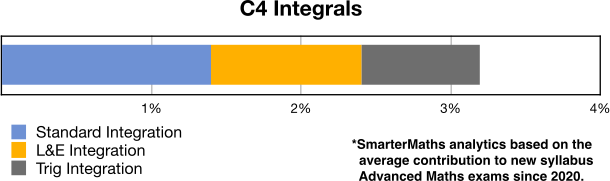
  • Integrals (3.2%) is made up of standard integration, log and exponential integration and trig integration.
  • Standard integration (1.4%) has appeared in each new syllabus exam between 2021-24, including 2 separate questions in 2022. Before this, it has appeared sporadically with a volatile mark allocation (including a notable 6 mark allocation in 2009).
  • Log and exponential integration (1.0%) was last examined in 2020, where it received 3 separate questions. Differentiate then integrate questions within this subtopic have easily been the worst answered.
  • Trig Integration (0.8%) was most recently tested in 2024. Again, differentiate then integrate questions have caused problems and deserve attention.

Filed Under: L&E Integration, Standard Integration, Trig Integration Tagged With: worksheet-preamble

2ADV C4 Snapshot: Trig Integration

HISTORICAL CONTRIBUTION

  • C4 Integration has contributed a substantial 14.0% to new syllabus Advanced exams since it was introduced in 2020.
  • This topic has been split into four sub-topics for analysis purposes: 1-Integrals (3.2%), 2-Areas Under Curves (5.8%), 3-Trapezoidal Rule (2.2%) and 4-Other Integration Examples (2.8%).
  • This analysis looks at Integrals.

HSC ANALYSIS - What to expect and common pitfalls

  • Integrals (3.2%) is made up of standard integration, log and exponential integration and trig integration.
  • Trig Integration was most recently examined in 2024 in a difficult differentiate then integrate question that is a must review question!
  • Before 2024, it was tested in 2020 in a band 3 questions that was very well answered. We note that this area is typically tested at the slightly higher band 4 difficulty level and many examples in the database cover this.

Filed Under: Trig Integration Tagged With: worksheet-preamble

2ADV C4 Snapshot: L&E Integration

HISTORICAL CONTRIBUTION

  • C4 Integration has contributed a substantial 14.0% to new syllabus Advanced exams since it was introduced in 2020.
  • This topic has been split into four sub-topics for analysis purposes: 1-Integrals (3.2%), 2-Areas Under Curves (5.8%), 3-Trapezoidal Rule (2.2%) and 4-Other Integration Examples (2.8%).
  • This analysis looks at Integrals.

HSC ANALYSIS - What to expect and common pitfalls

  • Integrals (3.2%) is made up of standard integration, log and exponential integration and trig integration.
  • Dedicated questions testing log and exponential integration have regularly appeared in past HSC exams (notably absent in 2021-24), including 3 separate questions in the 2020 exam.
  • Questions requiring students to differentiate then integrate have easily been the worst answered, causing problems in 2020 and 2019 - an important revision area.
  • Integration of a fraction that results in a logarithm is a 2-3 mark question type has a strong history of being examined, but noticeably just once in the last 6 years (2020 Adv 17).
  • We note 2019 13c(ii) surprisingly produced a sub-50% mean mark and deserves attention.

Filed Under: L&E Integration Tagged With: worksheet-preamble

2ADV C4 Snapshot: Standard Integration

HISTORICAL CONTRIBUTION

  • C4 Integration has contributed a substantial 14.0% to new syllabus Advanced exams since it was introduced in 2020.
  • This topic has been split into four sub-topics for analysis purposes: 1-Integrals (3.2%), 2-Areas Under Curves (5.8%), 3-Trapezoidal Rule (2.2%) and 4-Other Integration Examples (2.8%).
  • This analysis looks at Integrals.

HSC ANALYSIS - What to expect and common pitfalls

  • Integrals (3.2%) is made up of standard integration, log and exponential integration and trig integration.
  • Dedicated questions testing standard integration have appeared in every new syllabus exam between the 2021-24, including 2 separate questions in 2022. Before this, it has appeared sporadically with a volatile mark allocation (including a notable 6 mark allocation in 2009).
  • Standard integrals are a great opportunity to score highly, although attention should be given to 2011 Adv 2e and 2011 Adv 4d, which produced sub-50% mean marks.
  • A "differentiate then integrate" question was asked in 2022 within this sub-topic and should be part of any revision.

Filed Under: Standard Integration Tagged With: worksheet-preamble

2ADV C4 Snapshot: Trapezoidal Rule

HISTORICAL CONTRIBUTION

  • C4 Integration has contributed a substantial 14.0% to new syllabus Advanced exams since it was introduced in 2020.
  • This topic has been split into four sub-topics for analysis purposes: 1-Integrals (3.2%), 2-Areas Under Curves (5.8%), 3-Trapezoidal Rule (2.2%) and 4-Other Integration Examples (2.8%).
  • This analysis looks at Trapezoidal Rule.

HSC ANALYSIS - What to expect and common pitfalls

  • Trapezoidal Rule (2.2%) is the surviving area approximation method in the new Advanced course, with Simpson's Rule no longer examinable.
  • Trapezoidal Rule has been examined in 3 of the last 4 new syllabus exams (most recently in 2024), including two separate questions in 2022 (review 2022 Adv 29 - a cracking question). 
  • Note that while the standard formula and calculations are generally well answered, the follow up questions have produced sub-50% mean marks 4 times in the last decade.
  • Where possible, past Simpson Rule approximation questions have been rewritten as Trapezoidal Rule questions to help address the problem areas identified above.

Filed Under: Trapezoidal Rule (Y12) Tagged With: smc-5145-04-Trapezium rule, worksheet-preamble

2ADV C4 Snapshot: Areas Under Curves

HISTORICAL CONTRIBUTION

  • C4 Integration has contributed a substantial 14.0% to new syllabus Advanced exams since it was introduced in 2020.
  • This topic has been split into four sub-topics for analysis purposes: 1-Integrals (3.2%), 2-Areas Under Curves (5.8%), 3-Trapezoidal Rule (2.2%) and 4-Other Integration Examples (2.8%).
  • This analysis looks at Areas Under Curves.

HSC ANALYSIS - What to expect and common pitfalls

  • Areas Under Curves (5.8%) has attracted an average of two questions per new syllabus exam, appearing in both multiple choice and longer answer sections.
  • This topic area can be examined using a very broad range of underlying equations, including quadratic, cubic, exponential, hyperbola and trig functions.
  • The most common question type requires students to find areas between given curves and straight lines (although the area between 2 quadratics was asked in 2024 and 2020). 
  • Important revision questions: 2021 Adv 28 combined Area Under Curves with transformations and 2022 Adv 28 looked at circle functions in this context → both caused problems.
  • Definite integrals defining areas for functions that cannot be integrated has been asked via multiple choice 3 times in new syllabus exams, all producing sub-50% mean marks.

Filed Under: Areas Under Curves (Y12) Tagged With: worksheet-preamble

2ADV Snapshot: C3 Rates of Change

HISTORICAL CONTRIBUTION

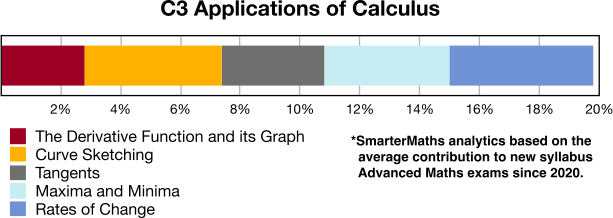
  • C3 Applications of Calculus is the 800 pound gorilla in the Advanced rainforest, contributing a massive 19.8% to new syllabus exams since introduced in 2020.
  • This topic has been split into five sub-topics for analysis purposes: 1-The Derivative Function and its Graph (2.8%), 2-Curve Sketching (4.6%), 3-Tangents (3.4%), 4-Maxima and Minima (4.2%) and 5-Rates of Change (4.8%).
  • This analysis looks at Rates of Change.

HSC ANALYSIS - What to expect and common pitfalls

  • Rates of Change (4.8%) as a sub-topic, is covered two areas of the syllabus: C1 Introduction to Calculus (standard differentiation) and C3 Applications of Calculus (features log, exponential and trig underlyings).
  • We note questions involving integration are covered within C4 Other Integration Applications.
  • Rates of Change looks primarily at water flow, motion and exponential growth and decay examples. 2020 Adv 21 caused problems with the differentiation of `a^x` versus the normal `e^x`. A must review question!
  • Motion featured in 2021 Adv Q26 with a substantial 5 mark allocation that proved challenging to most students.
  • Thorough revision of this sub-topic must pay special attention to questions in 2016 and 2011, where students had major difficulties and mean marks were well below 50%.

Filed Under: Rates of Change (Y12) Tagged With: worksheet-preamble

2ADV Snapshot: C3 Maxima and Minima

HISTORICAL CONTRIBUTION

  • C3 Applications of Calculus is the 800 pound gorilla in the Advanced rainforest, contributing a massive 19.8% to new syllabus exams since introduced in 2020.
  • This topic has been split into five sub-topics for analysis purposes: 1-The Derivative Function and its Graph (2.8%), 2-Curve Sketching (4.6%), 3-Tangents (3.4%), 4-Maxima and Minima (4.2%) and 5-Rates of Change (4.8%).
  • This analysis looks at Maxima and Minima.

HSC ANALYSIS - What to expect and common pitfalls

  • Maxima and Minima (4.2%) appears in every exam with significant mark allocations almost guaranteed. Its importance in achieving a band 5-6 result cannot be overstated. 
  • Max/Min problems will typically ask students to prove an equation in the earlier parts. A band 4 level task that presents a good opportunity for all students to score well.
  • HSC Markers remind students to work with the given equation of the question, even if they couldn't successfully complete the proof in the earlier part.
  • Max/Min problems have had a number of specific themes. Area/Volume equations have dominated, appearing in 4 out of 5 new syllabus exams. Other themes include distance (2017 and 2013) and a cost equation (2009).
  • Max/Min was novelly examined within the Probability Density Function topic in 2021 and is included in the database under that topic.

Filed Under: Maxima and Minima (Y12) Tagged With: worksheet-preamble

2ADV Snapshot: C3 Tangents

HISTORICAL CONTRIBUTION

  • C3 Applications of Calculus is the 800 pound gorilla in the Advanced rainforest, contributing a massive 19.8% to new syllabus exams since introduced in 2020.
  • This topic has been split into five sub-topics for analysis purposes: 1-The Derivative Function and its Graph (2.8%), 2-Curve Sketching (4.6%), 3-Tangents (3.4%), 4-Maxima and Minima (4.2%) and 5-Rates of Change (4.8%).
  • This analysis looks at Tangents.

HSC ANALYSIS - What to expect and common pitfalls

  • Tangents (3.4%) appear in two key areas of the syllabus: C1 Introduction to Calculus (involving standard differentiation - 0.8%) and C3 Applications of Calculus (involving log, exponential and trig underlyings - 3.4%).
  • This analysis looks at Tangents as a whole, which have been examined in 4 out of the 5 new syllabus exams to date. Worth noting the 2020 and 2021 exams each had multiple questions on this sub-topic which were poorly answered and represent key revision.
  • 2024 Adv 29 is a must review question which tested this sub-topic in a novel way, requiring a good understanding of both tangents and normals.
  • Composite functions overlapped with tangents in 2021 9 MC - differentiating these types of functions is an important competency in the new syllabus and this needs to be carefully reviewed.

Filed Under: Tangents (Y12) Tagged With: worksheet-preamble

2ADV Snapshot: C3 Curve Sketching

HISTORICAL CONTRIBUTION

  • C3 Applications of Calculus is the 800 pound gorilla in the Advanced rainforest, contributing a massive 19.8% to new syllabus exams since introduced in 2020.
  • This topic has been split into five sub-topics for analysis purposes: 1-The Derivative Function and its Graph (2.8%), 2-Curve Sketching (4.6%), 3-Tangents (3.4%), 4-Maxima and Minima (4.2%) and 5-Rates of Change (4.8%).
  • This analysis looks at Curve Sketching.

HSC ANALYSIS - What to expect and common pitfalls

  • Curve Sketching (4.6%) is consistently examined with significant mark allocations.
  • The most popular curve is easily the cubic, asked 6 times in the last decade, including each year in the period 2017-2020.
  • Important: The 2022 Adv 22 cubic asked for the "global maximum and minimum" within a given range for the first time. This required finding the `y`-values of the graph at the domain limits - a must review question!
  • Sketches of polynomials of degree 4 are the second most popular, most recently tested in 2024 (see 2024 Adv 19 and 2012 Adv 14a).
  • Curve Sketching questions regularly require students to look at concavity and intervals where a curve is increasing or decreasing. An important revision area that proiduces low mean marks.

Filed Under: Curve Sketching (Y12) Tagged With: worksheet-preamble

2ADV Snapshot: C3 The Derivative Function

HISTORICAL CONTRIBUTION

  • C3 Applications of Calculus is the 800 pound gorilla in the Advanced rainforest, contributing a massive 19.8% to new syllabus exams since introduced in 2020.
  • This topic has been split into five sub-topics for analysis purposes: 1-The Derivative Function and its Graph (2.8%), 2-Curve Sketching (4.6%), 3-Tangents (3.4%), 4-Maxima and Minima (4.2%) and 5-Rates of Change (4.8%).
  • This analysis looks at The Derivative Function and its Graph.

HSC ANALYSIS - What to expect and common pitfalls

  • The Derivative Function and its Graph is a challenging sub-topic that has been examined in 4 out of 5 new syllabus exams (including two questions in 3 of those years).
  • Students are regularly asked to explore the graphical relationship between `f(x)` and `f^{′}(x)`. This question type has caused problems in the past and deserves attention.
  • Investigating graph shapes and the related values of `f^{′}(x)` and `f^{″}(x)` in certain domains is key revision that is well covered in the database (see 2024 Adv 11, 2021 Adv 7 MC).
  • The 2020 exam tested composite functions in this context for the first time, producing an 11% mean mark (lowest in the exam). This should be carefully reviewed (see 2020 Adv 10 MC).

Filed Under: The Derivative Function and its Graph (Y12) Tagged With: worksheet-preamble

2ADV Snapshot: C2 L&E Differentiation

HISTORICAL CONTRIBUTION

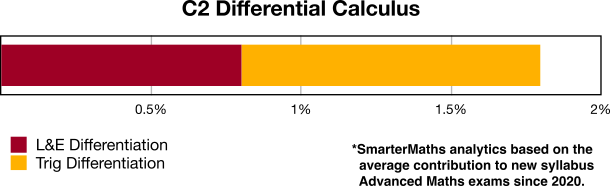
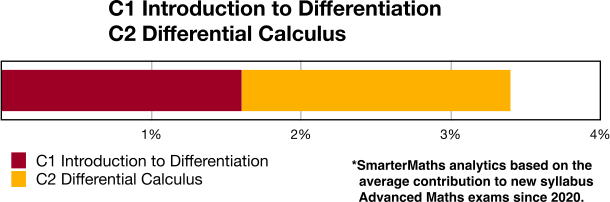
  • C2 Differential Calculus has contributed an average of 1.8% to new syllabus Advanced exams since their introduction in 2020.
  • This topic has been split into two sub-topics for analysis purposes: 1-Log and Exponential Differentiation (0.8%), and 2-Trig Differentiation (1.0%).
  • This analysis looks at L&E Differentiation.

HSC ANALYSIS - What to expect and common pitfalls

  • This topic area is the definition of low lying fruit where well prepared students should expect to score highly although we note that stand alone questions have been absent in the 2020-24 exam papers (it has however been tested within cross topic questions looking at Curve Sketching in 2022-23 and Differentiate then Integrate in 2020). 
  • HSC Marker's Comments have stated that students who wrote out the quotient rule and all its inputs before substituting in values made less mistakes. Good advice.
  • The new syllabus explicitly mentions the differentiation of  `a^x`  and  `log_a x`. Both are covered in the database within SM-Bank questions and are important revision.

Filed Under: L&E Differentiation (Y12) Tagged With: worksheet-preamble

2ADV Snapshot: C2 Trig Differentiation

HISTORICAL CONTRIBUTION

  • C2 Differential Calculus has contributed an average of 1.8% to new syllabus Advanced exams since their introduction in 2020.
  • This topic has been split into two sub-topics for analysis purposes: 1-Log and Exponential Differentiation (0.8%), and 2-Trig Differentiation (1.0%).
  • This analysis looks at Trig Differentiation.

HSC ANALYSIS - What to expect and common pitfalls

  • Trig Differentiation was most recently examined in a dedicated question the 2022 Advanced exam in a challenging 3-mark question that produced a 53% state mean mark.
  • We note this sub-topic was part of a differentiate then integrate question in the 2024 HSC exam which is covered in a later topic.
  • HSC Marker's Comments have noted that students who wrote out the quotient rule and all its inputs before substituting in values made less mistakes.
  • This topic, although a minor contributor the new syllabus exams, represents crucial gateway knowledge for numerous later Y12 topics.

Filed Under: Trig Differentiation (Y12) Tagged With: worksheet-preamble

2ADV Snapshot: C1 Rates of Change

HISTORICAL CONTRIBUTION

  • C1 Introduction to Differentiation is Y11 content that has contributed an average of 1.6% per exam since the new syllabus was introduced in 2020.
  • This topic has been split into three sub-topics for analysis purposes: 1-Standard Differentiation (0.8%), 2-Tangents (0.8%), and 3-Rates of Change.
  • This analysis looks at Rates of Change.

HSC ANALYSIS - What to expect and common pitfalls

  • Rates of Change, within C1 Introduction to Differentiation, only includes examples that require standard differentiation. This excludes log, exponential and trig underlyings and any questions that require integration - questions involving these aspects of Rates of Change are covered later in year 12.
  • Rates of Change questions that require standard differentiation have not been asked in new syllabus exams to date. Before this however, they were examined four times in the period 2013-2019, primarily as multiple choice questions but including a significant 5 mark allocation in 2018.
  • This sub-topic provides important gateway content for the challenging year 12 work in this area. 

Filed Under: Rates of Change (Y11) Tagged With: worksheet-preamble

2ADV Snapshot: C1 Tangents

HISTORICAL CONTRIBUTION

  • C1 Introduction to Differentiation is Y11 content that has contributed an average of 1.6% per exam since the new syllabus was introduced in 2020.
  • This topic has been split into three sub-topics for analysis purposes: 1-Standard Differentiation (0.8%), 2-Tangents (0.8%), and 3-Rates of Change.
  • This analysis looks at the sub-topic Tangents.

HSC ANALYSIS - What to expect and common pitfalls

  • Tangents in this sub-topic only include examples that require standard differentiation and no integration.  Importantly, it also excludes log, exponential and trig underlyings which are covered in later year 12 sub-topics.
  • Tangent questions that require standard differentiation have been asked 3 times in the last decade, most recently in 2023 and 2019 in 3-mark questions, the latter of which caused problems (see 2019 Adv 14d).
  • While regular question types offer a great opportunity for high scoring, take note of some more applied examples that created problems for many students (2009 HSC 6c, 2010 HSC 7b).

Filed Under: Tangents (Y11) Tagged With: worksheet-preamble

2ADV Snapshot: C1 Standard Differentiation

HISTORICAL CONTRIBUTION

  • C1 Introduction to Differentiation is Y11 content that has contributed an average of 1.6% per exam since the new syllabus was introduced in 2020.
  • This topic has been split into three sub-topics for analysis purposes: 1-Standard Differentiation (0.8%), 2-Tangents (0.8%), and 3-Rates of Change.
  • This analysis looks at the sub-topic Standard Differentiation.

HSC ANALYSIS - What to expect and common pitfalls

  • Standard Differentiation (0.8%) is the critical gateway content for all the calculus to follow in the Advanced course. It was last examined in a dedicated multiple choice question in both 2023 and 2022.
  • This topic area looks at the product, quotient and chain rules, but importantly excludes log, exponential and trig underlyings which are covered in later topics.
  • Standard Differentiation typically provides low hanging fruit for students, although 2023 Adv 7 MC was a very challenging chain rule/composite function example that deserves specific attention.
  • First principles and limit equations are covered in the database and should be reviewed.
  • TIP: Minimise errors by creating a clear cut process for writing formulae and identifying inputs before any calculations are made using the quotient rule.

Filed Under: Standard Differentiation (Y11) Tagged With: worksheet-preamble

2ADV Snapshot: T3 Trig Applications

HISTORICAL CONTRIBUTION

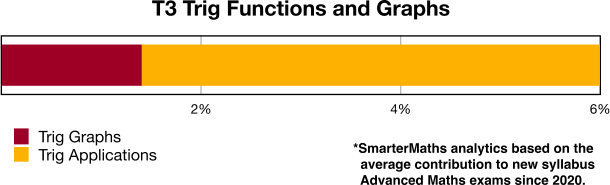
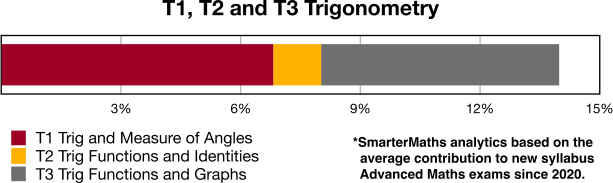
  • T3 Trig Functions and Graphs has contributed a meaningful 6.0% per new syllabus Advanced exam since being introduced in 2020.
  • This topic has been split into two sub-topics for analysis purposes: 1-Trig Graphs (1.4%), and 2-Trig Applications (4.6%).
  • This analysis looks at the largest sub-topic, Trig Applications.

HSC ANALYSIS - What to expect and common pitfalls

  • Trig Applications (4.6%) has been examined with substantial allocations of 6-7 marks in three of the last four years (we note the 2021 question was a large cross topic example incorporating integration which will be covered later in the database).
  • An interesting topic area in our view. While only examined 5 times since 2009, a number of these questions are in the pantheon of great Advanced HSC exam questions during this period.
  • Examiners have made it clear that students can expect these type of questions on a regular basis and a revision focus is highly recommended.
  • With a high difficulty level and substantial mark allocations almost a guarantee when asked, this topic area is a key area to outperform peers.

Filed Under: Trig Applications (Y12) Tagged With: worksheet-preamble

2ADV Snapshot: T3 Trig Graphs

HISTORICAL CONTRIBUTION

  • T3 Trig Functions and Graphs has contributed a meaningful 6.0% per new syllabus Advanced exam since being introduced in 2020.
  • This topic has been split into two sub-topics for analysis purposes: 1-Trig Graphs (1.4%), and 2-Trig Applications (4.6%).
  • This analysis looks at Trig Graphs.

HSC ANALYSIS - What to expect and common pitfalls

  • Trig Graphs (1.8%) have been examined in the first three new syllabus exams between 2020-22 and not since.
  • The database size reflects our view that this area will be consistently examined going forward and numerous examples of all trig graph variations are covered.
  • We recommend close revision of T3 EQ-Bank 3 and 5 which are informed by the question style and difficulty level of NESA's sample questions. Also, special attention should be given to 2013 HSC 6 MC which was surprisingly poorly answered.
  • Note that more than half of students answered the 2016 multiple choice question on a tan function graph's period incorrectly. Deserves attention.

Filed Under: Trig Graphs (Y12) Tagged With: worksheet-preamble

2ADV Snapshot: T2 Trig Identities and Harder Equations

HISTORICAL CONTRIBUTION

  • T2 Trig Functions and Identities is a small area that has contributed 1.2% to new syllabus Advanced exams since being introduced in 2020.
  • This topic has been split into two sub-topics for analysis purposes: 1-Exact Trig Ratios, and 2-Trig Identities and Harder Equations.
  • This analysis looks at Trig Identities and Harder Equations.

HSC ANALYSIS - What to expect and common pitfalls

  • Trig Identities and Harder Equations was most recently examined in 2021 and 2020 in questions worth 1 and 2 marks respectively. In a longer time horizon, it has been tested in a dedicated question in 4 of the last 8 years.
  • Dedicated HSC questions on this topic area have produced sub-50% mean marks on a majority of occasions.
  • Notwithstanding the small contribution of "dedicated" questions in this area, it is critical to note that examiners consistently test trig identities in high difficulty cross-topic questions.
  • Good skills in identifying and manipulating trig identities will reap benefits in tackling some of the harder questions that might appear in the later sections of the advanced HSC paper. 

Filed Under: Trig Identities and Harder Equations (Y11) Tagged With: worksheet-preamble

2ADV Snapshot: T2 Exact Trig Ratios

HISTORICAL CONTRIBUTION

  • T2 Trig Functions and Identities is a small area that has contributed 1.2% to new syllabus Advanced exams since being introduced in 2020.
  • This topic has been split into two sub-topics for analysis purposes: 1-Exact Trig Ratios, and 2-Trig Identities and Harder Equations.
  • This analysis looks at Exact Trig Ratios.

HSC ANALYSIS - What to expect and common pitfalls

  • Exact Trig Ratios attracted a 3-mark question in the 2023 exam, its first dedicated question since appearing in consecutive years from 2016-17. Note the use of "dedicated" question here, as this topic is invariably examined multiple times every year in later topics.
  • The most common question type gives a simple trig equation and asks students to answer in exact radian form, within a specified range. A majority of students struggled with 2008 Adv 6a.
  • Finding exact sec, cosec and cot trigonometric ratios is mentioned in NESA's Topic Guidance and multiple questions in the database address this.
  • The small contribution of this sub-topic belies its importance as it is required to answer a wide range of questions in other topics such as series, maxima and minima and trig calculus.

Filed Under: Exact Trig Ratios (Y11) Tagged With: worksheet-preamble

2ADV Snapshot: T1 Circular Measure

HISTORICAL CONTRIBUTION

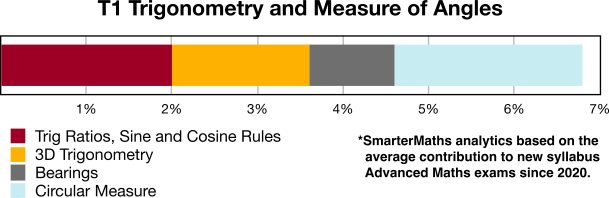
  • T1 Trigonometry and Measure of Angles has contributed a healthy average of 6.8% per Advanced exam since the new syllabus was introduced in 2020.
  • This topic has been split into four sub-topics for analysis purposes: 1-Trig Ratios, Sine and Cosine Rules (2.0%), 2- 3D Trigonometry (1.6%), 3-Bearings (1.0%) and 4-Circular Measure (2.2%).
  • This analysis looks at Circular Measure.

HSC ANALYSIS - What to expect and common pitfalls

  • Circular Measure (2.2%) has been tested in four of the five new syllabus exams. Most recently in 2024 within a cross-topic question with C3 Maxima/Minima that appears later in the database.
  • Circular Measure is a fertile area for Std2/Adv overlapping content and it will benefit in mark allocations from this (we note 2023 Adv 16 and 2020 Adv 22 appeared in both exams).
  • Circular Measure questions have been well answered in recent years. We do flag this warning: students are encouraged to carefully revise questions in the period 2005-2010 which represent the highest levels of difficulty in this topic area, producing consistent sub-50% mean marks.

Filed Under: Circular Measure (Y11) Tagged With: worksheet-preamble

2ADV Snapshot: T1 Bearings

HISTORICAL CONTRIBUTION

  • T1 Trigonometry and Measure of Angles has contributed a healthy average of 6.8% per Advanced exam since the new syllabus was introduced in 2020.
  • This topic has been split into four sub-topics for analysis purposes: 1-Trig Ratios, Sine and Cosine Rules (2.0%), 2- 3D Trigonometry (1.6%), 3-Bearings (1.0%) and 4-Circular Measure (2.2%).
  • This analysis looks at Bearings.

HSC ANALYSIS - What to expect and common pitfalls

  • Bearings (1.0%) has only been examined once in new syllabus Advanced exams to date, although the question was worth a substantial 5 marks (2020 Adv 15).
  • Bearings is a prime topic area to test Advanced and Standard 2 common content and is due a meaningful mark allocation, in our view.
  • Before 2020, bearings was most recently tested in the Advanced exam in 2018 and 2014, and well answered.
  • A number of Std2 past HSC questions that we consider good revision have been included in this database (identified by 2ADV* or STD2 in their title).

Filed Under: Bearings (Y11) Tagged With: worksheet-preamble

2ADV Snapshot: T1 3D Trigonometry

HISTORICAL CONTRIBUTION

  • T1 Trigonometry and Measure of Angles has contributed a healthy average of 6.8% per Advanced exam since the new syllabus was introduced in 2020.
  • This topic has been split into four sub-topics for analysis purposes: 1-Trig Ratios, Sine and Cosine Rules (2.0%), 2- 3D Trigonometry (1.6%), 3-Bearings (1.0%) and 4-Circular Measure (2.2%).
  • This analysis looks at 3D Trigonometry (previously Ext1 content).

HSC ANALYSIS - What to expect and common pitfalls

  • 3D Trigonometry (1.6%) now has two consecutive years of 3-mark allocations after being allocated just a single mark in the 3 previous new syllabus Advanced exams.
  • 3D Trig in its existence in the Advanced syllabus so far, has been tested around the band 4 difficulty level. We note that questions can get much more challenging and cater for this in the database (note questions taken from past Ext1 exams have ADV' in the title).
  • The challenging T1 SM-Bank 1 represents the highest level of difficulty this topic could present.

Filed Under: 3D Trigonometry (Y11) Tagged With: worksheet-preamble

2ADV Snapshot: T1 Trig Ratios, Sine and Cosine Rules

HISTORICAL CONTRIBUTION

  • T1 Trigonometry and Measure of Angles has contributed a healthy average of 6.8% per Advanced exam since the new syllabus was introduced in 2020.
  • This topic has been split into four sub-topics for analysis purposes: 1-Trig Ratios, Sine and Cosine Rules (2.0%), 2- 3D Trigonometry (1.6%), 3-Bearings (1.0%) and 4-Circular Measure (2.2%).
  • This analysis looks at Trig Ratios, Sine and Cosine Rules.

HSC ANALYSIS - What to expect and common pitfalls

  • Trig Ratios, Sine and Cosine Rules (2.0%) is most commonly examined using non-right angled trigonometry, often involving "2-triangle" examples.
  • It has been examined via dedicated questions 7 times in the last decade (notably absent in 2024) in questions of varying difficulty, producing sub-50% mean marks on 3 occasions.
  • Using one exact trig ratio to find others for further calculations has caused problems in the past and should be reviewed (see 2015 Adv 13a).
  • The specific syllabus mention of the "ambiguous case" warrants attention and 2021 Q18 along with T1 EQ-Bank 2 should be reviewed.

Filed Under: Trig Ratios, Sine and Cosine Rules (Y11) Tagged With: worksheet-preamble

STD2 Snapshot: M7 Ratios

IMPORTANT FEATURES AND TIPS FROM EXAM HISTORY

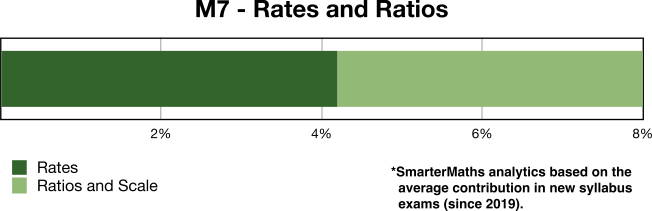
  • M7 Rates and Ratios has been a healthy contributor to new syllabus Std2 exams, responsible for an average of 8.0% per exam since 2019.
  • We have split this area into 2 topics for analysis purposes: 1-Rates (4.2%), and 2-Ratios and Scale (3.8%).
  • This analysis looks at Ratios and Scale.

ANALYSIS - What to Expect and Common pitfalls

  • Ratio and Scale has appeared in every new syllabus exam in questions typically worth 5–7 marks each (note cross topic themes are common).
  • Ratios have been examined every year since 2019 with 3-part ratios required in three of these years. Challenging examples include 2024 Std2 38, 2022 Std2 38, 2021 Std2 15 MC and 2020 Std2 23b.
  • 2013 Std2 30c is a brute of a revision question that caused massive problems.
  • Similarity is examinable and well covered in the database.
  • Capture/Recapture historically causes problems with 2022 Q4 MC no exception, producing a mean mark of 33%. A topic area that must be well understood. 
  • Scale is a core aspect of ratios and was tested in 2021 and 2019 in a challenging cross topic question with rates (2021 Q25) and the trapezoidal rule (2019 Q41).

Filed Under: Ratio and Scale (Std2) Tagged With: worksheet-preamble

STD1 Snapshot: A1 Formula Rearrange

IMPORTANT FEATURES AND TIPS FROM EXAM HISTORY

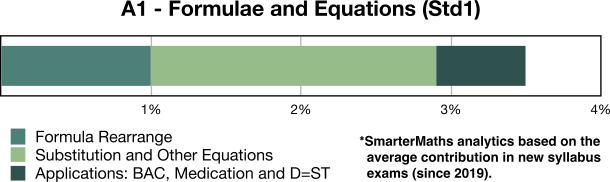
  • A1 Formulae and Equations has accounted for an average of 3.5% of the Standard 1 exam since 2019.
  • A1 Formulae and Equation is split into the following three sub-topics for the purposes of analysis: 1-Formula Rearrange (1.0%), 2-Substitution and Other Equations (1.9%) and 3-Applications: D=S×T and Other (0.6%). 
  • This analysis looks at the topic Formula Rearrange.

ANALYSIS - What to Expect and Common pitfalls

  • Most recently tested in 2021 Std1 16 and 2019 Std1 34 in substantial 3-mark questions, it has been notably absent in the period 2022-24. The 2021 and 2019 questions produced mean marks well below 50% and deserve attention. 
  • We note that syllabus adjustments that expanded the topic content make the rearrangement of both linear and non-linear equations examinable.
  • Formula rearranging presents very achievable marks. The upper level of difficulty in this area can be found in examples 2019 Std2 11 MC, 2017 Std2 28d and 2013 Std2 21 MC.

Filed Under: Formula Rearrange (Std 1) Tagged With: worksheet-preamble

STD2 Snapshot: A1 Formula Rearrange

IMPORTANT FEATURES AND TIPS FROM EXAM HISTORY

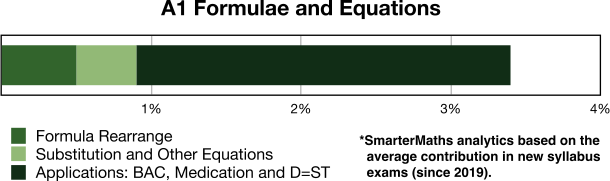
  • A1 Formulae and Equations has contributed an average of 3.5% per exam since the new syllabus was introduced in 2019.
  • We have split this area into 3 topics for analysis purposes: 1-Formula Rearrange (0.5%), 2-Substitution and Other Equations (0.5%) and Applications: BAC, Medication and D=S×T (2.5%).
  • This analysis looks at the sub-topic Formula Rearrange (0.5%).

ANALYSIS - What to Expect and Common pitfalls

  • Formula rearranging presents very achievable marks for most students, last examined in 2024 in a multiple choice question.
  • Although linear formulas are the "easier" equations to rearrange, some past HSC questions have caused problems for a majority of students and we recommend revising 2019 Std2 11 MC and 2013 Std2 21 MC (mean mark 27%!) to cover the hardest examples.
  • Non-linear equations are the harder question type in this sub-topic. Any revision should include 2017 Std2 28d and 2011 Std2 18 MC which covers the worst answered in the last decade.
  • Despite its small contribution in dedicated questions, this topic represents a core skill required throughout the course.

Filed Under: Formula Rearrange (Std 2) Tagged With: worksheet-preamble

STD1 Snapshot: S3 Further Statistical Analysis

IMPORTANT FEATURES AND TIPS FROM EXAM HISTORY

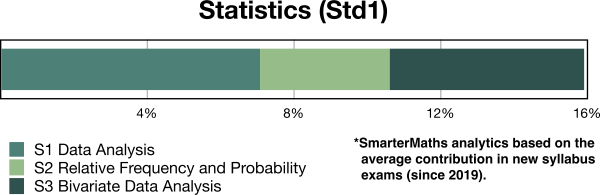
  • S3 Further Statistical Analysis has contributed an impressive average of 5.8% per Std1 exam since it was introduced in 2019.
  • This topic area includes content found in Std2's S4 Bivariate Data Analysis, but notably removes any analysis of Pearson's Correlation Coefficient.

ANALYSIS - What to Expect and Common pitfalls

  • Further Statistical Analysis has been examined in longer answer questions in every Std1 exam to date, regularly attracting significant mark allocations.
  • Students are commonly required to draw lines of best fit and use them to provide estimates. This is a core competency for this topic area and must be a focus of any revision set (review 2022 HSC 23 and 2021 HSC 18). 
  • Describing correlation with respect to strength and direction has been tested multiple times and represents important revision (review 2024 Std1 12).
  • A content coverage note: the Standard 1 syllabus omits any explicit reference to "interpret the intercept and gradient of a [line of best fit]", which is stated in the Standard 2 syllabus. Notwithstanding this, it is covered in the database as it arguably comes under other Std1 syllabus content, notably: describe the patterns, features and associations of bivariate datasets, and recognise the limitations of interpolation and extrapolation.

Filed Under: S3 Further Statistical Analysis (Y12) Tagged With: worksheet-preamble

STD1 Snapshot: A3 Types of Relationships

IMPORTANT FEATURES AND TIPS FROM EXAM HISTORY

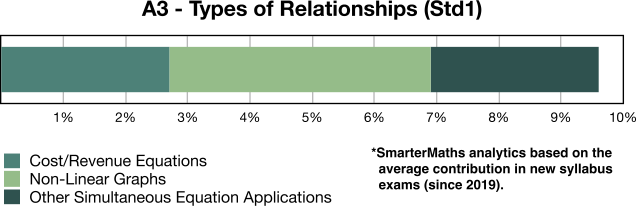
  • A3 Types of Relationships has emerged as an 800-pound gorilla in the Std1 HSC exam, accounting for a highly significant average of 9.6% per exam since the new syllabus was first examined in 2019.
  • This topic includes content found within the Standard 2 equivalent topic of A4 Types of Relationships, albeit with a much reduced focus on certain types of non-linear relationships.

ANALYSIS - What to Expect and Common pitfalls

  • A3 Types of Relationships has contributed an average of two questions per Std1 exam to date, a majority of which are high-mark longer answer questions. In short, a crucial area for revision.
  • Non-Linear Graphs (4.2%) is the most common question type, having been examined every year including twice in 2019 and 2020. A majority of these are longer answer questions that have caused problems.
  • Exponential graphs within this question type have been flagged by examiners as extremely important, with 6-mark and 4-mark questions in the 2020 and 2019 exams respectively. 
  • Simultaneous Equations and Applications (2.7%) has been examined every Std1 exam like clockwork. Cost/Revenue is the most common question type (see 2024 Std1 23 and 2019 Std1 30), although other bespoke themes can appear (2021 Std1 29 - emu/goanna legs and 2023 Std1 26 and 2020 Std1 29 - electricity and tank flow). 
  • We note syllabus changes mean that students can be tested on solving simultaneous equations graphically but not arithmetically.

Filed Under: A3 Types of Relationships (Y12) Tagged With: worksheet-preamble

STD1 Snapshot: A2 Applications: Currency, Fuel and Other Problems

IMPORTANT FEATURES AND TIPS FROM EXAM HISTORY

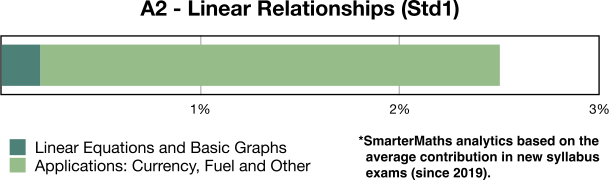
  • A2 Linear Relationships has accounted for an average of 2.5% of the Std 1 exam since 2019.
  • A2 Linear Relationships is split into the following two sub-topics for analysis purposes: 1-Linear Equations and Basic Graphs (0.2%) and Applications: Currency, Fuel and Other (2.3%). 
  • This analysis looks at the largest topic area, Applications: Currency, Fuel and Other.

ANALYSIS - What to Expect and Common pitfalls

  • Applications: Currency, Fuel and Other Problems is an important topic area for the new Std1 exam which has been examined every year with the exception of 2023-24, including twice each year from 2020-22.
  • It is a challenging topic area that can be examined very broadly, as evidenced by the wide array of past HSC questions in this dataset. 
  • Fuel consumption was examined in 2021 in a 2-mark question and well answered after causing all sorts of problems in 2019 Std1 33, a question that produced sub-20% mean marks in both parts and deserves careful attention.
  • Currency conversion was tested in 2019 Std1 33 with brutal mean marks of 8% and 16% produced in its two parts. It has not been examined since.
  • Modelling a linear cost equation has been examined in both 2022 and 2020. The latter was tested in 2020 Std1 10 MC, producing a mean mark of 21%.
  • Constructing an equation of linear proportionality attracted a substantial 3-mark allocation in the 2020 Std1 20 and represents important revision. 

Filed Under: Applications: Currency, Fuel and Other Problems (Std 1) Tagged With: worksheet-preamble

STD1 Snapshot: A2 Linear Equations and Basic Graphs

IMPORTANT FEATURES AND TIPS FROM EXAM HISTORY

  • A2 Linear Relationships has accounted for an average of 2.5% of the Std 1 exam since 2019.
  • A2 Linear Relationships is split into the following two sub-topics for analysis purposes: 1-Linear Equations and Basic Graphs (0.2%) and Applications: Currency, Fuel and Other (2.3%). 
  • This analysis looks at Linear Equations and Basic Graphs.

ANALYSIS - What to Expect and Common pitfalls

  • Linear Equations and Basic Graphs is a minor area that covers "gateway" knowledge which is required to solve harder practical problems in later topic areas such as S3 Further Statistical Analysis.
  • This area has only been examined in one solitary multiple choice question in Std1 since the new syllabus was introduced.
  • The most common question types, from Std2 exam history, asks students to identify the graphs of simple linear equations (see 2021 Std1 5 MC) or find gradients from simple graphs.
  • It is worth noting that when this topic area has attracted a dedicated question in past Std2 exams, students have often struggled with sub-50% mean marks produced half the time. 

Filed Under: Linear Equations and Basic Graphs (Std 1) Tagged With: worksheet-preamble

STD1 Snapshot: A1 Applications: BAC, Medication and D=ST

IMPORTANT FEATURES AND TIPS FROM EXAM HISTORY

  • A1 Formulae and Equations has accounted for an average of 3.5% of the Standard 1 exam since 2019.
  • A1 Formulae and Equation is split into the following three sub-topics for the purposes of analysis: 1-Formula Rearrange (1.0%), 2-Substitution and Other Equations (1.9%) and 3-Applications: D=S×T and Other (0.6%). 
  • This analysis looks at the topic Applications: D=S×T and Other. 

ANALYSIS - What to Expect and Common pitfalls

  • Applications: D=S×T has appeared in a longer answer question (2022) and multiple choice question (2020) in Std1 exams to date.
  • Fried's dosage formulae was examined in 2022 Std1 19, producing a mean mark of 52%. We recommend revision examples that cover this as well as Clarke's and Young's dosage formulae. 
  • Stopping distance hasn't appeared as an applied question in Std1 exams to date (noting that 2020 Std1 18 looking at this theme was a formula rearrange and substitution question). The database contains multiple examples to revise this area.
  • Distance, speed and time equations (D=S×T) have been the basis of challenging multiple choice questions in the past. We include numerous past questions in the database, acknowledging the obvious overlap with M4 Rates within the measurement strand which occurred in 2024 Std1 31. 2011 Std2 21 MC is a great revision example of the higher difficulty level in this area.

Filed Under: Applications: D=SxT and Other (Std 1) Tagged With: worksheet-preamble

STD1 Snapshot: A1 Substitutions and Other Equations

IMPORTANT FEATURES AND TIPS FROM EXAM HISTORY

  • A1 Formulae and Equations has accounted for an average of 3.5% of the Standard 1 exam since 2019.
  • A1 Formulae and Equation is split into the following three sub-topics for the purposes of analysis: 1-Formula Rearrange (1.0%), 2-Substitution and Other Equations (1.9%) and 3-Applications: D=S×T and Other (0.6%). 
  • This analysis looks at the topic Substitution and Other Equations. 

ANALYSIS - What to Expect and Common pitfalls

  • Substitution and Other Equations was tested in 2024, 2023, 2020 (twice) and 2019 in longer answer questions.
  • Rearranging an equation and then substituting has been examined twice and caused problems on each occasion. This style of question represents important revision and can be found using the sub-category filter in the database.
  • 2020 Std1 18 required substitution into a "stopping distance" equation and produced a surprisingly low mean mark of 21% - review closely.
  • Pitfalls: In Std2 exam history, students struggled with algebraic fractions in 2018 Std2 28b and substituting a negative number into an equation in 2010 Std2 7 MC - both examples deserve attention.
  • Revision recommended for "Find the Mistake" style questions. Although they have not appeared in Std1 exams to date, we note they have been poorly answered in the past and should be revised. 

Filed Under: Substitution and Other Equations (Std 1) Tagged With: worksheet-preamble

STD1 Snapshot: M5 Scale and Drawings

IMPORTANT FEATURES AND TIPS FROM EXAM HISTORY

  • M5 Scale Drawings is a blue whale in the Std1 ocean, contributing a highly significant average of 10.6% per Std1 exam since 2019, including a peak contribution of 15% in 2024.
  • M5 Scale Drawings is comprised of content which can be found in the Standard 2 equivalent topic of M7 Rates and Ratios which covers ratios, similarity and the associated use of scale in buildings and maps.

ANALYSIS - What to Expect and Common pitfalls

  • Floor plans are easily the biggest contributing question type at 4.6% per exam. Longer answer questions have appeared in every Std1 exam to date and represent a key revision area.
  • Maps and the associated scale calculations have been examined in 3 of the last 4 exams, producing sub-25% mean marks on each occasion (review 2024 Std1 32, 2023 Std1 3 MC and 2021 Std1 21). 
  • Similarity was omitted in 2024, but is regularly examined in Std1 exams. It was tested and poorly answered in longer answer questions between 2020–21, which are "must review" questions in this area (see 2021 HSC 26 and 2020 HSC 28).
  • Applied ratios were examined in 2023 Std1 9 MC and 2019 Std1 29. Any revision must include both 2-part and 3-part ratios.

Filed Under: M5 Scale Drawings (Y12) Tagged With: worksheet-preamble

STD1 Snapshot: M4 Rates

IMPORTANT FEATURES AND TIPS FROM EXAM HISTORY

  • M4 Rates has attracted multiple questions in every Std1 exam to date, contributing a highly significant average of 10.6% per exam. 
  • This topic has significant overlap with A1 Algebraic Applications and A2 Linear Relationships. We note that this topic's contribution to the Std1 exam would be even higher if this overlap was included in the above contribution analytics.

ANALYSIS - What to Expect and Common pitfalls

  • M4 Rates is the 550-pound Silverback in the Std1 jungle, providing highly significant contributions to every exam. 
  • Travel Graphs (Distance-Time Graphs) are proving to be a very important question type with longer answer questions appearing every year except 2020. The 2021-23 exams each contributed significant allocations of 4–6 marks and should be a revision focus (2024 notably allocated just 1 mark to this area).
  • Heart rates and blood pressure are two themes that have been regularly tested. Heart rates/blood pressure has its own specific syllabus dot point and we expect this trend to continue.
  • Other Std1 rate questions have looked at the following themes: water flow (2023 and 2021), calculating a painting quote (2020) and nutrition intake (2023). All represent important revision in this area.
  • Speed, distance and time questions (review the difficult 2024 Std1 31) are well covered in the database along with fuel consumption and other related "rate" contexts. 

Filed Under: M4 Rates (Y12) Tagged With: worksheet-preamble

STD1 Snapshot: M3 Right-Angled Triangles

IMPORTANT FEATURES AND TIPS FROM EXAM HISTORY

  • M3 Right-Angled Triangles has been examined every year since the new Std1 course has been examined, contributing a significant average of 7.9% per exam since 2019.

ANALYSIS - Common pitfalls

  • Right-Angled Triangles have been examined in the longer answer section every year, including twice in the period 2022-24.
  • Pythagoras related calculations were tested in 2024 Std1 14a, 2022 Std1 27 and 2019 Std1 31, producing surprisingly low mean marks on each occasion. Revision attention deserved here.
  • Basic Trig Ratios is easily the most dominant question type, typically examined in the longer answer section. This content has proven very challenging and must be a key revision area. 
  • Any revision must include exposure to angle of depression (last examined in 2023) and angle of elevation terminology (examined in 2024).
  • Bearings was examined significantly for the first time in a 4-mark question in 2023 HSC 29 that caused carnage. It returned in 2024 and must be given revision attention (also review the challenging 2021 Std1 10 MC).
  • Converting between compass and true bearings and rounding an angle to the nearest minute are specifically mentioned in the new syllabus and have appeared in both the 2022 and 2019 exams as multiple choice questions.

Filed Under: M3 Right-Angled Triangles (Y12) Tagged With: worksheet-preamble

  • « Previous Page
  • 1
  • 2
  • 3
  • 4
  • 5
  • …
  • 10
  • Next Page »

Copyright © 2014–2025 SmarterEd.com.au · Log in