SmarterEd

Aussie Maths & Science Teachers: Save your time with SmarterEd

  • Login
  • Get Help
  • About

STD1 Snapshot: M2 Time

TOPIC OVERVIEW

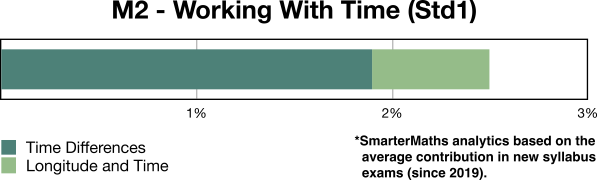
  • M2 Working with Time has been examined every year since the new Std1 course was introduced in 2019.
  • This topic area has accounted for an average of 2.5% per exam over this time.

ANALYSIS - Common pitfalls

  • Working With Time has been examined via a longer answer questions every year between 2020-2024 with allocations of between 2-3 marks.
  • The most common question type involves "time differences", examined 3 times in the last 4 years. This topic requires students to understand Coordinated Universal Time (UTC) and perform associated calculations. 
  • A much more challenging question type involves students calculating time difference based on longitudinal differences. This was examined in 2021 Std1 15, producing a concerning mean mark of 28%. 
  • Accordingly, the database now includes multiple examples that require the similar application of  15° = 1 hour, or 1° = 4 minutes time difference (review 2017 Std2 27d, M2 SM-Bank 3).
Filed Under: M2 Working with Time (Y11) Tagged With: worksheet-preamble

STD1 Snapshot: M1 Perimeter and Area

IMPORTANT FEATURES AND TIPS FROM EXAM HISTORY

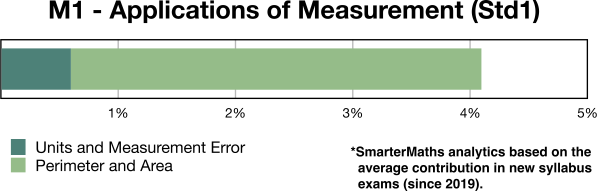
  • M1 Applications of Measurement has accounted for an average of 4.2% per Std1 exam since the new syllabus has been examined in 2019.
  • This topic has been split into two categories for analysis purposes which are 1-Units and Measurement Error (0.7%) and 2-Perimeter and Area (3.5%).
  • This analysis looks at the largest topic area of Perimeter and Area.

ANALYSIS - What to expect and common pitfalls

  • M1 Perimeter and Area has been examined in a feast or famine manner in the first six Std1 HSC exams. 2024 saw this topic examined in both multiple choice and longer answer questions with a total 4 mark allocation. Anaemic allocations in the period 2020-23 are in stark contrast to the massive allocation of 10 marks across 3 separate questions in 2019!
  • It must be noted that related "area" concepts can be tested in M5 Scale Drawings as was the case in 2024 Std1 29 and 2023 Std1 12b.
  • The 2024 and 2019 Std1 exams tested students on circular measure, composite shape areas and tiling. Each question caused problems with no mean mark above 30%. We recommend any revision of this area going through these examples thoroughly.
  • Volumes and surface areas (along with other Std2 content such as Trapezoidal Rule) are not examinable in the Std1 exam and are therefore omitted from the database.

Filed Under: Perimeter and Area (Std 1) Tagged With: worksheet-preamble

STD1 Snapshot M1: Units and Measurement Error

IMPORTANT FEATURES AND TIPS FROM EXAM HISTORY

  • M1 Applications of Measurement has accounted for an average of 4.2% per Std1 exam since the new syllabus has been examined in 2019.
  • This topic has been split into two categories for analysis purposes which are 1-Units and Measurement Error (0.7%) and 2-Perimeter and Area (3.5%).
  • This analysis looks at the minor topic area Units and Measurement Error.

ANALYSIS - What to expect and common pitfalls

  • Units and Measurement Error is a minor area which has attracted a multiple choice question each year in the 2020-22 period (notably absent in 2023-24).
  • Measurement Error has not examined in Std1 tests to date and is overdue to appear in our view. Database questions and solutions have been adjusted to reflect the "simplified" new syllabus calculation of percentage error (as a positive number, not the previous ± expression).
  • Significant figures and scientific notation have been the subject of all Std1 multiple choice questions, except in 2024, and proven challenging (review 2020 Std1 3 MC).
  • Converting between units (eg. kilograms → grams) is often required (2009 Std2 12 MC a "must review" question looks at  cm² → m²).
  • NESA Nov-19 syllabus maintenance includes the following in standard prefixes: mega-, giga-, nano- and micro-. These are examinable from the 2021 Std1 exam going forward.

Filed Under: Units and Measurement Error (Std 1) Tagged With: worksheet-preamble

STD1 Snapshot: F3 Loans

IMPORTANT FEATURES AND TIPS FROM EXAM HISTORY

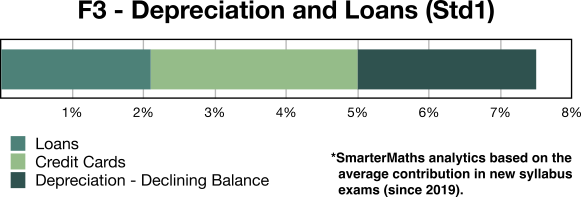
  • F3 Depreciation and Loans has accounted for a substantial average of 7.7% per Std1 exam since it was introduced in 2019.
  • We have split this area into its three subtopics for analysis purposes: 1-Loans (2.1%), 2-Credit Cards (2.9%) and 3-Declining Balance Depreciation (2.7%).
  • This analysis looks at the topic of Loans.

ANALYSIS - What to Expect and Common pitfalls

  • "Home Loan P+I-R Tables" have been the subject of the only two questions that have looked at loans in new syllabus exams to date.
  • Both 2021 Std1 27 and 2020 Std1 30 proved very challenging and are "must review" questions.
  • Examiners have included many different home loan payment tables over the years within Std2 exams. Exposure to a number of the different versions is highly recommended.
  • Flat-rate loans are outside the HSC Standard maths syllabus and all related questions have been removed from this database.

Filed Under: Loans (Std 1) Tagged With: worksheet-preamble

STD1 Snapshot: F3 Depreciation – Declining Balance

IMPORTANT FEATURES AND TIPS FROM EXAM HISTORY

  • F3 Depreciation and Loans has accounted for a substantial average of 7.7% per Std1 exam since it was introduced in 2019.
  • We have split this area into its three subtopics for analysis purposes: 1-Loans (2.1%), 2-Credit Cards (2.9%) and 3-Declining Balance Depreciation (2.7%).
  • This analysis looks at the topic Declining Balance Depreciation.

ANALYSIS - What to Expect and Common pitfalls

  • Declining Balance Depreciation has been examined in 5 of the last 6 Std1 exams, four times in the longer answer section (most recently in 2024).
  • The "comparison" of declining balance versus straight-line depreciation has been regularly examined, most recently in 2023 and 2022.
  • Std1 2019 21 described the straight-line depreciation as a percentage which confused some students and should be reviewed.
  • Std1 2024 30 involved a change from straight line to declining balance depreciation during the lifetime of a single asset. A novel way of examining this area which deserves attention.

Filed Under: Depreciation - Declining Balance (Std 1) Tagged With: worksheet-preamble

STD1 Snapshot: F2 Investments

IMPORTANT FEATURES AND TIPS FROM EXAM HISTORY

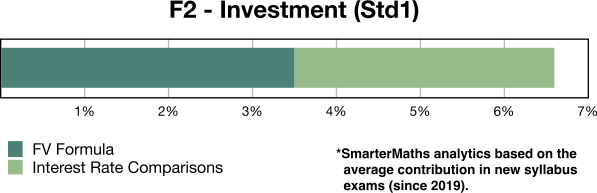
  • F2 Investments has accounted for a healthy average of 6.7% per Std1 exam since the new course was introduced in 2019.
  • F2 Investments is a Year 12 Std1 topic that is comprised of the compound interest content found in Std2 but which omits the content associated with shares and dividends.

ANALYSIS - What to Expect and Common pitfalls

  • Examiners have tested the formula  `FV=PV(1+r)^n`  in every Std1 exam to date, including twice in 2024, 2023, 2022 and 2020. This question type is contributing an average of 4.0% per Std1 exam and represents a key revision focus area.
  • Comparisons between compound and simple interest investments are an examiner favourite (most recently in 2024), contributing 3.0% per Std1 exam. It has been tested predominantly via longer answer questions with allocations of between 3–4 marks.
  • Testing compound interest through the Compounded Value of $1 tables has not been examined in the Std1 exam to date although it has been a regular contributor to the Std2 exams, consistently producing sub-50% mean marks.
  • All questions covering shares and dividends have been removed as they are beyond the scope of the Std1 course.

Filed Under: F2 Investment (Y12) Tagged With: worksheet-preamble

STD1 Snapshot: F1 – Earning Money and Budgeting

IMPORTANT FEATURES AND TIPS FROM EXAM HISTORY

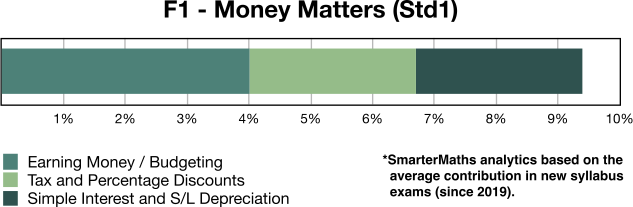
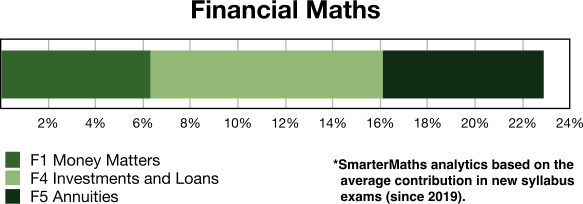
  • F1 Money Matters has accounted for an average of 9.4% per Std1 exam since the new course was introduced in 2019. 
  • We have split this area into 3 topics for analysis purposes: 1-Earning Money and Budgeting (4.0%), 2-Tax and Percentage Discounts (2.7%) and 3-Simple Interest and Straight Line Depreciation (2.7%).
  • This analysis looks at the largest topic area of Earning Money and Budgeting.

ANALYSIS - What to Expect and Common pitfalls

  • Earning money and budgeting has been examined every year in longer answer questions with allocations of 3–4 marks, including a total 6-mark allocation over 2 separate questions in 2019.
  • Wages and associated cost calculations is the most common question type and should be a focus of any revision. Examined each year 2022-24, students should review both adjusted hourly pay rates such as time-and-a-half and double time, and commission income.
  • Budgeting is another important revision area which has been notably absent since 2020.
  • A recurring theme in Markers Comments for minimising errors has been to set out answers in small clear steps. Take this advice and break down your calculations into bite size pieces!
  • Insurance has not been examined in Std1 exams to date. Numerous examples in the database cover this important area.

Filed Under: Earning Money and Budgeting (Std 1) Tagged With: worksheet-preamble

STD1 Snapshot: F1 – Tax and Percentage Discounts

IMPORTANT FEATURES AND TIPS FROM EXAM HISTORY

  • F1 Money Matters has accounted for an average of 9.4% per Std1 exam since the new course was introduced in 2019. 
  • We have split this area into 3 topics for analysis purposes: 1-Earning Money and Budgeting (4.0%), 2-Tax and Percentage Discounts (2.7%) and 3-Simple Interest and Straight Line Depreciation (2.7%).
  • This analysis looks at the topic Tax and Percentage Discounts.

ANALYSIS - What to Expect and Common pitfalls

  • Tax and Percentage Discounts revision should focus in on its 3 main question types: 1-Tax tables, 2-GST and 3-Medicare.
  • Tax Table problems are the most common question type. This area was last tested in both the 2022 and 2020 Std1 exams in 3-mark questions, producing sub-50% mean marks on both occasions. 
  • GST  has been examined in 4 of the 6 Std1 papers to date (most recently in 2024), regularly causing problems. 2019 Std1 26 saw a 2-mark longer question that required calculations with knowledge of the types of goods GST applies to and is a "must review" question.
  • Medicare taxation has not been examined in Std1 exams to date but is an important concept to revise.

Filed Under: Tax and Percentage Increase/Decrease (Std 1) Tagged With: worksheet-preamble

STD2 Snapshot: F1 – Simple Interest and Straight Line Depreciation

IMPORTANT FEATURES AND TIPS FROM EXAM HISTORY

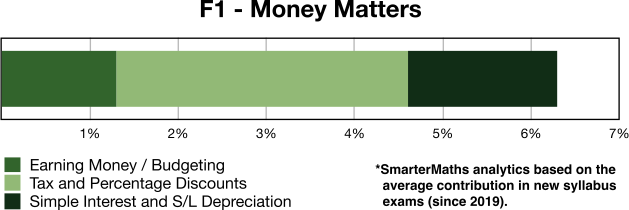
  • F1 Money Matters has contributed a solid 6.3% to new syllabus Std2 exams since it was introduced in 2019.
  • We have split this area into 3 topics for analysis: Earning money and budgeting (1.3%), Tax and Percentage Discounts (3.3%) and Simple Interest and Straight Line Depreciation (1.7%).
  • This analysis looks at the topic Simple Interest and Straight Line Depreciation.

ANALYSIS - What to Expect and Common pitfalls

  • Simple Interest and Straight Line Depreciation are minor contributors - "gateway" content for the Y12 topics of compound interest and declining balance depreciation.
  • Simple Interest was most recently examined in 2024 and 2023 in a low band multiple choice questions, and in 2021 as part of an interest rate comparison question that caused problems (covered in the MS-F4 topic area).
  • Flat-rate (simple) interest loans are regarded as outside the current syllabus and all past HSC questions in this area have been removed.
  • Depreciation attracted a low band "unit depreciation" question in 2023 as well as the more common comparison of straight line and declining balance methodologies. Due to the requirement of Y12 content, the latter comparison question type is covered in MS-F4.

Filed Under: Simple Interest and S/L Depreciation (Std 2) Tagged With: worksheet-preamble

STD1 Snapshot: F1 Simple Interest and Straight Line Depreciation

IMPORTANT FEATURES AND TIPS FROM EXAM HISTORY

  • F1 Money Matters has accounted for a significant 9.4% per Std1 exam since the new course was introduced in 2019. 
  • We have split this area into 3 topics for analysis purposes: 1-Earning Money and Budgeting (4.0%), 2-Tax and Percentage Discounts (2.7%) and 3-Simple Interest and Straight Line Depreciation (2.7%).
  • This analysis looks at the topic Simple Interest and Straight Line Depreciation.

ANALYSIS - What to Expect and Common pitfalls

  • Simple Interest and Straight Line Depreciation are minor contributors - "gateway" content for the Y12 topics of compound interest and declining balance depreciation.
  • Simple Interest was examined in the last two Std1 exams, where monthly interest calculations caused problems and should be reviewed.  
  • In every Std 1 exam to date, simple interest has been examined in questions that require a comparison between simple interest and compound interest investment outcomes. An extremely important area for revision that is covered within the F2 Investments due to the Y12 content of compound interest.
  • Straight Line Depreciation was tested in the 2021 Std1 exam using a graphical representation. We note this topic area is most often tested by comparing straight line and declining balance methodologies. These questions, due to the inclusion of Y12 content, are covered in the F3 Depreciation and Loans topic area.

Filed Under: Simple Interest and S/L Depreciation (Std 1) Tagged With: worksheet-preamble

STD1 Snapshot: S2 Single and Multi-Stage Events

IMPORTANT FEATURES AND TIPS FROM EXAM HISTORY

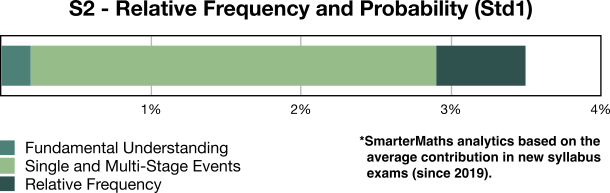
  • S2 Relative Frequency and Probability has accounted for an average of 3.5% per Std1 exam since the new course was introduced in 2019. 
  • S2 Relative Frequency and Probability is split into the following two sub-topics for the purposes of this analysis: 1-Fundamental Understanding (0.2%), 2-Relative Frequency (0.6%) and 3-Single and Multi-stage Events (2.7%).
  • This analysis looks at the dominant topic area of Single and Multi-stage Events.

ANALYSIS - What to Expect and Common pitfalls

  • Single and Multi-stage Events has been examined in the longer answer section in 4 of the past 5 Std1 exams, as well as via multiple-choice in 2022-23. 
  • Students have found this topic very challenging and it represents the upper end of the difficulty scale for Standard 1 content.
  • Complementary probability is a commonly tested concept where using the identity  "P(E) = 1 – P(Event NOT happening)" provides the easiest solution strategy (review the difficult 2022 Std1 17, 2021 Std1 20 and 2024 Std1 17).
  • Within this topic, probability trees have been a common question type (within Std2 exam history) and should be included in any revision of this area.

Filed Under: Single and Multi-Stage Events (Std 1) Tagged With: worksheet-preamble

STD1 Snapshot: S2 Combinations

IMPORTANT FEATURES AND TIPS FROM EXAM HISTORY

  • S2 Relative Frequency and Probability has accounted for an average of 3.5% per Std1 exam since the new course was introduced in 2019. 
  • S2 Relative Frequency and Probability is split into the following two sub-topics for the purposes of this analysis: 1-Fundamental Understanding (0.2%), 2-Relative Frequency (0.6%) and 3-Single and Multi-stage Events (2.7%).
  • This analysis looks at the, as yet unexamined, topic area of Combinations.

ANALYSIS - What to Expect and Common pitfalls

  • Combinations have not been examined in Std1 exams to date.
  • Notwithstanding this fact, it is covered in the database due to the following factors: new syllabus ambiguity, explicit mentions in both the new syllabus topic guidance and exemplar questions, and finally, the use of "combination" probability to interrogate questions dealing with "arrays" (or tables).
  • This is an example of an area which could arguably be examined and therefore it is safer to cover in the database, albeit modestly.
  • Unordered selection questions are regarded as beyond the scope of Std1 and are excluded.

Filed Under: Combinations (Std 1) Tagged With: worksheet-preamble

STD1 Snapshot: S2 Relative Frequency

IMPORTANT FEATURES AND TIPS FROM EXAM HISTORY

  • S2 Relative Frequency and Probability has accounted for an average of 3.5% per Std1 exam since the new course was introduced in 2019. 
  • S2 Relative Frequency and Probability is split into the following two sub-topics for the purposes of this analysis: 1-Fundamental Understanding (0.2%), 2-Relative Frequency (0.6%) and 3-Single and Multi-stage Events (2.7%).
  • This analysis looks at the minor topic area of Relative Frequency.

ANALYSIS - What to Expect and Common pitfalls

  • Relative Frequency was last examined in the 2019 Std1 exam in a 3-mark longer answer question. It has not appeared in the 5 years since although we note this does not include frequency tables which were examined in 2023 in S1 Summary Statistics.
  • The concept of expected frequency was the subject of 2019 Std1 24 and must be covered in any revision of this topic area.
  • Historically, two-way tables were a feature of questions on this topic area and we recommend covering this question type.

Filed Under: Relative Frequency (Std 1) Tagged With: worksheet-preamble

STD1 Snapshot: S1 Summary Statistics

IMPORTANT FEATURES AND TIPS FROM EXAM HISTORY

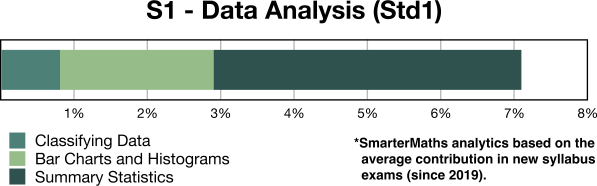
  • S1 Data Analysis has accounted for a healthy average of 7.1% per Std1 exam since the new course was introduced in 2019.
  • S1 Data Analysis is split into three subtopics for the purposes of this analysis: 1-Classifying Data (0.8%), 2-Bar Charts, Histograms and Other Graphs (2.1%) and 3-Summary Statistics (4.2%).
  • This analysis looks at the largest topic area of Summary Statistics. 

ANALYSIS - What to Expect and Common pitfalls

  • Summary Statistics has been examined in longer answer questions in every Std1 exam except 2021, with allocations of between 3–4 marks on each occasion.
  • Outlier calculations are regularly tested and consistently produce low mean marks (review 2024 HSC 13 and 2023 HSC 20).
  • Questions in this topic area require students to understand and calculate statistics such as median, mean and standard deviation (by calculator) given a simple data set. 
  • 2023 Std1 11 required a mean value calculation from a frequency table with class centres (a "must review" question that produced a mean mark of just 12%).
  • Box Plots were last examined in 2020 and should be covered. 

Filed Under: Summary Statistics (Std 1) Tagged With: worksheet-preamble

STD1 Snapshot: S1 Bar Charts, Histograms and Other

IMPORTANT FEATURES AND TIPS FROM EXAM HISTORY

  • S1 Data Analysis has accounted for a healthy average of 7.1% per Std1 exam since the new course was introduced in 2019.
  • S1 Data Analysis is split into three subtopics for the purposes of this analysis: 1-Classifying Data (0.8%), 2-Bar Charts, Histograms and Other Graphs (2.1%) and 3-Summary Statistics (4.2%).
  • This analysis looks at Bar Charts, Histograms and Other Graphs. 

ANALYSIS - What to Expect and Common pitfalls

  • Bar Charts, Histograms and Other Graphs has been examined every year of the new syllabus, including questions in the longer answer section each year between 2022-24.
  • Pareto Charts are an important new chart type that were examined in 2019 and caused major problems (review 2019 HSC 7 MC).
  • Bar Charts and Histograms have appeared in three Std1 exams to date, including challenging longer answer questions in 2022-23 (review 2023 Std1 13 and 2022 Std1 13b).
  • Historically, questions in this topic area were dominated by simple bar charts to the significantly harder cumulative frequency histograms. We see limited scope for the latter to be examined in any depth within Std1, although it does appear in NESA's "Additional sample HSC questions" for Std1 and should be covered.
  • Other chart types covered in this database include: stem and leaf, pie charts, segregated bar charts, area charts, step graphs and dot plots.
  • Comparison of datasets with respect to skew, median and spread was examined in 2024 Std1 24 and is a "must review" question.

Filed Under: Bar Charts, Histograms and Other Graphs (Std 1) Tagged With: worksheet-preamble

STD1 Snapshot: S1 Classifying Data

IMPORTANT FEATURES AND TIPS FROM EXAM HISTORY

  • S1 Data Analysis has accounted for a healthy average of 7.1% per Std1 exam since the new course was introduced in 2019.
  • S1 Data Analysis is split into three subtopics for the purposes of this analysis: 1-Classifying Data (0.8%), 2-Bar Charts, Histograms and Other Graphs (2.1%) and 3-Summary Statistics (4.2%).
  • This analysis looks at the smallest topic area of Classifying Data. 

ANALYSIS - What to Expect and Common pitfalls

  • Classifying Data has been examined in 3 out of 6 Std1 exams (most recently in 2024), primarily in the multiple choice section.
  • Data classification was tested in 2021 and produced a mean mark of just 25%.  Revision attention should be given to the definitions of categorical vs numerical variables and more importantly, their respective sub-categories.
  • Sampling methods and survey question design (2022 Std1 13) are important concepts that are well covered in database.

Filed Under: Classifying Data (Std 1) Tagged With: worksheet-preamble

STD1 Snapshot: N1 Minimum Spanning Trees

OVERVIEW

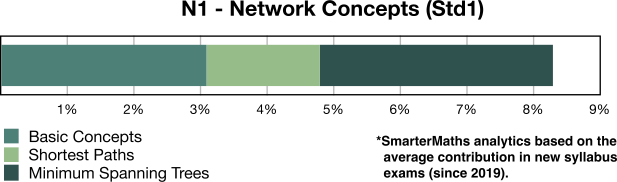
  • Networks has accounted for an average of 8.3% per Std1 exam since the new course was introduced in 2019.
  • We have split N1 Networks and Paths into three categories for the purposes of this analysis: 1-Basic Concepts (3.1%), 2-Shortest Paths (1.7%) and 3-Minimum Spanning Trees (3.5%).
  • This analysis looks at the largest topic area of Minimum Spanning Trees (MST).

ANALYSIS - Common questions and pitfalls

  • This topic area is proving an examiner favourite with longer answer questions worth between 2–4 marks asked in every Std1 exam since it was introduced.
  • Although well answered in 2022, this question type has typically caused problems with mean marks from 2023 and 2021-2019 below 50%. An important area for any exam revision given the high mark allocations and poor student understanding.
  • 2024 Std1 20 required students to provide reasons for their MST selection, a novel approach and "must review" question.
  • Along with a growing Std1 HSC question history, MST is well represented in our question database, drawing from multiple sources including official NESA sample exams and topic guidance documents.
  • The worked solutions provide significant detail for solving problems using both Prim's and Kruskal's algorithms, reflecting the step by step approach outlined in the Networks Topic Guidance document.

Filed Under: Minimum Spanning Trees Tagged With: worksheet-preamble

STD1 Snapshot: N1 Shortest Paths

OVERVIEW

  • Networks has accounted for an average of 8.3% per Std1 exam since the new course was introduced in 2019.
  • We have split N1 Networks and Paths into three categories for the purposes of this analysis: 1-Basic Concepts (3.1%), 2-Shortest Paths (1.7%) and 3-Minimum Spanning Trees (3.5%).
  • This analysis looks at the smallest topic area of Shortest Paths.

ANALYSIS - Common questions and pitfalls

  • This topic area has typically been associated with longer answer questions targeting low to mid-band difficulty. 
  • Examined four times to date in 2024, 2023, 2021 and 2019. With the exception of 2024, it has been tested as part of a more substantial minimum spanning tree question (note that the 2021 and 2019 examples are included within the Minimum Spanning Tree topic area).
  • Questions can require students to find a "shortest distance" by providing either a network diagram or a table, both of which are covered in the database.

Filed Under: Shortest Paths Tagged With: worksheet-preamble

STD1 Snapshot: N1 Basic Concepts

OVERVIEW

  • Networks has accounted for an average of 8.3% per Std1 exam since the new course was introduced in 2019.
  • We have split N1 Networks and Paths into three categories for the purposes of this analysis: 1-Basic Concepts (3.1%), 2-Shortest Paths (1.7%) and 3-Minimum Spanning Trees (3.5%).
  • This analysis will look at 1-Basic Concepts.

ANALYSIS - Common questions and pitfalls

  • Basic Concepts reviews a wide range of network concepts including the degree of vertices, number of edges, tree and path definitions, connected network and weighted edges.
  • Completing a table (or matrix) from a network graph and vice versa is a core competency that has been examined each year in the period 2022-24, predominantly via longer answer questions.
  • Examiners regularly test Basic Concepts through multiple choice with 7 separate MC questions appearing in new syllabus exams to date. A number of these have proven difficult for most and deserve attention (see 2024 Std1 6 MC, 2022 Std1 2 MC and 2020 Std1 5 MC).

Filed Under: Basic Concepts Tagged With: worksheet-preamble

STD2 Snapshot: N3 Critical Paths

IMPORTANT FEATURES AND TIPS FROM EXAM HISTORY

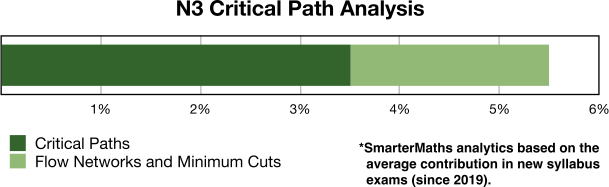
  • N3 Critical Path Analysis has contributed a significant 5.5% per new syllabus Std2 exam since it was introduced in 2019.
  • We have split this area into two categories for the purposes of analysis: 1-Critical Paths (3.5%) and 2-Flow Networks and Minimum Cuts (2.0%).
  • This analysis will look at Critical Paths, the largest and most challenging topic area within Networks.

ANALYSIS

  • Critical Paths (3.5%) has typically attracted significant 4-5 mark allocations in new syllabus exams with the outliers being 2024 (3 marks) and 2022 (1 mark).
  • The core skills students need in this area are set out below:
  • Skill 1: Draw a network diagram from a table. Tested with 6 activities in the 2019 HSC exam, and well answered. 
  • Skill 2: Scanning forwards (only) to establish critical paths. 
  • Skill 3: An extension of skill 2 that requires the scanning forwards and backwards of a network diagram. This exercise provides the EST and LST data to calculate float times and interrogate network adjustments.
  • The importance of setting out "scanning" information in network diagrams logically and clearly cannot be overstated. Detailed worked solutions show two styles of answer layout - one reflecting the NESA sample exam solution and the other following the Networks Topic Guidance.

Filed Under: Critical Paths Tagged With: worksheet-preamble

STD2 Snapshot: N3 Flow Networks and Minimum Cuts

IMPORTANT FEATURES AND TIPS FROM EXAM HISTORY

  • N3 Critical Path Analysis has contributed a significant 5.5% per new syllabus Std2 exam since it was introduced in 2019.
  • We have split this area into two categories for the purposes of analysis: 1-Critical Paths (3.5%) and 2-Flow Networks and Minimum Cuts (2.0%).
  • This analysis will look at Flow Networks and Minimum Cuts.

ANALYSIS - What to Expect and Common pitfalls

  • Flow Networks and Minimum Cuts has been examined in 4 of the 6 new syllabus exams (absent in 2024, 2021) and caused problems for students on each occasion.
  • Minimum Cut/Maximum Flow: this concept is easily the most common question type, examined four times since 2019 in questions that have all been poorly answered.
  • "Reverse flows" (i.e. flows from sink to source across a minimum cut line) has proven a challenging concept and deserves attention (see 2019 Std2 HSC 40).
  • Network adjustments to increase flow has appeared in both the 2022 and 2019 Std2 exams. We highly recommend reviewing examples of this question type which can be easily identified by using the sub-category filter in the program.
  • In addition to more difficult problems, the database also covers many lower band questions, in a similar style to the examples provided in NESA's Topic Guidance.

Filed Under: Flow Networks and Minimum Cuts Tagged With: worksheet-preamble

STD2 Snapshot: N2 Minimum Spanning Trees

IMPORTANT FEATURES AND TIPS FROM EXAM HISTORY

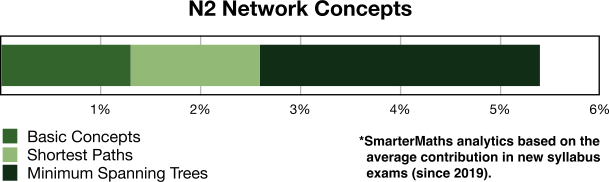
  • N2 Network Concepts has contributed 5.4% to new syllabus exams since its introduction in 2019.
  • We have split this area into three categories for the purposes of analysis: 1-Basic Concepts (1.3%), 2-Shortest Paths (1.3%) and 3-Minimum Spanning Trees (2.8%).
  • This analysis will look at the largest contributing topic area, Minimum Spanning Trees.

ANALYSIS - What to Expect and Common pitfalls

  • Minimum Spanning Trees (2.8%) looks to be an exam staple after appearing in every new syllabus exam to date with meaningful allocations of 2-4 marks.
  • The database reflects this importance and besides the growing number of HSC past questions, includes many supplementary examples informed by the syllabus document, NESA's Networks Topic Guide, exemplar questions and past VCE exam questions.
  • Minimum Spanning Trees represents a high scoring opportunity for students. We expect it to regularly be tested with typical levels of difficulty around the Band 3-4 level, although 2023 Std2 19b produced a mean mark of just 46% and deserves attention. 
  • The worked solutions provide significant detail for solving problems using both Prim's and Kruskal's algorithms, reflecting the step by step approach outlined in NESA's Networks Topic Guidance document.

Filed Under: Minimum Spanning Trees, Minimum Spanning Trees Tagged With: worksheet-preamble

STD2 Snapshot: N2 Shortest Paths

IMPORTANT FEATURES AND TIPS FROM EXAM HISTORY

  • N2 Network Concepts has contributed 5.4% to new syllabus exams since its introduction in 2019.
  • We have split this area into three categories for the purposes of analysis: 1-Basic Concepts (1.3%), 2-Shortest Paths (1.3%) and 3-Minimum Spanning Trees (2.8%).
  • This analysis will look at the topic Shortest Paths.

ANALYSIS - What to Expect and Common pitfalls

  • Shortest Paths is typically examined at low to mid-band difficulty level and received its highest allocation of 4 marks in the 2024 exam.
  • Prior to 2024, it has been tested in 2023, 2021 and 2019 in new syllabus exams, usually as a part of a minimum spanning tree question.
  • Although questions can often be answered through trial and error reasoning, implementing Djikstra's algorithm to solve questions is also well covered in the database solutions. This solution method is regularly described in detail, reflecting its importance in NESA's Networks Topic Guide.
  • Questions can require students to find a "shortest distance" by providing either a network diagram or a table, both of which are covered in the database.

Filed Under: Shortest Paths Tagged With: worksheet-preamble

STD2 Snapshot: N2 Networks – Basic Concepts

IMPORTANT FEATURES AND TIPS FROM EXAM HISTORY

  • N2 Network Concepts has contributed 5.4% to new syllabus exams since its introduction in 2019.
  • We have split this area into three categories for the purposes of analysis: 1-Basic Concepts (1.3%), 2-Shortest Paths (1.3%) and 3-Minimum Spanning Trees (2.8%).
  • This analysis will look at Basic Concepts.

ANALYSIS - What to Expect and Common pitfalls

  • Draw network from table/matrix/map: Completing a network graph from a table/matrix/map is a core competency which has been examined each year between 2022-24 (including longer answer questions in 2022 and 2023).
  • The database also covers the reverse process of completing a table related to a given network. 
  • Basic Concepts: Questions review basic concepts such as; odd and even vertices, tree and path definitions, connected network, weighted edge, etc..
  • A disproportionate number of multiple choice questions are used in our database to allow teachers to target specific basic concepts.
  • Practical problems: a number of practical problems requiring simple network design and representation are included. A review of 2020 Std2 9 MC exposed a lack of understanding of "competition" networks and should be reviewed.

Filed Under: Basic Concepts Tagged With: worksheet-preamble

2UA Snapshot – T13 Trig Graphs

HISTORICAL CONTRIBUTION

  • T13 Trig Calculus has contributed a very healthy 6.7% to the HSC exam, on average, over the last 10 years.
  • This topic has been split into three sub-categories for this analysis which are: 1-Trig Calculus (3.2%), 2-Circular Measure (1.7%), and 3-Trig Graphs (1.8%).
  • This analysis looks at Trig Graphs (1.8%).

HSC ANALYSIS - What to expect and common pitfalls

  • Trig Graphs (1.8%) received a multiple choice question in 2018 and a substantial 3 mark allocation in 2017.
  • It has also been a key component in outstanding longer answer questions asked in 2013 (Q13a) and 2009 (Q7b) which caused all sorts of problems for students - these are highly recommended revision questions for 2019.
  • Note that more than half of students answered the 2016 multiple choice question on a tan function graph's period incorrectly. Deserves attention.

Filed Under: Trig graphs Tagged With: worksheet-preamble

STD2 Snapshot: M7 Rates

IMPORTANT FEATURES AND TIPS FROM EXAM HISTORY

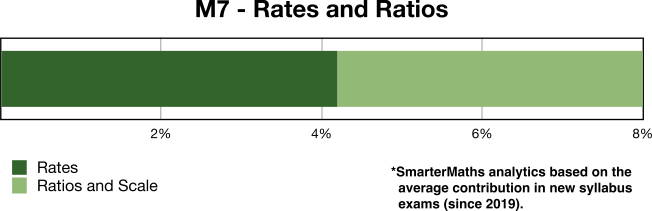
  • M7 Rates and Ratios has been a healthy contributor to new syllabus Std2 exams, responsible for an average of 8.0% per exam since 2019.
  • We have split this area into 2 topics for analysis purposes: 1-Rates (4.2%), and 2-Ratios and Scale (3.8%).
  • This analysis will look at Rates.

ANALYSIS - What to Expect and Common pitfalls

  • Rates is a very broad area that has the greatest overlap with other syllabus content of any Std2 topic.
  • Rates primarily offers up low to mid-band difficulty questions and students who have a good conceptual understanding should expect to score highly.
  • Students need to cover a broad cross-section of questions involving a number of different themes. Students struggled with 2024 Std2 33 and 2021 Std2 27 which deserve specific revision attention.
  • We recommend revising 2016 Std2 16 MC to deal with "part thereof" unit cost terminology - one of the few areas that has caused any problems in past questions.
  • This topic area is critical because its concepts need to be applied all across the syllabus, including A2 Linear Relationships and M1 Energy and Mass.

Filed Under: Rates (Std2) Tagged With: worksheet-preamble

STD2 Snapshot: A4 Non-Linear – Inverse and Other Problems

IMPORTANT FEATURES AND TIPS FROM EXAM HISTORY

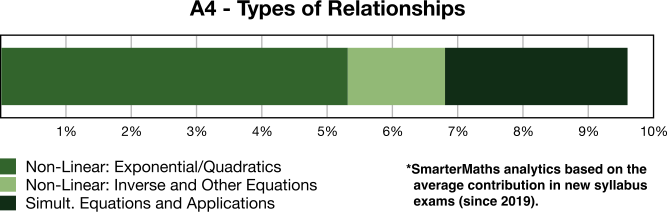
  • A4 Types of Relationships has contributed a very substantial 9.7% per paper since the new syllabus was introduced in 2019.
  • We have split this area into 3 topics for analysis purposes: 1-Non-Linear: Exponential/Quadratics (5.3%), 2-Non-Linear: Inverse and Other (1.5%) and 3-Simultaneous Equations (2.9%).
  • This analysis looks at the topic Non-Linear: Inverse and Other Problems.

ANALYSIS - What to Expect and Common pitfalls

  • Non-Linear: Inverse and Other Problems (1.5%) is a challenging topic area last examined in 2024, with sub-50% mean marks resulting virtually every time it has been tested! 
  • Questions where one quantity is proportional to the inverse of another have proved very challenging. 2024 Std2 9 MC and 2022 Std2 Q24 are important revision examples (we note the latter was a common Std2/Adv question that produced mean marks of 29% and 44% in its two parts).
  • The database is dominated by band 5 and 6 questions and revision attention is warranted for this difficult content area.
  • Explaining the practical "limitations" of an inverse relationship within a context should be reviewed in a variety of examples. Note a question testing this concept recorded a mean mark of just 7% in 2014 (Q29a).

Filed Under: Non-Linear: Inverse and Other Problems (Std 2) Tagged With: worksheet-preamble

STD2 Snapshot: A4 Non-Linear – Exponentials/Quadratics

IMPORTANT FEATURES AND TIPS FROM EXAM HISTORY

  • A4 Types of Relationships has contributed a very substantial 9.7% per paper since the new syllabus was introduced in 2019.
  • We have split this area into 3 topics for analysis purposes: 1-Non-Linear: Exponential/Quadratics (5.3%), 2-Non-Linear: Inverse and Other (1.5%) and 3-Simultaneous Equations (2.9%).
  • This analysis looks at the largest sub-topic Non-Linear: Exponentials/Quadratics.

ANALYSIS - What to Expect and Common pitfalls

  • Non-Linear: Exponentials/Quadratics (5.3%) is a major contributor to new syllabus Std2 exams, albeit with a volatile mark allocation that has seen a range of between 1-9 marks in this time.
  • This topic's revision importance is due in large part to the chunky allocations it regularly receives when it does appear, in questions often involving cross-topic concepts.
  • Quadratics graphing and interpretation has proven extremely challenging in the past. 2024 Std2 26 and 2021 Std2 25 represent the higher level of difficulty in this critical area and we cannot recommend highly enough the need for a revision focus here!
  • Exponential graphing and interpretation has been tested in 4 times in the last 9 years, most recently in 2024, causing major problems. 
  • Describing the "limitations" of certain models has produced sub-50% mean marks when examined and should be revised (see sub-category filter to isolate these questions).
  • Identifying graphs in a multiple choice question has been asked 3 times in the last decade, generally well answered although causing some problems in 2011 Std2 6 MC.

Filed Under: Non-Linear: Exponential/Quadratics (Std 2) Tagged With: worksheet-preamble

STD2 Snapshot: A4 Simultaneous Equations and Applications

IMPORTANT FEATURES AND TIPS FROM EXAM HISTORY

  • A4 Types of Relationships has contributed a very substantial 9.7% per paper since the new syllabus was introduced in 2019.
  • We have split this area into 3 topics for analysis purposes: 1-Non-Linear: Exponential/Quadratics (5.3%), 2-Non-Linear: Inverse and Other (1.5%) and 3-Simultaneous Equations (2.9%).
  • This analysis looks at Simultaneous Equations and Applications

ANALYSIS - What to Expect and Common pitfalls

  • Simultaneous Equations and Applications (2.9%) is a critical revision area with questions worth 4-5 marks appearing in three of the last five HSC exams (absent in 2024).
  • The high mark allocations and low mean marks over this period make it a key area where students can outperform.
  • Significant syllabus changes have occurred in this topic area - most notably that students can be tested on solving simultaneous equations graphically, but not arithmetically. 
  • Cost and revenue graphing is an important theme which has attracted high mark allocations in 2019 Std2 36 and 2018 Std2 27d - both important revision questions.
  • Students must review 2021 Std2 34 which produced a mean mark of just 29% and represents the upper difficulty level of this topic area.
  • Past HSC questions have required students to sketch linear equations on 5 separate occasions since 2014 - a key skill to incorporate into any revision.

Filed Under: Simultaneous Equations and Applications (Std 2) Tagged With: worksheet-preamble

STD2 Snapshot: A2 Applications: Currency, Fuel and Other Problems

IMPORTANT FEATURES AND TIPS FROM EXAM HISTORY

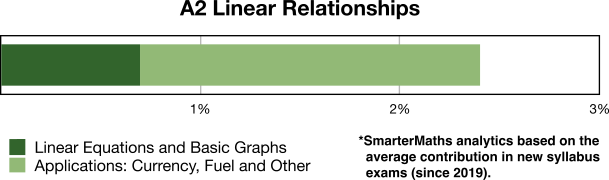
  • A2 Linear Relationships has contributed an average of 2.4% per paper since the new syllabus was introduced in 2019.
  • We have split this area into 2 topics for analysis purposes: 1-Linear Equations and Basic Graphs (0.7%) and 2-Applications: Currency, Fuel and Other (1.7%).
  • This analysis looks at the biggest topic Applications: Currency, Fuel and Other Problems.

ANALYSIS - What to Expect and Common pitfalls

  • Applications of Linear Relationships represents classic low hanging fruit, most recently examined each year between 2019-2022, in questions worth up to 3 marks.
  • Fuel Consumption questions have been asked in 3 times in the last decade, most recently in 2021. 
  • Currency Conversion was examined in 2019 for the first time since 2012, producing a mean mark of 42%. This sub-topic has proven challenging and warrants attention.
  • Finding a proportional constant in an applied context has been asked twice since 2014 (most recently in 2020) and should be revised.
  • Some linear modelling questions in everyday contexts have proven challenging. A multiple choice cost equation in 2020 caused problems (2020 Std2 10 MC). More importantly however, high-mark allocation questions describing income tax and boot production represent the most difficult past HSC questions in this area (see 2010 Std2 27c and 2009 Std2 24d).
  • It is important to note that the most important examination of this topic area is expected, in our view, to be within S4 Bivariate Data Analysis which covers overlapping concepts but incorporates scatterplots and lines of best fit.

Filed Under: Applications: Currency, Fuel and Other Problems (Std 2) Tagged With: worksheet-preamble

STD2 Snapshot: A2 Linear Equations and Basic Graphs

IMPORTANT FEATURES AND TIPS FROM EXAM HISTORY

  • A2 Linear Relationships has contributed an average of 2.4% per paper since the new syllabus was introduced in 2019.
  • We have split this area into 2 topics for analysis purposes: 1-Linear Equations and Basic Graphs (0.7%) and 2-Applications: Currency, Fuel and Other (1.7%).
  • This analysis looks at the minor contributing topic, Linear Equations and Basic Graphs.

ANALYSIS - What to Expect and Common pitfalls

  • Linear Equations and Basic Graphs is a regularly examined but small topic area. Its importance is due to its coverage of "gateway" knowledge which is required to solve harder practical problems later in the course.
  • Asked 5 times in the last decade (most recently 2022) - almost exclusively as multiple choice questions, except for 2011 Std2 23b which was allocated an outlier of 4 marks. 
  • The most common question type asks students to identify/sketch the graphs of simple linear equations or find gradients from simple graphs. 2022 Std2 2 MC produced a 48% mean mark in this area and should be reviewed.
  • Pattern questions have been asked 3 times since 2011 and caused problems. Revision attention is required here.
  • It is very surprising how much trouble students have with this sub-topic as a whole (sub-50% mean marks half the time). Practice should pay particular attention to eliminating silly errors.

Filed Under: Linear Equations and Basic Graphs (Std 2) Tagged With: worksheet-preamble

STD2 Snapshot: A1 Applications: BAC, Medication and D=ST

IMPORTANT FEATURES AND TIPS FROM EXAM HISTORY

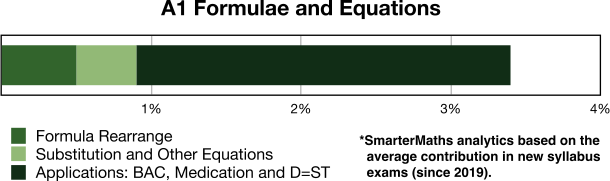
  • A1 Formulae and Equations has contributed an average of 3.5% per exam since the new syllabus was introduced in 2019.
  • We have split this area into 3 topics for analysis purposes: 1-Formula Rearrange (0.5%), 2-Substitution and Other Equations (0.5%) and Applications: BAC, Medication and D=S×T (2.5%).
  • This analysis looks at the largest topic Applications: BAC, Substitution and Other Equations.

ANALYSIS - What to Expect and Common pitfalls

  • Examiners have included BAC calculations in new syllabus exams in 2024, 2023, 2019 (worth 3–4 marks on each occasion) and 2020.
  • The 2020 BAC question was at the top difficulty echelon, combining BAC calculations with a difficult rates application - we highly recommend attention here (2020 Std2 13 MC).
  • Formulae and Other Equations deals with substitution into into Fried's, Young's and Clark's dosage formulae. This area has not been examined since 2018 but should be reviewed as it is specifically mentioned in the new syllabus.
  • Stopping distance has caused problems the last two times it has been tested in 2018 and 2015 and deserves revision attention.
  • Distance, speed and time equations (D=S×T) represent challenging multiple choice questions, most recently in 2024 Std2 11 MC. We include numerous past questions in the database, acknowledging the obvious overlap with M4 Rates within the measurement strand. 2011 Std2 21 MC is a great revision example of the higher difficulty level in this area.

Filed Under: Applications: BAC, Medication and D=SxT (Std 2) Tagged With: worksheet-preamble

STD2 Snapshot: A1 Substitution and Other Equations

IMPORTANT FEATURES AND TIPS FROM EXAM HISTORY

  • A1 Formulae and Equations has contributed an average of 3.5% per exam since the new syllabus was introduced in 2019.
  • We have split this area into 3 topics for analysis purposes: 1-Formula Rearrange (0.5%), 2-Substitution and Other Equations (0.5%) and Applications: BAC, Medication and D=S×T (2.5%).
  • This analysis looks at the sub-topic Substitution and Other Equations (0.5%).

ANALYSIS - What to Expect and Common pitfalls

  • Substitution and Other Equations (0.5%) represents classic low hanging fruit in the Std2 paper although its contribution to exams has been slashed since the new syllabus has been in place.
  • Substituting values into both linear and non-linear equations to find an unknown variable is required. 
  • Pitfalls: Algebraic Fractions warrant revision attention after causing problems for a majority of students in both 2021 (Q29) and 2018 (Q28b). 
  • Substituting negative numbers into an equation produced a sub-50% mean mark in 2010 Std2 7 MC and should be reviewed.
  • We recommend covering "Find the Mistake" style questions that have surprisingly caused issues in the past. 

Filed Under: Substitution and Other Equations (Std 2) Tagged With: worksheet-preamble

STD2 Snapshot: S4 Bivariate Data Analysis

IMPORTANT FEATURES AND TIPS FROM EXAM HISTORY

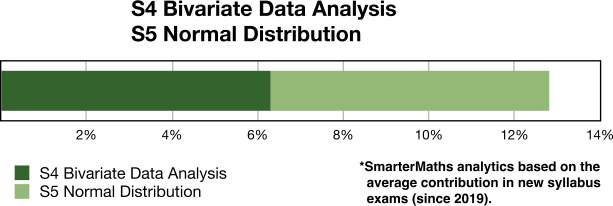
  • S4 Bivariate Data Analysis has contributed an average of 6.3% per paper since the new syllabus was introduced in 2019.

ANALYSIS - What to Expect and Common pitfalls

  • Bivariate Data Analysis (6.3%) has continued to grow in importance on the back of its common content with the Advanced maths course. We note common Std2/Adv questions have been asked every year between 2020-2024, with significant 3-5 mark allocations each time.
  • It is important that students review the long-winded style of recent question that have produced sub-30% mean marks (2021 Q33 and 2020 Q36) .
  • Further, 2022 presented the broadest question in the exam's history with instructions "Describe and interpret the data and other information provided, with reference to the context given."  A must review question where the solution structure is key (mean mark 30%).
  • Calculating the Pearson correlation coefficient from raw data was asked in the 2019 HSC exam and poorly answered.
  • Warning: execute calculator skills in Statistics mode efficiently and mistake free or easy marks will go by the wayside (review EQ-Bank Q1-3).
  • Pitfalls: Marker's comments have highlighted problems in finding equations of best fit, interpreting gradients and identifying equation limitations - all areas well covered in this question database.

Filed Under: S4 Bivariate Data Analysis (Y12) Tagged With: worksheet-preamble

STD2 Snapshot: S5 The Normal Distribution

IMPORTANT FEATURES AND TIPS FROM EXAM HISTORY

  • S5 The Normal Distribution has contributed a substantial average of 6.5% per paper since the new syllabus was introduced in 2019.

ANALYSIS - What to Expect and Common pitfalls

  • Normal Distribution (6.5%) has the important combination of high mark allocations and (very) low mean marks. Its importance in achieving a high band result cannot be overstated.
  • Std2 exams average two longer answer questions per exam and more than one multiple choice! It must be noted that six challenging Std2/Adv common questions have appeared since 2020.
  • In the clear majority of times it has been tested, sub-50% mean marks have resulted (including much lower in the last 4 years), making it a key opportunity to outperform.
  • `z`-score tables have been a feature of some of the hardest questions, appearing in each of the last 4 exams and causing major problems. A critical revision area.
  • Questions involving `z`-score intervals and the comparison of two data sets using `z`-scores have also been poorly answered and multiple examples cover this area.
  • Marker's Comments: Graphically representing `z`-scores on a curve to calculate percentages has been specifically mentioned as a feature of the "more successful" responses in past HSC exams. Heed this advice by including a quick default sketch.

Filed Under: S5 The Normal Distribution (Y12) Tagged With: worksheet-preamble

STD2 Snapshot: S2 Multi-Stage Events

IMPORTANT FEATURES AND TIPS FROM EXAM HISTORY

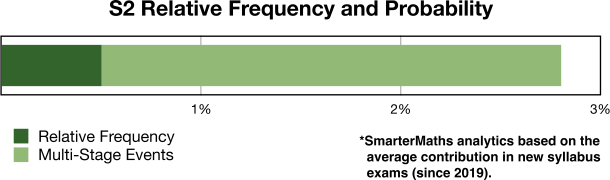
  • S2 Relative Frequency and Probability has contributed an average of 2.8% per new syllabus Std2 exam, well below its historical average when the previous syllabus was in place.
  • We have split this area into 3 categories for the purposes of analysis: 1-Relative Frequency (0.5%), 2-Combinations and Single Stage Events (0%) and 3-Multi-Stage Events (2.3%).
  • This analysis looks at easily the largest area in this topic Multi-Stage Events.

ANALYSIS - What to Expect and Common pitfalls

  • Multi-stage Events has been consistently examined in new syllabus Std2 exams, with longer answer and multiple choice questions being equally represented.
  • Students have found this sub-topic very challenging with mean marks sub-50% more often than not.
  • Within this topic, probability trees have been responsible for two-thirds of the total mark allocation, and have been examined in 6 times in the last decade (most recently in 2022). This specific area, answered poorly in 2021, 2016 and 2015, should be a revision focus.
  • Examiners regularly provide opportunities for applying complementary probabilities, posing problems that can be more efficiently solved using the identity  "P(E) = 1 – P(Event NOT happening)". Keep this front of mind when attempting revision questions (review 2024 Std2 31).

Filed Under: Multi-Stage Events (Std 2) Tagged With: worksheet-preamble

STD2 Snapshot: S2 Combinations and Single-Stage Events

IMPORTANT FEATURES AND TIPS FROM EXAM HISTORY

  • S2 Relative Frequency and Probability has contributed an average of 2.8% per new syllabus Std2 exam, well below its historical average when the previous syllabus was in place.
  • We have split this area into 3 categories for the purposes of analysis: 1-Relative Frequency (0.5%), 2-Combinations and Single Stage Events (0%) and 3-Multi-Stage Events (2.3%).
  • This analysis looks at the sub-topic Combinations and Single-Stage Events which is yet to be examined in new syllabus exams and hence does not appear in the graph above.

ANALYSIS - What to Expect and Common pitfalls

  • Combinations are covered in the database with a much reduced emphasis.
  • A number of reasons contribute to our current stance of covering combinations: new syllabus ambiguity, explicit mentions in the current syllabus topic guidance and the use of "combination" knowledge to interrogate questions dealing with "arrays" (or tables).
  • Unordered selection questions that require factorial notation are regarded as beyond the scope of Standard 2 and have not been included in the new syllabus question database.
  • Single-Stage events are a simpler version of the much more common multi-stage event probability, and should be considered gateway content for the more difficult Y12 probability.

Filed Under: Combinations and Single Stage Events (Std 2) Tagged With: worksheet-preamble

STD2 Snapshot: S2 Relative Frequency

IMPORTANT FEATURES AND TIPS FROM EXAM HISTORY

  • S2 Relative Frequency and Probability has contributed an average of 2.8% per new syllabus Std2 exam, well below its historical average when the previous syllabus was in place.
  • We have split this area into 3 categories for the purposes of analysis: 1-Relative Frequency (0.5%), 2-Combinations and Single Stage Events (0%) and 3-Multi-Stage Events (2.3%).
  • This analysis looks at the topic Relative Frequency.

ANALYSIS - What to Expect and Common pitfalls

  • Relative Frequency (0.5%) was last examined in the 2024 Std2 exam in a multiple choice question after a four year absence.
  • In the decade prior to this, it was tested every year, often in multiple questions. This strong historical presence demands revision attention.
  • Two-way tables are historically the most common question type, most recently appearing in 2024. Harder examples in this area that should be reviewed include 2016 Std2 23 MC and 2017 Std2 29c.
  • Some past HSC questions involving expected frequency in games of chance caused problems (2018 Std2 26a, 2004 Std2 25c) and should be reviewed carefully.

Filed Under: Relative Frequency (Std 2) Tagged With: worksheet-preamble

STD2 Snapshot: S1 Summary Statistics – No Graph

IMPORTANT FEATURES AND TIPS FROM EXAM HISTORY

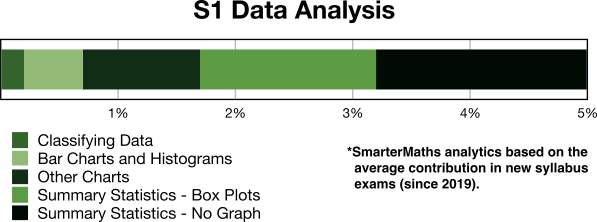
  • S1 Data Analysis has contributed 5.0% per new syllabus Std2 exam since its introduction in 2019.
  • We have split this area into 5 topics for analysis purposes: 1-Classifying Data (0.2%), 2-Bar Charts and Histograms (0.5%), 3-Other Charts (1.0%), 4-Summary Statistics Box Plots (1.5%) and 5-Summary Statistics - No Graph (1.8%).
  • This analysis looks at the topic Summary Statistics - No Graph.

ANALYSIS - What to Expect and Common pitfalls

  • Summary Statistics - No Graph questions require students to understand and calculate statistics such as median, mean, standard deviation (by calculator) and five-number summaries. 
  • Reduced scaffolding is a feature of many new syllabus exam questions in this area and effective revision must include exposure to this question style.
  • Mean calculations where data sets are "adjusted" is key revision (see 2023 Std2 15 MC).
  • Questions on outliers/IQRs have been asked in 5 of the last 10 years, most recently in 2021 (2018 Q26e an important revision example).
  • Standard deviation questions have seen an uptick in recent years and students must be able to find the std dev of a small data set by calculator (review 2017 Std2 27a) and also explain the measure conceptually (review 2020 Std2 24).

Filed Under: Summary Statistics - No Graph (Std 2) Tagged With: worksheet-preamble

STD2 Snapshot: S1 Summary Statistics – Box Plots

IMPORTANT FEATURES AND TIPS FROM EXAM HISTORY

  • S1 Data Analysis has contributed 5.0% per new syllabus Std2 exam since its introduction in 2019.
  • We have split this area into 5 topics for analysis purposes: 1-Classifying Data (0.2%), 2-Bar Charts and Histograms (0.5%), 3-Other Charts (1.0%), 4-Summary Statistics Box Plots (1.5%) and 5-Summary Statistics - No Graph (1.8%).
  • This analysis looks at the topic Summary Statistics - Box Plots.

ANALYSIS - What to Expect and Common pitfalls

  • Box-plots and in particular, the comparison of parallel box-plots receives its own dot point in the new syllabus and finally received a meaningful mark allocation in the 2024 HSC exam.
  • Box-plots only received a single multiple choice question in the previous 3 Std2 exams. The topic was most recently examined properly in 2019, receiving a significant 5 mark allocation and producing a mean mark of just 28%.
  • Students must be confident in drawing box-plots from scratch which has been required twice in the last 8 years (review 2019 Std2 39).
  • Comparing parallel box plots is an important question type that attracted significant mark allocations in 2024 and 2019.
  • 2024 Std2 28 asked specifically for comparisons of "skew, measures of central tendency and spread", and represents an important revision question.

Filed Under: Summary Statistics - Box Plots (Std 2) Tagged With: worksheet-preamble

STD2 Snapshot: S1 Other Charts

IMPORTANT FEATURES AND TIPS FROM EXAM HISTORY

  • S1 Data Analysis has contributed 5.0% per new syllabus Std2 exam since its introduction in 2019.
  • We have split this area into 5 topics for analysis purposes: 1-Classifying Data (0.2%), 2-Bar Charts and Histograms (0.5%), 3-Other Charts (1.0%), 4-Summary Statistics Box Plots (1.5%) and 5-Summary Statistics - No Graph (1.8%).
  • This analysis looks at the topic area Other Charts (1.2%).

ANALYSIS - What to Expect and Common pitfalls

  • Pareto Charts are the most important revision area in this topic. Last examined in a longer answer question in 2022 and a multiple choice in 2019, causing problems on each occasion with mean marks of 41% and 18% respectively. 
  • A revision of Stem & Leaf plots is recommended (last examined in 2021).
  • Double Stem and Leaf plots produced sub-50% mean marks the last 4 times they were examined (most recently in 2016), so revision attention is well advised.
  • Although Area charts are unlikely to be examined in our view, the generality of the syllabus wording still make this a possibility. Our current stance is to therefore briefly cover this graph type.
  • Other charts represented in the dataset include pie charts, segregated bar charts, step graphs and dot plots.

Filed Under: Other Charts (Std 2) Tagged With: worksheet-preamble

STD2 Snapshot: S1 Bar Charts and Histograms

IMPORTANT FEATURES AND TIPS FROM EXAM HISTORY

  • S1 Data Analysis has contributed 5.0% per new syllabus Std2 exam since its introduction in 2019.
  • We have split this area into 5 topics for analysis purposes: 1-Classifying Data (0.2%), 2-Bar Charts and Histograms (0.5%), 3-Other Charts (1.0%), 4-Summary Statistics Box Plots (1.5%) and 5-Summary Statistics - No Graph (1.8%).
  • This analysis looks at the minor topic Bar Charts and Histograms.

ANALYSIS - What to Expect and Common pitfalls

  • Bar Chart & Histogram questions can go from simple bar charts to the harder cumulative frequency histograms.
  • The more difficult cumulative frequency histogram topic was most recently examined in 2022 Q15 MC (33% mean mark) and 2021 Q7 MC (50% mean mark). Longer answer questions in the period 2013-2016 cover this sub-topic particularly well with harder examples.
  • "Positive" skew of a histogram should be reviewed (see 2020 Std2 9 MC).
  • Note that the related Pareto Charts are likely to cannibalise some marks previously allocated to this sub-topic. These are covered separately under the sub-topic Other Charts.
  • Pitfalls: Markers highlight class centres and finding the median and quartile values of cumulative frequency histograms as poorly understood concepts. 

Filed Under: Bar Charts and Histograms (Std 2) Tagged With: worksheet-preamble

STD2 Snapshot: S1 Classifying Data

IMPORTANT FEATURES AND TIPS FROM EXAM HISTORY

  • S1 Data Analysis has contributed 5.0% per new syllabus Std2 exam since its introduction in 2019.
  • We have split this area into 5 topics for analysis purposes: 1-Classifying Data (0.2%), 2-Bar Charts and Histograms (0.5%), 3-Other Charts (1.0%), 4-Summary Statistics Box Plots (1.5%) and 5-Summary Statistics - No Graph (1.8%).
  • This analysis looks at the minor topic area of Classifying Data.

ANALYSIS - What to Expect and Common pitfalls

  • Classifying Data was examined in 2024 for the first time since the new syllabus began in 2019! Welcome back old friend after 5 years in the wilderness. 
  • Historically, this topic area usually attracted a multiple choice question which are included in the database and should be reviewed.
  • Surprisingly, this topic area produced sub-50% mean marks in 2016 Q7 MC and 2007 Q17 MC which should both be covered.
  • Stratified sampling and categorical vs numerical variables and more importantly, their respective sub-categories, are key revision content.

Filed Under: Classifying Data (Std 2) Tagged With: worksheet-preamble

STD2 Snapshot: F5 Annuities

IMPORTANT FEATURES AND TIPS FROM EXAM HISTORY

  • F5 Annuities has contributed an impressive average of 6.8% to the new syllabus Std2 exams since its introduction in 2019.

ANALYSIS - What to Expect and Common pitfalls

  • Annuities have been a very challenging topic area for students. The topic has attracted huge allocations of between 5-8 marks in the last 4 exams.
  • Annuities is proving to be a critical content area for common Std2/Advanced questions which have appeared in both exams in 2023, 2022 and 2020. 
  • Questions involving Future Value of $1 Annuity Tables are the most common type under the new Std2 syllabus, producing low mean marks each year in the period 2021-24.
  • Further to the above point, 2022 Q25, 2021 Q40 and 2019 Q42 test students at the upper level of difficulty they will encounter within this question style and should be reviewed carefully.
  • Present Value Annuity Tables have been examined in 2024 and 2020-21, causing serious problems on each occasion.
  • Recurrence relations within the context of annuities was examined for the first time in 2020 and caused problems (see 2020 Std2 34).
  • It is recommended students also review Contribution per period for a future value of $1 table (2016 Std2 28d).

Filed Under: F5 Annuities (Y12) Tagged With: worksheet-preamble

STD2 Snapshot: F4 – Loans and Credit Cards

IMPORTANT FEATURES AND TIPS FROM EXAM HISTORY

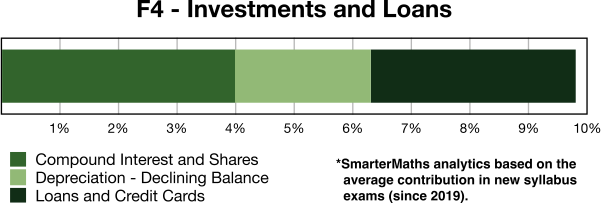
  • F4 Investments and Loans has contributed a substantial 9.8% to the new syllabus Std2 exams since its introduction in 2019.
  • We have split this area into 3 topics for analysis purposes: Compound Interest and Shares (4.0%), Depreciation - Declining Balance (2.3%) and Loans and Credit Cards (3.5%).
  • This analysis looks at Loans and Credit Cards.

ANALYSIS - What to Expect and Common pitfalls

  • Credit cards were last tested in a 4-mark question in 2023 after a two year absence, producing sub 50% mean marks in both parts..
  • Calculating daily interest rates and applying the correct number of days a key skill well covered in database.
  • Past HSC credit card questions have been adjusted from simple to daily compounding interest rates to align with the new syllabus (these have * in the title).
  • Loan payment tables have appeared each year between 2022-24. Note 2023 Std2 29 caused carnage and is a "must review" question!
  • "Loan P+I-R Table" style questions have appeared in the 2024 and 2022 exams, receiving significant mark allocations on each occasion. Interpreting these tables proved challenging on each occasion and revision attention is recommended.

Filed Under: Loans and Credit Cards (Std 2) Tagged With: worksheet-preamble

STD2 Snapshot: F4 – Depreciation – Declining Balance

IMPORTANT FEATURES AND TIPS FROM EXAM HISTORY

  • F4 Investments and Loans has contributed a substantial 9.8% to the new syllabus Std2 exams since its introduction in 2019.
  • We have split this area into 3 topics for analysis purposes: Compound Interest and Shares (4.0%), Depreciation - Declining Balance (2.3%) and Loans and Credit Cards (3.5%).
  • This analysis looks at the topic Depreciation - Declining Balance.

ANALYSIS - What to Expect and Common pitfalls

  • Declining Balance Depreciation has been tested in all but one exam over the last decade. Questions have been worth a significant 3–4 marks in each of the last three exams.
  • Examiners required a comparison of declining balance and straight line depreciation in 2023 and 2022, the latter of which caused problems and deserves specific attention. This "comparison" question type is important and well represented in the database.
  • 2020 Std2 11 MC caused problems with a 6-monthly depreciation period, producing a mean mark of 43% - attention required here.
  • This sub-topic has the positive revision qualities of being regularly asked and typically well answered. A notable exception to this is 2011 Q28b where an overlap with the linear relationships topic area and interpretations of gradients caused major problems (a must review question).

Filed Under: Depreciation - Declining Balance (Std 2) Tagged With: worksheet-preamble

STD2 Snapshot: F4 – Compound Interest and Shares

IMPORTANT FEATURES AND TIPS FROM EXAM HISTORY

  • F4 Investments and Loans has contributed a substantial 9.8% to the new syllabus Std2 exams since its introduction in 2019.
  • We have split this area into 3 topics for analysis purposes: Compound Interest and Shares (4.0%), Depreciation - Declining Balance (2.3%) and Loans and Credit Cards (3.5%).
  • This analysis looks at the largest topic Compound Interest and Shares.

ANALYSIS - What to Expect and Common pitfalls

  • Compound Interest consistently causes problems, particularly with questions involving Compounded Value of $1 tables which have been asked 5 times since 2011 (surprisingly absent in new syllabus exams to date), producing sub-50% mean marks on 4 occasions.
  • Examiners have required students to use the  `FV=PV(1+r)^n`  formula 8 times in the last 10 years (most recently in 2024). A regularly tested topic that is overdue for a more substantial mark allocation.
  • Comparing compound interest vs simple interest investments has been examined three times in new syllabus exams to date (most recently 2024). 2021 Std2 26b required a novel comparison in this context that caused problems and is a must review question. 
  • Dividend Yield was not examined between 2023-24, but appeared each year between 2019-2022. We expect this challenging topic area to be consistently examined going forward and highly recommend a revision focus.

Filed Under: Compound Interest and Shares (Std2) Tagged With: worksheet-preamble

STD2 Snapshot: F1 – Earning Money and Budgeting

IMPORTANT FEATURES AND TIPS FROM EXAM HISTORY

  • F1 Money Matters has contributed a solid 6.3% to new syllabus Std2 exams since it was introduced in 2019.
  • We have split this area into 3 topics for analysis: Earning money and budgeting (1.3%), Tax and Percentage Discounts (3.3%) and Simple Interest and Straight Line Depreciation (1.7%).
  • This analysis looks at Earning money and budgeting.

ANALYSIS - What to Expect and Common pitfalls

  • Historically, Earning money and budgeting's contribution to the Std2 past exams has been a case of feast or famine, with allocations between 0 and 7 since 2010.
  • The 2024 and 2022 exams saw an above average 3 mark allocation, although other new syllabus exams have firmly been in the famine category.
  • Budgeting questions are gifts from the examiners and have been very well answered in the past, while wages questions have presented a greater challenge, producing sub-50% mean marks in 2018 (Q8 MC), 2013 (Q9 MC) and 2011 (Q19 MC). A revision focus is recommended here.
  • Insurance has easily been the most poorly answered subject area and database questions cover CTP, non-compulsory third-party and comprehensive insurance, all of which have been tested in the last 5 years. 
  • A recurring theme in Markers Comments for minimising errors has been to set out answers in small clear steps. Take this advice!

Filed Under: Earning Money and Budgeting (Std 2) Tagged With: worksheet-preamble

STD2 Snapshot: F1 – Tax and Percentage Discounts

IMPORTANT FEATURES AND TIPS FROM EXAM HISTORY

  • F1 Money Matters has contributed a solid 6.3% to new syllabus Std2 exams since it was introduced in 2019.
  • We have split this area into 3 topics for analysis: Earning money and budgeting (1.3%), Tax and Percentage Discounts (3.3%) and Simple Interest and Straight Line Depreciation (1.7%).
  • This analysis looks at the largest topic, Tax and Percentage Discounts.

ANALYSIS - What to Expect and Common pitfalls

  • Tax and Percentage Discounts revision should focus in on its 3 main question types: 1-Tax tables, 2-GST and 3-Medicare.
  • Tax Table problems are the most common question type, examined in 5 of the last 7 exams in longer answer questions, notably absent in 2024. We note these questions also required medicare levy calculations on 4 occasions.
  • GST was examined in both 2024 and 2023, the latter where it was the subject of two separate questions that both caused problems. Questions that test knowledge of exempt-GST items are key revision (see 2023 Std2 30 and 2019 Std2 29).
  • Medicare taxation has been tested just the once in new syllabus exams to date. 2013 Std2 27b is an important example showing medicare is calculated using "taxable income" and not "gross income".

Filed Under: Tax and Percentage Increase/Decrease (Std 2) Tagged With: worksheet-preamble

STD2 Snapshot: M6 Bearings and Radial Surveys

IMPORTANT FEATURES AND TIPS FROM EXAM HISTORY

  • M6 Trigonometry has been a very significant contributor to new syllabus Std2 exams, responsible for an average of 11.7% per exam since 2019.
  • We have split this area into 3 subtopics: Pythagoras and Right-Angled Trig (2.7%), Non-Right-Angled Trig (5.0%) and Bearings and Radial Surveys (4.0%).
  • This analysis looks at Bearings and Radial Surveys.

ANALYSIS - What to Expect and Common pitfalls

  • Bearings and Radial Surveys (4.0%) have attracted healthy allocations in every new syllabus Std2 exams to date. 
  • Bearings questions have been the most common question type, appearing 3 times in the last 5 years and producing sub-50% state mean marks each time.
  • True Bearings is an important concept to understand well and has been examined three times since 2019 (see 2022 8 MC, 2021 4 MC and 2019 4 MC) 
  • Radial Surveys have been examined three times in new syllabus exams, most recently in 2024. On each occasion, students have struggled. Carefully review these questions.
  • HSC Markers' Comment of note: more successful students draw North/South parallel lines through important points on large clear diagrams. Simple advice that is incorporated into worked solutions. Follow it.

Filed Under: Bearings and Radial Surveys (Std2) Tagged With: worksheet-preamble

STD2 Snapshot: M6 Non Right-Angled Trig

IMPORTANT FEATURES AND TIPS FROM EXAM HISTORY

  • M6 Trigonometry has been a very significant contributor to new syllabus Std2 exams, responsible for an average of 11.7% per exam since 2019.
  • We have split this area into 3 subtopics: Pythagoras and Right-Angled Trig (2.7%), Non-Right-Angled Trig (5.0%) and Bearings and Radial Surveys (4.0%).
  • This analysis looks at Non-Right-Angled Trig.

ANALYSIS - What to Expect and Common pitfalls

  • The most difficult question type in this topic area is undoubtedly "2-triangle" questions which have produced sub-50% mean marks more often than not when examined in the last decade.
  • "2-Triangle" questions have been asked each year between 2022-24 and should be a focus of any revision.
  • Other more standard Non Right-Angled Trig questions requiring students to simply apply a version of the sine/cosine formula, have been regularly tested and generally well answered with the exception of 2021 Q37 (involving an obtuse angle) and 2010 26d which produced mean marks of 31% and 32% respectively.
  • While Non Right-Angled Trig calculations are a core competency within Bearings, note this analysis and allocation history does not include Bearings which are dealt with in their own sub-topic.

Filed Under: Non-Right Angled Trig (Std2) Tagged With: worksheet-preamble

STD2 Snapshot: M6 Pythagoras and Right-Angled Trig

IMPORTANT FEATURES AND TIPS FROM EXAM HISTORY

  • M6 Trigonometry has been a very significant contributor to new syllabus Std2 exams, responsible for an average of 11.7% per exam since 2019.
  • We have split this area into 3 subtopics: Pythagoras and Right-Angled Trig (2.7%), Non-Right-Angled Trig (5.0%) and Bearings and Radial Surveys (4.0%).
  • This analysis looks at Pythagoras and Right-Angled Trig.

ANALYSIS - What to Expect and Common pitfalls

  • Pythagoras and Right-Angled Trig can be tested via multiple choice or longer answer style questions. It has been examined in 4 new syllabus exams (most recently in 2024) with 2 separate questions appearing in 2020 and 2019. 
  • This sub-topic is a prime area to pick up marks, but note that questions in 2023 (Q12 MC), 2020 (Q32), 2015 (Q9 MC), 2012 (Q27d) and 2009 (Q23a) produced sub-50% mean marks and deserve attention.
  • Rounding an angle to the nearest minute is specifically mentioned in the new syllabus and should be reviewed. We have adjusted "nearest degree" in some past HSC questions to "nearest minute", testing students with some harder rounding examples.

Filed Under: Pythagoras and Right-Angled Trig (Std2) Tagged With: worksheet-preamble

STD2 Snapshot: MS-M1 Perimeter, Area and Volume

IMPORTANT FEATURES AND TIPS FROM EXAM HISTORY

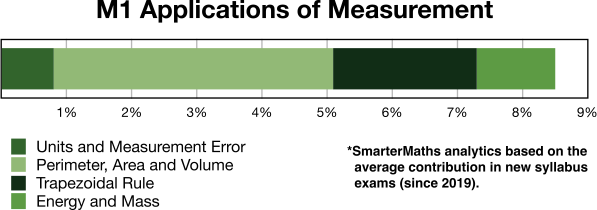
  • M1 Applications of Measurement has contributed a healthy average of 8.5% per new syllabus Std2 exam since it was introduced in 2019.
  • We have split this area into 4 categories for the purpose of analysis: 1-Units and Measurement Error (0.8%), 2-Perimeter, Area and Volume (4.3%), 3-Trapezoidal Rule (2.2%) and 4-Energy and Mass (1.2%).
  • This analysis looks at Perimeter, Area and Volume.

ANALYSIS - Common pitfalls

  • Perimeter, Area and Volume has contributed 5 separate longer answer questions in the 2022-24 period, regularly producing sub-50% mean marks. This is after the 2021-2019 Std2 papers presented low difficulty examinations of the topic area.
  • This topic area is very broad and to revise effectively, there is no substitute to doing lots of varied past exam questions.
  • Well designed revision must include a focus on area and volume questions that incorporate circular measure which are easily the most commonly asked and poorly answered Most recently 2024 Std2 34 illustrates this key revision example.
  • Water catchment questions (examined in 2022 for the first time since 2016) have caused problems and deserve attention.

Filed Under: Perimeter, Area and Volume (Std 2) Tagged With: worksheet-preamble

STD2 Snapshot: MS-M1 Energy and Mass

IMPORTANT FEATURES AND TIPS FROM EXAM HISTORY

  • M1 Applications of Measurement has contributed a healthy average of 8.5% per new syllabus Std2 exam since it was introduced in 2019.
  • We have split this area into 4 categories for the purpose of analysis: 1-Units and Measurement Error (0.8%), 2-Perimeter, Area and Volume (4.3%), 3-Trapezoidal Rule (2.2%) and 4-Energy and Mass (1.2%).
  • This analysis looks at Energy and Mass.

ANALYSIS - Common pitfalls

  • Energy and Mass is a small contributor to new syllabus Std2 exams although evaluating its contribution must take into account a significant overlap with M7 Rates and Ratios.
  • Mass calculations were required in 2023 Std2 24b and caused problems, producing a 46% mean mark.
  • Calories and kilojoules were last examined in 2019 in a 2 mark question of medium difficult.
  • Electricity consumption was last examined in 2024, although any revision should focus an examples from 2021 and 2013-15 that produced sub-50% mean marks.
  • Students must understand the kWh unit as a concept and be prepared for a multi-step calculation that is prone to silly error.

Filed Under: Energy and Mass (Std 2) Tagged With: worksheet-preamble

STD2 Snapshot: MS-M1 Trapezoidal Rule

IMPORTANT FEATURES AND TIPS FROM EXAM HISTORY

  • M1 Applications of Measurement has contributed a healthy average of 8.5% per new syllabus Std2 exam since it was introduced in 2019.
  • We have split this area into 4 categories for the purpose of analysis: 1-Units and Measurement Error (0.8%), 2-Perimeter, Area and Volume (4.3%), 3-Trapezoidal Rule (2.2%) and 4-Energy and Mass (1.2%).
  • This analysis looks at the Trapezoidal Rule.

ANALYSIS - What to expect and common pitfalls

  • Approximation methods have been tested in 8 of the last 10 years (notably absent in 2024) with mark allocations ranging from 5 marks (2023, 2020) to a single multiple choice (2021).
  • Any revision should feature 2020 Q27 which was worth 5 marks and produced sub-50% mean marks in all parts.
  • Worth noting that volume approximations have been tested prior to 2020 (vs area approximations). We include examples in the database due to syllabus ambiguity on the issue.
  • Important: while calculations associated with the Trapezoidal Rule itself are band 3 level, follow up questions have caused major difficulties in the past (see 2017 Std2 29a, and 2009 Std2 25c).
  • A conceptual understanding of whether an approximation will under or overestimate the actual area is important.

Filed Under: Trapezoidal Rule (Std 2) Tagged With: worksheet-preamble

STD2 Snapshot: MS-M1 Units and Measurement Error

IMPORTANT FEATURES AND TIPS FROM EXAM HISTORY

  • M1 Applications of Measurement has contributed a healthy average of 8.5% per new syllabus Std2 exam since it was introduced in 2019.
  • We have split this area into 4 categories for the purpose of analysis: 1-Units and Measurement Error (0.8%), 2-Perimeter, Area and Volume (4.3%), 3-Trapezoidal Rule (2.2%) and 4-Energy and Mass (1.2%).
  • This analysis looks at the minor contributing topic Units and Measurement Error.

ANALYSIS - Common pitfalls

  • Measurement Error was most recently tested in 2023 and is usually tested in the multiple choice format (except 2013 Q27d worth 3 marks).
  • Typical mean marks are sub-50% and worth noting solutions have been adjusted to reflect the "simplified" new syllabus calculation of percentage error (as a positive number, not the previous ± expression).
  • Significant figures must review questions include 2020 Q2 MC and 2015 Std2 1 MC.
  • Scientific Notation questions have produced volatile mean marks in the past. Pay careful attention to 2009 Std2 25b which produced a state mean mark of 20%!
  • Converting between units (eg. kilograms → grams) is often required. Few students were able to convert  cm² → m²  which was required in 2009 Std2 12 MC.

Filed Under: Units and Measurement Error (Std 2) Tagged With: worksheet-preamble

STD2 Snapshot: M2 Time

IMPORTANT FEATURES AND TIPS FROM EXAM HISTORY

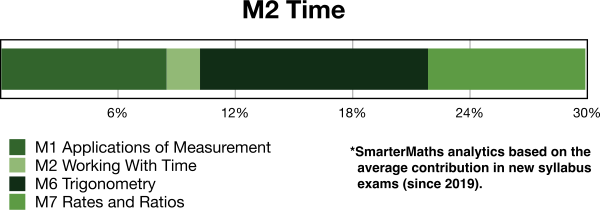
  • M2 Working with Time is a small topic area that has contributed an average of 1.7% per exam since it was introduced in 2019.

ANALYSIS - What to Expect and Common pitfalls

  • Working with Time has been examined four times in new syllabus Std2 exams, including longer answer questions in 2024 and 2021-22. It represents a high-scoring opportunity for students. 
  • Historically, most questions come in around the band 4 difficulty level, although the poorly answered 2009 Std2 26b deserves attention.
  • Exposure to Universal Coordinated Time (UTC) and similar terminology is an important feature of database questions.
  • Calculating the time difference between locations from a longitudinal difference is a proven problem area from past exams, and represents examinable content from 2021 onwards (examined in 2021).
  • Accordingly, the database now includes examples that require the application of  15° = 1 hour, or 1° = 4 minutes time difference (2021 Q20, 2017 Q27d, M2 SM-Bank 3).
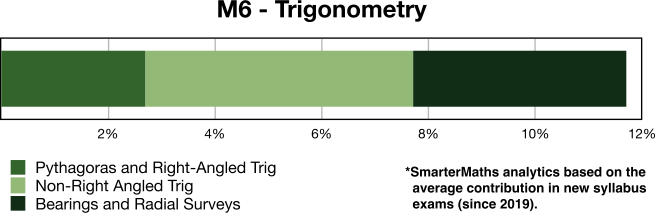
  • Some distance between locations (or "arc length" questions) have been adjusted from past HSC questions and included. We regard this as a possible cross topic application within measurement, provided the earth's radius is explicitly stated in the question.

Filed Under: M2 Working with Time (Y11) Tagged With: worksheet-preamble

MET AFG – Transformations – Snapshot

HISTORICAL CONTRIBUTION

  • Transformations (2.9%) is a small sub-topic of the broad Algebra, Functions and Graphs (29.1%) area of study. 

VCE ANALYSIS - What to expect and common pitfalls

  • Transformations (2.9%) has historically been exami
  • Met1 exam - Transformations have not featured in this section of the exam in the last decade with the notable exception of 2010 (Met1 Q6) where it was poorly answered with a mean mark of 40% and allocated a substantial 3 marks. Worth reviewing.
  • Met2 Multiple Choice - Transformations have been asked in each of the last 5 years within multiple choice, with 2 separate questions appearing on 3 of these occasions.
  • This topic area has regularly caused problems in the MC format, with around half of the questions producing sub-50% mean marks (and some of these substantially below 50% - see 2016 Met2 Q20 MC, 2015 Met2 Q11 MC and 2013 Met2 Q20 MC). 
  • It is highly recommended students look very carefully at the format of solutions in the worksheets, which are based on best practice and represent a structure to follow.
  • Met2 Longer Answer - Transformations has been examined in the Met2 longer answer section in each of the last 6 years with allocations ranging from 2-4 marks.
  • The average mean mark within this section over this period has been just 30%, highlighting how difficult students have found this topic area and its importance for outperforming peers. A critical revision area - enough said.

Filed Under: Uncategorized Tagged With: worksheet-preamble

MET AFG – Polynomials – Snapshot

HISTORICAL CONTRIBUTION

  • Polynomials (2.1%) is a small sub-topic of the broad Algebra, Functions and Graphs (29.1%) area of study. 

VCE ANALYSIS - What to expect and common pitfalls

  • Polynomials (2.1%) has historically been examined in the Met2 multiple choice and longer answer sections. Although its average contribution is modest, this underestimates its importance as manipulating and solving polynomial equations is a core competency that is required in many other sub-topics (whose contributions are not included here).
  • Met1 exam - Polynomials have not featured in this section of the exam outside of a cross-topic application.
  • Met2 Multiple Choice - Polynomials have been tested within the multiple choice section in 6 of the last 7 years, with 3 separate questions appearing in the 2015 exam. 
  • Students can be examined in a wide variety of question types, covering concepts such as the remainder/factor theorems, identifying polynomial graphs and most importantly, using discriminant calculations to determine conditions where quadratics have 1, 2 or no solutions, the latter of which is easily the most poorly answered area and is a key revision area.
  • Met2 Longer Answer - Polynomials have appeared in the Met2 longer answer section primarily through cross topic questions (whose contribution is not included here). However, notwithstanding this, there has been a couple of significant "dedicated" question parts in 2014 and 2015 that have been captured.

Filed Under: Uncategorized Tagged With: worksheet-preamble

MET AFG – Functional Equations – Snapshot

HISTORICAL CONTRIBUTION

  • Functional Equations (2.4%) is a small but difficult sub-topic of the broad Algebra, Functions and Graphs (29.1%) area of study. 

VCE ANALYSIS - What to expect and common pitfalls

  • Functional Equations (2.4%) has historically been examined within the Met1 and Met2 (multiple choice) sections. Although its average contribution is modest, its mark allocation in any one particular year can be significant - as shown in 2016 and 2017.
  • Met1 exam - Functional Equations have been examined twice in the Met1 exam since 2012 but notably this has been in 2016 and 2017 with a significant allocations of 4-5 marks on each occasion.
  • This topic area has proven extremely challenging for students in the past, and a revision focus is recommended.
  • Met2 Multiple Choice - Functional Equations have been tested within the multiple choice section in each of the last 5 years. On a majority of these occasions, 2 questions have appeared.
  • Met2 Longer Answer - Functional Equations do not feature in this section.

Filed Under: Uncategorized Tagged With: worksheet-preamble

  • « Previous Page
  • 1
  • 2
  • 3
  • 4
  • 5
  • 6
  • …
  • 10
  • Next Page »

Copyright © 2014–2025 SmarterEd.com.au · Log in