SmarterEd

Aussie Maths & Science Teachers: Save your time with SmarterEd

  • Login
  • Get Help
  • About

MET AFG – Inverse – Snapshot

HISTORICAL CONTRIBUTION

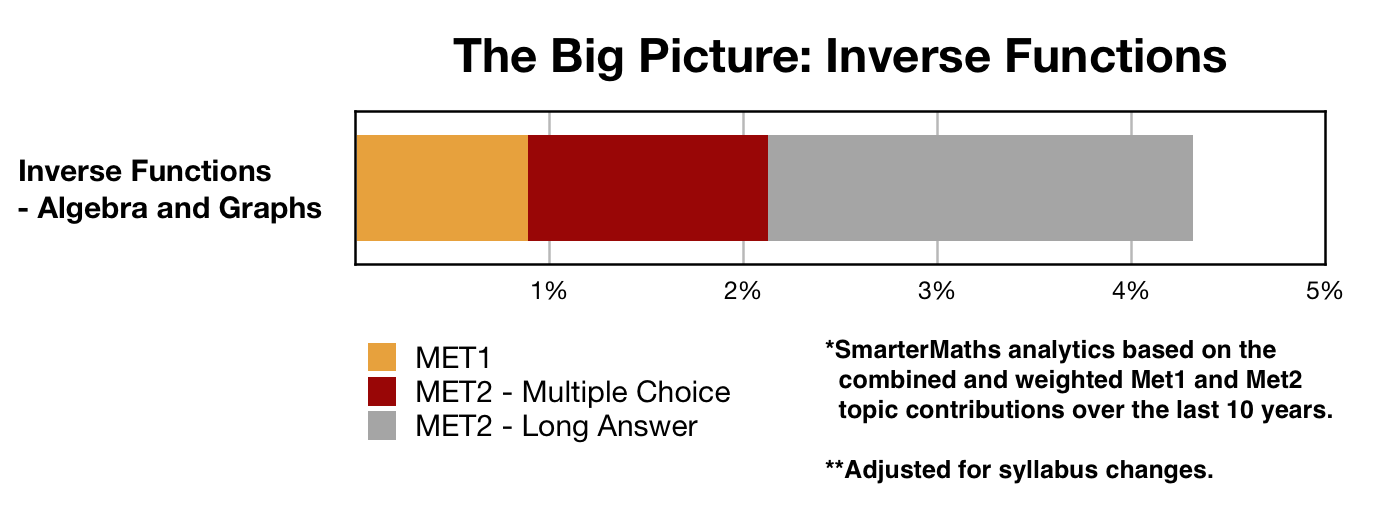
  • Inverse Functions (4.3%) is a significant contributing sub-topic to the broad Algebra, Functions and Graphs (29.1%) area of study. 

VCE ANALYSIS - What to expect and common pitfalls

  • Inverse Functions (4.3%) includes all inverse function algebra and graphs 
  • Met1 exam - Inverse Functions was last examined in the Met1 exam in 2016, where it was allocated 3 marks and poorly answered (2016 Met1 Q5b), increasing the likelihood of it being retested sooner, in our view.
  • The most common pitfall for students is related to domain restrictions and a number of past exam questions provide great revision for this concept.
  • Met2 Multiple Choice - Inverse Functions have been examined in this section in 8 of the last 9 years, with more than one question appearing half the time.
  • Although the multiple choice questions have typically been well answered, a few notable exceptions caused students problems and are worthy of careful attention (see 2013 Met2 7 MC, 2015 Met2 2 MC, and 2014 Met2 6 MC).
  • Met2 Longer Answer - Inverse Functions were examined in the Met2 longer answer section in both 2016 and 2017, after not appearing in this section the previous 4 years.
  • Historically, students have scored well in this topic area and when it is examined, the mark allocations have been meaningful at 2-8 marks. 
  • Note that examiners regularly ask for the intersection a graph and its inverse. Understand why this is most easily be found by finding the graph's intersection with the line  `y=x`.
Filed Under: Uncategorized Tagged With: worksheet-preamble

MET AFG – Trig – Snapshot

HISTORICAL CONTRIBUTION

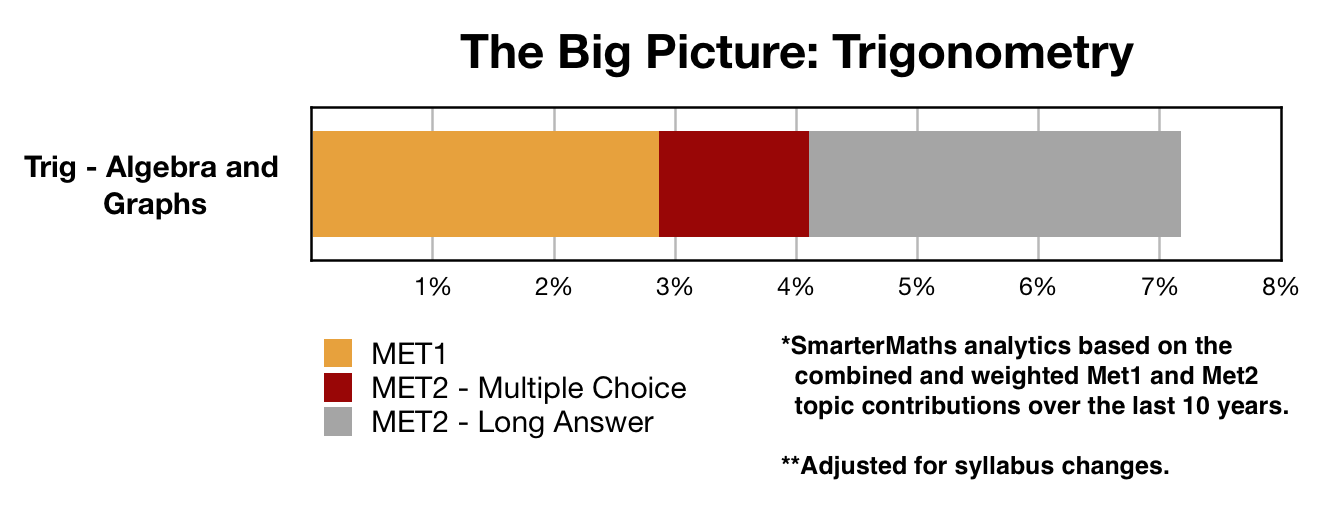
  • Trigonometry (7.2%) is the largest contributing sub-topic to the broad Algebra, Functions and Graphs (29.1%) area of study. 

VCE ANALYSIS - What to expect and common pitfalls

  • Trigonometry (7.2%) includes all trigonometry algebra and graphs. It is important to note that the 7.2% historical contribution does not include any other calculus related problems that come under topic areas like differentiation, average value and maxima minima.
  • Met1 exam - Trigonometry is a major contributor to the Met1 exam, being asked in a dedicated question in 8 of the last 9 years (missing only in 2016). The standard question type requires students to solve trig equations within a specified angle range.
  • High scoring requires students to know their "Table of Exact Trig Values" by heart (the importance of this cannot be overstated). Note the areas where students have had issues in the past, particularly 2017 Met1 Q6, 2015 Met1 Q10 and 2007 Met1 Q8.
  • Met2 Multiple Choice - Trigonometry is examined at least once every year in this section, with a high of 3 separate questions asked in 2016 and 2012. Examiners regularly test amplitude, period and range here, as well as regularly ratcheting up the difficulty level (sub-50% mean marks in 2017, 2014, 2012).
  • Met2 Longer Answer - Trigonometry's cross-topic potential is realised in the Met2 longer answer section. It is easily incorporated into area under curves (2015), maxima minima problems that look at area and volume (2010), as well as co-ordinate geometry underlyings (2017). 
  • Meaningful mark allocations in each of the last 5 years make this a key revision focus, with a broad array of past questions highly recommended.

Filed Under: Uncategorized Tagged With: worksheet-preamble

MET AFG – L&E – Snapshot

HISTORICAL CONTRIBUTION

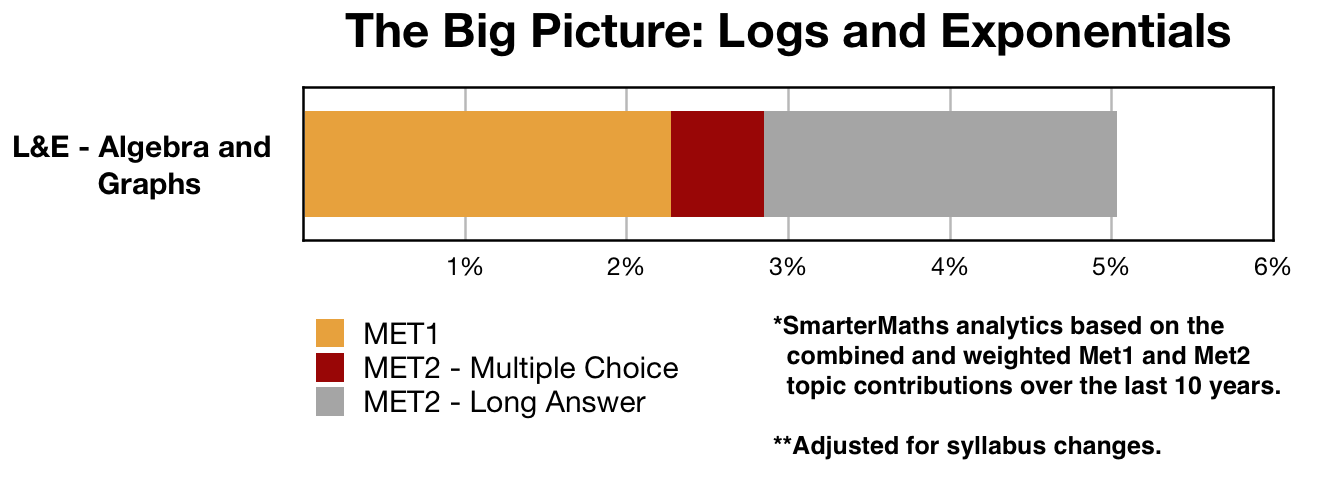
  • Logs & Exponentials (5.0%) is a solid contributor to the broad Algebra, Functions and Graphs (29.1%) area of study. 

VCE ANALYSIS - What to expect and common pitfalls

  • Logs & Exponentials (5.0%) includes all L&E algebra and graphs. It is important to note that the 5% historical contribution does not include any inverse functions, or other calculus related applications that come under topic areas like differentiation, curve sketching and maxima minima.
  • Met1 exam - at least one dedicated question testing log laws or exponential algebra was asked every year between 2011-2015 but has been noticeably absent in the last 2 years. While generally well answered, most students struggle with recognising an exponential equation that is reducible to a quadratic (see 2015 Met1 Q7b and 2011 Met1 Q2b).
  • Met2 Multiple Choice - L&E has a small allocation within this section of the exam, often combining with functional equations. Difficulty levels of past exam MC questions vary significantly and any revision worksheet should reflect this range.
  • Met2 Longer Answer - L&E is occasionally examined within the Met2 exam (we are not including calculus related questions here). This has occurred 3 times since 2009 and has involved the graphing of a logarithmic equation (2010 Met2 Q1b) or solving difficult exponential and log algebra within a broader question (2014 Met2 Q3, and 2009 Met2 Q3).

Filed Under: Uncategorized Tagged With: worksheet-preamble

MET Calc – Applied Calc – Avg Value – Snapshot

HISTORICAL CONTRIBUTION

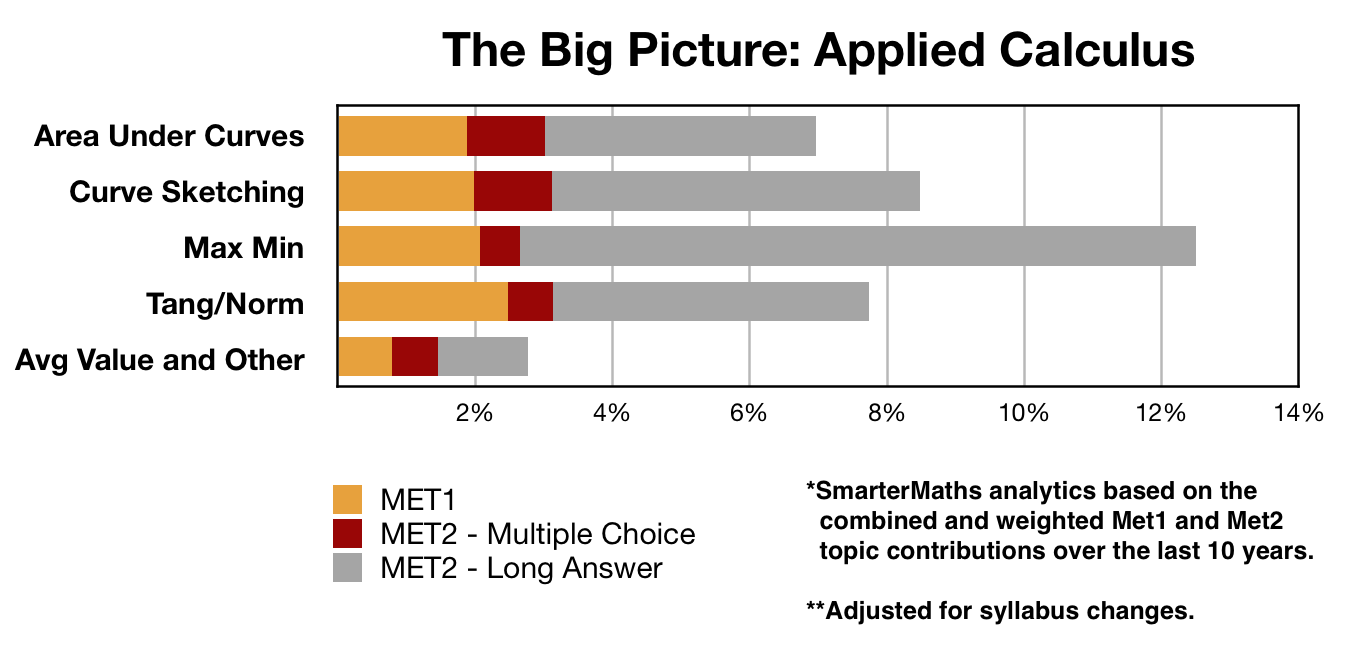
  • Average Value and Other (2.8%) is the smallest contributing sub-topic to Applied Calculus (38.4%). 
  • Applied Calculus (for analysis purposes) has been split into 5 main question types: 1-Area Under Curves (7.0%), Curve Sketching (8.5%), Max Min (12.5%), 4-Tangents/Normals (7.7%) and 5-Average Value and Other (2.8%).

VCE ANALYSIS - What to expect and common pitfalls

  • Average Value and Other (2.8%) is a small but not insignificant topic area. It has regularly caused students difficulties when it has been tested and requires specific revision as a topic.
  • Met1 exam - Average Value and Other is not a large contributor to the Met1 exam but deserves attention in our view. Why? It was examined in 2013, 2015 and 2016 but was omitted in 2017. Each time it appeared during this time, it was worth 2-3 marks and produced mean marks between 39%-51%. One marker's comment stated "Far too many students" misunderstood this topic area.
  • Met2 Multiple Choice - tested via multiple choice every year between 2010-2015 but not since.
  • The use of graphic representations of average value proved very useful and poorly understood in 2014 (Met2 Q20) and 2015 (Met2 Q8) and should be carefully reviewed.
  • Met2 Longer Answer - Average Value and Other is represented in the Met2 longer answer section primarily from "rate of flow" examples that do not fit into the maxima minima bucket. A small area to quickly look at given the significant problems it has caused in the past.

Filed Under: Uncategorized Tagged With: worksheet-preamble

MET Calc – Applied Calc – Tang/Norm – Snapshot

HISTORICAL CONTRIBUTION

  • Tangents/Normals (7.7%) is the third largest contributor to Applied Calculus (38.4%). 
  • Applied Calculus (for analysis purposes) has been split into 5 main question types: 1-Area Under Curves (7.0%), Curve Sketching (8.5%), Max Min (12.5%), 4-Tangents/Normals (7.7%) and 5-Average Value and Other (2.8%).

VCE ANALYSIS - What to expect and common pitfalls

  • Tangents/Normals (7.7%) is a very important topic area for students, with huge contributions to both the Met1 and Met2 longer answer sections of the final exam.
  • Met1 exam - Tangents/Normals is the largest contributing sub-topic to the Met1 exam, bar none. This sub-topic blends easily with many other cross-topics including area under curves, trigonometry, co-ordinate geometry and more ..
  • The key point is that mark allocations are often large and mean marks low when this area is examined within Met1. Smart revision will go over both simple and the many varied cross-topic scenarios of past exams.
  • Met2 Multiple Choice - asked in 2 out 3 years on average. Surprisingly, more than half  of the time over the last decade, sub-50% mean marks have resulted. Worthy of attention.
  • Met2 Longer Answer - Tangents/Normals questions have been examined in this section in all but one year in the last decade, with meaningful mark allocations on each occasion. A revision focus here goes without saying.
  • The range of difficulty level of Met2 questions in this topic in past exams can be seen by the incredible mean mark range of 4%-94% over the past decade. A significant amount of "easier" marks are available, mixed in with standard and extremely challenging ones.

Filed Under: Uncategorized Tagged With: worksheet-preamble

MET Calc – Applied Calc – Max Min – Snapshot

HISTORICAL CONTRIBUTION

  • Maxima Minima (12.5%) is the biggest contributing sub-topic to the biggest main topic Applied Calculus (38.4%). Its importance in scoring well in Methods goes without saying.
  • Applied Calculus (for analysis purposes) has been split into 5 main question types: 1-Area Under Curves (7.0%), Curve Sketching (8.5%), Max Min (12.5%), 4-Tangents/Normals (7.7%) and 5-Average Value and Other (2.8%).

VCE ANALYSIS - What to expect and common pitfalls

  • Max Min (12.5%) is a large contributor to the Met1 exam, but it is its massive mark allocation to the Met2 longer answer section that makes it so critical.
  • Met1 exam - Maxima Minima questions have been omitted from this section of the exam for the past 2 years - the only time this has happened in the last decade. 
  • A key revision area in our view. Why? A two year omission, and when it is examined in the Met1 exam, mean marks have been low and significant mark allocations of 3-4 have been common. 
  • Met2 Multiple Choice - Maxima Minima has not been regularly tested within multiple choice over the past decade but a recent uptick has seen it appear 3 times in the last 4 years. 
  • Met2 Longer Answer - Maxima Minima's importance in the Met2 longer answer section cannot be overstated. This sub-topic has appeared every year in the past decade with a significant mark allocation virtually guaranteed.
  • Good news: expect examiners to offer up very achievable marks in the early parts of these questions! The difficulty level then ratchets up which defines the best papers.

Filed Under: Uncategorized Tagged With: worksheet-preamble

MET Calc – Applied Calc – Curve Sketching – Snapshot

HISTORICAL CONTRIBUTION

  • Area Under Curves (7.0%) is a major contributor to the massive Applied Calculus (38.4%) topic area within the Methods course.
  • Applied Calculus (for analysis purposes) has been split into 5 main question types: 1-Area Under Curves (7.0%), Curve Sketching (8.5%), Max Min (12.5%), 4-Tangents/Normals (7.7%) and 5-Average Value and Other (2.8%).

VCE ANALYSIS - What to expect and common pitfalls

  • Curve Sketching (8.5%) is the second biggest sub-topic in the Methods course, and contributes meaningfully to Met1 and both sections of the Met2 exam.
  • Met1 exam - Curve Sketching questions have been examined in the Met1 exam in 5 of the last 6 years (last omitted in 2013), with allocations of up to 4 marks.
  • A great area for achieving high marks. Worth noting that cubics have been examined in 3 of the last 4 years.
  • Met2 Multiple Choice - Curve Sketching's contribution here has been a case of feast or famine. Only one MC question has appeared in the last 4 years, while 2012 and 2013 received 3 and 2 questions respectively.
  • The more difficult questions here involve a good understanding of the discriminant (crossing over with polynomials), concavity and the nature of turning points.
  • Met2 Longer Answer - Curve Sketching gets the second highest mark allocation of any sub-topic in the critical Met2 longer answer section. It has been under-examined within this section of the exam in the last 4 years vs its historical average - possibly cannibalised by large allocations to the tangent/normal sub-topic. We highly recommend a revision focus here.

Filed Under: Uncategorized Tagged With: worksheet-preamble

MET Calc – Applied Calc – AUC – Snapshot

HISTORICAL CONTRIBUTION

  • Area Under Curves (7.0%) is a major contributor to the massive Applied Calculus (38.4%) topic area within the Methods course.
  • Applied Calculus (for analysis purposes) has been split into 5 main question types: 1-Area Under Curves (7.0%), Curve Sketching (8.5%), Max Min (12.5%), 4-Tangents/Normals (7.7%) and 5-Average Value and Other (2.8%).

VCE ANALYSIS - What to expect and common pitfalls

  • Area Under Curves (7.0%) contributes meaningfully to Met1 and both sections of the Met2 exam and therefore represents a critical area of revision for the Methods course.
  • Met1 exam - Area Under Curve questions have been examined in the Met1 exam in 4 of the last 5 years (last omitted in 2015), often worth a chunky 3-4 marks.
  • Students have found this question-type challenging with mean marks ranging from 32-61% over the past decade - and half of these sub-50%.
  • Met2 Multiple Choice - Area Under Curve multiple choice questions have been asked 12 times in the last 9 years. A significant contribution, albeit to the smallest "section" of the exams. 
  • The difficulty range of the multiple choice questions varies from standard to very difficult, with the 2 MC questions in 2017 notably causing major problems.
  • Met2 Longer Answer - The Area Under Curve topic area is consistently and meaningfully examined virtually every year in this section of the exam (6 of the last 7 years).
  • Questions here regularly combine with the cross-topics of inverse functions and curve sketching in broad problems with multiple and varied difficulty levels.

Filed Under: Uncategorized Tagged With: worksheet-preamble

MET Calc Integration – Snapshot

HISTORICAL CONTRIBUTION

  • Integration (3.6%) includes all dedicated integration questions (i.e. it does not include applied calculus questions where it is also required). It is part of the largest area of study, Calculus (47.5%), within the Methods course.
  • Within Integration (for analysis purposes), we have split the topic area into 3 main question types: 1-Standard (1.6%), Logs and Exponential (1.1%) and 3-Trig Integration (0.9%).

VCE ANALYSIS - What to expect and common pitfalls

  • Integration (3.6%) questions have caused students a few more problems than differentiation in the context of the Met1 exam and Met2 multiple choice section, but still represent a great opportunity to score highly.
  • Note that the 3.6% total exam allocation does not include the marks related to questions in Applied Calculus are allocated to the applied calculus sub-topic.
  • Met1 exam - Integration is most commonly examined with dedicated questions in the Met1 exam.  Tested with a dedicated question every year in the last decade except 2016.
  • Questions are typically allocated 2-3 marks, and although generally well answered, the following questions produced sub-50% mean marks and warrant particular attention: 2012 Met1 Q2 (38%), 2011 Met1 Q2a (43%), and 2010 Met1 Q2b (49%).
  • Met2 Multiple Choice - This section of the exam has asked for simple integration calculations (which have been well answered) as well as complex variations on definite integrals which have proven very challenging. 
  • Met2 Longer Answer - No dedicated questions are asked in this section.

Filed Under: Uncategorized Tagged With: worksheet-preamble

MET Calc Diff – Snapshot

HISTORICAL CONTRIBUTION

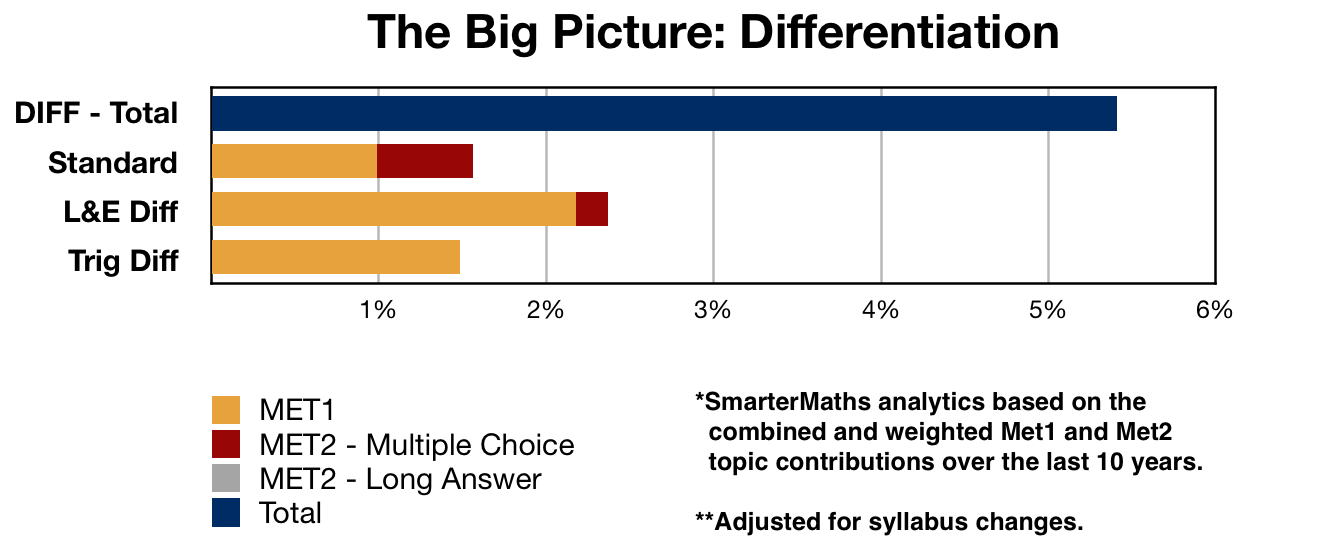
  • Differentiation (5.4%) includes all dedicated differentiation questions (i.e. it does not include applied calculus questions where it is also required). It is part of the largest area of study, Calculus (47.5%), within the Methods course.
  • Within Differentiation (for analysis purposes), we have split the topic area into 3 main question types: 1-Standard (1.5%), Logs and Exponential (2.4%) and 3-Trig Differentiation (1.5%).

VCE ANALYSIS - What to expect and common pitfalls

  • Differentiation (5.4%) is the land of low hanging fruit where students can gain some of the easier marks offered up. These questions appear in the Met1 and Met2 multiple choice sections only (noting that the marks related to questions in Applied Calculus are allocated to the applied sub-topic).
  • Met1 exam - Examiners test this area in Met1 like clockwork, with the only variable being what mix of differentiation "question types" are given.
  • Expect a meaningful mark allocation of 4-6 marks in the Met1 exam in this area. Careful attention should be given to 2016 Met1 Q6a - the only question in this area to produce a sub-50% mean mark which examined the average rate of change of a trig function. Prepare well and score highly here. 
  • Met2 Multiple Choice - This section of the exam has most commonly examined students' knowledge of the "average rate of change", testing this area specifically in 4 of the last 6 years. A small allocation but worthy of attention.
  • Met2 Longer Answer - No dedicated questions are asked in this section.

Filed Under: Uncategorized Tagged With: worksheet-preamble

MET PB Continuous – PARENT Snapshot

HISTORICAL CONTRIBUTION

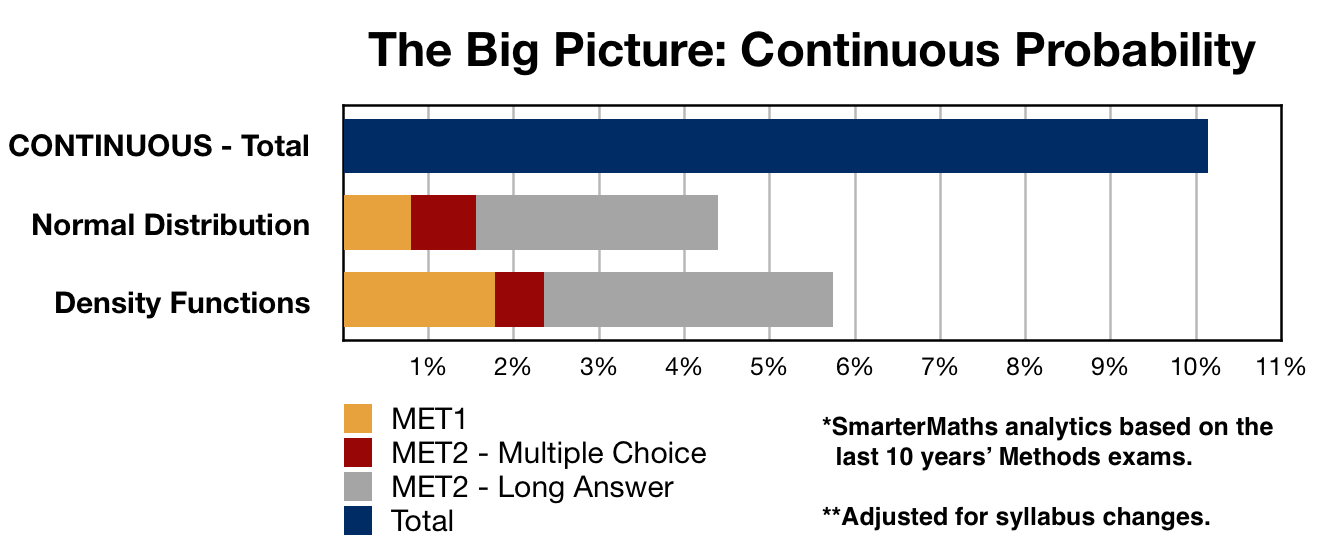
  • Probability (23.3%) is made up of Discrete Probability (13.2%) and Continuous Probability (10.1%).
  • Within Continuous Probability (for analysis purposes), we have split the topic area into 2 main question types: 1-Normal Distribution (4.4%) and 2-Density Functions (5.7%).

VCE ANALYSIS - What to expect and common pitfalls

  • Normal Distribution (4.4%) has proven a very challenging topic area for students in the past and represents an area where well prepared students can outperform.
  • While Normal Distribution sporadically appears in exam 1 and has been consistently asked in the multiple choice section of Met2, it is the longer answer section of the Met2 paper where examiners allocate the majority of marks.
  • Revision of past questions in the Met2 longer answer section is very important given it's omission from this section in 2017 and the fact it was poorly answered in 2016.
  • Probability Density Functions (5.7%) have been tested 5 times in exam 1 since 2010 and are on trend to be examined in 2018. This area has proven very challenging with half of the questions in this time producing sub-50% mean marks.
  • Met2 Multiple Choice - Density Functions examined via multiple choice every year since 2014. While generally well answered, questions in 2015 (Met2 Q9 MC) and 2014 (Met2 Q16 MC) caused problems and deserve attention.
  • Met2 Longer Answer - Density Functions have been examined in the Met2 longer answer section in 6 of the last 7 years. A critical revision area in this section of the Met2 exam that received a whopping mark allocation of 9 marks in 2017.  

Filed Under: Uncategorized Tagged With: worksheet-preamble

MET PB Continuous -Density Fn – Snapshot

HISTORICAL CONTRIBUTION

  • Probability (23.3%) is made up of Discrete Probability (13.2%) and Continuous Probability (10.1%).
  • Within Continuous Probability (for analysis purposes), we have split the topic area into 2 main question types: 1-Normal Distribution (4.4%) and 2-Density Functions (5.7%).

VCE ANALYSIS - What to expect and common pitfalls

  • Probability Density Functions (5.7%) are the largest contributing sub-topic to probability and any topic revision should reflect this fact.
  • Met1 exam - Density Functions have been tested 5 times in Met1 since 2010 and are on trend to be examined in 2018 (after being left out of Met1 paper in 2017). This area has proven very challenging with half of the questions in this time producing sub-50% mean marks (and some much lower than 50%).
  • Met2 Multiple Choice - Density Functions examined via multiple choice every year since 2014. While generally well answered, questions in 2015 (Met2 Q9 MC) and 2014 (Met2 Q16 MC) caused problems and deserve attention.
  • Met2 Longer Answer - Density Functions have been examined in the Met2 longer answer section in 6 of the last 7 years. The difficulty level of questions varies greatly and revising a broad spectrum of questions is particularly important here.
  • This critical topic area received a whopping mark allocation of 9 marks in 2017, well above its historical average.  

Filed Under: Uncategorized Tagged With: worksheet-preamble

MET PB Continuous Normal – Snapshot

HISTORICAL CONTRIBUTION

  • Probability (23.3%) is made up of Discrete Probability (13.2%) and Continuous Probability (10.1%).
  • Within Continuous Probability (for analysis purposes), we have split the topic area into 2 main question types: 1-Normal Distribution (4.4%) and 2-Density Functions (5.7%).

VCE ANALYSIS - What to expect and common pitfalls

  • Normal Distribution (4.4%) has proven a very challenging topic area for students in the past and represents an area where well prepared students can outperform.
  • Met1 exam - Normal Distribution has been examined just 3 times in the last decade in exam 1, the last time in 2015. It is worth noting that each year it has appeared in exam 1, it has produced sub-50% mean marks with markers commenting that the more successful answers included normal curve diagrams.
  • Met2 Multiple Choice - examined in this section at least once every year except in 2015. Attention should be given to the poorly answered confidence interval question in 2017 (Met2 Q5 MC).
  • Met2 Longer Answer - Normal Distribution has been examined in the Met2 longer answer section in 3 of the last 4 years, notably missing in 2017.
  • This area was poorly answered when last examined in 2016 (where it was allocated 6 marks) and is a recommended revision focus area.

Filed Under: Uncategorized Tagged With: worksheet-preamble

MET – Prob Discrete – PARENT Snapshot

HISTORICAL CONTRIBUTION

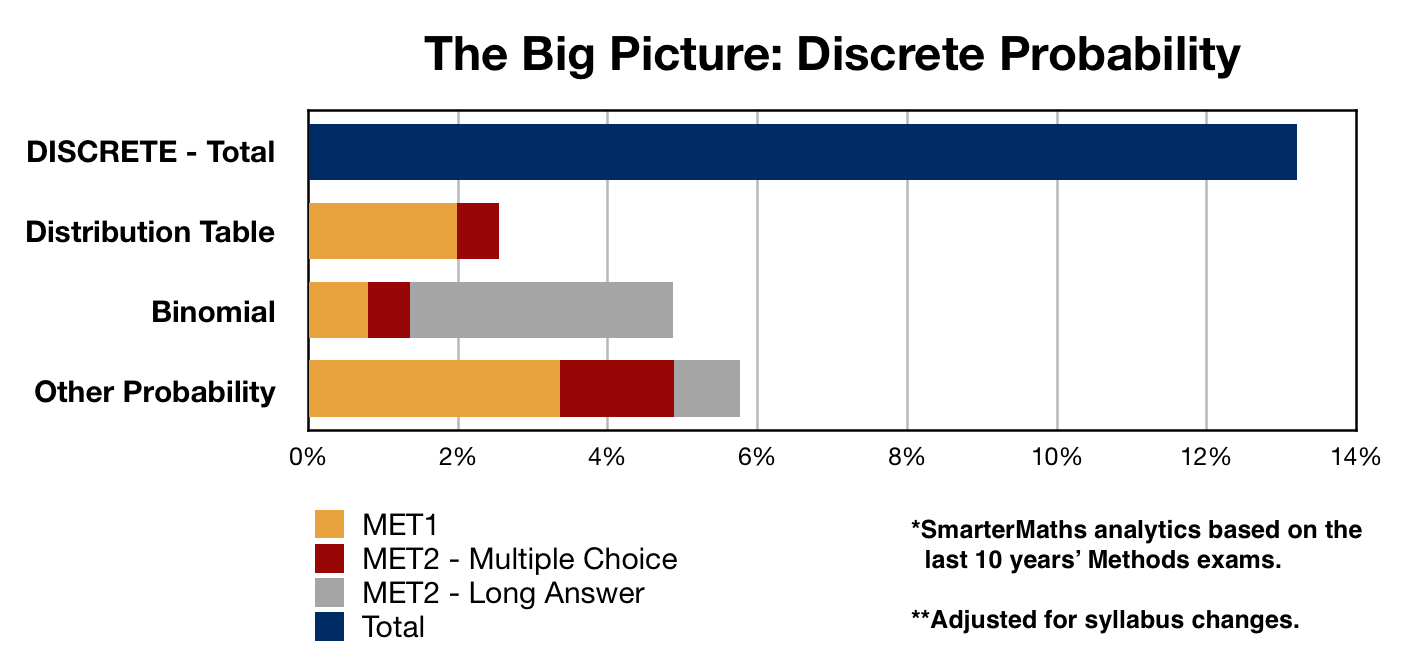
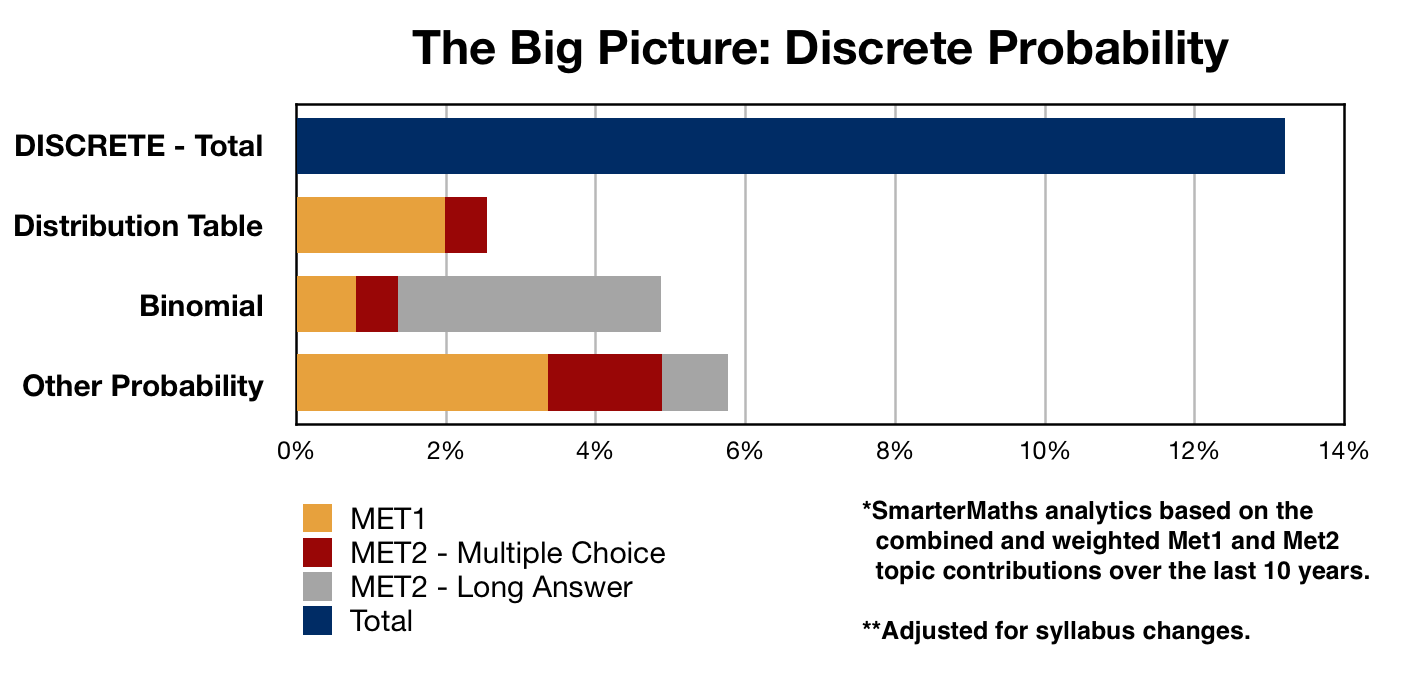
  • Probability has contributed a healthy 23.3% to the Methods exam, on average across both exams, over the last 10 years.
  • Discrete Probability is the smaller probability topic in the Methods exams, worth an average of 13.2% per year, vs Continuous Probability that accounts for 10.1%.
  • For analysis purposes, we have split Discrete Probability into 3 main question types: 1-Distribution Tables (2.5%), 2-Binomial (4.9%) and 3-Other Probability (5.8%).

HSC ANALYSIS - What to expect and common pitfalls

  • Distribution Tables (2.5%) has been examined in 8 of the last 10 years, with a majority of the allocation coming in exam 1. This area is generally well answered although notable difficulties were experienced in 2015 (Met2 19 MC), 2013 (Met1 7bii) and 2012 (Met1 4c) and should be reviewed carefully.
  • Binomial (4.9%) has a decent allocation in the Met1 exam and Met2 multiple choice sections, although it is most heavily examined in the Met2 longer answer section, where it regularly receives a significant mark allocation, particularly in the last 3 years (allocations of 6, 7 and 6 marks over this period). 
  • Other Probability (5.8%) is the largest topic within Discrete Probability and is an extremely important contributor to the Met1 exam and Met2 multiple choice sections (see graph above). Consistently low mean marks make this a key revision focus.

Filed Under: Uncategorized Tagged With: worksheet-preamble

MET – PB – Other Probability – Snapshot

HISTORICAL CONTRIBUTION

  • Probability (23.3%) is made up of Discrete Probability (13.2%) and Continuous Probability (10.1%).
  • Within Discrete Probability (for analysis purposes), we have split the topic area into 3 main question types: 1-Distribution Tables (2.5%), 2-Binomial (4.9%) and 3-Other Probability (5.8%).

VCE ANALYSIS - What to expect and common pitfalls

  • Other Probability (5.8%) is the largest sub-topic within probability, and includes all question types that do not include distribution tables or binomial expansion.
  • Met1 exam - Other Probability is the largest sub-topic contributor to the Met1 exam, worth over 10% (i.e. over 4 marks) of the first paper, over the last decade.
  • Within the Met1 exam, drawing tree and Venn diagrams and tables to visually express problems has been a feature of the highest achieving students. 
  • Conditional probability has been poorly answered in each of the last 5 years, is consistently tested, and deserves particular attention in any revision program.
  • Met2 Multiple Choice - examined every year and expect 1-3 MC questions (note 2017 had 3 MC questions). A very challenging area requiring a solid knowledge of set notation and independent events is a must. Effective revision needs to look at a broad spectrum of examples.
  • Met2 Longer Answer - sporadically tested in Met2 longer answer section, although solid revision of Met1 and Met2 multiple choice is our recommended focus for revision.

Filed Under: Uncategorized Tagged With: worksheet-preamble

MET – PB – Binomial – Snapshot

HISTORICAL CONTRIBUTION

  • Probability (23.3%) is made up of Discrete Probability (13.2%) and Continuous Probability (10.1%).
  • Within Discrete Probability (for analysis purposes), we have split the topic area into 3 main question types: 1-Distribution Tables (2.5%), 2-Binomial (4.9%) and 3-Other Probability (5.8%).

VCE ANALYSIS - What to expect and common pitfalls

  • Binomial (4.9%) is a heavily examined sub-topic within probability that is well represented in all sections of the Methods exams.
  • Met1 exam - Binomial has been asked in both 2016 and 2017 with good allocations of 3 and 2 marks respectively. Students have found the Met1 binomial questions challenging with only one question "part" receiving a mean mark over 60% since 2010.
  • Met2 Multiple Choice - examined around 2 times every 3 years in this format (notably not in 2017). Questions here have also proved challenging and deserve revision attention.
  • Met2 Longer Answer - As the graph above shows, Met2 longer answer is where examiners consistently test students in this topic area in a meaningful way. The last 3 years have seen a significant uptick in mark allocations of 6, 7 and 6 for 2017-16 respectively.
  • This section of the exam for the Binomial has proven difficult and resulted in sub-50% mean marks in each of the past 4 years for at least one part of the question.

Filed Under: Uncategorized Tagged With: worksheet-preamble

MET – PB – Dist Table – Snapshot

HISTORICAL CONTRIBUTION

  • Probability (23.3%) is made up of Discrete Probability (13.2%) and Continuous Probability (10.1%).
  • Within Discrete Probability (for analysis purposes), we have split the topic area into 3 main question types: 1-Distribution Tables (2.5%), 2-Binomial (4.9%) and 3-Other Probability (5.8%).

VCE ANALYSIS - What to expect and common pitfalls

  • Distribution Tables (2.5%) have been examined in 8 of the last 10 years, typically in Met2 multiple choice questions in recent times (2015-17) but also in longer answer questions in the Met1 exam, with allocations worth up to 3 marks.
  • While generally well answered, students had significant difficulties with the following 3 past questions which all had mean marks well below 50% and are worth a revision focus: 2015 Met2 19 MC (15%), 2013 Met1 7(b)(ii) (32%) and 2012 Met1 4(c) (36%).

Filed Under: Uncategorized Tagged With: worksheet-preamble

2UG MM4 Snapshot – Harder Areas and Volumes

HISTORICAL CONTRIBUTION

  • Perimeter, Area and Volume is examined through the preliminary topic MM2 (1.6%), and MM4 (6.9%), making an average contribution to the HSC of 8.5%.
  • MM4 (6.9%) has been divided up into 3 main question types for the purposes of this analysis which are: 1-Perimeter, Area and Volume (4.1%) questions, 2-Simpson's Rule (2.1%), and 3-% Error (0.7%).

PAST HSC ANALYSIS - What to expect and common pitfalls

  • MM4 Perimeter, Area and Volume questions have made up a very healthy 4.1% of the exam. This area is consistently examined in a meaningful way, and is a key focus area for any revision.
  • The degree of difficulty of past questions has varied greatly.
  • The compound shapes examiners have used to test this area in the past are many and varied, often producing sub-50% mean marks. Note the 2017 HSC exam provided an example of the highest level of difficulty that might be asked in this sub-topic.
  • Choosing questions with a broad spectrum of geometrical shapes is critical for effective revision.
  • Due to significant changes in this part of the syllabus in recent years, SmarterMaths has omitted or adjusted any questions no longer relevant so you know you're only studying what is examinable in 2018.

Filed Under: Areas and Volumes (Harder) Tagged With: worksheet-preamble

EXT1 T14 Snapshot – other motion

HISTORICAL CONTRIBUTION

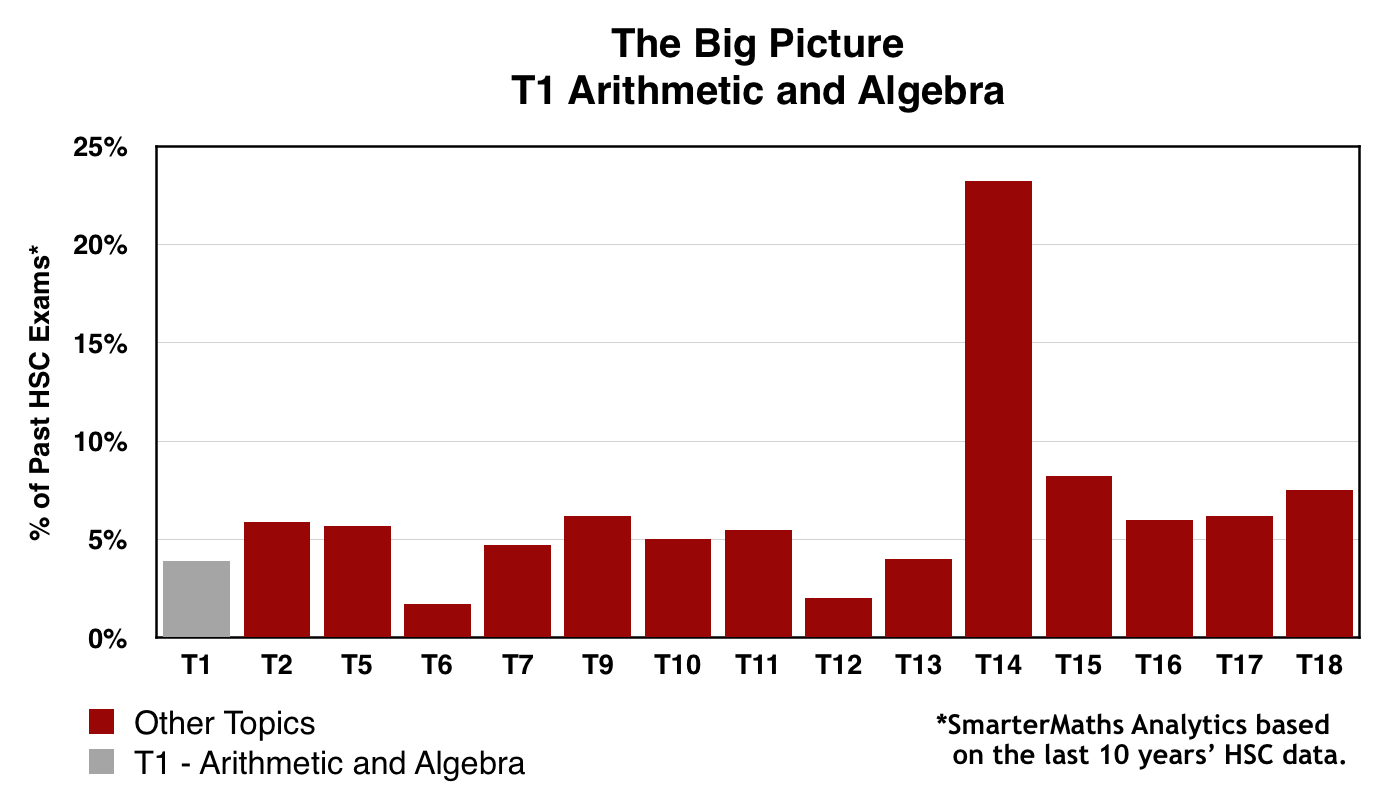
  • T14 Calculus in the Physical World has contributed a mammoth 23.2% to the HSC exam, on average, over the past 10 years.
  • This analysis will look at the sub-topic Other Motion which has accounted for 2.0% of the paper. 

HSC ANALYSIS - What to expect and common pitfalls

  • Other Motion (2.0%) includes motion questions outside of the major two categories of Projectile and Simple Harmonic Motion.
  • This topic has been examined in each of the last 5 years, with a volatile mark allocation of between 1-6 marks. It has been well answered in general, although 2015 Q14b proved challenging for a majority of students and deserves attention.

Filed Under: Other Motion EXT1 Tagged With: worksheet-preamble

EXT1 T15 Snapshot – Parent

HISTORICAL CONTRIBUTION

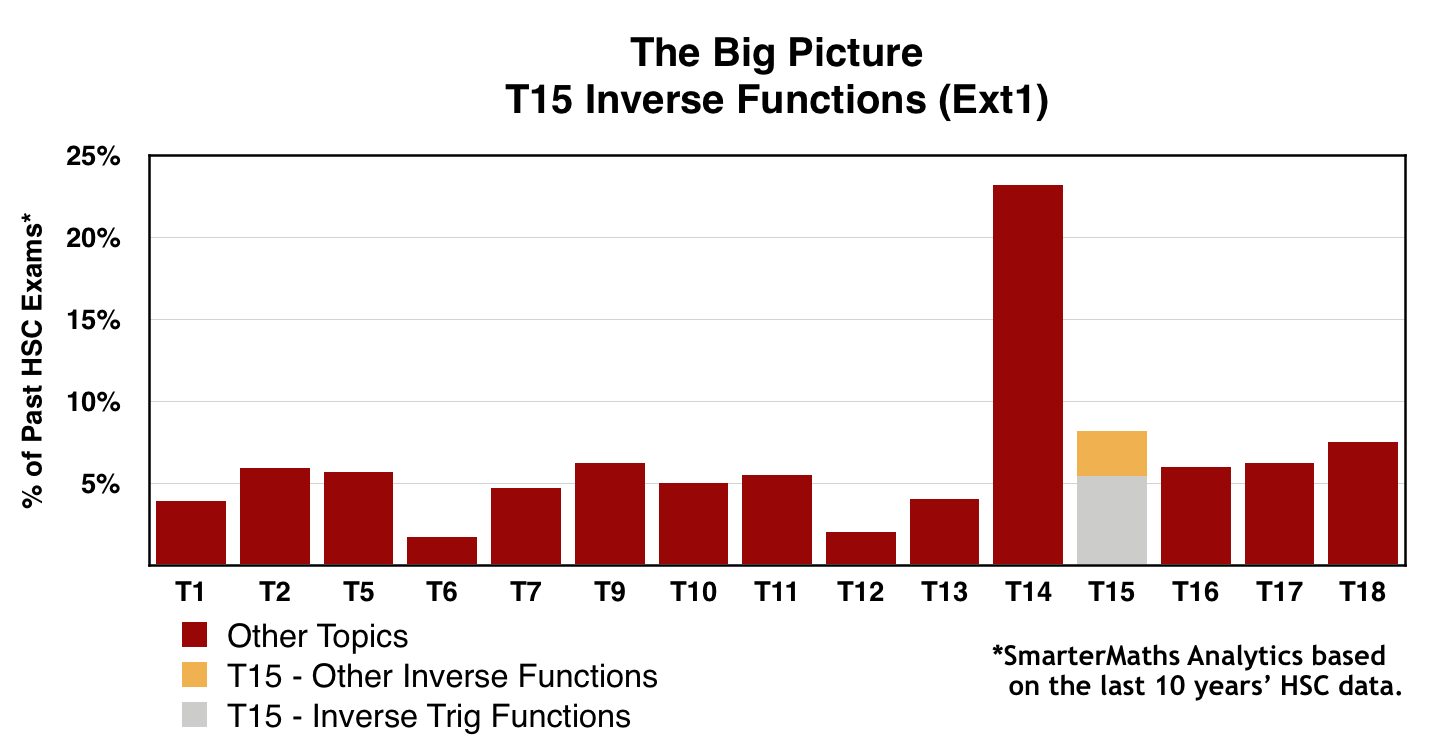
  • T15 Inverse Functions is a sneaky big contributor to the Extension 1 exam, with the second highest average allocation (after Topic 14) of 8.2% per year, over the last 10 years.
  • For analysis purposes, we have split this topic area into 2 main question types: 1-Inverse Trig Functions (5.4%) and 2-Other Inverse Functions (2.8%).

HSC ANALYSIS - What to expect and common pitfalls

  • Inverse Trig Functions (5.4%) represents the largest sub-topic in this area. 
  • Trig calculus represents the most common question-type. It has been tested in 9 of the last 10 years. Classic low hanging fruit.
  • Inverse Trig Graphs are a small part of Inverse Trig Functions that were last examined in 2017 and 2014-2012.
  • Other Inverse Functions (2.8%) represent non-trig inverse functions and are the smaller sub-topic (notably receiving its largest allocation in a decade of 6 marks in the 2018 exam).
  • Pitfalls: The graph and associated range and domain of an inverse exponential function has been the most poorly answered question type in this area in recent times and deserves attention (see 2018 Q13b and 2010 Q3b).

Filed Under: Inverse Trig Functions EXT1, Other Inverse Functions EXT1 Tagged With: worksheet-preamble

EXT1 T12 Snapshot

HISTORICAL CONTRIBUTION

  • T12 Logs and Exponentials has been worth 2.0% of the Extension 1 paper, on average, over the last 10 years.
  • Notwithstanding its smallish contribution, a thorough understanding of Logs and Exponentials is critical due to its significant presence in many cross-topic questions and other important topic areas (such as Exponential Growth and Decay, Motion and Inverse Functions).

HSC ANALYSIS - What to expect and common pitfalls

  • Logs and Exponentials (2.0%) are integral to a number of other large topics in the Extension 1 exam and this contribution is not included in the 2.0% quoted above.
  • Examiners have tested this area in a myriad of ways in the past, including: log laws (2018, 2017), differentiation (2014), integration (2013), curve sketching (2011), domain/range calculations (2011, 2008-09) ... 

Filed Under: 12. Logs and Exponentials EXT1 Tagged With: worksheet-preamble

EXT1 T18 Snapshot – Parent

HISTORICAL CONTRIBUTION

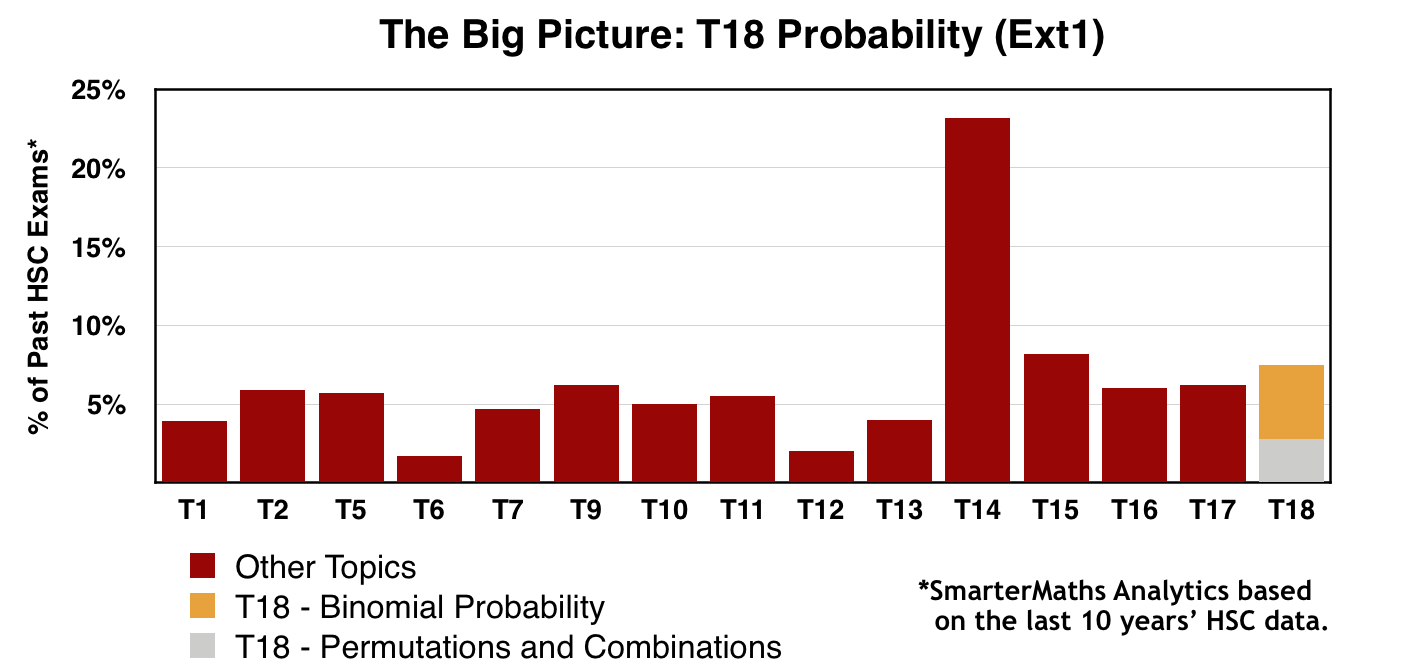
  • T18 Probability is the third largest contributing topic to the Extension 1 exam, worth an average of 7.5% per year, over the last 10 years.
  • For analysis purposes, we have split this topic area into 2 main question types: 1-Permutations and Combinations (2.8%) and 2-Binomial Probability (4.7%). Every exam over the past decade has examined both of these question types.

HSC ANALYSIS - What to expect and common pitfalls

  • Permutations and Combinations (2.8%) are examined every year, at least once.
  • Examiners have favoured the multiple choice format for this sub-topic, asking a MC question every year since it's inclusion in 2012.
  • Most multiple choice questions have been of moderate difficulty, although 2018 Q8 MC deserves attention. Be aware that some longer answer questions of much higher difficulty have also been tested in the past (of special note is 2010 Q7c and 2009 Q6b).
  • Binomial Probability (4.7%). On the whole, we see the 2018 and 2017 testing of this sub-topic on the easy side of the scale and expect a much more difficult question in 2019. It is highly recommended past questions in the period 2004-2012 are the focus of any revision.

Filed Under: Binomial Probability EXT1, Permutations and Combinations EXT1 Tagged With: worksheet-preamble

EXT1 T18 Binomial Probability Snapshot

HISTORICAL CONTRIBUTION

  • T18 Probability is the third largest contributing topic to the Extension 1 exam, worth an average of 7.5% per year, over the last 10 years.
  • For analysis purposes, we have split this topic area into 2 main question types: 1-Permutations and Combinations (2.8%) and 2-Binomial Probability (4.7%). Every exam over the past decade has examined both of these question types.

HSC ANALYSIS - What to expect and common pitfalls

  • Binomial Probability (4.7%) refers to questions where probabilities can be described as having a binomial distribution. 
  • Questions asked in this sub-topic have had quite variable difficulty levels over the years.
  • On the whole, we see the 2018 and 2017 testing of this sub-topic on the easy side of the scale and expect a much more difficult question in 2019. It is highly recommended past questions in the period 2004-2012 are the focus of any revision.
  • Binomial probability can sometimes overlap with T17 Binomial questions, as occurred in 2018.

Filed Under: Binomial Probability EXT1 Tagged With: worksheet-preamble

Ext1 T18 – Combinations Snapshot

HISTORICAL CONTRIBUTION

  • T18 Probability is the third largest contributing topic to the Extension 1 exam, worth an average of 7.5% per year, over the last 10 years.
  • For analysis purposes, we have split this topic area into 2 main question types: 1-Permutations and Combinations (2.8%) and 2-Binomial Probability (4.7%). Every exam over the past decade has examined both of these question types.

HSC ANALYSIS - What to expect and common pitfalls

  • Permutations and Combinations (2.8%) are examined every year, at least once.
  • Examiners have favoured the multiple choice format for this sub-topic, asking a MC question every year since it's inclusion in 2012.
  • Most multiple choice questions have been of moderate difficulty, although 2018 Q8 MC deserves attention. Be aware that some longer answer questions of much higher difficulty have also been tested in the past (of special note is 2010 Q7c and 2009 Q6b).

Filed Under: Permutations and Combinations EXT1 Tagged With: worksheet-preamble

EXT1 T15 Other Inverse Snapshot

HISTORICAL CONTRIBUTION

  • T15 Inverse Functions is a sneaky big contributor to the Extension 1 exam, with the second highest average allocation (after Topic 14) of 8.2% per year, over the last 10 years.
  • For analysis purposes, we have split this topic area into 2 main question types: 1-Inverse Trig Functions (5.4%) and 2-Other Inverse Functions (2.8%).
  • This analysis will look at the second question type, Other Inverse Functions.

HSC ANALYSIS - What to expect and common pitfalls

  • Other Inverse Functions (2.8%) represent non-trig inverse functions and are the smaller sub-topic (notably receiving its largest allocation in a decade of 6 marks in the 2018 exam).
  • In any given year, allocations between this area and the larger Inverse Trig Functions sub-topic tend to cannibalise each other.
  • When it has been tested in the past, Other Inverse Function questions have often attracted large mark allocations (see 2018, 2012, 2010, 2008). 
  • Pitfalls: The graph and associated range and domain of an inverse exponential function has been the most poorly answered question type in this area in recent times and deserves attention (see 2018 Q13b and 2010 Q3b).

Filed Under: Other Inverse Functions EXT1 Tagged With: worksheet-preamble

EXT1 T15 inverse Trig Snapshot

HISTORICAL CONTRIBUTION

  • T15 Inverse Functions is a sneaky big contributor to the Extension 1 exam, with the second highest average allocation (after Topic 14) of 8.2% per year, over the last 10 years.
  • For analysis purposes, we have split this topic area into 2 main question types: 1-Inverse Trig Functions (5.4%) and 2-Other Inverse Functions (2.8%).
  • This analysis will look at the first sub-topic, Inverse Trig Functions.

HSC ANALYSIS - What to expect and common pitfalls

  • Inverse Trig Functions (5.4%) represents the largest sub-topic in this area. 
  • Trig calculus represents the most common question-type. It has been tested in 9 of the last 10 years. A classic example of low hanging fruit that well-drilled students should expect to score highly in.
  • Inverse Trig Graphs are a small part of Inverse Trig Functions that were last examined in 2017 and 2014-2012.

Filed Under: Inverse Trig Functions EXT1 Tagged With: worksheet-preamble

EXT1 T10 Snapshot

HISTORICAL CONTRIBUTION

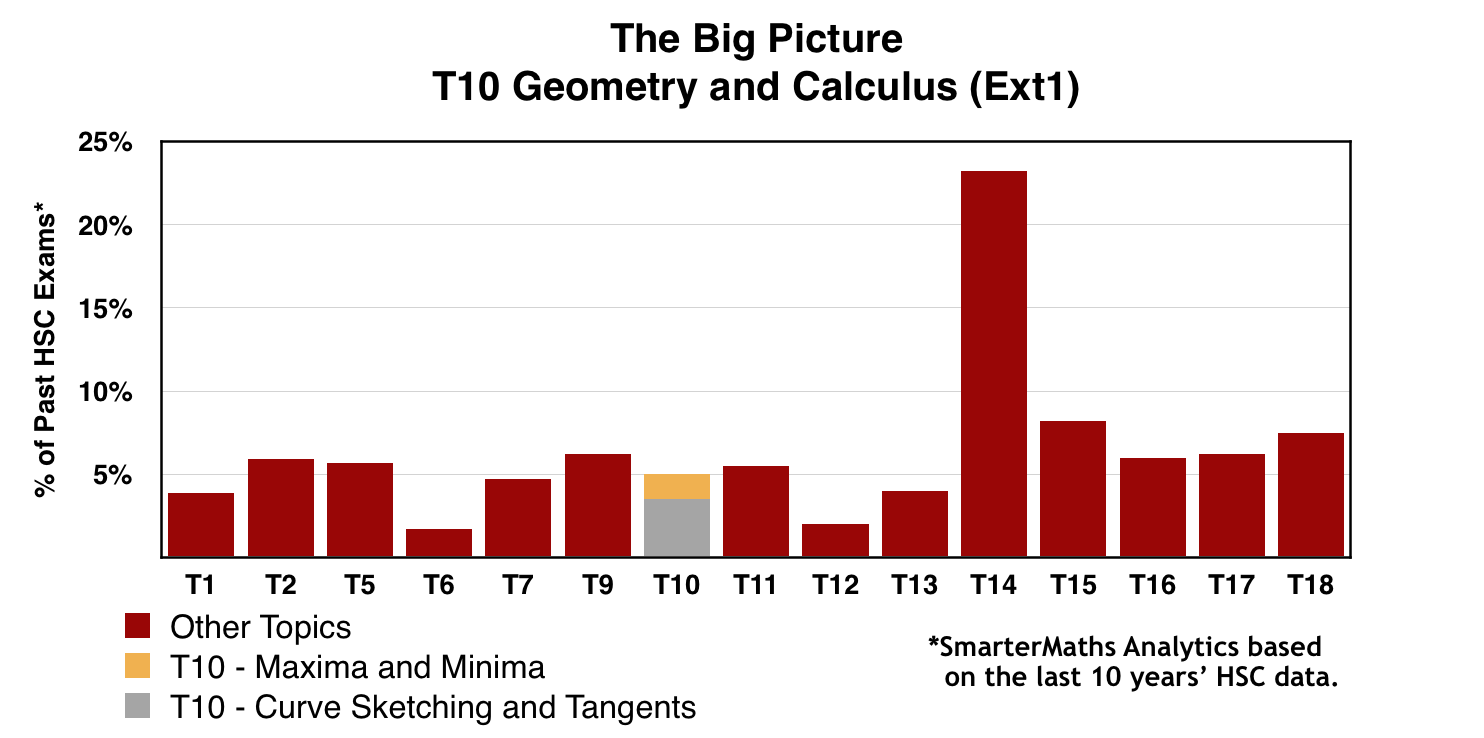
  • T10 Geometry and Calculus has been worth 5.0% of the Extension 1 paper, on average, over the last 10 years.
  • The Extension 1 component of this topic is dominated by Curve Sketching and Tangent questions, with a smaller number of other questions testing maxima/minima within cross-topic contexts.

HSC ANALYSIS - What to expect and common pitfalls

  • Curve Sketching (3.5%) received meaningful mark allocations between 2009-2013 but has been under-examined in the last 5 years (a single multiple choice question appeared in 2018 and 2017) and deserves particular attention.
  • The most common curve sketching questions require students to look at graphs with both vertical and horizontal asymptotes. This question type has been well answered in the past and represents a great opportunity for scoring highly. 
  • Maxima and Minima (1.5%) problems may also appear as a 2-3 mark part of a larger cross-topic question, as they did between 2012-2014 (this does not include any max/min elements of projectile or other Topic 14 questions) . Note that this type of max/min problem (i.e. ex-Topic 14) has been absent in the last 4 exams.

Filed Under: 10. Geometrical Applications of Calculus EXT1 Tagged With: worksheet-preamble

EXT1 T14 Snapshot – Projectile

HISTORICAL CONTRIBUTION

  • T14 Calculus in the Physical World has contributed a mammoth 23.2% to the HSC exam, on average, over the past 10 years.
  • This analysis will look at the sub-topic Projectile Motion which has accounted for an extremely significant 7.8% of the paper.

HSC ANALYSIS - What to expect and common pitfalls

  • Projectile Motion (7.8%) is examined every year with a significant mark allocation. It's importance in achieving a high band in Ext1 cannot be overstated. 
  • This topic area has proven very challenging, with at least one question part resulting in a sub-50% mean mark every year since specific data has been available.
  • A broad cross section of past questions is critical to effective revision here with a clear understanding of the following regularly tested concepts: maximum height, horizontal range/time of flight and the Cartesian equation.
  • While the concepts of this topic are very comprehensible, what brings most students unstuck is the trigonometric algebra. Prepare for examiners to test your ability in this area to a very high degree of difficulty. Good preparation here requires a broad range of past questions.
  • Pitfalls: An understanding of a projectile's angle with the horizontal was required in 2015 Q14a and 2011 Q6b. Both questions flagged a conceptual misunderstanding here, and a revision focus is recommended.

Filed Under: Projectile Motion EXT1 Tagged With: worksheet-preamble

EXT1 T14 Snapshot – Rates of Change

HISTORICAL CONTRIBUTION

  • T14 Calculus in the Physical World has contributed a mammoth 23.2% to the HSC exam, on average, over the past 10 years.
  • This analysis will look at the sub-topic Rates of Change which has historically been worth 4.1% of the paper. 

HSC ANALYSIS - What to expect and common pitfalls

  • Rates of Change (4.1%) has been asked in 9 out of the last 10 years (omitted only in 2015). Expect a question allocation of 3-6 marks.
  • The difficulty level of questions has varied significantly. The toughest examination of this topic was between 2011-2013 where sub-50% mean marks resulted each year - revision should focus here.
  • The most popular underlying subject matter of recent past questions is worth noting: areas/volumes (5 times) and Pythagoras theorem (4 times).
  • Marker's comments have flagged that students can often achieve half-marks by simply stating a correct chain rule and that students who draw diagrams in their solution are more successful. Great advice. Follow it.
  • Pitfalls: The use of non-right angled trig in this context was examined in 2013 and poorly answered. Not tested again since and worthy of a revision focus.
  • Pitfalls: If a constant rate of change is established, students have struggled with follow up questions in 2013 Q13a and 2009 Q5b. A highlighted knowledge gap worthy of attention.

Filed Under: Rates of Change EXT1 Tagged With: worksheet-preamble

EXT1 T14 Snapshot – SHM

HISTORICAL CONTRIBUTION

  • T14 Calculus in the Physical World has contributed a mammoth 23.2% to the HSC exam, on average, over the past 10 years.
  • This analysis will look at the sub-topic Simple Harmonic Motion which has historically been worth a substantial 5.8% of the paper.

HSC ANALYSIS - What to expect and common pitfalls

  • Simple Harmonic Motion (5.8%) has been asked every year in the last decade. Note that in each of the 3 years prior to 2017, both a multiple choice and a longer answer question were asked.
  • The 2018 and 2017 allocations of 1 and 3 marks respectively, are well below the historical average of this topic. We highly recommend a revision focus here.
  • Simple Harmonic Motion is a topic area that has proven very challenging for a majority of students, with sub-50% mean marks resulting in a majority of years.
  • This topic requires a solid fundamental understanding and if achieved, represents a key area where students can differentiate their paper and achieve higher band results. 

Filed Under: Simple Harmonic Motion EXT1 Tagged With: worksheet-preamble

EXT1 T14 Snapshot – GandD

HISTORICAL CONTRIBUTION

  • T14 Calculus in the Physical World has contributed a mammoth 23.2% to the HSC exam, on average, over the past 10 years.
  • This analysis will look at Exponential Growth and Decay, which has historically been worth 3.5% of the paper.

HSC ANALYSIS - What to expect and common pitfalls

  • Exponential Growth and Decay (3.5%) has been asked in 8 out of the last 9 years (including 2018) in questions with an allocation typically between 3-5 marks.
  • Although this sub-topic has produced the highest mean marks of any sub-category within Topic 14, the 2017 question put students' ability to work with log laws through the wringer, and caused all sorts of problems (in both parts!) - a must review area.

Filed Under: Exponential Growth and Decay EXT1 Tagged With: worksheet-preamble

EXT1 T13 Snapshot

HISTORICAL CONTRIBUTION

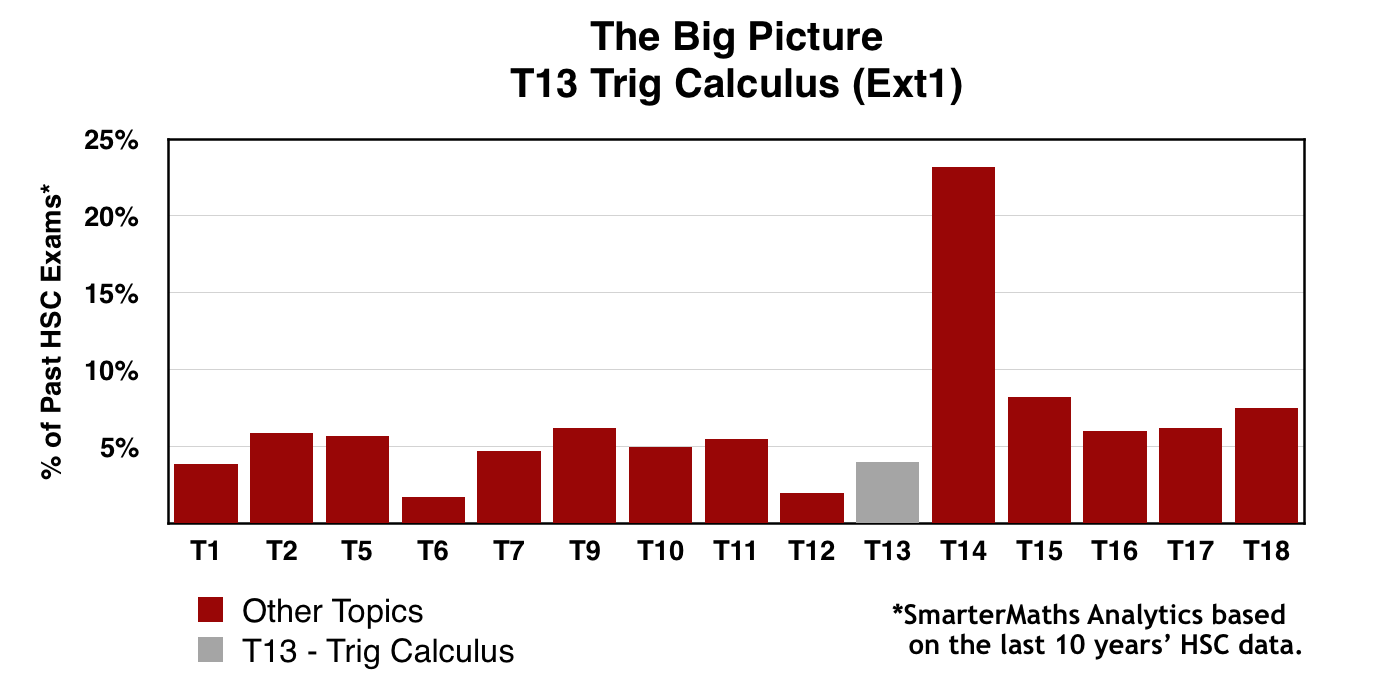
  • T13 Trig Calculus has contributed 4.0% to the Extension 1 exam, on average, over the last 10 years.
  • This contribution does not include inverse trig calculus or any trig calculus within Topic 14 - Calculus in the Physical World questions.

HSC ANALYSIS - What to expect and common pitfalls

  • T13 Trig Calculus (4.0%) has been well answered in the past and represents a fertile area for high scoring.
  • Trig differentiation questions would likely test the product or quotient rules, and "limit" questions have been popular recently, asked in 4 of the past 6 years (last time in 2018).
  • Integration questions in this topic area are dominated by versions of integrating sin² x. A must-review area asked in a dedicated question on 5 occasions since 2010. Note that a variation on this style of question produced a sub-50% mean mark in 2017 and should be reviewed.
  • Trig Graphs are understandably a minor sub-topic here as it overlaps with Topic 14 Simple Harmonic Motion. Having said that, it was examined within this topic area in 2015 (Q10 MC) and 2009 (Q3b).

Filed Under: 13. Trig Calc, Graphs and Circular Measure EXT1 Tagged With: worksheet-preamble

EXT1 T17 Snapshot

HISTORICAL CONTRIBUTION

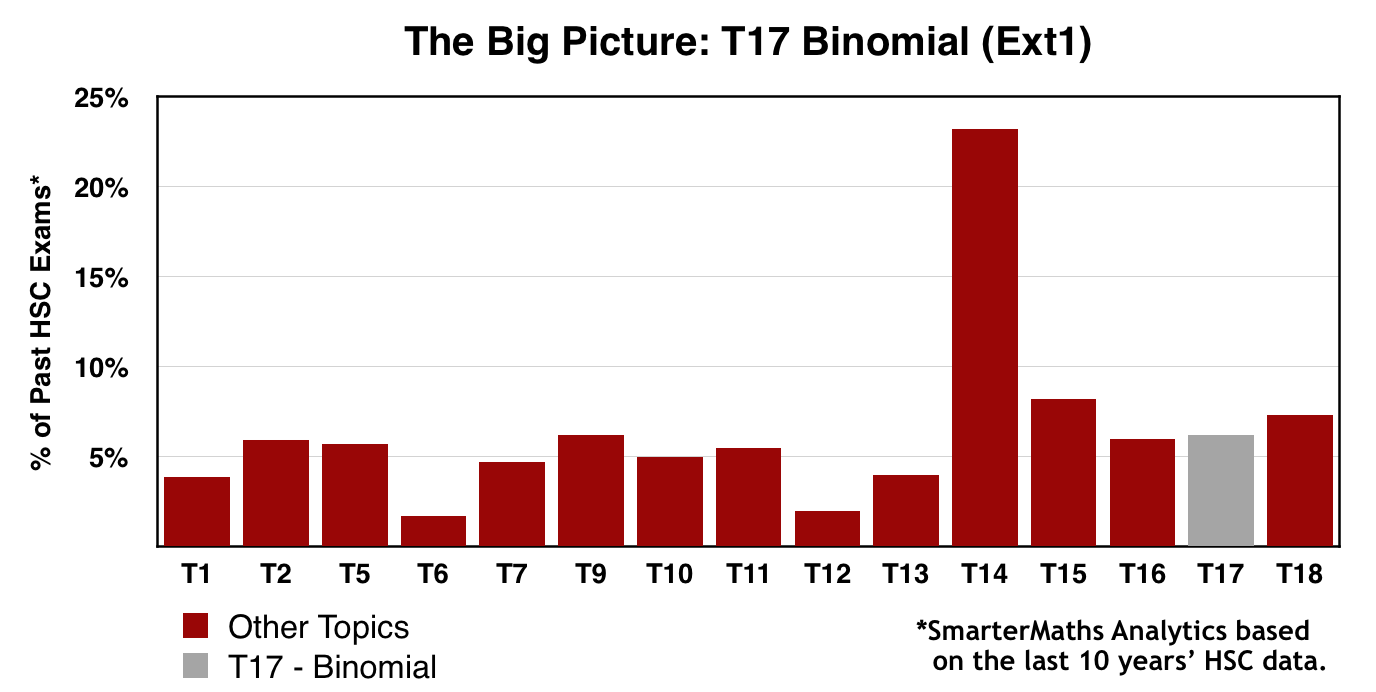
  • T17 Binomial has contributed an average of 6.2% to the Extension 1 exam, on average, over the last 10 years. The mark allocations of any one year have been between 3-7 marks.

HSC ANALYSIS - What to expect and common pitfalls

  • This topic area is tested using 2 distinct question types. The first, and significantly easier type,  asks students to calculate the constant/independent term or a specific co-efficient in the expansion. This has been asked in 5 of the last 7 years (last examined in 2017).
  • These "easier" type questions are generally well answered, although the difficulty level was notched up in Q6c 2008 and is well worth reviewing.
  • The harder question type requires students to prove an expression related to the binomial expansion. Asked in 5 of the last 6 years and producing sub-50% mean marks every year except 2014, this is a key differentiator of the best papers.
  • The binomial has a natural cross product partner with Topic 18 probability. Examples of this can be seen in 2018 Q14b, 2015 Q14c and 2009 Q6b.

Filed Under: 17. Binomial EXT1 Tagged With: worksheet-preamble

EXT1 T11 Snapshot

HISTORICAL CONTRIBUTION

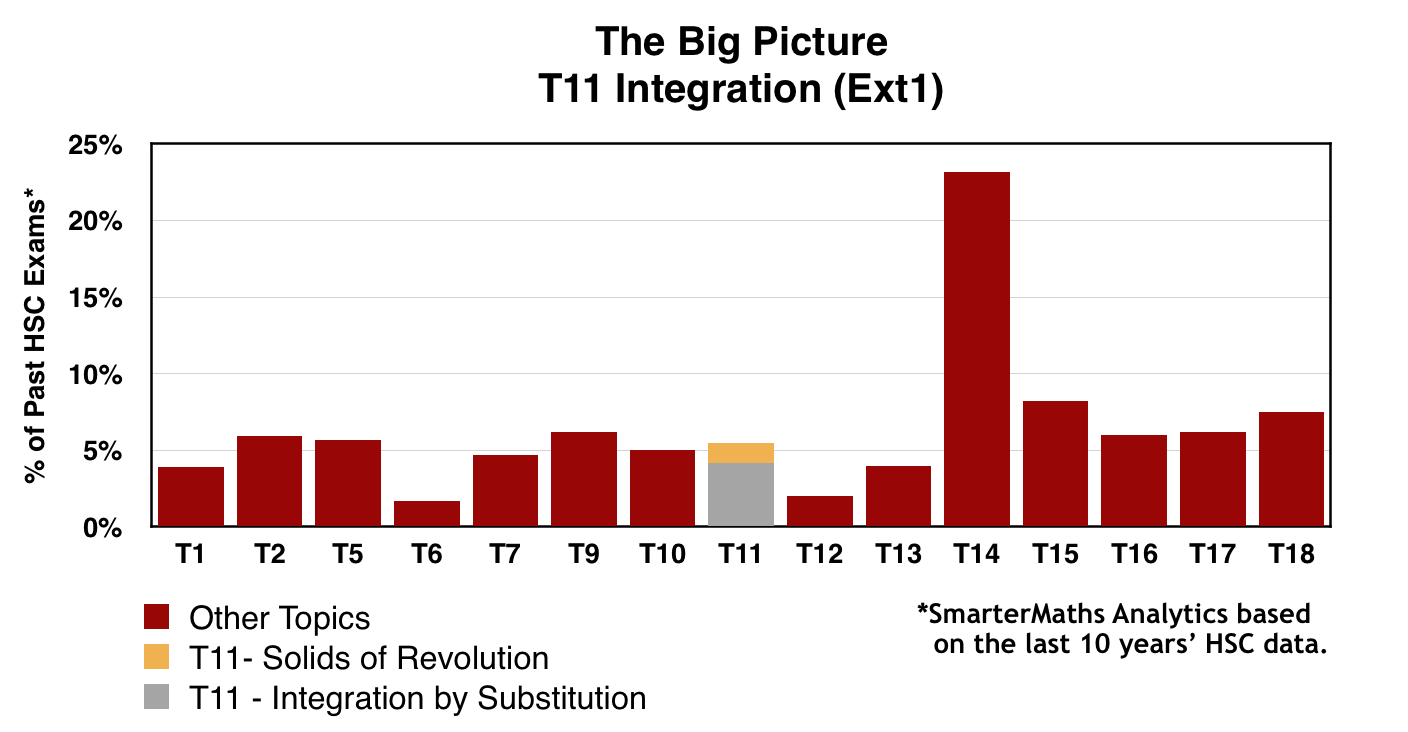
  • T11 Integration has contributed an average of 5.5% to the Extension 1 exam, on average, over the last 10 years.
  • This topic has been split into two sub-categories for this analysis: 1- Integration by Substitution (4.2%), and 2- Solids of Revolution (1.3%).

HSC ANALYSIS - What to expect and common pitfalls

  • Integration by Substitution (4.2%) is a super consistent topic area, asked in a dedicated 3-mark question every year of the last decade. A great area to score highly for all students.
  • Approach this area by concentrating on making no mistakes and getting ahead of the clock, in that order! One of the few problem areas flagged by markers has been when definite integral limits look inverted after the substitution (see Q1e 2007).
  • Solids of Revolution (1.3%) was last examined in 2017 after being omitted the previous two years.

Filed Under: 11. Integration EXT1 Tagged With: worksheet-preamble

EXT1 T16 Snapshot

HISTORICAL CONTRIBUTION

  • T16 Polynomials is a significant contributor to the Extension 1 exam, worth an average of 6.0% per year over the past decade.
  • This topic area has appeared in at least 2 questions in each of the last 6 years. We have split it into two main question types for this analysis which are: 1-Roots and Remainders (3.5%), and 2-Newton's Method (2.5%).

HSC ANALYSIS - What to expect and common pitfalls

  • Roots and Remainders (3.5%) has a great combination of being both examined every year and historically well answered (note the exception of 2006 Q4a).
  • Newton's Method (2.5%) has proven to be the more challenging sub-topic within Polynomials. It is also tested every year like clockwork with an expected 2-3 mark allocation, although 2017 and 2018 were anomalies with just a single mark allocation.
  • Pitfalls: Conceptual understanding of Newton's method (2018 Q6 MC, 2014 Q12e) and using  "halving the interval" estimation (2010 3b and 2005 Q3a).

Filed Under: Newton's Method etc... EXT1, Roots, Remainders and Factors Tagged With: worksheet-preamble

EXT1 T9 Snapshot

HISTORICAL CONTRIBUTION

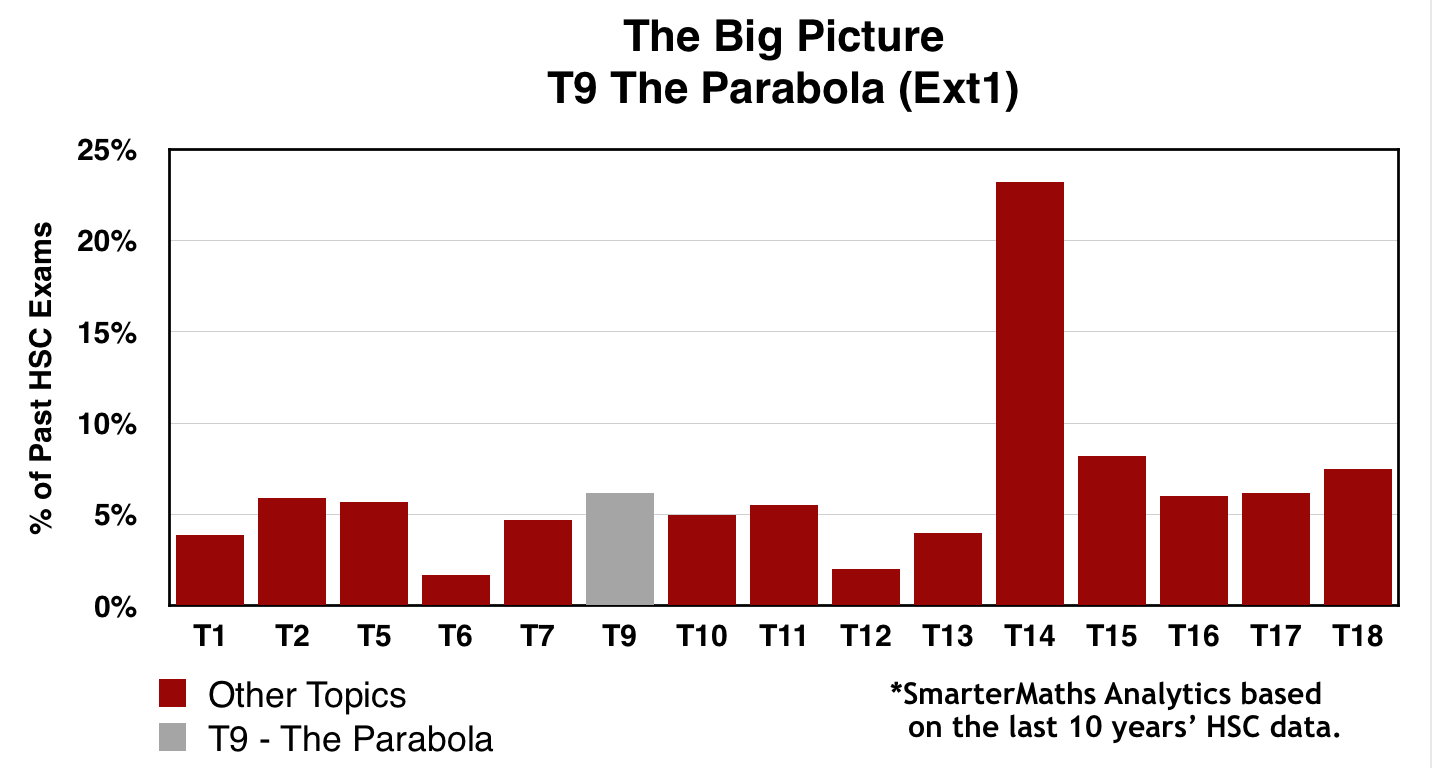
  • T9 The Parabola is another super consistent element of the Extension 1 exam, contributing an average of 6.2% per year over the past decade.
  • Examined every year of the last decade in questions worth 3-7 marks.

HSC ANALYSIS - What to expect and common pitfalls

  • The Parabola (6.2%) typically attracts a multi-step question where the difficulty level between different parts is often stark. It follows that easy marks are regularly on offer in the earlier parts of otherwise difficult questions. Take advantage.
  • The Parabola has proven very challenging for a majority of students in the past (with 2018 and 2017 no exception), and represents a key opportunity for students to differentiate their paper and outperform peers.
  • Locus questions have been particularly poorly answered in the past (last examined in 2016). 
  • It is highly recommended that students have well drilled proofs of tangent, normal and chord equations they can produce quickly if asked. Although not asked since 2011, this type of proof has appeared many times in past exams.

Filed Under: 9. Quadratics and the Parabola EXT1 Tagged With: worksheet-preamble

EXT1 T7 Snapshot

HISTORICAL CONTRIBUTION

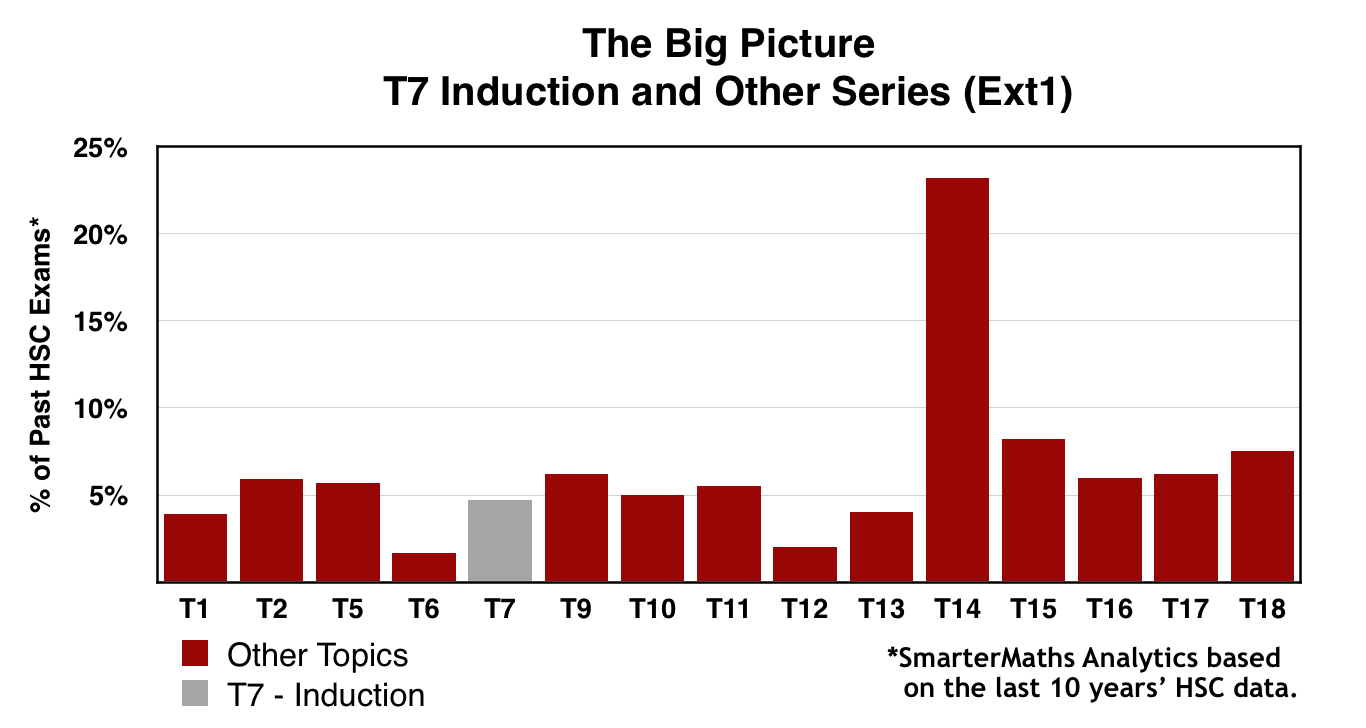
  • T7 Induction and Other Series has been worth 4.7% of the Extension 1 exam, on average, over the past decade.
  • Induction is examined every year like clockwork, typically in questions allocated 3 marks.

HSC ANALYSIS - What to expect and common pitfalls

  • Induction (4.7%). The most common induction question type is divisibility, where a series must be proven to be divisible by a certain integer. Asked 5 times in the last 10 years (not in 2018).
  • This is a rich area to pick up high marks with one significant exception - "Inequality Induction". Make sure you carefully review Q14a 2013, where the inequality induction question resulted in a mean mark of just 25%. This question type has not been re-examined in the 5 years since this poor result.
  • Examiners have occasionally thrown up left field examples in this area, testing differentiation formulas and trig equations to name just two examples. A broad spectrum of past questions is highly recommended.

Filed Under: 7. Induction and Other Series EXT1 Tagged With: worksheet-preamble

EXT1 T6 Snapshot

HISTORICAL CONTRIBUTION

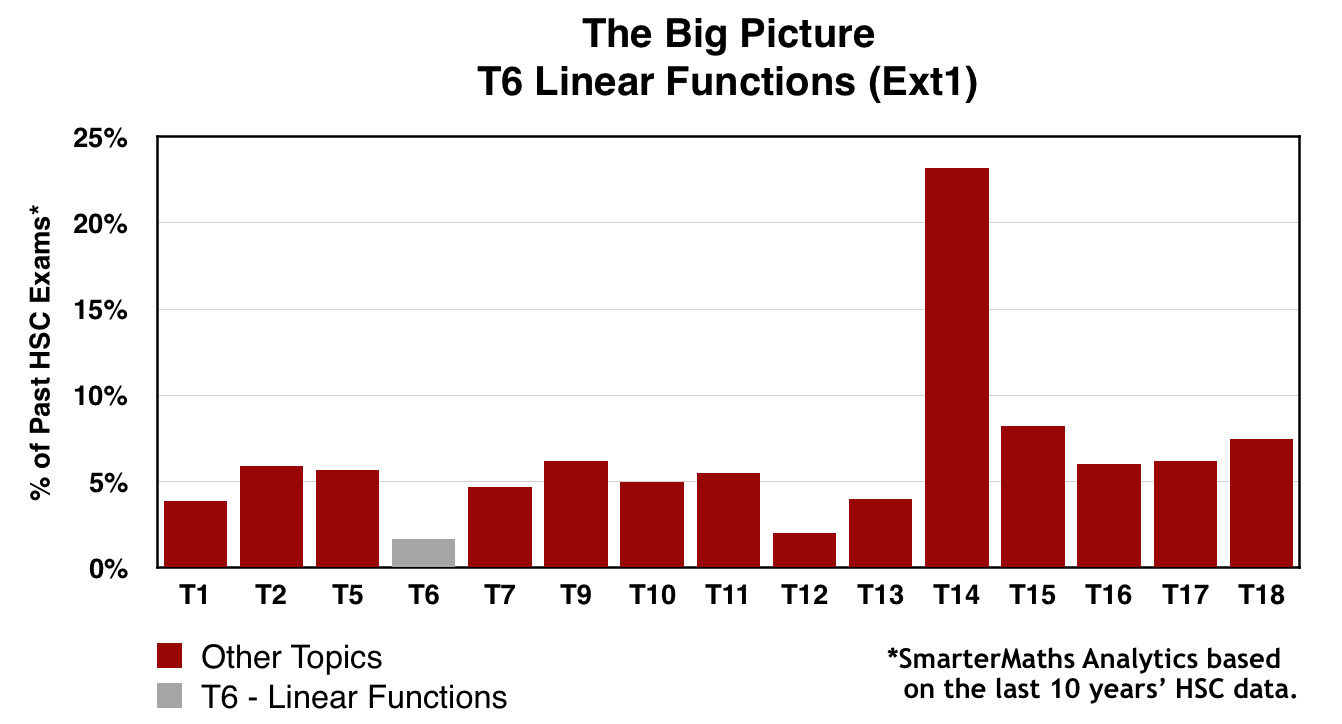
  • T6 Linear Functions is a minor part of the Extension 1 exam, contributing around 1.7% per exam, on average, over the past 10 years.

2017 HSC ANALYSIS - What to expect and common pitfalls

  • Linear Functions (1.7%) has been tested in 7 of the last 8 years (including twice in 2013), making it a small contributor that nevertheless deserves attention.
  • Past testing has been dominated by two question types: 1- calculating the acute angle between two lines (last examined in 2018), and 2- division of an interval in a ratio (last examined in 2017 and 2012).
  • A topic area that provides low hanging fruit for high scoring. Note however the one exception of Q12d 2013, where the perpendicular distance formula was examined in an applied context and a majority of students struggled. 

Filed Under: 6. Linear Functions EXT1 Tagged With: worksheet-preamble

EXT1 T5 Snapshot

HISTORICAL CONTRIBUTION

  • T5 Trig Ratios has been worth a substantial 5.7% of the HSC exam, on average, over the last 10 years. 
  • This topic has been split into three sub-categories which are: 1- Exact Trig Ratios and Other Identities (2.2%), 2-Auxiliary Angles (2.3%) and 3-3D Trig (1.2%).

HSC ANALYSIS - What to expect and common pitfalls

  • Exact Trig Ratios and Other Identities (2.2%) is tested regularly (although not in 2018) in stand alone and cross topic questions. Typically well answered, although Q8 MC 2013 caused problems for many students and should be revised.
  • Auxiliary Angles (2.3%) have been tested in 3 of the last 4 years. Note that the 2.3% allocation does not include its regular cross topic allocation within Topic 14- Simple Harmonic Motion. A key competence for the exam with a high probability of being examined.
  • The general solution was examined in 2018, 2016 and 2013 - notably more often than in the past.
  • 3D Trig (1.2%) questions are not asked regularly, but when they have appeared, mark allocations have been substantial. Not examined since 2015. Highly recommended that students review this area, including the challenging T1 SM-Bank 01.
  • T5 Trig Ratios has been under-examined in 2018-2016 versus its historical average (receiving mark allocations of 3, 3 and 1 respectively). A revision focus is recommended here.

Filed Under: 5. Trig Ratios EXT1 Tagged With: worksheet-preamble

EXT1 T2 Snapshot

HISTORICAL CONTRIBUTION

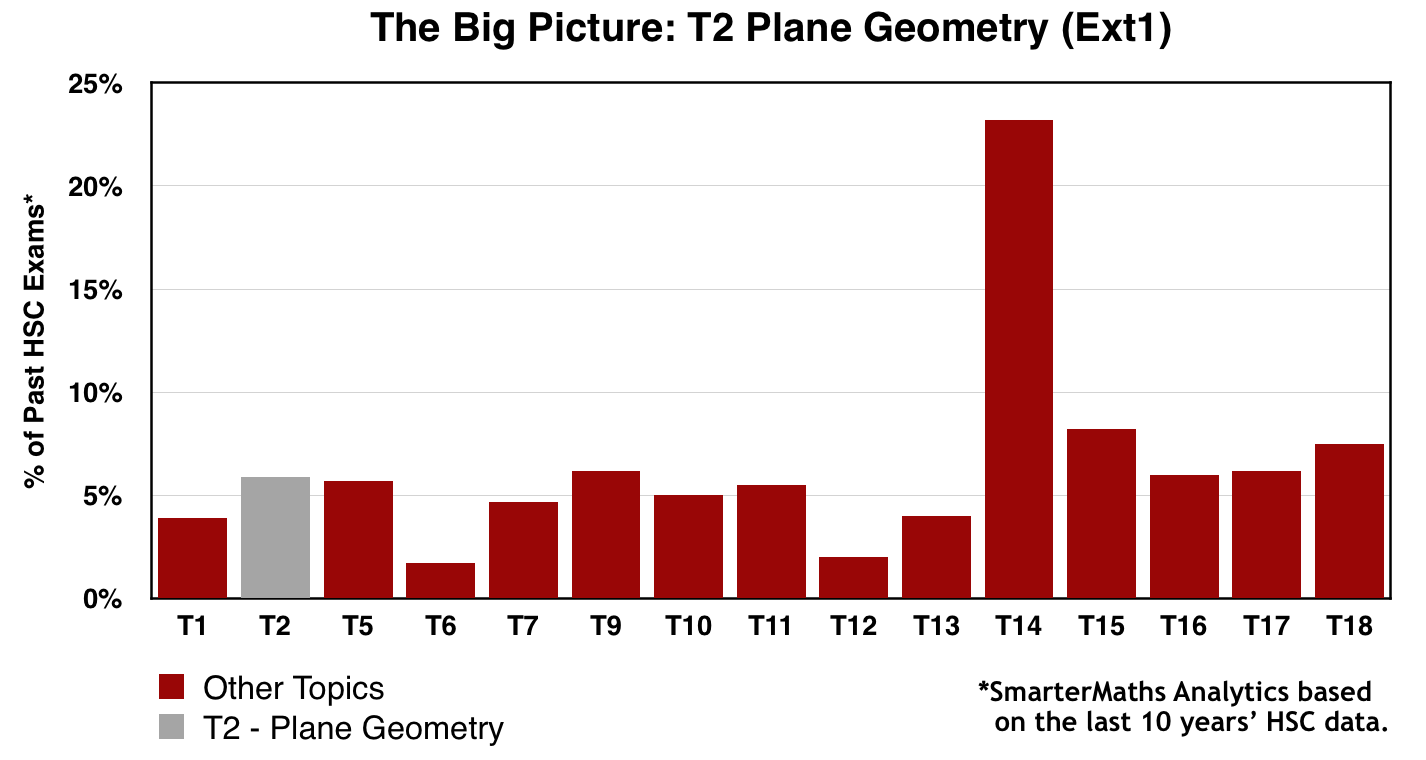
  • T2 Plane Geometry is examined every year and has contributed a substantial 5.9% per exam, on average, over the past decade.

HSC ANALYSIS - What to expect and common pitfalls

  • Recent history suggests that students can expect both a multiple choice and a longer answer question in this topic area - a trend that has been in place every year with multiple choice except 2018, which had 3 separate longer answer questions!
  • Sub-50% mean marks have resulted every year except 2017 (since data has been available), making this area very important for achieving high band results.
  • Key concepts that have proven examiner favourites are: alternate segment angles, cyclic quads, exterior angles of cyclic quads, angles at the centre twice the angle on circumference. Vigilance on recognising and applying these properties will unlock many difficult questions.
  • HSC marker's consistently state: the higher scoring students in this topic draw large diagrams and label angles clearly. Good advice. Follow it.
  • Tangent and secant theorems and associated ratio formulae - examined and well answered in 2018 although sub-50% mean marks all previous times tested.

Filed Under: 2. Plane Geometry EXT1 Tagged With: worksheet-preamble

EXT1 T1 Snapshot

HISTORICAL CONTRIBUTION

  • T1 Basic Arithmetic and Algebra is a sneaky big contributor to the Extension 1 exam, worth an average of 3.9% per exam over the past 10 years.

HSC ANALYSIS - What to expect and common pitfalls

  • T1 Basic Arithmetic and Algebra has been allocated at least one dedicated question every year since 2009, with the notable exception of 2018. When examined, the mark allocation has been a minimum of 3 marks, with 2013 the only outlier which received an allocation of just 1 mark.
  • Inequalities is the most dominant question type, tested in 9 of the last 10 years(!) and allocated a healthy 3 marks on each occasion. A great topic area to collect low hanging fruit in this exam.
  • Cubic factorisation was examined in a dedicated question 3 times between 2007-2012, but not since. Worthy of attention.
  • Absolute Value was most recently examined in 2017 Q12b (in a 4 mark question) and 2013 Q10 MC , the latter producing  the only sub-50% mean mark in this topic in the last decade.

Filed Under: 1. Basic Arithmetic and Algebra EXT1 Tagged With: worksheet-preamble

2UG Snapshot MM2 – PAV

HISTORICAL CONTRIBUTION

  • Perimeter, Area and Volume is examined through the preliminary topic MM2 (1.6%) and MM4 (6.9%), to contribute a substantial 8.5% to the HSC, on average, over the past 10 years.
  • This analysis will focus on the smaller preliminary topic MM2 Applications of Perimeter, Area and Volume.

PAST HSC ANALYSIS - What to expect and common pitfalls

  • MM2 Applications of Perimeter, Area and Volume has contributed a modest 1.6%, on average, to the HSC exam.
  • A natural overlap occurs with FS Resources, and "cross-topic" questions in this area are highly recommended revision examples.
  • Despite the topic being generally well answered, recent questions concerning the volume of prisms has caused significant difficulties the last three times it has been examined, and deserves specific attention.

Filed Under: MM2 - Perimeter, Area and Volume (Prelim) Tagged With: worksheet-preamble

2UA Snapshot – T11 Parent

HISTORICAL CONTRIBUTION

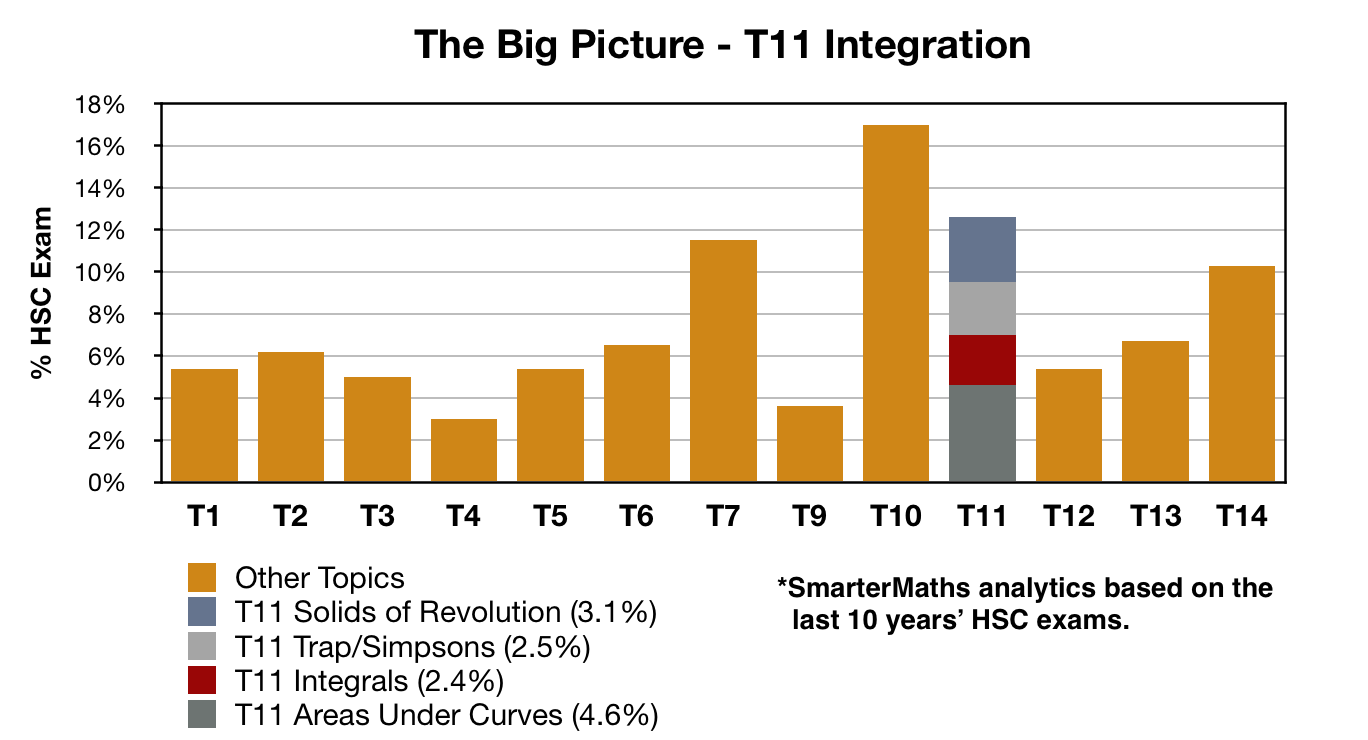
  • T11 Integration is the second largest topic in the Mathematics course, contributing 12.6% to the HSC exam, per year, over the last decade.
  • This topic has been split into four sub-categories: 1-Areas Under Curves (4.6%), 2-Integrals (2.4%), 3-Simpson's and Trapezoidal Rules (2.5%), and 4-Solids of Revolution (3.1%).

HSC ANALYSIS - What to expect and common pitfalls

  • Area Under Curves (4.6%). Students can count on at least one question appearing in the 2021 exam (and a better than 50% chance that it will be examined twice).
  • Solids of Revolution (3.1%) questions have been asked every year in the last decade and allocated 3-marks on all but two occasions.
  • Simpson's and Trapezoidal Rule (2.5%). Simpson's Rule has been tested 2016-2018. Trapezoidal rule hasn't been examined with a mark allocation above one since 2013. Take care - while the pure calculations are answered well, the follow up questions have produced horrible results (sub-50% mean marks in 5 of the last 7 years, including 2017).
  • Integrals (2.4%) includes all "vanilla" (not including trig or log underlying) integration problems.

Filed Under: Uncategorized Tagged With: worksheet-preamble

2UA Snapshot – T13 Parent

HISTORICAL CONTRIBUTION

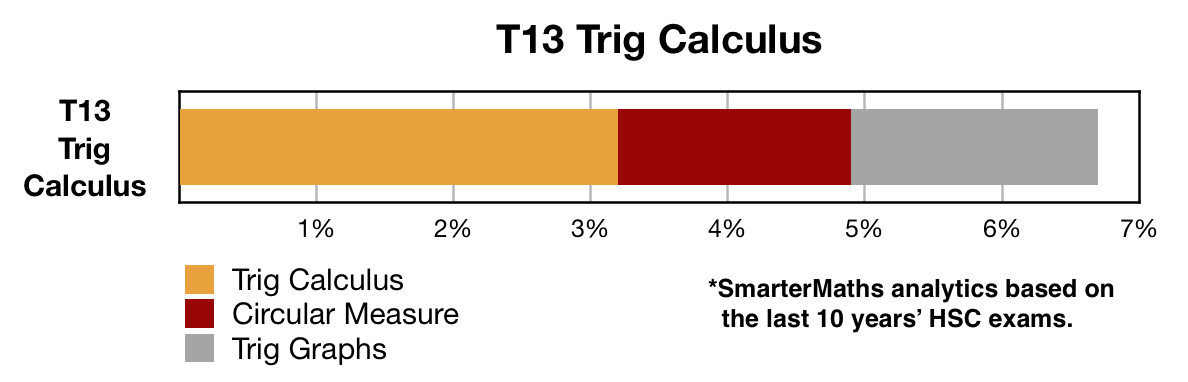
  • T13 Trig Calculus has contributed a very healthy 6.7% to the HSC exam, on average, over the last 10 years.
  • This topic has been split into three sub-categories for this analysis which are: 1-Trig Calculus (3.2%), 2-Circular Measure (1.7%), and 3-Trig Graphs (1.8%).

HSC ANALYSIS - What to expect and common pitfalls

  • Trig Calculus (3.2%) includes all differentiation and integration of trig functions. This area is consistently examined in earlier stages of the HSC and competence here should make for easy marks.
  • Circular Measure (1.7%) has been examined in 5 of the last 7 HSC exams, notably absent in 2018. A very reliable topic area to study.
  • This sub-topic has been well answered by students in recent times. However, it is recommended students carefully revise questions in the period 2005-2010 where sub-50% mean marks resulted in 5 of the 6 years.
  • Trig Graphs (1.8%) received a multiple choice question in 2018 and a substantial 3 mark allocation in 2017.
  • It has also been a key component in outstanding longer answer questions asked in 2013 (Q13a) and 2009 (Q7b) which caused all sorts of problems for students - these are highly recommended revision questions for 2019.

Filed Under: Circular Measure, Differentiation and Integration, Trig graphs Tagged With: worksheet-preamble

2UA Snapshot – T13 Circular Measure

HISTORICAL CONTRIBUTION

  • T13 Trig Calculus has contributed 6.7% to the HSC exam, on average, over the last 10 years.
  • This topic has been split into three sub-categories for this analysis which are: 1-Trig Calculus (3.2%), 2-Circular Measure (1.7%), and 3-Trig Graphs (1.8%).
  • This analysis looks at Circular Measure (1.7%).

HSC ANALYSIS - What to expect and common pitfalls

  • Circular Measure (1.7%) has been examined in 5 of the last 7 HSC exams, notably absent in 2018. A very reliable topic area to study.
  • This sub-topic has been well answered by students in recent times. However, it is recommended students carefully revise questions in the period 2005-2010 where sub-50% mean marks resulted in 5 of the 6 years.

Filed Under: Circular Measure Tagged With: worksheet-preamble

2UA Snapshot – T13 Trig Calc

HISTORICAL CONTRIBUTION

  • T13 Trig Calculus has contributed a very healthy 6.7% to the HSC exam, on average, over the last 10 years.
  • This topic has been split into three sub-categories for this analysis which are: 1-Trig Calculus (3.2%), 2-Circular Measure (1.7%), and 3-Trig Graphs (1.8%).
  • This analysis looks at the largest sub-topic Trig Calculus (3.2%)

PAST HSC ANALYSIS - What to expect and common pitfalls

  • Trig Calculus (3.2%) includes all dedicated questions on differentiation and integration of trig functions. Past exams show that this area is consistently examined in earlier stages of the HSC and gives students a great opportunity for scoring highly.
  • Marker's Comments have noted that students who wrote out the quotient rule and all its inputs before substituting in values made less mistakes.
  • 2-step questions that require students to differentiate and then use that information to integrate have been worth 4 full marks in the past and deserve attention (asked twice since 2008).

Filed Under: Differentiation and Integration Tagged With: worksheet-preamble

2UA Snapshot – T14 Parent

HISTORICAL CONTRIBUTION

  • T14 Calculus in the Physical World has contributed a substantial 10.3% to the HSC exam, on average, over the past 10 years.
  • This topic has been split into three sub-categories for this analysis which are: 1-Motion (4.4%), 2-Exponential Growth and Decay (4.2%), and 3-Rates of Change (1.7%).

PAST HSC ANALYSIS - What to expect and common pitfalls

  • Motion (4.4%) is examined every year. On notice: this topic area has received highly significant 5, 8 and 8 mark allocations in the 2018-2016 HSC exams respectively.
  • With the combination of high mark allocations and a high degree of difficulty, this topic area is incredibly important for achieving high band results. 
  • Exponential Growth and Decay (4.2%) has been asked every year in the last decade in questions worth 3-8 marks. A fertile area to revise thoroughly - consistently examined with the highest mean marks of any sub-topic within Topic 14.
  • Rates of Change (1.7%) is historically the smallest sub-category within Topic 14. Although not examined in 2018, worth noting that examiners allocated this topic 3 marks in 2017, and a huge 7 marks in 2016!

Filed Under: Exponential growth and decay, Motion, Rates of Change Tagged With: worksheet-preamble

2UA Snapshot – T14 Rates of Change

HISTORICAL CONTRIBUTION

  • T14 Calculus in the Physical World has contributed a substantial 10.3% to the HSC exam, on average, over the past 10 years.
  • This topic has been split into three sub-categories for this analysis which are: 1-Motion (4.4%), 2-Exponential Growth and Decay (4.2%), and 3-Rates of Change (1.7%).
  • This analysis looks at the smallest sub-topic Rates of Change.

PAST HSC ANALYSIS - What to expect and common pitfalls

  • Rates of Change (1.7%) is historically the smallest sub-category within Topic 14. Although not examined in 2018, worth noting that examiners allocated this topic 3 marks in 2017, and a huge 7 marks in 2016!
  • Although relatively well answered in 2017, note that on the 3 prior occasions this topic has been examined - 2016, 2015 and 2011 - students have had major difficulties with mean marks well below 50%.

Filed Under: Rates of Change Tagged With: worksheet-preamble

2UA Snapshot – T14 GandD

HISTORICAL CONTRIBUTION

  • T14 Calculus in the Physical World has contributed a substantial 10.3% to the HSC exam, on average, over the past 10 years.
  • This topic has been split into three sub-categories for this analysis which are: 1-Motion (4.4%), 2-Exponential Growth and Decay (4.2%), and 3-Rates of Change (1.7%).

HSC ANALYSIS - What to expect and common pitfalls

  • Exponential Growth and Decay (4.2%) has been asked every year in the last decade. A fertile area to focus revision on - that will be examined!
  • It has produced the highest mean marks of any sub-category within Topic 14, although the simultaneous growth and decay of fish populations in the 2013 exam caused major problems and deserves particular attention.
  • "Decay" (vs exponential growth) questions were asked in 4 consecutive years to 2017, with 2018 bucking the trend and examining a growth equation.

Filed Under: Exponential growth and decay Tagged With: worksheet-preamble

2UA Snapshot – T14 Motion

HISTORICAL CONTRIBUTION

  • T14 Calculus in the Physical World has contributed a substantial 10.3% to the HSC exam, on average, over the past 10 years.
  • This topic has been split into three sub-categories for this analysis which are: 1-Motion (4.4%), 2-Exponential Growth and Decay (4.2%), and 3-Rates of Change (1.7%).

HSC ANALYSIS - What to expect and common pitfalls

  • Motion (4.4%) is examined every year. On notice: this topic area has received highly significant 5, 8 and 8 mark allocations in the 2018-2016 HSC exams respectively.
  • With the combination of high mark allocations and a high degree of difficulty, this topic area is incredibly important for achieving high band results. 
  • Longer answer Motion questions have most commonly used equations that are a simple function of `t` (2018, 2016-2013) and less commonly exponential (2017) or trig equations.
  • Although Motion questions have proven challenging for a majority of students, they consistently offer up much easier marks in earlier parts.

Filed Under: Motion Tagged With: worksheet-preamble

2UA Snapshot – T12 Cross topic

HISTORICAL CONTRIBUTION

  • T12 Logs and Exponentials has contributed an average of 5.4% to the HSC exam per year, although this does not include its regular contribution to cross-topic problems involving other sub-topics such as Area Under Curves and Tangents.
  • This topic has been split into three sub-categories for this analysis which are: 1-Index Laws and Other Equations (1.1%), 2-Log Calculus (2.3%), and 3-Exponential Calculus (2.0%).
  • This analysis looks at cross-topic applications.

HSC ANALYSIS - What to expect and common pitfalls

  • T12 L&E is extremely adaptable to cross-topic questions and is regularly combined with Area Under Curves, Curve Sketching and Tangents and Normals.
  • The number of cross-topic questions involving Logs & Exponentials averages out at almost 1 per year which makes this area worthy of attention (particularly as none have appeared in the 2016-2018 exams).
  • Important to note that L&E's considerable contribution within Exponential Growth and Decay and Motion is treated separately under Topic 14 Calculus in the Physical World.

Filed Under: Applied Calculus (L&E) Tagged With: worksheet-preamble

2UA Snapshot – T12 L&E

HISTORICAL CONTRIBUTION

  • T12 Logs and Exponentials has contributed an average of 5.4% to the HSC exam per year, although this does not include its regular contribution to cross-topic problems involving other sub-topics such as Area Under Curves and Tangents.
  • This topic has been split into three sub-categories for this analysis which are: 1-Index Laws and Other Equations (1.1%), 2-Log Calculus (2.3%), and 3-Exponential Calculus (2.0%).

PAST HSC ANALYSIS - What to expect and common pitfalls

  • Topic 12 L&E has historically been a great topic area for students to score highly in.
  • Index Laws and Other Equations (1.1%) represent a small area that examiners have been consistently testing within multiple choice since this mode of question was included in 2012 (note it was omitted in 2018 and poorly answered in 2017).
  • Log Calculus (2.3%) is the biggest contributor to Topic 12. The integration of a fraction that results in a logarithm is a 2-3 mark question type that has appeared in 5 of the last 9 years, but has been notably absent in the last 3 years. Revision focus recommended here.
  • Exponential Calculus (2.0%) has been examined every year since 2011 (with a 4 mark allocation in 2018). Easy marks available for well prepared students here.

Filed Under: Exponential Calculus, Exponential Calculus (Y12), Log Calculus, Log Calculus (Y12), Log/Index laws and Other Equations Tagged With: worksheet-preamble

2UA Snapshot – T11 Integrals

HISTORICAL CONTRIBUTION

  • T11 Integration is the second largest topic in the Mathematics course, contributing 12.6% to the HSC exam, per year, over the last decade.
  • This topic has been split into four sub-categories: 1-Areas Under Curves (4.6%), 2-Integrals (2.4%), 3-Simpson's and Trapezoidal Rules (2.5%), and 4-Solids of Revolution (3.1%).

HSC ANALYSIS - What to expect and common pitfalls

  • Integrals (2.4%) make up the smallest contribution within T11 Integration and deals with the more "vanilla" integration problems. i.e. the 2.4% does not include Trig Integrals or Log & Exponential Integrals whose contribution to the HSC is attributed to their specific topic area.
  • Dedicated questions in this topic area appear sporadically with a volatile mark allocation (including a full 6 mark allocation in 2009). Examined 3 times in the last 7 years (notably absent in 2018).

Filed Under: Integrals Tagged With: worksheet-preamble

2UA Snapshot – T11 Simpsons

HISTORICAL CONTRIBUTION

  • T11 Integration is the second largest topic in the Mathematics course, contributing 12.6% to the HSC exam, per year, over the last decade.
  • This topic has been split into four sub-categories: 1-Areas Under Curves (4.6%), 2-Integrals (2.4%), 3-Simpson's and Trapezoidal Rules (2.5%), and 4-Solids of Revolution (3.1%).

HSC ANALYSIS - What to expect and common pitfalls

  • Simpson's and Trapezoidal Rule (2.5%) questions are asked every year, with Simpson's Rule the most popular question-type historically (asked each year 2016-2018).
  • Beware of the myth that Simpson's Rule and Trapezoidal rule questions are the easiest marks in the course. While the standard formula and calculations are generally well answered (except in 2018 Q15cii !), the follow up questions have produced horrible results (sub-50% mean marks in 4 out of the last 6 years).
  • An area that provides a great opportunity for scoring well, although we highly recommend a close examination of the variation of follow-up questions that have proven extremely challenging and been poorly answered in past years.

Filed Under: Trapezoidal and Simpson's Rule Tagged With: worksheet-preamble

2UA Snapshot – T11 Solids of Revolution

HISTORICAL CONTRIBUTION

  • T11 Integration is the second largest topic in the Mathematics course, contributing 12.6% to the HSC exam, per year, over the last decade.
  • This topic has been split into four sub-categories: 1-Areas Under Curves (4.6%), 2-Integrals (2.4%), 3-Simpson's and Trapezoidal Rules (2.5%), and 4-Solids of Revolution (3.1%).

HSC ANALYSIS - What to expect and common pitfalls

  • Solids of Revolution (3.1%) questions have been asked every year in the last decade and allocated 3-marks on all but two occasions.
  • This topic area has produced varied results over the years. While it is often well answered, it has produced sub-50% mean marks in 5 of the last 9 years. Q10b 2010 stands out as the toughest question in this topic area in the last decade and deserves attention.
  • History shows students have much more difficulty with y-axis rotations, as evidenced by sub-50% mean marks in 2015, 2013, and 2011 (examined in 2018 but well answered). 

Filed Under: Volumes of Solids of Rotation Tagged With: worksheet-preamble

2UA Snapshot – T11 Area Under Curve

HISTORICAL CONTRIBUTION

  • T11 Integration is the second largest topic in the Mathematics course, contributing 12.6% to the HSC exam, per year, over the last decade.
  • This topic has been split into four sub-categories: 1-Areas Under Curves (4.6%), 2-Integrals (2.4%), 3-Simpson's and Trapezoidal Rules (2.5%), and 4-Solids of Revolution (3.1%).

HSC ANALYSIS - What to expect and common pitfalls

  • Area Under Curves (4.6%) questions have attracted the largest mark allocation within T11 Integration and students can count on at least one question appearing in the 2019 exam (with a better than even chance of two questions).
  • A graph of the required area has been supplied within the question every year since 2010.
  • While these area questions have been generally well answered in the past, examiners have increased the difficulty level significantly on occasion. Q14d 2013 and 10a 2008 are good examples of the tougher questions examiners can set, and should be revised accordingly.

Filed Under: Areas Under Curves Tagged With: worksheet-preamble

2UA Snapshot – T10 Parent

HISTORICAL CONTRIBUTION

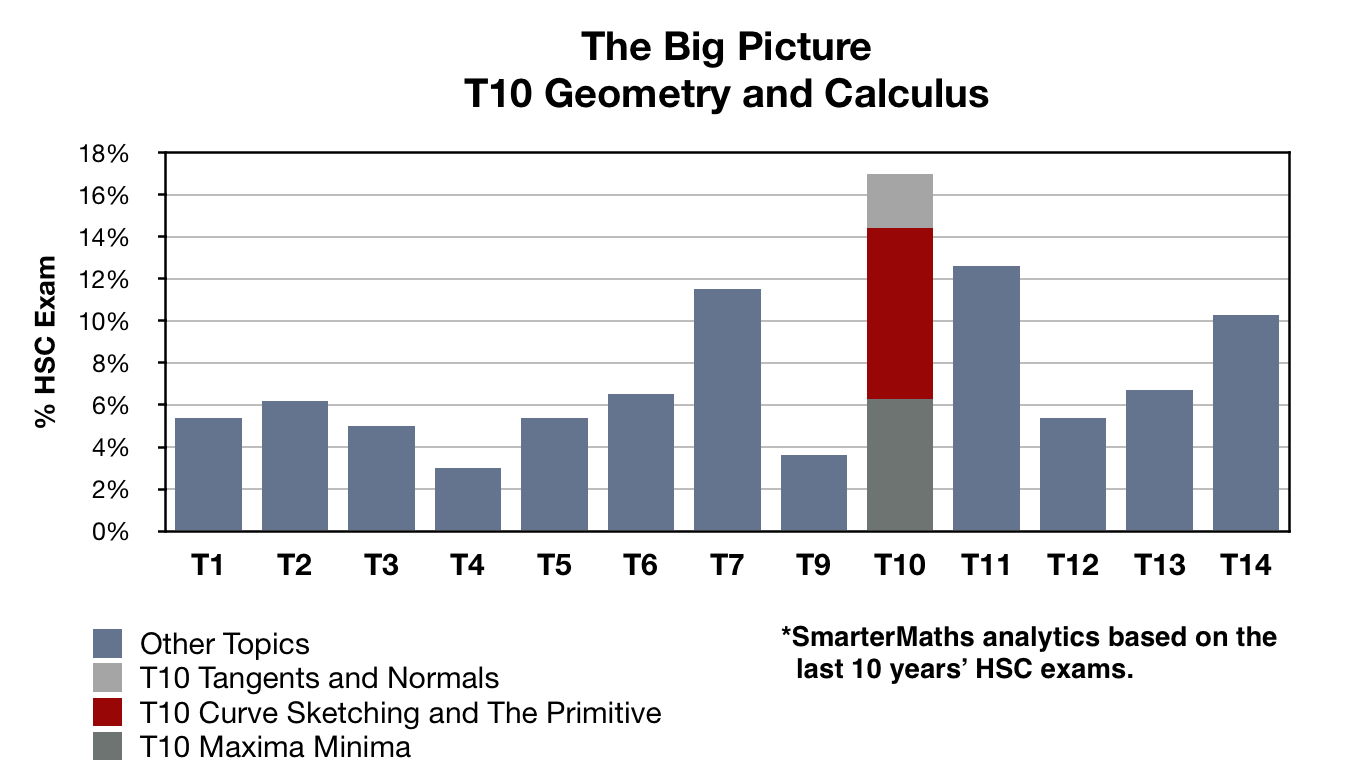
  • T10 Geometry and Calculus is the single largest topic within the Mathematics course, contributing 17.0% to each paper, on average, in the last 10 years.
  • This topic has been split into three sub-categories: 1-Maxima and Minima (6.3%), 2-Curve Sketching and The Primitive Function (8.1%), and 3-Tangents and Normals (2.6%).

HSC ANALYSIS - What to expect and common pitfalls

  • Maxima and Minima (6.3%) problems appear on every examination paper with a high mark allocation, and have produced sub-50% mean marks every year except 2016. 
  • Area/Volume themes have dominated in recent times, being asked in 7 of the last 9 years. Other themes have been distance (2017 and 2013) and a cost equation (2009).
  • Curve Sketching and The Primitive Function (8.1%). The most popular curve is easily the cubic, asked 9 times since 2003, including in 2018 and 2017. Polynomials of degree 4 are the next most popular, asked in 2016, 2012, 2008 and 2007.
  • Tangents and Normals (2.6%) questions make up the smallest sub-category within T10 and are generally a great topic area for high scoring. Examined in 9 of the last 10 years.

Filed Under: Curve Sketching and The Primitive Function, Maxima and Minima, Tangents and Normals Tagged With: worksheet-preamble

2UA Snapshot – T10 Tangents and Normals

HISTORICAL CONTRIBUTION

  • T10 Geometry and Calculus is the single largest topic within the Mathematics course, contributing 17.0% to each paper, on average, in the last 10 years.
  • This topic has been split into three sub-categories: 1-Maxima and Minima (6.3%), 2-Curve Sketching and The Primitive Function (8.1%), and 3-Tangents and Normals (2.6%).

HSC ANALYSIS - What to expect and common pitfalls

  • Tangents and Normals (2.6%) questions make up the smallest sub-topic within Topic 10. It is consistently tested and offers up very achievable marks - fitting within our definition of low lying fruit.
  • This topic area has appeared in the HSC in 9 of the last 10 years (including 2018).
  • Examiners have increased the difficulty level of tangent questions in the past by including them within longer answer cross-topic problems. Note that The Parabola and Logs and Exponentials are the most common cross-topic partners in these harder questions.

Filed Under: Tangents and Normals Tagged With: worksheet-preamble

2UA Snapshot – T10 Curve Sketching

HISTORICAL CONTRIBUTION

  • T10 Geometry and Calculus is the single largest topic within the Mathematics course, contributing 17.0% to each paper, on average, in the last 10 years.
  • This topic has been split into three sub-categories: 1-Maxima and Minima (6.3%), 2-Curve Sketching and The Primitive Function (8.1%), and 3-Tangents and Normals (2.6%).

HSC ANALYSIS - What to expect and common pitfalls

  • Curve Sketching and The Primitive Function (8.1%). The most popular curve is easily the cubic, asked 9 times since 2003, including 2018 and 2017.
  • Sketches of polynomials of degree 4 are the second most popular, asked in 2016, 2012, 2008 and 2007. An important revision area for 2019.
  • Focus Area: An examiner favourite in this topic area requires students to switch between f(x) and f´(x) for a given function, either graphically or by using an equation. This has been tested consistently over the past decade and should be an area of revision focus.
  • Markers' Comments of note: Many students do not have a clear understanding of concavity and the second derivative, AND when drawing a graph within a given domain, clearly identify the extremes!

Filed Under: Curve Sketching and The Primitive Function Tagged With: worksheet-preamble

2UA Snapshot – T10 Max/Min

HISTORICAL CONTRIBUTION

  • T10 Geometry and Calculus is the single largest topic within the Mathematics course, contributing 17.0% to each paper, on average, in the last 10 years.
  • This topic has been split into three sub-categories: 1-Maxima and Minima (6.3%), 2-Curve Sketching and The Primitive Function (8.1%), and 3-Tangents and Normals (2.6%).

HSC ANALYSIS - What to expect and common pitfalls

  • Maxima and Minima (6.3%) problems appear in every exam and have been worth 5-10 marks. Its importance in achieving a band 5-6 result cannot be overstated. 
  • Max/Min problems will typically ask students to prove an equation in the earlier parts. This forms the basis of later questions and typically is at a Band 4 level - a good opportunity for all students to score well.
  • Important exam strategy: HSC Markers consistently remind students to work with the given equation in later parts of the question, even if they couldn't successfully complete the proof.
  • Max/Min problems have underlying themes. Area/Volume equations have dominated (7 times in the last 9 years, including 2018). Other themes include distance (2017 and 2013) and a cost equation (2009).

Filed Under: Maxima and Minima Tagged With: worksheet-preamble

  • « Previous Page
  • 1
  • …
  • 3
  • 4
  • 5
  • 6
  • 7
  • …
  • 10
  • Next Page »

Copyright © 2014–2025 SmarterEd.com.au · Log in