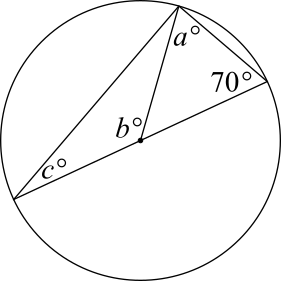
Determine the value of \(a^{\circ}\), \(b^{\circ}\), and \(c^{\circ}\), giving reasons for your answer. (3 marks)
--- 6 WORK AREA LINES (style=lined) ---
Show Answers Only
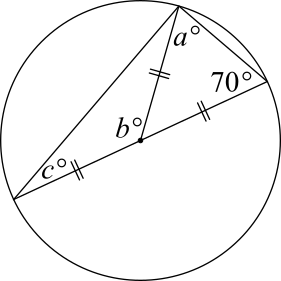
\(\text{All radii are equal (see diagram).}\)
\(a^{\circ} = 70^{\circ}\ \ \text{(angles opposite equal sides in isosceles triangle)} \)
\(b^{\circ} = 2 \times 70 = 140^{\circ}\ \ \text{(external angle = sum of interior opposite angles)} \)
| \(140^{\circ} + 2 \times c^{\circ}\) | \(=180^{\circ}\ \ \text{(angle sum of isosceles triangle)} \) | |
| \(2c^{\circ}\) | \(=180-40\) | |
| \(c^{\circ}\) | \(=\dfrac{40}{2} = 20^{\circ} \) |
Show Worked Solution
\(\text{All radii are equal (see diagram).}\)
\(a^{\circ} = 70^{\circ}\ \ \text{(angles opposite equal sides in isosceles triangle)} \)
\(b^{\circ} = 2 \times 70 = 140^{\circ}\ \ \text{(external angle = sum of interior opposite angles)} \)
| \(140^{\circ} + 2 \times c^{\circ}\) | \(=180^{\circ}\ \ \text{(angle sum of isosceles triangle)} \) | |
| \(2c^{\circ}\) | \(=180-40\) | |
| \(c^{\circ}\) | \(=\dfrac{40}{2} = 20^{\circ} \) |