- Find values of `a`, `b`, `c` and `d` such that `underset~v = ((a),(b)) + 2((c),(d))` is a vector equation of a line that passes through `((3),(1))` and `((−3),(−3))`. (2 marks)
--- 5 WORK AREA LINES (style=lined) ---
- Determine whether `underset~u = ((4),(6)) + lambda((−2),(3))` is perpendicular to `underset~v`. (1 mark)
--- 4 WORK AREA LINES (style=lined) ---
- Express `underset~u` in Cartessian form. (1 mark)
--- 5 WORK AREA LINES (style=lined) ---
Vectors, EXT2 V1 SM-Bank 1
Consider the vectors `underset~u = a underset~i - b underset~j + c underset~k` and `underset~v = underset~i - 8underset~j + 4underset~k`.
Find all possible values of `a, b` and `c` if `underset~u` is parallel to `underset~v` and has a magnitude of 3. (3 marks)
Vectors, EXT2 V1 SM-Bank 10
- Determine the point of intersection of `underset ~a` and `underset ~b` given.
`qquad underset ~a = ((3), (5), (1)) + lambda ((1), (3), (text{−2})),` and
`qquad underset ~b = ((text{−2}), (2), (text{−1})) + mu ((1), (text{−1}), (2))` (2 marks)
--- 6 WORK AREA LINES (style=lined) ---
- Determine if the point `(2, text{−2}, 5)` lies on `underset ~b`. (1 mark)
--- 3 WORK AREA LINES (style=lined) ---
Vectors, EXT2 V1 SM-Bank 9
- Find the equation of line vector `underset ~r`, given it passes through `(1, 3, –2)` and `(2, –1, 2)`. (2 marks)
--- 4 WORK AREA LINES (style=lined) ---
- Determine if `underset ~r` passes through `(4, –9, 10)`. (1 mark)
--- 4 WORK AREA LINES (style=lined) ---
Functions, EXT1′ F1 2008 HSC 3a
The following diagram shows the graph of `y = g(x)`.
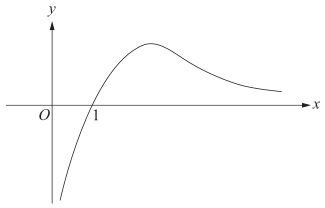
Draw separate one-third page sketches of the graphs of the following:
- `y = |g(x)|` (1 mark)
--- 8 WORK AREA LINES (style=lined) ---
- `y = 1/(g(x))` (2 marks)
--- 8 WORK AREA LINES (style=lined) ---
Show Answers Only
Show Worked Solution
| i. | 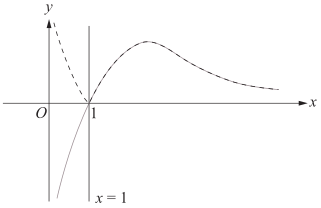 |
| ii. | 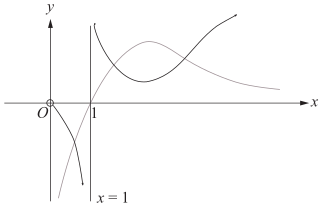 |
Functions, 2ADV F1 SM-Bank 47
Find `a` and `b` such that `a,b` are real numbers and
`(sqrt32-6)/(3sqrt2) = a + bsqrt2` (2 marks)
Functions, 2ADV F1 SM-Bank 46
Find `a` and `b` such that `a, b` are real numbers and
`(8-sqrt27)/(2sqrt3) = a + bsqrt3`. (2 marks)
GRAPHS, FUR2 2019 VCAA 2
Each branch within the association pays an annual fee based on the number of members it has.
To encourage each branch to find new members, two new annual fee systems have been proposed.
Proposal 1 is shown in the graph below, where the proposed annual fee per member, in dollars, is displayed for branches with up to 25 members.
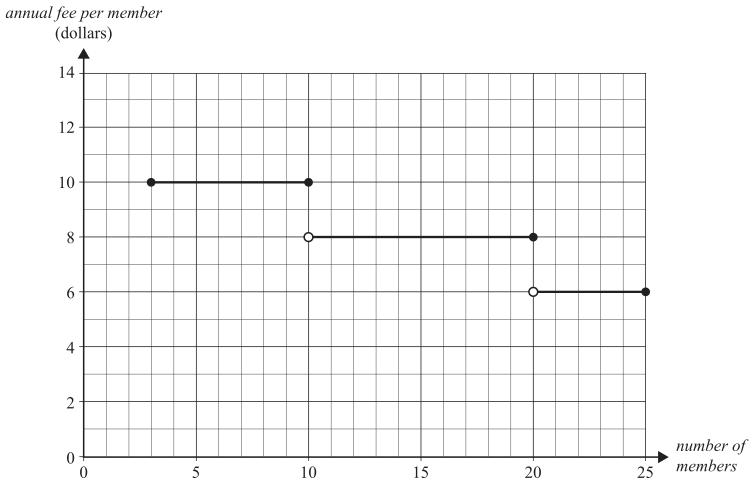
- What is the smallest number of members that a branch may have? (1 mark)
- The incomplete inequality below shows the number of members required for an annual fee per member of $10.
Complete the inequality by writing the appropriate symbol and number in the box provided. (1 mark)
| 3 ≤ number of members |
|
Proposal 2 is modelled by the following equation.
annual fee per member = – 0.25 × number of members + 12.25
- Sketch this equation on the graph for Proposal 1, shown below. (1 mark)
- Proposal 1 and Proposal 2 have the same annual fee per member for some values of the number of members.
Write down all values of the number of members for which this is the case. (1 mark)
Show Worked Solution
a. `3`
b. `3 <= text(number of members) <= 10`
| c. | 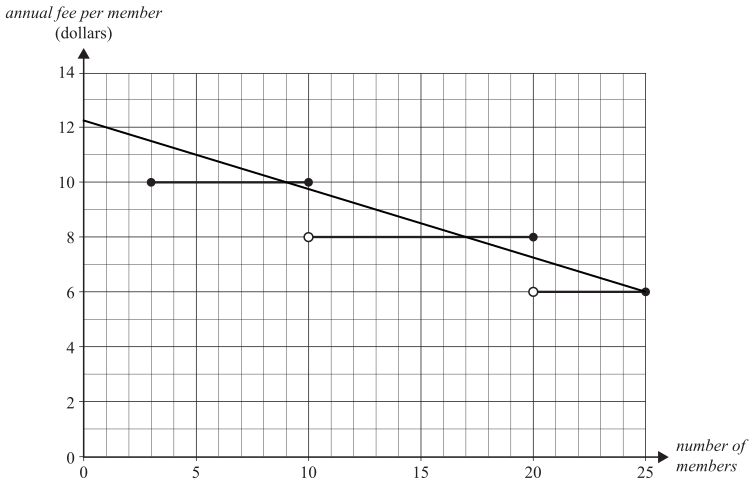 |
d. `text(Same annual fee occurs when graphs intersect.)`
`text(Member numbers): 9, 17, 25`
GRAPHS, FUR2 2019 VCAA 1
The graph below shows the membership numbers of the Wombatong Rural Women’s Association each year for the years 2008–2018.
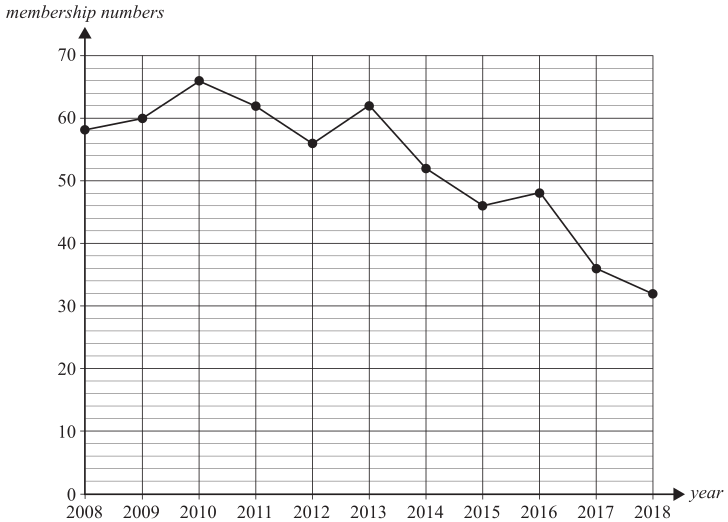
- How many members were there in 2009? (1 mark)
-
- Show that the average rate of change of membership numbers from 2013 to 2018 was − 6 members per year. (1 mark)
- If the change in membership numbers continues at this rate, how many members will there be in 2021? (1 mark)
GEOMETRY, FUR2 2019 VCAA 3
The following diagram shows a crane that is used to transfer shipping containers between the port and the cargo ship.
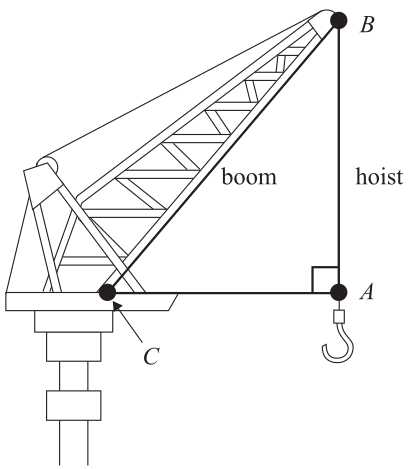
The length of the boom, `BC`, is 25 m. The length of the hoist, `AB`, is 15 m.
-
- Write a calculation to show that the distance `AC` is 20 m. (1 mark)
- Find the angle `ACB`.
Round your answer to the nearest degree. (1 mark)
- The diagram below shows a cargo ship next to a port. The base of a crane is shown at point `Q`.
`qquad`
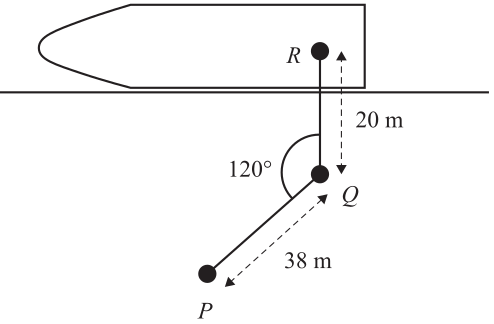
The base of the crane (`Q`) is 20 m from a shipping container at point `R`. The shipping container will be moved to point `P`, 38 m from `Q`. The crane rotates 120° as it moves the shipping container anticlockwise from `R` to `P`.
What is the distance `RP`, in metres?
Round your answer to the nearest metre. (1 mark)
- A shipping container is a rectangular prism.
Four chains connect the shipping container to a hoist at point `M`, as shown in the diagram below.
`qquad`
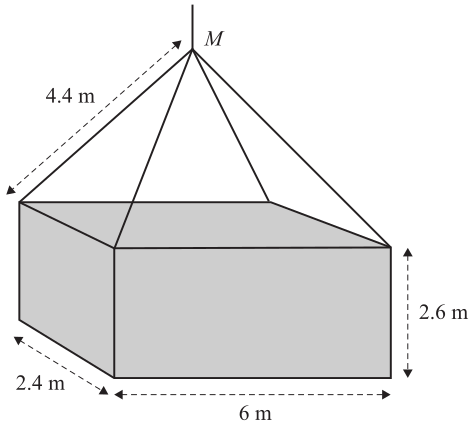
The shipping container has a height of 2.6 m, a width of 2.4 m and a length of 6 m.
Each chain on the hoist is 4.4 m in length.
What is the vertical distance, in metres, between point `M` and the top of the shipping container?
Round your answer to the nearest metre. (2 marks)
Show Worked Solution
| a.i. | `AC` | `= sqrt(BC^2 – AB^2)` |
| `= sqrt(25^2 – 15^2)` | ||
| `= sqrt 400` | ||
| `= 20` |
| a.ii. | `tan\ /_ ACB` | `= 15/20` |
| `/_ ACB` | `= tan^(-1) (3/4)` | |
| `= 36.86…` | ||
| `~~ 37^@` |
b. `text(Using cosine rule:)`
| `RP^2` | `= 20^2 + 38^2 – 2 xx 20 xx 38 xx cos 120^@` |
| `= 2604` | |
| `:. RP` | `= 51.029…` |
| `~~ 51\ text(metres)` |
| c. | 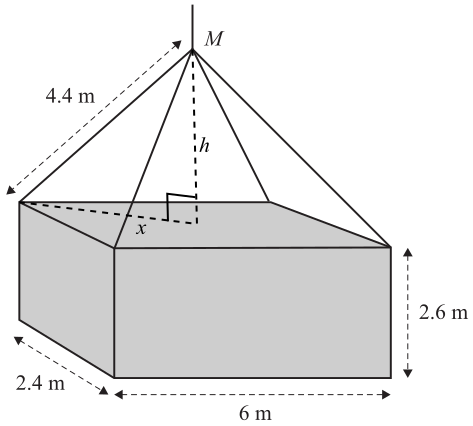 |
`text(Find)\ h => text(need to find)\ x`
`text(Consider the top of the container)`
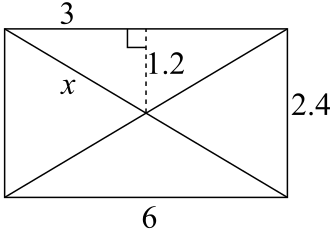
| `x` | `= sqrt(3^2 + 1.2^2)` |
| `~~ 3.2311` |
| `:. h` | `= sqrt(4.4^2 – 3.2311^2)` |
| `= 2.98…` | |
| `~~ 3\ text(metres)` |
GEOMETRY, FUR2 2019 VCAA 1
The following diagram shows a cargo ship viewed from above.
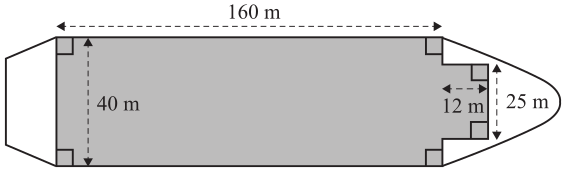
The shaded region illustrates the part of the deck on which shipping containers are stored.
- What is the area, in square metres, of the shaded region? (1 mark)
Each shipping container is in the shape of a rectangular prism.
Each shipping container has a height of 2.6 m, a width of 2.4 m and a length of 6 m, as shown in the diagram below.
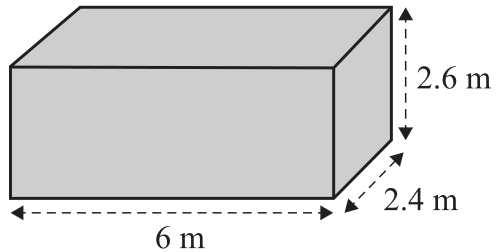
- What is the volume, in cubic metres, of one shipping container? (1 mark)
- What is the total surface area, in square metres, of the outside of one shipping container? (1 mark)
- One shipping container is used to carry barrels. Each barrel is in the shape of a cylinder.
Each barrel is 1.25 m high and has a diameter of 0.73 m, as shown in the diagram below.
Each barrel must remain upright in the shipping container
`qquad qquad`
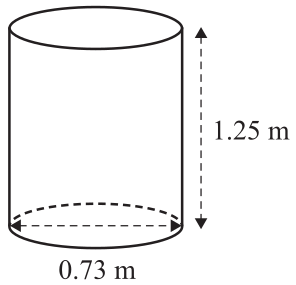
What is the maximum number of barrels that can fit in one shipping container? (1 mark)
NETWORKS, FUR2 2019 VCAA 2
Fencedale High School offers students a choice of four sports, football, tennis, athletics and basketball.
The bipartite graph below illustrates the sports that each student can play.
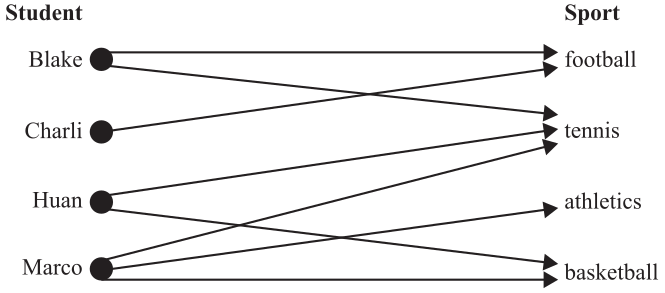
Each student will be allocated to only one sport.
- Complete the table below by allocating the appropriate sport to each student. (1 mark)
--- 0 WORK AREA LINES (style=lined) ---
| Student | Sport | |
| Blake | ||
| Charli | ||
| Huan | ||
| Marco |
- The school medley relay team consists of four students, Anita, Imani, Jordan and Lola.
The medley relay race is a combination of four different sprinting distances: 100 m, 200 m, 300 m and 400 m, run in that order.
The following table shows the best time, in seconds, for each student for each sprinting distance.
Best time for each sprinting distance (seconds) Student 100 m 200 m 300 m 400 m Anita 13.3 29.6 61.8 87.1 Imani 14.5 29.6 63.5 88.9 Jordan 13.3 29.3 63.6 89.1 Lola 15.2 29.2 61.6 87.9
The school will allocate each student to one sprinting distance in order to minimise the total time taken to complete the race.To which distance should each student be allocated?
Write your answers in the table below. (2 marks)
--- 2 WORK AREA LINES (style=lined) ---
Student Sprinting distance (m) Anita Imani Jordan Lola
NETWORKS, FUR2 2019 VCAA 1
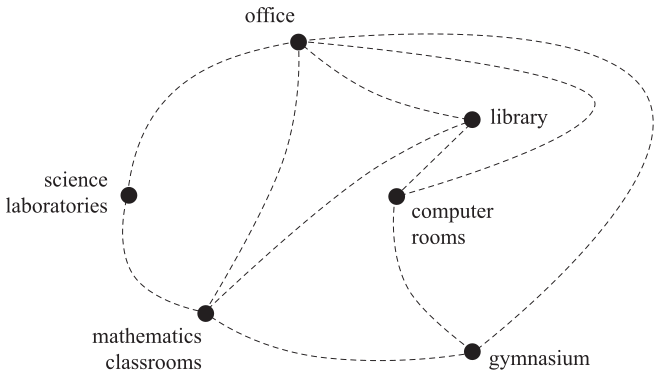
Fencedale High School has six buildings. The network below shows these buildings represented by vertices. The edges of the network represent the paths between the buildings.
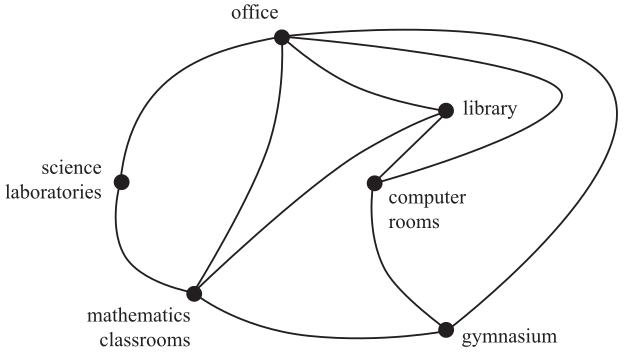
- Which building in the school can be reached directly from all other buildings? (1 mark)
--- 1 WORK AREA LINES (style=lined) ---
- A school tour is to start and finish at the office, visiting each building only once.
i. What is the mathematical term for this route? (1 mark)
--- 1 WORK AREA LINES (style=lined) ---
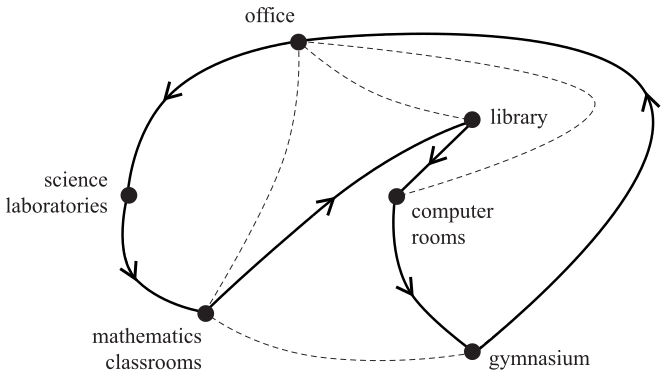
- ii. Draw in a possible route for this school tour on the diagram below. (1 mark)
--- 0 WORK AREA LINES (style=lined) ---
Show Worked Solution
a. `text(Office)`
b.i. `text(Hamiltonian cycle)`
`text{(note a Hamiltonian path does not start and finish}`
`text{at the same vertex.)}`
b.ii. `text(One of many solutions:)`
MATRICES, FUR2 2019 VCAA 2
The theme park has four locations, Air World `(A)`, Food World `(F)`, Ground World `(G)` and Water World `(W)`.
The number of visitors at each of the four locations is counted every hour.
By 10 am on Saturday the park had reached its capacity of 2000 visitors and could take no more visitors.
The park stayed at capacity until the end of the day
The state matrix, `S_0`, below, shows the number of visitors at each location at 10 am on Saturday.
`S_0 = [(600), (600), (400), (400)] {:(A),(F),(G),(W):}`
- What percentage of the park’s visitors were at Water World `(W)` at 10 am on Saturday? (1 mark)
--- 2 WORK AREA LINES (style=lined) ---
Let `S_n` be the state matrix that shows the number of visitors expected at each location `n` hours after 10 am on Saturday.
The number of visitors expected at each location `n` hours after 10 am on Saturday can be determined by the matrix recurrence relation below.
`{:(qquad qquadqquadqquadqquadqquadqquadqquadqquadqquadqquadqquadqquadqquadqquadqquadqquadqquadqquadqquadqquadqquadqquad text( this hour)),(qquadqquadqquadqquadqquadqquadqquadqquadqquadqquadqquadqquadqquadqquadqquadqquadqquadqquadqquad qquad qquad quad A qquad quad F qquad \ G \ quad quad W),({:S_0 = [(600), (600), (400), (400)], qquad S_(n+1) = T xx S_n quad quad qquad text(where):}\ T = [(0.1,0.2,0.1,0.2),(0.3,0.4,0.6,0.3),(0.1,0.2,0.2,0.1),(0.5,0.2,0.1,0.4)]{:(A),(F),(G),(W):}\ text(next hour)):}`
- Complete the state matrix, `S_1`, below to show the number of visitors expected at each location at 11 am on Saturday. (1 mark)
--- 0 WORK AREA LINES (style=lined) ---
`S_1 = [(\ text{______}\ ), (\ text{______}\ ), (300),(\ text{______}\ )]{:(A),(F),(G),(W):}`
- Of the 300 visitors expected at Ground World `(G)` at 11 am, what percentage was at either Air World `(A)` or Food World `(F)` at 10 am? (1 mark)
--- 3 WORK AREA LINES (style=lined) ---
- The proportion of visitors moving from one location to another each hour on Sunday is different from Saturday.
Matrix `V`, below, shows the proportion of visitors moving from one location to another each hour after 10 am on Sunday.
`qquad qquad {:(qquadqquadqquadqquadqquadtext(this hour)),(qquad qquad qquad \ A qquad quad F qquad \ G \ quad quad W),(V = [(0.3,0.4,0.6,0.3),(0.1,0.2,0.1,0.2),(0.1,0.2,0.2,0.1),(0.5,0.2,0.1,0.4)]{:(A),(F),(G),(W):}\ text(next hour)):}`
Matrix `V` is similar to matrix `T` but has the first two rows of matrix `T` interchanged. - The matrix product that will generate matrix `V` from matrix `T` is
- `qquad qquad V = M xx T`
- where matrix `M` is a binary matrix.
- Write down matrix `M`. (1 mark)
--- 4 WORK AREA LINES (style=lined) ---
Calculus, EXT2 C1 2003 HSC 1b
Use integration by parts to find `int x^3 log_e x dx` (3 marks)
Calculus, EXT2 C1 2004 HSC 1a
Use integration by parts to find `int x e^(3x) dx`. (2 marks)
Proof, EXT2 P1 SM-Bank 13
If `(n - 3)^2` is an even integer, prove by contrapositive that `n` is odd. (2 marks)
--- 6 WORK AREA LINES (style=lined) ---
Combinatorics, EXT1 A1 SM-Bank 6
- In how many ways can the numbers 9, 8, 7, 6, 5, 4 be arranged around a circle? (1 mark)
--- 2 WORK AREA LINES (style=lined) ---
- How many of these arrangements have at least two odd numbers together? (2 marks)
--- 6 WORK AREA LINES (style=lined) ---
Show Worked Solution
i. `text{Fix 9 (or any odd number) on the circle}.`
`text(Arrangements) \ = 5 ! = \ 120`
ii. `text(Fix) \ 9 \ text(on circle).`
`text(Consider arrangements with no odd numbers together):`
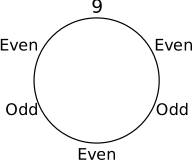
`text{Combinations (clockwise from top)}`
`= 1 × 3 × 2 × 2 × 1 × 1`
`= 12`
`:. \ text(Arrangements with at least 2 odds together)`
`= 120 – 12`
`= 108`
MATRICES, FUR2 2019 VCAA 1
The car park at a theme park has three areas, `A, B` and `C`.
The number of empty `(E)` and full `(F)` parking spaces in each of the three areas at 1 pm on Friday are shown in matrix `Q` below.
`{:(qquad qquad qquad \ E qquad F),(Q = [(70, 50),(30, 20),(40, 40)]{:(A),(B),(C):}quad text(area)):}`
- What is the order of matrix `Q`? (1 mark)
--- 1 WORK AREA LINES (style=lined) ---
- Write down a calculation to show that 110 parking spaces are full at 1 pm. (1 mark)
--- 2 WORK AREA LINES (style=lined) ---
Drivers must pay a parking fee for each hour of parking.
Matrix `P`, below, shows the hourly fee, in dollars, for a car parked in each of the three areas.
`{:(qquad qquad qquad qquad qquad text{area}), (qquad qquad qquad A qquad quad quad B qquad qquad C), (P = [(1.30, 3.50, 1.80)]):}`
- The total parking fee, in dollars, collected from these 110 parked cars if they were parked for one hour is calculated as follows.
`qquad qquad qquad P xx L = [207.00]`
where matrix `L` is a `3 xx 1` matrix.
Write down matrix `L`. (1 mark)
--- 2 WORK AREA LINES (style=lined) ---
The number of whole hours that each of the 110 cars had been parked was recorded at 1 pm. Matrix `R`, below, shows the number of cars parked for one, two, three or four hours in each of the areas `A, B` and `C`.
`{:(qquadqquadqquadqquadquadtext(area)),(quad qquadqquadquad \ A qquad B qquad C),(R = [(3, 1, 1),(6, 10, 3),(22, 7,10),(19, 2, 26)]{:(1),(2),(3),(4):}\ text(hours)):}`
- Matrix `R^T` is the transpose of matrix `R`.
Complete the matrix `R^T` below. (1 mark)
--- 0 WORK AREA LINES (style=lined) ---
`qquad R^T = [( , , , , , , , , ), ( , , , , , , , , ), ( , , , , , , , , ), ( , , , , , , , , ), ( , , , , , , , , )]`
- Explain what the element in row 3, column 2 of matrix `R^T` represents. (1 mark)
--- 2 WORK AREA LINES (style=lined) ---
Proof, EXT2 P1 SM-Bank 10
Prove that `sqrt11 - sqrt5 < sqrt2` by contradiction. (2 marks)
--- 5 WORK AREA LINES (style=lined) ---
Financial Maths, GEN2 2019 NHT 8
Phil invests $200 000 in an annuity from which he receives a regular monthly payment.
The balance of the annuity, in dollars, after `n` months, `A_n`, can be modelled by the recurrence relation
`A_0 = 200\ 000, qquad A_(n + 1) = 1.0035\ A_n - 3700`
- What monthly payment does Phil receive? (1 mark)
--- 1 WORK AREA LINES (style=lined) ---
- Show that the annual percentage compound interest rate for this annuity is 4.2%. (1 mark)
--- 2 WORK AREA LINES (style=lined) ---
At some point in the future, the annuity will have a balance that is lower than the monthly payment amount.
- What is the balance of the annuity when it first falls below the monthly payment amount?
Round your answer to the nearest cent. (1 mark)
--- 2 WORK AREA LINES (style=lined) ---
- If the payment received each month by Phil had been a different amount, the investment would act as a simple perpetuity.
What monthly payment could Phil have received from this perpetuity? (1 mark)
--- 2 WORK AREA LINES (style=lined) ---
Calculus, EXT2 C1 SM-Bank 1
By completing the square and using the table of standard integrals, find
`int(dx)/(4x^2-4x+10)` (2 marks)
Financial Maths, 2ADV M1 SM-Bank 15
Phil is a builder who has purchased a large set of tools.
The value of Phil’s tools is depreciated using the reducing balance method.
The value of the tools, in dollars, after `n` years, `V_n` , can be modelled by the recurrence relation shown below.
`V_0 = 60\ 000, qquad qquad V_(n + 1) = 0.9 V_n`
- Use recursion to show that the value of the tools after two years. (1 mark)
--- 1 WORK AREA LINES (style=lined) ---
- Phil plans to replace these tools when their value first falls below $20 000.
After how many years will Phil replace these tools? (1 mark)
--- 1 WORK AREA LINES (style=lined) ---
- Phil has another option for depreciation. He depreciates the value of the tools by a flat rate of 8% of the purchase price per annum.
Let `V_n` be the value of the tools after `n` years, in dollars.
Write down a recurrence relation, in terms of `V_0, V_(n + 1)` and `V_n`, that could be used to model the value of the tools using this flat rate depreciation. (1 mark)
--- 2 WORK AREA LINES (style=lined) ---
CORE, FUR2 2019 VCAA 7
Phil is a builder who has purchased a large set of tools.
The value of Phil’s tools is depreciated using the reducing balance method.
The value of the tools, in dollars, after `n` years, `V_n` , can be modelled by the recurrence relation shown below.
`V_0 = 60\ 000, qquad V_(n + 1) = 0.9 V_n`
- Use recursion to show that the value of the tools after two years, `V_2` , is $48 600. (1 mark)
--- 3 WORK AREA LINES (style=lined) ---
- What is the annual percentage rate of depreciation used by Phil? (1 mark)
--- 1 WORK AREA LINES (style=lined) ---
- Phil plans to replace these tools when their value first falls below $20 000.
After how many years will Phil replace these tools? (1 mark)
--- 4 WORK AREA LINES (style=lined) ---
- Phil has another option for depreciation. He depreciates the value of the tools by a flat rate of 8% of the purchase price per annum.
Let `V_n` be the value of the tools after `n` years, in dollars.
Write down a recurrence relation, in terms of `V_0, V_(n + 1)` and `V_n`, that could be used to model the value of the tools using this flat rate depreciation. (1 mark)
--- 3 WORK AREA LINES (style=lined) ---
CORE, FUR2 2019 VCAA 5
The scatterplot below shows the atmospheric pressure, in hectopascals (hPa), at 3 pm (pressure 3 pm) plotted against the atmospheric pressure, in hectopascals, at 9 am (pressure 9 am) for 23 days in November 2017 at a particular weather station.
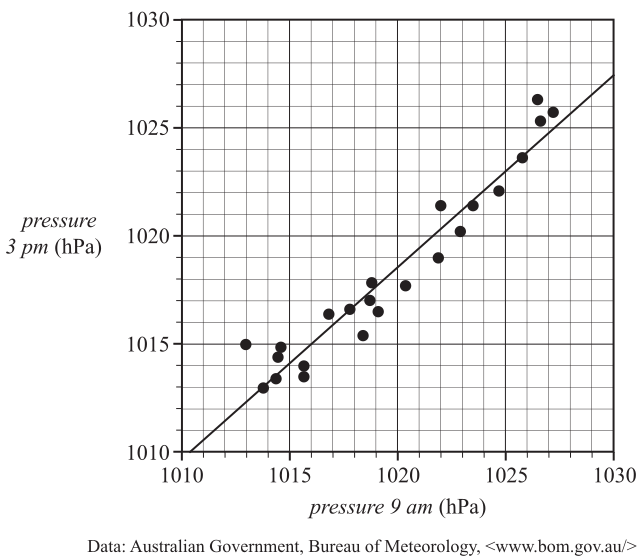
A least squares line has been fitted to the scatterplot as shown.
The equation of this line is
pressure 3 pm = 111.4 + 0.8894 × pressure 9 am
- Interpret the slope of this least squares line in terms of the atmospheric pressure at this weather station at 9 am and at 3 pm. (1 mark)
--- 2 WORK AREA LINES (style=lined) ---
- Use the equation of the least squares line to predict the atmospheric pressure at 3 pm when the atmospheric pressure at 9 am is 1025 hPa.
- Round your answer to the nearest whole number. (1 mark)
--- 2 WORK AREA LINES (style=lined) ---
- Is the prediction made in part b. an example of extrapolation or interpolation? (1 mark)
--- 1 WORK AREA LINES (style=lined) ---
- Determine the residual when the atmospheric pressure at 9 am is 1013 hPa.
- Round your answer to the nearest whole number. (1 mark)
--- 3 WORK AREA LINES (style=lined) ---
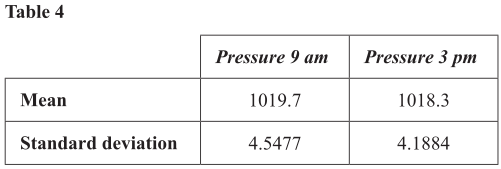
- The mean and the standard deviation of pressure 9 am and pressure 3 pm for these 23 days are shown in Table 4 below.
-
- Use the equation of the least squares line and the information in Table 4 to show that the correlation coefficient for this data, rounded to three decimal places, is `r` = 0.966 (1 mark)
--- 3 WORK AREA LINES (style=lined) ---
- What percentage of the variation in pressure 3 pm is explained by the variation in pressure 9 am?
- Round your answer to one decimal place. (1 mark)
--- 2 WORK AREA LINES (style=lined) ---
- Use the equation of the least squares line and the information in Table 4 to show that the correlation coefficient for this data, rounded to three decimal places, is `r` = 0.966 (1 mark)
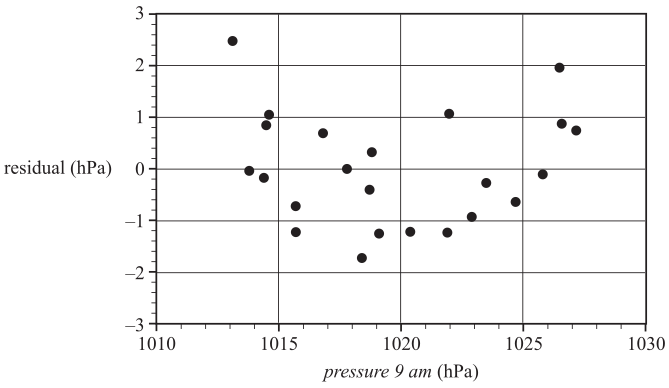
- The residual plot associated with the least squares line is shown below.
-
- The residual plot above can be used to test one of the assumptions about the nature of the association between the atmospheric pressure at 3 pm and the atmospheric pressure at 9 am.
- What is this assumption? (1 mark)
--- 2 WORK AREA LINES (style=lined) ---
- The residual plot above does not support this assumption.
- Explain why. (1 mark)
--- 2 WORK AREA LINES (style=lined) ---
CORE, FUR2 2019 VCAA 4
The relative humidity (%) at 9 am and 3 pm on 14 days in November 2017 is shown in Table 3 below.
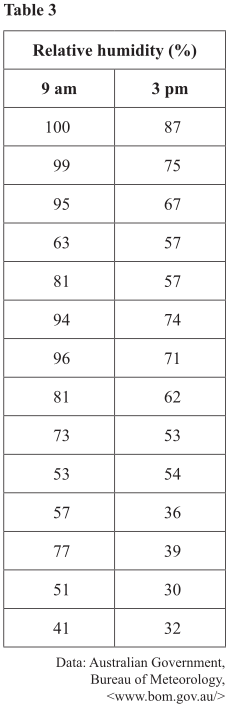
A least squares line is to be fitted to the data with the aim of predicting the relative humidity at 3 pm (humidity 3 pm) from the relative humidity at 9 am (humidity 9 am).
- Name the explanatory variable. (1 mark)
--- 1 WORK AREA LINES (style=lined) ---
- Determine the values of the intercept and the slope of this least squares line.
- Round both values to three significant figures and write them in the appropriate boxes provided. (1 mark)
--- 0 WORK AREA LINES (style=lined) ---
| humidity 3 pm = |
|
+ |
|
× humidity 9 am (1 mark) |
- Determine the value of the correlation coefficient for this data set.
- Round your answer to three decimal places. (1 mark)
--- 1 WORK AREA LINES (style=lined) ---
Calculus, EXT2 C1 2004 HSC 1c
By completing the square, find `int (dx)/(sqrt (5+4x-x^2))` . (2 marks)
Calculus, EXT2 C1 2005 HSC 1a
Find `int(cos theta)/(sin^5 theta) d theta` (2 marks)
--- 5 WORK AREA LINES (style=lined) ---
Proof, EXT2 P1 SM-Bank 1 MC
Consider the following statement.
"If you have no treasure, I have no kingdom."
Which of the following is logically equivalent to this statement?
- If I have no kingdom then you have no treasure.
- If you have treasure then I have a kingdom.
- If you have no kingdom then I have no treasure.
- If I have a kingdom then you have treasure.
Proof, EXT2 P1 SM-Bank 3
Prove that `1/sqrt2` is irrational. (3 marks)
--- 8 WORK AREA LINES (style=lined) ---
CORE, FUR2 2019 VCAA 2
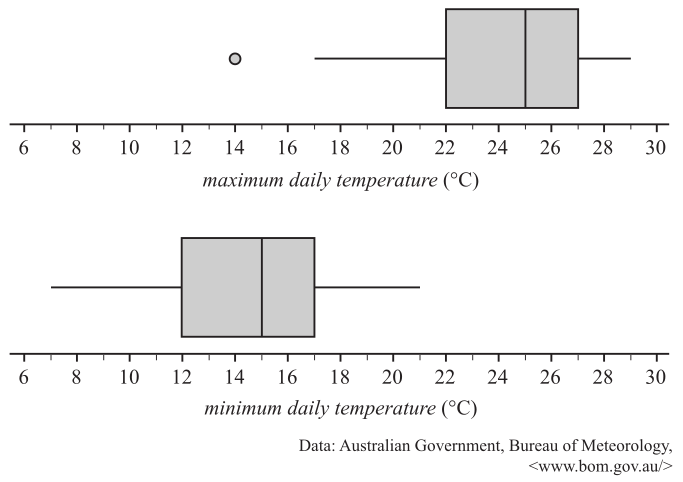
The parallel boxplots below show the maximum daily temperature and minimum daily temperature, in degrees Celsius, for 30 days in November 2017. --- 2 WORK AREA LINES (style=lined) --- --- 2 WORK AREA LINES (style=lined) --- --- 2 WORK AREA LINES (style=lined) --- --- 2 WORK AREA LINES (style=lined) ---
CORE, FUR2 2019 VCAA 1
Table 1 shows the day number and the minimum temperature, in degrees Celsius, for 15 consecutive days in May 2017.
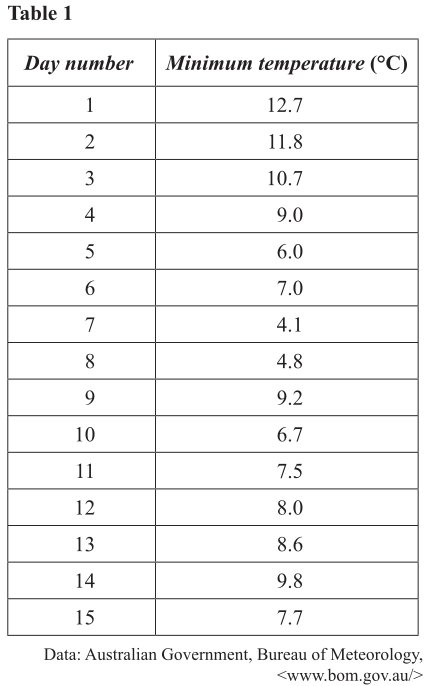
- Which of the two variables in this data set is an ordinal variable? (1 mark)
--- 1 WORK AREA LINES (style=lined) ---
The incomplete ordered stem plot below has been constructed using the data values for days 1 to 10.
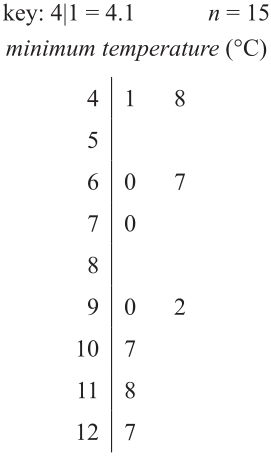
- Complete the stem plot above by adding the data values for days 11 to 15. (1 mark)
--- 0 WORK AREA LINES (style=lined) ---
- The ordered stem plot below shows the maximum temperature, in degrees Celsius, for the same 15 days.
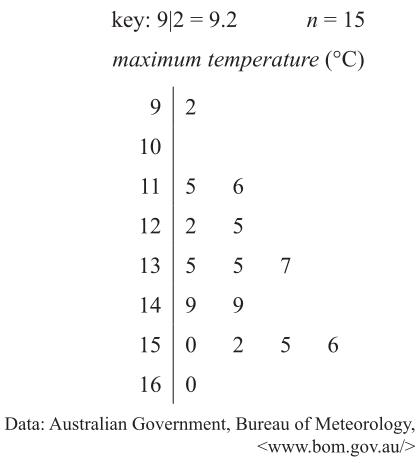
Use this stem plot to determine
- i. the value of the first quartile `(Q_1)` (1 mark)
--- 2 WORK AREA LINES (style=lined) ---
- ii. the percentage of days with a maximum temperature higher than 15.3 °C. (1 mark)
--- 2 WORK AREA LINES (style=lined) ---
Show Worked Solution
a. `text(Day number)`
| b. | 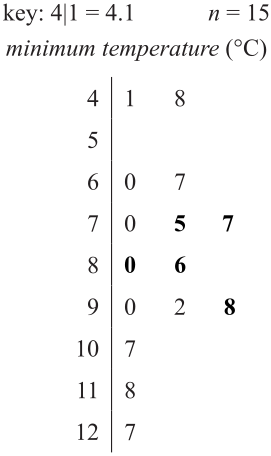 |
c.i. `15\ text(data points)`
`Q_1 = 12.2\ text{(4th data point)}`
| c.ii. | `text(% Days)` | `= 3/15 xx 100` |
| `= 20%` |
GRAPHS, FUR1 2019 VCAA 2 MC
The cost, `$C`, of using `K` kilowatt hours of electricity can be calculated using the equation below.
`C = 52.00 + 0.15 xx K`
From this equation, it can be concluded that there is
- no fixed charge and the electricity used is charged at $0.15 per kilowatt hour.
- no fixed charge and the electricity used is charged at $52.00 per kilowatt hour.
- a fixed charge of $0.15 and the electricity used is charged at $52.00 per kilowatt hour.
- a fixed charge of $52.00 and the electricity used is charged at $0.15 per kilowatt hour.
- a fixed charge of $52.00 and the electricity used is charged at $15.00 per kilowatt hour.
Calculus, EXT2 C1 2003 HSC 1d
- Find the real numbers `a` and `b` such that
`qquad (5x^2-3x+13)/((x-1)(x^2+4)) ≡ a/(x-1) + (bx-1)/(x^2+4)` (2 marks)
--- 6 WORK AREA LINES (style=lined) ---
- Hence find `int (5x^2-3x+13)/((x-1)(x^2+4)) \ dx` (2 marks)
--- 2 WORK AREA LINES (style=lined) ---
GEOMETRY, FUR1 2019 VCAA 3 MC
An ice cream dessert is in the shape of a hemisphere. The dessert has a radius of 5 cm.
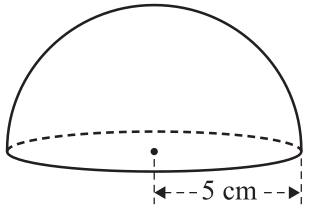
The top and the base of the dessert are covered in chocolate.
The total surface area, in square centimetres, that is covered in chocolate is closest to
- 52
- 157
- 236
- 314
- 942
Calculus, EXT2 C1 2004 HSC 1d
- Find real numbers `a` and `b` such that
`qquad (x^2-7x+4)/((x+1)(x-1)^2) ≡ a/(x+1) + b/(x-1) - 1/(x-1)^2` (2 marks)
- Hence find `int (x^2-7x+4)/((x+1)(x-1)^2)\ dx` (2 marks)
Calculus, EXT2 C1 2005 HSC 1b
- Find real numbers `a` and `b` such that
`qquad (5x)/(x^2-x-6) ≡ a/(x-3) + b/(x+2)` (2 marks)
--- 6 WORK AREA LINES (style=lined) ---
- Hence find `int (5x)/(x^2-x-6)\ dx` (1 mark)
--- 2 WORK AREA LINES (style=lined) ---
Functions, EXT1 F1 2003 HSC 1d
A curve has parametric equations `x = t/2, y = 3t^2`.
Find the Cartesian equation for this curve. (2 marks)
MATRICES, FUR1 2019 VCAA 2 MC
There are two rides called The Big Dipper and The Terror Train at a carnival.
The cost, in dollars, for a child to ride on each ride is shown in the table below.
| Ride | Cost ($) | |
| The Big Dipper | 7 | |
| The Terror Train | 8 |
Six children ride once only on The Big Dipper and once only on The Terror Train.
The total cost of the rides, in dollars, for these six children can be determined by which one of the following calculations?
| A. | `[6] xx [(7, 8)]` | B. | `[6] xx [(7), (8)]` |
| C. | `[(6, 6)] xx [(7, 8)]` | D. | `[(6, 6)] xx [(7), (8)]` |
| E. | `[(6), (6)] xx [(7, 8)]` |
CORE, FUR1 2019 VCAA 17 MC
Consider the recurrence relation shown below.
`A_0 = 3, qquad A_(n + 1) = 2A_n + 4`
The value of `A_3` in the sequence generated by this recurrence relation is given by
- `2 xx 3 + 4`
- `2 xx 4 + 4`
- `2 xx 10 + 4`
- `2 xx 24 + 4`
- `2 xx 52 + 4`
CORE, FUR1 2019 VCAA 9-10 MC
A least squares line is used to model the relationship between the monthly average temperature and latitude recorded at seven different weather stations. The equation of the least squares line is found to be
`quad text(average temperature) = 42.9842 - 0.877447 xx text(latitude)`
Part 1
When the numbers in this equation are correctly rounded to three significant figures, the equation will be
- `text(average temperature) = 42.984 - 0.877 xx text(latitude)`
- `text(average temperature) = 42.984 - 0.878 xx text(latitude)`
- `text(average temperature) = 43.0 - 0.878 xx text(latitude)`
- `text(average temperature) = 42.9 - 0.878 xx text(latitude)`
- `text(average temperature) = 43.0 - 0.877 xx text(latitude)`
Part 2
The coefficient of determination was calculated to be 0.893743
The value of the correlation coefficient, rounded to three decimal places, is
- − 0.945
- − 0.898
- 0.806
- 0.898
- 0.945
CORE, FUR1 2019 VCAA 4-5 MC
The stem plot below shows the distribution of mathematics test scores for a class of 23 students.
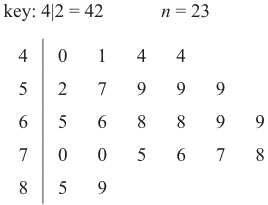
Part 1
For this class, the range of test scores is
- 22
- 40
- 45
- 49
- 89
Part 2
For this class, the interquartile range (IQR) of test scores is
- 14.5
- 17.5
- 18
- 24
- 49
CORE, FUR1 2019 VCAA 1-3 MC
The histogram below shows the distribution of the population size of 48 countries in 2018.
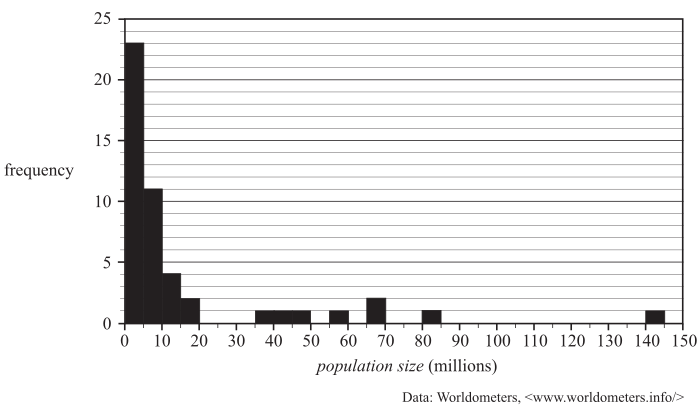
Part 1
The number of these countries with a population size between 5 million and 20 million people is
- 11
- 17
- 23
- 34
- 35
Part 2
The shape of this histogram is best described as
- positively skewed with no outliers.
- positively skewed with outliers.
- approximately symmetric.
- negatively skewed with no outliers.
- negatively skewed with outliers.
Part 3
The histogram below shows the population size for these 48 countries plotted on a `log_10` scale.
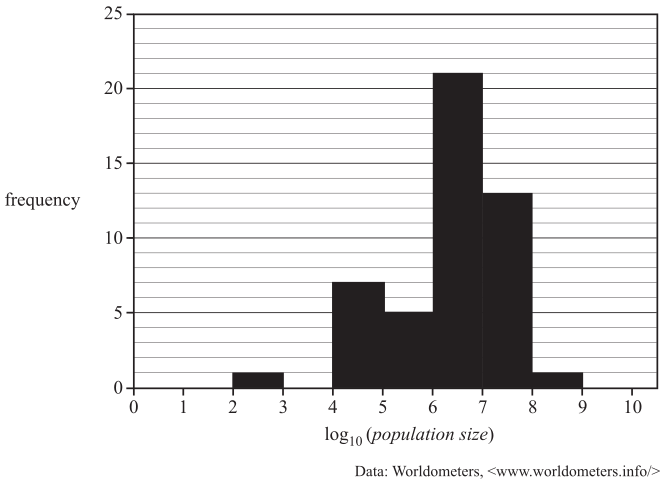
Based on this histogram, the number of countries with a population size that is less than `100\ 000` people is
- 1
- 5
- 7
- 8
- 48
Functions, EXT1 F2 SM-Bank 2
The polynomial `P(x) = x^3 - 2x^2 + kx + 24` has roots `alpha, beta, gamma`.
- Find the value of `alpha + beta + gamma`. (1 mark)
--- 1 WORK AREA LINES (style=lined) ---
- Find the value of `alphabetagamma`. (1 mark)
--- 1 WORK AREA LINES (style=lined) ---
- It is known that two of the roots are equal in magnitude but opposite in sign.
Find the third root and hence find the value of `k`. (2 marks)
--- 6 WORK AREA LINES (style=lined) ---
Functions, 2ADV F1 SM-Bank 44
Solve `|\ x - 2\ | = 3.` (2 marks)
--- 5 WORK AREA LINES (style=lined) ---
Functions, 2ADV F1 SM-Bank 43
Solve `|\ 3x -1\ | = 2` (2 marks)
Functions, 2ADV F1 SM-Bank 42
Find the values of `x` for which `|\ x − 3\ | = 1`. (2 marks)
--- 5 WORK AREA LINES (style=lined) ---
Functions, 2ADV F1 SM-Bank 41
Find the values of `x` for which `|\ x + 1\ |= 5`. (2 marks)
--- 5 WORK AREA LINES (style=lined) ---
Trigonometry, EXT1 T1 SM-Bank 2
Evaluate `beta` if `beta = cos^(-1)(-sqrt3/2)`. (2 marks)
Trigonometry, EXT1 T1 EQ-Bank 1
Show that `cos(sin^(-1)q) = sqrt(1-q^2)` (2 marks)
--- 6 WORK AREA LINES (style=lined) ---
Show Worked Solution
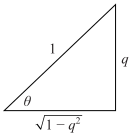
| `sin theta` | `=q` | |
| `theta` | `=sin^(-1)q` | |
| `:. cos(sin^(-1)q)` | `= cos theta` |
| `= sqrt(1-q^2)` |
Trigonometry, EXT1 T3 SM-Bank 10
Given that `cot(2x) + 1/2 tan(x) = a cot(x)`, calculate `a`. (3 marks)
Trigonometry, EXT1 T2 SM-Bank 9 MC
If `sin(theta + phi) = a` and `sin(theta - phi) = b`, then `sin(theta) cos(phi)` is equal to
A. `sqrt(a^2 + b^2)`
B. `sqrt (ab)`
C. `sqrt(a^2 - b^2)`
D. `(a + b)/2`
Mechanics, SPEC2 2019 VCAA 5
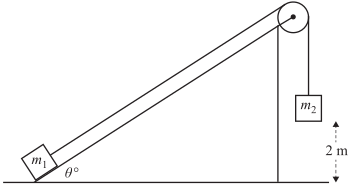
A mass of `m_1` kilograms is initially held at rest near the bottom of a smooth plane inclined at `theta` degrees to the horizontal. It is connected to a mass of `m_2` kilograms by a light inextensible string parallel to the plane, which passes over a smooth pulley at the end of the plane. The mass `m_2` is 2 m above the horizontal floor.
The situation is shown in the diagram below.
- After the mass `m_1` is released, the following forces, measured in newtons, act on the system:
• weight forces `W_1` and `W_2`
• the normal reaction force `N`
• the tension in the string `T`
On the diagram above, show and clearly label the forces acting on each of the masses. (1 mark)
- If the system remains in equilibrium after the mass `m_1` is released, show that `sin(theta) = (m_2)/(m_1)`. (1 mark)
- After the mass `m_1` is released, the mass `m_2` falls to the floor.
- For what values of `theta` will this occur? Express your answer as an inequality in terms of `m_1` and `m_2`. (1 mark)
- Find the magnitude of acceleration, in ms−2, of the system after the mass `m_1` is released and before the mass `m_2` hits the floor. Express your answer in terms of `m_1, \ m_2` and `theta`. (2 marks)
- After the mass `m_1` is released, it moves up the plane.
Find the maximum distance, in metres, that the mass `m_1` will move up the plane if `m_1 = 2m_2` and `sin(theta) = 1/4`. (5 marks)
Show Answers Only
-
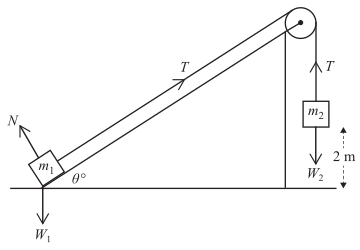
- `text(See Worked Solutions)`
- `theta < sin^(−1)\ ((m_2)/(m_1)), theta ∈ (0, pi/2)`
- `a = (g(m_2 – m_1 · sin(theta)))/(m_1 + m_2)`
- `10/3 \ text(m)`
Show Worked Solution
| a. | |
b. `T = m_2g\ \ … \ (1)`
`T = m_1sin(theta)\ \ … \ (2)`
`text{Solve: (1) = (2)}`
| `m_1g sin(theta)` | `= m_2g` |
| `sin(theta)` | `= (m_2)/(m_1)` |
c.i. `m_2g > m_1gsin(theta)`
`sin(theta) < (m_2)/(m_1)`
`theta < sin^(−1)\ ((m_2)/(m_1)), \ \ theta ∈ (0, pi/2)`
c.ii. `text(Net force)\ (F) = m_2g – m_1gsin(theta)`
| `(m_1 + m_2) · a` | `= g(m_2 – m_1 sin(theta))` |
| `:. a` | `= (g(m_2 – m_1 sin(theta)))/(m_1 + m_2)` |
d. `text(Motion:)\ m_1\ text(will accelerate up the plane for 2 m.)`
`m_1\ text(will then decelerate up plane until)\ v = 0.`
`text(Find)\ v_(m_1)\ \ text(given)\ \ s_(m_1) = 2, \ u = 0, \ m_1=2m_2`
`a = (g(m_2 – m_1 sintheta))/(m_1 + m_2) = (g(m_2 – 2m_2 · 1/4))/(2m_2 + m_2) = g/6`
`text(Using)\ \ v^2 = u^2 + 2as,`
`v_(m_1)^2 = 0 + 2 · g/6 · 2 = (2g)/3`
`text(Find distance)\ (s_2)\ text(for)\ m_1\ text(to decelerate until)\ v = 0:`
`a = −gsintheta = −g/4, \ u = sqrt((2g)/3)`
| `0` | `= (2g)/3 – 2 · g/4 · s_2` |
| `s_2` | `= (2g)/3 xx 2/g` |
| `= 4/3` |
| `:.\ text(Maximum distance)` | `= 2 + 4/3` |
| `= 10/3\ text(m)` |
Vectors, SPEC2 2019 VCAA 4
The base of a pyramid is the parallelogram `ABCD` with vertices at points `A(2,−1,3), B(4,−2,1), C(a,b,c)` and `D(4,3,−1)`. The apex (top) of the pyramid is located at `P(4,−4,9)`. --- 5 WORK AREA LINES (style=lined) --- --- 5 WORK AREA LINES (style=lined) --- --- 5 WORK AREA LINES (style=lined) --- --- 6 WORK AREA LINES (style=lined) --- --- 5 WORK AREA LINES (style=lined) ---
`overset(->)(DC) = (a-4)underset~i + (b-3)underset~j + (c + 1)underset~k` `a-4 = 2 \ => \ a = 6` `b-3 = −1 \ => \ b = 2` `c + 1 = −2 \ => \ c = −3` b. `overset(->)(AB) = 2underset~i-underset~j-2underset~k` `overset(->)(AD) = 2underset~i + 4underset~j-4underset~k` d. `text(Let)\ \ underset~r = 6underset~i + 2underset~j + 5underset~k` `text(Let)\ \ hatr\ = text(unit vector ⊥ to pyramid base)` `underset~overset^r = 1/sqrt(6^2 + 2^2 + 5^2) *underset~r = 1/sqrt65(6underset~i + 2underset~j + 5underset~k)` e. `text(Find height)\ (h)\ text(of pyramid:)` Show Worked Solution
a.
`overset(->)(AB)`
`= (4-2)underset~i + (−2 + 1)underset~j + (1-3)underset~k`
`= 2underset~i-underset~j-2underset~k`
`text(S)text(ince)\ ABCD\ text(is a parallelogram)\ => \ overset(->)(AB)= overset(->)(DC)`
`cos angleBAD`
`= (overset(->)(AB) · overset(->)(AD))/(|overset(->)(AB)| · |overset(->)(AD)|)`
`= (4-4 + 8)/(sqrt(4 + 1 + 4) · sqrt(4 + 16 + 16))`
`= 4/9`
c.
`1/2 xx text(Area)_(ABCD)`
`= 1/2 ab sin c`
`text(Area)_(ABCD)`
`= |overset(->)(AB)| · |overset(->)(AD)| *sin(cos^(−1)\ 4/9)`

`:. text(Area)_(ABCD)`
`= 3 · 6 · sqrt65/9`
`= 2sqrt65\ text(u²)`
`underset~r · overset(->)(AB)`
`= 6 xx 2 + 2 xx −1 + 5 xx −2 = 0`
`underset~r · overset(->)(AD)`
`= 6 xx 2 + 2 xx 4 + 5 xx −2 = 0`
`:. underset~r\ \ text(is ⊥ to)\ \ overset(->)(AB)\ \ text(and)\ \ overset(->)(AD)`
`overset(->)(AP)`
`= (4-2)underset~i + (−4 + 1)underset~j + (9-3)underset~k`
`= 2underset~i-3underset~j + 6underset~k`
`h`
`= overset(->)(AP) · underset~overset^r`
`= (2 xx 6/sqrt65)-(3 xx 2/sqrt65) + (6 xx 5/sqrt65)`
`= 36/sqrt65`
`:. V`
`= 1/3 b xx h`
`= 1/3 xx 2sqrt65 xx 36/sqrt65`
`= 24\ text(u³)`
Complex Numbers, SPEC2 2019 VCAA 2
- Show that the solutions of `2z^2 + 4z + 5 = 0`, where `z ∈ C`, are `z = −1 ± sqrt6/2 i`. (1 mark)
--- 3 WORK AREA LINES (style=lined) ---
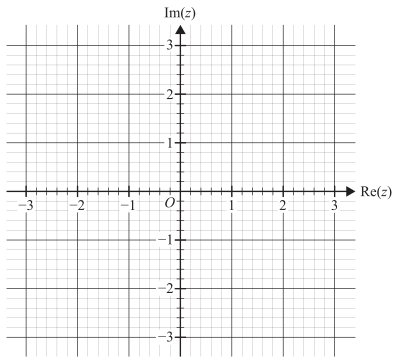
- Plot the solutions of `2z^2 + 4z + 5 = 0` on the Argand diagram below. (1 mark)
--- 0 WORK AREA LINES (style=lined) ---
Let `|z + m| = n`, where `m, n ∈ R`, represent the circle of minimum radius that passes through the solutions of `2z^2 + 4z + 5 = 0`.
-
- Find `m` and `n`. (2 marks)
--- 3 WORK AREA LINES (style=lined) ---
- Find the cartesian equation of the circle `|z + m| = n`. (1 mark)
--- 2 WORK AREA LINES (style=lined) ---
- Sketch the circle on the Argand diagram in part a.ii. Intercepts with the coordinate axes do not need to be calculated or labelled. (1 mark)
--- 0 WORK AREA LINES (style=lined) ---
- Find `m` and `n`. (2 marks)
- Find all values of `d`, where `d ∈ R`, for which the solutions of `2z^2 + 4z + d = 0` satisfy the relation `|z + m| <= n`. (2 marks)
--- 4 WORK AREA LINES (style=lined) ---
- All complex solutions of `az^2 + bz + c = 0` have non-zero real and imaginary parts.
Let `|z + p| = q` represent the circle of minimum radius in the complex plane that passes through these solutions, where `a, b, c, p, q ∈ R`.
Find `p` and `q` in terms of `a, b` and `c`. (2 marks)
--- 4 WORK AREA LINES (style=lined) ---
Show Answers Only
- `text(See Worked Solutions)`
-
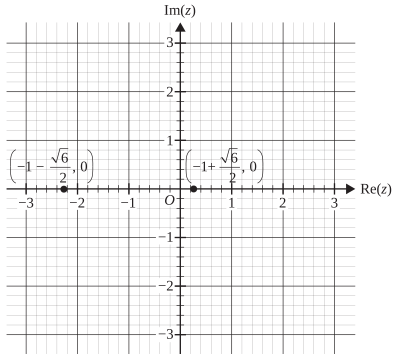
- `m = 1, n = sqrt6/2`
- `(x + 1)^2 + y^2 = 3/2`
- `−1 <= d <= 5\ \ (text(by CAS))`
- `p = b/(2a), \ q = |sqrt(b^2-4ac)/(2a)|`
Show Worked Solution
| a.i. | `z` | `= (−b ± sqrt(b^2-4ac))/(2a)` |
| `= (−4 ± sqrt(16-4 · 2 · 5))/(4)` | ||
| `= (−4 ± 2sqrt6 i)/(4)` | ||
| `= −1 ± sqrt6/2 i\ \ …\ text(as required)` |
| a.ii. | |
b.i. `text(Radius of circle = )sqrt6/2`
`text(Centre) = (0, −1)`
`:. m = 1, \ n = sqrt6/2`
| b.ii. | `|z + 1|` | `= sqrt6/2` |
| `|x + iy + 1|` | `= sqrt6/2` | |
| `(x + 1)^2 + y^2` | `= 3/2` |
| b.iii. | 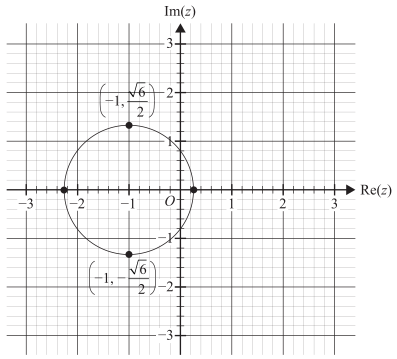 |
c. `text(Solve:)\ 2z^2 + 4z + d = 0`
`z = −1 ± sqrt(4-2d)/2 = −1 ± sqrt((2-d)/2)`
`z + 1 = ± sqrt((2-d)/2)`
`text(Solve for)\ d\ text(such that:)`
`|sqrt((2-d)/2)| <= sqrt6/2`
`−1 <= d <= 5\ \ (text(by CAS))`
d. `z = (−b ± sqrt(b^2-4ac))/(2a) = (−b)/(2a) ± sqrt(b^2-4ac)/(2a)`
| `z + b/(2a)` | `= ± sqrt(b^2-4ac)/(2a)` |
| `|z + b/(2a)|` | `= |sqrt(b^2-4ac)/(2a)|` |
`:. p = b/(2a), \ q = |sqrt(b^2-4ac)/(2a)|`
Calculus, SPEC2 2019 VCAA 1
A curve is defined parametrically by `x = sec(t) + 1, \ y = tan(t)`, where `t ∈ [0, pi/2)`.
- Show that the curve can be represent in cartesian form by the rule `y = sqrt(x^2-2x)`. (2 marks)
--- 5 WORK AREA LINES (style=lined) ---
- State the domain and range of the relation given by `y = sqrt(x^2-2x)`. (2 marks)
--- 4 WORK AREA LINES (style=lined) ---
- i. Express `(dy)/(dx)` in terms of `sin(t)`. (2 marks)
--- 4 WORK AREA LINES (style=lined) ---
- ii. State the limiting value of `(dy)/(dx)` as `t` approaches `pi/2`. (1 mark)
--- 4 WORK AREA LINES (style=lined) ---
- Sketch the curve `y = sqrt(x^2-2x)` on the axes below for `x ∈ [2, 4]`, labelling the endpoints with their coordinates. (2 marks)
--- 0 WORK AREA LINES (style=lined) ---

- The portion of the curve given by `y = sqrt(x^2-2x)` for `x ∈ [2, 4]` is rotated about the `y`-axis to form a solid of revolution.
- Write down, but do not evaluate, a definite integral in terms of `t` that gives the volume of the solid formed. (2 marks)
--- 6 WORK AREA LINES (style=lined) ---
Show Answers Only
- `text(See Worked Solutions)`
- `text(Domain:)\ x ∈ [2, ∞)`
`text(Range:)\ y ∈ [0, ∞)`
-
- `(dy)/(dx) = ((dy)/(dt))/((dt)/(dx)) = (sec^2(t))/(sin(t)sec^2(t)) = 1/(sin(t))`
- `(dy)/(dx) -> 1`
-
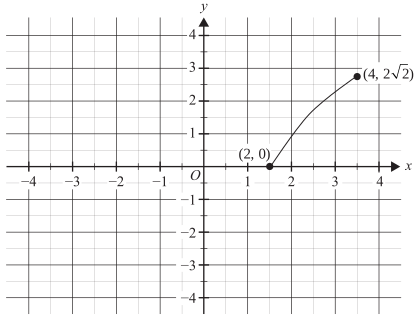
- ` V = pi int_0^(tan^(−1)(2sqrt2)) (sec(t) + 1)^2sec^2(t)dt`
Show Worked Solution
a. `x = sec(t) + 1 \ => \ sec(t) = x-1`
`y = tan(t)`
`text(Using)\ \ tan^2(t) + 1 = sec^2(t):`
| `y^2 + 1` | `= (x-1)^2` |
| `y^2 + 1` | `= x^2-2x + 1` |
| `y^2` | `= x^2-2x` |
| `y` | `= sqrt(x^2-2x), \ y >= 0\ \ text(as)\ \ t ∈ [0, pi/2)` |
b. `text(Sketch:)\ \ x = sec(t) + 1, \ y = tan(t)\ \ text(for)\ \ t ∈ [0, pi/2)`
`text(Domain:)\ \ x ∈ [2, ∞)`
`text(Range:)\ \ y ∈ [0, ∞)`
c.i. `(dy)/(dt) = sec^2(t), \ (dx)/(dt) = sin(t)sec^2(t)\ \ \ (text(by CAS))`
`(dy)/(dx) = ((dy)/(dt))/((dx)/(dt)) = (sec^2(t))/(sin(t)sec^2(t)) = 1/(sin(t))`
c.ii. `text(As)\ \ t -> pi/2:`
`(dy)/(dx) -> 1`
| d. | |
e. `V = pi int_0^(2sqrt2) x^2\ dy`
`x^2 = (sec(t) + 1)^2`
`(dy)/(dt) = sec^2(t) \ => \ dy = sec^2(t)\ dt`
`text(When)\ y = 0, t = 0`
`text(When)\ y = 2sqrt2, t = tan^(−1)(2sqrt2)`
`:. V = pi int_0^(tan^(−1)(2sqrt2)) (sec(t) + 1)^2sec^2(t)\ dt`
Vectors, SPEC2 2019 VCAA 11 MC
Let point `M` have coordinates `(a, 1,-2)` and let point `N` have coordinates `(-3, b,-1)`.
If the coordinates of the midpoint of `bar(MN)` are `(-5, 3/2, c)` and `a, b` and `c` are real constants, the the values of `a, b` and `c` are respectively
- `−13, 2 and −1/2`
- `−2, 1/2 and −3`
- `−7, −2 and −3/2`
- `−2, −1/2 and −3`
- `−7, 2 and −3/2`
Statistics, MET2 2019 VCAA 4
The Lorenz birdwing is the largest butterfly in Town A. The probability density function that describes its life span, `X`, in weeks, is given by `f(x) = {(4/625 (5x^3-x^4), quad 0 <= x <= 5),(0, quad text(elsewhere)):}` --- 3 WORK AREA LINES (style=lined) --- --- 3 WORK AREA LINES (style=lined) --- --- 3 WORK AREA LINES (style=lined) --- The wingspans of Lorenz birdwing butterflies in Town A are normally distributed with a mean of 14.1 cm and a standard deviation of 2.1 cm. --- 2 WORK AREA LINES (style=lined) --- Find the greatest possible wingspan, in centimetres, for a very small Lorenz birdwing butterfly in Town A, correct to one decimal place. (1 mark) --- 4 WORK AREA LINES (style=lined) --- Each year, a detailed study is conducted on a random sample of 36 Lorenz birdwing butterflies in Town A. A Lorenz birdwing butterfly is considered to be very large if its wingspan is greater than 17.5 cm. The probability that the wingspan of any Lorenz birdwing butterfly in Town A is greater than 17.5 cm is 0.0527, correct to four decimal places. --- 2 WORK AREA LINES (style=lined) --- Find the smallest value of `n`, where `n` is an integer. (2 marks) --- 5 WORK AREA LINES (style=lined) --- --- 2 WORK AREA LINES (style=lined) --- --- 5 WORK AREA LINES (style=lined) --- In a particular sample of Lorenz birdwing butterflies from Town B, an approximate 95% confidence interval for the proportion of butterflies that are very large was calculated to be (0.0234, 0.0866), correct to four decimal places. Determine the sample size used in the calculation of this confidence interval. (2 marks) --- 5 WORK AREA LINES (style=lined) ---
Calculus, MET2 2019 VCAA 3
During a telephone call, a phone uses a dual-tone frequency electrical signal to communicate with the telephone exchange.
The strength, `f`, of a simple dual-tone frequency signal is given by the function `f(t) = sin((pi t)/3) + sin ((pi t)/6)`, where `t` is a measure of time and `t >= 0`.
Part of the graph of `y = f(t)` is shown below
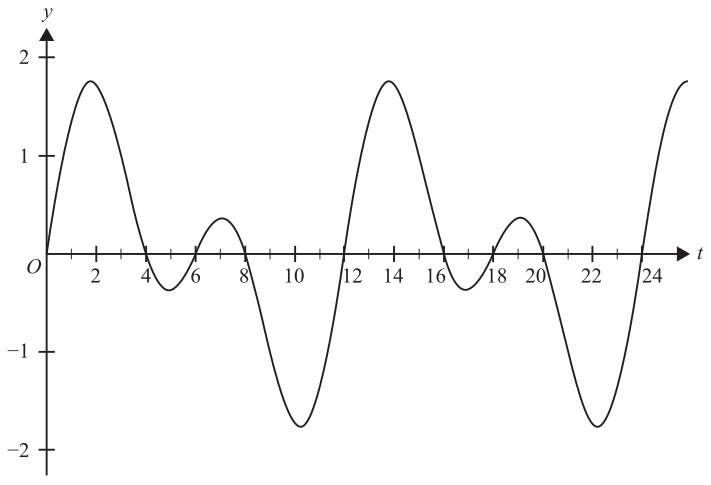
- State the period of the function. (1 mark)
--- 5 WORK AREA LINES (style=lined) ---
- Find the values of `t` where `f(t) = 0` for the interval `t in [0, 6]`. (1 mark)
--- 5 WORK AREA LINES (style=lined) ---
- Find the maximum strength of the dual-tone frequency signal, correct to two decimal places. (1 mark)
--- 5 WORK AREA LINES (style=lined) ---
- Find the area between the graph of `f` and the horizontal axis for `t in [0, 6]`. (2 marks)
--- 5 WORK AREA LINES (style=lined) ---
Let `g` be the function obtained by applying the transformation `T` to the function `f`, where
`T([(x), (y)]) = [(a, 0), (0, b)] [(x), (y)] + [(c), (d)]`
and `a, b, c` and `d` are real numbers.
- Find the values of `a, b, c` and `d` given that `int_2^0 g(t)\ dt + int_2^6 g(t)\ dt` has the same area calculated in part d. (2 marks)
--- 5 WORK AREA LINES (style=lined) ---
- The rectangle bounded by the line `y = k, \ k in R^+`, the horizontal axis, and the lines `x = 0` and `x = 12` has the same area as the area between the graph of `f` and the horizontal axis for one period of the dual-tone frequency signal.
Find the value of `k`. (2 marks)
--- 5 WORK AREA LINES (style=lined) ---
Calculus, SPEC2 2019 VCAA 1 MC
The graph of `f(x) = (e^x)/(x - 1)` does not have a
- horizontal asymptote.
- vertical asymptote.
- local minimum.
- vertical axis intercept.
- point of inflection.
- « Previous Page
- 1
- …
- 30
- 31
- 32
- 33
- 34
- …
- 57
- Next Page »