SmarterEd

Aussie Maths & Science Teachers: Save your time with SmarterEd

  • Login
  • Get Help
  • About

Proof, EXT2 P1 2025 HSC 5 MC

Consider the statement:

If  \(x^2-2 x \geq 0\), then  \(x \leq 0\).

Which of the following is the contrapositive of the statement?

  1. If  \(x>0\), then  \(x^2-2 x<0\).
  2. If  \(x \leq 0\), then  \(x^2-2 x \geq 0\).
  3. If  \(x^2-2 x<0\), then  \(x<0\).
  4. If  \(x^2-2 x \leq 0\), then  \(x>0\).
Show Answers Only

\(A\)

Show Worked Solution

\(\text{Statement: If}\ \ p\ \Rightarrow \ q\)

\(\text{Contrapositive statement: If}\ \ \neg\ q\ \Rightarrow \ \neg\ p\)

\(\therefore\ \text{If}\ \ x>0\ \ \Rightarrow\ \ x^2-2 x<0\).

\(\Rightarrow A\)

Filed Under: Converse, Contradiction and Contrapositive Proof Tagged With: Band 3, smc-1207-20-Contrapositive

BIOLOGY, M5 2025 HSC 29

The Varroa mite is an external parasite of European honey bees and considered to be the most serious pest of honey bees worldwide. 

  1. Why is the Varroa mite infection considered to be an infectious disease.   (2 mark2)

    --- 4 WORK AREA LINES (style=lined) ---
  2. In June 2022, the Varroa mite was detected for the first time in Australia at the Port of Newcastle. It then spread to surrounding areas.
  3. Explain TWO procedures that could have been employed to prevent the spread of the Varroa mite in honey bees.   (4 marks)

    --- 9 WORK AREA LINES (style=lined) ---

Show Answers Only

a.    Varroa mite infection classification

  • Varroa mite infection is classified as an infectious disease because the mite acts as a pathogen.
  • The mite transmits from one honey bee host to another through direct contact.
  • This enables the infection to spread between individual bees and across different hive populations.

b.    Procedure 1: Quarantine

  • Quarantine works by isolating infected hives at the Port of Newcastle to prevent mite movement.
  • This stops infected bees from contacting healthy colonies in surrounding areas.
  • Movement restrictions on beekeeping equipment reduce the risk of accidentally transporting mites to new locations

Procedure 2: Surveillance and Destruction

  • Regular inspection of hives allows early detection of Varroa mite presence before widespread establishment.
  • Destruction of heavily infested hives eliminates the source of infection and prevents further transmission.
  • This creates a containment zone that limits geographic spread of the parasite.
Show Worked Solution

a.    Varroa mite infection classification

  • Varroa mite infection is classified as an infectious disease because the mite acts as a pathogen.
  • The mite transmits from one honey bee host to another through direct contact.
  • This enables the infection to spread between individual bees and across different hive populations.

b.    Procedure 1: Quarantine

  • Quarantine works by isolating infected hives at the Port of Newcastle to prevent mite movement.
  • This stops infected bees from contacting healthy colonies in surrounding areas.
  • Movement restrictions on beekeeping equipment reduce the risk of accidentally transporting mites to new locations

Procedure 2: Surveillance and Destruction

  • Regular inspection of hives allows early detection of Varroa mite presence before widespread establishment.
  • Destruction of heavily infested hives eliminates the source of infection and prevents further transmission.
  • This creates a containment zone that limits geographic spread of the parasite.

Filed Under: Prevention, Treatment and Control Tagged With: Band 3, Band 4, smc-3658-30-Procedures to Prevent Spread

Proof, EXT2 P1 2025 HSC 13c

  1. For positive real numbers \(a\) and \(b\), prove that  \(\dfrac{a+b}{2} \geq \sqrt{a b}\).   (2 marks)

    --- 5 WORK AREA LINES (style=lined) ---

  2. Hence, or otherwise, show that  \(\dfrac{2 n+1}{2 n+2}<\dfrac{\sqrt{2 n+1}}{\sqrt{2 n+3}}\)  for any integer \(n \geq 0\).   (2 marks)

    --- 5 WORK AREA LINES (style=lined) ---

Show Answers Only


Show Worked Solution

i.    \(\text {Using}\ \ (\sqrt{a}-\sqrt{b})^2 \geqslant 0:\)

\(a-2 \sqrt{a b}+b\) \(\geqslant 0\)
\(a+b\) \(\geqslant 2 \sqrt{a b}\)
\(\dfrac{a+b}{2}\) \(\geqslant \sqrt{a b}\)

 
ii.
    \(\text{Show}\ \ \dfrac{2 n+1}{2 n+2}<\dfrac{\sqrt{2 n+1}}{\sqrt{2 n+3}}\)

\(\text{Using part (i):}\)

\(\text{Let} \ \ a=2 n+1, b=2 n+3\)

\(\dfrac{2 n+1+2 n+3}{2}\) \(\geqslant \sqrt{2 n+1} \sqrt{2 n+3}\)
\(2 n+2\) \(\geqslant \sqrt{2 n+1} \sqrt{2 n+3}\)
\(\dfrac{1}{2 n+2}\) \(\leqslant \dfrac{1}{\sqrt{2 n+1} \sqrt{2 n+3}}\)
\(\dfrac{2 n+1}{2 n+2}\) \(\leqslant \dfrac{\sqrt{2 n+1}}{\sqrt{2 n+3}}\)


\(\text{Consider part (i):}\ (\sqrt{a}-\sqrt{b})^2 \geqslant 0\)

\(\Rightarrow \ \text{Equality only holds when} \ \ a=b\)

\(\text{Since}\ \ a=2 n+1 \neq b=2 n+3\)

\(\dfrac{2 n+1}{2 n+2}<\dfrac{\sqrt{2 n+1}}{\sqrt{2 n+3}}\)

Filed Under: Proof and Inequalities Tagged With: Band 3, Band 4, smc-1208-20-Proofs using Square > 0

BIOLOGY, M5 2025 HSC 22a

Outline a process used by fungi for reproduction.  (2 marks)

--- 4 WORK AREA LINES (style=lined) ---
Show Answers Only

Spore production (asexual reproduction):

  • Fungi produce spores within specialised structures called sporangia.
  • Spores are released into the environment and dispersed by wind or water.
  • When conditions are favourable, spores germinate to form new fungal hyphae.
  • This produces genetically identical offspring.

Alternative acceptable response – Budding:

  • A small outgrowth (bud) forms on the parent fungal cell.
  • The bud grows and receives a copy of the nucleus.
  • The bud detaches to become an independent organism.
  • This is common in yeasts.

Show Worked Solution

Spore production (asexual reproduction):

  • Fungi produce spores within specialised structures called sporangia.
  • Spores are released into the environment and dispersed by wind or water.
  • When conditions are favourable, spores germinate to form new fungal hyphae.
  • This produces genetically identical offspring.

Alternative acceptable response – Budding:

  • A small outgrowth (bud) forms on the parent fungal cell.
  • The bud grows and receives a copy of the nucleus.
  • The bud detaches to become an independent organism.
  • This is common in yeasts.

Filed Under: Reproduction Tagged With: Band 3, Band 4, smc-3647-35-Fungi

BIOLOGY, M7 2025 HSC 22b

Outline an adaptation in a pathogen that facilitates transmission between hosts.   (2 marks)

--- 4 WORK AREA LINES (style=lined) ---
Show Answers Only

Answers could include ONE of the following:

Influenza virus:

  • Influenza produces viral particles that are expelled in respiratory droplets when infected individuals cough or sneeze.
  • These droplets can be inhaled by nearby individuals, facilitating airborne transmission.

Plasmodium (malaria parasite):

  • Plasmodium has a complex life cycle adapted to mosquito vectors.
  • The parasite develops specific stages (sporozoites) in mosquito salivary glands.
  • This enables injection into new human hosts during blood feeding.

Bacterial spores:

  • Some bacteria form resistant endospores that survive harsh environmental conditions.
  • Spores can persist on surfaces or in soil for extended periods.
  • This increases opportunity for transmission to new hosts.

Show Worked Solution

Answers could include ONE of the following:

Influenza virus

  • Influenza produces viral particles that are expelled in respiratory droplets when infected individuals cough or sneeze.
  • These droplets can be inhaled by nearby individuals, facilitating airborne transmission.

Plasmodium (malaria parasite):

  • Plasmodium has a complex life cycle adapted to mosquito vectors.
  • The parasite develops specific stages (sporozoites) in mosquito salivary glands.
  • This enables injection into new human hosts during blood feeding.

Bacterial spores:

  • Some bacteria form resistant endospores that survive harsh environmental conditions.
  • Spores can persist on surfaces or in soil for extended periods.
  • This increases opportunity for transmission to new hosts.

Filed Under: Causes of Infectious Disease Tagged With: Band 3, Band 4, smc-3655-40-Pathogen Adaptations

Vectors, EXT2 V1 2025 HSC 11d

  1. Force \({\underset{\sim}{F}}_1\) has magnitude 12 newtons in the direction of vector  \(2 \underset{\sim}{i}-2 \underset{\sim}{j}+\underset{\sim}{k}\).   
  2. Show that  \({\underset{\sim}{F}}_1=8 \underset{\sim}{i}-8 \underset{\sim}{j}+4 \underset{\sim}{k}\).   (1 mark)

    --- 4 WORK AREA LINES (style=lined) ---
  3. Force \({\underset{\sim}{F}}_1\) from part (i) and a second force,  \({\underset{\sim}{F}}_2=-6 \underset{\sim}{i}+12 \underset{\sim}{j}+4 \underset{\sim}{k}\), both act upon a particle.
  4. Show that the resultant force acting on the particle is given by:
  5.      \({\underset{\sim}{F}}_3=2 \underset{\sim}{i}+4 \underset{\sim}{j}+8 \underset{\sim}{k}.\)   (1 mark)

    --- 3 WORK AREA LINES (style=lined) ---

  6. Calculate  \({\underset{\sim}{F}}_3 \cdot \underset{\sim}{d}\), where \({\underset{\sim}{F}}_3\) is the resultant force from part (ii) and  \(\underset{\sim}{d}=\underset{\sim}{i}+\underset{\sim}{j}+2 \underset{\sim}{k}\).   (1 mark)

    --- 3 WORK AREA LINES (style=lined) ---

Show Answers Only

i.    \(\abs{2 \underset{\sim}{i}-2 \underset{\sim}{j}+\underset{\sim}{k}}=\sqrt{2^2+(-2)^2+1^2}=3\)

\({\underset{\sim}{F}}_1=\dfrac{12}{3}\left(\begin{array}{c}2 \\ -2 \\ 1\end{array}\right)=\left(\begin{array}{c}8 \\ -8 \\ 4\end{array}\right)\)

\({\underset{\sim}{F}}_1=8\underset{\sim}{i}-8 \underset{\sim}{j}+4 \underset{\sim}{k}\)
 

ii.    \({\underset{\sim}{F}}_3={\underset{\sim}{F}}_1+{\underset{\sim}{F}}_2=\left(\begin{array}{c}8 \\ -8 \\ 4\end{array}\right)+\left(\begin{array}{c}-6 \\ 12 \\ 4\end{array}\right)=\left(\begin{array}{l}2 \\ 4 \\ 8\end{array}\right)\)

\({\underset{\sim}{F}}_3=2 \underset{\sim}{i}+4 \underset{\sim}{j}+8 \underset{\sim}{k}\)
 

iii.  \({\underset{\sim}{F}}_3 \cdot d=\left(\begin{array}{l}2 \\ 4 \\ 8\end{array}\right)\left(\begin{array}{l}1 \\ 1 \\ 2\end{array}\right)=2+4+16=22\)

Show Worked Solution

i.    \(\abs{2 \underset{\sim}{i}-2 \underset{\sim}{j}+\underset{\sim}{k}}=\sqrt{2^2+(-2)^2+1^2}=3\)

\({\underset{\sim}{F}}_1=\dfrac{12}{3}\left(\begin{array}{c}2 \\ -2 \\ 1\end{array}\right)=\left(\begin{array}{c}8 \\ -8 \\ 4\end{array}\right)\)

\({\underset{\sim}{F}}_1=8\underset{\sim}{i}-8 \underset{\sim}{j}+4 \underset{\sim}{k}\)
 

ii.    \({\underset{\sim}{F}}_3={\underset{\sim}{F}}_1+{\underset{\sim}{F}}_2=\left(\begin{array}{c}8 \\ -8 \\ 4\end{array}\right)+\left(\begin{array}{c}-6 \\ 12 \\ 4\end{array}\right)=\left(\begin{array}{l}2 \\ 4 \\ 8\end{array}\right)\)

\({\underset{\sim}{F}}_3=2 \underset{\sim}{i}+4 \underset{\sim}{j}+8 \underset{\sim}{k}\)
 

iii.  \({\underset{\sim}{F}}_3 \cdot d=\left(\begin{array}{l}2 \\ 4 \\ 8\end{array}\right)\left(\begin{array}{l}1 \\ 1 \\ 2\end{array}\right)=2+4+16=22\)

Filed Under: Basic Concepts and Arithmetic Tagged With: Band 3, Band 4, smc-1195-10-Basic Calculations, smc-1195-40-Unit Vectors and Projections

Complex Numbers, EXT2 N2 2025 HSC 11a

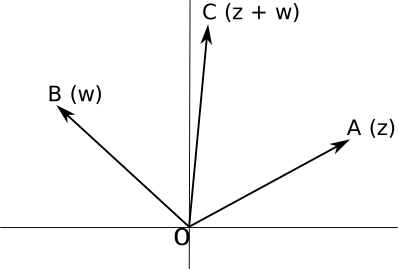
The location of the complex number \(z\) is shown on the diagram below.

On the diagram, indicate the locations of  \(\bar{z}\)  and  \(i \bar{z}\).   (2 marks)  
 

--- 5 WORK AREA LINES (style=lined) ---

Show Answers Only

Show Worked Solution

Filed Under: Geometrical Implications of Complex Numbers Tagged With: Band 3, smc-1052-55-Rotations

Mechanics, EXT2 M1 2025 HSC 4 MC

A particle in simple harmonic motion has speed \(v \ \text{ms}^{-1}\), given by  \(v^2=-x^2+2 x+8\)  where \(x\) is the displacement from the origin in metres.

What is the amplitude of the motion?

  1. 1 m
  2. 3 m
  3. 6 m
  4. 9 m
Show Answers Only

\(B\)

Show Worked Solution

\(\text{Using} \ \ v^2=n^2\left(a^2-(x-c)^2\right):\)

\(v^2\) \(=-x^2+2 x+8\)
  \(=9-\left(x^2-2 x+1\right)\)
  \(=9-(x-1)^2\)

 
\(\therefore a^2 = 9\ \ \Rightarrow\ \ a=3\)

\(\Rightarrow B\)

Filed Under: Simple Harmonic Motion Tagged With: Band 3, smc-1059-10-Amplitude / Period

Complex Numbers, EXT2 N1 2025 HSC 3 MC

What are the square roots of  \(3-4 i\) ?

  1. \(1-2 i\)  and  \(-1+2 i\)
  2. \(1+2 i\)  and  \(-1-2 i\)
  3. \(2-i\)  and  \(-2+i\)
  4. \(-2-i\)  and  \(2+i\)
Show Answers Only

\(C\)

Show Worked Solution

\(\text{Let} \ \ z=\sqrt{3-4 i}\) :

\(z^2=3-4 i\)

\(z^2=a^2-b^2+2 a b\,i\)

\(\text{Equate real/imaginary parts:}\)

\(a^2-b^2=3\ \ldots\ (1)\)

\(2 a b=-4 \ \ \Rightarrow \ \ a b=-2\ \ldots\ (2)\)

\(\text{By inspection:}\)

\(a=2, b=-1 \ \Rightarrow \ z_1=2-i\)

\(a=-2, b=1 \ \Rightarrow \ z_2=-2+i\)

\(\Rightarrow C\)

Filed Under: Arithmetic of Complex Numbers Tagged With: Band 3, smc-1048-25-Square Root

Calculus, EXT2 C1 2025 HSC 12a

Using integration by parts, evaluate \(\displaystyle \int_0^{\small{\dfrac{\pi}{2}}} x\, \sin x \, dx\).   (3 marks)

--- 7 WORK AREA LINES (style=lined) ---

Show Answers Only

\(\displaystyle \int_0^{\small{\dfrac{\pi}{2}}} x\, \sin x \, dx = 1\)

Show Worked Solution
\(u\) \(=x\) \(u^{\prime}\) \(=1\)
\(v^{\prime}\) \(=\sin\,x\) \(v\) \(=-\cos\,x\)
\(\displaystyle \int_0^{\small{\dfrac{\pi}{2}}} x\, \sin x \, dx\) \(=\Big[-x\,\cos\,x\Big]_0^{\small{\dfrac{\pi}{2}}} + \displaystyle \int_0^{\small{\dfrac{\pi}{2}}} \cos x \, dx\)  
  \(=(0-0)+\Big[\sin\,x\Big]_0^{\small{\dfrac{\pi}{2}}} \)  
  \(=\sin\,\dfrac{\pi}{2}-\sin\,0\)  
  \(=1\)  

Filed Under: Integration By Parts Tagged With: Band 3, smc-1055-30-Trig

Calculus, EXT2 C1 2025 HSC 11f

Find \(\displaystyle \int \dfrac{5}{\sqrt{7-x^2-6 x}} \, dx\).   (2 marks)

--- 5 WORK AREA LINES (style=blank) ---

Show Answers Only

\(5\,\sin^{-1} \left( \dfrac{x+3}{4} \right) +c\)

Show Worked Solution
\(\displaystyle \int \dfrac{5}{\sqrt{7-x^2-6 x}} \, dx\) \(=\displaystyle \int \dfrac{5}{\sqrt{16-(x^2+6x+9)}} \, dx\)  
  \(=\displaystyle \int \dfrac{5}{\sqrt{16-(x+3)^2}} \, dx\)  
  \(=5\,\sin^{-1} \left( \dfrac{x+3}{4} \right) +c\)  

Filed Under: Trig Integration Tagged With: Band 3, smc-1193-10-sin/cos

BIOLOGY, M6 2025 HSC 2 MC

What type of mutagen is UV light?

  1. Biochemical
  2. Biological
  3. Chemical
  4. Electromagnetic
Show Answers Only

\(D\)

Show Worked Solution
  • D is correct: UV light is electromagnetic radiation that causes DNA mutations.

Other Options:

  • A is incorrect: Biochemical mutagens are biological molecules like enzymes or toxins.
  • B is incorrect: Biological mutagens include viruses or transposons that alter DNA.
  • C is incorrect: Chemical mutagens are substances like alkylating agents or base analogs.

Filed Under: Mutation Tagged With: Band 3, smc-3652-60-Mutagens

BIOLOGY, M5 2025 HSC 1 MC

Amoeba reproduce by the process shown.


Which of the following is a characteristic of the daughter cells?

  1. Genetically different to parent amoeba
  2. Genetically identical to parent amoeba
  3. More organelles due to the cell division
  4. Fewer chromosomes than the parent amoeba
Show Answers Only

\(B\)

Show Worked Solution
  • B is correct: Asexual reproduction produces genetically identical offspring.

Other Options:

  • A is incorrect: Sexual reproduction produces genetic variation, not asexual.
  • C is incorrect: Cell division distributes existing organelles between daughter cells.
  • D is incorrect: Mitosis maintains the same chromosome number in offspring.

Filed Under: Reproduction Tagged With: Band 3, smc-3647-40-Sexual vs Asexual

Complex Numbers, EXT2 N1 2025 HSC 11c

The complex number \(z\) is given by  \(x+i y\).

Find, in Cartesian form:

  1. \(z^2\)   (1 mark)

    --- 2 WORK AREA LINES (style=lined) ---

  2. \(\dfrac{1}{z}\).   (2 marks)

    --- 4 WORK AREA LINES (style=lined) ---
Show Answers Only

i.    \(z^2=x^2-y^2+2xy\,i\)

ii.  \(\dfrac{1}{z}=\dfrac{x}{x^2-y^2}-\dfrac{y}{x^2-y^2}\,i\)

Show Worked Solution
i.    \(z^{2}\) \(=(x+iy)^2\)
    \(=x^2-y^2+2xy\,i\)


ii.    \(\dfrac{1}{z}\) \(=\dfrac{1}{x+iy}\)
    \(=\dfrac{x-iy}{(x+iy)(x-iy)}\)
    \(=\dfrac{x-iy}{x^2+y^2}\)
    \(=\dfrac{x}{x^2+y^2}-\dfrac{y}{x^2+y^2}\,i\)

Filed Under: Arithmetic of Complex Numbers Tagged With: Band 3, smc-1048-10-Basic Arithmetic

Complex Numbers, EXT2 N1 2025 HSC 11b

The complex numbers \(w\) and \(z\) are given by  \(w=2 e^{\small{\dfrac{i \pi}{6}}}\)  and  \(z=3 e^{\small{\dfrac{i \pi}{6}}}\).  Find the modulus and argument of \(w z\).   (2 marks)

--- 5 WORK AREA LINES (style=lined) ---
Show Answers Only

\(\text{Modulus = 6,  Argument}\ = \dfrac{\pi}{3} \)

Show Worked Solution

\(w=2 e^{\small{\dfrac{i \pi}{6}}}, \ \ z=3 e^{\small{\dfrac{i \pi}{6}}}\)

\(wz=2 e^{\small{\dfrac{i \pi}{6}}} \times 3 e^{\small{\dfrac{i \pi}{6}}} = 6 e^{\small{\dfrac{i \pi}{3}}}\)

\(\text{Modulus = 6,  Argument}\ = \dfrac{\pi}{3} \)

Filed Under: Exponential Form Tagged With: Band 3, smc-1191-35-Exponential - Mod/Arg

Proof, EXT2 P1 2025 HSC 2 MC

Consider the statement:

\(\exists\, x \in Z\), such that \(x^2\) is odd.

Which of the following is the negation of the statement?

  1. \(\forall\, x \in Z , x^2\)  is odd
  2. \(\forall\, x \in Z , x^2\)  is even
  3. \(x^2\) is even \(\Rightarrow x \in Z\)
  4. \(\exists\, x \in Z\),  such that  \(x^2\) is even
Show Answers Only

\(B\)

Show Worked Solution

\(x^2\ \text{is odd is negated by}\ x^2\ \text{is even.}\)

\(\therefore\ \text{Negation of statement:}\ \forall\, x \in Z , x^2\ \text{is even}\)

\(\Rightarrow B\)

Filed Under: Converse, Contradiction and Contrapositive Proof Tagged With: Band 3, smc-1207-40-Odd/Even proofs

Statistics, STD1 S3 2025 HSC 15

A researcher is using the statistical investigation process to investigate a possible relationship between average number of minutes per day a person spends watching television, and the average number of minutes per day the person spends exercising.

  1. State the statistical question being posed.   (1 mark)

    --- 3 WORK AREA LINES (style=lined) ---
Participants were asked to record the number of minutes they spent watching television each day and the number of minutes they spent exercising each day. The averages for each participant were recorded and graphed, and a line of best fit was included.
 

  1. From the graph, identify the dependent variable.   (1 mark)

    --- 1 WORK AREA LINES (style=lined) ---
  2. Describe the bivariate dataset in terms of its form and direction.   (2 marks)

    --- 3 WORK AREA LINES (style=lined) ---
  3. The points \((0, 70)\) and \((60, 10)\) lie on the line of best fit. By first plotting these points on the graph, find the gradient and the \(y\)-intercept of the line of best fit.   (3 marks)

    --- 10 WORK AREA LINES (style=lined) ---
  4. Explain why it is NOT appropriate to extrapolate the line of best fit to predict the average number of minutes of exercise per day for someone who watches an average of 2 hours of television per day.   (1 mark)

    --- 4 WORK AREA LINES (style=lined) ---
Show Answers Only

a.    \(\text{How does the average daily time spent watching television}\)

\(\text{relate to the average daily time spent exercising?}\)
 

b.    \(\text{Dependent variable: Average minutes per day exercising, or }y.\)
 

c.    \(\text{Form:  Linear}\)

\(\text{Direction:  Negative}\)
 

d.   \(\text{Gradient}=-1\)
 

e.    \(\text{The extrapolation of the graph past 70 minutes produces}\)

\(\text{negative average minutes per day exercising (impossible).}\)

Show Worked Solution

a.    \(\text{How does the average daily time spent watching television}\)

\(\text{relate to the average daily time spent exercising?}\)
 

b.    \(\text{Dependent variable:}\)

\(\text{Average minutes per day exercising, or }y.\)
 

c.    \(\text{Form:  Linear}\)

\(\text{Direction:  Negative}\)
 

d. 


\(y-\text{intercept = 70}\)

\(\text{Gradient}=\dfrac{\text{rise}}{\text{run}}=\dfrac{-60}{60}=-1\)
 

e.    \(\text{The extrapolation of the graph past 70 minutes produces}\)

\(\text{negative average minutes per day exercising (impossible).}\)

Filed Under: S3 Further Statistical Analysis (Y12) Tagged With: Band 3, Band 4, Band 5, smc-1113-10-Line of Best Fit, smc-1113-50-Gradient, smc-1113-60-Limitations, smc-1113-80-Investigation Process

Networks, STD1 N1 2025 HSC 14

The time, in minutes, it takes to travel by road between six towns is recorded and shown in the network diagram below.
 

  1. In this network the shortest path corresponds to the minimum travel time.
  2. What is the minimum travel time between towns \(A\) and \(F\), and what is the corresponding path?   (2 marks)

    --- 3 WORK AREA LINES (style=lined) ---
New roads are built to connect a town \(G\) to towns \(A\) and \(D\). The table gives the times it takes to travel by the new roads.

\begin{array} {|c|c|c|}
\hline
\rule{0pt}{2.5ex} \textit{Town} \rule[-1ex]{0pt}{0pt} & \textit{Time} \text{(minutes)}  \rule[-1ex]{0pt}{0pt} & \textit{Town} \\
\hline
\rule{0pt}{2.5ex} A \rule[-1ex]{0pt}{0pt} & 8 \rule[-1ex]{0pt}{0pt} & G \\
\hline
\rule{0pt}{2.5ex} G \rule[-1ex]{0pt}{0pt} & 22 \rule[-1ex]{0pt}{0pt} & D \\
\hline
\end{array}

  1. Add the new roads and times to the network diagram below.   (2 marks)


    --- 0 WORK AREA LINES (style=lined) ---
  2. Explain whether the path in part (a) is still the shortest path from \(A\) to \(F\) after the new roads are added.   (1 mark)

    --- 3 WORK AREA LINES (style=lined) ---
Show Answers Only

a.    \(\text{Minimum travel time}\ = 15+20+10+5+8=58\ \text{minutes}\)

\(\text{Path: }A → B → C → D → E → F\)
 

b.    \(\text{New roads}\ A  → G\ \text{and }G → D \)
 

c.    \(\text{Using the new roads }A → G\ \text{and }G → D:\)

\(\text{Minimum travel time}\ =8+22+5+8=43\ \text{minutes.}\)

\(\text{Therefore the original path is no longer the shortest path.}\)

Show Worked Solution

a.    \(\text{Minimum travel time}\ = 15+20+10+5+8=58\ \text{minutes}\)

\(\text{Path: }A → B → C → D → E → F\)
 

b.    \(\text{New roads}\ A  → G\ \text{and }G → D \)
 

c.    \(\text{Using the new roads }A → G\ \text{and }G → D:\)

\(\text{Minimum travel time}\ =8+22+5+8=43\ \text{minutes.}\)

\(\text{Therefore the original path is no longer the shortest path.}\)

Filed Under: Shortest Paths Tagged With: Band 3, Band 4, smc-1137-10-Network Diagram, smc-1137-20-Table

Probability, STD1 S2 2025 HSC 7 MC

A biased die is made from this net.
 

The die is rolled once.

What is the probability of rolling a 2?

  1. \(\dfrac{1}{6}\)
  2. \(\dfrac{1}{4}\)
  3. \(\dfrac{1}{3}\)
  4. \(\dfrac{1}{2}\)
Show Answers Only

\(C\)

Show Worked Solution

\(P(2)=\dfrac{2}{6}=\dfrac{1}{3}\)

\(\Rightarrow C\)

Filed Under: Single and Multi-Stage Events (Std 1) Tagged With: Band 3, smc-1135-05-Simple Probability

Measurement, STD1 M1 2025 HSC 4 MC

What is \(6\ 280\ 000\) in standard form?

  1. \(628\times 10^4\)
  2. \(62.8\times 10^5\)
  3. \(6.28\times 10^6\)
  4. \(0.628\times 10^7\)
Show Answers Only

\(C\)

Show Worked Solution

\(6\ 280\ 000=6.28\times 10^6\)

\(\Rightarrow C\)

Filed Under: Units and Measurement Error (Std 1) Tagged With: Band 3, smc-1120-20-Scientific Notation

Measurement, STD1 M4 2025 HSC 2 MC

Mario drives from his home to his friend’s house. He watches a movie at his friend’s house and then drives home.

Which distance−time graph best represents Mario’s complete journey?
 

Show Answers Only

\(B\)

Show Worked Solution

\(\text{Mario’s trip starts at home (zero) and ends at home (zero).}\)

\(\Rightarrow B\)

Filed Under: M4 Rates (Y12) Tagged With: Band 3, smc-1104-10-Travel Graphs

Statistics, STD1 S1 2025 HSC 1 MC

Which of the following could be classified as discrete data?

  1. Colour of a car
  2. Time taken to swim 200 m
  3. Temperature of an ice block
  4. Number of children in a class
Show Answers Only

\(D\)

Show Worked Solution

\(\text{Discrete data refers to individual and countable items that can be listed.}\)

\(\Rightarrow D\)

Filed Under: Classifying Data (Std 1) Tagged With: Band 3, smc-1127-20-Classifying Data

Measurement, STD2 M1 2025 HSC 26

A toy has a curved surface on the top which has been shaded as shown. The toy has a uniform cross-section and a rectangular base.
 

  1. Use two applications of the trapezoidal rule to find an approximate area of the cross-section of the toy.   (2 marks)

    --- 6 WORK AREA LINES (style=lined) ---
  2. The total surface area of the plastic toy is 1300 cm².
  3. What is the approximate area of the curved surface?   (2 marks)

    --- 6 WORK AREA LINES (style=lined) ---
  4. The measurements shown on the diagram are given to the nearest millimetre.
  5. What is the percentage error of the measurement of 10.2 cm? Give your answer correct to 3 significant figures.   (2 marks)

    --- 6 WORK AREA LINES (style=lined) ---
Show Answers Only

a.   \(34.68 \ \text{cm}^2\)

b.   \(582.64 \ \text{cm}^2\)

c.   \(0.490 \%\)

Show Worked Solution

a.    \(\begin{array}{|c|c|c|c|}
\hline\rule{0pt}{2.5ex} \quad x \quad \rule[-1ex]{0pt}{0pt}& \quad 0 \quad & \quad 5.1 \quad & \quad 10.2 \quad\\
\hline \rule{0pt}{2.5ex}y \rule[-1ex]{0pt}{0pt}& 6 & 3.8 & 0 \\
\hline
\end{array}\)

\(A\) \(\approx \dfrac{h}{2}\left(y_0+2y_1+y_2\right)\)
  \(\approx \dfrac{5.1}{2}\left(6+2 \times 3.8+0\right)\)
  \(\approx 34.68 \ \text{cm}^2\)


b.    \(\text{Toy has 5 sides.}\)

\(\text{Area of base}=10.2 \times 40=408 \ \text{cm}^2\)

\(\text{Area of rectangle}=6.0 \times 40=240 \ \text{cm}^2\)

\(\text{Approximated areas}=2 \times 34.68=69.36 \ \text{cm}^2\)

\(\therefore \ \text{Area of curved surface}\) \(=1300-(408+240+69.36)\)
  \(=582.64 \ \text{cm}^2\)


c.   \(\text{Convert cm to mm:}\)

\(10.2 \ \text{cm}\times 10=102 \ \text{mm}\)

\(\text{Absolute error}=\dfrac{1}{2} \times \text{precision}=0.5 \ \text{mm}\)

\(\% \ \text{error}=\dfrac{0.5}{102} \times 100=0.490 \%\)

Filed Under: Trapezoidal Rule (Std 2), Units and Measurement Error (Std 2) Tagged With: Band 3, Band 4, Band 5, smc-941-10-1-3 Approximations

Combinatorics, EXT1 A1 2025 HSC 13e

  1. The Pascal's triangle relation can be expressed as
    1. \(\displaystyle \binom{n}{r}=\binom{n-1}{r-1}+\binom{n-1}{r}.\) (Do NOT prove this.)
  2. Show that \(\displaystyle \binom{m}{R}=\binom{m+1}{R+1}-\binom{m}{R+1}\).   (1 mark)

    --- 5 WORK AREA LINES (style=lined) ---
  3. Hence, or otherwise, prove that
  4. \(\displaystyle\binom{2000}{2000}+\binom{2001}{2000}+\binom{2002}{2000}+\cdots+\binom{2050}{2000}=\binom{2051}{2001}\).   (2 marks)

    --- 10 WORK AREA LINES (style=lined) ---
Show Answers Only

i.    \(\displaystyle \binom{n}{r}=\binom{n-1}{r-1}+\binom{n-1}{r}\ \ldots\ (1)\)

\(\text{Show:}\ \displaystyle \binom{m}{R}=\binom{m+1}{R+1}-\binom{m}{R+1}\)

\(\text{Substitute} \ \ n=m+1 \ \ \text{and} \ \ r=R+1 \text{ into (1):}\)

\(\displaystyle\binom{m+1}{R+1}=\binom{m}{R}+\binom{m}{R+1}\)

\(\displaystyle\binom{m}{R}=\binom{m+1}{R+1}-\binom{m}{R+1}\)
 

ii.    \(\text{Prove} \ \ \displaystyle \binom{2000}{2000}+\binom{2001}{2000}+\binom{2002}{2000}+\cdots+\binom{2050}{2000}=\binom{2051}{2001}\)

\(\text{Using part (i)}:\)

\(\operatorname{LHS}\) \(=1+\displaystyle \left[\binom{2002}{2001}-\binom{2001}{2001}\right]+\left[\binom{2003}{2001}-\binom{2002}{2001}\right]+\ldots\)
  \(\quad \quad \quad +\displaystyle \left[\binom{2050}{2001}-\binom{2049}{2001}\right]+\left[\binom{2051}{2001}-\binom{2050}{2001}\right]\)
  \(=1-1+\displaystyle \binom{2051}{2001}\)
  \(=\displaystyle \binom{2051}{2001}\)
Show Worked Solution

i.    \(\displaystyle \binom{n}{r}=\binom{n-1}{r-1}+\binom{n-1}{r}\ \ldots\ (1)\)

\(\text{Show:}\ \displaystyle \binom{m}{R}=\binom{m+1}{R+1}-\binom{m}{R+1}\)

\(\text{Substitute} \ \ n=m+1 \ \ \text{and} \ \ r=R+1 \text{ into (1):}\)

\(\displaystyle\binom{m+1}{R+1}=\binom{m}{R}+\binom{m}{R+1}\)

\(\displaystyle\binom{m}{R}=\binom{m+1}{R+1}-\binom{m}{R+1}\)
 

ii.    \(\text{Prove} \ \ \displaystyle \binom{2000}{2000}+\binom{2001}{2000}+\binom{2002}{2000}+\cdots+\binom{2050}{2000}=\binom{2051}{2001}\)

\(\text{Using part (i)}:\)

\(\operatorname{LHS}\) \(=1+\displaystyle \left[\binom{2002}{2001}-\binom{2001}{2001}\right]+\left[\binom{2003}{2001}-\binom{2002}{2001}\right]+\ldots\)
  \(\quad \quad \quad +\displaystyle \left[\binom{2050}{2001}-\binom{2049}{2001}\right]+\left[\binom{2051}{2001}-\binom{2050}{2001}\right]\)
  \(=1-1+\displaystyle \binom{2051}{2001}\)
  \(=\displaystyle \binom{2051}{2001}\)

Filed Under: Binomial Expansion (Ext1) Tagged With: Band 3, Band 4, smc-1088-30-Proofs

Functions, EXT1 F2 2025 HSC 11f

The roots of  \(2 x^3+6 x^2+x-1=0\)  are  \(\alpha, \beta\)  and  \(\gamma\).

What is the value of  \(\dfrac{1}{\alpha \beta}+\dfrac{1}{\alpha \gamma}+\dfrac{1}{\beta \gamma}\) ?   (2 marks)

--- 5 WORK AREA LINES (style=lined) ---
Show Answers Only

\(\dfrac{1}{\alpha \beta} + \dfrac{1}{\alpha \gamma}+\dfrac{1}{\beta \gamma}=-6\)

Show Worked Solution

\(2 x^3+6 x^2+x-1=0\)

\(\dfrac{1}{\alpha \beta}+\dfrac{1}{\alpha \gamma}+\dfrac{1}{\beta \gamma}=\dfrac{\alpha+\beta+\gamma}{\alpha \beta \gamma}\)

\(\alpha+\beta+\gamma=-\dfrac{b}{a}=-3\)

\(\alpha \beta \gamma=-\dfrac{d}{a}=\dfrac{1}{2}\)

\(\therefore \dfrac{1}{\alpha \beta} + \dfrac{1}{\alpha \gamma}+\dfrac{1}{\beta \gamma}=\dfrac{-3}{\frac{1}{2}}=-6\)

Filed Under: Sum, Products and Multiplicity of Roots (Ext1) Tagged With: Band 3, smc-1205-10-Sum and Product

Vectors, EXT1 V1 2025 HSC 11e

For what value of \(m\) is the vector \(\displaystyle \binom{1}{m}\) parallel to the vector \(\displaystyle \binom{2}{6}\)?   (1 mark)

--- 5 WORK AREA LINES (style=lined) ---
Show Answers Only

\(m=3\)

Show Worked Solution

\(\text{If vectors are parallel:}\)

\(\displaystyle \binom{2}{6}=k\binom{1}{m} \ \Rightarrow \ k=2\)

\(2m\) \(=6\)
\(m\) \(=3\)

Filed Under: Operations With Vectors (Ext1) Tagged With: Band 3, smc-1086-20-Angles Between Vectors

Trigonometry, EXT1 T2 2025 HSC 11b

Solve  \(\sin 2 \theta-\sin \theta=0\)  for  \(0 \leq \theta \leq \pi\).   (3 marks)

--- 6 WORK AREA LINES (style=lined) ---
Show Answers Only

\(\theta=0, \dfrac{\pi}{3}\ \text{or}\ \pi\)

Show Worked Solution
\(\sin\,2\theta-\sin\,\theta\) \(=0\)  
\(2\,\sin\,\theta\,\cos\,\theta-\sin\,\theta\) \(=0\)  
\(\sin\,\theta(2\,\cos\,\theta-1)\) \(=0\)  

 
\(\sin\,\theta=0\ \ \Rightarrow\ \ \theta=0, \pi\)

\(2\,\cos\,\theta-1=0\ \ \Rightarrow\ \ \cos\,\theta=\dfrac{1}{2}\ \ \Rightarrow\ \ \theta=\dfrac{\pi}{3}\)

\(\therefore \theta=0, \dfrac{\pi}{3}\ \text{or}\ \pi.\)

Filed Under: T2 Further Trigonometric Identities (Y11) Tagged With: Band 3, smc-1025-10-Double Angles

Functions, EXT1 F1 2025 HSC 11a

Find the inverse function, \(f^{-1}(x)\), of the function  \(f(x)=1-\dfrac{1}{x-2}\).   (2 marks)

--- 5 WORK AREA LINES (style=lined) ---
Show Answers Only

\(f^{-1} (x) = 2 + \dfrac{1}{1-x}\)

Show Worked Solution

\(y=1-\dfrac{1}{x-2}\)

\(\text{Inverse: swap}\ x ↔ y\)

\(x\) \(=1-\dfrac{1}{y-2}\)  
\(\dfrac{1}{y-2}\) \(=1-x\)  
\(y-2\) \(=\dfrac{1}{1-x}\)  
\(y\) \(=2+\dfrac{1}{1-x}\)  

Filed Under: Inverse Functions (Ext1) Tagged With: Band 3, smc-1034-20-Other Functions

Vectors, EXT1 V1 2025 HSC 2 MC

The projection of \(\underset{\sim}{u}\) onto \(\underset{\sim}{v}\) is given by  \(\left(\dfrac{\underset{\sim}{u} \cdot \underset{\sim}{v}}{|\underset{\sim}{v}|^2}\right) \underset{\sim}{v}\).

What is the projection of  \(\underset{\sim}{u}=\underset{\sim}{i}+2 \underset{\sim}{j}\)  onto  \(\underset{\sim}{v}=2 \underset{\sim}{i}-3 \underset{\sim}{j}\) ?

  1. \(-\dfrac{4}{5}(\underset{\sim}{i}+2 \underset{\sim}{j})\)
  2. \(-\dfrac{4}{13}(2 \underset{\sim}{i}-3 \underset{\sim}{j})\)
  3. \(-\dfrac{4}{\sqrt{5}}(\underset{\sim}{i}+2 \underset{\sim}{j})\)
  4. \(-\dfrac{4}{\sqrt{13}}(2 \underset{\sim}{i}-3 \underset{\sim}{j})\)
Show Answers Only

\(B\)

Show Worked Solution

\(\underset{\sim}{u}=\displaystyle\binom{1}{2},|\underset{\sim}{u}|=\sqrt{1^2+2^2}=\sqrt{5}\)

\(\underset{\sim}{v}=\displaystyle \binom{2}{-3},|\underset{\sim}{v}|=\sqrt{2^2+(-3)^2}=\sqrt{13}\)

\(\operatorname{proj}_{\underset{\sim}{v}}{\underset{\sim}{u}}\) \(=\dfrac{\underset{\sim}{u} \cdot \underset{\sim}{v}}{|\underset{\sim}{v}|^2} \times \underset{\sim}{v}\)
  \(=\dfrac{2-6}{13}(\underset{\sim}{2i}-3\underset{\sim}{j})\)
  \(=-\dfrac{4}{13}(\underset{\sim}{2i}-3\underset{\sim}{j})\)

 
\(\Rightarrow B\)

Filed Under: Operations With Vectors (Ext1) Tagged With: Band 3, smc-1086-30-Unit Vectors and Projections

Functions, EXT1 F1 2025 HSC 1 MC

What is the solution to \(\abs{2 x+3}<5\) ?

  1. \(-4<x<1\)
  2. \(x<-4\)  or  \(x>1\)
  3. \(-1<x<4\)
  4. \(x<-1\)  or  \(x>4\)
Show Answers Only

\(A\)

Show Worked Solution

\(\abs{2 x+3}<5\)

\(-5 < 2x+3 <5\)

\(-8< 2x < 2\)

\(-4<x<1\)

\(\Rightarrow A\)

Filed Under: Inequalities (Ext1) Tagged With: Band 3, smc-1033-20-Absolute Value

Measurement, STD2 M7 2025 HSC 21

A house has a reverse-cycle air conditioner which uses 2.5 kW of power for cooling and 3.2 kW of power for heating. The cost of electricity is 29 cents per kWh .

  1. Find the cost, in dollars and cents, of cooling the house for 6 hours.   (1 mark)

    --- 5 WORK AREA LINES (style=lined) ---
  2. The cost of operating the air conditioner to heat the house during winter last year was $640. There are 92 days in winter.
  3. Find the number of hours, to 1 decimal place, that the air conditioner was used on average per day.   (2 marks)

    --- 7 WORK AREA LINES (style=lined) ---
Show Answers Only

a.    \(\text{Cooling cost (6 hours )}\ = 6 \times 2.5 \times 0.29 = \$4.35\)

b.    \(7.5\ \text{hours}\)

Show Worked Solution

a.    \(\text{Cooling cost (6 hours )}\ = 6 \times 2.5 \times 0.29 = \$4.35\)
 

b.    \(\text{Let \(h\) = hours used per day}\)

\(\text{Cost per day}\ = h \times 3.2 \times 0.29\)

\(\text{Cost (92 days )}\ = 92 \times h \times 3.2 \times 0.29\)

\(\text{Find \(h\) when cost = \$640:}\)

\(640\) \(=92 \times h \times 3.2 \times 0.29\)  
\(h\) \(=\dfrac{640}{92 \times 3.2 \times 0.29}=7.5\ \text{hours (1 d.p.)}\)  

Filed Under: Rates (Std2) Tagged With: Band 3, Band 4, smc-805-20-Energy

Networks, STD2 N3 2025 HSC 19

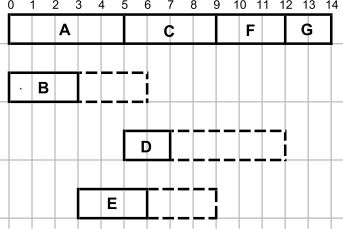
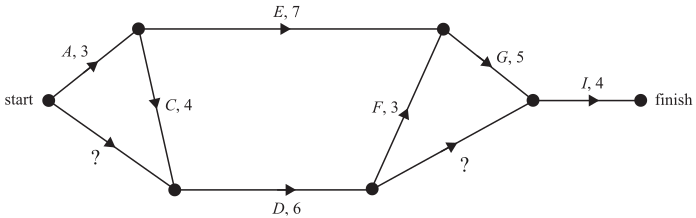
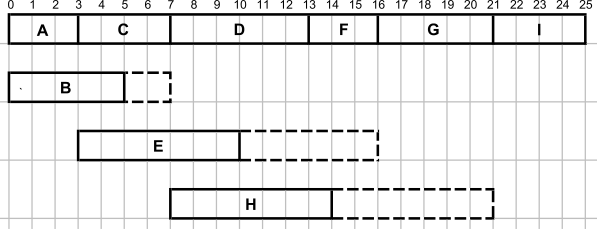
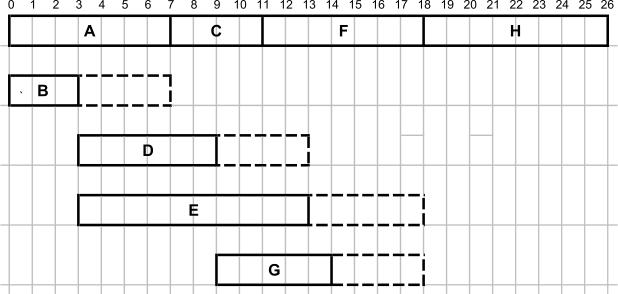
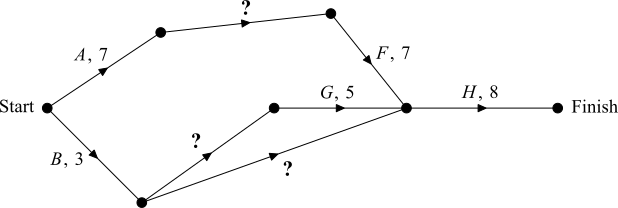
The activities and corresponding durations in days for a project are shown in the network diagram.


  1. Complete the table showing the immediate prerequisites for each activity. Indicate with an \(\text{X}\) any activities without any immediate prerequisites.   (2 marks)

\begin{array} {|c|c|}
\hline
\rule{0pt}{2.5ex} \text{Activity} \rule[-1ex]{0pt}{0pt} & \text{Immediate prerequisite(s)} \\
\hline
\rule{0pt}{2.5ex} B \rule[-1ex]{0pt}{0pt} &  \\
\hline
\rule{0pt}{2.5ex} E \rule[-1ex]{0pt}{0pt} &  \\
\hline
\rule{0pt}{2.5ex} F \rule[-1ex]{0pt}{0pt} &  \\
\hline
\end{array}

  1. Find the critical path for this project AND state the minimum duration for the project.   (2 marks)

--- 4 WORK AREA LINES (style=lined) ---
  1. The duration of activity \( A \) is increased by 2. Does this affect the critical path for the project? Give a reason for your answer.   (1 mark)

--- 4 WORK AREA LINES (style=lined) ---

Show Answers Only

a.           

\begin{array} {|c|c|}
\hline
\rule{0pt}{2.5ex} \text{Activity} \rule[-1ex]{0pt}{0pt} & \text{Immediate prerequisite(s)} \\
\hline
\rule{0pt}{2.5ex} B \rule[-1ex]{0pt}{0pt} & \text{X} \\
\hline
\rule{0pt}{2.5ex} E \rule[-1ex]{0pt}{0pt} & C,D \\
\hline
\rule{0pt}{2.5ex} F \rule[-1ex]{0pt}{0pt} & E \\
\hline
\end{array}

  
b.   \(\text{Critical Path:}\ BDEFH\)

\(\text{Minimum Duration}\ =4+5+5+7+5=26\ \text{days}\)
 

c.   \(\text{If duration of activity \(A\) is increased by 2:}\)

\(\text{The critical path remains unchanged (EST of activity \(E\) remains = 9)}\)

Show Worked Solution

a.   

\begin{array} {|c|c|}
\hline
\rule{0pt}{2.5ex} \text{Activity} \rule[-1ex]{0pt}{0pt} & \text{Immediate prerequisite(s)} \\
\hline
\rule{0pt}{2.5ex} B \rule[-1ex]{0pt}{0pt} & \text{X} \\
\hline
\rule{0pt}{2.5ex} E \rule[-1ex]{0pt}{0pt} & C,D \\
\hline
\rule{0pt}{2.5ex} F \rule[-1ex]{0pt}{0pt} & E \\
\hline
\end{array}

  
b.   

\(\text{Critical Path:}\ BDEFH\)

\(\text{Minimum Duration}\ =4+5+5+7+5=26\ \text{days}\)
 

c.   \(\text{If duration of activity \(A\) is increased by 2:}\)

\(\text{The critical path remains unchanged (EST of activity \(E\) remains = 9)}\)

Filed Under: Critical Paths Tagged With: Band 3, Band 4, smc-916-30-Scanning Both Ways

Measurement, STD2 M7 2025 HSC 16

Paint is sold in two sizes at a local shop. 

  • Four-litre cans at $90 per can
  • Ten-litre cans at $205 per can

Mina needs to purchase 80 litres of paint.

Calculate the amount of money Mina will save by purchasing only ten-litre cans of paint rather than only four-litre cans of paint.   (2 marks)

--- 7 WORK AREA LINES (style=lined) ---
Show Answers Only

\(\text{Savings}\ = $160\)

Show Worked Solution

\(\text{Cost of 4 litre cans:}\)

\( C_1=\dfrac{80}{4} \times 90=$1800 \)

\(\text{Cost of 10 litre cans:}\)

\( C_2=\dfrac{80}{10} \times 205=$1640\)

\(\therefore\ \text{Savings}\ = 1800-1640 = $160\)

Filed Under: Rates (Std2) Tagged With: Band 3, smc-805-60-Other rate problems

Measurement, STD2 M1 2025 HSC 5 MC

Which of the following is arranged from largest to smallest?

  1. \( 6.2 \times 10^{-3}, 4.5 \times 10^{-4}, 3.2 \times 10^{-1} \)
  2. \( 4.5 \times 10^{-4}, 6.2 \times 10^{-3}, 3.2 \times 10^{-1} \)
  3. \( 3.2 \times 10^{-1}, 4.5 \times 10^{-4}, 6.2 \times 10^{-3} \)
  4. \( 3.2 \times 10^{-1}, 6.2 \times 10^{-3}, 4.5 \times 10^{-4}\)
Show Answers Only

\(D\)

Show Worked Solution

\(\text{Largest to smallest:}\)

\( 3.2 \times 10^{-1}, 6.2 \times 10^{-3}, 4.5 \times 10^{-4}\)

\(\Rightarrow D\)

Filed Under: Units and Measurement Error (Std 2) Tagged With: Band 3, smc-797-20-Scientific Notation

Financial Maths, STD2 F1 2025 HSC 4 MC

Frankie takes four weeks of annual leave. His weekly pay is $350 and his annual leave loading is \( 17 \dfrac{1}{2} \)% of four weeks pay.

What is Frankie's total pay for this period of annual leave?

  1. $245.00
  2. $411.25
  3. $1461.25
  4. $1645.00
Show Answers Only

\(D\)

Show Worked Solution

\(\text{4 weeks pay}\ = 4 \times 350 = $1400\)

\(\text{Annual leave loading}\ =17.5\% \times 1400 = $245\)

\(\text{Total pay}\ = 1400+245=$1645\)

\(\Rightarrow D\)

Filed Under: Earning Money and Budgeting (Std 2) Tagged With: Band 3, smc-810-10-Wages

Algebra, STD2 A4 2025 HSC 2 MC

Which graph could represent  \(y=4^x\) ?
 

Show Answers Only

\(A\)

Show Worked Solution

\(\Rightarrow A\)

Filed Under: Non-Linear: Exponential/Quadratics (Std 2) Tagged With: 2adv-std2-common, Band 3, smc-1009-20-Exponential

Functions, 2ADV F2 2025 HSC 2 MC

Which graph could represent  \(y=4^x\) ?
 

Show Answers Only

\(A\)

Show Worked Solution

\(\Rightarrow A\)

Filed Under: Non-Calculus Graphing (Y12) Tagged With: 2adv-std2-common, Band 3, smc-1009-20-Exponential

Networks, STD2 N2 2025 HSC 3 MC

The network shows the distances, in kilometres, along a series of roads that connect towns.
 

What is the value of the largest weighted edge included in the minimum spanning tree for this network?

  1. 7
  2. 8
  3. 9
  4. 10
Show Answers Only

\(C\)

Show Worked Solution

\(\text{Minimum spanning tree:}\)
 

\(\text{Using Kruskal’s algorithm:}\)

\(\text{Edge 1 = 4, Edge 2/3 = 4, Edge 4 = 6, Edge 5 = 9}\) 

\(\therefore\ \text{The largest weighted edge in the MST = 9.}\)

\(\Rightarrow C\)

Filed Under: Minimum Spanning Trees Tagged With: Band 3, smc-914-20-Distance

Calculus, 2ADV C4 2024 HSC 5 MC v1

What is \( {\displaystyle \int x(3 x^2+1)^4 d x} \) ?

  1. \( \dfrac{1}{30}(3x^2+1)^5+C \)
  2. \( \dfrac{1}{5}(3x^2+1)^5+C \)
  3. \( \dfrac{5}{6}(3x^2+1)^5+C \)
  4. \( \dfrac{6}{5}(3x^2+1)^5+C \)
Show Answers Only

\( A \)

Show Worked Solution
\[ \int x(3x^2+1)^4 dx\] \(=\dfrac{1}{5} \cdot \dfrac{1}{6x}x(3x^2+1)^5+C\)  
  \(=\dfrac{1}{30}(3x^2+1)^5+C\)  

 
\( \Rightarrow A \)

NOTE: Integrating by the reverse chain rule only works if some form of the derivative is already present outside of the brackets.

Filed Under: Standard Integration (Adv-X) Tagged With: Band 3, eo-derivative (HSC), smc-1202-10-Indefinite Integrals

Calculus, 2ADV C1 EO-Bank 3

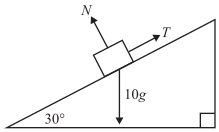
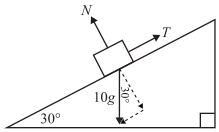
The displacement `x` metres from the origin at time `t` seconds of a particle travelling in a straight line is given by

`x = t^3-4t^2 +5t + 6`     when   `t >= 0`

  1.  Calculate the velocity when  `t = 3`.  (1 mark)

    --- 2 WORK AREA LINES (style=lined) ---
  2.  When is the particle stationary?  (2 marks)

    --- 4 WORK AREA LINES (style=lined) ---
Show Answers Only
  1.  `8\ text(ms)^(−1)`
  2.  `1, 5/3\ text(s)`
Show Worked Solution

i.   `x =t^3 -4t^2 +5t + 6` 

`v = (dx)/(dt) = 3t^2 – 8t +5`

 
`text(When)\ t = 3,`

`v` `= 3 xx 3^2 -8 · 3 +5`
  `= 8\ text(ms)^(−1)`


ii.   `text(Particle is stationary when)\ \ v = 0`

`3t^2 -8t +5` `= 0`
`3t^2-3t-5t+5` `= 0`
`3t(t-1)-5(t-1)` `= 0`
`(t-1)(3t-5)` `= 0`
`t` `= 1, 5/3\ text(s)`

Filed Under: Rates of Change (Adv-X) Tagged With: Band 3, Band 4, eo-unique, smc-1083-20-Polynomial Function

Trigonometry, 2ADV T1 2025 HSC 29

The point \(T\) is the peak of a mountain and the point \(O\) is directly below the mountain's peak. The point \(Y\) is due east of \(O\) and the angle of elevation of \(T\) from \(Y\) is 60°. The point \(F\) is 4 km south-west of \(Y\). The points \(O, Y\) and \(F\) are on level ground. The angle of elevation of \(T\) from \(F\) is 45°.
 

  1. Let the height of the mountain be \(h\).
  2. Show that  \(O Y=\dfrac{h}{\sqrt{3}}\).   (1 mark)

    --- 5 WORK AREA LINES (style=lined) ---
  3. Hence, or otherwise, find the value of \(h\), correct to 2 decimal places.   (3 marks)

    --- 16 WORK AREA LINES (style=lined) ---

  4. Find the bearing of point \(O\) from point \(F\), correct to the nearest degree.   (3 marks)

    --- 8 WORK AREA LINES (style=lined) ---

Show Answers Only

a.   \(\text{See Worked Solutions}\)

b.   \(h=3.03 \ \text{km}\)

c.   \(\text {Bearing of \(O\) from \(F\)}=021^{\circ} \)

Show Worked Solution

a.    \(\text{In}\ \triangle TOY:\)

\(\tan 60^{\circ}\) \(=\dfrac{h}{OY}\)  
\(OY\) \(=\dfrac{h}{\tan 60^{\circ}}\) \(=\dfrac{h}{\sqrt{3}}\)


b.   \(\text{In}\ \triangle TOF:\)

\(\tan 45^{\circ}=\dfrac{h}{OF} \ \Rightarrow \ OF=h\)

\(\text{Since \(Y\) is due east of \(O\) and \(F\) is south-west of \(Y\):}\)

\(\angle OYF =45^{\circ}\)
 

\(\text{Using cosine rule in} \ \triangle OYF:\)

\(OY^2+YF^2-2 \times OY \times YF\, \cos 45^{\circ}\) \(=OF^2\)
\(\left(\dfrac{h}{\sqrt{3}}\right)^2+4^2-2 \times \dfrac{h}{\sqrt{3}} \times 4 \times \dfrac{1}{\sqrt{2}}\) \(=h^2\)
\(\dfrac{h^2}{3}+16-\dfrac{8}{\sqrt{6}} h\) \(=h^2\)
\(\dfrac{2}{3} h^2+\dfrac{8}{\sqrt{6}} h-16\) \(=0\)


\(h\)

\(=\dfrac{\dfrac{-8}{\sqrt{6}}+\sqrt{\frac{64}{6}+4 \times \frac{2}{3} \times 16}}{2 \times \frac{2}{3}}\ \ \ (h>0)\)
  \(=3.0277 \ldots\)
  \(=3.03 \ \text{km (to 2 d.p.)}\)


c.    \(\text {Using sine rule in} \ \ \triangle OYF:\)

\(\dfrac{\sin\angle FOY}{4}\) \(=\dfrac{\sin 45^{\circ}}{3.03}\)  
\(\sin \angle F O Y\) \(=\dfrac{4 \times \sin 45^{\circ}}{3.03}=0.93347\)  
\(\angle FOY\) \(=180-\sin^{-1}(0.93347)=180-68.98 \ldots = 111^{\circ} \ \text{(angle is obtuse)}\)  

 
\(\angle FOS^{\prime}=111-90=21^{\circ}\)

\(\angle \text{N}^{\prime}FO=21^{\circ}(\text {alternate})\)

\(\therefore \ \text {Bearing of \(O\) from \(F\)}=021^{\circ} \)

Filed Under: 3D Trigonometry (Y11) Tagged With: Band 3, Band 5, Band 6

Calculus, 2ADV C4 2025 HSC 27

The shaded region is bounded by the graph  \(y=\left(\dfrac{1}{2}\right)^x\), the coordinate axes and  \(x=2\).
 

  1. Use two applications of the trapezoidal rule to estimate the area of the shaded region.   (2 marks)

    --- 5 WORK AREA LINES (style=lined) ---

  2. Show that the exact area of the shaded region is  \(\dfrac{3}{4 \ln 2}\).   (2 marks)

    --- 6 WORK AREA LINES (style=lined) ---

  3. Using your answers from part (a) and part (b), deduce  \(e<2 \sqrt{2}\).   (2 marks)

    --- 9 WORK AREA LINES (style=lined) ---

Show Answers Only

a.   \(A\approx \dfrac{9}{8}\ \text{units}^2\)
 

b.     \(\text{Area}\) \(=\displaystyle \int_0^2\left(\frac{1}{2}\right)^x d x\)
    \(=\left[-\dfrac{2^{-x}}{\ln 2}\right]_0^2\)
    \(=-\dfrac{2^{-2}}{\ln 2}+\dfrac{1}{\ln 2}\)
    \(=-\dfrac{1}{4 \ln 2}+\dfrac{1}{\ln 2}\)
    \(=\dfrac{3}{4 \ln 2}\)


c.    \(\text{Trapezoidal estimate assumes a straight line (creating a trapezium)}\)

\(\text{between (0,1) and \((2,\dfrac{1}{4})\)}\)

\(\Rightarrow \ \text{Area using trap rule > Actual area}\)

\(\dfrac{9}{8}\) \(>\dfrac{3}{4 \ln 2}\)  
\(36\, \ln 2\) \(>24\)  
\(\ln 2\) \(>\dfrac{2}{3}\)  
\(e^{\small \dfrac{2}{3}}\) \(>2\)  
\(e\) \(>2^{\small \dfrac{3}{2}}\)  
\(e\) \(>2 \sqrt{2}\)  
Show Worked Solution

a.  

\begin{array}{|c|c|c|c|}
\hline \ \ x \ \  & \ \ 0 \ \  & \ \ 1 \ \  & \ \ 2 \ \  \\
\hline y & 1 & \dfrac{1}{2} & \dfrac{1}{4} \\
\hline
\end{array}

\(A\) \(\approx \dfrac{h}{2}\left[1 \times 1+2 \times \dfrac{1}{2}+1 \times \dfrac{1}{4}\right]\)
  \(\approx \dfrac{1}{2}\left(\dfrac{9}{4}\right)\)
  \(\approx \dfrac{9}{8}\ \text{units}^2\)
 
b.     \(\text{Area}\) \(=\displaystyle \int_0^2\left(\frac{1}{2}\right)^x d x\)
    \(=\left[-\dfrac{2^{-x}}{\ln 2}\right]_0^2\)
    \(=-\dfrac{2^{-2}}{\ln 2}+\dfrac{1}{\ln 2}\)
    \(=-\dfrac{1}{4 \ln 2}+\dfrac{1}{\ln 2}\)
    \(=\dfrac{3}{4 \ln 2}\)


c.    \(\text{Trapezoidal estimate assumes a straight line (creating a trapezium)}\)

\(\text{between (0,1) and \((2,\dfrac{1}{4})\)}\)

\(\Rightarrow \ \text{Area using trap rule > Actual area}\)

\(\dfrac{9}{8}\) \(>\dfrac{3}{4 \ln 2}\)  
\(36\, \ln 2\) \(>24\)  
\(\ln 2\) \(>\dfrac{2}{3}\)  
\(e^{\small \dfrac{2}{3}}\) \(>2\)  
\(e\) \(>2^{\small \dfrac{3}{2}}\)  
\(e\) \(>2 \sqrt{2}\)  

Filed Under: Trapezoidal Rule (Y12) Tagged With: Band 3, Band 4, Band 5, smc-976-20-No Table, smc-976-30-Estimate Comparison

Statistics, 2ADV S2 2025 HSC 14

In a research study, participants were asked to record the number of minutes they spent watching television and the number of minutes they spent exercising each day over a period of 3 months. The averages for each participant were recorded and graphed.


  1. Describe the bivariate dataset in terms of its form and direction.   (2 marks)
  2. Form:  ..................................................................
  3. Direction:  ............................................................

    --- 0 WORK AREA LINES (style=lined) ---

The equation of the least-squares regression line for this dataset is

\(y=64.3-0.7 x\)

  1. Interpret the values of the slope and \(y\)-intercept of the regression line in the context of this dataset.   (2 marks)

    --- 6 WORK AREA LINES (style=lined) ---

  2. Jo spends an average of 42 minutes per day watching television.
  3. Use the equation of the regression line to determine how many minutes on average Jo is expected to exercise each day.   (1 mark)

    --- 4 WORK AREA LINES (style=lined) ---

  4. Explain why it is NOT appropriate to extrapolate the regression line to predict the average number of minutes of exercise per day for someone who watches an average of 2 hours of television per day.   (1 mark)

    --- 4 WORK AREA LINES (style=lined) ---

Show Answers Only

a.    \(\text{Form: Linear}\)

\(\text{Direction: Negative}\)
 

b.    \(\text{Slope}=-0.7\)

\(\text{This means that for each added minute of watching television per day, a participant, on average,}\)

\(\text{will exercise for 0.7 minutes less.}\)

\(y \text{-intercept}=64.3\)

\(\text{If someone watches no television, the LSRL predicts they will exercise for 64.3 minutes per day.}\)
 

c.    \(\text{34.9 minutes}\)
 

d.    \(\text{At} \ \  x=120\ \text{(2 hours),} \ \ y=64.3-0.7 \times 120=-19.7\)

\(\text{The model predicts a negative value for time spent exercising, which is not possible.}\)

Show Worked Solution

a.    \(\text{Form: Linear}\)

\(\text{Direction: Negative}\)
 

b.    \(\text{Slope}=-0.7\)

\(\text{This means that for each added minute of watching television per day, a participant, on average,}\)

\(\text{will exercise for 0.7 minutes less.}\)

\(y \text{-intercept}=64.3\)

\(\text{If someone watches no television, the LSRL predicts they will exercise for 64.3 minutes per day.}\)
 

c.    \(\text{At} \ \ x=42:\)

\(y=64.3-0.7 \times 42=34.9\)

\(\therefore \ \text{Jo is expected to exercise for 34.9 minutes}\)
 

d.    \(\text{At} \ \  x=120\ \text{(2 hours),} \ \ y=64.3-0.7 \times 120=-19.7\)

\(\text{The model predicts a negative value for time spent exercising, which is not possible.}\)

Filed Under: Bivariate Data Analysis (Y12) Tagged With: 2adv-std2-common, Band 3, Band 4, Band 5, smc-1001-20-Least-Squares Regression Line, smc-1001-50-Gradient Interpretation, smc-1001-60-Limitations

Financial Maths, 2ADV M1 2025 HSC 13

The numbers, 75, \(p\), \(q\), 2025, form a geometric sequence.

Find the values of \(p\) and \(q\).   (2 marks)

--- 5 WORK AREA LINES (style=lined) ---

Show Answers Only

\(p=225, \ q=675\)

Show Worked Solution

\(a=75, \ 75r=p, \ 75r^2=q, \ 75r^3=2025\)

\(\text{Using}\ \ 75r^3=2025:\)

\(r=\sqrt[3]{\dfrac{2025}{75}}=3\)

\(p=75 \times 3 = 225\)

\(q=75 \times 3^{2}=675\)

Filed Under: Geometric Series (Y12) Tagged With: Band 3, smc-1006-10-Find Term, smc-1006-70-Calculations Only

Calculus, 2ADV C3 2025 HSC 12

Find the equation of the tangent to  \(y=5 x^3-\dfrac{2}{x^2}-9\)  at the point \((1,-6)\).   (3 marks)

--- 9 WORK AREA LINES (style=lined) ---

Show Answers Only

\(y=19 x-25\)

Show Worked Solution

\(y=5 x^3-2 x^{-2}-9\)

\(y^{\prime}=15 x^2+4 x^{-3} \)

\(\text{At} \ \  x=1:\)

\(y^{\prime}=15+4=19\)

\(\text{Equation of line} \ \  m=19 \ \ \text {through}\ \ (1,-6): \)

\(y+6\) \(=19(x-1)\)
\(y+6\) \(=19 x-19\)
\(y\) \(=19 x-25\)

Filed Under: Tangents (Y12) Tagged With: Band 3, smc-1090-35-Other Function, smc-1090-40-Find tangent given curve

Algebra, STD2 A4 2025 HSC 20

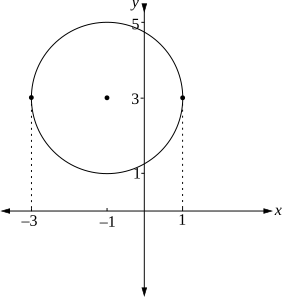
The graph of a quadratic function represented by the equation  \(h=t^2-8 t+12\)  is shown.
 

  1. Find the values of \(t\) and \(h\) at the turning point of the graph.   (2 marks)

    --- 6 WORK AREA LINES (style=lined) ---

  2. The graph shows  \(h=12\)  when  \(t=0\).
  3. What is the other value of \(t\) for which  \(h=12\)?   (1 mark)

    --- 3 WORK AREA LINES (style=lined) ---

Show Answers Only

a.   \(\text{Turning point at} \ \ (4,-4)\)

b.   \(t=8\)

Show Worked Solution

a.    \(\text{Axis of quadratic occurs when}\ \ t= \dfrac{2+6}{2} = 4\)

\(\text{At} \ \ t=4:\)

\(h=4^2-8 \times 4+12=-4\)

\(\therefore \ \text{Turning point at} \ \ (4,-4)\)
 

b.    \(\text {When} \ \ h=12:\)

\(t^2-8 t+12\) \(=12\)
\(t(t-8)\) \(=0\)

 
\(\therefore \ \text{Other value:} \ \ t=8\)

Filed Under: Non-Linear: Exponential/Quadratics (Std 2) Tagged With: 2adv-std2-common, Band 3, Band 4, smc-830-20-Quadratics

Functions, 2ADV F1 2025 HSC 11

The graph of a quadratic function represented by the equation  \(h=t^2-8 t+12\)  is shown.
 

  1. Find the values of \(t\) and \(h\) at the turning point of the graph.   (2 marks)

    --- 6 WORK AREA LINES (style=lined) ---

  2. The graph shows  \(h=12\)  when  \(t=0\).
  3. What is the other value of \(t\) for which  \(h=12\)?   (1 mark)

    --- 3 WORK AREA LINES (style=lined) ---

Show Answers Only

a.   \(\text{Turning point at} \ \ (4,-4)\)

b.   \(t=8\)

Show Worked Solution

a.    \(\text{Strategy 1 (no calculus)}\)

\(\text{Axis of quadratic occurs when}\ \ t= \dfrac{2+6}{2} = 4\)

\(\text{At} \ \ t=4:\)

\(h=4^2-8 \times 4+12=-4\)

\(\therefore \ \text{Turning point at} \ \ (4,-4)\)
 

\(\text{Strategy 2 (using calculus)}\)

\(h=t^2-8 t+12\)

\(h^{\prime}=2 t-8\)

\(\text{Find \(t\) when} \ \ h^{\prime}=0:\)

\(2 t-8=0 \ \Rightarrow \ t=4\)
 

b.    \(\text {When} \ \ h=12:\)

\(t^2-8 t+12\) \(=12\)
\(t(t-8)\) \(=0\)

 
\(\therefore \ \text{Other value:} \ \ t=8\)

Filed Under: Quadratics and Cubic Functions (Y11) Tagged With: 2adv-std2-common, Band 2, Band 3, smc-984-10-Quadratics

Calculus, 2ADV C4 2025 HSC 5 MC

What is  \(\displaystyle \int \frac{1}{\sqrt{x+5}} d x\) ?

  1. \(\dfrac{1}{2} \sqrt{x+5}+C\)
  2. \(2 \sqrt{x+5}+C\)
  3. \(-\dfrac{1}{2} \sqrt{x+5}+C\)
  4. \(-2 \sqrt{x+5}+C\)
Show Answers Only

\(B\)

Show Worked Solution
\(\displaystyle \int \frac{1}{\sqrt{x+5}}\ d x\) \(=\displaystyle \int (x+5)^{-\frac{1}{2}}\ d x\)  
  \(= 2 \sqrt{x+5}+C\)  

 
\(\Rightarrow B\)

Filed Under: Standard Integration Tagged With: Band 3, smc-1202-10-Indefinite Integrals

Functions, 2ADV F1 2025 HSC 3 MC

What is the domain of the function  \(y=\sqrt{6-x^2}\) ?

  1. \(\left(0, \sqrt{6}\right)\)
  2. \(\left[0, \sqrt{6}\right]\)
  3. \(\left(-\sqrt{6}, \sqrt{6}\right)\)
  4. \(\left[-\sqrt{6}, \sqrt{6}\right]\)
Show Answers Only

\(D\)

Show Worked Solution

\(6-x^2 \geq 6\ \ \Rightarrow\ \ x^2 \leq 6\)

\(-\sqrt{6} \leq x \leq \sqrt{6} \)

\(\Rightarrow D\)

Filed Under: Further Functions and Relations (Y11) Tagged With: Band 3, smc-987-40-Square-Root Functions

Probability, 2ADV S1 2025 HSC 1 MC

The probability distribution table for a discrete random variable \(X\) is shown.

\begin{array}{|c|c|}
\hline \quad \quad x \quad \quad & \quad P(X=x) \quad\\
\hline 1 & 0.4 \\
\hline 2 & 0.2 \\
\hline 3 & \\
\hline
\end{array}

What is the value of \(P(X=3)\) ?

  1. \(0.2\)
  2. \(0.4\)
  3. \(1.2\)
  4. \(2.0\)
Show Answers Only

\(B\)

Show Worked Solution

\(\text{Probabilities sum to 1:}\)

\(0.4+0.2+P(X=3) = 1\ \ \Rightarrow\ \ P(X=3) = 0.4\)

\(\Rightarrow B\)

Filed Under: Discrete Probability Distributions (Y11) Tagged With: Band 3, smc-992-10-Sum of Probabilities = 1

Calculus, 2ADV C1 2018 HSC 12d v1

The displacement of a particle moving along the `x`-axis is given by

`x = 1/4t^4 -t^3 -1/2t^2 +3t,`

where `x` is the displacement from the origin in metres and `t` is the time in seconds, for `t >= 0`.

  1. What is the initial velocity of the particle?  (1 mark)

    --- 2 WORK AREA LINES (style=lined) ---

  2. At which times is the particle stationary?  (2 marks)

    --- 3 WORK AREA LINES (style=lined) ---

  3. Find the position of the particle when the acceleration is `4/3`.  (2 marks)

    --- 4 WORK AREA LINES (style=lined) ---

Show Answers Only
  1. `3\ text(ms)^(-1)`
  2. `t = 1 or 3\ text(seconds)`
  3. `-329/324\ text(m)`
Show Worked Solution

i.    `x = 1/4t^4 -t^3 -1/2t^2 +3t`

`v = (dx)/(dt) = t^3-3t^2-t+3`
 

`text(Find)\ \ v\ \ text(when)\ \ t = 0:`

`v` `= 0 -3(0) -0+ 3`
  `= 3\ text(ms)^(-1)`


ii.  `text(Particle is stationary when)\ \ v = 0`

`t^3-3t^2-t+3` `=0`  
`t^2(t-3)-1(t-3)` `=0`  
`(t-3)(t^2-1)` `=0`  
`(t-3)(t-1)(t+1)` `=0`  


`t = 1 or 3\ text(seconds), t >= 0`
 

iii.  `a = (dv)/(dt) = 3t^2-6t-1`
 

`text(Find)\ \ t\ \ text(when)\ \ a = 4/3`

`3t^2-6t-1` `= 4/3`
`3t^2-6t-7/3` `= 0`
`9t^2-18t-7` `=0`
`(3t-7)(3t+1)` `=0`
`t` `=7/3`, `t >= 0`
`x(7/3)` `= 1/4(7/3)^4 -(7/3)^3 -1/2(7/3)^2 +3(7/3)`
  `= -329/324\ text(m)`

Filed Under: Rates of Change (Adv-X) Tagged With: Band 3, eo-derivative (HSC), smc-1083-20-Polynomial Function

Calculus, 2ADV C1 EO-Bank 2

  1.  Find the equations of the tangents to the curve  `y = x^2-5x+6`  at the points where the curve cuts the `x`-axis.  (2 marks)

    --- 4 WORK AREA LINES (style=lined) ---

  2.  Where do the tangents intersect?  (2 marks)

    --- 3 WORK AREA LINES (style=lined) ---

Show Answers Only
  1. `y = −x+2`
    `y = x-3`
  2. `(5/2, −1/2)`
Show Worked Solution
a.   `y` `= x^2-5x+6`
  `= (x-2)(x-3)`

 
`text(Cuts)\ xtext(-axis at)\ \ x = 2\ \ text(or)\ \ x = 3`
 

`(dy)/(dx) = 2x-5`

 
`text(At)\ \ x = 2 \ => \ (dy)/(dx) = -1`

`T_1\ text(has)\ \ m = −1,\ text{through (2, 0)}`

`y -0` `= -1(x-2)`
`y` `= -x+2`


`text(At)\ \ x = 3 \ => \ (dy)/(dx) = 1`

`T_2\ text(has)\ \ m = 3,\ text{through (3, 0)}`

`y -0` `= 1(x-3)`
`y` `= x -3`


b.   `text(Intersection occurs when:)`

`-x+2` `= x-3`
`2x` `= 5`
`x` `= 5/2`


`y = 5/2 – 3 = −1/2`

`:.\ text(Intersection at)\ \ (5/2, −1/2)`

Filed Under: Tangents (Adv-X) Tagged With: Band 3, Band 4, eo-unique, smc-973-10-Find Tangent Equation, smc-973-30-Intersections

Calculus, 2ADV C1 2023 HSC 14 v1

Find the equation of the tangent to the curve  `y=x(3x+2)^2`  at the point `(1,25)`.   (3 marks)

--- 6 WORK AREA LINES (style=lined) ---

Show Answers Only

`y=55x-30`

Show Worked Solution
`y` `=x(3x+2)^2`  
`dy/dx` `=6x(3x+2) + (3x+2)^2`  
  `=(3x+2)(9x+2)`  

 
`text{At}\ x=1\ \ =>\ \ dy/dx=(3(1)+2)(9(1)+2)=55`
 

`text{Find equation of line}\ \ m=55,\ text{through}\ (1,25)`

`y-y_1` `=m(x-x_1)`  
`y-25` `=55(x-1)`  
`y` `=55x-30`  

Filed Under: Tangents (Adv-X) Tagged With: Band 3, eo-derivative (HSC), smc-973-10-Find Tangent Equation

Calculus, 2ADV C1 2009 HSC 1d v1

Find the gradient of the tangent to the curve `y = 2x^3 - 5x^2 + 4` at the point `(2, 0)`.   (2 marks)

Show Answers Only

`text(Gradient = 2.)`

Show Worked Solution
`y` `= 2x^3-5x^2 + 4`  
`dy/dx` `= 6x^2 – 10x`  
     

`text(At)\ x = 2`

`dy/dx` `= 6(2)^2 – 10(2)`  
  `=24-20`  
  `=4`  


`:.\ text(Gradient of tangent at)\ (2, 0) = 4.`

Filed Under: Tangents (Adv-X) Tagged With: Band 3, eo-derivative (HSC), smc-973-10-Find Tangent Equation

Calculus, 2ADV C1 2019 HSC 11c v1

Differentiate  `(4x + 3)/(3x-4)`.  (2 marks)

--- 5 WORK AREA LINES (style=lined) ---

Show Answers Only

`-25/(3x-4)^2`

Show Worked Solution

`text(Using quotient rule:)`

`u=4x+3,`     `v=3x-4`  
`u^{′} = 4,`     `v^{′} = 3`  
     
`y^{′}` `= (u^{′} v-v^{′} u)/v^2`
  `= (4(3x-4)-3(4x+3))/(3x-4)^2`
  `= (12x-16-12x-9)/(3x-4)^2`
  `= -25/(3x-4)^2`

Filed Under: Standard Differentiation (Adv-X) Tagged With: Band 3, eo-derivative (HSC), smc-1069-10-Quotient Rule

Calculus, 2ADV C1 2015 HSC 12c v1

Find  `f^{′}(x)`, where  `f(x) = (2x^2-3x)/(2-x).`   (2 marks)

--- 5 WORK AREA LINES (style=lined) ---

Show Answers Only

`((x-3) (x + 1))/(x-1)^2`

Show Worked Solution

`f(x) = (2x^2-3x)/(2-x)`

`text(Using the quotient rule:)`

`u` `= 2x^2-3x` `\ \ \ \ \ \ v` `= 2-x`
`u^{′}` `= 4x-3` `\ \ \ \ \ \ v^{′}` `= -1`
`f^{′}(x)` `= (u^{′} v-uv^{′})/v^2`
  `= ((4x-3)(2-x)-(2x^2-3x) xx -1)/(2-x)^2`
  `= (-2x^2 + 8x-6)/(x-2)^2`
  `= (-2(x^2-4x+3)/(x-2)^2`
  `= (-2(x-3) (x-1))/(x-2)^2`

Filed Under: Standard Differentiation (Adv-X) Tagged With: Band 3, eo-derivative (HSC), smc-1069-10-Quotient Rule

Calculus, 2ADV C1 EQ-Bank 3

  1.  Use differentiation by first principles to find \(y^{′}\), given  \(y = 2x^2 + 5x\).   (2 marks)

    --- 6 WORK AREA LINES (style=lined) ---

  2.  Find the equation of the tangent to the curve when  \(x = 1\).   (1 mark)

    --- 3 WORK AREA LINES (style=lined) ---

Show Answers Only
  1.  `y^{′} = 4x+5`
  2.  `y = 9x-2`
Show Worked Solution
i.    `f(x)` `= 2x^2 + 5x`
  `f^{′}(x)` `= lim_(h->0) (f(x + h)-f(x))/h`
    `= lim_(h->0) ((2(x + h)^2 +5(x + h))-(2x^2+5x))/h`
    `= lim_(h->0)(2x^2 + 4xh + 2h^2+5x+5h-2x^2-5x)/h`
    `= lim_(h->0)(4xh + 2h^2+5h)/h`
    `= lim_(h->0)(h(4x+5 +2h))/h`

 
`:.\ y^{′} = 4x+5`
 

ii.   `text(When)\ \ x = 1, y = 7`

`y^{′} = 4+5 = 9`
 

`:. y-7` `= 9(x-1)`
`y` `= 9x-2`

Filed Under: Standard Differentiation (Y11), Tangents (Y11) Tagged With: Band 3, smc-1069-40-1st Principles, smc-973-10-Find Tangent Equation

CHEMISTRY, M1 EQ-Bank 18

A geochemist analyzes a rock sample and finds it contains 15 600 kg of ore. Chemical analysis shows that the ore contains 3.8% w/w of chromium metal.

Calculate the mass of chromium in the rock sample. Express your answer in scientific notation.   (2 marks)

--- 4 WORK AREA LINES (style=lined) ---

Show Answers Only

\(5.93 \times 10^2\ \text{kg}\)

Show Worked Solution
Mass of chromium \(= 3.8\% \times 15\,600\ \text{kg}\)  
  \(=0.038 \times 15\,600\ \text{kg}\)  
  \(=5.93 \times 10^2\ \text{kg}\)  

Filed Under: Properties of Matter Tagged With: Band 3, smc-4255-30-Percentage composition

CHEMISTRY, M1 EQ-Bank 11 MC

Which statement about the periodic table is correct?

  1. Non-metals are found on the left side of the periodic table and are generally good conductors of electricity.
  2. Metalloids have properties intermediate between metals and non-metals and are found along the staircase line.
  3. Metals generally have high electronegativity and form negative ions.
  4. Noble gases are highly reactive due to their incomplete valence shells.
Show Answers Only

\(B\)

Show Worked Solution
  • Metalloids (such as silicon, germanium, and arsenic) are located along the staircase line separating metals and non-metals on the periodic table.
  • They exhibit properties of both metals and non-metals, such as being semiconductors of electricity.

\(\Rightarrow B\)

Filed Under: Properties of Matter Tagged With: Band 3, smc-4255-20-Periodic Table

CHEMISTRY, M1 EQ-Bank 9 MC

The formula for the sulfate ion is \(\ce{SO4^2-}\). What is the formula for aluminium sulfate?

  1. \(\ce{AlSO4}\)
  2. \(\ce{Al2SO4}\)
  3. \(\ce{Al(SO4)3}\)
  4. \(\ce{Al2(SO4)3}\)
Show Answers Only

\(D\)

Show Worked Solution
  • Aluminum has a charge of \(3+\) and sulfate has a charge of \(2-\). To form a neutral compound, the charges must balance.
  • Using the criss-cross method, we need 2 aluminum ions (total charge: \(2 \times 3 = 6+\)) and 3 sulfate ions (total charge: \(3 \times 2- = 6-\)) to achieve a neutral compound.
  • Therefore, the formula is \(\ce{Al2(SO4)3}\).

\(\Rightarrow D\)

Filed Under: Properties of Matter Tagged With: Band 3, smc-4255-45-Inorganic compounds

  • 1
  • 2
  • 3
  • …
  • 56
  • Next Page »

Copyright © 2014–2025 SmarterEd.com.au · Log in