SmarterEd

Aussie Maths & Science Teachers: Save your time with SmarterEd

  • Login
  • Get Help
  • About

Complex Numbers, EXT2 N2 2005 HSC 2c

Sketch the region on the Argand diagram where the inequalities

    `| z - overset_z | < 2`  and  `| z - 1 | >=1`

hold simultaneously.   (3 marks)

Show Answers Only
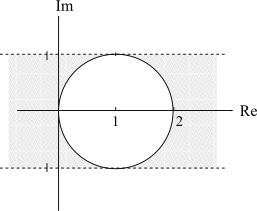
Show Worked Solution
`| z – overset_z |` `< 2`
`| x + i y – (x – i y) |` `< 2`
`| 2 i y |` `< 2`
`| y |` `< 1`

 
`| z – 1 | = 1 \ => \ text{Circle, radius = 1, centre (1, 0)}`
 

`:.\ text(Graph:)\ | z – overset_z |<2 \ ∩ \ | z – 1 | >= 1`
 

Filed Under: Geometrical Implications of Complex Numbers Tagged With: Band 4, smc-1052-10-Sketch regions

Complex Numbers, EXT2 N2 EQ-Bank 1

`z = sqrt2 e^((ipi)/15)`  is a root of the equation  `z^5 = alpha(1 + isqrt3), \ alpha ∈ R`.

  1. Express  `1 + isqrt3`  in exponential form.  (2 marks)

    --- 4 WORK AREA LINES (style=lined) ---

  2. Find the value of `alpha`.  (1 mark)

    --- 4 WORK AREA LINES (style=lined) ---

  3. Find the other 4 roots of the equation in exponential form.  (3 marks)

    --- 6 WORK AREA LINES (style=lined) ---

Show Answers Only
  1. `2e^((ipi)/3)`
  2. `alpha = 2sqrt2`
  3. `e^((i11pi)/15), e^(-(ipi)/3), e^((i13pi)/15), e^(−(i11pi)/15)`
Show Worked Solution

i.   `beta = 1 + isqrt3`

`|beta| = sqrt(1 + (sqrt3)^2) = 2`

`text(arg)(beta) = tan^(−1) (sqrt3/1) = pi/3`

`beta = 2e^((ipi)/3)`


ii.    `z` `= sqrt2 e^((ipi)/15)`
  `z^5` `= (sqrt2 e^((ipi)/15))^5`
    `= (sqrt2)^5 e^((ipi)/15 xx 5)`
    `= 4sqrt2 e^((ipi)/3)`

 
`:. alpha = 2sqrt2`


iii.   `text(arg)(z^5) = pi/3 + 2kpi, \ \ k = 0, ±1, ±2, …`

`text(arg)(z) = pi/15 + (2kpi)/5`

`k = 1:\ text(arg)(z) = pi/15 + (2pi)/5 = (11pi)/15`

`k = text(−1):\ text(arg)(z) = pi/15 – (2pi)/5 = −pi/3`

`k = 2:\ text(arg)(z) = pi/15 + (4pi)/5 = (13pi)/15`

`k =text(−2):\ text(arg)(z) = pi/15 – (4pi)/5 = −(11pi)/15`
 

`:. 4\ text(other roots are:)`

`e^((i11pi)/15), e^(−(ipi)/3), e^((i13pi)/15), e^(−(i11pi)/15)` 

Filed Under: Solving Equations with Complex Numbers Tagged With: Band 2, Band 3, Band 4, smc-1050-30-Roots > 3, smc-1050-50-Exponential form

Complex Numbers, EXT2 N1 EQ-Bank 6

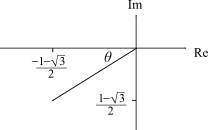
Given  \(z=\dfrac{-1-i \sqrt{3}}{1+i}\), calculate  \(z^2\)  in exponential form.  (3 marks)

--- 10 WORK AREA LINES (style=lined) ---

Show Answers Only

\(2 e^{\small{\dfrac{i \pi}{6}}}\)

Show Worked Solution
\(z\) \(=\dfrac{-1-i \sqrt{3}}{1+i} \times \dfrac{1-i}{1-i}\)
  \(=\dfrac{(-1-i \sqrt{3})(1-i)}{1-i^2}\)
  \(=\dfrac{-1+i-i \sqrt{3}+i^2 \sqrt{3}}{2}\)
  \(=\dfrac{-1-\sqrt{3}}{2}+i\left(\dfrac{1-\sqrt{3}}{2}\right)\)


\(\abs{z}\) \(=\sqrt{\left(\dfrac{-1-\sqrt{3}}{2}\right)^2+\left(\dfrac{1-\sqrt{3}}{2}\right)^2}\)
  \(=\sqrt{\dfrac{1+2 \sqrt{3}+3+1-2 \sqrt{3}+3}{4}}\)
  \(=\sqrt{2}\)

\(\text{Find}\ \ \arg (z):\)

\(\tan \theta\) \(=\dfrac{\frac{1-\sqrt{3}}{2}}{\frac{-1-\sqrt{3}}{2}}=\dfrac{\sqrt{3}-1}{\sqrt{3}+1}\)
\(\theta\) \(=15^{\circ}=\dfrac{\pi}{12}\)

\(\therefore \arg (z)=-\dfrac{11 \pi}{12}\)
 

\(z\) \(=\sqrt{2} \operatorname{cis}\left(-\dfrac{11 \pi}{12}\right)\)
\(z^2\) \(=(\sqrt{2})^2 \operatorname{cis}\left(-\dfrac{11 \pi}{12} \times 2+2 \pi\right)\)
  \(=2 \operatorname{cis}\left(\dfrac{\pi}{6}\right)\)
  \(=2 e^{\small{\dfrac{i \pi}{6}}}\)

Filed Under: Exponential Form Tagged With: Band 4, smc-1191-35-Exponential - Mod/Arg

Calculus, EXT2 C1 2005 HSC 1e

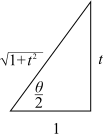
Let  `t=tan(theta/2).`

  1. Show that  `(dt)/(d theta) = 1/2(1+t^2)`   (1 mark)

    --- 3 WORK AREA LINES (style=lined) ---

  2. Show that  `sin theta = (2t)/(1+t^2).`   (2 marks)

    --- 6 WORK AREA LINES (style=lined) ---

  3. Use the substitution  `t=tan(theta/2)`  to find  `int text(cosec)\ theta\ d theta.`   (2 marks)

    --- 5 WORK AREA LINES (style=lined) ---

Show Answers Only
  1. `text(See Worked Solutions)`
  2. `text(See Worked Solutions)`
  3. `log_e | tan frac{theta}{2} | + c`
Show Worked Solution
i.     `t` `= tan frac{theta}{2}`
  `frac{dt}{d theta}` `= frac{1}{2} text{sec}^2 frac{theta}{2}`
    `= frac{1}{2} (1 + tan^2 frac{theta}{2})`
    `= frac{1}{2} (1 + t^2)`


ii.   `text{Show} \ \ sin theta = frac{2t}{1 + t^2} :`
 

`sin theta` `= 2 \ sin frac{theta}{2} cos frac{theta}{2}`
  `= 2 * frac{t}{sqrt(1 + t^2)} * frac{1}{sqrt(1 + t^2)}`
  `= frac{2t}{1 + t^2}`


iii.   `int \ text{cosec} \ theta \ d theta`

`t = tan frac {theta}{2}`

`frac{dt}{d theta} = frac{1}{2} text{sec}^2 frac{theta}{2} \ , \ d theta = frac{2dt}{sec^2 frac{theta}{2}} = frac{2}{1 + t^2}  dt`

`int \ text{cosec} \ theta\ d theta` `= int frac{1 + t^2}{2t} xx frac{2}{1 + t^2} dt`
  `= int frac{1}{t}\ dt`
  `= log_e | t | + c`
  `= log_e | tan frac{theta}{2} | + c`

Filed Under: Trig Integration Tagged With: Band 3, Band 4, smc-1193-20-t = tan theta/2

Complex Numbers, EXT2 N1 2008 HSC 2b

  1. Write  `frac{1 + i sqrt3}{1 + i}`  in the form  `x + iy`, where `x` and `y` are real.  (2 marks)

    --- 2 WORK AREA LINES (style=lined) ---

  2. By expressing both  `1 + i sqrt3`  and  `1 + i`  in  modulus-argument form, write  `frac{1 + i sqrt3}{1 + i}`  in modulus-argument form.   (3 marks)

    --- 8 WORK AREA LINES (style=lined) ---

  3. Hence find  `cos frac{pi}{12}`  in surd form.  (1 mark)

    --- 3 WORK AREA LINES (style=lined) ---

  4. By using the result of part (ii), or otherwise, calculate  `(frac{1 + i sqrt3}{1 + i})^12`.   (1 mark)

    --- 2 WORK AREA LINES (style=lined) ---

Show Answers Only
  1. `frac{1 + sqrt3}{2} – i ( frac{1 – sqrt3}{2} )`
  2. `sqrt2 (cos (frac{pi}{12}) + i sin (frac{pi}{12}))`
  3. `frac{sqrt2 + sqrt6}{4}`
  4. `-64`
Show Worked Solution
i.      `frac{1 + i sqrt3}{1 + i} xx frac{1 – i}{1 – i}` `= frac{(1 + i sqrt3)(1 – i)}{1 – i^2}`
    `= frac{1 – i + i sqrt3 – sqrt3 i^2}{2}`
    `= frac{1 + sqrt3}{2} – i ( frac{1 – sqrt3}{2} )`


ii.   `z_1 = 1 +  i sqrt3`

`| z_1 | = sqrt(1 + ( sqrt3)^2) = 2`

`text{arg} (z_1) = tan^-1 (sqrt3) = frac{pi}{3}`
  

`z_1 = 2 (cos frac{pi}{3} + i sin frac{pi}{3})`
 
`z_2 = 1 + i`

`| z_2 | = sqrt(1^2 + 1^2) = sqrt2`

`text{arg} (z_2) = tan^-1 (1) = frac{pi}{4}`

`z_2 = sqrt2 (cos frac{pi}{4} + i sin frac{pi}{4})`
 

`frac{1 + i sqrt3}{1 + i}` `= frac{z_1}{z_2}`
  `= frac{2}{sqrt2} ( cos ( frac{pi}{3} – frac{pi}{4} ) + i sin ( frac{pi}{3} – frac{pi}{4} ) )`
  `= sqrt2 ( cos (frac{pi}{12}) + i sin (frac{pi}{12}) )`


iii.  `text{Equating real parts of i and ii:}`

`sqrt2 cos (frac{pi}{12})` `= frac{1 + sqrt3}{2}`
`cos(frac{pi}{12})` `= frac{1 + sqrt3}{2 sqrt2} xx frac{sqrt2}{sqrt2}`
  `= frac{sqrt2 + sqrt6}{4}`


iv.     `(frac{1 + i sqrt2}{1 + i})^12` `= (sqrt2)^12 (cos (frac{pi}{12} xx 12) + i sin (frac{pi}{12} xx 12))`
    `= 64 (cos pi + i sin pi)`
    `= – 64`

Filed Under: Argand Diagrams and Mod/Arg form Tagged With: Band 3, Band 4, Band 5, smc-1049-20-Cartesian to Mod/Arg, smc-1049-40-Mod/Arg arithmetic, smc-1049-50-Powers

Complex Numbers, EXT2 N1 EQ-Bank 3 MC

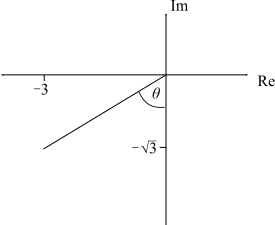
Which of the following is the complex number  \(-3-\sqrt{3}i\)?

  1. \(12 e^{-\small{\dfrac{i 5 \pi}{6}}}\)
  2. \(12 e^{\small{\dfrac{i \pi}{6}}}\)
  3. \(2 \sqrt{3} e^{\small{-\dfrac{i 5 \pi}{6}}}\)
  4. \(2 \sqrt{3} e^{\small{\dfrac{i \pi}{6}}}\)
Show Answers Only

\(C\)

Show Worked Solution

\(\abs{z}\) \(=\sqrt{3^2+(\sqrt{3})^2}\)
  \(=\sqrt{12}\)
  \(=2 \sqrt{3}\)


\(\tan \theta\) \(=\dfrac{3}{\sqrt{3}} \times \dfrac{\sqrt{3}}{\sqrt{3}}=\sqrt{3}\)
\(\theta\) \(=\dfrac{\pi}{3}\)
\(\arg (z)\) \(=-\left(\dfrac{\pi}{3}+\dfrac{\pi}{2}\right)=-\dfrac{5 \pi}{6}\)

\(\text {In exponential form:}\)

\(z=2 \sqrt{3} e^{-\small{\dfrac{i5\pi}{6}}}\)

\(\Rightarrow C\)

Filed Under: Exponential Form Tagged With: Band 4, smc-1191-30-Cartesian - Exponential

Complex Numbers, EXT2 N1 2020 HSC 9 MC

What is the maximum value of  `|e^(i theta) - 2| + |e^(i theta) + 2|`  for  `0 ≤ theta ≤ 2 pi`?

  1. `sqrt5`
  2. `4`
  3. `2 sqrt5`
  4. `10`
Show Answers Only

`C`

Show Worked Solution

`e^(i theta) = a + ib \ \ text{where}\ \ a^2 + b^2 =1`

Mean mark 56%.
`X` `= |e^(i theta) – 2| + |e^(i theta) + 2|`
  `= | (a – 2) + ib | + | (a + 2) + i b |`
  `= sqrt((a-2)^2 + b^2) + sqrt((a+2)^2 + b^2)`
  `= sqrt(a^2 – 4a + 4 + b^2) + sqrt(a^2 + 4a + 4 + b^2`
  `= sqrt(5 – 4a) + sqrt(5 + 4a)`


`frac{dX}{da}` `= -frac{1}{2} xx 4 xx frac{1}{sqrt(5 – 4a)} + frac{1}{2} xx 4 xx frac{1}{sqrt(5 + 4a)}`
  `= frac{2}{sqrt(5 + 4a)} – frac{2}{sqrt(5 – 4a)}`

 
`text(When)\ \ frac{dX}{da} = 0:`

`5 + 4a` `= 5 – 4a`
`a` `= 0`

 
`:. X_text(max) = 2 sqrt5`
 
`=> \ C`

Filed Under: Exponential Form Tagged With: Band 4, smc-1191-70-Other

Mechanics, EXT2 M1 2020 HSC 16a

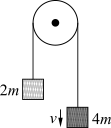
Two masses, `2m` kg and `4m` kg, are attached by a light string. The string is placed over a smooth pulley as shown.

The two masses are at rest before being released and `v` is the velocity of the larger mass at time `t` seconds after they are released.


The force due to air resistance on each mass has magnitude `kv`, where `k` is a positive constant.

  1. Show that  `frac{dv}{dt} = frac{gm-kv}{3m}`.   (2 marks)

    --- 6 WORK AREA LINES (style=lined) ---

  2. Given that  `v < frac{gm}{k}`, show that when  `t = frac{3m}{k} ln 2`, the velocity of the larger mass is  `frac{gm}{2k}`.  (3 marks)

    --- 8 WORK AREA LINES (style=lined) ---

Show Answers Only
  1. `text{See Worked Solutions}`
  2. `text{See Worked Solutions}`
Show Worked Solution

i. 

♦ Mean mark part (i) 37%.

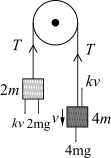
`text{Taking} \ v \ text{downwards as positive.}`

`text{Forces acting on}\ 2m\ text{mass:}`
  
`kv + 2 mg-T = -2m * frac{dv}{dt}\ …\ (1)`
  
`text{Forces acting our} \ 4m \ text{mass:}`
 
`4mg-kv-T = 4m * frac{dv}{dt}\ …\ (2)`

`text{Subtract} \ \ (2)-(1)`

`2 mg-2 kv` `= 6 m * frac{dv}{dt}`
`:. frac{dv}{dt}` `= frac{2mg-2 kv}{6 m}`
  `= frac{gm-kv}{3m}`


ii.    `frac{dv}{dt}` `= frac{gm-kv}{3m}`
  `frac{dt}{dv}` `= frac{3m}{gm-kv}`
  `t` `= int frac{3m}{gm-kv}\ dv`
    `= -frac{3m}{k} log_e |gm-kv | + c`

 
`text{When} \ \ t = 0, v = 0:`

`0` `= -frac{3m}{k} log_e \ | gm | + c`
`c` `= frac{3m}{k} log_e \ | gm | `
`t` `= frac{3m}{k} log_e  \ | gm | \-frac{3m}{k} log_e  \ | gm -kv |`
  `= frac{3m}{k} log_e \ | frac{mg}{gm-kv} |`

 
`text{Find} \ \ v\ \ text{when} \ \ t = frac{3m}{k} log_e 2 :`

`frac{3m}{k} log_e 2` `= frac{3m}{k} log_e | frac{gm}{gm-kv} |`
`2` `= frac{gm}{gm-kv}`
`2gm-2kv` `= gm`
`2kv` `= gm`
`therefore \ v` `= frac{gm}{2k}`


Filed Under: Resisted Motion Tagged With: Band 4, Band 5, smc-1061-09-Pulleys

Proof, EXT2 P1 2020 HSC 14d

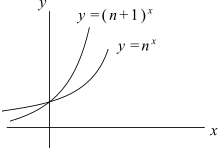
Prove that for any integer  `n > 1, log_n (n + 1)`  is irrational.   (3 marks)

--- 8 WORK AREA LINES (style=lined) ---

Show Answers Only

`text{See Worked Solutions}`

Show Worked Solution

`text{Proof by contradiction:}`

`text{Assume} \ log_n(n + 1) \ text{is rational}`

`therefore \ log_n (n + 1) = frac{p}{q} \ \ text{where} \ \ p,q ∈ ZZ \ text{with no common factor except 1}` 

`n^(frac{p}{q}` `= n + 1`
`n^p` `= (n + 1)^q`

 
`text{Strategy 1}`
 

`n^p = (n + 1)^q \ \ text{when} \ \ p = q = 0\ \ text{only}`

`q ≠ 0`

`:.\ text{By contradiction}, log_n (n + 1) \ \ text{is irrational.}`
 

`text{Strategy 2}`

`n^p = (n + 1)^q`

`text{If} \ \ n\  \ text{is odd, LHS is odd and RHS is even.}`

`text{If} \ \ n\  \ text{is even LHS is even and RHS is odd.}`

`text{Statement is true for} \ \ p = q = 0 , text{but} \ \ q ≠ 0`

`therefore \ text{By contradiction,} \ log_n (n + 1) \ text{is irrational.}`

Filed Under: Contradiction, Contrapositive and Other Proofs, Converse, Contradiction and Contrapositive Proof Tagged With: Band 4, smc-1207-10-Contradiction, smc-1207-30-Irrational, smc-5116-10-Contradiction, smc-5116-30-Irrational

Vectors, EXT2 V1 2020 HSC 15b

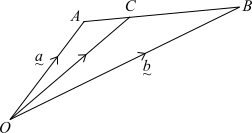
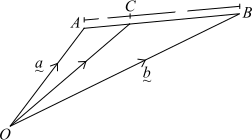
The point `C` divides the interval `AB` so that  `frac{CB}{AC} = frac{m}{n}`. The position vectors of `A` and `B` are `underset~a` and `underset~b` respectively, as shown in the diagram.
 

  1. Show that  `overset->(AC) = frac{n}{m + n} (underset~b - underset~a)`.  (2 marks)

    --- 6 WORK AREA LINES (style=lined) ---


  2. Prove that  `overset->(OC) = frac{m}{m + n} underset~a + frac{n}{m + n} underset~b`.  (1 mark)

    --- 5 WORK AREA LINES (style=lined) ---

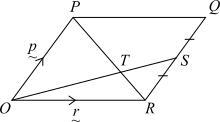
Let `OPQR` be a parallelogram with  `overset->(OP) = underset~p`  and  `overset->(OR) = underset~r`. The point `S` is the midpoint of `QR` and `T` is the intersection of `PR` and `OS`, as shown in the diagram.


  1. Show that  `overset->(OT) = frac{2}{3} underset~r + frac{1}{3} underset~p`.  (3 marks)

    --- 8 WORK AREA LINES (style=lined) ---

  2. Using parts (ii) and (iii), or otherwise, prove that `T` is the point that divides the interval `PR` in the ratio 2 :1.   (1 mark)

    --- 3 WORK AREA LINES (style=lined) ---

Show Answers Only
  1. `text{See Worked Solutions}`
  2. `text{See Worked Solutions}`
  3. `text{See Worked Solutions}`
  4. `text{See Worked Solutions}`
Show Worked Solution

i.  

`frac{overset->(AC)}{overset->(AB)}` `= frac{n}{m + n}`
`overset->(AC)` `= frac{n}{m + n} * overset->(AB)`
  `= frac{n}{m + n} (underset~b – underset~a)`


ii.    `overset->(OC)` `= overset->(OA) + overset->(AC)`
    `= underset~a + frac{n}{m + n} (underset~b – underset~a)`
    `= underset~a – frac{n}{m + n} underset~a + frac{n}{m + n} underset~b`
    `= (1 – frac{n}{m + n}) underset~a + frac{n}{m + n} underset~b`
    `= (frac{m + n – n}{m + n}) underset~a + frac{n}{m + n} underset~b`
    `= frac{m}{m + n} underset~a + frac{n}{m + n} underset~b`


iii.  `text{Show} \ \ overset->(OT) = frac{2}{3} underset~r + frac{1}{3} underset~p`

♦ Mean mark part (iii) 50%.


`text{Consider} \ \ Delta PTO \ \ text{and} \ \ Delta RTS:`

`angle PTO = angle RTS \ (text{vertically opposite})`

`angle OPT = angle SRT \ (text{vertically opposite})`

`therefore \ Delta PTO \ text{|||} \ Delta RTS\ \ text{(equiangular)}`
 

`OT : TS = OP : SR = 2 : 1`

`(text{corresponding sides in the same ratio})`

`frac{overset->(OT)}{overset->(OS)}` `= frac{2}{3}`
`overset->(OT)` `= frac{2}{3} overset->(OS)`
  `= frac{2}{3} ( underset~r + frac{1}{2} underset~p)`
  `= frac{2}{3} underset~r + frac{1}{3} underset~p`
Mean mark part (iv) 51%.


iv.   `text{Let} \ \ overset->(OT) \ text{divide} \ PR\ text{so that}\ \ frac{TR}{PT} = frac{m}{n}`

`text{Using part (ii):}`

`overset->(OT)` `= frac{m}{m + n} underset~p + frac{n}{m + n} c`
`overset->(OT)` `= frac{1}{3} underset~p + frac{2}{3} underset~r \ \ \ (text{part (iii)})`
`frac{m}{m + n}` `= frac{1}{3} , frac{n}{m + n} = frac{2}{3}`

 
`=> \ m = 1 \ , \ n = 2`
 

`therefore \ T \ text{divides} \ PR \ text{in ratio  2 : 1}.`

Filed Under: Vectors and Geometry Tagged With: Band 3, Band 4, Band 5, smc-1210-30-Quadrilateral, smc-1210-40-Triangle, smc-1210-55-Ratios, smc-1210-60-2D problems

Proof, EXT2 P1 2020 HSC 15a

In the set of integers, let `P` be the proposition:

'If  `k + 1`  is divisible by 3, then  `k^3 + 1`  divisible by 3.'

  1. Prove that the proposition `P` is true.  (2 marks)

    --- 5 WORK AREA LINES (style=lined) ---

  2. Write down the contrapositive of the proposition `P`.  (1 mark)

    --- 2 WORK AREA LINES (style=lined) ---

  3. Write down the converse of the proposition `P` and state, with reasons, whether this converse is true or false.  (3 marks)

    --- 8 WORK AREA LINES (style=lined) ---

Show Answers Only
  1. `text{See Worked Solutions}`
  2. `text{See Worked Solutions}`
  3. `text{See Worked Solutions}`
Show Worked Solution

i.     `text{Let} \ \ k + 1 = 3N, \ N∈ Z`

`=>  k = 3N – 1`

`k^3 + 1` `= (3N -1)^3 + 1`
  `= (3N)^3 + 3(3N)^2 (-1) + 3(3N)(-1)^2 + (-1)^3 + 1`
  `= 27N^3 – 27N^2 + 9N – 1 + 1`
  `= 3 (9N^3 – 9N^2 + 3N)`
  `= 3Q \ , \ Q ∈ Z`

 
`therefore \ text{If} \ \ k+ 1 \ \ text{is divisible by 3}, text{then} \ \ k^3 + 1 \ \ text{is divisible by 3.}`
 

ii.    `text{Contrapositive}`

`text{If} \ \ k^3 + 1 \ \ text{is not divisible by 3, then}\ \ k + 1\ \ text{is not divisible by 3.}`
 

♦♦ Mean mark part (iii) 36%.

iii.   `text{Converse:}`

`text{If} \ \ k^3 + 1\ \ text{is divisible by 3, then}\ \ k + 1\ \ text{is divisible by 3.}`

`text(Contrapositive of converse:)`

`text{If}\ \ k + 1\ \ text{is not divisible by 3, then}\ \ k^3 + 1\ \ text{is not divisible by 3.}`
 
`text(i.e.)\ \ k + 1 \ \ text{is not divisible by 3 when}\ \ k + 1 = 3Q + 1\ \ text{or}\ \ k + 1 = 3Q + 2, text{where}\ Q ∈ Z`
 

`text{If} \ \ k + 1` `= 3Q + 1\ \ => \ k=3Q`
`k^3 + 1` `= (3Q)^3 + 1`
  `= 27Q^3 + 1`
  `= 3(9Q^3) + 1`
  `= 3M + 1 \ \ (text{not divisible by 3,}\ M ∈ Z)`


`text{If} \ \ k + 1` `= 3Q + 2\ \ => \ k=3Q+1`
`k^3 + 1` `= (3Q + 1)^3 + 1`
  `= (3Q)^3 + 3(3Q)^2 + 3(3Q) + 1 + 1`
  `= 27Q^3 + 27Q^2 + 9Q + 2`
  `= 3(9Q^3 + 9Q^2 + 3Q) + 2`
  `= 3M + 2 \ (text{not divisible by 3,}\ M ∈ Z) `


`therefore \ text{By contrapositive, if}\ \ k^3 + 1\ \ text {is divisible by 3, k + 1 is divisible by 3.}`

Filed Under: Contradiction, Contrapositive and Other Proofs, Converse, Contradiction and Contrapositive Proof Tagged With: Band 3, Band 4, Band 5, smc-1207-20-Contrapositive, smc-1207-25-Converse, smc-1207-50-Divisibility, smc-5116-20-Contrapositive, smc-5116-25-Converse, smc-5116-50-Divisibility

Proof, EXT2 P2 2020 HSC 14c

Prove by mathematical induction that, for  `n ≥ 2`,

`frac{1}{2^2} + frac{1}{3^2} + ... + frac{1}{n^2} < frac{n - 1}{n}`    (4 marks)

--- 10 WORK AREA LINES (style=lined) ---

Show Answers Only

`text{See Worked Solutions}`

Show Worked Solution

`text{Prove} \ frac{1}{2^2} + frac{1}{3^2} + … + frac{1}{n^2} < frac{n – 1}{n}\ \ \ text(for)\ \ n>=2`
 

`text(If)\ \ n=2:`

`text{LHS} = frac{1}{2^2} = frac{1}{4}`

`text{RHS} = frac{2-1}{2} = frac{1}{2} > text{LHS}`
 
`therefore \ text{True for} \ \ n = 2`
 

`text{Assume true for} \ \ n =k`

`frac{1}{2^2} + frac{1}{3^2} + … + frac{1}{k^2} < frac{k – 1}{k}`
 

`text{Prove true for} \ \ n = k + 1`

`frac{1}{2^2} + frac{1}{3^2} + … + frac{1}{k^2} + frac{1}{(k + 1)^2}< frac{k}{k+1}`
 

`text{LHS}` `= frac{k – 1}{k} + frac{1}{(k + 1}^2}`
  `= frac{(k – 1)(k + 1)^2 + k}{k (k + 1)^2}`
  `= frac{(k – 1)(k^2 + 2 k +1) + k}{k(k +1)^2}`
  `= frac{k^3 + 2k^2 + k – k^2 – 2k – 1 + k}{k(k + 1)^2}`
  `= frac{k^3 + k^2 -1}{k(k + 1)^2}`
  `= frac{k^2 (k + 1 – frac{1}{k^2})}{k(k + 1)^2}`
  `= frac{k}{k +1} xx frac{(k + 1 – frac{1}{k^2})}{k +1}`
  `< frac{k}{k +1} \ \ \ (text{since} \ frac{k + 1 – frac{1}{k^2}}{k +1} < 1 )`

 
`=> \ text{True for} \ n = k + 1`

`therefore \ text{S}text{ince true for} \ n = 2, \ text{by PMI, true integral} \ n ≥ 2.`

Filed Under: Induction, P2 Induction (Ext2) Tagged With: Band 4, smc-1044-10-Inequalities, smc-5115-10-Inequalities

Mechanics, EXT2 M1 2020 HSC 14b

A particle starts from rest and falls through a resisting medium so that its acceleration, in m/s2, is modelled by

`a = 10 (1 - (kv)^2)`,

where `v` is the velocity of the particle in m/s and  `k = 0.01`.

Find the velocity of the particle after 5 seconds.  (4 marks)

Show Answers Only

`46.21 \ text{ms}^-1`

Show Worked Solution
`a` `= 10 (1 – (kv)^2)`
`frac{dv}{dt}` `= 10 – 10 xx 0.01^2 xx v^2`
  `= 10 – 0.001 v^2`
`frac{dt}{dv}` `= frac{1}{10 – 0.001 \ v^2}`
  `= frac{1000}{10 \ 000 – v^2}`
`t` `= int frac{1000}{100^2 – v^2}\ dv`


`text{Using partial fractions}:`

`frac{1}{100^2 – v^2}` ` = frac{A}{100 + v} + frac{B}{100 – v}`
`1` `= A (100 – v) + B(100 + v)`

 
`text{If} \ \ v = 100 \ , \ 1 = 200 B \ => \ B = frac{1}{200}`

`text{If} \ \ v = -100 \ , \ 1 = 200 A \ => \ A = frac{1}{200}`
 

`t` `= 1000 int frac{1}{200 (100 + v)}\ dv + 1000 int frac{1}{200(100 -v)}\ dv`
  `= 5 int frac{1}{100 + v}\ dv +  5 int frac{1}{100 – v}\ dv`
  `= 5 ln \ | 100 + v | – 5 ln  \|100 – v | + c`
  `= 5 ln \ | frac{100 + v}{100 – v} | + c`

 
`text{When} \ \ t = 0 , \ v = 0`

`0 = 5 ln 1  + c  \ => \ c = 0`
 

`:. t = 5 ln \ | frac{100 + v}{100 – v} |`
  

`text{Find} \ \ v \ \ text{when} \ \ t = 5 :`

`5` `= 5 ln | frac{100 + v}{100 – v} |`
`1` `= ln | frac{100 + v}{100 – v} | `
`e` `= frac{100 + v}{100 – v}`
`100 e – ve` `= 100 + v`
`v + ve` `= 100 e – 100`
`v(1 + e)` `= 100 e – 100`
`:. v` `= frac{100 e – 100}{1 + e}`
  `= 46.21 \ text{ms}^-1 \ \ (text{2 d.p.})`

Filed Under: Resisted Motion Tagged With: Band 4, smc-1061-07-Resistive medium, smc-1061-20-R ~ v^2

Complex Numbers, EXT2 N2 2020 HSC 14a

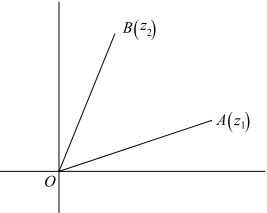
Let `z_1` be a complex number and let  `z_2 = e^(frac{i pi}{3}) z_1`

The diagram shows points `A` and `B` which represent `z_1` and `z_2`, respectively, in the Argand plane.


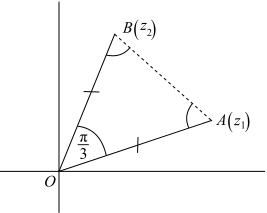
  1. Explain why triangle  `OAB`  is an equilateral triangle.   (2 marks)

    --- 6 WORK AREA LINES (style=lined) ---

  2. Prove that  `z_1 ^2 + z_2^2 = z_1 z_2`.  (3 marks)

    --- 8 WORK AREA LINES (style=lined) ---

Show Answers Only
  1. `text{See Worked Solutions}`
  2. `text{See Worked Solutions}`
Show Worked Solution

i.


`text{Let}`     `z_1` `= r(cos theta + i sin theta)`
  `z_2` `= e^(i frac{pi}{3}) z_1`
    `= r (cos ( theta + frac{pi}{3} ) + i sin (theta + frac{pi}{3}))`


`| z_1 | = | z_2 | => OA = OB`

` angle AOB = frac{pi}{3} \ ( z_2 \ text{is a} \ frac{pi}{3} \ text{anti-clockwise rotation of} \ z_1 )`

`=> angle OBA = angle BAO = pi/3\ \ \ text{(angles opposite equal sides)}`

`therefore \ OAB \ text{is equilateral}`


ii.     `z_1` `= z_2 e^(i frac{pi}{3})`
  `frac{z_1}{z_2}` `= e^(i frac{pi}{3})`
  `(frac{z_1}{z_2})^3` `= e^((3 xx i frac{pi}{3})) \ \ (text{by De Moivre})`
  `frac{z_1^3}{z_2^3}` `= e^(i pi)`
  `z_1^3` `= -z_2^3`
  `z_1^3 + z_2^3` `= 0`

COMMENT: The identity to prove suggests the addition of 2 cubes is a possible strategy.
`(z_1 + z_2)(z_1^2 – z_1 z_2 + z_2^2)` `= 0`
`z_1^2 – z_1 z_2 + z_2^2` `= 0`
`z_1^2 + z_2^2` `= z_1 z_2`

Filed Under: Geometrical Implications of Complex Numbers, Solving Equations with Complex Numbers Tagged With: Band 3, Band 4, smc-1050-40-De Moivre and trig identities, smc-1050-50-Exponential form, smc-1052-20-Triangles, smc-1052-55-Rotations

Mechanics, EXT2 M1 2020 HSC 13a

A particle is undergoing simple harmonic motion with period `frac{pi}{3}`. The central point of motion of the particle is at  `x = sqrt(3)`. When  `t = 0`  the particle has its maximum displacement of  `2 sqrt(3)`  from the central point of motion.

Find an equation for the displacement, `x`, of the particle in terms of `t`.    (3 marks)

Show Answers Only

`x = 2 sqrt(3) cos (6t) + sqrt(3)`

Show Worked Solution
`text{Period}` `= frac{pi}{3}`
`frac{2 pi}{n}` `= frac{pi}{3}`
`n` `= 6`

 
`text{Amplitude} = 2 sqrt(3)`

`text{Centre of motion} = sqrt(3)`

`text{S} text{ince maximum displacement at}\ \ t = 0,`

`x = 2 sqrt(3) cos (6t) + sqrt(3)`

Filed Under: Simple Harmonic Motion Tagged With: Band 4, smc-1059-20-Prove/Identify SHM

Mechanics, EXT2 M1 2020 HSC 12b

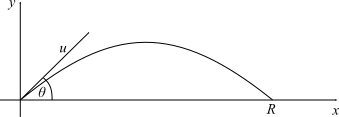
A particle is projected from the origin with initial velocity `u` m/s at an angle  `theta`  to the horizontal. The particle lands at  `x = R`  on the `x`-axis. The acceleration vector is given by  `underset~a = ((0),(-g))`, where `g` is the acceleration due to gravity. (Do NOT prove this.)
 

  1. Show that the position vector  `underset~r (t)`  of the particle is given by
     
         `underset~r (t) = ((ut  cos theta),(ut  sin theta-frac{1}{2} g t^2))`.   (3 marks)

    --- 8 WORK AREA LINES (style=lined) ---

  2. Show that the Cartesian equation of the path of flights is given by
     
         `y = frac{-gx^2}{2u^2} (tan^2 theta-frac{2u^2}{gx} tan theta + 1)`.   (3 marks)

    --- 6 WORK AREA LINES (style=lined) ---

  3. Given  `u^2 > gR`, prove that there are 2 distinct values of  `theta`  for which the particle will land at  `x = R`.   (2 marks)

    --- 7 WORK AREA LINES (style=lined) ---

Show Answers Only
  1. `text{See Worked Solutions}`
  2. `text{See Worked Solutions}`
  3. `text{See Worked Solutions}`
Show Worked Solution

i.    `underset~a = ((0),(-g))`

`ddotx = 0`

`dotx = int ddotx \ dt = c`
 
`text{When} \ \ t = 0, \ dotx = u  cos theta \ =>  \ c = u  cos theta`

`=> dotx = u  cos theta`

 
`x = int dotx \ dt =u t cos theta + c`

`text{When} \ \ t = 0 , \ x = 0, \ c = 0`

`therefore \ x = ut  cos theta`
 

`ddoty = -g`

`doty = int-g \ dt = -g t + c`

`text{When} \ \ t = 0 , \ doty = u  sin theta`

`=> doty = u  sin theta-g t`
 

`y = int doty \ dt = ut  sin theta-frac {1}{2} g t^2 + c`

`text{When} \ \ t = 0, \ y = 0  \ => \ c = 0`

`therefore  y = ut  sin theta-frac(1)(2) g t^2`

`:. underset~r = ((x),(y)) = ((ut  cos theta),(ut sin theta-frac{1}{2} g t^2))`
 

ii.   `x = ut \ cos theta`

`t = frac{x}{u \ cos theta}`
 
`text{Substitute into} \ y:`

`y` `= u * frac{x}{u \ cos theta}\ sin theta-frac{1}{2} g ( frac{x}{u \ cos theta} )^2`
  `= x tan theta-frac{gx^2}{2 u^2 cos^2 theta}`
  `= frac{-gx^2}{2u^2} ( frac{1}{cos^2 theta}-frac{2u^2}{gx} tan theta )`
  `= frac{-gx^2}{2u^2} ( sec^2 theta-frac{2u^2}{gx} tan theta )`
  `= frac{-gx^2}{2u^2} ( tan^2 theta-frac{2u^2}{gx} tan theta + 1 )`


iii.    `text{When} \ \ x = R \ , \ y = 0`

Mean mark part (iii) 52%.
`frac{-gR^2}{2 u^2}` `( tan^2 theta-frac{2u^2}{gR} tan theta + 1 ) = 0`
   `tan^2 theta-frac{2u^2}{gR} tan theta + 1 = 0`
 
`Delta`
 
`= ( frac{-2u^2}{gR} )^2-4 * 1 * 1`
  `= frac{4u^4}{g^2 R^2}-4`


  `u^2` `> gR\ \ \ text{(given)}`
  `u^4` `> g^2 R^2`
  `frac{u^4}{g^2 R^2}` `> 1`
  `frac{4u^4}{g^2 R^2}` `> 4`
  `frac{4u^4}{g^2 R^2}-4` `> 0`
  `Delta` `> 0`

 
`therefore \ 2 \ text{distinct values of} \ \ theta\  \ text{satisfy} \ \ x = R.`

Filed Under: Projectile Motion Tagged With: Band 3, Band 4, smc-1062-40-Initial Angle/Speed, smc-1062-80-Cartesian

Mechanics, EXT2 M1 2020 HSC 12a

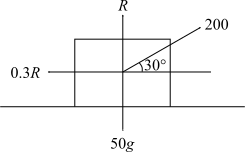
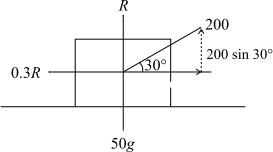
A 50-kilogram box is initially at rest. The box is pulled along the ground with a force of 200 newtons at an angle of 30° to the horizontal. The box experiences a resistive force of  `0.3R`  newtons, where `R` is the normal force, as shown in the diagram.
 
Take the acceleration `g` due to gravity to be 10m/s2.
 

  1. By resolving the forces vertically, show that  `R =400`.   (2 marks)

    --- 5 WORK AREA LINES (style=lined) ---

  2. Show that the net force horizontally is approximately 53.2 newtons.  (2 marks)

    --- 4 WORK AREA LINES (style=lined) ---

  3. Find the velocity of the box after the first three seconds.  (2 marks)

    --- 6 WORK AREA LINES (style=lined) ---

Show Answers Only
  1. `text{See Worked Solutions}`
  2. `text{See Worked Solutions}`
  3. `3.19 \ text{ms}^-1`
Show Worked Solution

i.   

`text{Resolving forces vertically:}`

`R + 200 \ sin 30^@` `= 50g`
`R + 200 xx frac{1}{2}` `= 50 xx 10`
`R + 100` `= 500`
`therefore \ R` `= 400 \ text(N)`


ii.    `text{Resolving forces horizontally:}`

`text{Net Force}` `= 200 \ cos 30^@ – 0.3 R`
  `= 200 xx frac{sqrt3}{2} – 0.3 xx 400`
  `= 100 sqrt3 – 120`
  `= 53.2 \ text{N (to 1 d. p.)}`


iii.    `F` `=ma`
  `50 a` `=100 sqrt300 – 120`
  `a` `= frac{100 sqrt3 – 120}{50}\ text(ms)^(-2)`

 
`text{Initially} \ \ u = 0,`

`v` `= u + at`
`v_(t=3)` `= 0 + frac{100 sqrt3 – 120}{50} xx 3`
  `= 3.1923 \ …`
  `= 3.19 \ text{ms}^-1 \ text{(to 2 d.p.)}`

Filed Under: Resisted Motion Tagged With: Band 3, Band 4, smc-1061-06-Planes/Inclined Planes, smc-1061-30-R ~ c, smc-1061-70-Newton's Law

Mechanics, EXT2 M1 2020 HSC 5 MC

A particle undergoing simple harmonic motion has a maximum acceleration of 6 m/s2 and a maximum velocity of 4 m/s.
 
What is the period of the motion?

  1. `pi`
  2. `frac{2pi}{3}`
  3. `3pi`
  4. `frac{4pi}{3}`
Show Answers Only

`D`

Show Worked Solution

`ddotx = -n^2  x`

Mean mark 57%.

`text{Find} \ n :`

`ddotx_text{max} =  6 \ \ text{occurs when} \ \ x = – a`

`6 = n^2 a\ …\ (1)`
 

`v^2 = n^2 (a^2 – x^2)`

`v_text{max} = 4 \ \ text{occurs when} \ \ x = 0`

`4^2` `= n^2 (a^2-0)`  
`16` `= n^2  a^2`  
`4` `= n a\ …\ (2)`  

 
`text{Substitute} \ \ na = 4 \ \ text{from (2) into (1):}`

`6` `= 4n`
`n` `= frac{3}{2}`

 
`therefore \ text{Period} = frac{2pi}{n} = frac{4pi}{3}`

`=> \ D`

Filed Under: Simple Harmonic Motion Tagged With: Band 4, smc-1059-10-Amplitude / Period

Complex Numbers, EXT2 N1 2020 HSC 4 MC

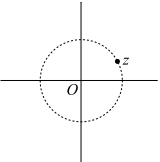
The diagram shows the complex number `z` on the Argand diagram.


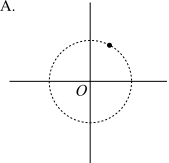
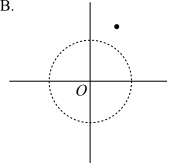
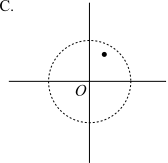
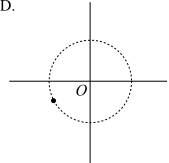
Which of the following diagrams best shows the position of  `frac{z^2}{|z|}`?


Show Answers Only

`A`

Show Worked Solution

`text{Let} \ \ z = r\ text(cis)\ theta`

`z^2` `= r^2  text(cis)\ (2 theta)`
`|z|` `= r`
`therefore  frac{z^2}{|z|}` `= frac{r^2 \ text(cis)\ (2 theta)}{r}`
  `= r\ text(cis)\ (2 theta)`

 
`text{On Argand diagram, it lies on the dotted line`

`text{(modulus the same) with an argument that is}`

`text{doubled.}`
  

`=> \ A`

Filed Under: Argand Diagrams and Mod/Arg form Tagged With: Band 4, smc-1049-10-Cartesian and Argand diagrams, smc-1049-40-Mod/Arg arithmetic

Probability, STD1 S2 2020 HSC 26

Barbara plays a game of chance, in which two unbiased six-sided dice are rolled. The score for the game is obtained by finding the difference between the two numbers rolled. For example, if Barbara rolls a 2 and a 5, the score is 3.

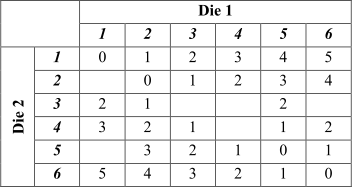
The table shows some of the scores.


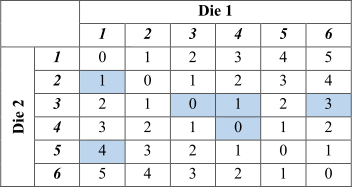
  1. Complete the six missing values in the table to show all possible scores for the game.   (1 mark)
  2. What is the probability that the score for a game is NOT 0?  (2 marks)

    --- 3 WORK AREA LINES (style=lined) ---

Show Answers Only
  1.  

     
  2. `frac{5}{6}`
Show Worked Solution

a.     

♦ Mean mark part (b) 47%.
b.       `Ptext{(not zero)}` `= frac{text(numbers) ≠ 0}{text(total numbers)}`
    `= frac{30}{36}`
    `= frac{5}{6}`

 
\(\text{Alternate solution (b)}\)

b.       `Ptext{(not zero)}` `= 1 – Ptext{(zero)}`
    `= 1 – frac{6}{36}`
    `= frac{5}{6}`

Filed Under: Probability, Single and Multi-Stage Events (Std 1) Tagged With: Band 4, Band 5, num-title-ct-core, num-title-qs-hsc, smc-1135-20-Other Multi-Stage Events, smc-1135-40-Arrays, smc-4225-20-Complementary events, smc-4225-45-Multi-stage events

Statistics, STD1 S3 2020 HSC 22

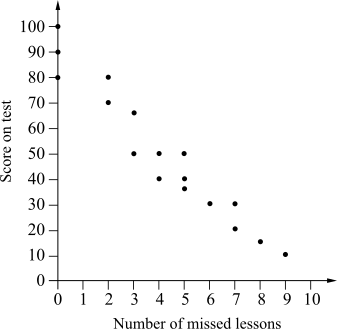
A group of students sat a test at the end of term. The number of lessons each student missed during the term and their score on the test are shown on the scatterplot.


  1. Describe the strength and direction of the linear association observed in this dataset.  (2 marks)

    --- 5 WORK AREA LINES (style=lined) ---

  2. Calculate the range of the test scores for the students who missed no lessons.  (1 mark)

    --- 1 WORK AREA LINES (style=lined) ---

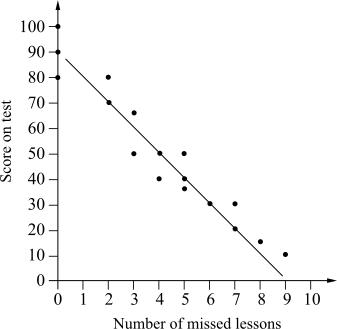
  3. Draw a line of the best fit in the scatterplot above.  (1 mark)
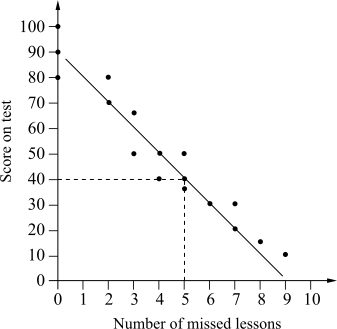
  4. Meg did not sit the test. She missed five lessons.


    Use the line of the best fit drawn in part (c) to estimate Meg's score on this test. (1 mark)

    --- 1 WORK AREA LINES (style=lined) ---

  5. John also did not sit the test and he missed 16 lessons.


    Is it appropriate to use the line of the best fit to estimate his score on the test? Briefly explain your answer. (1 mark)

    --- 2 WORK AREA LINES (style=lined) ---

Show Answers Only

a.    \(\text{Strength : strong}\)

\(\text{Direction : negative} \)

b.    \(\text{Range}\ = \text{high}-\text{low}\ = 100-80=20\)
 

c.   

d. 


e.    \(\text{John’s missed days are too extreme and the LOBF is not}\)

\(\text{appropriate. The model would estimate a negative score for}\)

\(\text{John which is impossible.}\)

Show Worked Solution

a.    \(\text{Strength : strong}\)

\(\text{Direction : negative} \)

♦ Mean mark (a) 45%.
♦♦ Mean mark (b) 31%.

b.    \(\text{Range}\ = \text{high}-\text{low}\ = 100-80=20\)
 

c.   

d. 


\(\therefore\ \text{Meg’s estimated score = 40}\)
 

e.    \(\text{John’s missed days are too extreme and the LOBF is not}\)

\(\text{appropriate. The model would estimate a negative score for}\)

\(\text{John which is impossible.}\)

♦ Mean mark (e) 38%.

Filed Under: Bivariate Data, S3 Further Statistical Analysis (Y12) Tagged With: Band 4, Band 5, num-title-ct-coreb, num-title-qs-hsc, smc-1113-10-Line of Best Fit, smc-1113-60-Limitations, smc-5022-10-Line of best fit graphs, smc-5022-25-Draw LOBF, smc-5022-30-Correlation, smc-5022-60-Limitations

Algebra, STD1 A2 2020 HSC 20

The weight of a bundle of A4 paper (`W` kg) varies directly with the number of sheets (`N`) of A4 paper that the bundle contains.

This relationship is modelled by the formula  `W = kN`, where  `k`  is a constant.

The weight of a bundle containing 500 sheets of A4 paper is 2.5 kilograms.

  1. Show that the value of  `k`  is 0.005.   (1 mark)

    --- 2 WORK AREA LINES (style=lined) ---

  2. A bundle of A4 paper has a weight of 1.2 kilograms. Calculate the number of sheets of A4 paper in the bundle.   (2 marks)

    --- 4 WORK AREA LINES (style=lined) ---

Show Answers Only
  1. `text{Show Worked Solutions}`
  2. `240 \ text{sheets}`
Show Worked Solution

a.     `W = 2.5\ text{kg when} \  N = 500:`

`2.5` `= k xx 500`
`therefore \ k` `= frac{2.5}{500}`
  `= 0.005`


b.     `text{Find}\ \ N \ \ text{when} \ \ W = 1.2\ text{kg:}`

♦ Mean mark 50%.
`1.2` `= 0.005 xx N`
`therefore N` `= frac{1.2}{0.005}`
  `= 240 \ text{sheets}`

Filed Under: Applications: Currency, Fuel and Other Problems (Std 1), Applications: Currency, Fuel and Other Problems (Std 2), Direct Variation (Std1-2027), Direct Variation and Currency Conversion (Std2-2027) Tagged With: Band 4, Band 5, smc-1119-50-Proportional, smc-6249-10-Find k, smc-6249-20-Algebraic Solutions, smc-6514-10-Find k, smc-6514-20-Algebraic Solutions, smc-793-50-Proportional

Financial Maths, STD1 F1 2020 HSC 17

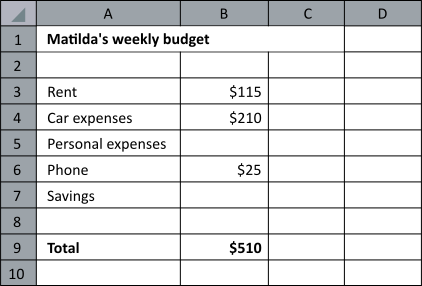
Matilda has a weekly net income of $ 510. She has created a budget where she allocates this income to rent, car expenses, personal expenses, phone, and rest to savings.

Her budget is shown below, with some details missing.


Matilda allocates 20% of her weekly net income to personal expenses.

How many weeks will it take Matilda to save $4930?   (3 marks)

Show Answers Only

`85 \ text{weeks}`

Show Worked Solution

`text{Personal expenses} = 20text(%) xx 510 = $102`

`text{Savings}` `= 510 – (115 + 210 + 102 + 25)`
  `= $58`


`therefore \ text{Weeks to save} \ $4930`

`= frac{4930}{58}`

`= 85 \ text{weeks}`

Filed Under: Budgeting (Std1-2027), Budgeting (Std2-2027), Earning Money and Budgeting (Std 1) Tagged With: Band 4, smc-1126-30-Budgeting, smc-6279-10-Personal Budget, smc-6518-10-Personal Budget

Algebra, STD1 A1 2020 HSC 16

Consider the equation  `m = 6 - frac{3R}{2R - 5}`.

Find the value of  `m`  when  `R = 10`.   (2 marks)

Show Answers Only

`4`

Show Worked Solution
`m` `= 6 – frac{3 xx 10}{2 xx 10 – 5}`
  `= 6 – frac{30}{15}`
  `= 6 – 2`
  `= 4`

Filed Under: Substitution and Other Equations (Std 1), Substitution and Other Equations (Std1-2027) Tagged With: Band 4, smc-1116-10-Substitution, smc-6508-10-Substitution

Algebra, STD1 A3 2020 HSC 14

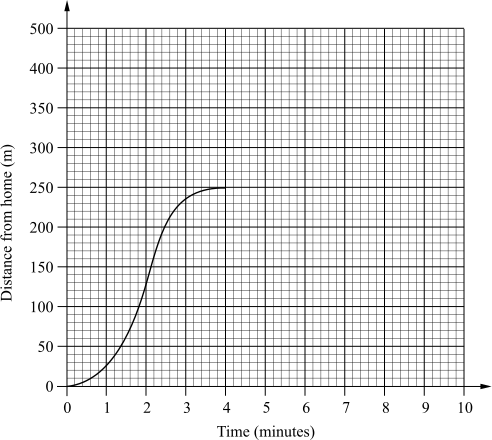
Adam travels on a straight road away from his home. His journey is shown in the distance – time graph.

  1. Describe the journey in the first 4 minutes by referring to change in speed and distance travelled.   (2 marks)

    --- 5 WORK AREA LINES (style=lined) ---

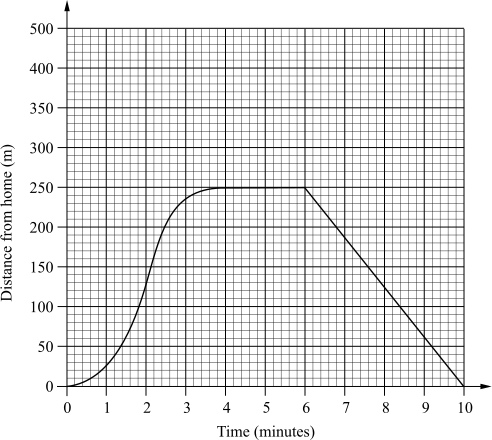
  2. After the 4 minutes shown on the graph. Adam rests for 2 minutes and then return home by travelling on the same road at a constant speed. Adam is away from home for a total of 10 minutes.


    On the above, complete the distance-time using the information provided.   (2 marks)

    --- 0 WORK AREA LINES (style=lined) ---

Show Answers Only
  1. `text{Speed: Adam increases speed until approximately}\ \ t=2,`

    `text{and then decreases speed until he stops when}\ \ t=4.`

    `text{Distance travelled: Adam’s distance from home increases}`

    `text{at an increasing rate until}\ \ t=2, \ text{and then continues}`

    `text{to increase but at a decreasing rate until}\ \ t=4, \ text(when the)`

    `text(distance from home remains the same.)`

  2.  
Show Worked Solution

a.    `text{Speed: Adam increases speed until approximately}\ \ t=2,`

♦ Mean mark part (a) 35%.

`text{and then decreases speed until he stops when}\ \ t=4.`

`text{Distance travelled: Adam’s distance from home increases}`

`text{at an increasing rate until}\ \ t=2, \ text{and then continues}`

`text{to increase but at a decreasing rate until}\ \ t=4, \ text(when the)`

`text(distance from home remains the same.)`

Mean mark part (b) 51%.


b.  `text(S)text(ince Adam travels home at a constant speed, the graph is)`

`text{is a straight line and ends at (10, 0).}`
 

Filed Under: A3 Types of Relationships (Y12) Tagged With: Band 4, Band 5, smc-1099-50-Non-linear graphs

Measurement, STD1 M4 2020 HSC 12

Two painters each provide a quote for painting an area of 1500 square metres. Painter A charges $100 per 30 square metres. Painter B charges $80 per hour and bases their quote on painting 25 square metres per hour.

Calculate how much will be saved by choosing the cheaper quote.   (3 marks)

--- 6 WORK AREA LINES (style=lined) ---

Show Answers Only

`$200`

Show Worked Solution

`text{Painter A cost:}`

`C_A = frac{1500}{30} xx 100 = $5000`
 

`text{Painter B cost:}`

`text(Hours)\ = frac{1500}{25} = 60`

`C_B = 60 xx 80 = $ 4800`
 

`therefore \ text{Savings by using Painter B}`

`= 5000 – 4800`

`=  $200`

Filed Under: M4 Rates (Y12) Tagged With: Band 4, smc-1104-15-General rate problems

Statistics, STD1 S3 2020 HSC 4 MC

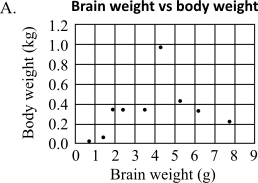
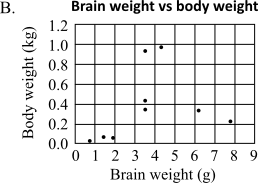
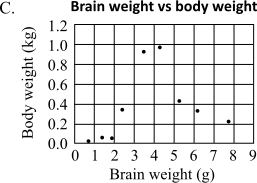
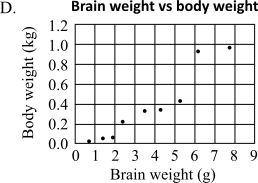
The table shows the average brain weight (in grams) and average body weight (in kilograms) of nine different mammals.

\begin{array} {|l|c|c|c|c|c|c|c|c|}
\hline
\rule{0pt}{2.5ex} \textit{Brain weight (g)} \rule[-1ex]{0pt}{0pt} & 0.7 & 0.4 & 1.9 & 2.4 & 3.5 & 4.3 & 5.3 & 6.2 & 7.8 \\
\hline
\rule{0pt}{2.5ex} \textit{Body weight (kg)} \rule[-1ex]{0pt}{0pt} & 0.02 &0.06 & 0.05 & 0.34 & 0.93 & 0.97 & 0.43 & 0.33 & 0.22 \\
\hline
\end{array}

Which of the following is the correct scatterplot for this dataset?


Show Answers Only

`C`

Show Worked Solution

`text{Consider data point} \ (1.9, 0.05)`

`→ \ text{Eliminate} \ A \ text{(too high)}`

`→ \ text{Eliminate} \ D \ text{(should be below 2nd data point)}`
 

`text{Consider data point} \ (2.4, 0.34)`

`→ \ text{Eliminate} \ B \ text{(not on graph)}` 

`=> \ C`

Filed Under: Bivariate Data, S3 Further Statistical Analysis (Y12) Tagged With: Band 4, num-title-ct-coreb, num-title-qs-hsc, smc-1113-20-Scatterplot from Table, smc-5022-20-Scatterplot from table

Trigonometry, EXT1 T3 2020 HSC 14b

  1. Show that  `sin^3 theta-3/4 sin theta + (sin(3theta))/4 = 0`.  (2 marks)

    --- 7 WORK AREA LINES (style=lined) ---

  2. By letting  `x = 4sin theta`  in the cubic equation  `x^3-12x + 8 = 0`.


    Show that  `sin (3theta) = 1/2`. (2 marks)

    --- 7 WORK AREA LINES (style=lined) ---

  3. Prove that  `sin^2\ pi/18 + sin^2\ (5pi)/18 + sin^2\ (25pi)/18 = 3/2`.  (3 marks)

    --- 10 WORK AREA LINES (style=lined) ---

Show Answers Only
  1. `text(See Worked Solutions)`
  2. `text(See Worked Solutions)`
  3. `text(See Worked Solutions)`
Show Worked Solution

i.   `text(Prove:)\  \ sin^3 theta-3/4 sin theta + (sin(3theta))/4 = 0`

`text(LHS)` `= sin^3 theta-3/4 sin theta + 1/4 (sin 2thetacostheta + cos2thetasintheta)`
  `= sin^3 theta-3/4 sintheta + 1/4(2sinthetacos^2theta + sintheta(1 – 2sin^2theta))`
  `= sin^3theta-3/4 sintheta + 1/4(2sintheta(1-sin^2theta) + sintheta – 2sin^3theta)`
  `= sin^3theta-3/4 sintheta + 1/4(2sintheta-2sin^3theta + sintheta-2sin^3theta)`
  `= sin^3theta-3/4sintheta + 3/4sintheta-sin^3theta`
  `= 0`


ii.   `text(Show)\ \ sin(3theta) = 1/2`

`text{Using part (i):}`

`(sin(3theta))/4` `= 3/4 sintheta-sin^3 theta`
`sin(3theta)` `= 3sintheta-4sin^3theta\ …\ (1)`

 
`x^3-12x + 8 = 0`

`text(Let)\ \ x = 4 sin theta`

`(4sintheta)^3-12(4sintheta) + 8` `= 0`
`64sin^3theta-48sintheta` `= 0`
`−16underbrace{(3sintheta-4sin^2theta)}_text{see (1) above}` `= −8`
`−16 sin(3theta)` `= −8`
`sin(3theta)` `= 1/2`
♦♦♦ Mean mark (iii) 21%.


iii.   `text(Prove:)\ \ sin^2\ pi/18 + sin^2\ (5pi)/18 + sin^2\ (25pi)/18 = 3/2`

`text(Solutions to)\ \ x^3-12x + 8 = 0\ \ text(are)`

`x = 4sintheta\ \ text(where)\ \ sin(3theta) = 1/2`

`text(When)\ \ sin3theta = 1/2,`

`3theta` `= pi/6, (5pi)/6, (13pi)/6, (17pi)/6, (25pi)/6, (29pi)/6, …`
`theta` `= pi/18, (5pi)/18, (13pi)/18, (17pi)/18, (25pi)/18, (29pi)/18, …`

 
`:.\ text(Solutions)`

`x = 4sin\ pi/18 \ \ \ (= 4sin\ (17pi)/18)`

`x = 4sin\ (5pi)/18 \ \ \ (= 4sin\ (13pi)/18)`

`x = 4sin\ (25pi)/18 \ \ \ (= 4sin\ (29pi)/18)`
 

`text(If roots of)\ \ x^3-12x + 8 = 0\ \ text(are)\ \ α, β, γ:`

`α + β + γ = −b/a = 0`

`αβ + βγ + αγ = c/a = −12`

`(4sin\ pi/18)^2 + (4sin\ (5pi)/18)^2 + (4sin\ (25pi)/18)^2` `= (α + β + γ)^2 – 2(αβ + βγ + αγ)`
`16(sin^2\ pi/18 + sin^2\ (5pi)/18 + sin^2\ (25pi)/18)` `= 0-2(−12)`
`:. sin^2\ pi/18 + sin^2\ (5pi)/18 + sin^2\ (25pi)/18` `= 24/16=3/2`

Filed Under: Identities, Equations and 't' formulae (Ext1), Sum, Products and Multiplicity of Roots (Ext1) Tagged With: Band 4, Band 6, smc-1076-10-Double Angle Identities/Equations, smc-1205-10-Sum and Product

Statistics, STD1 S1 2020 HSC 2 MC

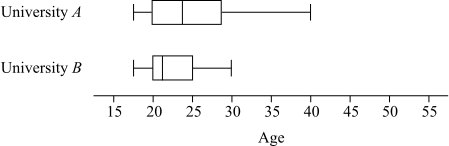
A random sample of students was taken from each of two universities, and their ages were recorded. The boxplots of their ages are shown.


For the given samples of students' ages, which of the following statements is FALSE?

  1. The range for University A is smaller than the range for University B.
  2. The median for University A is higher than the median for University B.
  3. The interquartile range (IQR) for University A is larger than the IQR for University B.
  4. The oldest student in the sample from University A is older than the oldest student in the sample from University B.
Show Answers Only

`A`

Show Worked Solution

`text{Consider} \ A :`

`text{Range of} \ A \ ≈ 40 – 17.5 ≈ 22.5`

`text{Range of} \ B \ ≈ 30 – 17.5 ≈ 12.5`

`therefore \ text{Range for} \ A > text{Range for}\ B`

`=> A`

Filed Under: Summary Statistics - Box Plots (Std1-2027), Summary Statistics (Std 1) Tagged With: Band 4, smc-1131-35-Box Plots, smc-6532-70-Other

Measurement, STD1 M3 2020 HSC 11

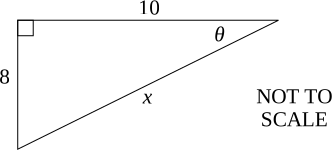
Consider the triangle shown.


  1. Find the value of `theta`, correct to the nearest degree.   (2 marks)

    --- 4 WORK AREA LINES (style=lined) ---

  2. Find the value of `x`, correct to one decimal place.   (2 marks)

    --- 4 WORK AREA LINES (style=lined) ---

Show Answers Only
  1. `39^@`
  2. `12.1 \ text{(to 1 d.p.)}`
Show Worked Solution
a.      `tan theta` `= frac{8}{10}`
  `theta` `= tan ^(-1) frac{8}{10}`
    `= 38.659…`
    `= 39^@ \ text{(nearest degree)}`

♦ Mean mark 44% and 39% for part (a) and (b) respectively.


b.     `text{Using Pythagoras:}`

`x` `= sqrt{8^2 + 10^2}`
  `= 12.806…`
  `= 12.8 \ \ text{(to 1 d.p.)}`

Filed Under: M3 Right-Angled Triangles (Y12) Tagged With: Band 4, Band 5, smc-1103-20-Right-angled Trig

Algebra, STD1 A1 2020 HSC 7 MC

The distance between Bricktown and Koala Creek is 75 km. A person travels from Bricktown to Koala Creek at an average speed of 50 km/h.

How long does it take the person to complete the journey?

  1.  40 minutes
  2.  1 hour 25 minutes
  3.  1 hour 30 minutes
  4.  1 hour 50 minutes
Show Answers Only

`C`

Show Worked Solution

Mean mark 52%.
`text(Time)` `= frac(text(Distance))(text(Speed))`
  `= frac(75)(50)`
  `=1.5 \ text(hours)`
  `= 1 \ text(hour) \ 30 \ text(minutes)`

 
`=> \ C`

Filed Under: Applications: BAC, Medicine and D=SxT (Std1-2027), Applications: D=SxT and Other (Std 1) Tagged With: Band 4, smc-1117-20-Distance Speed Time, smc-6509-20-Speed Distance Time, std2-std1-common

Measurement, STD2 M6 2020 HSC 31

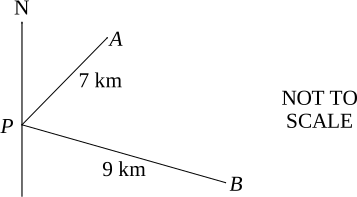
Mr Ali, Ms Brown and a group of students were camping at the site located at `P`. Mr Ali walked with some of the students on a bearing of 035° for 7 km to location `A`. Ms Brown, with the rest of the students, walked on a bearing of 100° for 9 km to location `B`.


  1. Show that the angle `APB` is 65°.  (1 mark)

    --- 2 WORK AREA LINES (style=lined) ---

  2. Find the distance `AB`.  (2 marks)

    --- 4 WORK AREA LINES (style=lined) ---

  3. Find the bearing of Ms Brown's group from Mr Ali's group. Give your answer correct to the nearest degree.  (2 marks)

    --- 4 WORK AREA LINES (style=lined) ---

Show Answers Only
  1. `text(See Worked Solutions)`
  2. `8.76\ text{km  (to 2 d.p.)}`
  3. `146^@`
Show Worked Solution
a.    `angle APB` `= 100 – 35`
    `= 65^@`


b.   `text(Using cosine rule:)`

Mean mark 53%.
`AB^2` `= AP^2 + PB^2 – 2 xx AP xx PB cos 65^@`
  `= 49 + 81 – 2 xx 7 xx 9 cos 65^@`
  `= 76.750…`
`:.AB` `= 8.760…`
  `= 8.76\ text{km  (to 2 d.p.)}`

 
c.

 
`anglePAC = 35^@\ (text(alternate))`

♦♦ Mean mark 22%.

`text(Using cosine rule, find)\ anglePAB:`

`cos anglePAB` `= (7^2 + 8.76 – 9^2)/(2 xx 7 xx 8.76)`  
  `= 0.3647…`  
`:. angle PAB` `= 68.61…^@`  
  `= 69^@\ \ (text(nearest degree))`  


`:. text(Bearing of)\ B\ text(from)\ A\ (theta)` 

`= 180 – (69 – 35)`

`= 146^@`

Filed Under: Bearings and Radial Surveys (Std2) Tagged With: 2adv-std2-common, Band 3, Band 4, Band 5, smc-803-10-Bearings

Calculus, EXT1 C3 2020 HSC 13b

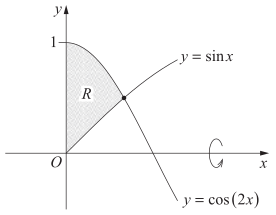
The region `R` is bounded by the `y`-axis, the graph of  `y = cos(2x)`  and the graph of  `y = sin x`, as shown in the diagram.
 

Find the volume of the solid of revolution formed when the region `R` is rotated about the `x`-axis.  (4 marks)

--- 8 WORK AREA LINES (style=lined) ---

Show Answers Only

`(3sqrt3 pi)/16\ text(u)³`

Show Worked Solution

`text(Find intersection:)`

Mean mark 53%.

`sin x = cos 2x`

`sin x = 1 – 2sin^2 x`

`2sin^2 x + sinx – 1` `= 0`
`(2 sinx – 1)(sinx + 1)` `= 0`
`sin x` `= 1/2` `text(or)` `sin x` `= −1`
`x` `= pi/6`   `x` `= (3pi)/2`


`V` `= pi int_0^(pi/6) (cos 2x)^2\ dx – pi int_0^(pi/6)(sin x)^2\ dx`
  `= pi int_0^(pi/6) cos^2 2x – sin^2 x\ dx`
  `= pi int_0^(pi/6) 1/2 (1 + cos 4x) – 1/2 (1 – cos 2x)\ dx`
  `= pi/2 int_0^(pi/6) cos 4x + cos 2x\ dx`
  `= pi/2 [1/4 sin 4x + 1/2 sin 2x]_0^(pi/6)`
  `= pi/8 [sin\ (2pi)/3 + 2sin\ pi/3]`
  `= pi/8 (sqrt3/2 + 2 xx sqrt3/2)`
  `= (3sqrt3 pi)/16\ text(u)³`

Filed Under: Further Area and Solids of Revolution (Ext1) Tagged With: Band 4, smc-1039-20-Trig Function, smc-1039-60-x-axis Rotation

Calculus, EXT1 C2 2020 HSC 13a

  1. Find  `d/(d theta) (sin^3 theta)`.  (1 mark)

    --- 1 WORK AREA LINES (style=lined) ---

  2. Use the substitution  `x = tan theta`  to evaluate  `int_0^1 (x^2)/(1 + x^2)^(5/2)\ dx`.  (4 marks)

    --- 12 WORK AREA LINES (style=lined) ---

Show Answers Only
  1. `3 cos theta sin^2 theta`
  2. `sqrt2/12`
Show Worked Solution

i.   `d/(d theta) (sin^3 theta) = 3 cos theta sin^2 theta`


ii.   `text(Let)\ x = tan theta`

`(dx)/(d theta) = sec^2 theta \ => \ dx  = sec^2 theta\ d theta`

`text(When)\ x = 1, \ theta = pi/4`

`text(When)\ x = 0, \ theta = 0`

`int_0^1 (x^2)/(1 + x^2)^(5/2) dx` `= int_0^(pi/4) (tan^2 theta)/((1 + tan^2 theta)^(5/2)) xx sec^2 theta\ d theta`
  `= int_0^(pi/4) (tan^2 theta)/((sec^2 theta)^(5/2)) xx sec^2 theta\ d theta`
  `= int_0^(pi/4) (sin^2 theta)/(cos^2 theta) · 1/((sec^2 theta)^(3/2))\ d theta`
  `= int_0^(pi/4) (sin^2 theta)/(cos^2 theta) · 1/(sec^3 theta)\ d theta`
  `= int_0^(pi/4) sin^2 theta cos theta\ d theta`
  `= 1/3[sin^3 theta]_0^(pi/4)`
  `= 1/3(sin^3\ pi/4 – 0)`
  `= 1/3 (1/sqrt2)^3`
  `= 1/(6sqrt2)`
  `= sqrt2/12`

Filed Under: Integration By Substitution (Ext1) Tagged With: Band 4, smc-1036-30-Trig, smc-1036-60-Diff then integrate

Calculus, EXT1 C2 2020 HSC 12d

Find  `int_0^(pi/2) cos 5x\ sin 3x\ dx`.  (3 marks)

Show Answers Only

`−1/2`

Show Worked Solution
`int_0^(pi/2) cos 5x\ sin 3x\ dx` `= 1/2 int_0^(pi/2) 2cos 5x\ sin 3x\ dx`
  `= 1/2 int_0^(pi/2) sin 8x-sin 2x\ dx`
  `= 1/2[−1/8 cos 8x + 1/2 cos 2x]_0^(pi/2)`
  `= 1/2[(−1/8 cos 4pi + 1/2 cospi)-(−1/8 cos0 + 1/2 cos0)]`
  `= 1/2(−1/8-1/2 + 1/8-1/2)`
  `= −1/2`

Filed Under: Harder Trig Calculus (Ext1) Tagged With: Band 4, smc-1038-30-Compound angles

Combinatorics, EXT1 A1 2020 HSC 12c

To complete a course, a student must choose and pass exactly three topics.

There are eight topics from which to choose.

Last year 400 students completed the course.

Explain, using the pigeonhole principle, why at least eight students passed exactly the same three topics.  (2 marks)

--- 6 WORK AREA LINES (style=lined) ---

Show Answers Only

`text(See Worked Solution)`

Show Worked Solution

`\ ^8C_3 = 56\ text(ways of choosing 3 topics)`

Mean mark 52%.

`text(400 students pass)`

`text(Pigeonholes)\ (k)= 56`

`text(Pigeons)\ (n) = 400`

`n/k` `= 400/56`
  `= 7.14…`

 
`:.\ text(By PHP, at least 8 students passed the)`

`text(same 3 subjects.)`

Filed Under: Permutations and Combinations (Ext1) Tagged With: Band 4, smc-1082-40-Pigeonhole

Statistics, EXT1 S1 2020 HSC 12b

When a particular biased coin is tossed, the probability of obtaining a head is `3/5`.

This coin is tossed 100 times.

Let `X` be the random variable representing the number of heads obtained. This random variable will have a binomial distribution.

  1. Find the expected value, `E(X)`.  (1 mark)

    --- 2 WORK AREA LINES (style=lined) ---

  2. By finding the variance, `text(Var)(X)`, show that the standard deviation of `X` is approximately 5.  (1 mark)

    --- 3 WORK AREA LINES (style=lined) ---

  3. By using a normal approximation, find the approximate probability that `X` is between 55 and 65.  (1 mark)

    --- 1 WORK AREA LINES (style=lined) ---

Show Answers Only
  1. `60`
  2. `text(See Worked Solutions)`
  3. `68text(%)`
Show Worked Solution

i.   `X = text(number of heads)`

`X\ ~\ text(Bin) (n, p)\ ~\ text(Bin) (100, 3/5)`

`E(X)` `= np`
  `= 100 xx 3/5`
  `= 60`


ii.    `text(Var)(X)` `= np(1 – p)`
    `= 60 xx 2/5`
    `= 24`


`sigma(x)` `= sqrt24`
  `~~ 5`


iii.    `P(55 <= x <=65)` `~~ P(−1 <= z <= 1)`
    `~~ 68text(%)`

Filed Under: Normal Approximations of Sample Proportions (Ext1), Statistics and Binomial Distributions (Ext1) Tagged With: Band 2, Band 3, Band 4, smc-1085-20-z-score intervals, smc-1199-10-Calculate E(X), smc-1199-20-Calculate Var(X)/Std Dev

Measurement, STD2 M1 2020 HSC 25

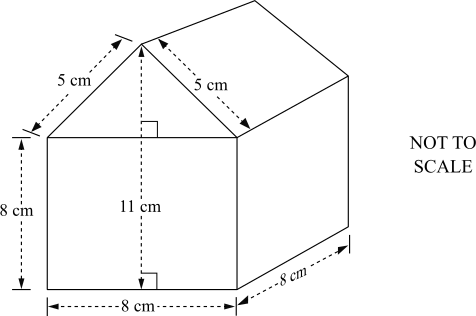
A composite solid consists of a triangular prism which fits exactly on top of a cube, as shown.
 

Find the surface area of the composite solid.   (3 marks)

--- 6 WORK AREA LINES (style=lined) ---

Show Answers Only

`424 \ text{cm}^2`

Show Worked Solution

`text{S.A. of 1 face of cube} = 8 xx 8 = 64 \ text{cm}^2`

`text{Height of triangle} = 11 – 8 = 3 \ text{cm}`

`therefore \ text{S.A. (triangular prism)}` `= 2 xx ( frac{1}{2} xx 8 xx 3 ) + 2 xx (5 xx 8)`
  `= 24 + 80`
  `= 104 \ text{cm}^2`


`therefore \ text{Total S.A.}` `= 5 xx 64 + 104`
  `= 424 \ text{cm}^2`

Filed Under: Area and Surface Area, Perimeter, Area and Volume (Std 2), Surface Area (Std1-2027), Surface Area (Std2-2027) Tagged With: Band 4, num-title-ct-corea, num-title-qs-hsc, smc-4234-40-SA (prisms), smc-6484-10-Surface Area (Composite Shapes), smc-6522-10-Surface Area (Composite Shapes), smc-798-25-Surface Area

Functions, 2ADV F1 2020 HSC 11

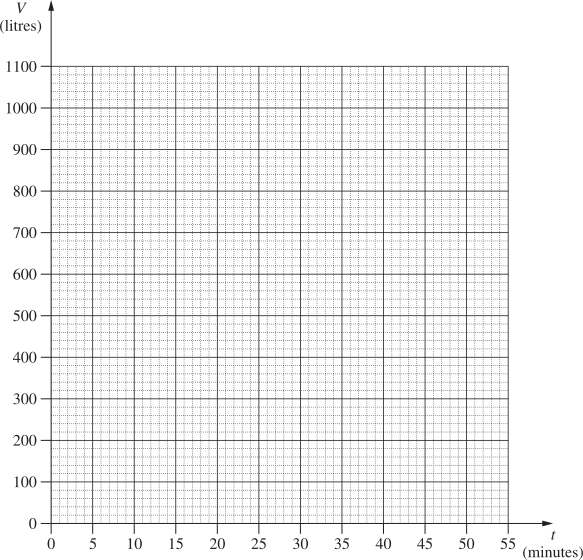
There are two tanks on a property, Tank `A` and Tank `B`. Initially, Tank `A` holds 1000 litres of water and Tank B is empty.

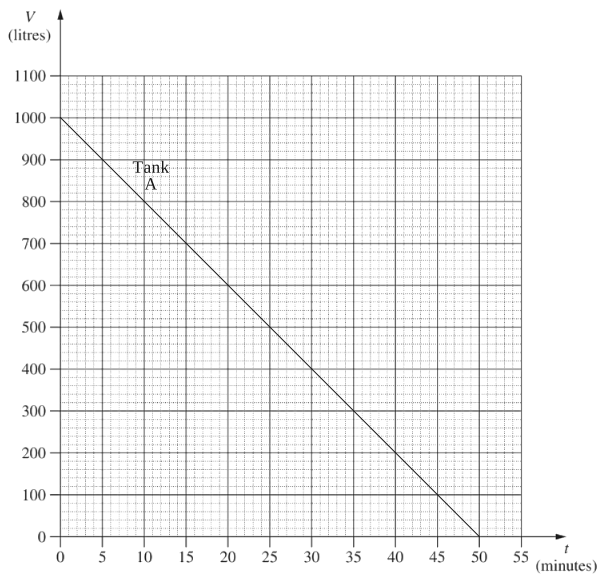
  1.  Tank `A` begins to lose water at a constant rate of 20 litres per minute. The volume of water in Tank `A` is modelled by  `V = 1000 - 20t`  where  `V`  is the volume in litres and  `t`  is the time in minutes from when the tank begins to lose water.   (1 mark)
     
    On the grid below, draw the graph of this model and label it as Tank `A`.


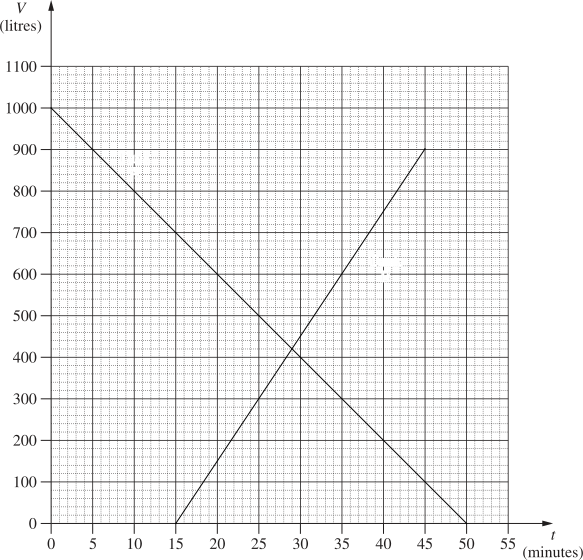
  2. Tank `B` remains empty until  `t=15`  when water is added to it at a constant rate of 30 litres per minute.


    By drawing a line on the grid (above), or otherwise, find the value of  `t`  when the two tanks contain the same volume of water.  (2 marks)

  3. Using the graphs drawn, or otherwise, find the value of  `t`  (where  `t > 0`) when the total volume of water in the two tanks is 1000 litres.  (1 mark)

    --- 2 WORK AREA LINES (style=lined) ---

Show Answers Only
  1.  `text{T} text{ank} \ A \ text{will pass trough (0, 1000) and (50, 0)}` 
      
  2. `29 \ text{minutes}`
  3. `45 \ text{minutes}`
Show Worked Solution

a.     `text{T} text{ank} \ A \ text{will pass trough (0, 1000) and (50, 0)}` 


b.   `text{T} text{ank} \ B \ text{will pass through (15, 0) and (45, 900)}`  


`text{By inspection, the two graphs intersect at} \ \ t = 29 \ text{minutes}`

 
c.   `text{Strategy 1}`

`text{By inspection of the graph, consider} \ \ t = 45`

`text{T} text{ank A} = 100 \ text{L} , \ text{T} text{ank B} =900 \ text{L} `

`:.\ text(Total volume = 1000 L when  t = 45)`
  

`text{Strategy 2}`

`text{Total Volume}` `=text{T} text{ank A} + text{T} text{ank B}`
`1000` `= 1000 – 20t + (t – 15) xx 30`
`1000` `= 1000 – 20t + 30t – 450 `
`10t` `= 450`
`t` `= 45 \ text{minutes}`

Filed Under: Linear Functions (Adv-2027), Linear Functions (Y11) Tagged With: 2adv-std2-common, Band 2, Band 3, Band 4, common-content, smc-6214-50-Simultaneous Equations, smc-985-40-Simultaneous Equations

Algebra, STD2 A4 2020 HSC 24

There are two tanks on a property, Tank A and Tank B. Initially, Tank A holds 1000 litres of water and Tank B is empty.

  1. Tank A begins to lose water at a constant rate of 20 litres per minute.


    The volume of water in Tank A is modelled by  `V = 1000 - 20t`  where `V` is the volume in litres and  `t`  is the time in minutes from when the tank begins to lose water.


    On the grid below, draw the graph of this model and label it as Tank A.   (1 mark)


  2. Tank B remains empty until  `t=15`  when water is added to it at a constant rate of 30 litres per minute.
    By drawing a line on the grid (above), or otherwise, find the value of  `t`  when the two tanks contain the same volume of water.  (2 marks)

    --- 2 WORK AREA LINES (style=lined) ---

  3. Using the graphs drawn, or otherwise, find the value of  `t`  (where  `t > 0`) when the total volume of water in the two tanks is 1000 litres.  (1 mark)

    --- 1 WORK AREA LINES (style=lined) ---

Show Answers Only
  1.  `text{T} text{ank} \ A \ text{will pass trough (0, 1000) and (50, 0)}` 
      
  2. `29 \ text{minutes}`
  3. `45 \ text{minutes}`
Show Worked Solution

a.     `text{T} text{ank} \ A \ text{will pass trough (0, 1000) and (50, 0)}` 


b.   `text{T} text{ank} \ B \ text{will pass through (15, 0) and (45, 900)}`  


`text{By inspection, the two graphs intersect at} \ \ t = 29 \ text{minutes}`

 
c.   `text{Strategy 1}`

♦♦ Mean mark part (c) 22%.

`text{By inspection of the graph, consider} \ \ t = 45`

`text{T} text{ank A} = 100 \ text{L} , \ text{T} text{ank B} =900 \ text{L} `

`:.\ text(Total volume = 1000 L when  t = 45)`
  

`text{Strategy 2}`

`text{Total Volume}` `=text{T} text{ank A} + text{T} text{ank B}`
`1000` `= 1000 – 20t + (t – 15) xx 30`
`1000` `= 1000 – 20t + 30t – 450 `
`10t` `= 450`
`t` `= 45 \ text{minutes}`

Filed Under: Simultaneous Equations and Applications (Std 2) Tagged With: 2adv-std2-common, Band 3, Band 4, Band 5, common-content, smc-794-15-Other SE Applications, smc-794-20-Find Intersection, smc-794-30-Sketch Linear Equations

Trigonometry, EXT1 T3 2020 HSC 11d

By expressing  `sqrt3 sin x + 3 cos x`  in the form  `A sin (x + a)`, solve  `sqrt3 sin x + 3 cos x = sqrt3`, for  `0 <= x <= 2pi`.  (4 marks)

--- 8 WORK AREA LINES (style=lined) ---

Show Answers Only

`x = pi/2, \ (11pi)/6`

Show Worked Solution

`A sin(x + alpha) = sqrt3 sinx + 3cosx`

`Asinx cos alpha + Acosx sin alpha = sqrt3 sinx + 3cosx`
 

`text(Equating co-efficients:)`

`=> Acos alpha = sqrt3`

`=> Asin alpha = 3`

`A^2` `= (sqrt3)^2 + 3^2 = 12`
`:. A` `= sqrt12`
`(Asinalpha)/(Acosalpha)` `= 3/sqrt3`
`tanalpha` `= sqrt3`
`alpha` `= pi/3`


`sqrt3 sinx + 3cosx` `= sqrt3`
`sqrt12 sin(x + pi/3)` `= sqrt3`
`sin(x + pi/3)` `= 1/2`
`x + pi/3` `= (5pi)/6, (13pi)/6`
`:. x` `= pi/2, (11pi)/6\ \ \ (0 <= x <= 2pi)`

Filed Under: Auxiliary Angles (Ext1) Tagged With: Band 4, smc-1075-10-Rsin

Calculus, EXT1 C1 2020 HSC 10 MC

The quantities `P`, `Q` and `R` are connected by the related rates.

`(dR)/(dt) = −k^2`

`(dP)/(dt) = −l^2 xx (dR)/(dt)`

`(dP)/(dt) = m^2 xx (dQ)/(dt)`

where `k`, `l` and `m` are non-zero constants.

Which of the following statements is true?

  1. `P` is increasing and `Q` is increasing
  2. `P` is increasing and `Q` is decreasing
  3. `P` is decreasing and `Q` is increasing
  4. `P` is decreasing and `Q` is decreasing
Show Answers Only

`A`

Show Worked Solution

`(dR)/(dt) = −k^2 < 0 => R\ text(is decreasing)`

`(dP)/(dt) = −l^2 xx (dR)/(dt) > 0 => P\ text(is increasing)`

`(dP)/(dt) = m^2 xx (dQ)/(dt) > 0 => Q\ text(is increasing)`

`=> A`

Filed Under: Related Rates of Change (Ext1) Tagged With: Band 4, smc-1079-40-Other Themes

Vectors, EXT1 V1 2020 HSC 9 MC

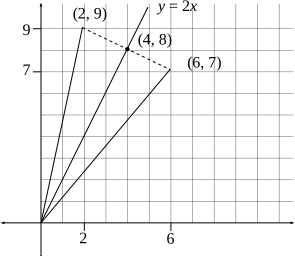
The projection of the vector  `((6),(7))`  onto the line  `y = 2x`  is  `((4),(8))`.

The point  `(6, 7)`  is reflected in the line  `y = 2x`  to a point `A`.

What is the position vector of the point `A`?

  1. `((6),(12))`
  2. `((2),(9))`
  3. `((−6),(7))`
  4. `((−2),(1))`
Show Answers Only

`B`

Show Worked Solution

`text(Graph the projection and reflection:)`


`=>B`

Filed Under: Operations With Vectors (Ext1), Vectors and Geometry (Ext1) Tagged With: Band 4, smc-1086-30-Unit Vectors and Projections, smc-1211-60-Other, smc-1211-70-Projections

Combinatorics, EXT1 A1 2020 HSC 8 MC

Out of 10 contestants, six are to be selected for the final round of a competition. Four of those six will be placed 1st, 2nd, 3rd and 4th.

In how many ways can this process be carried out?

  1. `(10!)/(6!4!)`
  2. `(10!)/(6!)`
  3. `(10!)/(4!2!)`
  4. `(10!)/(4!4!)`
Show Answers Only

`C`

Show Worked Solution
`text(Combinations)` `= \ ^10 C_6 xx \ ^6P_4`
  `= \ ^10 C_6 xx 6 xx 5 xx 4 xx 3`
  `= (10!)/(6!4!) xx (6!)/(2!)`
  `= (10!)/(4!2!)`

  
`=>C`

Filed Under: Permutations and Combinations (Ext1) Tagged With: Band 4, smc-1082-10-Ordered Combinations, smc-1082-20-Unordered Combinations

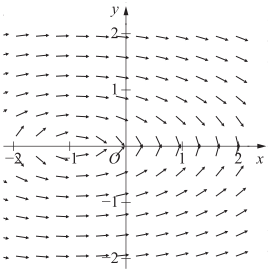
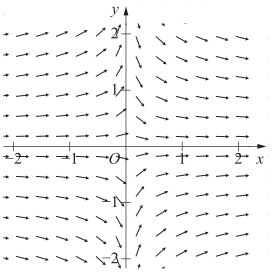
Calculus, EXT1 C3 2020 HSC 7 MC

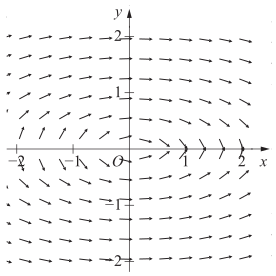
Which of the following best represents the direction field for the differential equation  `(dy)/(dx) = −x/(4y)`?

A. B.
C. D.
Show Answers Only

`A`

Show Worked Solution

`text(At)\ \ x = 0, (dy)/(dx) = 0\ (text(horizontal))`

`=>A`

Filed Under: Equations and Slope Fields Tagged With: Band 4, smc-1197-10-Slope Fields

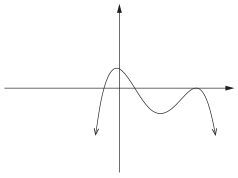
Functions, EXT1 F2 2020 HSC 5 MC

A monic polynomial  `p(x)`  of degree 4 has one repeated zero of multiplicity 2 and is divisible by  `x^2 + x + 1`.

Which of the following could be the graph of  `p(x)`?

A. B.
C. D.
Show Answers Only

`C`

Show Worked Solution

`text(S)text(ince)\ \ p(x)\ \ text(is monic,)`

`=> p(x) = (x – a)^2(x^2 + x + 1)`
 

`text(Consider)\ \ x^2 + x + 1`

`Delta = sqrt(1^2 – 4 · 1 · 1) = sqrt(−3) < 0 => text(No roots)`

`:. text(Only root is)\ \ x = a\ \ (text(multiplicity 2))`

`=>\ text(Eliminate)\ \ B and D`

`text(As)\ \ x -> ∞, \ p(x) -> ∞`

`=>C`

Filed Under: Sum, Products and Multiplicity of Roots (Ext1) Tagged With: Band 4, smc-1205-20-Multiplicity of Roots

Functions, EXT1 F1 2020 HSC 2 MC

Given  `f(x) = 1 + sqrtx`, what are the domain and range of  `f^(−1)(x)`

  1. `x >= 0,\ \ y >= 0`
  2. `x >= 0,\ \ y >= 1`
  3. `x >= 1,\ \ y >= 0`
  4. `x >= 1,\ \ y >= 1`
Show Answers Only

`C`

Show Worked Solution

`text(Domain)\ \ f(x): \ x >= 0`

`text(Range)\ \ f(x): \ y >= 1`

`text(Domain)\ \ f^(−1) = text(Range)\ \ f(x) = x >= 1`
`text(Range)\ \ f^(−1) = text(Range)\ \ f(x) = y >= 0`

`=> C`

Filed Under: Inverse Functions (Ext1-2027), Inverse Functions (Ext1) Tagged With: Band 4, smc-1034-20-Other Functions, smc-6641-20-Other Functions

Trigonometry, 2ADV T3 2020 HSC 31

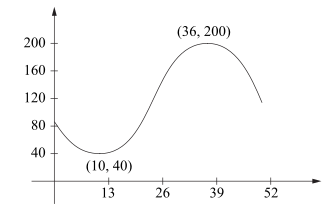
The population of mice on an isolated island can be modelled by the function.

`m(t) = a sin (pi/26 t) + b`,

where  `t`  is the time in weeks and  `0 <= t <= 52`. The population of mice reaches a maximum of 35 000 when  `t=13`  and a minimum of 5000 when  `t = 39`. The graph of  `m(t)`  is shown.
 

  1. What are the values of `a` and `b`?  (2 marks)

    --- 3 WORK AREA LINES (style=lined) ---

  2. On the same island, the population of cats can be modelled by the function
     
    `\ \ \ \ \ c(t) = −80cos(pi/26 (t - 10)) + 120`
     
    Consider the graph of  `m(t)`  and the graph of  `c(t)`.


    Find the values of  `t, \ 0 <= t <= 52`, for which both populations are increasing.  (3 marks)

    --- 7 WORK AREA LINES (style=lined) ---

  3. Find the rate of change of the mice population when the cat population reaches a maximum.  (2 marks)

    --- 5 WORK AREA LINES (style=lined) ---

Show Answers Only
  1. `a = 15\ 000, b = 20\ 000`
  2. `text(Both populations are increasing when)\ 10 < t < 13`
  3. `\text(– 643 mice per week)`
Show Worked Solution
a.    `b` `= (35\ 000 + 5000)/2`
    `= 20\ 000`


`a` `=\ text(amplitude of sin graph)`
  `= 35\ 000 – 20\ 000`
  `= 15\ 000`


b.   `text(By inspection of the)\ \ m(t)\ \ text(graph)`

♦♦ Mean mark part (b) 30%.

`m^{′}(t) > 0\ \ text(when)\ \ 0 <= t < 13\ \ text(and)\ \ 39 < t <= 52`

`text(Sketch)\ \ c(t):`

`text(Minimum)\ \ (cos0)\ \ text(when)\ \ t = 10`

`text(Maximum)\ \ (cospi)\ \ text(when)\ \ t = 36`

`:. c^{′}(t) > 0\ \ text(when)\ \ 10 < t < 36`

`:. text(Both populations are increasing when)\ \ 10 < t < 13`


c.   `c(t)\ text(maximum when)\ \ t = 36`

♦♦♦ Mean mark part (c) 27%.
`m(t)` `= 15\ 000 sin(pi/26 t) + 20\ 000`
`m^{′}(t)` `= (15\ 000pi)/26 cos(pi/26 t)`
`m^{′}(36)` `= (15\ 000pi)/26 · cos((36pi)/26)`
  `= -642.7`

 
`:.\ text(Mice population is decreasing at 643 mice per week.)`

Filed Under: Rates of Change (Y12), Trig Applications (Y12) Tagged With: Band 4, Band 5, Band 6, smc-1091-25-Other Themes, smc-1091-40-Trig Function, smc-1188-10-Population

Measurement, STD2 M7 2020 HSC 23

In a tropical drink, the ratio of pineapple juice to mango juice to orange juice is 15 : 9 : 4 .

  1. How much orange juice is needed if the tropical drink is to contain 3 litres of pineapple juice?  (2 marks)

    --- 4 WORK AREA LINES (style=lined) ---

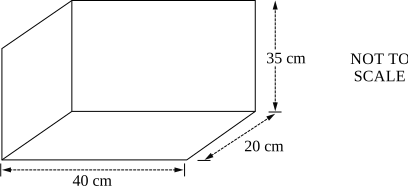
  2. The internal dimensions of a drink container, in the shape of a rectangular prism, are shown.


    To completely fill the container with the tropical drink, how many litres of mango juice are required. (3 marks)

    --- 6 WORK AREA LINES (style=lined) ---

Show Answers Only
  1. `0.8 \ text{L}`
  2. `9\ text{L}`
Show Worked Solution
a.    `text(15 parts)` `= 3\ text(L)`
  `text(1 part)` `=3/15`
    `=0.2\ text(L)`


`:.\ text(4 parts)` `=4 xx 0.2`  
  `=0.8\ text(L)`  


Mean mark 51%.
b.      `text{Volume of container}` `= 40 xx 20 xx 35`
    `= 28 \ 000 \ text{cm}^3`

 
`1 \ text{mL} \ to \ 1 \ text{cm}^3`

`⇒ \ 28 \ 000 \ text{mL of tropical drink}`

`therefore \ text{Mango juice required}` `=text(Mango parts)/text(Total parts) xx 28\ 000`
  `= frac{9}(28} xx 28 \ 000`
  `= 9000 \ text{mL}`
  `=9\ text(L)`

Filed Under: Ratio and Scale (Std2) Tagged With: Band 4, Band 5, smc-1187-20-Ratio (3 part)

Statistics, 2ADV S3 2020 HSC 28

In a particular country, the hourly rate of pay for adults who work is normally distributed with a mean of $25 and a standard deviation of $5.

  1. Two adults who both work are chosen at random.


    Find the probability that at least one of them earns between $15 and $30 per hour.  (3 marks)

    --- 6 WORK AREA LINES (style=lined) ---

  2. The number of adults who work is equal to three times the number of adults who do not work.


    One adult is chosen at random.


    Find the probability that the chosen adult works and earn more than $25 per hour.  (2 marks)

    --- 4 WORK AREA LINES (style=lined) ---

Show Answers Only
  1. `0.965775`
  2. `3/8`
Show Worked Solution

`ztext(-score)\ ($15) = (x – mu)/sigma = (15 – 25)/5 = −2`

♦ Mean mark part (a) 40%.

`ztext(-score)\ ($30) = (30 -25)/5 = 1`
 

`text(Percentage of scores where)\  −2 <= z <= 1`

`= 81.5text(%)`
 

`P(text(at least one earns between $15 – $30))`

`= 1 – P(text(neither))`

`= 1 – (1-0.815)^2`

`=1-0.185^2`

`= 0.965775`


b.
   `P(text(works)) = 3/4, \ P(text(earns) > $25) = 1/2`

`:. P(text(works and earns) > $25)`

`= 3/4 xx 1/2`

`= 3/8`

Filed Under: Normal Distribution (Y12) Tagged With: Band 4, Band 5, smc-995-20-z-score Intervals, smc-995-30-Comparisons of Data Sets

Trigonometry, 2ADV T1 2020 HSC 22

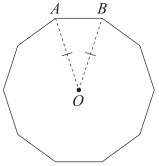
The diagram shows a regular decagon (ten-sided shape with all sides equal and all interior angles equal). The decagon has centre `O`.
 

The perimeter of the shape is 80 cm.

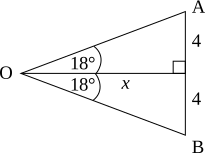
By considering triangle `OAB`, calculate the area of the ten-sided shape. Give your answer in square centimetres correct to one decimal place.  (4 marks)

--- 8 WORK AREA LINES (style=lined) ---

Show Answers Only

`492.4\ text(cm²)`

Show Worked Solution

`angle AOB = 360/10 = 36^@`

`AB = 80/10 = 8\ text(cm)`

`DeltaAOB\ text(is made up of 2 identical right-angled triangles)`
 

`tan 18^@` `= 4/x`
`x` `= 4/(tan 18^@)`


`:.\ text(Area of decagon)` `= 20 xx 1/2 xx 4/(tan 18^@) xx 4`
  `= 492.429…`
  `= 492.4\ text(cm²  (to 1 d.p.))`

Filed Under: Circular Measure (Adv-2027), Circular Measure (Y11) Tagged With: 2adv-std2-common, Band 4, smc-6394-30-Area - Other, smc-978-30-Area - Other

Calculus, 2ADV C4 2020 HSC 30

The diagram shows two parabolas  `y = 4x - x^2`  and  `y = ax^2`, where  `a > 0`. The two parabolas intersect at the origin, `O`, and at `A`.


  1. Show that the `x`-coordinate of  `A`  is  `4/(a + 1)`.  (2 marks)

    --- 4 WORK AREA LINES (style=lined) ---

  2. Find the value of  `a`  such that the shaded area is `16/3`.  (4 marks)

    --- 8 WORK AREA LINES (style=lined) ---

Show Answers Only
  1. `text(See Worked Solutions)`
  2. `sqrt2 – 1`
Show Worked Solution

a.   `text(Intersection occurs when)`

`4x – x^2` `= ax^2`
`x^2(a + 1) – 4x` `= 0`
`x[x(a + 1) – 4]` `= 0`
`x(a+1)-4` `=0\ \ \ text(or)`   `x=0`
`:. x_A` `=4/(a + 1)`  

♦ Mean mark part (b) 48%.


b.    `text(Area)` `= int_0^(4/(a + 1)) 4x – x^2\ dx – int_0^(4/(a + 1)) ax^2\ dx`
  `16/3` `= int_0^(4/(a + 1)) 4x – (1 + a)x^2\ dx`
  `16/3` `= [2x^2 – ((1 + a)/3) x^3]_0^(4/(a + 1))`
  `16/3` `= 2(4/(a + 1))^2 – ((1 + a)/3)(4/(a + 1))^3`
  `16/3` `= 32/((a + 1)^2) – 64/3 · 1/((a + 1)^2)`
  `16` `= 96/((a + 1)^2) – 64/((a + 1)^2)`
`16(a + 1)^2` `= 32`
`(a + 1)^2` `= 2`
`a + 1` `= sqrt2,\ \ \ (a > 0)`
`:. a` `= sqrt2 – 1`

Filed Under: Areas Under Curves (Y12) Tagged With: Band 4, Band 5, smc-975-10-Quadratic

Calculus, 2ADV C3 2020 HSC 29

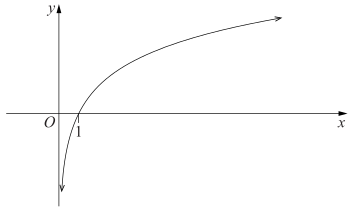
The diagram shows the graph of  `y = c ln x, \ c > 0`.
 

  1. Show that the equation of the tangent to  `y = c ln x`  at  `x = p`, where  `p > 0`, is
     
    `\ \ \ \ \ y = c/p x - c + c ln p`.  (2 marks)

    --- 5 WORK AREA LINES (style=lined) ---

  2. Find the value of `c` such that the tangent from part (a) has a gradient of 1 and passes through the origin.  (2 marks)

    --- 5 WORK AREA LINES (style=lined) ---

Show Answers Only
  1. `text(See Worked Solutions)`
  2. `c = e`
Show Worked Solution

a.   `y = c ln x`

`(dy)/(dx) = c/x`

`text(At)\ x = p,`

`m_text(tang) = c/p`

`text(T)text(angent passes through)\ (p, c ln p)`

 
`:.\ text(Equation of tangent)`

`y – c ln p` `= c/p (x – p)`
`y` `= c/p x – c + c ln p`


b.   `text(If)\ m_text(tang) = 1,`

♦ Mean mark part (b) 40%.
`c/p` `= 1`
`c` `= p`

 
`text(If tangent passes through)\ (0, 0)`

`0` `= −c + c ln c`
`0` `= c(ln c – 1)`

 
`ln c = 1\ \ (c > 0)`

`:. c = e`

Filed Under: Tangents (Y12) Tagged With: Band 4, Band 5, smc-1090-20-Log/Exp Function, smc-1090-40-Find tangent given curve, smc-966-40-Log graphs

Financial Maths, STD2 F5 2020 HSC 34

Tina inherits $60 000 and invests it in an account earning interest at a rate of 0.5% per month. Each month, immediately after the interest has been paid, Tina withdraws $800.

The amount in the account immediately after the `n`th withdrawal can be determined using the recurrence relation

`A_n = A_(n - 1)(1.005) - 800`,

where `n = 1, 2, 3, …`  and  `A_0 = 60\ 000`

  1. Use the recurrence relation to find the amount of money in the account immediately after the third withdrawal.  (2 marks)

    --- 4 WORK AREA LINES (style=lined) ---

  2. Calculate the amount of interest earned in the first three months.  (2 marks)

    --- 4 WORK AREA LINES (style=lined) ---

Show Answers Only
  1. `$58\ 492.49`
  2. `$892.49`
Show Worked Solution

♦ Mean mark part (a) 41%.
a.    `A_1` `= 60\ 000(1.005) – 800 = $59\ 500`
  `A_2` `= 59\ 500(1.005) – 800 = $58\ 997.50`
  `A_3` `= 58\ 997.50(1.005) – 800 = $58\ 492.49`


b.   `text{Amount (not interest)}`

♦♦ Mean mark part (b) 33%.

`= 60\ 000 – (3 xx 800)`

`= $57\ 600`
 

`:.\ text(Interest earned in 3 months)`

`= A_3 – 57\ 600`

`= 58\ 492.49 – 57\ 600`

`= $892.49`

Filed Under: F5 Annuities (Y12) Tagged With: 2adv-std2-common, Band 4, Band 5, common-content, smc-816-50-Recurrence Relation

Financial Maths, 2ADV M1 2020 HSC 26

Tina inherits $60 000 and invests it in an account earning interest at a rate of 0.5% per month. Each month, immediately after the interest has been paid, Tina withdraws $800.

The amount in the account immediately after the `n`th withdrawal can be determined using the recurrence relation

`A_n = A_(n - 1)(1.005) - 800`,

where `n = 1, 2, 3, …`  and  `A_0 = 60\ 000`

  1. Use the recurrence relation to find the amount of money in the account immediately after the third withdrawal.  (2 marks)

    --- 5 WORK AREA LINES (style=lined) ---

  2. Calculate the amount of interest earned in the first three months.  (2 marks)

    --- 4 WORK AREA LINES (style=lined) ---

  3. Calculate the amount of money in the account immediately after the 94th withdrawal.  (3 marks) 

    --- 6 WORK AREA LINES (style=lined) ---

Show Answers Only
  1. `$58\ 492.49`
  2. `$892.49`
  3. `$187.85`
Show Worked Solution
a.    `A_1` `= 60\ 000(1.005) – 800 = $59\ 500`
  `A_2` `= 59\ 500(1.005) – 800 = $58\ 997.50`
  `A_3` `= 58\ 997.50(1.005) – 800 = $58\ 492.49`


b.   `text{Amount (not interest)}`

`= 60\ 000 – (3 xx 800)`

`= $57\ 600`
 

`:.\ text(Interest earned in 3 months)`

`= A_3 – 57\ 600`

`= 58\ 492.49 – 57\ 600`

`= $892.49`
 

c.   `A_1 = 60\ 000(1.005) – 800`

`A_2` `= [60\ 000(1.005) – 800](1.005) – 800`
  `= 60\ 000(1.005)^n – 800(1.005 + 1)`
`vdots`  
`A_n` `= 60\ 000(1.005)^n – 800(1 + 1.005 + … + 1.005^(n – 1))`
`A_94` `= 60\ 000(1.005)^94 – 800\ underbrace((1 + 1.005 + … + 1.005^93))_(text(GP where)\ a = 1,\ r = 1.005,\ n = 94)`
  `= 60\ 000(1.005)^94 – 800 ((1(1.005^94 – 1))/(1.005 – 1))`
  `= 60\ 000(1.005)^94 – 160\ 000(1.005^94 – 1)`
  `= $187.85`

Filed Under: Financial Applications of Series (Y12) Tagged With: Band 3, Band 4, Band 5, smc-1007-30-Annuity/Deposit - Withdrawal Phase, smc-1007-60-Recursion

Financial Maths, STD2 F4 2020 HSC 22

Nisa has a credit card on which interest at 17% per annum, compounded daily, is charged on the amount owing.

At the beginning of the month, Nisa owes $500 on her credit card. She makes no other purchases using the credit card, but fifteen days later, she repays $250.

Assuming that interest is charged for the fifteen days, calculate the amount owing on the credit card immediately after the $250 payment is made.   (3 marks)

Show Answers Only

`$253.50`

Show Worked Solution

`text{Days of interest}\ (n) = 15`

`text{Daily interest rate}\ (r) = frac{0.17}{365} = 0.00046575 …`

`text{Amount owing}\ (FV)` `= PV (1 + r)^n – 250`
  `= 500 (1.00046575 …)^15 – 250`
  `= 503.50 – 250`
  `= $253.50`

Filed Under: Loans and Credit Cards (Std 2) Tagged With: Band 4, smc-814-10-Credit Cards

Financial Maths, STD2 F4 2020 HSC 21

The inflation rate over the year from January 2019 to January 2020 was 2%.

The cost of a school jumper in January 2020 was $122.

Calculate the cost of the jumper in January 2019 assuming that the only change in the cost of the jumper was due to inflation.   (2 marks)

--- 5 WORK AREA LINES (style=lined) ---

Show Answers Only

`$119.61`

Show Worked Solution
`FV` `=PV(1+r)^n`
`122` `=C_(2019)(1+0.02)^1`
`C_2019 xx 1.02` `= 122`
`C_2019` `= frac(122)(1.02)`
  `= $119.61`

Filed Under: Compound Interest, Compound Interest and Shares (Std2), F2 Investment (Y12) Tagged With: Band 4, num-title-ct-coreb, num-title-qs-hsc, smc-1108-20-FV Formula, smc-4334-30-Find PV, smc-817-20-FV Formula

Financial Maths, STD2 F1 2020 HSC 20

The table shows the income tax rates for the 2019 – 2020 financial year.

\begin{array} {|l|l|}
\hline
\rule{0pt}{2.5ex}\textit{    Taxable income}\rule[-1ex]{0pt}{0pt} & \textit{    Tax payable}\\
\hline
\rule{0pt}{2.5ex}\text{\$0 – \$18 200}\rule[-1ex]{0pt}{0pt} & \text{Nil}\\
\hline
\rule{0pt}{2.5ex}\text{\$18 201 – \$37 000}\rule[-1ex]{0pt}{0pt} & \text{19 cents for each \$1 over \$18 200}\\
\hline
\rule{0pt}{2.5ex}\text{\$37 001 – \$90 000}\rule[-1ex]{0pt}{0pt} & \text{\$3572 plus 32.5 cents for each \$1 over \$37 000}\\
\hline
\rule{0pt}{2.5ex}\text{\$90 001 – \$180 000}\rule[-1ex]{0pt}{0pt} & \text{\$20 797 plus 37 cents for each \$1 over \$90 000}\\
\hline
\rule{0pt}{2.5ex}\text{\$180 001 and over}\rule[-1ex]{0pt}{0pt} & \text{\$54 097 plus 45 cents for each \$1 over \$180 000}\\
\hline
\end{array}

For the 2019 – 2020 financial year, Wally had a taxable income of $122 680. During the year, he paid $3000 per month in Pay As You Go (PAYG) tax.

Calculate Wally's tax refund, ignoring the Medicare levy.   (3 marks)

--- 6 WORK AREA LINES (style=lined) ---

Show Answers Only

`$3111.40`

Show Worked Solution
`text(Tax paid)` `=12 xx 3000`
  `=$36\ 000`

 
`text(Tax payable on $122 680)`

`=20\ 797 + 0.37(122\ 680-90\ 000)`

`=20\ 797 + 0.37(32\ 680)`

`=$32\ 888.60`
 

`:.\ text(Tax refund)` `=36\ 000-32\ 888.60`  
  `=$3111.40`  

Filed Under: Earning and Spending Money, Tax and Percentage Increase/Decrease (Std 2), Taxation (Std2-2027) Tagged With: Band 4, num-title-ct-corea, num-title-qs-hsc, smc-4226-30-Tax tables, smc-6277-10-Tax Tables, smc-831-10-Tax Tables

Probability, 2ADV S1 2020 HSC 14

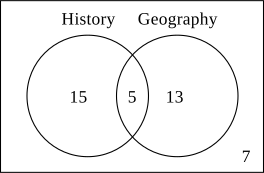
History and Geography are two of the subjects students may decide to study. For a group of 40 students, the following is known.

    • 7 students study neither History nor Geography
    • 20 students study History
    • 18 students study Geography
  1. A student is chosen at random. By a using a Venn diagram, or otherwise, find the probability that the student studies both History and Geography.  (2 marks)

    --- 8 WORK AREA LINES (style=lined) ---

  2. A students is chosen at random. Given that the student studies Geography, what is the probability that the student does NOT study History?  (1 mark)

    --- 1 WORK AREA LINES (style=lined) ---

  3. Two different students are chosen at random, one after the other. What is the probability that the first student studies History and the second student does NOT study History?  (2 marks)

    --- 3 WORK AREA LINES (style=lined) ---

Show Answers Only
  1.  
  2. `13/18`
  3. `10/39`
Show Worked Solution
a.   
`P(text(H and G))` `= 5/40`
  `= 1/8`


♦ Mean mark (b) 49%.
b.    `P(bartext(H) | text(G))` `= (P(bartext(H) ∩ text(G)))/(Ptext{(G)})`
    `= 13/18`


c.    `P(text(H), bartext(H))` `= 20/40 xx 20/39`
    `= 10/39`

Filed Under: Conditional Probability and Venn Diagrams (Adv-2027), Conditional Probability and Venn Diagrams (Y11) Tagged With: Band 3, Band 4, Band 5, smc-6470-20-Venn Diagrams/Intersections, smc-991-20-Venn Diagrams/Intersections

Networks, STD2 N2 2020 HSC 18

The diagram represents a network with weighted edges.


  1. Draw a minimum spanning tree for this network and determine its length.   (3 marks)

    --- 7 WORK AREA LINES (style=lined) ---

  2. The network is revised by adding another vertex, `K`. Edges `AK` and `CK` have weights of 12 and 10 respectively, as shown.


What is the length of the minimum spanning tree for this revised network?   (1 mark)

--- 1 WORK AREA LINES (style=lined) ---

Show Answers Only
  1. `text(Length = 14)`


    `text(One of many possibilities:)`
     

  2. `24`
Show Worked Solution

a.      `text{Using Kruskal’s Algorithm (one of many possibilities):}`

`text{Edge 1 :}\ GH\ (1)`
`text{Edge 2 :}\ FH\ (2)`
`text{Edge 3 :}\ CF\ (2)`
`text{Edge 4 :}\ FD\ (2)`
`text{Edge 5 :}\ DE\ (2)`
`text{Edge 6 :}\ BC\ (3)`
`text{Edge 7 :}\ AB\ (2)`


`text{Minimum length of spanning tree}` `= 1 + 2 + 2 + 2 +2 + 3 +2`
  `= 14`


b.     `text{Add}\ CK \ text{to the minimum spanning tree in (a).}`

`therefore \ text(Revised length)` `= 14 + 10`
  `= 24`

Filed Under: Minimum Spanning Trees, Spanning Trees (Std2-2027) Tagged With: Band 4, smc-6320-10-General, smc-6320-40-Draw Tree, smc-914-10-General, smc-914-40-Draw Tree

  • « Previous Page
  • 1
  • …
  • 64
  • 65
  • 66
  • 67
  • 68
  • …
  • 114
  • Next Page »

Copyright © 2014–2025 SmarterEd.com.au · Log in