SmarterEd

Aussie Maths & Science Teachers: Save your time with SmarterEd

  • Login
  • Get Help
  • About

Calculus, 2ADV C3 2020 HSC 25

A landscape gardener wants to build a garden in the shape of a rectangle attached to a quarter-circle. Let `x` and `y` be the dimensions of the rectangle in metres, as shown in the diagram.
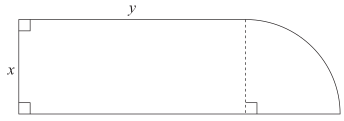


The garden bed is required to have an area of 36 m² and to have a perimeter which is as small as possible. Let `P` metres be the perimeter of the garden bed.

  1. Show that  `P = 2x + 72/x`.  (3 marks)

    --- 6 WORK AREA LINES (style=lined) ---

  2. Find the smallest possible perimeter of the garden bed, showing why this is the minimum perimeter.  (4 marks)

    --- 8 WORK AREA LINES (style=lined) ---
Show Answers Only
  1. `text(See Worked Solutions)`
  2. `24\ text(m)`
Show Worked Solution
a.    `text(Area)` `= xy + 1/4 pir^2`
  `36` `= xy + 1/4 pix^2`
  `xy` `= 36 – (pix^2)/4`
  `y` `= 36/x – (pix)/4`

♦ Mean mark part (a) 47%.


`:. P` `= 2x + 2y + 1/4(2pix)`
  `= 2x + 2(36/x – (pix)/4) + (pix)/2`
  `= 2x + 72/x – (pix)/2 + (pix)/2`
  `= 2x + 72/x`


b.   `P = 2x + 72/x`

`(dP)/(dx)` `= 2 – 72x^(−2)`
`(d^2P)/(dx^2)` `= 144x^(−3)`

 
`text(Max or min when)\ \ (dP)/(dx) = 0:`

`2 – 72/(x^2)` `= 0`
`2x^2` `= 72`
`x^2` `= 36`
`x` `= 6,\ \  (x > 0)`


`text(When)\ \ x = 6,`

`(d^2P)/(dx^2) = 144/(6^3) = 2/3 > 0`

 
`=>\  text(MIN at)\ x = 6`

`:. P_text(min)` `= 2 xx 6 + 72/6`
  `= 24\ text(m)`

Filed Under: Maxima and Minima (Y12) Tagged With: Band 4, Band 5, smc-970-10-Area

Statistics, 2ADV S3 2020 HSC 23

A continuous random variable, `X`, has the following probability density function.
 

`f(x) = {(sin x, text(for)\ \ 0 <= x <= k),(0, text(for all other values of)\ x):}`
 

  1. Find the value of `k`.  (2 marks)

    --- 4 WORK AREA LINES (style=lined) ---

  2. Find  `P(X <= 1)`. Give your answer correct to four decimal places.  (2 marks)

    --- 4 WORK AREA LINES (style=lined) ---

Show Answers Only
  1. `pi/2`
  2. `0.4597\ \ (text(to 2 d.p.))`
Show Worked Solution
a.    `int_0^k sin x` `= 1`
  `[−cos x]_0^k` `= 1`
  `−cos k + cos 0` `= 1`
  `−cos k` `= 0`
  `cos k` `= 0`
  `k` `= pi/2`


♦ Mean mark part (b) 44%.
b.    `P(X <= 1)` `= int_0^1 sin x\ dx`
    `= [−cos x]_0^1`
    `= −cos1 + cos0`
    `= 1 – cos1`
    `= 0.45969…`
    `= 0.4597\ \ (text(to 4 d.p.))`

Filed Under: Probability Density Functions (Y12) Tagged With: Band 4, Band 5, smc-994-30-Other Probability, smc-994-80-Trig PDF

Calculus, 2ADV C4 2020 HSC 20

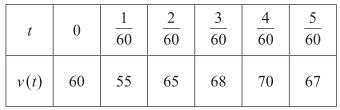
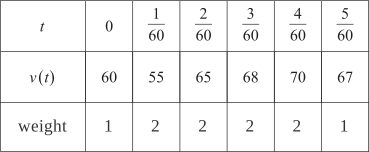
Kenzo is driving his car along a road while his friend records the velocity of the car, `v(t)`, in km/h every minute over a 5-minute period. The table gives the velocity  `v(t)`  at time  `t`  hours.


The distance covered by the car over the 5-minute period is given by

`int_0^(5/60) v(t)\ dt`.

Use the trapezoidal rule and the velocity at each of the six time values to find the approximate distance in kilometres the car has travelled in the 5-minute period. Give your answer correct to one decimal place.  (2 marks)

--- 5 WORK AREA LINES (style=lined) ---

Show Answers Only

`5.4\ text(km)`

Show Worked Solution

`int_0^(5/60) v(t)\ dt` `~~ 1/2 xx 1/60 [60 + 2(55 + 65 + 68 + 70) + 67]`
  `~~ 1/120 (643)`
  `~~ 5.358…`
  `~~ 5.4\ text(km)`

Filed Under: Trapezium Rule and Newton, Trapezoidal Rule (Y12) Tagged With: Band 4, smc-5145-04-Trapezium rule, smc-5145-10-Table provided, smc-976-10-Table provided

Trigonometry, 2ADV T2 2020 HSC 19

Prove that  `sec theta-cos theta = sin theta\ tan theta.`   (2 marks)

Show Answers Only
`text(LHS)` `=1/cos theta-cos theta`  
  `=(1-cos^2 theta)/cos theta`  
  `=sin^2 theta/cos theta`  
  `=sin theta * sin theta/cos theta`  
  `=sin theta\ tan theta\ …\ text(as required)`  
Show Worked Solution
`text(LHS)` `=1/cos theta-cos theta`  
  `=(1-cos^2 theta)/cos theta`  
  `=sin^2 theta/cos theta`  
  `=sin theta * sin theta/cos theta`  
  `=sin theta\ tan theta\ …\ text(as required)`  

Filed Under: Trig Identities and Harder Equations (Adv-2027), Trig Identities and Harder Equations (Y11) Tagged With: Band 4, smc-1189-20-Prove Identity, smc-6412-20-Prove Identity

Calculus, 2ADV C3 2020 HSC 16

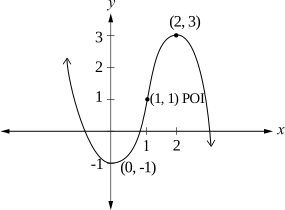
Sketch the graph of the curve  `y = −x^3 + 3x^2 - 1`, labelling the stationary points and point of inflection. Do NOT determine the `x`-intercepts of the curve.  (4 marks)

Show Answers Only

Show Worked Solution
`y` `= −x^3 + 3x^2 – 1`
`(dy)/(dx)` `= −3x^2 + 6x`
`(d^2y)/(dx^2)` `= −6x + 6`

 
`text(SP’s when)\ (dy)/(dx) = 0`

`−3x^2 + 6x` `= 0`
`−3x(x – 2)` `= 0`

`x = 0\ \ text(or)\ \ 2`

 
`text(When)\ \ x = 0,`

`y = −1`

`(d^2 y)/(dx^2) = 6 > 0`

 
`:. text(MIN at)\ \ (0, −1)`
 

`text(When)\ \ x = 2,`

`y` `= −8 + 12 – 1 = 3`
`(d^2y)/(dx^2)` `= −6 xx 2 + 6 = −6 < 0`

 
`:. text(MAX at)\ \ (2, 3)`
 

`(d^2y)/(dx^2) = 0\ text(when)`

`−6x + 6` `= 0`
`x` `= 1`

 
`text(Checking change of concavity)`

`text(Concavity changes either side of)\ x = 1`

`:. text(POI at)\ (1, 1)`
 

Filed Under: Curve Sketching (Y12) Tagged With: Band 4, smc-969-10-Cubic

Trigonometry, 2ADV T1 2020 HSC 15

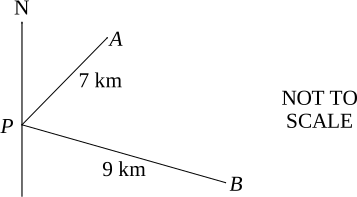
Mr Ali, Ms Brown and a group of students were camping at the site located at `P`. Mr Ali walked with some of the students on a bearing of 035° for 7 km to location `A`. Ms Brown, with the rest of the students, walked on a bearing of 100° for 9 km to location `B`.


  1. Show that the angle `APB` is 65°.  (1 mark)

    --- 1 WORK AREA LINES (style=lined) ---

  2. Find the distance `AB`.  (2 marks)

    --- 5 WORK AREA LINES (style=lined) ---

  3. Find the bearing of Ms Brown's group from Mr Ali's group. Give your answer correct to the nearest degree.  (2 marks)

    --- 5 WORK AREA LINES (style=lined) ---

Show Answers Only
  1. `text(See Worked Solutions)`
  2. `8.76\ text{km  (to 2 d.p.)}`
  3. `146^@`
Show Worked Solution
a.    `angle APB` `= 100-35`
    `= 65^@`


b.   `text(Using cosine rule:)`

`AB^2` `= AP^2 + PB^2-2 xx AP xx PB cos 65^@`
  `= 49 + 81-2 xx 7 xx 9 cos 65^@`
  `= 76.750…`
`:.AB` `= 8.760…`
  `= 8.76\ text{km  (to 2 d.p.)}`

 
c.

`anglePAC = 35^@\ (text(alternate))`

`text(Using cosine rule, find)\ anglePAB:`

`cos anglePAB` `= (7^2 + 8.76-9^2)/(2 xx 7 xx 8.76)`  
  `= 0.3647…`  
`:. angle PAB` `= 68.61…^@`  
  `= 69^@\ \ (text(nearest degree))`  


`:. text(Bearing of)\ B\ text(from)\ A\ (theta)` 

`= 180-(69-35)`

`= 146^@`

Filed Under: Bearings (Adv-2027), Bearings (Y11) Tagged With: 2adv-std2-common, Band 2, Band 3, Band 4, common-content, smc-6395-10-Bearings, smc-981-10-Bearings

Measurement, STD2 M7 2020 HSC 17

Ayla wishes to estimate the number of trees on a square block of land measuring 1000 m by 1000 m. She counts the number of trees on a 5 m by 5 m section of the block and finds there are 8 trees.

Based on this, estimate the number of tress on the entire square block of land.   (2 marks)

Show Answers Only

`320\ 000`

Show Worked Solution
`text{Area of block}` `= 1000 xx 1000`
  `= 1\ 000\ 000 \ text{m}^2`


`8\ text{trees per} \ 25 text{m}^2`

`therefore \ text{Total trees}` `= 8 xx frac{1\ 000\ 000}{25}`
  `= 320\ 000`

Filed Under: Rates (Std2) Tagged With: Band 4, smc-805-60-Other rate problems

Calculus, 2ADV C4 2020 HSC 17

Find  `int x/(4 + x^2)\ dx`.  (2 marks)

Show Answers Only

`1/2 log_e (4 + x^2) + c`

Show Worked Solution
`int x/(4 + x^2)\ dx` `= 1/2 int (2x)/(4 + x^2)\ dx`
  `= 1/2 log_e (4 + x^2) + c`

Filed Under: L&E Integration, Log Calculus (Y12) Tagged With: Band 4, smc-1203-30-Log (Indefinite), smc-964-20-Indefinite Integrals

Statistics, 2ADV S3 2020 HSC 9 MC

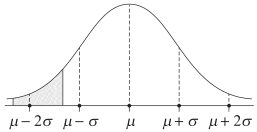
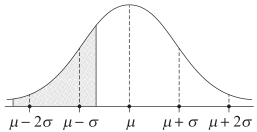
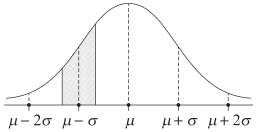
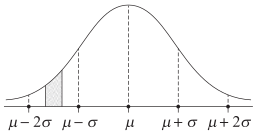
Suppose the weight of melons is normally distributed with a mean of `mu` and a standard deviation of `sigma`.

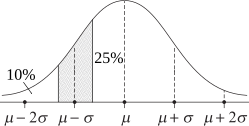
A melon has a weight below the lower quartile of the distribution but NOT in the bottom 10% of the distribution.

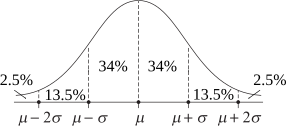
Which of the following most accurately represents the region in which the weight of this melon lies?
 

A. B.
C. D.
Show Answers Only

`C`

Show Worked Solution

`text(Distributions using)\ mu and sigma:`


`text(Adjusting the above to identify the interval  10% < weight < 25%)`

  
`=>C`

Filed Under: Normal Distribution (Y12) Tagged With: Band 4, common-content, smc-995-20-z-score Intervals, smc-995-40-Graphs

Calculus, 2ADV C3 2020 HSC 5 MC

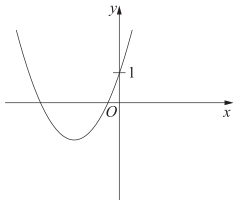
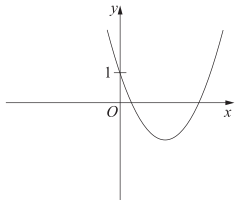
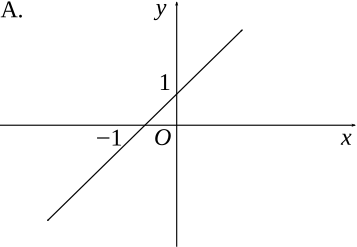
Which of the following could represent the graph of  `y = −x^2 + bx + 1`, where  `b > 0`?
 

A. B.
C. D.
Show Answers Only

`C`

Show Worked Solution

`y = −x^2 + bx + 1`

`(dy)/(dx) = −2x + b`

`text(S.P. occurs when)\ \ (dy)/(dx) = 0:`

`−2x + b` `= 0`
`x` `= b/2`

 
`text(S)text(ince)\ b > 0, text(SP occurs when)\ x > 0`

`=>C`

Filed Under: The Derivative Function and its Graph (Y12) Tagged With: Band 4, smc-1089-40-Investigate Graph Shapes

Statistics, STD2 S4 2020 HSC 12 MC

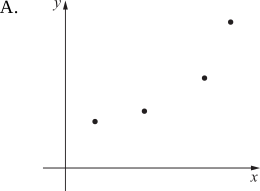
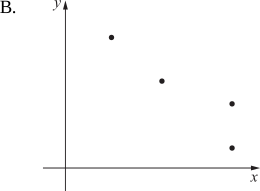
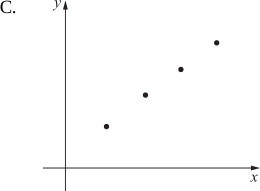
For a set of bivariate data, Pearson's correlation coefficient is  –1.

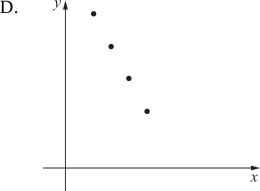
Which graph could best represent this set of bivariate data?


Show Answers Only

`D`

Show Worked Solution

`text(Negative correlation coefficient:)`

`text(Line of Best Fit will go from top left to bottom right)`

`text(Correlation coefficient of magnitude 1:)`

`text(Data will be in a straight line.)`

`=> \ D`

Filed Under: S4 Bivariate Data Analysis (Y12) Tagged With: Band 4, common-content, smc-785-40-Pearson's

Statistics, 2ADV S3 2020 HSC 3 MC

John recently did a class test in each of three subjects. The class scores on each test were normally distributed.

The table shows the subjects and John's scores as well as the mean and standard deviation of the class scores on each test.


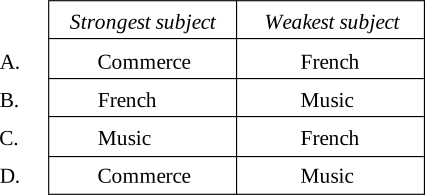
Relative to the rest of class, which row of the table below shows John's strongest subject and his weakest subject?
 

Show Answers Only

`A`

Show Worked Solution

`text(Calculate the)\ ztext(-score of each subject:)`

`ztext{-score (French)} = frac(82 – 70)(8) = 1.5`

`ztext{-score (Commerce)} = frac(80 – 65)(5) = 3.0`

`ztext{-score (Music)} = frac(74 – 50)(12) = 2.0`

 
`therefore \ text{Commerce is strongest, French is weakest}`

`=> \ A`

Filed Under: Normal Distribution (Y12) Tagged With: 2adv-std2-common, Band 4, common-content, smc-995-30-Comparisons of Data Sets

Statistics, STD2 S5 2020 HSC 8 MC

John recently did a class test in each of three subjects. The class scores on each test were normally distributed.

The table shows the subjects and John's scores as well as the mean and standard deviation of the class scores on each test.

Relative to the rest of class, which row of the table below shows John's strongest subject and his weakest subject?

Show Answers Only

`A`

Show Worked Solution

`text(Calculate the)\ ztext(-score of each subject:)`

`ztext{-score (French)} = frac(82-70)(8) = 1.5`

`ztext{-score (Commerce)} = frac(80-65)(5) = 3.0`

`ztext{-score (Music)} = frac(74-50)(12) = 2.0`

 
`therefore \ text{Commerce is strongest, French is weakest}`

`=> \ A`

Filed Under: S5 The Normal Distribution (Y12) Tagged With: 2adv-std2-common, Band 4, common-content, smc-819-30-Comparisons of Data Sets

Algebra, STD2 A2 2020 HSC 6 MC

Suppose  `y = -1-2x`.

When the value of  `x`  increases by 5, the value of  `y`  decreases by

  1.  1.
  2.  2.
  3.  5.
  4.  10.
Show Answers Only

`D`

Show Worked Solution

`text(Strategy 1)`

`text(If) \ \ x\  \ text(increases by) \ 5`

`=> y \ \ text(decreases by) \ \ 2x = 2 xx 5 = 10`

 
`text(Strategy 2)`

`text(Test) \ 2 \ text(values:)`

`text(If) \ \ x = 0 , \ y = -1`

`text(If) \ \ x = 5 , \ y = -1-10 = -11`

`:.\ y \ text(decreases by) \ 10.`

`=>D`

Filed Under: Linear Equations and Basic Graphs (Std 1), Linear Equations and Basic Graphs (Std 2), Linear Modelling and Basic Graphs (Std1-2027), Linear Modelling and Basic Graphs (Std2-2027) Tagged With: Band 4, smc-1118-40-Other problems, smc-6255-40-Other, smc-6512-40-Other, smc-792-40-Other

Financial Maths, STD2 F4 2020 HSC 4 MC

Joan invests $200. She earns interest at 3% per annum, compounded monthly.

What is the future value of Joan's investment after 1.5 years?

  1. $209.07
  2. $209.19
  3. $279.51
  4. $311.93
Show Answers Only

`B`

Show Worked Solution

`text(Monthly interest rate) \ = frac(0.03)(12)`

`n \ = \ 1.5 xx 12 = 18`
  

`text(FV)` `= text(PV) \ (1 + r)^n`
  `= 200 (1 + frac(0.03)(12))^18`
  `= $209.19`

 
`=> \ B`

Filed Under: Compound Interest, Compound Interest and Shares (Std2) Tagged With: Band 4, num-title-ct-coreb, num-title-qs-hsc, smc-4334-10-Find FV, smc-817-20-FV Formula

Algebra, STD2 A4 2020 HSC 1 MC

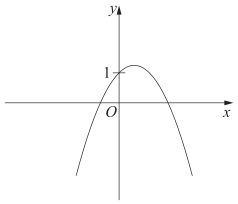
Which of the following could represent the graph of  `y = -x^2 + 1`?


Show Answers Only

`C`

Show Worked Solution

♦ Mean mark 53%.
COMMENT: A surprisingly low State mean mark!

`=> C`

Filed Under: Non-Linear: Exponential/Quadratics (Std 2) Tagged With: Band 4, num-title-ct-coreb, num-title-qs-hsc, smc-4443-10-Identify graphs, smc-830-10-Identify Graphs

Calculus, 2ADV C4 2020 HSC 4 MC

What is  `int e + e^(3x)\ dx`?

  1. `ex + 3e^(3x) + c`
  2. `ex + 1/3e^(3x) + c`
  3. `e + 3e^(3x) + c`
  4. `e + 1/3e^(3x) + c`
Show Answers Only

`B`

Show Worked Solution

`int e + e^(3x) = ex + 1/3e^(3x) + c`

`(text(Note)\ e\ text(is a simple constant here))`

`=> B`

Filed Under: Exponential Calculus (Y12), L&E Integration Tagged With: Band 4, smc-1203-10-Exponential (Indefinite), smc-965-30-Indefinite integrals

Functions, 2ADV F1 2020 HSC 1 MC

Which inequality gives the domain of  `y = sqrt(2x-3)`?

  1. `x < 3/2`
  2. `x > 3/2`
  3. `x <= 3/2`
  4. `x >= 3/2`
Show Answers Only

`D`

Show Worked Solution

`text(Domain exists when:)`

`2x-3` `>= 0`
`2x` `>= 3`
`x` `>= 3/2`

  
`=>D`

Filed Under: Functions and Other Graphs, Further Functions and Relations (Y11), Other Functions and Relations (Adv-2027) Tagged With: Band 4, num-title-ct-patha, num-title-qs-hsc, smc-4244-10-Domain, smc-4244-70-Square root, smc-6218-40-Square-Root Functions, smc-987-20-Inequalities, smc-987-40-Square-Root Functions

Mechanics, EXT2 M1 EQ-Bank 3

A car and its driver has a mass of 1200 kilograms and is travelling at 90 km/h.

Calculate the magnitude of the uniform breaking force, in Newtons, required to bring the car to a stop in 40 metres.   (3 marks)

--- 8 WORK AREA LINES (style=lined) ---
Show Answers Only

`9375\ text(N)`

Show Worked Solution

`text(Let)\ \ k =\ text{Uniform breaking force (constant)}`

`text(Newton’s 2nd law:)`

`F = mddotx` `= −k`
`1200ddotx` `= −k`
`ddotx` `= −k/1200`
`v · (dv)/(dx)` `= −k/1200`
`(dv)/(dx)` `= −k/(1200v)`
`(dx)/(dv)` `= −1200/k v`
`x` `= −1200/k intv\ dv`
  `= −600/k v^2 + C`

 
`text(When)\ \ x = 0, v = (90\ 000)/(60 xx 60) = 25\ text(ms)^(−1):`

`0 = −600/k  · 25^2 + C`

`C = (375\ 000)/k`

`x = (375\ 000)/k – 600/k v^2`


`text(When)\ \ x = 40, v = 0:`

`40 = (375\ 000)/k`

`:. k = 9375\ text(N)`

Filed Under: Resisted Motion Tagged With: Band 4, smc-1061-06-Planes/Inclined Planes, smc-1061-30-R ~ other, smc-1061-70-Newton's Law

Mechanics, EXT2 M1 EQ-Bank 2

A particle with mass `m` moves horizontally against a resistance force `F`, equal to  `mv(1 + v^2)`  where `v` is the particle's velocity.

Initially, the particle is travelling in a positive direction from the origin at velocity `T`.

  1. Show that the particle's displacement from the origin, `x`, can be expressed as
     
         `x = tan^(-1)((T - v)/(1 + Tv))`  (2 marks)

    --- 6 WORK AREA LINES (style=lined) ---


  2. Show that the time, `t`, when the particle is travelling at velocity `v`, is given by
     
         `t = 1/2 log_e ((T^2(1 + v^2))/(v^2(1 + T^2)))`  (4 marks)

    --- 8 WORK AREA LINES (style=lined) ---
     

  3. Express `v^2` as a function of `t`, and hence find the limiting values of `x` and `v`.  (2 marks)

    --- 6 WORK AREA LINES (style=lined) ---

Show Answers Only
  1. `text(See Worked Solutions)`
  2. `text(See Worked Solutions)“
  3. `v -> 0, \ x -> tan^(−1)T`
Show Worked Solution

i.   `text(Newton’s 2nd law:)`

`F = mddotx = −mv(1 + v^2)`

`v · (dv)/(dx)` `= −v(1 + v^2)`
`(dv)/(dx)` `= −(1 + v^2)`
`(dx)/(dv)` `= −1/(1 + v^2)`
`x` `= −int 1/(1 + v^2)\ dv`
  `= −tan^(−1) v + C`


`text(When)\ \ x = 0, v = T:`

`C = tan^(−1)T`

`x = tan^(−1)T – tan^(−1)v`
 

`text(Let)\ \ x = A – B`

`A = tan^(−1) T \ => \ T = tan A`

`B = tan^(−1)v \ => \ v = tan B`

`tan x` `= tan(A – B)`
  `= (tan A – tan B)/(1 + tan A tan B)`
  `= (T – v)/(1 + Tv)`
`:. x` `= tan^(−1)((T – v)/(1 + Tv))`


ii.   `text(Using)\ \ ddotx = (dv)/(dt):`

`(dv)/(dt) = −1/(v(1 + v^2))`

`t = −int 1/(v(1 + v^2)) dv`
 

`text(Using Partial Fractions):`

`1/(v(1 + v^2)) = A/v + (Bv + C)/(1 + v^2)`

`A(1 + v^2) + (Bv + C)v = 1`

`A = 1`

`(A + B)v^2` `= 0`   `=> `    `B` `= −1`
`Cv` `= 0`   `=> `    `C` `= 0`


`t` `= −int 1/v\ dv + int v/(1 + v^2)\ dv`
  `= −log_e v + 1/2 int(2v)/(1 + v^2)\ dv`
  `= −log_e v + 1/2 log_e (1 + v^2) + C`
  `= −1/2 log_e v^2 + 1/2 log_e (1 + v^2) + C`
  `= 1/2 log_e ((1 + v^2)/(v^2)) + C`


`text(When)\ \ t = 0, v = T:`

`C = −1/2 log_e ((1 + T^2)/(T^2))`
 

`:. t` `= 1/2 log_e ((1 + v^2)/(v^2)) – 1/2 log_e((1 + T^2)/(T^2))`
  `= 1/2 log_e (((1 + v^2)/(v^2))/((1 + T^2)/(T^2)))`
  `= 1/2 log_e ((T^2(1 + v^2))/(v^2(1 + T^2)))`


iii. `t` `= 1/2 log_e ((T^2(1 + v^2))/(v^2(1 + T^2)))`
  `e^(2t)` `= (T^2(1 + v^2))/(v^2(1 + T^2))`
  `1 + v^2` `= (e^(2t)v^2(1 + T^2))/(T^2)`
  `1` `= v^2((e^(2t)(1 + T^2))/(T^2) – 1)`
  `1` `= v^2((e^(2t)(1 + T^2) – T^2)/(T^2))`
  `:. v^2` `= (T^2)/(e^(2t)(1 + T^2) – T^2)`

 
`text(As)\ \ t -> ∞:`

`v^2 -> 0, \ v -> 0`

`x = tan^(−1)T – tan^(−1)v`

`x -> tan^(−1)T`

Filed Under: Resisted Motion Tagged With: Band 4, Band 5, Band 6, smc-1061-06-Planes/Inclined Planes, smc-1061-20-R ~ v^2, smc-1061-70-Newton's Law

Mechanics, EXT2 M1 EQ-Bank 1

A canon ball of mass 9 kilograms is dropped from the top of a castle at a height of `h` metres above the ground.

The canon ball experiences a resistance force due to air resistance equivalent to  `(v^2)/500`, where `v` is the speed of the canon ball in metres per second. Let  `g=9.8\ text(ms)^-2`  and the displacement, `x` metres at time `t` seconds, be measured in a downward direction.

  1. Show the equation of motion is given by
     
         `ddotx = g - (v^2)/4500`  (1 mark)

    --- 4 WORK AREA LINES (style=lined) ---

  2. Show, by integrating using partial fractions, that
     
         `v = 210((e^(7/75 t) - 1)/(e^(7/75 t) + 1))`  (5 marks)

    --- 12 WORK AREA LINES (style=lined) ---


  3. If the canon hits the ground after 4 seconds, calculate the height of the castle, to the nearest metre.  (3 marks)

    --- 8 WORK AREA LINES (style=lined) ---
Show Answers Only
  1. `text(See Worked Solutions)`
  2. `text(See Worked Solutions)`
  3. `78\ text(metres)`
Show Worked Solution

i.   `text(Newton’s 2nd Law:)`

`text(Net Force)` `= mddotx`
`mddotx` `= mg – (v^2)/500`
`9ddotx` `= 9g – (v^2)/500`
`ddotx` `= g – (v^2)/4500`


ii.    `(dv)/(dt)` `= g – (v^2)/4500`
    `= (44\ 100 – v^2)/4500`

 
`(dt)/(dv) = 4500/(44\ 100 – v^2)`
 

`text(Using Partial Fractions:)`

`1/(44\ 100 – v^2) = A/(210- v) + B/(210 – v)`

`A(210 – v) + B(210 + v) = 1`
 

`text(If)\ \ v = 210,`

`420B = 1 \ => \ B = 1/420`
 

`text(If)\ \ v = −210,`

`420A = 1 \ => \ A = 1/420`
 

`t` `= int 4500/(210^2 – v^2)\ dv`
  `= 4500/420 int 1/(210 + v) + 1/(210 – v)\ dv`
  `= 75/7 [ln(210 + v) – ln(210 – v)] + c`
  `= 75/7 ln((210 + v)/(210 – v)) + c`


`text(When)\ \ t = 0, v = 0:`

`0` `= 75/7 ln(210/210) + c`
`:. c` `= 0`


` t` `= 75/7 ln((210 + v)/(210 – v))`
`7/75 t` `= ln((210 + v)/(210 – v))`
`e^(7/75 t)` `= (210 + v)/(210 – v)`
`e^(7/75 t) (210 – v)` `= 210 + v`
`210e^(7/75 t) – 210` `= ve^(7/75 t) + v`
`210(e^(7/75 t) – 1)` `= v(e^(7/75 t) + 1)`
`:. v` `= 210((e^(7/75 t) – 1)/(e^(7/75 t) + 1))`


iii.    `v · (dv)/(dx)` `= (44\ 100 – v^2)/4500`
  `(dx)/(dv)` `= (4500v)/(44\ 100 – v^2)`
  `int (dx)/(dv)\ dv` `= −4500/2 int (−2v)/(44\ 100 – v^2)\ dv`
  `x` `= −2550 log_e(44\ 100 – v^2) + c`

 
`text(When)\ \ x = 0, v = 0:`

`0` `= −2250 log_e(44\ 100) + c`
`c` `= 2250 log_e(44\ 100)`
`x` `= −2250 log_e(44\ 100 – v^2) + 2250 log_e44\ 100`
  `= 2250 log_e((44\ 100)/(44\ 100 – v^2))`

 
`text(When)\ \ t = 4:`

`v` `= 210((e^(28/75) – 1)/(e^(28/75) + 1))`
  `= 38.7509…`


`:. h` `= 2250 log_e((44\ 100)/(44\ 100 – 38.751^2))`
  `= 77.94…`
  `= 78\ text(metres)`

Filed Under: Resisted Motion Tagged With: Band 3, Band 4, Band 5, smc-1061-05-Projectile Motion, smc-1061-20-R ~ v^2, smc-1061-60-Time of Travel / Distance

Calculus, EXT2 C1 EQ-Bank 1

Using partial fractions, show that

`int_0^(1/2) 8/(1-x^4)\ dx = log_e 9-4 tan^(−1) (1/2)`  (3 marks)

--- 8 WORK AREA LINES (style=lined) ---
Show Answers Only

`text(See Worked Solutions)`

Show Worked Solution

`text(Using partial fractions:)`

`8/(1-x^4) = A/(1-x^2) + B/(1 + x^2)`

`A(1 + x^2) + B(1-x^2)` `= 8`
`A + B + (A-B)x^2` `= 8`
`A + B` ` = 8\ \ …\ (1)`
`A-B` ` = 0\ \ …\ (2)`

 
`A = 4, \ B = 4`


`4/(1-x^2) = A/(1-x) + B/(1 + x)`

`A(1 + x) + B(1-x)` `= 4`
`A + B + (A-B)x` `= 4`
`A + B` `= 4\ \ …\ (1)`
`A-B` `= 0\ \ …\ (2)`

 
`A = 2, B = 2`
 

`int_0^(1/2) 8/(1-x^4)\ dx` `= int_0^(1/2) 2/(1-x) + 2/(1 + x) + 4/(1 + x^2)\ dx`
  `= [−2ln |1-x| + 2ln |1 + x| + 4tan^(−1)x]_0^(1/2)`
  `= [2ln |(1 + x)/(1-x)| + 4tan^(−1)x]_0^(1/2)`
  `= 2ln |(1 1/2)/(1/2)| + 4tan^(−1)(1/2)-(2ln1 + 4tan^(−1) 0)`
  `= 2ln3 + 4tan^(−1)(1/2)`
  `= ln9 + 4tan^(−1)(1/2)`

Filed Under: Partial Fractions, Partial Fractions and Other Integration (SM) Tagged With: Band 4, smc-1056-25-x^4 denom, smc-1056-40-PF not given, smc-2565-30-x^4 denom, smc-2565-60-PF not given

Trigonometry, EXT1 T1 EQ-Bank 4 MC

The graph of the function  `y = sin^(-1)(x-2)`  is transformed by being dilated by a factor of 3 from the `y`-axis and then translated to the right by 2.

What is the equation of the transformed graph?

  1. `y = sin^(-1)((x-8)/3)`
  2. `y = sin^(-1)((x-12)/3)`
  3. `y = sin^(-1)(3x-4)`
  4. `y = sin^(-1)(3x-8)`
Show Answers Only

`A`

Show Worked Solution

`y = sin^(-1)(x-2)`
 

`text(Dilate by factor 3 from the)\ ytext(-axis)`

`text(Swap:)\ \ x -> x/3`

`y_1` `= sin^(-1)(x/3-2)`
  `= sin^(-1)((x-6)/3)`


`text(Translate to the right by 2)`

`text(Swap:)\ \ x -> x-2`

`y_2` `= sin^(-1)(((x-2)-6)/3)`
  `= sin^(-1)((x-8)/3)`

 
`=>A`

Filed Under: T1 Inverse Trig Functions (Y11) Tagged With: Band 4, smc-1024-10-arcsin Graphs, smc-1024-40-Transformations

Trigonometry, EXT1 T1 EQ-Bank 3 MC

The graph of the function  `y = arccos(x-3)`  is transformed by being dilated horizontally with a scale factor of `1/2` and then translated to the left by 1.

What is the equation of the transformed graph?

  1. `y = cos^(-1)((x-5)/2)`
  2. `y = cos^(-1)((x-8)/2)`
  3. `y = cos^(-1)(2x-1)`
  4. `y = cos^(-1)(2x-2)`
Show Answers Only

`C`

Show Worked Solution

`y = cos^(-1)(x-3)`

`text(Dilate horizontally with scale factor)\ 1/2`

`text(Swap:)\ \ x -> 2x`

`y_1 = cos^(-1)(2x-3)`


`text(Translate to the left by 1)`

`text(Swap:)\ \ x -> x + 1`

`y_2` `= cos^(-1)(2 (x + 1)-3)`
  `= cos^(-1)(2x + 2-3)`
  `= cos^(-1)(2x-1)`

 
`=>C`

Filed Under: T1 Inverse Trig Functions (Y11) Tagged With: Band 4, smc-1024-11-arccos Graphs, smc-1024-40-Transformations

Algebra, STD2 A2 SM-Bank 12 MC

 
Which of these equations represents the line in the graph?

  1.  `y = 11 - 2x`
  2.  `y = 11 + 5.5x`
  3.  `y = 11 - 5.5x`
  4.  `y = 11 + 2x`
Show Answers Only

`A`

Show Worked Solution

`text{Graph passes through (0, 11) and (5.5, 0)}`

`text(Gradient)` `=(y_2-y_1)/(x_2-x_1)`  
  `=(11-0)/(0-5.5)`  
  `=-2`  

`:.\ text(Equation is:)\ \ y = 11 – 2x`

`=> A`

Filed Under: Linear Equations and Basic Graphs (Std 1), Linear Equations and Basic Graphs (Std 2), Linear Modelling and Basic Graphs (Std1-2027), Linear Modelling and Basic Graphs (Std2-2027) Tagged With: Band 4, smc-1118-20-Identify graph/equation, smc-6255-20-Equation of a Line, smc-6512-20-Equation of a line, smc-792-20-Equation of Line

Algebra, STD2 A2 SM-Bank 10 MC

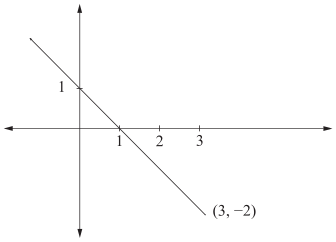
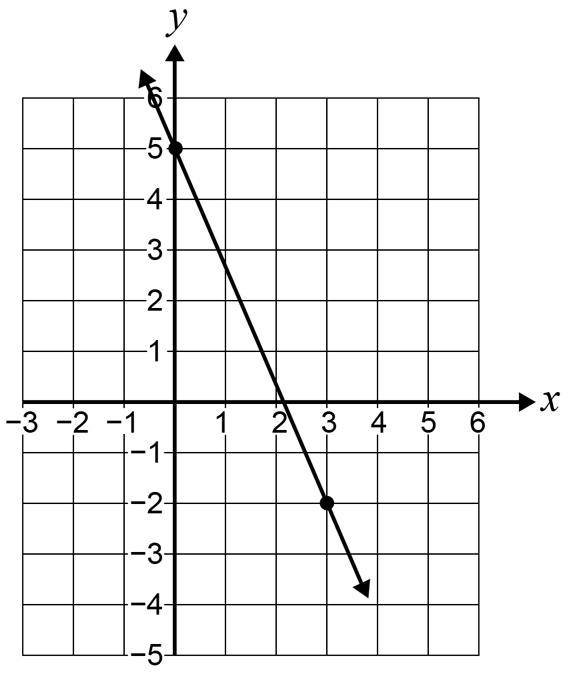
Leo drew a straight line through the points (0, 5) and (3, -2) as shown in the diagram below.


What is the gradient of the line that Leo drew?

  1. `7/3`
  2. `3/7`
  3. `-3/7`
  4. `-7/3`
Show Answers Only

`D`

Show Worked Solution

`text{Line passes through (0, 5) and (3, – 2)}`

`text(Gradient)` `= (y_2-y_1)/(x_2-x_1)`
  `= (5-(-2))/(0-3)`
  `= -7/3`

 
`=>D`

Filed Under: Linear Equations and Basic Graphs (Std 1), Linear Equations and Basic Graphs (Std 2), Linear Modelling and Basic Graphs (Std1-2027), Linear Modelling and Basic Graphs (Std2-2027) Tagged With: Band 4, smc-1118-10-Gradient, smc-6255-10-Find Gradient/Intercept, smc-6512-10-Find Gradient/Intercept, smc-792-10-Gradient

Algebra, STD2 A2 SM-Bank 20

Peter uses matchsticks to make a pattern of shapes, as shown in the table below.


How many sticks (`S`) will be needed to make Shape Number (`N`) 13?  (2 marks)

--- 5 WORK AREA LINES (style=lined) ---

Show Answers Only

`66`

Show Worked Solution

`text(Shape 1:)\ \ S=5 xx 1 +1 =6`

`text(Shape 2:)\ \ S=5 xx 2 +1 =11`

`vdots`

`text(Shape)\ N:\ \ S=5N +1 `
 

`:.\ text(Sticks required when)\ \ N=13`

`=13 xx 5 +1`

`=66`

Filed Under: Linear Equations and Basic Graphs (Std 1), Linear Equations and Basic Graphs (Std 2) Tagged With: Band 4, smc-1118-30-Patterns, smc-792-30-Patterns

Algebra, STD2 A2 SM-Bank 6 MC

Renee went bike riding on a holiday.

The hiring charges are  listed in the table below:

\begin{array} {|l|c|c|}
\hline \text{Hours hired} \ (h) & 1 & 2 & 3 & 4 & 5 \\
\hline \text{Cost} \ (C) & 18 & 24 & 30 & 36 & 42 \\
\hline \end{array}

Which linear equation shows the relationship between `C` and `h`?

  1. `C = 12 + 6h`
  2. `C = 6 + 12h`
  3. `C=18 + 12h`
  4. `C=12 + 18h`
Show Answers Only

`A`

Show Worked Solution

`text(Consider Option 1:)`

`12 + (6 xx 1) = 12+6=18`

`12 + (6 xx 2) = 12+12=24`

`12 + (6 xx 3) = 12+18=30\ \ \ \ text(etc …)`

`:.\ text(The linear equation is:)\ \ C = 12 + 6h`

`=>A`

Filed Under: Linear Equations and Basic Graphs (Std 1), Linear Equations and Basic Graphs (Std 2), Linear Modelling and Basic Graphs (Std1-2027), Linear Modelling and Basic Graphs (Std2-2027) Tagged With: Band 4, smc-1118-40-Other problems, smc-6255-40-Other, smc-6512-40-Other, smc-792-40-Other

Measurement, STD2 M7 SM-Bank 19

A laundromat can wash 12 loads of laundry in one hour at full capacity.

A standard load of laundry weighs 7 kilograms.

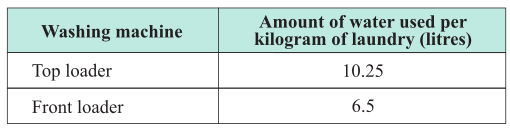
Here is some information about two different washing machines.


Working at full capacity, how many litres of water would the laundromat expect to save in one hour by using the front loader instead of the top loader?   (2 marks)

--- 4 WORK AREA LINES (style=lined) ---
Show Answers Only

`text(315 L)`

Show Worked Solution

`text(Top loader water used (1 load))`

`= 7 xx 10.25`

`= 71.75\ text(L)`
 

`text(Front loader water used (1 load))`

`= 7 xx 6.5`

`= 45.5\ text(L)`
 

`:.\ text(Expected water saved)`

`= 12 xx (71.75 – 45.5)`

`= 315\ text(L)`

Filed Under: Rates (Std2) Tagged With: Band 4, smc-805-60-Other rate problems

Measurement, STD2 M7 SM-Bank 18

A health food packet had the following information on its label.


What was the mass of the health food packet to the nearest gram?   (2 marks)

Show Answers Only

`578\ text(grams)`

Show Worked Solution

`text(Multiple of 100 grams in one packet:)`

`844 ÷ 146 = 5.78…`

`5.78 xx 100 = 578.08…`
 

`:.\ text{The mass of the packet = 578 grams  (nearest gram)}`

Filed Under: Rates (Std2) Tagged With: Band 4, smc-799-10-Calories/Joules

Algebra, STD2 A1 SM-Bank 2 MC

Fleur lives 15 kilometres from her work.

On Wednesday, she drove to work and averaged 60 kilometres per hour.

On Thursday, she took the bus which averaged 15 kilometres per hour.

What was the extra time of the bus journey, in minutes, compared to when she drove on Wednesday?

  1.  15
  2.  45
  3.  60
  4.  75
Show Answers Only

`B`

Show Worked Solution
`text(Time on Wednesday)` `= 15/60`
  `= 0.25\ text(hour)`
  `= 15\ text(minutes)`


`text(Time on Thursday)` `= 15/15`
  `= 1\ text(hour)`
  `= 60\ text(minutes)`


`:.\ text(The extra time taking the bus)\ =60-15 = 45\ text(minutes)`

`=>B`

Filed Under: Applications: BAC, Medication and D=SxT (Std 2), Applications: BAC, Medicine and D=SxT (Std2-2027) Tagged With: Band 4, smc-6235-20-Speed Distance Time, smc-791-20-Speed Distance Time

Measurement, STD2 M7 SM-Bank 1 MC

A dog breeder owns 500 dogs.

150 are Ridgebacks and the rest are Pugs.

What is the ratio of Ridgebacks to Pugs?

  1. 3 : 5
  2. 3 : 7
  3. 3 : 9
  4. 3 : 10
Show Answers Only

`B`

Show Worked Solution

`text(S)text(ince 150 are ridgebacks,)`

`=> 500-150=350\ text(pugs)`

`text(Ridgebacks)` `:\ text(Pugs)`
`150` `: 350`
`3` `: 7`

 
`=> B`

Filed Under: Ratio and Scale (Std2) Tagged With: Band 4, smc-1187-10-Ratio (2 part)

Measurement, STD2 M7 SM-Bank 17

There are 48 people in a meeting room.

The ratio of females to males in the room is 13 to 11.

How many females need to leave the room so that the ratio of females to males in the room is 1 to 1?   (2 marks)

--- 4 WORK AREA LINES (style=lined) ---
Show Answers Only

`4\ text(females)`

Show Worked Solution

`text(Females : Males) = 13 : 11`

`text(S)text(ince there are 48 people in the room,)`

`26\ text(females : 22 males.)`


`:. 4\ text(females need to leave for the ratio to become 1 : 1)`

Filed Under: Ratio and Scale (Std2) Tagged With: Band 4, smc-1187-10-Ratio (2 part)

Measurement, STD2 M7 SM-Bank 16

A refreshment stand at the market sells its iced tea in four different sizes.
 

Showing calculations, find which serving size offers the cheapest iced tea.   (2 marks)

--- 4 WORK AREA LINES (style=lined) ---
Show Answers Only

`text(375 mL)`

Show Worked Solution

`text(Consider the price per mL of each option)`

`text(150 mL :)\ \ 1.50/150 = 1\ text(cent/mL)`

`text(750 mL :)\ \ 6.10/750 = 0.81\ text(cent/mL)`

`text(375 mL :)\ \ 3.00/375 = 0.8\ text(cent/mL)`

`text(200 mL :)\ \ 1.80/200 = 0.9\ text(cent/mL)`


`:.\ text(375 mL serving size offers the cheapest price)`

Filed Under: M4 Rates (Y12), Rates (Std2) Tagged With: Band 4, smc-1104-50-Best Buys, smc-805-50-Best Buys

Measurement, STD2 M7 SM-Bank 15 MC

A brand of pasta is sold in two different packets.
 

What is the difference in the price per kilogram of these two packets?

  1. $1.50
  2. $3.00
  3. $3.60
  4. $7.20
Show Answers Only

`B`

Show Worked Solution

`text(Convert to price per kg:)`

`text(Packet 1)`

`200\ text(g) = $1.80`

`1\ text(kg) = 5 xx 1.80 = $9`


`text(Packet 2)`

`750\ text(g) = $9`

`100\ text(g) = 9.00 ÷ 7.5 = $1.20`

`1\ text(kg) = 1.20 xx 10 = $12`


`:.\ text(Difference per kg)`

`= 12 – 9`

`= $3.00`
 

`=> B`

Filed Under: M4 Rates (Y12), Rates (Std2) Tagged With: Band 4, smc-1104-50-Best Buys, smc-805-50-Best Buys

Measurement, STD2 M7 SM-Bank 14

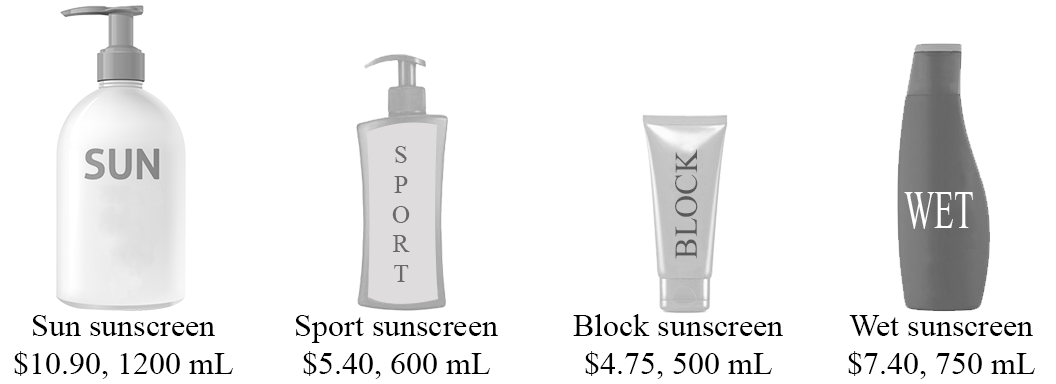
Reece looks at the price of four sunscreens.


Which sunscreen is the cheapest per litre? Show your calculations.   (2 marks)

--- 4 WORK AREA LINES (style=lined) ---
Show Answers Only

`text(Sport sunscreen)`

Show Worked Solution

`text(Sun)\ =1090/1200 = 0.91\ text(c/mL)`

STRATEGY: Finding the cost per mL is much more efficient in answering this question than finding the cost per litre.

`text(Sport)\ =540/600 = 0.9\ text(c/mL)`

`text(Block)\ =475/500 = 0.95\ text(c/mL)`

`text(Wet)\ =740/750 = 0.99\ text(c/mL)`


`:.\ text(Sport sunscreen is the cheapest.)`

Filed Under: M4 Rates (Y12), Rates (Std2) Tagged With: Band 4, smc-1104-50-Best Buys, smc-805-50-Best Buys

Calculus, EXT1 C3 EQ-Bank 1

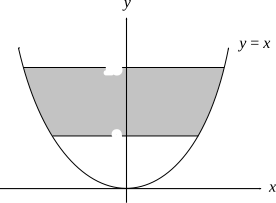
  1. Sketch the region bounded by the curve  `y = x^2`  and the lines  `y = 16`  and  `y = 9`.  (1 mark)

    --- 8 WORK AREA LINES (style=lined) ---
  2. Calculate the area of this region.  (3 marks)

    --- 6 WORK AREA LINES (style=lined) ---
Show Answers Only
  1.  
  2. `148/3 \ text(u²)`
Show Worked Solution
i.   


ii.   `text(Areas either side of)\ ytext(-axis are equal.)`

`y = x^2\ \ =>\ \ x = sqrty`

`:. A` `= 2 int_9^16 x\ dy`
  `= 2 int_9^16 sqrty\ dy`
  `= 2[2/3 y^(3/2)]_9^16`
  `= 4/3[(sqrt16)^3 – (sqrt9)^3]`
  `= 4/3[64 – 27]`
  `= 148/3 \ text(u²)`

Filed Under: Further Area and Solids of Revolution (Ext1) Tagged With: Band 3, Band 4, smc-1039-50-Area

Functions, 2ADV F2 EQ-Bank 13

The curve  `y = kx^2 + c`  is subject to the following transformations

    • Translated 2 units in the positive `x`-direction
    • Dilated in the positive `y`-direction by a factor of 4
    • Reflected in the `y`-axis

The final equation of the curve is  `y = 8x^2 + 32x - 8`.

  1.  Find the equation of the graph after the dilation.  (1 mark)

    --- 4 WORK AREA LINES (style=lined) ---
  2.  Find the values of  `k`  and  `c`.  (2 marks)

    --- 6 WORK AREA LINES (style=lined) ---
Show Answers Only
  1. `y = 4k(x – 2)^2 + 4c`
  2. `k = 2, c = −10`
Show Worked Solution

i.    `y = kx^2 + c`

`text(Translate 2 units in positive)\ xtext(-direction.)`

`y = kx^2 + c \ => \ y = k(x – 2)^2 + c`

`text(Dilate in the positive)\ ytext(-direction by a factor of 4.)`

`y = k(x – 2)^2 + c \ => \ y = 4k(x – 2)^2 + 4c`


ii.    `y` `= 4k(x^2 – 4x + 4) + 4c`
    `= 4kx^2 – 16kx + 16k + 4c`


`text(Reflect in the)\ ytext(-axis.)`

COMMENT: Using “swap” terminology for reflections in the y-axis is simpler and more intelligible for students in our view.

`=>\ text(Swap:)\ \ x →\ – x`

`y` `= 4k(−x)^2 – 16k(−x) + 16k + 4c`
  `= 4kx^2 + 16kx + 16k + 4c`


`text(Equating co-efficients:)`

`4k` `=8`  
`:. k` `=2`  


`16k + 4c` `= −8`
`4c` `= −40`
`:. c` `=-10`

Filed Under: Graph Transformations (Adv-2027), Transformations (Y12) Tagged With: Band 4, Band 5, smc-1008-10-Polynomials, smc-1008-70-Combinations, smc-6408-10-Polynomials, smc-6408-60-Combinations

Functions, 2ADV F2 EQ-Bank 14

List a set of transformations that, when applied in order, would transform  `y = x^2`  to the graph with equation  `y = 1 - 6x - x^2`.  (3 marks)

--- 6 WORK AREA LINES (style=lined) ---
Show Answers Only

`text(T1: Translate 3 units in negative)\ xtext(-direction)`

`text(T2: Translate 10 units in negative)\ ytext(-direction)`

`text(T3: Reflect in the)\ xtext(-axis)`

Show Worked Solution

`y = x^2`

`text(Transformation 1:)`

`text(Translate 3 units in negative)\ xtext(-direction)`

`y = (x + 3)^2`

`y = x^2 + 6x + 9`
 

`text(Transformation 2:)`

`text(Translate 10 units in negative)\ ytext(-direction)`

`y = x^2 + 6x – 1`
 

`text(Transformation 3:)`

`text(Reflect in the)\ xtext(-axis)`

`y` `= −(x^2 + 6x – 1)`
  `= 1 – 6x – x^2`

Filed Under: Graph Transformations (Adv-2027), Transformations (Y12) Tagged With: Band 4, smc-1008-10-Polynomials, smc-1008-70-Combinations, smc-6408-10-Polynomials, smc-6408-60-Combinations

Statistics, STD2 S4 EQ-Bank 4

Ten high school students have their height and the length of their right foot measured.

The results are recorded in the table below.


  1. Using technology, calculate Pearson's correlation coefficient for the data. Give your answer to 3 decimal places.  (1 mark)

    --- 1 WORK AREA LINES (style=lined) ---

  2. Describe the strength of the association between height and length of right foot for these students.  (1 mark)

    --- 2 WORK AREA LINES (style=lined) ---
  3. Using technology, determine the least squares regression line that allows height to be predicted from right foot length.  (1 mark)

    --- 1 WORK AREA LINES (style=lined) ---
Show Answers Only
  1. `0.941\ \ (text(to 3 d.p.))`
  2. `text(The association is positive and strong.)`
  3. `text(Height) =47.4 + 4.7 xx text(foot length)`
Show Worked Solution

i.   `text(By calculator,)`

COMMENT: Issues here? YouTube has short and excellent help videos – search your calculator model and topic – eg. “fx-82 correlation” .

`r` `= 0.94095…`
  `= 0.941\ \ (text(to 3 d.p.))`


ii.   `text(The association is positive and strong.)`


iii.   `x\ text(value ⇒ foot length (independent variables))`

`y\ text(value ⇒ height.)`

`text(By calculator:)`

`text(Height) = 47.4 + 4.7 xx text(foot length)`

Filed Under: Bivariate Data Analysis (Y12), S4 Bivariate Data Analysis (Y12) Tagged With: Band 4, common-content, smc-1001-20-Least-Squares Regression Line, smc-1001-30-Correlation, smc-1001-40-Pearson's, smc-1001-70-Calculator (Stats Mode), smc-785-20-Least-Squares Regression Line, smc-785-30-Correlation, smc-785-40-Pearson's, smc-785-70-Calculator (Stats Mode)

Functions, 2ADV F2 EQ-Bank 16

`y = -(x + 2)^4/3`  has been produced by three successive transformations: a translation, a dilation and then a reflection.

  1. Describe each transformation and state the equation of the graph after each transformation.  (2 marks)

    --- 4 WORK AREA LINES (style=lined) ---
  2. Sketch the graph.  (1 mark)

    --- 6 WORK AREA LINES (style=lined) ---
Show Answers Only
  1. `text(See Worked Solutions)`
  2.  
Show Worked Solution

i.   `text(Transformation 1:)`

`text(Translate)\ \ y = x^4\ \ 2\ text(units to the left.)`

`y = x^4 \ => \ y = (x + 2)^4`
  

`text(Transformation 2:)`

`text(Dilate)\ \ y = (x + 2)^4\ \ text(by a factor of)\ 1/3\ text(from the)\ xtext(-axis)`

`y = (x + 2)^4 \ => \ y = ((x + 2)^4)/3`
 

`text(Transformation 3:)`

`text(Reflect)\ \ y = ((x + 2)^4)/3\ \ text(in the)\ xtext(-axis).`

`y = ((x + 2)^4)/3 \ => \ y = −(x + 2)^4/3`


ii.   

Filed Under: Graph Transformations (Adv-2027), Transformations (Y12) Tagged With: Band 3, Band 4, smc-1008-10-Polynomials, smc-1008-70-Combinations, smc-6408-10-Polynomials, smc-6408-60-Combinations

Functions, 2ADV F1 EQ-Bank 8

Jacques is a marine biologist and finds that the mass of a crab is directly proportional to the cube of the diameter of its shell.

If a crab with a shell diameter of 15 cm weighs 680 grams, what will be the diameter of a crab that weighs 1.1 kilograms? Give your answer to 1 decimal place.  (2 marks)

--- 5 WORK AREA LINES (style=lined) ---

Show Answers Only

`17.6\ text(cm)`

Show Worked Solution
`M` `prop d^3`  
`M` `= kd^3`  

 
`text(When)\ \ M=680, \ d=15`

`680` `=k xx 15^3`  
`k` `=0.201481…`  

 
`text(Find)\ \ d\ \ text(when)\ \ M=1100:`

`1100` `=0.20148… xx d^3`  
`d` `=root3(1100/(0.20148…))`  
  `=17.608…`  
  `=17.6\ text{cm  (to 1 d.p.)}`  

Filed Under: Direct and Inverse Variation (Adv-2027), Further Functions and Relations (Y11) Tagged With: Band 4, smc-6383-10-prop kx^n, smc-987-60-Proportional

Functions, 2ADV F1 EQ-Bank 7

The current of an electrical circuit, measured in amps `(A)`, varies inversely with its resistance, measured in ohms `(R)`.

When the resistance of a circuit is 28 ohms, the current is 3 amps.

What is the current when the resistance is 8 ohms?   (2 marks)

--- 6 WORK AREA LINES (style=lined) ---
Show Answers Only

`10.5`

Show Worked Solution

`A \prop 1/R\ \ =>\ \ A=k/R`

`text(When)\ \ A=3, \ R=28:`

`3` `=k/28`  
`k` `=84`  

 
`text(Find)\ A\ \text{when}\ R=8:`

`A=84/8=10.5`

Filed Under: Direct and Inverse Variation (Adv-2027), Further Functions and Relations (Y11) Tagged With: Band 4, smc-6383-30-prop 1/(kx^n), smc-987-60-Proportional

Statistics, 2ADV S3 EQ-Bank 2

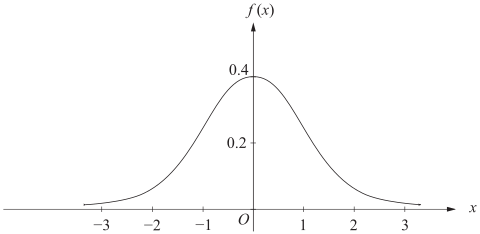
Let  `X` denote a normal random variable with mean 0 and standard deviation 1.

The random variable `X` has the probability density function

`f(x) = 1/sqrt(2pi) e^((−x^2)/2)`   where  `x ∈ (−∞, ∞)`

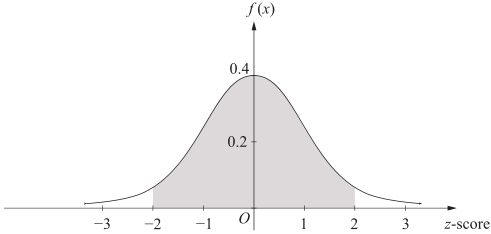
The diagram shows the graph of  `y = f(x)`.


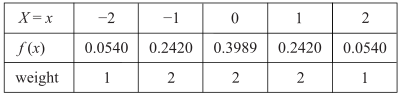
  1. Complete the table of values for the given function, correct to four decimal places.  (1 mark)


  2. Use the trapezoidal rule and 5 function values in the table in part i. to estimate


         `int_(−2)^2 f(x)\ dx`   (2 marks)

    --- 5 WORK AREA LINES (style=lined) ---
  3. The weights of Rhodesian ridgebacks are normally distributed with a mean of 48 kilograms and a standard deviation of 6 kilograms.


    Using the result from part ii., calculate the probability of a randomly selected Rhodesian ridgeback weighing less than 36 kilograms.  (2 marks)

    --- 5 WORK AREA LINES (style=lined) ---

Show Answers Only
i.   

ii.  `0.9369`

iii.  `3.155text(%)`

Show Worked Solution
i.   


ii.   


`int_(−2)^2 f(x)` `~~ 1/2[0.0540 + 2(0.2420 + 0.3989 + 0.2420) + 0.0540]`
  `~~ 1/2 xx 1.8738`
  `~~ 0.9369`


iii.   `mu = 48, sigma = 6`

`ztext(-score (36))` `= (x – mu)/sigma= (32 – 48)/6=-2`

`text(Shaded area = 93.69%)`

`text(By symmetry,)`

`P(X < 36\ text(kgs))` `= P(z < −2)`
  `= (100 – 93.69)/2`
  `= 3.155text(%)`

Filed Under: Normal Distribution (Y12) Tagged With: Band 3, Band 4, smc-995-50-Normal PDF / Trap Rule

Statistics, 2ADV S2 EQ-Bank 3

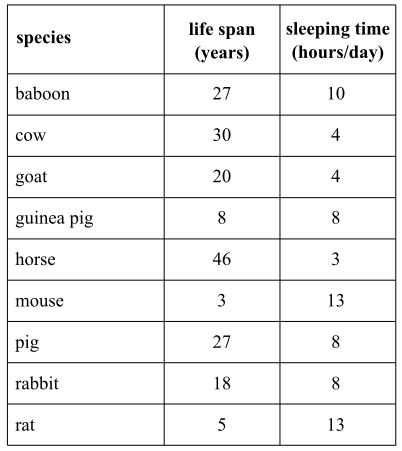
The table below lists the average life span (in years) and average sleeping time (in hours/day) of 9 animal species.


  1. Using sleeping time as the independent variable, calculate the least squares regression line. (1 mark)

    --- 1 WORK AREA LINES (style=lined) ---

  2. A wallaby species sleeps for 4.5 hours, on average, each day.


    Use your equation from part i to predict its expected life span, to the nearest year.   (1 mark)

    --- 1 WORK AREA LINES (style=lined) ---

Show Answers Only
  1. `text(life span) = 42.89 – 2.85 xx text(sleeping time)`
  2. `30\ text(years)`
Show Worked Solution

i.    `text(By calculator:)`

COMMENT: Issues here? YouTube has short and excellent help videos – search your calculator model and topic – eg. “fx-82 regression line” .

`text(life span) = 42.89 – 2.85 xx text(sleeping time)`
 

ii.   `text(Predicted life span of wallaby)`

`= 42.89 – 2.85 xx 4.5` 

`= 30.06…`

`= 30\ text(years)`

Filed Under: Bivariate Data Analysis (Y12), S4 Bivariate Data Analysis (Y12) Tagged With: Band 3, Band 4, common-content, smc-1001-20-Least-Squares Regression Line, smc-1001-70-Calculator (Stats Mode), smc-785-20-Least-Squares Regression Line, smc-785-70-Calculator (Stats Mode)

Calculus, 2ADV C4 EQ-Bank 5

The velocity of a particle moving along the `x`-axis at `v` metres per second at `t` seconds, is shown in the graph below.


Initially, the displacement `x` is equal to 12 metres.

  1. Write an equation that describes the displacement, `x`, at time `t` seconds.  (2 marks)

    --- 4 WORK AREA LINES (style=lined) ---

  2. Draw a graph that shows the displacement of the particle, `x`  metres from the origin, at a time `t` seconds between  `t= 0`  and  `t = 5`. Label the coordinates of the endpoints of your graph.  (2 marks)

    --- 8 WORK AREA LINES (style=lined) ---

Show Answers Only
  1. `x = 3t – (3)/(10) t ^2 + 12`
  2.  

Show Worked Solution
i.    `m_v` `= -(3)/(5)`
  `v` `= 3 – (3)/(5) t`


`x` `= int v \ dt`
  `= int 3 – (3)/(5) t \ dt`
  `= 3t – (3)/(10) t^2 + c`

 
`text(When) \ \ t = 0, x = 12  \ => \ c = 12`

`:. \ x = 3t – (3)/(10) t ^2 + 12`


ii.  `text(When) \ \ t = 5:`

`x = 15 – (3)/(10) xx 25 + 12 = 19.5`
 

Filed Under: Other Integration Applications (Y12) Tagged With: Band 4, Band 5, smc-1213-10-Motion

Financial Maths, 2ADV M1 EQ-Bank 1

Ralph opens an annuity account and makes a contribution of $12 000 at the end of each year for 9 years.

For the first 8 years, the interest rate is 4% per annum, compounded annually.

For the 9th year, the interest rate decreases to 3% per annum, compounded annually.


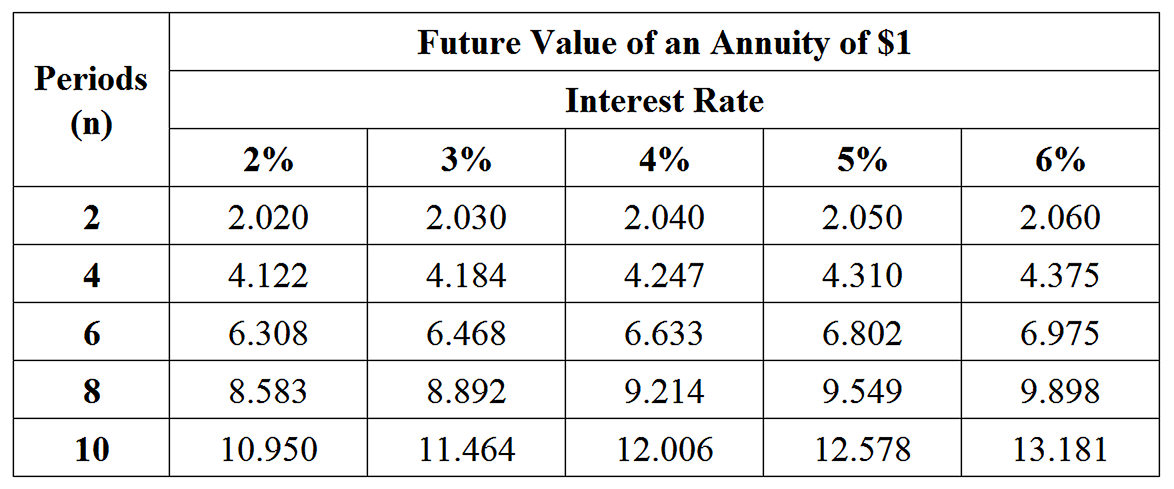
Use the Future Value of an Annuity table to calculate the amount in the account immediately after the 9th contribution is made.  (3 marks)

Show Answers Only

`$125\ 885.04`

Show Worked Solution

`text(After 8 years:)`

`text(Total)` `= 9.214 xx $12\ 000`
  `= $110\ 568`

 
`text{After 9 years (9th contribution made year end):}`

`text(Total)` `= 110\ 568 xx 1.03 + 12\ 000`
  `= $125\ 885.04`

Filed Under: F5 Annuities (Y12), Modelling Investments and Loans (Y12) Tagged With: Band 4, common-content, smc-1002-40-FV Annuity Table, smc-816-10-FV of $1 Annuity Table

Statistics, 2ADV S2 EQ-Bank 2

The table below lists the average body weight (in kilograms) and average brain weight (in grams) of nine animal species.


A least squares regression line is fitted to the data using body weight as the independent variable.

  1. Calculate the equation of the least squares regression line. (1 mark)

    --- 2 WORK AREA LINES (style=lined) ---
  2. If dingos have an average body weight of 22.3 kilograms, calculate the predicted average brain weight of a dingo using your answer to part i.   (1 mark)

    --- 1 WORK AREA LINES (style=lined) ---

Show Answers Only
  1. `text(brain weight) = 49.4 + 2.68 xx text(body weight)`
  2. `109\ text(grams)`
Show Worked Solution

i.   `text(By calculator:)`

COMMENT: Know this critical calculator skill!.

`text(brain weight) = 49.4 + 2.68 xx text(body weight)`


ii.   `text(Predicted brain weight of a dingo)`

`= 49.4 + 2.68 xx 22.3` 

`=109.164`

`= 109\ text(grams)`

Filed Under: Bivariate Data Analysis (Y12), S4 Bivariate Data Analysis (Y12) Tagged With: Band 3, Band 4, common-content, smc-1001-20-Least-Squares Regression Line, smc-1001-70-Calculator (Stats Mode), smc-785-20-Least-Squares Regression Line, smc-785-70-Calculator (Stats Mode)

Statistics, 2ADV S2 EQ-Bank 1

The arm spans (in cm) and heights (in cm) for a group of 13 boys have been measured. The results are displayed in the table below.
 

CORE, FUR2 2008 VCAA 4

The aim is to find a linear equation that allows arm span to be predicted from height.

  1. What will be the independent variable in the equation?  (1 mark)

    --- 1 WORK AREA LINES (style=lined) ---
  2. Assuming a linear association, determine the equation of the least squares regression line that enables arm span to be predicted from height. Write this equation in terms of the variables arm span and height. Give the coefficients correct to two decimal places.  (2 marks)

    --- 4 WORK AREA LINES (style=lined) ---

  3. Using the equation that you have determined in part b., interpret the slope of the least squares regression line in terms of the variables height and arm span.  (1 mark)

    --- 2 WORK AREA LINES (style=lined) ---

Show Answers Only
  1. `text(Height)`
  2. `text(Arm span)\ = 1.09 xx text(height) – 15.63`
  3. `text(On average, arm span increases by 1.09 cm)`
    `text(for each 1 cm increase in height.)`
Show Worked Solution

a.   `text(Height)`

COMMENT: Calculator skills for finding the least squares regression line were required in NESA sample exam – know this critical skill well!


b.   `text(By calculator,)`

`text(Arm span)\ = 1.09 xx text(height) – 15.63`


c.   `text(On average, arm span increases by 1.09 cm)`

`text(for each 1 cm increase in height.)`

Filed Under: Bivariate Data Analysis (Y12), S4 Bivariate Data Analysis (Y12) Tagged With: Band 3, Band 4, common-content, smc-1001-20-Least-Squares Regression Line, smc-1001-50-Gradient Interpretation, smc-1001-70-Calculator (Stats Mode), smc-785-20-Least-Squares Regression Line, smc-785-50-Gradient Interpretation, smc-785-70-Calculator (Stats Mode)

Functions, 2ADV F2 EQ-Bank 1

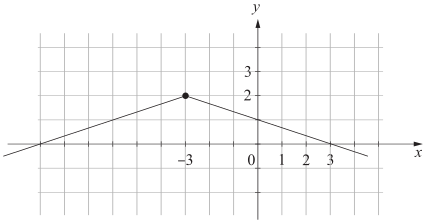
The function  `f(x) = |x|`  is transformed and the equation of the new function is  `y = kf(x + b) + c`.

The graph of the new function is shown below.


What are the values of  `k`, `b`  and  `c`.  (2 marks)

Show Answers Only

`k = −1/3, b = 3, c = 2`

Show Worked Solution

`y = |x|`

`text(Translate 3 units left) \ => \ y = |x + 3|`

`text(Reflect in the)\ xtext(-axis) \ => \ y = −|x + 3|`

`text(Dilate by)\ 1/3\ text(from the)\ x text(-axis)`

`=>\ text(Multiply by)\ 1/3 \ => \ y = −1/3|x + 3|`

`text(Translate 2 units up) \ => \ y = −1/3 |x + 3| + 2`
 

`:. k = −1/3, b = 3, c = 2`

Filed Under: Graph Transformations (Adv-2027), Transformations (Y12) Tagged With: Band 4, smc-1008-20-Absolute Value, smc-1008-70-Combinations, smc-6408-15-Absolute Value, smc-6408-60-Combinations

Functions, 2ADV F1 EQ-Bank 6

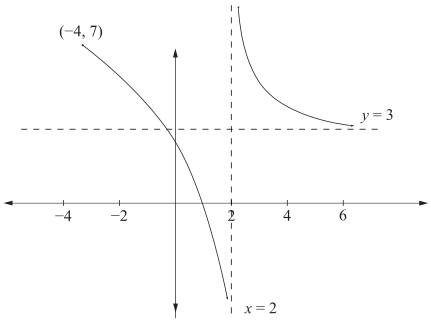
The graph of `f(x)` is shown below. It has asymptotes at  `y = 3`  and  `x = 2`.


Using interval notation, state the domain and range of `f(x)`.   (2 marks)

Show Answers Only

`text(Domain:)\ [−4, 2) ∪ (2, ∞)`

`text(Range:)\ (−∞, ∞)`

Show Worked Solution

`text(Domain:)\ [−4, 2) ∪ (2, ∞)`

`text(Range:)\ (−∞, ∞)`

Filed Under: Further Functions and Relations (Y11), Reciprocal Functions (Adv-2027) Tagged With: Band 4, smc-6382-40-Domain/Range, smc-6382-60-Set Notation, smc-987-30-Reflections and Other Graphs

Statistics, 2ADV S3 EQ-Bank 1

A probability density function can be used to model the lifespan of a termite, `X`, in weeks, is given by
 

`f(x) = {(k(36 - x^2)),(0):}\ \ \ {:(3 <= x <= 6),(text(otherwise)):}`
 

  1. Show that the value of  `k`  is  `1/45`.  (2 marks)

    --- 4 WORK AREA LINES (style=lined) ---

  2. Find the cumulative distribution function.  (2 marks)

    --- 4 WORK AREA LINES (style=lined) ---
  3. Find the probability that a termite's lifespan is greater than 5 weeks.  (1 mark)

    --- 2 WORK AREA LINES (style=lined) ---

Show Answers Only
  1. `text(See Worked Solutions)`
  2. `F(x) = {(0),(1/135 (108t – t^3  – 297)),(1):}\ \ \ {:(x < 3),(3 <= x <= 6),(x > 6):}`
  3. `17/135`
Show Worked Solution
i.    `k int_3^6 36 – x^2\ dx` `= 1`
  `k[36x – (x^3)/3]_3^6` `= 1`
  `k[(216 – 72)-(108 – 9)]` `= 1`
  `45k` `= 1`
  `k` `= 1/45`


ii.    `F(t)` `= int_(-∞)^t f(x)\ dx`
    `= int_3^t f(x)\ dx`
    `= 1/45 int_3^t 36 – x^2\ dx`
    `= 1/45 [36x – (x^3)/3]_3^t`
    `= 1/135[108x – x^3]_3^t`
    `= 1/35[(108t – t^3) – (324 – 27)]`
    `= 1/135(108t – t^3 – 297)`

 
`:. F(x) = {(0),(1/135 (108t – t^3  – 297)),(1):}\ \ \ {:(x < 3),(3 <= x <= 6),(x > 6):}`


iii.    `P(X > 5)` `= 1 – F(5)`
    `= 1 – 1/135(108 xx 5 – 5^3 – 297)`
    `= 1 – 118/135`
    `= 17/135`

Filed Under: Probability Density Functions (Y12) Tagged With: Band 4, Band 5, smc-994-30-Other Probability, smc-994-40-Cumulative Distribution Fn, smc-994-60-Polynomial PDF

Calculus, 2ADV C4 EQ-Bank 2

The population, `D`, of Tasmanian Devils in a sanctuary is given by  `D(t)`, where  `t`  is the time in years after the sanctuary was established.

The devil population changes at a rate modelled by the function  `(dD)/(dt) = 28 e^(0.35t)`.

Calculate the increase in the number of Tasmanian Devils at the end of the first 8 years. Give your answer correct to three significant figures.  (3 marks)

Show Answers Only

`1240 \ text((to 3 sig. fig.))`

Show Worked Solution
`int_0^8 28e^(0.35t)` `= [28 xx (1)/(0.35) e^(0.35t)]_0^8`
  `= 80(e^(0.35 xx 8) – e°)`
  `= 80(16.44 … – 1)`
  `= 1235.57 …`
  `= 1240 \ text((to 3 sig. fig.))`

Filed Under: Other Integration Applications (Y12) Tagged With: Band 4, smc-1213-20-Population, smc-966-20-Population

Calculus, 2ADV C2 EQ-Bank 10

The function  `f(theta) = sin^3(2 theta)`.

If  `f^{′}(theta) = 6 cos(2 theta)-6 cos^n (2 theta)`, find the value of `n`.  (2 marks)

--- 5 WORK AREA LINES (style=lined) ---
Show Answers Only

`3`

Show Worked Solution

`f(theta)= sin^3(2 theta)= (sin(2theta))^3`

`f^{′}(theta)` `= 3 xx 2cos(2 theta) xx sin^2(2 theta)`
  `= 6 cos(2 theta)(1-cos^2(2 theta))`
  `= 6 cos (2 theta)-6 cos^3(2 theta)`

 
`:. \ n = 3`

Filed Under: Trig Differentiation (Y12) Tagged With: Band 4, smc-968-10-Sin, smc-968-60-Chain Rule

Functions, 2ADV F1 EQ-Bank 11

Given the function  `f(x) = sqrt(3-x)`  and  `g(x) = x^2-2`, sketch  `y = g(f(x))`  over its natural domain.   (2 marks)

--- 8 WORK AREA LINES (style=lined) ---
Show Answers Only

Show Worked Solution

`g(x) = x^2-2,\ \ f(x) = sqrt(3-x)`

`g(f(x))` `= (sqrt(3-x))^2-2`
  `= 3-x-2`
  `= 1-x`

 
`text(S)text(ince)\ \ f(x) = sqrt(3-x),`

`=> text(Domain:)\ x <= 3`
 

Filed Under: Composite Functions (Adv-2027), Composite Functions (Y11) Tagged With: Band 4, smc-6216-20-Quadratics, smc-6216-30-Other Functions, smc-6216-50-Draw/Interpret Graphs, smc-986-20-Quadratic, smc-986-30-Other, smc-986-50-Sketch

Functions, 2ADV F1 EQ-Bank 12

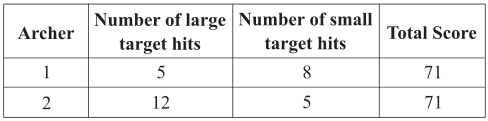
Two archers play a game where each can aim for a large target or a small target.

If an arrow hits the large target it scores `L` points, and if it hits the small target, it scores `S` points.

The results of a game are shown in the table below.
 

By forming a pair of simultaneous equations, or otherwise, find the value of `L` and `S`.  (3 marks)

--- 8 WORK AREA LINES (style=lined) ---

Show Answers Only

`L = 3, S = 7`

Show Worked Solution

`5L + 8S = 71\ \ …\ (1)`

`12L + 5S = 71\ \ …\ (2)`
 

`text(Multiply  (1)) xx 5`

`25L + 40S = 355\ \ …\ (3)`
 

`text(Multiply  (2)) xx 8`

`96L + 40S = 568\ \ …\ (4)`

 
`text{Subtract  (4) − (3)}`

`71L` `= 213`
`:. L` `= 3`

 
`text(Substitute)\ \ L = 3\ \ text(into (1))`

`8S` `= 56`
`:. S` `= 7`

Filed Under: Linear Functions (Y11) Tagged With: Band 4, smc-985-40-Simultaneous Equations

Probability, 2ADV S1 EQ-Bank 42

The discrete random variable `X` has the probability distribution shown in the table below.
 

     `X = x` `4` `5` `6` `7` `8`
  `P(x)` `0.3` `a` `0.1` `0.15` `0.2`

   
 Find the value of  `a`, and hence calculate the the expected value and variance of  `X`.  (3 marks)

--- 8 WORK AREA LINES (style=lined) ---
Show Answers Only

`2.31`

Show Worked Solution

`0.3 + a + 0.1 + 0.15 + 0.2 = 1`

`=> \ a = 0.25`
 

`E(X) = ∑ x P(x)`
 

  `qquad X = x` `4` `5` `6` `7` `8`
  `qquad P(x) qquad` `0.3` `0.25` `0.1` `0.15` `0.2`
  `qquad x xx P(x) qquad` `1.2` `1.25` `0.6` `1.05` `1.6`


`E(X)` `= 1.2 + 1.25 + 0.6 + 1.05 + 1.6`
  `= 5.7`


`text(Var)(X)` `= E(X^2) – [E(X)]^2`
  `= (4^2 xx 0.3) + (5^2 xx 0.25) + (6^2 xx 0.1) + (7^2 xx 0.15) + (8^2 xx 0.2) – 5.7^2`
  `= 2.31`

Filed Under: Discrete Probability Distributions (Y11) Tagged With: Band 4, smc-992-10-Sum of Probabilities = 1, smc-992-20-E(X) / Mean, smc-992-30-Var(X) / Std Dev

Statistics, 2ADV S3 EQ-Bank 6 MC

A continuous probability density function graph is drawn below.


Which of the following is the mode?

  1. 0.42
  2. 0.08
  3. 1.5
  4. 5
Show Answers Only

`C`

Show Worked Solution

`text(Mode is the most common)\ xtext(-value.)`

`ytext(-axis measures the probability.)`

`text(Highest probability = 0.42)`

`:.\ text(Mode = 1.5)`

`=>\ C`

Filed Under: Probability Density Functions (Y12) Tagged With: Band 4, smc-994-20-Mode, smc-994-80-Trig PDF

Calculus, 2ADV C2 EQ-Bank 4 MC

If  `f(x)=log_2(x^(2x))`, which expression is equal to  `f^(′)(x)`?

  1. `2/(x^(2x)ln2`
  2. `2/ln2 + 2log_2x`
  3. `log_2x+2/ln2`
  4. `2/ln2 xx log_2(x^(2x-1))`
Show Answers Only

`B`

Show Worked Solution
`f(x)` `=log_2(x^(2x))`  
  `=2x log_2x`  
  `=(2x lnx)/ln2`  


`f^(′)(x)` `=1/ln2 (2x*1/x + 2lnx)`  
  `=2/ln2 + (2lnx)/ln2`  
  `=2/ln2 + 2log_2x`  

 
`=>  B`

Filed Under: L&E Differentiation (Y12), Log Calculus (Y12) Tagged With: Band 4, smc-964-10-Differentiation, smc-967-20-Logs, smc-967-30-Product Rule, smc-967-60-New Reference Sheet, smc-967-70-Log Laws required

NETWORKS, FUR2-NHT 2019 VCAA 3

The zoo’s management requests quotes for parts of the new building works.

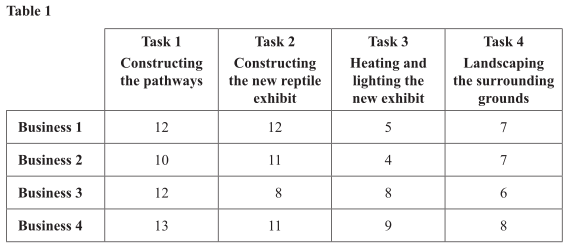
Four businesses each submit quotes for four different tasks.

Each business will be offered only one task.

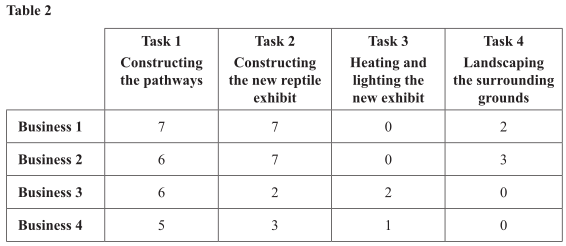
The quoted cost, in $100 000, of providing the work is shown in Table 1 below.


The zoo’s management wants to complete the new building works at minimum cost.

The Hungarian algorithm is used to determine the allocation of tasks to businesses.

The first step of the Hungarian algorithm involves row reduction; that is, subtracting the smallest element in each row of Table 1 from each of the elements in that row.

The result of the first step is shown in Table 2 below.


The second step of the Hungarian algorithm involves column reduction; that is, subtracting the smallest element in each column of Table 2 from each of the elements in that column.

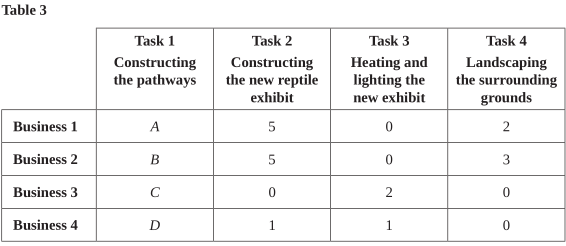
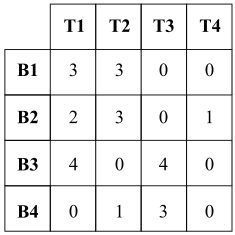
The results of the second step of the Hungarian algorithm are shown in Table 3 below. The values of Task 1 are given as `A, B, C` and `D`.


  1. Write down the values of `A, B, C` and `D`.   (1 mark)

    --- 1 WORK AREA LINES (style=lined) ---

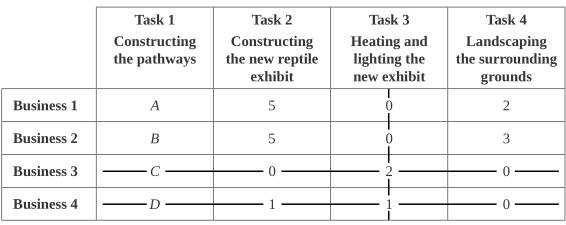
  2. The next step of the Hungarian algorithm involves covering all the zero elements with horizontal or vertical lines. The minimum number of lines required to cover the zeros is three.


    Draw these three lines on Table 3 above.   (1 mark)

    --- 0 WORK AREA LINES (style=lined) ---

  3. An allocation for minimum cost is not yet possible.


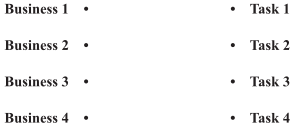
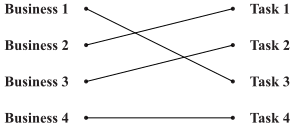
    When all steps of the Hungarian algorithm are complete, a bipartite graph can show the allocation for minimum cost.


    Complete the bipartite graph below to show this allocation for minimum cost.   (1 mark)

    --- 4 WORK AREA LINES (style=lined) ---


  1. Business 4 has changed its quote for the construction of the pathways. The new cost is $1 000 000. The overall minimum cost of the building works is now reduced by reallocating the tasks.


    How much is this reduction?   (1 mark)

    --- 6 WORK AREA LINES (style=lined) ---

Show Answers Only
  1. `A = 2, B = 1, C = 1, D = 0`
  2. `text(See Worked Solutions)`
  3. `text(See Worked Solutions)`
  4. `text(See Worked Solutions)`
Show Worked Solution

a.   `A = 2, \ B = 1, \ C = 1, \ D = 0`


b.  


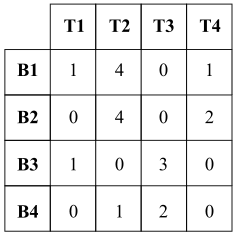
c.  `text(After next step:)`
 

`text(Allocation): `


d.  `text{Hungarian Algorithm table (complete):}`
 

`text(Allocation): B2 -> T3,\ B1 -> T4,\ B3 -> T2,\ B4 -> T1`
 

`text(C)text(ost) = 4 + 7 + 8 + 10 = 29`

`text(Previous cost) = 5 + 10 + 8 + 8 = 31`
 

`:.\ text(Reduction)` `= 2 xx 100\ 000`
  `= $200\ 000`

Filed Under: Matching Problems Tagged With: Band 3, Band 4, Band 5, page-break-before-question, smc-623-10-Hungarian Algorithm

  • « Previous Page
  • 1
  • …
  • 65
  • 66
  • 67
  • 68
  • 69
  • …
  • 114
  • Next Page »

Copyright © 2014–2025 SmarterEd.com.au · Log in