SmarterEd

Aussie Maths & Science Teachers: Save your time with SmarterEd

  • Login
  • Get Help
  • About

GEOMETRY, FUR1-NHT 2019 VCAA 6 MC

A cake in the shape of three cylindrical sections is shown in the diagram below.


Each section of the cake has a height of 8 cm, as shown in the diagram.

The middle section of the cake, B, has twice the volume of the top section of the cake, A.

The bottom section of the cake, C, has twice the volume of the middle section of the cake, B.

The volume of the top section of the cake, A, is 900 cm3.

The diameter of the bottom section of the cake, C, in centimetres, is closest to

  1. 12
  2. 18
  3. 24
  4. 36
  5. 48
Show Answers Only

`C`

Show Worked Solution
`text(Volume) \ C` `= 900 xx 4`
  `= 3600 \ text(cm)^3`


`pi xx r_C^2 xx h` `= 3600`
`r_C^2` `= (3600)/(8 pi)`
`r_C^2` `= 11.968 \ …`

 
`:. \ text(Diameter of)\  C ≈ 24\ text(cm)`
  
`=> \ C`

Filed Under: Similarity and Scale Tagged With: Band 4, smc-606-30-Factors k / k^2 / k^3

GEOMETRY, FUR1-NHT 2019 VCAA 5 MC

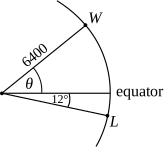
The cities of Lima and Washington, DC have the same longitude of 77° W.

The shortest great circle distance between Lima and Washington, DC is 5697 km.

Assume that the radius of Earth is 6400 km.

Lima has a latitude of 12° S and is located due south of Washington, DC.

What is the latitude of Washington, DC?

  1. 39° N
  2. 51° S
  3. 51° N
  4. 63° N
  5. 65° S
Show Answers Only

`A`

Show Worked Solution


`text(Arc Distance) \ WL` `= 5697`
`({theta + 12}/{360}) xx 2 xx pi xx 6400` `= 5697`
`theta + 12` `= (5697 xx 360)/(2 pi xx 6400)`
  `= 51°`
`:. \ theta` `= 39°`

 
`=> \ A`

Filed Under: Great Circle Geometry Tagged With: Band 4, smc-758-20-Great Circle distance

GEOMETRY, FUR1-NHT 2019 VCAA 3 MC

A waterfall in a national park is 4 km east of a camp site.

A lookout tower is 4 km south of the waterfall.

The bearing of the camp site from the lookout tower is

  1.  045°
  2.  090°
  3.  135°
  4.  300°
  5.  315°
Show Answers Only

`E`

Show Worked Solution

`text(Bearing of) \ C \ text(from) \ T` `= 360 – 45`
  `= 315°`

 
`=> \ E`

Filed Under: Trig - Bearings Tagged With: Band 4

Networks, STD2 N3 2019 FUR2-N 2

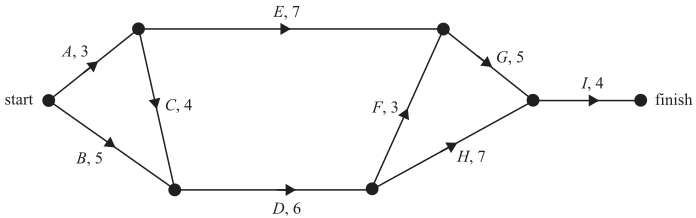
The construction of the new reptile exhibit is a project involving nine activities, `A` to `I`.

The directed network below shows these activities and their completion times in weeks.


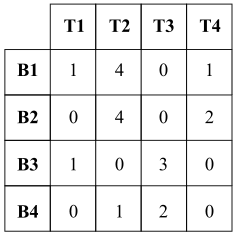
  1. Which activities have more than one immediate predecessor?  (1 mark)

    --- 1 WORK AREA LINES (style=lined) ---

  2. Write down the critical path for this project.  (1 mark)

    --- 1 WORK AREA LINES (style=lined) ---

  3. What is the latest start time, in weeks, for activity `B`?  (1 mark)

    --- 2 WORK AREA LINES (style=lined) ---

Show Answers Only
  1. `D, G and I`
  2. `text(See Worked Solutions)`
  3. `2\ text(weeks)`
Show Worked Solution

a.   `D, G and I`


b.   `text(Scanning forwards and backwards:)`
 

​
 

`text(Critical Path:)\ ACDFGI`


c.   `text{LST (activity}\ B text{)}` `= 7 – 5`
    `= 2\ text(weeks)`

Filed Under: Critical Paths Tagged With: Band 3, Band 4, smc-916-30-Scanning Both Ways

NETWORKS, FUR2-NHT 2019 VCAA 1

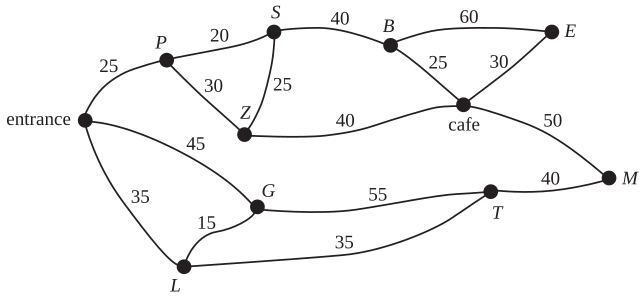
A zoo has an entrance, a cafe and nine animal exhibits: bears `(B)`, elephants `(E)`, giraffes `(G)`, lions `(L)`, monkeys `(M)`, penguins `(P)`, seals `(S)`, tigers `(T)` and zebras `(Z)`.

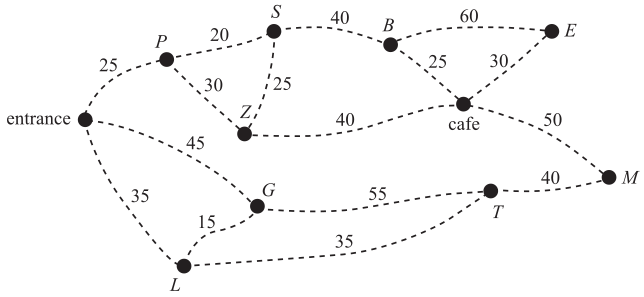
The edges on the graph below represent the paths between the entrance, the cafe and the animal exhibits. The numbers on each edge represent the length, in metres, along that path. Visitors to the zoo can use only these paths to travel around the zoo.


  1. What is the shortest distance, in metres, between the entrance and the seal exhibit `(S)`?   (1 mark)

    --- 1 WORK AREA LINES (style=lined) ---

  2. Freddy is a visitor to the zoo. He wishes to visit the cafe and each animal exhibit just once, starting and ending at the entrance.
  3. i. What is the mathematical term used to describe this route?   (1 mark)

    --- 1 WORK AREA LINES (style=lined) ---

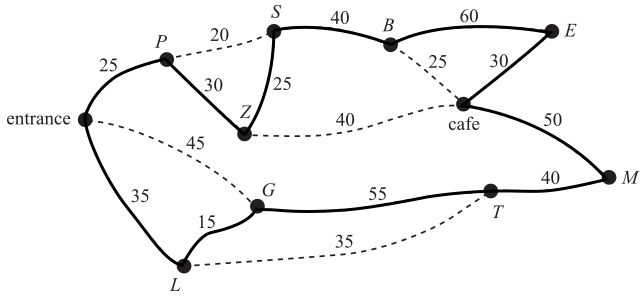
  4. ii. Draw one possible route that Freddy may take on the graph below.   (1 mark)

    --- 0 WORK AREA LINES (style=lined) ---


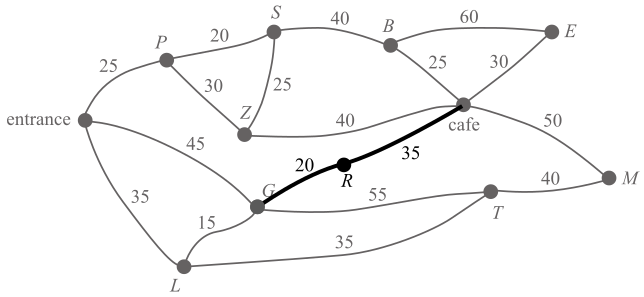
A reptile exhibit `(R)` will be added to the zoo.

A new path of length 20 m will be built between the reptile exhibit `(R)` and the giraffe exhibit `(G)`.

A second new path, of length 35 m, will be built between the reptile exhibit `(R)` and the cafe.

  1. Complete the graph below with the new reptile exhibit and the two new paths added. Label the new vertex `R` and write the distances on the new edges.   (1 mark)

    --- 0 WORK AREA LINES (style=lined) ---


  1. The new paths reduce the minimum distance that visitors have to walk between the giraffe exhibit `(G)` and the cafe.


    By how many metres will these new paths reduce the minimum distance between the giraffe exhibit `(G)` and the cafe?   (1 mark)

    --- 5 WORK AREA LINES (style=lined) ---

Show Answers Only
  1.  `45\ text(metres)`
  2. i.  `text(Hamilton cycle.)`
    ii. `text(See Worked Solutions)`
  3.  `text(See Worked Solutions)`
  4.  `85\ text(metres)`
Show Worked Solution

a.   `45\ text(metres)`
 

b.i.   `text(Hamilton cycle.)`
 

b.ii.  

`text(Possible route:)`

`text(entrance)\ – LGTMCEBSZP\ –\ text(entrance)`


c.  


d.  `text{Minimum distance (before new exhibit)}`

`= GLTMC`

`= 15 + 35 + 40 + 50`

`= 140\ text(m)`
 

`:.\ text(Reduction in minimum distance)`

`= 140 – (20 + 35)`

`= 85\ text(m)`

Filed Under: Minimum Spanning Trees and Shortest Paths Tagged With: Band 2, Band 3, Band 4, smc-624-60-Shortest Paths

MATRICES, FUR2-NHT 2019 VCAA 4

After 5.00 pm, tourists will start to arrive in Gillen and they will stay overnight.

As a result, the number of people in Gillen will increase and the television viewing habits of the tourists will also be monitored.

Assume that 50 tourists arrive every hour.

It is expected that 80% of arriving tourists will watch only `C_2` during the hour that they arrive.

The remaining 20% of arriving tourists will not watch television during the hour that they arrive.

Let `W_m` be the state matrix that shows the number of people in each category `m` hours after 5.00 pm on this day.

The recurrence relation that models the change in the television viewing habits of this increasing number of people in Gillen `m` hours after 5.00 pm on this day is shown below.

`W_(m + 1) = TW_m + V` 

where

`{:(quad qquad qquad qquadqquadqquadquadtext(this hour)),(qquadqquadqquad quad \ C_1 qquad quad C_2 qquad \ C_3 quad \ NoTV),(T = [(quad 0.50, 0.05, 0.10, 0.20 quad),(quad 0.10, 0.60, 0.20, 0.20 quad),(quad 0.25, 0.10, 0.50, 0.10 quad),(quad 0.15, 0.25, 0.20, 0.50 quad)]{:(C_1),(C_2),(C_3),(NoTV):}\ text(next hour,) qquad and qquad  W_0 = [(400), (600), (300),(700)]):}`
 

  1. Write down matrix `V`.   (1 mark)

    --- 3 WORK AREA LINES (style=lined) ---

  2. How many people in Gillen are expected to watch `C_2` at 7.00 pm on this day?   (2 marks)

    --- 5 WORK AREA LINES (style=lined) ---

Show Answers Only
  1.  `V=[(0),(40),(0),(10)]`
  2.  `666`
Show Worked Solution

a.   `V=[(0),(40),(0),(10)]`

b.    `W_1` `=TW_0+V`
    `=[(quad 0.50, 0.05, 0.10, 0.20 quad),(quad 0.10, 0.60, 0.20, 0.20 quad),(quad 0.25, 0.10, 0.50, 0.10 quad),(quad 0.15, 0.25, 0.20, 0.50 quad)] [(400),(600),(300),(700)]+[(0),(40),(0),(10)]=[(400),(640),(380),(630)]`
     
  `W_2` `=TW_1+V=[(396),(666),(417),(621)]`

 
`:.\ text(666 people are expected to watch)\ C_2\ text(at 7 pm.)`

Filed Under: Transition Matrices - Modified Tagged With: Band 4, Band 5, smc-1893-20-State Matrix in discrete period, smc-1893-32-4x4 Matrix

MATRICES, FUR2-NHT 2019 VCAA 3

The basketball finals will be televised on `C_3` from 12.00 noon until 4.00 pm.

It is expected that 600 Gillen residents will be watching `C_3` at any time from 12.00 noon until 4.00 pm.

The remaining 1400 Gillen residents will not be watching `C_3` from 12.00 noon until 4.00 pm (represented by NotC3).
 

`{:(qquadqquadqquadquadtext(this hour)),(qquadqquadqquad \ C_3 quadquad \ NotC_3),(P = [(v, qquad quad w quad),(0.35, quad qquad x quad)]{:(C_3),(NotC_3):}\ text(next hour)):}`
 

Write down the values of `v, w` and `x` in the boxes provided below.   (2 marks)

`v =`
 
`w =`
 
`x =`
 

--- 6 WORK AREA LINES (style=lined) ---

Show Answers Only

`v = 0.65, \ w = 0.15, \ x = 0.85`

Show Worked Solution

`v = 1-0.35 = 0.65`
 

`text(Residents who change from)\ C_3\ text(to Not)C_3`

`= 0.35 xx 600`

`= 210`
 

`text(S) text(ince 600 residents are watching)\ C_3\ text(at any time)`

`w xx 1400` `= 210`
`w` `= 0.15`
`:. x` `= 1-0.15`
  `= 0.85`

Filed Under: Transition Matrices - Regular Tagged With: Band 4, smc-618-60-2x2 Matrix

MATRICES, FUR2-NHT 2019 VCAA 2

Three television channels, `C_1, C_2` and `C_3`, will broadcast the International Games in Gillen.

Gillen’s 2000 residents are expected to change television channels from hour to hour as shown in the transition matrix `T` below. 

The option for residents not to watch television (NoTV) at that time is also indicated in the transition matrix.
 

`{:(qquadqquadqquadqquadqquadquadtext(this hour)),(qquadqquadqquad \ C_1 quadquad \ C_2 quadqquad C_3 quad \ NoTV),(T = [(0.50,0.05,0.10,0.20),(0.10,0.60,0.20,0.20),(0.25,0.10,0.50,0.10),(0.15,0.25,0.20,0.50)]{:(C_1),(C_2),(C_3),(NoTV):}text(next hour)):}`
 

The state matrix `G_0` below lists the number of Gillen residents who are expected to watch the games on each of the channels at the start of a particular day (9.00 am).

Also shown is the number of Gillen residents who are not expected to watch television at that time.
 

`G_0 = [(100), (400), (100), (1400)]{:(C_1), (C_2), (C_3), (NoTV):}`
 

  1. Complete the calculation below to show that 835 Gillen residents are not expected to watch television (NoTV) at 10.00 am that day.   (1 mark)

    --- 0 WORK AREA LINES (style=lined) ---


`xx 100 +`
 
`xx 400 +`
 
`xx 100 `
  `+\ \ `
 
`xx 1400 ` `= 835`  


  1. Determine the number of residents expected to watch the games on `C_3` at 11.00 am that day.   (1 mark)

    --- 3 WORK AREA LINES (style=lined) ---

Show Answers Only
  1. `0.15 xx 100 + 0.25 xx 400 + 0.20 xx 100 + 0.50 xx 1400 = 835`
  2. `356`
Show Worked Solution

a.  `0.15 xx 100 + 0.25 xx 400 + 0.20 xx 100 + 0.50 xx 1400 = 835`
 

b.  `G_1 text{(11:00 am)} = TG_0 = [(400),(584),(356),(660)]`

`:. 356\ text(residents are expected to watch)\ C_3\ text(at 11:00 am).`

Filed Under: Transition Matrices - Regular Tagged With: Band 4, smc-618-30-State Matrix in discrete period, smc-618-62-4x4 Matrix

MATRICES, FUR2-NHT 2019 VCAA 1

A total of six residents from two towns will be competing at the International Games.

Matrix `A`, shown below, contains the number of male `(M)` and the number of female `(F)` athletes competing from the towns of Gillen `(G)` and Haldaw `(H)`.

`{:(qquad qquad quad \ M quad F), (A = [(2, 2), (1, 1)]{:(G),(H):}):}` 

  1. How many of these athletes are residents of Haldaw?   (1 mark)

    --- 1 WORK AREA LINES (style=lined) ---

Each of the six athletes will compete in one event: table tennis, running or basketball.

Matrices `T` and `R`, shown below, contain the number of male and female athletes from each town who will compete in table tennis and running respectively.
 

            Table tennis                        Running             
 

`{:(qquad qquad quad \ M quad F), (T = [(0, 1), (1, 0)]{:(G),(H):}):}`

`{:(qquad qquad quad \ M quad F), (R = [(1, 1), (0, 0)]{:(G),(H):}):}`


  1. Matrix `B` contains the number of male and female athletes from each town who will compete in basketball.


    Complete matrix `B` below.   (1 mark)

    --- 0 WORK AREA LINES (style=lined) ---

`{:(qquad qquad qquad \ M qquad quad F), (B = [(\ text{___}, text{___}\ ), (\ text{___}, text{___}\)]{:(G),(H):}):}`

Matrix `C` contains the cost of one uniform, in dollars, for each of the three events: table tennis `(T)`, running `(R)` and basketball `(B)`.

`C = [(515), (550), (580)]{:(T), (R), (B):}`

    1. For which event will the total cost of uniforms for the athletes be $1030?   (1 mark)

      --- 1 WORK AREA LINES (style=lined) ---

    2. Write a matrix calculation, that includes matrix `C`, to show that the total cost of uniforms for the event named in part c.i. is contained in the matrix answer of [1030].   (1 mark)

      --- 3 WORK AREA LINES (style=lined) ---

  1. Matrix `V` and matrix `Q` are two new matrices where  `V = Q xx C`  and:
  • matrix `Q` is a  `4 xx 3`  matrix
  • element `v_11 =` total cost of uniforms for all female athletes from Gillen
  • element `v_21 =` total cost of uniforms for all female athletes from Haldaw
  • element `v_31 =` total cost of uniforms for all male athletes from Gillen
  • element `v_41 =` total cost of uniforms for all male athletes from Haldaw
     
  • `C = [(515), (550), (580)]{:(T), (R), (B):}`
  1. Complete matrix `Q` with the missing values.   (1 mark)

    --- 0 WORK AREA LINES (style=lined) ---

`Q = [(1, text{___}, text{___}\ ), (0, 0, 1), (0, 1, 1), (\ text{___}, text{___}, 0)]`

Show Answers Only
  1.  `2`
  2.  `B = [(1, 0), (0, 1)]`
  3. i.  `text(Table tennis)`
    ii. `[2\ \ \ 0\ \ \ 0] xx [(515), (550), (580)] = [1030]`
  4.  `Q = [(1, \ 1, \ 0),(0, \ 0, \ 1),(0, \ 1, \ 1),(1, \ 0, \ 0)]`
Show Worked Solution

a.  `2`
 

b.  `B = [(1, 0), (0, 1)]`
 

c.i.  `text(Table tennis)`
 

c.ii.  `[2\ \ \ 0\ \ \ 0] xx [(515), (550), (580)] = [1030]`
 

d.  `Q = [(1, \ 1, \ 0),(0, \ 0, \ 1),(0, \ 1, \ 1),(1, \ 0, \ 0)]`

Filed Under: Matrix Applications Tagged With: Band 2, Band 3, Band 4, smc-619-10-Matrix from info/table, smc-619-30-Matrix product and interpretation, smc-619-40-Interpret Elements

Calculus, 2ADV C4 2019 MET1-N 3

Evaluate  `int_0^1 e^x - e^-x\ dx`.  (2 marks)

Show Answers Only

`e + (1)/(e) – 2`

Show Worked Solution
`int_0^1 e^x – e^-x\ dx` `= [e^x + e^-x]_0^1`
  `= [e + (1)/(e) – (1 + 1)]`
  `= e + (1)/(e) – 2`

Filed Under: Exponential Calculus (Y12), L&E Integration Tagged With: Band 4, smc-1203-10-Exponential (Indefinite), smc-965-40-Definite Integrals

Functions, 2ADV F1 2019 MET1-N 2

Let  `f(x) = -x^2 + x + 4`  and  `g(x) = x^2 - 2`.

  1. Find  `g(f(3))`.  (2 marks)

    --- 6 WORK AREA LINES (style=lined) ---

  2. Express  `f(g(x))`  in the form  `ax^4 + bx^2 + c`, where  `a`, `b`  and  `c`  are non-zero integers.  (2 marks)

    --- 4 WORK AREA LINES (style=lined) ---
Show Answers Only
  1. `2`
  2. `-x^4 + 5x^2 – 2`
Show Worked Solution
a.    `f(3)` `= -3^2 + 3 + 4`
  `= -2`


`g(f(3))` `= g(-2)`
  `= (-2)^2 – 2`
  `= 2`


b.    `f(g(x))` `= -(x^2 – 2)^2 + (x^2 – 2) + 4`
  `= -(x^4 – 4x^2 + 4) + x^2 + 2`
  `= -x^4 + 5x^2 – 2`

Filed Under: Composite Functions (Adv-2027), Composite Functions (Y11) Tagged With: Band 3, Band 4, smc-6216-20-Quadratics, smc-986-20-Quadratic

Statistics, MET1-NHT 2018 VCAA 8

Let  `overset^p`  be the random variable that represents the sample proportions of customers who bring their own shopping bags to a large shopping centre.

From a sample consisting of all customers on a particular day, an approximate 95% confidence interval for the proportion  `p`  of customers who bring their own shopping bags to this large shopping centre was determined to be  `((4853)/(50\ 000) , (5147)/(50\ 000))`.

  1. Find the value of  `hatp`  that was used to obtain this approximate 95% confidence interval.   (1 mark)

    --- 3 WORK AREA LINES (style=lined) ---

  2. Use the fact that  `1.96 = (49)/(25)`  to find the size of the sample from which this approximate 95% confidence interval was obtained.   (2 marks)

    --- 5 WORK AREA LINES (style=lined) ---

Show Answers Only

  1. `(1)/(10)`
  2. `40\ 000`

Show Worked Solution

a.    `overset^p – z sqrt((overset^p(1 – overset^p))/(n)) = (4853)/(50\ 000) \ \ , \ \ overset^p + z sqrt((overset^p(1 – overset^p))/(n)) = (5147)/(50\ 000)`

`2 overset^p` `= (4853)/(50\ 000) + (5147)/(50\ 000)`  
`:. \ overset^p` `=1/10`  


b.    `(1)/(10) + (49)/(25) sqrt(({1)/{10}(1 – {1}/{10}))/(n)` `= (5147)/(50000)`
`(49)/(25) sqrt((9)/(100n))` `= (147)/(50000)`
`(49)/(25) * (3)/(10) * (1)/(sqrtn)` `= (147)/(25 xx 2000)`
`(147)/(sqrtn)` `= (147)/(200)`
`sqrtn` `= 200`
`:. \ n` `= 40\ 000`

Filed Under: Normal Distribution Tagged With: Band 4, Band 5, smc-719-20-95% confidence intervals, smc-719-40-Find sample size

Calculus, MET1-NHT 2018 VCAA 7

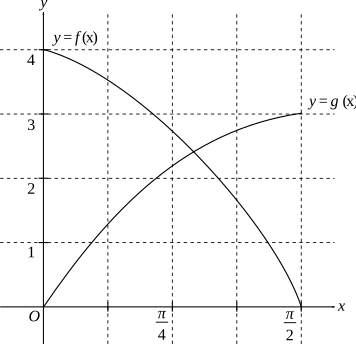
Let  `f : [ 0, (pi)/(2)] → R, \ f(x) = 4 cos(x)`  and  `g : [0, (pi)/(2)]  → R, \ g(x) = 3 sin(x)`.

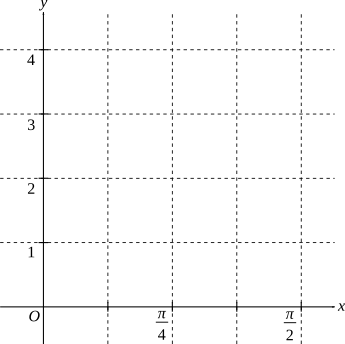
  1. Sketch the graph of `f` and the graph of `g` on the axes provided below.   (2 marks)

    --- 0 WORK AREA LINES (style=lined) ---
     
     
    `qquad qquad `
     

  2. Let `c` be such that  `f(c) = g(c)`,  where  `c∈[0, (pi)/(2)]`

     
    Find the value of  `sin(c)`  and the value of  `cos(c)`.   (3 marks)


    --- 4 WORK AREA LINES (style=lined) ---

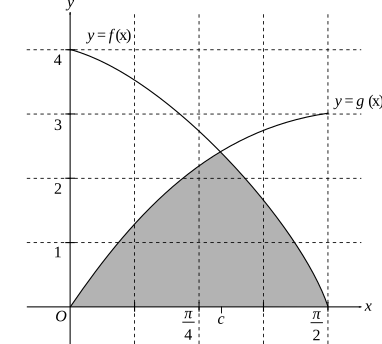
  3.  Let `A` be the region enclosed by the horizontal axis, the graph of `f` and the graph of `g`.
    1. Shade the region `A` on the axes provided in part a. and also label the position of `c` on the horizontal axis.   (1 mark)

      --- 0 WORK AREA LINES (style=lined) ---

    2. Calculate the area of the region `A`.   (3 marks)

      --- 7 WORK AREA LINES (style=lined) ---

Show Answers Only
  1.  


  2. `sin(c) = (4)/(5), \ cos(c) = (3)/(5)`


  3. i.

     
    ii. `2 \ u^2`
Show Worked Solution

a.   


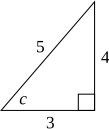
b.   `text(At intersection:)`

`4cos(c)` `= 3sin(c)`
`tan(c)` `= (4)/(3)`

`sin(c) = (4)/(5)`

`cos(c) = (3)/(5)`


c. i.
 

   ii.       `A` `= int_0^c g(x)\ dx + int_c^((pi)/(2)) f(x)\ dx`
  `= int_0^c 3sin x \ dx + int_c^((pi)/(2)) 4cos \ x \ dx`
  `= 3[-cos x]_0^c + 4[sin x]_c^((pi)/(2))`
  `= 3(-cos(c) + cos \ 0) + 4(sin \ (pi)/(2)-sin(c))`
  `= 3(-(3)/(5) + 1) + 4(1-(4)/(5))`
  `= (6)/(5) + (4)/(5)`
  `= 2 \ \ text(u²)`

Filed Under: Area Under Curves, Trig Graphing Tagged With: Band 4, smc-2757-10-Sin, smc-2757-15-Cos, smc-2757-70-Sketch graph, smc-723-60-Trig, smc-723-80-Area between graphs

Statistics, MET1-NHT 2018 VCAA 6

The discrete random variable `X` has the probability mass function
 

`text(Pr)(X = x) = {(kx), (k), (0):} qquad {:(x∈{1, 4, 6}), (x = 3), (text(otherwise)):}`
 

  1. Show that  `k = (1)/(12)`.  (2 marks)

    --- 5 WORK AREA LINES (style=lined) ---

  2. Find  `text(E)(X)`.  (1 mark)

    --- 5 WORK AREA LINES (style=lined) ---

  3. Evaluate  `text(Pr)(X ≥ 3 | X ≥ 2)`.  (1 mark)

    --- 5 WORK AREA LINES (style=lined) ---

Show Answers Only

  1. `text(Proof (See Worked Solution))`
  2. `(14)/(3)`
  3. `1`

Show Worked Solution

a.     `qquad X` `qquad 1 qquad` `qquad 3 qquad` `qquad 4 qquad` `qquad 6 qquad`
  `qquad Pr(X = x) qquad` `k` `k` `4k` `6k`


`k + k+4k + 6k` `= 1`
`12k` `= 1`
`k` `= (1)/(12)`


b.    `E(X)` `= ∑ x text(Pr)(X = x)`
  `= k + 3k + 16k + 36k`
  `= 56k`
  `= (56)/(12)`
  `= (14)/(3)`


c.    `text(Pr) (X ≥ 3 | X ≥ 2)` `= (text(Pr) (X ≥ 3 ∩ X ≥ 2))/(text(Pr) (X ≥ 2))`
  `= (text(Pr) (X ≥ 3))/(text(Pr) (X ≥ 2))`
  `= (k + 4k + 6k)/(k + 4k + 6k)`
  `= 1`

Filed Under: Probability density functions Tagged With: Band 4, Band 5, smc-637-10-E(X), smc-637-40-Conditional probability

Algebra, MET1-NHT 2018 VCAA 4

Solve  `log_3(t) - log_3(t^2 - 4) = -1`  for  `t`.  (3 marks)

Show Answers Only

`4 `

Show Worked Solution
`log_3(t) – log_3(t^2 – 4)` `= -1`
`log_3 ({t}/{t^2 – 4})` `= -1`
`(t)/(t^2 – 4)` `= (1)/(3)`
`t^2 – 4` `= 3t`
`t^2 – 3t – 4` `= 0`
`(t – 4)(t+ 1)` `= 0`

 
`:. t=4 \ \ \ (t > 0, \ t!= –1)`

Filed Under: Log/Index Laws and Equations Tagged With: Band 4, smc-726-10-Log - Product/Quotient Rule, smc-726-60-Quadratic Equations

Calculus, MET1-NHT 2018 VCAA 3

Evaluate  `int_0^1 e^x-e^-x\ dx`.   (2 marks)

--- 4 WORK AREA LINES (style=lined) ---

Show Answers Only

`e + (1)/(e)-2`

Show Worked Solution
`int_0^1 e^x-e^-x\ dx` `= [e^x + e^-x]_0^1`
  `= [e + (1)/(e)-(1 + 1)]`
  `= e + (1)/(e)-2`

Filed Under: Integration (L&E), L&E Integration Tagged With: Band 4, smc-740-20-Exponential (definite), smc-748-20-Exponential (definite)

Functions, MET1-NHT 2018 VCAA 2

Let  `f(x) = -x^2 + x + 4`  and  `g(x) = x^2-2`.

  1. Find `g(f(3))`.   (2 marks)

    --- 4 WORK AREA LINES (style=lined) ---

Show Answers Only
  1. `2`
  2. `-x^4 + 5x^2-2`
Show Worked Solution
a.    `f(3)` `= -3^2 + 3 + 4`
  `= -2`


`g(f(3))` `= g(-2)`
  `= (-2)^2-2`
  `= 2`


b.    `f(g(x))` `= -(x^2-2)^2 + (x^2-2) + 4`
  `= -(x^4-4x^2 + 4) + x^2 + 2`
  `= -x^4 + 5x^2-2`

Filed Under: Functional Equations Tagged With: Band 3, Band 4, smc-642-10-(f o g)(x)

Financial Maths, GEN1 2019 NHT 20 MC

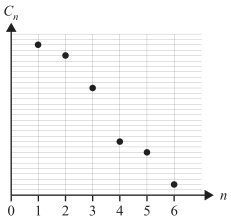
Marty has been depreciating the value of his car each year using flat rate depreciation.

After three years of ownership, the value of the car was halved due to an accident.

Marty continued to depreciate the value of his car by the same amount each year after the accident.

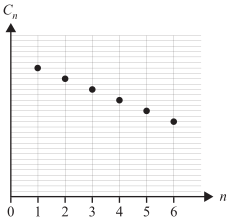
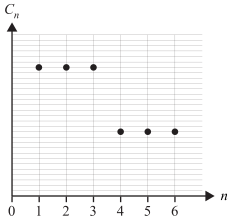
Which one of the following graphs could show the value of Marty’s car after `n` years, `C_n`?

A. B.
C. D.
E.    
Show Answers Only

`C`

Show Worked Solution

`text(Flat rate depression)`

`=>\ text{graph decreases in a straight line.}`

`text(Value of the car halves between)\ C_3\ text(and)\ C_4\ \ text(and then)`

`text(continues with the same gradient.)`

`=>\ C`

Filed Under: Depreciation Tagged With: Band 4, smc-602-10-Flat rate

Vectors, EXT1 V1 EQ-Bank 6

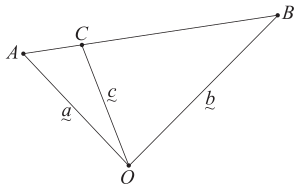
Point  `C`  lies on  `AB`  such that  `overset(->)(AC) = lambdaoverset(->)(AB)`.

  1.  Express  `underset~c`  in terms of  `underset~a`  and  `underset~b`.   (2 marks)

    --- 8 WORK AREA LINES (style=lined) ---

  2.  Hence or otherwise, show that  `overset(->)(BC) = (1-lambda)(underset~a-underset~b)`.   (1 mark)

    --- 4 WORK AREA LINES (style=lined) ---

Show Answers Only
  1. `lambdaunderset~b + (1-lambda)underset~a`
  2. `text{Proof (See Worked Solutions)}`
Show Worked Solution
i.      

`underset~c = underset~a + overset(->)(AC)`

`overset(->)(AB)` `= underset~b-underset~a`
`overset(->)(AC)` `= lambdaoverset(->)(AB)`
  `= lamda(underset~b-underset~a)`


`:.underset~c` `= underset~a + lambda(underset~b-underset~a)`
  `= lambdaunderset~b + (1-lambda)underset~a`


ii.    `overset(->)(BC)` `= underset~c-underset~b`
    `= lambdaunderset~b + (1-lambda)underset~a-underset~b`
    `=(1-lambda)underset~a +(lambda-1)underset~b`
    `=(1-lambda)underset~a -(1-lambda)underset~b`
    `= (1-lambda)(underset~a-underset~b)`

Filed Under: Vectors and Geometry (Ext1) Tagged With: Band 4, smc-1211-10-Triangle, smc-1211-40-Ratio/Scalar

Vectors, EXT1 V1 EQ-Bank 5

Using vectors, calculate the acute angle between the line that passes through  `A(1, 3)`  and  `B(2,–6)`  and the line that passes through  `C(1, 5)`  and  `D(3,–2)`.

Give your answer correct to one decimal place.  (2 marks)

--- 6 WORK AREA LINES (style=lined) ---

Show Answers Only

`9.6°`

Show Worked Solution

`underset~a = ((1),(3)), \ underset~b = ((2),(−6)), \ underset~c = ((1),(5)), \ underset~d = ((3),(−2))`

`overset(->)(AB)` `= underset~b – underset~a = ((2),(−6)) – ((1),(3)) = ((1),(−9))`
`overset(->)(CD)` `= underset~d – underset~c = ((3),(−2)) – ((1),(5)) = ((2),(−7))`


`costheta` `= (overset(->)(AB) · overset(->)(CD))/(|overset(->)(AB)| · |overset(->)(CD)|)`
  `= (2 + 63)/(sqrt82 · sqrt53)`
  `= 0.985…`


`:. theta` `=cos^(-1) 0.985…`
  `= 9.605…`
  `= 9.6°\ \ (text(to 1 d.p.))`

Filed Under: Operations With Vectors (Ext1) Tagged With: Band 4, smc-1086-20-Angles Between Vectors

Vectors, EXT1 V1 EQ-Bank 3

A force described by the vector  `underset~F = ((3),(6))`  newtons is applied to a line  `l`  which is parallel to the vector  `((4),(3))`.

  1. Find the component of the force  `underset~F`  in the direction of  `l`.  (2 marks)

    --- 5 WORK AREA LINES (style=lined) ---

  2. What is the component of the force  `underset~F`  in the direction perpendicular to the line?  (1 mark)

    --- 2 WORK AREA LINES (style=lined) ---

Show Answers Only
  1. `((4.8),(3.6))`
  2. `((−1.8),(2.4))`
Show Worked Solution

i.   `underset~F = ((3),(6)), \ underset~v = ((4),(3))`

`underset~overset^v = underset~v/(|underset~v|) = underset~v/sqrt(4^2 + 3^2) = 1/5 underset~v=((0.8),(0.6))`

`underset~ F · underset~overset^v` `= ((3),(6))((0.8),(0.6))`
  `= 3 xx 0.8 + 6 xx 0.6`
  `= 6`


`text(proj)_(underset~v) underset~F` `= (underset~F · underset~overset^v) underset~overset^v`
  `= 6((0.8),(0.6))`
  `= ((4.8),(3.6))`


ii.   `text(Component of)\ underset~F ⊥ l`

`= ((3),(6)) – ((4.8),(3.6))`

`= ((−1.8),(2.4))`

Filed Under: Vectors, Force and Velocity (Ext1) Tagged With: Band 4, smc-1086-50-Force, smc-3577-20-Force

Vectors, EXT1 V1 EQ-Bank 2

In the diagram below, `ROT` is a diameter of the circle with centre `O`.

`S`  is a point on the circumference.
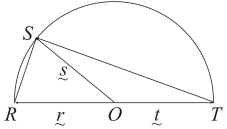
 

Using the properties of vectors  `underset~r`, `underset~s`  and  `underset~t`, show that  `angleRST`  is a right angle.  (2 marks)

--- 8 WORK AREA LINES (style=lined) ---

Show Answers Only

`text{Proof (See Worked Solutions)}`

Show Worked Solution
`|underset~r|` `= |underset~s| = |underset~t|\ \ \ text{(radii)}`
`underset~r` `= −underset~t`
`overset(->)(RS)` `= underset~s-underset~r`
`overset(->)(TS)` `= underset~s-underset~t`
`overset(->)(RS) · overset(->)(TS)` `= (underset~s-underset~r) · (underset~s-underset~t)`
  `= (underset~s-underset~r) · (underset~s + underset~r)\ \ \ \ (text{using}\ \ underset~r = – underset~t)`
  `= underset~s · (underset~s + underset~r)-underset~r · (underset~s + underset~r)`
  `= underset~s · underset~s + underset~s · underset~r-underset~r · underset~s-underset~r · underset~r`
  `= |underset~s|^2-|underset~r|^2`
  `= 0`

 
`:. overset(->)(RS) ⊥ overset(->)(TS)`

`:. angleRST\ \ text(is a right angle.)`

Filed Under: Vectors and Geometry (Ext1) Tagged With: Band 4, smc-1211-50-(Semi)circle

Financial Maths, GEN2 2019 NHT 7

Tisha plays drums in the same band as Marlon.

She would like to buy a new drum kit and has saved $2500.

  1. Tisha could invest this money in an account that pays interest compounding monthly.


    The balance of this investment after `n` months, `T_n` could be determined using the recurrence relation below
     
          `T_0 = 2500, \ \ \ \ T_(n+1) = 1.0036 xx T_n` 
     
    Calculate the total interest that would be earned by Tisha's investment in the first five months.


    Round your answer to the nearest cent.   (2 marks)

    --- 4 WORK AREA LINES (style=lined) ---

Tisha could invest the $2500 in a different account that pays interest at the rate of 4.08% per annum, compounding monthly. She would make a payment of $150 into this account every month.

  1. Let `V_n` be the value of Tisha's investment after `n` months.


    Write down a recurrence relation, in terms of `V_0`, `V_n` and `V_(n + 1)`, that would model the change in the value of this investment.   (1 mark)

    --- 2 WORK AREA LINES (style=lined) ---

  2. Tisha would like to have a balance of $4500, to the nearest dollar, after 12 months.


    What annual interest rate would Tisha require?


    Round your answer to two decimal places.   (1 mark)

    --- 2 WORK AREA LINES (style=lined) ---

Show Answers Only
  1. `$45.33`
  2. `V_0 = 2500, \ V_(n+1) = 1.0034 xx V_n + 150`
  3. `5.87%`
Show Worked Solution

a.    `T_1 = 1.0036 xx 2500 = 2509`

`T_2 = 1.0036 xx 2509 = 2518.0324`

`vdots`

`T_5 = 2545.33`

`:. \ text(Total interest) ` `= 2545.33-2500`
  `= $45.33`


b.    `text(Monthly interest) = (4.08)/(12) = 0.34%`

`:. \ V_0 = 2500, \ V_(n+1) = 1.0034 xx V_n + 150`


c.    `text(By TVM Solver:)`

`N` `= 12`  
`I text(%)` `=?`  
`PV` `=-2500`  
`PMT` `=-150`  
`FV` `=4500`  
`text(PY)` `= text(CY)=12`  

 
`=> I = 5.87%`

Filed Under: Annuities and Perpetuities, Recursion - Financial Tagged With: Band 4, Band 5, smc-2512-10-Annuity, smc-2512-50-CAS solver, smc-2512-70-Recurrence relations, smc-717-10-Compound interest, smc-717-70-Find RR

Financial Maths, GEN2 2019 NHT 6

Marlon plays guitar in a band.

He paid $3264 for a new guitar.

The value of Marlon's guitar will be depreciated by a fixed amount for each concert that he plays.

After 25 concerts, the value of the guitar will have decreased by $200.

  1. What will be the value of Marlon's guitar after 25 concerts?   (1 mark)

    --- 2 WORK AREA LINES (style=lined) ---

  2. Write a calculation that shows that the value of Marlon's guitar will depreciate by $8 per concert.   (1 mark)

    --- 2 WORK AREA LINES (style=lined) ---

  3. The value of Marlon's guitar after `n` concerts, `G_n`, can be determined using a rule.


    Complete the rule below by writing the appropriate numbers in the boxes provided.   (1 mark)

    --- 1 WORK AREA LINES (style=lined) ---

     
              `G_n =`   – × `n`
     

  4. The value of the guitar continues to be depreciated by $8 per concert.


    After how many concerts will the value of Marlon's guitar first fall below $2500?   (2 marks)

    --- 4 WORK AREA LINES (style=lined) ---
Show Answers Only
  1. `$3064`
  2. `text{Proof (See Worked Solution)}`
  3. `G_n = 3264-8 xx n`
  4. `96 \ text(concerts)`
Show Worked Solution
a.    `text(Value)` `= 3264-200`
  `= $3064`


b.    `text(Depreciation per concert)` `= (200)/(25)`
  `= $8 \ text(per concert)`

c.    `G_n = 3264 – 8 xx n`
 

d.    `text(Find) \ n \ text(when) \ \ G_n = 2500:`

`2500` `= 3264 – 8n`
`n` `= (3264-2500)/8`
  `= 95.5`

 
`:. \ text(After) \ 96 \ text(concerts, value first falls below $2500)`

Filed Under: Depreciation Tagged With: Band 2, Band 3, Band 4, smc-602-30-Unit cost

Data Analysis, GEN2 2019 NHT 5

A random sample of 12 mammals drawn from a population of 62 types of mammals was categorized according to two variables.

likelihood of attack (1 = low, 2 = medium, 3 = high)

exposure to attack during sleep (1 = low, 2 = medium, 3 = high)

The data is shown in the following table.


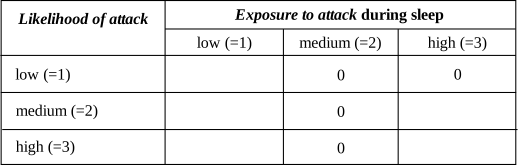
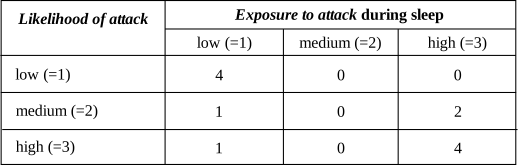
  1. Use this data to complete the two-way frequency table below.   (1 mark)

    --- 0 WORK AREA LINES (style=lined) ---


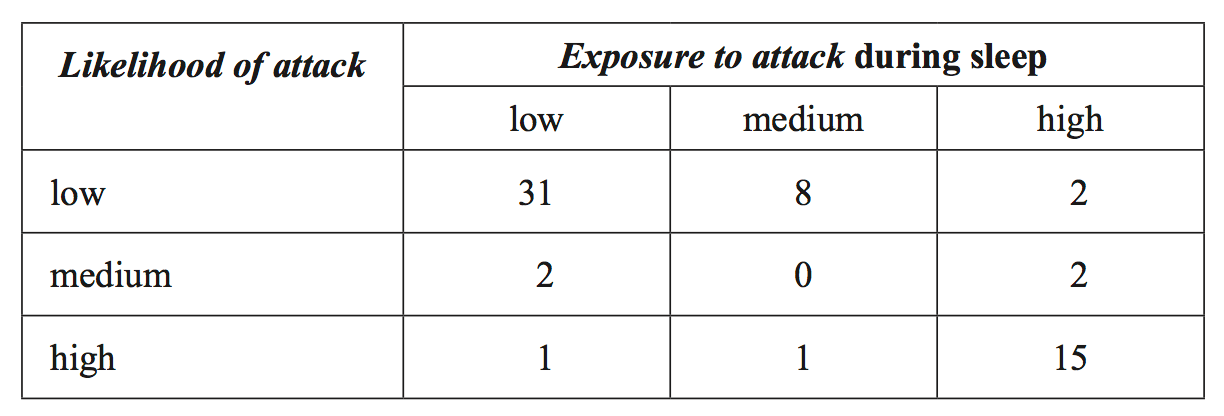
The following two-way frequency table was formed from the data generated when the entire population of 62 types of mammals was similarly categorized.


    1. How many of these 62 mammals had both a high likelihood of attack and a high exposure to attack during sleep?   (1 mark)

      --- 5 WORK AREA LINES (style=lined) ---

    2. Of those mammals that had a medium likelihood of attack, what percentage also had a low exposure to attack during sleep?   (1 mark)

      --- 2 WORK AREA LINES (style=lined) ---

    3. Does the information in the table above support the contention that likelihood of attack is associated with exposure to attack during sleep? justify your answer by quoting appropriate percentages. It is sufficient to consider only one category of likelihood of attack when justifying your answer.   (2 marks)

      --- 4 WORK AREA LINES (style=lined) ---
Show Answers Only
  1.  
    1. `15`
    2. `text(Percentage) = (2)/(4) xx 100`
                           `= 50 %`
    3. `text(The data supports the contention that animals with a low likelihood)`
      `text(of attack is associated with low exposure to attack during sleep.)`
       
      `text(- 91%) \ ({31}/{34}) \ text(of animals with low exposure to attack)`
         `text(during sleep, have a low likelihood of attack.)`
       
      `text(- Similarly, 89% of animals with a medium exposure to attack during)`
         `text(sleep have a low likelihood of attack.)`
       
      `text(- 11% of animals with a high exposure to attack during sleep have)`
          `text(a low likelihood of attack)`

Show Worked Solution

a.     


b.    i. `15`

ii.   `text(Percentage)` `= (2)/(4) xx 100`
  `= 50%`


iii. `text(The data supports the contention that animals with a low likelihood)`

`text(of attack is associated with low exposure to attack during sleep.)`

`text(- 91%) \ ({31}/{34}) \ text(of animals with low exposure to attack)`

`text(during sleep, have a low likelihood of attack.)`

`text(- Similarly, 89% of animals with a medium exposure to attack during)`

`text(sleep have a low likelihood of attack.)`

`text(- 11% of animals with a high exposure to attack during sleep have)`

`text(a low likelihood of attack)`

Filed Under: Graphs - Histograms and Other Tagged With: Band 4, Band 5, Band 6, page-break-before-question, smc-644-50-Frequency Tables

Data Analysis, GEN2 2019 NHT 4

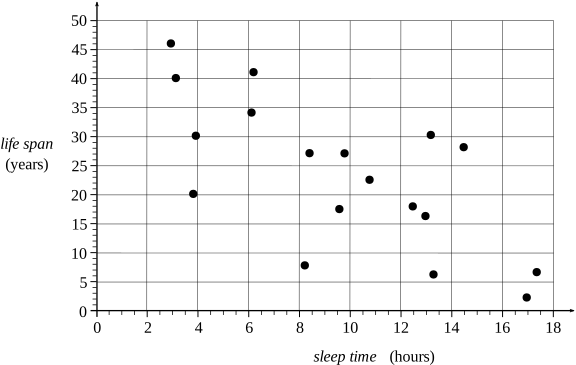
The scatterplot below plots the variable life span, in years, against the variable sleep time, in hours, for a sample of 19 types of mammals.
 

On the assumption that the association between sleep time and life span is linear, a least squares line is fitted to this data with sleep time as the explanatory variable.

The equation of this least squares line is

life span = 42.1 – 1.90 × sleep time

The coefficient of determination is 0.416

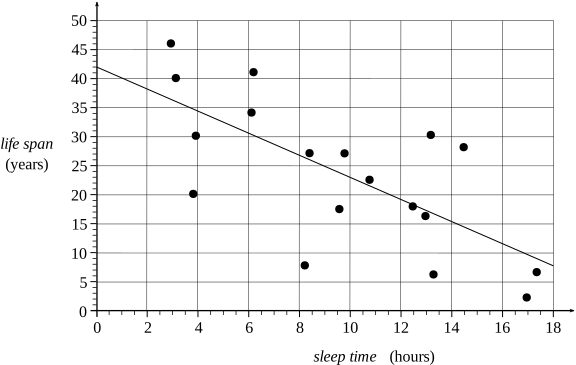
  1. Draw the graph of the least squares line on the scatterplot above.   (1 mark)

    --- 0 WORK AREA LINES (style=lined) ---

  2. Describe the linear association between life span and sleep time in terms of strength and direction.   (2 marks)

    --- 2 WORK AREA LINES (style=lined) ---

  3. Interpret the slope of the least squares line in terms of life span and sleep time.   (2 marks)

    --- 2 WORK AREA LINES (style=lined) ---

  4. Interpret the coefficient of determination in terms of life span and sleep time.   (1 mark)

    --- 2 WORK AREA LINES (style=lined) ---

  5. The life of the mammal with a sleep time of 12 hours is 39.2 years.
  6. Show that, when the least squares line is used to predict the life span of this mammal, the residual is 19.9 years.   (2 marks)

    --- 4 WORK AREA LINES (style=lined) ---
Show Answers Only
  1.  

  2. `text(Strength is moderate.)`


    `text(Direction is negative.)`

  3. `text(The gradient of –1.9 means that life span decreases by)` 


    `text(1.9 years for each additional hour of sleep time.)`

  4. `text(41.6% of the variation in life span can be explained by the)`


    `text(variation in sleep time.)`

  5. `text(Proof(See Worked Solution))`
Show Worked Solution

a.    `text{Graph endpoints (0, 42.1) and (18, 7.9)}`


b.   `text(Strength is moderate.)`

`text(Direction is negative.)`
 

c.    `text(The gradient of –1.9 means that life span decreases by)`

`text(1.9 years for each additional hour of sleep time.)`


d.    `text(41.6% of the variation in life span can be explained by the )`

`text(variation in sleep time.)`
 

e.    `text(Predicted value)` `= 42.1 – 1.9 xx 12`
  `= 19.3 \ text(years)`


`text(Residual)` `= text(actual) – text(predicted)`
  `= 39.2 – 19.3`
  `= 19.9 \ text(years)`

Filed Under: Correlation and Regression Tagged With: Band 3, Band 4, Band 5, smc-265-10-r / r^2 and Association, smc-265-40-Interpret Gradient, smc-265-50-Residuals

Data Analysis, GEN2 2019 NHT 3

The life span, in years, and gestation period, in days, for 19 types of mammals are displayed in the table below.
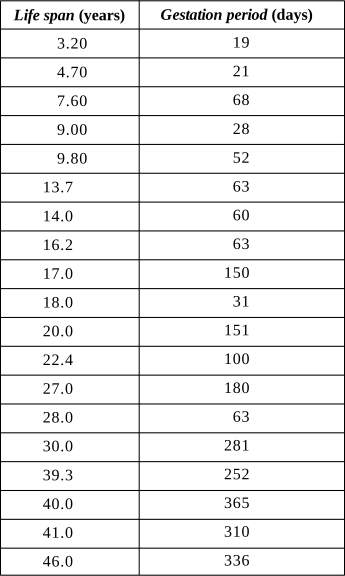
 

  1. A least squares line that enables life span to be predicted from gestation period is fitted to this data.
  2. Name the explanatory variable in the equation of this least squares line.   (1 mark)

    --- 1 WORK AREA LINES (style=lined) ---

  3. Determine the equation of the least squares line in terms of the variables life span and gestation period.
  4. Round the numbers representing the intercept and slope to three significant figures.   (2 marks)

    --- 2 WORK AREA LINES (style=lined) ---

  5. Write the value of the correlation rounded to three decimal places.   (1 mark)

    --- 2 WORK AREA LINES (style=lined) ---

Show Answers Only
  1. `text(gestation period)`
  2. `text(life span) = 7.58 + 0.101 xx \ text(gestation period)`
  3. `0.904`
Show Worked Solution

a.    `text(gestation period)`
 

b.    `text(Input data points into CAS:)`

`text(life span) = 7.58 + 0.101 xx \ text(gestation period)`
 

c.    `r = 0.904 \ text{(by CAS)}`

Filed Under: Correlation and Regression Tagged With: Band 3, Band 4, page-break-before-question, smc-265-10-r / r^2 and Association, smc-265-20-Find LSRL Equation/Gradient, smc-265-75-Explanatory / Response, smc-265-80-Rounding (Sig Fig)

Data Analysis, GEN2 2019 NHT 2

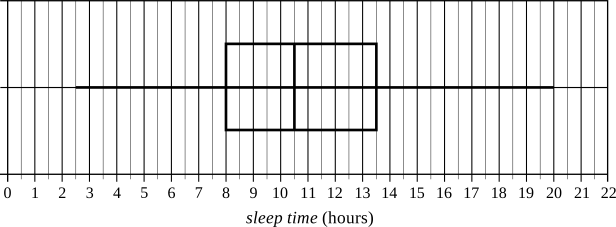
The five-number summary below was determined from the sleep time, in hours, of a sample of 59 types of mammals.

\begin{array} {|l|c|}
\hline
\rule{0pt}{2.5ex} \ \ \ \textbf{Statistic} \rule[-1ex]{0pt}{0pt} & \textbf{Sleep time (hours)} \\
\hline
\rule{0pt}{2.5ex} \text{minimum} \rule[-1ex]{0pt}{0pt} & \text{2.5} \\
\hline
\rule{0pt}{2.5ex} \text{first quartile} \rule[-1ex]{0pt}{0pt} & \text{8.0} \\
\hline
\rule{0pt}{2.5ex} \text{median} \rule[-1ex]{0pt}{0pt} & \text{10.5} \\
\hline
\rule{0pt}{2.5ex} \text{third quartile} \rule[-1ex]{0pt}{0pt} & \text{13.5} \\
\hline
\rule{0pt}{2.5ex} \text{maximum} \rule[-1ex]{0pt}{0pt} & \text{20.0} \\
\hline
\end{array}
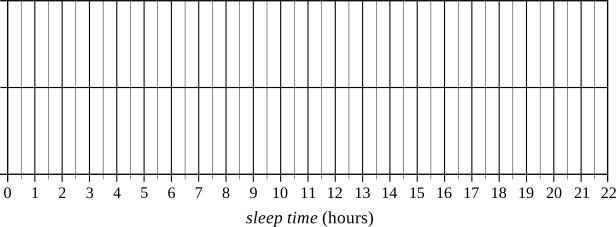
  1. Show with calculations, that a boxplot constructed from this five-number summary will not include outliers.   (2 marks)

    --- 5 WORK AREA LINES (style=lined) ---

  2. Construct the boxplot below.   (1 mark)

    --- 0 WORK AREA LINES (style=lined) ---


Show Answers Only

  1. `text(Proof (See Worked Solution))`
  2.  

Show Worked Solution

a.    `IQR = Q_3-Q_1 = 13.5-8.0 = 5.5`

`text(Lower fence)` `= Q_1-1.5 xx IQR`
  `= 8-1.5 xx 5.5`
  `= -0.25`


`text(Upper fence)` `= Q_3 + 1.5 xx IQR`
  `= 13.5 + 1.5 xx 5.5`
  `= 21.75`

 
`text(S) text(ince) \ -0.25 < 2.5 \ text{(minimum value) and} \ 21.75 > 20.0 \ text{(maximum value)}`

`=> \ text(no outliers)`
 

b. 

Filed Under: Graphs - Stem/Leaf and Boxplots Tagged With: Band 4, smc-643-30-Draw Box Plots, smc-643-60-Outliers

Data Analysis, GEN2 2019 NHT 1

The table below displays the average sleep time, in hours, for a sample of 19 types of mammals.
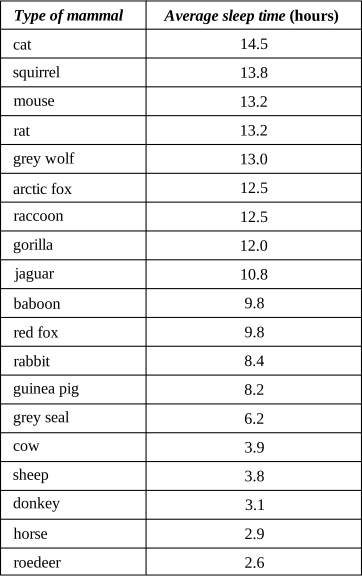
 

  1. Which of the two variables, type of mammal or average sleep time, is a nominal variable?   (1 mark)

    --- 1 WORK AREA LINES (style=lined) ---

  2. Determine the mean and standard deviation of the variable average sleep time for this sample of mammals.
  3. Round your answer to one decimal place.   (1 mark)

    --- 2 WORK AREA LINES (style=lined) ---

  4. The average sleep time for a human is eight hours.
  5. What percentage of this sample of mammals has an average sleep time that is less than the average sleep time for a human.
  6. Round your answer to one decimal place.   (1 mark)

    --- 2 WORK AREA LINES (style=lined) ---

  7. The sample is increase in size by adding in the average sleep time of the little brown bat.
  8. Its average sleep time is 19.9 hours.
  9. By how many many hours will the range for average sleep time increase when the average sleep time for the little brown bat is added to the sample?   (1 mark)

    --- 2 WORK AREA LINES (style=lined) ---

Show Answers Only
  1. `text(type of mammal)`
  2. `text(mean)= 9.2 \ text(hours)`


    `sigma = 4.2 \ text(hours)`

  3. `31.6text(%)`
  4. `5.4 \ text(hours)`
Show Worked Solution

a.    `text(type of mammal is nominal)`

 
b.    `text(mean)= 9.2 \ text(hours) \ \ text{(by CAS)}`

`sigma = 4.2 \ text(hours) \ \ text{(by CAS)}`
 

c.    `text(Percentage)` `= (6)/(19) xx 100`
  `= 0.3157 …`
  `= 31.6text(%)`


d.    `text(Range increase)` `= 19.9-14.5`
  `= 5.4 \ text(hours)`

Filed Under: Summary Statistics Tagged With: Band 2, Band 3, Band 4, page-break-before-question, smc-468-10-Data Classification, smc-468-20-Mean, smc-468-30-Std Dev, smc-468-40-Median Mode and Range

Statistics, EXT1 S1 EQ-Bank 10

Four cards are placed face down on a table. The cards are made up of a Jack, Queen, King and Ace.

A gambler bets that she will choose the Queen in a random pick of one of the cards.

If this process is repeated 7 times, express the gambler's success as a Bernoulli random variable and calculate

  1. the mean.  (1 mark)

    --- 1 WORK AREA LINES (style=lined) ---

  2. the variance.  (1 mark)

    --- 1 WORK AREA LINES (style=lined) ---

Show Answers Only
  1. `7/4`
  2. `21/16`
Show Worked Solution

i.     `text(Let)\ \ X = text(number of Queens chosen)`

`X\ ~\ text(Bin) (7,1/4)`

`E(X)` `=np`
  `= 7 xx 1/4`
  `=7/4`


ii.   `text(Var)(X)` `= np(1-p)`
    `=7/4(1-1/4)`
    `= 21/16`

Filed Under: Statistics and Binomial Distributions (Ext1) Tagged With: Band 3, Band 4, smc-1199-10-Calculate E(X), smc-1199-20-Calculate Var(X)/Std Dev

GRAPHS, FUR1-NHT 2019 VCAA 6 MC

In January 2018, an online shop had 260 customer accounts.

In June 2018, the shop had 500 customer accounts.

The graph below shows the number of customer accounts, `a`, with the online shop `n` months after January 2018, for a period of 10 months.
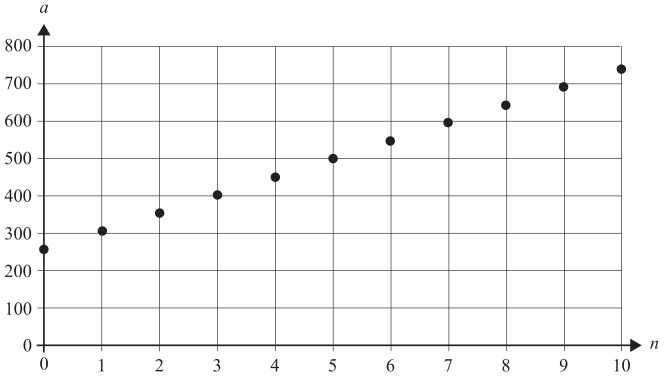


The growth in the number of customer accounts that this graph shows is expected to continue beyond these 10 months, following the same trend.

How many customer accounts can the online shop expect to have at the end of December 2019 `(n = 23)`?

  1. 1364
  2. 1376
  3. 1388
  4. 1400
  5. 1412
Show Answers Only

`A`

Show Worked Solution

`text(Graph passes through)\ \ (0, 260) \ and \ (5, 500)`

`:. m = (500 – 260)/5 ~~ 48`

`text(Equation:)\ \ a = 260 + 48n`

`text(When)\ \ n = 23,`

`a` `~~ 260 + 48 xx 23`
  `~~ 1364`

 
`=>  A`

Filed Under: Linear relationships Tagged With: Band 4

GRAPHS, FUR1-NHT 2019 VCAA 5 MC

The revenue, `R`, in dollars, that a company receives from selling `n` caps is given by the equation
 

`R = {(25n, qquad n <= 1000),(20n + c, qquad n> 1000):}`
 

The graph of this revenue equation consists of two straight lines that intersect at the point where  `n = 1000`.

What is the value of  `c`  in this revenue equation?

  1.       0
  2. 1000
  3. 2000
  4. 4000
  5. 5000
Show Answers Only

`E`

Show Worked Solution

`text(Intersection at)\ \ n = 1000`

`25 xx 1000` `= 20 xx 1000 + c`
`:. c` `= 5000`

 
`=>  E`

Filed Under: Linear relationships Tagged With: Band 4

GRAPHS, FUR1-NHT 2019 VCAA 3 MC

The graph below shows a relationship between `x` and `y`.
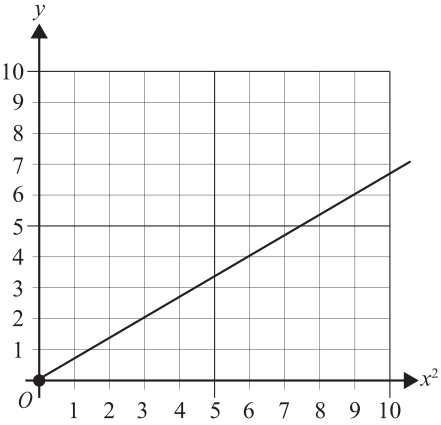


The rule that represents this relationship between `x` and `y` is

  1.  `y = 2/3 x`
  2.  `y = 3/2 x`
  3.  `y = 2/3 x^2`
  4.  `y = 3/2 x^2`
  5.  `y = sqrt(3/2) x`
Show Answers Only

`C`

Show Worked Solution

`text(When)\ \ x^2 = 3,\ \ y = 2`

`text(Consider)\ C:`

`y` `= 2/3 x^2`
`2` `= 2/3 xx 3` ✔

 
`=>  C`

Filed Under: Non-linear Relationships Tagged With: Band 4

MATRICES, FUR1-NHT 2019 VCAA 6 MC

Matrix `W` is a  `3 xx 2`  matrix.

Matrix `Q` is a matrix such that  `Q xx W = W`.

Matrix `Q` could be

A. `\ [1]` B. `\ [(1,0),(0,1)]` C. `\ [(1,1),(1,1),(1,1)]`
D. `\ [(1,0,0),(0,1,0),(0,0,1)]` E. `\ [(1,1,1),(1,1,1),(1,1,1)]`    
Show Answers Only

`D`

Show Worked Solution

`W = (3 xx 2)`

`[(1,0,0),(0,1,0),(0,0,1)][(e_11,e_12),(e_21,e_22),(e_31,e_32)] = [(e_11,e_12),(e_21,e_22),(e_31,e_32)]`

`=>\ D`

Filed Under: Matrix Calculations Tagged With: Band 4, smc-616-20-Order / (Un)Defined, smc-616-30-Matrix Product

MATRICES, FUR1-NHT 2019 VCAA 4 MC

In a game between two teams, Hillside and Rovers, each team can score points in two ways.

The team may hit a Full or the team may hit a Bit.

More points are scored for hitting a Full than for hitting a Bit.

A team’s total point score is the sum of the points scored from hitting Fulls and Bits.

The table below shows the scores at the end of the game.
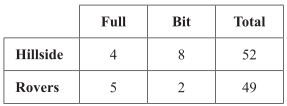


Let  `f`  be the number of points scored by hitting one Full.

Let  `b`  be the number of points scored by hitting one Bit.

Which one of the following matrix products can be evaluated to find the matrix  `[(f),(b)]`?

A. `\ [(4,8),(5,2)]^(−1) xx [(52),(49)]` B. `\ [(4,8),(5,2)] xx [(52),(49)]` C. `\ [(52,49)][(4,8),(5,2)]`
D. `\ [(52,49)][(4,8),(5,2)]^(−1)` E. `\ [(4,8,52),(5,2,49)]^(−1)`    
Show Answers Only

`A`

Show Worked Solution
`[(4,8),(5,2)][(f),(b)]` `= [(52),(49)]`
`[(f),(b)]` `= [(4,8),(5,2)]^(−1)[(52),(49)]`

 
`=>\ A`

Filed Under: Simultaneous Equations Tagged With: Band 4, smc-617-40-Inverse Matrix to solve equation

MATRICES, FUR1-NHT 2019 VCAA 2 MC

Four teams, blue (`B`), green (`G`), orange (`O`) and pink (`P`), played each other once in a competition.

There were no draws in this competition.

The results of the competition are shown in the matrix below.
 

`{:(),(),(text(winner)):}{:(qquadqquad\ text(loser)),((qquadquadB,G,O,P)),({: (B), (G), (O), (P):}[(text(−),1,v,1),(0,text(−),1,1),(0,w,text(−),0),(0,0,x,text(−))]):}`
 

The letters `v`, `w` and `x` each have a value of 0 or 1.

A 1 in the matrix shows that the team named in that row defeated the team named in that column.

A 0 in the matrix shows that the team named in that row was defeated by the team named in that column.

A dash (–) in the matrix shows that no game was played.

The values of `v`, `w` and `x` are

  1.  `v = 0, \ w = 1, \ x = 0`
  2.  `v = 0, \ w = 1, \ x = 1`
  3.  `v = 1, \ w = 0, \ x = 1`
  4.  `v = 1, \ w = 1, \ x = 0`
  5.  `v = 1, \ w = 1, \ x = 1`
Show Answers Only

`C`

Show Worked Solution

`v = 1\ \ (B\ text(defeated)\ O)`

`w = 0\ \ (O\ text(defeated)\ G)`

`x = 1\ \ (P\ text(defeated)\ O)`

`=> C`

Filed Under: Matrix Applications Tagged With: Band 4, smc-619-70-One/Two Step Dominances

NETWORKS, FUR1-NHT 2019 VCAA 5 MC

In the graph below, the vertices represent electricity transformer substations.

The numbers on the edges of the graph show the length, in kilometres, of cables that connect these substations.
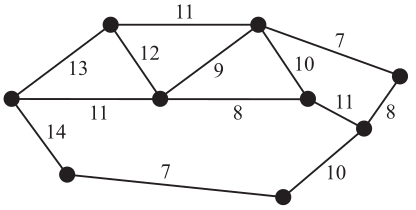


What is the minimum length of cable, in kilometres, that is necessary to make sure that each substation remains connected to the network?

  1. 65
  2. 71
  3. 73
  4. 74
  5. 77
Show Answers Only

`B`

Show Worked Solution

`text(Minimum length)` `= 7 + 8 + 10 + 7 + 9 + 8 + 11 + 11`
  `= 71\ text(km)`

`=>  B`

Filed Under: Minimum Spanning Trees and Shortest Paths Tagged With: Band 4, smc-624-10-Distance

NETWORKS, FUR1-NHT 2019 VCAA 4 MC

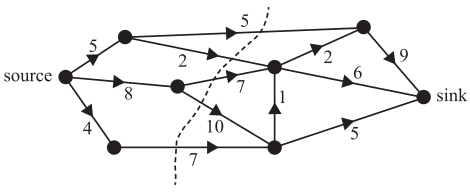
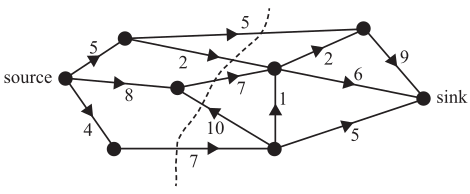
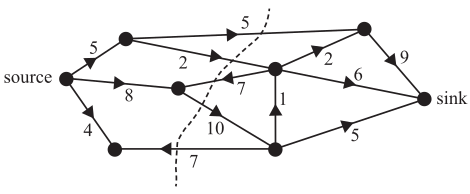
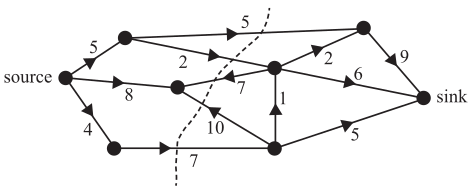
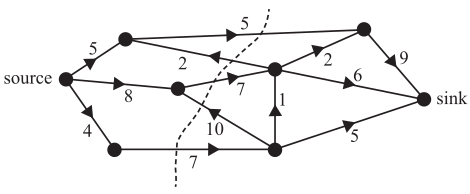
Which one of the following flow diagrams shows a cut that has a capacity of 19?

A.  
B.  
C.  
D.  
E.  
Show Answers Only

`E`

Show Worked Solution

`text(Consider each option):`

`text(Capacity of:)`

`text(Cut)\ A` `= 5 + 2 + 7 + 10 + 7 = 31`
`text(Cut)\ B` `= 5 + 2 + 7 + 7 = 21`
`text(Cut)\ C` `= 5 + 2 + 10 = 17`
`text(Cut)\ D` `= 5 + 2 + 7 = 14`
`text(Cut)\ E` `= 5 + 7 + 7 = 19`

 
`=>  E`

Filed Under: Flow Problems Tagged With: Band 4, smc-625-10-Cut Capacity

Calculus, MET2-NHT 2019 VCAA 5

Let  `f: R → R, \ f(x) = e^((x/2))`  and  `g: R → R, \ g(x) = 2log_e(x)`.

  1. Find  `g^-1 (x)`.   (1 mark)

    --- 4 WORK AREA LINES (style=lined) ---

  2. Find the coordinates of point  `A`, where the tangent to the graph of  `f` at  `A` is parallel to the graph of  `y = x`.   (2 marks)

    --- 5 WORK AREA LINES (style=lined) ---

  3. Show that the equation of the line that is perpendicular to the graph of  `y = x`  and goes through point  `A` is  `y = -x + 2log_e(2) + 2`.   (1 mark)

    --- 3 WORK AREA LINES (style=lined) ---

Let `B` be the point of intersection of the graphs of `g` and  `y =-x + 2log_e(2) + 2`, as shown in the diagram below.
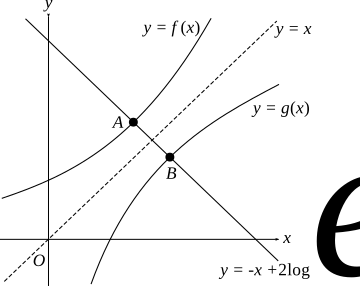


  1. Determine the coordinates of point `B`.   (1 mark)

    --- 4 WORK AREA LINES (style=lined) ---
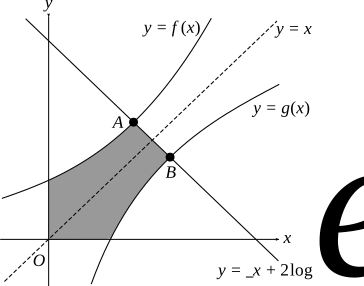
  2. The shaded region below is enclosed by the axes, the graphs of  `f` and `g`, and the line  `y =-x + 2log_e(2) + 2`.


    Find the area of the shaded region.   (2 marks)

    --- 4 WORK AREA LINES (style=lined) ---

Let  `p : R→ R, \ p(x) = e^(kx)`  and  `q : R→ R, \ q(x) = (1)/(k) log_e(x)`.
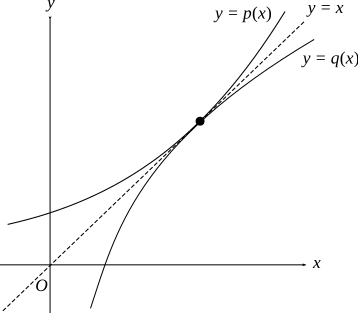
  1. The graphs of `p`, `q` and  `y = x`  are shown in the diagram below. The graphs of `p` and `q` touch but do not cross.


     Find the value of  `k`.   (2 marks)

    --- 6 WORK AREA LINES (style=lined) ---

  2. Find the value of  `k, k > 0`, for which the tangent to the graph of `p` at its `y`-intercept and the tangent to the graph of `q` at its `x`-intercept are parallel.   (1 mark)

    --- 5 WORK AREA LINES (style=lined) ---

Show Answers Only
  1. `e^{(x)/(2)}`
  2. `(2log_e 2, 2)`
  3. `text(Proof(See Worked Solution))`
  4. `(2, 2log_e 2)`
  5. `6-2(log_e 2)^2-4 log_e 2`
  6. `(1)/(e)`
  7. `k =1`
Show Worked Solution

a.    `g(x) = 2log_e x`

`text(Inverse: swap) \ x ↔ y`

`x` `= 2log_e y`
`log_e y` `= (x)/(2)`
`y` `= e^{(x)/(2)}`


b.    `f(x) = e^{(x)/(2)}`

`f′(x) = (1)/(2) e^{(x)/(2)}`
 
`text(S) text(olve) \ \ f′(x) = 1 \ text(for) \ x:`

`x = 2log_e 2`

`y = e^(log_e 2) = 2`
 
`:. \ A\ text(has coordinates)\  (2log_e 2, 2)`


c.    `m_(⊥) = -1`

`text(Equation of line) \ \ m = -1 \ \ text(through)\ \ (2log_e 2, 2) :`

`y-2` `= -(x-2log_e 2)`
`y` `= -x +  2log_e 2 + 2`


d.    `text(Method 1)`

`text(S) text(olve for) \ x :`

`-x + 2log_e 2 + 2 = 2log_e x`

`=> x = 2 , \ y = 2log_e 2`

`:. B ≡ (2, 2log_e 2)`
 

`text(Method 2)`

`text(S) text(ince) \ \ f(x) = g^-1 (x)`

`B \ text(is the reflection of) \ \ A(2log_e 2, 2) \ \ text(in the) \ \ y=x \ \ text(axis)`

`:. \ B ≡ (2, 2log_e 2)`


e.
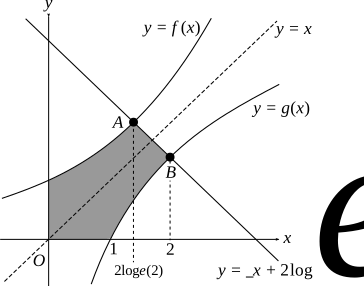


`y = g(x) \ \ text(intersects) \ x text(-axis at) \ \ x = 1`

`text(Dividing shaded area into 3 sections:)`

`A` `= int_0^1 f(x)\ dx \ + \ int_1^(2log_e 2) f(x)-g(x)\ dx`  
  ` \ + \ int_(2log_e 2)^2 (-x + 2log_e 2 + 2)-g(x)\ dx`  
  `= 6-2(log_e 2)^2-4 log_e 2`  


f.   `p(x) = e^(kx) \ , \ q(x) = (1)/(k) log_e x`

`p′(x) = k e^(kx) \ , \ q′(x) = (1)/(kx)`
 
`text(S) text(ince graphs touch on) \ y = x`

`k e^(kx) = 1\ …\ (1)`

`(1)/(kx) = 1\ …\ (2)`

`text(Substitute) \ x = (1)/(k) \ text{from (2) into (1)}`

`k e^(k xx 1/k)` `= 1`
`:. k` `= (1)/(e)`


g.   `text(Consider)\ \ p(x):`

`text(When) \ \ x = 0 , \ p(0) = 1 , \ p′(0) = k`
 

 `text(Consider) \ \ q(x):`

`text(When) \ \ y= 0, \ (1)/(k) log_e x = 0 \ => \ x = 1`

`q′(1) = (1)/(k)`

`text(If lines are parallel), \ k = (1)/(k)`
 
`:. \ k = 1`

Filed Under: Area Under Curves, Logs and Exponential Functions Tagged With: Band 4, Band 5, Band 6, smc-5204-50-Find intersection, smc-723-50-Log/Exponential

Calculus, MET2-NHT 2019 VCAA 4

A mining company has found deposits of gold between two points, `A` and `B`, that are located on a straight fence line that separates Ms Pot's property and Mr Neg's property. The distance between `A` and `B` is 4 units.

The mining company believes that the gold could be found on both Ms Pot's property and Mr Neg's property.

The mining company initially models he boundary of its proposed mining area using the fence line and the graph of 

`f : [0, 4] → R, \ f(x) = x(x-2)(x-4)`

where `x` is the number of units from point `A` in the direction of point `B` and `y` is the number of units perpendicular to the fence line, with the positive direction towards Ms Pot's property. The mining company will only mine from the boundary curve to the fence line, as indicated by the shaded area below.
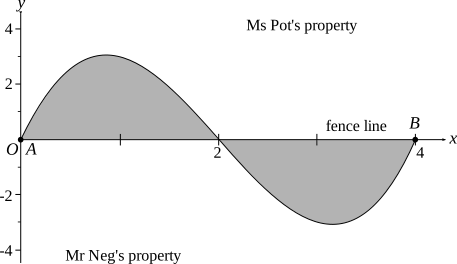
 

  1. Determine the total number of square units that will be mined according to this model.   (2 marks)

    --- 3 WORK AREA LINES (style=lined) ---

The mining company offers to pay Mr Neg $100 000 per square unit of his land mined and Ms Pot $120 000 per square unit of her land mined.

  1. Determine the total amount of money that the mining company offers to pay.   (1 mark)

    --- 2 WORK AREA LINES (style=lined) ---

The mining company reviews its model to use the fence line and the graph of

     `p : [0, 4] → R, \ p(x) = x(x-4 + (4)/(1 + a)) (x-4)`  where `a > 0`.

  1. Find the value of  `a`  for which  `p(x) = f(x)`  for all `x`.   (1 mark)

    --- 3 WORK AREA LINES (style=lined) ---

  2. Solve  `p^{′}(x) = 0`  for `x` in terms of `a`.   (2 marks)

    --- 3 WORK AREA LINES (style=lined) ---

Mr Neg does not want his property to be mined further than 4 units measured perpendicular from the fence line.

  1. Find the smallest value of `a`, correct to three decimal places, for this condition to be met.   (2 marks)

    --- 5 WORK AREA LINES (style=lined) ---

  2. Find the value of `a` for which the total area of land mined is a minimum.   (3 marks)

    --- 5 WORK AREA LINES (style=lined) ---

  3. The mining company offers to pay Ms Pot $120 000 per square unit of her land mined and Mr Neg $100 000 per square unit of his land mined.
  4. Determine the value of `a` that will minimize the total cost of the land purchase for the mining company. Give your answer correct to three decimal places.   (2 marks)

    --- 4 WORK AREA LINES (style=lined) ---

Show Answers Only
  1. `8`
  2. `$880\ 000`
  3. `1`
  4. `x = ((8a + 4) ± 4 sqrt(a^2 + a + 1))/(3a + 3)`
  5. `0.716`
  6. `1`
  7. `0.886`
Show Worked Solution
a.    `A` `= int_0^2 x(x-2)(x-4)\ dx – int_2^4 x(x-2)(x-4)\ dx`
  `= 4-(-4)`
  `= 8`


b.    `text(Total payment)` `= 4 xx 100 000 + 4 xx 120 000`
  `= $880\ 000`

 
c.
    `text(If) \ \ p(x) = f(x)`

`x-2` `= x-4 + (4)/(1 + a)`  
`(4)/(1 + a)` `=2`  
`:. a` `=1`  

 
d.
    `p^{′}(x) = (3(a + 1) x^2-8(2a + 1) x + 16a)/(a + 1) \ \ \ text{(by CAS)}`

`text(S) text(olve) \ \ p^{′}(x) = 0 \ \ text(for) \ \ x :`

`x = ((8a + 4) ± 4 sqrt(a^2 + a + 1))/(3a +3) \ , \ a > 0` 
 

e.    `text(If no mining further than 4 units,) \ \ p(x) ≥-4`

`text(Max distance from Mr Neg’s fence occurs when) \ \ 2< x <4 .`

`text((i.e. the higher) \ x text(-value when) \ \ p^{′}(x) = 0)`
 

`text(At) \ \ x = ((8a + 4) + 4 sqrt(a^2 + a + 1))/(3a + 3) \ ,`
 
`text(S) text(olve for) \ \ a \ \ text(such that) \ \ p(x) = -4`

`=> a = 0.716 \ \ text((to 3 d.p.))`


f.    `p(x) \ text(intersects) \ x text(-axis at) \ \ x = 4-(4)/(1 + a) = (4a)/(1 + a)`

`A` `= int_0^{(4a)/(1 +a)} p(x)\ dx-int_{(4a)/(1 +a)}^4 p(x)\ dx`
  `= (64(1 + 2a + 2a^3 + a^4))/(3(1 + a)^4)`

 
`text(S) text(olve) \ \ A^{′}(a) = 0 \ \ text(for) \ \ a :`

`a = 1`


g.    `C(a) = 120\ 000 int_0^{(4a)/(1 +a)} p(x)\ dx-100\ 000 int_{(4a)/(1 +a)}^4 p(x)\ dx`

`text(S) text(olve) \ \ C^{′}(a) = 0 \ \ text(for) \ \ a :`

`a = 0.886 \ \ text((to 3 d.p.))`

Filed Under: Maxima and Minima Tagged With: Band 4, Band 5, Band 6, smc-641-10-Area

Statistics, MET2-NHT 2019 VCAA 3

Concerts at the Mathsland Concert Hall begin `L` minutes after the scheduled starting time. `L` is a random variable that is normally distributed with a mean of 10 minutes and a standard deviation of four minutes.

  1. What proportion of concerts begin before the scheduled starting time, correct to four decimal places?   (1 mark)

    --- 2 WORK AREA LINES (style=lined) ---

  2. Find the probability that a concert begins more than 15 minutes after the scheduled starting time, correct to four decimal places.   (1 mark)

    --- 2 WORK AREA LINES (style=lined) ---

If a concert begins more than 15 minutes after the scheduled starting time, the cleaner is given an extra payment of $200. If a concert begins up to 15 minutes after the scheduled starting time, the cleaner is given an extra payment of $100. If a concert begins at or before the scheduled starting time, there is no extra payment for the cleaner.

Let `C` be the random variable that represents the extra payment for the cleaner, in dollars.

    1. Using your responses from part a. and part b., complete the following table, correct to three decimal places.   (1 mark)

      --- 0 WORK AREA LINES (style=lined) ---


    2. Calculate the expected value of the extra payment for the cleaner, to the nearest dollar.   (1 mark)

      --- 3 WORK AREA LINES (style=lined) ---

    3. Calculate the standard deviation of `C`, correct to the nearest dollar.   (1 mark)

      --- 3 WORK AREA LINES (style=lined) ---

The owners of the Mathsland Concert Hall decide to review their operation. They study information from 1000 concerts at other similar venues, collected as a simple random sample. The sample value for the number of concerts that start more than 15 minutes after the scheduled starting time is 43.

    1. Find the 95% confidence interval for the proportion of the concerts that begin more than 15 minutes after the scheduled starting time. Give values correct to three decimal places.   (1 mark)

      --- 3 WORK AREA LINES (style=lined) ---

    2. Explain why this confidence interval suggests that the proportion of concerts that begin more than 15 minutes after the scheduled starting time at the Mathsland Concert Hall is different from the proportion at the venue in the sample.   (1 mark)

      --- 3 WORK AREA LINES (style=lined) ---

The owners of the Mathsland Concert Hall decide that concerts must not begin before the scheduled starting time. They also make changes to reduce the number of concerts that begin after the scheduled starting time. Following these changes, `M` is the random variable that represents the number of minutes after the scheduled starting time that concerts begin. The probability density function for `M` is
 

`qquad qquad f(x) = {(8/(x + 2)^3), (0):} qquad {:(x ≥ 0), (x < 0):}`
 

where `x` is the the time, in minutes, after the scheduled starting time.

  1. Calculate the expected value of `M`.   (2 marks) 

    --- 3 WORK AREA LINES (style=lined) ---

    1. Find the probability that a concert now begins more than 15 minutes after the scheduled starting time.   (1 mark)

      --- 2 WORK AREA LINES (style=lined) ---

    2. Find the probability that each of the next nine concerts begins more than 15 minutes after the scheduled starting time and the 10th concert begins more than 15 minutes after the scheduled starting time. Give your answer correct to four decimal places.   (2 marks)

      --- 5 WORK AREA LINES (style=lined) ---

    3. Find the probability that a concert begins up to 20 minutes after the scheduled starting time, given that it begins more than 15 minutes after the scheduled starting time. Give your answer correct to three decimal places.   (2 marks)

      --- 5 WORK AREA LINES (style=lined) ---

Show Answers Only

  1. `0.0062`
  2. `0.1056`
  3. i.   

     ii.   `$110 \ \ text((nearest dollar))`
     iii.  `$32 \ \ text(nearest dollar))`
  4. i.   `(0.030, 0.056)`
    ii.   `text(The proportion of concerts that begin more than 15 minutes)` 


    `qquad text(late is not within the sample 95% confidence interval.)`

  5.  `2`
  6. i.   `(4)/(289)`
    ii.   `0.0122 \ \ text((to 4 decimal places))`
    iii.  `0.403 \ \ text((to 3 decimal places))`

Show Worked Solution

a.    `L\ ~\ N (10, 4^2)`

`text(Pr) (L < 0)` `= P(z < –2.5)`
  `= 0.0062`


b.    `text(Pr) (L > 15)` `= text(Pr) ( z > 1.25)`
  `= 0.1056`


c.i.

ii.  `E(C)` `= 0.8882 xx 100 + 0.1056 xx 200`
  `= 109.94`
  `= $110 \ \ text((nearest dollar))`


iii.  `E(C^2)` `= 100^2 xx 0.8882 + 200^2 xx 0.1056`
  `= 13\ 106`


`text(s.d.) (C)` `= sqrt(E(C^2) – [E(C)]^2)`
  `= sqrt(13\ 106 – (109.94)^2)`
  `= sqrt(1019.1 …)`
  `= 31.92 …`
  `= $32 \ \ text((nearest dollar))`


d.i.  `overset^p = (43)/(1000) \ \ , \ n = 1000`

`95% \ text(C. I.)` `= overset^p ± 1.96 sqrt((overset^p(1 – overset^p))/(n))`
  `= (0.030, 0.056)`

 
ii.
   `text(The proportion of concerts that begin more than 15 minutes)`

`text(late is not within the sample 95% confidence interval.)`


e.    `E(M)` `= int_0^∞ x ((8)/((x +2)^3))\ dx`
  `= 2`


f.i.    `text(Pr)(M > 15)` `=int_0^∞ x ((8)/((x +2)^3))\ dx`
  `= (4)/(289)`

 
ii.  `text(Pr)(M > 15) = (4)/(289) \ \ , \ \ text(Pr)(M ≤ 15) = (285)/(289)`
 

`:. \ text(Pr) text{(9 concerts}\ \ M ≤ 15 ,\ text{10th concert}\ \ M > 15)`

`= ((205)/(289))^9 xx (4)/(289)`

`= 0.0122 \ \ text((to 4 decimal places))`

 
iii.  `text(Pr)(15 < M < 20)= int_15^20 (8)/((x + 2)^3)\ dx = (195)/(34\ 969)`

 `text(Pr)(M > 15)= int_15^oo (8)/((x + 2)^3)\ dx = (4)/(289)`
 

`text(Pr)(M < 20 | M>15)` `= (text(Pr)(15 < M < 20))/(text(Pr)(M > 15))`
  `= ((195)/(34\ 969))/((4)/(289))`
  `= (195)/(484)`
  `= 0.403 \ \ text((to 3 decimal places))`

Filed Under: Normal Distribution, Probability density functions Tagged With: Band 4, Band 5, smc-637-10-E(X), smc-637-40-Conditional probability, smc-637-45-Other probability, smc-719-20-95% confidence intervals

Trigonometry, EXT1 T3 EQ-Bank 5

A particular energy wave can be modelled by the function

`f(t) = sqrt5 sin 0.2t + 2 cos 0.2t, \ \ t ∈ [0, 50]`

  1. Express this function in the form  `f(t) = Rsin(nt-alpha), \ \ alpha ∈ [0, 2pi]`.  (2 marks)

    --- 6 WORK AREA LINES (style=lined) ---

  2. Find the time the wave first attains its maximum value. Give your answer to one decimal place.  (2 marks)

    --- 6 WORK AREA LINES (style=lined) ---

Show Answers Only
  1. `f(t) = 3sin(0.2t-5.553)`
  2. `t = 4.2`
Show Worked Solution

i.   `f(t) = sqrt5 sin 0.2t + 2cos 0.2t`

`Rsin(nt-alpha)` `= Rsin(0.2t-alpha)`
  `= Rsin 0.2t cosalpha-Rcos 0.2t sinalpha`


`=> Rcosalpha = sqrt5,\ \ R sinalpha = −2`

`R^2` `= (sqrt5)^2 + (-2)^2 = 9`
`R` `= 3`

 
`cosalpha = sqrt5/3, sinalpha = −2/3`

`=> alpha\ text(is in 4th quadrant)`
 

`text(Base angle) = cos^(−1)(sqrt5/3) = 0.7297`

`:.alpha` `= 2pi-0.7297`
  `= 5.553…`

 
`:. f(t) = 3sin(0.2t-5.553)`


ii.   `text(Max value occurs when)\ sin(0.2t-5.553) = 1`

`0.2t-5.553` `= pi/2`
`0.2t` `= 7.124…`
`t` `= 35.62…`

 
`text(Test if)\ \ t > 0\ \ text(for:)`

`0.2t-5.553` `= -(3pi)/2`
`0.2t` `= 0.8406`
`t` `= 4.20…`

 
`:. text(Time of 1st maximum:)\ \ t = 4.2`

Filed Under: Auxiliary Angles (Ext1) Tagged With: Band 4, Band 5, smc-1075-10-Rsin, smc-1075-40-Real world context

Trigonometry, MET2-NHT 2019 VCAA 2

The wind speed at a weather monitoring station varies according to the function

`v(t) = 20 + 16sin ((pi t)/(14))`

where `v` is the speed of the wind, in kilometres per hour (km/h), and  `t`  is the time, in minutes, after 9 am.

  1. What is the amplitude and the period of  `v(t)`?   (2 marks)

    --- 3 WORK AREA LINES (style=lined) ---

  2. What are the maximum and minimum wind speeds at the weather monitoring station?   (1 mark)

    --- 2 WORK AREA LINES (style=lined) ---

  3. Find  `v(60)`, correct to four decimal places.   (1 mark)

    --- 2 WORK AREA LINES (style=lined) ---

  4. Find the average value of  `v(t)`  for the first 60 minutes, correct to two decimal places.   (2 marks)

    --- 5 WORK AREA LINES (style=lined) ---

A sudden wind change occurs at 10 am. From that point in time, the wind speed varies according to the new function

                    `v_1(t) = 28 + 18 sin((pi(t-k))/(7))`

where  `v_1`  is the speed of the wind, in kilometres per hour, `t` is the time, in minutes, after 9 am and  `k ∈ R^+`. The wind speed after 9 am is shown in the diagram below.
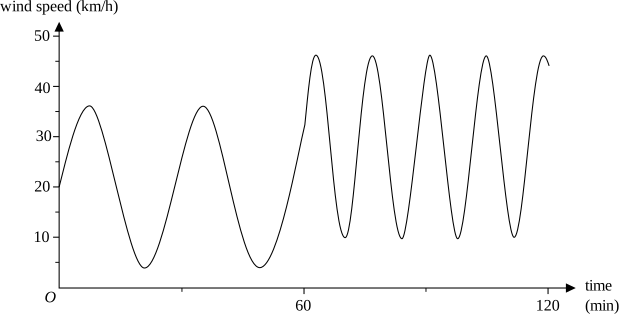
 

  1. Find the smallest value of `k`, correct to four decimal places, such that  `v(t)`  and  `v_1(t)`  are equal and are both increasing at 10 am.   (2 marks)

    --- 2 WORK AREA LINES (style=lined) ---

  2. Another possible value of `k` was found to be 31.4358


    Using this value of `k`, the weather monitoring station sends a signal when the wind speed is greater than 38 km/h.


    i.  Find the value of `t` at which a signal is first sent, correct to two decimal places.   (1 mark)

    --- 2 WORK AREA LINES (style=lined) ---


    ii. Find the proportion of one cycle, to the nearest whole percent, for which  `v_1 > 38`.   (2 marks)

    --- 5 WORK AREA LINES (style=lined) ---

  3. Let  `f(x) = 20 + 16 sin ((pi x)/(14))`  and  `g(x) = 28 + 18 sin ((pi(x-k))/(7))`.
     
    The transformation  `T([(x),(y)]) = [(a \ \ \ \ 0),(0 \ \ \ \ b)][(x),(y)] + [(c),(d)]`  maps the graph of  `f`  onto the graph of  `g`.


    State the values of  `a`, `b`, `c` and `d`, in terms of `k` where appropriate.   (3 marks)

    --- 11 WORK AREA LINES (style=lined) ---

Show Answers Only
  1. `28`
  2. `v_text(max) \ = 36 \ text(km/h)`


    `v_text(min) \ = 4 \ text(km/h)`

  3. `32.5093 \ text(km/h)`
  4. `20.45 \ text(km/h)`
  5. `3.4358`
  6. i. `60.75 \ text(m)`


    ii. `31text(%)`

  7. `a = (1)/(2) \ , \ b = (9)/(8) \ , \ c = k \ , \ d = (11)/(2)`
Show Worked Solution

a.    `text(Amplitude) = 16`

`text{Find Period (n):}`

`(2 pi)/(n)` `= (pi)/(14)`
`n` `= 28`


b.    `v_text(max) = 20 + 16 = 36 \ text(km/h)`

`v_text(min) = 20-16 = 4 \ text(km/h)`


c.    `v(60)` `= 20 + 16 sin ((60 pi)/(14))`
  `= 32.5093 \ \ text(km/h)`


d.    `v(t)\ \ text(is always positive.)`

`s(t) = int_0^60 v(t) \ dt`

`v(t)_(avg)` `= (1)/(60) int_0^60 20 + 16 sin ((pi t)/(14))\ dt`
  `= 20.447`
  `= 20.45 \ text(km/h) \ \ text((to 2 d.p.))`


e.    `text(S) text{olve (for}\ k text{):} \ \ v(60) = v_1(60)`

`k = 3.4358 \ \ text((to 4 d.p.))`


f.i.  `text(S) text(olve for) \ t , \ text(given) \ \ v_1(t) = 38 \ \ text(and) \ \ k = 31.4358`

`=> t = 60.75 \ text(minutes)`
 

f.ii.  `text(S) text(olving for) \ \ v_1(t) = 38 \ , \ k = 31.4358`

`t_1 = 60.75 \ text{(part i)}, \ t_2 = 65.123`

`text(Period of) \ \ v_1 = (2 pi)/(n) = (pi)/(7)\ \ => \ n = 14`

`:. \ text(Proportion of cycle)` `= (65.123-60.75)/(14)`
  `= 0.312`
  `= 31 text{%  (nearest %)}`


g.    `f(x) → g(x)`

`y^{prime} = 28 + 18 sin ({pi(x^{prime}-k)}/{7})`

`x^{prime} = ax + c` `\ \ \ \ \ \ y^{prime} = by + d`


`text(Using) \ \ y^{prime} = by + d`

`28 + 18 sin ({pi(x^{prime}-k)}/{7}) = b (20 + 16 sin ({pi x}/{14})) + d`
 

`text(Equating coefficients of) \ \ sin theta :`

`16b = 18 \ \ \ => \ b = (9)/(8)`
 

`text(Equating constants:)`

`20 xx (9)/(8) + d = 28 \ \ \ => \ \ d = (11)/(2)`

`(x^{prime}-k)/(7)` `= (x)/(14)`
`x^{prime}` `= (x)/(2) + k \ \ => \ \ a = (1)/(2) \ , \ c = k`


`a = (1)/(2) \ , \ b = (9)/(8) \ , \ c = k \ , \ d = (11)/(2)`

Filed Under: Transformations, Trig Graphing Tagged With: Band 4, Band 5, Band 6, smc-2757-10-Sin, smc-2757-30-Find period, smc-2757-40-Find amplitude, smc-2757-80-Applications, smc-2757-85-Max/min (non-calc), smc-753-60-Matrix

Graphs, MET2-NHT 2019 VCAA 1

Parts of the graphs of  `f(x) = (x-1)^3(x + 2)^3`  and  `g(x) = (x-1)^2(x + 2)^3`  are shown on the axes below.
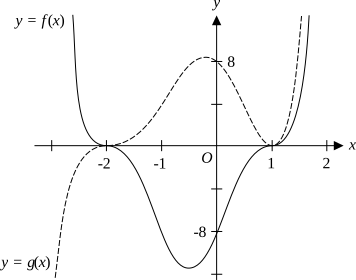


The two graphs intersect at three points,  (–2, 0),  (1, 0)  and  (`c`, `d`). The point  (`c`, `d`)  is not shown in the diagram above.

  1. Find the values of `c` and `d`.   (2 marks)

    --- 4 WORK AREA LINES (style=lined) ---

  2. Find the values of `x` such that  `f(x) > g(x)`.   (1 mark)

    --- 2 WORK AREA LINES (style=lined) ---

  3. State the values of `x` for which
    1. `f^{'}(x) > 0`   (1 mark)

      --- 2 WORK AREA LINES (style=lined) ---

    2. `g^{'}(x) > 0`   (1 mark)

      --- 2 WORK AREA LINES (style=lined) ---

  4. Show that  `f(1 + m) = f(–2-m)`  for all  `m`.   (1 mark)

    --- 3 WORK AREA LINES (style=lined) ---

  5. Find the values of `h` such that  `g(x + h) = 0`  has exactly one negative solution.   (2 marks)

    --- 4 WORK AREA LINES (style=lined) ---

  6. Find the values of `k` such that  `f(x) + k = 0`  has no solutions.   (1 mark)

    --- 2 WORK AREA LINES (style=lined) ---

Show Answers Only
  1. `c = 2 \ , \ d = 64`
  2. `(–∞, –2) \ ∪ \ (2, ∞)`
  3. i.  `(–(1)/(2), 1) \ ∪ \ (1, ∞)`
    ii. `(–∞, –2) \ ∪ \ (–2, –(1)/(5)) \ ∪ \ (1, ∞)`
  4. `text{Proof (Show Worked Solution)}`
  5.  `-2< h <=1`
  6. `(729)/(64)`
Show Worked Solution

a.    `text(Solve:) \ \ f(x) = g(x)`

`x = 1 , \ –2 \ text(and) \ 2`
 
`f(2) = 1^3 xx 4^3 = 64`
 
`text(Intersection at) \ (2, 64)`

`:. \ c = 2 \ , \ d = 64`


b.    `text(Using the graph and intersection at) \ (2, 64):`

`f(x) > g(x) \ \ text(for) \ \ (–∞, –2) \ ∪ \ (2, ∞)`


c.i.  `f'(x) > 0 \ \ text(for) \ \ (–(1)/(2), 1) \ ∪ \ (1, ∞)`

c.ii.  `g'(x) > 0 \ \ text(for) \ \ (–∞, –2) \ ∪ \ (–2, –(1)/(5)) \ ∪ \ (1, ∞)`


d.     `f(1 + m)` `= (1 + m-1)^3 (1 + m + 2)^3`
  `= m^3 (m + 3)^3`


`f(–2-m)` `= (–2-m -1)^3 (-2-m + 2)^3`
  `= (-m-3)^3 (-m)^3`
  `= (–1)^3 (m + 3)^3 (–1)^3 m^3`
  `= m^3 (m + 3)^3`


e.     `g(x + h)` `= (x + h-1)^2(x + h + 2)^3`
  `= underbrace{(x-(1 -h))^2}_{text(+ve solution)} * underbrace{(x-(h-2))^3}_{text(–ve solution)}`

 
`1-h ≥ 0 \ \ => \ \ h ≤ 1`

`-h-2 < 0 \ \ =>\ \ h > -2`

`:. -2< h <=1`


f.    `f(x) \ \ text(minimum S.P. when) \ \ f ′(x) = 0 \ =>  \ x =-(1)/(2)`

`text(S.P. at) \ \ (-(1)/(2) \ , \ -(729)/(64))`

`:. \ text(No solution if) \ \ k > (729)/(64)`

Filed Under: Polynomials Tagged With: Band 3, Band 4, Band 5, smc-750-60-Other

Trigonometry, EXT1 T3 EQ-Bank 4

The current flowing through an electrical circuit can be modelled by the function

`qquad f(t) = 6sin 0.05t + 8cos 0.05t, \ \ t >= 0`

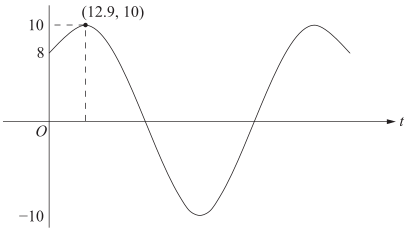
  1.  Express the function in the form  `f(t) = Asin(at + b),\ \ text(for)\ \ 0<=b<=pi/2`.  (2 marks)

    --- 6 WORK AREA LINES (style=lined) ---

  2.  Find the time at which the current first obtains it maximum value.   (1 mark)

    --- 4 WORK AREA LINES (style=lined) ---

  3.  Sketch the graph of  `f(t)`. Clearly show its range and label the coordinates of its first maximum value. Do not label `x`-intercepts.   (1 mark)

    --- 10 WORK AREA LINES (style=lined) ---
Show Answers Only
  1. `f(t) = 10sin(0.05t + 0.927)`
  2.   `12.9\ \ (text(to 1 d.p.))`
  3.  
Show Worked Solution

i.   `f(t) = 6sin 0.05t + 8cos 0.05t`

`Asin(at + b)` `=Asin(0.05t + b)`  
  `= Asin(0.05t)\ cos(b) + Acos(0.05t)\ sin(b)`  

 
`=> Acos(b) = 6, \ Asin(b) = 8`

`A^2` `= 6^2 + 8^2`
`A` `= 10`


`=> 10cos(b)` `= 6`
`cos(b)` `= 6/10`
`b` `= cos^(−1) 0.06 ~~ 0.927\ text(radians)`

 
`:. f(t) = 10sin(0.05t + 0.927)`


ii.   `text(Max occurs at)\ \ sin(0.05t + 0.927)= sin\ pi/2`

`0.05t + 0.927` `= pi/2`
`0.05t` `= 0.643…`
`:.t` `= 12.87`
  `= 12.9\ \ (text(to 1 d.p.))`


iii.   

Filed Under: Auxiliary Angles (Ext1) Tagged With: Band 4, smc-1075-10-Rsin, smc-1075-40-Real world context

Trigonometry, EXT1 T3 EQ-Bank 1

  1. Show that `sinx + sin3x = 2sin2xcosx`.  (2 marks)

    --- 8 WORK AREA LINES (style=lined) ---

  2. Hence or otherwise, find all values of `x` that satisfy
     
    `qquad sinx + sin2x + sin3x = 0,\ \ \ x in [0,2pi]`.  (2 marks)

    --- 8 WORK AREA LINES (style=lined) ---

Show Answers Only
  1. `text(See Worked Solutions)`
  2. `x = 0, pi/2, pi, (3pi)/2, 2pi, (2pi)/3, (4pi)/3`
Show Worked Solution
i.   `sinx + sin3x` `= sinx + sin2xcosx + cos2xsinx`
  `= sinx + 2sinxcos^2x + (cos^2x – sin^2x)sinx`
  `= sinx + 2sinxcos^2x + cos^2xsinx – sin^3x`
  `= sinx + 3sinx(1 – sin^2x) – sin^3x`
  `= sinx + 3sinx – 3sin^3x- sin^3x`
  `= 4sinx(1 – sin^2x)`
  `= 4sinxcos^2x`
  `= 2sin2xcosx`
  `=\ text(RHS)`


ii.    `sinx + sin2x + sin3x` `= 0`
  `sin2x + 2sin2xcosx` `= 0`
  `sin2x(1 + 2cosx)` `= 0`


`text(If)\ sin2x` `= 0:`
`2x` `= 0, pi, 2pi, 3pi, 4pi`
`:.x` `= 0, pi/2, pi, (3pi)/2, 2pi`
`text(If)\ \ cosx` `= -1/2:`
`:.x` `= (2pi)/3, (4pi)/3`

Filed Under: Identities, Equations and 't' formulae (Ext1) Tagged With: Band 4, Band 5, smc-1076-10-Double Angle Identities/Equations

Trigonometry, EXT1 T3 EQ-Bank 3

Find all values of  `theta`  that satisfy the equation  `sqrt3 cos theta = sin(2theta)`.  (3 marks)

Show Answers Only

`theta = 90° + m xx 180°, \ 60° + m xx 360°\ or\ 120° + m xx 360°`

Show Worked Solution
`sqrt3 cos theta` `= sin(2 theta)`
`2 cos theta sin theta – sqrt3 cos theta` `= 0`
`cos theta(sin theta – sqrt3/2)` `= 0`

COMMENT: Expressing “all values” is specifically mentioned in Topic Guidance as an application of arithmetic sequences.

`cos theta = 0 \or \  sin theta = sqrt3/2`

`theta = 90°, 270°\ or\ theta = 60°, 120° \ \ \ (0°<=theta<=360°)`

`:. theta = 90° + m xx 180°, \ 60° + m xx 360°\ or\ 120° + m xx 360°`

`text(where)\ \ m\ \ text(is an arbitrary integer).`

Filed Under: Identities, Equations and 't' formulae (Ext1) Tagged With: Band 4, smc-1076-10-Double Angle Identities/Equations

Probability, 2ADV S1 2019 MET2-N 9 MC

At the start of a particular week, Kim has three red apples and two green apples. She eats one apple everyday. On Monday, Tuesday and Wednesday of that week, she randomly selects an apple to eat. In this three-day period, the probability that Kim does not eat an apple of the same colour on any two consecutive days is

  1.  `(1)/(5)`
  2.  `(3)/(10)`
  3.  `(2)/(5)`
  4.  `(6)/(25)`
Show Answers Only

`B`

Show Worked Solution

`P text{(alternate colours)}`

`= P(RGR) + P(GRG)`

`= (3)/(5) ·(2)/(4) ·(2)/(3) + (2)/(5) ·(3)/(4) ·(1)/(3)`

`= (12)/(60) + (6)/(60)`

`= (3)/(10)`
 

`=> \ B`

Filed Under: Multi-Stage Events (Adv-2027), Multi-Stage Events (Y11) Tagged With: Band 4, smc-6469-20-Other Multi-Stage Events, smc-989-20-Other Multi-Stage Events

Calculus, 2ADV C4 SM-Bank 1

If  `m = int_1^3 (2)/(x)\ dx`, express  `e^m`  in its simplest form.   (2 marks)

--- 5 WORK AREA LINES (style=lined) ---

Show Answers Only

`9`

Show Worked Solution
`int_1^3 (2)/(x)\ dx` `= [2 log_e x]_1^3`
`m` `= 2 log_e 3 – 2 log_e 1`
  `= 2 log_e 3`
`:. e^m` `=e^(2 log_e 3)`
  `= e^(log_e 9)`
  `= 9`

Filed Under: L&E Integration, Log Calculus (Y12) Tagged With: Band 4, smc-1203-40-Log (Definite), smc-964-30-Definite Integals

Probability, 2ADV S1 2019 MET2-N 5 MC

Consider the probability distribution for the discrete random variable `X` shown in the table below.

\begin{array} {|c|c|c|c|c|}
\hline
\rule{0pt}{2.5ex} x \rule[-1ex]{0pt}{0pt} & \ \ \ \ -1\ \ \ \  & \ \ \ \ \ 0\ \ \ \ \  & \ \ \ \ \ 1\ \ \ \ \  & \ \ \ \ \ 2\ \ \ \ \  &\ \ \ \ \ 3\ \ \ \ \ \\
\hline
\rule{0pt}{2.5ex} P(X=x) \rule[-1ex]{0pt}{0pt} & b & b & b & \dfrac{3}{5}-b & \dfrac{3b}{5} \\
\hline
\end{array}

The value of `E(X)` is

  1.  `(76)/(65)`
  2.  `1`
  3.  `0`
  4.  `(2)/(13)`
  5.  `(86)/(65)`
Show Answers Only

`A`

Show Worked Solution
`1` `= b + b + b + (3)/(5) – b + (3b)/(5)`
`(2)/(5)` `= (13b)/(5)`
`b` `= (2)/(13)`


`E(X)` `= -(2)/(13) + 0 + (2)/(13) + 2((3)/(5) – (2)/(13)) +3 ((6)/(65))`
  `= (76)/(65)`


\(\Rightarrow A\)

Filed Under: Discrete Probability Distributions (Y11) Tagged With: Band 4, smc-992-20-E(X) / Mean

CORE, GEN1 2019 NHT 19 MC

Consider the recurrence relation shown below.

`V_0 = 125\ 000,quadqquadV_(n + 1) = 1.013V_n - 2000`

This recurrence relation could be used to determine the value of

  1. a perpetuity with a payment of $2000 per quarter.
  2. an annuity with withdrawals of $2000 per quarter.
  3. an annuity investment with additional payments of $2000 per quarter.
  4. an item depreciating at a flat rate of 1.3% of the purchase price per quarter.
  5. a compound interest investment earning interest at the rate of 1.3% per annum.
Show Answers Only

`B`

Show Worked Solution

`text(The investment earns interest of 13% each period)`

`text(and a withdrawal of $2000 is made at the end of)`

`text(each period.)`

`=>\ B`

Filed Under: Recursion - Financial Tagged With: Band 4, smc-717-80-Interpret RR

CORE, GEN1 2019 NHT 18 MC

A truck was purchased for $134 000.

Using the reducing balance method, the value of the truck is depreciated by 8.5% each year.

Which one of the following recurrence relations could be used to determine the value of the truck after `n` years, `V_n`?

  1. `V_0 = 134\ 000,quadqquad V_(n + 1) = 0.915 xx V_n`
  2. `V_0 = 134\ 000,quadqquad V_(n + 1) = 1.085 xx V_n`
  3. `V_0 = 134\ 000,quadqquad V_(n + 1) = V_n - 11\ 390`
  4. `V_0 = 134\ 000,quadqquad V_(n + 1) = 0.915 xx V_n - 8576`
  5. `V_0 = 134\ 000,quadqquad V_(n + 1) = 1.085 xx V_n - 8576`
Show Answers Only

`A`

Show Worked Solution

`text(Each year, value decreases by 8.5%)`

`:. V_1` `= V_0 – 0.085 xx V_0`
  `= 0.915 xx V_0`

 
`=>\ A`

Filed Under: Recursion - Financial Tagged With: Band 4, smc-717-60-Depreciation (reducing balance), smc-717-70-Find RR

Data Analysis, GEN1 2019 NHT 16 MC

A small cafe is open every day of the week except Tuesday.

The table below shows the daily seasonal indices for labour costs at this cafe.

Excluding the day that the cafe is closed, the long-term average weekly labour cost is $9786.

The expected daily labour cost on a Wednesday is closest to

  1.  $1127
  2.  $1315
  3.  $1631
  4.  $1733
  5.  $2022
Show Answers Only

`E`

Show Worked Solution

`text(Average daily labour cost)`

`= 9786/6`

`= 1631`


`:.\ text(Wednesday’s expected cost)`

`= 1631 xx 1.24`

`= $2022.44`
 

`=>\ E`

Filed Under: Time Series Tagged With: Band 4, smc-266-20-(De)Seasonalising Data

Data Analysis, GEN1 2019 NHT 15 MC

The table below shows the long-term monthly average heating cost, in dollars, for a small office.

The seasonal index for April is closest to

  1.  0.80
  2.  0.87
  3.  0.96
  4.  1.25
  5.  1.56
Show Answers Only

`B`

Show Worked Solution

`text(Average cost per month = 125)`

`text{S.I. (April)}` `= 109/125`
  `= 0.872`

 
`=>\ B`

Filed Under: Time Series Tagged With: Band 4, smc-266-10-Seasonal Index from a Table

Data Analysis, GEN1 2019 NHT 14 MC

The time series plot below shows the daily number of visitors to a historical site over a two-week period.
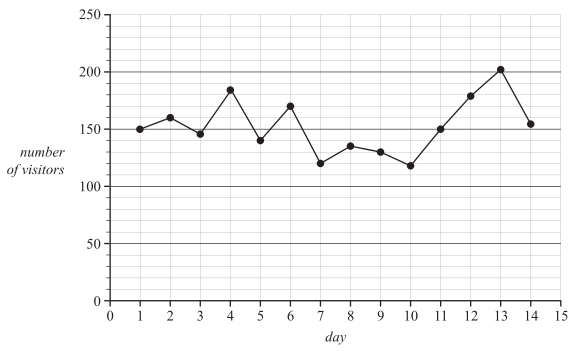
 

This time series plot is to be smoothed using seven-median smoothing.

The smoothed number of visitors on day 4 is closest to

  1. 120
  2. 140
  3. 145
  4. 150
  5. 160
Show Answers Only

`D`

Show Worked Solution

`text{The seven data points about day 4 (ascending):}`

`120, 140, 147, 150, 160, 170, 183`

`:.\ text{7 median smoothing (Day 4)} = 150`

`=> D`

Filed Under: Time Series Tagged With: Band 4, smc-266-70-MEDIAN Smoothing

Data Analysis, GEN1 2019 NHT 13 MC

The association between amount of protein consumed (in grams/day) and family income (in dollars) is best displayed using

  1. a scatterplot.
  2. a time series plot.
  3. parallel boxplots.
  4. back-to-back stem plots.
  5. a two-way frequency table.
Show Answers Only

`A`

Show Worked Solution

`text(Both variables are numerical and continuous.)`

`:.\ text(A scatterplot is best.)`

`=>\ A`

Filed Under: Correlation and Regression Tagged With: Band 4, smc-265-10-r / r^2 and Association

Data Analysis, GEN1 2019 NHT 10 MC

A student uses the data in the table below to construct the scatterplot shown below.
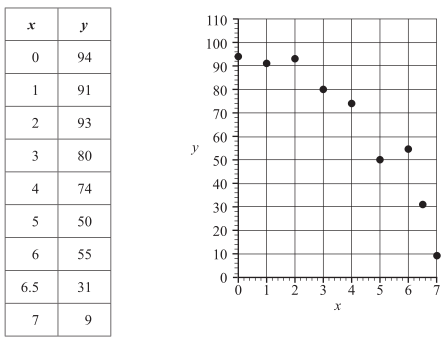


A squared transformation is applied to the variable `x` to linearise the data.

A least squares line is fitted to this linearised data with `x^2` as the explanatory variable.

The equation of this least squares line is closest to

  1. `y = 94.1 - 12.3x^2`
  2. `y = 95.8 - 1.57x^2`
  3. `y = 8.76 - 0.0768x^2`
  4. `y = 107 - 111x^2`
  5. `y = 107 - 0.0768x^2`
Show Answers Only

`B`

Show Worked Solution

`text(Input all data points into CAS:)`

`y = 95.8 – 1.57x^2`

`=> B`

Filed Under: Correlation and Regression Tagged With: Band 4, smc-265-71-Linearise - Squared/Inverse

Data Analysis, GEN1 2019 NHT 9 MC

A least squares line of the form  `y = a + bx`  is fitted to a set of bivariate data for the variables `x` and `y`.

For this set of bivariate data,  `barx = 5.50`,  `bary = 5.60`,  `s_x = 3.03`,  `s_y =1.78`  and  `a = 3.1`

The slope of the least squares line, `b`, is closest to
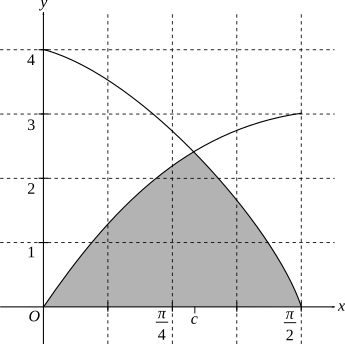
  1.  0.44
  2.  0.45
  3.  0.58
  4.  0.59
  5.  0.76
Show Answers Only

`B`

Show Worked Solution
`bar y` `=a+b barx`
`5.60` `= 3.1 – b(5.50)`
`b` `= (5.60 – 3.1)/5.50`
  `= 04545…`

 
`=> B`

Filed Under: Correlation and Regression Tagged With: Band 4, smc-265-30-LSRL formula

Data Analysis, GEN1 2019 NHT 8 MC

The variables recovery time after exercise (in minutes) and fitness level (below average, average, above average) are

  1. both numerical.
  2. both categorical.
  3. an ordinal variable and a nominal variable respectively.
  4. a numerical variable and a nominal variable respectively.
  5. a numerical variable and an ordinal variable respectively.
Show Answers Only

`E`

Show Worked Solution

`text{Recovery time in minutes → numerical variable}`

`text{Fitness level → ordinal (categories that can be ordered)}`

`=> E`

Filed Under: Summary Statistics Tagged With: Band 4, smc-468-10-Data Classification

Data Analysis, GEN1 2019 NHT 5-7 MC

The birth weights of a large population of babies are approximately normally distributed with a mean of 3300 g and a standard deviation of 550 g.

Part 1

A baby selected at random from this population has a standardised weight of  `z = – 0.75`

Which one of the following calculations will result in the actual birth weight of this baby?
 

  1. `text(actual birth weight)\ = 550 - 0.75 × 3300`
  2. `text(actual birth weight)\ = 550 + 0.75 × 3300`
  3. `text(actual birth weight)\ = 3300 - 0.75 × 550`
  4. `text(actual birth weight)\ = 3300 + 0.75/550`
  5. `text(actual birth weight)\ = 3300 - 0.75/550`


Part 2

Using the 68–95–99.7% rule, the percentage of babies with a birth weight of less than 1650 g is closest to

  1. 0.14%
  2. 0.15%
  3. 0.17%
  4. 0.3%
  5. 2.5%


Part 3

A sample of 600 babies was drawn at random from this population.

Using the 68–95–99.7% rule, the number of these babies with a birth weight between 2200 g and 3850 g is closest to

  1. 111
  2. 113
  3. 185
  4. 408
  5. 489
Show Answers Only

`text(Part 1:)\ \ C`

`text(Part 2:)\ \ B`

`text(Part 3:)\ \ E`

Show Worked Solution

`text(Part 1)`

`text(Actual weight)` `= text(mean) + z xx text(std dev)`
  `= 3300 – 0.75 xx 550`

`=> C`


`text(Part 2)`

`z-text(score)` `= (x – barx)/5`
  `= (1650 – 3300)/550`
  `= −3`


`:. P(x < 1650)` `= P(z < −3)`
  `= 0.3/2`
  `= 0.15\ text(%)`

`=>B`
 

`text(Part 3)`

`ztext(-score)\ (2200) = (2200 – 3300)/550 = −2`

`ztext(-score)\ (3850) = (3850 – 3300)/550 = 1`


`text(Percentage)` `= (47.5 + 34)text(%) xx 600`
  `= 81.5text(%) xx 600`
  `= 48text(%)`

`=>\ E`

Filed Under: Normal Distribution Tagged With: Band 3, Band 4, Band 5, smc-600-10-Single z-score, smc-600-20-z-score Intervals

  • « Previous Page
  • 1
  • …
  • 66
  • 67
  • 68
  • 69
  • 70
  • …
  • 114
  • Next Page »

Copyright © 2014–2025 SmarterEd.com.au · Log in