Which of the following expressions is equivalent to the sum of \(3x\) and \(4\)?
- \(12x\)
- \(4 + 3x\)
- \(\dfrac{3x}{4}\)
- \(3x-4\)
Aussie Maths & Science Teachers: Save your time with SmarterEd
Which of the following expressions is equivalent to the sum of \(3x\) and \(4\)?
\(B\)
\(\text{Sum means to add}\)
\(\therefore\ 4+3x\ \text{is equivalent to the sum of } 3x\ \text{and}\ 4\)
\(\Rightarrow B\)
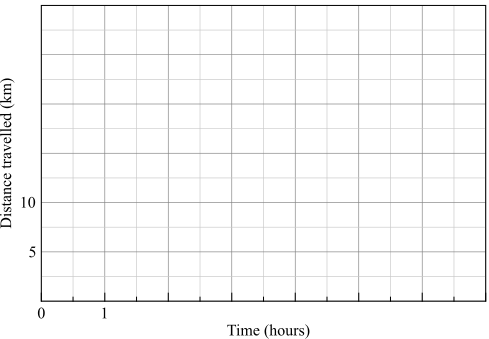
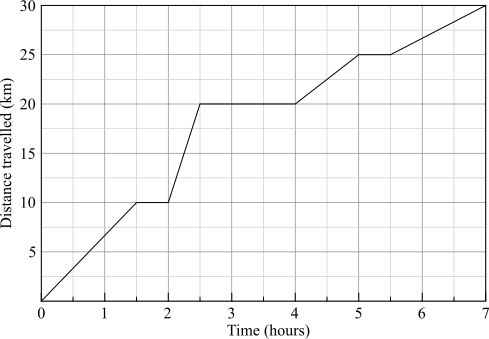
Each stage of Moira's 30 km charity fitness challenge is outlined below.
Draw a distance-time graph to represent Moira's challenge on the following grid. Include the scale on both axes. (3 marks)
--- 0 WORK AREA LINES (style=lined) ---
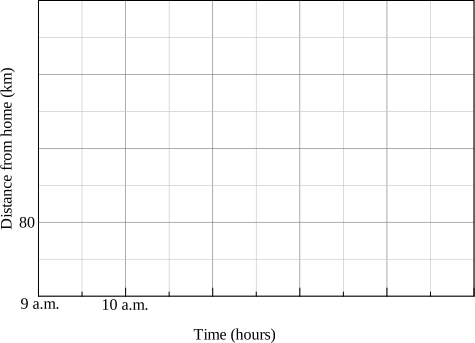
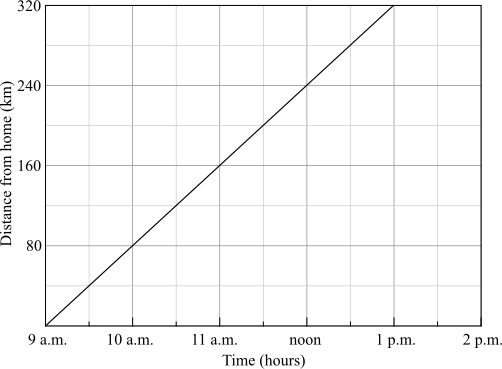
Jefferson left home at 9 a.m. and travelled at an average speed of 80 km/h for 4 hours.
Draw a distance-time graph to represent Jefferson's journey on the following grid, completing times and distances on the axes. (2 marks)
--- 0 WORK AREA LINES (style=lined) ---
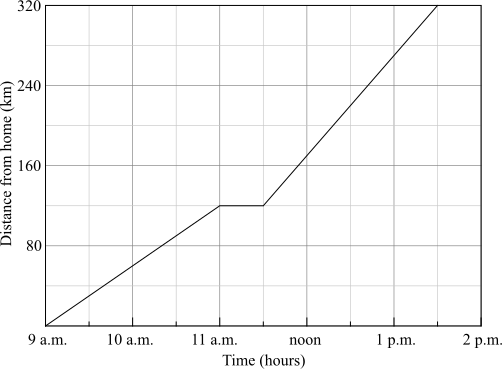
Roland left home at 9 a.m. and travelled through the city averaging 60 km/h for 2 hours.
He then stopped for half an hour at a roadhouse.
Roland continued his journey on the motorway and averaged 100 km/h arriving at his destination after 2 hours.
Draw a distance-time graph to represent Roland's journey on the following grid, completing times and distances on the axes. (3 marks)
--- 0 WORK AREA LINES (style=lined) ---
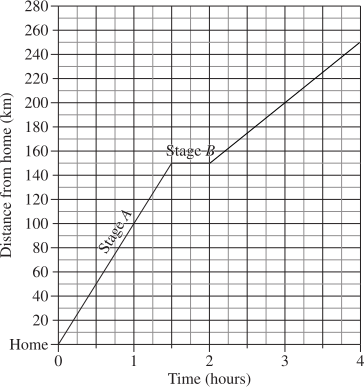
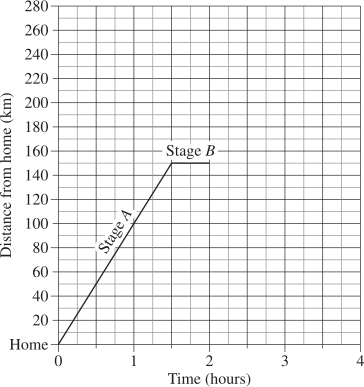
The distance-time graph shows the first two stages of a car journey from home to a holiday house.
--- 1 WORK AREA LINES (style=lined) ---
--- 0 WORK AREA LINES (style=lined) ---
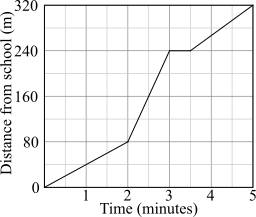
The distance-time graph below shows Clive's walk home from school.
--- 1 WORK AREA LINES (style=lined) ---
--- 2 WORK AREA LINES (style=lined) ---
a. \(40\ \text{m}\)
b. \(240\ \text{m}\)
c. \(320\ \text{m}\)
d. \(40\ \text{m/minute}\)
e. \(64\ \text{m/minute}\)
f. \(\text{The graph was steepest between the 2nd and 3rd minutes.}\)
\(\text{This is where Clive was walking the fastest.}\)
a. \(40\ \text{m}\)
b. \(240\ \text{m}\)
c. \(320\ \text{m}\)
| d. |
\(\text{Speed}\) | \(=\dfrac{\text{Distance}}{\text{Time}}\) |
| \(=\dfrac{80}{2}\) | ||
| \(=40\ \text{m/minute}\) |
| e. |
\(\text{Speed}\) | \(=\dfrac{\text{Distance}}{\text{Time}}\) |
| \(=\dfrac{320}{5}\) | ||
| \(=64\ \text{m/minute}\) |
f. \(\text{The graph was steepest between the 2nd and 3rd minutes.}\)
\(\text{This is where Clive was walking the fastest.}\)
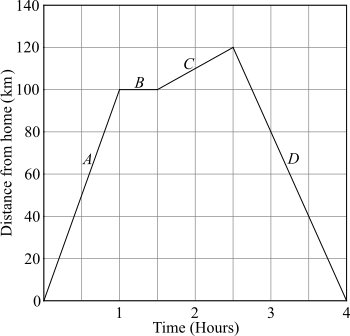
The distance-time graph below shows Betty's train trip to her Grandmother's house in the Blue Mountains and the return journey in her Grandmother's car.
--- 1 WORK AREA LINES (style=lined) ---
--- 2 WORK AREA LINES (style=lined) ---
--- 1 WORK AREA LINES (style=lined) ---
--- 2 WORK AREA LINES (style=lined) ---
a. \(\textit{B}\)
b. \(1 \text{ hour}\)
c. \(2.5 \text{ hours}\)
d. \(80\ \text{km/h}\)
e. \(240\ \text{km}\)
f. \(60\ \text{km/h}\)
g. \(\text{The graph was steepest in Section }\textit{A}.\)
\(\text{This is where Betty was travelling the fastest.}\)
a. \(\text{Horizontal sections of the graph indicate the person}\)
\(\text{is not moving.}\)
\(\therefore\ \text{Betty waited for the next train in section}\ \textit{B}.\)
b. \(1 \text{ hour}\)
c. \(2.5 \text{ hours}\)
| d. |
\(\text{Speed}\) | \(=\dfrac{\text{Distance}}{\text{Time}}\) |
| \(=\dfrac{120}{1.5}\) | ||
| \(=80\ \text{km/h}\) |
e. \(\text{Total distance}=2\times 120=240\ \text{km}\)
| f. |
\(\text{Speed}\) | \(=\dfrac{\text{Distance}}{\text{Time}}\) |
| \(=\dfrac{240}{4}\) | ||
| \(=60\ \text{km/h}\) |
g. \(\text{The graph was steepest in Section }\textit{A}.\)
\(\text{This is where Betty was travelling the fastest.}\)
Caleb is travelling from Brisbane to Toowoomba. The journey is 135 kilometres.
His car uses 9.45 litres of fuel per 100 kilometres.
How much fuel will Caleb need to make the journey?
Round your answer to the nearest litre. (2 marks)
\(13\ \text{litres (nearest whole)}\)
| \(\text{Fuel needed}\) | \(=\dfrac{135}{100}\times 9.45\) |
| \(= 12.75\dots\) | |
| \(= 13\ \text{litres (nearest whole)}\) |
Mika is making lemonade.
The recipe says she needs 1 cup of sugar for every 3 lemons.
If 7 lemons are used, how many cups of sugar are needed? (2 marks)
\(2\dfrac{1}{3}\ \text{cups}\)
\(\text{3 lemons}\rightarrow 1\ \text{cup of sugar}\)
\(\text{1 lemon}\rightarrow\dfrac{1}{3}\ \text{cup of sugar}\)
| \(\therefore\ 7\ \text{lemons}\) | \(=7\times\dfrac{1}{3}\) |
| \(=\dfrac{7}{3}\) | |
| \(=2\dfrac{1}{3}\ \text{cups}\) |
Johnno and Zoey are driving from Wahroonga to Ballarat which is a distance of 825 kilometres.
After every two hours of driving, they rest for 20 minutes and swap drivers.
How long will their trip take if they average 100 km/h when driving? (2 marks)
\(9\ \text{h }35\ \text{min}\)
\(\text{Driving time}=\dfrac{825}{100}=8.25\ \text{h}\)
\(\text{Number of stops}=4\)
| \(\therefore\ \text{Total trip time}\) | \(=8\ \text{h }15\ \text{m}+(4\times 20)\ \text{m}\) |
| \(=8\ \text{h }15\ \text{m}+1\ \text{h }20\ \text{m}\) | |
| \(=9\ \text{h }35\ \text{min}\) |
Roy and Siegfried are driving from Broken Hill to Albury which is a distance of 840 kilometres.
After every two hours of driving, they rest for 20 minutes and swap drivers.
How long will their trip take if they average 80 km/h when driving? (2 marks)
\(12\ \text{h }10\ \text{min}\)
\(\text{Driving time}=\dfrac{840}{80}=10.5\ \text{h}\)
\(\text{Number of stops}=5\)
| \(\therefore\ \text{Total trip time}\) | \(=10\ \text{h }30\ \text{m}+(5\times 20)\ \text{m}\) |
| \(=10\ \text{h }30\ \text{m}+1\ \text{h }40\ \text{m}\) | |
| \(=12\ \text{h }10\ \text{min}\) |
Oscar and Lucinda are driving from Dungog to Bourke which is a distance of 735 kilometres.
After every two hours of driving, they rest for 15 minutes and swap drivers.
How long will their trip take if they average 70 km/h when driving? (2 marks)
\(11\ \text{h }45\ \text{min}\)
\(\text{Driving time}=\dfrac{735}{70}=10.5\ \text{h}\)
\(\text{Number of stops}=5\)
| \(\therefore\ \text{Total trip time}\) | \(=10\ \text{h }30\ \text{m}+(5\times 15)\ \text{m}\) |
| \(=10\ \text{h }30\ \text{m}+1\ \text{h }15\ \text{m}\) | |
| \(=11\ \text{h }45\ \text{min}\) |
Jenny needs to reduce her discretionary spending which is shown in the table below.
| Spend | Amount | How Often |
| Gym membership | $50 | Monthly |
| Air travel | $120 | Quarterly |
| KFC lunch | $14 | 2 days per week |
| Football tickets for 26 rounds | $25 | Weekly |
Which action will save her the most?
\(D\)
\(\text{Calculate the yearly saving of each action}\)
\(\text{Gym membership}=$50\times 12 =$600\)
\(\text{Air travel}=$120\times 4=$480\)
\(\text{KFC lunch}=\bigg(\dfrac{14\times 52}{2}\bigg)=$364\)
\(\text{Football tickets}=26\times 25=$650\)
\(\text{Penrith Panthers tickets costs the most each year}\)
\(\text{so she should stop going to Penrith games.}\)
\(\Rightarrow D\)
Rhonda needs to reduce her discretionary spending which is shown in the table below.
| Spend | Amount | How Often |
| Car Wash | $80 | Monthly |
| Hairdresser | $150 | Quarterly |
| Thai take-away | $15 | 2 nights per week |
| Streaming services | $12 | Weekly |
Which action will save her the most?
\(A\)
\(\text{Calculate the yearly saving of each action}\)
\(\text{Car wash}=$80\times 12 =$960\)
\(\text{Hairdresser}=$150\times 4=$600\)
\(\text{Thai}=15\times 52=$780\)
\(\text{Streaming services}=12\times 52=$624\)
\(\text{Washing the car costs the most each year}\)
\(\text{so she should stop washing the car.}\)
\(\Rightarrow A\)
Choon is travelling at 90 km/h in his car.
If he maintains this speed, how many kilometres will he travel in 20 minutes?
\(C\)
| \(\text{Distance}\) | \(=\text{speed}\times \text{time}\) |
| \(=90\times \dfrac{20}{60}\) | |
| \(=90\times \dfrac{1}{3}\) | |
| \(=30\ \text{km}\) |
\(\Rightarrow C\)
The exchange rate between Australian dollars and Euro dollars (€) is A$1 = €0.5.
Leisa is in Paris and buys a baguette that costs €12.
What change, in Euro dollars (€), will Leisa receive from A$50?
\(A\)
\(\text{Convert A}\$50\ \text{to Euro dollars(€):}\)
| \(\text{A}$50\) | \(=50\times 0.5\) |
| \(=\text{€}25\) |
| \(\text{Change}\) | \(=\text{€}25-\text{€}12\) |
| \(=\text{€}13\) |
\(\Rightarrow A\)
The exchange rate between Australian dollars and Euro dollars (€) isA$1 = €0.5.
Murray is in Europe and takes a taxi that costs €20.
What change, in Euro dollars (€), will Murray receive from A$50?
\(A\)
\(\text{Convert A}$50\ \text{to Euro dollars(€):}\)
| \(\text{A}$50\) | \(=50\times 0.5\) |
| \(=\text{€}25\) |
| \(\text{Change}\) | \(=\text{€}25-\text{€}20\) |
| \(=\text{€}5\) |
\(\Rightarrow A\)
Patrick rode his scooter at a speed of 5 metres per second.
If he rode for 30 seconds, how far did he go?
\(C\)
| \(\text{Distance}\) | \(=\text{Speed}\times \text{Time}\) |
| \(=5 \times 30\) | |
| \(=150\ \text{metres}\) |
\(\Rightarrow C\)
A woomera can throw a spear at a speed of 75 metres per second.
What is the speed of the spear in metres per minute?
\(B\)
| \(\text{Speed}\) | \(=\text{Distance}\times \text{Time}\) |
| \(=75 \times 60\) | |
| \(=4500\ \text{metres per minute}\) |
\(\Rightarrow B\)
The nutritional information on a breakfast cereal is shown below.
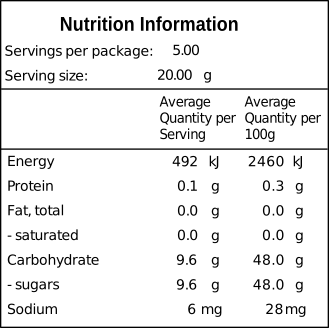
Kylie expends 1000 kJ of energy by rowing for 30 minutes.
If she consumes 100 grams of the cereal, approximately how long should she row to use up the energy it provides?
\(D\)
\(100\ \text{grams of cereal}\rightarrow 2460\ \text{kJ}\)
| \(\text{Exercise required}\) | \(=\dfrac{2460}{1000}\times 30\) |
| \(\approx 2.5\times 30\) | |
| \(\approx 75\ \text{minutes}\) |
\(\Rightarrow D\)
The nutritional information on a power bar is shown below.
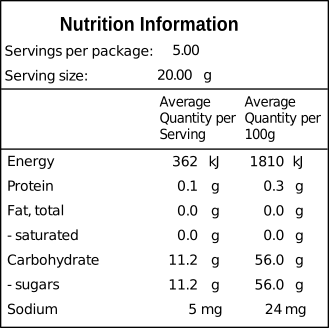
Sandra expends 900 kJ of energy by running for 20 minutes.
If she consumes 100 grams of the power bar, approximately how long should she run to use up the energy it provides?
\(C\)
\(100\ \text{grams of power bar}\rightarrow 1810\ \text{kJ}\)
| \(\text{Exercise required}\) | \(=\dfrac{1810}{900}\times 20\) |
| \(\approx 2\times 20\) | |
| \(\approx 40\ \text{minutes}\) |
\(\Rightarrow C\)
The nutritional information on a breakfast cereal is shown below.
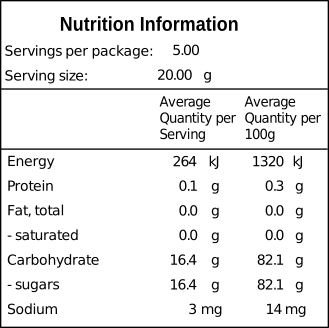
Anna expends 650 kJ of energy by swimming for 30 minutes.
If she consumes 100 grams of the cereal, approximately how long should she swim to use up the energy it provides?
\(C\)
\(100\ \text{grams of cereal}\rightarrow 1320\ \text{kJ}\)
| \(\text{Exercise required}\) | \(=\dfrac{1320}{650}\times 30\) |
| \(\approx 2\times 30\) | |
| \(\approx 60\ \text{minutes}\) |
\(\Rightarrow C\)
The nutritional information on a breakfast cereal is shown below.
Marjorie expends 1000 kJ of energy by jogging for 30 minutes.
If she consumes 100 grams of the cereal, approximately how long should she jog to use up the energy it provides?
\(B\)
\(100\ \text{grams of cereal}\rightarrow 1320\ \text{kJ}\)
| \(\text{Exercise required}\) | \(=\dfrac{1320}{1000}\times 30\) |
| \(\approx 1.3\times 30\) | |
| \(\approx 40\ \text{minutes}\) |
\(\Rightarrow B\)
Convert 72 km/h into m/s. (2 marks)
\(18\ \text{km/hour}\)
| \(72\ \text{km/h}\) | \(=72\ 000\ \text{m/h}\) |
| \(=\bigg(\dfrac{72\ 000}{60\times 60}\bigg)\ \text{m/s}\) | |
| \(=20\ \text{m/s}\) |
Convert 5 m/s into km/h. (2 marks)
\(18\ \text{km/hour}\)
| \(5\ \text{m/s}\) | \(=(5\times 60\times 60)\ \text{m/h}\) |
| \(=18\ 000\ \text{m/h}\) | |
| \(=18\ \text{km/h}\) |
Sandra is counting the cars heading south on the highway through her town.
She observes that 1 car passes every 6 seconds.
If Sandra is counting for 2 hours at this rate, how many cars does she count?
\(C\)
\(1\text{ car/}6\ \text{seconds}=10\text{ cars/}\text{minute}\)
| \(\therefore\ \text{Cars in 2 hours}\) | \(=2\times 10\times 60\) |
| \(=1200\) |
\(\Rightarrow C\)
The hardware store is having a sale on ladders.
They make $1800 from selling 3 ladders.
All ladders on sale cost the same.
How much will the hardware store make if they sell 8 ladders? (2 marks)
\($4800\)
| \(\text{Price per ladder}\) | \(=\dfrac{1800}{3}\) |
| \(=$600\) |
| \(\text{Price of 8 ladders}\) | \(=8\times $600\) |
| \(=$4800\) |
Byron makes $180 selling 20 poetry books on eBay.
All his poetry books are the same price.
How much money will he make selling 11 poetry books?
\(B\)
| \(\text{Cost per poetry book}\) | \(=\dfrac{180}{20}\) |
| \(=$9\) |
| \(\text{Cost for 11 poetry books}\) | \(=11\times 9\) |
| \(=$99\) |
\(\Rightarrow B\)
Bjork makes $1000 selling 10 scarves at the market.
All her scarves are the same price.
How much money will she make selling 13 scarves?
\(B\)
| \(\text{Cost per scarf}\) | \(=\dfrac{1000}{10}\) |
| \(=$100\) |
| \(\text{Cost for 13 scarves}\) | \(=13\times 100\) |
| \(=$1300\) |
\(\Rightarrow B\)
Esther can run 5 kilometres in 20 minutes.
Running at the same speed, how long will it take Esther to run 3 kilometres?
\(A\)
| \(\text{Minutes per kilometre}\) | \(=\dfrac{20}{5}\) |
| \(=4\) |
| \(\text{Minutes for 3 kilometres}\) | \(=3\times 4\) |
| \(=12\ \text{minutes}\) |
\(\Rightarrow A\)
Vinh saves $80 per month.
How many months will it take him to save $560?
\(D\)
| \(\text{Months}\) | \(=\dfrac{560}{80}\) |
| \(=7\) |
\(\Rightarrow D\)
Hans completed a 378 kilometre cycling race in 9 hours.
What was his average speed in kilometres per hour?
\(B\)
| \(\text{Average speed}\) | \(=\dfrac{\text{Distance}}{\text{Time}}\) |
| \(= \dfrac{378}{9}\) | |
| \(=42\ \text{km/h}\) |
\(\Rightarrow B\)
Anthony saves $300 each month.
How many months will it take him to save $1500?
\(A\)
| \(\text{Months}\) | \(=\dfrac{1500}{300}\) |
| \(=5\ \text{months}\) |
\(\Rightarrow A\)
Gayle decorated 162 cookies in 9 hours.
What was her average decorating speed in cookies per hour?
\(A\)
| \(\text{Average speed}\) | \(=\dfrac{\text{Cookies decorated}}{\text{Time}}\) |
| \(= \dfrac{162}{9}\) | |
| \(=18\ \text{cookies/hour}\) |
\(\Rightarrow A\)
Jerry ran 1500 metres in 6 minutes.
What was his average speed in metres per minute?
\(C\)
| \(\text{Average speed}\) | \(=\dfrac{\text{Distance}}{\text{Time}}\) |
| \(= \dfrac{1500}{6}\) | |
| \(=250\ \text{m/minute}\) |
\(\Rightarrow C\)
Celeste completed a 360 kilometre off-road rally in 5 hours.
What was her average speed in kilometres per hour?
\(A\)
| \(\text{Average speed}\) | \(=\dfrac{\text{Distance}}{\text{Time}}\) |
| \(= \dfrac{360}{5}\) | |
| \(=72\ \text{km/h}\) |
\(\Rightarrow A\)
An oyster farm sells bags of oysters in four different sizes.
| Bag Size | 1 kg | 2 kg | 3 kg | 5 kg |
| Price | $12.00 | $23.10 | $37.00 | $55.00 |
What is the lowest price a customer can pay for 7 kg of oysters, given that you must buy whole bags? (2 marks)
--- 5 WORK AREA LINES (style=lined) ---
\($78.10\)
\(\text{Calculate the cost per litre for each size:}\)
| \(1\ \text{L}\) | \(=$12.00\text{/kg}\) |
| \(2\ \text{L}\) | \(= \dfrac{23.10}{2} =$11.55\text{/kg}\) |
| \(3\ \text{L}\) | \(=\dfrac{37.00}{3} \approx $12.33\text{/kg}\) |
| \(5\ \text{L}\) | \(=\dfrac{55.00}{5}= $11.00\text{/kg}\) |
\(\therefore\ \text{Cheapest price to buy 7 kg}\)
\(=1\times 55.00+1\times 23.10\)
\(=$78.10\)
A farmers' market sells olive oil in four different sizes.
| Size | 0.5 litre | 1 litre | 1.5 litres | 3 litres |
| Price | $3.75 | $7.90 | $11.70 | $24.00 |
What is the lowest price a customer can pay for 6 litres of olive oil? (2 marks)
--- 5 WORK AREA LINES (style=lined) ---
\($45.00\)
\(\text{Calculate the cost per litre for each size:}\)
| \(0.5\ \text{L}\) | \(=$3.75\times 2=$7.50\text{/L}\) |
| \(1\ \text{L}\) | \(= $7.90\text{/L}\) |
| \(1.5\ \text{L}\) | \(=\dfrac{11.70}{1.5} = $7.80\text{/L}\) |
| \(3\ \text{L}\) | \(=\dfrac{24.00}{3}= $8.00\text{/L}\) |
\(\therefore\ \text{Cheapest price to buy 6 L}\)
\(=12\times 3.75\)
\(=$45.00\)
A fish market sells prawns in four different sizes.
| Size | 0.5 kg | 1 kg | 2 kg | 4 kg |
| Price | $8.25 | $16.30 | $34.00 | $65.50 |
What is the lowest price a customer can pay for 6 kg of prawns? (2 marks)
--- 5 WORK AREA LINES (style=lined) ---
\($97.80\)
\(\text{Calculate the cost per kg for each size:}\)
| \(0.5\text{kg}\) | \(=$8.25\times 2=$16.50\text{/kg}\) |
| \(1\text{kg}\) | \(= $16.30\text{/kg}\) |
| \(2\text{kg}\) | \(=\dfrac{34.00}{2} = $17.00\text{/kg}\) |
| \(4\text{kg}\) | \(=\dfrac{65.50}{4} \approx $16.38\text{/kg}\) |
\(\therefore\ \text{Cheapest price to buy 6 kg}\)
\(=6\times 16.30\)
\(=$97.80\)
A farmers' market sells potatoes in four different sizes.
| Size | 1 kg | 2 kg | 3 kg | 5 kg |
| Price | $3.40 | $6.10 | $9.30 | $15.75 |
What is the lowest price a customer can pay for 8 kg of potatoes? (2 marks)
--- 5 WORK AREA LINES (style=lined) ---
\($24.40\)
\(\text{Calculate the cost per kg for each size:}\)
| \(1\text{kg}\) | \(=$3.40\text{/kg}\) |
| \(2\text{kg}\) | \(=\dfrac{6.10}{2} = $3.05\text{/kg}\) |
| \(3\text{kg}\) | \(=\dfrac{9.30}{3} = $3.10\text{/kg}\) |
| \(4\text{kg}\) | \(=\dfrac{15.75}{5} =$3.15\text{/kg}\) |
\(\therefore\ 2\text{kg packet is the cheapest.}\)
\(\therefore\ \text{Cheapest price to buy 8 kg}\)
\(=4\times 6.10\)
\(=$24.40\)
Juliette sets out to paddle her kayak from the railway bridge to the Riverside caravan park. Her average paddling speed was 10 kilometres per hour and she travelled 18 kilometres.
For how many hours and minutes did Juliette paddle? (2 marks)
\(\text{1 hour and 48 minutes}\)
| \(\text{Time}\) | \(=\dfrac{\text{Distance}}{\text{Speed}}\) |
| \(= \dfrac{18}{10}\) | |
| \(=1.8\ \text{hours}\) |
\(\therefore \ \text{Juliette paddled for 1 hour and 48 minutes.}\)
Mo drives 272 kilometres on the first leg of his holidays. His average speed was 64 kilometres per hour.
For how many hours and minutes was Mo driving? (2 marks)
\(\text{4 hours and 15 minutes}\)
| \(\text{Time}\) | \(=\dfrac{\text{Distance}}{\text{Speed}}\) |
| \(= \dfrac{272}{64}\) | |
| \(=4.25\ \text{hours}\) |
\(\therefore \ \text{Mo travelled for 4 hours and 15 minutes.}\)
Bart is driving a ski boat at an average speed of 40 km/h. He drives the boat for 1 and a quarter hours.
How far did Bart travel in the boat? (2 marks)
\(50\ \text{km}\)
| \(\text{Distance}\) | \(=\text{Speed}\times \text{Time}\) |
| \(= 40\times 1.25\) | |
| \(=50\ \text{km}\) |
\(\therefore \ \text{Bart travels 50 km}\)
Miranda is walking an adventure trail at an average speed of 5 km/h. She completes the trail in 4.5 hours.
How far did Miranda walk? (2 marks)
\(22.5\ \text{km}\)
| \(\text{Distance}\) | \(=\text{Speed}\times \text{Time}\) |
| \(= 5\times 4.5\) | |
| \(=22.5\ \text{km}\) |
\(\therefore \ \text{Miranda walked 22.5 km}\)
Donald hired a bike to ride around the zoo. He completed a circuit of all the exhibits in 2 hours and travelled 15 kilometres.
What was Donald's average speed? (2 marks)
\(7.5\ \text{km/h}\)
| \(\text{Speed}\) | \(=\dfrac{\text{Distance}}{\text{Time}}\) |
| \(= \dfrac{15}{2}\) | |
| \(=7.5\) |
\(\therefore \ \text{Donald’s average speed was 7.5 km/h.}\)
Jory drives his car to work 120 km away. It takes him 2 hours to complete the trip.
What was his average speed for the trip? (2 marks)
\(60\ \text{km/h}\)
| \(\text{Speed}\) | \(=\dfrac{\text{Distance}}{\text{Time}}\) |
| \(= \dfrac{120}{2}\) | |
| \(=60\) |
\(\therefore \ \text{Jory was travelling at 60 km/h.}\)
An avocado farmer sells her avocados in four different sizes.
| Size | 1 kg | 2 kg | 3 kg | 4 kg |
| Price | $6.35 | $13.00 | $19.00 | $25.10 |
What is the lowest price a customer can pay for 8 kg of avocados? (2 marks)
--- 5 WORK AREA LINES (style=lined) ---
\($50.20\)
\(\text{Calculate the cost per kg for each size:}\)
| \(1\text{kg}\) | \(=$6.35\text{/kg}\) |
| \(2\text{kg}\) | \(=\dfrac{13}{2} = $6.50\text{/kg}\) |
| \(3\text{kg}\) | \(=\dfrac{19}{3} = $6.33\text{/kg}\) |
| \(4\text{kg}\) | \(=\dfrac{25.10}{4} \approx $6.28\text{/kg}\) |
\(\therefore\ 4\text{kg packet is the cheapest.}\)
\(\therefore \text{Cheapest price to buy 8 kg}\)
\(=2\times 25.10\)
\(=$50.20\)
A shop sells four sizes of chocolate bar.
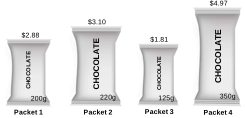
Which packet costs the least per gram?
\(B\)
| \(\text{Packet 1}\) | \(=\dfrac{288}{200} = 1.44\ \text{c/g}\) |
| \(\text{Packet 2}\) | \(=\dfrac{310}{220} = 1.41\ \text{c/g}\) |
| \(\text{Packet 3}\) | \(=\dfrac{181}{125} = 1.45\ \text{c/g}\) |
| \(\text{Packet 4}\) | \(=\dfrac{497}{350} = 1.42\ \text{c/g}\) |
\(\therefore\ \text{Packet 2 costs the least per gram.}\)
\(\Rightarrow B\)
The top speed of an ostrich is 72 kilometres per hour.
What is this speed in metres per second? (2 marks)
\(20\ \text{m/s}\)
| \(72\ \text{km/h}\) | \(=72\ 000\ \text{m/h}\) |
| \(=\bigg(\dfrac{72\ 000}{60\times 60}\bigg)\ \text{m/s}\) | |
| \(=20\ \text{m/s}\) |
Jesse sells, an average of 150 roller-coaster tickets every 10 minutes. How long will it take him sell 600 tickets? (2 marks)
--- 4 WORK AREA LINES (style=lined) ---
\(40\ \text{minutes}\)
| \(10\ \text{minutes}/150\ \text{tickets}\) | \(=\dfrac{10}{150}\ \text{minutes}/\dfrac{150}{150}\ \text{tickets}\) |
| \(=\dfrac{1}{15}\ \text{minute}/1\ \text{ticket}\) | |
| \(=\bigg(\dfrac{1}{15}\times 600\bigg)\ \text{minutes}/600\ \text{tickets}\) | |
| \(=40\ \text{minutes}/600\ \text{tickets}\) |
\(\therefore\ \text{It would take}\ 40\ \text{minutes to sell}\ 600\ \text{tickets.}\)
The top speed of a peregrine falcon is 360 km/hr.
What is this top speed in metres per second? (2 marks)
\(100\ \text{m/sec}\)
| \(\text{Speed}\) | \(=360\ \text{km/hour}\) |
| \(=360\ 000\ \text{m/hour}\) | |
| \(=\bigg(\dfrac{360\ 000}{60\times 60}\bigg)\ \text{m/sec}\) | |
| \(=100\ \text{m/sec}\) |
The cruising speed of a kangaroo is 720 metres per minute.
What is this speed in metres per second? (2 marks)
\(12\ \text{m/sec}\)
| \(\text{Speed}\) | \(=\bigg(\dfrac{720}{60}\bigg)\ \text{m/sec}\) |
| \(=12\ \text{m/sec}\) |
Convert 16 metres per second into kilometres per hour. (2 marks)
\(57.6\ \text{km/hour}\)
| \(16\ \text{m/second}\) | \(=(16\times 60\times 60)\ \text{m/hour}\) |
| \(=57\ 600\ \text{m/hour}\) | |
| \(=57.6\ \text{km/hour}\) |
Convert $648 per hour into cents per second. (2 marks)
\(18\ \text{cents/second}\)
| \($648\text{/hour}\) | \(=\bigg(\dfrac{64\ 800}{60\times 60}\bigg)\ \text{cents/second}\) |
| \(=18\ \text{cents/second}\) |
Convert 15 grams per day into kilograms per week. (2 marks)
\(0.105\ \text{kg/}\text{week}\)
| \(15\ \text{g/day}\) | \(=15\times 7\ \text{g/week}\) |
| \(=105\ \text{g/}\text{week}\) | |
| \(=0.105\ \text{kg/}\text{week}\) |
Convert 4 litres per minute into litres per hour. (2 marks)
\(240\ \text{L/}\text{hour}\)
| \(4\ \text{L/minute}\) | \(=4\times 60\ \text{L/}60\ \text{minutes}\) |
| \(=240\ \text{L/}\text{hour}\) |
Convert $30 per hour into cents per minute. (2 marks)
\(50\ \text{cents/}\text{minute}\)
| \($30\text{/hour}\) | \(=3000\ \text{cents/}60\ \text{minutes}\) |
| \(= \dfrac{3000}{60}\ \text{cents/}\dfrac{60}{60}\ \text{minutes}\) | |
| \(=50\ \text{cents/}\text{minute}\) |
Zach is saving money every year. The graph shows how much money is in his bank account at the end of each year.
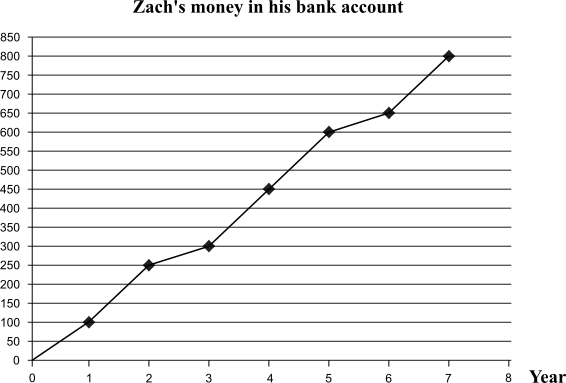
What was Zach's average amount of money saved per year during the first 5 years? (2 marks)
\($120\text{/year}\)
| \(\text{Average saved per year}\) | \(=\dfrac{\text{Money at Y5}}{\text{time}}\) |
| \(= \dfrac{600}{5}\) | |
| \(= $120\text{/year}\) |
Peter went on a 150 kilometre drive to the lake. The graph below shows the distance driven, in kilometres, and the time, in hours, taken for the trip.
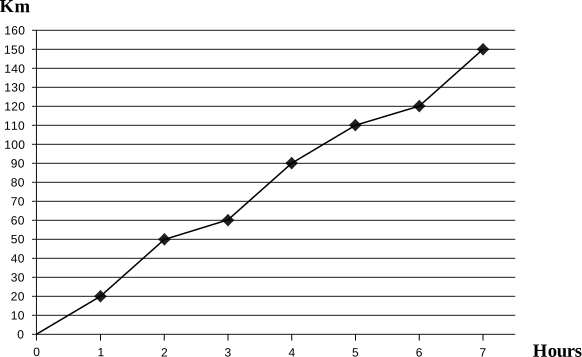
What was the average speed of Peter's car during the first 6 hours? (2 marks)
\(20\ \text{km/h}\)
| \(\text{Average speed for first 6 hrs}\) | \(=\dfrac{\text{Distance at 6 hours}}{\text{time}}\) |
| \(= \dfrac{120}{6}\) | |
| \(= 20\ \text{km/h}\) |
Barry lives 30 kilometres from the library.
On Tuesday, he drove to the library and averaged 90 kilometres per hour.
On Thursday, he took the train which averaged 30 kilometres per hour.
What was the extra time of the train journey, in minutes, compared to when he drove on Tuesday?
\(C\)
| \(\text{Time Driving}\) | \(=\dfrac{\text{Distance}}{\text{Speed}}\) |
| \(= \dfrac{30}{90}\) | |
| \(= \dfrac{1}{3}\ \text{hour}\) | |
| \(=20\ \text{minutes}\) |
| \(\text{Train Time}\) | \(=\dfrac{30}{30}\) |
| \(= 1\ \text{hour}\) | |
| \(= 60\ \text{minutes}\) |
\(\therefore\ \text{The extra time taking the train}\)
\(=60-20\)
\(= 40\ \text{minutes}\)
\(\Rightarrow C\)