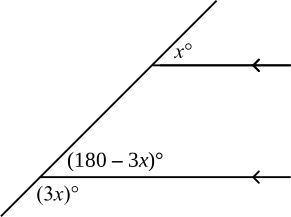
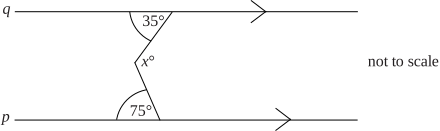
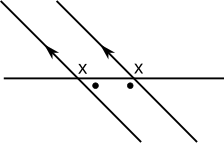
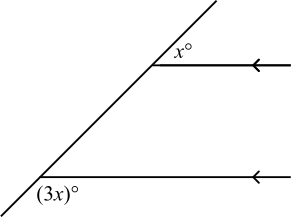
Find the value of \(x^{\circ}\) in the diagram, giving reasons for your answer. (2 marks)
--- 4 WORK AREA LINES (style=lined) ---
Aussie Maths & Science Teachers: Save your time with SmarterEd
Find the value of \(x^{\circ}\) in the diagram, giving reasons for your answer. (2 marks)
--- 4 WORK AREA LINES (style=lined) ---
\(45°\)
\(\text{Angle above}\ \angle (3x)^{\circ} = (180-3x)^{\circ}\ \ \text{(180° in a straight line)}\)
| \(180-3x\) | \(=x\ \ \text{(corresponding angles)} \) | |
| \(4x\) | \(=180\) | |
| \(x^{\circ}\) | \(=\dfrac{180}{4}\) | |
| \(=45^{\circ}\) |
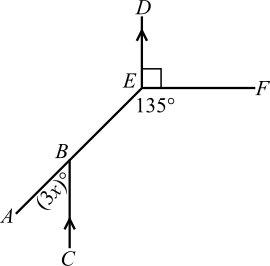
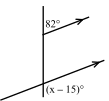
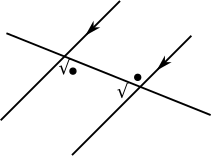
Find the value of \(x^{\circ}\) in the diagram, giving reasons for your answer. (3 marks)
--- 6 WORK AREA LINES (style=lined) ---
\(15°\)
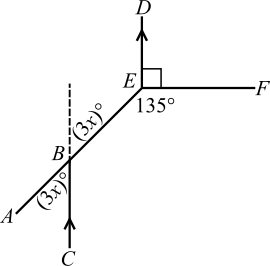
\(\text{Extend the parallel line on the left:}\)
\(\text{Angle opposite}\ \angle ABC = 3x^{\circ}\ \ \text{(vertically opposite)}\)
\(\angle DEB = 360-(90+135) = 135^{\circ}\ \ \text{(360° about a point)} \)
| \(3x+135\) | \(=180\ \ \text{(cointerior angles)} \) | |
| \(3x\) | \(=180-135\) | |
| \(x^{\circ}\) | \(=\dfrac{45}{3}\) | |
| \(=15^{\circ}\) |
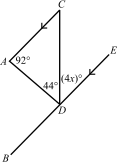
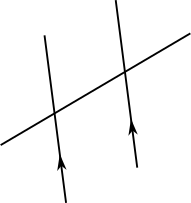
Find the value of \(x^{\circ}\) in the diagram, giving reasons for your answer. (2 marks)
\(11°\)
\(\angle ADE + \angle DAC = 180^{\circ}\ \ \text{(cointerior angles)}\)
\(\angle ADE = 180-92=88^{\circ}\)
| \(44+4x\) | \(=88\) | |
| \(4x\) | \(=44\) | |
| \(x^{\circ}\) | \(=\dfrac{44}{4} \) | |
| \(=11^{\circ}\) |
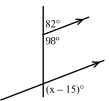
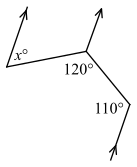
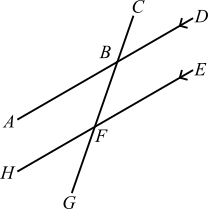
Find the value of \(x^{\circ}\) in the diagram, giving reasons for your answer. (3 marks)
\(50°\)
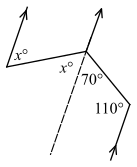
\(\text{Extend the middle parallel line:}\)
\(\text{Alternate angles are equal}\ (x^{\circ}) \).
\(\text{Cointerior angles sum to 180° (110° and 70°)}\)
\(x^{\circ} = 120-70=50^{\circ} \)
An Aussie Rules football team has booked half of the SCG for a training session. The field available to them under this booking covers 8257 square metres.
Assuming the SCG is perfectly round, determine its diameter, giving your answer in metres to 1 decimal place. (2 marks)
--- 4 WORK AREA LINES (style=lined) ---
\(145.0\ \text{m}\)
\(\text{Area of full SCG}\ =2 \times 8257 = 16\ 514 \ \text{m}^{2}\)
| \(A\) | \(=\pi r^{2} \) |
| \(16\ 514\) | \(= \pi r^2\) |
| \(r^{2}\) | \(=\dfrac{16\ 514}{\pi} \) |
| \(r\) | \(=\sqrt{5256.569…}\) |
| \(=72.5022…\ \text{m} \) |
\(\therefore\ \text{Diameter}\ = 2 \times 72.502 = 145.0\ \text{m (1 d.p.)} \)
The semi-circle, pictured below, has an area of 32 square centimetres.
Calculate the diameter of the semi-circle, giving your answer to 2 decimal places. (2 marks)
--- 4 WORK AREA LINES (style=lined) ---
\(9.03\ \text{cm}\)
\(\text{Area of full circle}\ =2 \times 32 = 64 \ \text{cm}^{2}\)
| \(A\) | \(=\pi r^{2} \) |
| \(64\) | \(= \pi r^2\) |
| \(r^{2}\) | \(=\dfrac{64}{\pi} \) |
| \(r\) | \(=\sqrt{20.3718…}\) |
| \(=4.5135…\ \text{cm} \) |
\(\therefore\ \text{Diameter}\ = 2 \times 4.513 = 9.03\ \text{cm (2 d.p.)} \)
A semi-circle has an area of 470 square centimetres.
Calculate the diameter of the semi-circle, giving your answer to 1 decimal place. (2 marks)
--- 4 WORK AREA LINES (style=lined) ---
\(34.6\ \text{cm}\)
\(\text{Area of full circle}\ =2 \times 470 = 940\ \text{cm}^{2}\)
| \(A\) | \(=\pi r^{2} \) |
| \(940\) | \(= \pi r^2\) |
| \(r^{2}\) | \(= \dfrac{940}{\pi} \) |
| \(r\) | \(=\sqrt{299.211…}\) |
| \(=17.30\ \text{cm}\) |
\(\therefore\ \text{Diameter}\ = 2 \times 17.30 = 34.6\ \text{cm (1 d.p.)}\)
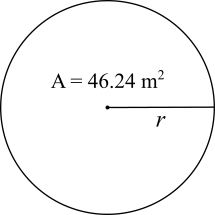
The cross-section of the circular road tunnel, pictured below, has an area of \(46.24\pi \) square metres.
Calculate the radius of the tunnel. (2 marks)
--- 4 WORK AREA LINES (style=lined) ---
\(6.8\ \text{m}\)
| \(A\) | \(=\pi r^{2} \) |
| \(46.24 \pi\) | \(= \pi r^2\) |
| \(r^{2}\) | \(=46.24\) |
| \(r\) | \(=\sqrt{46.24}\) |
| \(=6.8\ \text{m}\) |
The entrance to a tunnel, pictured below, is a semi-circle with an area of \(28.88\pi \) square metres.
Calculate the diameter of the tunnel. (2 marks)
--- 4 WORK AREA LINES (style=lined) ---
\(7.6\ \text{m}\)
\(\text{Area of full circle}\ =2 \times 28.88\pi = 57.76\pi \ \text{m}^{2}\)
| \(A\) | \(=\pi r^{2} \) |
| \(57.76 \pi\) | \(= \pi r^2\) |
| \(r^{2}\) | \(=57.76\) |
| \(r\) | \(=\sqrt{57.76}\) |
| \(=7.6\ \text{m}\) |
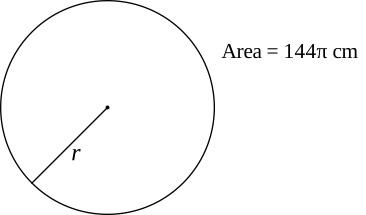
The circle pictured below has an area of \(144\pi \) square centimetres.
Calculate the radius of the circle. (2 marks)
--- 4 WORK AREA LINES (style=lined) ---
\(12\ \text{cm}\)
| \(A\) | \(=\pi r^{2} \) |
| \(144 \pi\) | \(= \pi r^2\) |
| \(r^{2}\) | \(=144\) |
| \(r\) | \(=\sqrt{144}\) |
| \(=12\ \text{cm}\) |
A circular cricket ground has an area of 11 028 square metres.
Determine the radius of the cricket ground, in metres, giving your answer to 1 decimal place. (2 marks)
--- 4 WORK AREA LINES (style=lined) ---
\(59.2\ \text{m}\)
| \(A\) | \(=\pi r^{2} \) |
| \(11\ 028\) | \(= \pi r^2\) |
| \(r^{2}\) | \(=\dfrac{11\ 028}{\pi}\) |
| \(r\) | \(=\sqrt{3510.321…}\) |
| \(=59.247…\) | |
| \(=59.2\ \text{m (1 d.p.)}\) |
If a circle has an area of 100 square millimetres, find the radius of the circle, giving your answer to 2 decimal places. (2 marks)
--- 4 WORK AREA LINES (style=lined) ---
\(5.64\ \text{mm}\)
| \(A\) | \(=\pi r^{2} \) |
| \(100\) | \(= \pi r^2\) |
| \(r^{2}\) | \(=\dfrac{100}{\pi}\) |
| \(r\) | \(=\sqrt{31.8309}\) |
| \(=5.641…\) | |
| \(=5.64\ \text{mm (2 d.p.)}\) |
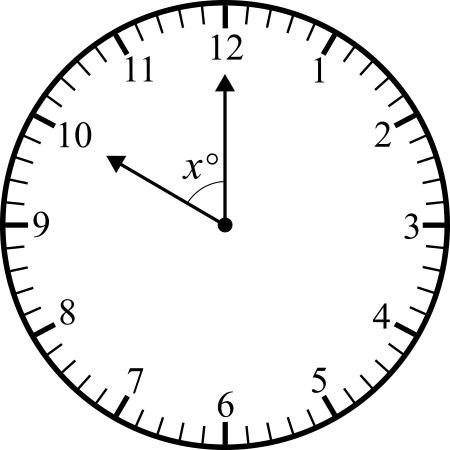
A clock displayed the time ten o'clock, as shown on the diagram below.
The angle, `x^{\circ}`, between the small hand and the large hand is
`D`
`text{There are 360° about a point.}`
`x^{\circ}=2/12 xx 360 = 60^{\circ}`
`=> D`
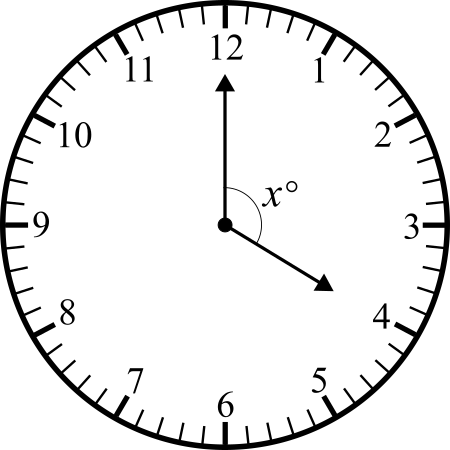
A clock displayed the time four o'clock, as shown on the diagram below.
Calculate the angle, `x^{\circ}`, between the small hand and the large hand. (2 marks)
--- 3 WORK AREA LINES (style=lined) ---
`120^{\circ}`
`text{There are 360° about a point.}`
`x^{\circ}=1/3 xx 360 = 120^{\circ}`
How many degrees does the minute hand of a clock turn in 35 minutes? (2 marks)
--- 4 WORK AREA LINES (style=lined) ---
`210°`
`text(A clock’s minute hand turns 360° in 60 minutes.)`
`:.\ text(In 35 minutes, it turns through:)`
`35/60 xx 360 = 210^@`
How many degrees does the hour hand of a clock turn in 60 minutes? (2 marks)
--- 4 WORK AREA LINES (style=lined) ---
`30°`
`text(A clock’s hour hand turns 360° in 12 hours.)`
`:.\ text(In 1 hour, it turns)`
`1/12 xx 360 = 30^@`
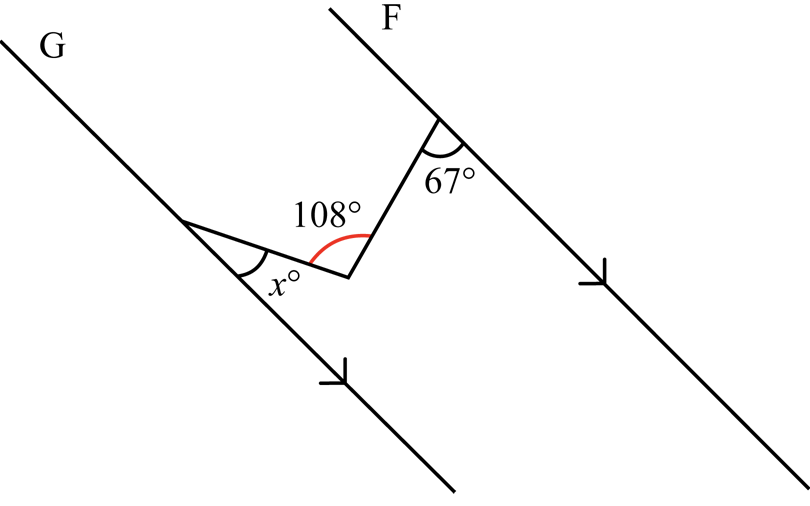
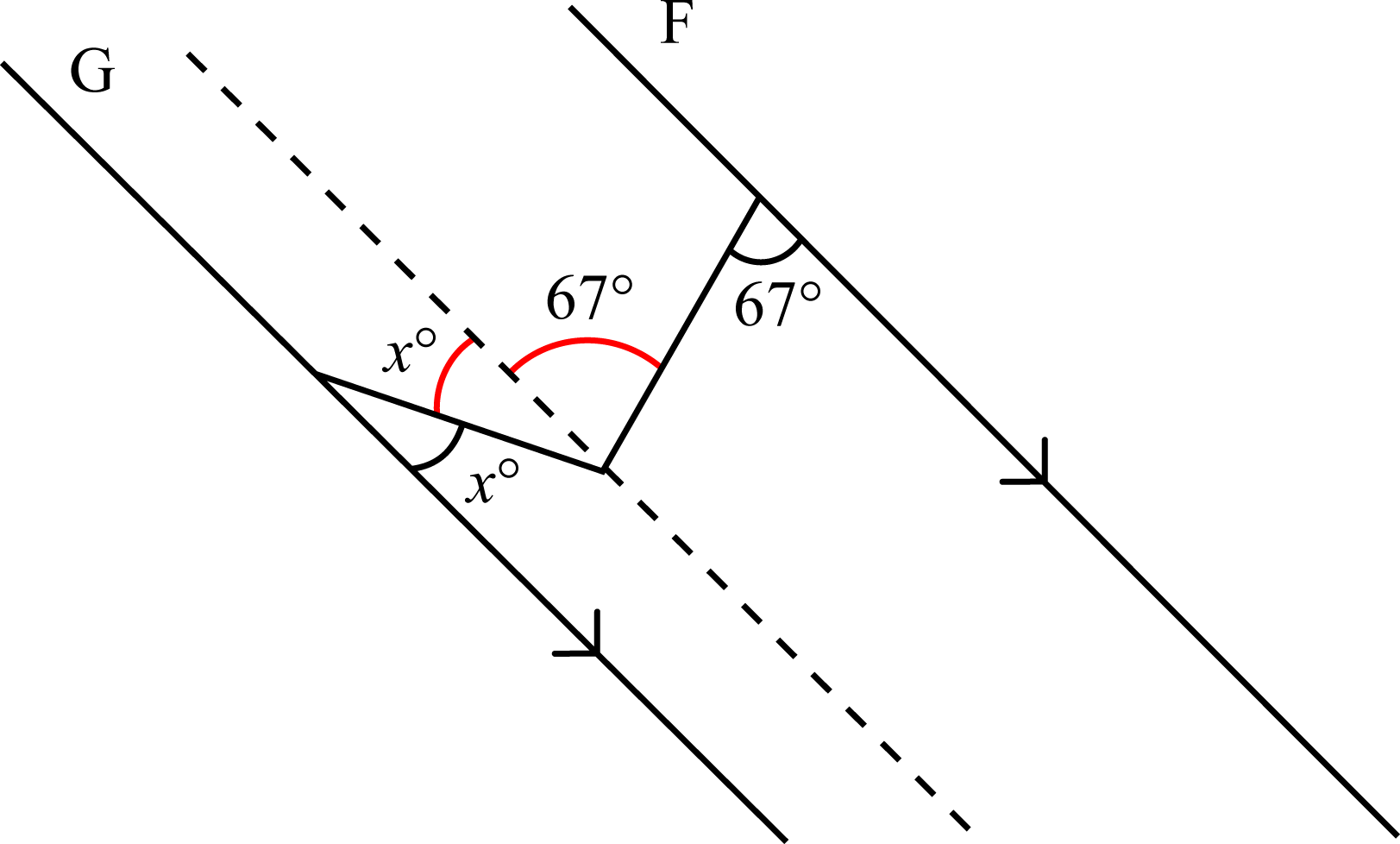
In the figure below, the lines `G` and `F` are parallel.

Determine the value of `x^@`. (3 marks)
--- 5 WORK AREA LINES (style=lined) ---
`41°`

| `x^@` | `= 108-67` |
| `= 41^@` |
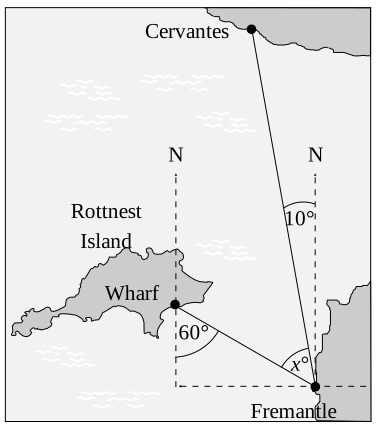
Two boats leave from Fremantle. One sails to the Wharf at Rottnest Island and the other sails to Cervantes.
The direction each boat sailed is shown in the map below.
Determine the value of `x°` on the map. (2 marks)
--- 6 WORK AREA LINES (style=lined) ---
`50°`
Brianna plotted the points `A-F` on a grid paper, as shown below.
She then joined some of the points together with lines.
Which of these pairs of lines are parallel?
`C`
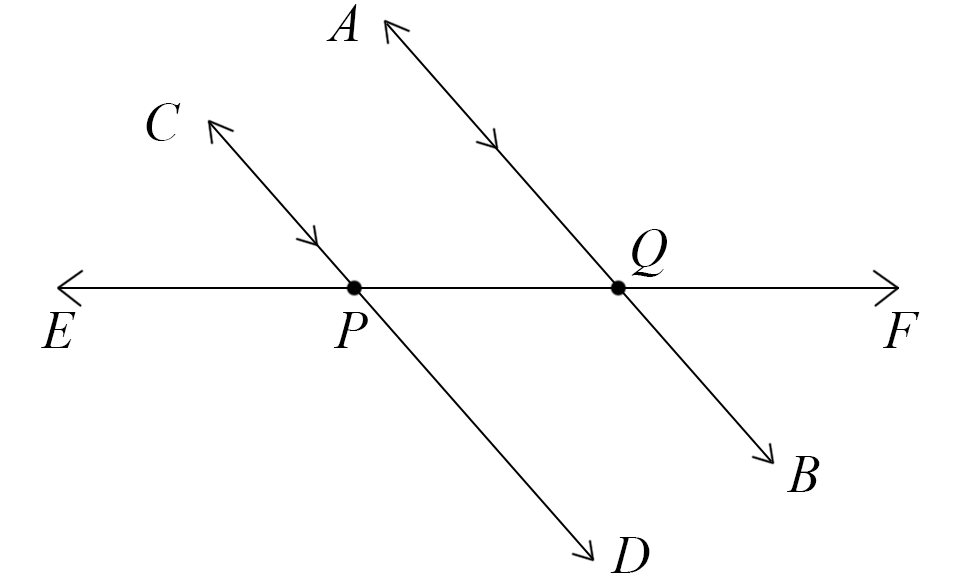
The diagram below shows a transversal intersecting two parallel lines.
On the diagram, label the following:
--- 0 WORK AREA LINES (style=lined) ---
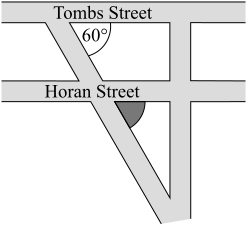
Craig is a town planner and needs to know the angles that streets make with each other.
He knows that Tombs Street and Horan Street are parallel.
What is the size of the shaded angle on the map?
`A`
`text(Corresponding angles are equal.)`
`:.\ text(Shaded angle) = 60°`
`=>A`
The diagram below shows a transversal intersecting two parallel lines.
On the diagram, identify
--- 0 WORK AREA LINES (style=lined) ---
i. & ii.
\(\text{One solution (of many possibilities):}\)
i. & ii.
\(\text{One solution (of many possibilities):}\)
The diagram below shows a transversal intersecting two parallel lines.
On the diagram, label the following:
--- 0 WORK AREA LINES (style=lined) ---
i. & ii.
\(\text{One solution (of many possibilities):}\)
i. & ii.
\(\text{One solution (of many possibilities):}\)
The diagram below shows a transversal intersecting two parallel lines.
On the diagram, identify
--- 0 WORK AREA LINES (style=lined) ---
i. & ii.
\(\text{One solution (of many possibilities):}\)
i. & ii.
\(\text{One solution (of many possibilities):}\)
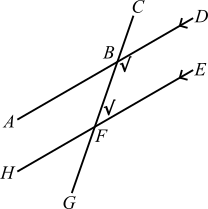
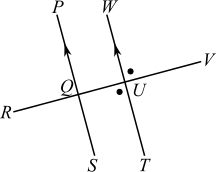
The diagram below shows two parallel lines intersected by transversal \(RV\).
--- 1 WORK AREA LINES (style=lined) ---
i. \(\angle WUV\)
ii. \(\angle WUV\)
The diagram below shows two parallel lines intersected by transversal \(RV\).
--- 1 WORK AREA LINES (style=lined) ---
i. \(\angle SQU\)
ii. \(\angle TUR\)
iii. \(\angle SQU\)
The diagram below shows two parallel lines intersected by transversal \(CG\).
--- 1 WORK AREA LINES (style=lined) ---
i. \(\angle DBF\)
ii. \(\angle EFB\)
Determine, giving reasons, if the two lines cut by the transversal in the diagram below are parallel. (2 marks)
--- 4 WORK AREA LINES (style=lined) ---
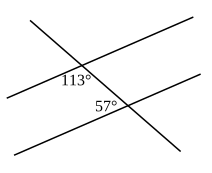
Determine, giving reasons, if the two lines cut by the transversal in the diagram below are parallel. (1 mark)
--- 2 WORK AREA LINES (style=lined) ---
\(\text{Cointerior angles sum to 180°, and} \)
\(113 + 57 = 170^{\circ} \neq 180^{\circ}\)
\(\therefore\ \text{Lines are not parallel.}\)
\(\text{Cointerior angles sum to 180°, and} \)
\(113 + 57 = 170^{\circ} \neq 180^{\circ}\)
\(\therefore\ \text{Lines are not parallel.}\)
The diagram below shows two parallel lines cut by a transversal.
Find the value of \(x^{\circ}\), giving reasons. (1 mark)
--- 2 WORK AREA LINES (style=lined) ---
\(x=72^{\circ}\ \ \text{(corresponding angles)}\)
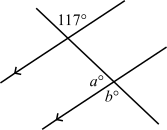
The diagram below shows two parallel lines cut by a transversal.
Find the value of \(a^{\circ}\) and \(b^{\circ}\), giving reasons. (2 marks)
--- 4 WORK AREA LINES (style=lined) ---
\(\text{One strategy:}\)
\(\text{Vertically opposite angles are equal (117°)}\).
\(a^{\circ} = 180-117=63^{\circ}\ \ \text{(cointerior angles)}\)
\(b^{\circ}=180-63=117^{\circ}\ \ \text{(180° in straight line)}\)
\(\text{One strategy:}\)
\(\text{Vertically opposite angles are equal (117°)}\).
\(a^{\circ} = 180-117=63^{\circ}\ \ \text{(cointerior angles)}\)
\(b^{\circ}=180-63=117^{\circ}\ \ \text{(180° in straight line)}\)
Find the value of \(x^{\circ}\), giving reasons. (1 mark)
--- 2 WORK AREA LINES (style=lined) ---
\(x^{\circ} = 35^{\circ}\ \ \text{(alternate angles)}\)
A trapezium is pictured below.
Find the value of \(x^{\circ}\), giving reasons. (2 marks)
--- 3 WORK AREA LINES (style=lined) ---
\(\text{A trapezium has one pair of parallel sides.}\)
\(x^{\circ} = 180-115 = 65^{\circ}\ \ \text{(cointerior angles)}\)
\(\text{A trapezium has one pair of parallel sides.}\)
\(x^{\circ} = 180-115 = 65^{\circ}\ \ \text{(cointerior angles)}\)
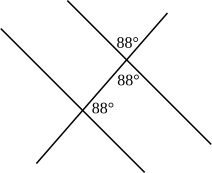
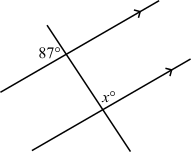
Find the value of \(x^{\circ}\), giving reasons. (2 marks)
--- 3 WORK AREA LINES (style=lined) ---
\(\text{Vertically opposite angles}\ = 87^{\circ} \).
\(x^{\circ} = 180-87=93^{\circ}\ \ \text{(cointerior angles)}\)
\(\text{Vertically opposite angles}\ = 87^{\circ} \).
\(x^{\circ} = 180-87=93^{\circ}\ \ \text{(cointerior angles)}\)
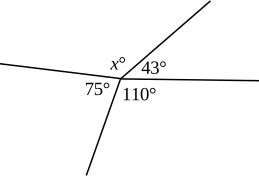
Calculate the value of \(x^{\circ}\), giving reasons for your answer. (2 marks)
--- 4 WORK AREA LINES (style=lined) ---
\(\text{Sum of angles about a point = 360}^{\circ} \)
\(x^{\circ} =132^{\circ}\ \)
\(\text{Sum of angles about a point = 360}^{\circ} \)
| \(x^{\circ}\) | \(=360-(75+110+43) \) | |
| \(=132^{\circ}\) |
Calculate the value of \(x^{\circ}\), giving reasons for your answer. (2 marks)
--- 4 WORK AREA LINES (style=lined) ---
\(\text{Sum of angles about a point = 360}^{\circ} \)
\(x^{\circ} =75^{\circ}\ \)
\(\text{Sum of angles about a point = 360}^{\circ} \)
| \(x^{\circ}\) | \(=360-(70+90+125) \) | |
| \(=75^{\circ}\) |
The diagram below shows a right angle.
Calculate, giving reasons, the value of \(x^{\circ}\). (1 mark)
--- 2 WORK AREA LINES (style=lined) ---
\(\text{Right angles = 90}^{\circ} \)
\(a^{\circ} =50^{\circ}\ \ \text{(complementary angles)}\)
\(\text{Right angles = 90}^{\circ} \)
| \(a+2+a-12\) | \(=90\ \text{(complementary angles)}\) | |
| \(2a-10\) | \(=90\) | |
| \(a^{\circ}\) | \(=\dfrac{100}{2}\) | |
| \(=50^{\circ}\) |
A straight line, as shown below, is split into two angles.
Calculate the value of both angles. (3 marks)
--- 5 WORK AREA LINES (style=lined) ---
\(\text{Straight lines have 180}^{\circ}\ \text{about a point.}\)
\(p^{\circ}=45^{\circ}, (3p)^{\circ} = 3 \times 45 = 135^{\circ}\)
\(\text{Straight lines have 180}^{\circ}\ \text{about a point.}\)
| \(3p+p\) | \(=180\ \ \text{(supplementary angles)}\) | |
| \(p^{\circ}\) | \(=\dfrac{180}{4}\) | |
| \(=45^{\circ}\) |
\(\therefore\ \text{Two angles:}\ p^{\circ}=45^{\circ}, (3p)^{\circ} = 3 \times 45 = 135^{\circ}\)
A straight line, as shown below, is split into two angles.
Calculate the value of \(x^{\circ}\), giving reasons. (2 marks)
--- 4 WORK AREA LINES (style=lined) ---
\(\text{Straight lines have 180}^{\circ}\ \text{about a point.}\)
\(x^{\circ}=89^{\circ}\)
\(\text{Straight lines have 180}^{\circ}\ \text{about a point.}\)
| \(x+16+x-14\) | \(=180\ \ \text{(supplementary angles)}\) | |
| \(2x+2\) | \(=180\) | |
| \(x^{\circ}\) | \(=\dfrac{178}{2}\) | |
| \(=89^{\circ}\) |
A straight line, as shown below, is split into three angles.
Calculate the value of \(a^{\circ}\), giving reasons. (2 marks)
--- 4 WORK AREA LINES (style=lined) ---
\(\text{Straight lines have 180}^{\circ}\ \text{about a point.}\)
\(a^{\circ} = 30^{\circ}\)
\(\text{Straight lines have 180}^{\circ}\ \text{about a point.}\)
| \(a+3a+2a\) | \(=180\ \ \text{(supplementary angles)}\) | |
| \(a^{\circ}\) | \(=\dfrac{180}{6}\) | |
| \(=30^{\circ}\) |
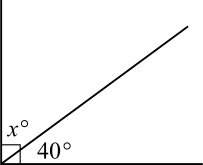
The diagram below shows a right angle.
Calculate, giving reasons, the value of \(x^{\circ}\). (1 mark)
--- 2 WORK AREA LINES (style=lined) ---
\(\text{Right angles = 90}^{\circ} \)
\(x^{\circ} = 90-40=50^{\circ}\ \ \text{(complementary angles)}\)
\(\text{Right angles = 90}^{\circ} \)
\(x^{\circ} = 90-40=50^{\circ}\ \ \text{(complementary angles)}\)
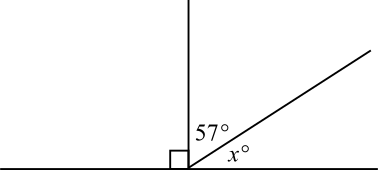
Calculate, giving reasons, the value of \(x^{\circ}\). (1 mark)
--- 2 WORK AREA LINES (style=lined) ---
\(\text{Straight line has adjacent right angles.}\)
\(x^{\circ} = 90-57=33^{\circ}\ \ \text{(complementary angles)}\)
\(\text{Straight line has adjacent right angles.}\)
\(x^{\circ} = 90-57=33^{\circ}\ \ \text{(complementary angles)}\)
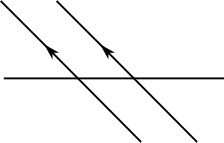
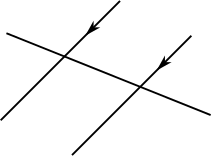
The diagram below has one pair of parallel lines.
Calculate, giving reasons, the value of \(x^{\circ}\). (2 marks)
--- 3 WORK AREA LINES (style=lined) ---
\(\text{Alternate angles are equal (see diagram).}\)
\(\text{Angles in a straight line sum to 180°:} \)
\(x^{\circ} = 180-30=150^{\circ}\)
\(\text{Alternate angles are equal (see diagram).}\)
\(\text{Angles in a straight line sum to 180°:} \)
\(x^{\circ} = 180-30=150^{\circ}\)
A rhombus has an area of 250 square centimetres. If one diagonal measures 10 centimetres, find the length of the other diagonal. (2 marks)
--- 4 WORK AREA LINES (style=lined) ---
\(50\ \text{cm}\)
\(\text{Area of rhombus}=250\ \text{cm}^2\)
\(\text{Length of diagonal:}\ x=10\ \text{m}\)
| \(A\) | \(=\dfrac{1}{2}xy\) |
| \(250\) | \(=\dfrac{1}{2}\times 10\times y\) |
| \(5y\) | \(=250\) |
| \(y\) | \(=\dfrac{250}{5}\) |
| \(=50\ \text{cm}\) |
\(\therefore\ \text{The other diagonal is }50\ \text{cm long.}\)
A rhombus has an area of 140.8 square metres. If one diagonal measures 16 metres, find the length of the other diagonal. (2 marks)
--- 4 WORK AREA LINES (style=lined) ---
\(17.6\ \text{m}\)
\(\text{Area of rhombus}=140.8\ \text{m}^2\)
\(\text{Length of diagonal:}\ x=16\ \text{m}\)
| \(A\) | \(=\dfrac{1}{2}xy\) |
| \(140.8\) | \(=\dfrac{1}{2}\times 16\times y\) |
| \(8y\) | \(=140.8\) |
| \(y\) | \(=\dfrac{140.8}{8}\) |
| \(=17.6\ \text{m}\) |
\(\therefore\ \text{The other diagonal is }17.6\ \text{m long.}\)
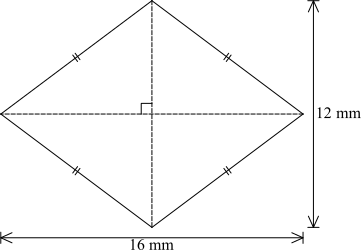
Calculate the area of the following rhombus in millimetres squared. (2 marks)
--- 4 WORK AREA LINES (style=lined) ---
\(96\ \text{mm}^2\)
\(\text{Length of diagonal 1:}\ x=16\ \text{mm}\)
\(\text{Length of diagonal 2:}\ y=12\ \text{mm}\)
| \(\text{Area of rhombus}\) | \(=\dfrac{1}{2}xy\) |
| \(=\dfrac{1}{2}\times 16\times 12\) | |
| \(=96\ \text{mm}^2\) |
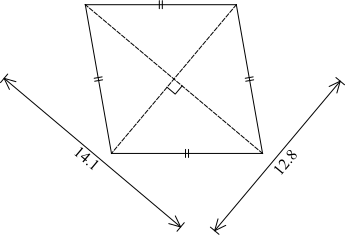
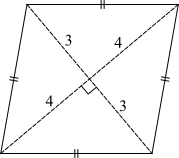
Calculate the area of the following rhombus. All measurements are in metres. (2 marks)
--- 4 WORK AREA LINES (style=lined) ---
\(90.24\ \text{m}^2\)
\(\text{Length of diagonal 1:}\ x=14.1\ \text{m}\)
\(\text{Length of diagonal 2:}\ y=12.8\ \text{m}\)
| \(\text{Area of rhombus}\) | \(=\dfrac{1}{2}xy\) |
| \(=\dfrac{1}{2}\times 14.1\times 12.8\) | |
| \(=90.24\ \text{m}^2\) |
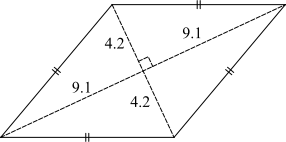
Calculate the area of the following rhombus. All measurements are in metres. (2 marks)
--- 4 WORK AREA LINES (style=lined) ---
\(76.44\ \text{m}^2\)
\(\text{Length of diagonal 1:}\ x=2\times 4.2=8.4\ \text{m}\)
\(\text{Length of diagonal 2:}\ y=2\times 9.1=18.2\ \text{m}\)
| \(\text{Area of rhombus}\) | \(=\dfrac{1}{2}xy\) |
| \(=\dfrac{1}{2}\times 8.4\times 18.2\) | |
| \(=76.44\ \text{m}^2\) |
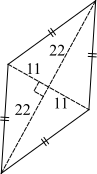
Calculate the area of the following rhombus. All measurements are in centimetres. (2 marks)
--- 4 WORK AREA LINES (style=lined) ---
\(484\ \text{cm}^2\)
\(\text{Length of diagonal 1:}\ x=2\times 11=22\ \text{cm}\)
\(\text{Length of diagonal 2:}\ y=2\times 22=44\ \text{cm}\)
| \(\text{Area of rhombus}\) | \(=\dfrac{1}{2}xy\) |
| \(=\dfrac{1}{2}\times 22\times 44\) | |
| \(=484\ \text{cm}^2\) |
Calculate the area of the following rhombus. All measurements are in millimetres. (2 marks)
--- 4 WORK AREA LINES (style=lined) ---
\(24\ \text{mm}^2\)
\(\text{Length of diagonal 1:}\ x=2\times 3=6\ \text{mm}\)
\(\text{Length of diagonal 2:}\ y=2\times 4=8\ \text{mm}\)
| \(\text{Area of rhombus}\) | \(=\dfrac{1}{2}xy\) |
| \(=\dfrac{1}{2}\times 6\times 8\) | |
| \(=24\ \text{mm}^2\) |
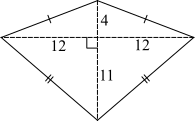
Calculate the area of the following kite. All measurements are in millimetres. (2 marks)
--- 4 WORK AREA LINES (style=lined) ---
\(180\ \text{mm}^2\)
\(\text{Length of diagonal 1:}\ x=4+11=15\ \text{mm}\)
\(\text{Length of diagonal 2:}\ y=2\times 12=24\ \text{mm}\)
| \(\text{Area of kite}\) | \(=\dfrac{1}{2}xy\) |
| \(=\dfrac{1}{2}\times 34\times 20\) | |
| \(=180\ \text{mm}^2\) |
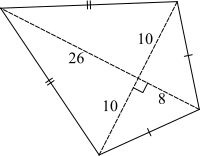
Calculate the area of the following kite. All measurements are in metres. (2 marks)
--- 4 WORK AREA LINES (style=lined) ---
\(340\ \text{m}^2\)
\(\text{Length of diagonal 1:}\ x=26+8=34\ \text{m}\)
\(\text{Length of diagonal 2:}\ y=2\times 10=20\ \text{m}\)
| \(\text{Area of kite}\) | \(=\dfrac{1}{2}xy\) |
| \(=\dfrac{1}{2}\times 34\times 20\) | |
| \(=340\ \text{m}^2\) |
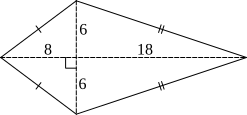
Calculate the area of the following kite. All measurements are in centimetres. (2 marks)
--- 4 WORK AREA LINES (style=lined) ---
\(156\ \text{cm}^2\)
\(\text{Length of diagonal 1:}\ x=8+18=26\ \text{cm}\)
\(\text{Length of diagonal 2:}\ y=2\times 6=12\ \text{cm}\)
| \(\text{Area of kite}\) | \(=\dfrac{1}{2}xy\) |
| \(=\dfrac{1}{2}\times 26\times 12\) | |
| \(=156\ \text{cm}^2\) |
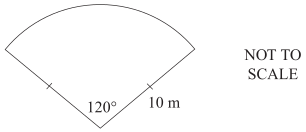
The diagram shows a sector with an angle of 120° cut from a circle with radius 10 m.
What is the area of the sector? Write your answer correct to 1 decimal place. (2 marks)
NOTE: \(\text{Sector area}=\dfrac{\theta}{360}\times \pi r^2\)
--- 4 WORK AREA LINES (style=lined) ---
\(104.7\ \text{m}^2\ (1\text{ d.p.})\)
| \(\text{Sector area}\) | \(=\dfrac{\theta}{360}\times \pi r^2\) |
| \(=\dfrac{120}{360}\times \pi\times 10^2\) | |
| \(=104.719\dots\) | |
| \(\approx 104.7\ \text{m}^2\ (1\text{ d.p.})\) |