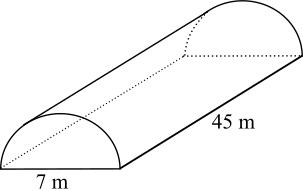
Calculate the surface area of the half-cylinder below (including the base), giving your answer correct to two decimal places. (3 marks)
--- 5 WORK AREA LINES (style=lined) ---
Aussie Maths & Science Teachers: Save your time with SmarterEd
Calculate the surface area of the half-cylinder below (including the base), giving your answer correct to two decimal places. (3 marks)
--- 5 WORK AREA LINES (style=lined) ---
Calculate the surface area of the cylinder below, giving your answer correct to two decimal places. (2 marks)
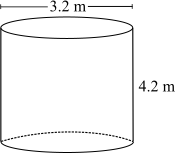
--- 5 WORK AREA LINES (style=lined) ---
The surface area of a brick is given by the rule:
total surface area = 2 × [(width × height) + (width × length) + (height × length)]
The brick shown has a total surface area of 982 square centimetres.
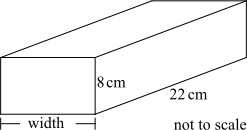
What is the width of the brick? (2 marks)
--- 5 WORK AREA LINES (style=lined) ---
A target is drawn as follows

What is the area of the entire target?
Round your answer to the nearest square centimetre. (2 marks)
--- 4 WORK AREA LINES (style=lined) ---
The plan of a square area of land is drawn below.
A mining licence is granted over part of the land.
All measurements are given in kilometres.
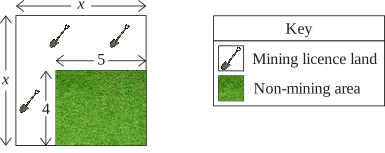
The area of land the mining licence covers is
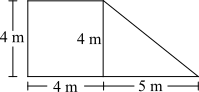
Kate owns a farm with a square paddock. She increases the area of the paddock by changing it into the shape of trapezium.
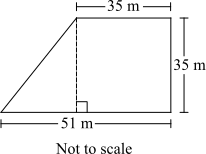
What is the area of the new paddock, in square metres? (2 marks)
--- 4 WORK AREA LINES (style=lined) ---
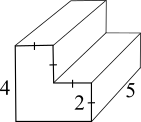
Clancy needs to paint all sides of a triangular prism.
The area of each triangular face is 12 cm².
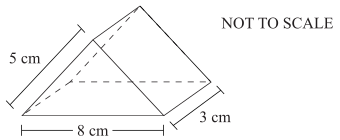
What is the total area Clancy needs to paint? (2 marks)
--- 4 WORK AREA LINES (style=lined) ---
An irregular shaped lawn is pictured below, with all measurements in metres.
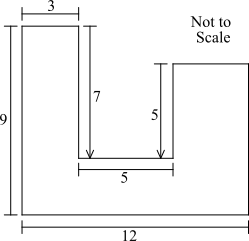
What is the area of the lawn in square metres? (3 marks)
--- 6 WORK AREA LINES (style=lined) ---
`text(Split the lawn into 3 areas)`
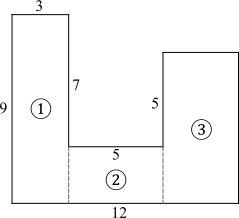
`text(Area 1) = 9 xx 3 = 27\ text(m²)`
`text(Area 2) = 5 xx 2 = 10\ text(m²)`
`text(Area 3:)`
`text(Height) = 5+2 = 7\ text(m)`
`text(Width)= 12-(5 + 3)= 4\ text(m)`
`=> text(Area 3) = 7 xx 4 = 28\ text(m²)`
| `:.\ text(Area of lawn)` | `= 27 + 10 + 28` |
| `= 65\ text(m²)` |
A plan of Zev's backyard is shown.
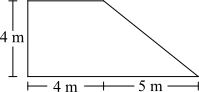
Zev wants to fertilise the lawn in his backyard and needs to know the total area.
What is the total area of Zev's lawn, in square metres? (2 marks)
--- 4 WORK AREA LINES (style=lined) ---
Harry has an irregularly shaped back yard.
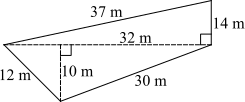
What is the area of Harry's back yard?
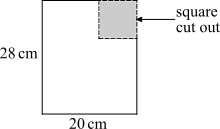
Pablo cuts a square out of a rectangular piece of paper, as shown below.
The square Pablo cut out has a side length of 6 cm.
Which of these expressions gives the area of Pablo's piece of paper after cutting out the square?
A trapezium is constructed on a grid of 10 rectangles.
Each rectangle measures 3 cm × 7 cm.
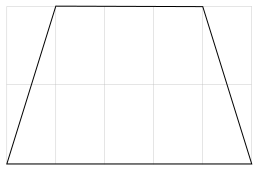
Find the area of the trapezium? (2 marks)
--- 5 WORK AREA LINES (style=lined) ---
Olive drew this plan of her lawn.
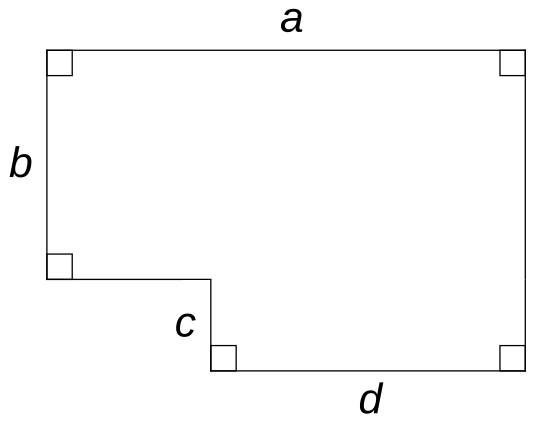
Which expression gives the area of Olive's lawn?
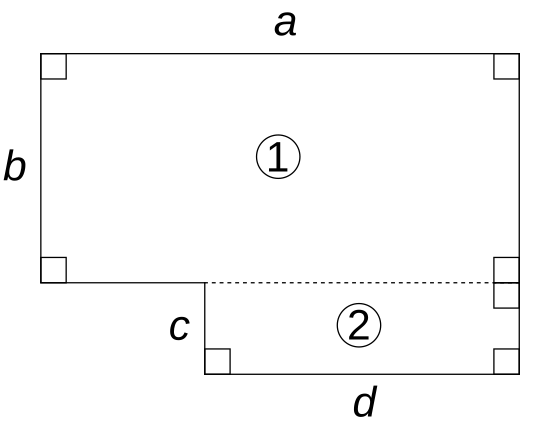
| `text(Total Area)` | `= text(Area 1) + text(Area 2)` |
| `= (a xx b) + (c xx d)` |
`=> A`
A triangular prism has the following dimensions (all measurements are in metres).
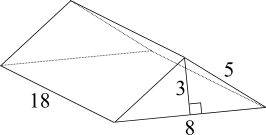
--- 5 WORK AREA LINES (style=lined) ---
--- 4 WORK AREA LINES (style=lined) ---
i.
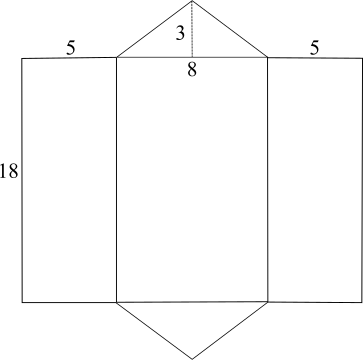
ii. \(348\ \text{m}^2\)
i.
| ii. \(\text{S.A.}\) | \(=2 \times (5 \times 18) + (8 \times 18) + 2 \times (\dfrac{1}{2} \times 8 \times 3) \) | |
| \(= 2(90) + 144 + 2(12) \) | ||
| \(=348\ \text{m}^2\) |
A triangular prism has the following dimensions (all measurements are in centimetres).
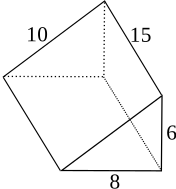
--- 5 WORK AREA LINES (style=lined) ---
--- 4 WORK AREA LINES (style=lined) ---
i.
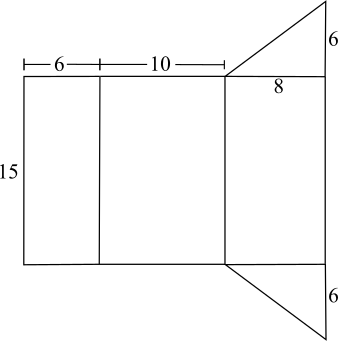
ii. \(408\ \text{cm}^2\)
i.
| ii. \(\text{S.A.}\) | \(=(15 \times 6) + (15 \times 10) + (15 \times 8) + 2 \times (\dfrac{1}{2} \times 8 \times 6) \) | |
| \(=90+150+120+2(24) \) | ||
| \(=408\ \text{cm}^2\) |
Find the surface area of the rectangular prism pictured below, correct to 1 decimal place. All measurements are in metres. (2 marks)
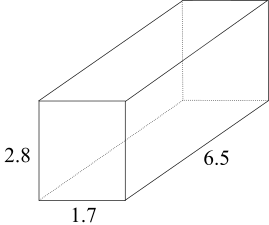
--- 4 WORK AREA LINES (style=lined) ---
Find the surface area of the rectangular prism pictured below. All measurements are in metres. (2 marks)
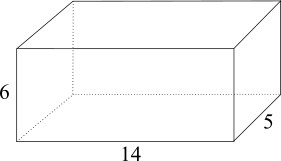
--- 4 WORK AREA LINES (style=lined) ---
The diagram shows the shape of Carmel’s garden bed. All measurements are in metres.
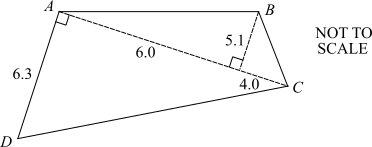
Show that the area of the garden bed is 57 square metres. (2 marks)
--- 4 WORK AREA LINES (style=lined) ---
Find the area of the shaded part in the diagram below, giving your answer in square metres to 1 decimal place. (3 marks)
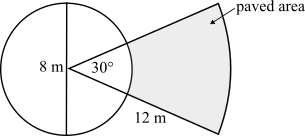
--- 6 WORK AREA LINES (style=lined) ---
Four identical circles of radius `r` are drawn inside a square, as shown in the diagram below
The region enclosed by the circles has been shaded in the diagram.
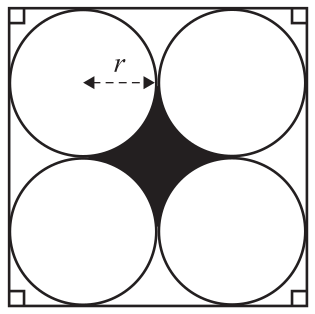
The shaded area can be found using
A child's toy has the following design.
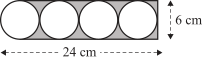
Find the area of the shaded region to the nearest square centimetre. (3 marks)
--- 4 WORK AREA LINES (style=lined) ---
A path 1.5 metres wide surrounds a circular lawn of radius 3 metres.
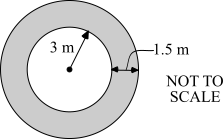
Find the area of the path, correct to the nearest square metre. (2 marks)
--- 5 WORK AREA LINES (style=lined) ---
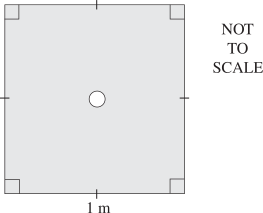
The diagram shows the floor of a shower. The drain in the floor is a circle with a diameter of 10 cm.
Find the area of the shower floor, excluding the drain, to the nearest square centimetre. (3 marks)
The shaded region shows a quadrant with a rectangle removed.
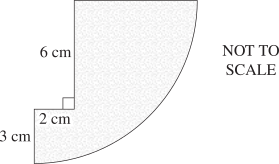
Find the area of the shaded region, to the nearest cm2. (2 marks)
--- 5 WORK AREA LINES (style=lined) ---
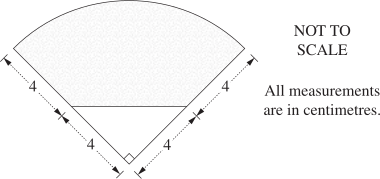
What is the area of the shaded part of this quadrant, to the nearest square centimetre? (3 marks)
If `tan theta = 80`, what is the value of `theta`, correct to 2 decimal places?
In which triangle is `sin theta = 4/7`?
| A. | 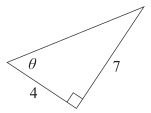 |
B. | 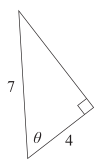 |
| C. | 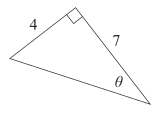 |
D. | 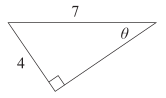 |
`=>D`
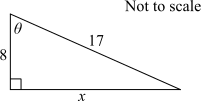
--- 3 WORK AREA LINES (style=lined) ---
--- 3 WORK AREA LINES (style=lined) ---
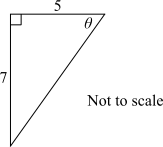
Find the value of `theta`, correct to the nearest minute. (2 marks)
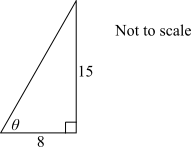
Find the value of `theta`, correct to the nearest minute. (2 marks)
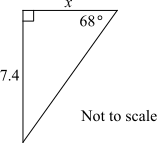
Find the value of `x`, correct to 1 decimal place. (2 marks)
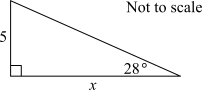
Find the value of `x`, correct to 2 decimal places. (2 marks)
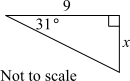
Find the value of `x`, correct to 2 decimal places. (2 marks)
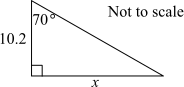
Find the value of `x`, correct to 1 decimal place. (2 marks)
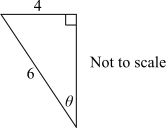
Express `tan theta` as a fraction in its simplest form. (3 marks)
--- 6 WORK AREA LINES (style=lined) ---
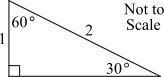
Using Pythagoras and showing your working, express `tan 30^{@}` as a fraction. (2 marks)
--- 4 WORK AREA LINES (style=lined) ---
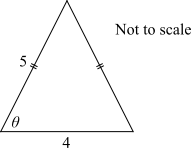
Find the value of `theta`, correct to the nearest minute. (3 marks)
--- 5 WORK AREA LINES (style=lined) ---
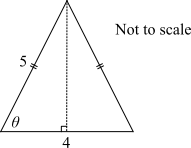
| `cos theta` | `=2/5` | |
| `theta` | `=cos^{-1}(2/5)` | |
| `=66.421…^@` | ||
| `=66^@ 25^{′} text{(to 1 d.p.)}` |
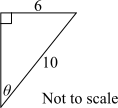
--- 4 WORK AREA LINES (style=lined) ---
--- 2 WORK AREA LINES (style=lined) ---
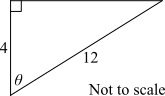
Find the value of `theta`, correct to the nearest minute. (2 marks)
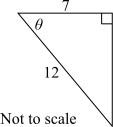
Find the value of `theta`, correct to the nearest minute. (2 marks)
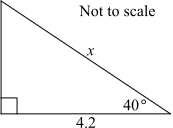
Find the value of `x`, correct to 1 decimal place. (2 marks)
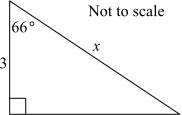
Find the value of `x`, correct to 2 decimal places. (2 marks)
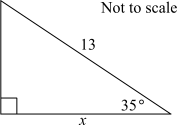
Find the value of `x`, correct to 2 decimal places. (2 marks)
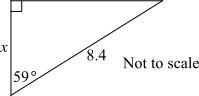
Find the value of `x`, correct to 2 decimal places. (2 marks)
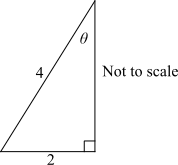
Express `cos theta` as a fraction in its simplest form. (3 marks)
--- 6 WORK AREA LINES (style=lined) ---
Using Pythagoras and showing your working, express `cos 30^{@}` as a fraction. (2 marks)
--- 4 WORK AREA LINES (style=lined) ---
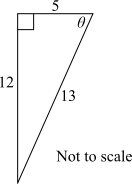
Find the value of `theta`, correct to one decimal place. (2 marks)
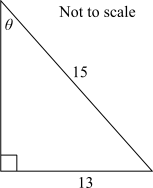
Find the value of `theta`, correct to the nearest minute. (2 marks)
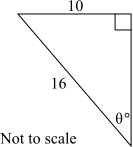
Find the value of `theta`, correct to the nearest minute. (2 marks)
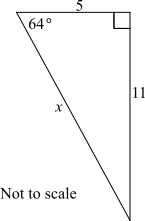
Use trigonometry to find the value of `x`, correct to 1 decimal place. (2 marks)
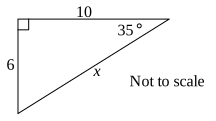
Use trigonometry to find the value of `x`, correct to 1 decimal place. (2 marks)
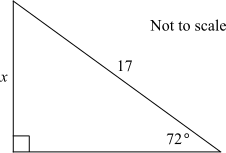
Find the value of `x`, correct to 2 decimal places. (2 marks)
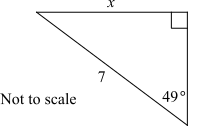
Find the value of `x`, correct to 2 decimal places. (2 marks)
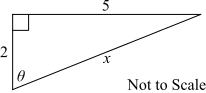
Express `sin theta` as a fraction. (2 marks)
Without the use of a calculator, express the following as a fraction
--- 1 WORK AREA LINES (style=lined) ---
--- 3 WORK AREA LINES (style=lined) ---