SmarterEd

Aussie Maths & Science Teachers: Save your time with SmarterEd

  • Login
  • Get Help
  • About

Functions, EXT1 F1 EQ-Bank 3 MC

A curve has the equation  \(\dfrac{(y-2)^2}{9}-\dfrac{(x+1)^2}{4}=1\).

Which of the following expresses the curve in parametric form?

  1. \(x=2 \sec \theta-1, \ y=3 \tan \theta+2\)
  2. \(x=2 \sin \theta-1, \ y=3 \cos \theta+2\)
  3. \(x=2 \tan \theta-1, \ y=3 \sec \theta+2\)
  4. \(x=4 \sec \theta-1, \ y=3 \tan \theta+2\)
Show Answers Only

\(\Rightarrow C\)

Show Worked Solution

\(\text{Curve is an ellipse} \ \ \Rightarrow \ \ \text {Eliminate B}\)

\(\text{Trig identity:}\)

\(\sin ^2 \theta+\cos ^2 \theta=1 \ \Rightarrow \ \tan ^2 \theta+1=\sec ^2 \theta \ \ \text{(Divide by \(\cos ^2 \theta\))} \)
 

\(\text{Consider option A:}\)

\(x=2 \sec \theta-1 \ \Rightarrow \ \sec \theta=\dfrac{x+1}{2}\)

\(y=3 \tan \theta+2 \ \Rightarrow \ \tan \theta=\dfrac{y-2}{3}\)

\(\dfrac{(y-2)^2}{9}+1=\dfrac{(x+1)^2}{4} \quad\)X

 
\(\text{Consider option C:}\)

\(x=2 \tan \theta-1 \ \Rightarrow \ \tan \theta=\dfrac{x+1}{2}\)

\(y=3 \sec \theta+2 \ \Rightarrow \ \sec \theta=\dfrac{y-2}{3}\)

\(\dfrac{(x+1)^2}{4}+1=\dfrac{(y-2)^2}{9} \quad \large{\checkmark}\)

\(\Rightarrow C\)

Filed Under: Parametric Functions (Ext1) Tagged With: Band 4, smc-1035-30-Linear and Other, smc-1035-40-Cartesian to Parametric

Functions, EXT1 F1 2023 HSC 11a

The parametric equations of a line are given below.

\begin{aligned}
& x=1+3 t \\
& y=4 t
\end{aligned}

Find the Cartesian equation of this line in the form  \(y=m x+c\).  (2 marks)

Show Answers Only

\(y=\dfrac{4}{3}x-\dfrac{4}{3} \)

Show Worked Solution

\(x=1+3t\ \ \Rightarrow \ \ t=\dfrac{x-1}{3} \)

\(y\) \(=4t\)  
\(y\) \(=4\bigg{(}\dfrac{x-1}{3}\bigg{)} \)  
\(y\) \(=\dfrac{4}{3}x-\dfrac{4}{3} \)  

Filed Under: Parametric Functions (Ext1) Tagged With: Band 3, smc-1035-30-Linear and Other

Functions, EXT1 F1 2019 SPEC2-N 2 MC

The curve given by  `x = 3sec(t) + 1`  and  `y = 2tan(t)-1`  can be expressed in cartesian form as

  1.  `((y + 1)^2)/4-((x-1)^2)/9 = 1`
  2.  `((x + 1)^2)/3-((y-1)^2)/2 = 1`
  3.  `((x-1)^2)/3 + ((y + 1)^2)/2 = 1`
  4.  `((x-1)^2)/9-((y + 1)^2)/4 = 1`
Show Answers Only

`D`

Show Worked Solution

`sec^2theta = tan^2theta + 1`

`x = 3sec(t) + 1 \ => \ sec(t) = (x-1)/3`

`y = 2tan(t)-1 \ => \ tan(t) = (y + 1)/2`

`:.((x-1)/3)^2-((y + 1)/2)^2` `= 1`
`((x-1)^2)/9-((y + 1)^2)/4` `= 1`

`=>\ D`

Filed Under: Parametric Functions (Ext1) Tagged With: Band 3, smc-1035-30-Linear and Other

Functions, EXT1 F1 EQ-Bank 7

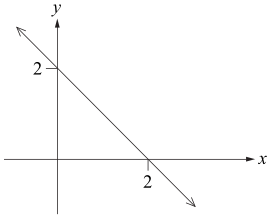
The parametric equations of a graph are

`x = 1-1/t`

`y = 1 + 1/t`

Sketch the graph.   (2 marks)

--- 6 WORK AREA LINES (style=lined) ---

Show Answers Only

Show Worked Solution
`x` `= 1-1/t\ \ …\ (1)`
`tx` `= t-1`
`t(1-x)` `= 1`
`t` `= 1/(1-x)\ \ …\ (1^{′})`
`y` `= 1 + 1/t\ \ …\ (2)`

 
`text(Substitute)\ \ t = 1/(1-x)\ \ text{from}\ (1^{′})\ \text{into (2)}:`

`y` `= 1 + 1/(1/(1-x))`
`y` `= 1 + 1-x`
`y` `= 2-x`


Filed Under: Parametric Functions (Ext1) Tagged With: Band 3, smc-1035-30-Linear and Other

Functions, EXT1 F1 EQ-Bank 6

The parametric equations of a graph are

`x = t^2`

`y = 1/t`  for  `t > 0`
 

  1. Find the Cartesian equation for the graph.  (1 mark)

    --- 5 WORK AREA LINES (style=lined) ---

  2. Sketch the graph.  (1 mark)

    --- 6 WORK AREA LINES (style=lined) ---

Show Answers Only

i.   `y = sqrt(1/x)`

ii.

Show Worked Solution

i.     `x = t^2\ …\ (1)`

`y = 1/t\ …\ (2)`
 

`text(Substitute)\ \ t = 1/y\ \ text{from (1) into (1)}`

`x` `= (1/y)^2`
`y^2` `= 1/x`
`y` `= sqrt(1/x)\ \ \ (y > 0\ \ text(as)\ \ t > 0)`


ii.

Filed Under: Parametric Functions (Ext1) Tagged With: Band 3, smc-1035-30-Linear and Other

Copyright © 2014–2025 SmarterEd.com.au · Log in