The graph of \(y=f(x)\), with all its stationary points, is shown.
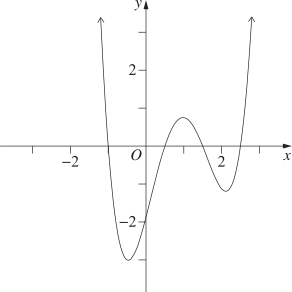
How many stationary points does the graph of \(y=f\left(e^x\right)\) have?
- 0
- 1
- 2
- 3
Aussie Maths & Science Teachers: Save your time with SmarterEd
The graph of \(y=f(x)\), with all its stationary points, is shown.
How many stationary points does the graph of \(y=f\left(e^x\right)\) have?
\(C\)
\(y=f(e^{x})\ \ \Rightarrow\ \ y^{\prime}=e^{x} \times f(e^{x}) \)
\(\text{Find number of \(x\) values where}\ \ y^{\prime}=0.\)
\(\text{Since}\ e^{x} \in (0, \infty)\ \text{for all}\ x: \)
\(\text{Stationary points of \(f(e^x)\) = 2 (SP’s of \(f(x)\) for}\ x \in (0, \infty)).\)
\(\Rightarrow C\)
The graph shows two functions `y = f(x)` and `y = g(x)`.
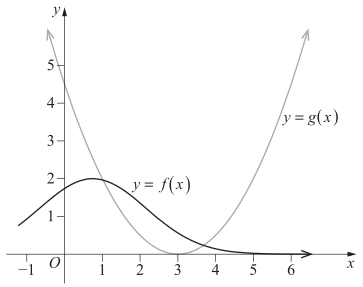
Define `h(x) = f(g(x))`.
How many stationary points does `y = h(x)` have for `1 <= x <= 5`?
`D`
`h(x) = f(g(x))`
`h′(x) = g′(x) xx f′(g(x))`
`text(S.P.’s occur when)\ \ g′(x) = 0\ \ text(or)\ \ f′(g(x)) = 0`
`g′(x) = 0\ \ text(when)\ \ x =3\ (text(from graph))`
`f′(x) = 0\ \ text(when)\ \ x ~~ 1 \ \ text{(i.e.}\ xtext{-value is just under 1)}`
`text(Find values of)\ x\ text(when)\ g(x) ~~ 1:`
`text(By inspection, there are 2 values where)`
`g(x) ~~ 1, \ x ∈ [1, 5]`
`:.\ text(There are 3 S.P.’s for)\ y = h(x), \ x ∈ [1, 5]`
`=> D`