SmarterEd

Aussie Maths & Science Teachers: Save your time with SmarterEd

  • Login
  • Get Help
  • About

HMS, TIP 2025 HSC 26

Analyse the relationship between training thresholds and TWO physiological adaptations. In your answer, provide examples of both aerobic and resistance training.  (8 marks)

--- 24 WORK AREA LINES (style=lined) ---

Show Answers Only

Overview Statement:

  • Training thresholds represent critical intensity levels that trigger specific physiological adaptations.
  • Understanding how aerobic and resistance thresholds connect to metabolic and muscular changes can open up pathways to enhanced athletic performance.

Aerobic Threshold and Cardiovascular Adaptations:

  • The aerobic training threshold occurs at approximately 70% of maximum heart rate. Training at this intensity influences fuel utilisation and cardiovascular function.
  • This causes the body to shift from primarily using fat to using carbohydrates for energy. For example, a marathon runner training at 70% max heart rate stimulates this metabolic adaptation.
  • The threshold also triggers increased stroke volume through enhanced left ventricle filling capacity. This relationship results in improved cardiac output and oxygen delivery to working muscles.
  • Consequently, athletes sustain effort over extended periods with greater efficiency. This shows that aerobic threshold training enables both metabolic and cardiovascular improvements for endurance performance.

Resistance Threshold and Muscular Adaptations:

  • Resistance training thresholds involve working at 70-85% of one-rep maximum with 6-12 repetitions. This intensity creates sufficient mechanical stress to stimulate muscle hypertrophy.
  • For instance, a weightlifter performing squats at 80% of 1RM bmicroscopic muscle fibre damage. This initiates increased protein synthesis and muscle repair processes.
  • The threshold works through progressive overload that leads to enlarged muscle fibres with increased actin and myosin filaments. As a result, greater force production capacity develops.
  • The significance is that athletes gain strength and power output essential for explosive movements.

Implications and Synthesis:

  • These thresholds work together as intensity markers that determine adaptation type. Aerobic thresholds influence metabolic and cardiovascular systems whilst resistance thresholds affect muscular structure.
  • Therefore, coaches must apply appropriate threshold intensities to achieve specific performance goals. This reveals that training success depends on understanding the precise relationship between intensity levels and resulting physiological changes.
Show Worked Solution

Overview Statement:

  • Training thresholds represent critical intensity levels that trigger specific physiological adaptations.
  • Understanding how aerobic and resistance thresholds connect to metabolic and muscular changes can open up pathways to enhanced athletic performance.

Aerobic Threshold and Cardiovascular Adaptations:

  • The aerobic training threshold occurs at approximately 70% of maximum heart rate. Training at this intensity influences fuel utilisation and cardiovascular function.
  • This causes the body to shift from primarily using fat to using carbohydrates for energy. For example, a marathon runner training at 70% max heart rate stimulates this metabolic adaptation.
  • The threshold also triggers increased stroke volume through enhanced left ventricle filling capacity. This relationship results in improved cardiac output and oxygen delivery to working muscles.
  • Consequently, athletes sustain effort over extended periods with greater efficiency. This shows that aerobic threshold training enables both metabolic and cardiovascular improvements for endurance performance.

Resistance Threshold and Muscular Adaptations:

  • Resistance training thresholds involve working at 70-85% of one-rep maximum with 6-12 repetitions. This intensity creates sufficient mechanical stress to stimulate muscle hypertrophy.
  • For instance, a weightlifter performing squats at 80% of 1RM bmicroscopic muscle fibre damage. This initiates increased protein synthesis and muscle repair processes.
  • The threshold works through progressive overload that leads to enlarged muscle fibres with increased actin and myosin filaments. As a result, greater force production capacity develops.
  • The significance is that athletes gain strength and power output essential for explosive movements.

Implications and Synthesis:

  • These thresholds work together as intensity markers that determine adaptation type. Aerobic thresholds influence metabolic and cardiovascular systems whilst resistance thresholds affect muscular structure.
  • Therefore, coaches must apply appropriate threshold intensities to achieve specific performance goals. This reveals that training success depends on understanding the precise relationship between intensity levels and resulting physiological changes.

♦♦ Mean mark 36%.

Filed Under: Physiological adaptations and improved performance, Principles of training Tagged With: Band 4, Band 5, Band 6, smc-5460-10-Thresholds, smc-5461-10-Cardio adaptations, smc-5461-30-Muscular adaptations

CHEMISTRY, M6 2025 HSC 34

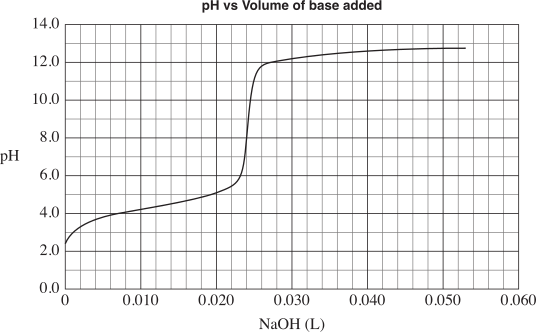
A 0.010 L aliquot of an acid was titrated with 0.10 mol L\(^{-1} \ \ce{NaOH}\), resulting in the following titration curve.
 

  1. Calculate the \(K_a\) for the acid used.   (3 marks)

    --- 9 WORK AREA LINES (style=lined) ---

  2. The concentration of the \(\ce{NaOH}\) was 0.10 mol L\(^{-1}\).
  3. Explain why the pH of the final solution never reached 13.   (2 marks)
  4. --- 6 WORK AREA LINES (style=lined) ---

Show Answers Only

a.   \(\text{Strategy 1:}\)
 

\(\text{From the shape of the titration curve, the acid was weak.}\)

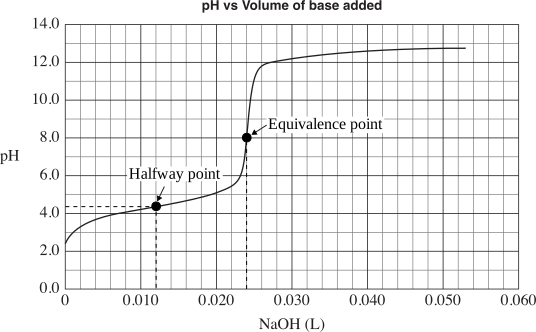
\(\text{Equivalence point}\ \ \Rightarrow \ \ \ce{NaOH}\ \text{added}\ = 0.24\ \text{L} \)

\(\text{Halfway to the equivalent point = 0.012 L}, \ce{[ HA ]=\left[ A^{-}\right]}\)

\(\text{Here the pH} \approx 4.4 , \text{or}\ \ce{\left[H^{+}\right] is 4.0 \times 10^{-5}}\).

\(K_a=10^{-\text{pH}}=\ce{\left[H+\right]} \times \dfrac{\ce{\left[A^{-}\right]}}{\ce{[HA]}}\)

\(\text{At this pH,} \ \ce{\left[A^{-}\right]=[HA] so} \ K_a=4.0 \times 10^{-5}\).
 

\(\text{Strategy 2:}\)

\(\text{Equivalence point is at} \ \ce{0.024 L NaOH added}\).

\(\text{Shape of curve shows acid is monoprotic.}\)

\(\ce{[HA] \times 0.010=0.1 \times 0.024}\)

\(\ce{[HA]=0.24 mol L^{-1}}\)

\(\text{pH at start is approximately 2.5}\)

\(\text{So,} \ \ce{\left[H+\right]=3.16 \times 10^{-3}}\)

\(K_a=\dfrac{\ce{\left[H^{+}\right]\left[A^{-}\right]}}{\ce{[HA]}} \quad \ce{\left[A^{-}\right]=\left[H^{+}\right]}\)

\(\ce{[HA]=0.24-3.16 \times 10^{-3}=0.237}\)

\(K_a=\dfrac{\left(3.16 \times 10^{-3}\right)^2}{0.237}=4.2 \times 10^{-5}\)
 

b.   pH of the final solution < 13:

  • Some of the hydroxide was neutralised by the acid.
  • The 10 mL of acid also diluted the NaOH.
  • So the \(\ce{NaOH}\) concentration of the mixture will be less than 0.1 mol L\(^{-1}\) and the pH will be less than 13.
Show Worked Solution

a.   \(\text{Strategy 1:}\)
 

♦♦ Mean mark 40%.

\(\text{From the shape of the titration curve, the acid was weak.}\)

\(\text{Equivalence point}\ \ \Rightarrow \ \ \ce{NaOH}\ \text{added}\ = 0.24\ \text{L} \)

\(\text{Halfway to the equivalent point = 0.012 L}, \ce{[ HA ]=\left[ A^{-}\right]}\)

\(\text{Here the pH} \approx 4.4 , \text{or}\ \ce{\left[H^{+}\right] is 4.0 \times 10^{-5}}\).

\(K_a=10^{-\text{pH}}=\ce{\left[H+\right]} \times \dfrac{\ce{\left[A^{-}\right]}}{\ce{[HA]}}\)

\(\text{At this pH,} \ \ce{\left[A^{-}\right]=[HA] so} \ K_a=4.0 \times 10^{-5}\).
 

\(\text{Strategy 2:}\)

\(\text{Equivalence point is at} \ \ce{0.024 L NaOH added}\).

\(\text{Shape of curve shows acid is monoprotic.}\)

\(\ce{[HA] \times 0.010=0.1 \times 0.024}\)

\(\ce{[HA]=0.24 mol L^{-1}}\)

\(\text{pH at start is approximately 2.5}\)

\(\text{So,} \ \ce{\left[H+\right]=3.16 \times 10^{-3}}\)

\(K_a=\dfrac{\ce{\left[H^{+}\right]\left[A^{-}\right]}}{\ce{[HA]}} \quad \ce{\left[A^{-}\right]=\left[H^{+}\right]}\)

\(\ce{[HA]=0.24-3.16 \times 10^{-3}=0.237}\)

\(K_a=\dfrac{\left(3.16 \times 10^{-3}\right)^2}{0.237}=4.2 \times 10^{-5}\)
 

b.   pH of the final solution < 13:

  • Some of the hydroxide was neutralised by the acid.
  • The 10 mL of acid also diluted the NaOH.
  • So the \(\ce{NaOH}\) concentration of the mixture will be less than 0.1 mol L\(^{-1}\) and the pH will be less than 13.
♦♦♦ Mean mark 19%.

Filed Under: Quantitative Analysis Tagged With: Band 5, Band 6, smc-3675-20-Titration Curves and Conductivity Graphs, smc-3675-30-Ka/Kb

CHEMISTRY, M5 2025 HSC 32

The following three solids were added together to 1 litre of water:

  • \(\ce{0.006\ \text{mol}\ Mg(NO3)2}\)
  • \(\ce{0.010\ \text{mol}\ NaOH}\)
  • \(\ce{0.002\ \text{mol}\ Na2CO3}\).

Which precipitate(s), if any, will form? Justify your answer with appropriate calculations.   (5 marks)

--- 12 WORK AREA LINES (style=lined) ---

Show Answers Only

All sodium and nitrate salts are soluble  \(\Rightarrow\)  possible precipitates are \(\ce{Mg(OH)2}\) and \(\ce{MgCO3}\). 

\(\ce{\left[Mg^{2+}\right]=6 \times 10^{-3} \quad\left[ OH^{-}\right]=1 \times 10^{-2} \quad\left[ CO3^{2-}\right]=2 \times 10^{-3}}\)

\(\ce{\left[Mg^{2+}\right]\left[ OH^{-}\right]^2=6 \times 10^{-7} \quad \quad \quad \ \ \ K_{\textit{sp}}=5.61 \times 10^{-12}}\)

\(\ce{\left[ Mg^{2+}\right]\left[ CO3^{2-}\right]=1.2 \times 10^{-5} \quad \quad  K_{\textit{sp}}=6.82 \times 10^{-6}}\)
 

\(\ce{Mg(OH)2}\) is a lot less soluble than \(\ce{MgCO3}\) and will precipitate preferentially.

\(\ce{\left[Mg^{2+}\right]\left[OH^{-}\right]^2 > K_{\textit{sp}}}\)

\(\Rightarrow \ce{Mg(OH)2}\) will precipitate.
 

\(\ce{Mg^{2+}(aq) + 2OH-(aq) \rightarrow Mg(OH)2(s)}\)

Since \(K_{\textit{sp}}\) is small, assume reaction goes to completion.

\(\ce{n(Mg^{2+})=0.006\ mol, n(OH^{-})=0.010\ mol}\)

Using stoichiometric ratio \((1:2)\)

\(0.006 > \dfrac{0.010}{2}=0.005\ \ \Rightarrow \ce{Mg^{2+}}\) is in excess.

Concentration drops to: \(6 \times 10^{-3}-5 \times 10^{-3}=1 \times 10^{-3}\).
 

Check if \(\ce{MgCO3}\) will precipitate:

\(\ce{\left[Mg^{2+}\right]\left[CO3^{2-}\right]}\) becomes  \(2 \times 10^{-6} <K_{\textit{sp}}\).

\(\ce{\Rightarrow\ MgCO3}\) won’t precipitate.

Show Worked Solution

All sodium and nitrate salts are soluble  \(\Rightarrow\)  possible precipitates are \(\ce{Mg(OH)2}\) and \(\ce{MgCO3}\). 

\(\ce{\left[Mg^{2+}\right]=6 \times 10^{-3} \quad\left[ OH^{-}\right]=1 \times 10^{-2} \quad\left[ CO3^{2-}\right]=2 \times 10^{-3}}\)

\(\ce{\left[Mg^{2+}\right]\left[ OH^{-}\right]^2=6 \times 10^{-7} \quad \quad \quad \ \ \ K_{\textit{sp}}=5.61 \times 10^{-12}}\)

\(\ce{\left[ Mg^{2+}\right]\left[ CO3^{2-}\right]=1.2 \times 10^{-5} \quad \quad  K_{\textit{sp}}=6.82 \times 10^{-6}}\)

♦♦ Mean mark 40%.

\(\ce{Mg(OH)2}\) is a lot less soluble than \(\ce{MgCO3}\) and will precipitate preferentially.

\(\ce{\left[Mg^{2+}\right]\left[OH^{-}\right]^2 > K_{\textit{sp}}}\)

\(\Rightarrow \ce{Mg(OH)2}\) will precipitate.
 

\(\ce{Mg^{2+}(aq) + 2OH-(aq) \rightarrow Mg(OH)2(s)}\)

Since \(K_{\textit{sp}}\) is small, assume reaction goes to completion.

\(\ce{n(Mg^{2+})=0.006\ mol, n(OH^{-})=0.010\ mol}\)

Using stoichiometric ratio \((1:2)\)

\(0.006 > \dfrac{0.010}{2}=0.005\ \ \Rightarrow \ce{Mg^{2+}}\) is in excess.

Concentration drops to: \(6 \times 10^{-3}-5 \times 10^{-3}=1 \times 10^{-3}\).
 

Check if \(\ce{MgCO3}\) will precipitate:

\(\ce{\left[Mg^{2+}\right]\left[CO3^{2-}\right]}\) becomes  \(2 \times 10^{-6} <K_{\textit{sp}}\).

\(\ce{\Rightarrow\ MgCO3}\) won’t precipitate.

Filed Under: Solution Equilibria Tagged With: Band 5, Band 6, smc-3672-20-Calcs given K(sp), smc-3672-70-Precipitate

PHYSICS, M8 2025 HSC 20 MC

Consider the possibility of an electron and a positron colliding in a particle accelerator to produce a proton and an antiproton, as shown in the equation below.

\(\text{electron}+ \text{positron}\ \rightarrow \ \text{proton}+ \text {antiproton}\)

Which statement makes the correct conclusion about the possibility of such a reaction, and provides a plausible reason for this conclusion?

  1. The reaction is impossible because electrons and positrons will combine to produce a single neutral particle.
  2. The reaction is possible because the masses of the proton and antiproton are the result of their relativistic velocities.
  3. The reaction is possible because the masses of the proton and antiproton come mainly from energy supplied by the accelerator.
  4. The reaction is impossible because protons are much more massive than electrons and hence the reaction violates the law of conservation of mass.
Show Answers Only

\(C\)

Show Worked Solution

Option \(C\) is correct:

  • The electron and positron have very small rest masses compared to protons and antiprotons.
  • The particle accelerator supplies enormous kinetic energy to the electron and positron by accelerating them to speeds close to the speed of light.
  • This kinetic energy can be converted into mass to create the heavier proton-antiproton pair according to Einstein’s \(E = mc^2\) equation.
  • This means conservation of energy is satisfied, even though the products have much greater rest mass than the reactants.
♦ Mean mark 47%.

Other options:

  • The reaction is possible – see above (eliminate \(A\) and \(D\)).
  • Option \(B\) is incorrect. The proton and antiproton’s mass must come from the reactants’ energy (electron + positron + accelerator energy), not from their own relativistic velocities.

Filed Under: Deep Inside the Atom Tagged With: Band 6, smc-3704-25-Linear Accelerator, smc-3704-30-Nuclear Transformation

PHYSICS, M5 2025 HSC 18 MC

The escape velocity from the surface of a planet, which has no atmosphere, is \(v\). A mass is launched at 45° to the planet's surface at \(v\).

What will be the subsequent motion of the mass?

  1. A circular orbit around the planet
  2. An elliptical orbit around the planet
  3. A parabolic trajectory, returning to land with velocity \(v\)
  4. A trajectory reaching zero velocity at an infinite distance
Show Answers Only

\(D\)

Show Worked Solution
  • The mass is launched at escape velocity which means the object has just enough energy to escape the planet’s gravity.
  • As the mass travels away from the planet, kinetic energy converts into gravitational potential energy.
  • Since its initial velocity was exactly escape velocity, at infinite distance, all kinetic energy has been converted to potential energy. This means the velocity reaches zero exactly when the distance becomes infinite.
  • The 45° launch angle does not matter – escape velocity depends only on speed, not direction.

\(\Rightarrow D\)

♦♦♦ Mean mark 29%.

Filed Under: Motion in Gravitational Fields Tagged With: Band 6, smc-3692-70-Escape Velocity

PHYSICS, M5 2025 HSC 36

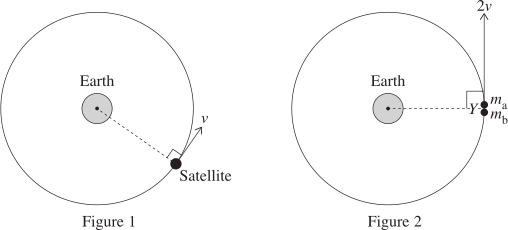
A satellite with velocity \(v\), is in a geostationary orbit as shown in Figure 1.
 

At point \(Y\), the satellite explodes and splits into two pieces \(m_{ a }\) and \(m_{ b }\), of identical mass. As a result of the explosion, the velocity of one piece, \(m_{ a }\), changes from \(v\) to \(2 v\) as shown in Figure 2.

Analyse the subsequent motion of BOTH \(m_{ a }\) and \(m_{ b }\) after the explosion. Include reference to relevant conservation laws and formulae in your answer.   (8 marks)

--- 22 WORK AREA LINES (style=lined) ---

Show Answers Only

At the point in time of the explosion:

  • By the law of conservation of momentum, the momentum changes of \(m_a\) and \(m_b\) caused by the explosion must be equal in magnitude but opposite in direction.
  • Since their masses are equal, both pieces experience the same change in velocity, but in opposite directions.
  • Because the velocity of \(m_a\) increases by \(v\) in the direction it was already travelling, the velocity of \(m_b\) must also change by \(v\) but in the opposite direction to its original motion.
  • Hence, relative to Earth, the velocity of \(m_b\) becomes zero at that instant.

Motion after the explosion:

  • The satellite’s orbital velocity before the explosion is  \(v_{\text{orb}}=\sqrt{\dfrac{GM}{r}}\)  and the instantaneous velocity of \(m_a\) becomes twice this value.
  • Since  \(2v_{\text{orb}} = 2 \times \sqrt{\dfrac{GM}{r}} >\sqrt{\dfrac{2GM}{r}} \left(v_{\text{esc}}\right)\), the speed of \(m_a\) after the explosion exceeds escape velocity.
  • After the explosion, \(m_a\) continues moving away from Earth with a decreasing speed, but because its initial speed is greater than escape velocity from that point, it will never return. Its total mechanical energy (kinetic + potential) remains constant and positive.
  • Meanwhile, \(m_b\) begins accelerating from an initial velocity of zero toward Earth’s centre. Its initial acceleration is less than \(\text{ 9.8 m s}^{-2}\) because it is not at Earth’s surface. As gravitational force increases, its acceleration also increases, and it continues gaining speed at an increasing rate until it reaches Earth’s atmosphere.
  • In accordance with the conservation of energy, until \(m_b\) reaches the atmosphere, the sum of its kinetic and potential energy remains constant and equal to its initial potential energy immediately after the explosion.
Show Worked Solution

At the point in time of the explosion:

  • By the law of conservation of momentum, the momentum changes of \(m_a\) and \(m_b\) caused by the explosion must be equal in magnitude but opposite in direction.
  • Since their masses are equal, both pieces experience the same change in velocity, but in opposite directions.
  • Because the velocity of \(m_a\) increases by \(v\) in the direction it was already travelling, the velocity of \(m_b\) must also change by \(v\) but in the opposite direction to its original motion.
  • Hence, relative to Earth, the velocity of \(m_b\) becomes zero at that instant.
♦ Mean mark 39%.

Motion after the explosion:

  • The satellite’s orbital velocity before the explosion is  \(v_{\text{orb}}=\sqrt{\dfrac{GM}{r}}\)  and the instantaneous velocity of \(m_a\) becomes twice this value.
  • Since  \(2v_{\text{orb}} = 2 \times \sqrt{\dfrac{GM}{r}} >\sqrt{\dfrac{2GM}{r}} \left(v_{\text{esc}}\right)\), the speed of \(m_a\) after the explosion exceeds escape velocity.
  • After the explosion, \(m_a\) continues moving away from Earth with a decreasing speed, but because its initial speed is greater than escape velocity from that point, it will never return. Its total mechanical energy (kinetic + potential) remains constant and positive.
  • Meanwhile, \(m_b\) begins accelerating from an initial velocity of zero toward Earth’s centre. Its initial acceleration is less than \(\text{ 9.8 m s}^{-2}\) because it is not at Earth’s surface. As gravitational force increases, its acceleration also increases, and it continues gaining speed at an increasing rate until it reaches Earth’s atmosphere.
  • In accordance with the conservation of energy, until \(m_b\) reaches the atmosphere, the sum of its kinetic and potential energy remains constant and equal to its initial potential energy immediately after the explosion.

Filed Under: Motion in Gravitational Fields Tagged With: Band 5, Band 6, smc-3692-40-Satellites

PHYSICS, M8 2025 HSC 33

Analyse the role of experimental evidence and theoretical ideas in developing the Standard Model of matter.   (6 marks)

--- 18 WORK AREA LINES (style=lined) ---

Show Answers Only

Overview Statement

  • The Standard Model’s development depends on the cyclical relationship between experimental evidence and theoretical predictions.
  • These components interact with each other, where theory guides experiments and results validate or refine theory.

Particle Discovery

  • Theoretical predictions lead to targeted experimental searches for specific particles.
  • The Higgs Boson was theoretically proposed decades before its experimental discovery to explain particle mass.
  • Cloud chambers discovered antimatter after theory predicted its existence.
  • Particle accelerators verified quarks existed by revealing the internal structure of protons and neutrons.
  • This pattern shows theory provides the framework while experiments confirm reality.
  • Consequently, successful verification enables confidence in theoretical models and guides further predictions.

Experimental Tools Driving Theoretical Refinement

  • High-energy particle accelerators create small wavelength ‘matter probes’ allowing high-resolution investigation of matter’s structure.
  • These experiments verified electroweak theory by demonstrating electromagnetic and weak nuclear forces result from the same underlying interaction.
  • Unexpected experimental results sometimes cause theoretical modifications or new predictions.
  • The significance is that increasingly powerful experimental tools reveal deeper layers of matter structure.

Implications and Synthesis

  • This reveals the Standard Model emerged from iterative cycles where theory and experiment continuously influence each other.
  • Neither component alone could have produced the model.
  • Together, they form a self-correcting system advancing our understanding of fundamental matter.
Show Worked Solution

Overview Statement

  • The Standard Model’s development depends on the cyclical relationship between experimental evidence and theoretical predictions.
  • These components interact with each other, where theory guides experiments and results validate or refine theory.
♦♦♦ Mean mark 37%.

Particle Discovery

  • Theoretical predictions lead to targeted experimental searches for specific particles.
  • The Higgs Boson was theoretically proposed decades before its experimental discovery to explain particle mass.
  • Cloud chambers discovered antimatter after theory predicted its existence.
  • Particle accelerators verified quarks existed by revealing the internal structure of protons and neutrons.
  • This pattern shows theory provides the framework while experiments confirm reality.
  • Consequently, successful verification enables confidence in theoretical models and guides further predictions.

Experimental Tools Driving Theoretical Refinement

  • High-energy particle accelerators create small wavelength ‘matter probes’ allowing high-resolution investigation of matter’s structure.
  • These experiments verified electroweak theory by demonstrating electromagnetic and weak nuclear forces result from the same underlying interaction.
  • Unexpected experimental results sometimes cause theoretical modifications or new predictions.
  • The significance is that increasingly powerful experimental tools reveal deeper layers of matter structure.

Implications and Synthesis

  • This reveals the Standard Model emerged from iterative cycles where theory and experiment continuously influence each other.
  • Neither component alone could have produced the model.
  • Together, they form a self-correcting system advancing our understanding of fundamental matter.

Filed Under: Deep Inside the Atom Tagged With: Band 5, Band 6, smc-3704-10-Standard Model

PHYSICS, M7 2025 HSC 32

Analyse the consequences of the theory of special relativity in relation to length, time and motion. Support your answer with reference to experimental evidence.   (8 marks)

--- 22 WORK AREA LINES (style=lined) ---

Show Answers Only

Overview Statement

  • Special relativity predicts that time dilation, length contraction and relativistic momentum arise from the principle that the speed of light is constant for all observers.
  • These effects change how time, distance and motion are measured and each consequence is supported by experimental evidence.

Time–Length Relationship in Muon Observations

  • Muon-decay experiments show how time dilation and length contraction depend on relative motion.
  • Muons created high in the atmosphere have such short lifetimes that, in classical physics, they should decay long before reaching Earth’s surface. Yet far more muons are detected at ground level than predicted.
  • In Earth’s frame of reference, the muons experience time dilation, so they “live longer” and travel further.
  • In the muon’s frame of reference, the atmosphere is length-contracted according to the equation  \(l=l_0 \sqrt{\left(1-\dfrac{v^{2}}{c^{2}}\right)}\), so the distance they travel is much shorter.
  • Both viewpoints are valid within their own reference frames, showing that time and length are not absolute but depend on relative motion.

Momentum–Energy Relationship in Particle Accelerators

  • Relativistic momentum explains how objects behave as they approach light speed.
  • Particle accelerators show that enormous increases in energy produce only small increases in speed at high velocities.
  • Particles act as though their mass increases, so each additional acceleration requires disproportionately more energy.
  • This makes it impossible for any object with mass to reach the speed of light, since doing so requires infinite energy.
  • Thus, relativistic momentum preserves light speed as a universal limit.

Implications and Synthesis

  • The consequences of these observations reveal that space and time form a single, interconnected framework rather than separate absolute quantities.
  • At high velocities, motion fundamentally alters measurements of time, distance and momentum.
  • Together, these consequences confirm that classical physics fails at relativistic speeds and that special relativity accurately describes the behaviour of fast-moving objects.
Show Worked Solution

Overview Statement

  • Special relativity predicts that time dilation, length contraction and relativistic momentum arise from the principle that the speed of light is constant for all observers.
  • These effects change how time, distance and motion are measured and each consequence is supported by experimental evidence.
♦ Mean mark 53%.

Time–Length Relationship in Muon Observations

  • Muon-decay experiments show how time dilation and length contraction depend on relative motion.
  • Muons created high in the atmosphere have such short lifetimes that, in classical physics, they should decay long before reaching Earth’s surface. Yet far more muons are detected at ground level than predicted.
  • In Earth’s frame of reference, the muons experience time dilation, so they “live longer” and travel further.
  • In the muon’s frame of reference, the atmosphere is length-contracted according to the equation  \(l=l_0 \sqrt{\left(1-\dfrac{v^{2}}{c^{2}}\right)}\), so the distance they travel is much shorter.
  • Both viewpoints are valid within their own reference frames, showing that time and length are not absolute but depend on relative motion.

Momentum–Energy Relationship in Particle Accelerators

  • Relativistic momentum explains how objects behave as they approach light speed.
  • Particle accelerators show that enormous increases in energy produce only small increases in speed at high velocities.
  • Particles act as though their mass increases, so each additional acceleration requires disproportionately more energy.
  • This makes it impossible for any object with mass to reach the speed of light, since doing so requires infinite energy.
  • Thus, relativistic momentum preserves light speed as a universal limit.

Implications and Synthesis

  • The consequences of these observations reveal that space and time form a single, interconnected framework rather than separate absolute quantities.
  • At high velocities, motion fundamentally alters measurements of time, distance and momentum.
  • Together, these consequences confirm that classical physics fails at relativistic speeds and that special relativity accurately describes the behaviour of fast-moving objects.

Filed Under: Light and Special Relativity Tagged With: Band 4, Band 5, Band 6, smc-3699-10-Time Dilation, smc-3699-20-Length Contraction, smc-3699-30-Momentum Dilation and calcs, smc-3699-50-Scientific Theories

CHEMISTRY, M6 2025 HSC 19 MC

0.1 mol of solid sodium acetate is dissolved in 500 mL of 0.1 mol L\(^{-1}\) \(\ce{HCl}\) in a beaker. This solution has a pH of 4.8 .

500 mL of distilled water is then added to the beaker.

What is the pH of the final solution?

  1. 2.4
  2. 4.5
  3. 4.8
  4. 5.1
Show Answers Only

\(C\)

Show Worked Solution
  • The initial reaction between sodium acetate and hydrochloric acid runs to completion as \(\ce{HCl}\) is a strong acid:
  •    \(\ce{CH3COO-(aq) + HCl(aq) -> CH3COOH(aq) + Cl-(aq)}\)
  • \(n(\ce{CH3COO-}) = 0.1\ \text{mol}\)
  • \(n(\ce{HCl}) = 0.5\ \text{L} \times 0.1\ \text{mol L}^{-1} = 0.05\ \text{mol}\)
  • As they react in a \(1:1\) ratio, \(\ce{HCl}\) is the limiting reagent.
  • \(n(\ce{CH3COO-_{\text{after reaction}}}) = n(\ce{CH3COO_{\text{initial}}})-n(\ce{CH3COO_{\text{reacted}}}) = 0.1-0.05 = 0.05\ \text{mol}\)
  • \(n(\ce{CH3COOH_{\text{after reaction}}}) = n(\ce{CH3COO_{\text{reacted}}}) = 0.05\ \text{mol}\)
  • The following equilibrium reaction is then established below dilution
  •    \(\ce{CH3COOH(aq) + H2O(l) \leftrightharpoons CH3COO-(aq) + H3O+(aq)}\)
  • Therefore the following ice table can be constructed:
♦♦♦ Mean mark 19%.

\begin{array} {|c|c|c|c|}
\hline  & \ce{[CH3COOH]} & \ce{[CH3COO-]} & \ce{[H3O+]} \\
\hline \text{Initial} & 0.1 & 0.1 & 0 \\
\hline \text{Change} & -10^{-4.8} & +10^{-4.8} & +10^{-4.8} \\
\hline \text{Equilibrium} & 0.1-10^{-4.8} & 0.1+10^{-4.8} & +10^{-4.8} \\
\hline \end{array}

\(\therefore K_a = \dfrac{(0.1+10^{-4.8})(10^{-4.8})}{0.1-10^{-4.8}} = 1.585395 \times 10^{-5}\)

  • Then considering the dilution which would shift the equilibrium position to the right.

\begin{array} {|c|c|c|c|}
\hline  & \ce{[CH3COOH]} & \ce{[CH3COO-]} & \ce{[H3O+]} \\
\hline \text{Initial} & 0.1 \times \dfrac{500\ \text{mL}}{1000\ \text{mL}} = 0.05 & 0.1 \times \dfrac{500\ \text{mL}}{1000\ \text{mL}} = 0.05 & 0 \\
\hline \text{Change} & -x & +x & +x \\
\hline \text{Equilibrium} & 0.05-x & 0.05+x & +x \\
\hline \end{array}

  • As \(K_{eq}\) is small, \(0.05 -x \approx 0.05\)  and  \(0.05 + x \approx 0.05\). 
  •    \(\therefore K_{eq} = \dfrac{0.05x}{0.05} = x = 1.585395 \times 10^{-5}\)
  • \(\text{pH} = -\log_{10}\ce{[H3O+]} = -\log_{10}(1.585395 \times 10^{-5}) = 4.79962 = 4.8\ \text{(1 d.p.)}\)

\(\Rightarrow C\)

Filed Under: Bronsted-Lowry Theory, Quantitative Analysis Tagged With: Band 6, smc-3674-15-pH of Mixed Solution, smc-3675-30-Ka/Kb, smc-3675-40-Strong/Weak Acids

CHEMISTRY, M8 2025 HSC 18 MC

The concentration of silver ions in a solution is determined by titrating it with aqueous sodium chloride, using yellow potassium chromate as the indicator.

Which row of the table correctly identifies the colour change at the endpoint and the more soluble salt?

\begin{align*}
\begin{array}{l}
\rule{0pt}{2.5ex} \ & \\
 \ \rule[-1ex]{0pt}{0pt}& \\
\rule{0pt}{2.5ex}\textbf{A.}\rule[-1ex]{0pt}{0pt}\\
\rule{0pt}{2.5ex}\textbf{B.}\rule[-1ex]{0pt}{0pt}\\
\rule{0pt}{2.5ex}\textbf{C.}\rule[-1ex]{0pt}{0pt}\\
\rule{0pt}{2.5ex}\textbf{D.}\rule[-1ex]{0pt}{0pt}\\
\end{array}
\begin{array}{|c|c|}
\hline
\rule{0pt}{2.5ex}\ \ \text{Colour change} \ \ & \text{More soluble salt} \\
\text{at endpoint}\rule[-1ex]{0pt}{0pt}& \text{} \\
\hline
\rule{0pt}{2.5ex}\text{Red to yellow}\rule[-1ex]{0pt}{0pt}& \ce{Ag2CrO4}\\
\hline
\rule{0pt}{2.5ex}\text{Yellow to red}\rule[-1ex]{0pt}{0pt}& \ce{Ag2CrO4}\\
\hline
\rule{0pt}{2.5ex}\text{Red to yellow}\rule[-1ex]{0pt}{0pt}& \ce{AgCl} \\
\hline
\rule{0pt}{2.5ex}\text{Yellow to red}\rule[-1ex]{0pt}{0pt}& \ce{AgCl} \\
\hline
\end{array}
\end{align*}

Show Answers Only

\(B\)

Show Worked Solution
  • The two key reactions that take place in this titration are
  •    \(\ce{Ag+(aq) + Cl-(aq) -> AgCl(s)}\)
  •    \(\ce{2Ag+(aq) + CrO4^{2-}(aq) -> Ag2CrO4(s)}\)
  • For the titration to occur effectively all of the \(\ce{Cl-}\) ions must react with \(\ce{Ag+}\) ion and be precipitated out of the solution as the sodium chloride is Titrant (known volume and known concentration).
  • Only once all of the \(\ce{Cl-}\) ions are used up will silver ions begin to react the chromate ions signally the endpoint of the titration.
  • Hence, \(\ce{Ag2CrO4}\) is the more soluble salt and as the potassium chromate is initially yellow, the colour change must be from yellow to red.

\(\Rightarrow B\)

♦♦♦ Mean mark 14%.

Filed Under: Inorganic Substances Tagged With: Band 6, smc-3682-70-Precipitation Titrations

Vectors, EXT2 V1 2025 HSC 16c

Consider the point \(B\) with three-dimensional position vector \(\underset{\sim}{b}\) and the line  \(\ell: \underset{\sim}{a}+\lambda \underset{\sim}{d}\), where \(\underset{\sim}{a}\) and \(\underset{\sim}{d}\) are three-dimensional vectors, \(\abs{\underset{\sim}{d}}=1\) and \(\lambda\) is a parameter.

Let \(f(\lambda)\) be the distance between a point on the line \(\ell\) and the point \(B\).

  1. Find \(\lambda_0\), the value of \(\lambda\) that minimises \(f\), in terms of \(\underset{\sim}{a}, \underset{\sim}{b}\) and \(\underset{\sim}{d}\).   (2 marks)

    --- 12 WORK AREA LINES (style=lined) ---

  2. Let \(P\) be the point with position vector  \(\underset{\sim}{a}+\lambda_0 \underset{\sim}{d}\).
  3. Show that \(PB\) is perpendicular to the direction of the line \(\ell\).   (1 mark)

    --- 7 WORK AREA LINES (style=lined) ---

  4. Hence, or otherwise, find the shortest distance between the line \(\ell\) and the sphere of radius 1 unit, centred at the origin \(O\), in terms of \(\underset{\sim}{d}\) and \(\underset{\sim}{a}\).
  5. You may assume that if \(B\) is the point on the sphere closest to \(\ell\), then \(O B P\) is a straight line.   (3 marks)

    --- 16 WORK AREA LINES (style=lined) ---

Show Answers Only

i.    \(\lambda_0=\underset{\sim}{d}(\underset{\sim}{b}-\underset{\sim}{a})\)

ii.   \(\text{See Worked Solutions.}\)

iii.  \(d_{\min }= \begin{cases}\sqrt{\abs{\underset{\sim}{a}}^2-(\underset{\sim}{a} \cdot \underset{\sim}{d})^2}-1, & \sqrt{\abs{\underset{\sim}{a}}^2-(\underset{\sim}{a} \cdot \underset{\sim}{d})^2}>1 \\ 0, & \sqrt{\abs{\underset{\sim}{a}}^2-(\underset{\sim}{a} \cdot \underset{\sim}{d})^2} \leqslant 1 \ \ \text{(i.e. it touches sphere) }\end{cases}\)

Show Worked Solution

i.    \(\ell=\underset{\sim}{a}+\lambda \underset{\sim}{d}, \quad\abs{\underset{\sim}{d}}=1\)

\(\text{Vector from point \(B\) to a point on \(\ell\)}:\ \underset{\sim}{a}+\lambda \underset{\sim}{d}-\underset{\sim}{b}\)

\(f(\lambda)=\text{distance between \(\ell\) and \(B\)}\)

\(f(\lambda)=\abs{\underset{\sim}{a}-\underset{\sim}{b}+\lambda \underset{\sim}{d}}\)

\(\text{At} \ \ \lambda_0, f(\lambda) \ \ \text{is a min}\ \Rightarrow \ f(\lambda)^2 \ \ \text {is also a min}\)

♦♦ Mean mark (i) 33%.
\(f(\lambda)^2\) \(=\abs{\underset{\sim}{a}-\underset{\sim}{b}+\lambda \underset{\sim}{d}}^2\)
  \(=(\underset{\sim}{a}-\underset{\sim}{b}+\lambda \underset{\sim}{d})(\underset{\sim}{a}-\underset{\sim}{b}+\lambda \underset{\sim}{d})\)
  \(=(\underset{\sim}{a}-\underset{\sim}{b})\cdot (\underset{\sim}{a}-\underset{\sim}{b})+2\lambda (\underset{\sim}{a}-\underset{\sim}{b}) \cdot \underset{\sim}{d}+\lambda^2 \underset{\sim}{d} \cdot  \underset{\sim}{d}\)
  \(=\lambda^2|\underset{\sim}{d}|^2+2 \underset{\sim}{d} \cdot (\underset{\sim}{a}-\underset{\sim}{b}) \lambda +\abs{\underset{\sim}{a}-\underset{\sim}{b}}^2\)
  \(=\lambda^2+2 \underset{\sim}{d} \cdot (\underset{\sim}{a}-\underset{\sim}{b}) \lambda+\abs{\underset{\sim}{a}-\underset{\sim}{b}}^2\)


\(f(\lambda)^2 \ \ \text{is a concave up quadratic.}\)

\(f(\lambda)_{\text {min}}^2 \ \ \text{occurs at the vertex.}\)

\(\lambda_0=-\dfrac{b}{2 a}=-\dfrac{2 \underset{\sim}{d} \cdot (\underset{\sim}{a}-\underset{\sim}{b})}{2}=\underset{\sim}{d} \cdot (\underset{\sim}{b}-\underset{\sim}{a})\)
 

ii.    \(P \ \text{has position vector} \ \ \underset{\sim}{a}+\lambda_0 \underset{\sim}{d}\)

\(\text{Show} \ \ \overrightarrow{PB} \perp \ell:\)

♦♦♦ Mean mark (ii) 22%.

\(\overrightarrow{PB}=\underset{\sim}{b}-\underset{\sim}{p}=\underset{\sim}{b}-\underset{\sim}{a}-\lambda_0 \underset{\sim}{d}\)

\(\overrightarrow{P B} \cdot \underset{\sim}{d}\) \(=\left(\underset{\sim}{b}-\underset{\sim}{a}-\lambda_0 \underset{\sim}{d}\right) \cdot \underset{\sim}{d}\)
  \(=(\underset{\sim}{b}-\underset{\sim}{a}) \cdot \underset{\sim}{d}-\lambda_0 \underset{\sim}{d} \cdot \underset{\sim}{d}\)
  \(=\lambda_0-\lambda_0\abs{\underset{\sim}{d}}^2\)
  \(=0\)


\(\therefore \overrightarrow{PB}\ \text{is perpendicular to the direction of the line}\ \ell. \)
 

iii.   \(\text{Shortest distance between} \ \ell \ \text{and sphere (radius\(=1\))}\)

\(=\ \text{(shortest distance \(\ell\) to \(O\))}-1\)

♦♦♦ Mean mark (iii) 4%.

\(f\left(\lambda_0\right)=\text{shortest distance \(\ell\) to point \(B\)}\)

\(\text{Set} \ \ \underset{\sim}{b}=0 \ \Rightarrow \ f\left(\lambda_0\right)=\text{shortest distance \(\ell\) to \(0\)}\)

\(\Rightarrow \lambda_0=\underset{\sim}{d} \cdot (\underset{\sim}{b}-\underset{\sim}{a})=-\underset{\sim}{d} \cdot \underset{\sim}{a}\)

\(f\left(\lambda_0\right)\) \(=\abs{\underset{\sim}{a}-\underset{\sim}{b}-(\underset{\sim}{d} \cdot \underset{\sim}{a})\cdot \underset{\sim}{d}}=\abs{\underset{\sim}{a}-(\underset{\sim}{d} \cdot \underset{\sim}{a})\cdot \underset{\sim}{d}}\)
\(f\left(\lambda_0\right)^2\) \(=\abs{\underset{\sim}{a}}^2-2( \underset{\sim}{a}\cdot \underset{\sim}{d})^2+(\underset{\sim}{d} \cdot \underset{\sim}{a})^2\abs{\underset{\sim}{d}}^2\)
  \(=\abs{\underset{\sim}{a}}^2-(\underset{\sim}{a} \cdot \underset{\sim}{d})^2\)
\(f\left(\lambda_0\right)\) \(=\sqrt{\abs{\underset{\sim}{a}}^2-(\underset{\sim}{a} \cdot \underset{\sim}{d})^2}\)


\(\text {Shortest distance of \(\ell\) to sphere \(\left(d_{\min }\right)\):}\)

\(d_{\min }= \begin{cases}\sqrt{\abs{\underset{\sim}{a}}^2-(\underset{\sim}{a} \cdot \underset{\sim}{d})^2}-1, & \sqrt{\abs{\underset{\sim}{a}}^2-(\underset{\sim}{a} \cdot \underset{\sim}{d})^2}>1 \\ 0, & \sqrt{\abs{\underset{\sim}{a}}^2-(\underset{\sim}{a} \cdot \underset{\sim}{d})^2} \leqslant 1 \ \ \text{(i.e. it touches sphere) }\end{cases}\)

Filed Under: Vectors and Vector Equations of Lines Tagged With: Band 5, Band 6, smc-1196-48-Spheres, smc-1196-80-3D vectors

Mechanics, EXT2 M1 2025 HSC 16b

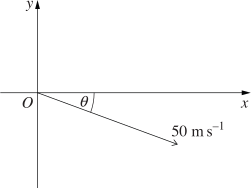
A particle of mass 1 kg is projected from the origin with a speed of 50 ms\(^{-1}\), at an angle of \(\theta\) below the horizontal into a resistive medium.
 

The position of the particle \(t\) seconds after projection is \((x, y)\), and the velocity of the particle at that time is  \(\underset{\sim}{v}=\displaystyle \binom{\dot{x}}{\dot{y}}\).

The resistive force, \(\underset{\sim}{R}\), is proportional to the velocity of the particle, so that  \(\underset{\sim}{R}=-k \underset{\sim}{v}\), where \(k\) is a positive constant.

Taking the acceleration due to gravity to be 10 ms\(^{-2}\), and the upwards vertical direction to be positive, the acceleration of the particle at time \(t\) is given by:

\(\underset{\sim}{a}=\displaystyle \binom{-k \dot{x}}{-k \dot{y}-10}\).    (Do NOT prove this.) 

Derive the Cartesian equation of the motion of the particle, given  \(\sin \theta=\dfrac{3}{5}\).   (5 marks)

--- 25 WORK AREA LINES (style=lined) ---

Show Answers Only

\(y=\left(\dfrac{1-3 k}{4 k}\right) x+\dfrac{10}{k^2} \times \ln \abs{1-\dfrac{k x}{40}}\)

Show Worked Solution

\(\sin \theta=\dfrac{3}{5} \ \Rightarrow \ \cos \theta=\dfrac{4}{5}\)

\(\text{Components of initial velocity:}\)

\(\dot{x}(0)=50\, \cos \theta=50 \times \dfrac{4}{5}=40 \ \text{ms}^{-1}\)

\(\dot{y}(0)=50\, \sin \theta=50 \times \dfrac{3}{5}=-30\ \text{ms}^{-1}\)

♦♦ Mean mark 35%.

\(\text{Horizontal motion:}\)

  \(\dfrac{d \dot{x}}{dt}\) \(=-k \dot{x} \ \ \text{(given)}\)  
\(\dfrac{dt}{d \dot{x}}\) \(=-\dfrac{1}{k \dot{x}}\)  
\(\displaystyle \int dt\) \(=-\dfrac{1}{k} \int \dfrac{1}{\dot{x}}\, d x\)  
\(t\) \(=-\dfrac{1}{k} \ln \dot{x}+c\)  

 
\(\text{When} \ \ t=0, \ \dot{x}=40 \ \Rightarrow \ c=\dfrac{1}{k} \ln 40\)

\(t\) \(=\dfrac{1}{k} \ln 40-\dfrac{1}{k} \ln \abs{\dot{x}}=\dfrac{1}{k} \ln \abs{\dfrac{40}{\dot{x}}}\)
    \(k t\) \(=\ln \abs{\dfrac{40}{\dot{x}}}\)
  \(e^{k t}\) \(=\dfrac{40}{\dot{x}}\)
\(\dot{x}\) \(=40 e^{-k t}\)
\(x\) \(\displaystyle=\int 40 e^{-k t}\, d t=-\dfrac{40}{k} \times e^{-k t}+c\)


\(\text{When} \ \ t=0, x=0 \ \Rightarrow \ c=\dfrac{40}{k}\)

   \(x=\dfrac{40}{k}-\dfrac{40}{k} e^{-k t}=\dfrac{40}{k}\left(1-e^{-k t}\right)\ \ldots\ (1)\)
 

\(\text{Vertical Motion }\)

\(\dfrac{d \dot{y}}{dt}\) \(=-k \dot{y}-10 \quad \text{(given)}\)
\(\dfrac{d t}{d \dot{y}}\) \(=-\dfrac{1}{k} \times \dfrac{1}{\dot{y}+\frac{10}{k}}\)
\(t\) \(=-\dfrac{1}{k} \displaystyle \int \dfrac{1}{\dot{y}+\frac{10}{k}} \, d \dot{y}=-\dfrac{1}{k} \ln \abs{\dot{y}+\frac{10}{k}}+c\)


\(\text{When} \ \ t=0, \, \dot{y}=-30 \ \ \Rightarrow\ \ c=\dfrac{1}{k} \ln \abs{-30+\frac{10}{k}}\)

\(t\) \(=\dfrac{1}{k} \ln \abs{-30+\frac{10}{k}}-\dfrac{1}{k} \ln \abs{\dot{y}+\frac{10}{k}}\)
  \(=\dfrac{1}{k} \ln \abs{\frac{-30+\frac{10}{k}}{\dot{y}+\frac{10}{k}}}\)
  \(e^{k t}\) \(=\abs{\dfrac{-30+\frac{10}{k}}{y+\frac{10}{k}}}\)
\(\dot{y}\) \(=\left(-30+\dfrac{10}{k}\right) e^{-k t}-\dfrac{10}{k}\)
\(y\) \(=\displaystyle \left(-30+\dfrac{10}{k}\right) \int e^{-kt}\, d t-\int \dfrac{10}{k}\, dt\)
  \(=-\dfrac{1}{k}\left(-30+\dfrac{10}{k}\right) e^{-k t}-\dfrac{10 t}{k}+c\)

 \(\text{When} \ \ t=0, y=0 \ \Rightarrow \  c=\dfrac{1}{k}\left(-30+\dfrac{10}{k}\right)\)

  \(y\) \(=\dfrac{1}{k}\left(-30+\dfrac{10}{k}\right)-\dfrac{1}{k}\left(-30+\dfrac{10}{k}\right) e^{-k t}-\dfrac{10t}{k}\)
  \(=\left(\dfrac{10}{k^2}-\dfrac{30}{k}\right)\left(1-e^{-k t}\right)-\dfrac{10 t}{k}\ \ldots\ (2)\)


\(\text {Cartesian equation (using (1) above):}\)

\(x\) \(=\dfrac{40}{k}\left(1-e^{-k t}\right)\)
\(\dfrac{k x}{40}\) \(=1-e^{-k t}\)
\(e^{-k t}\) \(=1-\dfrac{k x}{40}\)
\(-k t\) \(=\ln \abs{1-\dfrac{k x}{40}}\)
\(t\) \(=-\dfrac{1}{k} \ln \abs{1-\dfrac{kx}{40}}\)


\(y\) \(=\left(\dfrac{10}{k^2}-\dfrac{30}{k}\right) \times \dfrac{k x}{40}+\dfrac{10}{k^2} \times \ln \abs{1-\dfrac{k x}{40}}\)
  \(=\left(\dfrac{1-3 k}{4 k}\right) x+\dfrac{10}{k^2} \times \ln \abs{1-\dfrac{k x}{40}}\)

Filed Under: Resisted Motion Tagged With: Band 5, Band 6, smc-1061-07-Resistive medium, smc-1061-10-R ~ v

Proof, EXT2 P1 2025 HSC 16a

Consider the equation

\(z^n \cos\left[n \theta\right]+z^{n-1} \cos \left[(n-1) \theta\right]+z^{n-2} \cos \left[(n-2) \theta\right]+\cdots+z\, \cos\left[\theta\right]=1\)

where  \(z \in \mathbb{C} , \theta \in \mathbb{R} \), and \(n\) is a positive integer.

Using a proof by contradiction and the triangle inequality, or otherwise, prove that all the solutions to the equation lie outside the circle  \(\abs{z}=\dfrac{1}{2}\)  on the complex plane.   (4 marks)

--- 16 WORK AREA LINES (style=lined) ---

Show Answers Only

\(\text{Proof by contradiction}\)

\(\text{Assume}\ \exists\ z \in \mathbb{C},\ \text{where}\ \abs{z} \in\left[0, \dfrac{1}{2}\right],\ \text{and}\)

\(z^n \cos \left[n \theta \right]+z^{n-1} \cos \left[(n-1) \theta \right] + \ldots +z\, \cos \theta=1\)
 

\(\text{Using the triangle inequality}\ \ \left(\abs{x}+\abs{y} \geqslant \abs{x+y}\right):\)

   \(\left|z^n \cos \left[n \theta\right] \right|+\left|z^{n-1} \cos \left[(n-1) \theta\right] \right|+\ldots+|z\, \cos \theta|\)

\(\geqslant\left|z^n \cos \left[n \theta \right] +z^{n-1} \cos \left[(n-1) \theta \right]+\ldots+z\, \cos \theta\right|\)
 

\(1 \leqslant\left|z^n \cos \left[n \theta \right]\right|+\left|z^{n-1} \cos \left[(n-1) \theta \right]\right|+\ldots+|z\, \cos \theta|\)

\(1 \leqslant|z|^n+|z|^{n-1}+\cdots+|z| \quad (\text{since}-1 \leqslant \cos (k \theta) \leqslant 1)\)

\(1 \leqslant (\frac{1}{2})^n+(\frac{1}{2})^{n-1}+\cdots+(\frac{1}{2}) \)

\(1 \leqslant \underbrace{2^{-n}+2^{-n+1}+\cdots+2^{-1}}_{\text{GP:}\  a=2^{-n}, r=2}\)

\(1 \leqslant \dfrac{2^{-n}\left(2^n-1\right)}{2-1}\)

\(1 \leqslant 1-2^{-n}\)

\(2^{-n} \leqslant 0 \ \ \text {(which is not true)}\)

\(\therefore \ \text{By contradiction, the original statement is correct}\)

Show Worked Solution

\(\text{Proof by contradiction}\)

\(\text{Assume}\ \exists\ z \in \mathbb{C},\ \text{where}\ \abs{z} \in\left[0, \dfrac{1}{2}\right],\ \text{and}\)

\(z^n \cos \left[n \theta \right]+z^{n-1} \cos \left[(n-1) \theta \right] + \ldots +z\, \cos \theta=1\)

♦♦♦ Mean mark 10%.

\(\text{Using the triangle inequality}\ \ \left(\abs{x}+\abs{y} \geqslant \abs{x+y}\right):\)

   \(\left|z^n \cos \left[n \theta\right] \right|+\left|z^{n-1} \cos \left[(n-1) \theta\right] \right|+\ldots+|z\, \cos \theta|\)

\(\geqslant\left|z^n \cos \left[n \theta \right] +z^{n-1} \cos \left[(n-1) \theta \right]+\ldots+z\, \cos \theta\right|\)
 

\(1 \leqslant\left|z^n \cos \left[n \theta \right]\right|+\left|z^{n-1} \cos \left[(n-1) \theta \right]\right|+\ldots+|z\, \cos \theta|\)

\(1 \leqslant|z|^n+|z|^{n-1}+\cdots+|z| \quad (\text{since}-1 \leqslant \cos (k \theta) \leqslant 1)\)

\(1 \leqslant (\frac{1}{2})^n+(\frac{1}{2})^{n-1}+\cdots+(\frac{1}{2}) \)

\(1 \leqslant \underbrace{2^{-n}+2^{-n+1}+\cdots+2^{-1}}_{\text{GP:}\  a=2^{-n}, r=2}\)

\(1 \leqslant \dfrac{2^{-n}\left(2^n-1\right)}{2-1}\)

\(1 \leqslant 1-2^{-n}\)

\(2^{-n} \leqslant 0 \ \ \text {(which is not true)}\)

\(\therefore \ \text{By contradiction, the original statement is correct}\)

Filed Under: Converse, Contradiction and Contrapositive Proof, Proof and Inequalities Tagged With: Band 6, smc-1207-10-Contradiction, smc-1208-55-Triangle inequality

Complex Numbers, EXT2 N2 2025 HSC 15c

  1. Show that
  2.     \(\dfrac{1+\cos \theta+i \sin \theta}{1-\cos \theta-i \sin \theta}=i \cot \dfrac{\theta}{2}.\)   (3 marks)

    --- 12 WORK AREA LINES (style=lined) ---

  3. Use De Moivre's theorem to show that the sixth roots of \(-1\) are given by 
  4.    \(\cos \left(\dfrac{(2 k+1) \pi}{6}\right)+i \sin \left(\dfrac{(2 k+1) \pi}{6}\right)\)  for  \(k=0,1,2,3,4,5\).   (2 marks)

    --- 5 WORK AREA LINES (style=lined) ---

  5. Hence, or otherwise, show the solutions to  \(\left(\dfrac{z-1}{z+1}\right)^6=-1\)  are 
  6. \(z=i \cot \left(\dfrac{\pi}{12}\right), i \cot \left(\dfrac{3 \pi}{12}\right), i \cot \left(\dfrac{5 \pi}{12}\right), i \cot \left(\dfrac{7 \pi}{12}\right), i \cot \left(\dfrac{9 \pi}{12}\right)\), and \(i \cot \left(\dfrac{11 \pi}{12}\right)\).   (2 marks)

    --- 5 WORK AREA LINES (style=lined) ---

Show Answers Only

i.    \(\text{Show} \ \ \dfrac{1+\cos \theta+i \sin \theta}{1-\cos \theta-i \sin \theta}=i \cot \left(\dfrac{\theta}{2}\right)\)

\(\text{LHS}\) \(=\dfrac{1+e^{i \theta}}{1-e^{i \theta}} \times \dfrac{e^{-\tfrac{i \theta}{2}}}{e^{-\tfrac{i \theta}{2}}}\)
  \(=\dfrac{e^{-\tfrac{i \theta}{2}}+e^{\tfrac{i \theta}{2}}}{e^{-\tfrac{i \theta}{2}}-e^{\tfrac{i \theta}{2}}}\)
  \(=\dfrac{2 \cos \left(\frac{\theta}{2}\right)}{-2 i \sin \left(\frac{\theta}{2}\right)}\)
  \(=i \cot \left(\frac{\theta}{2}\right)\)


ii.    \(z=\cos \theta+i \sin \theta\)

\(\text{Find sixth roots of}\ -1 \ \text{(by De Moivre):}\)

\(z^6=\cos (6 \theta)+i \sin (6 \theta)=-1\)

\(\cos (6 \theta)\) \(=-1 \ \text{and} \ \ \sin (6 \theta)=0\)
\(6 \theta\) \(=\pi, 3 \pi, 5 \pi, \ldots\)
\(\theta\) \(=\dfrac{(2 k+1) \pi}{6}\ \ \text{for}\ \ k=0,1,2, \ldots, 5\)

 
\(\therefore \operatorname{Roots }=\cos \left(\dfrac{(2 k+1) \pi}{6}\right)+i \sin \left(\dfrac{(2 k+1) \pi}{6}\right) \ \  \text{for} \ \ k=0,1, \ldots, 5\)
 

iii.  \(\left(\dfrac{z-1}{z+1}\right)^6=-1\)

\(\text {Let} \ \ \alpha=\dfrac{z-1}{z+1} \ \Rightarrow \ \alpha^6=-1\)
 

\(\text {Using part (ii):}\)

\(\alpha=\operatorname{cis}\left(\dfrac{(2 k+1) \pi}{6}\right) \ \ \text{for}\ \ k=0,1,2,3,4,5\ \ldots\ (1)\)

\(\alpha=\dfrac{z-1}{z+1}\  \ \Rightarrow\ \ \alpha z+\alpha=z-1 \ \ \Rightarrow\ \ z=\dfrac{1+\alpha}{1-\alpha}\)
 

\(\text{Consider} \ \ \alpha=\operatorname{cis}\left(\dfrac{\pi}{6}\right) \ \text{(i.e. where}\ \ k=0 \ \ \text{from (1) above):}\)

\(z=\dfrac{1+\operatorname{cis}\left(\dfrac{\pi}{6}\right)}{1-\operatorname{cis}\left(\dfrac{\pi}{6}\right)} \ \Rightarrow \ z=i \cot \left(\dfrac{\pi}{12}\right) \quad \text{(using part (i))}\)

\(\text{Similarly}\ (k=1), \ z=\dfrac{1+\operatorname{cis}\left(\dfrac{3 \pi}{6}\right)}{1-\operatorname{cis}\left(\dfrac{3 \pi}{6}\right)} \ \Rightarrow \ z=i \cot \left(\dfrac{3 \pi}{12}\right)\)

\(\therefore z=i \cot \left(\dfrac{\pi}{12}\right), \, i \cot \left(\dfrac{3 \pi}{12}\right), \, i \cot \left(\dfrac{5 \pi}{12}\right), \ldots, i \cot \left(\dfrac{11 \pi}{12}\right)\)

Show Worked Solution

i.    \(\text{Show} \ \ \dfrac{1+\cos \theta+i \sin \theta}{1-\cos \theta-i \sin \theta}=i \cot \left(\dfrac{\theta}{2}\right)\)

\(\text{LHS}\) \(=\dfrac{1+e^{i \theta}}{1-e^{i \theta}} \times \dfrac{e^{-\tfrac{i \theta}{2}}}{e^{-\tfrac{i \theta}{2}}}\)
  \(=\dfrac{e^{-\tfrac{i \theta}{2}}+e^{\tfrac{i \theta}{2}}}{e^{-\tfrac{i \theta}{2}}-e^{\tfrac{i \theta}{2}}}\)
  \(=\dfrac{2 \cos \left(\frac{\theta}{2}\right)}{-2 i \sin \left(\frac{\theta}{2}\right)}\)
  \(=i \cot \left(\frac{\theta}{2}\right)\)


ii.    \(z=\cos \theta+i \sin \theta\)

\(\text{Find sixth roots of}\ -1 \ \text{(by De Moivre):}\)

\(z^6=\cos (6 \theta)+i \sin (6 \theta)=-1\)

\(\cos (6 \theta)\) \(=-1 \ \text{and} \ \ \sin (6 \theta)=0\)
\(6 \theta\) \(=\pi, 3 \pi, 5 \pi, \ldots\)
\(\theta\) \(=\dfrac{(2 k+1) \pi}{6}\ \ \text{for}\ \ k=0,1,2, \ldots, 5\)

 
\(\therefore \operatorname{Roots }=\cos \left(\dfrac{(2 k+1) \pi}{6}\right)+i \sin \left(\dfrac{(2 k+1) \pi}{6}\right) \ \  \text{for} \ \ k=0,1, \ldots, 5\)
 

iii.  \(\left(\dfrac{z-1}{z+1}\right)^6=-1\)

\(\text {Let} \ \ \alpha=\dfrac{z-1}{z+1} \ \Rightarrow \ \alpha^6=-1\)

♦♦♦ Mean mark (iii) 23%.

\(\text {Using part (ii):}\)

\(\alpha=\operatorname{cis}\left(\dfrac{(2 k+1) \pi}{6}\right) \ \ \text{for}\ \ k=0,1,2,3,4,5\ \ldots\ (1)\)

\(\alpha=\dfrac{z-1}{z+1}\  \ \Rightarrow\ \ \alpha z+\alpha=z-1 \ \ \Rightarrow\ \ z=\dfrac{1+\alpha}{1-\alpha}\)
 

\(\text{Consider} \ \ \alpha=\operatorname{cis}\left(\dfrac{\pi}{6}\right) \ \text{(i.e. where}\ \ k=0 \ \ \text{from (1) above):}\)

\(z=\dfrac{1+\operatorname{cis}\left(\dfrac{\pi}{6}\right)}{1-\operatorname{cis}\left(\dfrac{\pi}{6}\right)} \ \Rightarrow \ z=i \cot \left(\dfrac{\pi}{12}\right) \quad \text{(using part (i))}\)

\(\text{Similarly}\ (k=1), \ z=\dfrac{1+\operatorname{cis}\left(\dfrac{3 \pi}{6}\right)}{1-\operatorname{cis}\left(\dfrac{3 \pi}{6}\right)} \ \Rightarrow \ z=i \cot \left(\dfrac{3 \pi}{12}\right)\)

\(\therefore z=i \cot \left(\dfrac{\pi}{12}\right), \, i \cot \left(\dfrac{3 \pi}{12}\right), \, i \cot \left(\dfrac{5 \pi}{12}\right), \ldots, i \cot \left(\dfrac{11 \pi}{12}\right)\)

Filed Under: Solving Equations with Complex Numbers Tagged With: Band 4, Band 6, smc-1050-30-Roots > 3, smc-1050-40-De Moivre and trig identities

BIOLOGY, M8 2025 HSC 32

A population lives across three regions, \(A, B\) and \(C\).
  

People in community \(B\) developed an environmental disease. An epidemiological study was carried out to determine the risk of developing the disease due to age at exposure. The results of this study are shown in the graph.
  

Design an epidemiological study that could be used to produce the results shown in the graph. Justify the features of your design.   (7 marks)

--- 22 WORK AREA LINES (style=lined) ---

Show Answers Only

Study Type: A prospective cohort study would be used. This is justified because it follows participants over extended time periods (up to 60 years) to observe disease development naturally.

Participants: Recruit individuals from community B across three age groups: 10-year-olds, 20-year-olds and 30-year-olds at the time of exposure to the environmental factor. This is justified because the graph displays separate curves for exposure at these three ages.

Baseline Data: Record each participant’s exact age at first exposure. This is justified because age at exposure is the independent variable being tested.

Longitudinal Follow-up: Monitor all participants annually for disease development over 60 years. This is justified because the graph tracks disease risk across this timeframe and shows when risk peaks and declines.

Data Collection: Document whether each participant develops the disease and calculate the percentage of each age cohort affected at yearly intervals. This is justified because the y-axis shows risk as a percentage.

Control Variables: Ensure all participants experience similar levels of environmental exposure in community B. This is justified because the study isolates age at exposure as the only variable affecting disease risk.

Statistical Analysis: Calculate risk percentages for each time point after exposure for each age group. This is justified because it produces the three distinct curves showing risk declining differently based on initial exposure age.

Show Worked Solution

Study Type: A prospective cohort study would be used. This is justified because it follows participants over extended time periods (up to 60 years) to observe disease development naturally.

Participants: Recruit individuals from community B across three age groups: 10-year-olds, 20-year-olds and 30-year-olds at the time of exposure to the environmental factor. This is justified because the graph displays separate curves for exposure at these three ages.

Baseline Data: Record each participant’s exact age at first exposure. This is justified because age at exposure is the independent variable being tested.

Longitudinal Follow-up: Monitor all participants annually for disease development over 60 years. This is justified because the graph tracks disease risk across this timeframe and shows when risk peaks and declines.

Data Collection: Document whether each participant develops the disease and calculate the percentage of each age cohort affected at yearly intervals. This is justified because the y-axis shows risk as a percentage.

Control Variables: Ensure all participants experience similar levels of environmental exposure in community B. This is justified because the study isolates age at exposure as the only variable affecting disease risk.

Statistical Analysis: Calculate risk percentages for each time point after exposure for each age group. This is justified because it produces the three distinct curves showing risk declining differently based on initial exposure age.


♦♦♦ Mean mark 46%.

Filed Under: Causes and Effects, Epidemiology Tagged With: Band 5, Band 6, smc-3660-11-Environmental/Nutritional, smc-3661-20-Evaluating the Method

Measurement, STD2 M6 2025 HSC 35

The triangle \(PTA\) is shown. The length of \(PA\) is 75 m and the length of \(PT\) is 51 m.

The angle of depression from \(T\) to \(A\) is 36°, and the angle \(PTA\) is obtuse.
 

Find the length of \(TA\). Give your answer correct to 2 decimal places.   (3 marks)

--- 10 WORK AREA LINES (style=lined) ---

Show Answers Only

\(TA=35.03 \ \text{m}\)

Show Worked Solution

♦♦♦ Mean mark 29%.

\(\angle TAP=36^{\circ} \ \text {(alternate)}\)

\(\text{Using sine rule in} \ \triangle TAP:\)

\(\dfrac{\sin \angle PTA}{75}\) \(=\dfrac{\sin 36^{\circ}}{51}\)
\(\sin \angle PTA\) \(=75 \times \dfrac{\sin 36^{\circ}}{54}=0.864 \ldots\)
\(\angle PTA\) \(=\sin ^{-1}(0.864 \ldots)=180-59.81=120.19^{\circ}\ \ \text{(obtuse)}\)

 
\(\angle PTX=120.19-54=66.19^{\circ}\)

\(\angle TPA=90-66.19=23.81^{\circ}\ \left(180^{\circ}\ \text{in}\ \triangle \right)\)
 

\(\text{Using sine rule in} \ \triangle TAP:\)

\(\dfrac{TA}{\sin 23.81^{\circ}}\) \(=\dfrac{51}{\sin 36^{\circ}}\)
\(TA\) \(=\dfrac{51 \times \sin 23.81^{\circ}}{\sin 36^{\circ}}\)
  \(=35.03 \ \text{m (2 d.p.)}\)

Filed Under: Non-Right Angled Trig (Std2) Tagged With: Band 6, smc-804-20-Sine Rule, smc-804-50-Obtuse

Measurement, STD1 M4 2025 HSC 28

The table provides information about a $2 coin and a $5 note.

\begin{array} {|c|c|c|}
\hline \text{Coin/note} & \text{Quantity needed to} & \text{Mass of this number} \\ & \text{make \$1000} & \text{of notes/coins}  \\& & \text{(kg)} \\
\hline \$2  & 500 &  3.3 \\
\hline \$5  & 200 & 0.157  \\
\hline \end{array}

  1. Calculate the mass of a $2 coin in grams, correct to 1 decimal point?   (2 marks)
  2. --- 4 WORK AREA LINES (style=lined) ---

  3. Suppose the $2 coin is to be replaced with a note that has the same mass as a $5 note.
  4. What is the mass of $1000 in $2 notes in grams? Give your answer correct to the nearest gram.   (2 marks)

    --- 6 WORK AREA LINES (style=lined) ---

Show Answers Only

a.    \( 6.6\ \text{g}\)

b.    \( 393\ \text{g (nearest gram)}\)

Show Worked Solution

a.    \(\text{Using 1 kg = 1000 grams:}\)

\(\text{Mass of \$2 coin}=\dfrac{3.3\times 1000}{500}=6.6\ \text{g}\)


♦♦ Mean mark (a) 34%.

b.    \( \text{Number of \$2 notes}=\dfrac{1000}{2}=500\)

\(\text{Mass of one \$5 note} = \dfrac{0.157}{200}=0.000785\ \text{kg}\)

\(\text{Since \$2 note weighs the same as \$5 note:}\)

\(\text{Mass of 500 \$2 notes}\) \(=500\times 0.000785\)
  \(=0.3925\ \text{kg}\)
  \(=393\ \text{g (nearest gram)}\)

♦♦♦ Mean mark (b) 28%.

Filed Under: M4 Rates (Y12) Tagged With: Band 5, Band 6, smc-1120-40-Other unit conversion

Financial Maths, STD1 F3 2025 HSC 27

The graph shows the salvage value of a car over 5 years.
 

The salvage values are based on the declining-balance method.

By what amount will the car’s value depreciate during the 10th year?   (4 marks)

--- 12 WORK AREA LINES (style=lined) ---

Show Answers Only

\($1476.40\)

Show Worked Solution

\(\text{Find}\ r:\)

\(\text{When}\ \ n=1, \ S=$44\ 000\ \ \text{(see graph)}\)

\(S\) \(=V_0(1-r)^n\)
\(44\ 000\) \(=55\ 000(1-r)^1\)
\(\dfrac{44\ 000}{55\ 000}\) \(=1-r\)
\(1-r\) \(=0.8\)
\(r\) \(=1-0.8=0.20\)

  
\(\text{Find \(S\) when}\ \ n=9\ \ \text{and}\ \ n=10:\)

\(S_9=55\ 000(1-0.20)^{9}=$7381.97504\)

\(S_{10}=55\ 000(1-0.20)^{10}=$5905.5800\)

\(S_9-S_{10}=$7381.9750-$5905.580=$1476.40\ \text{(nearest cent)}\)
 

\(\therefore\ \text{The car’s value will depreciate by \$1476.40 in the 10th year.}\)


♦♦♦ Mean mark 23%.

Filed Under: Depreciation - Declining Balance (Std 1) Tagged With: Band 6, smc-1139-20-Find r, smc-1139-60-Depreciation Graphs, std2-std1-common

Algebra, STD1 A3 2025 HSC 23

It costs $465 to register a passenger car and $350 to register a motorcycle.

Let    \(P\) \(\ =\ \text{the number of passenger cars, and}\)
  \(B\) \(\ =\ \text{the number of motorcycles}\)

 
Write TWO linear equations that represent the relationship below.

  • There are 11 times as many passenger cars as motorcycles.
  • The total registration fees for passenger cars and motorcycles is $494 million.   (2 marks)

--- 8 WORK AREA LINES (style=lined) ---

Show Answers Only

\(\text{Equation 1: }\ P=11B\)

\(\text{Equation 2: }\ 465P+350B=494\ 000\ 000\)

Show Worked Solution

\(\text{Equation 1: }\ P=11B\)

\(\text{Equation 2: }\ 465P+350B=494\ 000\ 000\)


♦♦♦ Mean mark 11%.

Filed Under: A3 Types of Relationships (Y12) Tagged With: Band 6, smc-1099-20-Other SE applications, std2-std1-common

Measurement, STD1 M3 2025 HSC 22

An isosceles triangle is drawn inside a circle as shown. The base of the triangle is 4.8 cm long, the length of other sides is 4 cm and the height is \(h\) cm.
 

  1. Calculate the height, \(h\), of triangle \(ABC\).   (2 marks)

    --- 5 WORK AREA LINES (style=lined) ---

  1. The area of triangle \(ABC\) is 7.68 cm².
  2. The radius of the circle is 2.5 cm.
  3. Express the area of triangle \(ABC\) as a percentage of the area of the circle, correct to 1 decimal place.   (2 marks)

    --- 5 WORK AREA LINES (style=lined) ---

Show Answers Only

a.    \(h=3.2\ \text{cm}\)

b.    \(39.1\%\)

Show Worked Solution

a.   \(\text{Since}\ \Delta ABC\ \text{is isosceles:}\)

\(BM\ \text{bisects}\ AC\ \ \Rightarrow\ \ AM=MC=2.4\)
 

\(\text{Using Pythagoras:}\)

\(h^2=4^2-2.4^2=16-5.76=10.24\)

\(h = \sqrt{10.24} = 3.2\ \text{cm}\)


♦♦ Mean mark (a) 31%.

b.  \(\text{Area of circle}=\pi\times 2.5^2\)

\(\text{Percentage}\) \(=\dfrac{\text{Area of triangle}}{\text{Area of circle}}\times 100\%\)
  \(=\dfrac{7.68}{\pi\times 2.5^2}\times 100\%\)
  \(=39.11…\%\)
  \(\approx 39.1\%\ \text{(1 decimal place)}\)

♦♦♦ Mean mark (b) 22%.

Filed Under: M3 Right-Angled Triangles (Y12) Tagged With: Band 5, Band 6, smc-1103-10-Pythagoras

Measurement, STD1 M3 2025 HSC 20

A map of a park containing a duck pond is shown.

A fence is built passing through the points \(A\), \(B\) and \(C\) around the duck pond.
 

  1. Using the scale provided on the map, calculate the length of the fence \(AB\).   (2 marks)

    --- 5 WORK AREA LINES (style=lined) ---

  1. The length of \(AB\) is equal to the length of \(BC\).
  2. Use Pythagoras’ theorem to calculate the length of \(AC\) in metres. Give your answer correct to 3 significant figures.   (3 marks)

    --- 7 WORK AREA LINES (style=lined) ---

  3. What is the true bearing of point \(A\) from point \(C\) ?   (2 marks)

    --- 7 WORK AREA LINES (style=lined) ---

Show Answers Only

a.    \(75\ \text{metres}\)

b.    \(106\ \text{metres}\)

c.    \(225^\circ\)

Show Worked Solution

a.   \(\text{Scale: 1 grid width = 5 metres}\)

\(AB = 15 \times 5 = 75\ \text{metres}\)


Mean mark (a) 54%.
 

b.   \(\text{Using Pythagoras:}\)

\(AC^2=AB^2+BC^2\)

\(AC^2=75^2+75^2=11250\)

  \(\therefore\ AC\) \(=\sqrt{11250}\)
    \(=106.066…\)
    \(\approx 106\ \text{m (3 sig fig)}\)

♦♦ Mean mark (b) 38%.
  
c.   
\(\text{Since }AB=BC:\)

\(\angle BAC=\angle BCA=45^\circ\)

\(\text{Bearing of \(A\) from \(C\)}\ =180+45=225^\circ\)


♦♦♦ Mean mark (c) 24%.

Filed Under: M3 Right-Angled Triangles (Y12) Tagged With: Band 5, Band 6, smc-1103-10-Pythagoras, smc-1103-60-Bearings, smc-1105-20-Maps and Scale Drawings

Algebra, STD1 A2 2025 HSC 16

The mass \((M )\) of a box with a square base, in grams, is directly proportional to the area of its base, in cm².
 

A box with a square base of side length 5 cm has a mass of 500 g.

What is the mass of a similar box with a square base of side length 3 cm?    (3 marks)

--- 8 WORK AREA LINES (style=lined) ---

Show Answers Only

\(M=180\ \text{grams}\)

Show Worked Solution

\(\text{Area of square base }= s^2\)

\(M \propto s^2\ \ \Rightarrow \ \ M=k\times s^2\)

\(\text{Find \(k\) given \(\ s=5\ \) when \(\ M=500\):}\)

\(500\) \(=k\times 5^2\)
\(25k\) \(=500\)
\(k\) \(=\dfrac{500}{25}=20\)

 
\(\text{Find \(M\) when  \(s=3\):}\)

\(M=20\times 3^2=180\ \text{grams}\)


♦♦♦ Mean mark 21%.

Filed Under: Applications: Currency, Fuel and Other Problems (Std 1), Direct Variation (Std1-2027) Tagged With: Band 6, smc-1119-50-Proportional, smc-6514-20-Algebraic Solutions

Statistics, STD1 S3 2025 HSC 15

A researcher is using the statistical investigation process to investigate a possible relationship between average number of minutes per day a person spends watching television, and the average number of minutes per day the person spends exercising.

  1. State the statistical question being posed.   (1 mark)

    --- 3 WORK AREA LINES (style=lined) ---

Participants were asked to record the number of minutes they spent watching television each day and the number of minutes they spent exercising each day. The averages for each participant were recorded and graphed, and a line of best fit was included.
 

  1. From the graph, identify the dependent variable.   (1 mark)

    --- 1 WORK AREA LINES (style=lined) ---

  2. Describe the bivariate dataset in terms of its form and direction.   (2 marks)

    --- 3 WORK AREA LINES (style=lined) ---

  3. The points \((0, 70)\) and \((60, 10)\) lie on the line of best fit. By first plotting these points on the graph, find the gradient and the \(y\)-intercept of the line of best fit.   (3 marks)

    --- 10 WORK AREA LINES (style=lined) ---

  4. Explain why it is NOT appropriate to extrapolate the line of best fit to predict the average number of minutes of exercise per day for someone who watches an average of 2 hours of television per day.   (1 mark)

    --- 4 WORK AREA LINES (style=lined) ---

Show Answers Only

a.    \(\text{How does the average daily time spent watching television}\)

\(\text{relate to the average daily time spent exercising?}\)
 

b.    \(\text{Dependent variable: Average minutes per day exercising, or }y.\)
 

c.    \(\text{Form:  Linear}\)

\(\text{Direction:  Negative}\)
 

d.   \(\text{Gradient}=-1\)
 

e.    \(\text{The extrapolation of the graph past 70 minutes produces}\)

\(\text{negative average minutes per day exercising (impossible).}\)

Show Worked Solution

a.    \(\text{How does the average daily time spent watching television}\)

\(\text{relate to the average daily time spent exercising?}\)
 

b.    \(\text{Dependent variable:}\)

\(\text{Average minutes per day exercising, or }y.\)


♦♦♦ Mean mark (b) 21%.

c.    \(\text{Form:  Linear}\)

\(\text{Direction:  Negative}\)


♦♦ Mean mark (c) 45%.
d. 


\(y-\text{intercept = 70}\)

\(\text{Gradient}=\dfrac{\text{rise}}{\text{run}}=\dfrac{-60}{60}=-1\)


♦♦♦ Mean mark (d) 30%.

e.    \(\text{The extrapolation of the graph past 70 minutes produces}\)

\(\text{negative average minutes per day exercising (impossible).}\)


♦♦♦♦ Mean mark (e) 14%.

Filed Under: S3 Further Statistical Analysis (Y12) Tagged With: Band 4, Band 5, Band 6, smc-1113-10-Line of Best Fit, smc-1113-50-Gradient, smc-1113-60-Limitations, smc-1113-80-Investigation Process

Measurement, STD1 M1 2025 HSC 13

A trapezium is shown.
 

  1. Write an expression for the area of this trapezium.   (1 mark)

    --- 4 WORK AREA LINES (style=lined) ---

  2. Find the value of \(a\), given that the area of the trapezium is 330 cm².   (2 marks)
  3. --- 5 WORK AREA LINES (style=lined) ---

Show Answers Only

a.   \(\text{A}=6(a+30)\ \text{or}\ A=6a+180\)

b.   \(a=25\)

Show Worked Solution
a.     \(A\) \(=\dfrac{h}{2}\Big(a+b\Big)\)
    \(=\dfrac{12}{2}\Big(a+30\Big)\)
    \(=6a+180\)

♦♦♦ Mean mark (a) 24%.

b.    \(\text {When} \ A=330:\)

\(6a+180\) \(=330\)
\(6a\) \(=330-180\)
\(6a\) \(=150\)
\(a\) \(=25\)

♦♦♦ Mean mark (b) 25%.

Filed Under: Perimeter and Area (Std 1), Perimeter and Area (Std1-2027) Tagged With: Band 6, smc-1121-10-Perimeter and Area, smc-6520-20-Composite areas

Financial Maths, STD1 F2 2025 HSC 9 MC

An amount of $90 000 is invested at 4% per annum, compounded quarterly.

Which expression gives the value of this investment, in dollars, after 6 years?

  1. \(90\ 000(1+0.04)^6\)
  2. \(90\ 000(1+0.04)^{24}\)
  3. \(90\ 000(1+0.01)^6\)
  4. \(90\ 000(1+0.01)^{24}\)
Show Answers Only

\(D\)

Show Worked Solution

\(PV=90\ 000,\  r=\dfrac{4\%}{4}=1\%=0.01,\  n=4\times 6=24\)

\(FV\) \(=PV(1+r)^n\)
  \(=90\ 000(1+0.01)^{24}\)

  
\(\Rightarrow D\)


♦♦♦ Mean mark 22%.

Filed Under: F2 Investment (Y12) Tagged With: Band 6, smc-1108-20-FV Formula

Measurement, STD1 M1 2025 HSC 4 MC

What is \(6\ 280\ 000\) in standard form?

  1. \(628\times 10^4\)
  2. \(62.8\times 10^5\)
  3. \(6.28\times 10^6\)
  4. \(0.628\times 10^7\)
Show Answers Only

\(C\)

Show Worked Solution

\(6\ 280\ 000=6.28\times 10^6\)

\(\Rightarrow C\)


♦♦♦ Mean mark 29%.

Filed Under: Identify and Convert Between Units (Std1-2027), Identify and Convert Between Units (Std2-2027), Units and Measurement Error (Std 1) Tagged With: Band 6, smc-1120-20-Scientific Notation, smc-6303-40-Scientific Notation, smc-6519-40-Scientific Notation

Statistics, STD1 S1 2025 HSC 1 MC

Which of the following could be classified as discrete data?

  1. Colour of a car
  2. Time taken to swim 200 m
  3. Temperature of an ice block
  4. Number of children in a class
Show Answers Only

\(D\)

Show Worked Solution

\(\text{Discrete data refers to individual and countable items that can be listed.}\)

\(\text{Consider Options:}\)

\(\text{A. Colour → categorical}\)

\(\text{B. Time → measurement → continuous}\)

\(\text{C. Temperature → measurement → continuous}\)

\(\text{D. Number of children → countable → discrete}\)

\(\Rightarrow D\)


♦♦♦ Mean mark 29%.

Filed Under: Classifying Data (Std 1), Data Classification, Investigation and Sampling Methods (Std1-2027) Tagged With: Band 6, smc-1127-20-Classifying Data, smc-6529-20-Data Classification

Calculus, EXT1 C2 2025 HSC 10 MC

For the function \(f(x)\), it is known that  \(f(3)=1, f^{\prime}(3)=2\)  and  \(f^{\prime \prime}(3)=4\).

Let  \(g(x)=f^{-1}(x)\).

What is the value of \(g^{\prime \prime}(1)\) ?

  1. \(\dfrac{1}{4}\)
  2. \(-\dfrac{1}{4}\)
  3. \(-\dfrac{1}{2}\)
  4. \(-1\)
Show Answers Only

\(C\)

Show Worked Solution

\(f(3)=1, f^{\prime}(3)=2, f^{\prime \prime}(3)=4\)

\(\text{Given} \ \ g(x)=f^{-1}(x):\)

\(f(g(x))=x \ \ \text{(Definition of an inverse fn)}\)

♦♦♦ Mean mark 22%.

\(\text{Differentiate both sides:}\)

\(g^{\prime}(x) \cdot f^{\prime}(g(x))=1 \ \ \Rightarrow \ \ g^{\prime}(x)=\dfrac{1}{f^{\prime}(g(x))}\)

\(g^{\prime \prime}(x)=\dfrac{d}{d x}\left(\dfrac{1}{f^{\prime}(g(x))}\right)=-\dfrac{f^{\prime \prime}(g(x)) \cdot g^{\prime}(x)}{\left[f^{\prime}(g(x))\right]^2}\)
 

\(\text{When}\ \ x=1:\)

\(g^{\prime}(1)\) \(=\dfrac{1}{f^{\prime}(g(1))}=\dfrac{1}{f^{\prime}(3)}=\dfrac{1}{2}\)
\(g^{\prime \prime}(1)\) \(=-\dfrac{f^{\prime \prime}(g(1)) \cdot g^{\prime}(1)}{\left[f^{\prime}(g(1))\right]^2}=-\dfrac{f^{\prime \prime}(3) \cdot \dfrac{1}{2}}{\left[f^{\prime}(3)\right]^2}=-\dfrac{4 \times \dfrac{1}{2}}{2^2}=-\dfrac{1}{2}\)

 
\(\Rightarrow C\)

Filed Under: Inverse Functions Calculus (Ext1) Tagged With: Band 6, smc-1037-50-Other inverse functions

Functions, EXT1 F2 2025 HSC 14e

It is given that \(\tan \alpha, \tan \beta\) and \(\tan \gamma\) are the three real roots of the polynomial equation  \(x^3+b x^2+c x-1+b+c=0\), where \(b\) and \(c\) are real numbers and \(c \neq 1\).

Find the smallest positive value of  \(\alpha+\beta+\gamma\).   (3 marks)

--- 6 WORK AREA LINES (style=lined) ---

Show Answers Only

\(\alpha+\beta+\gamma=\dfrac{3 \pi}{4}\)

Show Worked Solution

\(x^3+b x^2+c x-1+b+c=0\)

\(\text{Roots:} \ \tan \alpha, \tan \beta, \tan \gamma\)

\(\tan \alpha+\tan \beta+\tan \gamma=-\dfrac{b}{a}=-b\)

\(\tan \alpha \cdot \tan \beta+\tan \beta \cdot \tan \gamma+\tan \alpha \cdot \tan \gamma=c\)

\(\tan \alpha \cdot \tan \beta \cdot \tan \gamma=-\dfrac{d}{a}=1-b-c\)

♦♦♦ Mean mark 26%.

\(\text { Find smallest +ve value of} \ \ \alpha+\beta+\gamma:\)

\(\tan (\alpha+\beta+\gamma)\) \(=\dfrac{\tan (\alpha+\beta)+\tan \gamma}{1-\tan (\alpha+\beta) \tan \gamma}\)
  \(=\dfrac{\dfrac{\tan \alpha+\tan \beta}{1-\tan \alpha \cdot \tan \beta}+\tan \gamma}{1-\dfrac{\tan \alpha+\tan \beta}{1-\tan \alpha \cdot \tan \beta} \times \tan \gamma}\)
  \(=\dfrac{\tan \alpha+\tan \beta+\tan \gamma(1-\tan \alpha \cdot \tan \beta)}{1-\tan \alpha \cdot \tan \beta-(\tan \alpha+\tan \beta) \tan \gamma}\)
  \(=\dfrac{\tan \alpha+\tan \beta+\tan \gamma-\tan \alpha \cdot \tan \beta \cdot \tan \gamma}{1-(\tan \alpha \cdot \tan \beta+\tan \beta \cdot \tan \gamma+\tan \alpha \cdot \tan \gamma)}\)
  \(=\dfrac{-b-(1-b-c)}{1-c}\)
  \(=\dfrac{-1+c}{1-c}\)
  \(=-1\)

 
\(\therefore \ \text{Smallest +ve value of} \ \ \alpha+\beta+\gamma=\dfrac{3 \pi}{4}\)

Filed Under: Sum, Products and Multiplicity of Roots (Ext1), Sums and Products of Roots (Ext1-2027) Tagged With: Band 6, smc-1205-10-Sum and Product, smc-6645-10-Sum and Product

Calculus, 2ADV C3 2025 HSC 10 MC

The graph of  \(y=f(x)\), with all its stationary points, is shown.
 

How many stationary points does the graph of  \(y=f\left(e^x\right)\)  have?

  1. 0
  2. 1
  3. 2
  4. 3
Show Answers Only

\(C\)

Show Worked Solution

\(y=f(e^{x})\ \ \Rightarrow\ \ y^{\prime}=e^{x} \times f(e^{x}) \)

\(\text{Find number of \(x\) values where}\ \ y^{\prime}=0.\)

\(\text{Since}\ e^{x} \in (0, \infty)\ \text{for all}\ x: \)

\(\text{Stationary points of \(f(e^x)\) = 2 (SP’s of \(f(x)\) for}\ x \in (0, \infty)).\)

\(\Rightarrow C\)

♦ Mean mark 29%.

Filed Under: The Derivative Function and its Graph (Y12) Tagged With: Band 6, smc-1089-45-Composite Functions

Calculus, 2ADV C3 2025 HSC 9 MC

The diagram shows the graph of  \(y=f^{\prime}(x)\).
 

Given  \(f(1)=6\), which interval includes the best estimate for \(f(1.1)\) ?

  1. \([6.2,6.4)\)
  2. \([6.0,6.2)\)
  3. \([5.8,6.0)\)
  4. \([5.6,5.8)\)
Show Answers Only

\(B\)

Show Worked Solution

\(\text{Gradient of \(f(x)\)  at  \(x=1\)  is 2 (see graph).}\)

\(\text{Gradient of \(f(x)\)  at  \(x=1.1\)  is slightly below 2 (see graph).}\)

\(\text{As \(x\) increases 0.1 (from 1.0 to 1.1), \(y\) will increase less than 0.2 units.}\)

\(\therefore f(1.1) \in [6.0,6.2)\)

\(\Rightarrow B\)

♦♦♦ Mean mark 27%.

Filed Under: The Derivative Function and its Graph (Y12) Tagged With: Band 6

Networks, STD2 N3 2025 HSC 22

A network of pipes with one cut is shown. The number on each edge gives the capacity of that pipe in L/min.
 

  1. What is the capacity of the cut shown?   (1 mark)

    --- 2 WORK AREA LINES (style=lined) ---

  2. The diagram shows a possible flow for this network of pipes.
     

    1. What is the value of \(x\)? Give a reason for your answer.   (2 marks)

      --- 4 WORK AREA LINES (style=lined) ---

    2. Which of the pipes in the flow are at full capacity?   (1 mark)

      --- 2 WORK AREA LINES (style=lined) ---

    3. The maximum flow for this network is 50 L/min.
    4. Which path of pipes could have an increase in flow of 2 L/min to achieve the maximum flow?   (1 mark)

      --- 2 WORK AREA LINES (style=lined) ---

Show Answers Only

a.    \(\text{Capacity} =62\)

b.i.   \(x=30\) 

b.ii.  \(DE, DG, CF \ \text{and} \ FG\)

b.iii. \(ACEG\)

Show Worked Solution

a.    \(\text{Capacity} =26+24+12=62\)

♦ Mean mark (a) 51%.
b.i.   \(\text{Inflow into} \ C\) \(=\text{Outflow from} \ C\)
  \(x\) \(=5+13+12\)
    \(=30\)


b.ii. \(DE, DG, CF \ \text{and} \ FG\)
 

b.iii.  \(ACEG\)

♦ Mean mark (b.i.) 38%.
♦♦♦ Mean mark (b.ii.) 15%.
♦♦♦ Mean mark (b.iii.) 6%.

Filed Under: Flow Networks and Minimum Cuts Tagged With: Band 5, Band 6, smc-915-20-Cut Capacity, smc-915-30-Flow Capacity

Statistics, STD2 S4 2025 HSC 25

In a research study, participants were asked to record the number of minutes they spent watching television and the number of minutes they spent exercising each day over a period of 3 months. The averages for each participant were recorded and graphed.
 

  1. Describe the bivariate dataset in terms of its form and direction.   (2 marks)
  2. Form:  ..................................................................
  3. Direction:  ............................................................

    --- 0 WORK AREA LINES (style=lined) ---

The equation of the least-squares regression line for this dataset is

\(y=64.3-0.7 x\)

  1. Interpret the values of the slope and \(y\)-intercept of the regression line in the context of this dataset.   (2 marks)

    --- 6 WORK AREA LINES (style=lined) ---

  2. Jo spends an average of 42 minutes per day watching television.
  3. Use the equation of the regression line to determine how many minutes on average Jo is expected to exercise each day.   (1 mark)

    --- 4 WORK AREA LINES (style=lined) ---

  4. Explain why it is NOT appropriate to extrapolate the regression line to predict the average number of minutes of exercise per day for someone who watches an average of 2 hours of television per day.   (1 mark)

    --- 4 WORK AREA LINES (style=lined) ---

Show Answers Only

a.    \(\text{Form: Linear. Direction: Negative}\)

b.    \(\text{Slope}=-0.7\)

This means that for each added minute of watching television per day, a participant, on average, will exercise for 0.7 minutes less.

\(y \text{-intercept}=64.3\)

If someone watches no television, the LSRL predicts they will exercise for 64.3 minutes per day.

c.    Jo is expected to exercise for 34.9 minutes.

d.    \(\text{At} \ \  x=120\ \text{(2 hours),} \ \ y=64.3-0.7 \times 120=-19.7\)

The model predicts a negative value for time spent exercising, which is not possible.

Show Worked Solution

a.    Form: Linear

Direction: Negative

Mean mark (a) 51%.

b.    \(\text{Slope}=-0.7\)

This means that for each added minute of watching television per day, a participant, on average, will exercise for 0.7 minutes less.

\(y \text{-intercept}=64.3\)

If someone watches no television, the LSRL predicts they will exercise for 64.3 minutes per day.

♦♦♦ Mean mark (b) 20%.

c.    \(\text{At} \ \ x=42:\)

\(y=64.3-0.7 \times 42=34.9\)

\(\therefore\) Jo is expected to exercise for 34.9 minutes.
 

d.    \(\text{At} \ \  x=120\ \text{(2 hours),} \ \ y=64.3-0.7 \times 120=-19.7\)

The model predicts a negative value for time spent exercising, which is not possible.

♦ Mean mark (d) 45%.

Filed Under: S4 Bivariate Data Analysis (Y12) Tagged With: 2adv-std2-common, Band 4, Band 5, Band 6, smc-785-20-Least-Squares Regression Line, smc-785-50-Gradient Interpretation, smc-785-60-Limitations

Algebra, STD2 A4 2025 HSC 11 MC

The thickness of the skin of a spherical balloon varies inversely with the surface area of the balloon.

What would be the effect on the thickness of the skin if the radius of the balloon is doubled?

  1. Divided by 2
  2. Multiplied by 2
  3. Divided by 4
  4. Multiplied by 4
Show Answers Only

\(C\)

Show Worked Solution

\(\text{Thickness}\ (T) \propto \dfrac{1}{\text{S.A. balloon}}\ \propto \dfrac{1}{4\pi\,r^2}\)

\(T \propto\ \dfrac{1}{r^2}\)

\(\text{If \(r\) is doubled, \(T\) will be reduced to}\ \dfrac{1}{4}T.\)

\(\Rightarrow C\)

♦♦♦ Mean mark 21%.

Filed Under: Non-Linear: Inverse and Other Problems (Std 2) Tagged With: Band 6, smc-795-40-Proportional

Trigonometry, 2ADV T2 2025 HSC 31

The equation  \(\cos \, p x=\dfrac{1}{2}\) has 2 solutions where  \(0 \leq x \leq 2 \pi\)  and  \(p>0\). 

Find all possible values of \(p\).   (3 marks)

--- 12 WORK AREA LINES (style=lined) ---

Show Answers Only

\(\dfrac{5}{6} \leqslant p<\dfrac{7}{6}\)

Show Worked Solution

\(\cos (p x)=\dfrac{1}{2}\ \ \Rightarrow\ \ px=\cos ^{-1}\left(\dfrac{1}{2}\right)=\dfrac{\pi}{3}, \dfrac{5 \pi}{3}, \dfrac{7 \pi}{3}\)

♦♦♦ Mean mark 27%.

\(\text{Since there are 2 solutions in range} \ \ 0 \leq x<2 \pi:\)

\(p x=\dfrac{5 \pi}{3} \ \Rightarrow \ x=\dfrac{5 \pi}{3 p}\)

\(\dfrac{5 \pi}{3 p}\) \(\leqslant 2 \pi\)  
\(3 p\) \(\geqslant \dfrac{5}{2}\)  
\(p\) \(\geqslant \dfrac{5}{6}\)  

 
\(\text{Since}\ \ p x=\dfrac{7 \pi}{3} \ \ \text{cannot be a solution in the range} \ \ 0 \leq x \leq 2 \pi:\) 

\(p x=\dfrac{7 \pi}{3} \ \Rightarrow \ x=\dfrac{7 \pi}{3 p}\)

\(\dfrac{7 \pi}{3 p}\) \(>2 \pi\)  
\(p\) \(<\dfrac{7}{6}\)  

 
\(\therefore \dfrac{5}{6} \leqslant p<\dfrac{7}{6}\)

Filed Under: Exact Trig Ratios, Exact Trig Ratios (Y11) Tagged With: Band 6, smc-6411-20-cos, smc-979-20-cos

Trigonometry, 2ADV T1 2025 HSC 29

The point \(T\) is the peak of a mountain and the point \(O\) is directly below the mountain's peak. The point \(Y\) is due east of \(O\) and the angle of elevation of \(T\) from \(Y\) is 60°. The point \(F\) is 4 km south-west of \(Y\). The points \(O, Y\) and \(F\) are on level ground. The angle of elevation of \(T\) from \(F\) is 45°.
 

  1. Let the height of the mountain be \(h\).
  2. Show that  \(O Y=\dfrac{h}{\sqrt{3}}\).   (1 mark)

    --- 5 WORK AREA LINES (style=lined) ---

  3. Hence, or otherwise, find the value of \(h\), correct to 2 decimal places.   (3 marks)

    --- 16 WORK AREA LINES (style=lined) ---

  4. Find the bearing of point \(O\) from point \(F\), correct to the nearest degree.   (3 marks)

    --- 8 WORK AREA LINES (style=lined) ---

Show Answers Only

a.   \(\text{See Worked Solutions}\)

b.   \(h=3.03 \ \text{km}\)

c.   \(\text {Bearing of \(O\) from \(F\)}=021^{\circ} \)

Show Worked Solution

a.    \(\text{In}\ \triangle TOY:\)

\(\tan 60^{\circ}\) \(=\dfrac{h}{OY}\)  
\(OY\) \(=\dfrac{h}{\tan 60^{\circ}}\) \(=\dfrac{h}{\sqrt{3}}\)


b.   \(\text{In}\ \triangle TOF:\)

\(\tan 45^{\circ}=\dfrac{h}{OF} \ \Rightarrow \ OF=h\)

\(\text{Since \(Y\) is due east of \(O\) and \(F\) is south-west of \(Y\):}\)

\(\angle OYF =45^{\circ}\)
 

♦♦♦ Mean mark (b) 25%.

\(\text{Using cosine rule in} \ \triangle OYF:\)

\(OY^2+YF^2-2 \times OY \times YF\, \cos 45^{\circ}\) \(=OF^2\)
\(\left(\dfrac{h}{\sqrt{3}}\right)^2+4^2-2 \times \dfrac{h}{\sqrt{3}} \times 4 \times \dfrac{1}{\sqrt{2}}\) \(=h^2\)
\(\dfrac{h^2}{3}+16-\dfrac{8}{\sqrt{6}} h\) \(=h^2\)
\(\dfrac{2}{3} h^2+\dfrac{8}{\sqrt{6}} h-16\) \(=0\)


\(h\)

\(=\dfrac{\dfrac{-8}{\sqrt{6}}+\sqrt{\frac{64}{6}+4 \times \frac{2}{3} \times 16}}{2 \times \frac{2}{3}}\ \ \ (h>0)\)
  \(=3.0277 \ldots\)
  \(=3.03 \ \text{km (to 2 d.p.)}\)

 
c.
    \(\text {Using sine rule in} \ \ \triangle OYF:\)

\(\dfrac{\sin\angle FOY}{4}\) \(=\dfrac{\sin 45^{\circ}}{3.03}\)  
\(\sin \angle F O Y\) \(=\dfrac{4 \times \sin 45^{\circ}}{3.03}=0.93347\)  
\(\angle FOY\) \(=180-\sin^{-1}(0.93347)=180-68.98 \ldots = 111^{\circ} \ \text{(angle is obtuse)}\)  
♦♦♦ Mean mark (c) 12%.

\(\angle FO\text{S}^{\prime}=111-90=21^{\circ}\)

\(\angle \text{N}^{\prime}FO=21^{\circ}(\text {alternate})\)

\(\therefore \ \text {Bearing of \(O\) from \(F\)}=021^{\circ} \)

Filed Under: 3D Trigonometry (Ext1-2027), 3D Trigonometry (Y11) Tagged With: Band 4, Band 5, Band 6

Trigonometry, 2ADV T1 2025 HSC 28

A farmer wants to use a straight fence to divide a circular paddock of radius 10 metres into two segments. The smaller segment is \(\dfrac{1}{4}\) of the paddock and is shaded in the diagram. The fence subtends an angle of \(\theta\) radians at the centre of the circle as shown.
 

  1. Show that  \(\theta=\sin \theta+\dfrac{\pi}{2}\).   (2 marks)

    --- 8 WORK AREA LINES (style=lined) ---

  2. The graph of  \(y=\sin \theta+\dfrac{\pi}{2}\) is shown.
     
  3. Use the graph and the result in part (a) to estimate the arc length of the smaller segment to the nearest metre.   (2 marks)

    --- 6 WORK AREA LINES (style=lined) ---

Show Answers Only

a.   \(\text{See Worked Solutions}\)

b.   \(\text{Arc length} \ \approx 23 \ \text{metres.}\)

Show Worked Solution

a.    \(\text{Area of paddock} =\pi \times 10^2=100 \pi\)

\(\text{Area of segment} =\dfrac{1}{4} \times 100 \pi =25 \pi\)

\(\text{Area of sector} =\dfrac{\theta}{2 \pi} \times 100 \pi=50 \theta\)

\(\text{Area of triangle} =\dfrac{1}{2} ab \, \sin C=50 \, \sin \theta\)

\(\text{Equating sector areas:}\)

\(25 \pi\) \(=50 \theta-50\, \sin \theta\)
\(50 \theta\) \(=25 \pi+50 \, \sin \theta\)
\(\theta\) \(=\dfrac{\pi}{2}+\sin \theta\)
♦♦ Mean mark (a) 34%.

b.    \(\text{Find where} \ \ \theta=\sin \theta+\dfrac{\pi}{2}\)

\(\text {Intersection occurs where: }\)

\(y=\theta \ \ \text{intersects with} \ \ y=\sin \theta+\dfrac{\pi}{2}\)

\(\text{At intersection (from graph):} \ \ \theta \approx 2.3 \ \text{radians}\)

\(\text{Arc length} \ \approx 10 \times 2.3 \approx 23 \ \text{metres.}\)

♦♦♦ Mean mark (b) 7%.

Filed Under: Circular Measure (Y11) Tagged With: Band 5, Band 6, smc-978-20-Area of Sector

Calculus, 2ADV C4 2025 HSC 27

The shaded region is bounded by the graph  \(y=\left(\dfrac{1}{2}\right)^x\), the coordinate axes and  \(x=2\).
 

  1. Use two applications of the trapezoidal rule to estimate the area of the shaded region.   (2 marks)

    --- 5 WORK AREA LINES (style=lined) ---

  2. Show that the exact area of the shaded region is  \(\dfrac{3}{4 \ln 2}\).   (2 marks)

    --- 6 WORK AREA LINES (style=lined) ---

  3. Using your answers from part (a) and part (b), deduce  \(e<2 \sqrt{2}\).   (2 marks)

    --- 9 WORK AREA LINES (style=lined) ---

Show Answers Only

a.   \(A\approx \dfrac{9}{8}\ \text{units}^2\)
 

b.     \(\text{Area}\) \(=\displaystyle \int_0^2\left(\frac{1}{2}\right)^x d x\)
    \(=\left[-\dfrac{2^{-x}}{\ln 2}\right]_0^2\)
    \(=-\dfrac{2^{-2}}{\ln 2}+\dfrac{1}{\ln 2}\)
    \(=-\dfrac{1}{4 \ln 2}+\dfrac{1}{\ln 2}\)
    \(=\dfrac{3}{4 \ln 2}\)


c.    \(\text{Trapezoidal estimate assumes a straight line (creating a trapezium)}\)

\(\text{between (0,1) and \((2,\dfrac{1}{4})\)}\)

\(\Rightarrow \ \text{Area using trap rule > Actual area}\)

\(\dfrac{9}{8}\) \(>\dfrac{3}{4 \ln 2}\)  
\(36\, \ln 2\) \(>24\)  
\(\ln 2\) \(>\dfrac{2}{3}\)  
\(e^{\small \dfrac{2}{3}}\) \(>2\)  
\(e\) \(>2^{\small \dfrac{3}{2}}\)  
\(e\) \(>2 \sqrt{2}\)  
Show Worked Solution

a.  

\begin{array}{|c|c|c|c|}
\hline \ \ x \ \  & \ \ 0 \ \  & \ \ 1 \ \  & \ \ 2 \ \  \\
\hline y & 1 & \dfrac{1}{2} & \dfrac{1}{4} \\
\hline
\end{array}

\(A\) \(\approx \dfrac{h}{2}\left[1 \times 1+2 \times \dfrac{1}{2}+1 \times \dfrac{1}{4}\right]\)
  \(\approx \dfrac{1}{2}\left(\dfrac{9}{4}\right)\)
  \(\approx \dfrac{9}{8}\ \text{units}^2\)
 
b.     \(\text{Area}\) \(=\displaystyle \int_0^2\left(\frac{1}{2}\right)^x d x\)
    \(=\left[-\dfrac{2^{-x}}{\ln 2}\right]_0^2\)
    \(=-\dfrac{2^{-2}}{\ln 2}+\dfrac{1}{\ln 2}\)
    \(=-\dfrac{1}{4 \ln 2}+\dfrac{1}{\ln 2}\)
    \(=\dfrac{3}{4 \ln 2}\)

Mean mark (b) 51%.

c.    \(\text{Trapezoidal estimate assumes a straight line (creating a trapezium)}\)

\(\text{between (0,1) and \((2,\dfrac{1}{4}).\)}\)

\(\Rightarrow \ \text{Area using trap rule > Actual area}\)

♦♦♦ Mean mark (c) 25%.
\(\dfrac{9}{8}\) \(>\dfrac{3}{4 \ln 2}\)  
\(36\, \ln 2\) \(>24\)  
\(\ln 2\) \(>\dfrac{2}{3}\)  
\(e^{\small \dfrac{2}{3}}\) \(>2\)  
\(e\) \(>2^{\small \dfrac{3}{2}}\)  
\(e\) \(>2 \sqrt{2}\)  

Filed Under: Trapezoidal Rule (Y12) Tagged With: Band 4, Band 5, Band 6, smc-976-20-No Table, smc-976-30-Estimate Comparison

Calculus, 2ADV C3 2025 HSC 26

A piece of wire is 100 cm long. Some of the wire is to be used to make a circle of radius \(r\) cm. The remainder of the wire is used to make an equilateral triangle of side length \(x\) cm.

  1. Show that the combined area of the circle and equilateral triangle is given by
  2. \(A(x)=\dfrac{1}{4}\left(\sqrt{3} x^2+\dfrac{(100-3 x)^2}{\pi}\right)\).   (2 marks)

    --- 10 WORK AREA LINES (style=lined) ---

  3. By considering the quadratic function in part (a), show that the maximum value of \(A(x)\) occurs when all the wire is used for the circle.   (3 marks) 

    --- 15 WORK AREA LINES (style=lined) ---

Show Answers Only

a.   \(\text{See Worked Solutions}\)

b.   \(\text{See Worked Solutions}\)

Show Worked Solution

a.    \(\text{Area of equilateral triangle:}\)

\(A_{\Delta}=\dfrac{1}{2} a b\, \sin C=\dfrac{1}{2} \times x^2 \times \sin 60^{\circ}=\dfrac{\sqrt{3} x^2}{4}\)

♦ Mean mark (a) 41%.

\(\text{Wire remaining to make circle}=100-3 x\)

\(\text {Find radius of circle:}\)

\(2 \pi r=100-3 x \ \Rightarrow \ r=\dfrac{100-3 x}{2 \pi}\)

\(\text{Area of circle: }\)

\(A_{\text {circ }}=\pi r^2=\pi \times\left(\dfrac{100-3 x}{2 \pi}\right)^2=\dfrac{(100-3 x)^2}{4 \pi}\)

\(\text{Total Area}\) \(=\dfrac{\sqrt{3} x^2}{4}+\dfrac{(100-3 x)^2}{4 \pi}\)
  \(=\dfrac{1}{4}\left(\sqrt{3} x^2+\dfrac{(100-3 x)^2}{\pi}\right)\)


b.   \(\text{Note strategy clue in question: “By considering the quadratic..”}\)

\(\text {Expanding} \ A(x):\)

 \(A(x)\)  \(=\dfrac{1}{4}\left(\sqrt{3} x^2+\dfrac{10\,000}{\pi}-\dfrac{600 x}{\pi}+\dfrac{9 x^2}{\pi}\right)\)
   \(=\dfrac{1}{4}\left(\sqrt{3}+\dfrac{9}{\pi}\right) x^2-\dfrac{150}{\pi} x+\dfrac{2500}{\pi}\)
♦♦♦ Mean mark (b) 28%.

\(\text{Consider limits on} \ x:\)

\(3 x \leqslant 100 \ \Rightarrow \ x \in\left[0,33 \frac{1}{3}\right]\)

\(\text{Consider vertex of concave up parabola}\ A(x):\)

\(x=-\dfrac{b}{2 a}=\dfrac{150}{\pi} \ ÷ \ \dfrac{1}{2}\left(\sqrt{3}+\dfrac{9}{\pi}\right) \approx 20.8\)
 

\(\text{By symmetry of the quadratic for} \ x \in\left[0,33 \dfrac{1}{3}\right],\)

\(A(x)_{\text{max}} \ \text{occurs at} \ \ x=0.\)

\(\text{i.e. when the wire is all used in the circle.}\)

Filed Under: Maxima and Minima (Y12) Tagged With: Band 5, Band 6, smc-970-10-Area

Statistics, STD2 S5 2025 HSC 40

  1. In a flock of 12 600 sheep, the ratio of males to females is \(1:20\).
  2. The weights of the male sheep are normally distributed with a mean of 76.2 kg and a standard deviation of 6.8 kg.
  3. In the flock, 15 of the male sheep each weigh more than \(x\) kg. 
  4. Find the value of \(x\).   (4 marks)

    --- 10 WORK AREA LINES (style=lined) ---

  5. The weights of the female sheep are also normally distributed but have a smaller mean and smaller standard deviation than the weights of male sheeр.
  6. Explain whether it could be expected that 300 of the females from the flock each weigh more than \(x\) kg, where \(x\) is the value found in part (a).   (1 mark)

    --- 6 WORK AREA LINES (style=lined) ---

Show Answers Only

a.   \(x=89.8 \ \text{kg}\)

b.    \(\text{Female sheep} \ \%=\dfrac{300}{12\,000}=0.025 \%\ (z \text{-score = 2)}\)

\(\text{Given} \ \ \bar{x}_f<\bar{x}_m \ \ \text{and} \ \ s_f<s_m\)

\(\text{Consider the value of}\ x_f\ \text{when \(z\)-score = 2}:\)

\(\Rightarrow x_f=\bar{x}_f+2 \times s_f \leq x_m\)

\(\therefore \ \text{It is not expected that  300 females weigh > 89.8 kg.}\)

Show Worked Solution

a.    \(12\,600 \ \text{sheep} \ \Rightarrow \ \text{male : female}=1:20\)

\(\text{Number of sheep in “1 part”} = \dfrac{12\,600}{21}=600\)

\(\Rightarrow \ \text{male : female}=600:12\,000\)

\(\text{male sheep} \ \%=\dfrac{15}{600}=0.025\%\)

\(z \text{-score }(0.025 \%)=2\)

\(\text{Using } \ z=\dfrac{x-\bar{x}}{s}, \ \text{find} \ \ x_m:\)

\(2\) \(=\dfrac{x_m-76.2}{6.8}\)  
\(x_m\) \(=76.2+2 \times 6.8=89.8 \ \text{kg}\)  
♦♦ Mean mark (a) 35%.

b.    \(\text{Female sheep} \ \%=\dfrac{300}{12\,000}=0.025 \%\ (z \text{-score = 2)}\)

\(\text{Given} \ \ \bar{x}_f<\bar{x}_m \ \ \text{and} \ \ s_f<s_m\)

\(\text{Consider the value of}\ x_f\ \text{when \(z\)-score = 2}:\)

\(\Rightarrow x_f=\bar{x}_f+2 \times s_f \leq x_m\)

\(\therefore \ \text{It is not expected that  300 females weigh > 89.8 kg.}\)

♦♦♦ Mean mark (b) 6%.

Filed Under: S5 The Normal Distribution (Y12) Tagged With: 2adv-std2-common, Band 5, Band 6, smc-819-10-Single z-score

Statistics, STD2 S4 2025 25

In a research study, participants were asked to record the number of minutes they spent watching television and the number of minutes they spent exercising each day over a period of 3 months. The averages for each participant were recorded and graphed.


  1. Describe the bivariate dataset in terms of its form and direction.   (2 marks)
  2. Form:  ..................................................................
  3. Direction:  ............................................................

    --- 0 WORK AREA LINES (style=lined) ---

The equation of the least-squares regression line for this dataset is

\(y=64.3-0.7 x\)

  1. Interpret the values of the slope and \(y\)-intercept of the regression line in the context of this dataset.   (2 marks)

    --- 6 WORK AREA LINES (style=lined) ---

  2. Jo spends an average of 42 minutes per day watching television.
  3. Use the equation of the regression line to determine how many minutes on average Jo is expected to exercise each day.   (1 mark)

    --- 4 WORK AREA LINES (style=lined) ---

  4. Explain why it is NOT appropriate to extrapolate the regression line to predict the average number of minutes of exercise per day for someone who watches an average of 2 hours of television per day.   (1 mark)

    --- 4 WORK AREA LINES (style=lined) ---

Show Answers Only

a.    \(\text{Form: Linear. Direction: Negative}\)

Show Worked Solution

a.    \(\text{Form: Linear}\)

\(\text{Direction: Negative}\)
 

b.    \(\text{Slope}=-0.7\)

\(\text{This means that for each added minute of watching television per day, a participant, on average,}\)

\(\text{will exercise for 0.7 minutes less.}\)

\(y \text{-intercept}=64.3\)

\(\text{If someone watches no television, the LSRL predicts they will exercise for 64.3 minutes per day.}\)
 

c.    \(\text{At} \ \ x=42:\)

\(y=64.3-0.7 \times 42=34.9\)

\(\therefore \ \text{Jo is expected to exercise for 34.9 minutes}\)
 

d.    \(\text{At} \ \  x=120\text{(2 hours),} \ \ y=64.3-0.7 \times 120=-19.7\)

\(\text{The model predicts a negative value for time spent exercising, which is not possible.}\)

Filed Under: S4 Bivariate Data Analysis (Y12) Tagged With: 2adv-std2-common, Band 4, Band 5, Band 6, smc-785-20-Least-Squares Regression Line, smc-785-50-Gradient Interpretation, smc-785-60-Limitations

Statistics, STD2 S5 2025 HSC 15 MC

The minimum daily temperature, in degrees, of a town each year follows a normal distribution with its mean equal to its standard deviation. The minimum daily temperature was recorded over one year.

What percentage of the recorded minimum daily temperatures was above zero degrees?

  1. 16%
  2. 50%
  3. 68%
  4. 84%
Show Answers Only

\(D\)

Show Worked Solution

\(\text{Consider a possible example:}\)

\(\text{Let mean min daily temperature = 8°C}\)

\(\text{Std dev = 8°C}\)

\(z\text{-score (0°C)}\ =-1\)

\(\text{Percentage above 0°C} = 50+34=84\%\)

\(\Rightarrow D\)

♦♦♦ Mean mark 25%.

Filed Under: S5 The Normal Distribution (Y12) Tagged With: Band 6, smc-819-10-Single z-score

BIOLOGY, M7 2021 VCE 11

Two students designed an experiment to investigate antibiotic resistance in Escherichia coli bacteria. They began with an E. coli culture. The following procedure was conducted in a filtered air chamber using aseptic techniques:

  • On Day 0, spread 1 mL of E. coli culture onto a nutrient agar plate containing \(0 \ \mu \text{g} / \text{mL}\) (micrograms per millilitre) of the antibiotic ampicillin. Spread \(1 \ \text{mL}\) of the \(E. coli \) culture onto a separate nutrient agar plate containing \(1 \ \mu \text{g} / \mathrm{mL}\) of ampicillin. Cover each plate with an airtight lid.
  • On Day 1, transfer a sample of bacteria from one of the Day 0 plates to one of the Day 1 plates containing \(2 \ \mu \text{g} / \text{mL}\) of ampicillin. Transfer a sample of bacteria from the other Day 0 plate to the other Day 1 plate, which also contains \(2 \ \mu \text{g} / \text{mL}\) of ampicillin. Cover as before.
  • On Day 2, transfer a sample of bacteria from one of the Day 1 plates to one of the Day 2 plates containing \(4 \ \mu \text{g} / \text{mL}\) of ampicillin. Transfer a sample of bacteria from the other Day 1 plate to the other Day 2 plate, which also contains \(4 \ \mu \text{g} / \text{mL}\) of ampicillin. Cover as before.
  • On Day 3, transfer a sample of bacteria from one of the Day 2 plates to one of the Day 3 plates containing \(6 \ \mu \text{g} / \text{mL}\) of ampicillin. Transfer a sample of bacteria from the other Day 2 plate to the other Day 3 plate, which also contains \(6 \ \mu \text{g} / \text{mL}\) of ampicillin. Cover and seal the plates.

All plates were incubated at 37 °C for each 24-hour period. Used plates were refrigerated until the end of the experiment. They were then photographed to compare the amount of bacterial growth and disposed of safely.

The students drew a diagram (Figure 1) to help explain the experimental design and to show their predicted results in each condition at the end of each day.
 

  1. Identify any two controlled variables for this experiment.   (2 marks)

--- 2 WORK AREA LINES (style=lined) ---

  1. Write a suitable hypothesis for this experiment.   (2 marks)

--- 4 WORK AREA LINES (style=lined) ---

The refrigerated plates kept from Days 0,1,2 and 3 of the experiment were photographed. The diagrams in Figure 2 represent the bacterial growth seen in the photographs.


  1.  i. Analyse the results of the experiment shown in Figure 2.   (3 marks)
  2. ii. Explain whether the results of the students' experiment shown in Figure 2 support the predicted results shown in Figure 1.   (2 marks)
Show Answers Only

a.    Examples of suitable responses included two of the following:

  • volume of E. coli first applied to plates
  • type of nutrient agar used
  • size of agar plates used
  • batch or source of ampicillin
  • duration of incubation
  • temperature of incubation
  • exposure time to each concentration of ampicillin.

b.    Hypothesis:

  • If E. coli is exposed to low OR 1 µg/ml concentration of ampicillin, it will exhibit increased growth when exposed to higher levels of ampicillin.

c.i.  Experiment analysis:

  • No ampicillin: More E. coli growth on Day 0.
  • 2 µg/mL ampicillin: No effect on bacterial growth.
  • Days 2/3: Fewer colonies for both groups.
  • Higher ampicillin (4 µg/mL, 6 µg/mL): Significant effect, killed many E. coli.
  • More growth than predicted on all plates.
  • By end: More ampicillin-resistant bacteria on experimental plate.
  • 1 µg/mL ampicillin: Initial exposure led to greater number of resistant E. coli.

c.ii.  If the experimental results did not support the predicted results:

  • E. coli was still present on both plates on Day 3.
  • This shows exposing E. coli to 1 µg/ml ampicillin does not increase its resistance to ampicillin.
  • Resistant E. coli grew regardless of initial exposure to ampicillin.

Any two of the following, if the experimental results did support the predicted results:

  • The number of colonies in both groups decreased over time.
  • More E. coli developed ampicillin resistance in the experimental group.
  • There were more colonies in the experimental group than in the control group on Day 3.
  • There were more colonies than expected as ampicillin concentration increased.
  • No growth was expected at the end of Day 3 for the control group.
Show Worked Solution

a.    Examples of suitable responses included two of the following:

  • volume of E. coli first applied to plates
  • type of nutrient agar used
  • size of agar plates used
  • batch or source of ampicillin
  • duration of incubation
  • temperature of incubation
  • exposure time to each concentration of ampicillin.

b.    Hypothesis:

  • If E. coli is exposed to low OR 1 µg/ml concentration of ampicillin, it will exhibit increased growth when exposed to higher levels of ampicillin.

♦♦♦ Mean mark (b) 40%.

c.i.  Experiment analysis:

  • No ampicillin: More E. coli growth on Day 0.
  • 2 µg/mL ampicillin: No effect on bacterial growth.
  • Days 2/3: Fewer colonies for both groups.
  • Higher ampicillin (4 µg/mL, 6 µg/mL): Significant effect, killed many E. coli.
  • More growth than predicted on all plates.
  • By end: More ampicillin-resistant bacteria on experimental plate.
  • 1 µg/mL ampicillin: Initial exposure led to greater number of resistant E. coli.

♦♦♦ Mean mark (c)(i) 6%.

c.ii.  If the experimental results did not support the predicted results:

  • E. coli was still present on both plates on Day 3.
  • This shows exposing E. coli to 1 µg/ml ampicillin does not increase its resistance to ampicillin.
  • Resistant E. coli grew regardless of initial exposure to ampicillin.

Any two of the following, if the experimental results did support the predicted results:

  • The number of colonies in both groups decreased over time.
  • More E. coli developed ampicillin resistance in the experimental group.
  • There were more colonies in the experimental group than in the control group on Day 3.
  • There were more colonies than expected as ampicillin concentration increased.
  • No growth was expected at the end of Day 3 for the control group.

♦♦ Mean mark (c)(ii) 50%.

Filed Under: Causes of Infectious Disease Tagged With: Band 4, Band 5, Band 6, smc-3655-50-Microbial Tests

CHEMISTRY, M1 EQ-Bank 19

Silicon \(\ce{(Si)}\) is in Group 14 and Period 3 of the periodic table. Sodium \(\ce{(Na)}\) is in Group 1 and Period 3.   (6 marks)

Compare the properties of silicon and sodium with reference to their:

    • Metallic character
    • Electrical conductivity
    • Ion formation

--- 15 WORK AREA LINES (style=lined) ---

Show Answers Only

Metallic character:

  • Sodium has much greater metallic character than silicon. Sodium is an alkali metal (Group 1) with typical metallic properties such as being shiny, malleable, and ductile.
  • Silicon is a metalloid with properties intermediate between metals and non-metals.

Electrical conductivity:

  • Sodium is an excellent electrical conductor, while silicon is a semiconductor. As a Group 1 metal, sodium has one valence electron that is delocalised in a metallic lattice, allowing it to move freely and conduct electricity very effectively.
  • Silicon, as a metalloid, has moderate electrical conductivity that increases with temperature – its conductivity is much lower than sodium’s but higher than non-metals.

Ion formation:

  • Sodium readily forms positive ions (cations) with a 1+ charge (\(\ce{Na^+}\)) by losing its single valence electron to achieve a stable electron configuration similar to neon. Silicon typically does not form simple ions due to its position as a metalloid.
  • Instead, silicon forms covalent bonds by sharing its four valence electrons with other atoms. While silicon can theoretically form \(\ce{Si^4+}\) or \(\ce{Si^4-}\) ions, the energy required to remove or add four electrons is too high.
Show Worked Solution

Metallic character:

  • Sodium has much greater metallic character than silicon. Sodium is an alkali metal (Group 1) with typical metallic properties such as being shiny, malleable, and ductile.
  • Silicon is a metalloid with properties intermediate between metals and non-metals.

Electrical conductivity:

  • Sodium is an excellent electrical conductor, while silicon is a semiconductor. As a Group 1 metal, sodium has one valence electron that is delocalised in a metallic lattice, allowing it to move freely and conduct electricity very effectively.
  • Silicon, as a metalloid, has moderate electrical conductivity that increases with temperature – its conductivity is much lower than sodium’s but higher than non-metals.

Ion formation:

  • Sodium readily forms positive ions (cations) with a 1+ charge (\(\ce{Na^+}\)) by losing its single valence electron to achieve a stable electron configuration similar to neon. Silicon typically does not form simple ions due to its position as a metalloid.
  • Instead, silicon forms covalent bonds by sharing its four valence electrons with other atoms. While silicon can theoretically form \(\ce{Si^4+}\) or \(\ce{Si^4-}\) ions, the energy required to remove or add four electrons is too high.

Filed Under: Properties of Matter Tagged With: Band 5, Band 6, smc-4255-20-Periodic Table

CHEMISTRY, M1 EQ-Bank 16

Hexane and water are liquids that are immiscible with each other. Some of their properties are shown in the table.

\begin{array} {|c|c|c|}
\hline  & \text{Boiling point } (^{\circ}\text{C}) & \text{Density } (\text{g mL}^{-1})\\
\hline \text{Hexane} & 68.7 & 0.66 \\
\hline \text{Water} & 100 & 1.00 \\
\hline \end{array}

A chemist finds a bottle containing hexane and water and needs to determine whether she should use a separating funnel or distillation to separate the liquids.

Assess the effectiveness of each technique when separating hexane and water.   (4 marks)

--- 10 WORK AREA LINES (style=lined) ---

Show Answers Only
  • Hexane and water are immiscible, so they do not mix and, instead, form separate layers.
  • As a result, they can be separated effectively with a separating funnel. The density of hexane is lower than the density of water, so the hexane will be the upper layer and the water will be the lower layer.
  • The liquids could also be separated effectively through distillation.
  • They have a large difference in boiling points. Hexane has a lower boiling point than water (68.7°C). As such, it will be the first fraction to be collected during distillation.
Show Worked Solution
  • Hexane and water are immiscible, so they do not mix and, instead, form separate layers.
  • As a result, they can be separated effectively with a separating funnel. The density of hexane is lower than the density of water, so the hexane will be the upper layer and the water will be the lower layer.
  • The liquids could also be separated effectively through distillation.
  • They have a large difference in boiling points. Hexane has a lower boiling point than water (68.7°C). As such, it will be the first fraction to be collected during distillation.

Filed Under: Properties of Matter Tagged With: Band 5, Band 6, smc-4255-35-Separation techniques

CHEMISTRY, M1 EQ-Bank 10 MC

Element \(\ce{Y}\) forms the following ionic compound:

\(\ce{YCl2}\)​

What is the correct spdf notation for \(\ce{Y}\) in this compound?

  1. \(1s^2\,2s^2\,2p^6\)
  2. \(1s^2\,2s^2\,2p^6\,3s^2\)
  3. \(1s^2\,2s^2\,2p^6\,3s^2\,3p^1\)
  4. \(1s^2\,2s^2\,2p^6\,3s^2\,3p^2\)
Show Answers Only

\(A\)

Show Worked Solution
  • In \(\ce{YCl2}\), each chlorine becomes \(\ce{Cl-}\), therefore \(\ce{Y}\) must form a \(\ce{Y^2+}\).
  • The neutral atom that forms a 2+ ion is typically in group 2 (the alkaline earth metals), which have a valence configuration of \(ns^2\).
  • The neutral atom’s configuration is \(1s^2\,2s^2\,2p^6\,3s^2\). When it loses two eelctrons to form \(\ce{Y^2+}\), those are removed from the outer \(3s\) shell leaving:  \(\ce{Y^2+}: 1s^2\,2s^2\,2p^6\)

\(\Rightarrow A\)

Filed Under: Atomic Structure and Atomic Mass Tagged With: Band 6, smc-4256-60-Isotopes

CHEMISTRY, M1 EQ-Bank 8 MC

Which of the alternatives below identifies the electron configuration of the cation and anion present in the compound magnesium oxide?

\begin{align*}
\begin{array}{l}
\rule{0pt}{2.5ex} \ \rule[-1ex]{0pt}{0pt}& \\
\rule{0pt}{2.5ex}\textbf{A.}\rule[-1ex]{0pt}{0pt}\\
\rule{0pt}{2.5ex}\textbf{B.}\rule[-1ex]{0pt}{0pt}\\
\rule{0pt}{2.5ex}\textbf{C.}\rule[-1ex]{0pt}{0pt}\\
\rule{0pt}{2.5ex}\textbf{D.}\rule[-1ex]{0pt}{0pt}\\
\end{array}
\begin{array}{|c|c|}
\hline
\rule{0pt}{2.5ex}\text{Cation}\rule[-1ex]{0pt}{0pt}& \text{Anion} \\
\hline
\rule{0pt}{2.5ex} 1s^2\,2s^2\,2p^6\,3s^1\rule[-1ex]{0pt}{0pt}& 1s^2\,2s^2\,2p^6\\
\hline
\rule{0pt}{2.5ex} 1s^2\,2s^2\,2p^6\rule[-1ex]{0pt}{0pt}& 1s^2\,2s^2\,2p^6\\
\hline
\rule{0pt}{2.5ex} 1s^2\,2s^2\,2p^6\,3s^2\rule[-1ex]{0pt}{0pt}& 1s^2\,2s^2\,2p^4 \\
\hline
\rule{0pt}{2.5ex} 1s^2\,2s^2\,2p^6\rule[-1ex]{0pt}{0pt}& 1s^2\,2s^2\,2p^6\,3s^2\,3p^6 \\
\hline
\end{array}
\end{align*}

Show Answers Only

\(B\)

Show Worked Solution
  • In its neutral state \(\ce{Mg}\) has an electron configuration of \(1s^2\,2s^2\,2p^6\,3s^2\). 
  • In \(\ce{MgO}\), magnesium forms \(\ce{Mg^2+}\) by losing its two \(3s\) electrons. Hence the magnesium ion has the electron configuration of \(1s^2\,2s^2\,2p^6\).
  • In its neutral state \(\ce{O}\) has an electron configuration of \(1s^2\,2s^2\,2p^4\). 
  • In \(\ce{MgO}\), oxygen forms \(\ce{O^2-}\) by gaining two electrons to complete the \(2p\) subshell. Hence the oxygen ion has the electron configuration of \(1s^2\,2s^2\,2p^6\).

\(\Rightarrow B\)

Filed Under: Atomic Structure and Atomic Mass Tagged With: Band 6, smc-4256-30-Electronic Configuration

CHEMISTRY, M1 EQ-Bank 6

Describe the process by which emission line spectra are formed.   (4 marks)

--- 8 WORK AREA LINES (style=lined) ---

Show Answers Only
  • Electrons in atoms exist in discrete energy levels.
  • When an atom absorbs energy (e.g. from heat or electricity), an electron is excited to a higher energy level.
  • The excited electron is unstable and will eventually fall back to a lower energy level.
  • As it does so, it releases energy in the form of a photon of light.
  • The energy of the photon corresponds to the difference between the two energy levels, so only specific wavelengths of light are emitted.
  • Passing this light through a spectroscope produces a series of discrete coloured lines known as the emission spectrum.
Show Worked Solution
  • Electrons in atoms exist in discrete energy levels.
  • When an atom absorbs energy (e.g. from heat or electricity), an electron is excited to a higher energy level.
  • The excited electron is unstable and will eventually fall back to a lower energy level.
  • As it does so, it releases energy in the form of a photon of light.
  • The energy of the photon corresponds to the difference between the two energy levels, so only specific wavelengths of light are emitted.
  • Passing this light through a spectroscope produces a series of discrete coloured lines known as the emission spectrum.

Filed Under: Atomic Structure and Atomic Mass Tagged With: Band 5, Band 6, smc-4256-35-Flame Test, smc-4256-90-Models of the Atom

CHEMISTRY, M1 EQ-Bank 7 MC

What is the electron configuration of the element with atomic number 34?

  1. \(1s^2\, 2s^2\, 2p^6\, 3s^2\, 3p^6\, 4s^2\, 3d^{10}\, 4p^4\)
  2. \(1s^2\, 2s^2\, 2p^6\, 3s^2\, 3p^6\, 4s^2\, 3d^9\, 4p^5\)
  3. \(1s^2\, 2s^2\, 2p^6\, 3s^2\, 3p^6\, 4s^2\, 3d^6\, 4p^2\)
  4. \(1s^2\, 2s^2\, 2p^6\, 3s^2\, 3p^6\, 4s^2\, 4p^{4}\, 4d^{10}\)
Show Answers Only

\(A\)

Show Worked Solution
  • Electrons occupy orbitals in increasing energy order: `1s` → `2s` → `2p` → `3s` → `3p` → `4s` → `3d` → `4p`.
  • `s` orbitals can hold two electrons, `p` can hold 6 electrons and `d` orbitals can hold 10 electrons.
  • Filling the 34 electrons into these orbitals gives, \(1s^2\, 2s^2\, 2p^6\, 3s^2\, 3p^6\, 4s^2\, 3d^{10}\, 4p^4\).

\(\Rightarrow A\)

Filed Under: Atomic Structure and Atomic Mass Tagged With: Band 6, smc-4256-30-Electronic Configuration

CHEMISTRY, M1 EQ-Bank 14

Compare and explain the reactivity of Group 1 (alkali metals) and Group 2 (alkaline earth metals) with water. In your answer, link your explanation to electron configuration, atomic radius, and ionisation energy.   (6 marks)

--- 15 WORK AREA LINES (style=lined) ---

Show Answers Only
  • Group 1 metals (e.g. \(\ce{Li, Na, K}\)) react vigorously with water to form a hydroxide and hydrogen gas.
  • Group 2 metals (e.g. \(\ce{Mg, Ca}\)) also react with water but much less vigorously, especially at the top of the group. For example, magnesium reacts only slowly with cold water.
  • Electron configuration: Group 1 metals have one valence electron, while Group 2 metals have two valence electrons. Losing one electron requires less energy than losing two, making Group 1 metals more reactive.
  • Atomic radius and ionisation energy: Down both groups, the atomic radius increases, shielding increases, and ionisation energy decreases. This means reactivity with water increases down the group.
  • Therefore: Reactivity increases down both groups, but Group 1 metals show higher reactivity with water compared with Group 2 metals in the same period.
Show Worked Solution
  • Group 1 metals (e.g. \(\ce{Li, Na, K}\)) react vigorously with water to form a hydroxide and hydrogen gas.
  • Group 2 metals (e.g. \(\ce{Mg, Ca}\)) also react with water but much less vigorously, especially at the top of the group. For example, magnesium reacts only slowly with cold water.
  • Electron configuration: Group 1 metals have one valence electron, while Group 2 metals have two valence electrons. Losing one electron requires less energy than losing two, making Group 1 metals more reactive.
  • Atomic radius and ionisation energy: Down both groups, the atomic radius increases, shielding increases, and ionisation energy decreases. This means reactivity with water increases down the group.
  • Therefore: Reactivity increases down both groups, but Group 1 metals show higher reactivity with water compared with Group 2 metals in the same period.

Filed Under: Periodicity Tagged With: Band 5, Band 6, smc-4257-10-Atomic Radii, smc-4257-30-Ionisation Energy, smc-4257-40-Reactivity

v1 Algebra, STD2 A4 2021 HSC 35

A toy store releases a limited edition LEGO set for $20 each. At this price, 3000 LEGO sets are sold each week and the revenue is  `3000 xx 20=$60\ 000`.

The toy store considers increasing the price. For every dollar price increase, 15 fewer LEGO sets will be sold.

If the toy store charges `(20+x)` dollars for each LEGO set, a quadratic model for the revenue raised, `R`, from selling them is

`R=-15x^2+2700x+60\ 000`


  1. What price should be charged per LEGO set to maximise the revenue?   (2 marks)

    --- 4 WORK AREA LINES (style=lined) ---

  2. How many LEGO sets are sold when the revenue is maximised?   (2 marks)

    --- 4 WORK AREA LINES (style=lined) ---

  3. Find the value of the intercept of the parabola with the vertical axis.   (1 mark) 

    --- 2 WORK AREA LINES (style=lined) ---

Show Answers Only

a.   `$110`

b.    `1650`

c.   `$60\ 000`

Show Worked Solution

a.   `text{Highest revenue}\ (R_text{max})\ text(occurs halfway between)\ \ x= -20 and x=200.`

`text{Midpoint}\ =(-20 + 200)/2 = 90`

`:.\ text(Price of LEGO set for)\ R_text(max)`

`=90 + 20`

`=$110`
 

b.  `text{LEGO sets sold when}\ R_{max}`

`=3000-(90 xx 15)`

`=1650`
 

c.   `ytext(-intercept → find)\ R\ text(when)\ \ x=0:`

`R` `= -15(0)^2 + 2700(0) + 60\ 000`
  `=$60\ 000`

Filed Under: Non-Linear: Exponential/Quadratics (Std 2-X) Tagged With: Band 5, Band 6, smc-830-20-Quadratics

CHEMISTRY, M1 EQ-Bank 14

Copper and copper \(\text{(II)}\) oxide both conduct electricity in the molten state. However, copper also conducts electricity in the solid state, whereas copper \(\text{(II)}\) oxide does not.

Explain the electrical conductivity of copper and copper \(\text{(II)}\) oxide in terms of their structure and bonding.   (4 marks)

--- 8 WORK AREA LINES (style=lined) ---

Show Answers Only

Copper \(\text{(II)}\):

  • Copper is a metal with a giant metallic lattice structure. In both the solid and molten states, copper atoms are arranged in a lattice surrounded by a “sea of delocalised valence electrons”.
  • These delocalised electrons are free to move and carry charge, so copper conducts electricity in the solid state as well as when molten.

Copper \(\text{(II)}\) oxide :

  • Copper \(\text{(II)}\) oxide is an ionic compound composed of \(\ce{Cu^2+}\) cations and \(\ce{O^2-}\) anions arranged in a giant ionic lattice.
  • In the solid state, the ions are held in fixed positions by strong electrostatic forces and cannot move, so \(\ce{CuO}\) does not conduct electricity.
  • In the molten state, the ionic lattice breaks apart and the ions become mobile, allowing them to act as charge carriers, so molten \(\ce{CuO}\) does conduct electricity.
Show Worked Solution

Copper \(\text{(II)}\):

  • Copper is a metal with a giant metallic lattice structure.
  • In both the solid and molten states, copper atoms are arranged in a lattice surrounded by a “sea of delocalised valence electrons”.
  • These delocalised electrons are free to move and carry charge, so copper conducts electricity in the solid state as well as when molten.

Copper \(\text{(II)}\) oxide :

  • Copper \(\text{(II)}\) oxide is an ionic compound composed of \(\ce{Cu^2+}\) cations and \(\ce{O^2-}\) anions arranged in a giant ionic lattice.
  • In the solid state, the ions are held in fixed positions by strong electrostatic forces and cannot move, so \(\ce{CuO}\) does not conduct electricity.
  • In the molten state, the ionic lattice breaks apart and the ions become mobile, allowing them to act as charge carriers, so molten \(\ce{CuO}\) does conduct electricity.

Filed Under: Bonding Tagged With: Band 6, smc-4258-40-Inter/Intramolecular Bonding, smc-4258-50-Chemical structure

v1 Algebra, STD2 A4 2013 HSC 22 MC

Jevin wants to build a rectangular chicken pen. He has 32 metres of fencing and will use a barn wall as one side of the pen. The width of the pen is \(d\) metres.
 

Which equation gives the area, \(P\), of the chicken pen?

  1. \(P = 16d-d^2\)
  2. \(P = 32d-d^2\)
  3. \(P = 16d-\dfrac{d^2}{2}\)
  4. \(P = 16d-2d^2\) 
Show Answers Only

\(C\)

Show Worked Solution
♦♦♦ Mean mark 24% (lowest mean of any MC question in 2013 exam)

\(\text{Length of pen}\ = \dfrac{1}{2}(32-d)\)

\(\text{Area}\ =d \times \dfrac{1}{2}(32-d)=16d-\dfrac{d^2}{2}\)

 \(\Rightarrow C\)

Filed Under: Non-Linear: Exponential/Quadratics (Std 2-X) Tagged With: Band 6, smc-830-20-Quadratics

CHEMISTRY, M1 EQ-Bank 12

  1. Draw a Lewis electron dot diagram for each of the following compounds:
  2. i. \(\ce{CO2}\)   (1 mark)
  3. ii. \(\ce{MgCl2}\)   (1 mark)
  1. Using the two substances in (a) as examples, compare the bonding in ionic compounds with the bonding in covalent molecular compounds.   (3 marks)

--- 5 WORK AREA LINES (style=lined) ---

  1. The boiling point of \(\ce{CO2}\) is –78°C, while the boiling point of \(\ce{MgCl2}\) is 1412\(^{\circ}\)C. Account for the difference in boiling points between these two substances.   (3 marks)

--- 5 WORK AREA LINES (style=lined) ---

Show Answers Only

a.i.  

 a.ii.  


b.   Bonding in ionic compounds vs covalent molecular compounds:

  • Ionic compounds are solids at STP and consist of positively and negatively charged ions held together in a lattice by strong electrostatic forces. 
  • In magnesium chloride, doubly charged magnesium cations are surrounded by chloride anions in a ratio of 1:2.
  • Covalent molecular compounds are groups of atoms in which one or more pairs of electrons are shared between atoms.
  • In carbon dioxide, carbon forms double covalent bonds with two oxygen atoms, sharing its valence electrons. Carbon dioxide molecules are bound together only by relatively weak dispersion forces and therefore exist as a gas at STP.

c.   Differences in boiling points:

  • \(\ce{CO2}\) molecules are held together by weak dispersion forces between neutral molecules. These forces require little energy to overcome, resulting in a very low boiling point –78°C.
  • \(\ce{MgCl2}\) has a giant ionic lattice. Strong electrostatic forces between \(\ce{Mg^2+}\) and \(\ce{Cl^-}\) ions extend throughout the solid. Large amounts of energy are required to break these ionic bonds, giving it a very high boiling point at 1412°C.
  • Therefore, the huge difference in boiling points is due to weak intermolecular forces in covalent molecular substances compared with strong ionic bonds in ionic compounds.
Show Worked Solution

a.i.  


 a.ii.  


b.   Bonding in ionic compounds vs covalent molecular compounds:

  • Ionic compounds are solids at STP and consist of positively and negatively charged ions held together in a lattice by strong electrostatic forces. 
  • In magnesium chloride, doubly charged magnesium cations are surrounded by chloride anions in a ratio of 1:2.
  • Covalent molecular compounds are groups of atoms in which one or more pairs of electrons are shared between atoms.
  • In carbon dioxide, carbon forms double covalent bonds with two oxygen atoms, sharing its valence electrons. Carbon dioxide molecules are bound together only by relatively weak dispersion forces and therefore exist as a gas at STP.

c.   Differences in boiling points:

  • \(\ce{CO2}\) molecules are held together by weak dispersion forces between neutral molecules. These forces require little energy to overcome, resulting in a very low boiling point –78°C.
  • \(\ce{MgCl2}\) has a giant ionic lattice. Strong electrostatic forces between \(\ce{Mg^2+}\) and \(\ce{Cl^-}\) ions extend throughout the solid. Large amounts of energy are required to break these ionic bonds, giving it a very high boiling point at 1412°C.
  • Therefore, the huge difference in boiling points is due to weak intermolecular forces in covalent molecular substances compared with strong ionic bonds in ionic compounds.

Filed Under: Bonding Tagged With: Band 4, Band 5, Band 6, smc-4258-30-Lewis Dot, smc-4258-40-Inter/Intramolecular Bonding

HMS, TIP EQ-Bank 419

Compare how program customisation approaches differ between recreational participants and elite athletes.   (6 marks)

--- 20 WORK AREA LINES (style=lined) ---

Show Answers Only

Benefits

  • [P] Assessment-driven customisation significantly improves program effectiveness by targeting individual needs precisely and efficiently.
  • [E] Personalised programs address specific strengths and weaknesses identified through systematic testing rather than generic approaches that may miss individual requirements.
  • [Ev] A recreational client with poor cardiovascular fitness but strong upper body receives aerobic-focused training whilst maintaining strength levels through targeted exercises.
  • [L] This demonstrates how customisation maximises training efficiency and individual progress rates through focused interventions.
      
  • [P] Customised programs enhance participant motivation and adherence through relevant and achievable goal setting based on personal capabilities.
  • [E] Individual assessment data enables realistic target establishment that maintains engagement throughout extended training periods and prevents unrealistic expectations.
  • [Ev] Basketball players setting 5cm vertical jump improvements based on testing results show greater commitment than arbitrary goals without data foundation.
  • [L] Therefore, data-driven customisation creates meaningful progress markers that sustain long-term participation and program compliance.

Challenges

  • [P] Assessment-based customisation requires significant professional expertise and time investment from qualified fitness practitioners and specialists.
  • [E] Comprehensive testing, data analysis, and individualised program design demand extensive knowledge and planning resources that increase program costs.
  • [Ev] Detailed performance analysis for elite athletes involves multiple testing sessions and complex program modifications requiring specialised equipment and facilities.
  • [L] This highlights how customisation complexity can limit accessibility for some fitness professionals and clients with restricted budgets.
Show Worked Solution

Benefits

  • [P] Assessment-driven customisation significantly improves program effectiveness by targeting individual needs precisely and efficiently.
  • [E] Personalised programs address specific strengths and weaknesses identified through systematic testing rather than generic approaches that may miss individual requirements.
  • [Ev] A recreational client with poor cardiovascular fitness but strong upper body receives aerobic-focused training whilst maintaining strength levels through targeted exercises.
  • [L] This demonstrates how customisation maximises training efficiency and individual progress rates through focused interventions.
      
  • [P] Customised programs enhance participant motivation and adherence through relevant and achievable goal setting based on personal capabilities.
  • [E] Individual assessment data enables realistic target establishment that maintains engagement throughout extended training periods and prevents unrealistic expectations.
  • [Ev] Basketball players setting 5cm vertical jump improvements based on testing results show greater commitment than arbitrary goals without data foundation.
  • [L] Therefore, data-driven customisation creates meaningful progress markers that sustain long-term participation and program compliance.

Challenges

  • [P] Assessment-based customisation requires significant professional expertise and time investment from qualified fitness practitioners and specialists.
  • [E] Comprehensive testing, data analysis, and individualised program design demand extensive knowledge and planning resources that increase program costs.
  • [Ev] Detailed performance analysis for elite athletes involves multiple testing sessions and complex program modifications requiring specialised equipment and facilities.
  • [L] This highlights how customisation complexity can limit accessibility for some fitness professionals and clients with restricted budgets.

Filed Under: Assessment and developing training programs Tagged With: Band 4, Band 5, Band 6, smc-5458-20-Program customisation

HMS, TIP EQ-Bank 413

Analyse the relationship between sport-specific assessment and training program effectiveness for elite athletes.   (8 marks)

--- 24 WORK AREA LINES (style=lined) ---

Show Answers Only

Overview Statement

  • Sport-specific assessment and training program effectiveness demonstrate strong interconnected relationships in elite athlete development.
  • Assessment precision directly influences program targeting and subsequent performance improvements.

Component Relationship 1

  • Sport-specific assessments identify key performance indicators that directly relate to competitive success requirements in individual sports.
  • Testing protocols measure capabilities most relevant to performance outcomes rather than general fitness parameters.
  • This relationship becomes critical when kickboxers undergo leg strength testing to reveal bilateral imbalances affecting competition performance.
  • Assessment specificity connects to program effectiveness as targeted training addresses exact performance limitations.
  • Therefore, sport-specific testing determines the precision of subsequent training interventions and performance improvement potential.

Component Relationship 2

  • Training program effectiveness depends on assessment accuracy in identifying genuine performance-limiting factors versus minor weaknesses.
  • Precise measurement influences program focus allocation and resource distribution across different training components.
  • This relationship demonstrates how sprinters with identified acceleration deficits receive explosive training emphasis rather than generic speed development.
  • Program success interacts with assessment quality as accurate testing leads to targeted interventions.
  • Consequently, sport-specific assessment precision enables maximum training effectiveness through focused performance improvement strategies.

Implications and Synthesis

  • The relationship between sport-specific assessment and program effectiveness reveals that testing precision directly determines training success rates.
  • Assessment accuracy establishes program targeting quality while training specificity maximises performance improvement efficiency.
  • This pattern shows that elite athlete development requires integrated assessment and training approaches where testing precision guides intervention effectiveness.
Show Worked Solution

Overview Statement

  • Sport-specific assessment and training program effectiveness demonstrate strong interconnected relationships in elite athlete development.
  • Assessment precision directly influences program targeting and subsequent performance improvements.

Component Relationship 1

  • Sport-specific assessments identify key performance indicators that directly relate to competitive success requirements in individual sports.
  • Testing protocols measure capabilities most relevant to performance outcomes rather than general fitness parameters.
  • This relationship becomes critical when kickboxers undergo leg strength testing to reveal bilateral imbalances affecting competition performance.
  • Assessment specificity connects to program effectiveness as targeted training addresses exact performance limitations.
  • Therefore, sport-specific testing determines the precision of subsequent training interventions and performance improvement potential.

Component Relationship 2

  • Training program effectiveness depends on assessment accuracy in identifying genuine performance-limiting factors versus minor weaknesses.
  • Precise measurement influences program focus allocation and resource distribution across different training components.
  • This relationship demonstrates how sprinters with identified acceleration deficits receive explosive training emphasis rather than generic speed development.
  • Program success interacts with assessment quality as accurate testing leads to targeted interventions.
  • Consequently, sport-specific assessment precision enables maximum training effectiveness through focused performance improvement strategies.

Implications and Synthesis

  • The relationship between sport-specific assessment and program effectiveness reveals that testing precision directly determines training success rates.
  • Assessment accuracy establishes program targeting quality while training specificity maximises performance improvement efficiency.
  • This pattern shows that elite athlete development requires integrated assessment and training approaches where testing precision guides intervention effectiveness.

Filed Under: Assessment and developing training programs Tagged With: Band 5, Band 6, smc-5458-15-Elite athlete optimisation

HMS, TIP EQ-Bank 410 MC

A 10-kilometre runner completes monthly time trials throughout their training program. After three months of consistent training, the results show no improvement in performance times. This scenario best demonstrates which aspect of assessment-based program development for elite athletes?

  1. The athlete requires more intensive training volume to achieve performance breakthroughs in endurance events
  2. Monthly testing frequency is insufficient for tracking meaningful performance changes in distance running
  3. Continuous monitoring enables identification of training ineffectiveness and indicates need for program adjustments
  4. Performance plateaus are natural indicators that athletes have reached their genetic potential limitations
Show Answers Only

\(C\)

Show Worked Solution
  • C is correct: Continuous performance monitoring reveals when current training approaches aren’t producing desired results, requiring systematic program modifications.

Other Options:

  • A is incorrect: While volume may need adjustment, the key principle is using monitoring data to identify ineffective approaches.
  • B is incorrect: Monthly frequency is typically adequate for endurance performance tracking rather than being the primary limitation.
  • D is incorrect: Plateaus often indicate training issues rather than genetic limitations, especially over short three-month periods.

Filed Under: Assessment and developing training programs Tagged With: Band 6, smc-5458-15-Elite athlete optimisation

HMS, TIP EQ-Bank 407

How does regular progress monitoring through reassessment enhance program effectiveness for recreational participants?   (5 marks)

--- 15 WORK AREA LINES (style=lined) ---

Show Answers Only
  • Regular reassessment provides objective data about fitness improvements and program effectiveness over extended time periods. This enables trainers to identify successful training elements and strategies. Therefore, proven approaches can be maintained whilst ineffective methods are systematically modified.
  • Progress tracking demonstrates tangible results that motivate recreational participants to continue their fitness journey enthusiastically. Visible improvements create positive reinforcement for sustained participation and engagement. Consequently, participants develop stronger commitment to long-term fitness goals.
  • Monitoring data reveals when training adaptations require program adjustments to prevent plateaus and maintain steady progression. Assessment results indicate optimal timing for intensity increases or exercise modifications. This leads to continuous improvement rather than stagnated performance outcomes.
  • Reassessment identifies potential overtraining or excessive fatigue requiring immediate program modifications for participant safety. Early detection prevents injury development and burnout issues effectively. As a result, participants maintain consistent training without setbacks or extended recovery periods.
Show Worked Solution
  • Regular reassessment provides objective data about fitness improvements and program effectiveness over extended time periods. This enables trainers to identify successful training elements and strategies. Therefore, proven approaches can be maintained whilst ineffective methods are systematically modified.
  • Progress tracking demonstrates tangible results that motivate recreational participants to continue their fitness journey enthusiastically. Visible improvements create positive reinforcement for sustained participation and engagement. Consequently, participants develop stronger commitment to long-term fitness goals.
  • Monitoring data reveals when training adaptations require program adjustments to prevent plateaus and maintain steady progression. Assessment results indicate optimal timing for intensity increases or exercise modifications. This leads to continuous improvement rather than stagnated performance outcomes.
  • Reassessment identifies potential overtraining or excessive fatigue requiring immediate program modifications for participant safety. Early detection prevents injury development and burnout issues effectively. As a result, participants maintain consistent training without setbacks or extended recovery periods.

Filed Under: Assessment and developing training programs Tagged With: Band 4, Band 5, Band 6, smc-5458-10-Recreational program dev

HMS, TIP EQ-Bank 097

To what extent has GPS tracking technology revolutionised tactical analysis and performance improvement in team sports?   (6 marks)

--- 18 WORK AREA LINES (style=lined) ---

Show Answers Only

Judgment Statement

  • GPS tracking technology has significantly revolutionised tactical analysis and performance improvement in team sports.
  • This is due to its role in workload monitoring, tactical decision-making and injury prevention.

Workload and Tactical Insights

  • GPS provides data on distance covered, speed, acceleration and positional heat maps.
  • Evidence supporting this includes the growing use of GPS technology by rugby coaches to monitor player fatigue and adjust substitutions accordingly.
  • Soccer teams use GPS to map player positioning, ensuring tactical discipline and improving defensive structures.
  • This shows GPS has transformed coaching decisions by replacing guesswork with objective data.
  • As a result, both tactical outcomes and player performance are improved.

Limitations in Real-Time Application

  • However, GPS is less useful in real-time decision-making during matches.
  • Data often needs post-game analysis which limits immediate tactical adjustments.
  • Cost can also restrict access for smaller teams.
  • Despite this, GPS remains a key driver of performance improvement because post-game insights refine future tactics and reduce injury risk.

Reaffirmation

  • In summary, GPS has largely revolutionised tactical analysis and performance improvement.
  • Its data-driven insights create stronger tactical planning and safer workload management.
  • While there are practical limits, its impact on modern team sports, particularly at the well resourced elite level, is profound.
Show Worked Solution

Judgment Statement

  • GPS tracking technology has significantly revolutionised tactical analysis and performance improvement in team sports.
  • This is due to its role in workload monitoring, tactical decision-making and injury prevention.

Workload and Tactical Insights

  • GPS provides data on distance covered, speed, acceleration and positional heat maps.
  • Evidence supporting this includes the growing use of GPS technology by rugby coaches to monitor player fatigue and adjust substitutions accordingly.
  • Soccer teams use GPS to map player positioning, ensuring tactical discipline and improving defensive structures.
  • This shows GPS has transformed coaching decisions by replacing guesswork with objective data.
  • As a result, both tactical outcomes and player performance are improved.

Limitations in Real-Time Application

  • However, GPS is less useful in real-time decision-making during matches.
  • Data often needs post-game analysis which limits immediate tactical adjustments.
  • Cost can also restrict access for smaller teams.
  • Despite this, GPS remains a key driver of performance improvement because post-game insights refine future tactics and reduce injury risk.

Reaffirmation

  • In summary, GPS has largely revolutionised tactical analysis and performance improvement.
  • Its data-driven insights create stronger tactical planning and safer workload management.
  • While there are practical limits, its impact on modern team sports, particularly at the well resourced elite level, is profound.

Filed Under: Technology and performance Tagged With: Band 5, Band 6, smc-5471-20-Monitoring

HMS, TIP EQ-Bank 401

Analyse how the relationship between health screening and performance testing contributes to effective exercise program development.    (8 marks)

--- 24 WORK AREA LINES (style=lined) ---

Show Answers Only

Overview Statement

  • Health screening and performance testing create complementary assessment components that provide comprehensive information for safe and effective program development.
  • Their relationship ensures both safety considerations and performance objectives are addressed.

Component Relationship 1

  • Health screening identifies potential medical risks that must be considered before performance testing protocols.
  • Risk factor identification influences test selection as medical conditions require modified assessment approaches.
  • This relationship becomes critical when cardiovascular concerns require submaximal rather than maximal testing.
  • Pre-exercise questionnaires connect to safe testing by revealing conditions like hypertension.
  • Therefore, health screening determines appropriate performance testing boundaries for individual clients.

Component Relationship 2

  • Performance testing results interact with health screening data to create comprehensive fitness profiles for program design.
  • Baseline measurements depend on health status interpretation to ensure appropriate training intensity prescription.
  • This relationship demonstrates how previous knee injury would receive modified strength assessments leading to rehabilitation exercises.
  • Health limitations influence performance expectations while fitness capabilities inform training loads.
  • Consequently, combined data enables personalised program development addressing health maintenance and performance improvement.

Implications and Synthesis

  • The relationship between health screening and performance testing reveals that effective program development requires both safety-focused and performance-oriented approaches.
  • Health screening establishes safe parameters while performance testing provides capability measurements.
  • This pattern shows that comprehensive assessment integrates medical safety with fitness evaluation for individually tailored exercise programs.
Show Worked Solution

Overview Statement

  • Health screening and performance testing create complementary assessment components that provide comprehensive information for safe and effective program development.
  • Their relationship ensures both safety considerations and performance objectives are addressed.

Component Relationship 1

  • Health screening identifies potential medical risks that must be considered before performance testing protocols.
  • Risk factor identification influences test selection as medical conditions require modified assessment approaches.
  • This relationship becomes critical when cardiovascular concerns require submaximal rather than maximal testing.
  • Pre-exercise questionnaires connect to safe testing by revealing conditions like hypertension.
  • Therefore, health screening determines appropriate performance testing boundaries for individual clients.

Component Relationship 2

  • Performance testing results interact with health screening data to create comprehensive fitness profiles for program design.
  • Baseline measurements depend on health status interpretation to ensure appropriate training intensity prescription.
  • This relationship demonstrates how previous knee injury would receive modified strength assessments leading to rehabilitation exercises.
  • Health limitations influence performance expectations while fitness capabilities inform training loads.
  • Consequently, combined data enables personalised program development addressing health maintenance and performance improvement.

Implications and Synthesis

  • The relationship between health screening and performance testing reveals that effective program development requires both safety-focused and performance-oriented approaches.
  • Health screening establishes safe parameters while performance testing provides capability measurements.
  • This pattern shows that comprehensive assessment integrates medical safety with fitness evaluation for individually tailored exercise programs.

Filed Under: Assessment and developing training programs Tagged With: Band 4, Band 5, Band 6, smc-5458-05-Assessment foundations

  • 1
  • 2
  • 3
  • …
  • 28
  • Next Page »

Copyright © 2014–2026 SmarterEd.com.au · Log in