SmarterEd

Aussie Maths & Science Teachers: Save your time with SmarterEd

  • Login
  • Get Help
  • About

CHEMISTRY, M5 2019 HSC 17 MC

A student makes a solution with a final volume of 200 mL by mixing 100 mL of 0.0500 mol L ¯1 barium nitrate solution with 100 mL of 0.100 mol L ¯1 sodium hydroxide solution.

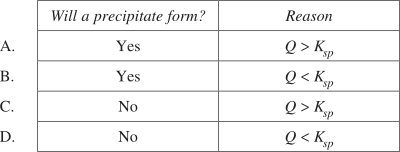
Which row of the table correctly identifies if a precipitate will form under these conditions and the reason?
 

Show Answers Only

\(D\)

Show Worked Solution

\(\ce{Ba(OH)2(s) \rightleftharpoons Ba^2+(aq) + 2OH-(aq)}\)

\(K_{sp}=2.55 \times 10^{-4}\)

\[\ce{[Ba^2+] = \frac{(0.05)(0.1)}{(0.2)} = 0.025 M}\]

\[\ce{[OH-] = \frac{(0.1)(0.1)}{(0.2)} = 0.05 M}\]

\(Q=\ce{[Ba^2+][OH-]^2}=(0.025)(0.05)^2=6.25 \times 10^{-6}\)

Since \(Q \lt K_{sp}\), no precipitate forms.

\(\Rightarrow D\)


♦♦♦ Mean mark 36%.

Filed Under: Equilibrium Constant Tagged With: Band 5, smc-3671-20-Calcs given K(eq), smc-3671-30-Deduce chemical equation, smc-3671-70-Precipitate

CHEMISTRY, M5 2021 HSC 19 MC

A quantity of silver nitrate is added to 250.0 mL of 0.100 mol L ¯1 potassium sulfate at 298 K in order to produce a precipitate. Silver nitrate has a molar mass of 169.9 g mol ¯1.

What mass of silver nitrate will cause precipitation to start?

  1. 0.00510 g
  2. 0.186 g
  3. 0.465 g
  4. 0.854 g
Show Answers Only

`C`

Show Worked Solution

The reaction when silver nitrate is added to potassium sulfate is:

`text{2} text{Ag} text{NO}_(3) (aq) + text{K}_(2) text{SO}_(4) (aq) →  text{Ag}_(2) text{SO}_(4) (s) + text{2} text{K} text{NO}_(3) (aq)`
 

Since each `text{K}_(2) text{SO}_(4)` molecule has 1 sulfate ion

`[text{SO}_(4) ^(2-)] = text{K}_(2) text{SO}_(4) = 0.100\ text{mol L}^(-1)`
 

`text{Ag}_(2) text{SO}_(4) (s) ⇋ 2text{Ag}^(+) (aq) + text{SO}_(4) ^(\ 2-) (aq)`

`text{K}_(sp) = [text{Ag}^(+)]^2 [text{SO}_(4) ^(2-)]`
 

From the data sheet:

`text{K}_(sp) = text{1.20 x 10}^-5`

`text{1.20 x 10}^-5 = [text{Ag}^(+)]^2  xx  [text{SO}_(4) ^(\ 2-)]`

`text{1.20 x 10}^-5 = [text{Ag}^(+)]^2  xx  [text{0.100}]`

`[text{Ag}^(+)] = 0.01095…\ text{mol L}^(-1)`

`[text{Ag}^(+)] = [text{AgNO}_(3)]`
 

`text{n(AgNO}_(3)) = text{c}  xx text{V} = 0.01095… xx 0.250 = 0.00273…\ text{mol}`

`text{m(AgNO}_(3)) = text{n} xx text{MM} = 0.00273… xx 169.9 = 0.465\ text{g}`

`=> C`


♦ Mean mark 45%.

Filed Under: Equilibrium Constant Tagged With: Band 5, smc-3671-20-Calcs given K(eq), smc-3671-30-Deduce chemical equation, smc-3671-70-Precipitate

Copyright © 2014–2025 SmarterEd.com.au · Log in