SmarterEd

Aussie Maths & Science Teachers: Save your time with SmarterEd

  • Login
  • Get Help
  • About

HMS, HIC 2025 HSC 28aii

Explain how becoming involved in community service can assist young people in attaining better health.  ( 5 marks)

--- 15 WORK AREA LINES (style=lined) ---

Show Answers Only
  • Community service creates opportunities for social connection with like-minded peers. This occurs when young people work alongside others towards shared goals in volunteer settings.
  • For example, a young person volunteering at environmental clean-up events develops teamwork and communication abilities. As a result, their social health improves through new friendships and increased confidence in group interactions.
  • Volunteering enhances mental health by providing sense of purpose and direction. This happens because contributing meaningfully to community needs generates feelings of value and belonging.
  • For instance, a young person supporting elderly residents through hospital visits experiences improved emotional wellbeing. The reason for this is that helping others creates perspective on personal challenges whilst building resilience through meaningful relationships.
  • Community service leads to increased physical activity in many volunteer roles. Consequently, young people gain health benefits from active engagement rather than sedentary screen time.
Show Worked Solution
  • Community service creates opportunities for social connection with like-minded peers. This occurs when young people work alongside others towards shared goals in volunteer settings.
  • For example, a young person volunteering at environmental clean-up events develops teamwork and communication abilities. As a result, their social health improves through new friendships and increased confidence in group interactions.
  • Volunteering enhances mental health by providing sense of purpose and direction. This happens because contributing meaningfully to community needs generates feelings of value and belonging.
  • For instance, a young person supporting elderly residents through hospital visits experiences improved emotional wellbeing. The reason for this is that helping others creates perspective on personal challenges whilst building resilience through meaningful relationships.
  • Community service leads to increased physical activity in many volunteer roles. Consequently, young people gain health benefits from active engagement rather than sedentary screen time.

♦♦ Mean mark 51%.

Filed Under: Strengthening, protecting and enhancing health Tagged With: Band 4, Band 5, smc-5511-30-Social connection/ethics, smc-5511-40-Skills application/impact

HMS, HIC 2025 HSC 27

Explain the responsibilities of individuals, communities and governments in creating supportive environments to promote health. Support your answer with examples.  ( 8 marks)

--- 26 WORK AREA LINES (style=lined) ---

Show Answers Only

Individual Responsibilities:

  • Individuals must adopt health-promoting behaviours that create safe environments for themselves and others. This occurs when people apply health literacy to make informed decisions.
  • For example, a parent choosing active transport to school reduces vehicle emissions and models healthy physical activity patterns. This leads to improved air quality and encourages children to adopt active lifestyles.

Community Responsibilities:

  • Communities must advocate for and support their members through accessible programs and resources. This enables individuals to access culturally appropriate health services.
  • For instance, neighbourhood walking groups organised by local councils provide social connection and physical activity opportunities. Consequently, participants experience improved mental and physical health through regular engagement and peer support networks.

Government Responsibilities:

  • Governments must develop and enforce policies that facilitate health-promoting environments. This works through legislation creating safe public spaces and restricting harmful exposures.
  • For example, mandatory bicycle helmet laws and dedicated cycling infrastructure protect cyclists from injury whilst encouraging active transport adoption. As a result, communities experience reduced traffic congestion, improved air quality and increased population physical activity levels.

Collective Impact:

  • These responsibilities work together to create comprehensive supportive environments. The significance is that sustained health improvements require coordinated action across all three levels rather than isolated individual efforts.
Show Worked Solution

Individual Responsibilities:

  • Individuals must adopt health-promoting behaviours that create safe environments for themselves and others. This occurs when people apply health literacy to make informed decisions.
  • For example, a parent choosing active transport to school reduces vehicle emissions and models healthy physical activity patterns. This leads to improved air quality and encourages children to adopt active lifestyles.

Community Responsibilities:

  • Communities must advocate for and support their members through accessible programs and resources. This enables individuals to access culturally appropriate health services.
  • For instance, neighbourhood walking groups organised by local councils provide social connection and physical activity opportunities. Consequently, participants experience improved mental and physical health through regular engagement and peer support networks.

Government Responsibilities:

  • Governments must develop and enforce policies that facilitate health-promoting environments. This works through legislation creating safe public spaces and restricting harmful exposures.
  • For example, mandatory bicycle helmet laws and dedicated cycling infrastructure protect cyclists from injury whilst encouraging active transport adoption. As a result, communities experience reduced traffic congestion, improved air quality and increased population physical activity levels.

Collective Impact:

  • These responsibilities work together to create comprehensive supportive environments. The significance is that sustained health improvements require coordinated action across all three levels rather than isolated individual efforts.

Filed Under: Models of health promotion Tagged With: Band 4, Band 5, smc-5515-10-Ottawa Charter, smc-5515-20-Policy legislation

HMS, TIP 2025 HSC 26

Analyse the relationship between training thresholds and TWO physiological adaptations. In your answer, provide examples of both aerobic and resistance training.  (8 marks)

--- 24 WORK AREA LINES (style=lined) ---

Show Answers Only

Overview Statement:

  • Training thresholds represent critical intensity levels that trigger specific physiological adaptations.
  • Understanding how aerobic and resistance thresholds connect to metabolic and muscular changes can open up pathways to enhanced athletic performance.

Aerobic Threshold and Cardiovascular Adaptations:

  • The aerobic training threshold occurs at approximately 70% of maximum heart rate. Training at this intensity influences fuel utilisation and cardiovascular function.
  • This causes the body to shift from primarily using fat to using carbohydrates for energy. For example, a marathon runner training at 70% max heart rate stimulates this metabolic adaptation.
  • The threshold also triggers increased stroke volume through enhanced left ventricle filling capacity. This relationship results in improved cardiac output and oxygen delivery to working muscles.
  • Consequently, athletes sustain effort over extended periods with greater efficiency. This shows that aerobic threshold training enables both metabolic and cardiovascular improvements for endurance performance.

Resistance Threshold and Muscular Adaptations:

  • Resistance training thresholds involve working at 70-85% of one-rep maximum with 6-12 repetitions. This intensity creates sufficient mechanical stress to stimulate muscle hypertrophy.
  • For instance, a weightlifter performing squats at 80% of 1RM bmicroscopic muscle fibre damage. This initiates increased protein synthesis and muscle repair processes.
  • The threshold works through progressive overload that leads to enlarged muscle fibres with increased actin and myosin filaments. As a result, greater force production capacity develops.
  • The significance is that athletes gain strength and power output essential for explosive movements.

Implications and Synthesis:

  • These thresholds work together as intensity markers that determine adaptation type. Aerobic thresholds influence metabolic and cardiovascular systems whilst resistance thresholds affect muscular structure.
  • Therefore, coaches must apply appropriate threshold intensities to achieve specific performance goals. This reveals that training success depends on understanding the precise relationship between intensity levels and resulting physiological changes.
Show Worked Solution

Overview Statement:

  • Training thresholds represent critical intensity levels that trigger specific physiological adaptations.
  • Understanding how aerobic and resistance thresholds connect to metabolic and muscular changes can open up pathways to enhanced athletic performance.

Aerobic Threshold and Cardiovascular Adaptations:

  • The aerobic training threshold occurs at approximately 70% of maximum heart rate. Training at this intensity influences fuel utilisation and cardiovascular function.
  • This causes the body to shift from primarily using fat to using carbohydrates for energy. For example, a marathon runner training at 70% max heart rate stimulates this metabolic adaptation.
  • The threshold also triggers increased stroke volume through enhanced left ventricle filling capacity. This relationship results in improved cardiac output and oxygen delivery to working muscles.
  • Consequently, athletes sustain effort over extended periods with greater efficiency. This shows that aerobic threshold training enables both metabolic and cardiovascular improvements for endurance performance.

Resistance Threshold and Muscular Adaptations:

  • Resistance training thresholds involve working at 70-85% of one-rep maximum with 6-12 repetitions. This intensity creates sufficient mechanical stress to stimulate muscle hypertrophy.
  • For instance, a weightlifter performing squats at 80% of 1RM bmicroscopic muscle fibre damage. This initiates increased protein synthesis and muscle repair processes.
  • The threshold works through progressive overload that leads to enlarged muscle fibres with increased actin and myosin filaments. As a result, greater force production capacity develops.
  • The significance is that athletes gain strength and power output essential for explosive movements.

Implications and Synthesis:

  • These thresholds work together as intensity markers that determine adaptation type. Aerobic thresholds influence metabolic and cardiovascular systems whilst resistance thresholds affect muscular structure.
  • Therefore, coaches must apply appropriate threshold intensities to achieve specific performance goals. This reveals that training success depends on understanding the precise relationship between intensity levels and resulting physiological changes.

♦♦ Mean mark 36%.

Filed Under: Physiological adaptations and improved performance, Principles of training Tagged With: Band 4, Band 5, Band 6, smc-5460-10-Thresholds, smc-5461-10-Cardio adaptations, smc-5461-30-Muscular adaptations

Probability, 2ADV EQ-Bank 3

In Year 11 there are 80 students. The students may choose to study Spanish (S), Japanese (J) and Mandarin (M).

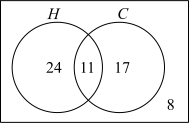
The Venn diagram shows their choices.


Two of the students are selected at random.

  1. What is the probability that both students study only Spanish?   (2 marks)

    --- 6 WORK AREA LINES (style=lined) ---

  2. What is the probability that at least one of the students studies two languages.   (2 marks)

    --- 6 WORK AREA LINES (style=lined) ---

Show Answers Only

a.    \(\dfrac{93}{632}\)

b.   \(\dfrac{81}{158} \)

Show Worked Solution

a.    \(\text{Students only studying Spanish = 31}\)

\(P(\text{both study only Spanish}\ =\dfrac{31}{80} \times \dfrac{30}{79} = \dfrac{93}{632}\)
 

b.   \(\text{1st student chosen:}\)

\(P(2L) =\dfrac{6+4+14}{80} = \dfrac{24}{80}\ \ \Rightarrow\ \ P(\overline{2L})=\dfrac{56}{80} \)

\(\text{2nd student chosen:}\)

\(P(\overline{2L})=\dfrac{55}{79} \)
 

\(P(\text{at least one studies two languages})\)

\(= 1- P(\text{both don’t study two languages)}\)

\(=1-\dfrac{56}{80} \times \dfrac{55}{79} \)

\(=\dfrac{81}{158} \)

Filed Under: Conditional Probability and Venn Diagrams Tagged With: Band 4, Band 5, smc-6470-20-Venn Diagrams/Intersections

Functions, 2ADV EQ-Bank 7

The cost of hiring an open space for a music festival is  $120 000. The cost will be shared equally by the people attending the festival, so that `C` (in dollars) is the cost per person when `n` people attend the festival.

  1. Complete the table below and draw the graph showing the relationship between `n` and `C`.   (2 marks)
    \begin{array} {|l|c|c|c|c|c|c|}
    \hline
    \rule{0pt}{2.5ex}\text{Number of people} (n) \rule[-1ex]{0pt}{0pt} & \ 500\ & \ 1000 \ & 1500 \ & 2000 \ & 2500\ & 3000 \ \\
    \hline
    \rule{0pt}{2.5ex}\text{Cost per person} (C)\rule[-1ex]{0pt}{0pt} &  &  &  & 60 & 48\ & 40 \ \\
    \hline
    \end{array}


  2. What equation represents the relationship between `n` and `C`?   (1 mark)

    --- 1 WORK AREA LINES (style=lined) ---

  3. Give ONE limitation of this equation in relation to this context.   (1 mark)

    --- 2 WORK AREA LINES (style=lined) ---

Show Answers Only

a.   

\begin{array} {|l|c|c|c|c|c|c|}
\hline
\rule{0pt}{2.5ex}\text{Number of people} (n) \rule[-1ex]{0pt}{0pt} & \ 500\ & \ 1000 \ & 1500 \ & 2000 \ & 2500\ & 3000 \ \\
\hline
\rule{0pt}{2.5ex}\text{Cost per person} (C)\rule[-1ex]{0pt}{0pt} & 240 & 120 & 80 & 60 & 48\ & 40 \ \\
\hline
\end{array}

b.   `C = (120\ 000)/n` 

c.   `text(Limitations can include:)`

  `•\ n\ text(must be a whole number)`

  `•\ C > 0`

Show Worked Solution

a.   

\begin{array} {|l|c|c|c|c|c|c|}
\hline
\rule{0pt}{2.5ex}\text{Number of people} (n) \rule[-1ex]{0pt}{0pt} & \ 500\ & \ 1000 \ & 1500 \ & 2000 \ & 2500\ & 3000 \ \\
\hline
\rule{0pt}{2.5ex}\text{Cost per person} (C)\rule[-1ex]{0pt}{0pt} & 240 & 120 & 80 & 60 & 48\ & 40 \ \\
\hline
\end{array}

b.   `C = (120\ 000)/n` 

c.   `text(Limitations can include:)`

  `•\ n\ text(must be a whole number)`

  `•\ C > 0`

Filed Under: Other Functions and Relations Tagged With: Band 3, Band 4, Band 5, smc-6218-30-Reciprocal

HMS, TIP 2025 HSC 18 MC

An elite athlete is training to enhance their muscular strength.

Which of the following approaches best demonstrates progressive overload for increased strength? (RM = repetition maximum)

  1. Adding exercises while performing four sets of eight repetitions at 60% of one RM
  2. Alternating between 80% and 90% of one RM weekly for three sets of 12 repetitions
  3. Starting with weights at 50% of one RM and gradually increasing the total repetitions each week repetitions each week 
  4. Adjusting the resistance from 80% to 90% of one RM, performing three to five sets of four to six repetitions
Show Answers Only

\(D\)

Show Worked Solution
  • D is correct: Progressive resistance increase (80% to 90% 1RM) with low reps (4-6) targets absolute strength development

Other Options:

  • A is incorrect: 60% 1RM with 8 reps develops muscular endurance, not maximal strength; adding exercises doesn’t increase load
  • B is incorrect: Alternating loads weekly lacks progressive overload; 12 reps targets endurance rather than strength
  • C is incorrect: Starting at 50% 1RM and increasing repetitions develops endurance, not strength; requires higher loads

♦♦ Mean mark 43%.

Filed Under: Principles of training Tagged With: Band 5, smc-5460-10-Thresholds

HMS, TIP 2025 HSC 14 MC

Which row in the table describes both a valid and reliable test for measuring the speed of an athlete?

\begin{align*}
\begin{array}{l}
\rule{0pt}{2.5ex} \ \rule[-1ex]{0pt}{0pt}&  \\
\textbf{}\ \rule[-1ex]{0pt}{0pt}& \\
\rule{0pt}{2.5ex}  \textbf{A.}\ \rule[-1ex]{0pt}{0pt}&\\
\textbf{}\ \rule[-1ex]{0pt}{0pt}& \\
\rule{0pt}{2.5ex}  \textbf{B.} \ \rule[-1ex]{0pt}{0pt}&\\
\textbf{} \ \rule[-1ex]{0pt}{0pt}&\\
\rule{0pt}{2.5ex}  \textbf{C.} \ \rule[-1ex]{0pt}{0pt}& \\
\textbf{} \ \rule[-1ex]{0pt}{0pt}& \\
\rule{0pt}{2.5ex}  \rule{0pt}{2.5ex}  \textbf{D.} \ \rule[-1ex]{0pt}{0pt}& \\
\textbf{}\ \rule[-1ex]{0pt}{0pt}& \\
\end{array}
\begin{array}{|l|l|}
\hline
\rule{0pt}{2.5ex} \ \ \ \ \ Athlete \rule[-1ex]{0pt}{0pt} &\ \ \ \ \ \ \ Test  \rule[-1ex]{0pt}{0pt} & \ \ \ \ \ \ \ \ \ \ \ \ \ \ \ \ \ \ \ \ \ \ \ \ Result  \\
\hline
\rule{0pt}{2.5ex}\text{100 m sprinter} & \text{Reaction time} & \text{There are changes in the athlete’s sprint} \\
\text{} &\text{to starter } &\text{times.} \\
\hline
\rule{0pt}{2.5ex}\text{100 m sprinter} &\text{Reaction time}  & \text{Results are consistent across multiple} \\
\text{} & \text{to starter} & \text{training sessions.} \\
\hline
\rule{0pt}{2.5ex} \text{Midfielder in } & \text{40 m sprint } & \text{There are changes in the athlete’s sprint} \\
 \text{soccer } &\text{choice} & \text{times.} \\
\hline
\rule{0pt}{2.5ex}\text{Midfielder in } & \text{40 m sprint } & \text{Results are consistent across multiple} \\
\text{soccer } &\text{choice} & \text{training sessions. } \\
\hline
\end{array}
\end{align*}

Show Answers Only

\(D\)

Show Worked Solution
  • D is correct: 40m sprint test is valid (measures speed); consistent results demonstrate reliability

Other Options:

  • A is incorrect: Reaction time measures response speed, not running speed (lacks validity)
  • B is incorrect: Reaction time test is not valid for measuring running speed
  • C is incorrect: Changes in sprint times indicate inconsistent results (lacks reliability)

♦♦ Mean mark 50%.

Filed Under: Performance/fitness testing Tagged With: Band 5, smc-5457-30-Specific tests

HMS, BM 2025 HSC 13 MC

Which of the following best demonstrates how the characteristics of the learner can influence their progression through to the associative stage of skill acquisition?

  1. A swimmer relies on their heredity traits and confidence to improve their freestyle technique.
  2. A gymnast performs a routine, relying on additional practice and feedback from their coach.
  3. A basketball player learns the technique of shooting by relying on demonstrations but gives up easily.
  4. A tennis player is struggling to return serves, due to limited confidence and inconsistent attention.
Show Answers Only

\(A\)

Show Worked Solution
  • A is correct: Heredity traits and confidence are learner characteristics enabling progression from cognitive to associative stage

Other Options:

  • B is incorrect: Practice and feedback are teaching methods, not learner characteristics influencing progression
  • C is incorrect: Giving up easily indicates failure to progress beyond cognitive stage, not advancement
  • D is incorrect: Struggling with limited confidence shows barriers preventing progression, not successful advancement

♦♦♦ Mean mark 36%.

Filed Under: Characteristics of learners, Stages of learning Tagged With: Band 5, smc-5534-60-Identify characteristics, smc-5921-20-Associative

HMS, HAG 2025 HSC 12 MC

Which of the following lists only non-institutional health facilities or services?

  1. Dentists, nursing homes and public hospitals
  2. Dentists, general practitioners and pharmaceutical services
  3. General practitioners, physiotherapists and public hospitals
  4. Nursing homes, pharmaceutical services and physiotherapists
Show Answers Only

\(B\)

Show Worked Solution
  • B is correct: Dentists, GPs and pharmacies are all non-institutional services operating outside residential/hospital facilities

Other Options:

  • A is incorrect: Nursing homes and public hospitals are institutional facilities requiring overnight/residential care
  • C is incorrect: Public hospitals are institutional facilities providing inpatient care and accommodation
  • D is incorrect: Nursing homes are institutional facilities providing residential aged care with overnight stays

♦♦ Mean mark 45%.

Filed Under: Healthcare System effectiveness Tagged With: Band 5, smc-5479-05-Healthcare roles

HMS, HAG 2025 HSC 9 MC

Which of the following is a circulatory disease which causes the blood vessels to narrow, resulting in blockages that reduce the delivery of oxygen to the limbs, kidneys and stomach?

  1. Angina
  2. Coronary heart disease
  3. Cerebrovascular disease
  4. Peripheral vascular disease
Show Answers Only

\(D\)

Show Worked Solution
  • D is correct: Peripheral vascular disease affects blood vessels supplying limbs, kidneys and stomach with narrowed arteries

Other Options:

  • A is incorrect: Angina is chest pain symptom from reduced heart blood flow, not systemic vessel narrowing
  • B is incorrect: Coronary heart disease affects heart arteries specifically, not peripheral vessels to limbs/organs
  • C is incorrect: Cerebrovascular disease affects brain blood vessels, not limbs, kidneys or stomach circulation

♦♦ Mean mark 40%.

Filed Under: Chronic Conditions, Diseases and Injury Tagged With: Band 5, smc-5477-05-Cardiovascular disease

HMS, BM 2025 HSC 6 MC

A golfer is practising hitting the ball.

Which of the following best describes the nature of the skill?

  1. Fine, discrete and self-paced
  2. Gross, discrete and self-paced
  3. Fine, serial and externally paced
  4. Gross, serial and externally paced
Show Answers Only

\(B\)

Show Worked Solution
  • B is correct: A golf swing uses large muscle groups, has clear beginning/end, controlled by performer’s timing.

Other Options:

  • A is incorrect: Fine motor skills involve small muscles; golf requires large muscle coordination.
  • C is incorrect: Serial skills link multiple actions; golf swing is single distinct movement.
  • D is incorrect: Externally paced means environment controls timing; golfer controls swing initiation.

♦♦ Mean mark 44%.

Filed Under: Characteristics of skills Tagged With: Band 5, smc-5922-20-Gross/Fine, smc-5922-30-Discrete/Serial/Continuous, smc-5922-40-Self and externally paced

Functions, 2ADV EQ-Bank 2

Given \(p\) and \(q\) are rational numbers, and  \(p, q \neq 0\), show

\(px^2-(p+q) x+q=0\)

has rational roots.   (3 marks)

--- 10 WORK AREA LINES (style=lined) ---

Show Answers Only

\(\text{Proof (See Worked Solution)}\)

Show Worked Solution
\(\Delta\) \(=b^2-4 a c\)
  \(=[-(p+q)]^2-4 \times p \times q\)
  \(=p^2+2 p q+q^2-4 p q\)
  \(=p^2-2 p q+q^2\)
  \(=(p-q)^2\)


\(\text{Roots of equation using quadratic formula:}\)

\(x\) \(=\dfrac{(p+q) \pm \sqrt{(p-q)^2}}{2 p}\)
  \(=\dfrac{p+q+(p-q)}{2 p} \ \ \text{or} \ \ \dfrac{p+q-(p-q)}{2 p}\)
  \(=1 \ \ \text{or} \ \ \dfrac{q}{p}\).


\(\text{Since \(p, q\) are rational, all roots are rational.}\)

Filed Under: Quadratics and Cubic Functions Tagged With: Band 5, smc-6215-80-Discriminant

Financial Maths, STD2 EQ-Bank 35

A used car is for sale at $19,500. Priya purchases it using a finance package with a 15% deposit and weekly repayments of $143.27 for 3 years.

What is the interest Priya will pay?   (3 marks)

--- 6 WORK AREA LINES (style=lined) ---

Show Answers Only

\($5775.12\)

Show Worked Solution
\(\text{Deposit}\) \(=\dfrac{15}{100}\times 19\,500=$2925\)

\(\text{Weeks in 3 years}=3\times 52=156\)

\(\text{Total repayments}\) \(=156\times 143.27\)
  \(=$22\,350.12\)
\(\text{Total cost}\) \(=2925+22\,350.12\)
  \(=$25\,275.12\)


\(\therefore\ \text{Interest paid}\) \(=25\,275.12-19\,500\)
  \(=$5775.12\)

Filed Under: Purchasing Goods (Std1-2027), Purchasing Goods (Std2-2027) Tagged With: Band 5, smc-6278-35-Loans, smc-6517-35-Loans, syllabus-2027

Financial Maths, STD2 EQ-Bank 34

A smart TV is for sale at $2850. Liam purchases it using a finance package with a 20% deposit and monthly repayments of $87.63 for 3 years.

What is the interest Liam will pay?   (3 marks)

--- 6 WORK AREA LINES (style=lined) ---

Show Answers Only

\($874.68\)

Show Worked Solution
\(\text{Deposit}\) \(=\dfrac{20}{100}\times 2850=$570\)

\(\text{Months in 3 years}=3\times 12=36\)

\(\text{Total repayments}\) \(=36\times 87.63\)
  \(=$3154.68\)
\(\text{Total cost}\) \(=570+3154.68\)
  \(=$3724.68\)


\(\therefore\ \text{Interest paid}\) \(=3724.68-2850\)
  \(=$874.68\)

Filed Under: Purchasing Goods (Std1-2027), Purchasing Goods (Std2-2027) Tagged With: Band 5, smc-6278-35-Loans, smc-6517-35-Loans, syllabus-2027

Financial Maths, STD2 EQ-Bank 28 MC

Tom purchased a car using a finance package. He paid a deposit of $6500 and the total amount he paid for the car was $38 900. The loan was for 4 years with equal monthly repayments.

What was Tom's monthly repayment?

  1. $675
  2. $810
  3. $8,100
  4. $9,725
Show Answers Only

\(A\)

Show Worked Solution
\(\text{Total repayments:}\) \(=\text{Total amount paid}-\text{Deposit}\)
  \(=$38\,900-$6500\)
  \(=$32\,400\)

\(\text{Number of repayments}=4\times 12=48\)

\(\text{Monthly repayment:}\) \(=\dfrac{32\,400}{48}\)
  \(=$675\ \text{per month}\)


\(\Rightarrow A\)

Filed Under: Purchasing Goods (Std1-2027), Purchasing Goods (Std2-2027) Tagged With: Band 5, smc-6278-35-Loans, smc-6517-35-Loans, syllabus-2027

Functions, 2ADV EQ-Bank 8 MC

The equation  `(p-1)x^2 + 4x = 5-p`  has no real roots when

  1. `p^2-6p + 6 < 0`
  2. `p^2-6p + 1 > 0`
  3. `p^2-6p-6 < 0`
  4. `p^2-6p + 1 < 0`
Show Answers Only

`B`

Show Worked Solution

`(p-1)x^2 + 4x + (p-5) = 0`

 
`text(No real solutions when)\ \ Δ<0:`

`b^2-4ac` `<0`
`4^2-4 (p-1)(p-5)` `< 0`
`16-4(p^2-6p+5)` `<0`
`−4p^2 + 24p-4` `< 0`
`p^2-6p + 1` `> 0`

 
`=> B`

Filed Under: Quadratics and Cubic Functions Tagged With: Band 5, smc-6215-80-Discriminant

Functions, 2ADV EQ-Bank 9 MC

The graphs of  `y = mx + c`  and  `y = ax^2`  will have no points of intersection for all values of `m, c` and `a` such that

  1. `a > 0 and c > 0`
  2. `m > 0 and c > 0`
  3. `a > 0 and c > -m^2/(4a)`
  4. `a < 0 and c > -m^2/(4a)`
Show Answers Only

`D`

Show Worked Solution

`text(Intersect when:)`

`mx + c` `= ax^2`
`ax^2-mx-c` `= 0`

 
`text(S)text(ince no points of intersection:)`

`Delta` `< 0`
`m^2-4a(−c)` `< 0`
`m^2 + 4ac` `< 0`

 
`text(Solve for)\ c:`

`:.\ c > (−m^2)/(4a),quada < 0`

`text(or)`

`c < (−m^2)/(4a),quada > 0`

`=>   D`

Filed Under: Quadratics and Cubic Functions Tagged With: Band 5, smc-6215-80-Discriminant

Algebra, STD2 EQ-Bank 18

A train departs from Town X at 1:00 pm to travel to Town Y. Its average speed for the journey is 80 km/h, and it arrives at 4:00 pm. A second train departs from Town X at 1:20 pm and arrives at Town Y at 3:30 pm.

What is the average speed of the second train? Give your answer to the nearest kilometre per hour.   (2 marks)

--- 5 WORK AREA LINES (style=lined) ---

Show Answers Only

\(\text{111 km/h}\)

Show Worked Solution

\(\text{Distance between towns X and Y using first train}\)

\(\text{Time taken by first train: 1 pm to 4 pm}=3\ \text{hours}\)

\(\text{Distance}\) \(=\text{speed}\times\text{time}\)
  \(=80\times 2=240\ \text{km}\)

\(\text{Time taken by second train: 1:20 pm to 3:30 pm}\)

\(=3:30-1:20=2\ \text{hours 10 minutes}\)

\(=\frac{130}{60}\ \text{hours}=\frac{13}{6}\ \text{hours}\)

\(\text{Average speed of second train}\)

\(\text{speed}\) \(=\dfrac{\text{distance}}{\text{time}}=\dfrac{240}{\frac{13}{6}}\)
  \( =240\times\frac{6}{13}=110.769…\)

  
\(\therefore\ \text{The average speed of the second train is 111 km/h (nearest km/h)}\)


Filed Under: Applications: BAC, Medicine and d=s x t (Std1-2027), Applications: BAC, Medicine and D=SxT (Std2-2027) Tagged With: Band 5, smc-6235-20-\(d=s\times t\), smc-6509-20-\(d=s \times t\), syllabus-2027

Measurement, STD2 EQ-Bank 30 MC

Singapore is located at longitude 104\(^{\circ}\text{E}\) and Buenos Aires is located at longitude 58\(^{\circ}\text{W}\). What is the time in Buenos Aires when it is 9:20 am in Singapore?

  1. 10:08 pm (previous day)
  2. 8:32 pm (previous day)
  3. 10:32 am
  4. 8:08 am
Show Answers Only

\(C\)

Show Worked Solution

\(\text{Step 1: Calculate the longitudinal distance between the two cities}\)

\(\rightarrow\ \text{Singapore is at } (104^{\circ}\text{E}),\text{and Buenos Aires is at}\ ( 58^{\circ} \text{W}) \)

\(\rightarrow\ \text{Since the cities are on opposite sides of the Prime Meridian, we add the longitudes:}\)

\(\rightarrow\ \text{Longitudinal distance} = 104^{\circ}+58^{\circ}=162^{\circ}\)

\(\text{Step 2: Calculate the time difference}\)

\(\rightarrow\ 15^{\circ}\ =\text{1 hour time difference}\)

\(\therefore\ \text{Time Difference} = \dfrac{162}{15} \text{ hours} = 10.8\text{ hours}=10\text{ hours}\ 48\ \text{minutes} \)

\(\text{Step 3: Determine which city is ahead}\)

\(\rightarrow\ \text{Singapore }(104^{\circ}\text{E) is east of Buenos Aires}\ ( 58^{\circ} \text{W), so Singapore is ahead in time.}\)

\(\rightarrow\ \text{Time in Singapore}\ =\ 9:20\ \text{am}\)

\(\therefore\ \text{Time in Buenos Aires}\) \(=9:20\ \text{am}-10\ \text{hours}\ 48\text{ minutes}\)
  \(=11:20\ \text{pm}-48\ \text{minutes}\)
  \(=10:32\ \text{pm, previous day}\)

\(\Rightarrow C\)

Filed Under: Position on the Earth's Surface (Std1-2027), Positions on the Earth's Surface (Std2-2027) Tagged With: Band 5, smc-6305-10-Longitude and Time Differences, smc-6524-10-Longitude and Time Differences, syllabus-2027

Measurement, STD2 EQ-Bank 26

Use the train timetable below to answer this question.

Emma lives in Berowra and travels to Wyong for an appointment. After her appointment, she needs to attend a meeting in Gosford before returning home to Berowra.

  1. Emma catches the train that departs Wyong at 09:16. How long does this train take to reach Gosford?   (1 mark)

    --- 2 WORK AREA LINES (style=lined) ---

  2. Emma's meeting in Gosford starts at 10:15 am at a venue that is 7 minutes walk from Gosford station. What is the latest train she can catch from Wyong to arrive at her meeting on time?   (2 marks)

    --- 3 WORK AREA LINES (style=lined) ---

  3. After her meeting finishes at 11:20 am, Emma walks back to Gosford station (taking 7 minutes). What is the earliest train she can catch from Gosford to return home to Berowra, and what time will she arrive home?   (2 marks)

    --- 3 WORK AREA LINES (style=lined) ---

Show Answers Only

a.   \(17\ \text{minutes}\)

b.   \(09:37\ \text{train}\)

c.   \(\text{11:34 am Gosford train, arrives at Berowra at 12:37 pm}\)

Show Worked Solution

a.   \(\text{Elapsed time:}\ =09:33-09:16 = 17 \text{ minutes} \)

b.   \(\text{Step 1: Meeting starts at 10:15 am}\)

\(\rightarrow\ 7\text{ minutes to walk from Gosford station to the venue.}\)

\(\rightarrow\ \text{At Gosford Station by: }\ 10:15-7 \text{ minutes} = 10:08 \text{ am}\)

\(\text{Step 2: Find latest train arriving at Gosford by 10:08 am}\)

\(\rightarrow\ \text{Arrival times: } 08:12, 08:33, 08:58, 09:33, 09:58, 10:33\)

\(\rightarrow\ \text{She must catch the }09:58.\)

\(\text{Step 3: When does 09:58 depart Wyong?}\)

\(\rightarrow\ 09:37\ \text{train}\)

c.   \(\text{Step 1: Determine when Emma arrives back at Gosford station}\)

\(\rightarrow\ \text{Meeting finishes at }11:20 \text{ am}\)

\(\text{Walking time back to station: 7 minutes}\)

\(\text{Emma arrives at Gosford station at:}\ 11:20 + 7 \text{ minutes} = 11:27 \text{ am} \)

\(\text{Step 1: Find the earliest train departing Gosford after 11:27 am}\)

\(\rightarrow\ \text{Meeting finishes at }11:20 \text{ am}\)

\(\rightarrow\ \text{Relevant departure times:} …10:34, 10:59, 11:34, 11:59\)

\(\rightarrow\ \text{Earliest train after 11:27 am is the }11:34 \text{ am}\)

\(\text{Step 3: Find when this train arrives in Berowra}\)

\(\rightarrow\ \text{11:34 am Gosford train, arrives at Berowra at }12:37 \text{ pm}\)

Filed Under: Time and Time Difference (Std1-2027), Time and Time Difference (Std2-2027) Tagged With: Band 3, Band 4, Band 5, smc-6306-20-Elapsed Time Problems, smc-6525-20-Elapsed Time Problems, syllabus-2027

Statistics, STD2 EQ-Bank 11 MC

Twenty-five people were surveyed about the amount of money they spent on groceries per week, to the nearest dollar.

The results are shown in the frequency table.

\begin{array} {|c|c|}
\hline
\rule{0pt}{2.5ex} \textit{Amount Spent}  ($) \rule[-1ex]{0pt}{0pt} & \ \ \ \ \ \textit{Frequency}\ \ \ \ \  \\
\hline
\rule{0pt}{2.5ex} 50-99 \rule[-1ex]{0pt}{0pt} & 8 \\
\hline
\rule{0pt}{2.5ex} 100-149 \rule[-1ex]{0pt}{0pt} & 10 \\
\hline
\rule{0pt}{2.5ex} 150-199 \rule[-1ex]{0pt}{0pt} & 7 \\
\hline
\rule{0pt}{2.5ex} 200-249 \rule[-1ex]{0pt}{0pt} & 5 \\
\hline
\end{array}

What is the mean amount spent on groceries by these people per week?

  1. $143.50
  2. $148.50
  3. $153.50
  4. $158.50
Show Answers Only

\(B\)

Show Worked Solution

\(\text{Using the class centres}\)

\(\text{Class centres: } 74.5, 124.5, 174.5, 224.5\)

\(\text{Total hours}\) \(=(74.5 \times 4) + (124.5 \times 9) + (174.5 \times 8) + (224.5 \times 4)\)
  \(=298 + 1120.5 + 1396 + 898\)
  \(=3712.5\)
\(\text{Mean amount}\) \(=\dfrac{3712.5}{25} =$148.50\)

\(\Rightarrow B\)

Filed Under: Measures of Central and Spread (Std1-2027), Measures of Centre and Spread (Std2-2027), Summary Statistics - No Graph (Std 2), Summary Statistics - No graph (Y12), Summary Statistics (no graph), Summary Statistics (Std 1) Tagged With: Band 5, smc-1131-10-Mean, smc-1131-40-Class Centres, smc-6312-10-Mean, smc-6312-40-Class Centres, smc-6532-10-Mean, smc-6532-40-Class Centres, smc-824-10-Mean, smc-824-40-Class Centres, smc-999-10-Mean, smc-999-40-Class Centres, syllabus-2027

Statistics, STD2 EQ-Bank 10 MC

Thirty students were surveyed about the number of hours they spent on homework per week, to the nearest hour.

The results are shown in the frequency table.

\begin{array} {|c|c|}
\hline
\rule{0pt}{2.5ex} \textit{Hours per week} \rule[-1ex]{0pt}{0pt} & \ \ \ \ \ \textit{Frequency}\ \ \ \ \  \\
\hline
\rule{0pt}{2.5ex} 0-4 \rule[-1ex]{0pt}{0pt} & 8 \\
\hline
\rule{0pt}{2.5ex} 5-9 \rule[-1ex]{0pt}{0pt} & 10 \\
\hline
\rule{0pt}{2.5ex} 10-14 \rule[-1ex]{0pt}{0pt} & 7 \\
\hline
\rule{0pt}{2.5ex} 15-19 \rule[-1ex]{0pt}{0pt} & 5 \\
\hline
\end{array}

What is the mean number of hours of homework completed by the students per week?

  1. 8.0
  2. 8.5
  3. 9.0
  4. 9.5
Show Answers Only

\(B\)

Show Worked Solution

\(\text{Using the class centres}\)

\(\text{Class centres: } 2, 7, 12, 17\)

\(\text{Total hours}\) \(=(2\times 8) + (7\times 10) + (12\times 7) + (17\times 5)\)
  \(=16 + 70 + 84 + 85\)
  \(=255\)
\(\text{Mean hours}\) \(=\dfrac{255}{30} =8.5\)

\(\Rightarrow B\)

Filed Under: Measures of Central and Spread (Std1-2027), Measures of Centre and Spread (Std2-2027), Summary Statistics - No Graph (Std 2), Summary Statistics - No graph (Y12), Summary Statistics (no graph), Summary Statistics (Std 1) Tagged With: Band 5, smc-1131-10-Mean, smc-1131-40-Class Centres, smc-6312-10-Mean, smc-6312-40-Class Centres, smc-6532-10-Mean, smc-6532-40-Class Centres, smc-824-10-Mean, smc-824-40-Class Centres, smc-999-10-Mean, smc-999-40-Class Centres, syllabus-2027

Statistics, STD2 EQ-Bank 9 MC

A dataset has an interquartile range (IQR) of 18.

The upper quartile (Q₃) is 45.

What is the maximum value that would NOT be classified as an outlier? 

  1. 63
  2. 68
  3. 70
  4. 72
Show Answers Only

\(D\)

Show Worked Solution

\(1.5 \times \text{IQR} = 1.5 \times 18 = 27\)

\(\text{Upper boundary} = Q_3 + 27 = 45 + 27 = 72\)

\(\text{Values up to and including 72 are not outliers}\)

\(\text{Values above 72 are outliers}\)

\(\therefore\ \text{Maximum value that is not an outlier} = 72\)

\(\Rightarrow D\)

Filed Under: Measures of Centre and Spread (Std2-2027) Tagged With: Band 5, smc-6312-30-IQR and Outliers, syllabus-2027

BIOLOGY, M6 2025 HSC 30b

PAI-1 protein is encoded by the SERPINE 1 gene in humans. Anopheles mosquitoes have been genetically modified to express PAI-1, which blocks the entry of the malarial Plasmodium into the mosquito gut. This disrupts the Plasmodium life cycle, resulting in reduced transmission of malaria. 

'Genetic technologies are beneficial for society.'

Evaluate this statement.   (7 marks)

--- 24 WORK AREA LINES (style=lined) ---

Show Answers Only

Evaluation Statement

  • Genetic technologies are highly beneficial for society when evaluated against health improvements and food security criteria.
  • Despite some ethical and environmental concerns requiring careful management, the overall net benefits are substantial.

Health Benefits

  • Genetically modified mosquitoes expressing PAI-1 significantly reduce malaria transmission, potentially saving millions of lives annually.
  • Recombinant DNA technology produces insulin and vaccines, improving accessibility to life-saving treatments for diabetes and infectious diseases.
  • Gene therapy offers potential cures for inherited genetic disorders, dramatically improving quality of life for affected individuals.
  • The health criterion strongly meets beneficial status because these technologies address major global health challenges.

Food Security and Agricultural Benefits

  • Genetically modified crops like Bt cotton and Golden Rice increase crop yields and nutritional content, addressing food scarcity.
  • Drought-resistant GM crops enable farming in challenging environments, supporting population growth and farmer livelihoods.
  • However, concerns exist about reduced genetic diversity and corporate control over seeds, creating inequalities in access.

Final Evaluation

  • Weighing these factors shows genetic technologies are substantially beneficial for society.
  • The health improvements and food security gains outweigh the manageable ethical concerns.
  • While challenges like biodiversity impacts and equitable access require ongoing attention, the overall societal benefit remains considerable through life-saving medical applications and enhanced food production.
Show Worked Solution

Evaluation Statement

  • Genetic technologies are highly beneficial for society when evaluated against health improvements and food security criteria.
  • Despite some ethical and environmental concerns requiring careful management, the overall net benefits are substantial.

Health Benefits

  • Genetically modified mosquitoes expressing PAI-1 significantly reduce malaria transmission, potentially saving millions of lives annually.
  • Recombinant DNA technology produces insulin and vaccines, improving accessibility to life-saving treatments for diabetes and infectious diseases.
  • Gene therapy offers potential cures for inherited genetic disorders, dramatically improving quality of life for affected individuals.
  • The health criterion strongly meets beneficial status because these technologies address major global health challenges.

Food Security and Agricultural Benefits

  • Genetically modified crops like Bt cotton and Golden Rice increase crop yields and nutritional content, addressing food scarcity.
  • Drought-resistant GM crops enable farming in challenging environments, supporting population growth and farmer livelihoods.
  • However, concerns exist about reduced genetic diversity and corporate control over seeds, creating inequalities in access.

Final Evaluation

  • Weighing these factors shows genetic technologies are substantially beneficial for society.
  • The health improvements and food security gains outweigh the manageable ethical concerns.
  • While challenges like biodiversity impacts and equitable access require ongoing attention, the overall societal benefit remains considerable through life-saving medical applications and enhanced food production.

♦ Mean mark 64%.

Filed Under: Biotechnology Tagged With: Band 4, Band 5, smc-3653-20-Evaluating Genetic Technology

Financial Maths, STD2 EQ-Bank 18

David and Mary are a couple living together. They each receive the maximum Age Pension payment of $888.50 per fortnight (which includes basic rate, Pension Supplement and Energy Supplement).

Their combined income from part-time work is $520 per fortnight. Their Age Pension is reduced by 25 cents each for every dollar of combined income over $380 per fortnight..

  1. Calculate the reduction in each person's Age Pension payment.    (2 marks)

    --- 3 WORK AREA LINES (style=lined) ---

  2. Calculate their total household fortnightly income including their reduced Age Pension payments and earnings.   (2 marks)

    --- 3 WORK AREA LINES (style=lined) ---

  3. What percentage of their total household income comes from their Age Pension payments? Give your answer to 1 decimal place.   (1 mark)

    --- 3 WORK AREA LINES (style=lined) ---

Show Answers Only

a.    \($35\)

b.    \($2227\)

c.    \(76.6\%\ \text{(to 1 d.p.)}\)

Show Worked Solution

a.    \(\text{Combined income over free area} = 520-380=$140\)

\(\text{Reduction for each person} = 0.25 \times 140= $35\)

\(\therefore\ \text{Each person’s pension is reduced by \$35}\)
  

b.    \(\text{Reduced pension for each person}=888.50-35= $853.50\)

\(\text{Combined Age Pension} = 2 \times 853.50=$1707\)

\(\text{Total household income} = 1707+520=$2227\)
  

c.    \(\text{Percentage from Age Pension} =\dfrac{1707}{2227}\times 100=76.6\%\ \text{(to 1 d.p.)}\)

\(\therefore\ 76.6\%\text{ of their household income comes from Age Pension}\)

Filed Under: Ways of Earning (Std2-2027) Tagged With: Band 3, Band 4, Band 5, smc-6276-40-Govt Payments, syllabus-2027

Financial Maths, STD2 EQ-Bank 17

Baron is 19 years old, single with no children, and lives away from his parents' home to study. He receives the maximum Youth Allowance payment of $663.30 per fortnight.

Baron supplements his payments by working part-time and earns $15.50 per hour in a retail position. His Youth Allowance is reduced by 50 cents for each dollar earned over $236 per fortnight.

  1. Baron works 22 hours per fortnight. Calculate his total fortnightly income including his reduced Youth Allowance payment and earnings.   (2 marks)

    --- 4 WORK AREA LINES (style=lined) ---

  2. What is the maximum number of hours Baron can work per fortnight before his Youth Allowance payment is reduced to zero? Give your answer to the nearest whole hour.   (2 marks)

    --- 4 WORK AREA LINES (style=lined) ---

Show Answers Only

a.    \(\text{\$951.80 per fortnight}\)

b.    \(\text{101 hours per fortnight}\)

Show Worked Solution

a.    \(\text{Baron’s earnings} = 15.50\times 22=$341\)

\(\text{Income over free area} = 341-236 = $105\)

\(\text{Reduction in payment} = 0.50\times 105= $52.50\)

\(\text{Reduced Youth Allowance} = 663.30-52.50=$610.80\)

\(\text{Total fortnightly income} = 610.80+341=$951.80\)

b.    \(\text{For payment to reduce to zero, reduction needed} = $663.30\)

\(\text{Income over free area} = \dfrac{663.30}{0.50}=$1326.60\)

\(\text{Total earnings needed} = 1326.60+236=$1,562.60\)

\(\text{Hours needed}=\dfrac{1,562.60}{15.50}=100.8\)

\(\therefore\ \text{Baron can work a maximum of 101 hours per fortnight}\)

Filed Under: Ways of Earning (Std2-2027) Tagged With: Band 3, Band 5, smc-6276-40-Govt Payments, syllabus-2027

Financial Maths, STD2 EQ-Bank 16

Yuki is single with no children and receives the maximum JobSeeker Payment of $793.60 per fortnight.

Her JobSeeker Payment is reduced by 50 cents for each dollar earned over $150 per fortnight.

  1. Rachel earns $380 per fortnight from casual work. Calculate her reduced JobSeeker Payment.   (2 marks)

    --- 4 WORK AREA LINES (style=lined) ---

  2. How much would Rachel need to earn per fortnight for her JobSeeker Payment to be reduced to $600?   (2 marks)

    --- 4 WORK AREA LINES (style=lined) ---

Show Answers Only

a.    \($678.60\ \text{per fortnight}\)

b.    \($537.20\ \text{per fortnight}\)

Show Worked Solution

a.    \(\text{Income over free area} = 380-150=$230\)

\(\text{Reduction in payment} = 0.50\times 230 = $115\)

\(\text{Reduced JobSeeker Payment} = 793.60-115 = $678.60\)

\(\therefore\ \text{Rachel receives \$678.60 per fortnight}\)

b.    \(\text{Required reduction} = 793.60-600=$193.60\)

\(\text{Income over free area} = \dfrac{193.60}{0.50}=$387.20\)

\(\text{Total income needed} = 387.20+150=$537.20\)

\(\therefore\ \text{Rachel needs to earn \$537.20 per fortnight}\)

Filed Under: Ways of Earning (Std2-2027) Tagged With: Band 3, Band 5, smc-6276-40-Govt Payments, syllabus-2027

Financial Maths, STD1 EQ-Bank 1 MC

Sarah is single with no children and receives the maximum JobSeeker Payment of $793.60 per fortnight.

She earns $350 per fortnight from casual work. The JobSeeker Payment is reduced by 50 cents for each dollar earned over $150 per fortnight.

What is Sarah's reduced JobSeeker Payment this fortnight?

  1. $593.60
  2. $643.60
  3. $693.60
  4. $743.60
Show Answers Only

\(C\)

Show Worked Solution

\(\text{Maximum JobSeeker Payment (single, no children)} = $793.60\)

\(\text{Income over free area} = 350-150 = $200\)

\(\text{Reduction in payment} = 0.50\times 200 = $100\)

\(\therefore\ \text{Reduced JobSeeker Payment} = 793.60-100 = $693.60\)

\(\Rightarrow C\)

Filed Under: Ways of Earning (Std1-2027) Tagged With: Band 5, smc-6515-40-Govt Payments, syllabus-2027

Functions, EXT1′ F1 2007 HSC 3a*

The diagram shows the graph of  \(y = f(x)\). The line  \(y = x\)  is an asymptote.

Draw separate one-third page sketches of the graphs of the following:

  1.   \(f(\abs{x})\).   (2 marks)

    --- 10 WORK AREA LINES (style=lined) ---

  2.    \(f(x)-x\).   (2 marks)

    --- 10 WORK AREA LINES (style=lined) ---

Show Answers Only

i.       
       

ii.
           

Show Worked Solution
MARKER’S COMMENT: In part (i), a significant number of students graphed  \(y=\abs{f(x)}\).
i.


ii. 

Filed Under: Graphical Relationships (Ext1-2027) Tagged With: Band 4, Band 5, page-break-before-solution, smc-6640-30-\(y=\abs{f(x)}; y=f(\abs{x}) \), smc-6640-60-\(f(x)-g(x)\)

Functions, EXT1′ F1 2013 HSC 13bii

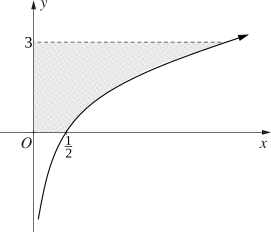
The diagram shows the graph of a function `f(x).`
 

Sketch the curve  `y = 1/(1-f(x)).`   (3 marks)

--- 12 WORK AREA LINES (style=lined) ---

Show Answers Only

Show Worked Solution

`y = 1/(1-f(x))`

MARKER’S COMMENT: Correct working sketches such as `y=-f(x)` and `y=1-f(x)` meant that students could obtain some marks, even if their final sketch was wrong.

`f(x) = 1,\ \ \ y\ text(undefined.)`

`f(x) > 1,\ \ \ y < 0`

`f(x) <= 0, \ \ \ y <= 1`

`\text{Create graph in 3 stages:}`
 

Filed Under: Graphical Relationships (Ext1-2027) Tagged With: Band 5, smc-6640-10-\(y=\dfrac{1}{f(x)}\)

Financial Maths, STD2 EQ-Bank 8

Chen works in a packaging factory and is paid $0.85 for each box he packs. Last month he worked 160 hours and packed 8960 boxes.

  1. Calculate Chen's total earnings for the month.  (1 mark)

    --- 2 WORK AREA LINES (style=lined) ---

  2. Calculate what percentage of Chen's total earnings he would earn per hour. Give your answer correct to 2 decimal places.   (2 marks)

    --- 4 WORK AREA LINES (style=lined) ---

Show Answers Only
  1. \($7616\)
  2. \(0.63\%\)
Show Worked Solution
a.     \(\text{Total Earnings}\) \(=0.85\times 8960\)
    \(=$7616\)


b.     \(\text{Hourly rate}\) \(=\dfrac{\text{Total earnings}}{\text{Hours worked}}\)
    \(=\dfrac{7616}{160}\)
    \(=$47.60\)
  \(\%\ \text{per hour}\) \(=\dfrac{47.60}{7616}\times 100\)
    \(=0.625\%\)

  
\(\therefore\ \text{Chen earns }0.63\%\ \text{of his total earnings per hour.}\)

Filed Under: Ways of Earning (Std2-2027) Tagged With: Band 3, Band 5, smc-6276-30-Piecework/Royalties, syllabus-2027

CHEMISTRY, M8 2025 HSC 36

Use the data sheet provided and the information in the table to answer this question.


Consider the molecule shown.

For each of the following instrumental techniques, predict the expected features of the spectra produced.

Refer to the structural features of the molecule in your answer.

  • Infrared (IR)    (Ignore any absorptions due to \(\ce{C - C}\) or \(\ce{C - H}\) )
  • Carbon-13 NMR
  • Proton NMR
  • Mass spectrometry   (7 marks)

    --- 30 WORK AREA LINES (style=lined) ---

Show Answers Only

Infrared (IR)

  • Strong broad \(\ce{OH}\) signal at approximately 2750 cm\(^{-1}\)
  • Strong sharp \(\ce{CO}\) signal at approximately 1700 cm\(^{-1}\)

\(^{13}\text{C NMR}\)

  • 3 distinct carbon environments 
  • 1 signal at 5−40 ppm \(\ce{(CH3)}\)
  • 1 signal at 20−50 ppm \(\ce{(CH2)}\)
  • 1 signal at 160−185 ppm \(\ce{(acid CO)}\)

\(^{1}\text{H NMR (Proton NMR)}\)

  • 3 distinct hydrogen environments
  • 1 signal at 0.7−2.1 ppm \(\ce{(CH3)}\), triplet splitting pattern, integration of 3
  • 1 signal at 2.1−4.5 ppm \(\ce{(CH2)}\), quartet splitting pattern, integration of 2
  • 1 signal at 9.0−13.0 ppm \(\ce{(COOH)}\), singlet, integration of 1

Mass Spectrometry

  • Molecular ion at 74 m/z (molar mass of propanoic acid ~74 g/mol)
Show Worked Solution

Infrared (IR)

  • Strong broad \(\ce{OH}\) signal at approximately 2750 cm\(^{-1}\)
  • Strong sharp \(\ce{CO}\) signal at approximately 1700 cm\(^{-1}\)
♦ Mean mark 62%.

\(^{13}\text{C NMR}\)

  • 3 distinct carbon environments 
  • 1 signal at 5−40 ppm \(\ce{(CH3)}\)
  • 1 signal at 20−50 ppm \(\ce{(CH2)}\)
  • 1 signal at 160−185 ppm \(\ce{(acid CO)}\)

\(^{1}\text{H NMR (Proton NMR)}\)

  • 3 distinct hydrogen environments
  • 1 signal at 0.7−2.1 ppm \(\ce{(CH3)}\), triplet splitting pattern, integration of 3
  • 1 signal at 2.1−4.5 ppm \(\ce{(CH2)}\), quartet splitting pattern, integration of 2
  • 1 signal at 9.0−13.0 ppm \(\ce{(COOH)}\), singlet, integration of 1

Mass Spectrometry

  • Molecular ion at 74 m/z (molar mass of propanoic acid ~74 g/mol)

Filed Under: Organic Substances Tagged With: Band 4, Band 5, smc-3683-10-C NMR, smc-3683-20-H NMR, smc-3683-40-Mass Spectrometry, smc-3683-43-IR Spectroscopy, smc-3683-50-Combining Techniques

CHEMISTRY, M6 2025 HSC 34

A 0.010 L aliquot of an acid was titrated with 0.10 mol L\(^{-1} \ \ce{NaOH}\), resulting in the following titration curve.
 

  1. Calculate the \(K_a\) for the acid used.   (3 marks)

    --- 9 WORK AREA LINES (style=lined) ---

  2. The concentration of the \(\ce{NaOH}\) was 0.10 mol L\(^{-1}\).
  3. Explain why the pH of the final solution never reached 13.   (2 marks)
  4. --- 6 WORK AREA LINES (style=lined) ---

Show Answers Only

a.   \(\text{Strategy 1:}\)
 

\(\text{From the shape of the titration curve, the acid was weak.}\)

\(\text{Equivalence point}\ \ \Rightarrow \ \ \ce{NaOH}\ \text{added}\ = 0.24\ \text{L} \)

\(\text{Halfway to the equivalent point = 0.012 L}, \ce{[ HA ]=\left[ A^{-}\right]}\)

\(\text{Here the pH} \approx 4.4 , \text{or}\ \ce{\left[H^{+}\right] is 4.0 \times 10^{-5}}\).

\(K_a=10^{-\text{pH}}=\ce{\left[H+\right]} \times \dfrac{\ce{\left[A^{-}\right]}}{\ce{[HA]}}\)

\(\text{At this pH,} \ \ce{\left[A^{-}\right]=[HA] so} \ K_a=4.0 \times 10^{-5}\).
 

\(\text{Strategy 2:}\)

\(\text{Equivalence point is at} \ \ce{0.024 L NaOH added}\).

\(\text{Shape of curve shows acid is monoprotic.}\)

\(\ce{[HA] \times 0.010=0.1 \times 0.024}\)

\(\ce{[HA]=0.24 mol L^{-1}}\)

\(\text{pH at start is approximately 2.5}\)

\(\text{So,} \ \ce{\left[H+\right]=3.16 \times 10^{-3}}\)

\(K_a=\dfrac{\ce{\left[H^{+}\right]\left[A^{-}\right]}}{\ce{[HA]}} \quad \ce{\left[A^{-}\right]=\left[H^{+}\right]}\)

\(\ce{[HA]=0.24-3.16 \times 10^{-3}=0.237}\)

\(K_a=\dfrac{\left(3.16 \times 10^{-3}\right)^2}{0.237}=4.2 \times 10^{-5}\)
 

b.   pH of the final solution < 13:

  • Some of the hydroxide was neutralised by the acid.
  • The 10 mL of acid also diluted the NaOH.
  • So the \(\ce{NaOH}\) concentration of the mixture will be less than 0.1 mol L\(^{-1}\) and the pH will be less than 13.
Show Worked Solution

a.   \(\text{Strategy 1:}\)
 

♦♦ Mean mark 40%.

\(\text{From the shape of the titration curve, the acid was weak.}\)

\(\text{Equivalence point}\ \ \Rightarrow \ \ \ce{NaOH}\ \text{added}\ = 0.24\ \text{L} \)

\(\text{Halfway to the equivalent point = 0.012 L}, \ce{[ HA ]=\left[ A^{-}\right]}\)

\(\text{Here the pH} \approx 4.4 , \text{or}\ \ce{\left[H^{+}\right] is 4.0 \times 10^{-5}}\).

\(K_a=10^{-\text{pH}}=\ce{\left[H+\right]} \times \dfrac{\ce{\left[A^{-}\right]}}{\ce{[HA]}}\)

\(\text{At this pH,} \ \ce{\left[A^{-}\right]=[HA] so} \ K_a=4.0 \times 10^{-5}\).
 

\(\text{Strategy 2:}\)

\(\text{Equivalence point is at} \ \ce{0.024 L NaOH added}\).

\(\text{Shape of curve shows acid is monoprotic.}\)

\(\ce{[HA] \times 0.010=0.1 \times 0.024}\)

\(\ce{[HA]=0.24 mol L^{-1}}\)

\(\text{pH at start is approximately 2.5}\)

\(\text{So,} \ \ce{\left[H+\right]=3.16 \times 10^{-3}}\)

\(K_a=\dfrac{\ce{\left[H^{+}\right]\left[A^{-}\right]}}{\ce{[HA]}} \quad \ce{\left[A^{-}\right]=\left[H^{+}\right]}\)

\(\ce{[HA]=0.24-3.16 \times 10^{-3}=0.237}\)

\(K_a=\dfrac{\left(3.16 \times 10^{-3}\right)^2}{0.237}=4.2 \times 10^{-5}\)
 

b.   pH of the final solution < 13:

  • Some of the hydroxide was neutralised by the acid.
  • The 10 mL of acid also diluted the NaOH.
  • So the \(\ce{NaOH}\) concentration of the mixture will be less than 0.1 mol L\(^{-1}\) and the pH will be less than 13.
♦♦♦ Mean mark 19%.

Filed Under: Quantitative Analysis Tagged With: Band 5, Band 6, smc-3675-20-Titration Curves and Conductivity Graphs, smc-3675-30-Ka/Kb

CHEMISTRY, M6 2025 HSC 33

Chalk is predominantly calcium carbonate. Different brands of chalk vary in their calcium carbonate composition.

The table shows the composition of three different brands of chalk.

\begin{array}{|l|c|c|c|}
\hline \rule{0pt}{2.5ex}\rule[-1ex]{0pt}{0pt}& \ \ \textit{Brand X} \ \ & \ \ \textit{Brand Y} \ \ & \ \ \textit{Brand Z} \ \ \\
\hline \rule{0pt}{2.5ex}\ce{CaCO3(\%)} \rule[-1ex]{0pt}{0pt}& 85.5 & 83.9 & 82.4 \\
\hline
\end{array}

The following procedure was used to determine the calcium carbonate composition of a chalk sample.

  • A sample of chalk was crushed in a mortar and pestle.
  • A 3.00 g sample of the crushed chalk was placed in a conical flask.
  • 100.0 mL of 0.550 mol L\(^{-1} \ \ce{HCl(aq)}\) was added to the sample and left to react completely, resulting in a clear solution.
  • Four 20 mL aliquots of this mixture were then titrated with 0.10 mol L\(^{-1} \ \ce{KOH}\) .

The results of the titrations are recorded.

\begin{array}{|l|c|c|c|c|}
\hline
\rule{0pt}{2.5ex}\textit{Burette volume}\text{(mL)} \rule[-1ex]{0pt}{0pt}& \textit{Trial 1} & \textit{Trial 2} & \textit{Trial 3} & \textit{Trial 4} \\
\hline
\rule{0pt}{2.5ex}\text{Final} \rule[-1ex]{0pt}{0pt}& 7.80 & 14.90 & 22.10 & 29.25 \\
\hline
\rule{0pt}{2.5ex}\text{Initial} \rule[-1ex]{0pt}{0pt}& 0.00 & 7.80 & 14.90 & 22.10 \\
\hline
\rule{0pt}{2.5ex}\text{Total used} \rule[-1ex]{0pt}{0pt}& 7.80 & 7.10 & 7.20 & 7.15 \\
\hline
\end{array}

Determine the brand of the chalk sample. Include a relevant chemical equation in your answer.   (7 marks)

--- 14 WORK AREA LINES (style=lined) ---

Show Answers Only

\(\text{Exclude the outlier (Trial 1):}\)

\(\text{Average volume} \ \ce{(KOH)} =\dfrac{7.10+7.20+7.15}{3}=0.00715 \ \text{L}\)

\(\ce{HCl(aq) + KOH(aq) \rightarrow KCl(aq) + H2O(l)}\)

\(\text{moles} \ \ce{KOH=0.10 \times 0.00715=0.000715 mol }\)

\(\text{Ratio}\ \ \ce{HCl:KOH=1: 1}\)

   \(\ce{0.000715 mol HCl} \ \text{for each sample}\)

   \(\ce{0.000715 \times 5=0.003575 mol}\ \text{total in sampled solution}\)
 

\(\text{Initial} \ \ \ce{n(HCl)=0.550 \times 0.1000=0.0550 mol}\)

\(\ce{n(HCl)}\ \text{that reacted with} \ \ce{CaCO3=0.0550-0.003575=0.051425 mol}\)

\(\ce{2HCl(aq) + CaCO3(s) \rightarrow CaCl2(aq) + H2O(l) + CO2(g)}\)

\(\text{Ratio}\ \ \ce{HCl:CaCO3=2:1}\)

\(\ce{n(CaCO3)}=\dfrac{0.051425}{2}=0.0257125\ \text{mol}\)

\(\ce{MM(CaCO3)}=40.08+12.01+3 \times 16=100.09\)

\(\text{Mass} \ \ce{CaCO3} =0.0257125 \times 100.09=2.5735641\ \text{g}\)

\(\% \ce{CaCO3}=\dfrac{2.5735641}{3.00} \times 100=85.7854 \% \approx 85.8 \%\)

\(\text{Chalk sample has to be Brand X.}\)

Show Worked Solution

\(\text{Exclude the outlier (Trial 1):}\)

\(\text{Average volume} \ \ce{(KOH)} =\dfrac{7.10+7.20+7.15}{3}=0.00715 \ \text{L}\)

\(\ce{HCl(aq) + KOH(aq) \rightarrow KCl(aq) + H2O(l)}\)

\(\text{moles} \ \ce{KOH=0.10 \times 0.00715=0.000715 mol }\)

\(\text{Ratio}\ \ \ce{HCl:KOH=1: 1}\)

   \(\ce{0.000715 mol HCl} \ \text{for each sample}\)

   \(\ce{0.000715 \times 5=0.003575 mol}\ \text{total in sampled solution}\)

♦ Mean mark 55%.

\(\text{Calculate}\ \ce{HCl}\ \text{that reacted with}\ \ce{CaCO3}:\)

\(\text{Initial} \ \ \ce{n(HCl)=0.550 \times 0.1000=0.0550 mol}\)

\(\ce{n(HCl)}\ \text{that reacted with} \ \ce{CaCO3=0.0550-0.003575=0.051425 mol}\)

\(\ce{2HCl(aq) + CaCO3(s) \rightarrow CaCl2(aq) + H2O(l) + CO2(g)}\)

\(\text{Ratio}\ \ \ce{HCl:CaCO3=2:1}\)

\(\ce{n(CaCO3)}=\dfrac{0.051425}{2}=0.0257125\ \text{mol}\)

\(\ce{MM(CaCO3)}=40.08+12.01+3 \times 16=100.09\)

\(\text{Mass} \ \ce{CaCO3} =0.0257125 \times 100.09=2.5735641\ \text{g}\)
 

\(\% \ce{CaCO3}=\dfrac{2.5735641}{3.00} \times 100=85.7854 \% \approx 85.8 \%\)

\(\text{Chalk sample has to be Brand X.}\)

Filed Under: Quantitative Analysis Tagged With: Band 4, Band 5, smc-3675-10-Titration

CHEMISTRY, M5 2025 HSC 32

The following three solids were added together to 1 litre of water:

  • \(\ce{0.006\ \text{mol}\ Mg(NO3)2}\)
  • \(\ce{0.010\ \text{mol}\ NaOH}\)
  • \(\ce{0.002\ \text{mol}\ Na2CO3}\).

Which precipitate(s), if any, will form? Justify your answer with appropriate calculations.   (5 marks)

--- 12 WORK AREA LINES (style=lined) ---

Show Answers Only

All sodium and nitrate salts are soluble  \(\Rightarrow\)  possible precipitates are \(\ce{Mg(OH)2}\) and \(\ce{MgCO3}\). 

\(\ce{\left[Mg^{2+}\right]=6 \times 10^{-3} \quad\left[ OH^{-}\right]=1 \times 10^{-2} \quad\left[ CO3^{2-}\right]=2 \times 10^{-3}}\)

\(\ce{\left[Mg^{2+}\right]\left[ OH^{-}\right]^2=6 \times 10^{-7} \quad \quad \quad \ \ \ K_{\textit{sp}}=5.61 \times 10^{-12}}\)

\(\ce{\left[ Mg^{2+}\right]\left[ CO3^{2-}\right]=1.2 \times 10^{-5} \quad \quad  K_{\textit{sp}}=6.82 \times 10^{-6}}\)
 

\(\ce{Mg(OH)2}\) is a lot less soluble than \(\ce{MgCO3}\) and will precipitate preferentially.

\(\ce{\left[Mg^{2+}\right]\left[OH^{-}\right]^2 > K_{\textit{sp}}}\)

\(\Rightarrow \ce{Mg(OH)2}\) will precipitate.
 

\(\ce{Mg^{2+}(aq) + 2OH-(aq) \rightarrow Mg(OH)2(s)}\)

Since \(K_{\textit{sp}}\) is small, assume reaction goes to completion.

\(\ce{n(Mg^{2+})=0.006\ mol, n(OH^{-})=0.010\ mol}\)

Using stoichiometric ratio \((1:2)\)

\(0.006 > \dfrac{0.010}{2}=0.005\ \ \Rightarrow \ce{Mg^{2+}}\) is in excess.

Concentration drops to: \(6 \times 10^{-3}-5 \times 10^{-3}=1 \times 10^{-3}\).
 

Check if \(\ce{MgCO3}\) will precipitate:

\(\ce{\left[Mg^{2+}\right]\left[CO3^{2-}\right]}\) becomes  \(2 \times 10^{-6} <K_{\textit{sp}}\).

\(\ce{\Rightarrow\ MgCO3}\) won’t precipitate.

Show Worked Solution

All sodium and nitrate salts are soluble  \(\Rightarrow\)  possible precipitates are \(\ce{Mg(OH)2}\) and \(\ce{MgCO3}\). 

\(\ce{\left[Mg^{2+}\right]=6 \times 10^{-3} \quad\left[ OH^{-}\right]=1 \times 10^{-2} \quad\left[ CO3^{2-}\right]=2 \times 10^{-3}}\)

\(\ce{\left[Mg^{2+}\right]\left[ OH^{-}\right]^2=6 \times 10^{-7} \quad \quad \quad \ \ \ K_{\textit{sp}}=5.61 \times 10^{-12}}\)

\(\ce{\left[ Mg^{2+}\right]\left[ CO3^{2-}\right]=1.2 \times 10^{-5} \quad \quad  K_{\textit{sp}}=6.82 \times 10^{-6}}\)

♦♦ Mean mark 40%.

\(\ce{Mg(OH)2}\) is a lot less soluble than \(\ce{MgCO3}\) and will precipitate preferentially.

\(\ce{\left[Mg^{2+}\right]\left[OH^{-}\right]^2 > K_{\textit{sp}}}\)

\(\Rightarrow \ce{Mg(OH)2}\) will precipitate.
 

\(\ce{Mg^{2+}(aq) + 2OH-(aq) \rightarrow Mg(OH)2(s)}\)

Since \(K_{\textit{sp}}\) is small, assume reaction goes to completion.

\(\ce{n(Mg^{2+})=0.006\ mol, n(OH^{-})=0.010\ mol}\)

Using stoichiometric ratio \((1:2)\)

\(0.006 > \dfrac{0.010}{2}=0.005\ \ \Rightarrow \ce{Mg^{2+}}\) is in excess.

Concentration drops to: \(6 \times 10^{-3}-5 \times 10^{-3}=1 \times 10^{-3}\).
 

Check if \(\ce{MgCO3}\) will precipitate:

\(\ce{\left[Mg^{2+}\right]\left[CO3^{2-}\right]}\) becomes  \(2 \times 10^{-6} <K_{\textit{sp}}\).

\(\ce{\Rightarrow\ MgCO3}\) won’t precipitate.

Filed Under: Solution Equilibria Tagged With: Band 5, Band 6, smc-3672-20-Calcs given K(sp), smc-3672-70-Precipitate

PHYSICS, M5 2025 HSC 36

A satellite with velocity \(v\), is in a geostationary orbit as shown in Figure 1.
 

At point \(Y\), the satellite explodes and splits into two pieces \(m_{ a }\) and \(m_{ b }\), of identical mass. As a result of the explosion, the velocity of one piece, \(m_{ a }\), changes from \(v\) to \(2 v\) as shown in Figure 2.

Analyse the subsequent motion of BOTH \(m_{ a }\) and \(m_{ b }\) after the explosion. Include reference to relevant conservation laws and formulae in your answer.   (8 marks)

--- 22 WORK AREA LINES (style=lined) ---

Show Answers Only

At the point in time of the explosion:

  • By the law of conservation of momentum, the momentum changes of \(m_a\) and \(m_b\) caused by the explosion must be equal in magnitude but opposite in direction.
  • Since their masses are equal, both pieces experience the same change in velocity, but in opposite directions.
  • Because the velocity of \(m_a\) increases by \(v\) in the direction it was already travelling, the velocity of \(m_b\) must also change by \(v\) but in the opposite direction to its original motion.
  • Hence, relative to Earth, the velocity of \(m_b\) becomes zero at that instant.

Motion after the explosion:

  • The satellite’s orbital velocity before the explosion is  \(v_{\text{orb}}=\sqrt{\dfrac{GM}{r}}\)  and the instantaneous velocity of \(m_a\) becomes twice this value.
  • Since  \(2v_{\text{orb}} = 2 \times \sqrt{\dfrac{GM}{r}} >\sqrt{\dfrac{2GM}{r}} \left(v_{\text{esc}}\right)\), the speed of \(m_a\) after the explosion exceeds escape velocity.
  • After the explosion, \(m_a\) continues moving away from Earth with a decreasing speed, but because its initial speed is greater than escape velocity from that point, it will never return. Its total mechanical energy (kinetic + potential) remains constant and positive.
  • Meanwhile, \(m_b\) begins accelerating from an initial velocity of zero toward Earth’s centre. Its initial acceleration is less than \(\text{ 9.8 m s}^{-2}\) because it is not at Earth’s surface. As gravitational force increases, its acceleration also increases, and it continues gaining speed at an increasing rate until it reaches Earth’s atmosphere.
  • In accordance with the conservation of energy, until \(m_b\) reaches the atmosphere, the sum of its kinetic and potential energy remains constant and equal to its initial potential energy immediately after the explosion.
Show Worked Solution

At the point in time of the explosion:

  • By the law of conservation of momentum, the momentum changes of \(m_a\) and \(m_b\) caused by the explosion must be equal in magnitude but opposite in direction.
  • Since their masses are equal, both pieces experience the same change in velocity, but in opposite directions.
  • Because the velocity of \(m_a\) increases by \(v\) in the direction it was already travelling, the velocity of \(m_b\) must also change by \(v\) but in the opposite direction to its original motion.
  • Hence, relative to Earth, the velocity of \(m_b\) becomes zero at that instant.
♦ Mean mark 39%.

Motion after the explosion:

  • The satellite’s orbital velocity before the explosion is  \(v_{\text{orb}}=\sqrt{\dfrac{GM}{r}}\)  and the instantaneous velocity of \(m_a\) becomes twice this value.
  • Since  \(2v_{\text{orb}} = 2 \times \sqrt{\dfrac{GM}{r}} >\sqrt{\dfrac{2GM}{r}} \left(v_{\text{esc}}\right)\), the speed of \(m_a\) after the explosion exceeds escape velocity.
  • After the explosion, \(m_a\) continues moving away from Earth with a decreasing speed, but because its initial speed is greater than escape velocity from that point, it will never return. Its total mechanical energy (kinetic + potential) remains constant and positive.
  • Meanwhile, \(m_b\) begins accelerating from an initial velocity of zero toward Earth’s centre. Its initial acceleration is less than \(\text{ 9.8 m s}^{-2}\) because it is not at Earth’s surface. As gravitational force increases, its acceleration also increases, and it continues gaining speed at an increasing rate until it reaches Earth’s atmosphere.
  • In accordance with the conservation of energy, until \(m_b\) reaches the atmosphere, the sum of its kinetic and potential energy remains constant and equal to its initial potential energy immediately after the explosion.

Filed Under: Motion in Gravitational Fields Tagged With: Band 5, Band 6, smc-3692-40-Satellites

PHYSICS, M6 2025 HSC 35

A hollow copper pipe is placed upright on an electronic balance, which shows a reading of 300 g. A 50 g magnet is suspended inside the pipe and subsequently released.


It was observed that the readings on the balance began to increase after the magnet began to fall, and that the reading reached a constant maximum of 350 g before the magnet reached the bottom of the tube.

Explain these observations.   (4 marks)

--- 14 WORK AREA LINES (style=lined) ---

Show Answers Only

The balance reading changes in two stages:

Stage 1 – The Magnet Accelerates

  • As the magnet begins to fall, it speeds up, causing a growing change in magnetic flux through the copper pipe.
  • This induces eddy currents that produce an upward electromagnetic force on the magnet, opposing the constant gravitational force.
  • By Newton’s third law, the pipe experiences an equal downward force, so the balance reading increases as the magnet accelerates.

Stage 2 – The Magnet Reaches a Constant Speed

  • Eventually the magnet reaches a constant speed, where the upward electromagnetic force balances its weight.
  • At this point, the magnet pushes down on the pipe with a force equal to its own weight, so the balance reads the combined weight of the pipe (300 g) plus the magnet (50 g), giving a constant maximum reading of 350 g.
Show Worked Solution

The balance reading changes in two stages:

Mean mark 51%.

Stage 1 – The Magnet Accelerates

  • As the magnet begins to fall, it speeds up, causing a growing change in magnetic flux through the copper pipe.
  • This induces eddy currents that produce an upward electromagnetic force on the magnet, opposing the constant gravitational force.
  • By Newton’s third law, the pipe experiences an equal downward force, so the balance reading increases as the magnet accelerates.

Stage 2 – The Magnet Reaches a Constant Speed

  • Eventually the magnet reaches a constant speed, where the upward electromagnetic force balances its weight.
  • At this point, the magnet pushes down on the pipe with a force equal to its own weight, so the balance reads the combined weight of the pipe (300 g) plus the magnet (50 g), giving a constant maximum reading of 350 g.

Filed Under: Applications of the Motor Effect Tagged With: Band 4, Band 5, smc-3695-20-Back emf

PHYSICS, M7 2025 HSC 34

The diagram shows a model of the orbits of Earth, Jupiter and Io, including their orbital direction and periods of orbit. In this model, it is assumed that the orbits of Earth, Jupiter and Io are circular.
 

A method to determine the speed of light using this model is described below.

When Earth was at position \(P\), the orbital period of Io was measured, and the time that Io was at position \(R\) was recorded.

Six months later, Io had orbited Jupiter 103 times, and Earth had reached position \(Q\). The orbital period of Io was used to predict when it would be at position \(R\). Assume that Jupiter has not moved significantly in its orbit around the Sun.

The time for Io to reach position \(R\) was measured to be  \(1.000 \times 10^3\) seconds later than predicted, due to the time it takes light to cross the diameter of Earth's orbit from \(P\) to \(Q\).

  1. Use the measurements provided in the model to calculate the speed of light.   (2 marks)

    --- 5 WORK AREA LINES (style=lined) ---

  2. Consider a modification to this model in which the Earth's orbit is elliptical.
  3. Explain how this modification will affect the determination of the speed of light.   (3 marks)

    --- 8 WORK AREA LINES (style=lined) ---
Show Answers Only

a.    \(d=2 \times 1.471 \times 10^{11} = 2.942 \times 10^{11}\ \text{metres} \)

\(v=\dfrac{d}{t}=\dfrac{2.942 \times 10^{11}}{1 \times 10^3} = 2.942 \times 10^8\ \text{m s}^{-1}\)
 

b.    Model modifications:

  • The model now assumes an elliptical orbit and (importantly) the time for Io to reach position \(R\) is assumed to again be  \(1.000 \times 10^3\) seconds later.

Consider the long axis of the ellipse in line with \(PQ:\)

  • Along this “longer” eliptical axis, light travels further than \(2.942 \times 10^{11}\ \text{m} \).
  • The longer distance travelled in the same time would result in a faster calculation of the speed of light.

Consider the short axis of the ellipse in line with \(PQ:\)

  • Along this axis, light travels less than \(2.942 \times 10^{11}\ \text{m} \).
  • The shorter distance travelled in the same time would result in a slower calculation of the speed of light.
Show Worked Solution

a.    \(d=2 \times 1.471 \times 10^{11} = 2.942 \times 10^{11}\ \text{metres} \)

\(v=\dfrac{d}{t}=\dfrac{2.942 \times 10^{11}}{1 \times 10^3} = 2.942 \times 10^8\ \text{m s}^{-1}\)
 

Mean mark (a) 51%.

b.    Model modifications:

  • The model now assumes an elliptical orbit and (importantly) the time for Io to reach position \(R\) is assumed to again be  \(1.000 \times 10^3\) seconds later.

Consider the long axis of the ellipse in line with \(PQ:\)

  • Along this “longer” eliptical axis, light travels further than \(2.942 \times 10^{11}\ \text{m} \).
  • The longer distance travelled in the same time would result in a faster calculation of the speed of light.

Consider the short axis of the ellipse in line with \(PQ:\)

  • Along this axis, light travels less than \(2.942 \times 10^{11}\ \text{m} \).
  • The shorter distance travelled in the same time would result in a slower calculation of the speed of light.
♦ Mean mark (b) 46%.

Filed Under: Electromagnetic Spectrum Tagged With: Band 4, Band 5, smc-3696-20-Measuring c

Algebra, STD2 EQ-Bank 11

The amount of water (\(W\)) in litres used by a garden irrigation system varies directly with the time (\(t\)) in minutes that the system operates.

This relationship is modelled by the formula \(W=kt\), where \(k\) is a constant.

The irrigation system uses 96 litres of water when it operates for 24 minutes.

  1. Show that the value of \(k\) is 4.   (1 mark)

    --- 3 WORK AREA LINES (style=lined) ---

  2. The water tank for the irrigation system contains 650 litres of water. Calculate how many minutes the irrigation system can operate before the tank is empty.   (2 marks)

    --- 5 WORK AREA LINES (style=lined) ---

Show Answers Only

a.    \(W=kt\)

\(\text{When } W = 96 \text{ and } t = 24:\)

\(96\) \(=k \times 24\)
\(k\) \(=\dfrac{96}{24}\)
\(k\) \(=4\ \text{(as required)}\)

b.     \(162.5\ \text{minutes}\)

Show Worked Solution

a.    \(W=kt\)

\(\text{When } W = 96 \text{ and } t = 24:\)

\(96\) \(=k \times 24\)
\(k\) \(=\dfrac{96}{24}\)
\(k\) \(=4\ \text{(as required)}\)

  
b.    \(W = 4t\)

\(\text{When } W = 650:\)

\(650\) \(=4\times t\)
\(t\) \( =\dfrac{650}{4}\)
  \(=162.5\ \text{minutes}\)

    
\(\therefore\ \text{The irrigation system can operate for } 162.5 \text{ minutes.}\)

Filed Under: Direct Variation (Std1-2027), Direct Variation (Std2-2027) Tagged With: Band 4, Band 5, smc-6249-10-Find k, smc-6249-30-Graphical Solutions, smc-6513-30-Graphical Solutions, smc-6514-10-Find k, syllabus-2027

Algebra, STD2 EQ-Bank 10

The cost (\(C\)) of copper wire varies directly with the length (\(L\)) in metres of the wire.

This relationship is modelled by the formula \(C = kL\), where \(k\) is a constant.

A 250 metre roll of copper wire costs $87.50.

  1. Show that the value of \(k\) is 0.35.   (1 mark)

    --- 3 WORK AREA LINES (style=lined) ---

  2. A builder has a budget of $140 for copper wire. Calculate the maximum length of wire that can be purchased.   (2 marks)

    --- 5 WORK AREA LINES (style=lined) ---

Show Answers Only

a.    \(C=kL\)

\(\text{When } C = 87.50 \text{ and } L = 250:\)

\(87.50\) \(=k \times 250\)
\(k\) \(=\dfrac{87.50}{250}\)
\(k\) \(=0.35\ \text{(as required)}\)

b.     \(400\ \text{m}\)

Show Worked Solution

a.    \(C=kL\)

\(\text{When } C = 87.50 \text{ and } L = 250:\)

\(87.50\) \(=k \times 250\)
\(k\) \(=\dfrac{87.50}{250}\)
\(k\) \(=0.35\ \text{(as required)}\)

 
b.    \(C = 0.35L\)

\(\text{When } C = 140:\)

\(140\) \(=0.35\times L\)
\(L\) \( =\dfrac{140}{0.35}\)
  \(=400\ \text{m}\)

    
\(\therefore\ \text{The builder can purchase } 400 \text{ metres of wire.}\)

Filed Under: Direct Variation (Std1-2027), Direct Variation (Std2-2027) Tagged With: Band 4, Band 5, smc-6249-10-Find k, smc-6249-30-Graphical Solutions, smc-6513-30-Graphical Solutions, smc-6514-10-Find k, syllabus-2027

Algebra, STD2 EQ-Bank 9 MC

The amount of paint (\(P\)) needed to cover a wall varies directly with the area (\(A\)) of the wall.

A painter uses 3.5 litres of paint to cover a wall with an area of 28 square metres.

How much paint is needed to cover a wall with an area of 42 square metres?

  1. 4.2 L
  2. 4.75 L
  3. 5.25 L
  4. 5.75 L
Show Answers Only

\(C\)

Show Worked Solution

\(P \propto A\)

\(P=kA\)

\(\text{When } P = 3.5 \text{ and } A = 28:\)

\(3.5\) \(=k \times 28\)
\(k\) \(=\dfrac{3.5}{28}\)
\(k\) \(=0.125\)

  
\(\text{When } A = 42:\)  

\(P\) \(=0.125\times 42\)
  \(=5.25\)

  
\(\Rightarrow C\)

Filed Under: Direct Variation (Std1-2027), Direct Variation (Std2-2027) Tagged With: Band 5, smc-6249-10-Find k, smc-6249-20-Algebraic Solutions, smc-6514-10-Find k, smc-6514-20-Algebraic Solutions, syllabus-2027

PHYSICS, M6 2025 HSC 17 MC

A circular loop of wire is placed at position \(X\), next to a straight current-carrying wire with the current direction shown.

The loop is moved to position \(Y\) at a constant speed.


Which row in the table best describes the induced electromotive force (emf) in the loop as it moves from \(X\) to \(Y\) ?

Show Answers Only

\(C\)

Show Worked Solution
  • The downward current in the straight wire creates a magnetic field out of the page on the loop’s side (right-hand grip rule).
  • As the loop moves from \(X\) to \(Y\), this outward flux decreases. Lenz’s Law means that the loop induces an anticlockwise current to oppose the change (eliminate \(B\) and \(D\)).
  • Using  \(\epsilon = -\dfrac{\Delta \Phi}{\Delta t}\), the induced emf is equal to the negative slope of the flux-time graph.
  • Because the magnetic field gets weaker with distance \((B \propto \frac{1}{r})\) and the loop moves at constant speed, the flux drops in a curved (non-linear) way rather than straight.
  • This means the induced emf also decreases in a curved way, not as a straight-line fall.

\(\Rightarrow C\)

♦♦ Mean mark 37%.

Filed Under: Electromagnetic Induction Tagged With: Band 5, smc-3705-20-Induced emf, smc-3705-40-Lenz and Faraday

PHYSICS, M8 2025 HSC 16 MC

A neutron is absorbed by a nucleus, \(X\).

The resulting nucleus undergoes alpha decay, producing lithium-7.

What is nucleus \(X\) ?

  1. Boron-10
  2. Boron-11
  3. Lithium-6
  4. Lithium-10
Show Answers Only

\(A\)

Show Worked Solution
  • The alpha decay described can be expresses as:
  •      \(\ce{^1_0n + ^{10}_5Bu \rightarrow ^7_3 Li + ^4_2 He}\)

\(\Rightarrow A\)

♦ Mean mark 44%.

Filed Under: Properties of the Nucleus Tagged With: Band 5, smc-3703-40-Radioactive Decay

PHYSICS, M6 2025 HSC 14 MC

A proton having a velocity of  \(1 \times 10^6 \ \text{m s}^{-1}\)  enters a uniform field with a trajectory that is initially perpendicular to the field.

Which row in the table correctly identifies the field, and its effect on the kinetic energy of the proton?

\begin{align*}
\begin{array}{l}
\rule{0pt}{2.5ex} \ & \\
\ \rule[-1ex]{0pt}{0pt}& \\
\rule{0pt}{2.5ex}\textbf{A.}\rule[-1ex]{0pt}{0pt}\\
\rule{0pt}{2.5ex}\textbf{B.}\rule[-1ex]{0pt}{0pt}\\
\rule{0pt}{2.5ex}\textbf{C.}\rule[-1ex]{0pt}{0pt}\\
\rule{0pt}{2.5ex}\textbf{D.}\rule[-1ex]{0pt}{0pt}\\
\end{array}
\begin{array}{|c|c|}
\hline
\rule{0pt}{2.5ex}\ \ \textit{Type of field}\ \ & \textit{Effect on} \\
\textit{}\rule[-1ex]{0pt}{0pt}& \textit{kinetic energy } \\
\hline
\rule{0pt}{2.5ex}\text{Electric}\rule[-1ex]{0pt}{0pt}&\text{Decreases}\\
\hline
\rule{0pt}{2.5ex}\text{Electric}\rule[-1ex]{0pt}{0pt}& \text{Increases}\\
\hline
\rule{0pt}{2.5ex}\text{Magnetic}\rule[-1ex]{0pt}{0pt}& \text{Decreases} \\
\hline
\rule{0pt}{2.5ex}\text{Magnetic}\rule[-1ex]{0pt}{0pt}& \text{Increases} \\
\hline
\end{array}
\end{align*}

Show Answers Only

\(B\)

Show Worked Solution
  • In a magnetic field, the magnetic force is always perpendicular to the velocity, so it changes the direction of motion but does no work (i.e. there is no change in kinetic energy – eliminate \(C\) and \(D\)).
  • Since the proton enters perpendicular to the electric field, the electric force acts either upward or downward (depending on field direction), giving the proton an acceleration parallel to the field.
  • This acceleration adds a new velocity component, increasing the proton’s overall speed and kinetic energy.

\(\Rightarrow B\)

♦ Mean mark 54%.

Filed Under: Charged Particles, Conductors and Electric/Magnetic Fields Tagged With: Band 5, smc-3693-10-Charged Particles in EF, smc-3693-15-Charged Particles in MF

PHYSICS, M7 2025 HSC 12 MC

Which graph correctly represents Malus' Law?


Show Answers Only

\(A\)

Show Worked Solution
  • Malus’ Law: \(I=I_{\text{max}}\cos^{2}\theta\)
  • Light intensity is therefore directly proportional to \(\cos^{2}\theta\) (noting \(I_{\text{max}}\) is a constant).

\(\Rightarrow A\)

♦♦ Mean mark 34%.

Filed Under: Light: Wave Model Tagged With: Band 5, smc-3697-40-Polarisation

PHYSICS, M6 2025 HSC 11 MC

A DC motor connected to a 12 V supply is maintaining a constant rotational speed. An ammeter in the circuit reads 0.5 A .
 

Some material falls into the running motor, causing it to slow down.

What is the subsequent ammeter reading likely to be?

  1. 0
  2. Between 0 and 0.5 A
  3. 0.5 A
  4. Greater than 0.5 A
Show Answers Only

\(D\)

Show Worked Solution
  • When the motor slows down, its back EMF decreases, meaning it opposes the supply voltage less.
  • With a lower back EMF, the net voltage across the motor’s windings increases, causing more current to flow.
  • Therefore the ammeter reading becomes greater than 0.5 A.

\(\Rightarrow D\)

♦ Mean mark 45%.

Filed Under: Applications of the Motor Effect Tagged With: Band 5, smc-3695-20-Back emf

PHYSICS, M8 2025 HSC 10 MC

The diagram shows four lines, \(W, X, Y\) and \(Z\), depicting radioactivity varying with time.
 

Which of the four lines is consistent with a decay graph with the smallest decay constant \((\lambda)\) ?

  1. \(W\)
  2. \(X\)
  3. \(Y\)
  4. \(Z\)
Show Answers Only

\(C\)

Show Worked Solution
  • A radioactive decay graph is shaped exponentially and is not linear (eliminate \(W\) and \(Z\).
  • Since the decay constant \(=\dfrac{\lambda}{t_{\frac{1}{2}}}\), and \(Y\) has a higher half-life than \(X\) (its activity graaph is higher), \(Y\) must have the smaller decay constant.

\(\Rightarrow C\)

♦ Mean mark 40%.

Filed Under: Properties of the Nucleus Tagged With: Band 5, smc-3703-40-Radioactive Decay

PHYSICS, M8 2025 HSC 30

A beam of electrons travelling at \(4 \times 10^3 \ \text{m s}^{-1}\) exits an electron gun and is directed toward two narrow slits with a separation, \(d\), of 1 \(\mu\text{m}\). The resulting interference pattern is detected on a screen 50 cm from the slits.

  1. Show that the wavelength of the electrons in this experiment is 182 nm.   (2 marks)

    --- 4 WORK AREA LINES (style=lined) ---

  2. An interference fringe occurs on the screen where constructive interference takes place.
     

  1. Determine the distance between the central interference fringe \(A\) and the centre of the next bright fringe \(B\).   (2 marks)

    --- 4 WORK AREA LINES (style=lined) ---

  2. Determine the potential difference acting in the electron gun to accelerate the electrons in the beam from rest to \(4 \times 10^3 \ \text{m s}^{-1}\).   (2 marks)

    --- 4 WORK AREA LINES (style=lined) ---

Show Answers Only

a.    \(\text {Using} \ \ \lambda=\dfrac{h}{m v}:\)

\(\lambda=\dfrac{6.626 \times 10^{-34}}{9.109 \times 10^{-31} \times 4 \times 10^3}=1.82 \times 10^{-7} \ \text{m}=182 \ \text{nm}\)

b.    \(x=9.1 \ \text{cm}\)

c.    \(V=4.5 \times 10^{-5} \ \text{V}\)

Show Worked Solution

a.    \(\text {Using} \ \ \lambda=\dfrac{h}{m v}:\)

\(\lambda=\dfrac{6.626 \times 10^{-34}}{9.109 \times 10^{-31} \times 4 \times 10^3}=1.82 \times 10^{-7} \ \text{m}=182 \ \text{nm}\)
 

b.    \(\text {Using}\ \ x=\dfrac{\lambda m L}{d}\)

\(\text{where} \ \ x=\text{distance between middle of adjacent bright spots}\)

\(x=\dfrac{182 \times 10^{-9} \times 1 \times 0.5}{1 \times 10^{-6}}=0.091 \ \text{m}=9.1 \ \text{cm}\)
 

c.    \(\text{Work done by field}=\Delta K=K_f-K_i\)

\(qV\) \(=\dfrac{1}{2} m v^2-0\)
\(V\) \(=\dfrac{m v^2}{2 q}=\dfrac{9.109 \times 10^{-31} \times\left(4 \times 10^3\right)^2}{2 \times 1.602 \times 10^{-19}}=4.5 \times 10^{-5} \ \text{V}\)
♦ Mean mark (c) 45%.

Filed Under: Charged Particles, Conductors and Electric/Magnetic Fields, Light: Wave Model, Quantum Mechanical Nature of the Atom Tagged With: Band 4, Band 5, smc-3693-35-Kinematic/Work Calcs, smc-3697-30-Double Slit Calcs, smc-3702-40-De Broglie

PHYSICS, M8 2025 HSC 33

Analyse the role of experimental evidence and theoretical ideas in developing the Standard Model of matter.   (6 marks)

--- 18 WORK AREA LINES (style=lined) ---

Show Answers Only

Overview Statement

  • The Standard Model’s development depends on the cyclical relationship between experimental evidence and theoretical predictions.
  • These components interact with each other, where theory guides experiments and results validate or refine theory.

Particle Discovery

  • Theoretical predictions lead to targeted experimental searches for specific particles.
  • The Higgs Boson was theoretically proposed decades before its experimental discovery to explain particle mass.
  • Cloud chambers discovered antimatter after theory predicted its existence.
  • Particle accelerators verified quarks existed by revealing the internal structure of protons and neutrons.
  • This pattern shows theory provides the framework while experiments confirm reality.
  • Consequently, successful verification enables confidence in theoretical models and guides further predictions.

Experimental Tools Driving Theoretical Refinement

  • High-energy particle accelerators create small wavelength ‘matter probes’ allowing high-resolution investigation of matter’s structure.
  • These experiments verified electroweak theory by demonstrating electromagnetic and weak nuclear forces result from the same underlying interaction.
  • Unexpected experimental results sometimes cause theoretical modifications or new predictions.
  • The significance is that increasingly powerful experimental tools reveal deeper layers of matter structure.

Implications and Synthesis

  • This reveals the Standard Model emerged from iterative cycles where theory and experiment continuously influence each other.
  • Neither component alone could have produced the model.
  • Together, they form a self-correcting system advancing our understanding of fundamental matter.
Show Worked Solution

Overview Statement

  • The Standard Model’s development depends on the cyclical relationship between experimental evidence and theoretical predictions.
  • These components interact with each other, where theory guides experiments and results validate or refine theory.
♦♦♦ Mean mark 37%.

Particle Discovery

  • Theoretical predictions lead to targeted experimental searches for specific particles.
  • The Higgs Boson was theoretically proposed decades before its experimental discovery to explain particle mass.
  • Cloud chambers discovered antimatter after theory predicted its existence.
  • Particle accelerators verified quarks existed by revealing the internal structure of protons and neutrons.
  • This pattern shows theory provides the framework while experiments confirm reality.
  • Consequently, successful verification enables confidence in theoretical models and guides further predictions.

Experimental Tools Driving Theoretical Refinement

  • High-energy particle accelerators create small wavelength ‘matter probes’ allowing high-resolution investigation of matter’s structure.
  • These experiments verified electroweak theory by demonstrating electromagnetic and weak nuclear forces result from the same underlying interaction.
  • Unexpected experimental results sometimes cause theoretical modifications or new predictions.
  • The significance is that increasingly powerful experimental tools reveal deeper layers of matter structure.

Implications and Synthesis

  • This reveals the Standard Model emerged from iterative cycles where theory and experiment continuously influence each other.
  • Neither component alone could have produced the model.
  • Together, they form a self-correcting system advancing our understanding of fundamental matter.

Filed Under: Deep Inside the Atom Tagged With: Band 5, Band 6, smc-3704-10-Standard Model

PHYSICS, M7 2025 HSC 32

Analyse the consequences of the theory of special relativity in relation to length, time and motion. Support your answer with reference to experimental evidence.   (8 marks)

--- 22 WORK AREA LINES (style=lined) ---

Show Answers Only

Overview Statement

  • Special relativity predicts that time dilation, length contraction and relativistic momentum arise from the principle that the speed of light is constant for all observers.
  • These effects change how time, distance and motion are measured and each consequence is supported by experimental evidence.

Time–Length Relationship in Muon Observations

  • Muon-decay experiments show how time dilation and length contraction depend on relative motion.
  • Muons created high in the atmosphere have such short lifetimes that, in classical physics, they should decay long before reaching Earth’s surface. Yet far more muons are detected at ground level than predicted.
  • In Earth’s frame of reference, the muons experience time dilation, so they “live longer” and travel further.
  • In the muon’s frame of reference, the atmosphere is length-contracted according to the equation  \(l=l_0 \sqrt{\left(1-\dfrac{v^{2}}{c^{2}}\right)}\), so the distance they travel is much shorter.
  • Both viewpoints are valid within their own reference frames, showing that time and length are not absolute but depend on relative motion.

Momentum–Energy Relationship in Particle Accelerators

  • Relativistic momentum explains how objects behave as they approach light speed.
  • Particle accelerators show that enormous increases in energy produce only small increases in speed at high velocities.
  • Particles act as though their mass increases, so each additional acceleration requires disproportionately more energy.
  • This makes it impossible for any object with mass to reach the speed of light, since doing so requires infinite energy.
  • Thus, relativistic momentum preserves light speed as a universal limit.

Implications and Synthesis

  • The consequences of these observations reveal that space and time form a single, interconnected framework rather than separate absolute quantities.
  • At high velocities, motion fundamentally alters measurements of time, distance and momentum.
  • Together, these consequences confirm that classical physics fails at relativistic speeds and that special relativity accurately describes the behaviour of fast-moving objects.
Show Worked Solution

Overview Statement

  • Special relativity predicts that time dilation, length contraction and relativistic momentum arise from the principle that the speed of light is constant for all observers.
  • These effects change how time, distance and motion are measured and each consequence is supported by experimental evidence.
♦ Mean mark 53%.

Time–Length Relationship in Muon Observations

  • Muon-decay experiments show how time dilation and length contraction depend on relative motion.
  • Muons created high in the atmosphere have such short lifetimes that, in classical physics, they should decay long before reaching Earth’s surface. Yet far more muons are detected at ground level than predicted.
  • In Earth’s frame of reference, the muons experience time dilation, so they “live longer” and travel further.
  • In the muon’s frame of reference, the atmosphere is length-contracted according to the equation  \(l=l_0 \sqrt{\left(1-\dfrac{v^{2}}{c^{2}}\right)}\), so the distance they travel is much shorter.
  • Both viewpoints are valid within their own reference frames, showing that time and length are not absolute but depend on relative motion.

Momentum–Energy Relationship in Particle Accelerators

  • Relativistic momentum explains how objects behave as they approach light speed.
  • Particle accelerators show that enormous increases in energy produce only small increases in speed at high velocities.
  • Particles act as though their mass increases, so each additional acceleration requires disproportionately more energy.
  • This makes it impossible for any object with mass to reach the speed of light, since doing so requires infinite energy.
  • Thus, relativistic momentum preserves light speed as a universal limit.

Implications and Synthesis

  • The consequences of these observations reveal that space and time form a single, interconnected framework rather than separate absolute quantities.
  • At high velocities, motion fundamentally alters measurements of time, distance and momentum.
  • Together, these consequences confirm that classical physics fails at relativistic speeds and that special relativity accurately describes the behaviour of fast-moving objects.

Filed Under: Light and Special Relativity Tagged With: Band 4, Band 5, Band 6, smc-3699-10-Time Dilation, smc-3699-20-Length Contraction, smc-3699-30-Momentum Dilation and calcs, smc-3699-50-Scientific Theories

PHYSICS, M8 2025 HSC 31

Experiments have been carried out by scientists to investigate cathode rays.

Assess the contribution of the results of these experiments in developing an understanding of the existence and properties of electrons.   (5 marks)

--- 15 WORK AREA LINES (style=lined) ---

Show Answers Only

Judgment Statement

  • The cathode ray experiments were highly valuable in establishing both the existence and properties of electrons through definitive experimental evidence and quantitative measurements.

Demonstrating Particle Nature

  • Electric field deflection experiments produced significant results by proving cathode rays were negatively charged particles rather than electromagnetic radiation.
  • This was highly effective because it eliminated the competing theory that cathode rays were electromagnetic waves, since waves are not deflected by electric fields.
  • The consistent deflection pattern across many experiments provided strong evidence for the particle nature of electrons.

Quantifying Electron Properties

  • By adjusting electric and magnetic field strengths within experiments, the charge-to-mass ratio of the electron was determined.
  • This measurement proved highly effective as it provided the first quantitative property of electrons.
  • The e/m ratio demonstrated considerable value by revealing electrons were much lighter than atoms, indicating subatomic particles existed.

Overall Assessment

  • Assessment reveals these experiments achieved major significance in atomic theory development.
  • The combined results produced measurable, reproducible data that definitively established electrons as fundamental charged particles with specific properties.
  • Overall, these contributions proved essential for understanding atomic structure.

 
Other answers could include:

  • By using electrodes made of different materials, Thomson was able to deduce that the cathode rays’ properties were independent of the source of the electrons and hence that they were a constituent of atoms themselves rather than being a product of the cathode ray.
  • Cathode rays were passed through thin metal foils and the analysis of this behaviour allowed scientists (Lenard/Hertz) to deduce that the electrons had mass.
  • Crookes’ observation that cathode rays travelled in straight lines and cast sharp shadows from which he deduced that the rays were particles and not waves (which would have shown diffraction effects).
Show Worked Solution

Judgment Statement

  • The cathode ray experiments were highly valuable in establishing both the existence and properties of electrons through definitive experimental evidence and quantitative measurements.
♦ Mean mark 51%.

Demonstrating Particle Nature

  • Electric field deflection experiments produced significant results by proving cathode rays were negatively charged particles rather than electromagnetic radiation.
  • This was highly effective because it eliminated the competing theory that cathode rays were electromagnetic waves, since waves are not deflected by electric fields.
  • The consistent deflection pattern across many experiments provided strong evidence for the particle nature of electrons.

Quantifying Electron Properties

  • By adjusting electric and magnetic field strengths within experiments, the charge-to-mass ratio of the electron was determined.
  • This measurement proved highly effective as it provided the first quantitative property of electrons.
  • The e/m ratio demonstrated considerable value by revealing electrons were much lighter than atoms, indicating subatomic particles existed.

Overall Assessment

  • Assessment reveals these experiments achieved major significance in atomic theory development.
  • The combined results produced measurable, reproducible data that definitively established electrons as fundamental charged particles with specific properties.
  • Overall, these contributions proved essential for understanding atomic structure.

 
Other answers could include:

  • By using electrodes made of different materials, Thomson was able to deduce that the cathode rays’ properties were independent of the source of the electrons and hence that they were a constituent of atoms themselves rather than being a product of the cathode ray.
  • Cathode rays were passed through thin metal foils and the analysis of this behaviour allowed scientists (Lenard/Hertz) to deduce that the electrons had mass.
  • Crookes’ observation that cathode rays travelled in straight lines and cast sharp shadows from which he deduced that the rays were particles and not waves (which would have shown diffraction effects).

Filed Under: Structure of the Atom Tagged With: Band 4, Band 5, smc-3701-10-Cathode Rays and Thomson

PHYSICS, M5 2025 HSC 29

A mass moves around a vertical circular path of radius \(r\), in Earth's gravitational field, without loss of mechanical energy. A string of length \(r\) maintains the circular motion of the mass.

When the mass is at its highest point \(B\), the tension in the string is zero.
 

  1. Show that the speed of the mass at the highest point, \(B\), is given by  \(v=\sqrt{r g}\).   (2 marks)

    --- 4 WORK AREA LINES (style=lined) ---

  2. Compare the speed of the mass at point \(A\) to that at point \(B\). Support your answer using appropriate mathematical relationships.   (3 marks)

    --- 10 WORK AREA LINES (style=lined) ---

Show Answers Only

a.    \(\text {At point} \ B \ \Rightarrow \ F_c=F_{\text {net}}\)

\(\dfrac{mv_B^2}{r}\) \(=T+mg\)
\(v_B^2\) \(=rg \ \ (T=0)\)
\(v_B\) \(=\sqrt{r g}\)

 
b.
    \(\text {Total} \ ME=E_k+GPE\)

\(\text{At point} \ B :\)

 \(\text {Total} \ ME\) \(=\dfrac{1}{2} m v_B^2+mg(2r)\)
  \(=\dfrac{1}{2} m \times r g+2 mrg\)
  \(=\dfrac{5}{2} m r g\)

 
\(\text{At point} \ A :\)

\(\text {Total} \ ME=\dfrac{1}{2} mv_A^2+mrg\)
 

\(\text{Since \(ME\) is conserved:}\)

\(\dfrac{5}{2} mrg\) \(=\dfrac{1}{2} m v_A^2+m r g\)
\(\dfrac{1}{2} mv_A^2\) \(=\dfrac{3}{2} m r g\)
\(v_A^2\) \(=3 rg\)
\(v_A\) \(=\sqrt{3rg}=\sqrt{3} \times v_B\)
Show Worked Solution

a.    \(\text {At point} \ B \ \Rightarrow \ F_c=F_{\text {net}}\)

\(\dfrac{mv_B^2}{r}\) \(=T+mg\)
\(v_B^2\) \(=rg \ \ (T=0)\)
\(v_B\) \(=\sqrt{r g}\)

 
b.
    \(\text {Total} \ ME=E_k+GPE\)

\(\text{At point} \ B :\)

 \(\text {Total} \ ME\) \(=\dfrac{1}{2} m v_B^2+mg(2r)\)
  \(=\dfrac{1}{2} m \times r g+2 mrg\)
  \(=\dfrac{5}{2} m r g\)

 
\(\text{At point} \ A :\)

\(\text {Total} \ ME=\dfrac{1}{2} mv_A^2+mrg\)

♦♦ Mean mark (b) 34%.

\(\text{Since \(ME\) is conserved:}\)

\(\dfrac{5}{2} mrg\) \(=\dfrac{1}{2} m v_A^2+m r g\)
\(\dfrac{1}{2} mv_A^2\) \(=\dfrac{3}{2} m r g\)
\(v_A^2\) \(=3 rg\)
\(v_A\) \(=\sqrt{3rg}=\sqrt{3} \times v_B\)

Filed Under: Circular Motion Tagged With: Band 3, Band 5, smc-3691-10-Centripetal Forces

PHYSICS, M7 2025 HSC 25

A student conducts an experiment to determine the work function of potassium.

The following diagram depicts the experimental setup used, where light of varying frequency is incident on a potassium electrode inside an evacuated tube.
 

For each frequency of light tested, the voltage in the circuit is varied, and the minimum voltage (called the stopping voltage) required to bring the current in the circuit to zero is recorded.

\begin{array}{|c|c|}
\hline
\rule{0pt}{2.5ex}\ \ \textit{Frequency of incident light} \ \ & \quad \quad \quad \textit{Stopping voltage} \quad \quad \quad \\
\left(\times 10^{15} \ \text{Hz}\right) \rule[-1ex]{0pt}{0pt}& \text{(V)}\\
\hline
\rule{0pt}{2.5ex}0.9 \rule[-1ex]{0pt}{0pt}& 1.5 \\
\hline
\rule{0pt}{2.5ex}1.1 \rule[-1ex]{0pt}{0pt}& 2.0 \\
\hline
\rule{0pt}{2.5ex}1.2 \rule[-1ex]{0pt}{0pt}& 2.5 \\
\hline
\rule{0pt}{2.5ex}1.3 \rule[-1ex]{0pt}{0pt}& 3.0 \\
\hline
\rule{0pt}{2.5ex}1.4 \rule[-1ex]{0pt}{0pt}& 3.5 \\
\hline
\rule{0pt}{2.5ex}1.5 \rule[-1ex]{0pt}{0pt}& 4.0 \\
\hline
\end{array}

  1. Construct an appropriate graph using the data provided, and from this, determine the threshold frequency of potassium.   (3 marks)

--- 0 WORK AREA LINES (style=lined) ---

  1. Using the particle model of light, explain the features shown in the experimental results.   (3 marks)

    --- 6 WORK AREA LINES (style=lined) ---

Show Answers Only

a.    


b.   Features shown in experiment results:

  • Light is made of discrete energy packets called photons.
  • A photon’s energy is directly proportional to its frequency: \(E = hf\).
  • When photons hit a metal surface, they transfer their energy to electrons.
  • If the photon energy is greater than the metal’s work function \((\phi)\), the threshold frequency is exceeded and electrons are ejected with kinetic energy equal to the excess energy according to the equation  \(KE = hf-\phi\).
  • Increasing the frequency increases the photon energy which results in ejected electrons with greater kinetic energy.
  • A larger stopping voltage is therefore needed to halt these more energetic electrons.
Show Worked Solution

a.    
         

b.   Features shown in experiment results:

  • Light is made of discrete energy packets called photons.
  • A photon’s energy is directly proportional to its frequency: \(E = hf\).
  • When photons hit a metal surface, they transfer their energy to electrons.
  • If the photon energy is greater than the metal’s work function \((\phi)\), the threshold frequency is exceeded and electrons are ejected with kinetic energy equal to the excess energy according to the equation  \(KE = hf-\phi\).
  • Increasing the frequency increases the photon energy which results in ejected electrons with greater kinetic energy.
  • A larger stopping voltage is therefore needed to halt these more energetic electrons.
♦ Mean mark 47%.

Filed Under: Light: Quantum Model Tagged With: Band 4, Band 5, smc-3698-10-Photoelectric Effect

PHYSICS, M6 2025 HSC 23

A wire loop is carrying a current of 2 A from \(A\) to \(B\) as shown. The length of wire within the magnetic field is 5 cm. The loop is free to pivot around the axis. The magnetic field is of magnitude \(3 \times 10^{-2}\ \text{T}\) and at right angles to the wire.
 

  1. Determine the torque produced on the wire loop due to the motor effect.   (3 marks)

    --- 6 WORK AREA LINES (style=lined) ---

  2. Both the current and the magnetic field were changed, and the torque was observed to be in the same direction but twice the magnitude.
  3. What changes to the magnitude of BOTH the current and the magnetic field are required to produce this result?   (2 marks)

    --- 5 WORK AREA LINES (style=lined) ---

Show Answers Only

a.    \(\tau=6 \times 10^{-4} \ \text{Nm clockwise from side} \ B\)

b.    \(\text{Torque is doubled in same direction (given)}\)

\(\text{Using}\ \  \tau=BILd:\)

\(\text{If current is halved}\ \ \left(I \rightarrow \frac{1}{2} I\right) \ \ \text{and the magnetic field is}\)

\(\text {increased by a factor of} \ 4 \ (B \rightarrow 4B),\ \text{torque is doubled.}\)

\(\tau_{\text{new}}=4B \times \frac{1}{2} I \times Ld=2 \times BILd=2 \tau_{\text {orig }}\)

Show Worked Solution

a.    \(\text{Convert units:}\ \ 5 \ \text{cm} \  \Rightarrow \  \dfrac{5}{100}=0.05 \ \text{m}\)

\(F=BIL=3 \times 10^{-2} \times 2 \times 0.05=0.003 \ \text{N}\)

\(\text{Convert units:}\ \ 20\ \text{cm} \  \Rightarrow \ \ 0.2 \ \text{m}\)

\(\tau\) \(=F d\)
  \(=0.003 \times 0.2\)
  \(=6 \times 10^{-4} \ \text{Nm clockwise from side} \ B\)
Mean mark (a) 51%.

b.    \(\text{Torque is doubled in same direction (given)}\)

\(\text{Using}\ \  \tau=BILd:\)

\(\text{If current is halved}\ \ \left(I \rightarrow \frac{1}{2} I\right) \ \ \text{and the magnetic field is}\)

\(\text {increased by a factor of} \ 4 \ (B \rightarrow 4B),\ \text{torque is doubled.}\)

\(\tau_{\text{new}}=4B \times \frac{1}{2} I \times Ld=2 \times BILd=2 \tau_{\text {orig }}\)

♦ Mean mark (b) 45%.

Filed Under: The Motor Effect Tagged With: Band 4, Band 5, smc-3694-20-Force on Current-Carrying Conductor

BIOLOGY, M5 2025 HSC 33

The following diagram shows the cell division processes occurring in two related individuals.
 

  1. Compare the cell division processes carried out by cells \(R\) and \(S\) in Individual 1.   (3 marks)

    --- 8 WORK AREA LINES (style=lined) ---
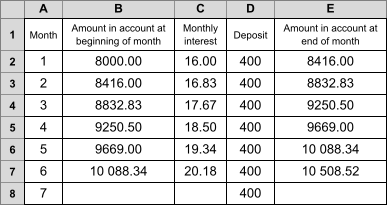
  2. Explain the relationship between Individuals 1 and 2.   (2 marks)

    --- 3 WORK AREA LINES (style=lined) ---

  3. \(A\) and \(B\) are two separate mutations. Analyse how mutations \(A\) and \(B\) affect the genetic information present in cells  \(U\), \(V\), \(W\) and \(X\).   (4 marks)

    --- 12 WORK AREA LINES (style=lined) ---
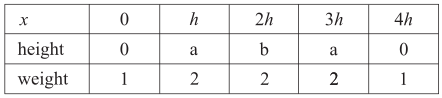
Show Answers Only

a.    Similarities:

  • Both cell R and cell S undergo cell division to produce daughter cells.

Differences:

  • Cell R undergoes mitosis producing two genetically identical diploid somatic cells (T and U).
  • Cell S undergoes meiosis producing four genetically different haploid gametes.
  • Mitosis in R maintains chromosome number for growth and repair.
  • Meiosis in S reduces chromosome number by half for sexual reproduction and genetic variation.

b.    Relationship between Individuals 1 and 2

  • Individual 2 is the offspring of Individual 1.
  • This is because Individual 1’s germ-line cell S produces a gamete (sperm) which fertilises an egg to form the zygote that develops into Individual 2.

c.    Mutation’s affect on genetic information

  • Mutation A occurs in the germ-line pathway after zygote Q. This means that mutation A is present in cell S and is passed to cell X.
  • Mutation A does not affect cells U, V or W because it occurred after the R/S split, so the R lineage and Individual 2’s somatic cells lack it.
  • Mutation B occurs in Individual 2’s somatic pathway. This results in mutation B being present in cells V and W only.
  • The significance is that only mutation A can be inherited by offspring, while mutation B cannot.
Show Worked Solution

a.    Similarities:

  • Both cell R and cell S undergo cell division to produce daughter cells.

Differences:

  • Cell R undergoes mitosis producing two genetically identical diploid somatic cells (T and U).
  • Cell S undergoes meiosis producing four genetically different haploid gametes.
  • Mitosis in R maintains chromosome number for growth and repair.
  • Meiosis in S reduces chromosome number by half for sexual reproduction and genetic variation.

b.    Relationship between Individuals 1 and 2

  • Individual 2 is the offspring of Individual 1.
  • This is because Individual 1’s germ-line cell S produces a gamete (sperm) which fertilises an egg to form the zygote that develops into Individual 2.

♦ Mean mark (b) 52%.

c.    Mutation’s affect on genetic information

  • Mutation A occurs in the germ-line pathway after zygote Q. This means that mutation A is present in cell S and is passed to cell X.
  • Mutation A does not affect cells U, V or W because it occurred after the R/S split, so the R lineage and Individual 2’s somatic cells lack it.
  • Mutation B occurs in Individual 2’s somatic pathway. This results in mutation B being present in cells V and W only.
  • The significance is that only mutation A can be inherited by offspring, while mutation B cannot.

♦ Mean mark (c) 52%.

Filed Under: Cell Replication, Mutation Tagged With: Band 4, Band 5, smc-3649-20-Meiosis, smc-3649-30-Mitosis, smc-3652-20-Somatic vs. Germ-Line

BIOLOGY, M6 2025 HSC 34

The following graph shows the changes in allele frequencies in two separate populations of the same species. Each line represents an introduced allele.

  1. Explain why the fluctuations of the allele frequencies are more pronounced in the small population, compared to the larger population.   (2 marks)

    --- 4 WORK AREA LINES (style=lined) ---
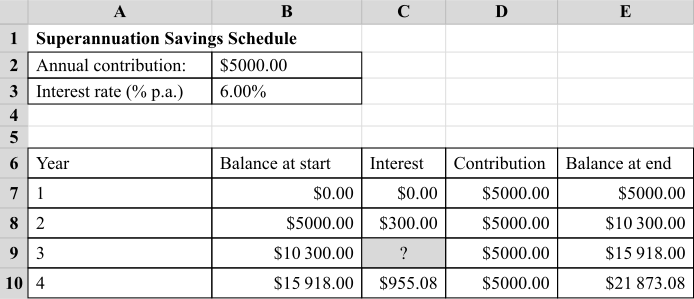
  2. Evaluate the effects of gene flow on the gene pools of the two populations.   (4 marks)

    --- 12 WORK AREA LINES (style=lined) ---
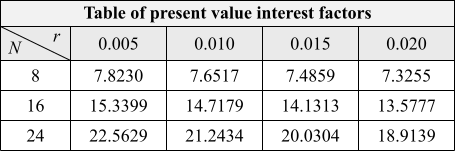
Show Answers Only

a.  Genetic Drift and Population Size

  • Small populations are more susceptible to genetic drift because each individual represents a larger proportion of the gene pool.
  • Random events cause greater fluctuations, while larger populations buffer these changes, resulting in stable allele frequencies.

b.    Evaluation Statement

  • Gene flow is highly effective for maintaining genetic diversity in the larger population but shows limited effectiveness in the smaller population.

Population Size Differences

  • The large population (2000) demonstrates strong effectiveness in maintaining stable allele frequencies around 0.5.
  • This occurs because gene flow introduces consistent genetic material that prevents random loss of alleles.
  • The population size allows introduced alleles to establish without being lost through drift.

Vulnerability in Small Populations

  • The small population (20) shows limited benefit from gene flow.
  • Despite introduction of new alleles, genetic drift overwhelms the stabilising effect.
  • Multiple alleles are lost completely, demonstrating that population size critically determines whether gene flow can maintain genetic diversity.

Final Evaluation

  • Overall, gene flow proves highly effective in large populations for maintaining diversity.
  • However, it demonstrates insufficient effectiveness in small populations where stochastic processes dominate.
Show Worked Solution

a.  Genetic Drift and Population Size

  • Small populations are more susceptible to genetic drift because each individual represents a larger proportion of the gene pool.
  • Random events cause greater fluctuations, while larger populations buffer these changes, resulting in stable allele frequencies.

♦♦ Mean mark (a) 41%.

b.    Evaluation Statement

  • Gene flow is highly effective for maintaining genetic diversity in the larger population but shows limited effectiveness in the smaller population.

Population Size Differences

  • The large population (2000) demonstrates strong effectiveness in maintaining stable allele frequencies around 0.5.
  • This occurs because gene flow introduces consistent genetic material that prevents random loss of alleles.
  • The population size allows introduced alleles to establish without being lost through drift.

Vulnerability in Small Populations

  • The small population (20) shows limited benefit from gene flow.
  • Despite introduction of new alleles, genetic drift overwhelms the stabilising effect.
  • Multiple alleles are lost completely, demonstrating that population size critically determines whether gene flow can maintain genetic diversity.

Final Evaluation

  • Overall, gene flow proves highly effective in large populations for maintaining diversity.
  • However, it demonstrates insufficient effectiveness in small populations where stochastic processes dominate.

♦ Mean mark (b) 50%.

Filed Under: Mutation Tagged With: Band 5, smc-3652-10-Mechanisms of Change/Variation

BIOLOGY, M7 2025 HSC 28

Alpha-gal syndrome (AGS) is a tick-borne allergy to red meat caused by tick bites. Alpha-gal is a sugar molecule found in most mammals but not humans, and can also be found in the saliva of ticks. The diagram shows how a tick bite might cause a person to develop an allergic reaction to red meat.


  1. The flow chart shows the process of antibody production following exposure to alpha-gal. 
  2.   
  3. Describe the role of \(\text{X}\), \(\text{Y}\) and \(\text{Z}\) in the process of antibody production.   (4 marks)

    --- 10 WORK AREA LINES (style=lined) ---
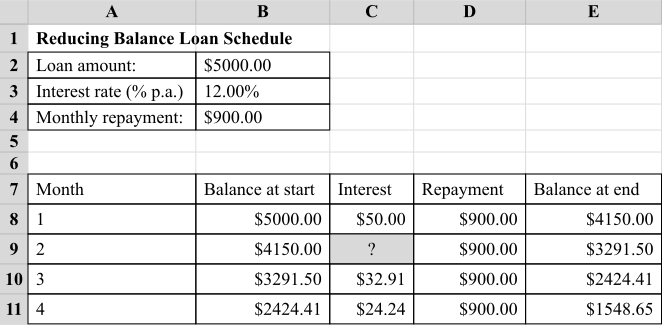
  4. An allergic reaction to alpha-gal sugar is similar to a secondary immune response.
    1.    
  5. Describe the features of antibody production shown in the graph.   (2 marks)

    --- 4 WORK AREA LINES (style=lined) ---
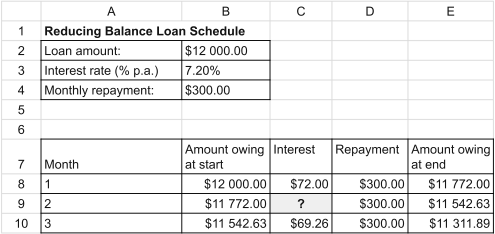
  6. Explain the role of memory cells in the immune response.   (3 marks)

    --- 6 WORK AREA LINES (style=lined) ---
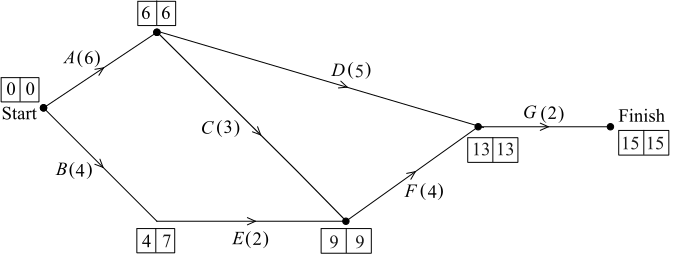
Show Answers Only

a.    Antibody Production Process

  • X is a Helper T-cell that recognises the alpha-gal antigen presented by macrophages on MHC-II molecules.
  • Helper T-cells activate and coordinate the adaptive immune response through cytokine release.
  • Y is a B-cell that has receptors specific to the alpha-gal antigen.
  • B-cells are activated by Helper T-cells and undergo clonal expansion.
  • Some B-cells differentiate into memory cells for long-term immunity.
  • Z is a Plasma cell, which is a differentiated B-cell specialised for antibody production.
  • Plasma cells produce large quantities of antibodies specific to alpha-gal that circulate in the bloodstream.

b.    Features of Antibody Production

  • Initial tick bite produces low antibody concentration with slow, gradual increase over time, representing primary immune response.
  • Subsequent meat consumption triggers rapid elevation to higher antibody concentration, demonstrating secondary immune response with accelerated, amplified production.

c.    Role of Memory Cells

  • Memory cells are produced during primary exposure and remain in circulation for years, maintaining immunological memory.
  • Upon re-exposure, memory cells rapidly recognise the specific antigen, which triggers immediate clonal expansion.
  • This results in faster and stronger antibody production because memory cells bypass the initial activation phase. In this way the process provides enhanced immune protection against subsequent infections.
Show Worked Solution

a.    Antibody Production Process

  • X is a Helper T-cell that recognises the alpha-gal antigen presented by macrophages on MHC-II molecules.
  • Helper T-cells activate and coordinate the adaptive immune response through cytokine release.
  • Y is a B-cell that has receptors specific to the alpha-gal antigen.
  • B-cells are activated by Helper T-cells and undergo clonal expansion.
  • Some B-cells differentiate into memory cells for long-term immunity.
  • Z is a Plasma cell, which is a differentiated B-cell specialised for antibody production.
  • Plasma cells produce large quantities of antibodies specific to alpha-gal that circulate in the bloodstream.

♦ Mean mark (a) 45%.

b.    Features of Antibody Production

  • Initial tick bite produces low antibody concentration with slow, gradual increase over time, representing primary immune response.
  • Subsequent meat consumption triggers rapid elevation to higher antibody concentration, demonstrating secondary immune response with accelerated, amplified production.

c.    Role of Memory Cells

  • Memory cells are produced during primary exposure and remain in circulation for years, maintaining immunological memory.
  • Upon re-exposure, memory cells rapidly recognise the specific antigen, which triggers immediate clonal expansion.
  • This results in faster and stronger antibody production because memory cells bypass the initial activation phase. In this way, the process provides enhanced immune protection against subsequent infections.

Filed Under: Immunity and Responses to Pathogens Tagged With: Band 4, Band 5, smc-3657-10-Antibody Mediated, smc-3657-25-Antibodies

Financial Maths, STD2 EQ-Bank 1 MC

Jacinta buys several items at the supermarket. The docket for her purchases is shown below.

What is the amount of GST included in the total? 

  1. $1.15
  2. $1.27
  3. $1.55
  4. $1.71
Show Answers Only

\(A\)

Show Worked Solution

\(\text{Total price of taxable items}\ +\ 10\%\ \text{ GST}\ =1.29+7.23+4.13=$12.65\)

\(\therefore\ 110\%\ \text{of original price}\) \(=$12.65\)
\(\therefore\ \text{GST}\) \(=$12.65\times\dfrac{100}{110}\)
  \(=$1.15\)

\(\Rightarrow A\)

Filed Under: Purchasing Goods (Std1-2027), Purchasing Goods (Std2-2027), Tax and Percentage Increase/Decrease (Std 1) Tagged With: Band 5, smc-1125-20-GST, smc-6278-20-GST/VAT, smc-6517-20-GST/VAT, syllabus-2027

Measurement, STD2 EQ-Bank 1 MC

The sheets of paper Jenny uses in her photocopier are 21 cm by 30 cm. The paper is 80 gsm, which means that one square metre of this paper has a mass of 80 grams. Jenny has a pile of this paper weighing 25.2 kg.

How many sheets of paper are in the pile?

  1. 500
  2. 2000
  3. 2500
  4. 5000
Show Answers Only

\(D\)

Show Worked Solution

\(1\ \text{square metre} = 100\ \text{cm}\times 100\ \text{cm}=10\,000\ \text{cm}^2\)

\(\text{Area of paper sheet}\ = \ 21\times 30=630\ \text{cm}^2\)

\(\text{Number of 80 gsm sheets in 25.2 kg}\ =\dfrac{25.2\times 1000}{80}=315\)

\(\therefore\ \text{Sheets in pile}\) \(=315\times\dfrac{10\,000}{630}\)
  \(=5000\)


Filed Under: Identify and Convert Between Units (Std2-2027) Tagged With: Band 5, smc-6303-30-Capacity/Volume/Mass, syllabus-2027

CHEMISTRY, M7 2025 HSC 28

Kevlar and polystyrene are two common polymers.

A section of their structures is shown.


  1. Kevlar is produced through a reaction of two different monomers, one of which is shown. Draw the missing monomer in the box provided.   (1 mark)

--- 0 WORK AREA LINES (style=lined) ---
  1. Kevlar chains are hard to pull apart, whereas polystyrene chains are not.
  2. With reference to intermolecular forces, explain the difference in the physical properties of the two polymers.   (3 marks)

    --- 10 WORK AREA LINES (style=lined) ---
Show Answers Only

a.    
           

b.    The physical differences between the two polymers are:

  • Kevlar chains are very hard to pull apart because the polymer contains many amide groups that can form strong hydrogen bonds between neighbouring chains. These strong forces hold the chains tightly together, making Kevlar rigid and very strong.
  • The close packing of the chains also gives Kevlar a high melting point, because a large amount of energy is required to break the hydrogen bonds.
  • Polystyrene, on the other hand, does not contain groups that can form hydrogen bonds. Its polymer chains are mostly non-polar, so the only forces between the chains are weak dispersion forces.
  • These weaker attractions mean the chains can slide past each other, making polystyrene much softer, brittle, and it also has a lower melting point than Kevlar. Because the forces between chains are weak, polystyrene is much easier to pull apart compared to Kevlar.
Show Worked Solution

a.    
           

♦ Mean mark (a) 50%.

b.    The physical differences between the two polymers are:

  • Kevlar chains are very hard to pull apart because the polymer contains many amide groups that can form strong hydrogen bonds between neighbouring chains. These strong forces hold the chains tightly together, making Kevlar rigid and very strong.
  • The close packing of the chains also gives Kevlar a high melting point, because a large amount of energy is required to break the hydrogen bonds.
  • Polystyrene, on the other hand, does not contain groups that can form hydrogen bonds. Its polymer chains are mostly non-polar, so the only forces between the chains are weak dispersion forces.
  • These weaker attractions mean the chains can slide past each other, making polystyrene much softer, brittle, and it also has a lower melting point than Kevlar. Because the forces between chains are weak, polystyrene is much easier to pull apart compared to Kevlar.

Filed Under: Polymers Tagged With: Band 4, Band 5, smc-3681-10-Addition Polymers, smc-3681-20-Condensation Polymers, smc-3681-30-Monomers

  • 1
  • 2
  • 3
  • …
  • 82
  • Next Page »

Copyright © 2014–2026 SmarterEd.com.au · Log in