SmarterEd

Aussie Maths & Science Teachers: Save your time with SmarterEd

  • Login
  • Get Help
  • About

CHEMISTRY, M7 2023 HSC 10 MC

Which of the following correctly lists the compounds in order of increasing boiling point?

  1. Heptane < heptan-2-one < heptan-1-o1 < heptanoic acid
  2. Heptane < heptan-1-o1 < heptan-2-one < heptanoic acid
  3. Heptanoic acid < heptan-2-one < heptan-1-o1 < heptane
  4. Heptanoic acid < heptan-1-o1 < heptan-2-one < heptane
Show Answers Only

\(A\)

Show Worked Solution
  • Compounds with functional groups capable of hydrogen bonding have higher boiling points (due to stronger bonds, more energy is required to break)

\(\Rightarrow A\)

Filed Under: Alcohols, Hydrocarbons and Associated Reactions, Reactions of Organic Acids and Bases Tagged With: Band 4, smc-3677-30-Solubility and Boiling Point, smc-3679-50-Solubility and Boiling Point, smc-3680-30-Boiling Point and Solubility

CHEMISTRY, M7 2023 HSC 29

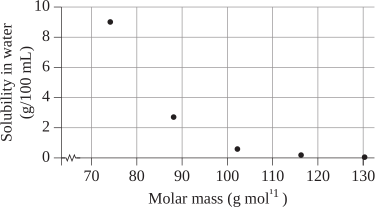
The following graph shows the solubility of some alkan-1-ols in water at 20°C.
 

Explain the relationship between the trend shown in the graph and the relevant intermolecular forces.   (3 marks)

--- 10 WORK AREA LINES (style=lined) ---

Show Answers Only
  • The graph shows a non-linear relationship with the following clear trend: as the molar mass increases, solubility decreases.
  • When molar mass increases, the chain length of a molecule increases. In alkan-1-ols this increases the length of their carbon backbone, increasing their non-polar nature (increased dispersion forces), thus solubility in polar solvents (eg: water) decreases
  • Shorter chain alcohols dissolve more readily in water. This is due to the formation of hydrogen bonds between the hydroxyl group of the alcohol and water molecules and the comparatively polar nature of the molecule compared top long-chained alkan-1-ols 
  • However, as the chain length of alkan-1-ols increase, the dispersion forces between the alkyl groups become stronger and mitigate the polarity of the hydroxyl group, decreasing their solubility.
Show Worked Solution
  • The graph shows a non-linear relationship with the following clear trend: as the molar mass increases, solubility decreases.
  • When molar mass increases, the chain length of a molecule increases. In alkan-1-ols this increases the length of their carbon backbone, increasing their non-polar nature (increased dispersion forces), thus solubility in polar solvents (eg: water) decreases
  • Shorter chain alcohols dissolve more readily in water. This is due to the formation of hydrogen bonds between the hydroxyl group of the alcohol and water molecules and the comparatively polar nature of the molecule compared top long-chained alkan-1-ols 
  • However, as the chain length of alkan-1-ols increase, the dispersion forces between the alkyl groups become stronger and mitigate the polarity of the hydroxyl group, decreasing their solubility.

Filed Under: Alcohols Tagged With: Band 4, smc-3679-50-Solubility and Boiling Point

CHEMISTRY, M7 EQ-Bank 24

Primary, unbranched alcohols and alkanes of the same carbon length have quite different boiling points.

Explain the difference in boiling point of these organic compounds, showing all intermolecular forces. Support your answer with diagrams.   (4 marks)

--- 10 WORK AREA LINES (style=lined) ---

Show Answers Only
  • Alkanes are saturated hydrocarbons – i.e. they are made up of carbon and hydrogen atoms only and all atoms are joined together by single covalent bonds which are non-polar.
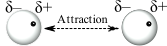
  • Weak intermolecular forces (Van der Waals) are therefore the only forces holding alkane molecules together and as a result, alkanes have low boiling points.

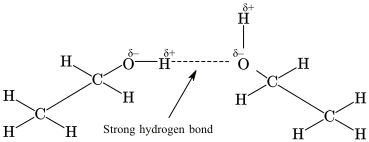
  • In contrast, alcohols have an \(\ce{OH}\) functional group. The \(\ce{OH}\) bond is polar with an oxygen “pole” that is slightly negatively charged and hydrogen “pole” that is slightly positively charged.

  • The hydrogen atom on one molecule will form an electrostatic bond with the oxygen atom on another atom creating a hydrogen bond.
  • Since hydrogen bonds are much stronger intermolecular forces than dispersion forces, the boiling points of alcohols are significantly higher than those of alkanes with the same carbon lengths.
Show Worked Solution
  • Alkanes are saturated hydrocarbons – i.e. they are made up of carbon and hydrogen atoms only and all atoms are joined together by single covalent bonds which are non-polar.
  • Weak intermolecular forces (Van der Waals) are therefore the only forces holding alkane molecules together and as a result, alkanes have low boiling points.

  • In contrast, alcohols have an \(\ce{OH}\) functional group. The \(\ce{OH}\) bond is polar with an oxygen “pole” that is slightly negatively charged and hydrogen “pole” that is slightly positively charged.

  • The hydrogen atom on one molecule will form an electrostatic bond with the oxygen atom on another atom creating a hydrogen bond.
  • Since hydrogen bonds are much stronger intermolecular forces than dispersion forces, the boiling points of alcohols are significantly higher than those of alkanes with the same carbon lengths.

Filed Under: Alcohols, Hydrocarbons and Associated Reactions Tagged With: Band 4, smc-3676-20-Alcohols, smc-3679-50-Solubility and Boiling Point

CHEMISTRY, M7 2016 HSC 15 MC

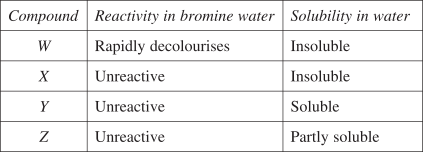
The table lists some properties of the straight-chained carbon compounds `W, X, Y` and `Z`.
 

Which row of the following table best identifies the compounds `W, X, Y` and `Z`?
 

\begin{align*} 
\begin{array}{c|c}
\rule{0pt}{2.5ex}\text{          }\rule[-1ex]{0pt}{0pt} \\
\rule{0pt}{2.5ex}\text{A.}\ \ \ \ \ \rule[-1ex]{0pt}{0pt} \\
\rule{0pt}{2.5ex}\text{B.}\ \ \ \ \ \rule[-1ex]{0pt}{0pt} \\
\rule{0pt}{2.5ex}\text{C.}\ \ \ \ \ \rule[-1ex]{0pt}{0pt} \\
\rule{0pt}{2.5ex}\text{D.}\ \ \ \ \ \rule[-1ex]{0pt}{0pt} \\
\end{array}
\begin{array}{|c|c|}
\hline
\rule{0pt}{2.5ex}\textit{W}\rule[-1ex]{0pt}{0pt} & \rule{0pt}{2.5ex}\textit{X}\rule[-1ex]{0pt}{0pt} & \rule{0pt}{2.5ex}\textit{Y}\rule[-1ex]{0pt}{0pt}& \rule{0pt}{2.5ex}\textit{Z}\rule[-1ex]{0pt}{0pt}\\
\hline
\rule{0pt}{2.5ex}\ \ \ \ce{C3H6}\ \ \ \rule[-1ex]{0pt}{0pt} & \rule{0pt}{2.5ex}\ \ \ \ce{C3H8}\ \ \ \rule[-1ex]{0pt}{0pt} & \rule{0pt}{2.5ex}\ce{CH3OH}\rule[-1ex]{0pt}{0pt}& \rule{0pt}{2.5ex}\ce{C4H9OH}\rule[-1ex]{0pt}{0pt}\\
\hline
\rule{0pt}{2.5ex}\ce{C3H8}\rule[-1ex]{0pt}{0pt} & \rule{0pt}{2.5ex}\ce{C3H6}\rule[-1ex]{0pt}{0pt} & \rule{0pt}{2.5ex}\ce{CH3OH}\rule[-1ex]{0pt}{0pt}& \rule{0pt}{2.5ex}\ce{C4H9OH}\rule[-1ex]{0pt}{0pt}\\
\hline
\rule{0pt}{2.5ex}\ce{C3H6}\rule[-1ex]{0pt}{0pt} & \rule{0pt}{2.5ex}\ce{C3H8}\rule[-1ex]{0pt}{0pt} & \rule{0pt}{2.5ex}\ce{C4H9OH}\rule[-1ex]{0pt}{0pt}& \rule{0pt}{2.5ex}\ce{CH3OH}\rule[-1ex]{0pt}{0pt}\\
\hline
\rule{0pt}{2.5ex}\ce{C3H8}\rule[-1ex]{0pt}{0pt} & \rule{0pt}{2.5ex}\ce{C3H6}\rule[-1ex]{0pt}{0pt} & \rule{0pt}{2.5ex}\ce{C4H9OH}\rule[-1ex]{0pt}{0pt}& \rule{0pt}{2.5ex}\ce{CH3OH}\rule[-1ex]{0pt}{0pt}\\
\hline
\end{array}
\end{align*}

Show Answers Only

`A`

Show Worked Solution
  • Compound W is unsaturated (C–C multiple bonds exist).
  • Compound X is saturated (all C–C bonds are single bonds).
  • Shorter alcohols, such as \(\ce{CH3OH}\) are more soluble.

`=>A`

Filed Under: Alcohols, Hydrocarbons and Associated Reactions Tagged With: Band 4, smc-3677-70-Reactions of Unsaturated Hydrocarbons, smc-3677-80-Reactions of Saturated Hydrocarbons, smc-3679-50-Solubility and Boiling Point

CHEMISTRY, M7 2016 HSC 5 MC

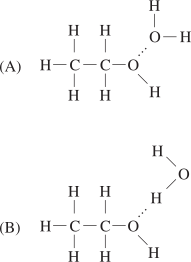
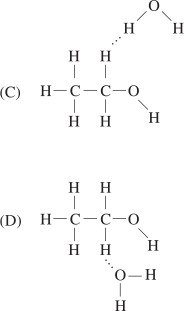
Which of the following diagrams best represents the bonding between molecules of water and ethanol?


Show Answers Only

`B`

Show Worked Solution
  • In a solution of ethanol and water, hydrogen bonding (strongest intermolecular force) occurs between the partially negative oxygen end of the ethanol molecule and the partially positive hydrogen end of a water molecule.

`=>B`

Filed Under: Alcohols Tagged With: Band 4, smc-3679-50-Solubility and Boiling Point

CHEMISTRY, M7 2019 HSC 32

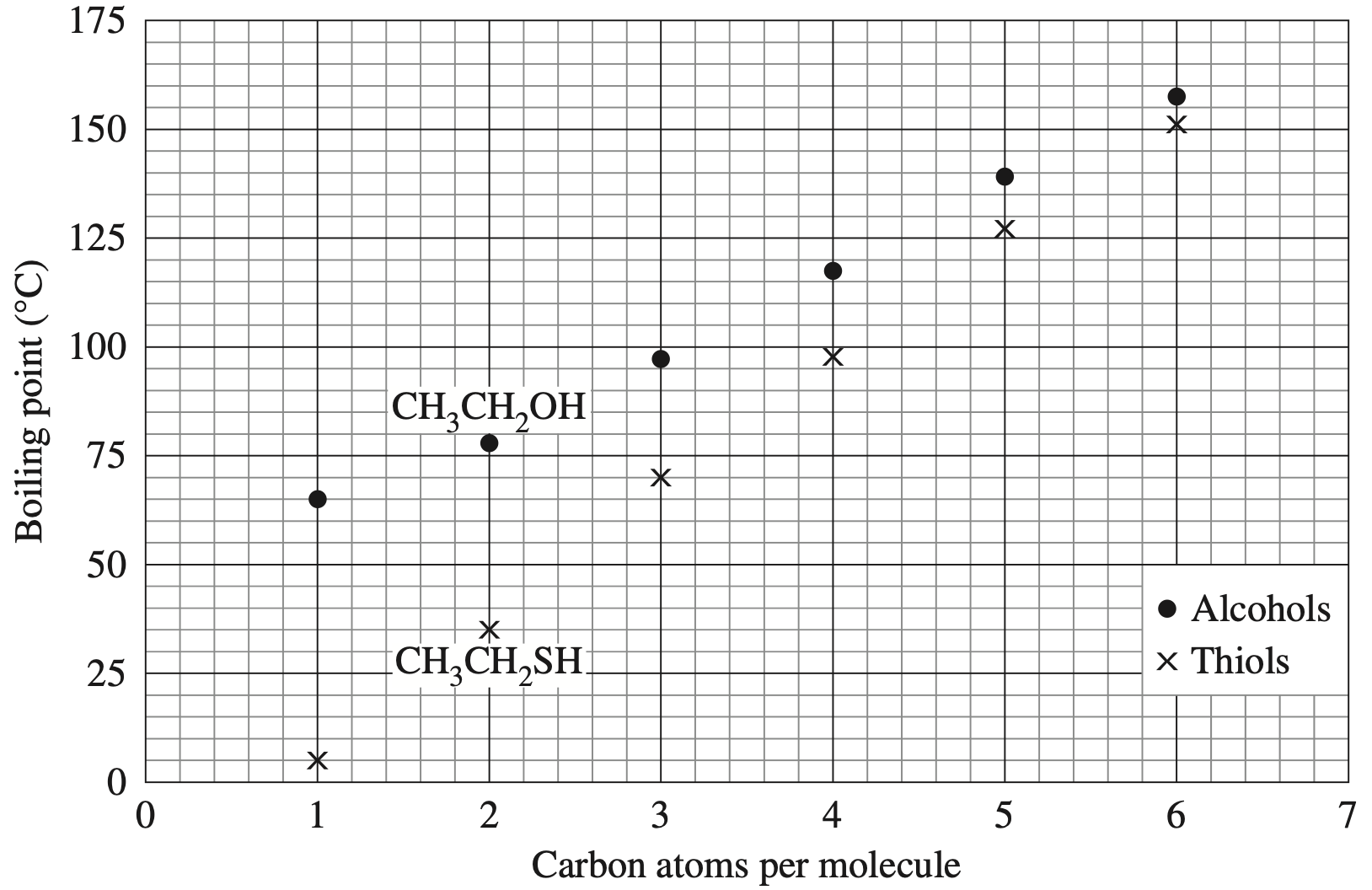
Thiols are the sulfur analogues of alcohols in that the oxygen atom of the alcohol is replaced by a sulfur atom. For example, methanethiol \(\ce{(CH3SH)}\) is the analogue of methanol \(\ce{(CH3OH)}\). The boiling points of some straight chain alcohols and thiols are given in the following graph.


Explain the patterns of the boiling points shown in the graph.   (4 marks)

Show Answers Only
  • The boiling point of a compound increases with an increase in the number of carbon atoms due to the increase in dispersion forces.
  • Alcohols have higher boiling points than thiols with the same number of carbon atoms due to the stronger hydrogen bonding in alcohols compared to the weaker dispersion forces in thiols.
  • As the chain length increases, the difference in boiling point between alcohols and thiols decreases because hydrogen bonding becomes a smaller contributor to the total intermolecular forces and the increasing strength of dispersion forces becomes more significant.
  • Methanol has hydrogen bonding as the dominant intermolecular force, while methanethiol has dipole-dipole forces as the dominant intermolecular force, resulting in a lower boiling point for methanethiol.
  • As the chain length increases, the thiols have a greater increase in boiling point due to their higher molecular mass and stronger dispersion forces compared to the alcohols.
Show Worked Solution
  • The boiling point of a compound increases with an increase in the number of carbon atoms due to the increase in dispersion forces.
  • Alcohols have higher boiling points than thiols with the same number of carbon atoms due to the stronger hydrogen bonding in alcohols compared to the weaker dispersion forces in thiols.
  • As the chain length increases, the difference in boiling point between alcohols and thiols decreases because hydrogen bonding becomes a smaller contributor to the total intermolecular forces and the increasing strength of dispersion forces becomes more significant.
  • Methanol has hydrogen bonding as the dominant intermolecular force, while methanethiol has dipole-dipole forces as the dominant intermolecular force, resulting in a lower boiling point for methanethiol.
  • As the chain length increases, the thiols have a greater increase in boiling point due to their higher molecular mass and stronger dispersion forces compared to the alcohols.

Filed Under: Alcohols Tagged With: Band 4, smc-3679-50-Solubility and Boiling Point

CHEMISTRY, M7 2019 HSC 9 MC

All of the following compounds have similar molar masses.

Which has the highest boiling point?

  1. Butane
  2. Ethanoic acid
  3. Propan-1-ol
  4. Propane
Show Answers Only

`B`

Show Worked Solution
  • Carboxyllic acids have a high affinity for hydrogen bonding, the strongest molecular force.
  • They therefore require more heat to break the intermolecular forces to convert liquid to gas versus other substances.

`=>B`

Filed Under: Alcohols, Hydrocarbons and Associated Reactions, Reactions of Organic Acids and Bases Tagged With: Band 4, smc-3677-30-Solubility and Boiling Point, smc-3679-50-Solubility and Boiling Point, smc-3680-30-Boiling Point and Solubility

CHEMISTRY, M7 2021 HSC 7 MC

Methanol undergoes a substitution reaction using hydrogen bromide.

Compared to methanol, the product of this reaction has a

  1. lower boiling point.
  2. lower molecular mass.
  3. greater solubility in water.
  4. different molecular geometry at the carbon atom.
Show Answers Only

`A`

Show Worked Solution
  • The product of the substitution reaction between methanol and hydrogen bromide is bromomethane.
  • Methanol contains an OH functional group and thus can form strong hydrogen bonds.
  • Bromomethane can only form dipole-dipole forces which are weaker than hydrogen bonds. As a result, bromomethane requires less energy to break these intermolecular forces, resulting in a lower boiling point than methanol.

`=> A`

Filed Under: Alcohols, Hydrocarbons and Associated Reactions Tagged With: Band 4, smc-3677-40-Molecular Shape, smc-3679-20-Reactions of Alcohols, smc-3679-50-Solubility and Boiling Point

Copyright © 2014–2025 SmarterEd.com.au · Log in