SmarterEd

Aussie Maths & Science Teachers: Save your time with SmarterEd

  • Login
  • Get Help
  • About

PHYSICS, M5 EQ-Bank 23

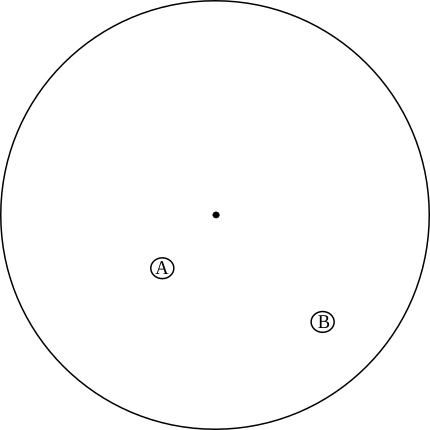
A horizontal disc is rotating clockwise on a table when viewed from above. Two small blocks are attached to the disc at different radii from the centre.

Using the diagram below, draw vector arrows to show the relative linear velocities and centripetal forces for each block as the disc rotates.   (3 marks)
 

Show Answers Only
Show Worked Solution

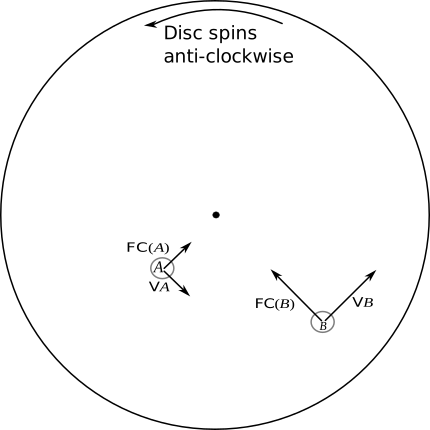
Points to note on the image

  • Centripetal force and velocity vectors are perpendicular
  • Vector arrows should show relative magnitudes of velocities and centripetal forces.
Filed Under: Circular Motion Tagged With: Band 4, smc-3691-10-Centripetal Forces, smc-3691-30-Linear Velocity

PHYSICS M5 2022 HSC 33

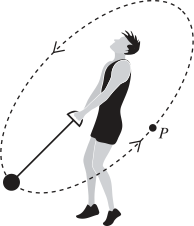
In a hammer throw sport event, a 7.0 kg projectile rotates in a circle of radius 1.6 m, with a period of 0.50 s. It is released at point `P`, which is 1.2 m above the ground, where its velocity is at 45° to the horizontal.


  1. Show that the vertical component of the projectile's velocity at `P` is `14.2 \ text{m s}^(-1)`.   (2 marks)

--- 4 WORK AREA LINES (style=lined) ---

  1. Calculate the horizontal range of the projectile from point `P`.    (4 marks)

--- 10 WORK AREA LINES (style=lined) ---

Show Answers Only

a.   Proof (See Worked Solution)

b.   42.3 m

Show Worked Solution

a.   `v=(2pir)/(T)=(2 xxpi xx1.6)/(0.5)=20.106  text{ms}^(-1)`

`v_(y)=20.106 xx sin 45^@=14.2\ text{ms}^(-1)`
 

b.   `text{Time of flight}\ =>\ \text{Find}\ t\ \text{when}\ s_(y)=-1.2`

`s_(y)` `=u_(y)t+(1)/(2)a_(y)t^2`
`-1.2` `=14.2t-(1)/(2) xx9.8t^2`
`0` `=4.9t^2-14.2t-1.2`

 
`t=(14.2+-sqrt(14.2^2+4 xx4.9 xx1.2))/(2 xx4.9)=2.98  text{s}\ \ (t>0)`

 
`text{Since launch angle = 45°}\ =>\ \ u_(x)=u_(y)`

`:. s_(x)=u_(x)t=14.2 xx2.98=42.3  text{m}`

Filed Under: Circular Motion, Projectile Motion Tagged With: Band 4, smc-3691-30-Linear Velocity

PHYSICS, M5 2021 HSC 22

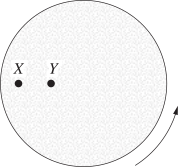
A horizontal disc rotates at a constant rate as shown. Two points on the disc, `X` and `Y`, are labelled. `X` is twice as far away from the centre of the disc as `Y`.
 

Compare the angular and instantaneous velocities of `X` with those of `Y`.   (3 marks)

--- 6 WORK AREA LINES (style=lined) ---

Show Answers Only
  • The angular velocities `(omega)` of  `X` and `Y` are equal. The direction of instantaneous velocities for `X` and `Y` are the same.
  • Since `v=r omega` the magnitude of the instantaneous velocity of `X` is twice that of `Y`.
Show Worked Solution
  • The angular velocities `(omega)` of  `X` and `Y` are equal. The direction of instantaneous velocities for `X` and `Y` are the same.
  • Since `v=r omega` the magnitude of the instantaneous velocity of `X` is twice that of `Y`.

Filed Under: Circular Motion Tagged With: Band 4, smc-3691-30-Linear Velocity, smc-3691-40-Angular Velocity

Copyright © 2014–2025 SmarterEd.com.au · Log in