Comet Hale-Bopp is a long period comet that is believed to come from the Oort cloud which lies far beyond the outermost planets. In our solar system, Hale-Bopp travels in an elliptical orbit around the Sun and spends most of its time beyond the outermost planets.
Using a diagram, explain how the motion of Comet Hale-Bopp in its orbit supports Kepler's second law. (3 marks)
Show Answers Only
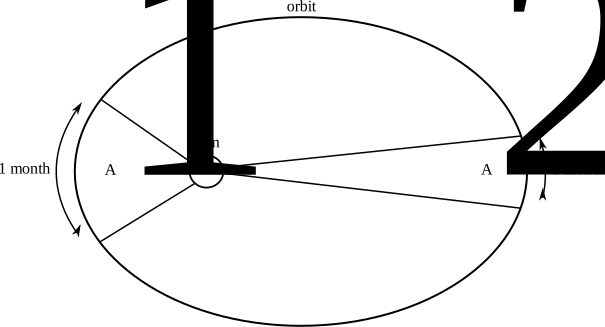
- Kepler’s Second Law states that a line between the comet and the sun will sweep an equal area in equal time.
- When the comet is closer to the sun, it must travel with a greater velocity in its orbit compared to when it is far away to sweep the same area in the same time (i.e. such that `A_1=A_2`.
- Comet Hale-Bopp supports this as it spends most of its time beyond the outermost planets. It therefore travels at a slower speed compared to when it is close to the sun. This reduced velocity allows it to sweep the same area compared to when it is closer to the sun.
Show Worked Solution
- Kepler’s Second Law states that a line between the comet and the sun will sweep an equal area in equal time.
- When the comet is closer to the sun, it must travel with a greater velocity in its orbit compared to when it is far away to sweep the same area in the same time (i.e. such that `A_1=A_2`.
- Comet Hale-Bopp supports this as it spends most of its time beyond the outermost planets. It therefore travels at a slower speed compared to when it is close to the sun. This reduced velocity allows it to sweep the same area compared to when it is closer to the sun.