Prior to 2019, the ampere was characterized as the unvarying current that, when sustained in two infinitely long, straight parallel conductors with negligible circular cross-section and spaced one meter apart in a vacuum, would result in a force of `10 xx 10^{-7}` newton per metre of length between the conductors.
- How does Newton’s Third Law apply to this definition of the ampere? (2 marks)
--- 4 WORK AREA LINES (style=lined) ---
- Two parallel current carrying wires are 1.2 metres long each, both carrying 0.55 amperes at a distance of 25 mm apart. Calculate the force between the wires. (2 marks)
--- 4 WORK AREA LINES (style=lined) ---
Show Answers Only
a.
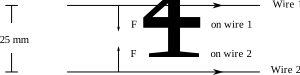
- Since the two wires in the definition carry current in the same direction, wire 1 will impart an attraction force on wire 2.
- Similarly, wire 2 will impart an attractive force on wire 1. This force will be equal but in an opposite direction to the attractive force imparted on wire 2 (above).
- Newton’s Third Law states that two objects interact with each other, they exert forces on each other that are equal in magnitude and opposite in direction, also known as action and reaction forces.
- In this way, Newton’s Third Law directly describes the forces between conductors within the definition of the ampere.
b. `2.9 xx 10^{-5}\ text{N}`
Show Worked Solution
a.
- Since the two wires in the definition carry current in the same direction, wire 1 will impart an attraction force on wire 2.
- Similarly, wire 2 will impart an attractive force on wire 1. This force will be equal but in an opposite direction to the attractive force imparted on wire 2 (above).
- Newton’s Third Law states that two objects interact with each other, they exert forces on each other that are equal in magnitude and opposite in direction, also known as action and reaction forces.
- In this way, Newton’s Third Law directly describes the forces between conductors within the definition of the ampere.
| b. | `F/l` | `=mu_0/(2pi) xx (I_1I_2)/r` |
| `F` | `=(4pi xx 10^{-7})/(2pi) xx (0.55)^2/(2.5 xx 10^{-3}) xx 1.2` | |
| `=(2 xx 10^{-7})xx (0.55)^2/(2.5 xx 10^{-3}) xx 1.2` | ||
| `=2.9 xx 10^{-5}\ text{N}` |