SmarterEd

Aussie Maths & Science Teachers: Save your time with SmarterEd

  • Login
  • Get Help
  • About

PHYSICS, M1 EQ-Bank 18

The velocity-time graph of a particle moving along an east-west line with velocity \(v\) m s\(^{-1}\) at time \(t\) seconds, starting from a fixed origin \(O\), is shown below. The graph comprises two straight line segments.
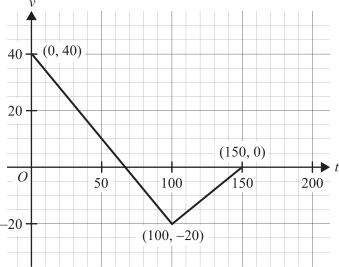
 

The initial velocity of the particle is 40 m s\(^{-1}\) to the east.

How far, in metres, is the particle to the east of \(O\), 150 seconds later?   (3 marks)

--- 6 WORK AREA LINES (style=lined) ---
Show Answers Only

\(500\ \text{m}\)

Show Worked Solution

\(\text{Distance travelled East = area under graph and above the}\ x\text{-axis.}\)

\(\text{Linear velocity graph cuts \(x\)-axis at}\ \ x=66 \dfrac{2}{3}\)

\(\text{Distance (east)}\ = \dfrac{1}{2} \times 66 \dfrac{2}{3} \times 40 = \dfrac{4000}{3}\ \text{m} \)

\(\text{Distance travelled West = area above graph and below the}\ x\text{-axis.}\)

\(\text{Distance (west)}\ = \dfrac{1}{2} \times 83 \dfrac{1}{3} \times 20 = \dfrac{2500}{3}\ \text{m} \)

\(\text{Net distance east (at 150 sec)}\ = \dfrac{4000}{3}-\dfrac{2500}{3}=500\ \text{m}\)

Filed Under: Motion in a Straight Line Tagged With: Band 4, smc-4273-70-Velocity-Time Graphs

PHYSICS, M1 EQ-Bank 16

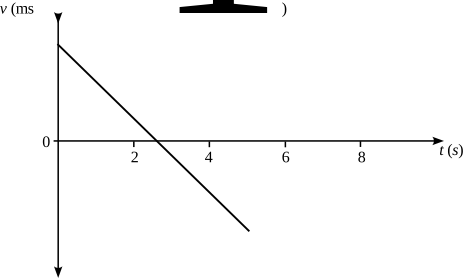
A soccer ball is kicked straight upward from a field at t = 0 seconds with an initial velocity.

It arrives at the exact height it was kicked from at t = 5 seconds and is caught.

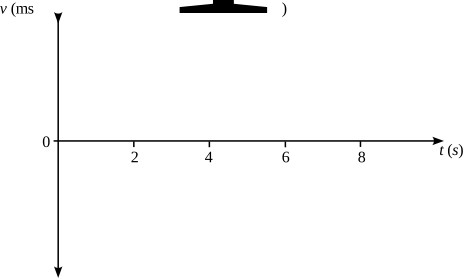
Using the graph provided, plot the ball’s velocity versus time over the course of its flight. Assume that upward is positive and ignore the effects of air resistance.   (2 marks)

--- 0 WORK AREA LINES (style=lined) ---


Show Answers Only

Show Worked Solution

  • The velocity of the ball will decrease at a constant rate as the ball is under a constant acceleration due to gravity.

Filed Under: Motion in a Straight Line Tagged With: Band 4, smc-4273-70-Velocity-Time Graphs

PHYSICS, M1 EQ-Bank 4 MC

A truck is driving along a straight road travelling at 10 ms\(^{-1}\). He then accelerates according to the acceleration time graph below:


Determine the final speed of the truck after it accelerates for 7 seconds.

  1. \(20.5\ \text{ms}^{-1}\)
  2. \(21.5\ \text{ms}^{-1}\)
  3. \(22.5\ \text{ms}^{-1}\)
  4. \(23.5\ \text{ms}^{-1}\)
Show Answers Only

\(A\)

Show Worked Solution
  • The increase in velocity of the truck will be equal to the area under the acceleration time graph.
  • Speed Increase \(=\dfrac{1}{2} \times 7 \times 3 = 10.5\ \text{ms}^{-1}\)
  • Final speed \(=10.5 + 10 = 20.5\ \text{ms}^{-1}\)

\(\Rightarrow A\)

Filed Under: Motion in a Straight Line Tagged With: Band 4, smc-4273-20-Velocity of objects, smc-4273-70-Velocity-Time Graphs

PHYSICS, M1 EQ-Bank 11

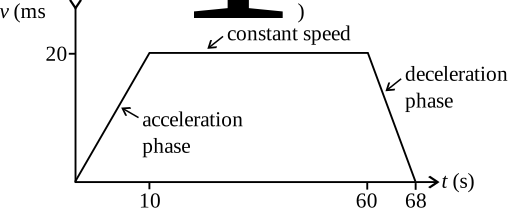
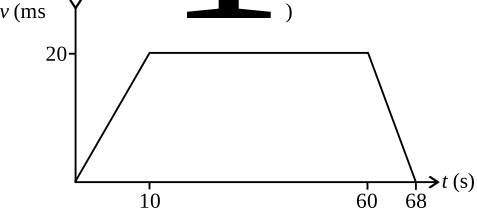
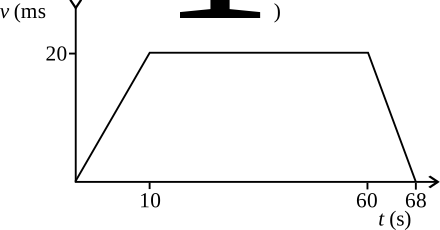
A bus departs from its depot, starting from rest and accelerating uniformly at 2.0 ms\(^{-2}\) for 10 seconds until it reaches a speed of 20 ms\(^{-1}\). It then travels at this constant speed for 50 seconds before decelerating uniformly at – 2.5 ms\(^{-2}\) until coming to a complete stop at the next bus stop.

  1. In the space provided, sketch a velocity–time graph of the bus's journey, clearly marking the acceleration phase, the constant speed phase, and the deceleration phase with all key values.   (3 marks)

    --- 6 WORK AREA LINES (style=blank) ---

  1. Calculate the total distance the bus covers during this trip.   (2 marks)

    --- 4 WORK AREA LINES (style=lined) ---

Show Answers Only

a.    


b.    \(1180\ \text{m}\)

Show Worked Solution

a.   
           

b.    Total distance travelled by the bus is equal to the area under the velocity-time graph.

\(\text{Distance}\) \(=(\dfrac{1}{2} \times 10 \times 20) + (50 \times 20) + (\dfrac{1}{2} \times 8 \times 20) \)  
  \(=1180\ \text{m} \)  

Filed Under: Motion in a Straight Line Tagged With: Band 4, smc-4273-25-Displacement, smc-4273-70-Velocity-Time Graphs

Copyright © 2014–2025 SmarterEd.com.au · Log in