SmarterEd

Aussie Maths & Science Teachers: Save your time with SmarterEd

  • Login
  • Get Help
  • About

PHYSICS, M3 EQ-Bank 1

  1. Create a labelled diagram to illustrate the distinction between transverse and longitudinal wave types. Briefly describe how the particle motion differs in each case.   (3 marks)

--- 10 WORK AREA LINES (style=lined) ---

  1. Describe a difference between electromagnetic waves and mechanical waves, giving an example of each.   (2 marks)

--- 4 WORK AREA LINES (style=lined) ---

  1. A beam of light has a frequency of \(5.0 \times 10^{14}\ \text{Hz}\). Calculate the wavelength of this light in metres.   (1 mark)

--- 2 WORK AREA LINES (style=lined) ---

Show Answers Only

a.    
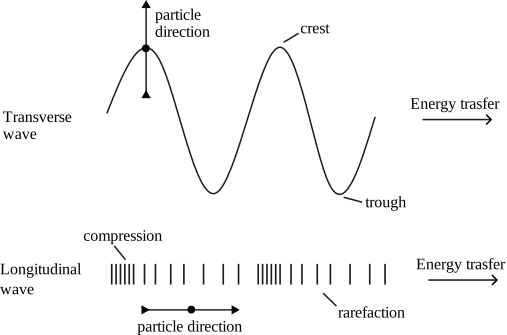


  • For transverse waves, particles move at 90 degrees to the direction of energy transfer.
  • For longitudinal waves, particles move back and forward in the same direction as the energy transfer.

b.   Electromagnetic wave example: radio wave.

  • EMR does not require a medium to travel through. i.e. they can travel through a vacuum.

Mechanical wave example: sound wave.

  • Mechanical waves require a medium to travel through.

c.    \(6 \times 10^{-7}\ \text{m}\).

Show Worked Solution

a.    


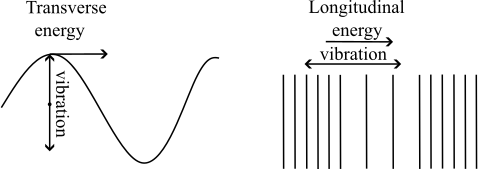
  • For transverse waves, particles move at 90 degrees to the direction of energy transfer.
  • For longitudinal waves, particles move back and forward in the same direction as the energy transfer.

b.   Electromagnetic wave example: radio wave.

  • EMR does not require a medium to travel through. i.e. they can travel through a vacuum.

Mechanical wave example: sound wave.

  • Mechanical waves require a medium to travel through.

c.   Using  \(v = f \lambda\):

\(\lambda = \dfrac{v}{f} = \dfrac{3 \times 10^8}{5.0 \times 10^{14}} = 6 \times 10^{-7}\ \text{m}\).
Filed Under: Wave Properties and Behaviour Tagged With: Band 4, smc-4278-20-Wave calculations, smc-4278-30-Transverse vs longitudinal, smc-4278-35-Mechanical Waves

PHYSICS, M3 2023 VCE 13 MC

A physics student hears a clap of thunder shortly after observing a flash of lightning.

Which one of the following statements best describes the sound associated with the clap of thunder and the visible light associated with the flash of lightning?

  1. Both the sound and the visible light are examples of transverse waves.
  2. Both the sound and the visible light are examples of longitudinal waves.
  3. Sound is an example of a transverse wave and visible light is an example of a longitudinal wave.
  4. Sound is an example of a longitudinal wave and visible light is an example of a transverse wave.
Show Answers Only

\(D\)

Show Worked Solution
  • Sound is a longitudinal wave where the particles travel parallel to the direction of motion and require a medium.
  • Light is a transverse wave of alternating electric and magnetic fields and therefore doesn’t require a medium.

\(\Rightarrow D\)

Filed Under: Wave Properties and Behaviour Tagged With: Band 3, smc-4278-30-Transverse vs longitudinal

PHYSICS, M3 2022 VCE 11 MC

Which one of the following statements best describes transverse and longitudinal waves?

  1. Both transverse waves and longitudinal waves travel in a direction parallel to their vibrations.
  2. Both transverse waves and longitudinal waves travel in a direction perpendicular to their vibrations.
  3. Transverse waves travel in a direction perpendicular to their vibrations; longitudinal waves travel parallel to their vibrations.
  4. Transverse waves travel in a direction parallel to their vibrations; longitudinal waves travel perpendicular to their vibrations.
Show Answers Only

\(C\)

Show Worked Solution
  • The energy transfer through transverse waves is perpendicular to the direction of vibrations.
  • The energy transfer through longitudinal waves is parallel to the direction of vibrations.
     

\( \Rightarrow C\)

Filed Under: Wave Properties and Behaviour Tagged With: Band 3, smc-4278-30-Transverse vs longitudinal

Copyright © 2014–2025 SmarterEd.com.au · Log in