SmarterEd

Aussie Maths & Science Teachers: Save your time with SmarterEd

  • Login
  • Get Help
  • About

PHYSICS, M3 EQ-Bank 17

A sealed container contains 2.0 kg of steam at 100\(^{\circ}\)C. The container is placed in a fridge and cooled until all the steam has condensed and the resulting water has cooled to 5\(^{\circ}\)C. Using the specific latent heat of vaporisation of water: 2.3 \(\times\) 10\(^6\) J kg\(^{-1}\),

  1. Calculate the energy removed during condensation.   (1 marks)

--- 2 WORK AREA LINES (style=lined) ---

  1. Calculate the total energy that must be removed from the container.   (2 mark)

--- 4 WORK AREA LINES (style=lined) ---

  1. Explain why steam burns are more dangerous than boiling water burns.   (2 mark)

--- 2 WORK AREA LINES (style=lined) ---
Show Answers Only

a.    \(4.6 \times 10^6\ \text{J}\)

b.    \(5.4 \times 10^6\ \text{J}\)

c.   Steam burns are more dangerous than boiling water burns as:

  • Steam contains additional energy in the form of latent heat from the phase change.
  • When steam condenses on the skin, it releases this latent heat of vaporisation, transferring more energy than boiling water at the same temperature, causing more severe tissue damage.
Show Worked Solution

a.    Using the specific latent heat of vaporisation:

\(Q = 2 \times 2.3 \times 10^6 = 4.6 \times 10^6\ \text{J}\)
 

b.    The heat energy lost to reduce the temperature of water from 100\(^{\circ}\)C to 5\(^{\circ}\)C:

\(Q=mc\Delta T = 2 \times 4.18 \times 10^3 \times (100-5) = 7.942 \times 10^5\ \text{J}\)

  • The total energy that must be removed from the container is the latent heat of vaporization and the energy require to cool the water down to 5\(^{\circ}\).
  •     \(E_T= 4.6 \times 10^6 + 7.942 \times 10^5 = 5.4 \times 10^6\ \text{J}\) 

c.   Steam burns are more dangerous than boiling water burns because:

  • Steam contains additional energy in the form of latent heat from the phase change.
  • When steam condenses on the skin, it releases this latent heat of vaporisation, transferring more energy than boiling water at the same temperature, causing more severe tissue damage.

Filed Under: Thermodynamics Tagged With: Band 4, Band 5, smc-4282-30-Q=mcΔt, smc-4282-35-Quantitative calcs, smc-4282-50-Latent heat

PHYSICS, M3 EQ-Bank 8

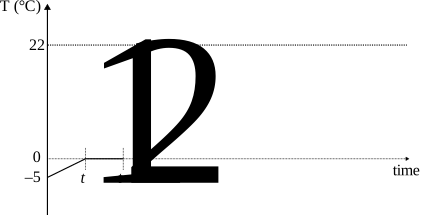
A frozen water bottle is removed from a cooler at -5\(^{\circ}\)C and placed on a desk in a room where the air temperature is 22\(^{\circ}\)C. A graph of the water bottle’s temperature over time is shown below.
 

  1. Explain the shape of the graph during the following time intervals:
  2.  i. From  \(t=0\)  to  \(t=t_1\) seconds.   (1 mark) 

    --- 3 WORK AREA LINES (style=lined) ---

  3. ii. From  \(t=t_1\)  to  \(t=t_2\) seconds.   (1 mark)

    --- 3 WORK AREA LINES (style=lined) ---

  1. On the graph provided, draw the expected temperature curve of the water bottle from \(t=t_2\) until \(t= 22\).   (2 marks)

    --- 0 WORK AREA LINES (style=lined) ---

Show Answers Only

a.i.  \(t=0\)  to  \(t=t_1:\)

  • The heat energy added to the bottle increases the kinetic energy of the ice molecules, raising its temperature.
  • The graph shows a positive linear slope, indicating a steady increase in temperature over time.

a.ii.  \(t=1\)  to  \(t=t_2:\)

  • In this interval, the ice is undergoing a phase change from solid to liquid (melting).
  • Even though heat is still being added, the temperature stays constant at 0\(^{\circ}\)C, because the energy is being used to break intermolecular bonds rather than raise temperature.

b.    
       

Show Worked Solution

a.i.  \(t=0\)  to  \(t=t_1:\)

  • The heat energy added to the bottle increases the kinetic energy of the ice molecules, raising its temperature.
  • The graph shows a positive linear slope, indicating a steady increase in temperature over time.

a.ii.  \(t=1\)  to  \(t=t_2:\)

  • In this interval, the ice is undergoing a phase change from solid to liquid (melting).
  • Even though heat is still being added, the temperature stays constant at 0\(^{\circ}\)C, because the energy is being used to break intermolecular bonds rather than raise temperature.

b.    
       

Filed Under: Thermodynamics Tagged With: Band 4, Band 6, smc-4282-50-Latent heat

PHYSICS, M3 EQ-Bank 7

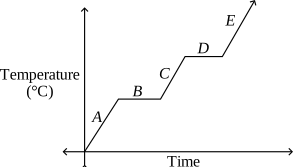
The graph below shows the temperature of a pure substance as heat is added at a constant rate.
 

  1. Identify the section(s) of the graph where the substance is undergoing a phase change.   (1 mark)

--- 1 WORK AREA LINES (style=lined) ---

  1. For one of the phase change sections you identified, explain why the temperature remains constant even though heat is being added.   (2 marks)

--- 4 WORK AREA LINES (style=lined) ---

  1. What is the name of the heat associated with the horizontal section representing the solid-to-liquid phase change?   (1 mark)

--- 1 WORK AREA LINES (style=lined) ---

Show Answers Only

a.    Phase changes:

  • Phase changes occur during the horizontal (flat) sections of the graph.
  • These occur during sections \(B\) and \(D\).

b.    For the phase change at \(B\):

  • The added heat is used to break intermolecular bonds, rather than increase the kinetic energy of the particles.
  • Since temperature is a measure of average kinetic energy, the temperature remains constant during this process. The energy added is called latent heat, which is required to overcome the forces holding the particles in their current phase.

c.    The heat involved in the solid-to-liquid phase change is latent heat of fusion.

Show Worked Solution

a.    Phase changes:

  • Phase changes occur during the horizontal (flat) sections of the graph.
  • These occur during sections \(B\) and \(D\).

b.    For the phase change at \(B\):

  • The added heat is used to break intermolecular bonds, rather than increase the kinetic energy of the particles.
  • Since temperature is a measure of average kinetic energy, the temperature remains constant during this process. The energy added is called latent heat, which is required to overcome the forces holding the particles in their current phase.

c.    The heat involved in the solid-to-liquid phase change is latent heat of fusion.

Filed Under: Thermodynamics Tagged With: Band 3, Band 4, smc-4282-50-Latent heat

PHYSICS, M3 EQ-Bank 4

Define latent heat and name the stages of latent heat that occur between the states of solid and liquid, and liquid and gas.   (3 marks)

--- 6 WORK AREA LINES (style=lined) ---

Show Answers Only
  • Latent heat is the heat energy required to change the state of matter from a solid to a liquid, or a liquid to a gas, without changing the temperature of the substance.
  • During this process, energy is supplied to break the bonds between particles. This leads to a greater degree of freedom without increasing the kinetic energy of the particles.
  • The two stages of latent heat are the latent heat of fusion (solid to liquid) and the latent heat of evaporation (liquid to gas).
Show Worked Solution
  • Latent heat is the heat energy required to change the state of matter from a solid to a liquid, or a liquid to a gas, without changing the temperature of the substance.
  • During this process, energy is supplied to break the bonds between particles. This leads to a greater degree of freedom without increasing the kinetic energy of the particles.
  • The two stages of latent heat are the latent heat of fusion (solid to liquid) and the latent heat of evaporation (liquid to gas).

Filed Under: Thermodynamics Tagged With: Band 4, smc-4282-50-Latent heat

Copyright © 2014–2025 SmarterEd.com.au · Log in