SmarterEd

Aussie Maths & Science Teachers: Save your time with SmarterEd

  • Login
  • Get Help
  • About

PHYSICS, M4 EQ-Bank 10

A camping lantern consists of four smaller light bulbs, each of which can be modelled as an ohmic resistor. The lantern is powered by a 9 V battery, as shown in the circuit diagram.
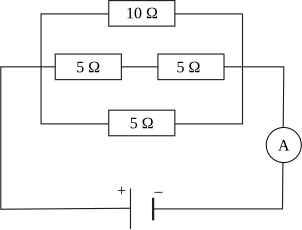
 

  1. Calculate the current measured by the ammeter in the circuit.   (3 marks)

--- 5 WORK AREA LINES (style=lined) ---

  1. Determine the amount of electrical energy used by the lantern over a period of 2 hours.   (2 marks)

--- 4 WORK AREA LINES (style=lined) ---
Show Answers Only

a.    \(3.6\ \text{A}\)

b.    \(233\,280\ \text{J}\)

Show Worked Solution

a.    Combining the resistors in series:

\(R_{\text{series}} = 5 + 5 = 10\ \Omega\).
 

Combing the resistors in parallel:

\(\dfrac{1}{R_T}\) \(=\dfrac{1}{10} + \dfrac{1}{10} + \dfrac{1}{5} = \dfrac{2}{5}\)  
\(R_T\) \(=2.5\ \Omega\)  

 
The current through circuit can be calculated through Ohm’s law:

\(I_{\text{circuit}} = \dfrac{V_{\text{circuit}}}{R_T} = \dfrac{9}{2.5} = 3.6\ \text{A}\).
 

b.    \(P = IV = 3.6 \times 9 = 32.4\ \text{W}\)

\(E = P\Delta t = 32.4 \times (2 \times 60 \times 60) = 233\,280\ \text{J}\)

Filed Under: Electric Circuits Tagged With: Band 4, Band 5, smc-4284-10-V=IR, smc-4284-20-Resistence in circuits, smc-4284-30-Power

PHYSICS, M4 EQ-Bank 8

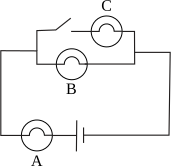
A battery powers a circuit containing three identical light bulbs: \(\text{A}\), \(\text{B}\), and \(\text{C}\). Refer to the diagram.
 

Predict and explain the effect on the brightness of bulbs \(\text{A}\) and \(\text{B}\) when the switch is closed. Support your answer using appropriate physics concepts.   (4 marks)

--- 8 WORK AREA LINES (style=lined) ---

Show Answers Only

Given brightness is directly related to the power dissipated in each bulb:

  • When the switch is closed, the circuit configuration changes — bulbs B and C become a parallel branch. This decreases the overall resistance of the circuit, which causes the total current from the battery to increase.
  • According to the power formula  \(P= I^2R\), bulb A, which is still in series with the rest of the circuit, now receives a greater current and increases in brightness.
  • For bulb B, once the switch is closed, it shares current with bulb C in a parallel arrangement. Since each of these two bulbs (B and C) has half the current that B previously received on its own (before the switch was closed), the current through bulb B decreases.
  • Consequently, the power dissipated in B decreases, and it becomes dimmer.
Show Worked Solution

Given brightness is directly related to the power dissipated in each bulb:

  • When the switch is closed, the circuit configuration changes — bulbs B and C become a parallel branch. This decreases the overall resistance of the circuit, which causes the total current from the battery to increase.
  • According to the power formula  \(P= I^2R\), bulb A, which is still in series with the rest of the circuit, now receives a greater current and increases in brightness.
  • For bulb B, once the switch is closed, it shares current with bulb C in a parallel arrangement. Since each of these two bulbs (B and C) has half the current that B previously received on its own (before the switch was closed), the current through bulb B decreases.
  • Consequently, the power dissipated in B decreases, and it becomes dimmer.

Filed Under: Electric Circuits Tagged With: Band 5, Band 6, smc-4284-30-Power

PHYSICS, M4 EQ-Bank 5

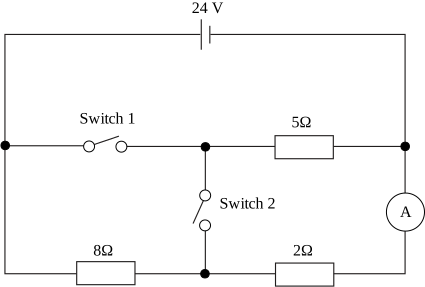
A circuit contains two switches, S\(_1\) and S\(_2\). The configuration of the circuit changes depending on which of the switches are open.
 

  1. S\(_1\) is closed and S\(_2\) is open. What current would the ammeter display, assuming ideal conditions?   (2 marks)

--- 3 WORK AREA LINES (style=lined) ---

  1. The switch S\(_1\) is open, and S\(_2\) is closed. What is the equivalent resistance of the circuit in this configuration?  (2 marks)

--- 3 WORK AREA LINES (style=lined) ---

  1. Both S\(_1\) and S\(_2\) are now closed. Calculate the power dissipated by the \(2\ \Omega\) resistor under this condition.  (2 marks)

--- 3 WORK AREA LINES (style=lined) ---

Show Answers Only

a.    \(2.4\ \text{A}\)

b.    \(9.43\ \Omega\)

c.    \(288\ \text{W}\)

Show Worked Solution

a.    When S\(_1\) is closed and S\(_2\) is open:

  • The circuit becomes a parallel circuit where the bottom branch contains both the \(2\ \Omega\) and \(8\ \Omega\) resistor. 
  • The voltage through each arm of the parallel circuit is equal to the total voltage which is equal to \(24\ \text{V}\).
  • Therefore, the reading on the ammeter  \(I = \dfrac{V}{R} = \dfrac{24}{10} = 2.4\ \text{A}\)
     

b.    When the switch S\(_1\) is open, and S\(_2\) is closed:

  • The resistance in the parallel part of the circuit \((5\ \Omega\) and \(2\ \Omega)\) resistors is calculated by:
\(\dfrac{1}{R}\) \(=\dfrac{1}{5} + \dfrac{1}{2} = \dfrac{7}{10}\)  
\(R\) \(=\dfrac{10}{7}\ \Omega\)  

 
Total resistance through the circuit \(= \dfrac{10}{7} + 8 = 9.43\ \Omega\).
 

c.    When both S\(_1\) and S\(_2\) are closed:

  • The system acts as a parallel circuit through the \(5\ \Omega\) and \(2\ \Omega\) resistors and then all current will pass through the switch as it has no resistance and no current will pass through the \(8\ \Omega\) resistor.
  • Therefore the voltage drop over the \(2\ \Omega\) resistor will be \(24\ \text{V}\)
  • By combining  \(P= IV\)  and  \(V=IR\):
  •    \(P = \dfrac{V^2}{R} = \dfrac{24^2}{2} = 288\ \text{W}\)

Filed Under: Electric Circuits Tagged With: Band 4, Band 5, smc-4284-10-V=IR, smc-4284-30-Power, smc-4284-50-Parallel Circuits

PHYSICS, M4 EQ-Bank 6 MC

An electric railway train delivers a maximum mechanical output power of 3.6 MW. The train receives electrical energy from overhead wires at a voltage of 18 kV. The train operates with an overall efficiency of 75%, meaning 75% of the electrical power input is converted into mechanical power.

What is the electric current supplied by the overhead wires when the train is running at full mechanical output?

  1. 180 A
  2. 220 A
  3. 267 A
  4. 300 A
Show Answers Only

\(C\)

Show Worked Solution
  • Maximum mechanical output power = \(3.6\ \text{MW}\)
  • Maximum electrical power supplied = \(\dfrac{3.6}{0.75} = 4.8\ \text{MW}\)
  • \(I = \dfrac{P}{V} = \dfrac{4.8 \times 10^6}{18 \times 10^3} = 267\ \text{A}\)

\(\Rightarrow C\)

Filed Under: Electric Circuits Tagged With: Band 5, smc-4284-30-Power

PHYSICS, M4 EQ-Bank 2

The circuit shown below contains three identical light bulbs: \(\text{X}\), \(\text{Y}\), and \(\text{Z}\), connected to a DC power supply and a switch \(\text{S}\).

  1. When switch \(\text{S}\) is open, compare the brightness of bulbs \(\text{X}\), \(\text{Y}\), and \(\text{Z}\).   (2 marks)

--- 4 WORK AREA LINES (style=lined) ---
  1. When switch \(\text{S}\) is closed, compare the brightness of bulbs \(\text{X}\), \(\text{Y}\), and \(\text{Z}\). Be quantitative in your reasoning.   (3 marks)

--- 6 WORK AREA LINES (style=lined) ---

Show Answers Only

a.   When the switch is open:

  • \(\text{X}\) and \(\text{Y}\) are in series, have equal resistance and the current through each is the same.
  • Using  \(P= I^2R\), the power dissipated in each light bulb is the same. Therefore, \(\text{X}\) and \(\text{Y}\) have the same brightness.
  • \(\text{Z}\) is not in the circuit (as the switch \(\text{S}\) is open), so there is no current through \(\text{Z}\). Therefore, light bulb \(\text{Z}\) will not light up.
     

b.    When the switch is closed:

  • Since \(\text{Y}\) and \(\text{Z}\) are in parallel, they each get the same voltage. Given they have equal resistance, the current through each is equal and they will have equal brightness.
  • The voltage drop across bulb \(\text{X}\) will be the same as the voltage drop across \(\text{Y}\) and \(\text{Z}\) combined. Since \(\text{Y}\) and \(\text{Z}\) are connected in parallel, the voltage drop across each individual bulb will be half of the voltage drop across \(\text{X}\).
  • Using \(P= \dfrac{V^2}{R}\), the power dissipated in \(\text{X}\) will be four times larger than the power dissipated in either \(\text{Y}\) or \(\text{Z}\).
  • Therefore the brightness in \(\text{X}\) will be four times that of \(\text{Y}\) or \(\text{Z}\).
Show Worked Solution

a.   When the switch is open:

  • \(\text{X}\) and \(\text{Y}\) are in series, have equal resistance and the current through each is the same.
  • Using  \(P= I^2R\), the power dissipated in each light bulb is the same. Therefore, \(\text{X}\) and \(\text{Y}\) have the same brightness.
  • \(\text{Z}\) is not in the circuit (as the switch \(\text{S}\) is open), so there is no current through \(\text{Z}\). Therefore, light bulb \(\text{Z}\) will not light up.
     

b.    When the switch is closed:

  • Since \(\text{Y}\) and \(\text{Z}\) are in parallel, they each get the same voltage. Given they have equal resistance, the current through each is equal and they will have equal brightness.
  • The voltage drop across bulb \(\text{X}\) will be the same as the voltage drop across \(\text{Y}\) and \(\text{Z}\) combined. Since \(\text{Y}\) and \(\text{Z}\) are connected in parallel, the voltage drop across each individual bulb will be half of the voltage drop across \(\text{X}\).
  • Using \(P= \dfrac{V^2}{R}\), the power dissipated in \(\text{X}\) will be four times larger than the power dissipated in either \(\text{Y}\) or \(\text{Z}\).
  • Therefore the brightness in \(\text{X}\) will be four times that of \(\text{Y}\) or \(\text{Z}\).

Filed Under: Electric Circuits Tagged With: Band 4, Band 5, smc-4284-30-Power, smc-4284-50-Parallel Circuits

PHYSICS, M4 EQ-Bank 1 MC

Two electric kettles have the following power ratings:

\begin{array} {|c|c|c|}
\hline
\rule{0pt}{2.5ex} \text{Kettle} \rule[-1ex]{0pt}{0pt} & \text{Voltage (V)} & \text{Power (W)}\\
\hline
\rule{0pt}{2.5ex} \text{A} \rule[-1ex]{0pt}{0pt} & \text{120} & \text{1800}\\
\hline
\rule{0pt}{2.5ex} \text{B} \rule[-1ex]{0pt}{0pt} & \text{240} & \text{2000} \\
\hline
\end{array}

A student compares the two devices.

Which of the following statements is most accurate?

  1. Kettle A draws more current than Kettle B.
  2. Kettle B must be more efficient because it operates at a higher voltage.
  3. Both kettles consume the same amount of electrical energy.
  4. Kettle A is suitable for standard Australian household outlets.
Show Answers Only

\(A\)

Show Worked Solution
  • Option \(A\) is correct: Using  \(I = \dfrac{P}{V}\)
  •    Kettle A, \(I_A = \dfrac{1800}{120} = 15\ \text{A}\)
  •    Kettle B, \(I_B = \dfrac{2000}{240} = 8.33\ \text{A}\)
  • Other options:
  • \(B\) is incorrect: Higher voltage does not automatically mean better efficiency. Efficiency depends on energy output vs input, not just voltage.
  • \(C\) is incorrect: Using  \(E= P \times t\), Kettle B (2000 W) uses more energy per second than Kettle A (1800 W).
  • \(D\) is incorrect: Australian household voltage is 240 V. Kettle A runs on 120 V  which is not suitable without a transformer.

Filed Under: Electric Circuits Tagged With: Band 4, smc-4284-30-Power

PHYSICS, M4 2019 VCE 6a

A home owner on a large property creates a backyard entertainment area. The entertainment area has a low-voltage lighting system. To operate correctly, the lighting system requires a voltage of 12 \(\text{V}\). The lighting system has a resistance of 12 \(\Omega\).

Calculate the power drawn by the lighting system.   (3 mark)

--- 4 WORK AREA LINES (style=lined) ---

Show Answers Only

\(12\ \text{W}\)

Show Worked Solution

Using  \(P=IV\) and  \(I= \dfrac{V}{R} :\)

\(P\) \(=\dfrac{V^2}{R}\)  
  \(=\dfrac{12^2}{12}\)  
  \(=12\ \text{W}\)  

  • The power drawn from the lighting system is 12 \(\text{W}\).

Filed Under: Electric Circuits Tagged With: Band 3, smc-4284-30-Power

Copyright © 2014–2025 SmarterEd.com.au · Log in