Determine which of the following angles on the unit circle has coordinates \(\left(-\dfrac{1}{\sqrt{2}}, -\dfrac{1}{\sqrt{2}}\right)\).
- \(135^{\circ}\)
- \(225^{\circ}\)
- \(315^{\circ}\)
- \(335^{\circ}\)
Aussie Maths & Science Teachers: Save your time with SmarterEd
Determine which of the following angles on the unit circle has coordinates \(\left(-\dfrac{1}{\sqrt{2}}, -\dfrac{1}{\sqrt{2}}\right)\).
\(B\)
\(\text{Coordinates are in the 3rd quadrant.}\)
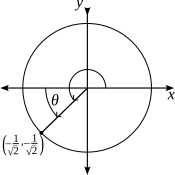
\(\tan \theta= \dfrac{\frac{1}{\sqrt{2}}}{\frac{1}{\sqrt{2}}} = 1 \)
\(\text{Find reference angle:}\)
\(\theta =\tan^{-1}\left( 1 \right) = 45^{\circ}\)
\(\text{Angle on unit circle}\ = 180+45=225^{\circ}\)
\(\Rightarrow B\)
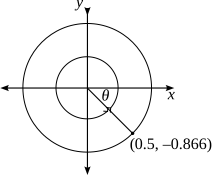
If point \(P\) lies on the unit circle at coordinates \((0.5, -0.866)\), which quadrant does \(P\) lie in and what is the approximate angle in standard position?
\(B\)
\(P\ \text{is found in Quadrant IV}\)
\(\theta = 60^{\circ}\)
\(\text{Angle in standard position}\ =360-60 = 300^{\circ}\)
\(\Rightarrow B\)
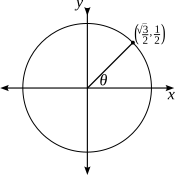
Which of the following angles on the unit circle has coordinates \(\left(\dfrac{\sqrt{3}}{2}, \dfrac{1}{2}\right)\)?
\(A\)
\(\text{Coordinates are in the 1st quadrant.}\)
| \(\tan \theta\) | \(= \dfrac{\frac{1}{2}}{\frac{\sqrt{3}}{2}} = \dfrac{1}{2} \times \dfrac{2}{\sqrt{3}} = \dfrac{1}{\sqrt{3}} \) | |
| \(\theta\) | \(=\tan^{-1}\left( \dfrac{1}{\sqrt{3}} \right) = 30^{\circ}\) |
\(\Rightarrow A\)
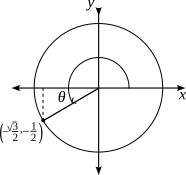
Determine the angle on the unit circle that has coordinates
--- 3 WORK AREA LINES (style=lined) ---
--- 6 WORK AREA LINES (style=lined) ---
a. \(\theta = 90^{\circ}\)
b. \(\theta=210^{\circ}\)
a. \((1, 0)\ \Rightarrow\ \text{Coordinates are on the positive \(y\)-axis.}\)
\(\theta = 90^{\circ}\)
b. \(\text{Coordinates are in the 3rd quadrant.}\)
\(\tan \theta= \dfrac{\frac{1}{2}}{\frac{\sqrt{3}}{2}} = \dfrac{1}{2} \times \dfrac{2}{\sqrt{3}} = \dfrac{1}{\sqrt{3}}\)
\(\text{Find reference angle:}\)
\(\theta =\tan^{-1}\left( \dfrac{1}{\sqrt{3}} \right) = 30^{\circ}\)
\(\text{Angle on unit circle}\ = 180+30=210^{\circ}\)
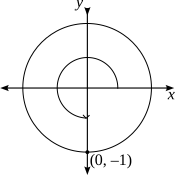
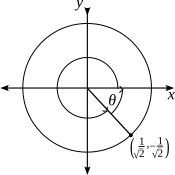
Determine the angle on the unit circle that has coordinates
--- 3 WORK AREA LINES (style=lined) ---
--- 6 WORK AREA LINES (style=lined) ---
a. \(\theta = 270^{\circ}\)
b. \(\theta=315^{\circ}\)
a. \(\text{Coordinates are on the negative \(y\)-axis.}\)
\(\theta = 270^{\circ}\)
b. \(\text{Coordinates are in the 4th quadrant.}\)
\(\tan \theta= \dfrac{\frac{1}{\sqrt{2}}}{\frac{1}{\sqrt{2}}} = 1\)
\(\text{Find reference angle:}\)
\(\theta =\tan^{-1}\left( 1 \right) = 45^{\circ}\)
\(\text{Angle on unit circle}\ = 360-45=315^{\circ}\)
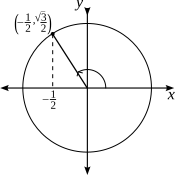
Determine which of the following angles on the unit circle has coordinates \(\left(-\dfrac{1}{2}, \dfrac{\sqrt{3}}{2}\right)\).
\(A\)
\(\text{Coordinates are in the 2nd quadrant.}\)
\(\tan \theta= \dfrac{\frac{\sqrt{3}}{2}}{\frac{1}{2}} = \dfrac{\sqrt{3}}{2} \times \dfrac{2}{1} = \sqrt{3} \)
\(\text{Find reference angle:}\)
\(\theta =\tan^{-1}\left( \sqrt{3} \right) = 60^{\circ}\)
\(\text{Angle on unit circle}\ = 180-60=120^{\circ}\)
\(\Rightarrow A\)
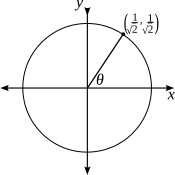
Determine which of the following angles on the unit circle has coordinates \(\left(\dfrac{1}{\sqrt{2}}, \dfrac{1}{\sqrt{2}}\right)\).
\(B\)
\(\text{Coordinates are in the 1st quadrant.}\)
| \(\tan \theta\) | \(= \dfrac{\frac{1}{\sqrt{2}}}{\frac{1}{\sqrt{2}}} = 1 \) | |
| \(\theta\) | \(=\tan^{-1}\left( 1 \right) = 45^{\circ}\) |
\(\Rightarrow B\)