SmarterEd

Aussie Maths & Science Teachers: Save your time with SmarterEd

  • Login
  • Get Help
  • About

Sequences and Series, 2ADV 2026 HSC 13

In a theatre, starting from the stage, the number of seats in each row forms an arithmetic sequence.

The theatre has 30 seats in the 3rd row and 42 seats in the 6th row.
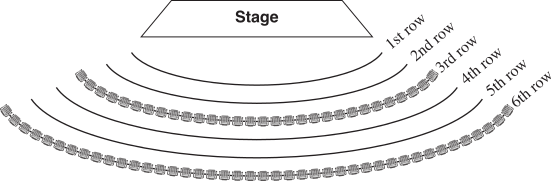
 

  1. How many seats are in the first row?   (2 marks)

    --- 6 WORK AREA LINES (style=lined) ---

  2. How many seats will this theatre have if there are 9 rows?   (2 marks)

    --- 4 WORK AREA LINES (style=lined) ---

Show Answers Only

a.    \(22\ \text{seats}\)

b.    \(342\ \text{seats}\)

Show Worked Solution

a.    \(a_3=a+2d=30\ \ \ldots\ (1)\)

\(a_6=a+5d=42\ \ \ldots\ (2)\)

\(\text{Subtract: }(2)-(1)\)

\(3d=12\ \ \Rightarrow\ \ d=4\)

\(\text{Substitute}\ \ d=4\ \ \text{into (1):}\)

\(a+8=30\ \ \Rightarrow\ \ a=22\)

\(\therefore\ \text{22 seats in the first row}\)


b.    \(\text{Find}\ S_9\ \text{using}\ \ S_n=\dfrac{n}{2}[2a + (n-1)d]:\)

\(S_9\) \(=\dfrac{9}{2}\big(2(22)+(9-1)(4)\big)\)
  \(=\dfrac{9}{2}(44+32)\)
  \(=342\ \text{seats}\)

Filed Under: Arithmetic Series Tagged With: Band 3, Band 4, smc-7126-10-Find Term, smc-7126-20-Find Sum

Copyright © 2014–2026 SmarterEd.com.au · Log in