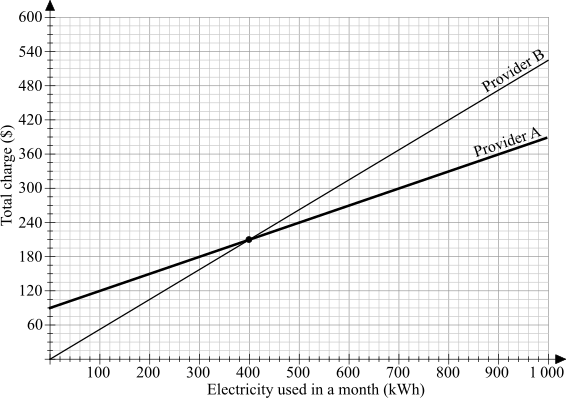
Electricity provider \(A\) charges 30 cents per kilowatt hour (kWh) for electricity, plus a fixed monthly charge of $90. Complete the table showing Provider \(A\)'s monthly charges for different levels of electricity usage. (1 mark) --- 1 WORK AREA LINES (style=lined) --- --- 4 WORK AREA LINES (style=lined) --- a. \(\text{When kWh} =400\) \(\text{Monthly charge}\ =$90+0.30\times 400=$210\) \begin{array} {|l|c|} b. c. \(\text{400 kWh}\) d. \(\text{Provider}\ A\ \text{is cheaper by \$45.}\) a. \(\text{When kWh} =400\) \(\text{Monthly charge}\ =$90+0.30\times 400=$210\) \begin{array} {|l|c|} b. c. \(A_{\text{charge}} = B_{\text{charge}}\ \text{at intersection.}\) \(\therefore\ \text{Same charge at 400 kWh}\) d. \(\text{Cost at 600 kWh:}\) \(\text{Method 1: Using graph}\rightarrow\ $315-270=$45\) \(\text{Method 2: Algebraically}:\) \(\text{Provider}\ A: \ 90 + 0.30 \times 600 = $270\) \(\text{Provider}\ B: \ 0.525 \times 600 = $315\) \(\therefore \text{Provider}\ A\ \text{is cheaper by \$45.}\)
\begin{array} {|l|c|}
\hline
\rule{0pt}{2.5ex} \textit{Electricity used in a month (kWh)} \rule[-1ex]{0pt}{0pt} & \ \ 0 \ \ & \ \ 400 \ \ & \ \ 1000 \ \ \\
\hline
\rule{0pt}{2.5ex} \textit{Monthly Charge (\$)} \rule[-1ex]{0pt}{0pt} & \ \ 90 \ \ & \ \ 210 \ \ & \ \ 390 \ \ \\
\hline
\end{array}
\hline
\rule{0pt}{2.5ex} \textit{Electricity used in a month (kWh)} \rule[-1ex]{0pt}{0pt} & \ \ 0 \ \ & \ \ 400 \ \ & \ 1000 \ \\
\hline
\rule{0pt}{2.5ex} \textit{Monthly Charge (\$)} \rule[-1ex]{0pt}{0pt} & \ \ 90 \ \ & \ \ 210 \ \ & \ \ 390 \ \ \\
\hline
\end{array}
\hline
\rule{0pt}{2.5ex} \textit{Electricity used in a month (kWh)} \rule[-1ex]{0pt}{0pt} & \ \ 0 \ \ & \ \ 400 \ \ & \ 1000 \ \\
\hline
\rule{0pt}{2.5ex} \textit{Monthly Charge (\$)} \rule[-1ex]{0pt}{0pt} & \ \ 90 \ \ & \ \ 210 \ \ & \ \ 390 \ \ \\
\hline
\end{array}
v1 Algebra, STD2 A4 2023 HSC 21
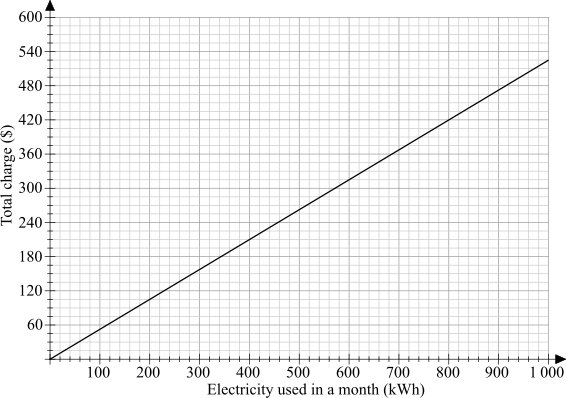
Provider \(B\) charges 52.5 cents per kWh, with no fixed monthly charge. The graph shows how Provider \(B\)'s charges vary with the amount of electricity used in a month.