SmarterEd

Aussie Maths & Science Teachers: Save your time with SmarterEd

  • Login
  • Get Help
  • About

Vectors, EXT1 2026 HSC 13d

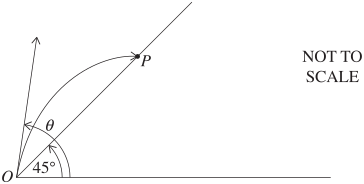
An inclined plane passes through the origin \(O\) at an angle of 45° to the horizontal. A particle is projected from \(O\) with initial speed 20 m s\(^{-1}\) at an angle of \(\theta\) to the horizontal. The particle hits the plane at \(P\) as shown.
 

The position vector of the particle at time \(t\) seconds is

\(\underset{\sim}{r}(t)=20t\,\cos\theta\,\underset{\sim}{i}+\left(20t\,\sin\theta-5t^2\right)\underset{\sim}{j}\).   (Do NOT prove this.)

  1. Show that the length, \(\ell\), of \(OP\) is given by
  2.    \(\ell=80\sqrt{2}\cos\theta(\sin\theta-\cos\theta)\).    (3 marks)

    --- 10 WORK AREA LINES (style=lined) ---

  3. Find \(\theta\) such that \(\ell\) is a maximum.   (3 marks)

    --- 12 WORK AREA LINES (style=lined) ---
Show Answers Only

i.    \(\text{Particle hits plane when} \ \ y=x:\)

\(20t\sin\theta-5t^2\) \(=20t\cos\theta\)
\(5t(4\sin\theta-4\cos\theta-t)\) \(=0\)

 
\(t=4(\sin\theta-\cos\theta), \ \ (t>0)\)

 
\(x_P=20\cos\theta \times 4(\sin\theta-\cos\theta)=80\cos\theta(\sin\theta-\cos\theta)\)
 

\(\text{Since} \ OP \ \text{is inclined at 45°:}\)

\(\cos 45^{\circ}=\dfrac{x_P}{\ell}\ \ \Rightarrow\ \ \ell=\dfrac{x_P}{\cos 45^{\circ}}\)

\(\ell\) \(=\sqrt{2} \times 80\cos\theta(\sin\theta-\cos\theta)\)
  \(=80\sqrt{2}\cos\theta(\sin\theta-\cos\theta)\)


ii.     \(\ell\) \(=80\sqrt{2}\left(\sin\theta\cos\theta-\cos^2\theta\right)\)
    \(=80\sqrt{2}\left(\dfrac{1}{2}\sin 2\theta-\dfrac{1}{2}(1+\cos 2\theta)\right)\)
    \(=40\sqrt{2}\left(\sin 2\theta-\cos 2\theta-1\right)\)

 
\(\dfrac{d\ell}{d\theta}=40\sqrt{2}\left(2\cos 2\theta+2\sin 2\theta\right)\)
 

\(\text{SP’s when} \ \ \dfrac{d\ell}{d\theta}=0:\)

\(2\sin 2\theta=-2\cos 2\theta \ \ \Rightarrow \ \ \tan 2\theta=-1\)

\(\text{Since} \ \ 45^{\circ}<\theta<90^{\circ} \ \ \Rightarrow \ \ 90^{\circ}<2\theta<180^{\circ}\)

\(2\theta=\dfrac{3\pi}{4} \ \ \Rightarrow \ \ \theta=\dfrac{3\pi}{8}\)

\(\dfrac{d^2\ell}{d\theta^2}=40\sqrt{2}\left(-4\sin 2\theta+4\cos 2\theta\right)\)
 

\(\text{At} \ \ \theta=\dfrac{3\pi}{8}:\)

\(\dfrac{d^2\ell}{d\theta^2}=40\sqrt{2}\left(-\dfrac{4}{\sqrt{2}}-\dfrac{4}{\sqrt{2}}\right)<0 \ \ \Rightarrow\ \ \text{MAX}\)

\(\therefore \ \ell \ \text{is a maximum when} \ \ \theta=\dfrac{3\pi}{8} \ \ (67.5^{\circ})\)

Show Worked Solution

i.    \(\text{Particle hits plane when} \ \ y=x:\)

\(20t\sin\theta-5t^2\) \(=20t\cos\theta\)
\(5t(4\sin\theta-4\cos\theta-t)\) \(=0\)

 
\(t=4(\sin\theta-\cos\theta), \ \ (t>0)\)

 
\(x_P=20\cos\theta \times 4(\sin\theta-\cos\theta)=80\cos\theta(\sin\theta-\cos\theta)\)
 

\(\text{Since} \ OP \ \text{is inclined at 45°:}\)

\(\cos 45^{\circ}=\dfrac{x_P}{\ell}\ \ \Rightarrow\ \ \ell=\dfrac{x_P}{\cos 45^{\circ}}\)

\(\ell\) \(=\sqrt{2} \times 80\cos\theta(\sin\theta-\cos\theta)\)
  \(=80\sqrt{2}\cos\theta(\sin\theta-\cos\theta)\)


ii.     \(\ell\) \(=80\sqrt{2}\left(\sin\theta\cos\theta-\cos^2\theta\right)\)
    \(=80\sqrt{2}\left(\dfrac{1}{2}\sin 2\theta-\dfrac{1}{2}(1+\cos 2\theta)\right)\)
    \(=40\sqrt{2}\left(\sin 2\theta-\cos 2\theta-1\right)\)

 
\(\dfrac{d\ell}{d\theta}=40\sqrt{2}\left(2\cos 2\theta+2\sin 2\theta\right)\)
 

\(\text{SP’s when} \ \ \dfrac{d\ell}{d\theta}=0:\)

\(2\sin 2\theta=-2\cos 2\theta \ \ \Rightarrow \ \ \tan 2\theta=-1\)

\(\text{Since} \ \ 45^{\circ}<\theta<90^{\circ} \ \ \Rightarrow \ \ 90^{\circ}<2\theta<180^{\circ}\)

\(2\theta=\dfrac{3\pi}{4} \ \ \Rightarrow \ \ \theta=\dfrac{3\pi}{8}\)

\(\dfrac{d^2\ell}{d\theta^2}=40\sqrt{2}\left(-4\sin 2\theta+4\cos 2\theta\right)\)
 

\(\text{At} \ \ \theta=\dfrac{3\pi}{8}:\)

\(\dfrac{d^2\ell}{d\theta^2}=40\sqrt{2}\left(-\dfrac{4}{\sqrt{2}}-\dfrac{4}{\sqrt{2}}\right)<0 \ \ \Rightarrow\ \ \text{MAX}\)

\(\therefore \ \ell \ \text{is a maximum when} \ \ \theta=\dfrac{3\pi}{8} \ \ (67.5^{\circ})\)

Filed Under: Vectors and Projectile Motion Tagged With: Band 5, Band 6, smc-7288-10-Range, smc-7288-90-X-topic

Copyright © 2014–2026 SmarterEd.com.au · Log in