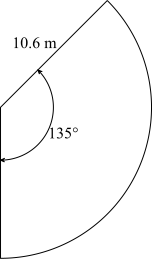
Use the arc length formula below to calculate the arc length of the sector, correct to one decimal place. (2 marks)
\(l=\dfrac{\theta}{360}\times 2\pi r\)
--- 4 WORK AREA LINES (style=lined) ---
Aussie Maths & Science Teachers: Save your time with SmarterEd
Use the arc length formula below to calculate the arc length of the sector, correct to one decimal place. (2 marks)
\(l=\dfrac{\theta}{360}\times 2\pi r\)
--- 4 WORK AREA LINES (style=lined) ---
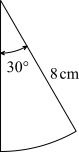
Use the arc length formula below to calculate the arc length of the sector, correct to one decimal place. (2 marks)
\(l=\dfrac{\theta}{360}\times 2\pi r\)
--- 4 WORK AREA LINES (style=lined) ---
Evan rides his bike around a circular track with a radius of 150 metres.
He rides the track 5 days a week and wants to have ridden 230 kilometres by the end of the week.
What is the minimum number of laps, to the nearest whole lap, he must complete each day to achieve his target? (3 marks)
--- 6 WORK AREA LINES (style=lined) ---
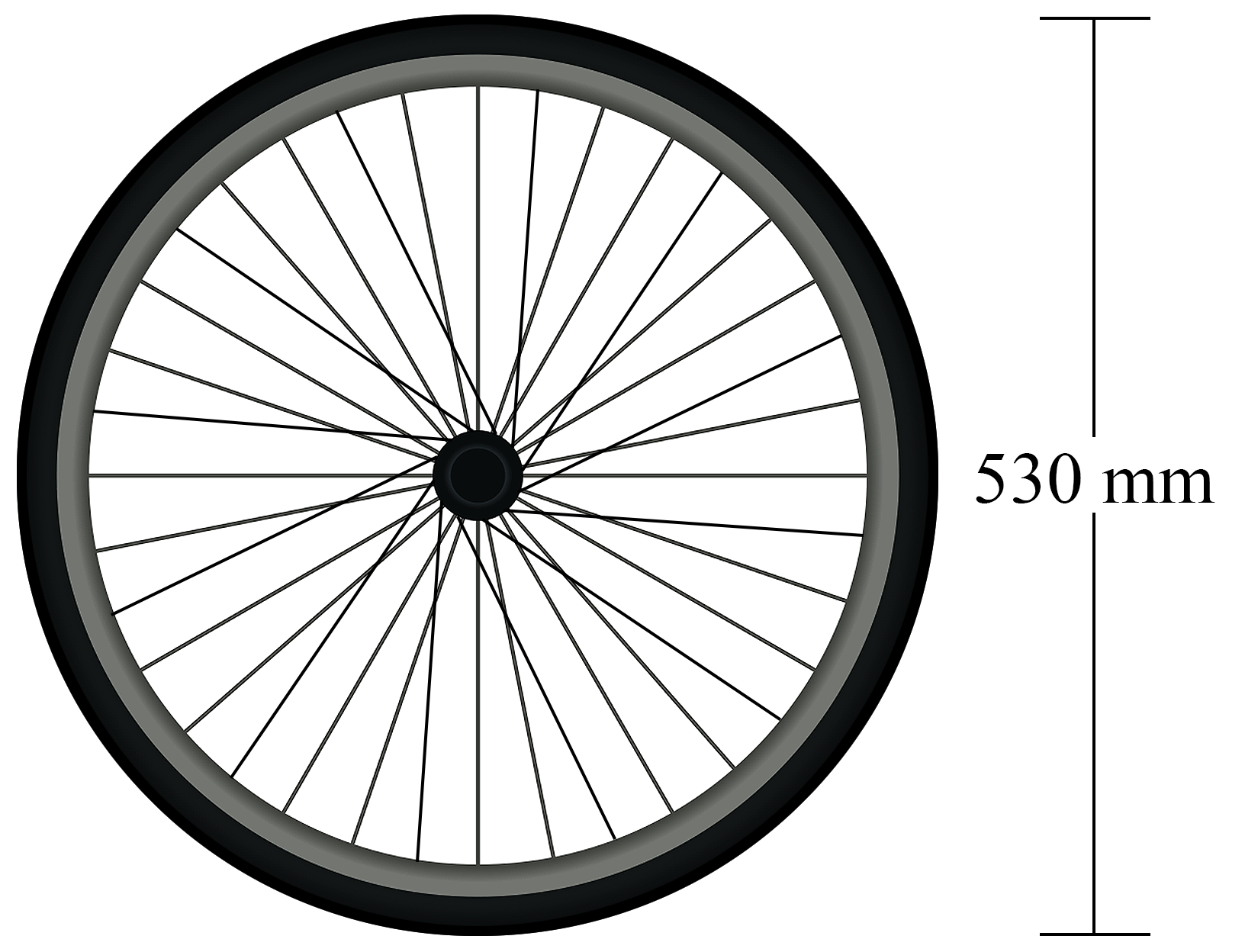
A car tyre has a circumference of 120 cm.
Which of these is closest to the radius of the tyre?
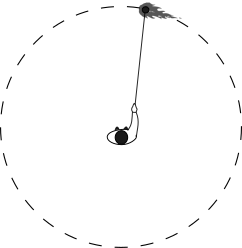
A yoyo at the end of a string moves through a quarter circle arc, as shown below.
The string is 70 cm long.
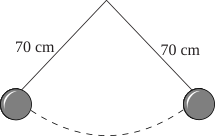
The curved distance the yoyo has travelled is closest to
Calculate the radius of a circle with a circumference of 870 metres, correct to the nearest ten metres. (2 marks)
--- 4 WORK AREA LINES (style=lined) ---
Calculate the radius of a circle with a circumference of 324 centimetres, correct to 2 decimal places. (2 marks)
--- 4 WORK AREA LINES (style=lined) ---
Calculate the diameter of a circle with a circumference of 109.8 metres, correct to 2 decimal places. (2 marks)
--- 4 WORK AREA LINES (style=lined) ---
Calculate the diameter of a circle with a circumference of 24 centimetres, correct to 1 decimal place. (2 marks)
--- 4 WORK AREA LINES (style=lined) ---
Calculate the circumference of a circle with a radius of 1012 centimetres, correct to the nearest hundred. (2 marks)
--- 4 WORK AREA LINES (style=lined) ---
Calculate the circumference of a circle with a radius of 453 kilometres, correct to the nearest whole number. (2 marks)
--- 4 WORK AREA LINES (style=lined) ---
Calculate the circumference of a circle with a diameter of 24.6 millimetres, correct to 0ne decimal place. (2 marks)
--- 4 WORK AREA LINES (style=lined) ---
Calculate the circumference of a circle with a diameter of 35 centimetres, correct to two decimal places. (2 marks)
--- 4 WORK AREA LINES (style=lined) ---
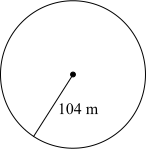
Calculate the circumference of the circle below correct to two decimal places. (2 marks)
--- 4 WORK AREA LINES (style=lined) ---
Calculate the circumference of the circle below correct to one decimal place. (2 marks)
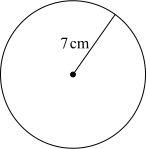
--- 4 WORK AREA LINES (style=lined) ---
Calculate the circumference of the circle below correct to one decimal place. (2 marks)
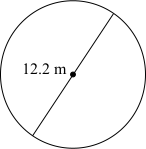
--- 4 WORK AREA LINES (style=lined) ---
Calculate the circumference of the circle below correct to two decimal places. (2 marks)
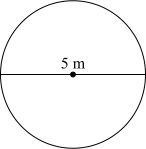
--- 4 WORK AREA LINES (style=lined) ---
Use a calculator to evaluate \(2\large\pi r\) correct to 1 decimal place, when \(\large r\)\(=2.1\). (2 marks)
--- 2 WORK AREA LINES (style=lined) ---
Evaluate \(5\large\pi\) using a calculator, giving your answer correct to 2 decimal places. (1 mark)
--- 2 WORK AREA LINES (style=lined) ---
Which of the following is the definition of the circumference of a circle?
\(\text{The circumference is the distance along}\)
\(\text{the boundary a circle.}\)
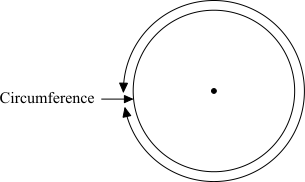
\(\Rightarrow C\)
Which of the following is the definition of the radius of a circle?
\(\text{The radius is the distance from the centre of}\)
\(\text{ a circle to the circumference.}\)
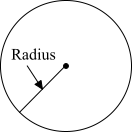
\(\Rightarrow D\)
Which of the following is the definition of the diameter of a circle?
\(\text{The diameter is the distance across a circle}\)
\(\text{passing through the centre.}\)
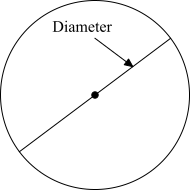
\(\Rightarrow A\)
Which of the following is the definition of an arc?
\(\text{An arc is a section of the circumference of a circle.}\)
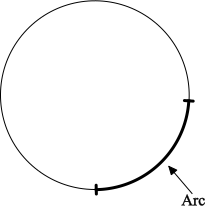
\(\Rightarrow B\)
What fraction of a circle is indicated in the diagram below? (1 mark)
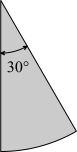
--- 2 WORK AREA LINES (style=lined) ---
What fraction of a circle is indicated in the diagram below? (1 mark)
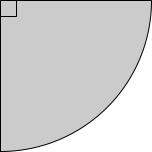
--- 2 WORK AREA LINES (style=lined) ---
--- 5 WORK AREA LINES (style=lined) ---
What fraction of a circle is indicated in the diagram below? (1 mark)
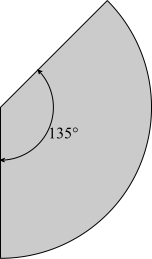
--- 2 WORK AREA LINES (style=lined) ---
What fraction of a circle is indicated in the diagram below? (1 mark)
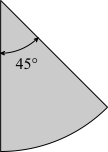
--- 2 WORK AREA LINES (style=lined) ---
What fraction of a circle is indicated in the diagram below? (1 mark)
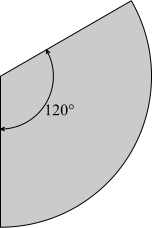
--- 2 WORK AREA LINES (style=lined) ---
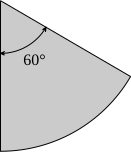
What fraction of a circle is indicated in the diagram below? (1 mark)
--- 2 WORK AREA LINES (style=lined) ---
If the diameter of a circle is 16.2 millimetres, what is the length of its radius? (1 mark)
--- 2 WORK AREA LINES (style=lined) ---
If the radius of a circle is 24 centimetres, what is the length of its diameter? (1 mark)
--- 2 WORK AREA LINES (style=lined) ---
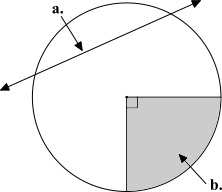
Name the circle parts indicated in the drawing below. (2 marks)
--- 4 WORK AREA LINES (style=lined) ---
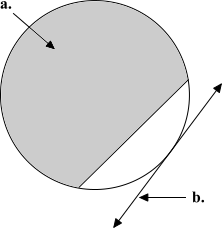
Name the circle parts indicated in the drawing below. (2 marks)
--- 4 WORK AREA LINES (style=lined) ---
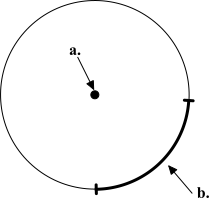
Name the circle parts indicated in the drawing below. (2 marks)
--- 4 WORK AREA LINES (style=lined) ---
Name the circle parts indicated in the drawing below. (2 marks)
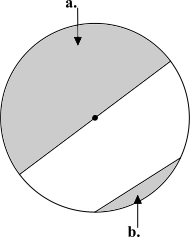
--- 4 WORK AREA LINES (style=lined) ---
Name the circle parts indicated in the drawing below. (2 marks)
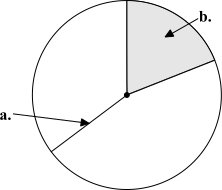
--- 4 WORK AREA LINES (style=lined) ---
Name the circle parts indicated in the drawing below. (2 marks)
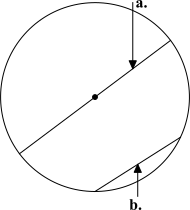
--- 4 WORK AREA LINES (style=lined) ---
An isosceles triangle has a base of length 4 centimetres and a perimeter of 20 centimetres.
Find the length of the equal sides. (2 marks)
--- 4 WORK AREA LINES (style=lined) ---
--- 5 WORK AREA LINES (style=lined) ---
Find the perimeter of the following irregular shape. (2 marks)
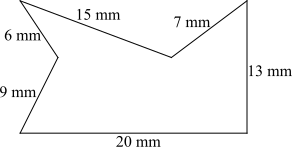
--- 4 WORK AREA LINES (style=lined) ---
Find the perimeter of the following irregular shape. (2 marks)
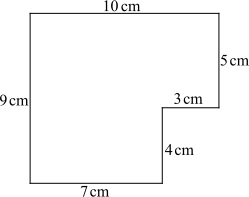
--- 4 WORK AREA LINES (style=lined) ---
Find the perimeter of the following irregular shape. (2 marks)
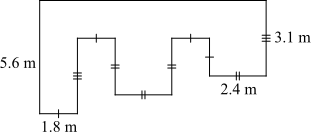
--- 4 WORK AREA LINES (style=lined) ---
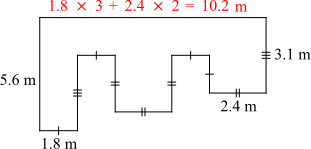
\(\text{Perimeter}\)
\(=10.2+2\times 3.1 +4\times 2.4+4\times 1.8+5.6\)
\(=38.8\ \text{m}\)
--- 2 WORK AREA LINES (style=lined) ---
--- 2 WORK AREA LINES (style=lined) ---
a.
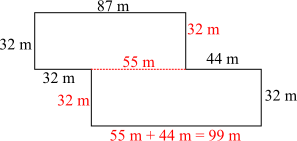
b. \(390\ \text{m}\)
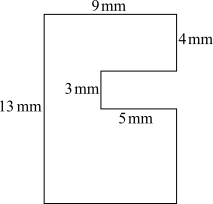
a.
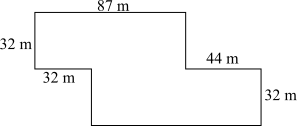
b. \(\text{Perimeter}\)
\(=87+5\times 32+44+99\)
\(=390\ \text{m}\)
--- 2 WORK AREA LINES (style=lined) ---
--- 2 WORK AREA LINES (style=lined) ---
a.
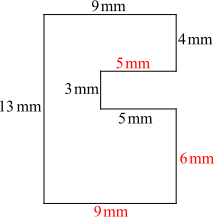
b. \(54\ \text{mm}\)
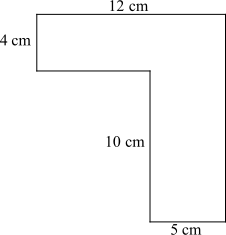
a.
b. \(\text{Perimeter}\)
\(=13+2\times 9+4+2\times 5+3+6\)
\(=54\ \text{mm}\)
--- 2 WORK AREA LINES (style=lined) ---
--- 4 WORK AREA LINES (style=lined) ---
a.
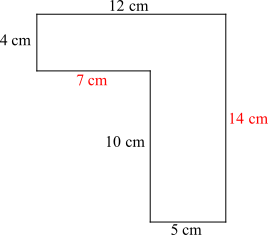
b. \(52\ \text{cm}\)
a.
b. \(\text{Perimeter}\)
\(=12+14+5+10+7+4\)
\(=52\ \text{cm}\)
Calculate the perimeter of the following polygon. (2 marks)
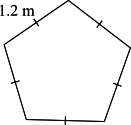
--- 4 WORK AREA LINES (style=lined) ---
Calculate the perimeter of the following trapezium. (2 marks)
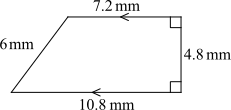
--- 4 WORK AREA LINES (style=lined) ---
Calculate the perimeter of the following kite. (2 marks)
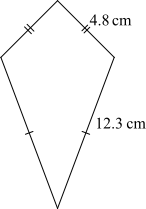
--- 4 WORK AREA LINES (style=lined) ---
Calculate the perimeter of the following parallelogram. (2 marks)
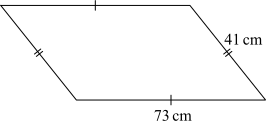
--- 4 WORK AREA LINES (style=lined) ---
Calculate the perimeter of the following triangle. (2 marks)
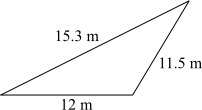
--- 4 WORK AREA LINES (style=lined) ---
Calculate the perimeter of the following triangle. (2 marks)
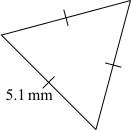
--- 4 WORK AREA LINES (style=lined) ---
Calculate the perimeter of the following triangle. (2 marks)
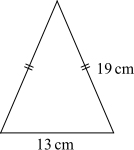
--- 4 WORK AREA LINES (style=lined) ---
Calculate the perimeter of the following rhombus. (2 marks)
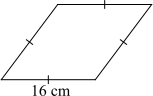
--- 4 WORK AREA LINES (style=lined) ---
Calculate the perimeter of the following square. (2 marks)
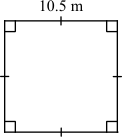
--- 4 WORK AREA LINES (style=lined) ---
Calculate the perimeter of the following rectangle. (2 marks)
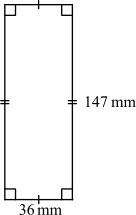
--- 4 WORK AREA LINES (style=lined) ---
Calculate the perimeter of the following rectangle. (2 marks)
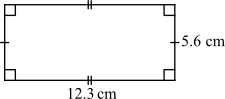
--- 4 WORK AREA LINES (style=lined) ---
A farmer uses the river bordering his property and fencing to create a large grazing paddock for his horses, as shown in the diagram below.
The fencing has 4-strand wiring which is also shown below.
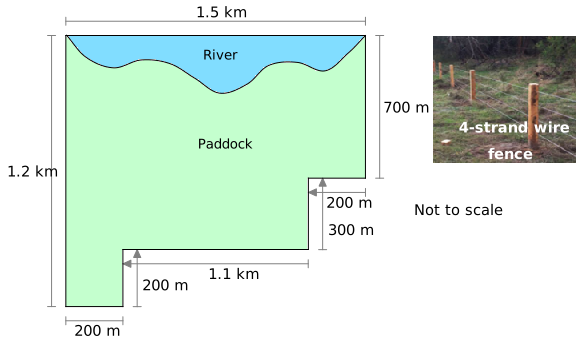
Given that fencing is not required on the river boundary, how many kilometres of wire will be required to fence the rest of the paddock? (2 marks)
--- 4 WORK AREA LINES (style=lined) ---
Jill cut a piece of binding in half.
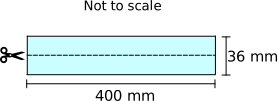
She then placed one half on top of the other half, as shown below.
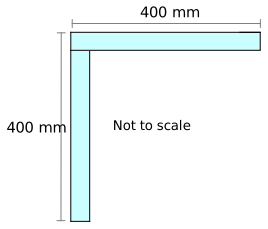
What is the perimeter of the newly formed shape in millimetres? (2 marks)
--- 4 WORK AREA LINES (style=lined) ---
\(\text{Calculating the perimeter clockwise from top right:}\)
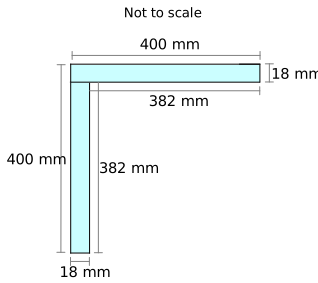
\(\text{Perimeter}\)
\(=18+2\times 382 +18+2\times 400\)
\(=1600\ \text{mm}\)